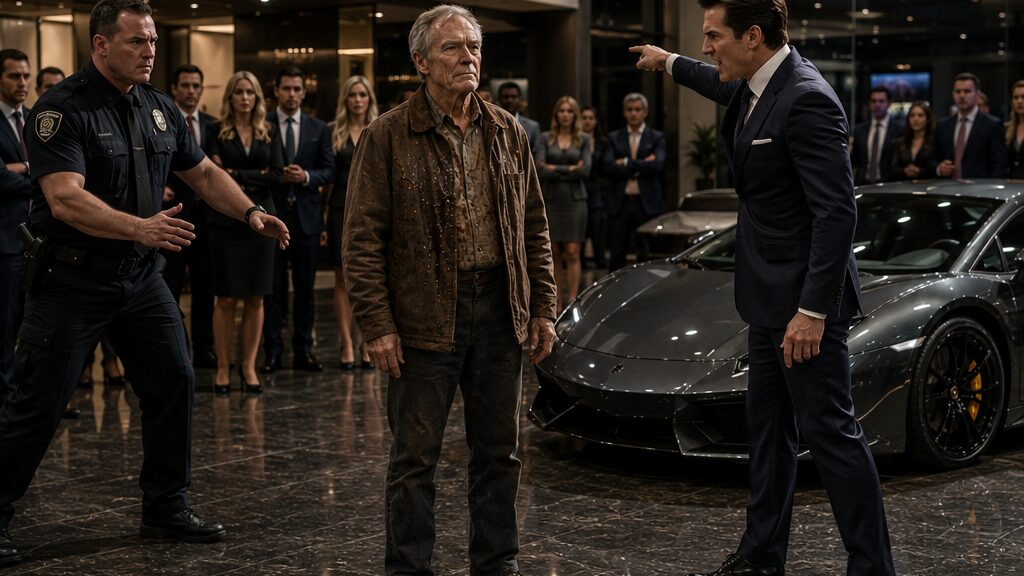
The Old Man Covered in Coffee Who Destroyed a Showroom’s Illusion of Power
Chapter 1: The Man Who Did Not Belong Here
The first thing people noticed was not the old man.
It was the silence that followed him.
The showroom usually hummed with soft conversations and carefully controlled admiration. Customers lowered their voices around the exotic machines lined beneath white lights. Sales representatives moved like hosts at an expensive gallery.
Then William Campbell walked in wearing a faded work jacket.
The silence spread one person at a time.
A receptionist looked up.
A salesman paused mid-sentence.
A couple examining a bright red supercar exchanged a glance.
William continued walking as if he belonged there.
The jacket was old. His boots carried road dust. His gray hair looked untrimmed. In one hand he carried a small notebook with worn corners.
Everything about him suggested he had wandered into the wrong building.
Everything except his eyes.
His eyes studied the showroom with unusual attention.
Not the cars.
The people.
A sign near the entrance read:
APPOINTMENTS REQUIRED FOR ALL PRIVATE VIEWINGS.
William stopped beneath it.
He looked at the sign for several seconds before quietly writing something in his notebook.
Then he moved deeper into the showroom.
A young salesman intercepted him.
“Sir?”
William smiled politely.
“Morning.”
“Can I help you?”
“Maybe.”
The salesman glanced toward the entrance.
“Do you have an appointment?”
William looked around.
“I was hoping to look at the cars first.”
The salesman forced a smile.
“We don’t really operate that way.”
William nodded.
Another note went into the notebook.
The salesman noticed.
“What are you writing?”
“Observations.”
The answer seemed to make the young man more uncomfortable.
Before he could respond, another customer approached asking about financing options.
The salesman left quickly.
William continued walking.
The nearest vehicle sat on a raised platform beneath focused lighting. Silver paint reflected across the polished floor.
A masterpiece of engineering.
At least that was how the brochure described it.
William looked at the machine for several moments.
Then he looked beyond it.
A cleaner was polishing fingerprints from a glass wall.
No one smiled at her.
No one acknowledged her existence.
William wrote another note.
Twenty years ago, he had personally approved the first customer-service manual for the company.
The first page contained a simple instruction:
Treat every person with equal respect.
He still remembered typing it himself.
Now he wondered whether anyone remembered reading it.
“Quite a place, isn’t it?”
The voice came from beside him.
William turned.
Jessica Lewis stood there holding a tablet.
Operations manager.
The identification badge confirmed it.
Unlike the others, she looked curious rather than hostile.
“It is,” William said.
“You interested in buying?”
“Maybe.”
She smiled faintly.
“You don’t sound convinced.”
“I’ve learned expensive things aren’t always valuable.”
For a second she looked like she wanted to laugh.
Instead she glanced around the showroom.
Several employees were openly watching them.
“Do you have an appointment?” she asked quietly.
“There it is again.”
“What?”
“That question.”
Jessica looked embarrassed.
“It’s policy.”
“Do you know why the policy exists?”
She hesitated.
“To protect clients.”
“From what?”
She didn’t answer.
William made another note.
Jessica watched him write.
“What exactly are you observing?”
Before William could respond, another voice cut across the showroom.
“Ladies and gentlemen.”
The voice carried confidence sharpened by arrogance.
Alexander Rivera had arrived.
Several employees immediately straightened.
Even customers recognized him.
The luxury real-estate broker frequently appeared in local magazines and social media campaigns.
Expensive suit.
Perfect smile.
Perfectly rehearsed charm.
Alexander walked toward a group of wealthy clients.
As he spoke, he noticed William.
The smile faded.
Only slightly.
But William saw it.
Alexander continued entertaining his clients while keeping one eye on the old man.
The attention amused William.
He had seen it before.
People who built their identity around status often treated uncertainty like a threat.
William represented uncertainty.
A man who looked poor but acted comfortable.
A man who wasn’t trying to impress anyone.
A man who didn’t seem ashamed.
That bothered people more than anger ever could.
An hour passed.
William moved through the showroom slowly.
He watched sales conversations.
He watched employees greet customers.
He watched security officers.
Most importantly, he watched who received warmth and who received suspicion.
Patterns emerged quickly.
A young couple in casual clothing received minimal attention.
A wealthy collector arriving in a tailored suit received immediate service.
Appearance determined value.
Exactly the thing he feared.
Near noon, William sat briefly on a bench overlooking the central display area.
He opened the notebook.
The pages contained observations.
Employee behavior.
Ignored customers.
Policy violations.
Moments of respect.
Moments of contempt.
A shadow appeared over him.
Alexander.
The broker smiled.
The smile never reached his eyes.
“Enjoying yourself?”
William closed the notebook.
“I’ve seen worse waiting rooms.”
Several nearby clients laughed.
Alexander did not.
“This isn’t a waiting room.”
“I noticed.”
Alexander looked him up and down.
The inspection was deliberate.
Calculated.
Cruel.
“What exactly are you doing here?”
“Looking.”
“At cars you can’t afford?”
A few customers glanced over.
The conversation had become entertainment.
William remained seated.
“I didn’t realize browsing required a bank statement.”
Alexander’s smile tightened.
“You’d be surprised what people try.”
“And what do people like me try?”
Alexander folded his arms.
Now the hostility was visible.
“Sometimes they take advantage of good manners.”
William looked around the showroom.
“Have I taken advantage of anything?”
“No.”
“Then what’s the issue?”
For a moment Alexander had no answer.
That annoyed him more.
The problem wasn’t William’s behavior.
The problem was William’s presence.
He looked wrong.
And in a place built around appearances, looking wrong was enough.
Alexander leaned closer.
“You should probably leave.”
“Why?”
“Because this isn’t your environment.”
The sentence hung between them.
Several people heard it.
Jessica heard it too.
She looked up from across the room.
William slowly stood.
His joints protested slightly.
Age was real.
The weakness people imagined behind it was not.
“I appreciate the concern,” he said calmly.
“I’m staying a little longer.”
Alexander stared.
The refusal caught him off guard.
Most people retreated.
Most people felt embarrassed.
William simply looked at him.
Alexander’s expression hardened.
For the first time, the mask slipped.
William saw insecurity beneath the confidence.
Fear beneath the arrogance.
Fear of losing status.
Fear of looking weak.
Fear of losing control.
The broker turned away without another word.
But the conflict was no longer hidden.
Employees whispered.
Customers watched.
The showroom atmosphere changed.
William knew what came next.
Pressure always revealed character.
The only question was whose character would be revealed first.
Across the room, a server carried a tray of coffee toward a group of VIP clients.
Alexander intercepted her.
He took one cup.
Then he started walking directly toward William.
Chapter 2: The Cost of Looking Poor
The coffee hit William before anyone realized what Alexander intended.
Hot liquid exploded across his jacket and shirt.
The cup bounced across the polished floor.
Gasps echoed through the showroom.
For a moment nobody moved.
Coffee dripped from William’s sleeve.
A dark stain spread across his chest.
The server froze in horror.
Alexander looked at the old man.
Then at the gathered customers.
Then back at William.
“You think you can look at supercars in those rags?” he said loudly.
The room listened.
“Leave before I call the cops.”
The words landed harder than the coffee.
Because everyone understood what Alexander was really saying.
You don’t belong here.
William lowered his eyes briefly.
Coffee slid from the edge of his jacket.
He could feel the heat.
Not enough to injure.
Enough to humiliate.
He looked at the stain.
Then he looked at Alexander.
“Was that necessary?”
Alexander laughed.
The sound invited others to join.
A few did.
Most did not.
That difference mattered.
William noticed who laughed.
He also noticed who looked away.
Jessica was among the latter.
She took one step forward.
Then stopped.
The hesitation lasted only a second.
But William saw it.
And she saw him see it.
That seemed to hurt her more than the scene itself.
Alexander spread his arms dramatically.
“Someone had to do something.”
“About what?” William asked.
“You’ve been wandering around all morning.”
“Looking at cars.”
“You’re making customers uncomfortable.”
William glanced toward the nearest customer.
The man quickly looked away.
Not uncomfortable.
Embarrassed.
There was a difference.
William knew it.
Alexander knew it too.
But truth wasn’t the point anymore.
The audience was.
A security officer approached.
Then another.
Gregory Mitchell arrived behind them.
Tall.
Broad shoulders.
Confident stride.
His badge reflected the showroom lights.
“What seems to be the problem?” Gregory asked.
Alexander pointed immediately.
“Him.”
William almost smiled.
The entire situation now fit inside a single word.
Him.
Not an action.
Not a threat.
Not misconduct.
Simply existence.
Gregory studied William.
The stained jacket.
The notebook.
The worn boots.
The appearance.
His judgment formed within seconds.
“Sir, I’m going to ask you to leave.”
William nodded slowly.
“And why is that?”
“You’re disrupting business.”
“How?”
Gregory frowned.
The question irritated him.
Because he didn’t have a good answer.
Only assumptions.
Alexander stepped in.
“He refused multiple requests.”
“I wasn’t aware looking at cars required permission.”
“Appointment only,” Gregory said.
William looked toward the entrance.
“So every customer without an appointment gets coffee thrown at them?”
Several nearby employees lowered their eyes.
Gregory’s jaw tightened.
The comment made him look unreasonable.
He disliked that.
“We’re not discussing that.”
“Seems relevant.”
“No.”
“It seems very relevant.”
For a moment silence returned.
William noticed customers watching openly now.
Phones appeared.
Not many.
A few.
Enough.
Gregory noticed them too.
His posture stiffened.
He wanted the situation resolved.
Quickly.
Jessica approached carefully.
“Maybe we should move this conversation to an office.”
Alexander shot her a look.
One that immediately revealed the power dynamic.
Not formal authority.
Social authority.
The kind built on influence.
Jessica stopped talking.
William noticed that too.
Another note would have gone into his notebook if it weren’t soaked with coffee.
A strange disappointment touched him.
The notebook had become evidence.
Now several pages were ruined.
A small thing.
Yet symbolic.
An institution damaged by the very behavior it should have prevented.
Gregory took a step closer.
“Sir, leave voluntarily.”
William studied him.
The captain wasn’t evil.
That was the uncomfortable truth.
He was ambitious.
Status-conscious.
Eager to prove value.
The type of man who confused force with competence.
“What happens if I don’t?” William asked.
Gregory answered immediately.
“We escort you out.”
Around them, customers watched.
Employees watched.
Nobody seemed interested in cars anymore.
The showroom had become a stage.
William looked at Jessica.
She held his gaze briefly.
There was guilt there.
And fear.
Not fear of him.
Fear of consequences.
Fear of speaking too late.
Fear of speaking at all.
Then she looked away.
That hurt more than Alexander’s insults.
Because Alexander represented one arrogant man.
Jessica represented everyone who saw a problem and remained silent.
William took a slow breath.
His original plan had been simple.
Observe.
Document.
Leave.
Review findings later.
The plan suddenly felt inadequate.
Still, he said nothing.
Still, he remained the observer.
It was a habit decades in the making.
A habit that had built an empire.
A habit that sometimes allowed damage to spread too far.
Gregory reached for William’s arm.
Not violently.
Not yet.
Firmly.
Professionally.
At least in his own mind.
“Let’s go.”
William looked down at the hand.
Then back up.
“You should reconsider.”
Gregory laughed once.
“So should you.”
The words settled heavily in the air.
Because neither man meant the same thing.
Gregory thought he was removing a problem.
William wondered whether the captain understood the size of the mistake approaching him.
Neither spoke further.
Gregory tightened his grip.
And began leading William toward the exit.
Chapter 3: The Inspection Nobody Recognized
The movement lasted only a few steps before everything became worse.
Gregory’s grip tightened as customers moved aside.
William walked without resistance.
That should have ended the situation.
Instead, Alexander followed.
Still performing for the crowd.
Still determined to win.
“See?” Alexander called to nearby clients. “Problem solved.”
William glanced at him.
The confidence looked forced now.
Almost desperate.
As though Alexander needed everyone to agree that he was right.
People who were truly confident rarely required applause.
Halfway across the showroom, Gregory stopped.
A young employee had approached him quietly.
The employee whispered something.
Gregory’s expression changed.
Only slightly.
Then he shook his head.
“No.”
The employee retreated immediately.
William noticed.
“What was that?”
“None of your business.”
Interesting answer.
The employee had looked nervous.
Concerned.
Not about William.
About Gregory.
Another note William wished he could have written.
The damaged notebook remained tucked inside his jacket.
Coffee stains had blurred entire sections.
Evidence erased.
The symbolism annoyed him more than it should have.
As they continued moving, Jessica appeared near the side corridor.
“Captain.”
Gregory stopped again.
“What?”
“We need to talk.”
“Now?”
“Yes.”
Her voice carried unusual urgency.
Gregory looked irritated.
Alexander looked even more irritated.
William quietly listened.
Jessica lowered her voice.
Not enough.
“He’s not the issue.”
Alexander immediately stepped closer.
“He absolutely is.”
Jessica ignored him.
Gregory didn’t.
“What are you trying to say?”
Jessica hesitated.
That hesitation told William everything.
She had seen problems before.
Many times.
And every time she had waited.
Every time she had chosen caution.
Now caution was collapsing.
“We’ve had complaints,” she said.
Gregory frowned.
“What complaints?”
“About customer screening.”
Alexander’s face hardened.
“This isn’t the time.”
Jessica finally looked directly at him.
“Actually, it might be exactly the time.”
The statement surprised everyone.
Including Jessica.
William watched carefully.
A small crack had appeared.
Not courage yet.
But movement.
Alexander laughed dismissively.
“Oh please.”
Jessica continued anyway.
“Three written complaints this quarter.”
Gregory looked confused.
“No one told me.”
“I submitted them.”
“To who?”
She didn’t answer immediately.
That silence created a bigger question.
Eventually she said, “Regional management.”
“And?”
“No response.”
For the first time, William felt something colder than anger.
Disappointment.
Not because of the complaints.
Because of what they suggested.
This wasn’t isolated behavior.
This was repetition.
Patterns.
Ignored warnings.
The possibility settled heavily in his chest.
Maybe the problem wasn’t one broker.
Or one captain.
Maybe the culture itself had drifted.
Alexander crossed his arms.
“Those complaints came from people who couldn’t afford anything here.”
Jessica looked at him.
“That’s not the point.”
“It is exactly the point.”
“No.”
The word came out sharper than intended.
Several employees turned.
Jessica lowered her voice again.
“We’re supposed to treat everyone professionally.”
Alexander smiled.
The smile carried no warmth.
“We are.”
“No, we’re not.”
The words hung in the air.
William watched Gregory carefully.
The captain looked uncomfortable now.
Not guilty.
Conflicted.
The complaints changed things.
They introduced doubt.
And doubt was dangerous.
Because doubt forced people to examine choices they preferred not to examine.
Alexander noticed the shift immediately.
He moved fast.
People like him always did when control started slipping.
“Look around,” he said.
He gestured toward the showroom.
The cars.
The clients.
The polished marble.
“This place exists because we maintain standards.”
William said nothing.
Alexander pointed directly at him.
“And that includes keeping obvious problems out.”
The statement landed poorly.
Even some customers looked uncomfortable.
Yet Alexander continued.
He had gone too far to retreat.
“People come here expecting exclusivity.”
William finally spoke.
“Do they come here expecting cruelty?”
Silence.
Alexander’s jaw tightened.
No answer.
Because there wasn’t one.
The question remained suspended between them.
A simple question.
A devastating one.
Jessica looked at William differently now.
Not recognition.
Respect.
The kind earned through restraint.
Most people would have shouted.
Threatened.
Stormed away.
He simply kept asking questions nobody wanted to answer.
A vibration touched William’s pocket.
His phone.
The message was brief.
Only three words.
Arriving in five.
No name.
None needed.
William stared at the screen.
Then slipped the phone away.
Omega was close.
The inspection could end.
The truth could emerge.
The humiliation could stop.
Yet he hesitated.
The old instinct returned.
Observe a little longer.
Gather a little more.
Make certain.
That instinct had served him for decades.
Now he wasn’t sure whether it was wisdom or weakness.
Across the showroom, Gregory noticed the movement.
“You calling someone?”
William met his eyes.
“Maybe.”
Alexander laughed.
“Good. Call whoever you want.”
The broker spread his arms toward the showroom.
“Let’s see who comes running.”
William looked around one final time.
At the employees.
The customers.
The security team.
The gleaming machines.
The expensive furniture.
The polished image.
Everything looked impressive.
Everything looked successful.
And yet something fundamental felt broken.
For the first time that day, William wondered whether the problem had started much higher than this showroom.
Maybe it started with leadership.
Maybe it started with him.
Before he could follow the thought further, Gregory stepped forward again.
This time there was no hesitation.
“That’s enough,” the captain said.
“You’re leaving now.”
William slowly lifted his eyes.
The message in his pocket felt heavier than before.
Omega was nearby.
The next few minutes would decide everything.
The question was no longer whether the dealership had failed its test.
The question was whether William was finally willing to stop watching and act.
Chapter 4: The Very Expensive Mistake
“You’re leaving now.”
Gregory’s voice cut through the showroom.
William looked at him for a long moment.
Around them, conversations had stopped completely. The luxury dealership no longer felt like a place that sold cars. It felt like a courtroom where everyone was waiting for a verdict.
William slowly removed his hand from his pocket.
The message remained unread by everyone except him.
Arriving in five.
Less than that now.
He could end everything immediately.
One phone call.
One name.
One revelation.
Instead he looked at Gregory.
“Do you believe you’re doing the right thing?”
The question caught the security captain off guard.
“I believe I’m doing my job.”
William nodded.
The answer sounded sincere.
That was what troubled him.
The worst failures were rarely committed by people who thought they were villains.
They were committed by people who convinced themselves they were professionals.
Alexander stepped forward.
“We’re done talking.”
William turned toward him.
“No. You’re done listening.”
Several customers exchanged looks.
The balance of the room had shifted.
Not visibly.
Not yet.
But something was changing.
The confidence that had fueled Alexander’s performance all morning was beginning to crack.
He sensed it.
That was why he kept pushing.
“Gregory.”
The broker pointed toward the entrance.
“Get him out.”
The captain tightened his grip.
This time William resisted.
Not aggressively.
Simply enough to stop moving.
The small act created immediate tension.
“Sir.”
Gregory’s patience was thinning.
“I said let’s go.”
“No.”
The single word echoed.
Alexander laughed.
A nervous laugh.
The kind people use when certainty starts slipping away.
“Listen to him.”
William ignored him.
His attention remained on Gregory.
“How many years have you worked security?”
The captain frowned.
“What?”
“How many?”
“Eight.”
“And in eight years, no one taught you to distinguish appearance from threat?”
The question landed harder than an accusation.
Because it wasn’t emotional.
It was practical.
Gregory’s jaw tightened.
“I’m not judging you by your appearance.”
“Then what are you judging me by?”
Neither man spoke.
The answer hung in the silence.
Across the showroom, Jessica watched with growing unease.
She knew where this was heading.
Not because she knew William’s identity.
Because she knew Alexander.
Every time he felt embarrassed, he escalated.
Every time he lost control of a room, he doubled down.
The pattern repeated itself.
And everyone allowed it.
Including her.
A customer lifted a phone and began recording openly.
Then another.
Alexander saw them.
Panic flickered behind his eyes.
Not fear of being wrong.
Fear of looking wrong.
A different thing entirely.
“Put those away,” he snapped.
No one listened.
William noticed.
Status was already weakening.
Not because of authority.
Because witnesses existed.
Alexander pointed at William.
“This man has been wandering around all day causing problems.”
“What problems?” someone asked.
The question came from a customer.
Not an employee.
Not a manager.
A customer.
The room became quieter still.
Alexander looked irritated.
“He doesn’t belong here.”
The customer shrugged.
“That’s not a problem.”
A few people nodded.
William saw Alexander realize something dangerous.
The audience was no longer fully on his side.
The realization made him reckless.
He stepped closer.
Too close.
“You think you’re clever?”
William said nothing.
“You walk in dressed like that, waste everyone’s time, and expect respect?”
The old man studied him.
Then he asked softly, “Do you respect everyone wearing expensive clothes?”
Alexander froze.
William continued.
“Or only the ones who can benefit you?”
The question hit its target.
Color rose into Alexander’s face.
Because somewhere beneath the arrogance sat a truth he hated.
He knew exactly what he was doing.
He always had.
The showroom wasn’t about cars.
It was about access.
And access was power.
People like William disrupted that system.
They reminded everyone that status was fragile.
Alexander looked away first.
That should have ended it.
Instead Gregory tried again.
He placed both hands on William’s shoulders.
“Enough.”
The movement was stronger than before.
Not violent.
Not yet.
But no longer professional.
William stumbled backward.
His heel struck the edge of the central touchscreen kiosk.
The expensive display rocked.
Gasps spread through the room.
The kiosk steadied.
Barely.
Gregory immediately looked toward it.
Then toward William.
As if the old man were responsible.
Something inside William finally shifted.
Not anger.
Not exactly.
Disappointment reaching its limit.
For decades he had built this company.
Personally.
The first dealership had been a converted warehouse.
He remembered sweeping floors himself.
Greeting customers himself.
Serving coffee himself.
No appointment system.
No status games.
No worship of appearances.
Only respect.
Somewhere along the way, people had mistaken luxury for superiority.
And perhaps he had allowed it.
The realization hurt more than the coffee.
More than the insults.
More than the shove.
His silence had consequences too.
That truth settled heavily inside him.
Alexander misread the pause.
He thought he was winning.
“See?” the broker said loudly.
“Now he’s damaging property.”
The statement was absurd.
Everyone knew it.
Yet he kept talking.
“The police should be here already.”
William looked around the showroom.
His eyes settled on an ancient ceramic vase standing near the central display area.
Six feet tall.
Hand-painted.
Imported decades ago.
He knew the piece well.
He had approved its purchase himself.
Not because it was expensive.
Because the artist had once told him something he never forgot.
A beautiful object means nothing if people forget how to treat each other.
The memory arrived unexpectedly.
Then another sound followed.
The front doors opening.
Several dark vehicles pulling into the parking area.
Few people noticed.
William did.
He saw them through the glass.
Right on time.
Omega had arrived.
He should reveal himself now.
He knew that.
A rational man would.
Instead he looked back at Gregory.
At Alexander.
At Jessica.
At the customers.
At the employees.
At the culture they had created.
At the culture he had failed to notice sooner.
Something became clear.
Observation was over.
William reached down.
Gripped the edge of a crocodile-leather sofa.
And flipped it aside.
The showroom froze.
The motion stunned everyone.
The old man who supposedly didn’t belong had moved with startling strength.
Before anyone could react, William stepped toward the ancient vase.
“Sir!” Gregory shouted.
Too late.
William wrapped both hands around the ceramic body.
Lifted.
The room stared.
Even Alexander stopped speaking.
The vase rose slowly from its pedestal.
William turned.
His eyes met the broker’s.
“You wanted a disruption.”
Then he hurled it downward.
The impact exploded through the showroom.
Ceramic shattered across the granite floor.
Thousands of sharp fragments burst outward like a wave.
Customers jumped back.
Employees cried out.
Silence followed.
Absolute silence.
Alexander stared at the destruction beneath his feet.
His face had gone completely pale.
William stood among the fragments.
Coffee stains on his jacket.
Ceramic dust around his boots.
Calm.
Motionless.
And for the first time all day, nobody looked at him like he didn’t belong.
Chapter 5: Omega Arrives
The silence lasted less than ten seconds.
Then the front doors burst open.
Boots struck polished flooring.
Fast.
Precise.
Coordinated.
Heads turned instantly.
A group of black-clad operators entered the showroom.
They moved with practiced efficiency.
Not rushing.
Not hesitating.
The atmosphere changed immediately.
People who understood authority recognized it.
People who relied on authority feared it.
Alexander’s expression transformed.
Relief flooded his face.
Finally.
Help.
Finally someone would remove the old man.
“About time,” he said.
He pointed toward William.
“That’s him.”
The lead operator ignored him.
Alexander frowned.
“You heard me?”
No response.
The team continued moving.
Gregory stepped forward.
“I’m security captain here.”
The lead operator looked at him.
“Not anymore.”
The words landed strangely.
Gregory blinked.
“What?”
Before he could react, two operators approached.
Professional.
Calm.
Unyielding.
The captain’s hand moved instinctively toward his equipment belt.
A mistake.
Immediately, his wrist was secured.
Not violently.
Effortlessly.
The showroom erupted into confusion.
“What are you doing?” Gregory shouted.
Alexander looked from the operators to William and back again.
The confidence he’d recovered moments earlier began disappearing.
Fast.
“Wait.”
The broker forced a laugh.
“There must be some misunderstanding.”
No one answered him.
The operators spread through the room.
Local security personnel were separated and disarmed without resistance.
Customers backed away.
Employees watched in stunned silence.
Jessica stood frozen.
She didn’t understand what she was seeing.
But she understood one thing.
The team had not entered for William.
They had entered because of him.
That realization hit her like cold water.
Alexander continued talking.
People often did when panic arrived.
“You should arrest him.”
He pointed toward the shattered vase.
“He destroyed property.”
Still no response.
The lead operator finally stopped.
Not in front of Alexander.
In front of William.
The entire room watched.
The operator straightened.
Then lowered his head slightly.
A gesture of respect.
Not obedience.
Respect.
The difference was important.
“Sir.”
William said nothing.
The operator continued.
“We apologize for the delay.”
The showroom became perfectly still.
Alexander’s face drained of color.
Jessica felt her stomach drop.
Gregory stopped struggling.
The lead operator turned toward his team.
“Secure the area.”
Then he looked back at William.
“Chairman.”
Nobody moved.
Nobody breathed.
Nobody spoke.
The single word shattered every assumption in the room.
Chairman.
Not customer.
Not trespasser.
Not nuisance.
Chairman.
Alexander stared.
His mouth opened.
Nothing came out.
The old man covered in coffee suddenly looked very different.
Not because his clothing changed.
Not because his posture changed.
Not because he revealed some hidden symbol of wealth.
The difference came from understanding.
The room finally saw what had always been there.
Authority that required no performance.
Power that never needed approval.
William looked at Alexander.
The broker stepped backward.
One step.
Then another.
As if distance could protect him from realization.
“It can’t be.”
William said nothing.
The silence hurt more.
Because it left Alexander alone with every decision he had made.
Nearby, Gregory was being restrained.
His badge removed.
His face had gone gray.
“What is this?” he demanded.
The lead operator handed paperwork to another team member.
“Gregory Mitchell, you are being detained pending investigation into aggravated assault against a senior citizen and multiple violations of corporate conduct policy.”
The captain stared at the document.
Then at William.
Then at the coffee stain still visible on the old man’s jacket.
For the first time all day, genuine regret appeared.
Not fear.
Regret.
He understood now.
Not merely who William was.
What he had failed to be.
Alexander looked ready to collapse.
“You should have told us.”
The words escaped him before he could stop them.
William finally spoke.
His voice remained calm.
“Why?”
No one answered.
“Would your behavior have changed?”
Alexander lowered his eyes.
The answer was obvious.
Yes.
And that was the problem.
William looked around the showroom.
At the shattered ceramic.
The expensive cars.
The employees.
The customers.
The people who had laughed.
The people who had stayed silent.
The people who had tried to help.
The people who had failed.
The inspection was over.
The truth was not what he expected.
And that truth hurt more than any public humiliation ever could.
Chapter 6: The Empire in the Mirror
News traveled through the company faster than any official announcement.
By the time the executive meeting began the next morning, everyone already knew.
The chairman had appeared at the dealership disguised as an ordinary old man.
The chairman had been humiliated.
The chairman had been assaulted.
The chairman had shattered a vase worth more than some annual salaries.
And the chairman was furious.
The boardroom was silent when William entered.
No one rushed to greet him.
No one offered rehearsed sympathy.
They understood this was no longer about one dealership.
William took his seat at the head of the table.
For several moments he simply looked at the people around him.
Executives.
Regional directors.
Corporate managers.
People who had helped build the empire.
People who had helped shape what it became.
A large screen displayed reports gathered overnight.
Complaints.
Customer feedback.
Internal warnings.
Ignored recommendations.
Jessica sat near the end of the table.
She looked uncomfortable.
William understood why.
Everyone expected punishment.
Nobody expected the conversation he began instead.
“What happened yesterday was my fault.”
Several heads lifted immediately.
Confusion spread across the room.
William continued.
“Not because I threw coffee.”
Silence.
“Not because I shoved anyone.”
No one spoke.
“But because I believed observation alone was leadership.”
The room listened.
For years William had relied on secret inspections.
Anonymous visits.
Hidden evaluations.
He thought he was protecting honesty.
Instead he had created distance.
Distance allowed problems to grow.
Distance allowed people to confuse performance with values.
The screen changed.
More complaints appeared.
Not hundreds.
Enough.
Enough to establish a pattern.
The same themes repeated.
Appearance.
Status.
Selective treatment.
Jessica stared at the reports.
Some were familiar.
Several were hers.
Warnings she had submitted months earlier.
Warnings nobody addressed.
William looked toward her.
“Jessica.”
She stiffened.
“Yes, sir.”
“You knew.”
The words were not hostile.
That made them harder.
She nodded slowly.
“I did.”
“Why didn’t you push harder?”
The question lingered.
Jessica swallowed.
Then answered honestly.
“I was afraid.”
No one moved.
“Afraid of what?”
“Losing my position.”
The truth sounded small when spoken aloud.
Yet everyone understood it.
Fear rarely looked dramatic.
Most of the time it looked practical.
Reasonable.
Manageable.
Until damage appeared.
“I told myself I was protecting my team,” Jessica said quietly.
“I told myself I needed influence before making waves.”
Her voice weakened.
“But mostly I was protecting myself.”
The confession changed the room.
Because it was recognizable.
Too recognizable.
William nodded.
“Thank you.”
She looked surprised.
Not forgiven.
Acknowledged.
A different thing.
The screen changed again.
Regional data appeared.
More complaints.
Different locations.
Similar patterns.
William felt something heavy settle inside him.
The dealership was not unique.
That was the deeper truth.
The showroom had been a mirror.
And he did not like what it reflected.
One executive cleared his throat.
“Are we discussing disciplinary actions?”
William looked at him.
“No.”
The answer surprised everyone.
“We’re discussing responsibility.”
The room became uncomfortable.
Disciplinary actions were simple.
Responsibility was not.
Because responsibility spread outward.
William stood.
Slowly.
The same coffee-stained jacket hung over a chair nearby.
He had brought it intentionally.
A reminder.
Not of humiliation.
Of blindness.
“You all know what happened after Omega arrived.”
Nobody disagreed.
“You know Gregory lost his badge.”
Nods.
“You know Alexander lost every contract connected to this company.”
More nods.
Those consequences were expected.
Easy.
Visible.
But they solved very little.
William looked around the room.
“The real question is why everyone felt comfortable treating people that way in the first place.”
No one answered.
The silence itself was an answer.
Because culture never appeared suddenly.
It accumulated.
Decision by decision.
Exception by exception.
Silence by silence.
William finally understood something he had resisted.
The inspection had never been about identifying bad employees.
It had been about identifying failed leadership.
Including his own.
By the end of the meeting, reforms filled pages.
Appointment policies rewritten.
Anonymous complaint channels expanded.
Training programs redesigned.
Executive review systems changed.
But one announcement mattered more than all the others.
William approved a new requirement.
Every executive, every regional manager, every corporate leader would spend time each year working anonymously inside company locations.
Not observing from a distance.
Participating.
Listening.
Serving.
The announcement would become public within days.
When the meeting finally ended, nobody felt victorious.
That was appropriate.
Victories solved problems.
This was only the beginning of solving one.
As executives filed out, Jessica remained behind.
William gathered his papers.
She hesitated.
Then spoke.
“Do you think people can actually change?”
William looked toward the city beyond the glass windows.
For a moment he thought about the shattered vase.
The ruined kiosk.
The coffee stain.
The silence that followed recognition.
Then he answered.
“They can.”
Jessica waited.
“But only after they stop pretending there isn’t a problem.”
She nodded slowly.
Outside the boardroom, corporate staff were already preparing the public announcement.
The restructuring would begin immediately.
And for the first time since entering the dealership, William felt something unfamiliar.
Not satisfaction.
Hope.
A cautious kind.
The kind earned through action rather than appearances.
Because appearances had already caused enough damage.
Chapter 7: What the Chairman Saw That Day
The receptionist smiled before William reached the desk.
That alone almost made him stop walking.
“Good morning, sir,” she said. “Welcome. Is there anything I can help you with today?”
William looked at her for a moment.
The same faded jacket hung from his shoulders.
The same worn boots touched the polished floor.
The same gray hair framed the same lined face.
Nothing about him looked wealthier than it had weeks earlier.
Yet nobody stared.
Nobody whispered.
Nobody watched him with suspicion.
The difference wasn’t him.
That was the point.
He smiled back.
“I’m just looking around.”
“Of course.”
No hesitation.
No appointment question.
No visible judgment.
Just courtesy.
The receptionist gestured toward the showroom.
“If you’d like information on any vehicle, one of our specialists will be happy to assist. If not, please take your time.”
William thanked her and walked deeper into the dealership.
The layout remained familiar.
The cars still sat beneath carefully positioned lighting.
The polished floors still reflected every detail.
Luxury remained luxury.
But something felt different.
The atmosphere had changed.
Not dramatically.
Subtly.
The way a room changes when people stop performing and start paying attention.
William moved between displays.
Several employees greeted him.
Each interaction was brief.
Professional.
Respectful.
Most importantly, consistent.
A young couple dressed casually stood near a supercar that cost more than many homes.
A salesperson was explaining features with complete patience.
No one appeared rushed.
No one appeared annoyed.
No one seemed interested in determining whether the couple could afford the vehicle.
William paused nearby.
The salesperson noticed him.
“Good morning, sir.”
“Morning.”
“Would you like a closer look at this model?”
The offer sounded genuine.
Not strategic.
Not forced.
William declined politely.
The employee smiled.
“If you change your mind, I’ll be right here.”
Then he returned his attention to the couple.
No assumptions.
No hierarchy.
No visible ranking of human value.
William continued walking.
A familiar voice interrupted his thoughts.
“Mr. Campbell.”
He turned.
Jessica Lewis approached carrying a tablet.
She looked different.
Not because of her clothing.
Because she no longer carried the nervous tension he remembered.
“You recognized me.”
Jessica smiled.
“I had an advantage this time.”
William glanced around.
“No announcement?”
“No staff memo.”
“Then how?”
She pointed at his jacket.
“You keep wearing it.”
For the first time in days, William laughed.
A genuine laugh.
Jessica looked relieved to hear it.
“You came back to test us.”
“I came back to see.”
“And?”
William looked around the showroom.
“I haven’t decided yet.”
The answer earned another smile.
“You never do.”
They walked together through the dealership.
As they moved, Jessica explained changes implemented over the past weeks.
Training sessions.
Revised policies.
Anonymous reporting channels.
Manager evaluations tied to customer treatment rather than sales volume alone.
None of it sounded revolutionary.
Most of it sounded obvious.
William knew that was often how meaningful improvements worked.
Not through dramatic gestures.
Through consistent standards.
Near the center of the showroom, they stopped.
The ancient vase was gone.
Its replacement occupied a different corner.
Smaller.
Less expensive.
Jessica noticed William looking.
“The board wanted something even grander.”
“And?”
“I said no.”
William raised an eyebrow.
Jessica shrugged.
“It wasn’t the vase that mattered.”
No.
It wasn’t.
For a moment they stood quietly.
Then William noticed a familiar tension nearby.
Not conflict.
Fear.
A new employee stood speaking with a customer.
The employee appeared nervous.
Every word seemed carefully chosen.
Every movement looked cautious.
William watched for a minute.
Eventually he understood.
The young man wasn’t afraid of customers.
He was afraid of making a mistake.
Jessica followed his gaze.
“Still happens.”
“Of course it does.”
“We’re trying.”
William nodded.
Trying mattered.
Perfection didn’t exist.
That realization had become clearer since the inspection.
His biggest mistake had been believing a successful culture could sustain itself indefinitely.
Values required maintenance.
Attention.
Presence.
Leadership.
Not occasional observation from a distance.
The lesson had cost him a ruined jacket, a shattered vase, and several uncomfortable truths.
The price was worth paying.
A few minutes later, William separated from Jessica and continued alone.
No one recognized him.
Or if they did, they treated him exactly as they treated everyone else.
That was better.
Near the exit, an elderly woman entered carrying a worn handbag.
Nothing about her suggested wealth.
A salesperson immediately approached.
Not aggressively.
Not suspiciously.
Politely.
“Welcome,” the employee said. “How can I help you today?”
William stopped.
The woman smiled.
She looked relieved.
Not because she wanted to buy a car.
Because she had been treated like she belonged.
The moment lasted only seconds.
Yet it carried more meaning than any board meeting.
More meaning than any quarterly report.
More meaning than any public statement.
The inspection weeks earlier had been about discovering whether appearance determined worth.
This moment answered the question.
At least here.
At least today.
As William stepped outside, he looked back through the showroom windows.
Customers moved freely.
Employees worked.
Conversations continued.
Nothing dramatic happened.
No applause.
No recognition.
No celebration.
Just people treating one another with ordinary respect.
The sight felt strangely satisfying.
His phone vibrated.
A message from an executive asking about future inspections.
William smiled.
Then he put the phone away without answering.
Some things could wait.
He walked toward the parking lot.
The faded jacket moved in the breeze.
The same jacket that had once invited contempt.
The same jacket that had revealed uncomfortable truths.
Today it drew no attention at all.
And that, William realized, was exactly what he had hoped to see.
He got into his vehicle and drove away.
Behind him, the dealership continued operating.
Not perfectly.
But better.
Sometimes that was how real change looked.
Not dramatic.
Not loud.
Just visible in the small moments people usually ignored.
The story has ended.