The Woman in White Who Carried More Than Anyone Saw
Part I — The Lobby Went Quiet
Amy did not raise her voice when she reached the glass table.
That was what people remembered later.
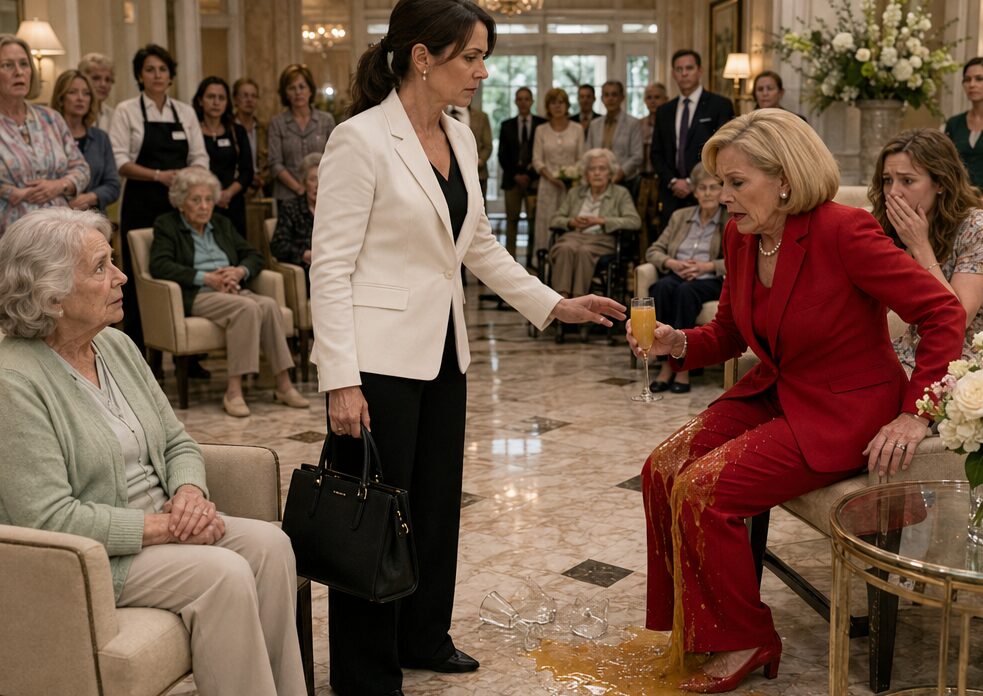
Not the music from the string trio in the corner. Not the spring flowers arranged in pale blue vases. Not the donation cards lined up beside the punch bowl. They remembered Amy in her white blazer, standing in the marble lobby of Rosebridge House with her black handbag looped over one wrist, looking down at Patricia like she had finally reached the end of something.
Patricia sat in one of the cream lounge chairs, bright red suit pressed smooth over her knees, pearl earrings catching the light, mimosa balanced beside her on the glass table. Her smile was still in place, but it had gone stiff.
Emily sat next to her in a floral dress, one hand halfway to her mouth.
Around them, residents, adult children, volunteers, and staff all went still in that special way polite people do when they want to watch without admitting they are watching.
Amy said, “You should have left my mother out of it.”
Patricia blinked once.
Then Amy swung the handbag.
Not high. Not at Patricia’s face. Just low and sharp across the edge of the glass table.
The mimosa tipped, caught the sunlight for half a second, then spilled in a bright orange sheet across Patricia’s red lap.
The glass hit the marble and cracked at the stem.
Nobody moved.
Patricia made a small sound, less a gasp than a swallowed scream. Her hands flew up, hovering above the wet fabric as if touching it would make the moment real.
Emily covered her mouth completely now.
Amy lowered the bag to her side.
Inside it were a folded cardigan, a folder of bills, a pack of soft peppermint candies, a medication list, a pen that no longer worked, three grocery receipts, a half-empty bottle of hand sanitizer, and a phone with a voicemail Patricia should never have left.
But no one in the lobby knew that yet.
They only saw the splash.
They only saw Patricia’s red suit darken.
They only saw Amy standing above her, calm enough to frighten everyone.
And from the row of chairs near the piano, Melissa lifted her silver head and looked at her daughter with a softness that made Amy’s throat close.
Melissa did not fully understand what had just happened.
But she knew, somehow, that someone had finally stood between her and the room.
Part II — Families Who Show Up
One week earlier, Amy had arrived at Rosebridge House carrying clean laundry and grocery-store tulips.
She came through the side entrance because it was closer to her mother’s wing and because the front lobby made her feel judged even when no one looked at her. The lobby was too perfect. Too bright. Too arranged. It smelled like lilies and lemon polish and money.
The side entrance smelled like raincoats, coffee, and the rubber mats staff used in winter.
Amy preferred it.
She worked in payroll for a regional HVAC company, which meant she spent her days fixing other people’s mistakes while making none of her own. She had built a life around being careful. Careful with money. Careful with words. Careful with how much of her private life she let show.
Then her mother started losing words.
Then the stove was left on.
Then Melissa called Amy at 2:13 in the morning from the front porch of the house she had lived in for thirty-eight years and said, politely, “I think I’m waiting for the bus.”
There had been no bus on that street since 1998.
Rosebridge House was the best option Amy could manage. Not the cheapest. Not the fanciest. Just the place where Melissa smiled during the tour because a woman at the piano had been playing “Moon River.”
Amy sold Melissa’s car. She rented out the old house instead of selling it, because Melissa still asked, on good days, when she was going home.
On bad days, Amy said, “Soon,” and hated herself.
That Thursday, Amy stopped at the sign-in desk and wrote her name beneath three others.
Patricia Collins had signed in above her in looping blue ink.
Beside the visitor log, two volunteers were arranging name tags for the spring fundraiser.
Patricia stood near them in a cream coat, blonde bob smooth as a helmet, laughing with the receptionist. Emily hovered at her elbow with a stack of programs pressed to her chest.
Amy nodded and tried to pass.
Patricia turned with a smile so warm it felt rehearsed.
“Amy. There you are. We were just talking about families who show up.”
The receptionist looked down at the name tags.
Emily smiled nervously.
Amy shifted the laundry bag on her shoulder. “I’m here almost every day.”
“Oh, I know, sweetheart.” Patricia touched Amy’s forearm with two fingers. “No one is saying you don’t try.”
There were words that sounded kind until they entered the body.
Try was one of them.
Amy’s hand tightened around the tulips.
Patricia continued, “The fundraiser is Saturday after next. We’re hoping every family can contribute in some way. Time, funds, energy. Presence. Rosebridge works best when loved ones stay involved.”
“I sent a check last month.”
“For the general appeal, yes.” Patricia’s smile did not move. “This is more personal. For the residents’ enrichment fund.”
Amy thought of the plumber’s estimate for Melissa’s old house. The cracked upstairs pipe. The insurance deductible. The care invoice due on Monday.
“I’ll see what I can do,” she said.
Patricia’s eyes softened in a way Amy had come to hate. “That’s all anyone can ask.”
As Amy walked away, she heard another volunteer whisper, “Is that Melissa’s daughter?”
Patricia answered quietly, but not quietly enough.
“She’s under a lot of strain.”
Amy kept walking.
That was how Patricia did it. Never one clean insult. Never one sentence you could hold up and say, See? This.
Just concern, folded neatly around a blade.
Melissa was in her room wearing the lavender cardigan Amy had washed last week. Her lipstick was a little crooked, which meant she had put it on herself and been proud enough not to ask for help.
“Well, look at you,” Melissa said.
Amy set the tulips in a plastic cup by the window. “Look at me?”
“All official.” Melissa gestured at the white blouse Amy wore under her work blazer. “You always did dress like you were about to tell someone no.”
Amy laughed before she could stop herself.
It felt good for half a second.
Then Melissa leaned closer and whispered, “Did we sell the house?”
Amy stilled.
“No, Mom. We rented it, remember?”
“Oh.” Melissa smoothed the edge of her cardigan. “The pretty woman in red asked me. She said it must be hard, not knowing where my money goes.”
Amy felt the room tilt.
“What pretty woman?”
“The one with the yellow hair.” Melissa’s fingers worried the cardigan button. “She said I should make sure I felt safe. With you doing the accounts.”
Amy sat down slowly on the edge of the bed.
Melissa looked embarrassed now, as if she had caused trouble by repeating it. “I told her you were good with numbers.”
Amy swallowed.
Her mother had worked thirty years as an elementary school secretary. She had known every lunch balance, every bus route, every child whose father was not allowed to pick them up on Thursdays. She had been discreet for a living.
Now strangers could walk into her room and make her doubt her own daughter.
“Mom,” Amy said carefully, “Patricia shouldn’t be asking you about money.”
Melissa folded her hands. “She seemed nice.”
That was the worst part.
She always did.
Part III — The Signature
The first time Emily looked away, Amy almost missed it.
It happened in the hallway outside the activities room. Emily was carrying a tray of paper cups and napkins, moving quickly behind Patricia, who was explaining table assignments to the activities director.
Amy stepped out of Melissa’s room with an empty laundry bag.
Emily saw her.
Their eyes met.
Then Emily looked down so fast one paper cup slipped from the tray and rolled to Amy’s shoe.
Amy picked it up.
Emily reached for it. “Thanks.”
Her cheeks were pink.
“Is something wrong?” Amy asked.
“No.” Emily’s smile appeared and vanished. “No, of course not.”
Patricia turned at the end of the hall. “Emily? We need those in the sunroom.”
Emily took the cup and hurried away.
Amy watched her go.
People who had done nothing wrong did not move like that.
Two days later, Amy found out about the wellness review.
The email came during lunch, while she was eating yogurt at her desk and approving timecards.
Subject: Family Concern Submission — Melissa Parker
She stared at it long enough for the screen to dim.
The message was written in calm facility language. Rosebridge had received a family and community concern regarding whether Melissa Parker’s current care level remained appropriate. A wellness review would be scheduled. Depending on the outcome, enhanced support might be recommended.
Enhanced support meant more money.
More money meant Amy would have to choose between draining the last of Melissa’s savings, raising the rent on the old house, or moving her mother somewhere cheaper.
Somewhere without “Moon River” in the lobby.
Attached was a scanned form.
Amy opened it.
Patricia’s signature sat first.
Emily’s sat fourth.
There were seven names altogether, including two people Amy knew only from nodding near the coffee station. People who had never seen Amy bring Melissa new socks because the laundry service shrank hers. People who had never watched Melissa panic because she could not find the bathroom in a room she had lived in for six months. People who had never sat in the parking lot afterward with both hands on the steering wheel, too tired to drive.
But they had signed.
Concern.
Such a clean word for reaching into someone else’s life.
Amy printed the form and folded it into her black handbag.
That night, she arrived at Rosebridge after eight, long after the front desk flowers had been refreshed and most visitors had gone home.
Melissa was asleep in her chair with a book open upside down in her lap.
Amy did not wake her at first.
She stood in the doorway and let herself feel the thing she never admitted.
Sometimes she missed her mother so sharply while standing in front of her that it felt ridiculous.
Melissa stirred. “Amy?”
“I’m here.”
“Oh, good.” Melissa smiled without opening her eyes. “I was hoping one of mine would come.”
One of mine.
Amy turned away until her face obeyed her again.
On her way out, she saw Emily in the parking lot beside a silver hatchback, digging through her purse for keys.
Amy crossed the lot before she could talk herself out of it.
“Emily.”
Emily flinched.
Amy held up the folded copy of the review request. “Why did you sign this?”
The color drained from Emily’s face.
“I didn’t know it would be formal.”
“It’s a form.”
“Patricia said it was just to make sure your mom got what she needed.”
“My mother needs people to stop asking her if I’m stealing from her.”
Emily’s mouth opened.
Amy stepped closer, not enough to threaten, just enough that Emily could not escape into politeness.
“You’ve seen me here,” Amy said. “You’ve seen me after work. You’ve seen me carrying laundry and flowers and those stupid peppermint candies she likes.”
Emily looked toward the building.
“I know.”
“Then why sign?”
For a moment Emily looked younger than thirty-one. Not innocent. Just small.
“Patricia said you were barely around. That your mother seemed confused after your visits. That maybe you weren’t telling the facility everything.”
“And you believed her?”
Emily’s eyes shone. “I wanted her to like me.”
The answer was so pathetic, so honest, that Amy had no place to put her anger.
Emily hugged her purse to her ribs. “She knows everyone. The staff, the donors, the residents’ families. When I started volunteering, no one talked to me unless Patricia introduced me. I thought if I said no, she’d—”
“She’d do to you what she did to me?”
Emily said nothing.
Amy folded the paper again.
“You knew it was wrong.”
Emily whispered, “Yes.”
That one word stayed with Amy all night.
Not because it helped.
Because it didn’t.
Part IV — Please Don’t Make a Scene
On Saturday morning, Melissa was clear.
Amy knew it the moment she entered the room. Her mother had brushed her own hair, chosen the pale green cardigan with pearl buttons, and placed two framed photos on the windowsill: Amy at sixteen in a graduation gown, Melissa and Amy’s father in front of the old house before the maple tree came down.
“Close the door,” Melissa said.
Amy did.
Melissa sat in her armchair, hands folded in her lap.
“I need to ask you something,” she said.
Amy felt the old reflex rise in her. The daughter standing at the kitchen counter. The teenager caught with a report card. The adult still wanting approval.
“Okay.”
“At the luncheon today, don’t make a scene.”
Amy went still.
Melissa looked ashamed of having said it.
“Mom—”
“I know people are talking.” Melissa’s voice was steady, but her fingers worked at the cardigan button. “Not all the time. But I know. A person can know even when she forgets.”
Amy sat on the bed.
Melissa looked toward the window. “The blonde woman came here. Patricia. That’s her name, isn’t it?”
Amy nodded.
“She said I was lucky to have so many people concerned. She said bills can confuse families. She said sometimes daughters take on more than they should because they don’t want to admit they need help.”
Amy’s stomach hardened.
Melissa’s mouth trembled. “She made me feel like a box someone had left in the wrong room.”
“Don’t say that.”
“It’s how I felt.”
Amy looked down at her hands.
Melissa reached for her. “I know you do a lot.”
Amy could not answer.
“I also know you get tired.”
The room changed around that sentence.
Amy had never said it to Melissa. Not once. Not when she missed work for appointments. Not when she spent lunch breaks arguing about prescription coverage. Not when she sat in Melissa’s old kitchen surrounded by mail addressed to a woman who was still alive but no longer able to open it.
“I’m fine,” Amy said.
Melissa gave her the soft, almost amused look she used to give children who lied badly.
“No, you’re not. But you’re here.”
That was worse than comfort.
Amy pressed the heel of her hand against her eye.
Melissa squeezed her fingers. “Promise me. No scene.”
Amy looked at the old photo on the windowsill. Her mother in a blue summer dress, younger than Amy was now, standing in front of the house she still sometimes asked to go home to.
“I’ll handle it quietly,” Amy said.
At 1:14 p.m., while Amy sat in her car outside Rosebridge, her phone rang.
Patricia.
Amy let it go to voicemail.
She watched the lobby doors open and close. Families entering with flowers, gift bags, folded checks, smiles arranged before they got inside.
The voicemail appeared.
Amy should have deleted it.
Instead, she played it.
Patricia’s voice filled the car, soft and bright.
“Amy, it’s Patricia. I wanted to reach out before today. I know this has all been uncomfortable, and I truly hope you understand that everyone’s only priority is your mother’s wellbeing. Some families are simply not equipped for every stage, and there is no shame in admitting that. Rosebridge has wonderful resources, but they do need cooperation from loved ones. I hope you’ll come today with an open heart rather than defensiveness. We all want what’s best for Melissa.”
Amy played it twice.
Then she saved it.
There was no threat in the message. No raised voice. No single sentence ugly enough to explain the heat rising in Amy’s chest.
That was Patricia’s gift.
She could set a fire and make it sound like a candle.
Amy looked at her handbag on the passenger seat.
It was structured black leather, scuffed at one corner, heavier than it looked. Her mother had bought it for her years ago after Amy got promoted.
“A serious bag for a serious woman,” Melissa had said, proud enough to embarrass them both at the department store register.
Now it held the wellness review form, the folder of bills, Melissa’s spare cardigan, two peppermints, and the phone.
Amy put the strap over her wrist.
Then she went inside.
Part V — The Public Kindness
The Rosebridge lobby had been transformed into a showroom of generosity.
White tablecloths. Silver trays. Tulips in tall vases. A donation board near the reception desk with gold stars beside family names. A string trio playing near the piano. Residents seated in a semicircle as if they were both guests and proof.
Patricia stood at the center of it all in her red suit, holding a mimosa.
She looked radiant.
That was the word everyone used for women who knew how to stand in expensive rooms and make other people feel grateful for being managed.
Emily sat nearby in her floral dress, phone in her lap, eyes moving nervously between Patricia and the entrance.
Amy saw Melissa in the resident row, wearing the green cardigan. Her lipstick was careful. Her hands were not.
Patricia tapped a spoon against her glass.
“Friends,” she called, “thank you for being here to support the Rosebridge enrichment fund. This community is special because we understand that care is not simply a service. It is a family commitment.”
People nodded.
Amy stopped near the orchids.
Patricia continued, “Some families give financially. Some give time. Some give both. And some, bless them, are still learning that love cannot be outsourced and called care.”
A few people laughed gently.
Not because it was funny.
Because Patricia had smiled.
Melissa lowered her head.
That was the moment Amy forgot her promise.
Not all at once. Not dramatically. The promise did not shatter.
It simply became smaller than the sight of her mother trying to disappear in a room full of people.
Amy walked forward.
Patricia saw her coming and brightened. “Amy. I’m so glad you made it.”
The room adjusted around them.
Emily’s hand moved to her mouth.
Patricia held out one manicured hand. “I was hoping we could speak after the program.”
“We can speak now,” Amy said.
Her voice was calm enough that several people leaned in.
Patricia’s smile flickered. “This may not be the best time.”
“No,” Amy said. “I think this is exactly the time you chose.”
A staff member near the reception desk shifted uncomfortably.
Amy took out her phone.
Patricia’s eyes dropped to it.
For the first time, something like uncertainty crossed her face.
Amy pressed play.
Patricia’s own voice filled the lobby.
“Some families are simply not equipped for every stage, and there is no shame in admitting that…”
The string trio faltered, then stopped.
The voicemail continued in the clean, kind, poisonous tone Patricia had trusted.
“…I hope you’ll come today with an open heart rather than defensiveness. We all want what’s best for Melissa.”
Amy stopped the recording.
Silence spread.
Patricia gave a small laugh. “Well. I’m not sure what you think that proves, except that I tried to be gracious.”
Amy looked at her. “You went into my mother’s room.”
“As Family Circle chair, I visit many residents.”
“You asked her about her money.”
“I asked whether she felt supported.”
“You asked whether she felt safe with me handling her accounts.”
Patricia’s lips thinned. “Your mother is often confused, Amy. You know that better than anyone.”
The sentence landed softly.
That was why it hurt.
It used Melissa’s condition as a shield and a knife at the same time.
Amy saw Melissa lift her head.
She saw Emily staring at the floor.
She saw the donation board with its gold stars.
She saw the glass table beside Patricia, the mimosa still glowing orange and harmless in its flute.
Patricia reached for it, as if taking a sip could restore the room.
“You’re emotional,” Patricia said gently. “And that’s understandable. Care decisions bring up guilt.”
Amy heard a sound in her own chest.
Not a sob. Not a laugh.
Something older.
She stepped closer.
“You should have left my mother out of it.”
Then she swung the bag.
The mimosa turned over.
Orange liquid spilled across Patricia’s lap, down the red fabric, onto the cream chair, then to the marble floor.
The glass cracked at the stem.
Patricia gasped.
Emily covered her mouth.
No one laughed now.
Amy stood over the table, breathing hard through her nose, the handbag hanging from her wrist.
It was only then, in the silence after the spill, that she felt the weight of it.
The cardigan.
The bills.
The papers.
The peppermints.
All the small, private proofs of love no one had cared to see.
Part VI — What the Room Could Not Say
Patricia was the first to move.
She stood too quickly, then seemed to remember the wet fabric and froze halfway up, hands hovering helplessly over her skirt.
“This is unbelievable,” she said.
But her voice did not fill the room the way it usually did.
It came out thin.
Amy bent and picked up the broken glass by its stem. She placed it carefully on the table.
That small act embarrassed Patricia more than the spill.
It made Amy look controlled again.
It made the room wonder whether she had ever stopped being controlled at all.
A young staff member hurried over with napkins. The activities director whispered into someone’s ear. The trio stared at their music stands as if music had become impossible.
Amy turned away from Patricia and walked to her mother.
Melissa looked up at her with wet eyes.
“Did I do something?” Melissa asked.
Amy crouched in front of her.
“No, Mom.”
“Are we in trouble?”
Amy took the spare cardigan from her bag. Pale blue, soft at the sleeves from too many washings. She draped it over Melissa’s shoulders though the room was warm.
“No,” Amy said. “We’re leaving the lobby.”
Melissa touched the cardigan. “This is mine.”
“I know.”
“I thought I lost it.”
“I had it.”
Melissa smiled faintly. “You always have everything.”
Amy almost broke then.
Because she did not have everything.
She had a cracked glass behind her, a room full of people watching, a mother who might forget this by dinner, and a reputation that would be rewritten before the fundraiser ended.
But she had the cardigan.
She had her mother’s hand.
She had finally said no in a language the room understood.
As Amy guided Melissa toward the hall, Emily stepped into their path.
Her face was pale.
“Amy,” she whispered.
Amy stopped.
Emily looked past her toward Patricia, then back again. “I’m sorry.”
Amy did not answer.
Sorry was another word people used when they wanted pain to become smaller.
Emily swallowed. “I’ll write what happened. Before today. About the form. About what she told us.”
Patricia, from behind them, said sharply, “Emily.”
Emily flinched.
Then, for once, she did not move toward Patricia.
Amy looked at her for a long second.
“Send it to the director,” Amy said. “Not to me.”
Emily nodded.
Amy walked Melissa down the hall.
Behind them, the lobby began making sounds again. Napkins pulled from stacks. Chairs shifting. Low voices pretending not to choose sides. Patricia saying something about dry cleaning. Someone else saying, “Maybe we should give them space,” as if space had not been the one thing no one had given Amy for weeks.
In Melissa’s room, Amy helped her into the armchair by the window.
The tulips from Thursday had started to droop.
Melissa noticed. “Those need water.”
Amy laughed once, softly. “They do.”
She filled the plastic cup at the sink.
For a minute, there was only the sound of running water.
Then Melissa said, “Was I brave?”
Amy turned.
Her mother was looking at the floor, hands smoothing the blue cardigan.
Amy crossed the room and knelt beside her.
“Yes,” she said. “You were.”
Melissa seemed satisfied by that. She leaned back, tired now.
Amy stayed until she fell asleep.
Only then did Amy step into the hallway and make the calls she should have made before the luncheon. She asked for a meeting with the director. She forwarded the voicemail. She attached the wellness review form. She requested that Patricia not be allowed unsupervised visits with Melissa.
Her hands shook while she typed.
Not from fear.
From aftermath.
That evening, Emily sent a statement.
It was short. Plain. Not noble.
Patricia encouraged me to sign the concern form. She said Amy was not present enough and suggested Melissa might not be safe with Amy managing her finances. I have personally seen Amy visiting late in the evenings with clothes, flowers, and supplies. I should have spoken sooner.
Amy read the last sentence twice.
I should have spoken sooner.
Yes, Amy thought.
You should have.
But she saved the statement anyway.
By Monday, the Rosebridge lobby had been restored.
The cream chair was gone. The glass table had been replaced. The donation board still stood near the desk, though Patricia’s gold-star name had been moved slightly lower to make room for new cards.
People looked at Amy differently when she signed in.
Some looked away.
Some nodded too kindly.
The receptionist no longer chatted when Amy passed.
Amy found that she did not mind as much as she thought she would.
She was not welcomed anymore.
But she was not being managed either.
In Melissa’s room, the blue cardigan was folded neatly over the chair.
Melissa was asleep, one peppermint resting unopened on the side table.
Amy sat beside her and opened the folder of bills.
Outside the window, the maple trees along the parking lot had begun to leaf out, small green shapes trembling in the wind.
Her phone buzzed once.
A message from Emily.
I’m sorry again. I hope your mom is okay.
Amy looked at it for a long time.
Then she typed: She is.
She did not add thank you.
She did not add anything else.
Across the room, Melissa stirred.
“Amy?” she murmured.
“I’m here.”
Melissa opened her eyes just enough to smile.
“Oh, good,” she said. “I was hoping one of mine would come.”
Amy reached into her black handbag and took out the last peppermint.
She set it gently in her mother’s palm.
“I always do,” she said.
This time, she did not care who believed her.