They Blocked Her at the HOA Gala Because Her Porch Repair Looked Poor
Chapter 1: The Woman They Stopped at the Door
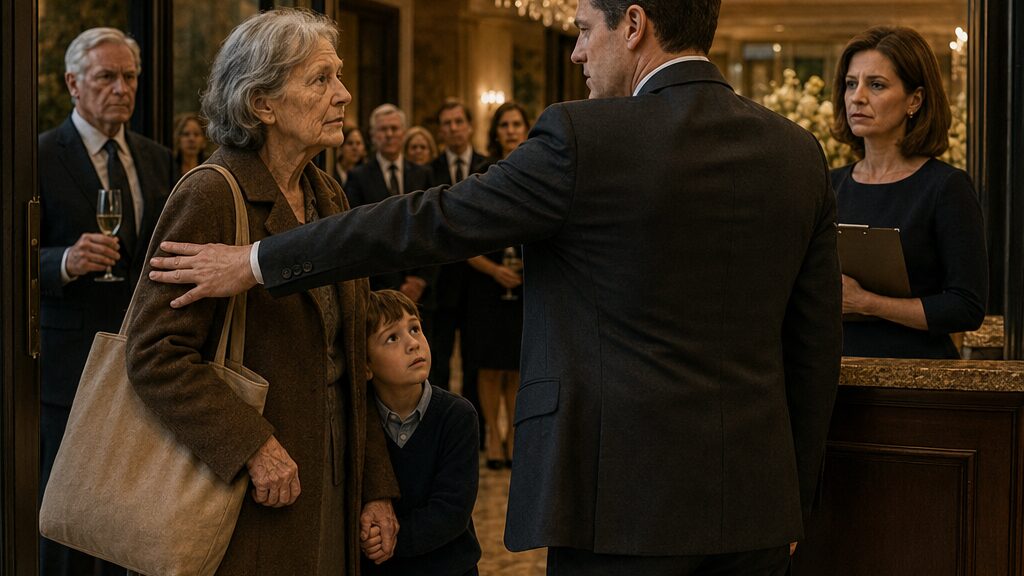
Jonathan King put his arm across the clubhouse doorway before Ruth Davis could step over the polished brass threshold.
Not a hand raised gently. Not a polite stop.
An arm.
It cut across the entrance between two white columns wrapped in silver ribbon, under a chandelier bright enough to make every glass in the lobby sparkle. Behind him, music drifted from the reception hall, low and expensive, while residents in dark suits and pearl earrings moved past trays of champagne as if the evening had been arranged only for people who already belonged there.
Ruth looked at the sleeve of Jonathan’s suit first. Charcoal wool. Gold cuff link. Clean and unwrinkled.
Then she looked at his face.
“Mrs. Davis,” he said, keeping his voice low enough that it sounded courteous to anyone not standing close, “this is not the time.”
Samuel’s fingers tightened around hers.
Ruth did not pull away from the boy. She adjusted her grip so his small hand sat safely inside her palm, then shifted the soft beige tote on her shoulder before it slipped down her coat sleeve. The bag was old enough that one seam near the strap had been mended twice with brown thread. Against the marble floor and mirrored walls of the clubhouse lobby, it looked like something brought in from another weather.
“I was told the board would be here,” Ruth said.
“The board is hosting an anniversary reception.”
“I can see that.”
Behind Jonathan, the reception hall opened in warm gold light. A banner hung over the far wall celebrating thirty years of the community association. Someone laughed near the bar. A bartender lifted a bottle from an ice bucket. Framed photographs of manicured lawns and newly painted shutters lined the entry corridor as if the neighborhood had been arranged for inspection.
At the front desk, Katherine Moore straightened from behind a tablet and a stack of name cards. She wore a navy dress and a headset, her smile carefully placed and already wearing thin.
“Mrs. Davis,” Katherine said, “if you left the documents with the office, I would have attached them to your file.”
“I did leave them,” Ruth said. “Twice.”
Katherine glanced toward Jonathan.
That was all. One quick glance, barely the length of a breath, but Ruth saw the message pass between them: not here, not now, not in front of residents.
Samuel leaned against Ruth’s side. He was still in his school clothes, his collar a little bent under the sweater Ruth had made him wear because the evening had turned cold. His eyes moved from Jonathan’s arm to the people behind him. He knew enough to understand they had been stopped. He did not know enough to understand why everyone else was allowed to pass.
“Grandma,” he whispered, “are we not allowed?”
Ruth felt the question land harder than Jonathan’s arm.
William Green stood a few steps inside the lobby with a champagne flute lifted near his chest. He was speaking to two neighbors, but his gaze rested openly on Ruth’s coat, then her shoes, then the tote. When he noticed her looking, he raised the glass a little, almost like a toast.
“Some folks don’t understand timing,” he said, not loudly, but not softly enough.
One of the women beside him smiled into her drink.
Ruth turned her eyes back to Jonathan.
“I understand timing,” she said. “I sent my request before the repair. I called before the contractor came. I came to the office before I came here.”
Jonathan’s jaw tightened. “You installed an exterior modification without written approval.”
“The porch was unsafe.”
“And now it is unfinished,” he said. “Which is exactly why emergency work cannot be done outside the process. The association has standards. Liability standards. Appearance standards. Contractor standards.”
Samuel looked down at the floor. Ruth could see the tips of his sneakers near the brass strip of the doorway, just short of crossing into the hall.
Katherine came around the front desk with a clipboard held close. “Mrs. Davis, I don’t think anyone is refusing to hear you. But walking into a private reception with a child, carrying photographs and notices—”
“I am carrying what your office asked for.”
“This event is for residents and invited guests.”
“I am a resident.”
The words made the lobby go a little quieter around them. Not silent. A party did not stop for an old woman in a worn brown coat. But a few heads turned. A man near the sign-in table slowed while pinning on his name tag. Someone at the bar stopped laughing too soon.
Jonathan lowered his arm only enough to fold both hands in front of him, making the block look less physical and more official.
“No one is disputing that you own your home,” he said.
Ruth heard the shape of the sentence. Own your home, but not this room. Own your home, but not the right to decide what touched it. Own your home, but only under conditions set by people who never had to measure the distance from the porch to the kitchen on a weak ankle.
She reached into the tote.
Samuel made a small sound, half warning, half fear. Ruth patted his hand once with her thumb and withdrew a folded paper. The top corner was creased from being opened too many times. The red stamp across it showed even from a distance.
VIOLATION NOTICE.
Katherine’s face changed. Not much. Just a tightening around the mouth.
“Mrs. Davis,” she said quickly, “let’s not put paperwork on the reception counter.”
Ruth stepped to the counter anyway. The movement was slow because her right knee disliked polished floors, and because she would not give Jonathan the satisfaction of seeing her hurry. She laid the notice flat on the black stone surface between a silver bowl of guest pins and a vase of white roses.
The paper looked rude there. Too ordinary. Too necessary.
Jonathan moved beside her. “This is precisely what I mean. You are creating a scene over a simple compliance matter.”
“A simple matter,” Ruth repeated.
“Yes. Remove the temporary boards and brace until approval is granted. That is all the notice says.”
William gave a dry little laugh. “Temporary boards. That’s generous.”
Ruth did not turn toward him.
Samuel did.
The boy’s face flushed, but he stayed quiet. Ruth felt his hand tremble once, and the anger she had folded and refolded all week pressed against her ribs. She had promised herself she would not come in angry. Anger made people stop listening. Anger let them say confused, difficult, emotional, unstable. Anger turned a woman’s need into someone else’s evidence.
So she stood with her shoulders level and kept her voice low.
“You sent the first letter to the wrong address,” she said to Katherine. “You answered my second request after the contractor was already ordered to stop. You took photographs of the porch while the work was unfinished. And now you want me to remove the only stable board because it does not match the neighborhood.”
Jonathan looked toward the hall, where more people had begun watching. “Mrs. Davis, that is not an accurate summary.”
“It is the short one.”
A few faces shifted. Someone murmured. Katherine’s eyes dropped to the notice, then to Ruth’s tote, where the edges of more papers stuck out beside a small key ring.
Jonathan’s courtesy thinned.
“The board cannot make exceptions every time a homeowner decides their situation is special,” he said. “If everyone ignored approval rules, we would have patched porches, mismatched rails, loose boards, and homemade fixes throughout the community. That affects safety. It affects property values. It affects everyone.”
“My porch already affected safety,” Ruth said.
“Then you should have waited for an inspection.”
“I asked for one.”
“You proceeded without authorization.”
“The step moved under my foot.”
Jonathan stopped.
Not because he understood. Because he needed to choose which part to challenge.
Ruth bent slightly and touched Samuel’s shoulder. “Stand back from the counter, sweetheart.”
He obeyed, but he did not let go of her coat.
She reached into the tote again and drew out a photograph. She did not show the room. Not yet. She placed it face down beside the notice. Her fingers rested on it for a moment. The glossy paper trembled faintly under her hand.
Jonathan saw the tremble. Ruth saw him see it.
His voice softened in a way that felt worse than his blocking arm. “Mrs. Davis, perhaps you should go home and let your family help you handle this during office hours.”
“My family is standing right here.”
Samuel’s eyes lifted.
The words seemed to travel farther than Ruth intended. A woman near the sign-in table turned fully around. William’s smile faded into irritation.
Katherine stepped closer, lowering her voice. “Ruth, please. We can schedule a review.”
“You scheduled one for next month.”
“That is the next available board slot.”
“The fine starts tomorrow.”
Jonathan lifted the violation notice from the counter, as if removing it from sight could remove the problem. “Daily fines begin only if the violation remains uncorrected.”
Ruth looked at the empty place where the paper had been.
A fine for leaving a board in place.
A fall for taking it away.
Those were the choices they had made sound orderly.
She took the notice back from Jonathan’s hand. Not quickly. She simply held out her fingers until he had no polite way to keep it.
Then she placed it on the counter again.
“You did not stop an eyesore,” Ruth said.
The lobby grew still enough that she could hear ice shift in a glass.
Jonathan’s eyes hardened. Katherine looked at Ruth as if she had just heard a door open somewhere she had not known existed.
Ruth held Samuel’s hand, kept her other palm on the folded notice, and spoke before anyone could interrupt.
“You stopped the step I use to get inside.”
Chapter 2: The Board Called It an Eyesore
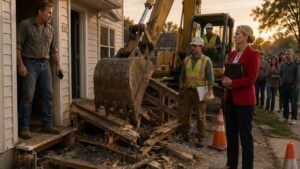
Three days before the gala, the board under Ruth’s right shoe gave a soft, wet sigh.
She stopped at once.
The grocery bag in her left hand swung forward, heavy with milk, potatoes, and a jar of peanut butter Samuel liked better than the cheaper kind. Her other hand clamped around the porch post. The post itself was solid. Gary had set it deep years ago, back when he still believed anything fixed properly would stay that way if a person took care of it.
The step below it had not held to the same promise.
Ruth waited until the loose board settled. Beneath the gray paint, the wood shifted again, almost too little to see, but enough for her ankle to remember last winter’s fall and send a warning up her leg.
She breathed through her nose.
“Not today,” she told the porch.
The porch did not answer, but the rainwater trapped near the threshold glistened in the seam where the board had pulled away from the frame. The drainage dip beside the flower bed had worsened after the last storm, and water had found the old weakness under the front entry. Gary would have known what to do first. He would have crouched, tapped the board with the handle of his hammer, and made a small dissatisfied sound before naming the problem like an old enemy.
Ruth had named it differently: the place where she could no longer pretend.
She got inside by shifting her weight sideways and putting her right foot on the narrow strip of temporary board the contractor had laid across the threshold that morning. It was plain pine, pale and unfinished, held with temporary screws until he returned with the proper cut, the brace, and the handrail piece.
It was ugly.
It was also the first thing in weeks that had not moved under her.
Inside, she set the groceries on the kitchen table and stood with one hand pressed against the chair back until her knee stopped complaining. The house was quiet. Not empty, she told herself. A house with photographs, a humming refrigerator, Samuel’s spelling list under a magnet, and Gary’s old key hanging by the door was not empty. But quiet had a way of stretching itself across rooms after a person had lived with another voice for most of her life.
Outside, a truck door shut.
Ruth looked through the front window. The contractor was kneeling near the porch with a measuring tape hooked under the threshold. A roll of yellow contractor tape sat beside his toolbox. He had already removed the worst splintered piece and laid the temporary board so she could cross until the replacement was ready. The handrail brace leaned against the siding, raw metal against beige paint.
A white SUV pulled up at the curb behind his truck.
Ruth knew the vehicle before the driver stepped out.
Katherine Moore wore sunglasses even though the sky was cloudy. She came around the SUV holding her phone and a folder. Jonathan King got out from the passenger side, buttoning his suit jacket as if Ruth’s porch were a meeting room.
The contractor stood.
Ruth reached the door before they reached the steps. She opened it but did not step out. The temporary board lay beneath her toes.
“Good morning,” Jonathan said.
“It was.”
His eyes flicked to the raw board, the brace, the open seam beneath the threshold. “We received a complaint.”
“About the step?”
“About exterior work being performed without approval.”
“I filed the request.”
Katherine opened the folder. “Your request was received, but not yet reviewed.”
“I called before he came.”
“You left a voicemail,” Katherine said. “The office noted it.”
“The board didn’t answer.”
Jonathan gestured toward the contractor’s tools. “That does not authorize construction.”
“It authorizes me not to fall through my own doorway.”
The contractor shifted his weight. He looked like a man who had been caught in a family argument, though Ruth had paid him and the porch was hers. “I can pause, Mrs. Davis, if they need something signed.”
Ruth did not look away from Jonathan. “He already paused once to take measurements for your form.”
Katherine’s voice turned professional. “The issue is that the visible work does not match approved exterior materials. Temporary boards, exposed braces, and tape create a safety and appearance concern.”
“Safety?” Ruth repeated.
Jonathan stepped closer to the bottom of the porch. “Yes. If someone trips over incomplete work, the association may be exposed.”
“I am the someone.”
“That is why the process exists.”
“No,” Ruth said. “The process did not hold the railing when the board moved. He did.”
She nodded toward the contractor.
A small silence followed. The contractor lowered his gaze to the tape measure in his hand.
Jonathan took out his phone and photographed the porch from the walkway. One picture from the left. One from the front. One close to the raw board where Ruth’s shoe stood.
The click of the phone camera bothered her more than she expected. It felt as if he were taking a picture not of damage, but of neglect. Not of a temporary repair, but of her failure to keep up.
“You don’t need to photograph my foot,” she said.
Jonathan lowered the phone a fraction. “Documentation is standard.”
“Then document the dip beside the flower bed. Document the water under the frame. Document the board that moved before this one was put down.”
“We are documenting the current violation.”
The word sat between them, neat and wrong.
Violation.
Ruth thought of the nights she had gone out the back door and walked around through damp grass because the front step had shifted again. She thought of holding the grocery bag against her hip while deciding which foot could risk the board. She thought of Samuel hopping over the threshold the way children hopped over cracks in sidewalks, not yet understanding that adults sometimes called danger by softer names until it hurt someone.
Katherine stepped aside and spoke quietly to the contractor. Ruth heard enough.
“Stop work until approval is granted.”
The contractor looked toward Ruth. “Ma’am, I can secure what’s already open.”
Jonathan answered before Ruth could. “No further work.”
“There’s an exposed gap,” the contractor said.
“Cover it temporarily without altering the exterior.”
“That board is the temporary cover.”
Jonathan’s expression hardened. “Then leave it as is. No brace. No rail. No additional attachment.”
Ruth’s fingers tightened on the doorframe. “You’re telling him to leave it unfinished?”
“I am telling him not to continue unauthorized exterior modification.”
Katherine looked uncomfortable for the first time. “We can expedite review if all documents are submitted.”
“I submitted them.”
“We need the material description, contractor license, color match, scope, and photos before work began.”
“Before it began, it was broken.”
Jonathan checked his phone. “The next architectural review is scheduled for next month.”
Ruth stared at him. “Next month?”
“If you wanted earlier review, the request should have been complete earlier.”
The contractor bent to gather his tools, slow and reluctant. The handrail brace remained leaning against the siding, unused. The temporary threshold board stayed beneath Ruth’s shoe, plain and pale against the weathered porch. Yellow tape fluttered where the contractor had marked the open area.
Jonathan photographed that too.
Ruth wanted to tell him about Gary. How he had built the original threshold after Samuel’s mother first brought the baby home, how he had widened the entry just enough for a stroller, how he had sanded the edge smooth because Ruth hated catching her slippers there. She wanted to say that the house had never been perfect, but it had always let them in.
Instead, she asked, “What am I supposed to use until next month?”
“The back entrance, if safer.”
“There are three steps in back and no rail.”
“Then arrange assistance.”
There it was. The clean little phrase people used when they had no intention of being the assistance.
Ruth looked down at the temporary board. It was not straight. It was not painted. It was not what Gary would have left for longer than an afternoon. But it did not shift under her, and that mattered more than matching trim.
The contractor lifted his toolbox. “I’m sorry, Mrs. Davis. Call me when they clear it.”
Jonathan and Katherine returned to the SUV. Before the door closed, Ruth heard Katherine say, “We should at least note the access issue.”
Jonathan replied, “We noted the violation.”
By late afternoon, Ruth had learned the new way to cross the threshold: right foot flat on the pale board, left hand on the post, pause before bringing the other foot through. It was slow and undignified. It was also hers.
At five, Samuel came home from school and stopped at the porch.
“Grandma, why is there tape?”
“So people look where they step.”
“Is it fixed?”
“Not yet.”
He frowned with the seriousness of a child trying to measure adult trouble. “Can I help?”
“You can carry the light bag next time.”
He nodded, accepting the task as if she had given him a title.
The notice arrived the next morning, tucked under the storm door where Ruth had to bend carefully to reach it. Katherine’s name was printed at the bottom. Jonathan’s title appeared below the association seal.
Unauthorized exterior modification. Temporary board and exposed brace. Remove or correct pending approval. Daily fines to begin if violation remains.
Ruth read it twice at the kitchen table.
Then she folded it carefully, placed it inside the beige tote, and pulled out the invitation that had been mailed to every resident.
Thirty-Year Community Anniversary Reception.
Meet the Board. Celebrate Our Shared Home.
She ran her thumb over the words shared home until the paper softened under her hand.
That evening, when Samuel asked why she was taking him to the clubhouse after dinner, Ruth hung Gary’s old key on the ring inside her tote and said, “Because sometimes an office does not answer until there are witnesses.”
Chapter 3: The Photos on the Reception Wall
Katherine Moore saw the boy recognize the porch before any adult did.
He had been standing close to Ruth Davis, shoulders drawn in, one hand still gripping the side of her coat after Jonathan King stopped them at the lobby entrance. Katherine had watched children in the clubhouse before—children bored by adult parties, children sneaking extra cookies from the dessert table, children warned not to run near the fountain. Samuel was doing none of those things.
He was staring past the guests.
At first Katherine thought he was looking at the dessert display under the framed photographs near the hall. Then his face changed. His mouth parted slightly. His eyes moved from the wall to Ruth and back again.
Katherine followed his gaze.
There it was, enlarged and mounted on foam board beside a display of approved neighborhood improvements: Ruth Davis’s front porch.
The photo had been taken from the walkway, angled low enough to make the raw temporary board look more jagged than it was. Yellow contractor tape hung across one corner. The unused handrail brace leaned against the siding like discarded junk. Beneath the picture, a printed caption read: Unapproved Modifications Create Safety and Property Concerns.
Katherine felt heat rise under her collar.
She had approved the display layout that afternoon, but she had not looked closely at every example. William Green had sent the photographs to the board email with a note about “visible decline near the west cul-de-sac.” Jonathan had asked that several examples be included for the reception’s homeowner standards table. Katherine had printed what she was told to print.
That was what she did too often, she thought. Printed what she was told to print. Filed what she was told to file. Stamped dates on decisions that had already been made elsewhere.
Samuel tugged Ruth’s coat.
“Grandma,” he whispered, but the word carried.
Ruth looked.
For the first time since entering the clubhouse, her stillness changed. Not into anger. Not visibly. But Katherine saw her hand tighten around the tote strap until the repaired seam puckered.
Jonathan was speaking near the reception counter, telling Ruth that the board could not accommodate procedural disruptions during a private event. William stood behind him, champagne still in hand, watching with the expression of a man pleased that the evening had finally become interesting.
Ruth did not answer Jonathan. She walked past him.
He moved as if to stop her again, then seemed to remember the watching residents and let her pass into the hall. Katherine followed, clipboard held uselessly against her side.
The reception hall smelled of white roses, floor polish, and chilled wine. The chandelier light softened everything it touched: the framed renderings of renovated homes, the silver bowls of appetizers, the rows of residents standing beneath banners about community pride. Ruth moved through it like someone walking through a room where a private letter had been read aloud.
Conversations thinned as she approached the display.
Samuel stayed beside her. His fingers curled around hers.
Ruth stopped in front of the photograph of her porch.
No one spoke for a moment.
William broke the silence. “It’s a standards example, Mrs. Davis. No one put your name on it.”
“My house is in the picture.”
“It faces the street.”
“It faces my street.”
Jonathan came up beside Katherine, his voice clipped. “The display is educational. It illustrates why approval procedures matter.”
Ruth looked at the picture but did not touch it. “Who took this angle?”
Katherine glanced at Jonathan. “The photo was submitted with a complaint.”
William lifted his glass slightly. “I submitted it. As any concerned resident would.”
Samuel turned toward him. “That’s our porch.”
William’s smile faltered. He looked at the child as if he had forgotten children could identify houses.
Ruth put one hand on Samuel’s shoulder. “Yes,” she said. “It is.”
Katherine saw several residents exchange glances. The photograph had changed now. A moment earlier, it had been an example. A caution. A piece of board-approved messaging. With the boy standing under it, it became a front door.
Jonathan tried to recover the room.
“This is not personal,” he said.
Ruth turned at last. “It became personal when you photographed the place my grandson steps over to come inside.”
“You made it visible by beginning work without authorization.”
“I made it passable.”
William gave a short laugh. “With plywood.”
“Pine,” Ruth said.
The correction was quiet enough that a few people almost missed it. Katherine did not.
Ruth continued, “Temporary pine, because your office told the contractor to leave before he installed the finished board.”
Jonathan’s eyes moved toward Katherine.
Katherine looked down at her clipboard. There were moments when procedure protected people from unfairness. There were other moments when it protected everyone from noticing who had been left standing outside.
“The contractor was advised to stop pending review,” she said carefully.
“After he removed the unstable piece,” Ruth said.
Jonathan’s face tightened. “Mrs. Davis, if you had waited for approval—”
“The board had my request.”
“An incomplete request.”
“I am seventy-eight years old,” Ruth said. “I can complete a form. What I cannot do is stand on a board that moves while I wait for someone to decide whether safe looks pretty enough.”
The room went still again.
Not sympathetic. Not yet. Stillness was not agreement. It was only the sound people made when a sentence landed too plainly to dismiss at once.
William set his glass on a nearby table. “Everyone has hardships. The rules exist so the neighborhood doesn’t become a patchwork of personal exceptions.”
Ruth looked at him. “My porch already became a patchwork when the water got under it.”
“Then maintain it properly.”
Katherine saw Samuel flinch.
Ruth did not. She stood in her plain coat beneath the expensive lights, the beige tote resting against her hip, and all at once Katherine understood why Jonathan had wanted her out of the lobby. Not because Ruth was loud. Because she was not.
A loud person could be managed. A quiet one made the room hear itself.
Jonathan stepped toward the display and turned slightly so his body faced the residents more than Ruth. “This is exactly why the board must act consistently. If an owner leaves an unfinished repair visible, it affects community standards. If there is a safety concern, unauthorized work only increases liability. The proper remedy is removal until the review process is complete.”
“Removal?” Ruth asked.
“The board has authority to require correction.”
“You mean take it off.”
“If necessary.”
Samuel’s hand slid into Ruth’s again.
Katherine heard herself say, “Jonathan, perhaps this should be discussed in executive session.”
He did not look at her. “The matter is already public.”
William nodded. “I agree. If we don’t address it now, every resident here will wonder why violations are allowed during the anniversary week.”
During the anniversary week.
Katherine looked at Ruth then, really looked. The worn coat. The practical shoes. The tote with papers bending the fabric out of shape. The boy trying to stand straight because his grandmother was standing straight. The enlarged porch photo above them, bright and cruel under the display light.
Ruth lifted her chin toward Jonathan. “You will not call my home a violation while my grandson stands under a picture of it.”
Jonathan’s expression cooled. “Then perhaps we should settle this tonight.”
Katherine’s stomach sank.
“Jonathan,” she said.
He turned toward the residents, raising his voice just enough to carry across the hall. “Ladies and gentlemen, since this issue has been brought into the reception, the board will convene an emergency vote after the remarks. The question will be whether to authorize immediate removal of the unapproved exterior materials at the Davis property, with fines assessed according to the governing documents.”
A murmur moved through the hall.
Samuel pressed closer to Ruth.
Ruth did not look at the residents. She did not look at William or Jonathan. She looked only at the photograph of her porch, at the pale board beneath the threshold, at the strip of temporary safety made ugly by someone else’s angle.
Then she reached into her tote and touched the folded violation notice inside, as if making sure it had not disappeared.
Katherine watched her, and for the first time that evening, the file number in her head became a woman at a doorway.
The music continued softly from the speakers overhead.
No one danced.
Chapter 4: Gary’s Key Still Fit the Lock
The next morning, Ruth emptied the beige tote onto the kitchen table and found Gary’s house key at the bottom.
It fell from between the folded notices and the grocery receipt with a small metallic sound, landing beside Samuel’s cereal bowl. The sound was sharp in the quiet kitchen, too familiar to ignore.
Ruth stood over it without moving.
The key was brass, dulled at the edges where Gary’s thumb had rubbed it for years. He had kept it on a separate ring because, he said, a house key ought to be easy to find in the dark. After he died, Ruth had moved it from his nightstand to the hook by the front door, then from the hook to the tote when the porch trouble began. She had not meant to carry it into the clubhouse like evidence. She had only wanted it near her.
Samuel sat across from her with his spoon in one hand. His eyes moved from the key to the papers spread across the table.
“Is that Grandpa’s?”
“Yes.”
“Why was it in your bag?”
Ruth picked it up. The key was warm almost at once in her palm. “Because I didn’t want to forget what the repair was for.”
Samuel frowned. “For the step.”
“For the door.”
Outside the kitchen window, the morning was pale and damp. The porch was still taped, the temporary board still raw against the threshold. From inside, it looked smaller than it had under the clubhouse display lights. Smaller, but not less important.
On the table lay the papers Ruth had carried into the reception: the violation notice, the invitation, the contractor’s estimate, a copy of her first request, a printout of the second email Katherine had acknowledged but not answered for six days, and the medical discharge paper from last winter when her ankle had swollen purple after she slipped near the front entry.
She had not shown that one at the reception.
Pride was not always loud. Sometimes it was a folded paper kept face down.
Samuel pushed his cereal away. “Are they going to take the board?”
“They want me to sign something first.”
“What something?”
Ruth picked up the envelope Katherine had handed her after the reception, once Jonathan announced the emergency vote and residents began drifting away in uncomfortable clusters. Removal Consent and Temporary Fine Suspension, the header read. The words sounded almost kind, which made Ruth distrust them more.
She read the first page again while Samuel watched.
If she agreed to remove all unapproved materials within forty-eight hours, the board would pause daily fines until formal architectural review. The contractor could submit a new application. No additional work could begin until full approval. Ruth would be responsible for maintaining safe access in the interim.
Safe access.
She almost laughed, but the sound would have frightened the boy.
“What happens if you sign?” Samuel asked.
“The fine waits.”
“That’s good.”
“The board comes off.”
He looked toward the front room. “Then how do you get in?”
“I use the back.”
“But the back steps are worse.”
Ruth folded the paper once along its original crease. “That is the problem.”
Samuel’s mouth tightened, angry in the way children were angry when the unfairness was simple enough to understand. “Then don’t sign.”
Ruth looked at him. He had Gary’s directness sometimes, without Gary’s years of learning when to soften it.
“You think it’s that easy?”
“No.”
The honesty surprised her.
Samuel slid off his chair and came around to the table. He did not touch the papers. He only looked at them as if they were pieces of a board game whose rules kept changing.
“Grandma,” he said, “why didn’t you tell them you fell?”
Ruth pressed Gary’s key into her palm until its teeth marked her skin.
Because she had spent months telling everyone she was fine. Because she had told Samuel’s mother the ankle was nothing. Because she had told the nurse she could manage the front step if she used the post. Because the first time Katherine mentioned “family assistance,” Ruth had heard what always hid underneath: Maybe it is time.
Time to sell. Time to move closer. Time to let someone else decide which chair, which dishes, which photographs could fit into a smaller place.
Because once an old woman admitted to falling, people stopped seeing a step and started seeing a case.
“I told them enough,” she said.
Samuel looked unconvinced, but he did not argue.
After breakfast, Ruth sent him to gather his school things and carried the consent form to the front door. She stood inside with one hand on the frame and studied the old threshold.
Gary had first repaired it the year Samuel was born. Ruth could still see him kneeling there in his work jeans, pencil tucked behind one ear, smoothing the edge of the board while she held the baby just inside the door.
“Needs to be easy,” he had said.
“For who?”
“For everybody coming home with their arms full.”
It had been a practical answer. Gary had preferred those. But later, after Samuel’s mother left a diaper bag on the porch and came in crying from exhaustion, after neighbors brought casseroles through that door when Gary’s diagnosis turned serious, after Ruth opened it for the hospice nurse and then for the man from the funeral home, the threshold had become more than wood.
It was the place life kept crossing, whether Ruth felt ready or not.
The raw temporary board creaked faintly when she stepped onto it. She held the post. Her knee stiffened, then steadied. The board did not shift.
Not pretty, she thought.
Present.
The removal consent waited on the kitchen table when she came back inside. She poured coffee she did not want and sat with the pen beside it. For a long time she watched steam rise from the cup.
If she signed, she could stop the fines for now. She could tell herself she had done the responsible thing. She could avoid another room full of faces. She could ask Samuel’s mother to drive over after work, maybe use the back entrance until next month, maybe be careful.
Maybe.
The word had carried widows farther than it should.
Ruth picked up the pen, uncapped it, and set the tip against the signature line.
Her hand would not move.
There were different kinds of stubbornness. She knew that. Gary had accused her of several. She had refused help when help would have been wise. She had carried laundry baskets she should have dragged. She had waited too long to ask the contractor because a repair meant admitting the house was aging with her.
Pride could be a hazard too.
She set down the pen.
When Samuel returned with his backpack, he had a folded carbon copy in his hand. “This fell behind the side table.”
Ruth recognized the contractor’s logo before he reached her.
She took the paper and opened it carefully. It was the stop-work note, written in the contractor’s blocky handwriting, with the time and date printed at the top.
Work paused by HOA instruction after removal of unstable threshold piece. Temporary board placed for access only. Final safety brace and finish board not installed pending approval.
Ruth read it once.
Then again.
Samuel leaned over her arm. “That means they stopped it before it was safe?”
Ruth looked at the key, the consent form, the violation notice, and the stop-work note now resting beside them.
Outside, a delivery truck passed slowly, its tires whispering over wet pavement. The house settled around her, old wood and pipes and memory.
Ruth picked up the pen again.
This time she did not sign.
She wrote one sentence across the blank space beneath the board’s signature line.
Removal would leave me without safe access to my own front door.
Then she folded the form, placed it in the beige tote with Gary’s key and the stop-work note, and snapped the worn strap over her shoulder.
Chapter 5: They Measured the Porch Like Evidence
By Thursday morning, a red violation tag hung from Ruth’s temporary handrail brace.
It had not been there when she watered the fern before breakfast. By the time she returned to the front room with her coffee, the tag was swinging from a plastic tie, bright against the raw metal and damp siding. Someone had written the date in black marker.
Ruth stood behind the screen door and watched it move in the wind.
At the curb, Jonathan King unfolded a measuring tape with the practiced confidence of a man who believed measurement made every decision neutral. William Green stood beside him in loafers too polished for wet grass, holding his phone out toward Ruth’s porch.
The contractor was not there. No toolbox. No truck. No one who had come to fix anything.
Ruth opened the front door.
Jonathan looked up. “Good morning, Mrs. Davis.”
William kept recording or photographing; Ruth could not tell which.
“Take that off my rail,” she said.
“It’s not a rail,” Jonathan replied. “It’s an unapproved brace.”
“It was going to be a rail before you stopped the work.”
Jonathan glanced at William, then hooked the metal end of the tape under the porch edge. “We are documenting the current condition before the board meeting.”
“You already photographed it.”
“We need measurements.”
“For removal?”
“For compliance.”
Ruth stepped carefully onto the temporary board. It held. The unfinished pine had begun to darken where damp air touched it, but it still lay firm over the gap the contractor had not been allowed to close. She kept one hand near the doorframe and the other at her side.
William tilted his phone. “You should be careful standing there. It looks unstable.”
“It looks unfinished because you told him to leave.”
“I didn’t tell your contractor anything,” William said.
“No. You sent the pictures.”
His eyes narrowed. “The whole street can see that mess.”
Ruth looked past him toward the neighboring lawns, clipped and green, the mailboxes matching, the shrubs rounded into obedient shapes. In the distance, a garage door opened. Someone paused while rolling a trash bin out, then pretended not to watch.
Jonathan stretched the tape across the porch. “Temporary surface projects six and three-quarter inches beyond the original threshold line.”
“It covers the opening.”
“It changes the exterior profile.”
“So does a hole.”
William gave a small impatient sound. “No one is asking you to live with a hole. We’re asking you to follow the same process as everybody else.”
Ruth looked at the red tag. “Everybody else doesn’t have to wait a month to get through their door.”
“That is an exaggeration,” Jonathan said.
“Is it?”
He straightened. “You have been offered an option. Remove the unapproved materials. Resubmit. The board will hold the fines.”
“And what do I step on while I wait?”
Jonathan’s answer came too quickly. “Use alternate access.”
“The back steps have no rail.”
“Then arrange temporary assistance.”
William lowered his phone. “Mrs. Davis, with respect, this is what family is for.”
Ruth’s face stayed still, but something inside her went cold.
With respect. The phrase people used before taking something from you.
“My family is not a porch,” she said.
Jonathan looked away first. William did not.
“We are trying to protect the community,” William said. “You may not realize how these things spread. One person puts up raw boards, another puts up a ramp without review, someone else leaves paint cans and tools out for weeks. Then buyers drive through and wonder what happened.”
“What happened,” Ruth said, “is water got under a step.”
Jonathan crouched near the threshold and pointed his phone toward the underside of the board. “There’s visible separation here.”
“Yes.”
“Which confirms the safety concern.”
“It confirms why I called the contractor.”
He rose, brushing one knee though it had not touched dirt. “The board cannot permit an unsafe temporary condition.”
“Then let him finish.”
“Not without approval.”
“You stopped the work because it wasn’t approved. Now you say it’s unsafe because it isn’t finished.”
Jonathan’s mouth tightened. For a moment, the neatness left him. “Mrs. Davis, arguing in circles won’t change the governing documents.”
“No,” Ruth said. “But dates might.”
William looked toward Jonathan. “What does that mean?”
Ruth did not answer him. She kept her eyes on Jonathan and placed her shoe flat on the temporary board. “He removed the loose piece at nine-thirty Monday morning. Katherine came with you before noon. You told him no brace, no finished board, no further attachment. You photographed what you ordered him to leave.”
“That’s your interpretation.”
“It is his note.”
The wind moved the red tag again. It scraped lightly against the metal brace.
William stepped closer to the porch, close enough that Ruth could smell the sharp aftershave he wore. “The issue is not your paperwork story. The issue is that this looks like neglect.”
Ruth looked down at him from the doorway. The height of one porch step was not much, but in that instant it mattered.
“This house has stood here longer than your complaint,” she said.
His face flushed. “That doesn’t exempt you from standards.”
“No. It should have kept you from mistaking damage for character.”
Jonathan snapped the measuring tape back into its case. The sound cracked through the quiet street.
“Enough. The board will decide. If removal is authorized, the association may send a crew to clear unapproved materials from the visible exterior.”
Ruth’s hand tightened on the doorframe. “You will not send strangers to pull up the board under my foot.”
“If it remains in violation—”
“You will not.”
Jonathan stepped onto the first porch step.
It happened so quickly that Ruth’s body reacted before her anger did. His shoe came down near the left edge, not on the temporary board but on the original piece beside it, the one the contractor had warned was hollow underneath. Ruth saw the shift begin—the faint dip, the roll of weight, the flash of surprise in Jonathan’s face.
“Stop,” she said.
Not loud. Sharp.
Jonathan froze with one foot half-loaded on the weak board.
Ruth reached for the doorframe with one hand and pointed with the other. “Back. Straight back. Do not turn your foot.”
For once, he obeyed.
He eased his weight away, stepping back onto the walkway. The board lifted a fraction when pressure left it, then settled crookedly with a damp click.
William lowered his phone completely.
Jonathan stared at the step. He had gone pale around the mouth.
“That,” Ruth said, “is what I called about.”
No one answered.
A car passed slowly at the end of the street. The neighbor with the trash bin stopped pretending and stood watching from the driveway.
Ruth let the silence remain. She did not soften it for Jonathan. She did not say she was glad he had not fallen. She was glad, but she would not use relief to hide the truth.
Jonathan put the tape measure in his pocket. When he spoke, his voice had recovered its official edge, but not all of it.
“You should not be using this entrance.”
“I know.”
“Then why are you standing there?”
“Because you stopped the repair that let me use it safely.”
William looked at Jonathan. “We should go.”
Jonathan adjusted his jacket. “You’ll receive formal notice of the board’s next action.”
“Another notice,” Ruth said.
“Yes.”
Katherine’s name was not on the red tag, but Ruth thought of her anyway. Katherine behind the reception desk. Katherine looking at Samuel beneath the porch photograph. Katherine holding a clipboard as if paper could keep the floor steady.
Jonathan turned to leave, but Ruth spoke before he reached the walkway.
“Mr. King.”
He paused.
“The next time you measure my porch, measure from the kitchen to the back steps too. Then measure how far a person can carry groceries while deciding which entrance hurts less.”
William muttered something under his breath and walked toward the curb.
Jonathan said nothing.
By afternoon, a new envelope arrived by courier. Ruth saw it through the glass before opening the door, tucked under the edge of the mat because the courier had not wanted to step onto the porch.
Inside was a formal notice of possible removal action within forty-eight hours.
Ruth read it standing on the temporary board.
The red tag brushed the brace beside her, bright as a warning flag.
Chapter 6: The Manager Read the Dates Twice
Katherine Moore read the date on Ruth Davis’s first request, then read it again.
March 3.
She turned back to the violation notice.
March 11.
Then the contractor stop-work note, copied from the document Ruth had left in the office drop box that morning.
March 6, 11:47 a.m.
Katherine sat alone in the HOA records room with a banker’s box at her feet and three file folders open on the narrow table. The room smelled faintly of toner and old carpet. Above her, a fluorescent light buzzed in a way that made every silence feel temporary.
She had come in early to prepare the removal packet. That was what she told herself. Jonathan wanted the file complete before the emergency meeting. Photographs, notices, architectural standards, board authority, fine schedule, resident correspondence. A clean packet made a clean decision possible.
Except the file was not clean.
Ruth’s first request had been logged eight days before the violation notice. It was handwritten on the standard architectural form, the letters small but steady. Reason for request: front threshold shifted after drainage damage; temporary repair needed for safe entry. Contractor estimate pending.
Katherine remembered seeing the form, but not reading the reason closely. She had scanned it for missing attachments: material sample, color, contractor license, before photographs. Missing, missing, missing. She had marked it incomplete and placed it in the review queue.
The second communication was a voicemail summary entered by the front desk clerk.
Resident reports step movement worsening. Asks if emergency repair can begin before scheduled review. Requests call back.
Katherine looked at the response note.
Left message: submit complete application before exterior work.
No mention of the step. No mention of safety. No emergency review opened.
Katherine rubbed the bridge of her nose.
There were policies for emergencies. Not generous ones, but they existed. Temporary stabilization could be reviewed by the property manager if delay created a risk of injury or blocked access. She had used the provision once for a storm-damaged garage door. Once for a broken exterior stair light near the pool path. She had not thought of Ruth’s porch that way because Ruth’s form had entered her mind as architectural, not emergency.
Because the complaint came with photographs.
Because William’s email had arrived with the subject line: Visible Porch Violation Before Anniversary Reception.
Because Jonathan had asked for examples for the standards display.
Katherine opened William’s first complaint.
Mrs. Davis has begun visible exterior work without approval. Raw board, metal brace, tape, tools. This is on a street we route prospective buyers through. If we allow this, others will copy it. Please act before the reception.
Katherine sat back.
Prospective buyers.
Others will copy it.
Not “someone may fall.” Not “is she safe.” Not even “is the repair done correctly.”
She went back to Ruth’s file. The discharge paper was clipped behind the contractor estimate, folded in half. Katherine hesitated before opening it. Medical documents made her uncomfortable, not because they were dramatic, but because they made bureaucratic language look thin.
Discharged with instructions: avoid uneven steps, use support rail, reduce fall risk.
No diagnosis she needed. No private details that belonged to Ruth alone. Just enough to make the temporary board look different.
Katherine looked toward the closed records room door.
Outside, the office phone rang twice, then stopped. The day had begun without her noticing. Residents would start coming in soon with pool passes and parking questions and complaints about trash bins left out too long. The office would return to its usual rhythm, where every problem came in as a form and every form waited its turn.
She picked up the contractor note.
Work paused by HOA instruction after removal of unstable threshold piece. Temporary board placed for access only. Final safety brace and finish board not installed pending approval.
Katherine had been there. She remembered standing by the SUV, checking her folder while Jonathan spoke. She had noted the access issue in her mind, then let Jonathan’s phrase replace it: current violation.
She had allowed the file to become what the loudest person called it.
A knock sounded at the door.
Jonathan entered before she answered. He carried a coffee and wore the same controlled expression he used when he expected cooperation.
“Do we have the removal packet?”
“Not yet.”
His eyebrows lifted. “The meeting is tonight.”
“I know.”
“We need the packet ready for the board.”
Katherine placed Ruth’s first request on top of the file. “Her emergency request predates the violation.”
Jonathan glanced at the page without leaning close. “Incomplete application.”
“She reported unsafe access.”
“She reported a repair she wanted to start.”
“She reported the step moving.”
“Katherine.”
The way he said her name carried warning more than familiarity.
She kept her hand on the paper. “The rules allow temporary stabilization when delay creates access risk.”
“They allow manager review if properly documented.”
“It was documented enough to call her.”
“And she was told what she needed.”
“She was told to submit a complete architectural package.”
“Which is correct.”
“For a planned modification,” Katherine said. “Not for a threshold that had already shifted.”
Jonathan’s face cooled. “Be careful. You are making a legal judgment.”
“No. I am reading dates.”
He set his coffee on the table, too close to Ruth’s discharge paper. “This is not complicated. The work is visible, unapproved, unfinished, and unsafe. If we reward that, we weaken enforcement across the association.”
“Reward?” Katherine repeated.
“Approve after the fact. Excuse the violation. Let emotion override standards.”
“She asked before the work began.”
“She did not receive approval.”
“No,” Katherine said. “She received delay.”
Jonathan looked at her for a long moment. “William is not the only resident concerned. The board has an obligation to preserve standards.”
“William’s concern was buyers.”
“That is a valid community concern.”
Katherine opened William’s email and turned the screen toward him. She did not read the whole thing aloud. She did not need to. Her finger rested under the sentence near the end.
Make her remove it before others start copying her.
Jonathan’s eyes flicked over the words. “That is one resident’s phrasing.”
“It shaped the response.”
“The response was based on the rules.”
Katherine looked down at the file. Ruth’s handwriting. The date stamps. The contractor note. The photograph from the reception display, still clipped in the packet, showing the porch from the angle that made the temporary board look like neglect instead of access.
When she spoke again, her voice surprised her by staying calm.
“If we send a crew to remove it before review, and she falls using the back steps, the packet will show she warned us.”
Jonathan picked up his coffee. “Then complete the packet accurately.”
“I intend to.”
He paused at the door. “And Katherine?”
She looked up.
“The board decides. Not the file.”
After he left, the fluorescent light hummed on.
Katherine sat still for a while, listening to the office beyond the records room. A printer started. Someone laughed near the front desk. A phone rang again.
Then she pulled the removal packet apart.
Not destroyed. Not altered. Rebuilt.
She placed Ruth’s first request first. Then the voicemail summary. Then the office response. Then the contractor note. Then the medical instruction. Then William’s complaint. Then the photographs, including one Katherine had taken herself that morning from the office copy: a close crop of the temporary board, yes, but also the dark gap beneath the old threshold.
Before closing the file, she wrote one line on the internal summary sheet.
Emergency access issue was reported before violation notice; HOA stop-work instruction contributed to unfinished condition.
She stared at the sentence until it stopped looking like an accusation and started looking like a fact.
Then she slipped William’s email behind it and clipped the packet shut.
Chapter 7: The Notice She Refused to Sign
The board meeting room was colder than the reception hall had been.
No chandelier. No roses. No music softening the spaces between people. Just a long table, a row of folding chairs, a pitcher of water sweating under fluorescent lights, and the enlarged porch photograph propped on an easel near the wall like a witness called by someone else.
Ruth sat in the front row with Samuel beside her.
She had told him he could stay home with a neighbor. He had put on his sweater without answering, then stood by the door until she stopped asking. Now his hands were folded in his lap, too carefully, the way children behaved when they believed one wrong movement might make adults worse.
The beige tote rested by Ruth’s shoe.
Inside were the violation notice, the consent form with her sentence written across it, the contractor’s note, copies of her requests, the discharge paper, and Gary’s house key. She had packed them in order, then repacked them twice before leaving. Not because she thought order would save her. Because order kept her hands from shaking.
Jonathan King sat at the center of the board table. Katherine Moore was two seats away from him with a thick packet clipped before her. William Green sat in the audience row across the aisle, arms crossed, his phone face down on one knee.
Behind Ruth, residents murmured. Some had come because the reception had made the issue interesting. Some because William had spoken to them. Some because a meeting about violations always drew people who wanted to know where the line was, and who had crossed it.
Jonathan tapped his pen once against the table.
“This emergency session concerns unresolved exterior modifications at the Davis property,” he said. “The purpose tonight is to determine whether immediate corrective action is required to protect association standards and safety.”
Ruth looked at the pitcher of water. There were lemon slices floating in it, thin and bright. Someone had thought of that.
Jonathan continued. “Mrs. Davis has been given an opportunity to remove unapproved materials voluntarily. If she signs the consent agreement tonight, daily fines will be paused pending formal review. If she refuses, the board may authorize association removal and assess costs according to the governing documents.”
Samuel’s knee moved once against Ruth’s.
She reached over and laid her hand on his.
Jonathan looked at her. “Mrs. Davis, before we proceed, are you willing to sign the agreement?”
Katherine’s eyes lifted from the packet.
Ruth opened the tote and removed the form. The paper had softened along the folds. She walked it to the table with Gary’s key closed in her other hand.
Jonathan extended his hand as if expecting a completed signature.
Ruth placed the form in front of him unsigned.
Then she laid Gary’s key on top of it.
The small brass key looked almost foolish under the meeting room lights. Too plain for the weight Ruth felt in it. Too ordinary to belong in a room where people spoke in motions and authority.
Jonathan glanced at the sentence she had written across the form.
Removal would leave me without safe access to my own front door.
His mouth tightened. “This is not a signature.”
“No,” Ruth said. “It is why I will not give you one.”
A faint stir moved through the chairs behind her.
Jonathan set the key aside, carefully, as if it were an object he did not want to touch more than necessary. “The association is not denying you access. We are requiring removal of unapproved materials.”
“The material you want removed is the board I use to cross the threshold.”
“You have alternate access.”
“The back steps have no rail.”
“You have family assistance.”
“My family is nine years old and sitting beside me.”
A few residents looked toward Samuel. He stared at the floor.
William leaned forward. “That’s not fair, Mrs. Davis. No one asked a child to help you.”
Ruth turned her head. “You asked me to arrange assistance. I am telling you what assistance looks like when people make rules from a distance.”
Jonathan raised a hand. “Let’s keep this orderly.”
Ruth faced him again. “Orderly is not the same as safe.”
Katherine looked down at the packet. Ruth saw her thumb press against the top page.
Jonathan slid the consent form toward Ruth. “You understand that refusal may result in removal crews being scheduled.”
“I understand.”
“And costs charged back to your account.”
“I understand that too.”
“Then why force the board into that position?”
Ruth almost smiled. Not from amusement. From the old tiredness of hearing power describe itself as trapped by the person it was pressing down.
“I did not force you to stop the contractor,” she said. “I did not force you to photograph my porch while it was unfinished. I did not force you to display it at a reception under a sign about community pride. I did not force you to call it neglect before you read the dates.”
Jonathan’s pen stopped moving.
Katherine’s eyes closed briefly.
William said, “The dates don’t change the appearance.”
“No,” Ruth said. “They change who made it look that way.”
The room went quiet enough that the air vent seemed loud.
Jonathan leaned back. “Katherine, please summarize the file.”
Katherine sat still for a moment, as if weighing the distance between the summary expected of her and the one in the packet. Then she turned the first page.
“Mrs. Davis submitted an architectural request on March third,” she said. “The request noted that the front threshold had shifted after drainage damage and that temporary repair was needed for safe entry.”
Jonathan’s expression did not change, but Ruth saw his fingers tense around the pen.
Katherine continued. “A voicemail was logged March fifth. Mrs. Davis reported worsening movement and asked whether emergency repair could begin before scheduled review. The office response instructed her to submit a complete architectural package. No emergency access review was opened.”
A murmur moved through the residents.
William sat back.
Katherine turned another page. “On March sixth, the contractor removed an unstable threshold piece and placed a temporary board for access. HOA representatives, including myself, instructed the contractor to stop work before the final board and safety brace were installed.”
Jonathan interrupted. “Pending approval.”
Katherine nodded once. “Pending approval. The violation notice was issued March eleventh for temporary board, exposed brace, and unfinished condition.”
Ruth listened with her hands folded at her waist. Hearing the facts in Katherine’s voice did not make them lighter. It made them real in a way that no one could push back into her tote.
Katherine turned to the next page. “The file also includes medical instructions advising Mrs. Davis to avoid uneven steps and use support rails.”
Ruth’s face warmed. She had known the paper was there. She had put it there herself. Still, having part of her body discussed under fluorescent lights made her want to take the document back.
Samuel’s hand slipped into hers.
She did not pull away.
Jonathan cleared his throat. “Thank you. The board acknowledges the timeline. However, incomplete applications cannot be treated as automatic approval.”
“I am not asking for automatic approval,” Ruth said.
“What are you asking for?”
She picked up Gary’s key from the table. The brass teeth pressed into her fingers.
“I am asking you not to remove the only stable surface at my front door before you decide what should replace it. I am asking you not to fine me for an unfinished condition your own stop-work order created. And I am asking you to write a rule for emergencies that can tell the difference between someone improving a porch and someone trying not to fall.”
No one moved.
Jonathan looked irritated, but not untouched. That was something. Not enough, but something.
William shifted in his chair. “If the board makes an exception, other residents will expect one.”
Ruth turned toward him fully. “Then let them expect not to be punished for making their homes safe.”
His face reddened. “That’s not what I meant.”
“I know what you meant.”
She did not say more. She did not need to. The photograph of her porch stood behind him, still angled to make the board look careless. But now the room had heard the dates. The picture could not do all the talking anymore.
Jonathan conferred quietly with two board members. Katherine sat back, hands still on the packet.
After a minute, Jonathan faced the room again.
“The board will vote on two questions,” he said. “First, whether to proceed with immediate removal. Second, whether to suspend fines pending an expedited safety review.”
Ruth stood beside the table. Her knee ached. Her palm was damp around Gary’s key. She wanted to sit, but she stayed upright.
Jonathan looked down the board table.
“Immediate removal?”
One hand rose.
Then another, slower.
Jonathan raised his own.
Three.
Across from him, two board members did not raise their hands. Katherine was not voting, but her eyes stayed on the packet, as if she were holding the dates in place by looking at them.
Jonathan’s jaw shifted. “Motion fails.”
Samuel exhaled beside Ruth, small and uneven.
Jonathan moved to the second question. “Suspend fines pending expedited safety review, with contractor documentation and temporary stabilization to remain in place unless deemed immediately hazardous by inspection.”
Hands rose.
This time, more of them.
The motion passed.
Not cleanly. Not warmly. No one clapped. William looked away. Jonathan gathered his papers with controlled precision.
Ruth did not thank the room.
She picked up the unsigned consent form, folded it once, and placed it back into the tote. Then she slipped Gary’s key into the side pocket where she could find it in the dark.
As residents began standing, Jonathan looked at Katherine.
“Schedule the inspection,” he said.
Katherine nodded.
Ruth turned toward the door with Samuel at her side. For the first time since the reception, no one blocked her path.
Chapter 8: The Step She Crossed Without Asking
Two weeks later, Ruth stood on the walkway and watched the contractor brush sawdust from the finished threshold board.
It was not the same color as the old porch yet. The stain would darken after weathering, the contractor had told her, and the handrail bracket would be painted to match once the primer cured. For now, the repair looked new in the way a healed place always looked different from the skin around it.
Ruth did not mind.
The board was fitted cleanly under the front door, level from the sill to the porch plank. The weak section beside it had been replaced, the drainage dip edged with stone to pull water away, and the handrail rose plain and sturdy beside the post Gary had set years before.
Not fancy.
Not invisible.
Safe.
The county accessibility inspector had come the week before, walked the porch, tested the rail, measured the rise, and said, “This should have been stabilized sooner.” He had said it to the contractor, not to Ruth, but she heard it anyway.
The HOA approval arrived three days after that. Conditional at first, with enough wording to make Jonathan feel he had not surrendered. Final stain to match existing exterior. Brace to meet code. Drainage correction completed by licensed contractor. Temporary emergency exception recorded.
Katherine delivered the final packet herself.
She did not come in. She stood on the walkway where Jonathan had measured, holding a folder instead of a clipboard.
“The fines have been withdrawn,” she said.
Ruth took the papers. “Withdrawn or suspended?”
“Withdrawn.”
Ruth looked at her.
Katherine met her eyes. “The board also approved an emergency safety repair procedure. Manager review within two business days when access is affected. Temporary stabilization allowed if delay creates risk.”
“That should help someone.”
“I hope so.”
A quiet passed between them.
Katherine glanced at the porch. “I should have read the first form better.”
Ruth could have answered in many ways. She could have been gracious. She could have been sharp. She could have used the moment to make Katherine carry more of what Ruth had carried.
Instead, she said, “Read the next one better.”
Katherine nodded. “I will.”
Now, with Katherine gone and the contractor packing his tools, the repaired threshold waited in the pale afternoon light.
Samuel stood beside Ruth, backpack still on, one sneaker nudging a pebble on the walkway.
“Can you try it?” he asked.
“I was waiting for him to finish sweeping.”
The contractor heard and smiled without looking up. “It’s ready, Mrs. Davis.”
Ruth adjusted the beige tote on her shoulder. It was lighter now. The copies, photographs, and old notices had been moved to a folder in the kitchen drawer. Only her wallet, a grocery list, peppermint candies for Samuel, and the withdrawn violation notice remained inside.
She had kept the notice.
Not because she wanted to remember the humiliation. Because she did not want anyone else to decide later that it had been smaller than it was.
Samuel reached for her hand.
Ruth looked at the porch.
For years she had crossed it without thinking. Arms full of laundry, groceries, mail, flowers from the grocery store when Gary was sick and she wanted the kitchen to look cheerful. She had crossed it angry, tired, laughing, worried, widowed. Then one day the step had moved, and the house had become something she had to negotiate with.
People had called the repair ugly. They had called it temporary, unapproved, unsafe, visible, noncompliant.
None of them had called it what it was.
A way in.
Ruth put her right foot on the first step.
The board did not sigh.
Her left hand reached for the new rail. The metal was cool and firm under her palm. She had resisted that rail when the contractor first suggested it, before the HOA ever entered the matter. She had told him she did not need something that made the house look like she was failing.
He had not argued. He had simply said, “A rail doesn’t mean you can’t walk. It means you decide where your hand goes.”
At the time, she had disliked him for it.
Now she held the rail and stepped up.
Samuel stayed beside her but did not pull. That was important. He held her hand because he wanted to, not because she needed him to drag her forward.
At the threshold, Ruth paused.
The front door stood open. Inside, the kitchen smelled faintly of lemon soap. Gary’s key waited in the lock where she had placed it that morning before the contractor arrived. The brass head caught a small line of sun.
Samuel looked up. “You okay?”
Ruth squeezed his fingers once.
“Yes.”
She stepped across.
No shift. No drop. No quick grab at the frame. No private bargaining with pain. Her foot landed on the inside mat, steady and ordinary.
For a moment she did not move.
Ordinary had become a gift she did not want to waste by naming it.
Samuel crossed after her and looked back at the porch as if expecting it to announce something.
“It works,” he said.
“It does.”
“Are you happy?”
Ruth looked at the new board, the handrail, the old post, the key in the lock, and the boy standing half inside, half out, as if he belonged on both sides of the doorway.
“I am relieved,” she said. “Happy can come later.”
He accepted that.
The contractor carried his toolbox to the truck. Before leaving, he handed Ruth a small envelope with the final invoice and a leftover paint card.
“For touch-ups,” he said. “In case the weather gets ahead of us.”
Ruth thanked him and set the envelope on the kitchen table.
After he drove away, she made tea she forgot to drink and walked once through the house, touching nothing, checking nothing. The rooms were the same. The chair by the window. Samuel’s spelling list. Gary’s photograph on the shelf. The house had not become new because the threshold was repaired.
It had become reachable again.
Near sunset, Ruth took the withdrawn violation notice from the beige tote. The red stamp still looked harsh across the page, but it no longer had movement in it. It no longer waited at the front door with a fine attached to every morning.
She folded it smaller than before.
Samuel watched from the table. “Are you throwing it away?”
“Not yet.”
“Why not?”
Ruth slipped the folded paper into the inside pocket of the tote, beneath the mended seam.
“So I remember where not to stop.”
He thought about that, then nodded as if it made enough sense.
Later, when the porch light came on, Ruth opened the front door just to look. The new rail cast a simple shadow across the repaired board. Gary’s key turned smoothly when she locked up for the night.
For the first time in weeks, Ruth did not plan tomorrow’s route through her own house.
She set the beige tote on the chair by the door, the folded notice tucked inside, no longer heavy enough to pull the strap out of shape.
Then she touched the rail once through the open doorway, closed the door, and left the threshold behind her.
The story has ended.