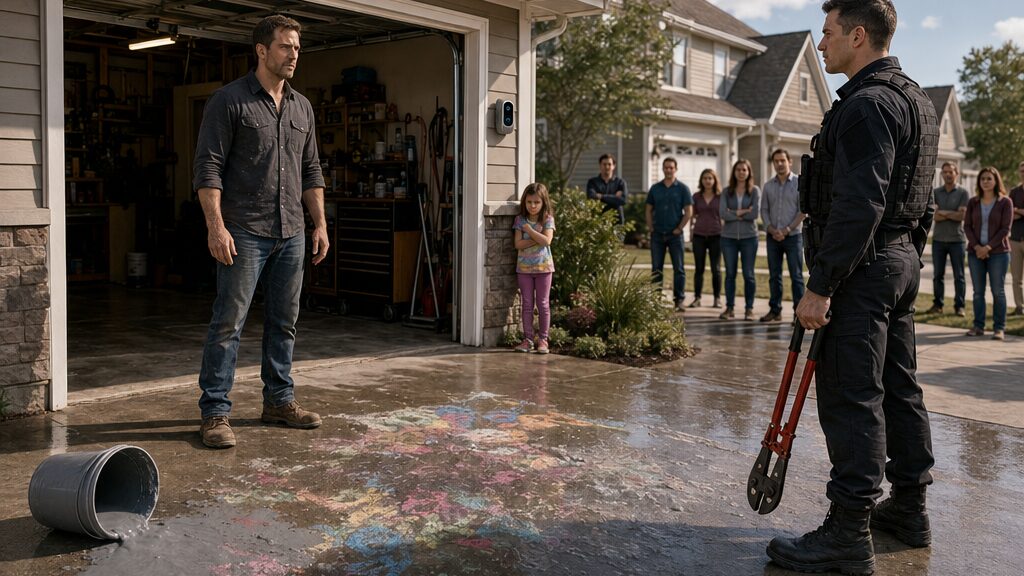
The Day a Security Guard Erased a Child’s Chalk Drawing and Accidentally Exposed an Entire HOA Scheme
Chapter 1: The Chalk Drawing Nobody Was Supposed to Notice
The spray of water hit the driveway so suddenly that Ryan Anderson thought a pipe had burst.
He looked up from the workbench inside his garage and saw colors running across the concrete.
Blue. Yellow. Pink.
A child’s chalk sun dissolved into muddy streaks.
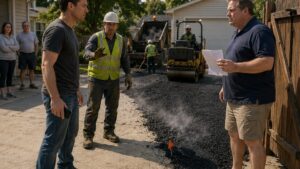
The man holding the hose wore a black tactical vest with SECURITY stitched across the chest in oversized white letters. He stood in the middle of Ryan’s driveway as if he owned it.
“Unauthorized graffiti,” the man announced.
The water swept away a row of chalk flowers.
“HOA orders.”
Ryan set down the piece of oak he had been sanding.
For a second he simply stared.
Not because of the chalk.
Because of where the man was standing.
Halfway up the driveway.
Past the property marker.
Past the line every survey map clearly showed.
On Ryan’s land.
The garage suddenly felt very quiet.
The circular saw had stopped humming.
The only sound was the hiss of water against concrete.
Ryan stepped forward.
“You’re on my property.”
The man turned.
He looked younger than Ryan expected. Early thirties maybe. Hard jaw. Short haircut. The kind of posture that seemed practiced in front of a mirror.
“Edward Davis,” he said.
As if the name should mean something.
Ryan glanced at the HOA logo stitched onto his sleeve.
Edward smiled slightly.
Not friendly.
Confident.
The kind of smile that assumed agreement was inevitable.
“The violation has been documented.”
Ryan looked down.
The chalk drawing was almost gone.
Near the edge of the driveway a few colorful lines remained.
His daughter had spent nearly three hours creating it the previous afternoon.
A giant sun.
Flowers.
A dog that looked nothing like their dog.
And the words WELCOME HOME DAD.
Now most of it was washing toward the street.
“What violation?”
Edward pointed at a clipboard.
“Unauthorized markings visible from community roads.”
Ryan laughed once.
Not because it was funny.
Because it sounded insane.
“It’s chalk.”
“It was reported.”
“By who?”
Edward shrugged.
“The association doesn’t disclose complainants.”
Ryan folded his arms.
The garage opening sat behind him like a frame.
His tools.
His workbench.
His property.
Everything he had spent years building.
“You crossed onto private property to wash away a kid’s drawing.”
Edward checked a box on his form.
“You can appeal through the proper process.”
Ryan had heard those words before.
Proper process.
The HOA loved those words.
The proper process had once required him to replace a mailbox because its paint color was supposedly too dark.
The proper process had fined a retired neighbor over a garden statue.
The proper process had become an excuse for people to forget common sense.
Still, Ryan usually kept his head down.
He documented everything.
Saved notices.
Took photographs.
Avoided public fights.
Angela hated the notices.
But she hated conflict even more.
So Ryan endured.
Until today.
Edward coiled the hose.
As he turned, something metallic swung at his side.
Ryan noticed it immediately.
Industrial bolt cutters.
Huge ones.
The kind used on heavy chains.
“What are those for?”
Edward glanced down.
“Enforcement equipment.”
“For what?”
“Depends.”
The answer bothered Ryan more than it should have.
The bolt cutters had no reason to be anywhere near a chalk drawing.
A strange feeling settled into his stomach.
This wasn’t about chalk.
Or at least not only about chalk.
A small movement near the front window caught his eye.
Angela.
Watching.
Concern written across her face.
Ryan gave her a slight nod.
I’m fine.
At least that was what he intended the gesture to mean.
Edward tucked the clipboard under his arm.
“You’ll receive an official notice by this afternoon.”
“You’re issuing paperwork over sidewalk chalk.”
“It’s driveway chalk.”
Ryan stared at him.
Edward didn’t seem embarrassed.
Didn’t seem uncertain.
If anything, he looked pleased.
Like every citation was a trophy.
Like authority itself was the reward.
The security guard walked toward the street.
Then paused.
“One more thing.”
Ryan waited.
“The association will be conducting a broader compliance review.”
“What does that mean?”
“Additional inspections.”
“When?”
Edward’s smile returned.
“Soon.”
Then he left.
The sound of the hose dragging across concrete faded.
Ryan looked at the ruined drawing.
The remaining pieces of color seemed smaller than before.
Angela stepped outside.
“They actually erased it?”
Ryan nodded.
She stared at the driveway.
“Oh my God.”
Neither of them spoke for several seconds.
Finally Angela looked toward the street.
“What are they doing?”
Ryan didn’t answer immediately.
Because he wasn’t sure.
What bothered him wasn’t the citation.
Not even the trespass.
It was the feeling that someone had wanted this confrontation.
Wanted to see whether he’d object.
Wanted to see how far they could push.
A few hours later the violation notice arrived by email.
Three pages.
Official language.
Warnings.
Deadlines.
References to community standards.
At the bottom sat a sentence that made Ryan read it twice.
Property scheduled for enhanced compliance inspection next week.
He opened another attachment.
Inspection checklist.
Landscaping.
Garage visibility.
Exterior surfaces.
Driveway conditions.
Security concerns.
The list went on for pages.
Angela read over his shoulder.
“This is ridiculous.”
Ryan agreed.
But something caught his eye.
A code number.
The same code number appeared on several previous notices he’d saved.
Different violations.
Different dates.
Same enforcement category.
His jaw tightened.
He walked into the garage.
Opened a drawer.
Pulled out an old folder.
Then another.
Then another.
Years of notices.
Years of warnings.
Years of complaints.
The same code appeared again.
And again.
And again.
The chalk drawing wasn’t an isolated incident.
It belonged to a pattern.
A pattern he suddenly couldn’t ignore.
As the evening light faded across the driveway, Ryan unfolded the newest inspection notice one more time.
Near the bottom was a handwritten addition.
Not part of the printed form.
Someone had added it afterward.
A single sentence.
Inspection team authorized for expanded access review.
Ryan stared at the words.
Then at the property line.
Then at the empty stretch of driveway where the chalk drawing had once been.
For the first time all day, he felt something colder than anger.
He felt curiosity.
Why were they escalating?
Chapter 2: Every Complaint Has a History
The next morning, another notice appeared before breakfast.
Not at Ryan’s house.
Across the street.
A retired neighbor stood in her yard holding a yellow envelope while arguing with an HOA representative.
Ryan watched from his driveway.
The woman’s voice carried across the road.
“It’s a bird feeder.”
The representative pointed at a document.
The conversation ended with the envelope being shoved into her hands.
Then the representative left.
The woman stood motionless.
Defeated.
Ryan crossed the street.
“You okay?”
She looked embarrassed.
“They say it’s oversized.”
Ryan glanced toward the feeder hanging beneath a tree branch.
It looked completely ordinary.
“You’re kidding.”
“I wish I was.”
She folded the notice.
“I’ll just take it down.”
The resignation in her voice bothered him.
Not anger.
Not outrage.
Resignation.
As if losing was easier than resisting.
Ryan thought about the chalk drawing.
About Edward.
About the bolt cutters.
About the inspection notice sitting on his kitchen table.
“When did this start?” he asked.
The woman laughed softly.
“Depends which time you mean.”
That answer stayed with him.
By afternoon Ryan had walked through half the neighborhood.
At first people spoke cautiously.
Then more openly.
A homeowner showed him a citation over holiday lights that had remained up two days too long.
Another revealed a warning about children’s toys being visible from the road.
One man displayed three separate notices involving lawn height measurements.
Each story sounded absurd by itself.
Together they formed something larger.
A pattern.
Not random enforcement.
Systematic pressure.
Ryan returned home carrying notes on his phone and growing frustration.
Angela found him sitting at the garage workbench.
“You’ve been gone all day.”
“I talked to people.”
“And?”
He looked up.
“It isn’t just us.”
Angela leaned against the doorway.
“I know.”
“No. I mean really not just us.”
He showed her photographs.
Copies of notices.
Violation letters.
Inspection schedules.
Angela’s expression darkened.
“How many?”
“More than twenty households.”
Her eyes widened.
Neither spoke for a moment.
The number felt important.
Not because it proved wrongdoing.
Because it proved intent.
Somewhere a decision had been made.
Someone wanted enforcement increased.
Someone wanted fear.
That evening Ryan attended a neighborhood gathering at a small community green.
The conversation started cautiously.
Then shifted.
People complained.
Shared stories.
Compared notices.
But when Ryan suggested documenting everything together, several residents immediately backed away.
One man shook his head.
“No.”
“Why not?”
The man glanced around before answering.
“Because they remember.”
Ryan frowned.
“Who remembers?”
“The board.”
The answer sounded ridiculous.
Yet nobody laughed.
A woman changed the subject.
Another person walked away.
The gathering slowly dissolved.
People who had been eager to complain suddenly became reluctant to speak.
Ryan watched them leave.
The silence revealed something he hadn’t expected.
Fear.
Not fear of fines.
Fear of attention.
Fear of becoming the next target.
On his way home he spotted Edward standing beside an HOA vehicle.
The security guard appeared to be inspecting several properties.
Clipboard in hand.
Tactical vest on.
Like a soldier preparing for battle.
Ryan approached.
Edward noticed him immediately.
“Good evening.”
The words sounded rehearsed.
Ryan folded his arms.
“You’re busy.”
“Community standards never sleep.”
Ryan almost laughed.
Instead he said, “I’ve been talking to neighbors.”
Edward’s expression barely changed.
But Ryan saw something flash behind his eyes.
Awareness.
“Have you?”
“A lot of complaints.”
Edward nodded.
“That’s usually what happens when standards rise.”
Ryan stepped closer.
“What exactly are you trying to accomplish?”
For a moment Edward looked genuinely surprised.
Then he answered honestly.
Or honestly enough.
“Order.”
Ryan waited.
Edward continued.
“Most communities decline because people stop enforcing rules. Someone has to be willing to be unpopular.”
There it was.
Not greed.
Not malice.
Conviction.
Edward actually believed he was improving the neighborhood.
That made him more dangerous.
Because people who enjoy power sometimes know they’re wrong.
People who believe they’re right rarely stop themselves.
A radio crackled on Edward’s shoulder.
The security guard looked down.
Then smiled.
“Good news.”
“What?”
“The compliance sweep has been approved.”
Ryan felt tension settle into his chest.
“What sweep?”
Edward lifted his clipboard.
“Enhanced inspections across the district.”
“When?”
“Very soon.”
Then he walked away.
Later that night Ryan sat alone in the garage.
The inspection notice rested beside him.
So did photographs from neighbors.
And copies of citations.
He arranged them across the workbench.
One by one.
Looking for connections.
Dates.
Code numbers.
Inspectors.
Addresses.
Eventually something emerged.
Several violations referenced the same enforcement category.
The same code.
Again and again.
Different homes.
Different complaints.
Same classification.
Ryan stared at the pattern.
Then opened a fresh notebook.
For the first time he began organizing everything systematically.
Not as individual incidents.
As evidence.
Hours later he reached for another file.
Inside was an older notice from nearly two years earlier.
Something slipped loose.
A secondary page.
One he’d forgotten existed.
Ryan unfolded it.
Read it once.
Then again.
The page connected three previous enforcement actions through the same internal authorization number.
Three unrelated incidents.
One source.
Ryan looked at the growing stack on his workbench.
The chalk drawing.
The inspections.
The neighbors.
The code numbers.
Suddenly the story felt much larger than a single driveway.
And for the first time, he had proof that the incidents might all lead back to the same place.
Chapter 3: The Evidence Nobody Wanted
The box had been hidden beneath the lowest shelf in the garage for so long that a layer of dust covered the lid.
Ryan dragged it into the light.
For several seconds he simply stared at it.
Then he opened it.
Folders filled the entire container.
Dates.
Photographs.
Inspection notices.
Emails.
Property maps.
Certified letters.
Years of records.
Years of patience.
Years of waiting for common sense to return.
Angela entered the garage carrying two mugs of coffee.
She stopped when she saw the contents.
“What is all this?”
Ryan didn’t answer immediately.
Because he knew exactly what she was seeing.
Not paperwork.
An obsession.
A history.
Evidence of every time he had chosen documentation over confrontation.
“I kept everything.”
Angela set down the mugs.
“How long?”
Ryan pulled out the oldest folder.
“Almost six years.”
Her eyes widened.
“Six years?”
He nodded.
Neither spoke.
The silence felt uncomfortable.
Not because Ryan regretted keeping records.
Because he realized Angela hadn’t known how much space the conflict occupied inside his head.
She picked up a photograph.
A property marker.
Another showed tire tracks crossing a boundary line.
Another showed workers entering private yards.
“You never told me it was this much.”
“I didn’t want you worrying.”
Angela laughed softly.
Not with amusement.
With disbelief.
“You think hiding six years of this makes me worry less?”
Ryan looked away.
The flaw had always been the same.
Endure quietly.
Handle it alone.
Gather proof.
Wait.
Maybe too long.
Angela sat beside him.
“What are you planning?”
Ryan considered the question.
Until now he hadn’t had a real answer.
Then his phone buzzed.
A neighborhood notification.
He opened it.
A new enforcement schedule had been posted.
Enhanced compliance review.
His address sat near the top.
Ryan read further.
Then froze.
The scheduled inspection included driveway modifications and surface correction review.
Angela noticed immediately.
“What?”
He handed her the phone.
She read.
Her expression tightened.
“They’re coming back.”
“Yeah.”
The garage seemed smaller.
The open doorway framed the driveway outside.
The place where the chalk drawing had vanished.
The place where Edward had stood.
The place where every confrontation somehow returned.
Angela looked at the evidence box.
Then at Ryan.
“Maybe it’s time somebody else sees this.”
Before Ryan could answer, another message appeared on his phone.
Unknown number.
Three words.
We should talk.
A second message followed.
My name is Christine Brown.
Ryan stared at the screen.
Then at the mountain of evidence spread across his workbench.
For the first time, he wondered how much of the story someone else already knew.
Edit
Chapter 4: The Investigation Behind the Cameras
Christine Brown did not waste time with introductions.
The moment Ryan answered the phone, she said, “How many years have you been keeping records?”
Ryan looked at the folders spread across his workbench.
“About six.”
A brief silence followed.
Then Christine exhaled.
“That’s longer than I expected.”
The next afternoon they met in a quiet corner of a local café.
Christine arrived carrying a tablet, a notebook, and the exhausted look of someone who had spent months chasing reluctant sources.
Ryan brought copies.
Not originals.
He still wasn’t ready for that.
For nearly an hour, Christine reviewed notices, photographs, inspection reports, and correspondence.
She rarely interrupted.
When she did, the questions were precise.
“Did the same people sign these?”
“Who approved this inspection?”
“Did anyone challenge the citation?”
“Did the HOA ever explain why enforcement increased?”
The pattern Ryan had noticed became more visible under her scrutiny.
Christine tapped one page.
Then another.
Then a third.
“Same authorization chain.”
Ryan nodded.
“I found that too.”
“And this one.”
She pointed again.
“Different neighborhood. Same approval number.”
Ryan leaned forward.
“You’ve seen this elsewhere?”
Christine hesitated.
“Yes.”
That answer changed everything.
Until now, Ryan had assumed the problem was local.
An aggressive board.
An overzealous enforcer.
A handful of bad decisions.
Christine’s expression suggested something larger.
She lowered her voice.
“We’ve been investigating HOA enforcement practices for months.”
Ryan stared at her.
“We?”
“My station.”
The words settled heavily.
“We’ve interviewed residents from three communities.”
Ryan looked down at the paperwork.
“What did you find?”
“Enough to ask questions. Not enough to publish conclusions.”
That distinction mattered.
Questions attracted attention.
Conclusions required proof.
Christine continued reviewing documents.
Eventually she pushed one folder back toward him.
“This helps.”
“Then why haven’t you aired anything?”
“Because accusations aren’t evidence.”
Ryan respected that answer.
Even if it frustrated him.
Christine wasn’t looking for outrage.
She was looking for facts that could survive scrutiny.
As they continued talking, Ryan noticed something else.
She never once claimed the HOA was guilty.
Not directly.
Instead she focused on actions.
Records.
Patterns.
Decisions.
It was slower than anger.
But stronger.
Before leaving, Christine asked one final question.
“What happens next?”
Ryan laughed softly.
“I think they’re coming after my driveway.”
Her expression did not change.
“Good.”
Ryan frowned.
“Good?”
“Not for you.”
She closed her notebook.
“For the story.”
Back at home, Angela listened carefully while Ryan described the meeting.
When he finished, she folded her arms.
“So now reporters are involved.”
“Maybe.”
“Ryan.”
He knew that tone.
The one she used when she was worried.
“You’re getting deeper into this.”
“They already brought it to our driveway.”
Angela looked toward the window.
Toward the spot where the chalk drawing had once been.
Neither of them spoke for several moments.
Finally she said, “Just don’t assume evidence protects people.”
The statement lingered.
Because she was right.
Evidence didn’t stop harassment.
Evidence didn’t stop trespassing.
Evidence only mattered after something happened.
Three days later another notice arrived.
This one was different.
The inspection date had been moved forward.
Significantly.
Ryan read the document twice.
Then a third time.
The review was no longer scheduled for next week.
It was scheduled for two days from now.
Angela read over his shoulder.
“They accelerated it.”
“Yeah.”
Ryan immediately called Christine.
She answered on the second ring.
Before he could explain, she interrupted.
“They moved the date.”
His grip tightened on the phone.
“How did you know?”
“Because two other residents reported the same thing today.”
Ryan looked out at the driveway.
The property line.
The garage threshold.
The place where all roads seemed to lead.
Christine’s voice remained calm.
“They’re getting aggressive.”
“Why?”
“I don’t know.”
But Ryan wasn’t sure she believed that.
After a pause she added, “Whatever happens, don’t force it.”
“What do you mean?”
“If they make a mistake, let them make it.”
Ryan understood.
The trap only worked if someone willingly stepped into it.
That evening, a technician installed additional equipment near Ryan’s existing doorbell camera.
The setup looked ordinary.
Nothing flashy.
Nothing obvious.
Exactly what Christine wanted.
Documentation.
Not theater.
As darkness settled over the neighborhood, Ryan stood in the garage looking out at the driveway.
For years he had watched people cross boundaries and walk away.
This time felt different.
Because for the first time, someone else was watching too.
The next morning a message arrived from Christine.
Short.
Direct.
Livestream arrangements confirmed.
Ryan stared at the screen.
The inspection was less than forty-eight hours away.
The cameras were ready.
The reporter was ready.
The evidence was ready.
The only unanswered question was whether Edward Davis would walk into the trap.
Chapter 5: The Line Across the Concrete
The trucks arrived shortly after nine.
Ryan heard them before he saw them.
Heavy engines.
Doors slamming.
Voices.
He stepped out of the garage and counted three vehicles.
One HOA truck.
One contractor vehicle.
One security SUV.
Edward climbed out first.
Tactical vest.
Clipboard.
The same confidence.
The same assumption that every confrontation would end the way he wanted.
Behind him, two workers unloaded equipment.
One carried industrial bolt cutters.
Another rolled supplies toward the driveway.
Ryan felt Angela appear beside him.
Neither spoke.
Across the street, curtains shifted.
Neighbors were watching.
Edward approached.
“Morning.”
Ryan stayed at the garage threshold.
“Morning.”
Edward checked his clipboard.
“Enhanced compliance inspection.”
“You already inspected.”
“This is a follow-up.”
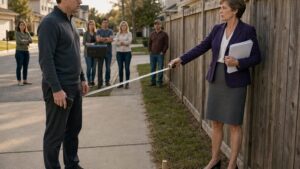
Ryan pointed toward the property line.
“You have no permission to enter.”
Edward smiled.
“We have authorization.”
“From who?”
“The association.”
Ryan almost laughed.
The answer was exactly what he expected.
Authority referencing authority.
A circle with no accountability.
The workers moved closer.
One set down the bolt cutters.
Another began arranging equipment.
Ryan noticed a large bucket near the truck.
Grey paint.
A bad feeling settled into his stomach.
“What is that for?”
Edward glanced back.
“Surface correction.”
“What surface?”
“Noncompliant markings.”
Ryan stared.
The chalk drawing had been gone for days.
There were no markings.
No violations.
Nothing left.
Unless the point had never been correction.
Only control.
Edward stepped across the property line.
One foot.
Then another.
Ryan’s jaw tightened.
“Stop.”
Edward continued walking.
The workers followed.
One hesitated.
The other looked uncertain.
Edward didn’t.
For a moment Ryan saw exactly what drove him.
Not hatred.
Certainty.
The belief that resistance itself was proof someone needed to be controlled.
Ryan stepped forward.
The distance between them narrowed.
“Last warning.”
Edward’s expression hardened.
“Move aside.”
The driveway suddenly felt silent.
Even the workers stopped moving.
One neighbor had stepped outside.
Then another.
People were watching.
Waiting.
Edward pointed toward the garage.
“You don’t decide where inspections occur.”
Ryan held his gaze.
“No.”
He nodded toward the property line.
“But I decide where my property begins.”
Edward signaled to the workers.
The one carrying the paint bucket started forward.
That was the moment everything changed.
Ryan moved quickly.
Not toward Edward.
Toward the bucket.
The worker froze.
Ryan grabbed the handle.
Twisted.
Then kicked.
The bucket overturned.
Grey paint exploded across the concrete.
A thick stream rolled across the driveway.
Stretching from one edge to the other.
A perfect line.
The paint settled.
Heavy.
Unmistakable.
A boundary.
Nobody moved.
Ryan looked at Edward.
Then at the line.
Then back at Edward.
When he finally spoke, his voice was almost quiet.
“Cross it.”
The security guard stared.
Ryan took one step backward.
“I dare you.”
For the first time since arriving, Edward hesitated.
Only briefly.
But Ryan saw it.
The uncertainty.
The calculation.
The realization that dozens of eyes were watching.
Then pride won.
Edward stepped forward.
Across the paint.
Across the line.
Across the boundary he had been warned about repeatedly.
The moment his boot landed, Ryan felt certainty settle inside him.
Not fear.
Not anger.
Certainty.
Because Edward had chosen.
The workers looked uncomfortable.
One backed away entirely.
Edward seemed determined to reclaim control.
“You’ve interfered with an official process.”
Ryan nodded slowly.
Then pointed upward.
Toward the small camera mounted beside the garage.
Edward glanced at it.
His expression didn’t change.
Not yet.
Ryan pointed toward a second camera.
Then a third.
Then toward Christine’s vehicle parked discreetly down the street.
Understanding began to form.
Slowly.
Dangerously.
Ryan looked directly at him.
“You’re live.”
The words hung in the air.
For the first time all morning, Edward looked genuinely confused.
Then alarmed.
Then pale.
Chapter 6: Live for the Entire Town to See
Edward’s eyes snapped toward the street.
Toward the parked vehicle.
Toward the cameras.
Toward the neighbors holding phones.
The confidence vanished so quickly it almost seemed unreal.
“What do you mean, live?”
Ryan didn’t answer immediately.
Instead, he let Edward look.
Let him notice details he had ignored.
The reporter’s vehicle.
The equipment.
The attention.
The witnesses.
Finally Ryan said, “Everything since you arrived.”
Edward’s face tightened.
“That’s not legal.”
Christine’s voice came from behind him.
“It is.”
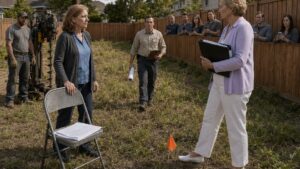
She stepped forward holding a microphone.
Not dramatic.
Not triumphant.
Professional.
Edward turned.
Recognition hit him instantly.
Ryan watched the realization spread across the security guard’s face.
The investigation.
The questions.
The cameras.
The pattern.
All connecting at once.
“What is this?” Edward demanded.
“A chance,” Christine replied, “for everyone to see exactly how these inspections happen.”
A crowd had formed now.
Not large.
But large enough.
Neighbors who usually stayed silent stood openly in their driveways.
Some carried violation notices.
Others simply watched.
The workers exchanged nervous glances.
One quietly walked back toward the truck.
Edward tried to recover.
Tried to sound authoritative.
“This inspection was approved.”
Christine nodded.
“Then you shouldn’t have a problem explaining why you crossed onto private property after being warned not to.”
Edward opened his mouth.
Stopped.
Tried again.
No answer came.
Because everyone present had seen it.
The line.
The warning.
The choice.
His radio crackled.
He ignored it.
Then it crackled again.
More urgently.
The performance was collapsing.
Ryan felt no satisfaction yet.
Only focus.
For years he had imagined this moment differently.
Louder.
Angrier.
Instead it felt strangely calm.
Because the truth required less effort than the lies protecting it.
A neighbor stepped forward.
Then another.
Stories emerged.
Not speeches.
Simple facts.
Notices.
Warnings.
Inspections.
Each person adding another piece.
Edward looked increasingly trapped.
Not by cameras.
By reality.
Then the police arrived.
Two officers stepped from a cruiser.
The crowd immediately parted.
Questions followed.
Statements.
Documentation.
Review of footage.
Review of property maps.
Review of warnings.
Everything Ryan had spent years collecting suddenly mattered.
Not because it solved everything.
Because it established context.
The officers watched footage from the cameras.
Then requested additional recordings.
Then spoke privately with the workers.
The tension shifted.
Edward felt it too.
His posture changed.
His voice lost certainty.
Eventually one officer approached him.
“We need to discuss the trespass complaint.”
Edward pointed toward the clipboard.
“The association authorized—”
“The association doesn’t authorize entry onto private property.”
The officer’s interruption landed hard.
Ryan saw panic appear for the first time.
Real panic.
Not anger.
Not frustration.
Fear.
The kind that arrives when certainty disappears.
Edward looked toward the crowd.
Toward Christine.
Toward Ryan.
As though searching for someone to restore the old balance.
Nobody did.
The officer instructed him to turn around.
Silence swept through the driveway.
One neighbor quietly exhaled.
Another shook their head.
Edward’s hands trembled.
“This is ridiculous.”
No one answered.
The handcuffs clicked into place.
A sound small enough to miss.
Yet impossible to ignore.
As officers escorted him toward the cruiser, several neighbors stepped closer together.
Not cheering.
Not celebrating.
Watching.
Witnessing.
The cruiser door opened.
Edward stopped.
Looked back once.
At the driveway.
At the cameras.
At the thick grey paint line still cutting across the concrete.
Then the officers placed him inside.
The door shut.
The sound echoed across the street.
For several seconds nobody moved.
Then Christine lowered her microphone.
Her phone buzzed repeatedly.
Messages.
Notifications.
Viewership updates.
She looked at Ryan.
“The audience is huge.”
Ryan blinked.
“How huge?”
She showed him the screen.
The number stunned him.
People far beyond the neighborhood were watching.
Listening.
Sharing.
Not because of chalk.
Not because of paint.
Because everyone understood the feeling of someone crossing a line they had no right to cross.
As the cruiser pulled away, Ryan remained standing near the garage.
Near the place where it had started.
The paint line remained visible.
A mark on concrete.
A mark on a story.
A mark that would not disappear as easily as chalk.
But even as the crowd slowly dispersed, another question lingered.
Edward had fallen.
The investigation had not.
And somewhere beyond one driveway, other people were about to discover what happened when a boundary finally held.
Edit
Chapter 7: What Remains After the Boundary Holds
The first chalk line appeared on the driveway three weeks later.
Ryan noticed it while carrying lumber into the garage.
A small blue circle.
Nothing more.
He stopped and looked down.
Then another shape caught his eye.
A yellow flower.
A red sun.
Children had returned.
For a moment he simply stood there.
The old grey paint line still remained faintly visible across the concrete. Rain had softened it. Tires had worn it down. Time had tried to erase it.
But traces remained.
The chalk drawings crossed over it without hesitation.
Color over grey.
Life over conflict.
Ryan found himself smiling before he realized it.
Angela stepped onto the driveway carrying groceries.
She followed his gaze.
“They came back.”
“Yeah.”
The words felt bigger than they sounded.
Because for weeks the neighborhood had been different.
People talked now.
Neighbors who once avoided eye contact stopped to chat.
Several residents had begun challenging citations.
Others attended HOA meetings for the first time.
The silence that had protected bad behavior had started breaking apart.
Not dramatically.
Gradually.
The way real change often happened.
Angela set down the grocery bags.
“You know what the strange part is?”
“What?”
“Nobody talks about Edward anymore.”
Ryan looked toward the street.
She was right.
For months the security guard had seemed larger than life.
An unavoidable problem.
A constant pressure.
Now he felt small.
A symptom rather than a cause.
The real story had never been one man.
It had been the system that encouraged people like him.
That afternoon Ryan received a call from Christine.
He answered while working inside the garage.
“How’s the celebrity life?” she asked.
Ryan laughed immediately.
“If anyone thinks I’m a celebrity, they’re confused.”
“Probably.”
He heard papers rustling on her end.
Then her tone shifted slightly.
“I thought you’d want an update.”
Ryan set down a measuring tool.
“What happened?”
“The investigation expanded.”
That got his attention.
Christine continued.
“Several board members retained attorneys.”
Ryan remained silent.
“The county requested records.”
“What kind of records?”
“Enforcement decisions. Internal approvals. Inspection procedures.”
Ryan leaned against the workbench.
The garage suddenly felt very familiar again.
The same garage where he had spent years collecting notices.
The same garage where he had hidden folders beneath shelves.
The same garage where he had convinced himself that enduring quietly was enough.
“What do you think happens now?” he asked.
Christine paused.
“I think people start asking questions they should’ve asked years ago.”
After the call ended, Ryan sat alone for a while.
Not celebrating.
Not reliving the confrontation.
Thinking.
The evidence box remained on a shelf nearby.
He walked over and opened it.
Folders filled with old frustrations stared back at him.
Six years.
Six years of proving things.
Six years of waiting.
Six years of believing that if he collected enough facts, someone else would eventually solve the problem.
Angela entered the garage.
“You look serious.”
Ryan nodded toward the box.
“I was thinking about getting rid of it.”
Her eyebrows rose.
“Really?”
“Maybe not all of it.”
He lifted one folder.
“But I don’t think I need to carry every battle forever.”
Angela studied him.
Then smiled softly.
“That sounds healthier.”
He laughed.
“Probably.”
For the first time, the box felt less like protection and more like history.
Something important.
Something real.
But no longer something that controlled him.
A week later the neighborhood held a small gathering near the community green.
Nothing official.
Just residents talking.
Children running between folding chairs.
Families sharing food.
The atmosphere felt unfamiliar.
Relaxed.
Ryan recognized several people who had once avoided speaking publicly.
Now they traded stories openly.
One neighbor approached him.
“I never thanked you.”
Ryan shook his head.
“You don’t need to.”
“Maybe I do.”
The man looked away briefly.
“I kept my head down for years.”
“So did I.”
The neighbor smiled.
“Not anymore.”
As evening approached, Ryan walked home alone.
When he reached his driveway, he stopped.
Fresh chalk drawings covered the concrete.
Someone had added a house.
A bright yellow sun.
Several stick figures.
Near the center sat a thick grey line.
Drawn intentionally.
The children had noticed it.
Remembered it.
Turned it into part of the picture.
Above the line, written in uneven letters, were four simple words.
THIS IS OUR HOME.
Ryan stared at them.
The message wasn’t about ownership.
Or law.
Or enforcement.
It was about belonging.
About limits.
About respect.
About understanding where your authority ended and another person’s life began.
Angela joined him at the edge of the driveway.
Neither spoke for a while.
The fading sunlight reflected off the chalk colors.
Across the street, neighbors laughed.
Children ran through the yards.
Normal sounds.
Ordinary sounds.
The kind that had always mattered more than citations.
Ryan looked one last time at the faint grey mark still visible beneath the drawings.
The line had changed meaning.
First it had been a warning.
Then a challenge.
Then evidence.
Now it was simply a reminder.
Boundaries mattered.
Not because they separated people.
Because respecting them allowed people to live together.
Angela slipped her hand into his.
Ryan squeezed it gently.
The fight was over.
The lesson remained.
And for the first time in a long while, the driveway felt like nothing more than a driveway again.
The story has ended.