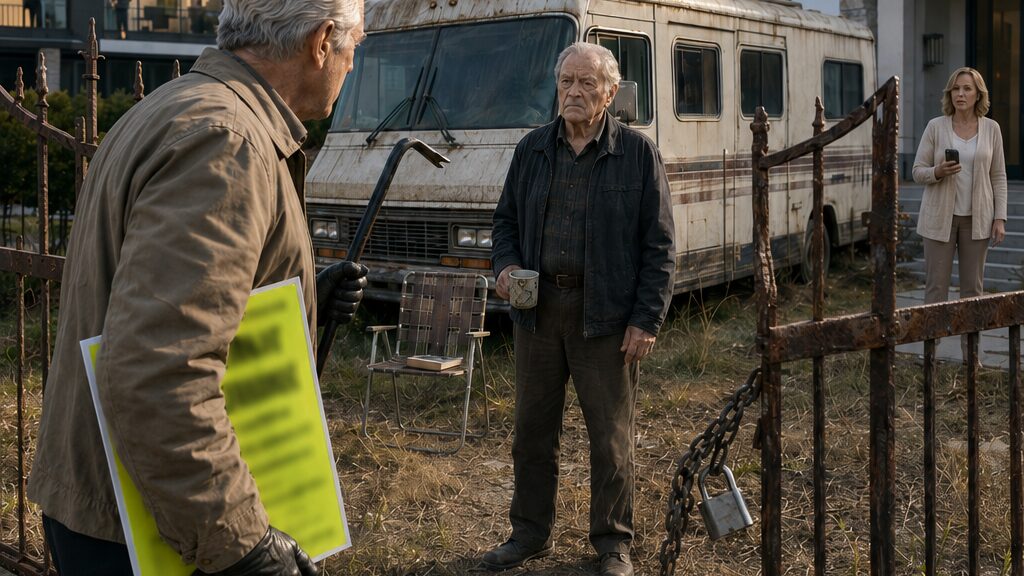
The Old Man They Tried To Tow Owned The Corner Lot Between Their Mansions
Chapter 1: The Rusty Gate Between Two Mansions
Jeffrey Taylor slowed his silver luxury car beside the rusty gate and raised his phone like he had found evidence of a crime.
The old RV sat beyond the chain-link entrance, half hidden by tall grass and wild blackberry vines, its cream paint weathered to the color of old bone. A folding chair stood beside it. A tin coffee pot rested on a crate. A paperback lay open-faced on the arm of the chair, pages held down by a smooth stone.
George Miller watched Jeffrey through the RV’s side mirror.
He did not turn around. He did not wave. He simply poured coffee into a chipped enamel mug and let the man take his pictures.
Jeffrey rolled forward three feet, stopped again, and photographed the RV from a lower angle, making sure to catch the mansion on the left and the mansion on the right. Both houses were new, sharp-edged, glass-fronted, and pale as polished teeth. Between them, George’s lot looked like a held breath from another decade.
The driver’s window came down.
“You know people can see you,” Jeffrey called.
George picked up his mug.
Jeffrey waited, offended by the lack of answer. “This is a private neighborhood.”
George took one slow sip.
The coffee had gone a little bitter. He liked it that way.
Jeffrey’s mouth tightened. He wore a soft gray sweater too clean for the hour, white-soled shoes, and a watch that caught the sun every time his wrist moved. His hair, silver at the sides, had been combed into place with the disciplined anger of a man who did not like disorder in mirrors or streets.
“You can’t just park that thing wherever you want.”
George stepped down from the RV. His knees gave their usual morning protest, but he did not let it show. He crossed the packed dirt path toward the gate, past grass that brushed his faded trousers, and reached into his jacket pocket.
Jeffrey’s phone followed him.
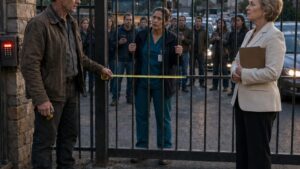
George took out a key, old brass, worn at the teeth. He slid it into the rusted lock at the gate latch and turned it once. The lock opened with a dry click.
For the first time that morning, Jeffrey stopped recording.
George looked at him through the bars. “Something you need?”
Jeffrey’s eyes flicked from the key to the lot, then back to George’s jacket, the scuffed shoes, the old mug. He recovered quickly.
“Where did you get that?”
George did not answer.
The question sat between them. George had learned that a question left alone told more about the person asking than any reply he could give.
From the mansion on the right, Carol Harris stepped onto her front walk holding a watering can. She was dressed for gardening but did not touch a plant. Her attention moved from Jeffrey to George with the wary calculation of someone deciding what kind of neighbor she wanted to be seen as.
“Morning, Carol,” Jeffrey said loudly.
Carol gave a small smile. “Good morning.”
Jeffrey lifted his phone again. “I’m documenting this. We all should. It’s getting ridiculous.”
George closed the gate and locked it again from inside.
The click seemed to irritate Jeffrey more than any insult could have.
“For weeks,” Jeffrey said, turning slightly so Carol could hear him, “we have had an unknown man living in a derelict vehicle on one of the most valuable lots on this block. I’ve called the city. I’ve called patrol. Nothing.”
Carol shifted the watering can to her other hand. “They said it was a civil matter, didn’t they?”
“They said they couldn’t move him unless they had a reason.” Jeffrey leaned on the word as if he were prepared to manufacture one. “Apparently standards aren’t reason enough anymore.”
George walked back to his chair.
The paperback was a secondhand copy with a cracked spine and notes in the margins from someone who had owned it before him. George liked books that had been handled by strangers. They reminded him that every life left pressure marks.
Near the gate, something pale was tucked into the chain.
He noticed it before sitting.
Folded paper. Heavy stock. Pushed between the links where he could not miss it.
George took his time. He set the coffee down, lifted the stone from the book, closed the paperback around a scrap of receipt, and only then returned to the gate.
Jeffrey watched from his idling car, satisfied.
George pulled the notice free.
It was not official, though it tried to look official. At the top, in bold letters, it read: CONCERNED RESIDENTS OF THE RIDGE. Beneath that, a printed paragraph described “hazards,” “transient occupation,” “declining curb appeal,” and “unverified tenancy.” Several lines were underlined in red.
At the bottom, in handwriting George recognized from earlier notes, someone had added:
Leave before this becomes unpleasant.
George folded the paper along its original crease.
Carol’s face changed. Not much. Just enough.
“Jeffrey,” she said softly, “maybe we should let the city handle it.”
“The city has had its chance.” Jeffrey slipped his phone into his pocket. “People like this count on decent people being too embarrassed to say what everyone is thinking.”
George placed the folded complaint inside his jacket.
Inside the RV, behind the narrow bench and under a shelf of old maps, was a black portfolio case with a brushed metal clasp. It already held six complaint letters, three city notices, two photographs taken from behind hedges, and one printed message claiming someone had seen “smoke” from his stove when he had not used the stove in a month.
He had kept them all.
Not because they frightened him.
Because paper had a way of making cowardice less deniable.
Jeffrey opened his car door and stepped one polished shoe onto the curb. “I don’t know what arrangement you think you have here, but this is not the kind of place where people can just squat until everyone gives up.”
George slid the folded notice deeper into his pocket. “You finished?”
Jeffrey blinked. “Excuse me?”
“I asked if you were finished.”
Carol lowered her eyes.
For one moment, Jeffrey looked less angry than unsettled. He had expected shame, excuses, maybe pleading. George’s calm had no handle on it. It gave Jeffrey nothing to grab.
Then the anger came back, stronger because it had stumbled.
“You have no idea who you’re dealing with.”
George looked past him, toward the two mansions, the clipped lawns, the stone mailboxes, the young ornamental trees tied upright with nursery straps. The neighborhood was beautiful in the way showrooms were beautiful. Nothing had been allowed to grow old enough to belong.
“I’ve got a fair idea,” George said.
Jeffrey stepped closer to the gate. “People worked their whole lives to live here.”
George glanced at Jeffrey’s car, then at the quiet house behind him. “Some did.”
Carol’s lips parted, but she said nothing.
Jeffrey heard the insult even if it had not been spoken loudly enough for the street. His face tightened, and for a second George saw something beneath the polish: a man pushed out of a corner office, carrying the old title around like a cane that no longer reached the ground.
The glimpse almost softened him.
Almost.
Jeffrey pointed at the RV. “That thing is coming out.”
George picked up his coffee again. “No, it isn’t.”
The answer was too simple. It left no room for negotiation, no ladder for Jeffrey to climb down without looking like he had obeyed.
Carol took one step back toward her porch.
“If the police won’t do their jobs,” Jeffrey said, loud enough for both mansions and the empty street, “then someone with standards will have to.”
George looked at the complaint notice in his pocket, feeling its sharp corner through the fabric. He thought of opening the portfolio, showing the deed, showing the survey, showing the old stamped pages that would end this small theater before it found a larger audience.
Instead, he lifted the mug.
Silence had taught him more than argument ever had.
But that morning, for the first time, the silence tasted less like patience and more like permission.
Jeffrey got back into his car. The engine purred with expensive restraint. He drove away from the curb and turned into his own driveway two houses down, though his eyes stayed on the RV until the last possible second.
Carol remained at the edge of her lawn.
“I’m sorry about the notice,” she said, not quite loudly enough.
George looked at her.
She held the empty watering can with both hands now.
“I didn’t write it,” she added.
George nodded once. It was not forgiveness. It was only acknowledgment.
By noon, the street had gone quiet. The gardeners left. Delivery vans came and went. A child on a scooter slowed near the gate, stared at the RV, then hurried away when someone called from inside one of the houses.
George repaired a loose hinge on the gate with a screwdriver from the RV’s tool drawer. He swept leaves from the narrow path. He made a fresh pot of coffee and read three pages of his paperback without remembering a sentence.
Just before evening, when the glass faces of the mansions caught the setting sun and threw it hard across the lot, a piece of paper appeared against the gate.
This one had not been tucked into the chain.
It had been taped flat to the rusted metal, where anyone walking past could see it.
George approached slowly.
It was a printed photograph of his RV.
Someone had taken it that morning from the street. The old vehicle looked smaller in the photo, sadder, trapped between the mansions as if it had been placed there by mistake. Across the bottom, in thick red marker, one word had been circled so hard the paper had torn.
REMOVE.
George stood with the tape lifting in the evening breeze.
Then he folded the photograph carefully, exactly in half, and carried it back to the RV.
Chapter 2: The Sticker Jeffrey Wanted Everyone To See
Jeffrey Taylor stood in his garage that afternoon peeling the corner of a neon sticker from its plastic backing, testing whether it would come away clean or fight him.
It fought him.
Good.
The sticker was the color of emergency tape, bright enough to shout from across the street. Across its face, in black block letters, it read:
CONDEMNED / TOW
He pressed the lifted corner back down with his thumb and smiled without pleasure. It was not an official sticker. It did not need to be. Most people did not read small print when fear arrived in large letters.
On the workbench beside it lay a thick crowbar, a roll of packing tape, a flashlight, and the printed photograph he had copied before taping the original to the old man’s gate. The word REMOVE looked even better the second time.
Jeffrey had once run meetings where grown men waited for him to nod before they spoke. He had controlled budgets that could move departments across states. When he had retired, people had clapped in a hotel ballroom and called him a visionary. Three months later, his replacement stopped returning his calls.
Now an old man in a faded jacket could ignore him from a lawn chair.
Jeffrey slid one finger beneath the sticker again. The adhesive stretched, then released with a soft, ugly rip.
Perfect.
Across the street, George was on his knees beside the gate, cleaning the old lock with a rag and a small bottle of oil. He could feel Jeffrey watching before he saw him. Men like Jeffrey believed attention was a weapon. They never understood how loud it made them.
The gate latch moved more smoothly now. George tested it twice, listening to the mechanism settle. Behind him, the RV door stood open. Inside, the narrow space was tidy enough to surprise anyone who expected ruin.
Books lined two shelves above the bench. Not decorative books bought by color, but worn paperbacks, field guides, histories, poetry with cracked covers. A stack of folded maps sat under a brass clip. Against the rear wall, rolled plans showed lot lines from decades ago. Beneath the bench, the black portfolio case waited with its metal clasp closed.
George took the complaint notice from his jacket and added it to the case.
He hesitated over the photograph with REMOVE circled in red.
That one he placed on top.
His phone buzzed on the little counter beside the sink.
The screen showed Maria Gonzalez.
George let it ring twice before answering. “Maria.”
“You didn’t sign the final release,” she said without greeting.
“I signed the parts that mattered.”
“That is not comforting when we are discussing an acquisition that makes lawyers sweat.”
George looked through the RV window. Jeffrey’s garage door was open across the street. The man stood at his workbench, shoulders tight, head bent over something bright enough to glow even in shade.
“What time is closing?” George asked.
“Technically, tomorrow morning. Practically, as soon as you stop pretending paperwork respects your sense of drama.” Maria paused. Her voice changed. “Are you still on the lot?”
“I am.”
“George.”
He smiled faintly. “That tone again.”
“That tone is why you pay me.”
“I pay you because you read what other people hide in footnotes.”
“And because I tell you when sentiment has become exposure.” Papers rustled on her end. “Your name is shielded through the foundation, but not forever. Once the purchase records update, anyone angry enough can connect pieces.”
George watched Jeffrey lift the neon sticker and hold it at arm’s length.
“I expect anger,” George said.
“You expect it from boardrooms. I’m asking about your neighbors.”
“My neighbors are educational.”
“That is not an answer.”
“It is the answer I have.”
Maria exhaled. She had worked with him for eleven years, long enough to know when pushing would only make him quieter. “At least keep the portfolio close.”
“It is close.”
“And George?”
“Yes.”
“Do not let some angry man in golf shoes become the reason I spend tomorrow explaining hospital security to your foundation board.”
Before George could answer, Jeffrey stepped out of his garage holding the neon sticker against its plastic backing like a sign.
George ended the call.
He placed the phone face down beside the sink.
Jeffrey crossed to the sidewalk but did not enter the street. Not yet. He wanted to be seen carrying the thing. Carol Harris saw him from her dining room window; George caught the movement of her curtain. Another neighbor’s garage door paused halfway up.
Public shame required an audience. Jeffrey understood that much.
George stepped out of the RV and closed the door behind him.
Jeffrey stopped at the gate. “You see this?”
George looked at the sticker. “Hard not to.”
“This is what happens when people refuse to cooperate.”
“People?”
Jeffrey’s mouth twitched. “Don’t make this philosophical.”
George rested one hand on the gate. “You have no authority to place that on anything here.”
Jeffrey gave a dry laugh. “Authority. That’s rich.”
“It can be.”
The joke landed nowhere Jeffrey could reach. His face colored.
Carol appeared at the edge of her porch again. She wore sunglasses though the porch sat in shade. Her attention fixed on the neon sticker, then on George, then on Jeffrey, as if she were silently arranging her testimony and hoping she would never have to give it.
Jeffrey noticed her. His voice grew stronger.
“I spoke with a towing service.”
“No, you didn’t,” George said.
Jeffrey’s jaw flexed.
George had not meant to say it. Not so plainly. But the lie was small and lazy, and he had less patience for lazy cruelty than he used to.
Jeffrey stepped closer to the gate. “You calling me a liar?”
“I’m saying no licensed towing service is removing a vehicle from private property without owner authorization and proper paperwork.”
Carol’s head lifted slightly.
Jeffrey looked at the gate, the lock, George’s old key hanging from a loop at his belt. “You read that somewhere in one of your little books?”
“In several.”
The sticker bent in Jeffrey’s grip.
For one dangerous second, George thought the man might try to slap it onto the gate right then. Instead, Jeffrey smiled, thin and controlled.
“Tomorrow,” he said. “Tomorrow morning, we’ll settle this.”
George glanced toward the crowbar lying just inside Jeffrey’s garage, partly covered by a towel now, but not enough.
Carol saw it too.
She took one step forward, then stopped.
Jeffrey followed George’s gaze and turned just enough to block the view into the garage. “You should pack whatever matters to you.”
George thought of the black portfolio. The books. The old maps. The enamel mug. The RV’s worn steering wheel, polished by hands from a life before money learned his name.
“What matters to me is staying,” he said.
Jeffrey leaned close to the gate. “Listen carefully. I tried the right way. I called the city. I called the police. I talked to the neighborhood. You’ve embarrassed everyone long enough.”
“Embarrassment is a private choice.”
“No,” Jeffrey snapped. “It’s what happens when people like you drag the rest of us down.”
There it was. Not safety. Not law. Not order. The rest of us.
George’s hand tightened around the top rail, then relaxed.
He could have said the street name before it had been paved. He could have described the old drainage ditch beneath Jeffrey’s driveway, the one the builders had filled too quickly. He could have told Carol the corner lot had been left wild by design, not neglect. He could have taken one document from the portfolio and ended Jeffrey’s performance under the white afternoon sun.
Instead, he looked at Carol.
Her face had gone still with the strain of witnessing something she wished would stay deniable.
George waited.
Carol lowered her eyes first.
That was the moment that disappointed him more than Jeffrey’s threat.
Jeffrey saw it as victory.
“Tomorrow morning,” he repeated. “This thing gets marked and dragged.”
He lifted the neon sticker once, letting it flash like a warning flare, then turned back toward his driveway.
Carol remained on her porch until he placed the sticker on his workbench and reached for the crowbar. She watched him lift it, test its weight, and lay it in the trunk of his luxury car with a deliberate softness that somehow made the act worse.
Her hand moved toward her phone.
Then it stopped.
George saw that too.
At dusk, he sat outside the RV with his coffee cooling beside him and the paperback open on his lap. He had read the same paragraph four times.
The gate stood between him and the street, old but locked.
For now.
Chapter 3: The Crowbar Hits The Padlock First
The crowbar hit the padlock before George had finished pouring his coffee.
The sound tore across the quiet morning, a hard metallic crack that made birds lift out of the overgrown lot in a single startled burst. Coffee spilled over George’s thumb and onto the little counter inside the RV.
He did not curse.
He turned off the burner, set the pot down, and listened.
A second strike landed.
The lock held, but the gate screamed on its hinges.
Outside, Jeffrey Taylor was breathing hard through his nose. He had parked his luxury car crooked at the curb with the trunk still open. The neon “CONDEMNED / TOW” sticker lay across the hood in its thick plastic backing, bright as a wound. He wore leather gloves and a windbreaker too expensive for the work he was pretending was necessary.
Carol Harris stood on her porch in a pale cardigan, one hand at her throat.
George picked up his phone from the counter. The screen was cracked at one corner, but it played messages well enough. He pressed voicemail.
Officer Scott Baker’s voice filled the narrow RV.
“Mr. Miller, this is Officer Baker returning your call. At this time, unless there is active damage, forced entry, or a direct threat, this remains a civil property matter. If anyone damages the gate or enters the lot without permission, call us immediately and stay clear if possible.”
A third strike rang out.
The lock snapped.
George stopped the message.
He looked at the coffee on his hand, then wiped it slowly on a dish towel.
Outside, Jeffrey kicked the lower part of the gate. It swung inward a few inches, dragging through grass and dirt. The broken padlock hung from the chain like a dead weight.
“Enough,” Jeffrey shouted, though no one had argued with him. “Enough of this.”
George opened the RV door.
The morning air was cool. The kind of cool that usually made the first sip of coffee matter. He stepped down carefully, one hand on the door frame, then straightened.
Jeffrey saw him and lifted the crowbar as if it were proof of office.
“Don’t start,” Jeffrey warned.
George looked at the broken lock. “You forced my gate.”
“I opened an illegal obstruction.”
“No.”
Jeffrey stepped through onto the lot.
George’s gaze moved to the line Jeffrey’s shoe had crossed. The dirt was still damp there from last night’s watering. The print was sharp.
“This is private property,” George said.
Jeffrey laughed, but there was effort in it. “That’s exactly what I’m trying to protect.”
“The gate is private property. The lot is private property. The RV is private property.”
“Then show me the owner.”
George’s silence pulled Jeffrey forward like a hook.
“That’s what I thought.” Jeffrey turned slightly toward Carol. “He can’t. He can mumble about private property, but he can’t produce a name, a lease, anything.”
George glanced at Carol.
She had her phone in her hand now. Not raised. Just held, screen dark, as if the possibility of recording could stand in for courage.
Jeffrey walked back to his car and grabbed the neon sticker from the hood. The plastic backing was thick, glossy, and stiff enough that he had to hold it with both hands against the breeze.
“Last chance,” Jeffrey said.
George stepped away from the RV and moved onto the dirt path between Jeffrey and the vehicle. He was not a large man. Age had drawn him inward at the shoulders. His jacket hung loose at the wrists. But the path seemed narrower with him standing in it.
“Do not touch my vehicle.”
“Your vehicle?” Jeffrey said. “Fine. Then move your vehicle.”
“No.”
The answer landed flat.
Jeffrey shook his head, almost smiling now, as if George’s refusal had freed him from the burden of pretending. “You people always make someone else be the bad guy.”
George’s eyes sharpened. “You people?”
“You know exactly what I mean.”
“I know exactly what you mean,” George said.
Something in his tone reached Carol. She took one step off her porch.
“Jeffrey,” she called, “maybe wait for the police.”
He whipped his head toward her. “The police already refused to do anything.”
“They said unless there was damage—”
“There is damage!” he snapped, pointing at the RV. “Look at this street.”
Carol flinched.
George did not.
Jeffrey turned back, breathing faster now. His face had changed from righteous to cornered. The crowbar had not made him look stronger. It had made his fear visible.
George saw that and felt the old temptation rise: let him go farther. Let him reveal himself fully. Let the record become clean beyond argument.
It was a familiar habit, and not a harmless one.
He had built institutions on patience. He had survived boardrooms by letting louder men overreach. He had learned that truth, if left undisturbed, usually rose.
But people could be hurt while waiting for truth to rise.
Jeffrey stepped closer with the sticker.
George lifted one hand. Not high. Not dramatic.
“Last warning.”
Jeffrey’s mouth curled. “Or what?”
The question hung in the space between them.
Behind Jeffrey, Carol finally raised her phone, though her hand trembled.
George did not look at her. He looked at the neon sticker and then at the RV window where Jeffrey meant to place it. On the other side of that glass were his books, the old maps, the portfolio, the coffee still warm on the counter, and a photograph tucked behind the visor that no one on this street had earned the right to see.
Jeffrey took the final step.
The plastic backing bent as he pressed the sticker toward the RV window.
George moved forward just enough to block the glass.
“Last warning,” he said again, quieter this time.
Jeffrey shoved the sticker closer. “Get out of my way.”
Chapter 4: Rotting Trash On A Polished Car
“Carol, record this,” Jeffrey shouted, and kicked the first garbage can toward the RV.
The can toppled with a hollow plastic boom, its lid flying off before it had rolled three feet. A sour spill of coffee grounds, wilted greens, greasy paper, and wet leaves spread across the dirt path. The smell rose at once, thick and rotten, turning the cool morning foul.
George did not look at Carol’s phone.
He looked at Jeffrey’s foot.
Jeffrey had not stepped back. He had planted himself wider, crowbar still hanging from one gloved hand, sticker bent under the other arm. His face had the flushed, bright look of a man who had crossed one line and found the next easier to see.
“You want to live in garbage?” Jeffrey said. “Then let’s make the outside match.”
The second can stood near the edge of the lot, one of the old city-issued bins George kept there for leaves and brush. Jeffrey grabbed its handle and yanked it toward the RV. The wheels caught in a rut. He cursed, kicked it free, and sent it lurching forward.
Carol’s phone was up now.
Her hands shook so badly the black rectangle bobbed in the air. Behind her, two curtains moved in separate houses. The street had become a theater, and no one had bought a ticket honestly.
George stepped sideways.
Not backward.
Just sideways.
The garbage can came at him, heavy and wobbling, its lid clapping like a loose jaw. Jeffrey had expected him to stumble away from it, maybe throw up his hands, maybe beg him to stop before the mess reached the RV’s worn side panel.
George did none of that.
He moved once, fast enough that Carol made a small sound.
His right foot struck the lower rim of the can, not wildly, not in panic, but with the clean precision of someone who knew where weight lived inside moving things. The can changed direction as if it had hit a wall. It snapped back toward the gate, wheels shrieking, lid flipping open.
Jeffrey’s smile disappeared.
The can slammed into the inside of the broken gate, burst through the gap Jeffrey had forced open, and bounced into the street. It struck the front corner of Jeffrey’s luxury car with a wet, ugly thud.
For one second nothing moved.
Then the contents slid out across the polished hood.
Rotten lettuce. Ripped trash bags. Old coffee filters. A gray ribbon of something spoiled and unrecognizable. It spread over the windshield, down the chrome trim, into the narrow seam above the headlights.
Carol dropped her phone.
It hit the porch step and clattered, still recording the sky.
Jeffrey stared at his car.
The look on his face was not simple anger. It was disbelief first, pure and childish. Then panic. Then something sharper, because the car was not only a car. It was the last bright proof of a life where people stepped aside before he had to raise his voice.
“You touched my vehicle,” he whispered.
George stood between him and the RV, breathing evenly.
“You kicked trash at mine.”
Jeffrey turned back slowly. His right hand tightened around the crowbar.
“Do not,” George said.
The words were quiet, but they stopped Carol from bending for her phone.
Jeffrey heard them too. His eyes flicked to George’s face, then to the old man’s shoulders, then to the foot that had turned a rolling garbage can into a return shot. For the first time since he had arrived, Jeffrey seemed to measure George as a body, not a category.
He did not like the numbers.
The fear embarrassed him, and embarrassment made him reckless.
He dropped the bent sticker onto the ground and seized the third can, the heaviest one, the one with a cracked lid and black handles worn smooth. It was packed with damp yard waste from the lot, heavier than it looked. Jeffrey dragged it backward, panting, then shoved.
“Let’s see you do it again.”
George’s jaw tightened.
He had time to step away. He had time to let the can crash against the RV and let the damage become evidence. He had time to prove Jeffrey wrong through paperwork, through police reports, through the slow machinery men like Jeffrey believed belonged only to them.
Instead, he saw the RV window behind him.
Behind that window, the worn paperback lay open on the bench. Beside it, the black portfolio sat under folded maps. Above the windshield, tucked where no one could see unless invited, was a small photograph of a younger man and a woman standing beside the RV before the paint had faded. The woman was laughing. The man had grease on his cheek and no idea yet what money would do to his name.
George stepped into the can’s path.
Carol gasped, “No—”
His left hand brushed the lid aside as it snapped up. His right foot slid back in the dirt, knee bending. The can hit his shin hard enough to bruise, but he took the force, turned with it, and drove his boot into the lower side.
The old strength came out of him like a door kicked open.
The can launched back through the gate.
It did not roll this time.
It lifted, toppled, and struck the first garbage can already collapsed against Jeffrey’s car. Both cans overturned together. A burst of sour liquid splashed across the hood and windshield. The cracked lid spun into the driver’s side mirror, folding it inward with a sharp plastic snap.
Jeffrey made a sound as if he had been hit.
The street froze.
George’s leg throbbed. He ignored it.
The crowbar slipped lower in Jeffrey’s hand. He looked from George to the car, then to Carol’s fallen phone, then to the houses. Curtains shifted. Someone’s garage door stopped halfway down.
They had seen.
That was the wound. Not the garbage. Not even the damage. The seeing.
“My car,” Jeffrey said.
George bent slowly and picked up the neon sticker from the dirt. The plastic backing had cracked where Jeffrey had dropped it. One corner of the sticker had collected dust and a strand of dead grass. He held it out.
Jeffrey did not take it.
“You brought this,” George said.
“You attacked my property.”
George let the sticker fall at Jeffrey’s feet. “You brought that too.”
Jeffrey’s face darkened. “You think this is funny?”
“No.”
“You think because you’re old, because you’re pathetic, because people feel sorry for whatever story you have, you can assault me?”
Carol came down from the porch then, not all the way, just to the bottom step. “Jeffrey, he didn’t touch you.”
Jeffrey spun toward her. “Stay out of this.”
The command snapped across the lawn with the ease of old habit. Carol stopped.
George saw her stop, and disappointment moved through him again, heavier than anger.
Jeffrey fumbled his phone from his pocket. His gloves made him clumsy. Trash slid slowly down his windshield in ropes. The car’s hood ornament, once bright, was buried under coffee grounds and torn plastic.
He stabbed at the screen.
“Yes,” he barked. “I need police. Right now. I’m at the corner lot on Ridge Hollow. The vagrant in the RV attacked my car.”
George walked to the broken gate and lifted the fallen padlock from the dirt. One side of its shackle had snapped under the crowbar blows. It was an old lock, but it had held for years against rain and wind and teenagers cutting through the lot. It had not held against a retired executive with something to prove.
Jeffrey paced by the curb, voice rising.
“Yes, he’s unstable. Yes, there are weapons. He has—” Jeffrey glanced at the crowbar in his own hand, then quickly tossed it onto the grass beside the gate. “He’s dangerous. I want him arrested.”
George turned the padlock over in his palm.
The break was clean.
Useful.
Carol had retrieved her phone now. The recording still ran. She stared at the screen as if it had betrayed her by keeping what she had failed to stop.
Jeffrey ended the call and pointed at George.
“You’re finished.”
George slipped the broken padlock into his jacket pocket.
Jeffrey took a step toward him, then stopped when George lifted his eyes.
The old man’s expression had not changed much. That made it worse. The garbage, the shouting, the police call, the public ruin of Jeffrey’s car—none of it had produced the pleading Jeffrey wanted. George simply stood inside the broken gate with dirt on one boot and coffee drying on one hand.
In the distance, a siren began to rise.
Jeffrey heard it and straightened, pulling his shoulders back into the shape of authority.
“I want this vagrant arrested for attacking my property!” he shouted toward the approaching sound, as if the law had already chosen his side.
Chapter 5: The Deed Proves Less Than Everyone Thinks
Officer Scott Baker stepped over the broken padlock just as Jeffrey pointed at the trash-covered luxury car and demanded handcuffs.
“There,” Jeffrey said, voice shaking with triumph and rage. “There is the damage. There is the man who did it. I want him removed from this neighborhood and charged.”
Officer Scott did not look where Jeffrey pointed first.
He looked down.
The padlock was gone from the dirt, but the scraped place where it had fallen remained beside the gate. The chain hung slack. Fresh marks scarred the metal around the latch. One hinge had bent inward from the force of the crowbar.
Then he looked at George.
“Mr. Miller.”
George gave a small nod. “Officer Baker.”
Jeffrey’s head snapped toward him. “You know him?”
“I returned a call regarding this address,” Officer Scott said.
“This is not an address. It’s a nuisance lot.”
Officer Scott’s eyes shifted to him. “Sir, step back from the gate.”
Jeffrey gave a short laugh. “I’m the one who called you.”
“And I’m asking you to step back from the gate.”
The sentence was calm enough to leave no room for performance. Jeffrey stepped back, but only half a pace.
Officer Scott was younger than George by decades, but his face already held the tired restraint of someone who spent his days entering arguments after everyone had begun lying to themselves. He took in the crowbar on the grass, the broken chain, the neon sticker face-down near the path, the garbage spread over the car, and Carol standing at the edge of her lawn with her phone clutched in both hands.
“Who forced the gate?” he asked.
Jeffrey opened his mouth.
Carol said, “Jeffrey did.”
The words surprised her as much as they surprised everyone else.
Jeffrey turned slowly. “Carol.”
She swallowed. Her sunglasses were gone now; without them, her eyes looked frightened and older. “You hit the lock with the crowbar. More than once.”
“I opened a hazard.”
“You broke a lock.”
Jeffrey stared at her as if betrayal were something only other people committed.
Officer Scott turned to Carol. “Did you see him enter the lot after breaking it?”
“Yes.”
“Did you see Mr. Miller strike Mr. Taylor?”
“No.”
“He launched garbage at my car,” Jeffrey snapped.
“After you kicked it toward his vehicle,” Carol said.
The street went quiet after that.
George looked at Carol. She did not look back. Her shame had finally become heavier than her fear, but it had arrived late. George knew late truth still mattered. He also knew what late truth cost before it came.
Officer Scott removed a small notebook. “Mr. Miller, do you have documentation for the property?”
Jeffrey laughed again, desperate for the sound to rebuild him. “Of course he doesn’t.”
George reached inside his jacket, then paused.
There it was again: the old reflex to let another man walk farther into his own trap. Let Jeffrey mock. Let him dig. Let him become undeniable.
Officer Scott waited.
George took out a folded envelope, soft at the creases but protected inside a clear sleeve. He handed it over without flourish.
Jeffrey leaned forward. “What is that supposed to be?”
Officer Scott opened the sleeve and unfolded the papers against the hood of his patrol car, not Jeffrey’s. His finger followed the lines. Lot number. Parcel boundary. Transfer stamp. Survey reference. Gate easement. Name.
George Miller.
The officer read it twice.
Jeffrey’s voice sharpened. “That could be anything.”
Officer Scott looked up. “It appears to be a deed.”
“Appears,” Jeffrey seized on. “Exactly. It appears. How old is that? Is it current? Has it been verified? You can print anything these days.”
George watched the paper flutter slightly in the morning air. So much weight, and still it could move like a leaf.
Officer Scott said, “Mr. Taylor, this document matches the lot number and address.”
“There is no house.”
“There is still an address.”
“This is absurd.” Jeffrey gestured toward the RV. “Look at him. Look at this place. You think a man who owns this kind of land lives like that?”
George said nothing.
The officer’s eyes moved briefly to him. Something like embarrassment crossed his face, not for George, but for the fact that the question had been allowed to hang in the open.
Carol’s voice came quietly from the lawn. “He unlocks the gate with a key.”
Jeffrey rounded on her. “You are not helping.”
“No,” she said, almost too softly to hear. “I suppose I wasn’t.”
George looked at her then.
Carol’s mouth tightened. “I saw the notice. The photo. The sticker. I saw the crowbar in your trunk yesterday.” She drew a breath that trembled. “I should have said something before.”
Jeffrey’s face showed the smallest crack. Under the fury there was something wounded and frantic. “You all complained. Don’t pretend now. You all wanted this handled.”
“Handled,” Carol said, “not smashed.”
Officer Scott folded the deed carefully. “Mr. Miller, do you wish to file a complaint for property damage and trespass?”
George looked at the broken gate, the crowbar, the sticker, the trash-coated hood of Jeffrey’s car. Then he looked at Jeffrey, who was still standing as if the street might return to him if he held his posture long enough.
“I want the facts recorded,” George said.
Jeffrey barked a laugh. “Facts? Fine. Record this. I am Jeffrey Taylor. I spent thirty years running divisions bigger than this town’s entire budget. I know lawyers who eat paperwork like that for lunch.”
Officer Scott’s pen stopped.
Jeffrey heard himself regaining shape. He stepped closer to the officer, lowering his voice but not enough. “You think this is over because he waved an old deed? I will bury him in court. I will have inspectors here. Environmental complaints. Health complaints. Zoning. Fire. Media, if I need it. By the time I’m done, he won’t be able to park a bicycle on this lot.”
George felt something inside him cool.
The deed had answered the easiest question. It had shown the ground belonged to him. But it had not touched the thing Jeffrey truly believed: that enough money, enough pressure, enough contempt dressed as procedure could make ownership meaningless for someone who looked powerless.
Officer Scott handed the deed back to George. “Sir, I advise you to stop making threats.”
Jeffrey smiled at him. “That wasn’t a threat. That was a preview.”
A black sedan turned into the street.
It was not loud. It did not speed. It simply appeared at the corner, clean and dark, and moved toward them with a steadiness that drew every eye. It stopped behind the patrol car.
Maria Gonzalez stepped out carrying a black business portfolio against her side.
Her shoes clicked once on the curb, then went silent on the grass. She took in the broken gate, the crowbar, the neon sticker, Jeffrey’s ruined car, Officer Scott’s notebook, and George holding the deed.
Her expression tightened, but she did not rush.
Jeffrey looked her up and down. “And who are you supposed to be?”
Maria ignored him.
She walked to George and lowered her voice.
“Do you want him to know now?”
Chapter 6: The Company Name Inside The Black Portfolio
Jeffrey laughed at the black portfolio until Maria said the company name aloud.
It was only two words, but they cut through the street cleanly. The laughter stopped in Jeffrey’s throat. His eyes, which had been narrowed in contempt, widened with a recognition he tried too late to hide.
“You don’t know that name,” he said.
Maria held the portfolio with both hands. “I know it very well.”
Jeffrey looked from her to George, then back again. “No.”
No one had accused him of anything yet. The denial came anyway.
George noticed that. So did Officer Scott.
Maria unlatched the portfolio. The sound of the clasp opening was small, almost polite. Inside were indexed folders, a sealed envelope, acquisition summaries, and a slim card case clipped beneath a leather strap. Nothing in it looked dramatic. That was the nature of real power, George had learned. It rarely needed to raise its voice.
“George,” Maria said, “the purchase finalized at 9:14 this morning. I was coming to get your signature on the public-facing release when your call log stopped answering.”
“I was occupied.”
Her eyes moved to his shin. Dust clung to his trouser leg where the garbage can had struck him. “I can see that.”
Jeffrey stepped closer. “Purchase?”
Officer Scott lifted one hand. “Sir, stay where you are.”
Jeffrey ignored him for half a second, then seemed to remember the badge and stopped. “What purchase?”
Maria looked to George, waiting.
There it was. The cleanest path. Let Maria speak. Let the documents do what documents did. Let Jeffrey be crushed by language he understood: acquisition, control, board, voting rights, resignation clauses, deferred compensation.
George could remain the quiet old man while someone else opened the trapdoor.
He almost allowed it.
Then Carol shifted near the porch, and her phone caught the movement. Not recording now, just reflecting sunlight. George saw in that little black screen the same thing he had seen for weeks: people waiting to let someone else decide what was decent.
He reached out.
Maria gave him the portfolio.
George held it against his chest for a moment. It was heavier than the deed. Not in paper. In consequence.
“Jeffrey,” he said.
Jeffrey flinched at being addressed by his first name. “You don’t get to call me that.”
“I bought the company you keep using as your introduction.”
Jeffrey’s face went blank.
Maria closed her eyes briefly, as if she had hoped for a gentler opening and known she would not get one.
George continued, not loudly. “Not personally in the way you mean. Through the foundation. Through holding structures you would recognize if you still read filings before dismissing people.”
Jeffrey stared at him.
For once, he did not have a ready sentence.
George opened the portfolio and removed a summary page. He did not wave it. He handed it to Officer Scott first.
The officer read the heading, then the signatures, then the effective date. His posture changed in small increments. At the bottom of the top page, clipped beneath the executive transition list, was Jeffrey Taylor’s name.
Former advisory compensation. Legacy consulting clause. Termination review pending.
Officer Scott looked up.
Jeffrey saw the look and lunged for the paper.
He moved before thought could catch him, one gloved hand reaching past the officer toward the portfolio. It was not a full attack, not the kind that began with fists, but it had the same root: the belief that what embarrassed him could be seized and removed.
George turned his shoulder.
Maria stepped back.
Officer Scott caught Jeffrey’s wrist before it reached the documents.
“Do not grab that,” the officer said.
Jeffrey jerked against him. “That’s confidential.”
“It’s his property.”
“It has my name on it!”
“Then you should be careful how you behave near it.”
The words struck harder than the grip.
Jeffrey stopped struggling, breathing fast.
George slid the paper back into the folder. “You spent all morning saying property mattered.”
Jeffrey’s eyes were wet now, though not with remorse. Rage could water a face too. “You set me up.”
“No.”
“You sat here, dressed like that, living in that wreck, letting people think—”
“Letting people think what they chose to think.”
“You knew who I was.”
George looked toward the RV. Its side window was streaked with dust where the sticker had almost gone. “I knew your name from the complaints before I knew it from the acquisition.”
Maria’s voice softened, but not kindly. “The foundation purchase includes several divisions Mr. Taylor helped build before retirement.”
“Helped build?” Jeffrey snapped. “I carried that company.”
George looked back at him. “And what did you carry it over?”
Jeffrey’s mouth opened.
No answer came.
For the first time, something other than anger moved through him. Not guilt exactly. Recognition, maybe, unwanted and incomplete. The kind that arrived when a man saw his own methods from the wrong side of the desk.
George opened the portfolio again and removed a small card case. Inside it was a platinum black card, plain except for his name and the foundation mark. He did not show it to impress Jeffrey. He showed it because Officer Scott needed the chain of authority to be visible.
The officer took down the information.
Carol stood motionless near the porch, watching the old man in the faded jacket become harder to misread with every quiet object he produced.
“You live in that?” Jeffrey said suddenly.
The words were smaller now. Confused, almost offended by the failure of the world to sort itself by price.
George followed his gaze to the RV.
“Yes.”
“Why?”
Maria turned slightly toward George. She had asked him a version of that question many times. Never on a street, never with a broken lock on the ground and trash sliding down a luxury windshield.
George touched the edge of the portfolio.
“Because before anyone called me sir, before anyone returned my calls, before the foundation and the boardrooms and the polished rooms where men explained compassion as a budget risk, I had that RV.” His voice stayed even. “It belonged to a time when I knew exactly what I owned because I could fix it with my hands.”
Jeffrey said nothing.
George looked at the broken gate. “My wife and I crossed half the country in it. We stopped where people were told to move along. We met men who slept in cars because a hospital bill took the apartment. Women who lost jobs because they looked tired. Families treated like stains because they had nowhere clean to stand.”
He paused, not because he wanted pity, but because saying too much still felt like spending something private.
“When the money came, I promised her I would not forget what people looked like when doors closed before they reached them.”
Maria lowered her eyes.
Carol’s hand went to her mouth.
Jeffrey’s face hardened again, fighting the human shape of what he had just heard. “So this is some performance. Some lesson.”
George met his gaze. “No. It was my morning. You made it a lesson.”
Officer Scott closed his notebook. “Mr. Taylor, turn around.”
Jeffrey stared at him. “What?”
“At this time, you’re being detained while I sort the charges for trespass, property damage, and attempted interference with documentation.”
“You can’t be serious.”
“Turn around.”
Jeffrey looked toward the houses. Curtains moved. A neighbor stood halfway behind a column. Carol did not move to save him. Maria watched with cool stillness. George held the portfolio at his side, not like a trophy, but like a burden he had finally agreed to carry in public.
Officer Scott took Jeffrey’s arm.
“This is insane,” Jeffrey said, but his voice had lost its architecture.
George stepped toward the broken gate and picked up the bent neon sticker. The words CONDEMNED / TOW were smeared with dirt now, their authority spoiled by the ground Jeffrey had never owned.
Jeffrey saw him holding it and stopped resisting.
For one brief, stripped second, he looked at George as if the old man had appeared from nowhere, though George had been there the entire time.
Then Officer Scott guided him toward the patrol car.
Chapter 7: Coffee, Paperbacks, And A Man Who Disappeared
Jeffrey Taylor was placed in the back of the patrol car while garbage still slid from the hood of his luxury car in slow, humiliating ribbons.
A clump of rotten leaves slipped down the windshield and landed on the wiper with a wet slap. The sound made Jeffrey turn his head sharply, as if even from behind the glass he could command it to stop.
He could not.
Officer Scott Baker closed the patrol car door with a firm, final sound. Jeffrey’s mouth moved behind the window. No one on the curb could hear the words, but the shape of them was familiar enough. Threats. Names. Lawsuits. The old vocabulary of a man trying to buy back the room after losing it in public.
George Miller stood beside the broken gate with the black portfolio under one arm and the ruined neon sticker in his hand.
The sticker no longer looked official. Dirt clung to the adhesive. One corner had folded onto itself, permanently stuck in a bright, useless wrinkle. CONDEMNED / TOW still showed through the smears, but now the words seemed to accuse the person who had carried them.
Maria Gonzalez watched George watch it.
“You do realize,” she said quietly, “that by tonight everyone on this street will know enough to start guessing.”
George looked toward the mansions.
Curtains that had hidden faces all morning moved back into place. A garage door lowered too late. Somewhere, a phone camera disappeared behind tinted glass. The neighborhood was pretending not to stare after staring had become the only thing it knew how to do.
“They were guessing before,” George said.
“Not about this.”
“No.”
Maria adjusted the sleeve of her jacket. Her composure was nearly perfect, but George had known her long enough to catch the worry beneath it. She liked locked files, sealed agreements, clean signatures, controlled releases. She did not like billion-dollar truths spilling into streets beside broken padlocks and trash cans.
“This changes the acquisition announcement,” she said. “It changes the foundation’s privacy structure. It changes your security needs.”
George bent and picked up the crowbar from the grass.
Officer Scott noticed the movement but did not interrupt. George held the tool in his palm, weighing it briefly. Heavy, blunt, ordinary. There was nothing evil about the metal. Only about the hand that had decided a lock was less real because it protected someone poor-looking.
“People keep telling me what changes,” George said. “Rarely what should.”
Maria softened. “That is exactly what I’m afraid of. You think because your reason is good, the cost will behave.”
He almost smiled. “Costs never behave.”
“No,” she said. “They arrive.”
Behind them, Carol Harris came down from her porch.
She did not move quickly. Every step seemed argued with and paid for. Her phone was no longer in her hand; she had left it somewhere inside, or hidden it, or finally understood that recording courage was not the same as having it.
Officer Scott was speaking into his radio near the patrol car. Jeffrey leaned toward the window, trying to catch phrases, trying to make his own name matter through glass.
Carol stopped a few feet from George.
“I sent the video to Officer Baker,” she said.
George looked at her.
“The whole thing,” she added. “The crowbar. The cans. Jeffrey telling me to record.” Her mouth tightened. “Me standing there.”
George said nothing.
Carol’s eyes flickered toward the broken gate. “I should have called yesterday when I saw him put the crowbar in the trunk.”
“Yes,” George said.
The word landed cleanly. Not cruelly. That made it harder for her.
Carol nodded once, as if she had expected comfort and knew she had no right to it. “I kept telling myself it wasn’t my business.”
George glanced at the two mansions, the lawns clipped smooth, the new stone mailboxes lined like small monuments. “That is how things become everyone’s business too late.”
Her eyes filled, but she kept her posture. “I’m sorry.”
George looked at the patrol car.
Jeffrey had stopped talking. He was looking out now, not at the officer, not at Maria, not even at his ruined car. He was looking at George through the closed window with an expression that had lost its polished anger and found something emptier. The man had not disappeared. Not physically. But the version of him that filled the street had shrunk until the leather seat seemed too large around him.
George turned back to Carol.
“What will you do the next time?” he asked.
She blinked. “The next time?”
“When someone decides another person is easier to move than understand.”
Carol’s answer did not come quickly. That counted in her favor.
“I don’t know,” she said. “But I won’t stand on the porch and call it peace.”
George nodded.
This time, it was closer to forgiveness, though not all the way there.
Officer Scott approached with the deed sleeve and acquisition summary copied into his report. He handed the originals back to George.
“Mr. Miller,” he said, “I’ll need you to come by later for a formal statement. We have enough for detainment now. Charges will depend on review, but forced entry and property damage are clear.”
George slid the deed into the portfolio. “And the car?”
Officer Scott looked at Jeffrey’s vehicle, where a slow trail of brown liquid had reached the front grille. “That will be a separate claim. Given the video, I’d suggest everyone let insurance and the report handle it.”
Maria’s expression suggested she had already made seven calls in her head.
Officer Scott hesitated, then lowered his voice. “For what it’s worth, sir, I should have come out sooner.”
George studied him.
The officer did not look away.
“You came when there was damage,” George said.
“That was the rule.”
“Yes.”
“It may not have been enough.”
George looked at the broken gate. “Rules often arrive after harm has introduced itself.”
Officer Scott accepted that without defense. “I’ll be in contact.”
He returned to the patrol car and opened the driver’s door. Jeffrey’s face turned toward him immediately, reassembled into argument. The officer got in anyway. A moment later, the patrol car pulled from the curb with Jeffrey in the back seat, passing his own trash-covered luxury car as slowly as if the street wanted him to see every inch of it.
No one waved.
After the patrol car turned the corner, the neighborhood made the mistake of believing the scene was over.
George placed the portfolio on the folding chair, walked to the RV, and returned with a small toolbox. He knelt beside the gate.
Maria stared at him. “What are you doing?”
“Replacing a lock.”
“I can have someone here in twenty minutes.”
George opened the toolbox. Inside were screwdrivers, pliers, a small tin of washers, and a new brass padlock still in its paper sleeve.
Maria looked at the lock, then at him. “You already had one?”
“I have owned old gates before.”
Carol remained on the grass, unsure whether to leave or help. George did not ask. After a moment, she stepped closer and held the chain steady while he threaded it back through the latch.
Her hands were clean and soft, unused to rust. Brown flakes marked her fingers. She did not wipe them off.
George noticed.
He said nothing.
The new lock clicked shut.
The sound was smaller than the siren, smaller than the crowbar strike, smaller than Jeffrey’s shouting, but it carried farther inside George than any of them.
Maria picked up the bent neon sticker with two fingers. “What do you want done with this?”
George stood slowly. His shin ached where the can had struck him. His back had tightened. His coffee was probably cold.
“Leave it.”
Maria frowned.
George took the sticker from her and carried it to the RV. For a second, Carol looked alarmed, as if he meant to place it on the glass himself. Instead, he slid it into the black portfolio beside the complaint notices, the photograph marked REMOVE, and the papers that had made men like Jeffrey suddenly careful.
“Records?” Maria asked.
“Reminders.”
“Of him?”
George closed the portfolio. “Of waiting too long.”
Maria’s face changed. She understood enough not to answer.
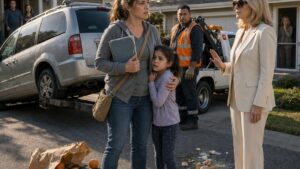
By afternoon, a tow truck arrived for Jeffrey’s car. Its driver stepped out, took one look at the hood, and stopped chewing whatever he had in his mouth. He asked no questions. He hooked the car carefully while a neighbor watched from behind a half-open blind.
The luxury vehicle left the street dripping.
The corner lot remained.
George washed his hands at the outdoor spigot near the RV. Dirt and rust ran into the grass. Carol had gone home. Officer Scott’s patrol car was gone. Maria stood by her sedan, phone in hand, waiting for permission to turn the day into strategy.
“The press may call,” she said.
“Let them call someone else.”
“The board will call.”
“You may answer.”
“Security?”
“One person at the entrance for a few days. Plain clothes.”
“The lot?”
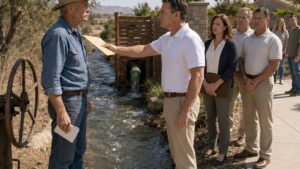
George turned off the spigot. Water fell from his fingers. He looked across the overgrown grass, the blackberry vines, the old trees that had survived the development crews because he had ordered the plans redrawn around them. A narrow path ran from the gate to the RV, but beyond it the land stayed wild in small, deliberate ways.
Children used to cut through lots like this before every corner became owned by people who hated footprints.
“I’m keeping it as it is,” he said.
Maria studied him. “As an overgrown lot between mansions?”
“As shade. As a place with benches. A drinking fountain by the sidewalk. Maybe a little library box near the gate.” He glanced at the paperback on the chair. “No plaque.”
Maria almost smiled. “You hate plaques.”
“I hate plaques that congratulate people for decency.”
“And the RV?”
George looked at it.
The old vehicle sat crooked in the afternoon light, streaked with dust, stubborn and plain. To anyone passing too quickly, it still looked like something left behind. George knew better. It had carried hunger, laughter, grief, bad coffee, maps folded wrong, nights in rain, mornings when the world had not yet decided what he was worth.
“The RV stays,” he said.
Maria nodded, though her eyes were damp now. She hid it by checking her phone. “Then I’ll make the calls.”
“Maria.”
She looked up.
“Thank you for bringing the portfolio.”
“You would have waited another week.”
“Maybe.”
“You would have let him stick that thing on the window.”
George looked toward the gate. “No.”
She accepted the answer because both of them knew how close it had come to being untrue.
When Maria’s sedan finally pulled away, the street held its breath again. Not the old breath of judgment. Something uncertain now. The mansions still stood bright and expensive on either side, but they no longer made the lot look misplaced. If anything, the lot made them look temporary.
George carried his coffee pot outside and poured what remained into the grass. Cold. Bitter. Done.
He made a fresh cup.
Then he lowered himself into the folding chair with care, opened the worn paperback to the page marked by the old receipt, and found the paragraph he had failed to read that morning.
Across the street, Jeffrey’s driveway was empty except for a dark wet stain where garbage had dripped from his car. The space where he had stood shouting seemed louder now than his voice had ever been.
George lifted the mug.
He took one slow sip.
This time, the coffee was hot.
The story has ended.