The HOA Vice President Filmed Robert’s Humiliation Until Her Own Rulebook Went Into the Wood Chipper
Chapter 1: The Trash Can Was Twenty Centimeters Wrong
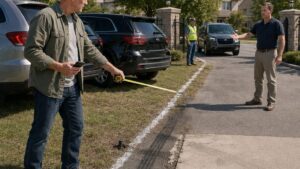
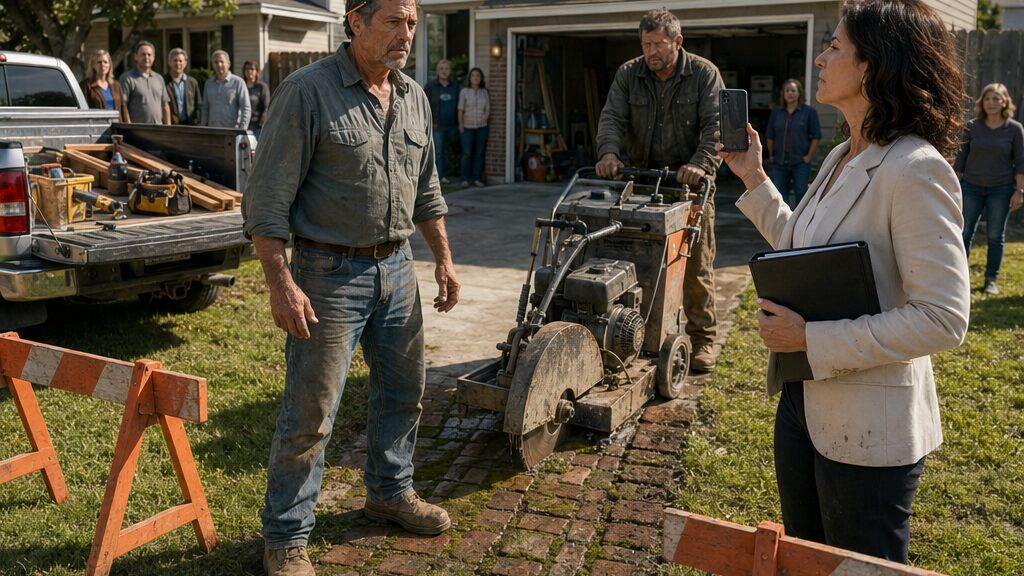
The concrete-cutting machine arrived before Robert Rivera had finished loading his pickup.
It came growling around the curve of Maple Row on a flatbed trailer, chained down and trembling, its circular blade flashing in the early sun like something hungry. Robert stood in the open mouth of his garage with a box of cabinet hinges in one hand and a coil of extension cord in the other, watching the truck brake in front of his driveway.
Behind it came a white HOA golf cart.
That was how Robert knew the morning had stopped belonging to him.
He set the hinges on the tailgate of his pickup. The truck bed was already packed for the day: miter saw, sawhorses, clamps, a toolbox older than half the houses on the street, and two lengths of maple trim wrapped in a moving blanket. Sawdust dusted the cuffs of his jeans. A carpenter’s pencil sat behind his ear. On the left side of the driveway, the mossy brick walkway curved from the garage to the front porch, each brick laid by his own hands years ago, uneven in the small ways that made it his.
Nicole Clark stepped out of the golf cart with her phone already raised.
“Good morning, residents,” she said brightly to the screen, though only Robert was in front of her. “We are here at Lot 17, where repeated noncompliance has required immediate corrective action.”
Robert looked behind him, then at the trash can standing near the curb.
It was green, plastic, ordinary, and by his eye maybe a hand’s width closer to the mailbox than usual.
“Nicole,” he said, “what is this?”
She lowered the phone just enough to smile at him over it. She wore a pale blazer too clean for a street where diesel fumes were beginning to settle. In her other hand was a thick black binder with colored tabs sticking from its side.
“This is enforcement,” she said. “Your trash receptacle was left twenty centimeters out of place after collection.”
Robert stared at her.
The machine on the trailer gave another metal rattle as a man climbed down from the cab. Two crew members began unhooking chains.
“Twenty centimeters,” Robert repeated.
“Approximately,” Nicole said. “Enough to be visible. Enough to violate the aesthetic uniformity standards. And enough, after prior reminders to the community, to trigger corrective action.”
“I got home late from a cabinet install,” Robert said. “I moved it off the street.”
“You moved it incorrectly.”
A neighbor’s curtain twitched across the road. Another garage door stopped halfway open and then went still, as if the person inside had decided not to be seen.
Robert wiped his thumb along the edge of the pickup’s tailgate. “So send me a notice.”
Nicole’s smile tightened with professional delight. “You received community-wide notice last week. Section Fourteen, Subsection C. Waste receptacles must be restored to their approved location, aligned behind the side-yard screening line, no later than two hours after collection.”
“That doesn’t explain the machine.”
Nicole lifted the phone again.
“Mr. Rivera is now questioning the board’s lawful enforcement response,” she narrated. “This is exactly why visible consequences matter. When one resident treats standards like suggestions, the whole neighborhood declines.”
Robert’s jaw moved once. He looked at the phone, not at Nicole.
“Turn that off.”
“It’s a public-facing compliance record.”
“It’s my driveway.”
“It’s HOA-governed frontage.”
“No,” Robert said quietly. “It isn’t.”
Nicole opened the binder with a snap. The pages were laminated. Robert noticed the small performance of it, the way she held the binder angled toward the camera, not toward him.
The crew boss came around the flatbed, boots heavy, beard gray at the chin. His shirt read Hill Contracting across the chest. “Where do you want the barricades?”
Nicole pointed with two fingers. “Lawn edge first. Then around the receptacle. Confiscation tag on the handle.”
The crew boss glanced at Robert. “You the owner?”
“I am.”
“Dennis Hill,” the man said, not offering his hand. “We’re just doing what they contracted.”
Robert looked from Dennis to the machine. “Contracted for what?”
Nicole answered before Dennis could. “Confiscation of improperly placed waste receptacle, temporary barricading of the lawn to prevent repeated violation, and restoration of visual compliance.”
“Restoration,” Robert said. “With a concrete cutter.”
Nicole’s expression warmed as if he had walked into the line she had been waiting for. “Your walkway edge has encroached visually into the regulated frontage zone. Moss growth, uneven brick, nonstandard curvature. It contributes to the same disorder.”
“That walkway is twenty-six years old.”
“And visibly noncompliant.”
Robert took the carpenter’s pencil from behind his ear and stepped to the edge of the driveway. He crouched slowly, knees clicking, and made a short mark on the concrete where the driveway ended and the lawn grade began.
Nicole watched him through her phone. “What are you doing?”
“Marking the property line.”
“You don’t determine property lines with a pencil.”
“No,” Robert said. “But I remember where mine is.”
She laughed softly for her audience. “Mr. Rivera is now drawing on the pavement.”
Robert made another small mark, then stood. He did not raise his voice. That had served him well for many years, through judges who blustered, opposing counsel who baited, clients who panicked, and the long private work of learning how not to let anger drive the hand.
But the phone made something old tighten in him.
Nicole turned slightly, catching both him and the trash can in frame. “This is exactly why we’ve had to become more proactive. Residents think if they perform confusion, rules disappear.”
Dennis’s crew dragged orange barricades from the trailer. The first one scraped across the street with a shrill plastic groan. The sound ran straight up Robert’s spine. One of the workers reached for the trash can.
Robert moved before he thought about it.
He didn’t shove, didn’t grab. He simply stepped between the worker and the can.
“Leave it.”
The worker looked at Dennis.
Nicole’s eyes sharpened. “You are obstructing enforcement.”
“I’m standing beside my trash can.”
“Your trash can was left twenty centimeters out of place,” Nicole said, loud enough for the neighboring driveways. “We have the right to confiscate it and barricade your lawn.”
“Show me where it says you can take personal property for a placement issue.”
She tapped the binder. “Section Fourteen.”
“Read the remedy section.”
Nicole’s mouth paused for half a breath. Robert saw it. She did not like being asked to read anything she had planned to wave.
“I don’t need to perform legal debate on camera,” she said.
“Then stop performing.”
A small sound came from across the street. A woman near her mailbox had covered her mouth. Robert recognized Samantha Lee, whose yard always had smooth white stones around a neat bed of lavender. She looked away when Nicole’s phone panned in her direction.
Nicole smiled again, but this time it was thinner.
“You know, Robert, everyone has been patient with your little workshop situation.” She gestured toward the open garage, the tools, the pickup loaded for labor. “The noise, the sawdust, the truck in and out. People try to be understanding.”
Robert’s hand closed around the carpenter’s pencil.
“I make furniture,” he said.
“You run a business out of a residential property.”
“I load tools in my own garage.”
“And you leave trash cans where everyone can see them.” Nicole stepped closer with the phone. “Smile. The neighborhood page is going to love this.”
Something in Robert’s face must have changed, because Dennis looked at him more carefully.
Robert did not smile.
The crewman holding the confiscation tag shifted from one foot to the other. The morning smelled of diesel, cut grass, and the faint dampness rising from the moss in the walkway. Robert could see the first brick he had ever set, darker than the rest, with a chipped corner he had turned inward because he could not afford to waste it at the time.
Nicole turned to Dennis. “Proceed.”
Dennis jerked his chin. The crewman reached around Robert for the trash can handle.
Robert put one hand on the lid.
“Not until you show me the authority.”
Nicole’s phone came closer. “Refusal documented.”
“You’re documenting yourself taking property.”
“I am documenting a resident becoming aggressive.”
Robert looked at his hand on the trash can. He lifted it away slowly, finger by finger. There were neighbors watching now, not openly, but through glass, over hedges, from half-opened garage doors. That was Nicole’s real machinery, he thought. Not the cutter. The shame.
The worker yanked the trash can backward. Its wheels bounced off the curb with a hollow plastic thump. Robert felt the sound in his teeth.
Nicole stepped onto the edge of the lawn and pointed to the walkway.
“Barricades here,” she said. “And here. Keep them off the street. We don’t want to violate city clearance.”
Dennis looked at the bricks. “You sure this is in the work order?”
“It is within the frontage correction zone.”
“Cut or remove?”
“For now,” Nicole said, glancing at Robert, “score the edge. Make it clear where compliance begins.”
Robert’s voice went flat. “You will not cut my walkway.”
Nicole swung the phone back to him. “Threat noted.”
“That was not a threat.”
“It sounded threatening.”
“It was a boundary.”
She smiled at the word. “The HOA sets boundaries.”
Robert walked to the first pencil mark and tapped the concrete with the point. “This one was set before the HOA existed.”
Nicole’s face hardened. For the first time, the bright public voice slipped.
“Dennis,” she said, “unload the cutter.”
The crew moved faster then, grateful for instruction that did not require interpretation. Chains clanked. Metal ramps hit the pavement. The concrete-cutting machine rolled backward inch by inch, heavy tires thudding onto the street.
Robert stood beside his mossy bricks, hands empty, pencil still between his fingers.
Dennis climbed onto the trailer and took the controls. The machine coughed, then roared.
Nicole held up her phone, catching Robert, the walkway, the machine, the stolen trash can, and the barricades in one clean frame.
Dennis looked down at her over the vibrating handlebar.
“You want the walkway cut first?”
Chapter 2: The Woman With the Phone and the Rulebook
“Resident remains noncompliant,” Nicole said into the phone, making each word crisp enough to survive compression on the neighborhood page. “Crew is preparing visual correction while Mr. Rivera continues to dispute established standards.”
Robert looked straight at the lens.
“Record the machine,” he said. “Make sure you get that too.”
Nicole’s thumb twitched against the side of the phone.
The concrete cutter idled behind her, engine pulsing against the quiet street. It was too large for the problem it had been brought to solve. That was what made people stare. A trash can could be rolled away. A letter could be taped to a door. But a machine with a blade and a contractor’s crew meant somebody had wanted noise.
Dennis climbed down from the flatbed and walked toward Nicole. “Before we start cutting anything, I need the work zone confirmed.”
Nicole turned the binder toward him without handing it over. “Frontage correction. Lot 17. Visual obstruction and waste-receptacle noncompliance.”
Dennis frowned. “That’s not a measurement.”
“It is sufficient for HOA enforcement.”
“It’s sufficient for your end,” Dennis muttered.
Robert heard him.
Nicole heard him too. Her smile sharpened. “You were hired because your company said you could handle resident pushback.”
Dennis’s shoulders stiffened. “We can handle pushback.”
“Then handle it.”
A few more neighbors had drifted out now, drawn by the machine but staying safely behind property lines. A man in running shoes stood with one earbud still in. A woman held a coffee mug in both hands. Samantha Lee lingered near her mailbox, eyes flicking between Nicole’s phone and Robert’s garage.
Nicole pivoted slowly, filming them.
“This is what responsible enforcement looks like,” she said. “It may feel uncomfortable to some residents, but discomfort is how communities learn.”
Samantha’s shoulders drew in. She lowered her gaze.
Robert noticed.
He stepped away from the trash can, which now stood tagged beside the flatbed, and crossed toward Samantha without entering the street. “You all right?”
She looked startled that he had spoken to her. “I’m fine.”
Nicole’s phone followed him.
“Mr. Rivera is now attempting to involve other residents,” she said.
Samantha’s face flushed. “I’m not involved.”
“No one said you were,” Robert said gently.
Nicole walked closer. “Samantha, since you are here, perhaps you can confirm that reminders have been posted about exterior standards.”
Samantha swallowed. “I saw the email.”
“And you corrected your own issue after notice, didn’t you?”
Robert saw Samantha’s fingers tighten around the mailbox handle.
“My garden stones,” she said.
Nicole gave the phone a sympathetic tilt. “A minor matter.”
“You posted pictures of them.”
“They were examples. No address was shown.”
“My porch was in the picture,” Samantha said, then immediately looked sorry she had said it.
Nicole’s expression cooled.
Robert turned slightly, placing his body between Samantha and the phone without making it obvious. “You posted her yard?”
Nicole laughed once. “The community page is for community education.”
“Education,” Robert said.
“Transparency.”
“Humiliation.”
Nicole’s eyes flicked toward the phone, calculating whether that word helped her or hurt him. “Strong language from someone refusing to comply.”
Robert felt the old habit rise in him: let the other side talk, let them build the record, never interrupt a person determined to convict themselves. But this was not a courtroom. Samantha was standing there small and red-faced beside a mailbox she paid for, afraid of a woman with a phone.
Robert looked back at the driveway.
“Show me the order,” he said.
Nicole lifted the binder.
“No,” he said. “The actual order. The work authorization. If you’re cutting anything near my property, show me the description.”
Dennis exhaled through his nose. “I’d like to see that too.”
Nicole’s chin came up. “I don’t answer to contractors or noncompliant residents on the street.”
“You answer to your own paperwork,” Robert said.
The phone came back to his face. “Notice the tone.”
“Notice the blade.”
For a moment, nobody spoke. The machine idled. A dog barked two houses away and was quickly hushed.
Then Nicole closed the binder and reached into the golf cart. She took out a folder with a red sticker across the top. She did not hand it to Robert. She held it at chest height, allowing him only a view of the first page.
“Temporary Corrective Action Order,” she read. “Approved by HOA President Christopher Roberts. Enforcement authority delegated to Vice President Nicole Clark for waste-receptacle noncompliance, landscape-frontage disorder, and related visual obstruction.”
“Related,” Robert said.
“Yes.”
“That word is doing a lot of work.”
“It’s doing enough.”
Dennis stepped closer, squinting at the paper. “Does it list the contractor scope?”
Nicole angled it away. “Your office received it.”
“My office sends crews where the client says. I still like knowing what I’m cutting.”
“You’re not cutting yet,” Nicole said. “You’re preparing.”
Robert kept his eyes on the paper. There was a parcel description halfway down, small print, blocky and official enough to intimidate anyone not used to such things.
Lot 17 frontage strip, communal visual easement, from curb to primary hardscape line.
Primary hardscape line.
Robert almost smiled. Almost.
His walkway was not the primary hardscape line. The driveway was. The original survey put the side walkway entirely within the privately owned lot, beyond the frontage easement. He knew because he had fought the builder over the drainage map the year he bought the house. He had kept every drawing.
Nicole saw his expression and mistook it.
“There,” she said. “Now you’ve seen it.”
“I’ve seen a problem.”
“Yes. Your trash can.”
“No. Your order.”
Nicole’s phone came up again. “Mr. Rivera is now claiming the HOA President’s signed corrective order is invalid.”
“Not claiming,” Robert said. “Reading.”
Samantha took one hesitant step closer. “Robert…”
Nicole swung the camera toward her so fast Samantha stopped.
“What were you going to say, Samantha?” Nicole asked sweetly.
Samantha’s mouth opened, then closed.
Robert looked at her. There was something there—more than embarrassment about garden stones. She had the look of a person who had already paid once and feared the next bill.
Nicole waited, phone steady.
Samantha shook her head. “Nothing.”
“Good,” Nicole said. “Speculation helps no one.”
Robert felt something sour settle under his ribs. He had lived among these people for years and had taken pride in not knowing their business. He waved from the driveway, fixed a loose porch rail if someone asked, lent a clamp, accepted a holiday cookie tin, kept to himself. He had thought privacy was a courtesy.
Maybe it had also been an excuse.
Dennis walked back to the flatbed. “I’m moving the cutter into position,” he called. “No blade until I get final.”
Nicole nodded. “Position it.”
Robert stepped in front of him. “No machinery on the walkway.”
Dennis’s face tightened. He was not eager anymore. He was a man caught between an invoice and a mistake. “I’m not on your walkway.”
“Keep it that way.”
Nicole’s voice cut in. “Mr. Rivera, your hostility is now affecting the safety of the crew.”
Robert turned to her. “You brought a concrete cutter over a trash can.”
“The trash can is the visible symptom. The larger issue is repeated disregard for community standards.”
“Repeated?”
“Your garage door is often open.”
“My garage door?”
“Visible tools. Materials. Vehicle loading. Sawdust.”
Robert looked into his garage, at the neat rows of chisels, the stack of sanded cabinet doors, the broom leaning against the wall. His father had taught him that a clean workspace was a form of respect. Nicole made it sound like decay.
“I work,” he said.
“This is a residential association.”
“People work in residences.”
“Not in a manner that affects neighborhood character.”
The running-shoe neighbor muttered something Robert couldn’t hear. Nicole heard enough to turn the phone toward him. He suddenly became fascinated by his shoelaces.
Dennis guided the cutter off the street and toward the driveway edge. The weight of it made the pavement hum. Robert watched the tires stop inches from his pencil mark.
Nicole took two steps closer to him and lowered her voice, though the phone still recorded.
“You could have avoided all of this by moving the can properly.”
Robert looked at the green trash can with its confiscation tag flapping from the handle.
“This isn’t about the can.”
Nicole’s smile returned. “No, Robert. It’s about whether people like you think you’re above the rules.”
People like you.
He had heard that phrase in polished conference rooms, in deposition breaks, across tables where men in expensive suits mistook worn hands for ignorance. It always meant the speaker had created a smaller version of him and intended to argue with that instead.
He reached for the order.
Nicole pulled it back. “You may request a copy through the board portal.”
Robert’s hand remained in the air for one second too long. Then he dropped it.
“Fine.”
He walked into the garage.
Nicole raised her voice. “Now he’s retreating.”
Robert did not answer. He went to the workbench, opened the shallow drawer, and took out a metal ruler. Then he returned to the edge of the driveway. He placed one end at the curb line, measured carefully to his first pencil mark, and then to the walkway curve. He made another mark.
Nicole laughed. “This is not a craft project.”
“No,” Robert said. “It’s a boundary issue.”
He crouched lower and looked again at the words on the order from where Nicole still held it. Communal visual easement, from curb to primary hardscape line.
His pulse slowed.
The order was not just aggressive. It was wrong.
He looked from the paper to the cutter, from the cutter to the mossy bricks, and finally to Nicole’s phone.
“That description doesn’t reach my walkway,” he said.
Nicole blinked.
Dennis heard him and turned.
Robert tapped the pencil mark at the driveway edge. “You’re about to enforce the wrong line.”
Chapter 3: The Walkway He Built Before He Disappeared
The key to the locked cabinet stuck the first time Robert turned it.
He hated that. A sticking lock meant neglect. He had oiled every hinge in the garage, sharpened every chisel, labeled every drawer, kept screws separated by length and head. But the cabinet under the workbench—the black metal one behind the stack of scrap oak—had not been opened in nearly two years.
Outside, Nicole was still talking.
“Now Mr. Rivera is inventing a boundary dispute to delay correction,” she said, voice lifted for the phone and the watching windows.
Dennis called back, “I’m not cutting until this is clear.”
“That is clear,” Nicole snapped. “He is making it unclear.”
Robert turned the key harder. The lock gave with a small, ugly click.
Inside were two lives.
On the top shelf were carpentry plans: hand-drawn cabinet elevations, measurements for a breakfast nook, receipts for walnut boards, folded sketches of porch railings he had repaired for neighbors who had never known what to do with their hands when offering payment.
Below them were the files.
They were not messy. Robert had not allowed them to be messy. Bankers boxes would have been too obvious, so he had kept the old case materials in dark accordion folders, each tab labeled in small block letters. Court stamps. Settlement charts. Expert reports. Depositions. Names he had promised himself not to carry into mornings like this.
One folder sat wrapped in a leather strap.
Hill Contracting Group et al.
Robert stared at it too long.
A blade coughed outside as Dennis tested the cutter’s throttle. The sound snapped Robert’s hand forward. He took the property folder instead: survey, drainage easement, original builder dispute, county recorder copy. It was beneath a carpentry sketch for the walkway itself.
He pulled the sketch free by accident.
For a moment, the garage disappeared.
He saw himself younger, thinner, sitting on the unfinished porch with bricks stacked in uneven towers around him. He had bought the house after the lawsuit had swallowed three years of his life. Back then his hands shook if he held a pen too long. He had spent so much time reading injury reports, hearing families describe cracked foundations and failed retaining walls and jobs done fast because somebody had signed off without looking.
He had won.
Everyone told him that.
But after the settlement, he could not sleep in a room with legal boxes. He could not stand the sound of a phone ringing after dark. He sold the city office, moved into the house on Maple Row, and built the walkway one brick at a time because brick did not argue. Brick held where you placed it, if you respected the ground underneath.
The first week, his knees ached. The second, his palms blistered. By the third, the curve had begun to appear from driveway to porch, modest and stubborn, softening at the edges after every rain.
He had told himself that when it was done, he would stop fighting for a living.
A shout came from outside.
“Robert?” Samantha’s voice. Worried, too close to the garage.
He slipped the Hill folder deeper under the others and took only the survey packet and walkway sketch.
When he stepped back into the driveway, Nicole’s phone found him instantly.
“He has returned with papers,” she said. “We welcome documentation, though it does not override the board.”
Robert placed the survey on the pickup tailgate beside his miter saw. The contrast irritated him: paper that settled ownership lying next to tools that had made it worth owning.
Dennis came closer despite himself. “That the lot survey?”
“Yes.”
Nicole moved too. “You can submit that through the proper channel.”
“The proper channel is standing in my driveway with a concrete cutter.”
“It is not your driveway for enforcement purposes.”
Robert unfolded the survey and held the bottom corners down with two clamps from the truck bed. “Here is the curb. Here is the easement. Here is the driveway edge. Your order says primary hardscape line. That is this.” He tapped the survey, then pointed to the concrete. “Not the walkway.”
Nicole did not look. She kept filming his face.
“You’re not a surveyor,” she said.
“No.”
“You’re not the board.”
“No.”
“You are a resident with a violation.”
Robert looked down at the survey. There it was in black ink, county-stamped. Proof, and yet not enough for a person determined not to see.
Dennis leaned in. “Can I?”
Robert slid the survey toward him.
Nicole’s voice sharpened. “Dennis, the HOA is your client.”
Dennis ignored her for three seconds. He scanned the page, eyes moving with the practical speed of a man who knew enough to get nervous. “This does show the walkway inside the private lot.”
Nicole snatched the air with her free hand. “It shows an old drawing. The board order is current.”
Robert opened his mouth, then closed it.
He could end it. Not fully, perhaps, but enough. He could say the words that would change Dennis’s posture and drain the color from Nicole’s confidence. He could give them the name the court used, the one printed on the complaint, the one attached to sanctions, settlements, expert affidavits, and a contracting company’s humiliation in federal court.
Instead, he heard himself say, “Nicole, take the machine away.”
It was not enough.
She smiled, because she sensed the gap between what he could do and what he was willing to do.
“You see?” she said softly. “You’re used to people letting you have your way because you stand there quietly and make them uncomfortable. That doesn’t work with me.”
Robert folded the survey once, more sharply than necessary.
Samantha was near the lawn now, arms crossed tight. “Nicole, maybe just postpone it until Christopher looks at—”
Nicole swung the phone at her.
Samantha stopped like a hand had closed around her throat.
“Until Christopher looks at what?” Nicole asked. “Would you like to explain to the neighborhood why you are interfering with an active enforcement action after your own landscaping warning?”
Samantha’s eyes glistened, but she said nothing.
Robert looked at her lavender bed across the street. He remembered seeing the stones gone one morning, the soil bare around the plants, and thinking vaguely that maybe she had changed her mind. He had not asked. He had been proud of not asking.
Nicole turned back to Dennis. “Barricades across the lawn. Cutter to the walkway edge. If Mr. Rivera wishes to dispute, he may do so after compliance.”
Dennis hesitated.
Nicole lowered the phone just enough to speak directly to him. “Your office wants the HOA maintenance contract. I assume you know that.”
His face hardened at the mention of money. “We’ll position.”
Robert noticed the change. Not confidence. Pressure.
Dennis waved the crew forward. Orange barricades came down with blunt plastic thuds, one after another, crossing the lawn like warning ribs. One blocked the curve of the walkway. Another boxed in the trash can beside the flatbed, the tag twisting in the breeze.
Robert looked at the moss along the brick edges. It had come in naturally over the years, a green seam softening the red. He had almost scraped it off once, worried it looked neglected. Then, after a long rain, he saw how the water beaded in it and left it alone.
Nicole saw him looking and mistook that too.
“It’s just brick,” she said.
Robert turned.
For the first time all morning, his voice lost some of its quiet. “No.”
The word stopped even Dennis.
Robert held the old sketch, the one with the curve drawn in pencil. “I put this in after the case that nearly took my life apart. Every brick. Every inch. Not for your page. Not for your standards. Because I needed to make one thing that stayed where I set it.”
Nicole’s face flickered. Something almost human appeared there, then vanished under irritation.
“If it mattered that much,” she said, “you should have maintained it in compliance.”
Robert let the sketch lower.
There it was. Not ignorance. Choice.
He placed the sketch back on the tailgate, but the motion exposed the corner of a folder beneath the survey packet. Damp air had lifted the top page. A company name showed for an instant.
Hill Contracting Group.
Dennis, passing the pickup, slowed.
His eyes caught on the words.
Robert saw him see it.
Dennis frowned, searching some back room of memory. Not there yet. Not fully. But the name had gone in.
Robert pulled the survey over the folder.
Nicole clapped once, hard. “Enough delays. Dennis, bring the cutter up.”
“Nicole,” Dennis said, still looking at the tailgate, “I want confirmation from the office before blade contact.”
“You have confirmation from me.”
“Your order’s messy.”
“My order is signed by Christopher Roberts.”
“And if the lot line is wrong?”
“Then Mr. Rivera can file paperwork and we will address it at the next board meeting.”
Robert laughed once, without humor. “After you cut the walkway.”
Nicole stepped close enough that he could smell her sharp perfume through the diesel.
“After you comply,” she said.
She turned to the crew, raising her phone high so the street could see the moment.
“If Mr. Rivera will not respect the line,” she said, “then the machine will make the line clear for him.”
Chapter 4: When the Machine Crossed the Wet Line
The concrete cutter’s blade lowered until its metal teeth hovered inches above the first mossy brick.
Robert could feel the vibration through the soles of his boots. It trembled in the pencil marks on the concrete, in the clamps on his tailgate, in the loose hinge box still sitting where he had left it before the morning had been broken open. The blade did not touch yet, but it was close enough to make the threat physical.
Dennis stood at the controls, jaw tight.
Nicole stood beside the machine, phone high, her blazer bright against the orange barricades. “For the record,” she said, “Mr. Rivera has been offered every opportunity to comply peacefully.”
Robert stepped between the machine and the walkway.
Dennis immediately took one hand off the control bar. “Don’t do that.”
“I’m on my property,” Robert said.
“You’re in front of equipment.”
“Then turn it off.”
Nicole’s voice cut through the engine. “Do not reward obstruction.”
Dennis looked at her. “He’s a person, Nicole.”
“And you are a contractor hired to complete a lawful order.”
The word lawful sat in the air like cheap paint over rot.
Robert had spent decades listening for that tone—the confidence of people who believed a stamped page could make any action clean. He had heard it from developers who ignored soil reports, from supervisors who signed off on unsafe work, from executives who called injuries unfortunate incidents. The words changed. The posture did not.
He looked once toward Samantha. She stood across the lawn, half hidden behind the mailbox, both hands pressed together under her chin. Other neighbors had gathered in shallow arcs along the street, none close enough to be accused of interfering.
Robert understood them too well.
He had made a life of staying just far enough back.
Dennis leaned toward him. “Mr. Rivera, I don’t want to hurt you. Move aside and we’ll pause.”
Nicole snapped, “We are not pausing.”
Robert kept his eyes on Dennis. “The survey is on the tailgate. The order is defective. If you cross that line, you are no longer a contractor relying on a client. You are an active participant.”
Dennis’s expression changed. Not enough. But something in the phrasing landed.
Nicole stepped closer, filming both men. “Now he’s threatening personal liability. This is intimidation.”
“This is notice,” Robert said.
“You have no authority to give notice.”
Robert almost answered.
The name rose in his throat, heavy with old courtrooms and harder mornings than this one. Robert Rivera, counsel of record. Robert Rivera, lead plaintiff attorney. Robert Rivera, the man whose signature had turned corporate denial into public liability.
He swallowed it.
The machine idled. The blade spun slowly, waiting.
Nicole saw his hesitation and pounced. “That’s what I thought.”
She turned to Dennis. “Keep going.”
Dennis stared at Robert another second, then lowered his eyes. “Back up,” he said. “Please.”
Robert did not back up.
Nicole moved to the side of the walkway, careful not to step where mud might touch her shoes. “If he wants to stand there, document it. We have witnesses.”
Robert looked toward his garage.
On the inside wall, above the utility sink and below a rack of clamps, was a red valve handle.
It had been installed after a small fire in the workshop years before. Nothing dramatic—an oily rag, a spark from a grinder, smoke crawling up the wall before he caught it. But the smell had stayed with him for days, and overcorrecting had always been one of his private habits. He had installed a high-output emergency sprinkler line that covered the garage door, driveway apron, side bed, and walkway edge. A contractor had laughed and said he was watering the county.
Robert had told him, “I like knowing where the shutoff is.”
Now he did.
Nicole followed his glance. “Don’t walk away from an active enforcement action.”
Robert stepped backward.
Dennis relaxed slightly, mistaking movement for surrender.
Robert moved into the garage.
Nicole lifted her voice. “Mr. Rivera is retreating again. Crew may proceed.”
Robert passed the miter saw, the sawhorses, the old toolbox with its worn handle. His fingers brushed the edge of the workbench. The locked cabinet door was still open beneath it, legal folders breathing old paper into the sawdust air.
For one second he stopped.
This was the line his life had been arranged around. Tools in sight, files hidden. Labor visible, law buried. Neighbors saw the man who could fix a sticking gate, not the man who could dismantle a company in discovery. He had wanted that separation. He had mistaken it for peace.
Outside, the engine surged.
The machine rolled forward.
Robert grabbed the red valve with both hands and yanked.
For half a second, nothing happened.
Then the garage ceiling thundered.
Water exploded from the overhead heads in hard white fans. Sprays blasted across the doorway, over the driveway, along the lawn edge, and straight onto the dirt beside the walkway. The force knocked dust from the garage rafters. A cold sheet of water hit Robert’s shoulders and ran down his neck.
Nicole screamed.
Not in fear. In outrage.
“What are you doing?”
Robert held the valve open.
The lawn edge darkened instantly. Dry soil turned black, then soft, then liquid. Water hammered the barricades until they rocked. The orange plastic skated sideways. Mud rose around the concrete cutter’s front tires.
Dennis shouted, “Kill the blade!”
The crewman lunged toward the engine housing. The cutter lurched as its wheels spun, seeking grip and finding only churned earth. A spray of mud fired out from the rear tire and slapped across Nicole’s blazer, her sleeve, and the phone still pointed at Robert.
She gasped, staring at the brown streak on the screen.
“Keep going!” she shouted. “Do not stop because he’s throwing a tantrum!”
Dennis fought the controls. “It’s sinking!”
“Reverse it!”
“I’m trying!”
The cutter’s engine roared louder, no longer threatening but trapped. The wheel on the walkway side dug itself deeper, carving a slick rut in the mud inches from the first brick. The blade, still raised, shook above the moss but did not descend. Water kept hammering the ground until the machine seemed to be struggling in wet cement.
Robert stepped out of the garage soaked through.
He did not run. He did not shout. He walked to the tailgate and closed his hand around the survey packet before the water could ruin it completely. The top page had gone limp, ink holding but wavering at the edges.
Nicole turned on him, muddy phone still recording. “That is assault. That is destruction of property. That is interference with a lawful contractor.”
Robert pointed at the cutter. “That machine crossed my marked line.”
“It did not touch your precious bricks.”
“Because I stopped it.”
“You flooded a worksite.”
“I flooded my own driveway and lawn.”
Dennis shut the engine down. Sudden silence fell hard over the street, broken only by the violent rain of the sprinklers. He climbed down into ankle-deep mud and nearly slipped. One crewman grabbed his arm.
“Valve!” Dennis shouted. “Can you shut it off?”
Robert walked back into the garage and pushed the red handle closed.
The sprinklers died in shuddering stages, water dripping from the eaves, tools, and barricades. The driveway steamed faintly in the sun. Mud slid down Nicole’s phone and gathered at the bottom edge of the case.
No one spoke.
Robert returned to the pickup tailgate. His shirt clung to his back. His hair dripped onto the survey. He laid the wet document flat and weighted it with a clamp.
Nicole wiped her phone with the sleeve of her ruined blazer. “I am calling the police.”
“Good,” Robert said.
That startled her.
He looked at Dennis. “And you should call your office.”
Dennis, breathing hard, took a step toward the tailgate. Mud sucked at his boots. His eyes went first to the survey, then to the wet folder partly exposed beneath it.
The top page had shifted again.
Robert saw the moment Dennis read the name.
Not the company name this time. The signature block on the old complaint summary beneath it, dark ink still legible despite the water.
Robert A. Rivera.
Dennis’s face lost color so quickly that even Nicole stopped wiping her phone.
He looked from the page to Robert’s face, and the anger in him went slack.
“Mr. Rivera,” Dennis said, but it no longer sounded like he was talking to a homeowner.
It sounded like he was remembering a courtroom.
Chapter 5: The Contractor Who Remembered the Case
Dennis dropped the wrench before he meant to.
It fell from his hand into the mud with a thick, final sound, disappearing halfway beneath the brown water at his boots. No one moved to pick it up. Dennis kept staring at Robert as if the wet driveway had opened under him and shown him the floor of some other place entirely.
Nicole noticed the silence and hated it.
“Pick that up,” she snapped. “We are not done.”
Dennis did not bend.
Robert folded the wet survey once and set it on the tailgate. Water ran from the paper to the steel, cutting clean lines through sawdust.
“You know me now,” Robert said.
Dennis swallowed. His eyes had gone to the folder again, to the old case name barely visible beneath the survey packet. Hill Contracting Group et al. The words seemed to have pulled the strength out of his shoulders.
Nicole looked between them. “What is happening?”
Dennis wiped mud from his palm onto his jeans. “We need to shut this job down.”
“No,” Nicole said immediately.
“We need to shut it down now.”
“You work for the HOA today.”
Dennis gave a short, bitter laugh. “Lady, you have no idea who you put me in front of.”
The neighbors shifted. The sentence moved through them faster than the mud had moved through the lawn. Samantha stepped off the curb, not fully onto Robert’s property, but closer than before.
Nicole raised the phone. “Dennis Hill is now refusing contracted work after Mr. Rivera created unsafe conditions.”
Robert looked at the phone, then at Nicole. “Keep recording.”
Her expression flickered.
He reached into the open cabinet drawer of his truck bed storage and pulled out the leather-strapped folder. He had not meant to open it in the driveway. There had been a time when that folder lived on conference tables under fluorescent lights, surrounded by tired clients and colder men. Bringing it into the sun among his chisels felt like letting a ghost sit on the tailgate.
He placed it beside the miter saw and unfastened the strap.
Dennis took one step back.
Nicole’s voice sharpened to cover what she did not understand. “Are those supposed to intimidate us?”
“No,” Robert said. “They’re supposed to clarify why your contractor should leave before he makes his situation worse.”
He opened the folder.
Inside were copies, not originals. Robert had learned long ago never to carry originals when emotion was in the room. Case caption. Settlement order. Expert findings. Photographs of cracked concrete, failed retaining walls, drainage systems installed against plans. Statements from homeowners who had trusted a contractor because someone with a clipboard said it was approved.
Dennis stared at one page.
Robert saw recognition pass into dread.
“You were operations manager,” Robert said. “Before you became crew boss again.”
Dennis’s mouth tightened. “I wasn’t named personally.”
“No. You were deposed.”
Nicole’s phone dipped half an inch.
Robert continued, voice even. “Your company settled after expert review showed a pattern of performing work outside approved scope when property managers wanted quick compliance. The injunction restricted unsupervised corrective work near disputed boundary areas for five years.”
Dennis closed his eyes briefly.
Nicole recovered. “This has nothing to do with us.”
“It has everything to do with you,” Robert said. “You hired that company to bring a concrete-cutting machine onto a disputed boundary after I gave notice and showed a survey.”
“You are not giving legal advice on my enforcement action.”
“I’m giving factual notice on my property while your phone records it.”
Nicole’s eyes narrowed. “So you admit you staged this.”
Robert looked at her muddy sleeve, the phone, the cutter sunk to the axle beside his walkway. “No. I admit I let you keep recording after I warned you.”
She took a step back before she could stop herself.
Dennis turned to his crew. “Load what you can. Leave the cutter until we get recovery equipment.”
Nicole whirled on him. “You will not abandon machinery in the middle of an enforcement action.”
Dennis’s face hardened with the desperation of a man who had just seen the invoice turn into a lawsuit. “Your enforcement action is your problem.”
“My problem? Your machine is on his lawn.”
“Because you ordered me there.”
“I ordered you to correct a violation.”
“You ordered me to cut private hardscape after he showed you a survey.”
Nicole looked toward the neighbors and saw too many eyes.
Her thumb moved across the phone screen.
Robert caught the motion. “Don’t delete it.”
She froze.
“I’m not deleting anything.”
“Good.”
Samantha’s voice came from the edge of the lawn, small but audible. “She does that.”
Nicole turned so fast mud flicked from her sleeve. “Excuse me?”
Samantha’s face had gone pale, but she did not step back this time. “On the page. She posts the worst few seconds. She cuts out what happened before.”
Nicole gave a tight smile. “Samantha, you may want to be careful.”
“No,” Robert said.
The word landed harder than he intended. Samantha looked at him. Nicole did too.
Robert softened his voice without weakening it. “Let her speak.”
Nicole raised the phone toward him again. “Now he’s directing residents.”
Samantha looked at the lens and nearly folded. Robert saw it happen: the old fear, the memory of her garden on a screen for neighbors to discuss. Her hands clenched.
Then she took out her own phone.
“I still have the clip,” she said.
Nicole’s expression changed.
It was subtle. But Robert had cross-examined enough people to recognize the first tremor under confidence.
“What clip?” Nicole asked.
“The day you filmed my yard. Before you posted it.” Samantha looked at Robert, then at the other neighbors. “You said if I didn’t remove the stones by sunset, you’d make sure everyone knew I was dragging down resale values.”
Nicole laughed, too quickly. “That is not what happened.”
Samantha’s thumb hovered over her screen. “It is.”
The running-shoe neighbor stepped closer. “She did something like that to us with the basketball hoop.”
A woman with the coffee mug said, “And the porch chairs.”
Nicole spun slowly, phone raised like a shield. “This is becoming a mob.”
Robert glanced at the folder on the tailgate, then at the people emerging from behind doors and hedges. A part of him wanted to close the folder, put away the survey, tell them all to handle their own disputes. He had spent years earning the right not to be anyone’s advocate.
But Samantha’s phone was shaking in her hand.
Dennis’s crew had started unhooking hoses and moving loose equipment back toward the flatbed. Dennis himself backed away from the cutter, then looked at Robert.
“I’m calling the office,” he said.
“You should tell them to preserve all records related to this job,” Robert said.
Dennis flinched. “I figured.”
Nicole jabbed at her phone. “I am calling Christopher.”
“You should,” Robert said. “Ask him why he signed an order with a false boundary description.”
“It is not false because you say so.”
“No. It’s false because the recorded survey says so.”
A black sedan came too fast around the curve and stopped behind Nicole’s golf cart. Christopher Roberts stepped out before the engine was fully off. He was dressed for an office, not a muddy street, tie loosened, expression already arranged into weary authority.
“What is going on?” he demanded.
Nicole rushed toward him, phone still up. “Robert Rivera attacked the enforcement crew with some kind of sprinkler system and damaged contracted equipment.”
Christopher looked at the sunken cutter, the mud, the barricades, the dripping garage, the neighbors.
Then he looked at Robert.
“Can we all take a breath?” Christopher said.
Robert almost laughed.
That was always the line from men who arrived after the damage. Not stop. Not explain. Not who authorized this? Just breathe, as if oxygen were accountability.
Nicole lowered her voice. “Christopher, we need to get ahead of this.”
Robert heard her anyway.
Christopher walked toward him with palms slightly out. “Robert, I’m sure this is a misunderstanding.”
Robert picked up the signed order and held it out.
Christopher hesitated before taking it.
“Did you read the boundary description before you signed?” Robert asked.
Christopher’s eyes flicked to Nicole.
That was answer enough.
The neighbors saw it.
Samantha stepped fully onto the wet edge of Robert’s lawn, her shoes sinking slightly into the mud. She held her phone in one hand, screen lit with a paused video. Behind her, two more residents had their phones out now, not recording Robert, but searching.
“Robert,” Samantha said, voice steadier than before, “several of us have videos.”
Nicole’s face tightened. “This is not a meeting.”
“No,” Samantha said. “It should be.”
Christopher looked suddenly tired. “Let’s not escalate.”
Robert looked at the machine half-buried beside the mossy bricks, the wet rulebook pages in Nicole’s binder, the tools in his pickup waiting for a job he was now late to, the old folder open in daylight.
He had wanted only to protect his driveway.
Samantha looked at him as if he had already chosen more.
“Are you finally going to help us?” she asked.
Chapter 6: The Emergency Meeting Nicole Could Not Edit
Nicole’s video began after the sprinklers.
On the clubhouse wall, Robert appeared soaked and severe, standing in front of a trapped concrete cutter while muddy water ran across the driveway. The clip showed Dennis shouting, a worker slipping, Nicole’s phone jerking away as mud struck her sleeve. It did not show the trash can. It did not show the pencil marks. It did not show the survey. It did not show the blade lowering over the mossy brick.
It made Robert look exactly how Nicole wanted him to look.
Dangerous.
The folding chairs in the HOA clubhouse were full before sunset. More residents stood along the back wall beneath framed photographs of community cleanups and holiday wreath contests. The old rulebook sat on the front table in three thick binders, the black covers swollen from Nicole’s damp hands. Beside them, Christopher Roberts had placed a pitcher of water no one touched.
Nicole stood near the projector with her phone connected by a cable, posture rigid, face scrubbed clean of mud but still flushed under the makeup.
“As you can see,” she said, stopping the clip on Robert near the valve, “we had a safety incident caused by a resident’s refusal to comply.”
A low murmur moved through the room.
Robert sat in the second row, not at the front. He had chosen the aisle seat out of old habit. Never trap yourself in a room where decisions are made. His shirt was dry now, but his boots still had mud along the welt. The leather folder rested on his knees. The survey lay inside it, pressed flat between two clean boards from his garage.
Samantha sat two seats away, phone in both hands.
Christopher cleared his throat. “We’re here informally to understand what occurred and avoid unnecessary legal expense.”
Robert looked at him.
Christopher did not meet his eyes.
Nicole clicked the remote again and replayed the burst of water. “The board cannot function if residents respond to enforcement with sabotage.”
A neighbor near the back said, “What was being enforced?”
Nicole smiled tightly. “Waste-receptacle placement, visual obstruction, and frontage disorder.”
“That machine was for a trash can?” someone else asked.
“It was for correction of the affected area.”
Robert heard the same trick. Not lying outright. Sanding the corners off the truth until it fit the frame.
Samantha stood.
The room shifted. Nicole’s head turned slowly.
“I have the earlier video,” Samantha said.
Nicole laughed. “Samantha, with respect, this meeting is not about your garden issue.”
“No,” Samantha said. “It’s about editing.”
The word changed the air.
She walked to the front with the stiff courage of someone approaching a dog that had bitten her before. Christopher looked uncertain but did not stop her. Nicole did.
“We can’t just plug in every resident’s phone,” Nicole said.
“Why not?” asked the running-shoe neighbor.
“Because there is a process.”
Robert rose.
He did not move toward the front. He simply stood beside his chair with the folder in one hand.
“Let her play it,” he said.
Nicole’s eyes flashed. “You don’t run this meeting.”
“No,” Robert said. “And that has been part of the problem.”
The room went quiet enough for the projector fan to be heard.
Christopher shifted uncomfortably. “Nicole, let’s allow it. For completeness.”
Nicole stepped away from the cable as if it had insulted her.
Samantha connected her phone with shaking fingers. Her video appeared sideways first, then righted itself. The room saw Robert’s driveway earlier that morning: the trash can tagged beside the flatbed, Nicole holding the binder, Dennis asking if the work zone was confirmed.
Then came Robert’s voice, steady through the tiny speaker.
“The survey is on the tailgate. The order is defective. If you cross that line, you are no longer a contractor relying on a client. You are an active participant.”
Nicole’s recorded voice followed.
“Keep going.”
In the clubhouse, no one moved.
The video continued. Robert warned them again. Dennis hesitated. Nicole ordered the machine forward. The blade lowered.
Then Samantha stopped the clip.
The frozen image filled the wall: the concrete cutter inches from the mossy brick walkway, Robert standing between the blade and the first brick, Nicole’s phone raised behind him.
Nicole’s face had gone very still.
“That was before the sprinklers,” Samantha said.
A woman in the front row whispered, “Why didn’t we see that part?”
Nicole snapped, “Because it doesn’t change the outcome.”
“It changes who caused it,” said the running-shoe neighbor.
Christopher raised both hands. “Let’s be careful.”
Robert stepped into the aisle. “Careful would have been reading the order before signing it.”
Christopher looked wounded by the directness. “Robert, I relied on our vice president’s assessment.”
Nicole turned on him. “You approved it.”
“I approved routine corrective action.”
“You approved enforcement authority.”
“Not a concrete cutter on a disputed boundary.”
The room stirred again.
Nicole’s cheeks flushed. “Don’t you dare act like you didn’t know we needed stronger enforcement. You told me complaints were eating your evenings. You told me to handle it.”
Christopher’s mouth opened, then closed.
There it was. Not innocence. Convenience.
Robert walked to the front table and laid out the order, the survey, and a clean sheet from his own notepad. He took the carpenter’s pencil from his pocket. A few residents leaned forward at the sight of it, as if the pencil had more authority now than the binders.
“This is the language Christopher signed,” Robert said, marking the line. “From curb to primary hardscape line. This is the recorded survey. This is the driveway edge. My walkway is beyond the easement.”
Nicole folded her arms. “A legal interpretation.”
“A measurement.”
“You keep saying that as if you’re qualified.”
Dennis had not come to the meeting, but he had sent an email. Robert had printed it. He did not read the whole thing. He placed it on the table with one paragraph highlighted.
“Your contractor has already suspended the work,” Robert said. “Pending review of improper authorization and potential liability.”
Christopher leaned over the email. His face lost some color.
Nicole saw it and grabbed for the remaining ground. “This is exactly why we need rules. People bring in lawyers, threaten contractors, turn neighbors against the board—”
“I didn’t bring in a lawyer,” Robert said.
The room turned toward him.
He had not meant to do it like this. Even then, with the documents laid out and the evidence in plain view, some part of him still wanted to step backward into the comfortable costume of the man with sawdust on his boots and no obligations beyond the day’s work.
But Samantha’s video still filled the wall. The blade was frozen above his bricks. Behind that image, he could see a dozen smaller humiliations in the faces around the room: garden stones, porch chairs, basketball hoops, warning emails, cropped photos, people standing alone in their own driveways while everyone else watched from behind glass.
Robert set the carpenter’s pencil down.
“I was a trial attorney,” he said.
The room did not gasp. Real rooms rarely did. Instead, there was a subtle rearranging of attention, a tightening, a silence that stopped belonging to Nicole.
“I left practice after a case involving unsafe corrective work by contractors who ignored property limits and engineering warnings. Hill Contracting was one of the defendants. I moved here because I did not want every room I entered to become a fight.”
Nicole’s mouth twisted. “So you hid that and waited to trap us.”
“No,” Robert said. “I hid it because I was tired.”
That answer did something the legal one had not. It softened a few faces. It made Samantha look down at her phone.
Robert turned to the residents, not Christopher, not Nicole. “And because I was tired, I ignored things I should not have ignored. I saw posts. I saw yards change overnight. I saw people stop talking when Nicole drove by. I told myself it was none of my business.”
His voice tightened, but he kept it level.
“This morning it became my business because the machine was in my driveway. That does not make me noble. It makes me late.”
Nicole looked away first.
Christopher sat heavily in one of the front chairs. “I signed the order,” he said, barely loud enough. “Nicole brought me a stack. I signed where she flagged them. I didn’t review the boundary language.”
“Because,” Nicole said, trembling now with anger, “you said you wanted fewer complaints.”
“I wanted fewer emails,” Christopher said. “I didn’t authorize this.”
“You authorized me.”
The sentence hung between them like an exposed wire.
The running-shoe neighbor stood. “Then both of you failed.”
A woman near the aisle rose next. “I move to remove Christopher Roberts as HOA President, effective immediately.”
Christopher closed his eyes.
Nicole barked, “You can’t do that in an informal meeting.”
Samantha looked at the old rulebook on the table. “Actually,” she said, voice quiet but clear, “emergency removal is in Section Two. You quoted it when you tried to remove my garden committee seat.”
A ripple moved through the room.
Robert looked at the binders. For the first time all day, the rulebook looked less like a weapon and more like what it was: paper waiting for the hand that used it.
The running-shoe neighbor pointed toward Robert.
“Then I nominate Robert Rivera to replace him.”
Robert’s fingers closed around the back of the chair in front of him.
Every face turned his way.
The room waited for the man who had spent years avoiding exactly that kind of attention to decide whether his silence was still dignity.
Chapter 7: The First Rule to Enter the Blades
The vote was unanimous, and Robert did not smile when they handed him the old rulebook.
It was heavier than he expected.
Christopher Roberts had placed it in his hands with the exhausted care of a man surrendering something he had never truly wanted to hold. Nicole stood near the clubhouse door, arms folded, phone absent for the first time Robert could remember. Without it, she looked smaller and angrier, but not beaten in the way the room wanted her to be. Her eyes kept moving from face to face, measuring who had turned and who might still turn back.
The residents waited.
That was the part Robert felt most.
Not the title. Not the sudden authority. Not even the thick black binder with its warped pages and colored tabs. It was the waiting, the silent transfer of expectation from the people who had hidden behind blinds that morning and now wanted him to stand where they had not.
The running-shoe neighbor said, “President Rivera has the floor.”
A few people clapped. Not many. The sound was careful, uncertain, embarrassed by itself.
Robert set the binder on the front table.
“I’ll accept,” he said.
The room released a breath.
Nicole gave a short laugh. “Of course you will.”
Robert looked at her. “Not for the reason you think.”
She raised her chin. “You think you’re better than this board.”
“No,” he said. “I think I let this board become worse than it had to be.”
That quieted the room more effectively than an accusation would have.
Christopher sat in the front row with his jacket folded over one arm, no longer at the table. He stared at the old rulebook as if seeing it clearly for the first time. Samantha stood along the side wall, phone tucked away now, both hands wrapped around a paper cup she had not drunk from.
Robert opened the binder. Some pages stuck together from the sprinkler water, the laminated tabs curling at the edges. The rules themselves were not all absurd. Roof colors. Fence height. Collection days. Drainage access. Quiet hours. A neighborhood needed some agreements if people were going to live close enough to hear each other’s saws, dogs, and arguments.
That had been Nicole’s fragment of truth.
She had taken it and sharpened it into a blade.
“We are not becoming a place without standards,” Robert said.
Nicole’s mouth tightened with surprise.
“We are becoming a place where standards cannot be used as weapons.”
He took the carpenter’s pencil from his pocket and laid it beside the binder. “Effective immediately, there will be no public-shaming posts from any board member, committee member, or enforcement volunteer. No resident’s home, yard, vehicle, porch, or mistake gets posted online as punishment.”
Several people nodded. Samantha looked down at her cup.
“Second,” Robert said, “no confiscation of personal property without written notice, a chance to cure, and a specific rule authorizing that remedy.”
A man in the back muttered, “Should’ve been obvious.”
Robert glanced at him. “Obvious rules are still worth writing down when obvious judgment has failed.”
The man’s face colored, but he nodded.
“Third, no contractor sets foot on disputed property for corrective work without verified boundary documents, board review, and written notice to the owner.”
Christopher closed his eyes briefly.
Nicole stepped forward. “You cannot rewrite the entire association from the front of the room because you had one bad morning.”
“No,” Robert said. “The rewrite will be done properly. Not tonight. Not by me alone. Temporary safety rules can be adopted pending review. Permanent changes go to the membership.”
“Convenient,” Nicole said. “You get to be reasonable now.”
Robert’s hand rested on the binder. “I’m trying.”
That stopped her for half a second.
Then her anger returned, but it did not find the same easy shape. “You humiliated me in front of everyone.”
Robert looked at the residents. Many of them wanted him to agree. They wanted the satisfying turn, the blade falling the other way, Nicole made small under the same light she had used on them.
He could have given it to them. He knew how. A few sentences, cleanly aimed, would have stripped the last authority from her posture. He had done worse to stronger people, in rooms built for it.
Instead, he said, “No. Your actions were shown in full.”
Nicole blinked.
“You will not be posted on the neighborhood page,” Robert said. “You will not be mocked by the board. The footage will be preserved for the association record, insurance review, and any lawful claim that follows. Your liability will be handled formally.”
A disappointed murmur moved through the back of the room. Someone had wanted punishment to look more like entertainment.
Robert looked toward the sound. “That rule applies to everyone, or it means nothing.”
Samantha’s eyes lifted to him then. Something in her expression eased.
Nicole seemed almost more offended by the fairness than she had been by the accusation. “You think that makes you noble?”
“No,” Robert said. “I think it makes me responsible.”
A buzz came from Christopher’s phone. He checked it, frowned, and stood.
“Robert,” he said quietly.
The room watched him cross to the front. He handed the phone over without ceremony. Robert read the email on the screen.
It was from Hill Contracting’s office.
Formal notice of equipment damage. Reservation of rights. Allegation of intentional flooding. Demand for preservation of evidence. The language was familiar enough to be almost comforting. A demand letter always believed itself the first move in a game, even when it arrived after the board had already lost the board.
Nicole saw the heading and seized it. “There. You damaged contractor equipment. This is exactly what I said.”
Robert handed the phone back to Christopher. “Print it. Add it to the file with the videos, the order, the survey, and Dennis Hill’s suspension email.”
“You’re not worried?” Christopher asked.
“I’m not grandstanding,” Robert said.
That was not the same thing.
He felt the old machinery inside him begin to turn: deadlines, records, notices, preservation letters, liability chains. Part of him hated how quickly it returned. Part of him was relieved that it still worked. But this time, the work did not swallow the room. It stayed where he placed it, like a tool returned to its rack.
By the next morning, the cutter was gone from his lawn.
It left behind two deep muddy ruts beside the walkway, the ugly proof of what had almost happened. Robert stood over them with a shovel before breakfast, smoothing the worst of the torn earth back into place. The mossy bricks were wet but uncut. Water had settled in the small low spots between them, catching pale morning light.
His pickup waited in the driveway again, tools loaded for work he had rescheduled with apologies the day before. The hinge box sat where he had left it. The world, stubbornly, expected cabinets to be finished.
At nine, residents gathered in the common area behind the clubhouse.
The wood chipper belonged to a landscaping crew already scheduled for branch cleanup. Robert had asked permission to use it for one additional item. The crew manager, after hearing three versions of the story from three different residents, had simply grinned and pointed to the feed chute.
Nicole came because the formal notice required board members involved in the incident to attend the transition meeting. She stood apart from the crowd in a dark jacket, no phone visible. Christopher came too, carrying a cardboard box of board records he had not known how to organize.
Samantha arrived with a stack of printed resident complaints, clipped neatly at the corner.
“You don’t have to read them all today,” she said.
Robert took the stack. “No. But I have to start.”
She nodded toward his driveway across the street. “Your walkway looks all right.”
“It will need work.”
“You know anyone handy?”
He looked at her.
For the first time since the machine had arrived, Robert smiled.
The crowd quieted when he lifted the old rulebook. Its black cover had dried warped and swollen, the pages inside bent into stiff waves. Colored tabs still stuck out, marking the sections Nicole had once used like pressure points.
Robert did not make a speech. The room the night before had used up all the words that mattered.
He opened the binder to Section Fourteen, Subsection C. Waste receptacles. Approved placement. Time limits. Corrective remedies. There was nothing wrong with asking people not to leave cans in the street. There was everything wrong with pretending twenty centimeters gave anyone the right to take what was not theirs.
He tore that section out first.
Nicole flinched.
Not because the paper mattered. Because she knew exactly which rule it was.
Robert looked at her, not unkindly. “The replacement will be clearer.”
She said nothing.
He fed the pages into the wood chipper.
The machine caught them with a harsh, satisfying snarl. Paper vanished into the blades, shredded into pale flecks that blew into the collection tarp. A few residents laughed despite themselves. Someone clapped once. Then others joined, not wildly, not like a victory parade, but like people recognizing the sound of something ending.
Robert removed another section. Public compliance documentation. He fed that in too.
The chipper chewed through it without judgment.
Then came delegated emergency enforcement. Temporary corrective action. Visual obstruction. Broad remedy provisions that had grown fat on vague words.
One by one, Robert tore them free.
He did not destroy the whole binder. Not really. He kept drainage rules. Noise rules. Fence safety. Shared maintenance. Things that protected people without making them kneel. The old rulebook was not evil; it had been careless, and carelessness in the wrong hands had become cruelty.
When he reached the final marked section, the warped cover sagged in his hand.
Nicole stepped closer. The crowd tensed.
“You could have just fined me,” she said quietly.
Robert looked at her.
“Yes,” he said.
“Why didn’t you?”
He thought of Samantha’s shaking phone. Christopher’s tired confession. Dennis’s wrench sinking into mud. His own locked cabinet, the key sticking because he had let a necessary part of himself go unused too long.
“Because I’m trying not to become you,” he said.
Nicole’s face tightened, but she did not answer. For a moment, stripped of the camera and the binder and the performance, she looked less like an enemy than a person who had built herself out of rules because she did not trust anything softer to hold.
That did not excuse her.
It made the repair harder.
Robert fed the last removed section into the chipper.
The blades roared. Paper became scraps. The crowd watched the old language disappear.
When it was done, Robert carried the remaining binder back to the table beside Samantha’s stack of complaints and Christopher’s box of records. He set his carpenter’s pencil on top.
Across the street, his mossy brick walkway curved from the garage to the porch, wet from yesterday’s flood and still exactly where he had laid it. The ruts beside it would take soil, seed, and time. Robert could already see the work: shovel, rake, tamp, water, patience.
He walked back to his driveway after the residents began to disperse. The pickup waited open, tools in their places. He touched the tailgate once, then stepped onto the first brick.
It held.
The story has ended.