The Rain-Soaked Driver Everyone Mocked Had the Receipts That Shut the Restaurant Down
Chapter 1: The Driver Who Came In Through the Front Door
“Use the back door,” Ronald White said, pointing past the hostess stand toward the narrow hall by the kitchen. “Drivers don’t belong where real customers eat.”
Ryan Carter stood just inside the front door with rain dripping from the edge of his helmet onto his sleeve. Behind him, the door chime gave one bright, cheerful note before the heavy glass swung shut and trapped him inside the warm noise of the restaurant.
Every table seemed to turn at once.
Forks paused. A couple by the window looked over their wineglasses. Someone at the bar gave a quick laugh, then pretended to cough into a napkin.
Ryan kept one hand around the strap of his delivery bag and the other around his phone. The app showed the pickup code, the customer name, the restaurant name, and the same little spinning icon he had been staring at for six minutes from his bike outside.
Order still being prepared.
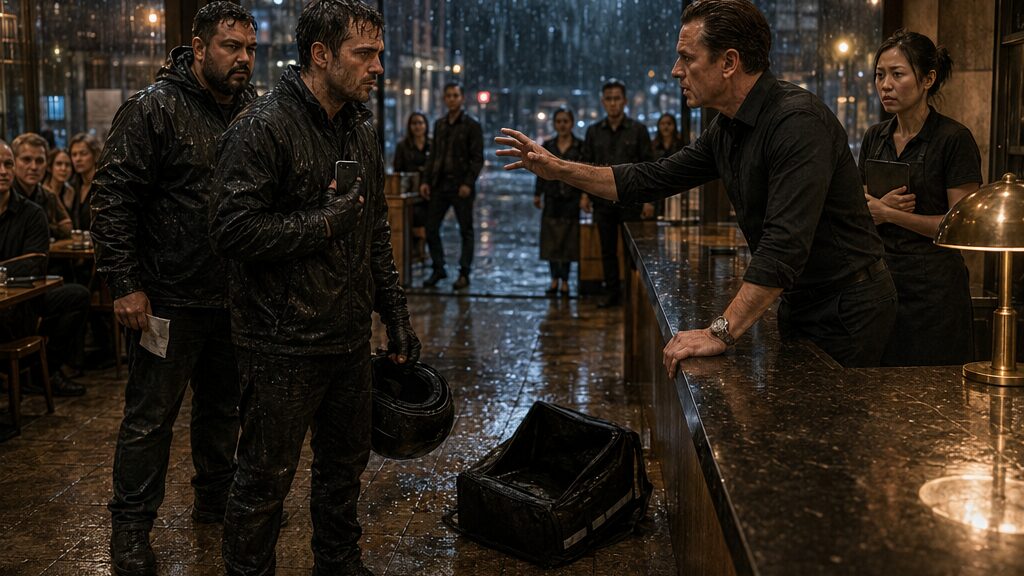
The restaurant, White Table, glowed like it had never heard of rain. Brass lamps over the bar. Polished counter. Dark wood shelves. Menus printed on thick cream paper. The kind of place where delivery bags were treated like stains.
Ryan did not move toward the back hall.
“I have a pickup,” he said.
Ronald looked him over as though Ryan had left mud on the floor just by breathing. He wore a fitted black shirt and a silver watch that flashed every time he moved his wrist. His hair was combed back with the exactness of someone who liked all visible things controlled.
“I heard you,” Ronald said. “And I told you where drivers go.”
At the pickup counter, Amanda Lee held a restaurant tablet against her apron with both hands. She was looking down at the screen too hard, as if the order list required total concentration. Ryan had seen that look before in restaurants where staff knew the rule was cruel but liked keeping their paychecks.
“My app says front pickup,” Ryan said.
Ronald smiled, not warmly. “Your app doesn’t own my dining room.”
A server squeezed past with two plates, eyes darting from Ryan’s wet jacket to Ronald’s face. Ryan stepped half an inch back to give her room. His delivery bag brushed against his boot. It was black, square, battered at the corners, the zipper tab replaced with a bent key ring. Rainwater ran off the bottom seam and made a small dark mark on the tile.
He could feel the restaurant reading him.
Wet driver. Late dinner rush. Cheap jacket. Phone in hand.
Replaceable.
Ryan’s thumb hovered near the side button of his phone. He did not record. Not yet. Recording too early made people act better, or smarter, or both. The platform had not sent him here for one insult. It had sent him after twelve complaints, seven missing-tip reports, and three drivers who had stopped responding when asked for statements.
One of them had sent Ryan a screenshot at 1:13 a.m. two weeks earlier.
Customer said she tipped. I got nothing. Not worth fighting.
The next day, that driver had closed his account.
Ryan looked past Ronald to the restaurant tablet. Amanda shifted it away slightly. On the screen, a line flashed yellow.
Driver delayed.
Ryan’s pickup number appeared beside it.
He glanced at the kitchen pass. No bag waited there. No stapled receipt. No sealed container. A cook moved behind the swinging door with empty hands.
Driver delayed.
Ryan felt something hard and cold settle under his ribs.
“How long until the order is ready?” he asked.
Amanda’s eyes lifted, then dropped. “A few minutes.”
Ronald cut in. “It would be faster if drivers followed instructions instead of blocking my entrance.”
Ryan did not answer him. He angled his phone as if checking the customer address again. In the counter’s polished edge, the tablet screen reflected in a warped stripe of light. Yellow status. Pickup number. Driver delayed.
He tapped once.
The photo saved without a sound.
Ronald’s smile disappeared.
“What are you doing?”
“Checking the order,” Ryan said.
“With your camera?”
Ryan looked up. The room had not returned to normal. It was pretending to. Chairs scraped. Someone murmured. A bartender polished the same glass twice.
Ronald stepped closer. “You people come in here with bags dripping on my floor, sticking phones in everyone’s faces, then blame us when customers complain.”
Ryan’s fingers tightened around the phone. He kept his voice flat. “The order isn’t ready.”
“It was ready when it was supposed to be.”
“It isn’t ready now.”
Ronald’s jaw moved. For half a second, the polished owner vanished and something more tired appeared. Not guilt. Pressure. A man counting rent in his head, labor costs, app fees, empty tables on rainy nights. Then he looked toward the diners and put the mask back on.
“Maybe if drivers used the proper entrance, my staff could find their orders.”
The couple by the window looked away. A man at the bar smirked into his drink. Ryan felt the old reflex rise in him: apologize, step back, survive the shift. Get the order, get paid, leave before the restaurant remembered your face.
He had lived years that way.
In parking lots. Under awnings. Outside locked apartment lobbies. Beside kitchen doors where steam rolled out with the smell of food he could not afford to buy.
He thought of the driver who quit. He thought of the message he had not answered until the morning, when it was already useless.
Not worth fighting.
Ryan lowered his phone and rested his helmet on the crook of his arm. “I’ll wait here.”
Ronald’s eyes sharpened.
“No,” he said. “You’ll wait where I told you.”
Amanda’s mouth parted, but no words came out. Her knuckles whitened around the tablet.
Ryan did not move.
Ronald leaned close enough that Ryan could smell coffee and mint on him. “I can report you for refusing restaurant procedure.”
“You can report anything you want.”
That made Ronald blink.
The response was too calm, too clean. Not the irritation he expected. Not the apology. Not the little bowed-head retreat to the back door. His gaze dropped to Ryan’s phone again.
“Is that a threat?”
“No.”
“Then stop acting like you have authority here.”
Ryan looked down at his delivery bag. It sat upright beside his boot, rain-dark, waiting to be filled with food someone else would eat. The key-ring zipper glinted under the brass light.
“I’m just waiting for the order,” he said.
Ronald laughed once, softly, for the room.
“Exactly,” he said. “Waiting. That’s the job.”
He stepped back, but not away. His shoe caught the side of Ryan’s delivery bag.
It was not an accident.
The bag slid across the tile with a wet scrape that cut through the restaurant louder than the plates, louder than the rain, louder than the bar music. It tipped onto its side near the base of the counter, empty mouth gaping open.
Ryan’s hand moved before he stopped it.
The whole restaurant went quiet.
Ronald looked down at the bag, then at Ryan.
“Pick it up at the back door,” he said.
Chapter 2: The Missing Tips Behind the Polished Counter
“Where did the tips go?” Ryan asked.
He did not pick up the bag.
That changed the air more than if he had shouted. The delivery bag lay on its side between Ronald’s shoes and the pickup counter, its open flap showing the silver insulated lining inside. Rainwater pooled beneath one corner. A child at a nearby table twisted around in his chair until his mother pulled him back by the sleeve.
Ronald gave the room another smile.
“Excuse me?”
“The tips,” Ryan said. “Three orders last week. Two the week before. Customers said they tipped. Drivers didn’t receive them.”
Amanda’s face tightened.
Ronald’s eyes flicked toward her, then back to Ryan. “You’re holding up my restaurant because you don’t understand your app?”
“I understand the app.”
“No, you understand riding around with a backpack and blaming restaurants when you don’t make enough money.” Ronald’s voice was smooth now, pitched for listeners. “Tips are for people with real jobs.”
The man at the bar laughed again, more carefully this time.
Ryan felt heat climb his neck, which annoyed him more than Ronald did. Anger was useful only if it stayed behind the ribs. On the face, it became evidence for the other side.
He unlocked his phone and opened the folder he had built over three weeks: screenshots, payout records, customer notes, timestamps. Not the official audit files. Not yet. Just enough to press the bruise.
He turned the screen toward Ronald.
“Order 4816. Customer message says, ‘Hope the tip helps in the rain.’ Payout shows base only. Order 5021. Same thing. Order 5088. Same thing.”
Ronald did not look long enough to read. “Screenshots can be anything.”
“They can.”
“Then stop waving fake numbers in my restaurant.”
Ryan slipped the phone back toward his chest. The bag remained on the floor. Every second he left it there felt like leaving a part of himself under Ronald’s shoe. He knew that was why Ronald had done it. To make him bend.
Amanda stepped closer to the counter, voice low. “Your order is still coming.”
Ryan looked at her.
She kept her eyes on the tablet. “It’s not smart to do this here.”
“Ask questions?”
“Make trouble at the counter.” Her lips barely moved. “Restaurants can flag drivers. Too many flags, your account gets reviewed.”
There it was. Not a threat from Ronald this time. A rule, clean and invisible. A button behind a counter. A little note in a system. A worker erased by someone who never had to stand in the rain.
Ronald heard enough to smile.
“Amanda’s right,” he said. “You should listen. She knows how this works.”
Ryan glanced at the tablet again. The yellow line had shifted.
Driver late arrival.
He had been inside for less than five minutes. His GPS would show the opposite. But platform reviews rarely began with GPS. They began with partner notes, customer complaints, delay categories, little boxes clicked by people with clean hands.
The kitchen door swung open. A paper bag appeared in a cook’s hand, unstapled, steam softening the top. Amanda reached for it, but Ronald lifted one finger. The cook froze and withdrew halfway.
Ryan saw it. So did Amanda.
A bell chimed behind him.
Another driver came in from the rain, hood up, receipt clutched in one hand, phone in the other. Dennis Garcia was shorter than Ryan, broader in the shoulders, with water dripping from his beard onto his jacket zipper. His eyes went first to the bag on the floor.
Then to Ryan.
“You too?” Dennis said.
Ryan did not answer quickly enough.
Dennis stepped closer, ignoring Ronald. “This place shorted me twice. Customer showed me the receipt herself last Friday. Eight-dollar tip. I got base fare and a one-star for late delivery.”
Ronald’s face hardened. “You need to leave.”
Dennis held up a damp receipt folded into quarters. “Not until someone explains this.”
Ryan saw the danger immediately. Dennis was shaking with the kind of anger that made cameras come out and managers look innocent. His phone was already angled in his palm, close to recording. Ryan should have expected this. Drivers talked in parking lots. Screenshots moved faster than food.
“Dennis,” Ryan said quietly.
Dennis stared at him. “What? You going to stand there and take it? He kicked your bag.”
The words landed badly because they were true.
Ryan had not told Dennis. Had not told any of them. He had wanted clean evidence, controlled statements, no emotional contamination. That was the phrase used by the audit team. Emotional contamination. As if exhausted people could present theft like a math problem and still be believed.
“I’m asking about the tips,” Ryan said.
“Ask louder.”
Ronald clapped once, sharp. Several diners flinched.
“That’s enough. You are not turning my restaurant into a driver complaint desk. You people cost us money every day. Wrong entrances, late pickups, cold food, customers calling us because you can’t read a map—”
“The order wasn’t ready,” Ryan said.
Ronald swung toward him. “Because you didn’t check in properly.”
“I checked in at the front.”
“That’s not our procedure.”
“The app says front pickup.”
“My staff told you otherwise.”
“No,” Amanda said.
It was so soft that for a moment no one reacted.
Ronald turned his head.
Amanda swallowed. “I mean—he did check in. The order wasn’t packed yet.”
The cook behind the door vanished.
Ronald’s expression did not change, but the room seemed to step backward from him.
“Amanda,” he said, “go to the kitchen.”
She looked at Ryan once, then at the tablet, then away.
Dennis muttered, “Of course.”
Ryan wanted to tell him to stop. Wanted to say, Not yet, not like this. But Dennis’s receipt trembled in his hand, the ink already bleeding at one edge from the rain. That paper was not official. It was not enough. But it was what he had.
Ryan held out his hand.
Dennis hesitated. “Why?”
“So it doesn’t get ruined.”
For a second, distrust moved across Dennis’s face. Then he handed it over.
Ryan unfolded the receipt carefully on the polished counter, smoothing it with two fingers. A date. A total. A tip line. White Table. The customer name partly smudged, but the amount clear enough.
Ronald glanced at it and laughed without humor. “That proves a customer tipped the platform. It doesn’t prove my restaurant touched anything.”
“You just said drivers caused the delay.”
“They do.”
“This receipt is from Friday. Dennis’s pickup was marked late before he arrived.”
Ronald’s smile disappeared again. “You don’t have access to that.”
Ryan realized his mistake the moment Ronald said it.
The room did too, though it did not understand why.
Ronald’s eyes narrowed. “How would you know when his pickup was marked?”
Ryan closed the receipt in his hand. Too much. He had shown too much pattern too soon.
Dennis looked between them. “What does that mean?”
“It means,” Ronald said, stepping behind the counter toward the tablet, “this man came in here looking for a fight.”
Ryan moved one step closer, not blocking him, not touching him.
Ronald reached for the tablet and tapped hard enough to make the stand rock.
“I can file a partner safety complaint,” he said. “Harassment. Disruption. Refusal to follow pickup procedure.” He looked at Ryan’s phone. “By morning, your account can disappear.”
Ryan kept his voice low. “Don’t falsify another report.”
Ronald’s finger hovered over the screen.
“Watch me,” he said.
Chapter 3: A Receipt That Should Have Ended the Argument
“I tipped twelve dollars,” Lisa Brown said from the table by the rain-dark window.
The words should have ended it.
They did not.
Ronald turned toward her with the slow, careful smile he used for diners, the one that made his anger look like service. “I’m sorry, ma’am. This is confusing for everyone. The platform handles driver payments. We don’t control what they do with tips.”
Lisa’s hand rested beside a half-finished glass of white wine. She had been watching too long to pretend she had not heard. Her coat was folded neatly over the back of her chair, and her phone lay face down beside her plate, as if even picking it up would make her part of something unpleasant.
Ryan recognized her name from the receipt Dennis had brought in, though the wet paper had blurred part of it. He did not say that. He looked at her only once, then back at Ronald. Pushing a customer too hard would give Ronald exactly the scene he wanted: angry drivers surrounding a woman at dinner.
Dennis was less careful.
“You hear that?” he said. “She tipped twelve. I got nothing.”
Lisa’s cheeks colored. “I didn’t say you were my driver.”
“You ordered from here Friday?”
She looked at Ronald, then at the other tables.
That hesitation told Ryan more than an answer.
Ronald spread his hands. “See? Nobody even knows what order they’re talking about. This is what I deal with. Drivers storm in, wave phones around, upset customers—”
“My order was Friday,” Lisa said.
Ronald stopped.
The bar seemed to go quiet first, then the tables near it. Rain tapped against the front window behind Lisa in quick silver lines.
She reached for her phone, then paused with her thumb on the edge. “I don’t want to be involved in some app dispute.”
“You’re not,” Ronald said instantly. “Please, enjoy your dinner.”
Ryan said, “You don’t have to do anything you don’t want to do.”
Dennis shot him a look. “Seriously?”
Ryan did not look away from Lisa. “But if you have the receipt, it would help confirm whether the customer side matches the driver side.”
Lisa inhaled through her nose. She was not cruel. Ryan could see that. She was embarrassed. There was a difference, though the result often felt the same to the person standing in wet shoes.
“I complained,” she said quietly.
Ronald’s face tightened.
Lisa looked down at her phone. “The food was cold. I thought the driver took too long. I wrote that in the complaint.”
Dennis’s jaw clenched.
Ryan felt the turn before it happened. This was the part Ronald would use.
“There,” Ronald said. “You heard her.”
Lisa shook her head, still not looking at Dennis. “But I tipped because it was pouring. I remember that. I wrote, ‘Please make sure the driver gets this.’”
The child at the nearby table whispered, “Mom,” and was hushed again.
Ryan kept his hands still. “Can you check the email receipt?”
Ronald stepped forward. “No, she cannot. This is harassment now.”
Lisa’s eyes flashed, not at Ryan but at Ronald.
“I can check my own email.”
She lifted her phone and searched while the room watched. The seconds stretched. Ryan heard the kitchen printer spit out a ticket, then another. Amanda stood near the tablet, rigid, the order bag still waiting behind her.
Dennis leaned over Ryan’s shoulder, dripping rain onto the floor.
“Back up,” Ryan murmured.
Dennis did, but his anger stayed close.
Lisa found the email. Her thumb scrolled. Her face changed before she spoke.
“Twelve dollars,” she said. “Tip: twelve dollars.”
Dennis gave a bitter laugh. “There it is.”
Ryan opened his payout record for the matching date and time. He did not show the audit folder, only the driver-side screenshot copied into his ordinary gallery. Base fare. No tip. Delay penalty. Customer complaint attached.
He placed the phone on the counter beside Dennis’s damp receipt, careful to keep his fingers around the edge.
Lisa stood halfway from her chair and looked. Her eyes moved from the phone to Dennis. “I’m sorry.”
Dennis swallowed whatever he had been about to say.
Ronald moved fast into the space her apology created. “No. Don’t apologize. You paid the platform. They mishandled the rest.”
Ryan said, “Then why was the driver marked late before pickup?”
Ronald’s gaze snapped back to him. “You keep saying that.”
“Because it happened.”
“You cannot prove what time my staff marked anything.”
Amanda’s fingers tightened around the tablet again.
Ryan saw it. Lisa saw it too. A tiny human movement, not a document, not a badge, not enough for a report. But the truth had a way of pressing on the weakest seam in a room.
“Amanda,” Ronald said without looking at her, “take the tablet to the kitchen.”
She did not move.
The restaurant’s front door opened again, letting in a gust of rain and two more drivers who stopped immediately at the sight of Dennis, Ryan, and the bag on the floor. One of them stayed by the mat. The other lifted his phone, then lowered it when Ryan shook his head once.
Not yet.
Ronald noticed the signal.
His face changed.
It was quick, but Ryan caught it: not fear of a driver, not fear of a complaint. Fear of coordination.
“You are organizing this?” Ronald said.
Ryan slid his phone back into his hand. “I’m asking for the tablet history.”
“You’re demanding private restaurant records.”
“I’m asking why customer tips are missing and drivers are being blamed for delays caused inside this building.”
Ronald laughed, but there was no room in it now. “Listen to yourself. You think because you have a wet receipt and a screenshot, you can accuse me in my own restaurant?”
Lisa sat down slowly. Her phone remained in her hand, screen lit.
Ryan knew the evidence still did not close the loop. Lisa’s email proved the tip existed. Dennis’s payout proved he did not receive it. The tablet might prove delay manipulation. But between those points, Ronald could still hide behind systems, fees, glitches, policy language. The truth was visible, but not yet undeniable.
That was the most dangerous kind of truth.
Ryan looked at Amanda. “The order history will show when the delay was entered.”
Ronald moved before Amanda could answer.
He came around the edge of the counter, not quite running, one hand raised toward Ryan’s phone. A chair scraped behind Lisa. Dennis cursed. Amanda said Ronald’s name, sharp and frightened.
Ryan stepped back, but Ronald was already reaching.
“Give me that,” Ronald said, his fingers closing inches from the screen, “before you fake another screenshot.”
Chapter 4: The Helmet Strike That Froze the Restaurant
Ronald’s hand clamped around Ryan’s wrist inches from the phone.
The grip was not strong enough to hurt, but it was strong enough to make the room see ownership. Ryan’s screen tilted toward the ceiling lights. Lisa’s receipt glowed in the corner of it, the twelve-dollar tip line still open, and Ronald’s thumb scraped toward the edge as if he could erase the whole room with one swipe.
“Let go,” Ryan said.
Ronald’s smile had gone flat. “You don’t get to come into my restaurant and manufacture evidence.”
Dennis stepped forward. “Take your hand off him.”
Ryan snapped his eyes toward him. “Don’t.”
The single word cut harder than he meant it to. Dennis stopped, face tightening. For a second, Ryan saw exactly what his silence had bought him: not trust, not calm, not control. Just another driver wondering if Ryan would rather be careful than stand with him.
Ronald used the hesitation.
“See?” he said, raising his voice. “Even he knows this is out of line.”
Ryan twisted his wrist, not violently, just enough to keep the phone against his chest. Ronald’s fingers slid but did not release. The restaurant had gone so quiet that Ryan could hear the soft tick of rain against the front windows, the kitchen printer stuttering behind the swinging door, the nervous clink of a fork set down too carefully.
Amanda stood frozen with the tablet in both hands.
Ryan looked at her. Not pleading. Not ordering. Just one second too long.
She looked away.
Ronald leaned closer. “I said give me the phone.”
“No.”
“Then you’re banned from this restaurant.”
Ryan felt the old anger press upward again, but this time there was shame under it. Shame because he had expected Amanda to move before he had earned it. Shame because Dennis had been willing to risk more in thirty seconds than Ryan had risked in three weeks. Shame because the delivery bag still lay on its side where Ronald had kicked it, and every diner in the room knew Ryan had not picked it up.
Ronald turned his head toward Amanda. “Mark him refused pickup.”
Amanda blinked. “What?”
“On the tablet. Refused pickup. Aggressive behavior. Driver caused delay.”
“The order isn’t—”
“Amanda.”
Her name landed like a slammed drawer.
Ryan saw her throat move. She lowered her eyes to the tablet. Her thumb hovered over the screen.
That was the system. Not one villain, not one insult, not one missing tip. A tired woman with rent due, a button under her thumb, and an owner close enough to punish her before the platform ever read the report.
Ryan said, “The order was ready late.”
Amanda’s thumb froze.
Ronald’s grip tightened on Ryan’s wrist. “You don’t know that.”
“The kitchen hadn’t packed it when I arrived.”
“You came through the wrong door.”
“The food wasn’t ready.”
Ronald looked at the nearest tables, inviting them back onto his side. “This is exactly what we deal with. They’re late, they’re rude, they refuse procedure, and then the restaurant gets blamed.”
Amanda’s voice came out before she seemed to decide to speak.
“The order was late from our side.”
No one moved.
Ronald slowly turned toward her.
Amanda’s face had gone pale, but she did not take it back. Her eyes stayed on the tablet now, as though the screen had become the safest place in the room.
“What did you say?” Ronald asked.
She swallowed. “It wasn’t packed when he checked in.”
The words were small. They were also enough to change the balance of the room. Lisa looked down at her receipt again. Dennis let out one breath through his nose. One of the drivers by the door lifted his phone, then lowered it when Ryan shook his head again.
Ronald released Ryan’s wrist.
The relief lasted half a second.
“Fine,” Ronald said. “You want official? We’ll make it official.”
He reached around Amanda and tapped the tablet himself. She flinched back.
Ryan saw the screen flash through the gap between Ronald’s arm and the counter.
Driver refused pickup.
“No,” Ryan said.
Ronald tapped again. “Aggressive at counter.”
Ryan stepped forward.
It was the movement Ronald had been waiting for. His eyes sharpened. His shoulders squared. The diners saw Ryan move, not Ronald’s entries. They saw wet jacket, clenched jaw, phone in hand. They saw exactly the frame Ronald had been building.
Ryan stopped.
His motorcycle helmet hung from his left hand, rain still beading on the black shell. He looked at it. He thought of the driver who quit, the message sent after midnight, the way he had told himself there was no point answering until he had something useful. Perfect evidence. Controlled process. No contamination.
And now Ronald was contaminating the record in real time.
Ryan lifted the helmet and brought it down on the polished counter.
The sound cracked through the restaurant.
Cups jumped. One toppled and rolled, spilling coffee in a dark line toward the tablet stand. A fork clattered to the floor near Lisa’s table. The kitchen printer stopped as if even the machine had been startled into silence.
Ryan left his hand on the helmet.
“Good,” he said, voice low. “Start with this account.”
Ronald stared at him. The first real uncertainty crossed his face, quick but visible.
Ryan did not raise his voice. “Mark what you just did. Driver refused pickup. Aggressive at counter. Then mark the time. Then explain why your tablet showed driver delayed before the order was ready.”
Ronald’s eyes flicked down to the tablet.
Ryan kept going. “Explain why the same restaurant has missing-tip complaints tied to delay penalties. Explain why a customer receipt shows twelve dollars and the driver payout shows zero.”
Ronald recovered enough to sneer. “You think a helmet slam helps your case?”
“No,” Ryan said. “It helps the room hear the next part.”
He unzipped the inside of his rain jacket.
He did not pull the badge all the way out. That would be theater. He had spent weeks avoiding theater. He opened the flap just enough for the platform audit badge to catch the light, the small laminated square resting against the inside pocket where his shirt was damp from rain and sweat.
Amanda saw it first.
Her eyes widened.
Ronald saw her reaction before he saw the badge. Then his gaze dropped, and the color changed around his mouth.
Dennis stared at Ryan. “What is that?”
Ryan did not answer him yet. That was another small betrayal, and he knew it. But the moment was narrow. If he turned it into confession, Ronald would fill the space.
Ryan looked at Amanda.
“Unlock the tablet,” he said.
Ronald barked a laugh that broke halfway through. “Absolutely not.”
Amanda held the tablet tight against her apron.
Ryan spoke to her, not him. “I’m not asking you to take blame for him.”
Her fingers trembled.
Ronald stepped between them. “She works for me.”
Ryan finally looked at Dennis. The other driver’s expression had gone from anger to confusion to something worse: hurt.
“I should have told you,” Ryan said.
Dennis did not soften. “Told me what?”
Ryan took out the badge and let the room see it.
“Audit division,” he said. “Independent contractor treatment and payout review.”
The phrase did not land like a movie reveal. It landed unevenly, into a room of people who did not know whether that meant power, trouble, paperwork, or all three. But Ronald knew enough. Amanda knew enough. Dennis looked at the badge, then at the delivery bag on the floor, then at Ryan’s face.
“So you let him do all that?” Dennis asked.
Ryan took the hit without defending himself. “I needed him to do it where the system could not call it rumor.”
“That was your plan?”
Ryan’s jaw tightened. “Part of it.”
Dennis gave a short, disbelieving laugh. “Must be nice, having a plan.”
Ronald seized the fracture. “This is entrapment. He came here pretending to be a driver to provoke my staff.”
Ryan turned the badge slightly so Amanda could read the ID number. “Amanda, if he enters another false report, it becomes part of the audit too.”
Ronald’s voice dropped. “Touch that tablet and you’re done here.”
Amanda looked at him.
There was something in her face Ryan had not seen before. Not bravery yet. Exhaustion sharpening into calculation. She looked at the tablet, then at the wet receipt on the counter, then at the coffee creeping toward the base of the stand.
Behind Ronald, the paper delivery bag finally appeared from the kitchen, stapled shut, ten minutes too late.
Amanda’s thumb moved toward the tablet screen.
Ronald stepped toward her.
Ryan moved the helmet aside and opened a space on the counter.
“Unlock it,” he said.
Chapter 5: The Tablet Remembered What the Owner Deleted
Amanda’s finger hovered over the tablet password while Ronald said, “Touch that and you’re done here.”
The restaurant seemed to shrink around her. The warm lights, the polished wood, the clean glass, the diners pretending not to stare—everything narrowed to her thumb and the blinking cursor on the tablet screen.
Ryan kept both hands visible on the counter. He could feel Dennis standing behind him, angry and waiting. He could feel Ronald’s attention darting between the badge, the tablet, the customers, the delivery bag still lying on the floor.
Amanda whispered, “I need this job.”
“I know,” Ryan said.
Ronald pointed at him. “He doesn’t know anything. He walks out tonight and you’re the one still here.”
Amanda’s thumb twitched.
That was the cruelest true thing Ronald had said.
Ryan had a badge in his pocket. Dennis had the rain and his own anger. Lisa had a receipt and the choice to sit down again. Amanda had shifts, rent, and Ronald’s name on the schedule. If she opened the tablet, she would not get to return to being invisible.
Ryan lowered his voice. “You’re already in his report.”
Her eyes lifted.
“He just said you handled the tablet. If the false entries stay there, he can say you made them.”
Ronald’s face tightened. “That is not what I said.”
Amanda looked at him. “You said I should mark refused pickup.”
“As instructed by management.”
“You tapped it yourself.”
Ronald leaned closer. “Careful.”
The word did not scare her as much as it seemed to settle something. She typed the password.
The screen opened.
A small sound moved through the room. Not applause. Not relief. Just breath.
Ronald lunged for the tablet, but Dennis stepped into his path, not touching him, only standing there with his wet jacket and clenched receipt. Ryan lifted one hand.
“No one grabs anything,” Ryan said.
Ronald glared at Dennis. “Move.”
Dennis looked at Ryan, then back at Ronald. “I’m just standing.”
Ryan slid the tablet closer without picking it up. “Amanda, order history. Tonight’s pickup first.”
She navigated quickly now, as though speed might make courage less painful. The order appeared with its status timeline.
Driver notified.
Driver arrived.
Driver delayed.
Food packed.
There it was, plain and cold: driver delayed entered three minutes before food packed.
Lisa stood behind her chair, phone still in hand. “That doesn’t make sense.”
Ronald snapped, “Because you don’t understand restaurant operations.”
Ryan took a photo of the timeline with his own phone. “Dennis’s order from Friday.”
Amanda hesitated.
Ronald said, “No.”
Amanda searched anyway.
The Friday order opened. Dennis leaned over, dripping rain onto the polished floor. The screen showed a delay flag entered nine minutes before the app recorded driver arrival. A customer complaint had been attached, then removed, then replaced with a platform note: driver delay confirmed by restaurant.
Dennis went still.
“That’s mine,” he said.
Ryan heard the break in his voice, small and humiliating. Not because Dennis was weak. Because anger had been easier than seeing the machinery.
Amanda scrolled.
A deleted note appeared in gray, still stored in the local restaurant history.
Customer stated driver waited. Food cold at pickup. Tip should remain with driver.
Lisa made a small sound.
“That was me.”
Ronald turned on her. “You don’t know that.”
She held up her phone, no longer hiding it from the room. “The time matches my email.”
Ryan photographed the deleted note. His hand was steady, but his stomach had tightened. This was the link he needed and the one he had been afraid he would not find. Not just missing money. Not just bad timing. The restaurant had removed the complaint that protected the driver and replaced it with one that protected itself.
Amanda scrolled further, too far, too fast.
“Stop,” Ryan said.
She froze.
On the screen was another order, then another. Delay adjustments. Complaint removals. Tip disputes marked resolved. Some entries had initials beside them. Some did not. A pattern, but messy. Enough to implicate the restaurant. Enough for Ronald to look for a smaller person to throw into the fire.
He found one immediately.
“Amanda handled those nights,” he said.
She stared at him.
Ronald lifted both hands as if regretting the necessity of truth. “I’m not saying she stole anything. I’m saying if someone entered something incorrectly, it wasn’t me watching every tablet during dinner rush.”
Amanda’s mouth opened, but no words came.
Ryan felt the room tilt again. Ronald was good at this. He did not need innocence; he needed confusion. One dirty system, one frightened supervisor, one angry driver, one embarrassed customer. Enough fog, and the platform would take weeks.
Ryan looked at Amanda. “Did you delete Lisa’s complaint?”
Her face crumpled with fear, then hardened in self-defense. “I cleared complaints when he told me they were duplicates.”
Ronald said, “Because they were.”
“They weren’t.” Her voice shook, but it carried. “Sometimes customers wrote that the food was late from the kitchen. He said if we left those notes, our rating would drop and corporate would throttle orders.”
White Table was not a chain, but it lived and died inside other companies’ dashboards. The word corporate meant the platform, the payment processor, the landlord, anyone bigger than Ronald that he could invoke when he wanted obedience.
Ronald’s eyes flashed. “We were being buried by app fees. Half these drivers don’t even come inside on time. Customers blame us for everything.”
Dennis held up his receipt. “So you took our tips?”
“I adjusted disputed orders,” Ronald said. “That’s not the same thing.”
Ryan said, “Where did the tip go?”
Ronald looked at him.
The question stayed there.
Amanda scrolled to the payout adjustment panel. Her fingers were moving now as if some part of her wanted the screen to speak before she lost nerve. The tablet showed a restaurant credit applied after a customer service dispute. Tip held pending review. Driver penalty recorded. Restaurant compensation granted.
Dennis read it twice. “Compensation?”
Ryan’s jaw tightened.
There were different ways to steal. Some looked like a hand in a jar. Some looked like a form.
Ronald said, “Those are platform mechanisms. I don’t control how they allocate funds.”
“But you triggered the dispute,” Ryan said.
“For cold food.”
“After marking the driver late before pickup.”
Ronald’s face reddened. “Because the system requires a category.”
Amanda laughed once. It startled everyone, including her. It was not amusement. It was the sound of a person recognizing the trap she had helped maintain.
“You told me to use driver delay,” she said. “You said kitchen delay hurts us more.”
Ronald turned on her fully. “I kept you employed.”
She flinched.
Ryan saw the opening and hated that it required hurting her more.
“Amanda,” he said, “were complaints deleted because they protected drivers?”
She stared at the tablet. Her eyes shone but did not spill over.
“Yes.”
The word was quiet. It hit harder because of that.
Ryan tapped the audit contact on his phone.
Ronald saw the screen. “Who are you calling?”
“Platform audit line.”
“No, you’re not.”
Ryan pressed call.
Ronald reached toward the restaurant tablet, but Dennis shifted again. Lisa moved too, surprising everyone. She stepped close enough to the counter that Ronald had to look at her.
“I’ll confirm my receipt,” she said.
Ronald’s mouth tightened. “You have no idea what damage you’re doing.”
Lisa looked embarrassed again, but this time she did not sit down. “I know what I paid.”
The call connected to hold music, thin and mechanical. Ryan put it on speaker and set the phone on the counter beside the tablet, the wet receipt, and his helmet.
Amanda scrolled one more line, then stopped.
The tablet flashed.
Compliance hold pending live review.
For the first time all night, Ronald White looked at the screen and said nothing.
Then Ryan’s phone rang through to a real voice.
Chapter 6: The Drivers Outside Held Up Their Receipts
Dennis stepped into the rain and raised his receipt against the window.
At first he was the only one. A broad-shouldered silhouette under the awning’s weak edge, his wet paper pressed flat to the glass beside his phone screen. Inside, customers leaned back from their tables as if the receipt might come through the window and touch their plates.
Then the driver near the mat went outside too.
Then the other.
Within a minute, four drivers stood in the rain-dark reflection of White Table, holding up receipts, screenshots, folded order slips, anything that proved they had once believed the numbers would add up if someone finally looked.
Ronald pointed toward the door. “This is intimidation.”
Ryan kept his phone on the counter, speaker active, audit line open. The voice on the other end had asked for restaurant ID, incident time, and whether the partner location was safe for continued pickup. Ryan had answered each question cleanly. Too cleanly, maybe. He could hear it himself. The trained calm. The careful language. The part of him still trying to make this a report instead of a room full of people.
“They’re outside,” Ryan said. “They’re not blocking the door.”
“They’re trespassing.”
“They’re on the sidewalk.”
“They are harassing my customers.”
One of the customers by the bar had already put on his coat. Another had placed cash on the table and was waiting for the server to pick it up without making eye contact. Ronald noticed every departure like a wound.
The audit voice asked, “Are there multiple contractor witnesses present?”
Ryan looked through the window.
Dennis’s receipt had begun to soften at the corners. Rain ran down his hand and under his sleeve, but he kept it raised. His face was turned toward Ryan, not Ronald.
Ryan picked up the phone. “Yes.”
Dennis met his eyes through the glass.
For three weeks Ryan had imagined this moment as a file closing. Evidence collected, partner reviewed, payment corrections issued. A clean line from suspicion to proof. He had not imagined Dennis standing in the rain, waiting to learn whether Ryan had used him or stood with him.
Ryan looked down at the delivery bag still lying on its side near the counter.
He had not picked it up.
The sight bothered him more now than when Ronald kicked it. The bag had become an accusation against his own restraint.
The audit voice said, “Can you collect witness documentation through the contractor support portal?”
Ryan answered, “Yes,” then stopped.
Dennis did not have time for portals. None of them did. They had orders waiting, phones buzzing, bikes double-parked, rent due, food cooling in bags. The system always asked tired people to submit the right form in the right place with the right tone after being humiliated by someone with a tablet and a title.
Ryan looked at Amanda. “Can you print the affected order list?”
Ronald snapped, “No.”
Amanda’s hand moved toward the tablet before fear caught up. “I don’t know if—”
“You print nothing,” Ronald said.
The audit voice, still on speaker, asked, “Is the partner representative refusing record preservation?”
Ronald looked at the phone as if it had betrayed him personally.
Ryan said, “Yes.”
“That is not what’s happening,” Ronald said loudly. “This man has brought a crowd to my restaurant. He is inciting them because he came here with an agenda.”
Dennis heard enough through the glass to react. He pushed open the door, bringing a sheet of rain and cold air with him.
“Agenda?” Dennis said. “You marked me late before I got here.”
Ryan stepped toward him. “Dennis, stay outside for a minute.”
Dennis laughed, hurt cutting through it. “You still telling me where to stand?”
That landed in the room.
Ryan deserved it.
He moved away from the counter and lowered the phone from speaker for one moment. The audit voice became a small buzz against his palm.
“I should have told you,” Ryan said.
“You said that already.”
“I mean before. When I asked about your Friday receipt. When I told you not to record. When I acted like your anger was the problem.”
Dennis stared at him. Rain dripped from his hood onto his cheek. “You were auditing him?”
“Yes.”
“And you let me think you were just scared?”
Ryan looked through the window at the other drivers. One of them had tucked a receipt under his phone case to keep it dry. Another stood with his shoulders hunched, face turned from the diners inside.
“I thought clean evidence would protect the case,” Ryan said. “I forgot people aren’t evidence.”
Dennis’s expression shifted, not into forgiveness, but into attention.
Ryan held out his free hand. “Submit it officially. Not just at the window. Put your name on it if you can. If you can’t, I’ll mark it confidential.”
Dennis looked toward Ronald. “And when he reports us?”
“He already did,” Ryan said. “That’s why the record matters.”
Dennis unfolded the receipt again. The paper was close to tearing.
“I almost deleted the app last week,” he said. “Thought maybe I was just bad at this.”
Ryan felt the words settle where the old midnight message lived.
“You weren’t,” he said.
Dennis nodded once and handed him the receipt.
That was the first true victory of the night. Not the badge. Not the tablet. A driver choosing not to disappear.
Ryan put the call back on speaker. “I have one contractor ready to submit documentation, with others present.”
The audit voice asked for names only if voluntarily provided. Ryan repeated that clearly toward the window, so the drivers outside could hear without coming in. A few exchanged looks. One shook his head, fear immediate. Another lifted his phone.
Ronald saw the hesitation and seized it. “They won’t sign because they know this is nonsense.”
“No,” Amanda said.
Everyone turned.
She had printed something from the small receipt printer connected to the tablet. A thin strip curled from the machine into her hand. Her face was pale, but her voice held.
“They won’t sign because you told us to flag difficult drivers.”
Ronald’s mouth opened.
Amanda continued before he could fill the room. “You said drivers who complain should wait longer next time. You said if they wanted respect, they could eat here instead of standing by the kitchen.”
The server near the bar stared at the floor.
Ryan did not ask Amanda for more. Not yet. Her truth had already cost her.
The audit voice asked, “Was that statement from a staff member?”
Ryan said, “Yes.”
Ronald stepped back as though the phone had become something physical. “I want this location cleared. Now.”
“You don’t control the sidewalk,” Dennis said.
“I control my restaurant.”
Ryan looked at the tablet. The compliance hold blinked again. On the phone, the audit voice went briefly silent, replaced by keyboard clicks.
Then: “Based on live evidence, partner access for White Table delivery services is being suspended pending repayment review and record preservation. Do not alter tablet data. Do not remove partner hardware. A formal notice will follow.”
For a moment, no one seemed to understand the words.
Then the restaurant tablet changed.
Platform access suspended.
The order queue vanished behind a gray notice.
Ronald’s face drained so quickly that Ryan almost looked away.
Outside, Dennis lowered his receipt at last. The drivers behind him did not cheer. One closed his eyes. Another pressed a hand against the wet glass, not in celebration, but in exhaustion.
Ryan looked at the delivery bag on the floor.
The suspension was real. The repayment review would start. The records were preserved.
But the bag was still lying where Ronald had kicked it, and no notice on a tablet could pick it up for him.
Chapter 7: The Apology Under the Rain-Dark Window
Ronald stood under the awning with rain soaking through the shoulders of his black shirt, reading from a tablet he was no longer allowed to control.
His first attempt came out too quiet.
No one corrected him immediately. That made it worse. The drivers stood on the sidewalk in a loose half circle, receipts tucked into pockets now, phones held low, rain shining on helmets and hoods. Inside the restaurant, diners watched through the front window with the awkward stillness of people who had already chosen their side too late.
Ronald cleared his throat.
“I apologize for any inconvenience caused tonight to the platform and its partners.”
Ryan stood just inside the doorway, one hand on the glass, the other holding his phone with the audit line still open. Amanda had stepped back from the counter, arms wrapped tightly around herself. Lisa remained near her table, coat on now, receipt email open on her screen like she still needed to prove to herself that she had not imagined any of it.
Dennis gave a humorless laugh.
Ronald looked toward Ryan, as if that should have satisfied the requirement.
Ryan shook his head once.
Ronald’s jaw tightened. “What?”
Ryan stepped onto the threshold. The rain touched his boots but not yet his face.
“To them,” he said.
Ronald stared at him.
Ryan did not raise his voice. He did not need to. The restaurant had learned to listen when he spoke quietly.
“You apologized to the platform,” Ryan said. “You took from drivers. You blamed drivers. You made them wait outside. Say it to them.”
A muscle moved in Ronald’s cheek.
For a moment Ryan thought Ronald would refuse, even with the tablet suspended, even with the audit line active, even with the drivers watching him from the rain. Pride had carried him this far. Pride could carry a man straight off a ledge if he called the fall dignity.
Then Ronald looked through the window at his restaurant.
The emptying tables. The servers pretending to wipe clean surfaces. The gray suspension notice still glowing on the tablet behind the counter. The order bags in the kitchen with nowhere to go.
He looked smaller when he turned back.
“I apologize,” Ronald said, voice rough, “to the drivers who picked up from White Table.”
Dennis folded his arms. “For what?”
Ronald’s eyes flashed.
Ryan said nothing.
The audit voice had gone silent, but the call timer still moved on Ryan’s screen. Record preserved. Live review active. Ronald could see it from where he stood.
“For incorrect delay reports,” Ronald said.
Dennis stepped forward. “Incorrect?”
Rain ran from the awning edge between them like a curtain.
Ronald swallowed. “For false delay reports.”
The words changed the sidewalk. One of the drivers lowered his head. Another wiped his face with the heel of his hand, though the rain made the gesture impossible to read. A third turned away toward the street, shoulders lifting once before settling.
Ryan watched them instead of Ronald.
He had thought the repayment notice would be the moment. The suspension. The official consequence. But hearing the words said aloud did something cleaner and more painful. It pulled the lie out of the drivers’ bodies.
False delay reports.
Not laziness. Not incompetence. Not bad luck. Not a glitch they were too poor to question.
Ronald looked at the tablet again. “And for mishandled tip disputes.”
Ryan stepped fully into the rain.
“No.”
Ronald glared at him. “What now?”
“Name it.”
Lisa appeared in the doorway behind Ryan. “I tipped twelve dollars,” she said, not loudly, but the drivers heard her. “It did not reach the driver.”
Ronald looked at her with tired hatred, then away.
“For diverted tips,” he said.
The phrase landed heavy.
Dennis did not smile. He looked down at his own hands, then at Ryan. “Say the repayment.”
Ronald’s face twisted. “That is under review.”
Ryan stepped closer, rain running down the back of his jacket. “The review includes restored deleted complaints, affected orders, delay penalties, and driver compensation claims. Say that.”
Ronald’s eyes narrowed. “You want a performance.”
“No,” Ryan said. “You gave customers a performance. This is the record.”
For a second, something bitter and exhausted broke through Ronald’s anger.
“You think I’m the only one stealing?” he said. “You think these apps don’t take from everyone? Fees, commissions, chargebacks, refunds we never approved? They turn restaurants against drivers and call it efficiency.”
Ryan held his gaze.
There it was. The reason Ronald had been carrying like a receipt of his own. It was not false. That was the worst part. The pressure was real. The margins probably were thin. The platform probably did take too much and explain too little. Ronald’s anger had a source.
But he had aimed it downward.
Ryan looked back through the doorway. The delivery bag still lay near the counter where it had been kicked, untouched by everyone, as if the room had agreed not to disturb the evidence of its own shame.
“You had someone weaker in front of you,” Ryan said. “That was the choice you made.”
Ronald’s mouth closed.
The rain filled the silence.
Finally Ronald turned toward the drivers again. He did not read this time.
“White Table filed false delay reports. Tips connected to disputed orders were diverted or withheld through those reports. Complaints that supported drivers were removed. The repayment review will include prior complaints, deleted records, delay penalties, and driver compensation claims.”
His voice thinned near the end, but he finished.
Nobody clapped.
That made it feel true.
Dennis unfolded what was left of his receipt. It had torn down one damp crease. He looked at it, then held it out to Ryan.
“You still need this?”
Ryan took it carefully. “Yes.”
Another driver came forward with a screenshot open. Then another with an order number written on the back of a gas receipt. They did not crowd him. They came one at a time, wary, tired, still half-expecting a trick. Ryan entered what he could into the support form while the audit voice gave instructions from the phone.
Names voluntary. Documentation accepted. Retaliation reports protected under review.
Some gave names. Some did not.
Ryan did not push.
When Dennis gave his full report, his voice was steady until he reached the part where he had thought he was bad at the job. Then he stopped.
Ryan waited.
Dennis cleared his throat. “That’s it.”
“It’s enough,” Ryan said.
Dennis looked at him for a long moment. “Next time, don’t make us stand outside your plan.”
Ryan nodded. “I won’t.”
It was not forgiveness. It was better than that. It was a rule Ryan could keep.
Inside, Amanda approached the doorway with the printed order list folded in both hands. She looked as though she expected Ronald to stop her even now. He did not. He stood under the awning, staring at the sidewalk, water running from his hairline.
Amanda handed the printout to Ryan.
“I saved the local logs,” she said. “Before the hold locked the screen.”
Ryan took the paper. “Thank you.”
She gave a small, frightened laugh. “I don’t know what happens to me now.”
Ryan looked at Ronald, then back at her. “Your statement is part of the record too.”
“That doesn’t pay rent.”
“No,” Ryan said. “It doesn’t.”
He could have offered comfort. He did not have enough truth to do it. Instead he folded the printout with care and placed it with the receipts.
Lisa stepped out last. She had her coat pulled tight, hair misted by the rain. She looked at Dennis.
“I’m sorry,” she said again. “For the complaint.”
Dennis shrugged, but the motion had no anger in it now. “Food was cold.”
“Not because of you.”
He nodded once.
The audit call ended only after Ryan confirmed the preservation notice, the suspension screen, the witness documents, and the restaurant ID. When the line went dead, the restaurant sounded different. Not peaceful. Hollowed.
Ronald looked at Ryan. “Are you satisfied?”
Ryan slipped the phone into his jacket. His sleeve was soaked through. His hands were cold.
“No,” he said.
Ronald’s face hardened again, grateful for an answer he could hate.
Ryan walked past him into the restaurant.
No one stopped him.
The floor still held the dark marks from his boots, the spilled coffee, the faint smear where his delivery bag had scraped across the tile. The bag lay on its side below the polished counter, open flap showing the silver lining. For one strange second, Ryan saw himself from the room’s point of view: wet driver, cheap jacket, tired face, the kind of man told to wait by the back door.
Then he bent down.
He picked up the bag slowly, not because it was heavy, but because he refused to make the gesture look hurried or embarrassed. The bottom was wet. One corner was scuffed where Ronald’s shoe had struck it. Ryan brushed the side once with his palm, though it did nothing.
Behind him, Ronald remained outside in the rain.
Ryan opened the bag and placed the receipts inside. Dennis’s torn paper. Amanda’s printed order list. The note with order numbers. The folded proof that the room had tried to ignore until it became too visible to step over.
He zipped the bag closed.
At the counter, the original order still sat under a heat lamp, stapled late and cooling. Ryan looked at it, then at Amanda.
“Cancel that pickup properly,” he said.
She nodded.
Ryan lifted his helmet from the counter. The coffee had dried in a crescent near where it had struck. He tucked the helmet under one arm and held the delivery bag by its strap in the other hand.
The front door opened before he reached it. Dennis stood there, holding it from outside, rain blowing around him into the warm restaurant.
For a moment neither of them spoke.
Then Dennis stepped aside.
Ryan walked through the front door without asking permission.
The story has ended.