My Neighbors Claimed My Side Yard Until the Survey Line Cut Through Their Koi Pond
Chapter 1: The Morning They Pulled Up Her Hostas
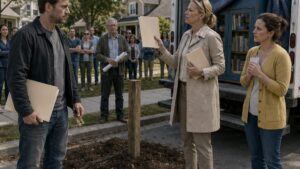
The first hosta came out of the ground with a sound like cloth tearing.
Patrick Harris heard it through the open kitchen window and set his coffee down without drinking. By the time he reached the side door, Nicole Walker had both hands around the plant’s root ball. Dark soil spilled across her pale gardening gloves. Three broad leaves bent beneath her wrist.
She laid the hosta beside a wheelbarrow already holding two others.
Patrick stopped on the concrete step.
“Nicole.”
She looked up, not startled enough.
“Oh. Morning.”
The strip between the houses was narrow enough that ordinary sounds carried clearly: a screen door closing, a rake against stone, the low mechanical hum of the Walkers’ koi-pond pump. A new white picket fence ran from their rear patio toward the street, then turned abruptly across the grass. Its final section sat between Patrick and the bed of hostas his wife had planted eleven years earlier.
Nicole brushed dirt from her gloves.
“These weren’t working here.”
Patrick looked at the empty holes. Moist soil showed where the plants had been rooted.
“They were working fine yesterday.”
She gave a small, patient smile, the kind used with someone who had misunderstood a simple instruction.
“We’re reorganizing the side garden.”
“This isn’t your side garden.”
Behind her, James Walker pushed a mower along the strip beside Patrick’s house. The mower’s right wheels ran over grass Patrick had cut every Thursday since the school year ended. James reached the sidewalk, turned, and came back without shutting off the engine.
Patrick stepped off the stoop.
“James.”
James stopped the mower but left it running. “Morning.”
“You’re mowing my yard.”
“I’m maintaining the disputed area.”
Patrick waited for the engine to sputter quieter. It did not.
“What disputed area?”
James pointed toward the fence as if the answer had been installed with it. “From the old maple to the drainage swale. It belongs with our parcel.”
“You moved here last year.”
“Eighteen months ago.”
“And the land somehow moved with you?”
Nicole dropped another hosta into the wheelbarrow. Patrick felt the sound in his chest more than he heard it. His wife, Linda, had chosen those plants because they survived shade, drought, and neglect. She had laughed when he measured the spacing between them, then moved every plant two inches off his marks because, she said, gardens should not look like shop projects.
He had not moved them back.
James shut off the mower. The sudden quiet sharpened everything.
“I was hoping we could handle this reasonably,” he said.
“You’re pulling up plants.”
“We’re restoring our boundary.”
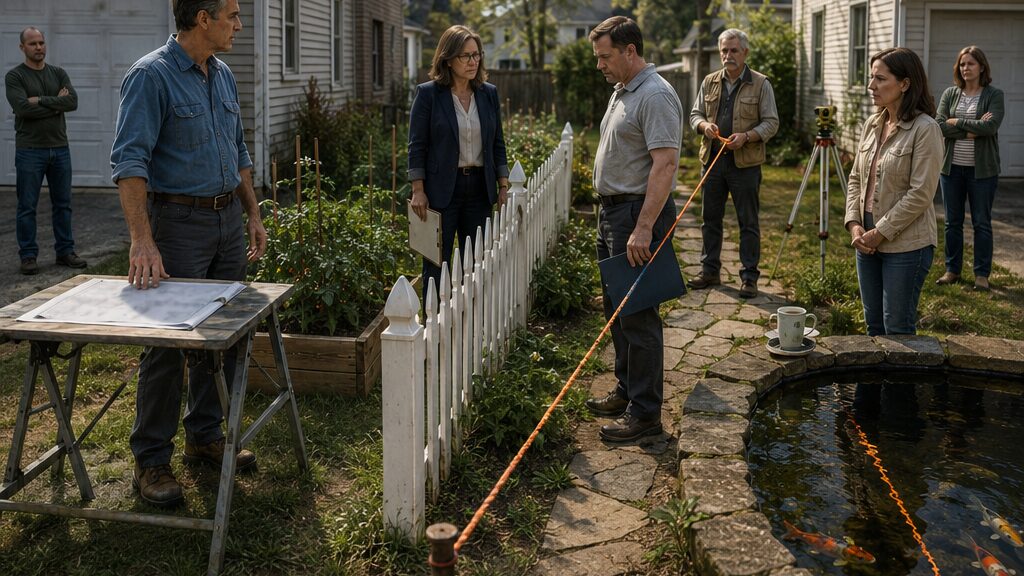
Patrick looked again at the fence. Its posts were new cedar, each one set in clean gray concrete. The fence crossed what he had always understood as his property by at least a couple of feet. Behind it, the Walkers’ raised beds were full of tomatoes held upright by black metal cages. A stone path curved toward the koi pond, where orange fish moved beneath dark water.
“When did you put that section in?” Patrick asked.
“Tuesday.”
“I was at a teachers’ workshop Tuesday.”
James shrugged. “You weren’t required to supervise.”
Patrick walked toward the fence. At the base of one post, the grass had been cut away in a neat circle. Beyond it lay a shallow seam between two mowing patterns. Patrick’s grass was cut higher. James’s was striped close to the soil. From ten feet away, the seam looked almost like a boundary.
Almost.
Patrick crouched and pressed his thumb into the earth beside the post. Fresh concrete.
“You need to stop,” he said.
Nicole’s expression tightened. “We already had the landscape plan approved.”
“By whom?”
“The association.”
Patrick stood.
James crossed to the patio, picked up a dark-blue folder, and returned holding it against his chest. A business card was clipped to the front. The folder was too clean for yard work.
“Our attorney has reviewed the situation,” James said. “The strip has been used with the Walker property since 2006. Continuous, open, exclusive use.”
Patrick looked at him.
James opened the folder and removed a page filled with narrow blocks of text. “Adverse possession. You can look it up.”
“I know what it means.”
“Then you understand that ignoring a property line for nearly twenty years has consequences.”
Patrick glanced at Nicole. She had stopped pulling plants, but one boot rested on the wheelbarrow’s axle as if she expected to resume.
“You bought the house eighteen months ago,” he said.
“The use runs with the property.”
“Whose use?”
“The previous owner’s. Ours. It doesn’t reset because the deed changes hands.”
Patrick held out his hand. “Let me see what you have.”
James drew the paper back half an inch. “You’ll get a copy through the proper channel.”
“Does the proper channel include taking my wife’s plants?”
Nicole’s face changed at the word wife. Not much. Her foot came off the wheelbarrow.
James did not look at the plants.
“We’re not trying to make this personal.”
“You began by digging.”
“We began by maintaining land that came with our house.”
Patrick felt an answer rise in him, hot and exact. He could have told James where the original iron pin was supposed to sit. He could have described the drainage permit filed in 2007, the utility trench inspected in 2011, the property-tax assessment he had challenged when the county added the side strip to his improved lot.
Instead, he said, “What date in 2006?”
James blinked.
“You said the use started in 2006. What date?”
“I don’t know the exact date.”
“What was being used?”
“The side yard.”
“For what?”
James’s mouth hardened. “That’s what records are for.”
“Yes.”
For the first time that morning, Patrick felt steady.
He pointed toward the empty holes. “Do not remove another plant. Do not mow past the swale. Do not add anything else until a licensed surveyor establishes the line.”
Nicole folded her arms. “The HOA already accepted the plan.”
“The HOA does not establish property boundaries.”
“Your opinion,” James said.
“No. Measurements.”
James tucked the paper back into the folder. “Then prove it.”
He said it with a short laugh, as though Patrick had been assigned a task too difficult to finish.
Patrick had heard that laugh from students who believed a warped board could be made square by forcing it against a fence. He never argued with them. He made them check both diagonals.
He looked beyond James toward the koi pond. The new stone path reached farther into the side yard than he remembered. So did the nearest raised bed. The white fence was not one mistaken panel. Its turn had reorganized the entire space.
“How far do you believe your property extends?” Patrick asked.
James pointed toward Patrick’s foundation. “Approximately three feet from your house.”
Patrick stared at him.
A narrow gravel service path ran along that wall. Patrick used it to reach the exterior water shutoff and the air-conditioning disconnect.
“You think your property comes within three feet of my foundation?”
“That’s what the documents indicate.”
“Which documents?”
“You’ll see them.”
Nicole bent toward the remaining hosta.
Patrick’s voice came out sharper than he intended. “Leave it.”
She froze with one hand above the leaves.
For several seconds, none of them moved. A car slowed at the corner. One of the adjacent homeowners looked across from a driveway, then busied himself with a trash bin.
Nicole straightened. “You don’t get to order me around.”
“You are standing in my planting bed.”
“You keep saying that.”
“And you keep pulling things out before checking.”
James stepped between them. “This is exactly why we involved the board.”
Patrick saw how the scene would look from the street: the longtime widower with dirt on his work shoes, the new couple beside a polished fence, a folder that suggested professional certainty. He also saw what his silence had purchased so far—three uprooted hostas and wet concrete around a post.
He took out his phone and photographed the wheelbarrow. Then the empty holes. Then the fence, the mower tracks, the stone path, and the distance between the final post and his house.
James watched him. “Go ahead.”
Patrick crouched and placed a folding ruler across one hole for scale.
“You always document your tantrums?” James asked.
Patrick took another photograph.
“No,” he said. “Only changes.”
He carried the uprooted hostas to the shade beside his garage and wrapped their roots in damp burlap. Nicole objected that he was taking plants from her wheelbarrow. Patrick did not answer. He had learned long ago that roots survived best when protected first and discussed later.
When he returned, James had restarted the mower but was keeping it on his side of the new fence. Nicole stood beside the pond with her phone raised, photographing the tomato beds.
Patrick went inside.
For most of the afternoon, the white fence flashed at the edge of every kitchen window. At three, someone drove a final nail into one of its panels. At four, the koi pump clicked off, then back on. At five, Patrick walked the strip again and found two orange plastic flags pushed into the ground near his air conditioner.
He removed neither.
At six-thirty, he heated soup and left it untouched.
The doorbell rang after sunset.
No one stood on the porch. A white envelope had been taped at eye level to the storm door. The Maplecrest Homeowners Association emblem was printed in the upper-left corner.
Patrick opened it beneath the porch light.
NOTICE OF NONCOMPLIANCE.
The letter ordered him to remove “unauthorized temporary markers and obstructions” from the Walker-approved landscape area within seven days. It also instructed him to cease interference with improvements authorized under an architectural application filed six months earlier.
At the bottom, above Rebecca Moore’s printed name, one sentence had been added in blue ink.
Continued disruption may subject the homeowner to enforcement costs.
Patrick read it twice.
Then he looked through the white fence toward the dark pond and realized the Walkers had not begun the dispute that morning.
They had prepared for it months before he knew one existed.
Chapter 2: Nineteen Years Inside a Plastic Tote
The tote had been sealed with gray duct tape since the week after Linda’s funeral.
Patrick set it on the center bench in his workshop and ran a utility knife along the lid. Dust lifted from the plastic in a narrow line. Written across the top in Linda’s black marker were two words:
HOUSE 2006.
Below them, in smaller handwriting, she had added, Keep everything. You’ll thank me.
He had not thanked her. He had not opened it.
The lid resisted, then released with a hollow snap. The smell of paper, basement dust, and old plastic rose from inside. Patrick stood with both hands on the rim.
The first folder contained the closing documents. The second held appliance warranties. Beneath those were property-tax statements organized by year, drainage plans, utility notices, invoices for topsoil, and a packet from the county engineer.
Linda had used colored tabs. Blue for taxes. Green for garden. Yellow for repairs. Red for anything she believed could become an argument.
Patrick sat on the stool.
Near the bottom, he found a photograph of the side yard taken the summer they bought the house. The land between the properties was mostly dirt. No fence. No pond. No raised beds. Linda stood near the old maple holding a garden hose, her hair tied back with a red bandanna. On the reverse she had written, First week. Pat says the slope is wrong. Pat is always right about slopes.
He put the photograph facedown.
By ten that night, the workbench had disappeared beneath nineteen years of records. Patrick arranged them the way he taught students to lay out parts before assembly: chronological order, labels visible, nothing stacked until its function was known.
The tax statements consistently described the same lot number.
A 2007 drainage permit showed a shallow swale running between the houses, with responsibility assigned to Patrick’s parcel.
A 2011 utility-easement notice granted access along the side of Patrick’s house.
A landscaping invoice from 2013 listed twelve hostas installed “west property bed.”
He found no deed transferring land. No recorded easement benefiting the neighboring property. No boundary adjustment.
At eleven-fifteen, he searched Ohio adverse-possession requirements on his laptop. The language was less simple than James’s folder had implied, but one number remained clear: fifteen years. Continuous possession might pass between owners under certain conditions, but it still had to be hostile, open, exclusive, and proven by clear evidence.
Patrick looked at the photograph again.
The previous owner had used parts of the side yard. That much was true.
Used was not the same as owned.
Yet when he tried to place those years precisely, memory became less cooperative. There had been vegetable beds before the Walkers arrived. A narrow path. Some stones near the drainage swale. Patrick had never objected.
He told himself he had not needed to.
At eight Monday morning, he carried copies of the deed, permit, and tax map into the county records office. The clerk behind the counter studied the parcel number and directed him to a public terminal.
“GIS is reference only,” she said. “Not a survey.”
“I understand.”
“People say that until the aerial photo agrees with them.”
Patrick almost smiled.
The county map placed a blue parcel line between the houses, but when he compared its dimensions with the deed, the line drifted. According to the screen, his western boundary sat farther from his foundation near the street and curved slightly near the rear.
Deed lines did not curve because an aerial image did.
He entered the measurements again.
The same result appeared.
The clerk leaned over the divider. “Problem?”
“The dimensions don’t match the picture.”
“They often don’t.”
“By eleven feet?”
That brought her around the counter.
She checked the lot number, then zoomed in. “The photography layer may be offset.”
“The neighboring landscape application seems to have used this.”
“The association used GIS?”
“I don’t know yet.”
She printed the parcel summary and stamped the bottom with a red disclaimer: NOT A SURVEY.
Patrick folded it into his folder.
Before leaving, he requested every recorded document connected to both parcels since 2006. The clerk returned with copies of deeds, mortgage releases, and easement references. Nothing transferred the strip.
One page, however, carried a handwritten pencil line across an older subdivision plat. It ran from the old maple toward the rear drainage inlet—the same general path Patrick remembered as the boundary.
He traced it with one finger.
The line passed nowhere near the foundation. It also did not match the GIS image exactly.
“Who drew this?” he asked.
The clerk examined it. “Could have been a title examiner. Could have been a homeowner. It isn’t recorded as an amendment.”
“So it proves nothing.”
“It tells you somebody had a question.”
At school that afternoon, Patrick taught juniors how to square a cabinet carcass. He demonstrated that two panels could look aligned while being wrong by half an inch. A student asked why half an inch mattered if the doors still closed.
“Because every error becomes part of the next measurement,” Patrick said.
The sentence stayed with him after the bell.
His principal found him in the shop office comparing the old plat with the drainage permit.
“You planning an addition?”
“Trying to stop one.”
Patrick explained only enough to justify using the large-format scanner. The principal listened, then looked at the maps.
“You need a surveyor.”
“I know.”
“Not more paper?”
“Paper tells me whether I’m wasting the surveyor’s time.”
“And?”
Patrick aligned the deed dimensions with the old plat. “I’m not.”
After school, he called three licensed firms. Two could not schedule him for weeks. The third had a cancellation Thursday morning.
The price was higher than he expected.
Patrick booked it.
That evening, he photographed every document and built a spreadsheet of dates. He found tax assessments showing he had paid on the same parcel for nineteen years. He found the drainage permit. He found an inspection report for the utility trench along the disputed strip. Each item weakened James’s claim.
None placed a pin in the ground.
At seven-forty, his phone rang.
Rebecca Moore did not begin with a greeting.
“Patrick, I understand you removed the boundary flags.”
“I did not.”
“James says two markers were disturbed.”
“They were beside my air conditioner when I last saw them.”
“He also says you entered the approved landscape area and took plants.”
“They were my hostas. Nicole had pulled them out.”
Rebecca sighed. “This has become unnecessarily adversarial.”
“It became adversarial when the board approved construction across a boundary it never verified.”
“The board approved a landscape design based on the submitted site plan.”
“Who prepared the site plan?”
“The Walkers submitted it with their application.”
“That isn’t what I asked.”
A pause.
Rebecca’s voice lowered. “The application included a mortgage location sketch and the association’s legacy lot diagram.”
“Neither is a boundary survey.”
“We are not a surveying authority.”
“Then why are you ordering me not to interfere with land you cannot identify?”
“I’m trying to preserve conditions until we understand what happened.”
“You sent me a violation notice.”
“Because the Walkers reported interference.”
Patrick looked at the envelope lying beside the archive tote.
“You never called me.”
“I’m calling now.”
“After approving the fence.”
“The board had no objection from you.”
“I did not know about the application.”
“You were listed as an adjacent owner notified during review.”
Patrick stood slowly.
“I was listed as notified?”
“That is what the file shows.”
“I received nothing.”
Rebecca’s silence lasted long enough to become an answer.
Finally she said, “We’ll conduct an on-site compliance inspection Thursday at ten. Bring whatever documents you believe are relevant. James will bring his.”
“I have a licensed surveyor coming Thursday morning.”
Another pause.
“That may complicate things,” she said.
“No,” Patrick replied. “It may measure them.”
He ended the call and opened his scanned copy of the old plat. Using a pencil, he extended the faint line from the maple toward the rear drainage inlet. It cut through the Walkers’ stone path and seemed to touch the edge of the koi pond.
Patrick checked the scale twice.
Then a third time.
If the pencil line was even close, the white fence was not the largest mistake in the yard.
Chapter 3: The Orange Line Through the Water
Thomas Davis found the iron pin beneath four inches of compacted gravel and the edge of a sandstone paver.
He cleared the dirt with a narrow trowel, brushed the rusted metal head, and looked up at Patrick.
“This one hasn’t moved.”
Across the yard, James folded his arms. “That is not where the map shows it.”
Thomas did not turn. “Which map?”
“The association plan.”
“Then the association plan is not where the pin shows it.”
It was nine-twenty Thursday morning. The koi pump hummed beside the patio. The sun had already warmed the white fence until the new paint smelled faintly sweet. Patrick stood near a folding workbench with the deed, drainage permit, and county records weighted beneath two steel squares.
Rebecca Moore arrived ten minutes early with the HOA secretary. Two adjacent homeowners remained on their own driveways but watched openly.
Nicole came out carrying coffee. James carried the same blue folder.
Rebecca surveyed the equipment Thomas had arranged along the side yard: tripod, receiver, range pole, metal detector, and a spool of neon-orange cord.
“Patrick,” she said, “these temporary stakes need to be removed until the board determines whether they interfere with the approved plan.”
Thomas straightened. “They’re control points.”
“I’m speaking to the homeowner.”
Patrick set the stamped work order on the bench. “They stay until he completes the survey.”
James gave a short laugh. “This is performance. We have an approved layout.”
Rebecca held up one hand. “Let’s keep this civil.”
Patrick looked at the empty places where Linda’s hostas had been.
“I’ve been civil.”
Thomas moved toward the rear of the properties, following measurements from the front pin. Near the drainage inlet, his detector sounded beneath a row of decorative river stones. Nicole watched him remove three pale stones and uncover a second iron marker.
Her coffee cup stopped halfway to her mouth.
Thomas checked the instrument, then checked it again.
“Both original corners agree with the recorded plat,” he said.
James opened his folder. “The previous owner used this garden for years.”
“That may matter to an attorney,” Thomas said. “It does not change where I mark the deed line.”
He drove a narrow wooden stake beside the rear pin, then returned to the front. The orange cord came off its spool with a dry whisper.
Rebecca stepped toward Patrick. “Before this goes further, the board’s position is that the Walkers acted under an approval.”
“Your approval does not move iron pins.”
“No one is saying it does.”
“Your notice says I am interfering with their landscape area.”
“With an approved landscape area.”
Patrick laid the stamped plat flat on the folding workbench.
“Show me which measurement on this plan your approval contradicts.”
Rebecca looked down but did not touch the paper.
James moved beside her and opened his folder. “This is absurd. He sat here for years while the prior owner maintained that strip. Now we invest in the property, and suddenly he decides it matters.”
Patrick felt the accusation land because part of it was true.
He kept his hand on the edge of the plat.
Thomas looped the orange cord around the front stake.
“Line coming through,” he called.
The cord tightened.
It crossed the first fence panel six inches above the ground.
Nicole stared at it.
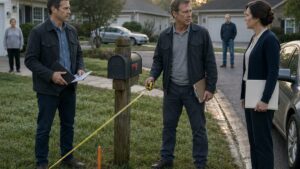
Thomas continued toward the rear stake, lifting the cord over the grass. The line sliced diagonally through the nearest tomato bed. It passed over two plants heavy with green fruit, crossed the stone path, and reached the koi pond.
For a second, the cord floated above the water.
Then Thomas lowered it until it ran taut from stake to stake, touching the pond’s concrete edge and cutting across the shallow end. Its reflection trembled below it, a second orange line wavering among the fish.
Nobody spoke.
One of the adjacent homeowners stepped off his driveway for a better view.
James’s folder hung open at his side.
Thomas measured from the cord to Patrick’s foundation, then from the cord to the fence. “Fence varies between two feet four inches and three feet one inch onto the Harris parcel. Raised bed is over by seven feet at the rear corner. Pond edge crosses approximately eleven feet at the widest point.”
Nicole set her coffee on the patio wall. “Eleven?”
“At the widest point.”
“That can’t be right.”
Thomas pointed toward the exposed rear pin. “That’s the monument referenced by the plat.”
James walked to the pond and looked down as if the cord itself were responsible. “The previous owner built the path.”
“Parts of it,” Patrick said.
James turned. “And you allowed it.”
Patrick did not answer.
Rebecca examined the county parcel printout Patrick had brought. “The GIS line appears farther east.”
Thomas nodded. “GIS is not a boundary survey.”
“The board relied on the submitted drawing.”
“Then the board relied on a drawing.”
The secretary lowered her clipboard.
Patrick should have felt vindicated. For four days he had imagined this moment: the true line visible, James unable to laugh it away, Rebecca forced to retract the notice.
Instead, he looked at the pond.
The orange cord crossed through a cluster of water lilies and over a shelf of smooth stones. Removing everything on his side would require draining the pond, cutting concrete, disturbing the shared drainage grade, and tearing out two mature shrubs. The tomato beds could be moved. The fence could be reset. The pond was different.
Nicole stood with both hands clasped at her waist.
“We spent nearly forty thousand dollars back here,” she said quietly.
James shot her a look.
Patrick heard the number and understood, for the first time, why every conversation had begun at full pressure. The garden was not merely decoration. It was debt set in stone.
Rebecca cleared her throat. “We need to review how the approval was issued.”
James recovered first.
“No. We need to review the possession history. The survey shows deed title, not necessarily ownership rights after long use.”
“You have lived here eighteen months,” Patrick said.
“The prior owner’s use counts.”
“If it was hostile.”
James pulled out a folded mortgage sketch and an HOA approval stamped six months earlier. He held both pages up for Rebecca and the observers to see.
“Our lender accepted this. The association accepted this. The landscape contractor built from this. Patrick never objected to the prior use, and he did not object during approval.”
“I was never notified.”
“You were listed.”
“Listed is not notified.”
Rebecca’s face tightened. “That is one of the issues we’ll examine.”
James looked around at the watching neighbors. “What everyone is seeing is a man who changed his mind after we improved the property.”
Patrick’s fingers pressed against the workbench.
He could have answered with nineteen years of tax records. He could have shown the drainage permit and utility documents. Instead, James had found the one fact Patrick could not arrange neatly on a page: he had watched the previous owner use part of the strip.
Not the pond. Not the fence. Not eleven feet.
But part.
Thomas clipped a bright flag to the orange cord where it crossed the stone path.
“The fieldwork supports the Harris deed,” he said. “I’ll prepare the signed plat this afternoon.”
James closed his folder.
“You prepare whatever you want. My attorney will file before any thirty-day demand expires.”
“No demand has been sent,” Patrick said.
“Then send one.”
Nicole looked at James. “Maybe we should wait for the file review.”
“We have waited long enough.”
“You put the fence up Tuesday.”
James ignored her.
Rebecca gathered the HOA papers. “No one removes anything until the board and counsel review the documents.”
Patrick looked at her. “Your board cannot order me to leave encroachments on my property.”
“And you should not demolish improvements while ownership is contested.”
“The deed is not contested by your approval stamp.”
“The history may be.”
The orange cord quivered when a koi brushed the water beneath it.
Patrick imagined the pond empty, its concrete split, the lilies piled beside the uprooted hostas. The image brought no satisfaction.
James stepped close enough that only Patrick and Rebecca could hear him clearly.
“You had nineteen years to draw this line,” he said. “You chose today.”
Then he walked back toward his house.
Nicole remained beside the pond, watching the orange reflection bend across the water.
Patrick looked down at the stamped plat on his workbench. It proved where the boundary stood.
It did not yet explain why he had left it invisible.
Chapter 4: The Approval That Should Never Have Been Signed
Patrick found his own name in the HOA file beside a signature he had never written.
The line appeared beneath the heading ADJACENT OWNER ACKNOWLEDGMENT. “Patrick Harris” had been typed into the first column. In the second, a slanted mark resembled two hurried initials. The date was six months earlier, on a Wednesday when Patrick had been supervising an all-day regional shop competition forty miles away.
He slid the page across the conference table.
“That is not mine.”
Rebecca Moore did not touch it. The HOA office occupied a converted room beside the neighborhood pool, with beige walls, metal filing cabinets, and one window facing the empty tennis courts. The secretary sat at the far end of the table with a laptop open.
Rebecca adjusted her glasses. “It may be a notation confirming delivery rather than a signature.”
“It is under acknowledgment.”
“I can see where it is.”
“Who put it there?”
The secretary looked at Rebecca before answering. “The applications were processed by the previous architectural chair.”
“Then call the previous chair.”
“He moved to Arizona.”
Patrick kept one finger on the page. “Did anyone send me the plan?”
The secretary searched the electronic file. “There’s no certified-mail receipt.”
“Email?”
“No email address is attached to the notification entry.”
“Hand delivery?”
Rebecca’s jaw tightened. “We do not maintain proof for routine adjacent-owner notices.”
“You maintained proof that somebody wrote my name.”
“That does not mean the board intended to mislead anyone.”
Patrick looked toward the filing cabinets. Orange highlighter marks covered the copy of the Walkers’ landscape plan in front of him. He had traced the deed measurements over the association’s lot diagram. The two lines diverged near the front fence, then separated sharply toward the rear. By the koi pond, the association line was nearly eleven feet east of the survey.
Rebecca tapped the HOA diagram.
“This map has been used for years.”
“For what?”
“Fence reviews. Shed placement. Drainage questions.”
“Has it ever been verified?”
“It came from the developer’s original neighborhood packet.”
“That packet is not a recorded plat.”
“It was accepted as the association’s working diagram.”
Patrick capped the highlighter. “A working mistake is still a mistake.”
Rebecca leaned back. Fatigue softened her expression without removing the defensiveness.
“You think I don’t understand the seriousness of this?”
“I think you sent me an enforcement notice before you called me.”
“I had a complaint, an approved application, and a report that you removed materials from the site.”
“My plants.”
“I know that now.”
“You could have known it then.”
The secretary stopped typing.
Rebecca folded her hands. “We process more than a hundred applications a year. Most neighbors do not hire surveyors after a fence is installed.”
“Most fences may not cross a pond.”
“That is not helpful.”
“It is accurate.”
Patrick heard the sharpness in his own voice. He wanted Rebecca to admit the board had failed. Instead, every answer came wrapped in procedure, as though the correct form could contain the damage.
The HOA’s attorney had advised that no further enforcement occur until ownership was resolved. Patrick’s attorney had prepared a certified demand requiring removal of the fence, beds, path, and pond encroachment within thirty days. The letter waited unsigned in his workshop.
Rebecca turned the landscape plan toward him. “The Walkers did not submit this on a blank sheet. They included a mortgage location sketch.”
“I saw it.”
“The lender accepted it.”
“A mortgage sketch usually shows approximate improvements. It says so at the bottom.”
“In small print.”
“Still print.”
“And the prior owner used the area in substantially the same way.”
Patrick’s hand stilled.
Rebecca noticed.
“That history matters,” she said.
“It may explain the error.”
“It may explain why no one believed there was an error.”
Patrick gathered his copies. “Send me the complete application file, including every version of the map.”
“Patrick.”
He looked at her.
“If the board made a mistake, we will correct it. But forcing immediate removal could affect the drainage swale. The pond overflow ties into a line that crosses near your property.”
“I know where the drainage line runs.”
“Then you know this is not as simple as moving a fence.”
He did know. That was the problem.
At home, Patrick spread the maps across his workshop bench. The Walkers’ contractor had shaped the pond so its overflow entered a buried channel leading toward the rear inlet. Cutting away the section on Patrick’s property could alter the grade and send runoff toward both foundations.
The signed demand letter lay beside the “House 2006” tote.
His attorney had marked three places for Patrick’s initials.
He picked up the pen.
A knock sounded on the workshop door.
Nicole stood outside alone.
She had no gardening gloves, no phone raised for photographs, and none of the careful brightness she wore around the yard. She held a folded sheet of paper against her sweater.
“James doesn’t know I’m here.”
Patrick did not invite her in, but he stepped back from the doorway. She entered and stopped when she saw the survey copies.
“That orange line is everywhere now,” she said.
“Until the fieldwork is complete.”
“I see it from our kitchen.”
Patrick waited.
Nicole placed the paper on the bench. It was a copy of their deed description with two dimensions circled in pencil.
“I noticed these before we closed.”
“How long before?”
“A week.”
“The numbers do not match the mortgage sketch.”
“I know.”
“Did you ask?”
“Our agent said the sketch was approximate. The seller said the garden had always gone to the drainage swale. James said the HOA plan confirmed it.”
“And you accepted that.”
She looked at the tote instead of him.
“We had already lost one house.”
Patrick said nothing.
“James’s company transferred him here. We sold in a bad month, and the buyer backed out after the inspection. We carried two mortgages for almost half a year. By the time this house came up, we needed something that looked settled.”
“The boundary was not settled.”
“No.”
“Yet you removed my plants.”
Her face tightened. “I was angry.”
“At me?”
“At the idea that everything could fall apart again because of lines on a page.”
Patrick looked at the deed she had brought. “So you saw the discrepancy and stayed quiet.”
“I told myself the older use mattered more. Then the HOA approved the plan. The contractor said nobody spends that much on a garden without checking ownership.”
“Contractors build from what customers give them.”
“I know that now.”
“James threatened adverse possession.”
“He believes the prior owner’s use gives him a claim.”
“Does he believe it, or need it?”
Nicole’s eyes lifted to his. That was answer enough.
She moved closer to the maps. “He borrowed against his retirement account for the landscaping. He thought the pond would add enough value to cover what we lost on the move.”
Patrick looked through the workshop window. The orange cord remained stretched across the yards, bright even in late afternoon.
“Why tell me this?”
“Because he’s going to make it worse.”
“How?”
“He asked the attorney to file before your deadline. He thinks filing first makes him look certain.”
“It makes him look litigious.”
“He doesn’t care how it looks anymore.”
Patrick picked up the unsigned demand letter.
Nicole saw it. “Are you really going to make us remove everything in thirty days?”
“That is what encroachment notices are for.”
“The pond cannot come out in thirty days.”
“That is not my engineering problem.”
He heard Linda’s voice in the sentence—not because she would have said it, but because she would not have.
Nicole flinched.
Patrick set the letter down.
“Did James know about the circled dimensions before the fence went up?”
She hesitated too long.
“Yes.”
The workshop seemed to shrink around them.
“He said the use history was stronger than a measurement discrepancy,” she continued. “He said if you objected, the board would back the approved plan.”
“And you let him proceed.”
“Yes.”
Patrick looked at the three uprooted hostas resting in temporary pots near the door. Two had begun to lift new leaves. The third remained folded inward.
Nicole followed his gaze.
“I shouldn’t have touched them.”
“No.”
“I thought making the yard look finished would make it ours.”
“It does not work that way.”
“I understand.”
Patrick did not know whether she meant the land or something larger.
After Nicole left, he called the county drainage office and described the pond overflow. The technician confirmed that abrupt demolition could compromise the shared swale and recommended an engineered removal plan.
The information should have weakened Patrick’s resolve.
Instead, it divided his anger more precisely. James had known enough to doubt. Nicole had known enough to hesitate. Rebecca had approved a plan from an unverified diagram. Patrick had known the prior use was informal and had never put that fact into writing.
No one had created the whole mistake alone.
At seven, the phone rang.
The voice belonged to the former owner of the Walker property. Age had thinned it, but Patrick recognized it at once.
“Rebecca Moore called me,” the former owner said. “She asked about the garden.”
Patrick gripped the receiver.
“I told her it wasn’t mine.”
“You used part of the strip.”
“With permission.”
Patrick closed his eyes.
The former owner continued, “I thought you had explained that when I sold.”
“I didn’t know the sale documents treated it as part of the yard.”
“You knew people could misunderstand.”
Patrick said nothing.
Then the former owner asked, softly and without accusation, “Why didn’t you ever tell them about the arrangement you and Linda made with me?”
Chapter 5: The Promise Hidden Beneath the Garden
“Don’t make kindness look like a fence.”
The former owner spoke Linda’s words from an armchair beside the assisted-living apartment window. Patrick had not heard the sentence in nineteen years, yet he knew exactly where his wife had been standing when she said it.
The side yard had been bare then. The former owner’s husband had recently died, and the vegetable beds behind the neighboring house had gone to weeds. She wanted a path wide enough to wheel a garden cart toward the sunlight beside Patrick’s maple.
Patrick had measured the boundary before agreeing.
Linda had watched him drive two temporary stakes into the ground.
“We should mark it,” he had said.
“With what?”
“A low fence. Edging. Something permanent.”
The former owner had looked embarrassed.
Linda pulled the stakes out.
“Don’t make kindness look like a fence,” she said. “We know where the line is.”
Patrick had known better than to leave an agreement unwritten.
He had done it anyway.
Now the former owner held a mug with both hands and looked across the small apartment at him.
“You said the use was temporary,” Patrick said.
“It was.”
“But the path stayed.”
“I stopped gardening after my hip surgery. Then my nephew helped sell the house. I assumed the survey would show everything.”
“There was no boundary survey.”
“I didn’t know that.”
Patrick looked at a framed photograph on the shelf. The former owner stood beside Linda in the shared garden, both women holding tomatoes. Behind them, the side yard had no fence, only a shallow swale and a line of hostas.
“How much did you tell the Walkers?”
“That the garden had always been used from the patio to the maple.”
“That sounds like ownership.”
“I told them you owned the strip.”
“Did they hear you?”
The former owner’s mouth tightened. “They heard the part they wanted.”
Patrick sat back.
She reached toward a side table and handed him an envelope. Inside was a copy of the handwritten note Linda had made after their original conversation.
Temporary garden access along west strip. No transfer. Revisit if either house sells.
Patrick read it twice.
“Why do you have this?”
“Linda gave me a copy.”
“I never saw it.”
“She said you were going to prepare something proper.”
Patrick remembered.
He had drafted a short easement agreement on his workshop computer. Linda had objected to the word easement because it sounded permanent. They had argued mildly, then postponed the discussion until after her next medical appointment.
The appointment led to tests. The tests led to treatment. The document never returned to the kitchen table.
Patrick folded the note along its old crease.
“I should have recorded something.”
“Yes.”
The former owner did not soften the answer.
“I also should have disclosed it more clearly when I sold,” she added. “I thought the old map and your deed would handle it. That was careless.”
Patrick looked again at the photograph.
Linda’s generosity had not caused the conflict. Silence had carried it forward.
When he returned home, the orange survey cord remained taut across the gardens. Fallen leaves had caught against it near the pond. From a distance, it looked less like a boundary than a warning line around a work site.
Patrick went straight to the workshop and emptied the archive tote.
He searched every green-tabbed folder, then the red ones. Near midnight, beneath warranty papers for an old water heater, he found three pages clipped together.
The first was the draft agreement.
The second was a sketch of the temporary garden area.
The third contained Linda’s handwritten revisions.
Permission ends upon sale unless renewed in writing.
Patrick sat down hard on the stool.
The draft proved no permanent transfer had occurred. It also proved he had understood the need for a written limit and failed to finish it.
In the margin, Linda had drawn an arrow toward a blank signature line.
Talk to her after treatment.
Patrick rested his thumb over the words.
For years he had treated the tote as evidence of how carefully they had managed the house. In truth, it also held the unfinished things he had preserved because finishing them would require admitting Linda had not returned.
At school the next day, a student brought him a cabinet door that would not close. The student had sanded one edge repeatedly, making the gap worse.
Patrick checked the frame.
“You’re correcting the door for a problem in the box,” he said.
“So what do I do?”
“Stop removing material until you know what’s out of square.”
The student waited.
Patrick looked at the cabinet, then at his own hands.
“Sometimes the part you want to cut is not the part that caused the problem.”
After class, Patrick called his attorney.
“I want to change the demand.”
There was a pause. “Change the deadline?”
“The remedy.”
“The survey gives you a strong position.”
“I know.”
“If you reduce the demand before they respond, they may interpret it as uncertainty.”
“It is not uncertainty about the line.”
“What is it uncertainty about?”
Patrick looked through the shop window at rows of workbenches marked with pencil measurements, each line made so someone could cut accurately.
“How much damage I need to cause to defend it.”
His attorney warned him not to surrender title, not to make verbal concessions, and not to negotiate without recorded terms. Patrick agreed.
Then he called Rebecca.
“I want the board to schedule one public meeting before the notice period expires.”
“For what purpose?”
“To correct the record and present a settlement.”
“You sent the removal demand yesterday.”
“I’m withdrawing the demand as written.”
Rebecca was silent.
“Are you conceding the boundary?” she asked.
“No.”
“The Walkers will say you are.”
“Then they can say it in the meeting.”
“What are you proposing?”
“You’ll hear it with everyone else.”
“That is not how board negotiations usually work.”
“Neither is approving a pond from an unverified sketch.”
Rebecca exhaled. “Patrick.”
“I will provide the survey, the drainage assessment, the prior owner’s statement, and the temporary-use draft. I will also explain my part.”
“Your part?”
“I knew the use was temporary. I failed to document it properly.”
Rebecca’s tone changed. “Does that affect your claim?”
“Not the deed. It affects the truth.”
By evening, the Walkers had received notice that Patrick was withdrawing the immediate demolition demand and requesting a formal meeting.
James came to the workshop door before sunset.
“You’re backing down,” he said.
“No.”
“You withdrew.”
“I changed the remedy.”
“Because your attorney told you the possession claim is stronger than you thought.”
“My attorney told me the deed is strong.”
“Then why not make us tear it out?”
Patrick looked past him toward the pond. The orange line crossed the water where the setting sun turned it copper.
“Because being allowed to destroy something does not make destruction the only honest choice.”
James gave a humorless smile. “You want to look generous now.”
“I want the ownership recorded correctly.”
“You want control.”
“I want the line recognized.”
“And what do you get for saving the pond?”
“That depends on whether you come to the meeting prepared to solve the problem.”
James stepped closer.
“We already solved it. The yard was functioning until you hired a surveyor.”
Patrick felt the old urge to end the conversation by closing the door.
Instead, he stayed where he was.
“The yard was functioning because everyone accepted a false map,” he said. “I helped that happen by staying silent. You helped it happen after you saw the deed numbers did not match. Rebecca helped it happen by approving your plan. None of those things move the boundary.”
James’s expression changed at the mention of the deed numbers.
“Nicole talked to you.”
“Yes.”
“She had no right.”
“She had more right than you gave the measurements.”
James looked toward his house.
Patrick continued, “The meeting is Tuesday. Bring your attorney if you want. Bring the HOA approval. Bring the mortgage sketch. I’m bringing everything I avoided saying for nineteen years.”
James’s face hardened again, but something uncertain had entered it.
“You think confession makes you noble?”
“No.”
Patrick closed the distance to the workshop door and rested one hand on its frame.
“I think it makes the next agreement harder to misunderstand.”
He shut the door only after James had turned away.
On the bench, beside Linda’s unfinished draft, Patrick placed a clean sheet of paper titled Proposed Boundary Restoration and Recorded Maintenance Agreement.
For the first time since the hostas were pulled, he did not begin with what the Walkers had to remove.
He began with what every person in the room would have to admit.
Chapter 6: Thirty Days, One Pond, and No Easy Victory
James arrived at the HOA meeting carrying a legal pad and the expression of a man expecting surrender.
He sat beside Nicole at the front table without looking at Patrick. Rebecca occupied the center seat with the secretary and the HOA attorney. Two adjacent homeowners sat against the wall. Patrick’s attorney remained near the door, a closed folder on his lap.
On an easel beside Patrick stood the revised site plan.
A neon-orange line ran through it from the front pin to the rear drainage inlet.
James noticed the plan and leaned toward Nicole. “He redrew the same survey.”
Patrick heard him.
“Yes,” he said. “This time it includes a solution.”
Rebecca called the meeting to order. Her voice was formal, but she did not read the usual opening statement about architectural harmony. Instead, she placed three documents in front of her: the stamped survey, the Walker approval, and the association’s legacy lot diagram.
“The board has confirmed that the landscape approval relied on an unverified diagram,” she said. “The board also lacks proof that Patrick Harris received adjacent-owner notification.”
James shifted in his chair. “That does not erase historic possession.”
“No,” Rebecca said. “But it means the approval cannot be treated as proof of ownership.”
It was the first public correction Patrick had heard from her.
Rebecca continued. “The association has suspended the violation issued to Patrick and will waive all related enforcement costs.”
One of the adjacent homeowners nodded. The other looked toward James.
Patrick waited for satisfaction.
What he felt instead was room to breathe.
James tapped his legal pad. “Are we here to discuss the survey or apologize for paperwork?”
“We are here to prevent litigation if possible,” the HOA attorney said.
“Then Patrick can acknowledge the established use.”
Patrick stood.
He placed Linda’s temporary-use draft beside the revised plan.
“I will acknowledge it.”
James looked up sharply.
Patrick faced the room rather than the easel.
“Nineteen years ago, the former owner asked to use part of the strip for a garden path and planting bed. My wife and I agreed. The permission was temporary. It was supposed to end when either property sold unless renewed in writing.”
Nicole lowered her eyes.
Patrick continued. “We drafted an agreement. We did not finish it. My wife became ill, and after she died, I put the papers away. I let the old arrangement remain visible without marking the boundary or recording the permission.”
James leaned back. “So the use was continuous.”
“The permission was continuous for a time. Permission is not hostile possession.”
“That is a legal conclusion.”
“My attorney can handle the legal conclusions. I’m handling my mistake.”
The room became still.
Patrick looked at Rebecca. “The board relied on a bad map.”
Rebecca nodded once. “Yes.”
He looked at Nicole. “The Walkers received a deed with measurements that did not match their sketch.”
Nicole swallowed. “Yes.”
James turned toward her.
Patrick did not let the silence break the sequence.
“James knew about the discrepancy before the fence was installed.”
James pushed his chair back an inch. “We relied on the prior use and the approval.”
“You relied on them after you knew the measurements conflicted.”
“We relied on legal advice.”
“Then your attorney advised you to obtain a boundary survey?”
James did not answer.
Patrick placed a drainage assessment on the table.
“The survey confirms my deed. Immediate demolition could damage the shared drainage swale and both properties. I’m not demanding that.”
James’s face shifted, triumph arriving too quickly.
“So you are conceding the improvements.”
“No.”
Patrick turned the easel toward the room.
The revised plan showed the white fence moved entirely to the Walker side. Both raised beds had been shortened. The stone path curved away from the true line. The pond was reduced at its shallow end but retained most of its depth and pump system.
A narrow shaded strip followed the rear drainage channel.
“The fence moves,” Patrick said. “The beds move. The path moves. The pond edge is rebuilt inside the Walker parcel. The work follows an engineered drainage plan.”
James stared at the drawing. “That removes a third of the pond.”
“Less than a quarter of the water area.”
“It destroys the design.”
“It corrects the encroachment.”
“And the shaded strip?”
“A recorded maintenance easement, four feet wide, limited to drainage access. No planting beds, no fence, no expansion, no claim of ownership.”
Nicole leaned closer to the plan.
Patrick continued. “The HOA corrects its lot diagram, records the approval error in the property file, and adopts a rule requiring a professional survey for future improvements within five feet of a disputed boundary.”
Rebecca said, “The board is prepared to accept those terms.”
James looked at her as if she had crossed the room.
“You discussed this without us?”
“We discussed the association’s exposure,” Rebecca replied. “The board cannot defend an approval based on a diagram we never verified.”
James turned to Patrick. “What do you pay?”
Patrick’s attorney shifted slightly but remained silent.
“For what?”
“For the reconstruction. You are preserving the pond because tearing it out hurts you too. You benefit from the drainage correction.”
“The Walkers pay to move private improvements from my property. The HOA reimburses the survey cost and contributes to the drainage engineering because its approval worsened the situation. I pay to restore my planting bed.”
James laughed once. “Generous.”
“No,” Patrick said. “Measured.”
The word settled over the table.
James looked at the orange line on the plan. “And if I refuse?”
“My removal demand returns with the remaining deadline. My attorney files to quiet title and seek removal. The HOA’s records, your deed discrepancy, and the survey become exhibits.”
“You cannot guarantee you win.”
“No.”
That answer seemed to disturb James more than certainty would have.
Patrick held his gaze.
“I can guarantee it costs all of us more.”
Nicole touched the corner of the plan. “Could the pond wall curve here instead?”
Patrick stepped beside her.
“If the engineer confirms the overflow remains inside the easement.”
“And these lilies?”
“They can be moved to the deeper section.”
James looked between them. “You’re redesigning our yard with him now?”
“I’m trying to keep what can be kept.”
“You told him private information.”
“I told him the truth you kept using as leverage.”
James’s face flushed.
Nicole’s voice remained low. “We saw the dimensions. We should have stopped before the fence.”
“The HOA approved it.”
“That did not make the numbers disappear.”
Rebecca folded her hands. “The board should have stopped it too.”
For a moment, responsibility moved around the table without anyone being able to push it entirely onto someone else.
Patrick placed four copies of the proposed agreement in front of them.
“The boundary acknowledgment is recorded with both parcels. The easement ends if the drainage route changes. No future use expands by habit. Any modification must be written and signed.”
James scanned the first page.
“This says we waive adverse possession.”
“Yes.”
“You want me to sign away a claim before a court evaluates it.”
“I want the deed line recognized before I preserve any access.”
James closed the document.
“No.”
Nicole did not move.
James stood. “We are not signing a confession.”
“It is not a confession,” Rebecca said. “It is a settlement.”
“It says we built on land we do not own.”
Thomas’s survey was attached as Exhibit A. The orange line seemed brighter beneath the meeting-room lights.
Patrick felt the room leaning toward confrontation. Months earlier, he would have let his attorney answer. Years earlier, he would have said nothing and waited for everyone to tire.
He stepped away from the easel.
“I gave informal permission because my wife believed neighbors should not need fences for every kindness,” he said. “I let grief turn that kindness into silence. The board let routine turn an old sketch into authority. You let fear over your investment turn a discrepancy into something you thought you could overpower.”
James’s jaw tightened.
Patrick’s voice remained level.
“I am not asking you to admire me. I am asking you to stop claiming what the measurements say is mine. In return, I will not use the measurements to cause damage that serves no practical purpose.”
No one applauded. No one spoke.
The koi-pond pump could not be heard from the meeting room, but Patrick imagined its steady hum beyond the windows.
Nicole picked up the pen.
James caught her wrist lightly. “Don’t.”
She looked at his hand until he released her.
“We cannot afford court,” she said.
“We cannot afford this reconstruction.”
“We could have afforded a survey.”
James looked away.
Nicole signed the boundary acknowledgment, then the easement proposal. Her handwriting shook only on the first page.
She slid the pen across the table toward James.
He remained standing.
Patrick gathered neither the papers nor the plan. He had placed the choice where everyone could see it. Taking it back would only give James another place to hide.
Rebecca closed the HOA file.
“The offer remains open until Friday at five,” she said.
James stared at Nicole’s signature. Then he stared at the orange line running through the revised pond.
For the first time since the dispute began, no folder, approval stamp, or unfinished history stood between him and the boundary.
Only the pen did.
Chapter 7: What We Replanted Along the True Boundary
The koi-pond pump went silent at eight twelve on a Tuesday morning.
Patrick heard the change from his workshop. For three months, the low hum had carried through the side yard whenever the windows were open. Its sudden absence made the space feel larger and less familiar.
Outside, a contractor stood beside the pond with the power cord looped over one shoulder. Orange flags marked the revised edge in a careful curve. The original survey cord was gone, but short sections of neon line had been tied between stakes to guide the excavation.
James stood near the patio in work gloves, watching the water level drop through a temporary hose.
He had signed the agreement at four forty-three on the Friday deadline.
Patrick knew the exact time because James had written it beside his signature.
No apology had accompanied it. James had initialed every page, signed the recorded boundary acknowledgment, and left the HOA office before Nicole finished collecting her copies. His attorney had advised him that filing first would not erase the deed discrepancy, the survey, or his knowledge of the conflicting measurements. Litigation would make all three public and expensive.
The settlement was recorded the following week.
Now the consequences had arrived with shovels, forms, and a rented holding tank full of koi.
Thomas Davis checked the orange markers against the revised plan while the drainage contractor examined the rear swale. Rebecca came by carrying a clipboard, no longer to enforce anything against Patrick but to document that the work matched the corrected approval.
The white fence had already been removed.
Without it, the two yards looked briefly as they had years ago—open grass, an uninterrupted view toward the maple, and no structure pretending certainty where none had been measured.
Nicole approached Patrick with the revised planting plan.
“The contractor says the pond wall can curve another six inches here without changing the overflow,” she said.
Patrick followed her finger. The change remained inside the Walker parcel and outside the drainage easement.
“That should be fine if Thomas confirms it.”
Nicole nodded and wrote the adjustment in the margin.
Their conversations had become like that: direct, specific, and short. She no longer called the space “our whole garden.” Patrick no longer answered questions with silence merely because he disliked the person asking them.
Across the yard, James lifted one of the old fence panels onto a trailer. He worked without speaking.
Patrick returned to the workshop to finish a cedar gate frame for the school’s storage yard. He had cut the final rail when someone set a black nursery pot outside the open door.
James stood behind it.
Inside the pot was a hosta.
Its leaves were smaller than Patrick remembered, and two carried brown edges from being uprooted and replanted too many times. Still, the central crown was alive.
“I found it behind the shed,” James said.
Patrick set down the square.
“One of the three?”
“I think so.”
Patrick crouched beside the plant. The soil in the pot was dry but not hardened.
“You kept it?”
“Nicole potted them. This one got moved during the fence work.”
Patrick touched one leaf with the back of his finger.
James looked toward the excavation. “The other two didn’t make it.”
Patrick had suspected as much.
He stood.
“Thank you for bringing it back.”
James shifted his weight, as if the words had created an obligation he did not want.
“The contractor wants to add a maintenance gate near the rear,” he said. “So we can reach the drainage channel without going around the pond.”
“That gate would open onto my property.”
“Onto the easement.”
“The easement permits maintenance access. It doesn’t automatically permit a permanent gate.”
James’s mouth tightened. The old reflex appeared and stopped there.
“What would make it acceptable?” he asked.
Patrick considered the question.
Three months earlier, he might have refused simply because James had asked. A gate could become another object whose use expanded quietly over time. It could also prevent workers from dragging equipment through the planting bed whenever the swale required service.
“Self-closing hinges,” Patrick said. “No lock on my side. Access only for drainage maintenance, with notice unless it’s an emergency.”
“Written into the agreement?”
“An amendment.”
James looked at him for a long moment.
“You really do put everything on paper now.”
“Yes.”
There was no humor in Patrick’s answer, but James gave a small breath that might have been the beginning of a laugh.
“Send me the language.”
“I will.”
James turned to leave.
“James.”
He stopped.
Patrick nodded toward the hosta. “This doesn’t settle anything else.”
“I know.”
“It matters anyway.”
James looked down at the plant. “I know that too.”
By the end of the week, the pond had been rebuilt inside the true boundary. It was smaller, but the curve appeared intentional rather than amputated. Nicole moved the lilies into the deeper section. The raised beds were shortened and turned parallel to the new fence. The imported stones were reused along the Walker patio instead of being hauled away.
The orange markers remained until Thomas completed his final inspection.
He checked the pond wall, fence footings, path, and maintenance gate. Then he pulled each stake from the ground and placed it in the bed of his truck.
The last one stood beside Patrick’s restored planting strip.
“You keeping this mark?” Thomas asked, pointing to a short orange paint line on the soil.
“For another day.”
Thomas nodded. “Sometimes people need to see where the line was before they trust where the work ended.”
After he left, Patrick carried the returned hosta to the strip. He measured from the recorded boundary, then stopped himself before marking the exact center with his ruler.
Linda would have moved it.
He shifted the pot two inches toward the maple.
Nicole watched from her side of the new fence. The pickets ended before the drainage easement, where the small cedar gate stood closed.
“That where it used to be?” she asked.
“Close.”
Patrick removed the plant from the pot. Fine white roots circled the soil. He loosened them carefully and lowered the hosta into the hole.
James approached with a hose but did not cross through the gate.
“Need water?”
Patrick looked at the hose, then at him.
“Yes.”
James passed the nozzle over the fence.
Patrick soaked the soil until it settled around the roots. Mud darkened his hands. One bent leaf rested against his wrist.
At the next HOA meeting, Rebecca presented the corrected lot diagram and a new survey-verification policy. She did not describe the conflict as a misunderstanding. She called it an approval failure compounded by unrecorded history and incomplete notice.
The minutes named each correction.
Patrick read them before the board adopted them.
When Rebecca asked whether he wanted anything added, he said, “State that the boundary agreement and maintenance easement are recorded.”
The secretary typed the sentence.
Nothing was left to memory alone.
Early in October, Patrick stood in the side yard with the signed gate amendment on a clipboard. James signed first this time. Patrick signed beneath him, and Nicole witnessed both signatures.
The new fence cast a narrow shadow across the grass but did not cross the recorded line. Beyond it, the smaller pond pump ran with a softer hum. The koi moved beneath the lilies as they had before, only now the water ended where the ownership did.
Patrick filed the amendment in the “House 2006” tote.
He removed the old duct tape from the lid and replaced it with a proper document seal. Linda’s handwriting remained visible above the label.
Keep everything. You’ll thank me.
He closed the tote, but he did not hide it beneath the bench.
Outside, the returned hosta had begun to uncurl a new leaf. Patrick pressed the last loose soil around it, exactly inside his boundary and two inches away from where any careful measurement would have placed it.
The story has ended.