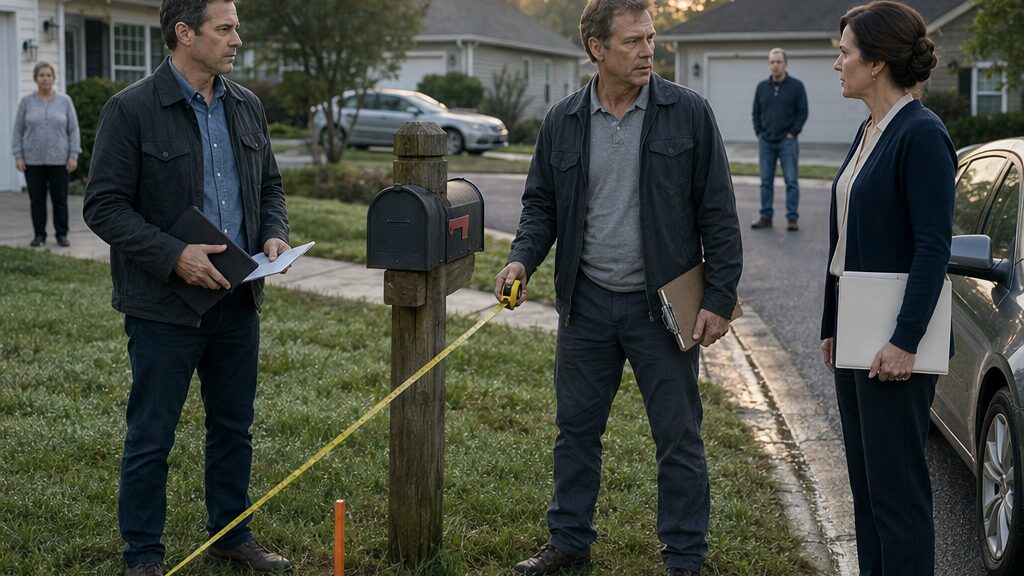
The Morning the HOA Measured James Clark’s Mailbox and Crossed the Line He Had Already Marked
Chapter 1: The Inspector Arrived Before the Street Was Fully Awake
Dennis Miller’s boot came down six inches from the survey pin.
James watched from behind the narrow glass beside his front door as the inspector stepped off the asphalt and onto the wet edge of the lawn. The pin’s orange cap caught the weak morning light. Dennis either did not see it or had decided it did not matter.
He carried a clipboard beneath one arm and a camera against his chest. A yellow measuring tape hung from his belt. Behind him, a white utility vehicle sat at the curb with CEDAR BROOK COMPLIANCE printed across the door.
The dashboard clock in James’s hallway read 7:04.
Dennis set the clipboard on top of the cedar mailbox, pulled out the tape, and hooked its metal end against the base of the post.
James picked up the folder waiting on the entry table.
He had arranged its contents the night before: recorded plat, enlarged boundary detail, photographs of both survey pins, certified-mail receipt, copy of the warning letter, and a completed notice identifying Dennis’s vehicle. The preparation had felt excessive at midnight.
Now the yellow tape stretched across the grass like a line being drawn by the wrong person.
James opened the door.
“Morning.”
Dennis glanced over his shoulder. “Mr. Clark?”
“That’s right.”
“I’m conducting an exterior compliance inspection.”
“You’re standing on my property.”
Dennis looked down, not at the pin but at his own boots. “The mailbox is in the common frontage.”
“The mailbox is partly in the county right-of-way. You reached it by crossing private lawn.”
Dennis gave the kind of sigh used by people who expected an argument and had already decided what kind of man would provide it.
“I was told access was authorized.”
“By whom?”
“The association.”
“That wasn’t my question.”
Dennis straightened. He was older than James had expected, perhaps in his late forties, with deep creases beside his mouth and a faded company polo under a light jacket. He did not look eager for confrontation. He looked tired and mildly embarrassed to have found one before breakfast.
“I’m not here to debate property law,” he said. “I need two measurements and photographs.”
James stopped at the edge of the driveway. He kept both hands visible around the folder.
“Before you take another photograph, read this.”
Dennis did not move.
James crossed the driveway slowly and held out the first page. It was the survey detail, enlarged until the road edge, right-of-way, and private parcel could be understood without a magnifying glass.
“This is the recorded line,” James said. “The orange cap beside your boot marks it.”
Dennis looked down again. This time he saw the pin.
His tape crossed it.
James opened the folder to the second document. “This is the notice sent to the HOA president twelve days ago. It states that representatives are not authorized to enter the parcel without written permission.”
“I don’t receive board mail.”
“No. Nicole Adams does.”
James placed the green certified-mail receipt on top.
Dennis’s eyes moved from Nicole’s signature to the date and back again.
“You’re saying she signed for this?”
“I’m saying the postal service says she did.”
The metal hook slipped from the cedar post and snapped back several inches. Dennis caught the tape before it recoiled fully.
James handed him the completed notice.
Dennis read the heading, then the line containing his vehicle plate. “You filled this out before I arrived?”
“I saw the work order added to the association portal last night.”
“That portal didn’t give you my plate.”
“Your truck was outside Nicole’s house yesterday afternoon.”
Dennis stared at him.
James heard how the answer sounded. Precise. Prepared. Too prepared.
“That’s not a threat,” he said. “It’s identification.”
Dennis lowered the paper. “You understand I’m a contractor. I go where the board sends me.”
“And you understand a board cannot authorize access it doesn’t own.”
A garage door rattled open across the street. A neighbor in running clothes slowed near the corner, pretending to adjust an earbud. James could feel the scene becoming public one witness at a time.
Dennis glanced toward the road.
“I can measure from the pavement,” he said.
“You can.”
It was the first small surrender of the morning.
Dennis stepped backward over the pin, reeled in the tape, and placed both boots on the asphalt. James felt some of the pressure leave his shoulders.
Then a gray sedan turned onto Sycamore Lane.
Nicole Adams parked behind the compliance vehicle and got out before the engine had fully stopped. She wore dark slacks, a cream blouse, and the navy cardigan she used for board meetings. A slim white folder was tucked under her arm.
Her gaze moved from Dennis to James, then settled on the papers in Dennis’s hand.
“What’s the delay?”
Dennis held up the certified receipt. “He says there’s an access restriction.”
“There is no restriction on an association inspection.”
“There is when the route crosses private land,” James said.
Nicole closed the sedan door carefully. That restraint had always bothered him more than anger would have. It made every disagreement seem like something she had already filed under his name.
“The board has a duty to enforce the standards residents pay for,” she said. “Dennis, complete the inspection.”
“He can complete it from the road.”
“The post cannot be properly measured from the road.”
“That’s not my problem.”
“No,” Nicole said. “Your problem is that you’ve turned a routine correction into a legal performance.”
Across the street, the runner had stopped pretending to adjust his earbud.
James kept his voice low. “You signed for the warning.”
“I sign for association mail every week.”
“You read it.”
“I reviewed it.”
“And sent him anyway.”
Nicole’s eyes flicked toward Dennis. For the first time, something uncertain crossed her face.
Dennis noticed.
“You told me access had been cleared,” he said.
Nicole’s mouth tightened. “It has been.”
“By the owner?”
“By the governing documents.”
James felt the morning change.
Until then, he had believed Nicole was relying on the ordinary arrogance of authority—the assumption that a logo on a vehicle and a section of covenants could carry someone across any patch of grass. But she had expected this objection. She had arrived with a folder of her own.
Nicole opened it and removed a photocopied page marked with an old recording stamp.
“There is a maintenance corridor along the community frontage,” she said. “Recorded when Cedar Brook was developed. It permits inspection and upkeep of approved exterior features.”
James did not take the page.
He recognized the shape of the exhibit before he could read the words. The narrow parcel diagram. The faded diagonal notation. The old development-company border.
A memory moved at the edge of his mind: a field sketch, years earlier, with a corridor note beside a line no one had ever precisely located.
Nicole held the page toward him.
“You’ve been very careful to show everyone where your boundary is,” she said. “You haven’t been nearly as careful about telling them what crosses it.”
Chapter 2: The Cedar Post Became a Test of Obedience
Three weeks earlier, Nicole had placed a glossy brochure against the cedar post as if comparing a paint sample.
The brochure showed a row of identical white vinyl mailboxes standing beneath identical black boxes. At the bottom, a smiling family walked along a sidewalk too clean to belong to any real neighborhood.
“This is the approved replacement,” she said.
James looked from the brochure to the cedar grain beneath it. The post had weathered to a muted silver-brown, except where he had resealed it the previous spring. It leaned less than half a degree toward the street. He knew because he had checked.
“There’s nothing structurally wrong with mine.”
“It isn’t about structural failure.”
“What is it about?”
“Consistency.”
Nicole removed the brochure and brushed a speck of dirt from its corner. She had been HOA president for four months. Before that, she had chaired the landscaping committee and attended nearly every open board session, usually with a binder already tabbed to the section being discussed.
“Cedar Brook has gone too long without consistent enforcement,” she said. “People complain that some owners receive exceptions while others get notices.”
“My post isn’t an exception. It was installed before the current standard.”
“Existing fixtures are subject to review when they affect neighborhood appearance.”
“It’s a mailbox.”
“It’s one of the first things people see.”
James glanced down Sycamore Lane. The houses differed only in their shutters, porch furniture, and the degree to which their owners obeyed the approved palette. His cedar post stood out, but not loudly. It looked made rather than ordered.
Nicole held out the brochure.
“You have thirty days.”
He did not take it.
“The post sits in the county right-of-way,” he said. “The association doesn’t own the location.”
“The association regulates visible exterior features.”
“Not automatically.”
Her expression changed by less than an inch. “Would you prefer a hearing?”
“I’d prefer you to withdraw the notice.”
“Then submit the documentation.”
“I will.”
“Good.” She placed the brochure on top of the mailbox. “There’s a mediation session next Thursday. We can resolve it without making this adversarial.”
James almost laughed at the word resolve. It was what people said when they had already decided which side would move.
“I won’t need mediation.”
Nicole studied him. “You’re certain.”
“I’m a land surveyor.”
“That wasn’t what I asked.”
He picked up the brochure and handed it back. “I’m certain enough.”
At the county records office the next morning, James spread the recorded plat across a waist-high table beneath fluorescent lights. The clerk brought him the original subdivision file and left him with a pair of cotton gloves.
The post sat four feet inside the county’s measured right-of-way from the road centerline. That supported him, but not as cleanly as he wanted. The HOA covenants contained broad language allowing the association to regulate exterior features visible from common roads. A separate development exhibit referenced a “frontage maintenance corridor” without fixed dimensions.
He read the sentence three times.
The corridor appeared to concern drainage swales and landscaping installed by the developer. It did not expressly mention mailboxes. It also did not clearly stop at the property line.
James photographed the page and closed the file.
The ambiguity irritated him more than an outright contradiction would have. A wrong line could be corrected. A vague one invited the person with more power to decide what it meant.
The clerk returned carrying a thinner folder.
“You asked for the postal placement correspondence?”
“Yes.”
She handed him a county letter approving the original mailbox locations along Sycamore Lane. His post number appeared in the list.
“Installed eleven years ago,” she said. “Looks like the county reviewed the setback.”
“Does the county maintain the posts?”
“No. Just approves placement. Ownership and design are separate questions.”
The answer gave him enough to resist, not enough to end the dispute.
Outside, he called Nicole.
“The county approved the location before the current standard,” he said. “The post is in the right-of-way.”
“The location isn’t the only issue.”
“It removes your access argument.”
“We haven’t made an access argument.”
“You will if you send someone to inspect it.”
A pause followed.
“James, come to mediation,” Nicole said. “Bring the plat. Let the board review it.”
“The board issued a demand before reviewing anything.”
“The board issued a notice based on the visible condition.”
“The visible condition is cedar.”
“The visible condition is noncompliance.”
There it was: not damage, not obstruction, not safety. Noncompliance as a condition of its own.
“I’ll send the documents,” he said.
“That isn’t the same as participating.”
“No. It isn’t.”
He ended the call.
That afternoon he enlarged the plat, photographed both front survey pins, and measured the path from the asphalt to the cedar post. The simplest route crossed four feet of his lawn. From the road, an inspector could photograph the post easily but would have difficulty placing a level against it or measuring the base.
He knew exactly what the board would do.
The first certified letter remained professional. It described the right-of-way, disputed the design authority, and denied entry onto the private parcel without written permission.
Nicole signed for it two days later.
The following week, the mediation session came and went without him. At 6:40 that evening, the association portal marked the case unresolved.
James printed the update and added it to the file.
The next morning, he installed a small no-trespassing notice near each front corner. They were plain, legal-sized signs rather than red warnings. He positioned them inside the line so no one could claim they obstructed the right-of-way.
Samantha Rivera watched from her driveway while loading a backpack into her car.
“Expecting burglars?” she called.
“Inspectors.”
She frowned as if she had misheard him.
James carried the post driver back toward his garage.
“You know those signs make the whole street look unfriendly,” she said.
“They’re temporary.”
“So is every permanent neighborhood argument.”
He did not answer.
That evening he installed two cameras—one at the door, one beneath the side eave—with both views angled toward the curb. He tested the motion zones until the recordings captured the lawn but excluded most of Samantha’s driveway.
At 9:12 the next morning, his phone vibrated on a job site.
Motion detected: Front boundary.
The recording showed Nicole stepping from the sidewalk onto his lawn. She carried the white folder and moved directly toward the cedar post. She bent at the base, photographed the ground, then walked farther into the parcel to examine the nearest survey pin.
She passed within three feet of the no-trespassing sign.
James watched the clip twice.
Nicole had not come to look at the mailbox.
She had come to find the line.
Chapter 3: Every Visit Left Another Mark in the Grass
The fresh mark in the grass was eight inches long and too straight to have come from a shoe.
James found it before sunrise, a narrow depression pressed into the wet ground beside the cedar post. At one end, the soil had been disturbed in a small square. Someone had placed a measuring tool there, leaned weight onto it, and removed it.
He crouched and photographed the indentation with a scale card beside it.
Across the street, a porch light clicked off.
By the time James stood, two curtains had moved.
The no-trespassing signs had changed the neighborhood faster than the violation notice had. People who had never asked about the mailbox now slowed near it. One neighbor waved less often. Another posted a message in the community group asking whether roadside signs were allowed under architectural standards.
James saved a screenshot and said nothing.
He entered every visit into a spreadsheet: date, time, person, path of entry, duration, visible equipment. Nicole appeared twice. An unnamed board member came once and remained on the pavement. A contractor’s vehicle stopped for eleven minutes but no one got out.
The records gave James the calm he could not get from conversation. Each row stayed where he put it. Each photograph showed only what the lens had captured.
People did not.
Samantha knocked on his door that Saturday afternoon with her phone in one hand.
“I’m not here about the signs,” she said.
James looked past her toward the curb. “What are you here about?”
“That answer is why people think you’re enjoying this.”
“I’m working.”
“So am I. May I come in?”
He stepped aside.
She remained near the entry rather than following him toward the kitchen. On her phone was a photograph of a mailbox two streets over: brick base, black metal box, decorative lantern mounted above it.
“That’s on Willow Bend,” she said. “Installed before the vinyl standard.”
“I know.”
She swiped to another image. A rough stone pillar. Then a painted wooden post with carved numbers. Then a copper box mounted on a timber frame.
“None of these owners received notices.”
“How do you know?”
“I asked.”
James looked at her.
Samantha folded her arms. “I used to volunteer with the architectural committee. People still tell me things.”
“Were these fixtures reviewed?”
“Some were grandfathered. Some probably weren’t. That’s the point.”
“The point is selective enforcement.”
“The point is I’m trying to help you establish that without turning the entrance to the neighborhood into a restricted site.”
He handed the phone back.
“Send me the originals.”
“I’ll send them if you agree to meet with the board.”
“No.”
“James.”
“They had the chance to review my documents before issuing the demand.”
“And you had the chance to sit in a room with them before sending trespass warnings.”
“The warning came after Nicole entered the property.”
“The first one came before the signs.”
He studied her face. “You’ve been discussing my correspondence.”
“I’ve been trying to understand why a mailbox has become the only thing anyone talks about.”
“It became that because Nicole chose it.”
“And it stayed that because you refuse every path that doesn’t end with somebody admitting you were right.”
The words struck closer than Samantha could have known.
James walked to the front window. From there, the cedar post appeared between two sections of white porch railing. The afternoon sun brought out the darker lines in the wood, the rings of a tree that had grown somewhere before becoming a neighborhood object.
“I don’t need the board to admit anything,” he said.
“You filled your lawn with cameras.”
“Because they kept entering.”
“You could have asked three neighbors to attend mediation.”
“I don’t need witnesses to read a plat.”
“No,” Samantha said. “You need neighbors when the board decides the story is about your behavior instead of their authority.”
He turned.
She held up the phone again. “I’ll send the photographs. But I’m not becoming part of a campaign.”
“I didn’t ask you to.”
“That’s also the problem.”
She left before he could decide whether the statement was unfair.
The photographs arrived ten minutes later with dates, addresses, and brief notes. James added them to his file. He told himself Samantha’s criticism was separate from the evidence.
By Monday, the selective-enforcement pattern looked substantial. Seven older fixtures remained in place. Three were more visually distinctive than his cedar post. Two had been repaired within the last year without being forced into the vinyl standard.
James drafted a concise message to the board requesting confirmation of the review criteria.
He did not send it.
A direct question would give Nicole time to produce a rationale. Better to preserve the inconsistency as it existed.
That decision felt strategic until he read it back in his own mind.
At noon, the postal carrier stopped beside his mailbox and called toward the garage.
“Mr. Clark?”
James walked down.
The carrier pointed to one of the signs. “Just checking. This doesn’t apply to delivery access, right?”
“No. Authorized delivery is fine.”
“You may want to make that clearer. A substitute skipped the box yesterday.”
James looked at the bundle in the carrier’s hand. Two envelopes had been delayed, including a notice from the association.
The sign had protected the line and interrupted his own mail.
He adjusted the wording that evening.
The association’s envelope contained no new violation. Instead, it announced a special board session concerning “resident obstruction of authorized compliance functions.” The document did not name James on the first page.
The attached incident summary did.
It described him as confrontational, unwilling to participate in mediation, and engaged in surveillance of volunteers performing community duties. It stated that an inspector had been “prevented from safely completing an exterior review.”
There was no mention of Nicole’s entry after the certified warning.
No mention of the county right-of-way.
No mention of the seven uncited legacy mailboxes.
At the bottom, residents were invited to submit concerns about “unequal treatment or hostile interactions affecting neighborhood operations.”
James read the phrase twice.
His phone began vibrating.
A message from a neighbor asked whether he had threatened the inspector. Another asked whether the sheriff had been called. Someone in the community group wrote that rules could not function if every homeowner declared their lawn off-limits.
Samantha’s message arrived last.
This is what I was trying to warn you about.
James looked through the front window. A vehicle slowed beside the cedar post, and the passenger raised a phone toward his house.
The board had stopped arguing about where the line was.
It had begun telling the neighborhood what kind
Chapter 4: The Survey Note James Did Not Want Read Aloud
James found his initials in the lower-right corner of the old sketch.
They were small, written in blue ink beside a penciled note that read FRONTAGE MAINTENANCE CORRIDOR—VERIFY IN FIELD.
He sat motionless at his desk while the scanner hummed beside him.
The note was not on the recorded plat Nicole had shown Dennis. It appeared on a working copy James had made years earlier, shortly after buying the house, when he had traced every visible line affecting the corner lot. He remembered drafting it from the developer’s utility exhibit. He did not remember why he had never resolved it.
The distinction mattered. A working note was not a recorded easement. But if the board produced it without context, it would look like James had always known the association might claim access.
He enlarged the corner on his monitor.
The road right-of-way was clear. The private parcel line was clear. The proposed drainage path was lightly shaded. The corridor itself had no width, no bearings, and no monument references. No survey pins established where it began or ended.
James opened the board’s incident summary in another window.
Uncooperative.
Obstruction.
Surveillance.
He dragged the working sketch into a folder labeled DISCLOSE, then moved it back out.
The motion felt familiar enough to disturb him.
At ten that morning, he drove forty minutes west to William Martin’s workshop. William had spent three decades as a survey technician for the company that laid out Cedar Brook. He now repaired antique levels and transits in a converted two-car garage behind a brick ranch house.
The workshop smelled of machine oil and sawdust. Brass instruments sat in padded cases along one wall. William stood at a bench with a magnifying lens clipped to his glasses.
“You brought trouble,” he said when James unrolled the copies.
“I brought paper.”
“Same thing once lawyers touch it.”
James laid out the recorded plat, utility exhibit, covenants, and his working sketch.
William studied them without speaking. His hands were spotted with age but steady. He traced the faint corridor note with one finger, then looked at James’s initials.
“You made this copy?”
“Yes.”
“When?”
“After closing. Eleven years ago.”
“And you never followed up?”
“I didn’t need to.”
William leaned back. “You need to now.”
“I know that.”
“No. You know you want me to tell you the note means nothing.”
James folded his arms.
William removed the magnifying lens. “The original developer wanted flexibility. Drainage, landscaping, mailbox clusters, whatever came up. They didn’t want to survey a separate strip along every lot because that cost money.”
“So they left it vague.”
“They called it practical.”
“Was it intended to authorize private access?”
“Sometimes.”
“That isn’t an answer.”
“It’s the only honest one.”
William pulled the recorded plat closer. “There should be a centerline or a stated width if this was meant to burden the lot permanently. There isn’t. But the covenants point back to development exhibits, and the exhibit uses corridor language. A board attorney could argue notice.”
“A board attorney could argue the moon is common property.”
“And you could argue the opposite until the bill came due.”
James looked toward the cases of old instruments. Everything in the room had a known purpose. Levels proved level. Compasses measured direction. Plumb bobs surrendered to gravity.
The corridor existed only because people had wanted future power without defining its limits.
“Why wasn’t it fixed?” James asked.
William’s expression changed.
“Because nobody complained.”
“That’s not a reason.”
“It was the reason.”
“You helped draft this.”
“I helped collect field notes. The engineers wrote the documents.”
“You knew the wording was vague.”
William rubbed the side of his thumb against the paper. “We all knew.”
The admission settled between them.
James waited for anger and found only a cold disappointment.
William looked toward the open garage door. “The developer was behind schedule. The county wanted drainage resolved. The HOA documents were being finished while lots were already under contract. A clean answer would’ve required another survey and revised filings.”
“So everyone passed the ambiguity forward.”
“Yes.”
“Onto homeowners.”
“And board members. And inspectors.”
James tapped the working sketch. “Nicole is treating this as settled authority.”
“Then she’s overstating it.”
“Do I have to disclose this?”
William met his eyes. “Legally?”
“I didn’t ask legally.”
“No,” William said. “You didn’t.”
James rolled the papers tighter than necessary.
Before he left, William photocopied an old field index. Several monument numbers appeared along Sycamore Lane, but the frontage corridor had none.
“No pins,” James said.
“Not for that strip.”
“So it was never located.”
“Not in the field records I kept.”
That was useful. It was also incomplete, which meant it belonged with everything else.
At home, Samantha was waiting by the cedar post.
She held the association notice folded lengthwise in one hand.
“They scheduled the hearing for Monday,” she said. “Residents can submit written comments until Friday.”
“I saw.”
“Are you going?”
“Yes.”
“Are you going to tell them about the other mailboxes?”
“I have the photographs.”
“That wasn’t what I asked.”
James unlocked his front door.
Samantha followed him onto the porch but did not enter. “Nicole told two board members you had personal records proving the corridor existed.”
“Nicole says a lot of things.”
“Do you?”
James looked at her.
“Have records,” she said. “Not say things.”
He could have shown her the sketch. The paper was inside his case, ten feet away. Instead, he heard himself answer, “Nothing that establishes a valid access strip.”
Samantha’s gaze remained on him a second too long.
“That’s careful wording.”
“It’s accurate.”
“Those aren’t always the same thing.”
She left the folded notice on the porch rail.
James carried the case into his office and opened the DISCLOSE folder on his computer. He added William’s field index and the recorded exhibit. He did not add his working sketch.
At 4:18, he submitted a written response to the board containing the county approval letter, photographs of the survey pins, the certified warning, and Samantha’s legacy-mailbox comparisons.
At 4:23, an automated message confirmed receipt.
At 4:31, he received an email from an address he did not recognize.
The subject line contained only his street name.
Mr. Clark,
I was the inspector at your property Tuesday. I need to speak with you before the hearing, but not through the association office.
Please do not copy Ms. Adams.
Dennis Miller
Chapter 5: The Man With the Clipboard Had Been Given Half the Truth
Dennis slid an unsigned work order across the diner table before James had removed his jacket.
“Don’t photograph it yet,” he said.
The restaurant was nearly empty. A waitress refilled coffee behind the counter while a television above the kitchen showed a muted weather map. Dennis had chosen a booth in the back where the overhead light flickered every few seconds.
James sat opposite him and read the first page.
Inspection type: exterior architectural compliance.
Property access: authorized.
Special instructions: document post dimensions, materials, condition, and distance from roadway.
The authorization line was blank.
“Who gave you this?” James asked.
“It came through the contractor portal.”
“Uploaded by Nicole?”
“Her login.”
James turned the page.
There was no copy of the certified warning. No notice that access was disputed. No instruction to remain in the right-of-way.
Dennis wrapped both hands around his coffee mug without drinking. “She called me Monday afternoon. Said the homeowner had made legal threats but that association counsel confirmed inspection rights.”
“Did she name the counsel?”
“No.”
“Did you ask for the opinion?”
“No.”
James looked up.
Dennis’s jaw tightened. “I do thirty or forty of these a month. Mostly fences, dead shrubs, paint colors. Boards certify access. I take the job.”
“You crossed a posted line.”
“I saw the sign after I was already measuring.”
“The sign faces the road.”
“I was looking at the mailbox.”
“That’s your defense?”
“No.” Dennis leaned back. “It’s what happened.”
James studied him. At the property, Dennis had seemed official because he had arrived in a marked vehicle carrying tools. Here, without the clipboard, he looked less like an enforcer than a man trying to calculate which mistake would cost him more.
“Why contact me?” James asked.
“Nicole called after the incident. Told me to write that you approached aggressively and interfered with safe completion.”
“Did I?”
“No.”
“What did you write?”
“That the owner presented documents and requested I leave private property.”
“Requested?”
“You didn’t threaten me.”
“Then why is the board summary using the word hostile?”
“I didn’t write the board summary.”
Dennis pushed a second sheet across the table. This one was a draft incident report with tracked changes printed along the margin. His original sentence had been crossed out. A revised version stated that James “advanced toward the inspector while recording and prevented completion of an authorized review.”
“I wasn’t recording you with a phone.”
“Your cameras were.”
“That isn’t what the sentence implies.”
“I know.”
The waitress approached. Dennis covered the papers with one hand until she moved away.
“My contract renews next month,” he said. “Cedar Brook is six percent of my work, but they talk to three other associations.”
“So you want protection.”
“I want the record accurate.”
“Those aren’t the same thing.”
Dennis gave a tired half-smile. “You really do answer everything like a deposition.”
James glanced at the work order again.
Nicole had not merely relied on vague documents. She had told Dennis that permission existed, then tried to reshape his report after the fact.
The clean anger James had carried into the diner began to change. Dennis had crossed the line. He had ignored the sign. But he had also been handed a job designed to make the legal uncertainty invisible.
“What will you say at the hearing?” James asked.
“The truth, if they ask the right questions.”
“That’s not enough.”
“It may be all I can do.”
“You contacted me.”
“Because I saw what they posted. It made it sound like you chased me off with a weapon.”
“No one reading it would think that.”
“People read what they expect.”
James folded the work order closed.
Dennis watched his hands. “There’s something else.”
He took out his phone and opened a message thread. Nicole’s name appeared at the top. One message, sent at 6:32 on the morning of the inspection, read:
Owner may attempt to obstruct. Access cleared under frontage corridor. Complete documentation before engaging.
Another, sent after Dennis left the property, read:
Do not acknowledge validity of private notice. Board will handle.
James read both twice.
“Send me screenshots.”
Dennis locked the phone. “Not yet.”
“Why not?”
“Because if I give you everything and you present only what makes you look clean, I’m the one left exposed.”
James’s back stiffened. “What does that mean?”
“It means Nicole says you’ve got your own survey notes about the corridor.”
The flickering light above them clicked off, then returned.
James said nothing.
Dennis leaned forward. “Do you?”
“I have a working sketch.”
“Does it mention a corridor?”
“It notes unresolved language. It does not establish access.”
“That’s not what I asked.”
The repetition landed harder coming from him.
James looked toward the window. His reflection floated over the dark parking lot, divided by the black frame between panes.
“Why does my sketch matter to your report?” he asked.
“Because I’m not walking into a board hearing to defend a homeowner who plans to hide the part that helps them call him dishonest.”
“I’m not asking you to defend me.”
“You’re asking me to hand you evidence that could end my contract.”
“I’m asking you to correct a false account.”
“And I’m asking whether you’ll correct yours.”
James closed the folder.
For most of the week, he had imagined Dennis as the weak link in Nicole’s version—an inspector who could confirm she knowingly sent him across disputed ground. He had not considered that Dennis might demand something in return beyond anonymity.
Not loyalty. Completeness.
“I need copies of every instruction you received,” James said.
“And I need the full survey record.”
“You’re in no position to set terms.”
Dennis took the unsigned work order back.
“That’s what Nicole thinks about everyone.”
The words stopped James.
Dennis slid the papers into a worn leather portfolio. “If you submit the working sketch before the hearing, I’ll provide the messages and a signed statement. If you don’t, I’ll answer questions truthfully, but I won’t volunteer anything.”
“You’re bargaining with evidence.”
“I’m deciding whether either side is telling the whole story.”
Dennis stood and left cash beneath his coffee cup.
At the end of the booth, he paused.
“For what it’s worth, I should’ve seen the sign,” he said. “I should’ve asked for the written authorization. I didn’t because getting the job done was easier.”
Then he walked out.
James remained beneath the flickering light with the certified receipt in his folder and the undisclosed sketch waiting on his computer at home.
Until that moment, the hidden note had seemed like a technical weakness.
Now it was a choice.
Chapter 6: The Old Boundary Error James Never Corrected
The small metal box fell from beneath the plat and struck the office floor hard enough to open.
Three survey-pin caps rolled beneath James’s desk.
They were faded orange, their stamped numbers nearly worn smooth. He had not seen them in years. The box had come from his previous firm, where field crews stored spare caps, nails, flagging, and bits of chalk. He had kept it through two moves without admitting why.
James crouched and picked up the first cap.
The memory arrived without invitation.
A drainage boundary on a commercial site. A junior surveyor who had questioned the supervisor’s interpretation. A rushed revision. A meeting where the supervisor blamed her field notes for a discrepancy James knew had begun in the office.
He had sat three chairs away with the corrected calculations in his folder.
He had said nothing.
The junior surveyor was dismissed two weeks later. James left the firm the following year and told himself the incident had taught him to document everything.
The truth was less flattering.
Documentation had not failed her. He had.
His phone vibrated on the desk.
The association portal had posted two new fines: one for obstruction of inspection, one for unauthorized signage. Payment was due in thirty days, though the hearing had not yet occurred.
James opened the notice, read it once, and printed it.
Then he looked at the metal box on the floor.
By noon, the full hearing packet covered his dining table. Documents that helped him formed one stack. Documents that hurt him formed another.
The second stack contained only the working sketch.
He carried both to Samantha’s house.
She opened the door with a dish towel over one shoulder. “If this is about another screenshot, I’m cooking.”
“It isn’t.”
Something in his face made her step aside.
Her kitchen smelled of onions and toasted cumin. A pot simmered on the stove. James placed the folders on the table while Samantha turned down the burner.
He showed her the working sketch.
She read the corridor note, then looked at his initials.
“You knew.”
“I knew the language existed.”
“That’s not how you answered me.”
“No.”
“You said nothing established access.”
“That remains true.”
Samantha’s expression sharpened. “You hear yourself, right?”
James sat across from her. “The note is not a recorded easement. It has no width, no bearings, no field monuments.”
“I believe you.”
He had prepared for accusation, not belief.
She tapped the page. “I also believe you knew this would look bad and decided I didn’t deserve to know.”
“It wasn’t relevant to the selective enforcement.”
“It was relevant to whether I was walking into a meeting beside someone telling the whole truth.”
James looked toward the simmering pot.
“I’ve submitted nothing false.”
“Silence can control a room just as well as a rule.”
The sentence held him still.
Samantha sat opposite him. “Why are you doing this alone?”
“I’m not.”
“You use people for documents, photographs, and statements. That isn’t the same as letting them stand with you.”
“I didn’t ask you to stand with me.”
“I know.”
He reached into his coat pocket and set the old pin box on the table.
Samantha glanced at it but waited.
James told her about the former firm. He kept the account spare: the disputed calculation, the meeting, the folder in his lap, the junior surveyor’s dismissal. He did not defend himself by describing the supervisor’s authority or the risk to his own job.
“I could have corrected the record,” he said. “I didn’t.”
“Did you ever contact her?”
“Once. She didn’t respond.”
“That doesn’t erase it.”
“I know.”
Outside, a child rode a bicycle past the kitchen window. The tires crossed the edge of Samantha’s lawn and returned to the sidewalk without anyone measuring the distance.
James turned the survey cap between his fingers.
“After that, I stopped trusting conversations,” he said. “If it mattered, I wanted it written. Signed. Located. Something no one could change later.”
“And when the paper isn’t clean?”
“I keep looking.”
“Or you hide the part that isn’t.”
He nodded.
Samantha pushed the working sketch back toward him. “Submit it yourself. Before Nicole does.”
“It may cost me the hearing.”
“Maybe.”
“It could let them claim the corridor is valid.”
“Then explain why it doesn’t.”
“The board may not care.”
“Then at least they won’t be right about you manipulating the record.”
James looked at the two stacks.
Nicole had used incomplete information to send Dennis onto the property. James had answered by building a cleaner version of his own case. The difference between them still mattered. But it was no longer as large as he wanted it to be.
His phone buzzed again.
A message from Dennis contained a single sentence:
Deadline is 5:00 if you want my statement included.
It was 3:47.
James opened his laptop at Samantha’s table.
He uploaded the recorded plat, William’s field index, the developer exhibit, the county approval letter, the certified warning, the legacy-mailbox photographs, and finally the working sketch with his initials visible.
In the accompanying statement, he wrote that the annotation documented unresolved corridor language but did not establish a surveyed easement. He also wrote that he had failed to include it in his first response.
His finger hovered over Submit.
Samantha did not tell him what to do.
At 4:12, he clicked.
The confirmation appeared immediately.
At 4:19, Dennis emailed a signed statement and screenshots of Nicole’s instructions. James added both to the packet without altering the filenames.
For several minutes, neither he nor Samantha spoke.
Then the printer in the corner began feeding pages.
The first sheet was not part of the hearing packet.
It was a new association notice generated at 4:25, announcing that the obstruction and signage fines would remain active pending review and that additional daily penalties could accrue.
Samantha read over his shoulder.
“They saw your submission fast.”
James lifted the page from the tray.
Below the fine schedule, a final paragraph stated that the board intended to introduce the homeowner’s previously undisclosed survey annotation as evidence of knowing noncompliance.
Nicole had turned his disclosure into an accusation before the hearing had begun.
James placed the notice beside the old pin box.
For the first time since the conflict started, he did not separate the papers into those that helped him and those that did not.
He put them all in the same folder.
Chapter 7: At the Hearing, Precision Was No Longer Enough
Nicole placed James’s working sketch on the projector before the board chair had finished reading the case number.
His initials appeared six feet tall on the clubhouse wall.
The penciled words FRONTAGE MAINTENANCE CORRIDOR—VERIFY IN FIELD sat beside the parcel line like a confession enlarged for public viewing.
A low murmur moved through the folding chairs behind him.
Nicole stood at the presentation table with one hand resting on the remote. “This document was prepared by Mr. Clark years before the current dispute,” she said. “It demonstrates that he knew an association corridor affected the frontage while repeatedly claiming no access right existed.”
James opened his folder but did not remove anything.
The cedar mailbox appeared in a photograph on the table before him, its weathered post centered between the asphalt and the lawn. Beside it lay the old pin box, closed.
The board chair looked toward James. “Is this your sketch?”
“Yes.”
Samantha shifted in the seat behind him.
Nicole seemed briefly wrong-footed by the answer. “And those are your initials?”
“They are.”
“You did not provide this document with your first written objection.”
“No.”
The murmur returned, sharper now.
James could feel the old instinct rising—the need to narrow every sentence until no one could use it against him.
He stood.
“The note records unresolved language from a development exhibit,” he said. “It does not establish a surveyed corridor. There is no width, no bearing, no monument, and no field location.”
Nicole folded her arms. “But you concealed it.”
“I failed to include it.”
“That is concealment.”
“It became concealment when I decided the ambiguity weakened the version of the case I wanted to present.”
The room went quiet.
James heard Samantha exhale behind him.
He continued before certainty could harden back around him.
“I submitted it Friday because the board is entitled to the complete record. I should have submitted it earlier.”
Nicole looked toward the board members as if asking whether they understood what he had just given her.
The HOA attorney leaned toward his microphone. “For clarity, Mr. Clark, are you conceding that the corridor is valid?”
“No. I am conceding that the source documents are ambiguous.”
“That ambiguity may still support association access.”
“It may support an argument. It does not support telling a contractor that owner permission had been secured when it had not.”
Nicole’s posture changed.
James took out Dennis’s signed statement.
The chair raised a hand. “We will hear from the inspector directly.”
Dennis sat near the back wall in the same faded company polo he had worn at the mailbox. He walked to the front carrying no clipboard.
The chair administered the association’s standard affirmation and asked him to describe the inspection.
Dennis spoke plainly. He had received the work order through the contractor portal. It marked property access as authorized. Nicole had called him the afternoon before and said counsel had cleared entry under the frontage corridor.
“Were you given Mr. Clark’s certified notice?” the chair asked.
“No.”
“Were you told he had denied entry?”
“I was told he might obstruct.”
Nicole pressed the button on her microphone. “That characterization is incomplete. I told Mr. Miller there had been legal threats regarding access.”
“You told me access was cleared,” Dennis said.
The words landed without drama, which made them harder to dismiss.
Nicole turned toward him. “Because the governing documents authorized it.”
“You also said the owner had been notified.”
“He had been.”
“That isn’t the same as permission.”
For the first time that evening, Nicole looked less like a president presenting a case and more like a homeowner whose authority had stopped working.
The HOA attorney asked to see the messages.
Dennis provided printed screenshots. James watched the board members read Nicole’s instruction to complete documentation before engaging him.
The attorney cleared his throat. “The association’s inspection procedure appears to have lacked a reliable method for confirming owner notice and disputed access. I would advise the board to suspend enforcement based on that inspection.”
A few people behind James whispered.
Nicole spoke quickly. “That does not resolve the underlying design violation.”
“No,” the attorney said. “It does not.”
The distinction prevented the moment from becoming a clean victory.
The board chair turned to James. “Do you have evidence regarding selective enforcement?”
He handed forward Samantha’s photographs and the county records. Seven older fixtures. Different materials. Recent repairs. No replacement notices.
One board member examined the dates. “Were all of these reported?”
Samantha rose from her seat. “I reported them Friday with the owners’ permission.”
Nicole looked at her. “You volunteered on the architectural committee. You know legacy approvals may exist.”
“For some,” Samantha said. “Not all. I checked the old minutes.”
The treasurer opened a binder. “We do not have approval records for three of them.”
Nicole’s face tightened. “Then those should also be reviewed.”
“That would make the standard consistent,” James said.
She turned toward him. “You say that as though consistency was not the purpose from the beginning.”
The chair asked Nicole to explain why the mailbox initiative had started.
For several seconds, she said nothing.
Then she looked past James toward the residents.
“The association ended last year with unpaid dues, deferred entrance repairs, and complaints that enforcement depended on who you knew,” she said. “Owners were threatening to stop paying because they believed the board ignored visible violations. I was elected to correct that.”
Her voice remained controlled, but the pressure beneath it was finally visible.
“If every challenged notice becomes a months-long negotiation,” she continued, “the rules become optional. Property values do not decline all at once. They decline through a hundred exceptions everyone calls small.”
James understood the fear. He did not accept what she had done with it.
“You wanted a visible example,” he said.
“I wanted a standard.”
“You chose the oldest wooden post on the most visible corner.”
“It was nonconforming.”
“And when the records became complicated, you made the homeowner the problem.”
Nicole met his eyes. “You made yourself difficult to work with.”
“That’s true.”
The admission silenced her more effectively than denial would have.
James rested one hand on the closed pin box.
“I refused mediation. I withheld a relevant sketch. I treated every conversation as though it were already evidence in a future dispute. None of that gave the board permission to misstate access, alter an inspector’s account, or publish a summary that implied a threat.”
The chair called a brief recess.
Residents remained in their seats, speaking in low voices. No one applauded. No one approached James. Dennis stood alone near the exit. Nicole stayed at the table, reading the same page without turning it.
When the board returned, the chair announced that all obstruction and signage fines would be suspended immediately. The incident summary would be removed from the resident portal pending correction. Nicole would be censured for failing to disclose disputed-access notice to the contractor, and enforcement authority would temporarily shift to the full board.
James waited.
“The design question remains unresolved,” the chair said. “The board directs counsel to draft a neutral legacy-fixture standard and a written inspection-access policy. Until that review is complete, no alteration of Mr. Clark’s mailbox will be required.”
Suspended. Temporary. Draft.
Not victory. Not defeat.
Nicole gathered her papers without looking at him.
As residents began leaving, the chair handed James a single-page interim order. At the bottom, beneath the suspended fines, was a new condition:
Any permanent resolution must include a defined method for lawful inspection access.
James folded the page and placed it beside the photograph of the measuring tape crossing the pin.
The board had accepted that the line mattered.
Now he would have to decide whether protecting it required letting anyone cross it again.
Chapter 8: The Mailbox Stayed, but the Line Changed Meaning
The white vinyl mailbox arrived on a Tuesday morning six weeks later.
A delivery driver left the boxed post beside James’s garage with an association work order taped to the top.
James found it when he returned from a field job.
For several seconds, he stood in the driveway staring at the printed product photograph: smooth white plastic, decorative cap, black metal box. The same model Nicole had held against the cedar post.
Then his phone rang.
The HOA treasurer spoke before James could.
“Do not open that box.”
“I wasn’t planning to.”
“It was ordered before the hearing and never canceled. The vendor delivered it automatically.”
James looked toward the street.
The cedar post remained in place. He had sanded the roughest edge after the hearing but left the rest untouched while the board reviewed its policy. The survey pin beside it was still visible, its orange cap cleaned of mud.
“What do you want me to do with the replacement?” he asked.
“We’ll arrange pickup. There is also a reimbursement form for inconvenience.”
“I don’t want reimbursement.”
A pause.
“The policy committee meets tonight,” the treasurer said. “You can submit final comments until five.”
“I already did.”
“You requested a change to the compensation section.”
“I requested that it be removed.”
The treasurer sounded confused. “Why?”
“Because paying me does nothing for the next homeowner.”
At four thirty, James sent one final revision.
The proposed legacy-fixture policy allowed existing structures to remain if they were safe, maintained, and documented before adoption of a newer aesthetic standard. It applied to mailboxes, fences, light fixtures, and approved landscape features.
The inspection policy required written notice, a defined purpose, a proposed time window, and explicit owner permission before representatives entered private parcels, except for emergencies or clearly recorded easements. If access was disputed, inspection had to occur from public or common property until the disagreement was resolved.
James added one sentence allowing an owner to designate a reasonable route for necessary inspection.
He read it twice before sending.
The sentence would permit someone to cross his lawn.
Not whenever they wished. Not because a board officer declared the route open. But under written terms, with notice, for a stated purpose.
He clicked Submit.
That evening, the policy passed with one amendment requiring annual review.
Nicole remained on the board but no longer supervised inspections. She voted for the access policy and against the legacy-fixture standard.
After the meeting, she approached James near the clubhouse door.
“I still think the post should be replaced,” she said.
“I know.”
“And I still think you made this harder than it needed to be.”
“So did you.”
She looked tired rather than offended.
“The entrance repairs are finally funded,” she said. “Dues collection improved after the hearing.”
“Because people saw the board could be corrected.”
“Or because they saw the board was functioning.”
James almost argued over the difference.
Instead, he held the door open while she walked through.
At the curb, Nicole stopped. “I should have given Dennis the letter.”
“Yes.”
“I believed the corridor language was enough.”
“You believed delay would look like weakness.”
Her expression sharpened, then softened by a degree.
“That too,” she said.
It was not an apology. It was closer to one than he had expected.
The next Saturday, James repaired the cedar post.
He tightened the base hardware, filled a narrow crack with exterior epoxy, sanded the weathered surface, and applied a clear sealant that darkened the grain. He did not make it look new. The old tool marks remained visible beneath the finish.
Samantha crossed the lawn carrying two glasses of iced tea.
“You got written permission to enter?” he asked.
She stopped beside the survey pin.
“No.”
He looked at her until she raised one glass.
“Emergency refreshment exception.”
“That policy failed.”
She handed him the tea.
The white vinyl box had been collected that morning. In its place, the delivery driver had left a scuffed rectangle of clean concrete beside the garage.
Samantha examined the post. “It looks good.”
“It looks maintained.”
“Careful. That sounded almost like compliance.”
James drank from the glass.
She pointed toward the visible pin. “You’re leaving that exposed?”
“Yes.”
“Won’t it get hit by a mower?”
“Not if people know it’s there.”
A week later, Samantha asked him to look at the rear corner of her property. A landscaping crew had removed an old fence section, and the replacement contractor could not locate one of the boundary markers.
She expected James to recommend a full survey.
Instead, he brought a metal detector, a shovel, and the old field notes for that block.
They worked for forty minutes beneath a row of overgrown shrubs. Samantha held back branches while James swept the detector in slow arcs.
“You charge by the hour?” she asked.
“Usually.”
“And today?”
“Today you supplied iced tea without authorization.”
“That was valuable.”
“It was adequate.”
The detector sounded near a buried root.
James knelt and cleared the soil carefully. Two inches down, the top of an iron rod appeared. He brushed away the dirt until the marker stood visible between them.
Samantha crouched beside him.
“That’s it?”
“That’s it.”
“It was there the whole time.”
“Most boundaries are.”
She looked toward his house, where the cedar mailbox stood at the corner in the late-afternoon light.
“No sign?” she asked.
“No sign.”
“No certified letter?”
“Not today.”
James fitted an orange cap onto the exposed rod and pressed the soil firmly around it.
When he finished, he did not cover the marker again.
He left it where both properties could see it.
The story has ended.