They Ordered Him to Remove the Wall, Then the Rain Reached Every Door
Chapter 1: The Morning Mud Crossed the Walking Path
The first rock struck the walking path hard enough to break it.
Jonathan Martin heard the crack from his kitchen. It was not thunder. Thunder rolled and faded. This sound had weight behind it—a blunt collision followed by the grinding rush of smaller stones.
He reached the rear window as a sheet of brown water burst through the gap where the retaining wall had stood twelve days earlier.
Mud crossed his lawn in a widening tongue. It carried mulch, roots, pale gravel, and one of Nancy Davis’s solar path lights. The current hit the community walkway below his property, climbed over the concrete edge, and spread toward the downhill houses.
Jonathan was already moving.
He pulled on his work boots without tying them, took the orange safety vest from the mudroom hook, and ran outside. Rain struck his face sideways. The exposed slope above his yard had darkened almost black, its surface trembling under the runoff pouring from the higher lots.
“Stay off the path!” he shouted.
A downhill resident stood behind a sliding door, one hand pressed to the glass. Farther along, another homeowner had stepped onto a covered patio to see what the noise was.
Jonathan pointed uphill. “Get inside. Move anything off the back floor.”
The resident stared at him as if the warning made no sense.
Then a second section of soil let go.
It slid six feet and stopped against the shallow drainage channel behind Jonathan’s lawn. Water piled behind it for one suspended second before punching through. The surge crossed the walking path and struck the retaining edge of the next property.
A thin crack appeared across that neighbor’s patio.
Jonathan watched it lengthen.
The sight removed the last trace of satisfaction he had been carrying since the first brown stream appeared. For twelve days, he had told himself that whatever happened next belonged to the board. He had saved every letter. He had photographed every block. He had sent the county notice by certified mail.
He had done exactly what they ordered.
But the crack in the patio did not know who had signed the order.
Neither did the water.
Jonathan turned toward his driveway. Forty feet uphill from the spreading mud, the limestone blocks stood in six clean stacks beneath plastic covers. He had numbered each one in chalk before removing it. Rain beaded on the plastic. The blocks were dry while the neighborhood below them began to move.
The arrangement looked less like salvaged material now than evidence.
His phone buzzed in his pocket.
RICHARD CAMPBELL flashed across the screen.
Jonathan let it ring twice before answering.
“What did you do?” Richard demanded.
Jonathan looked at the empty strip of compacted soil where the wall had stood.
“I complied.”
“Don’t play games with me. The path is flooding.”
“The path is flooding because the slope is no longer restrained.”
“You said the wall was on your property.”
“It was.”
“Then this is your problem.”
Another grinding sound came from the hill. Jonathan looked up and saw the upper planting bed sag beneath Nancy’s rear fence.
“No,” he said. “It’s already past that.”
He ended the call.
Nancy came through her side gate wearing a yellow rain jacket over her pajamas. Her hair was uncovered and plastered to her face.
“My patio’s pulling away from the house,” she said. “Jonathan, what’s happening?”
He pointed toward the gate. “Go back inside.”
“Is the hill coming down?”
“Move away from the rear rooms.”
Her expression changed. “You knew this could happen.”
The accusation landed because it was not entirely wrong.
Jonathan looked at the exposed grade. Before the removal, the limestone wall had separated three levels: Nancy’s upper garden, his flat backyard, and the common path below. It had not been a decorative border. It had been a working part of the slope, holding soil while directing water through a narrow outlet toward the rear swale.
Without it, all three levels had begun trying to become one.
“Nancy,” he said, “get inside and call anyone in the houses below. Tell them to stay away from their back doors.”
“You didn’t answer me.”
A section of her flower bed collapsed into Jonathan’s yard.
She flinched at the sound.
“Go,” he said.
This time she did.
Jonathan crossed the lawn toward the drainage channel. Water rose above his ankles and pulled at his boots. He knew the flow path as soon as he saw the direction of the debris. It was following the old grade beneath the wall, curving toward the shared path before turning downhill.
The route had been marked on the original grading plan.
He could picture the plan without opening the file: blue contour lines, black elevation numbers, a heavy arrow indicating stormwater movement. Amanda had leaned over that same sheet at their kitchen table years earlier, tapping the rear corner of the yard with a pencil.
If we do it, she had said, we do it right.
He had promised her they would.
A siren sounded beyond the entrance to the development. Someone had called emergency services.
Jonathan returned to the driveway and pulled the plastic from the nearest block stack. The stones were pale against the gray morning, each marked with a number in blue chalk. He bent, tested the weight of the top block, and felt pain tighten across his lower back.
He would need help.
Before he could call out, Richard’s SUV stopped crooked at the curb. Richard stepped into the rain in loafers and a board-logo jacket. He held no umbrella.
His eyes moved from the mud to the numbered stones.
“What are you doing?” he asked.
“Trying to keep the lower houses from flooding.”
“With those?”
“With what used to keep them from flooding.”
Richard’s mouth tightened. “You removed a private improvement. You sent notice to the county after the fact.”
“I sent it before the first block came out.”
“You never said the path could fail.”
Jonathan looked at him.
Richard heard the answer in the silence and went pale.
The emergency crew arrived before either man spoke again. Workers placed barricades at both ends of the walking path while a county truck backed toward Jonathan’s driveway. The rain continued, filling every pause with the sound of water striking roofs, pavement, leaves, and exposed earth.
A public-works supervisor approached the slope, stopped at the edge, and swore under his breath.
“Who removed the retaining system?”
Richard pointed at Jonathan.
Jonathan pointed toward the plastic sleeve clipped inside his garage.
“The signed order is in there.”
Richard turned on him. “That order was for an architectural violation.”
“The wall didn’t know that.”
Behind them, the patio crack widened with a brittle snap.
Twelve days earlier, before the rain, before the fractured concrete and the brown water crossing the path, Richard had stopped Jonathan beside his mailbox.
“Have you received the board’s letter?” he had asked.
Jonathan had not.
Richard gave him a tight, practiced smile.
“Check your mailbox.”
Between a grocery circular and a coupon envelope, Jonathan found a certified notice bearing the words:
FINAL ARCHITECTURAL VIOLATION.
Chapter 2: The Wall They Called an Eyesore
The photograph attached to the violation notice had been cropped just above the top row of limestone.
It showed forty feet of pale blocks, a strip of Jonathan’s lawn, and the dark mulch bed Amanda had planted. It did not show the six-foot rise behind the wall. It did not show Nancy’s patio above it, the uphill roofs beyond that, or the drainage outlet at the western end.
Without the slope, the wall looked ornamental.
Jonathan laid the photograph beside the full property survey on his kitchen table. The contrast was so deliberate that he checked the digital copy twice, thinking the missing ground might have been cut off during printing.
It had not.
The notice cited “visual inconsistency with approved community materials” and “an unreviewed structural landscape element.” It gave him fifteen days to submit proof of approval or request a hearing.
Jonathan read it three times.
Then he walked outside.
The limestone blocks were uniform and clean, their rough faces softened by years of rain. Amanda’s sedum spread over the planting bed above them in low green mats. At the far end, the wall stepped down toward the drainage channel exactly as the grading plan required.
Amanda had chosen the limestone because it did not look new even when it was.
“Nothing shiny,” she had told the contractor. “It should look like it belongs here.”
Jonathan put his palm against one of the blocks. It was cool from the morning shade.
He photographed the wall from both ends, then climbed the side steps and photographed the elevation difference from Nancy’s property line. He included a measuring rod in two shots and marked the drainage outlet in another.
By noon, he had assembled an appeal packet.
The original grading permit was harder to find. He went through two file drawers, a box of tax records, and the flat portfolio where Amanda had kept landscape sketches. The permit lay beneath a faded drawing of the upper bed, folded along the same lines it had carried for almost nineteen years.
County approval stamp. Permit number. Contractor information. Retaining structure specified as part of the approved grading plan.
Jonathan sat down.
For the first time since opening the notice, he smiled.
The appeal hearing took place nine days later in the small meeting room beside the community clubhouse. Richard sat at the center of the folding tables, with two board members and the property manager arranged beside him. A framed photograph of the development entrance hung behind them.
Jonathan placed his documents in separate stacks.
“Deed,” he said. “Survey. County grading permit. Original site plan. Current photographs. Soil engineer’s assessment.”
Richard glanced at the piles but did not touch them.
“We’re not disputing that you own the lot,” he said.
“Then which restriction am I accused of violating?”
“The architectural standards require exterior improvements to remain consistent with the community.”
“The wall was installed during original grading.”
“We have no complete approval record.”
“I do.”
Richard folded his hands. “Your permit is a county document. County approval does not replace association approval.”
Jonathan slid the site plan across the table. “The wall appears on the development grading plan.”
One of the board members leaned closer, but Richard placed two fingers on the paper and stopped it.
“The final association approval page is not in our archive.”
“That is not the same as saying it never existed.”
“No. But the burden is on the owner to demonstrate approval.”
Jonathan looked at the property manager. “The owner from nineteen years ago?”
“You were the owner,” she said.
“So was Amanda.”
The name entered the room before he intended it to.
Richard’s expression softened for half a second. He had known Amanda. Everyone who lived on the original street had known her. She organized the first holiday food drive and spent one summer trying to persuade the board to replace the dead maples near the entrance.
Then his face returned to order.
“We are discussing the wall, Jonathan.”
“So am I.”
He opened the engineer’s assessment and pushed it forward. “The structure is stable. It restrains the upper grade and directs runoff toward the rear swale. Removing it without a replacement plan would alter drainage across at least three lots.”
Richard finally picked up a document. Not the engineer’s report. The cropped photograph.
“This is what residents see from the walking path.”
“They also see the hill staying where it is.”
A board member shifted in her chair.
Richard said, “We have received complaints.”
“From whom?”
“We do not identify complainants during enforcement review.”
The property manager opened a second folder. Inside were photographs of standing water along the edge of Nancy’s patio. Jonathan recognized her outdoor table and the red ceramic planter near the steps.
He looked at Richard. “Those are drainage complaints.”
“They concern conditions adjacent to your wall.”
“They show water above it.”
“They show that the area is not functioning as intended.”
Jonathan held out his hand for the photographs. The dates in the corners covered three separate storms over two years.
Nancy had never mentioned them.
He thought of her waving across the fence, asking about Amanda’s roses, discussing real-estate agents in the driveway. She had not once said water collected near her patio.
The omission felt more personal than it should have.
“The common swale takes water from the upper lots,” Jonathan said. “If water is backing up there, the board should inspect the swale.”
Richard’s jaw tightened. “The current issue is the unapproved wall.”
Jonathan turned the full survey so everyone could see it. The boundary line ran six inches behind the limestone footing. Every block sat on his property.
“The wall is permitted. It is structurally necessary. It is inside my lot. Your rules do not mention retaining walls, limestone, height, or this location.”
“The standards cannot list every possible exterior feature.”
“Then standards become whatever you say they are.”
Richard leaned back. “They become what the elected board is required to interpret.”
For several seconds, neither man moved.
Jonathan had spent thirty-two years supervising municipal maintenance crews. He had sat through public hearings where residents shouted about storm drains, sidewalks, snow routes, tree roots, and cracked curbs. He knew the difference between a rule being inconvenient and a rule being invented after the fact.
He also knew what fear looked like when it wore procedural language.
Richard was afraid of something.
Not the wall itself.
Jonathan returned home and searched the association’s governing documents line by line. He checked architectural amendments, maintenance responsibilities, drainage easements, and enforcement authority. Nothing specifically prohibited the wall. Nothing granted the board control over a permitted grading structure installed as part of the original lot development.
The next morning, the county records clerk emailed him a scanned copy of the original permit packet. Every page was present except one: the final association acknowledgment referenced in the index.
The same page missing from the HOA archive.
Jonathan stared at the blank gap between page numbers.
Two independent files did not usually lose the same sheet by accident.
At four that afternoon, the property manager hand-delivered the board’s decision.
Appeal denied.
Jonathan had thirty days to remove the wall or submit a replacement design using materials acceptable to the architectural committee. If he failed, fines of one hundred fifty dollars per week would begin automatically.
At the bottom, beneath Richard’s signature, a handwritten line had been added:
No further engineering review is required for enforcement.
Jonathan read that sentence twice.
Then he looked through the rear window at the limestone blocks holding Nancy’s yard above his own.
Chapter 3: He Removed Each Block Under Their Cameras
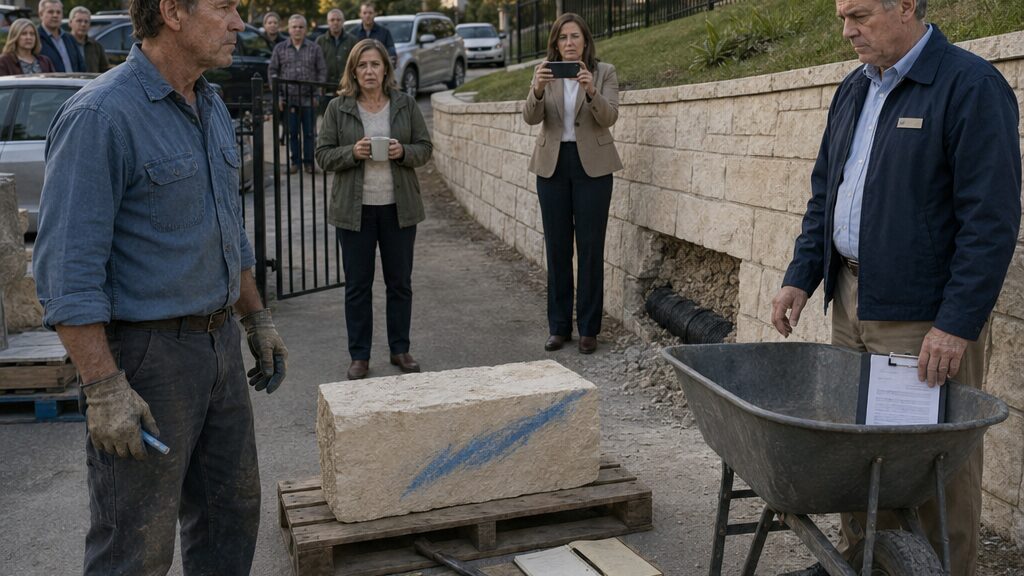
Richard clipped the compliance form to Jonathan’s wheelbarrow as if reserving it.
The metal clip snapped shut above the words FULL REMOVAL REQUIRED. Beneath the paper, Jonathan had laid out a carpenter’s pencil, a measuring tape, blue chalk, and a spiral notebook.
It was seven in the morning. Ten days remained before the deadline.
Richard looked at the tools. “What’s all this?”
“Documentation.”
The property manager stood several feet behind him with a phone held horizontally. Two board members waited near the curb. Across the upper fence, curtains moved in Nancy’s rear window.
Richard had expected a confrontation. Jonathan could see it in the way he planted his feet and kept his shoulders squared. Instead, Jonathan wore work gloves and an old municipal safety shirt. He had cleared the driveway and placed six wooden pallets beneath plastic covers.
“Before we begin,” Jonathan said, “I’m requesting a temporary hold for an engineering review.”
“We addressed that at the hearing.”
“You declined to address it.”
“We reviewed what was relevant.”
“The soil report is relevant.”
Richard lowered his voice. “Jonathan, we gave you alternatives.”
“A replacement design that removes the existing structure before approval.”
“The committee cannot approve something while the violation remains.”
“That is not an engineering sequence.”
“It is the compliance process.”
Jonathan took his phone from his pocket and started recording.
The property manager frowned. “Are you recording us?”
“Yes.”
“You need consent.”
“This is my property. You are here conducting an official inspection. You may leave.”
No one left.
Jonathan aimed the phone toward Richard. “Please confirm that the board is ordering complete removal of the limestone retaining wall.”
Richard looked toward the board members, then back at the camera.
“The association has issued a valid final determination requiring correction of an unapproved exterior structure.”
“That was not my question.”
“You have the written order.”
“I want the action stated clearly. Does full compliance require every limestone block to be removed?”
A few seconds passed.
Richard’s face changed from caution to irritation.
“Yes,” he said. “All of it.”
“Including the stepped section around the drainage outlet?”
“The entire wall.”
“Without an approved replacement?”
“You chose removal instead of submitting a new design.”
Jonathan lowered the phone.
“No,” he said. “You required removal before a design could be reviewed.”
Richard tapped the clipped paper. “Are you complying or not?”
Jonathan signed the form.
Then he walked to the western end of the wall, where the first block sat beside the narrow drainage outlet. He marked it W-1 in blue chalk, photographed it in place, measured its distance from the property pin, and recorded the number in his notebook.
One of the board members exhaled audibly.
Richard said, “You don’t have to turn this into theater.”
Jonathan slid a pry bar into the joint.
“I’m turning it into a record.”
The first block came free with a dry scrape. It was heavier than he remembered. He lifted it onto the wheelbarrow, rolled it to the driveway, and placed it on the first pallet with the chalk number facing outward.
The property manager kept filming.
By eight-thirty, five blocks stood in a precise row.
By ten, the opening at the drainage outlet had widened enough to expose the compacted gravel behind the wall. Water from an old irrigation cycle seeped through the stone and darkened the soil at Jonathan’s feet.
Richard had left after the first hour. The property manager remained to photograph the work, returning every twenty minutes from the shade of her car.
Nancy finally came through her side gate.
She wore gardening shoes and held a mug in both hands. For a moment she watched Jonathan brush dust from a block before writing its number.
“You’re really taking all of it down,” she said.
“That’s the order.”
“I thought you were appealing.”
“I did.”
She looked toward the clipped form. “Richard said you refused to submit a compliant plan.”
Jonathan set down the chalk.
“Did he also tell you the board will not review a replacement until this wall is gone?”
Nancy’s eyes moved toward the exposed gravel. “No.”
He waited for her to say more.
She stared at the opening where the first blocks had been removed. “Is that safe?”
The correct answer was not simple. The wall would not collapse at once. The original soil had been compacted in layers. The grade could remain stable through dry weather for days or perhaps weeks. But without the blocks, surface runoff could cut into the exposed face. A hard storm could saturate the upper fill and send it toward his yard.
Jonathan knew all of that.
He also knew Nancy’s photographs had appeared in the board packet.
“You should ask Richard,” he said.
Her grip tightened around the mug. “I’m asking you.”
“The board has determined the wall is unnecessary.”
“That isn’t what I asked.”
He turned back to the stones.
Nancy did not move. “I complained about water near my patio. I didn’t tell them to tear this down.”
Jonathan looked at her over his shoulder.
It was the first time she had admitted making the complaint.
“Why didn’t you come to me?”
“I thought the drainage was common property.”
“The swale is. The wall isn’t.”
“I didn’t know the difference.”
“You could have asked.”
“So could you.”
The reply struck harder than he expected.
Nancy glanced toward the upper bed. “Amanda would have told me what she thought before she started taking it apart.”
Jonathan’s hand closed around the chalk until it snapped.
Nancy’s face changed immediately. “I’m sorry.”
“No,” he said. “You meant it.”
He placed the broken pieces on the wheelbarrow and reached for another block.
She stood there a few seconds longer, then returned through the gate.
Jonathan worked until dusk.
The next morning, he mailed a certified notice to the county grading office. It stated that a permitted retaining structure was being removed pursuant to a written HOA directive. He attached the violation decision, photographs, the original permit, and the first day’s removal log.
He copied the board.
By the fourth day, the center section of wall was gone. The upper soil remained nearly vertical, held temporarily by its own compaction and the roots of Amanda’s planting bed. Jonathan covered exposed sections with heavy plastic each evening, though he knew the plastic would provide little protection in a real storm.
Neighbors slowed as they drove past. Some waved. Some did not.
On the sixth day, Richard returned.
The numbered limestone blocks now filled four pallets. Jonathan had arranged them by section and elevation. Blue chalk marks faced the street.
Richard walked around the stacks. “What are you planning to do with these?”
“Store them.”
“The architectural committee may consider the stacks a separate violation.”
Jonathan laughed once. He could not help it.
Richard reddened. “I’m serious.”
“So am I. They are construction materials temporarily stored during compliance.”
“For how long?”
“Until I know whether they’re needed as evidence.”
Richard lowered his voice. “You’re trying to embarrass the board.”
Jonathan met his eyes. “You don’t need my help.”
For the first time, Richard did not answer immediately.
He looked toward the exposed slope. “The board has responsibilities beyond your lot. If we allow one owner to ignore the standards because he believes his situation is special, every decision becomes negotiable.”
“This is not a paint color.”
“No, it’s worse. It is a structure no one can prove the association approved.”
“You cannot prove it didn’t.”
“That is why owners keep records.”
Jonathan pointed to the pallets. “I kept everything.”
Richard’s gaze moved to the blue numbers. Something in the order of the stacks unsettled him.
“You knew we wouldn’t find that page,” Jonathan said.
Richard’s expression closed.
“I knew the archive was incomplete.”
“Before you denied the appeal?”
“The board cannot stop functioning because records from nineteen years ago are disorganized.”
“So you turned missing paperwork into proof against me.”
“I enforced the documents we have.”
“You enforced the gap.”
Richard looked toward Nancy’s house and spoke more quietly. “People are trying to sell. They are worried about water, appearance, assessments, insurance. They want decisions.”
“They wanted the swale repaired.”
“They wanted confidence.”
“Those are not the same thing.”
Richard turned away. “Finish by the deadline.”
On the eighth day, Jonathan removed the last stepped blocks around the drainage outlet.
The opening behind them was larger than it had appeared on the plan. A gravel trench ran beneath the wall and curved toward the common swale. He photographed it from three angles, then covered it with plywood and plastic.
He sent the images to the county.
That evening, the weather service added a storm system to the extended forecast. Jonathan saw the alert and dismissed it. Ten days out, forecasts changed.
Two days later, the county called.
The woman introduced herself as Jessica Green from the grading office. Her voice was calm, clipped, and professional.
“I received your certified notice and attachments,” she said.
Jonathan looked through the kitchen window at the empty strip where the wall had stood.
“All right.”
“I need to clarify the current site condition.”
“The wall has been removed under written order.”
“I understand that. Did you remove the western outlet assembly as well?”
“The blocks around it.”
“That isn’t what I asked.”
Jonathan straightened.
Jessica continued, “The original permit does not describe that wall as an isolated landscape feature. It describes it as part of a connected drainage system.”
Outside, wind lifted one corner of the plastic covering the exposed soil.
Jessica’s voice hardened slightly.
“Mr. Martin, did you remove the drainage outlet too?”
Chapter 4: The Report Jonathan Never Put Forward
Jessica Green placed the engineer’s report between them and drew a yellow line beneath one sentence.
“Read that aloud.”
Jonathan did not.
The county office was nearly empty, its public counter closed for lunch. Behind Jessica, rolled grading plans stood upright in steel bins. Rain maps and flood-zone diagrams covered one wall. The room smelled faintly of copier heat and wet coats.
Jessica tapped the highlighted line.
Jonathan read it silently again.
Localized settlement at the western outlet should be corrected within twelve months through reinforcement of the existing retaining assembly and restoration of compacted drainage aggregate.
Jessica leaned back.
“You quoted the paragraph before this in your appeal.”
“Yes.”
“You quoted the paragraph after it.”
“Yes.”
“But not that sentence.”
“The report does not recommend removal.”
“I didn’t say it did.”
“It says the wall remains serviceable.”
“With reinforcement.”
“Within twelve months.”
“Which was eight months ago.”
Jonathan looked toward the window.
Beyond the parking lot, a row of bare trees moved under a steady wind. The storm in the extended forecast had shifted forward. The weather service now expected heavy rain within five days.
Jessica closed the report.
“You told the association the wall was stable.”
“It was.”
“You told the county it was a permitted drainage structure.”
“It was.”
“You did not tell either office that an engineer had identified settlement at the outlet.”
Jonathan kept his hands flat on the table. “The settlement was minor.”
“That is not your determination to make.”
“I supervised drainage maintenance for thirty-two years.”
“And now you’re the property owner, not the reviewing engineer.”
The words were not loud. That made them harder to dismiss.
Jessica opened the original permit packet and turned to the plan sheet. The wall, outlet, gravel trench, and rear swale were drawn as a single system.
“The permit is still valid,” she said. “The engineer did not order demolition. If the association had brought this to us before removal, we would have required either reinforcement or a stamped replacement plan.”
“They did not bring it to you.”
“Neither did you until you had already started taking it apart.”
“I sent certified notice.”
“You sent notice of a decision you had made.”
“A decision they ordered.”
Jessica studied him for a moment.
“Did you believe removing the wall created a hazard?”
Jonathan looked down at the contour lines.
“In dry conditions, the exposed grade could hold temporarily.”
“That was not my question.”
He said nothing.
Jessica slid the report back toward him. “I can open a site review. I cannot issue an emergency stabilization order unless I document an active hazard. I need access today.”
They drove separately to the neighborhood.
Nancy was standing near her patio when they arrived. A real-estate sign leaned against her garage, still wrapped in plastic. She crossed her arms as Jessica examined the shallow puddles along the rear edge of the concrete.
“These are the areas you reported?” Jessica asked.
Nancy nodded. “After heavy rain. It started two years ago and got worse last winter.”
“Did water come over Jonathan’s wall?”
“No. It collected up here.”
“Did you ask the association to remove the wall?”
Nancy looked at Jonathan before answering.
“No.”
The word was quiet but exact.
Jessica glanced toward him.
Nancy continued. “I sent photographs to the property manager because I thought the drainage swale was blocked. Richard called me later and said they had identified an unapproved structure affecting the area.”
Jonathan felt the old anger rise again.
“You let them use your pictures at the hearing.”
“I didn’t know what they were using them for until afterward.”
“You were in the packet.”
“I wasn’t at the hearing.”
“You could have called me.”
Nancy’s face tightened. “I should have. So should you.”
Jessica stepped between the lines of their argument without moving.
“What did you think would happen after the wall was removed?” she asked Nancy.
“I thought they had a replacement plan.”
Jonathan looked at her.
Nancy gave a small, helpless gesture toward the exposed slope. “Why would anyone order this taken down without one?”
That was the question Jonathan had wanted the entire neighborhood to ask.
Hearing it now brought no satisfaction.
Jessica walked the length of the former wall. At the western end, she crouched beside the plywood covering the outlet trench and lifted one corner.
The gravel beneath it had shifted. A narrow channel had formed through the exposed soil.
“This was not here when you removed the last block?” she asked.
“No.”
“How long has the irrigation runoff been crossing it?”
“Two days, maybe three.”
She stood and photographed the channel.
“You need temporary stabilization.”
“I have plastic sheeting.”
“You need more than plastic.”
“The board ordered the structure removed.”
“The board does not control gravity.”
Nancy looked from Jessica to Jonathan. “Can the blocks go back?”
“Not without a temporary plan and equipment,” Jessica said. “The base has been disturbed. Stacking them quickly could make the slope less predictable.”
Jonathan folded his arms. “So the wall was necessary enough that removing it is dangerous, but replacing it is prohibited.”
“I did not say prohibited. I said it has to be done correctly.”
He almost laughed at the phrase. Amanda’s voice had used the same words years ago.
If we do it, we do it right.
Jessica faced him. “I need the complete engineer’s report attached to the site review.”
“You have it.”
“I need it disclosed to the association and affected owners.”
Jonathan’s jaw tightened.
“The association ignored the report they received.”
“They received part of it.”
“They received the conclusion.”
“They received the conclusion you preferred.”
Nancy’s eyes moved between them. “What was left out?”
Jonathan picked up the folded plastic at the wall footing and pulled it tighter over the soil.
“It recommended reinforcement.”
Nancy stared at him. “You knew it needed work?”
“It did not need removal.”
“That isn’t what I asked.”
He drove the metal pin through the plastic with more force than necessary.
Jessica checked her phone. “The weather service has upgraded the system. Three to five inches possible over forty-eight hours, beginning Friday night.”
Four days.
Nancy looked toward her patio. “What are we supposed to do?”
“I’ll submit the hazard review today,” Jessica said. “The county can require interim measures if the site meets the threshold. Until then, reduce irrigation and keep the outlet clear.”
“And the HOA?”
“They should be notified immediately.”
Jonathan straightened. “I already notified them.”
“About removal,” Jessica said. “Not about the engineer’s reinforcement recommendation. Not about this channel. Not about the revised storm forecast.”
“They signed the order.”
“Yes.”
The single word carried no absolution.
That evening, Jonathan placed the complete report on his kitchen table.
Beside it lay one limestone block he had separated from the others. A crack crossed its lower corner. He had found it near the western outlet during removal and set it aside rather than marking it for the pallets.
Amanda’s old landscape sketch was beneath it.
The page showed the wall in rough pencil, but her notes were about water: slope here, keep path dry, outlet must stay open. She had drawn three small arrows curving away from the upper garden.
Jonathan lifted the cracked block and traced one of the arrows with his thumb.
His phone displayed the neighborhood email list.
He could send the report to every owner. He could explain the risk. He could admit that the wall had needed reinforcement even though the board had been wrong to demand removal.
Instead, he attached the report to a message addressed only to Jessica.
The association had created the problem.
The association could warn its residents.
Before he could press send, a car door closed outside.
Nancy stood at his front step holding a folder of printed photographs.
“I found the original emails I sent,” she said when he opened the door. “They weren’t about the stone.”
She handed him the folder.
The first message asked the property manager to inspect repeated pooling near the common swale. The second asked whether the board planned to repair the drainage before it damaged her patio. The third contained the photographs later used against Jonathan.
None mentioned the wall’s appearance.
At the bottom of the last email, the property manager had replied:
The board is reviewing an adjacent owner-maintained feature that may be contributing to the condition.
Nancy watched him read.
“They changed the complaint,” she said.
Jonathan looked past her toward the dark outline of the exposed slope.
A wet line had appeared halfway down the soil face.
It widened as they watched, carrying a thin ribbon of mud toward the uncovered outlet trench.
Chapter 5: The Complaint Was Never About Stone
The invoice was filed under “Landscape Appearance—Miscellaneous.”
Jonathan found it at the back of a storage box in the HOA records room, folded around an old landscaping estimate. The first page described mowing, mulch replacement, and entrance lighting. The second page carried a handwritten note beside a drainage inspection charge.
Temporary reliance on Martin wall pending reserve funding.
He read the line twice.
Richard stood at the records-room door.
“You are not authorized to remove documents.”
“I’m not removing it.”
Jonathan placed the invoice flat beneath his phone and took a photograph.
Richard stepped into the room. “That file predates my term.”
“The note is from last year.”
“The underlying issue predates my term.”
“You signed the removal order this month.”
The records room was barely larger than a closet. Bankers boxes filled metal shelves from floor to ceiling. Some were labeled by year. Others carried broad words in black marker: INSURANCE, GROUNDS, LEGAL, OLD BOARD.
Jonathan held up the invoice.
“The contractor inspected the swale and wrote that the community was temporarily relying on my wall.”
Richard’s face remained still, but the skin around his eyes tightened.
“It was one contractor’s observation.”
“Then why was it filed under landscaping?”
“I didn’t file it.”
“Why wasn’t it in my appeal packet?”
“I did not know it existed.”
Jonathan believed him for perhaps half a second.
Then Richard looked away from the invoice.
“You knew about the drainage problem,” Jonathan said.
“I knew there had been complaints.”
“You knew the reserve study did not include enough money to rebuild the swale.”
Richard closed the door behind him.
“The reserve fund covers the entire community. Roofs on the clubhouse. Private-road resurfacing. The pool pump. Stormwater work. We cannot spend six figures every time a contractor writes a cautious sentence.”
“So you moved the problem onto my wall.”
“We were already relying on your wall. That was the problem.”
Jonathan said nothing.
Richard moved closer, lowering his voice.
“A private structure was performing a common-area function. If it failed, the association could be blamed for depending on something it did not control. If we formally recognized it, we might have assumed maintenance responsibility. If we ignored it, owners would say the board neglected drainage.”
“So you called it ugly.”
“We called it unapproved.”
“You called it an eyesore in front of the board.”
Richard’s mouth tightened. “People understand appearance. They do not understand drainage liability.”
“That is not a defense.”
“No. It is how volunteer boards survive meetings.”
For the first time, Richard sounded tired rather than authoritative.
He sat on the edge of a box labeled MINUTES.
“You think I wanted this?” he asked. “Half the owners complain about assessments. The other half complain that nothing gets repaired. Nancy is trying to sell. Two downhill owners have threatened claims over the path. Our insurer asked whether all retaining systems had current records. Then your file had a missing approval page.”
“So you chose the answer that cost the board nothing.”
“I chose the only action the documents clearly allowed.”
“You refused an engineering review.”
“Because an engineering review would have forced an immediate reserve decision we could not fund.”
There it was.
Not ignorance.
Choice.
Jonathan photographed the invoice again, this time including the folder label.
Richard stood.
“If you send that around without context, you will create panic.”
“The storm warning will do that without my help.”
“We still do not have an official hazard order.”
“You have an exposed slope.”
“We have a dispute under county review.”
Jonathan put the invoice back exactly where he had found it.
“The difference between those two statements,” he said, “is the distance between this room and the back of Nancy’s house.”
The emergency board meeting began at six that evening.
Every chair in the clubhouse was occupied. Owners stood along the walls, many holding printed weather alerts. The property manager sat beside Richard with a laptop open. Jessica joined by speakerphone because the county had not yet completed its site determination.
Jonathan placed the photographed invoice, Nancy’s emails, and the full engineer’s report in front of him.
He did not distribute them.
Not yet.
Richard opened the meeting with a statement about “ongoing coordination” and “unverified assumptions circulating among residents.” His voice was steady, but he avoided looking toward Jonathan.
A downhill resident raised a hand. “Do we need to leave our homes?”
“At this time,” Richard said, “no governmental agency has ordered evacuation.”
“That wasn’t the question.”
“There is no official finding of imminent failure.”
Nancy stood before Richard could move on.
“My complaint was not about Jonathan’s wall.”
The room quieted.
She held up copies of her emails.
“I reported water collecting near my patio and asked the board to inspect the common drainage. The photographs used in Jonathan’s violation case came from those emails. I was never told they would be presented as evidence that the wall was unattractive or unapproved.”
The property manager leaned toward Richard. He did not respond.
Nancy continued. “I should have spoken to Jonathan directly. I didn’t. That is on me. But I did not ask anyone to remove the wall.”
A murmur moved across the room.
Jonathan watched Richard absorb the shift. For weeks, the board had spoken of “resident complaints” as though the neighborhood had demanded action. Now the person behind the photographs had separated herself from the decision.
Richard adjusted the microphone.
“The board never represented that a single owner requested removal.”
“You let me believe it,” Jonathan said.
Richard looked at him. “You believed many things without asking.”
The reply landed because it contained truth.
Jessica’s voice came through the speaker.
“I need everyone to understand the present issue. The original wall was part of an approved grading system. A later engineering report recommended reinforcement. Removal without temporary stabilization altered the runoff pathway. My office is evaluating whether emergency measures are required.”
Someone near the back asked, “Who removed it?”
Jonathan answered before Richard could.
“I did.”
Faces turned toward him.
“Under written HOA order,” he added.
“Did you know this could happen?” another resident asked.
Jonathan looked at the complete report in front of him.
He could say the risk had been uncertain. He could say the wall might have stood for years. He could say the board rejected his warnings and forced his hand.
All of those things were true.
None answered the question.
“I knew removal changed the risk,” he said.
The room became very still.
Richard stared at him.
Nancy sat down slowly.
Jonathan continued, “I notified the county and the board. I documented every block. I believed the written record made responsibility clear.”
A downhill resident said, “Clear to who? Not to us.”
Jonathan had no answer that did not sound like an excuse.
Richard took the microphone.
“The board acted on incomplete records supplied by the owner.”
Jonathan pushed the full report across the table. “And you acted on an invoice hidden in a landscaping file.”
The property manager’s head turned sharply.
Jonathan placed the photograph of the handwritten note beside the report.
Richard closed his eyes for one second.
“What does it say?” someone asked.
Jonathan read it aloud.
“Temporary reliance on Martin wall pending reserve funding.”
The room erupted—not with shouting at first, but with overlapping questions. How long had the board known? What reserve funding? Was the path insured? Who had inspected the swale? Why had owners not been informed?
Richard raised both hands.
“The reserve cannot absorb a full drainage reconstruction without a special assessment.”
That quieted the room more effectively than any gavel.
Owners understood those words.
A woman near the wall asked, “How much?”
“The preliminary estimate was significant.”
“How much?”
Richard looked at the property manager.
“Between eighty and one hundred twenty thousand dollars,” she said.
Several people spoke at once.
Jonathan watched fear replace outrage. Monthly budgets, fixed incomes, pending sales, insurance renewals—each owner began calculating privately.
Richard looked around the room.
“This is what the board was trying to manage,” he said. “Not hide. Manage.”
“You managed it by pretending limestone was the problem,” Nancy said.
Richard’s face hardened again. “We managed it by enforcing control over a structure the association could not legally depend on.”
Jessica interrupted through the speaker.
“I have received updated rainfall projections. The storm is expected to begin overnight, earlier than forecast. My site order is still under review.”
Jonathan looked toward the clubhouse windows.
Rain had begun as a faint stippling against the glass.
One of the downhill residents stood. “Should we leave?”
Richard answered first.
“There is no official evacuation order.”
Jonathan looked at the invoice, the engineer’s report, and Nancy’s emails.
He had spent days gathering proof.
Outside, the first real drops struck the pavement, darkening it one mark at a time.
By the time Jessica’s office could issue anything official, the storm had already arrived.
Chapter 6: When Being Right Stopped Being Enough
The slope dropped while Jonathan was holding the certified letter.
He had gone to the rear window at three in the morning after hearing water strike the siding. The envelope lay in his hand because he had taken it from the kitchen file, meaning to photograph the tracking receipt before the power failed.
Outside, the security light showed the exposed soil bulging between sheets of plastic.
Then the western section folded.
It did not collapse all at once. The upper edge dipped first, carrying a row of sedum and two fence posts with it. Soil rolled over itself and struck the drainage trench below. Water backed up behind the new mound, rising fast.
Jonathan looked down at the letter.
Certified notice. Delivery confirmed. Board copied.
For twelve days, it had felt like protection.
Now it was paper in a dry kitchen.
He dropped it on the counter and ran outside.
Rain filled the beam of his flashlight. The lower channel had already overflowed toward the community path. Nancy’s yard light moved at an angle above the failing soil.
Jonathan called her.
She answered on the second ring.
“Get out of the rear bedrooms,” he said. “Wake anyone in the house and move toward the street.”
“Is it happening?”
“Yes.”
He ended the call and dialed emergency services, then Richard, then the downhill residents whose numbers he had saved from association directories.
By the time he reached the driveway, Nancy was at her side gate in a raincoat.
“What do you need?” she asked.
Not Why didn’t you warn me.
Not Is this your fault.
What do you need?
Jonathan pulled the plastic from the first pallet.
“Blocks. We build a temporary check line from the outlet toward the east corner. Not high. Two courses, staggered.”
Nancy looked at the limestone. “We can’t lift those.”
“We can roll them onto the hand truck.”
Richard’s SUV stopped at the curb. He came out in boots this time, carrying a flashlight.
“The path is already taking water,” he said.
Jonathan pointed toward the second pallet. “Remove the cover.”
Richard hesitated.
“Now.”
Something in Jonathan’s voice ended the argument.
They worked in the rain.
Jonathan selected blocks by number, using the removal log in his head. Western outlet pieces first because their angles matched the original turn. Richard and Nancy moved them on the hand truck while Jonathan placed them along the lower edge of the yard.
Two downhill residents arrived. Jonathan assigned one to clear debris from the path inlet and sent the other to knock on doors.
“Do not stand below the exposed face,” he warned. “If it moves, move sideways, not downhill.”
The first line of blocks redirected part of the runoff toward Jonathan’s workshop.
Richard saw the water turning.
“That building will flood.”
“I know.”
“You keep tools in there.”
“I know.”
“We can angle it toward the path.”
“There are houses below the path.”
Jonathan set another block.
The workshop had been Amanda’s garden shed before he enclosed it. Her old bench was still against the north wall. The drawers held pruning shears, labels written in her hand, and the small radio she used on Saturdays.
Water reached the workshop door.
Jonathan looked at it once.
Then he pointed to the next block.
“Here.”
The emergency crew arrived with portable lights and sandbags. Their supervisor surveyed Jonathan’s improvised barrier.
“Who designed this line?”
“I did.”
“You an engineer?”
“No.”
“What are you?”
“Retired municipal maintenance.”
The supervisor watched the flow for several seconds. “Keep it low. If you stack higher, it may overturn.”
Jonathan nodded. “We need sandbags behind the eastern turn.”
The crew followed his direction—not because of his papers, but because the water was already proving the route.
A deep crack came from above.
Nancy froze.
Jonathan grabbed her arm and pulled her sideways as another slab of soil slid through the opening. Mud struck the first limestone course, surged over it, and split. Half moved toward the workshop. Half entered the cleared channel toward the swale.
The barrier held.
For the moment.
Nancy stared at Jonathan’s hand on her sleeve.
“You knew the path,” she said.
He released her.
“Yes.”
“Before tonight?”
“Yes.”
Her face changed, but she did not step away.
“Tell me where the next block goes.”
He pointed.
They kept working.
By dawn, muddy water stood nearly two feet deep inside Jonathan’s workshop. The door had buckled inward. Through the window, he could see Amanda’s bench tipped against the wall.
The lower houses remained dry.
The shared path had cracked in two places, and Nancy’s patio had separated along its rear edge, but the emergency line of limestone blocks had diverted the strongest flow away from occupied rooms.
When the rain weakened, Jonathan sat on the curb with his hands hanging between his knees.
Richard stood nearby, soaked through. Chalk from the numbered blocks had smeared blue across his jacket.
“You should have told them,” Richard said.
Jonathan looked at the water draining from his workshop.
“So should you.”
“I believed the county would intervene if there was real danger.”
“I believed my letter made it your responsibility.”
Richard sat beside him, leaving a foot of space.
“We were both waiting for someone official enough to carry the blame.”
Jonathan did not answer.
Nancy came down the driveway carrying three cups of coffee. She handed one to each man.
“I’m not ready to forgive either of you,” she said.
Richard looked at the cup. “Fair.”
Jonathan wrapped his hands around the heat.
Jessica arrived shortly after sunrise with a county inspection team and an insurance adjuster. She walked the site slowly, photographing the exposed grade, the failed swale, the cracked path, and the emergency block line.
At the workshop, she stopped.
“You sacrificed the building.”
“The flow had to go somewhere.”
She looked through the broken doorway. “Anything irreplaceable?”
Jonathan saw Amanda’s bench beneath the muddy water.
“Yes.”
Jessica did not ask what.
The inspection continued into the afternoon. Workers uncovered the original outlet trench and traced it toward the common swale. Near the path, one of them found a buried inspection marker. Another located an old cleanout almost entirely covered by landscaping soil.
The adjuster requested maintenance records.
The property manager brought boxes from the clubhouse.
At four, Jessica called Jonathan, Richard, and Nancy to the folding table beneath the emergency canopy.
A county worker placed a damp invoice inside a clear evidence sleeve. It was not the copy Jonathan had photographed. This one had been recovered from a contractor’s field packet stored with the old drainage plans.
The handwritten note was longer.
Temporary reliance on Martin wall pending reserve funding. Wall presently intercepts upper-lot runoff and reduces load on failed common swale. Removal should not occur without replacement conveyance.
Richard read the final sentence.
His face emptied.
The property manager looked down.
Jessica turned to Jonathan. “Your report should have been fully disclosed.”
He nodded.
Then she turned to Richard.
“And this recommendation should have stopped the order.”
Richard did not argue.
Rainwater dripped from the canopy edge between them.
Jonathan looked toward the emergency barrier. The blue numbers remained visible on several blocks, though mud had covered most of the chalk.
For weeks, he had imagined evidence producing a clean division between right and wrong.
Instead, every document on the table pointed in more than one direction.
Chapter 7: The New Wall Belonged to More Than One Yard
Jonathan placed two documents on the folding table.
On the left lay the engineer’s full report, opened to the sentence he had omitted from his appeal. On the right lay Richard Campbell’s signed order requiring complete removal of the wall without an approved replacement.
The room went quiet before anyone asked what either document meant.
Six weeks had passed since the storm. The clubhouse still smelled faintly of damp carpet, and one wall remained open where contractors had removed water-damaged drywall. Through the windows, Jonathan could see orange fencing around the shared path and the temporary terraces built into the slope.
Richard sat at the far end of the table rather than in the president’s chair.
The property manager opened the emergency meeting, but Jonathan barely heard her summary. His attention stayed on the documents before him and on the limestone dust still embedded beneath his fingernails.
Jessica Green sat beside a rolled set of county-approved repair plans. Nancy occupied the first row, her arms folded over a folder of insurance estimates.
The property manager finished.
Jonathan stood.
“The board ordered a permitted drainage structure removed without replacement,” he said. “That order should never have been issued.”
Richard did not look away.
Jonathan touched the engineer’s report.
“I also had information that should have been disclosed in full. The wall did not need demolition, but it did need reinforcement. I summarized the parts that supported me and left out the sentence that did not.”
Several owners shifted in their chairs.
A downhill resident spoke first. “Are you saying you knew it might fail?”
“I knew removing it increased the risk. I believed the board’s written order and my county notice made responsibility clear.”
“Did they?”
Jonathan looked through the window at the temporary barriers.
“No.”
The word cost him more than the admission at the storm meeting had. That night, there had been mud, fear, and no time to measure blame. Here, under fluorescent lights, every person could calculate what his silence had cost them.
“I should have warned the affected homes directly,” he said. “I did not. I wanted the board to understand what it had ordered. I let proving that point matter more than preventing the consequence.”
Nancy lowered her eyes.
Richard leaned forward. “The board bears the greater responsibility.”
Jonathan turned toward him.
Richard’s hands rested flat on the table.
“We had the contractor’s warning,” he said. “The archive was incomplete. The reserve account was inadequate. I believed recognizing Jonathan’s wall as part of the common drainage system would force an assessment the community would reject.”
A man near the back said, “So you hid it.”
“I told myself I was delaying a cost until we had better options.”
“You ordered the thing holding the hill up to be removed.”
“Yes.”
Richard’s voice did not rise.
“I did.”
The simplicity of the answer prevented the room from turning into the confrontation Jonathan had once imagined. There was no applause, no satisfying collapse of authority. Only tired homeowners, damaged property, and a repair estimate projected on the wall.
Jessica unrolled the new plan.
“The county-approved system divides responsibility differently from the original arrangement,” she said. “The reconstructed swale will be association property. The terraced retaining structure will cross Jonathan’s lot under a recorded maintenance easement. Surface drainage from the upper lots will be redirected before reaching the terrace.”
She indicated three stepped lines on the drawing.
“The existing limestone can be reused where it passes inspection. Additional engineered units will be required at the lower course.”
The property manager displayed the funding proposal. Insurance would cover part of the path and emergency work. The HOA reserve would fund the common swale. A special assessment would cover the remaining association share.
Jonathan’s contribution appeared on the final line.
He had agreed to provide the saved blocks and pay a limited portion of the emergency stabilization cost.
A board member looked at him. “Your attorney approved this?”
“I did not ask an attorney to decide what I owed.”
Richard’s expression tightened slightly.
Jonathan continued. “I am not accepting responsibility for the removal order. I am accepting responsibility for what I knew and did not say.”
The downhill resident who had questioned him before gave a small nod.
It was not forgiveness. Jonathan did not expect it to be.
The board voted to rescind the architectural violation, cancel every fine, release the complete maintenance archive to owners, and submit future grading decisions for professional review. The measures passed without celebration.
Richard then read his resignation.
He did not blame the property manager, the prior board, the missing records, or the reserve shortage. He stated that he had signed the removal order despite evidence that the wall performed a drainage function.
When he finished, someone asked whether he would pay the assessment personally.
Richard looked toward the projected total.
“I cannot pay the community’s share,” he said. “I will pay mine.”
The answer disappointed several people. It was also true.
After the meeting, Nancy found Jonathan beside the rolled repair plans.
“I brought something,” she said.
She handed him a sheet protected by a clear sleeve.
It was Amanda’s original landscape sketch.
Jonathan recognized her pencil marks immediately, but he had never seen the note written along the bottom edge. It must have been hidden beneath the fold.
Stone can change. Keep the water moving safely.
Nancy watched him read it.
“I found it stuck to the back of the copy you gave the board years ago,” she said. “The papers separated when the records room got damp.”
Jonathan traced Amanda’s handwriting through the plastic.
For years, he had treated the limestone as though preserving its exact form preserved her. Yet her sketch contained three versions of the wall, each different. The arrows showing the water route were the only marks she had never changed.
Construction began the following week.
The new system was lower, wider, and less elegant than the original wall. Engineered blocks formed the buried base. The surviving limestone faced the visible terraces. A reinforced channel carried runoff toward the rebuilt swale.
Jonathan worked beside the crew when Jessica allowed it. Nancy brought coffee and asked questions before making assumptions. Richard appeared twice, quietly completing the assessment paperwork for his property.
No one pretended the neighborhood had returned to what it had been.
Nancy’s patio retained a repaired seam. Jonathan’s workshop had to be stripped to its framing. Amanda’s bench could not be saved, though he kept one mud-stained drawer pull in his kitchen.
The shared path reopened near the end of summer.
On the final morning, one old limestone block remained on Jonathan’s driveway. Its blue number had faded, but a trace of chalk still marked the corner.
The crew supervisor asked whether he wanted it carried to his garage.
Jonathan lifted one end.
“No,” he said. “It belongs down there.”
Together they moved it to the repaired path, where the terrace met the common swale. Jonathan set it into the edge and adjusted it until it rested level.
Water from the crew’s test hose entered the upper channel, crossed the new terraces, and passed the block without pooling.
Jonathan watched it move safely beyond his yard.
Then he took his hands from the stone and left it where everyone could depend on it.
The story has ended.