She Filed a Noise Complaint, Then Learned Why the Whole Building Had Been Listening Wrong
Chapter 1: The Note Appeared Before the Music Stopped
The violation notice appeared on Kevin Davis’s door while he was still playing.
Cynthia saw Patricia Allen cross the second-floor walkway with a tablet tucked beneath one arm and a white envelope in her hand. Patricia pressed the adhesive strip against Kevin’s blue door, smoothed it twice, then stepped back as if the matter had already been settled.
Across the courtyard, the trumpet continued.
The first notes came cleanly through Cynthia’s open balcony door. Then the sound found the bedroom wall and sharpened. The baby monitor on the kitchen counter showed a green line trembling into yellow.
Cynthia froze with one hand around a half-rinsed bottle.
“No,” she whispered.
A red wake alert flashed.
From the bedroom came the first thin cry, followed by the breathless pause that meant the crying would soon become harder to stop.
Cynthia abandoned the bottle in the sink and hurried down the short hallway. Her daughter’s fists had worked free of the swaddle. The baby’s face was already tightening, eyes still closed, mouth open beneath the sound coming through the wall.
Cynthia lifted her and pressed the small warm body against her shoulder.
“I know. I know.”
The trumpet climbed into another phrase.
For three weeks, Cynthia had tried not to become the kind of neighbor who complained. She had closed windows. Rolled a towel beneath the balcony door. Moved the white-noise machine nearer the crib. She had sent two maintenance requests about the damp bedroom wall and the vent that rattled whenever the air-conditioning started.
Neither request had produced more than an automated email.
Received. Pending review.
She had told herself the music would stop.
It always did. Eventually.
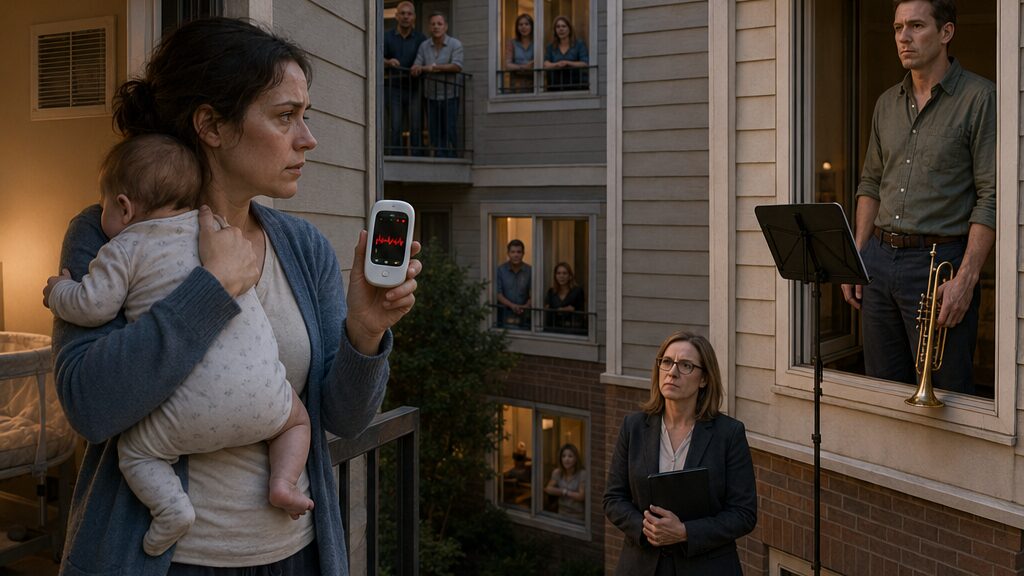
The baby cried into her neck while Cynthia crossed to the balcony. Kevin stood at his open window one floor above and on the opposite side of the courtyard. Only the bell of the trumpet and part of his face were visible behind a music stand.
Patricia had reached the stairs.
“Patricia,” Cynthia called.
The manager looked up but did not stop.
“Did you talk to him?”
Patricia glanced toward Kevin’s door. “The complaint has been documented.”
“That isn’t what I asked.”
Another neighbor opened a window. Then another.
Patricia lowered her voice, though the courtyard carried it easily. “The notice advises him of the applicable rule. There will be an opportunity for both parties to respond.”
“You put it on his door before speaking to either of us.”
“I reviewed your written complaint.”
“My complaint said the baby wakes up. It didn’t say you could decide everything from your office.”
The trumpet ended on a held note. Silence settled so suddenly that Cynthia could hear the baby hiccup against her shoulder.
Kevin lowered the instrument and looked across the courtyard.
“What notice?” he asked.
Patricia’s expression tightened. “Please retrieve the correspondence from your door.”
Kevin disappeared from the window. A moment later his door opened. He peeled the envelope away and read the first page beneath the walkway light.
Cynthia expected anger. Instead he looked tired.
“You filed this?” he called across to her.
“My baby has been awake four evenings in a row.”
“I practice for thirty minutes.”
“You practice during her sleep.”
“It’s six-thirty.”
“That doesn’t make her less awake.”
Kevin held the notice at his side. “Quiet hours start at ten.”
Cynthia felt the baby’s damp cheek against her collarbone. “So anything before ten is automatically reasonable?”
“I didn’t say that.”
“You didn’t have to.”
Kevin looked toward Patricia. “Did you tell her I already gave you my schedule?”
Patricia tapped her tablet awake. “This is not the place for a three-way discussion.”
“This became the place when you taped a violation to my door in front of everyone,” Kevin said.
More windows had opened. A man on the third floor leaned against his railing. Someone below Cynthia drew a curtain aside but left the glass closed.
Patricia stood at the base of the stairs, composed beneath the attention. “The notice is preliminary. No fine has been assessed.”
“Then take it down,” Cynthia said.
Both Patricia and Kevin looked at her.
Cynthia adjusted the baby higher on her shoulder. “Talk to him first. Talk to me. Then decide whether there should be a notice.”
Patricia’s voice remained professionally flat. “You submitted a formal noise complaint.”
“Because no one answered me.”
“You received confirmation.”
“An automatic email is not an answer.”
The baby began crying again, softer now but persistent. Cynthia rocked in place.
Kevin looked at the child, then at the small black monitor unit on the counter behind Cynthia. Its screen still glowed red.
He raised the trumpet slightly, not to play it but as if reminding himself why he was holding it.
“I started at six-fifteen,” he said. “I’ll stop at six-forty-five.”
Cynthia checked the kitchen clock through the open door.
Six-forty-two.
“You know exactly when you started,” she said.
“Yes.”
“And you’ll do this again tomorrow?”
Kevin’s jaw shifted. “Yes.”
The answer was calm enough to feel deliberate.
Patricia climbed the stairs and stopped halfway between their levels. “Until the board reviews the matter, Mr. Davis remains entitled to ordinary use of his unit, subject to governing documents and nuisance provisions.”
“That sentence helps no one,” Cynthia said.
“It explains the current position.”
The trumpet’s last note still seemed lodged in the bedroom wall. Cynthia could feel it there even in the quiet, as if the drywall had learned the sound.
Kevin folded the notice once.
“I have an audition,” he said.
Cynthia stared at him. “And I have a baby who hasn’t slept more than ninety minutes at a time.”
“I’m not saying that doesn’t matter.”
“You’re saying you’ll do it again tomorrow.”
He looked away first.
At six-forty-five, his phone alarm sounded through the open window. He silenced it, set the trumpet in its case, and closed the sash.
Thirty minutes exactly.
The sudden quiet should have felt like relief. Instead Cynthia stood on the balcony with the baby still awake and understood that Kevin had not been careless. He had chosen the time, measured it, and intended to repeat it.
Patricia typed something into her tablet.
“What are you writing?” Cynthia asked.
“A summary of tonight’s interaction.”
“You mean the interaction you caused.”
Patricia stopped typing. “The board can hear the complaint Thursday evening.”
“A private hearing?”
“Compliance hearings are open to affected residents unless the board votes otherwise.”
Cynthia looked around the courtyard at the faces withdrawing behind windows.
Kevin remained beside his closed window, visible through the glass.
Patricia sent the notice with one tap.
Cynthia’s phone chimed on the kitchen counter.
HOA COMPLIANCE HEARING—THURSDAY, 7:00 P.M.
By the time she reached it, a second message had arrived.
All residents of the courtyard wing were invited to attend.
Chapter 2: Every Window Opened When Cynthia Raised the Monitor
The baby woke before Kevin reached the second phrase.
Cynthia had been standing beside the crib with the monitor in her hand, watching its thin green graph. The first trumpet notes came from across the courtyard, mellow through the open balcony door.
Then the line leaped yellow.
The bedroom vent gave a faint metallic shiver.
The baby’s eyes opened.
Cynthia pressed the timestamp button with her thumb: 6:17:12.
She had prepared for this. She had written the previous wake times on the back of a grocery receipt. She had placed her phone beside the monitor to record the screen. She had promised herself she would speak without shouting.
The baby’s lower lip trembled.
At 6:17:19, the monitor flashed red.
Cynthia lifted her daughter, crossed the living room, and stepped onto the balcony.
“Kevin.”
He continued until the phrase ended. Then he lowered the trumpet.
Nearly every courtyard window opened.
Cynthia had expected curiosity after Patricia’s invitation, but not this. Neighbors stood behind screens and balcony rails as if the hearing had started two days early.
Kevin glanced at them before looking at Cynthia. “I said I would practice.”
“And I said it wakes her.”
“You’re standing outside with her.”
“Because she woke up inside.”
The baby monitor screen pulsed red in Cynthia’s free hand.
A woman below Kevin folded her arms. “He just started.”
“That’s the point,” Cynthia said.
Kevin set his mouthpiece against the music stand. “I’m not playing loudly.”
“You don’t get to decide what reaches my room.”
“I’m playing at a normal rehearsal volume.”
“Normal for whom?”
A voice from the third floor said, “It’s thirty minutes.”
Cynthia looked up. “Thirty minutes is a long time when you’ve spent forty-five getting a baby to sleep.”
Kevin’s expression hardened. “This is my work.”
“And this is my home.”
“It’s also mine.”
Patricia emerged from the ground-floor office carrying her tablet. Cynthia wondered whether someone had called her or whether she had been waiting.
“Please keep voices at a reasonable level,” Patricia said.
Cynthia almost laughed. “You’re documenting this, aren’t you?”
“I’m observing.”
“Then observe the screen.”
She held the monitor outward.
The red wake icon blinked above the jagged sound graph. Patricia approached, though not close enough to take it.
“Please lower the device,” she said.
“Why?”
“You’re displaying information relating to a minor in a common area.”
“It shows a sound line, not her medical record.”
Several people shifted at their windows. Kevin remained behind his music stand, trumpet held loosely at his side.
Cynthia waited until the courtyard was quiet.
“Monday, six-eighteen,” she said. “Tuesday last week, six-twenty-one. Thursday, six-sixteen. Tonight, six-seventeen. Every time, the line spikes when he starts.”
Kevin rubbed his thumb along one valve. “You never told me exact times.”
“I told you she wakes.”
“You told me to stop playing.”
“Yes.”
“You didn’t ask whether I could move the session.”
Cynthia stared at him. “Would you have?”
He did not answer immediately.
That silence turned several faces toward him.
“I have an audition Saturday,” he said. “City orchestra. This is the only consistent half hour I have after teaching lessons and before the building’s evening activity picks up.”
The words changed the courtyard. Not dramatically, but enough. A neighbor who had been watching Cynthia now looked at Kevin with interest.
“You teach?” someone asked.
“Private students. Mostly afternoons.”
Cynthia felt the old certainty shift beneath her feet. It did not disappear. Her daughter was still awake against her chest.
“An audition doesn’t make the sound quieter,” she said.
“No,” Kevin replied. “But it means I’m not doing this to irritate you.”
“I never said you were.”
“You filed a violation complaint.”
“After no one answered me.”
Patricia raised her tablet. “The hearing is the appropriate place for these facts.”
Cynthia looked down at the monitor again. The line had dropped to green while Kevin stood silent.
“All right,” Kevin said. “Watch the time.”
He lifted the trumpet.
“Don’t,” Cynthia said.
“I’m going to finish the thirty minutes.”
The baby flinched when the next note sounded. Cynthia’s anger rose so fast that she nearly shouted over him. Instead she turned and carried the monitor inside.
She set the baby in the bassinet in the hallway, where she could still see her, then returned to the bedroom alone.
The trumpet continued across the courtyard.
Near the balcony door, the monitor line climbed into yellow. Cynthia walked into the hall.
It fell.
She stopped.
The distance from the balcony to the hall was only twelve feet. The music remained audible, but the graph settled into a thin green ripple.
Cynthia went back into the bedroom and closed the balcony door.
The sound should have softened.
Instead, beside the wall vent, the graph jumped.
She held the monitor closer.
The trumpet came through the vent with a brittle, concentrated edge, as though someone were playing from inside the duct.
Cynthia opened the bedroom door and stepped into the hall.
Green.
Back beside the vent.
Yellow, then red.
Her phone was still recording. She moved between the two locations twice, slower the second time, keeping the screen visible.
When she returned to the balcony, Kevin was ending another passage.
“This isn’t right,” she said.
A neighbor laughed under his breath. “You finally noticed?”
Cynthia held up the monitor again, but now the red line meant something different.
“It’s louder beside the closed bedroom vent than it is here.”
Kevin frowned. “That’s impossible.”
“Come listen.”
“I’m not coming into your unit.”
“Then stop telling me what’s possible inside it.”
Patricia stepped forward. “Structural speculation is outside the scope of the complaint.”
“Of course it is,” Cynthia said. “Because the complaint is easier.”
“That is not what I said.”
“No, you said it in longer words.”
The woman below Kevin shook her head. “First she says it’s him. Now it’s the building.”
“It can be both,” Cynthia said.
“Or neither,” another neighbor replied.
Heat climbed Cynthia’s face. She looked around at people she had passed in the mailroom, people who had smiled at the baby, now watching her as if fatigue had made her unreasonable.
Kevin checked the time on his phone.
At 6:45, he stopped.
Again, exactly thirty minutes.
He placed the trumpet in its case but left the window open. “You have your proof of my schedule.”
Cynthia looked at the monitor. “And something else.”
Patricia made a final note on her tablet and returned toward the office.
The windows began closing.
Cynthia carried the baby inside. She had just shut the balcony door when someone knocked.
Robert Nelson stood in the hallway wearing an old gray work shirt. He did not look toward the baby or the monitor. His attention settled on the bedroom wall.
“You said the sound jumps beside the vent,” he said.
“Yes.”
He lowered his voice.
“Don’t test the window next time. Test the wall vent with the bedroom door closed.”
“I already did.”
Robert’s eyes sharpened.
“What do you know?” Cynthia asked.
He looked toward the stairwell before answering.
“Enough to tell you the trumpet may not be traveling through the air.”
Then he walked away before she could ask what it was traveling through instead.
Chapter 3: The First Hearing Chose an Easy Villain
Kevin’s penalty had already been drafted when Cynthia entered the meeting room.
The document lay facedown beside Patricia’s tablet, but its title was visible through the thin paper: CONDITIONAL PRACTICE RESTRICTION.
Cynthia took the chair nearest the door, the baby monitor zipped inside her bag. Her daughter was with a relative for the evening, yet Cynthia kept checking the silent bag as if a red alert might glow through the fabric.
Kevin arrived carrying a black instrument case. He saw the document, then Cynthia.
“So that’s decided,” he said.
“It hasn’t been voted on,” Patricia replied.
“Then why is my name already on it?”
Patricia aligned the paper with the edge of the table. “Drafting possible resolutions in advance is standard preparation.”
Three board members sat behind folding tables arranged in a shallow U. Residents filled most of the chairs along the wall. Several had attended the courtyard confrontation. Cynthia recognized the woman who had said thirty minutes was not long.
Patricia opened the hearing by reading the nuisance rule aloud. It prohibited repetitive sound that “unreasonably interfered with residential use,” but it did not define unreasonable.
“That’s the entire problem,” Kevin said.
“You will have time to respond,” Patricia told him.
Cynthia was invited to speak first.
She removed four printed screenshots from her folder and passed them forward. Each showed the monitor’s red wake alert beside a timestamp.
“My daughter woke during every recorded practice session,” she said. “I asked for help before filing the complaint. I’m not asking the board to decide whether music matters. I’m asking it to recognize that sleep matters too.”
A board member examined the pages. “You recorded inside your unit?”
“Yes.”
“Are these decibel readings?”
“No. They’re sound-activity graphs from the monitor.”
“So they establish that sound occurred, not its volume.”
“They establish when she woke.”
Kevin shifted in his chair.
Cynthia continued. “They also show a stronger spike beside the bedroom vent than near the balcony.”
Patricia leaned forward. “The present hearing concerns resident conduct. Maintenance questions can be submitted separately.”
“I submitted them separately. Twice.”
That caught one board member’s attention. “Submitted what?”
“A leak repair request and a request about the rattling vent.”
Patricia touched the screen of her tablet. “Neither request identified a noise-transmission problem.”
“I didn’t know there was one.”
“Then it cannot fairly be attributed to management’s response.”
Cynthia heard the neatness of the sentence. It separated every fact until none of them had to touch.
The board turned to Kevin.
He rested both hands on the closed instrument case. “I practice from six-fifteen to six-forty-five. Never later. Never longer. I gave that schedule to management before the complaint.”
“Why that time?” a board member asked.
“I teach beginner lessons in the afternoon. I work a delivery shift three mornings a week. The audition hall opens for candidate warmups Saturday, but until then I need daily preparation.”
“What audition?”
“The city orchestra.”
A low murmur moved through the room.
Kevin looked uncomfortable beneath the attention. “It’s a substitute-chair opening. Not a permanent contract. But it would mean regular calls and better-paying work.”
Cynthia had imagined a grand opportunity because he had said city orchestra across the courtyard. Hearing the details made it smaller and more precarious.
One board member asked why he could not practice elsewhere.
“I requested clubhouse access.”
Patricia’s fingers paused above her tablet.
“When?” the member asked.
“Three weeks ago.”
“Was it denied?”
Patricia answered before Kevin could. “The clubhouse is not currently designated for private commercial activity.”
“I wasn’t charging anyone,” Kevin said. “I asked for thirty minutes when it was empty.”
“The board has not adopted a rehearsal-use policy.”
“So instead of making one, you told me to play inside my unit.”
“I informed you that ordinary residential activity was governed by existing rules.”
“And now you’ve drafted a restriction for following them.”
A few residents nodded.
Cynthia watched sympathy move toward him. It was not undeserved, which made it harder to bear.
Kevin opened his case. Inside lay the trumpet, a stack of marked music, and a dark practice mute.
“I tried the mute,” he said. “It changes resistance and intonation. It’s useful for some exercises, not full audition preparation.”
The woman near the wall raised her hand though public comments had not begun. “You said something outside about classes.”
Patricia started to object, but a board member allowed the question.
Kevin looked down at the trumpet.
“If I got enough regular orchestra work,” he said, “I was going to offer a free Saturday class here. Basic music reading. Group instruction for kids whose families can’t pay private rates.”
The room became still.
Cynthia felt every eye avoid her for half a second, which was worse than being stared at.
Kevin did not look triumphant. “I’m not saying that should give me permission to wake a baby. It’s what I was working toward.”
A resident near the back said, “That would be good for this place.”
Another asked how many children he could take.
Patricia tapped her pen against the table. “The proposed future use is not relevant to the existing complaint.”
But it was relevant to the room. Cynthia could feel the story settling into a simpler shape: gifted musician, generous plan, exhausted woman asking him to stop.
She reached into her bag for the monitor screenshots.
“My baby still wakes,” she said.
No one argued with her. Their silence carried something worse—the belief that she was technically right and morally narrow.
The board recessed for seven minutes.
When they returned, Patricia read the proposed resolution. Kevin could continue practicing for thirty minutes daily, but only between five and six in the afternoon, with the practice mute used for scales and warmups. Any documented violation could result in a fine.
Cynthia should have felt relieved.
Instead she looked at Kevin. His delivery shift ended at five-thirty on three weekdays. The restriction had been designed to sound balanced while making full compliance nearly impossible.
“This doesn’t solve the vent,” she said.
Patricia’s expression remained composed. “That issue is separate.”
“It isn’t separate inside my daughter’s room.”
“The board cannot determine a building defect based on consumer-monitor screenshots.”
“Then inspect it.”
“That request must follow maintenance review.”
“I already followed it.”
One board member asked Patricia to verify Cynthia’s requests. Patricia looked at her tablet for several seconds.
“They remain pending classification,” she said.
Cynthia remembered the automated confirmations. Received. Pending review.
Kevin closed his case. “So I lose my practice time, she keeps the same wall, and the board calls it compromise.”
Patricia looked at him evenly. “You retain limited practice access.”
“During hours I told you I work.”
“You may adjust your outside employment.”
A few people lowered their eyes.
There it was—not cruelty, exactly. Something cleaner and more ordinary. A decision made by someone who would not have to live inside it.
The board voted to postpone the restriction until the following Wednesday while Patricia reviewed maintenance records. The hearing ended without applause, though several residents approached Kevin to ask about the proposed classes.
No one approached Cynthia.
She packed the screenshots into her folder and waited until the room had emptied. Patricia was stacking papers when she called Cynthia back.
“There may be a simpler resolution,” Patricia said.
She produced a two-page form.
The first paragraph offered dismissal of Cynthia’s noise complaint without prejudice. The second stated that Cynthia acknowledged the HOA had not verified a structural relationship between her unit and Kevin’s sound.
“You want me to withdraw,” Cynthia said.
“It would lower the temperature while maintenance review proceeds.”
“And Kevin?”
“No violation would remain on his file.”
That part tempted her. Kevin should not carry a penalty for a problem that might not be entirely his.
She read farther.
The final paragraph released the association from claims connected to temporary room use, sleep disruption, moisture conditions, and delayed inspection pending formal findings.
Cynthia looked up. “Why does a noise withdrawal mention moisture?”
Patricia folded her hands. “Standard language.”
“My daughter’s crib is beside that wall because the other side of the bedroom leaked.”
“You chose the crib placement.”
“Because the damaged corner still smells damp when the room is closed.”
“That condition has not been established.”
Cynthia placed the form flat on the table.
“If this is standard,” she said, “you won’t mind giving me time to have someone read it.”
Patricia’s professional smile thinned.
“The offer is available until noon tomorrow.”
“And if I don’t sign?”
“The compliance process continues.”
Cynthia slid the unsigned release into her folder.
On the way out, she looked back through the glass door. Patricia had already opened Cynthia’s maintenance file on the tablet.
For one second, before the screen dimmed, Cynthia saw a status beside the oldest request.
Resolved by resident.
She had never resolved anything.
Chapter 4: The Bedroom Wall Carried More Than Sound
The trumpet was louder through the closed vent than through the open window.
Cynthia confirmed it three times before breakfast.
She set the baby monitor on the dresser beside the wall vent, closed the balcony door, and played the recording from her phone at the same volume each time. Near the window, the graph remained green. In the hallway, it barely moved. Beside the vent, the line jumped into yellow and held there.
The result made no sense until she stopped thinking of the wall as solid.
At nine, she emailed Patricia photographs of the monitor screen, the damp stain near the baseboard, and the unsigned release.
Subject: Immediate inspection requested.
She did not mention Kevin. Not once.
Patricia answered twelve minutes later.
Your materials have been forwarded for routine maintenance review. Please avoid conducting unapproved acoustic testing that could disturb neighboring units.
Cynthia read the sentence twice.
The baby slept in the bassinet near the living-room wall. The bedroom remained empty except for the crib, the monitor, and a laundry basket pushed beneath the window. Months earlier, after the leak, Cynthia had moved the crib away from the darkened corner near the closet. She had wiped the wall with vinegar, then bleach, then a store-bought mold spray that left the room smelling sharp for days.
The stain returned anyway.
She had not told the board that at the hearing. She had wanted one clear complaint, one issue no one could dilute with forms and classifications. Now her silence looked like part of Patricia’s defense.
At noon, Robert knocked.
He carried a folding flashlight and a flathead screwdriver in the breast pocket of his work shirt.
“I can look,” he said. “I can’t authorize anything.”
“Will you tell the board what you find?”
Robert’s gaze moved past her toward the bedroom. “Let’s find something first.”
He removed the vent cover with slow turns of the screwdriver. Dust had collected in gray ropes along the screws. When he pulled the cover free, a draft moved across Cynthia’s wrist though the air-conditioning was off.
Robert shone the flashlight inside.
The metal duct did not continue straight. It opened into a larger dark cavity behind the wall.
“That isn’t supposed to be open like that,” Cynthia said.
“No.”
“What is it?”
“A chase. Space for ducts, pipes, wiring. The walls around it should be sealed by unit.”
“Should be?”
Robert leaned closer. “There was water damage in this wing before you bought. Upper roof drain backed up. They replaced drywall in three units.”
“Did they repair this?”
“I wasn’t on the contractor’s crew.”
“But you inspected it.”
His shoulders lowered slightly. “I volunteered with the maintenance committee. That’s different.”
“You knew there might be a problem.”
“I knew there had been shortcuts.”
Cynthia folded her arms. “That sounds like a careful way of saying yes.”
Robert replaced the vent cover but left one screw loose.
“There was a report,” he said. “The contractor noted missing fire blocking in part of the chase. The board said it was outside the water-damage scope.”
“What happened to the report?”
“I gave it to management.”
“Patricia?”
“The manager before Patricia. She inherited the files.”
Cynthia pointed toward the wall. “Then she inherited this.”
Robert looked tired rather than defensive. “You think because I noticed something six years ago, I can walk into a hearing and say your trumpet problem is caused by it?”
“I think you can say what you saw.”
“And when they ask whether I’m certified?”
“Are you?”
“No.”
“Then say that too.”
He slid the screwdriver back into his pocket. “I spent twenty years fixing small things in this building. Every time I raised a bigger issue, the board asked whether I was willing to accept liability for being wrong.”
“So you stopped.”
“I learned the difference between helping and becoming the problem.”
Cynthia glanced at the bassinet in the living room.
“That difference is working well for everyone.”
Robert flinched. She regretted the words immediately but did not take them back.
He walked to the service corridor at the end of the hall. A narrow utility door stood between two units, painted the same beige as the walls. Robert opened it with a square key from his pocket.
“You still have access?” Cynthia asked.
“I’m supposed to return this.”
Inside, pipes ran vertically through a dim concrete shaft. Robert angled his flashlight upward. A strip of insulation hung loose beside a metal panel.
“Kevin’s unit connects on the opposite side,” he said. “Sound can travel through gaps. Especially brass.”
“Can you prove it?”
“Not with a flashlight.”
“Will you attend Wednesday?”
Robert shut the door.
“I’ll tell them the chase deserves inspection.”
“That isn’t what I asked.”
“It’s what I can do.”
He left before Cynthia could force a clearer answer.
That afternoon, Kevin did not practice.
At six-fifteen, Cynthia stood beside the crib waiting for the first note. The monitor line remained flat. Six-twenty passed, then six-thirty.
Relief arrived first. Guilt followed.
She pictured the conditional restriction on Patricia’s table and wondered whether Kevin had decided that practicing was not worth another roomful of people looking at him.
At six-forty, a soft knock sounded at the balcony door.
Kevin stood on the opposite walkway holding his trumpet case. He did not come closer.
“I used a rehearsal room at a student’s church,” he said. “They had twenty minutes.”
Cynthia nodded.
He looked toward the bedroom. “Did you test the vent?”
“Yes.”
“And?”
“It isn’t normal.”
“That doesn’t mean I’m not loud.”
“No.”
The word hung between them.
Kevin shifted the case in his hand. “My audition is tomorrow morning.”
“I know.”
“I’m not asking you to wish me luck.”
“Good.”
For the first time, the corner of his mouth moved.
Then he looked serious again. “I saw the release in your folder.”
Cynthia tightened her grip on the balcony handle.
“You were reading over my shoulder?”
“No. Patricia left a copy on the table after you walked out. I saw the title.”
“It wasn’t just a withdrawal.”
“I figured.”
“She wanted me to release the HOA from anything connected to the wall.”
Kevin’s expression changed. “Before an inspection?”
“Yes.”
He looked toward the ground-floor office. Its blinds were closed.
“They denied my clubhouse request in four minutes,” he said. “I thought they were lazy.”
“They may be more organized than that.”
Saturday morning, while the baby napped in the living room, Cynthia logged into the HOA portal and opened every maintenance request she had ever submitted.
The recent vent complaint remained pending.
The leak request showed a green check mark.
Resolved by resident.
Cynthia opened the activity history.
Submitted eight months earlier.
Automated acknowledgment.
Assigned for classification.
Then, three days later, closed.
No inspection note. No contractor name. No photograph. Only one line in the comment field:
Resident confirmed no further action required.
Cynthia had confirmed nothing.
She downloaded the page and compared its timestamp with her email archive. At the exact time the request had been closed, she had been at a pediatric appointment across town, sending Patricia a photograph of moisture spreading beneath the baseboard.
The baby monitor gave a soft alert from the living room.
Not red. Only movement.
Cynthia saved the file, printed it, and placed it on top of the unsigned release.
The noise complaint had started with Kevin’s door.
The false record had been created inside her own.
Chapter 5: Kevin Had Also Been Given Nowhere to Go
Kevin nearly closed the door when Cynthia said she had come to apologize.
His hand remained on the inside knob. Behind him, the apartment looked smaller than it had from across the courtyard. A folding music stand occupied most of the living-room floor. Delivery bags were stacked beside the kitchen counter. The trumpet lay on a towel, its valves disassembled for cleaning.
“I don’t need an apology before the hearing,” he said.
“It isn’t for the hearing.”
“That’s when apologies usually arrive around here.”
Cynthia held up the baby monitor and a folder. “I was wrong about part of it.”
Kevin studied her face, then opened the door another six inches.
“Which part?”
“I thought you were ignoring what the sound was doing because you didn’t care.”
His expression did not soften.
“And now?”
“Now I think you cared and decided it wasn’t your responsibility.”
“That isn’t much better.”
“No.”
He let her in.
On the table beside the trumpet sat the dark practice mute and an unopened envelope bearing the HOA logo. Cynthia recognized Patricia’s formatting through the address window.
Kevin noticed her looking.
“That’s the clubhouse denial.”
“You never opened it?”
“I read the email.”
“Why keep the envelope?”
He shrugged. “Proof they spent more time mailing the refusal than considering the request.”
Cynthia opened her folder and showed him the monitor graphs, the photograph of the open vent, and the maintenance record marked resolved.
Kevin read without touching the pages.
“You think management closed this?”
“I know I didn’t.”
“That’s not the same thing.”
“No. It’s enough to inspect.”
He walked to the window. The courtyard below was empty except for a child’s bicycle leaning near the mailboxes.
“My audition was yesterday,” he said.
Cynthia waited.
“I played well for the first half. Then I overcorrected on a soft entrance because I’d practiced too much with the mute.”
“You said the mute changed the resistance.”
“It does.”
“Then why use it?”
“Because you filed a complaint.”
The answer struck with the bluntness he intended.
Kevin picked up the mute. It was black, cone-shaped, worn smooth around the rim.
“I used it after the notice,” he said. “For three days. Then I stopped because it was changing how the instrument felt. I told myself thirty minutes was within the rules, so your problem was yours.”
Cynthia looked at him.
“Was it?”
“No.”
He set the mute down.
“I kept six-fifteen because you told me to stop like the work meant nothing. I could have moved two sessions. Not all of them, but two. I didn’t.”
“That was pride.”
“Yes.”
The admission landed more heavily than an excuse would have.
Cynthia sat at the edge of a chair. “I didn’t tell the board the crib had been moved because of the leak.”
“Why not?”
“I wanted the complaint to be simple.”
Kevin gave a short, humorless laugh. “We both made it simple.”
She slid the HOA denial envelope toward herself. “May I?”
He nodded.
The letter cited insurance risk, lack of an adopted use policy, and possible disruption to adjacent units. At the bottom, the clubhouse calendar showed recurring reservations for board work sessions and resident social events. Sunday afternoons were blank.
“They said the room couldn’t be used for private commercial activity,” Cynthia said.
“I told them I wouldn’t teach there. Only rehearse.”
“Did you appeal?”
“To whom? The people who denied it?”
“You could have asked the board.”
“I did. Patricia said it would require an agenda item, and the next regular meeting was after the audition.”
The refusal had not forced him to practice at home. But it had narrowed his choices until the most defensible option was also the most damaging one.
Cynthia placed the monitor on the table.
“I need you to help me repeat the test.”
Kevin looked toward the trumpet.
“If I play, someone reports it.”
“It’s Sunday afternoon.”
“That didn’t protect me last week.”
“I’ll record the entire session. Five minutes. You play the same passage once open, once with the mute. I’ll measure in my room and the hallway.”
“This monitor isn’t calibrated.”
“I know.”
“Patricia will say that.”
“I know.”
“Then what does it prove?”
“That the building reacts differently depending on where the device is placed. Enough to justify someone with calibrated equipment.”
Kevin picked up the trumpet and reassembled the valves.
“Five minutes,” he said.
They agreed on a sequence. Cynthia returned to her unit, set her phone on a tripod improvised from cookbooks, and placed the monitor beside the vent. Kevin texted before beginning.
Open tone in ten seconds.
The first note arrived softly through the balcony glass.
The graph climbed into yellow.
Cynthia moved into the hallway.
Green.
Back beside the vent.
Yellow again, with a narrow red peak.
She texted him to stop.
A minute later came the muted passage. The sound through the window was dull and distant. Cynthia expected the monitor to remain calm.
Beside the vent, the line jumped red.
She stared at it.
The baby, awake in the living-room bassinet, turned her head but did not cry. The graph held red for two seconds, then dropped.
Cynthia repeated the position test. Hallway green. Vent red.
Someone knocked on her door. Kevin stood outside holding the trumpet with the mute still inserted.
“You saw it?” he asked.
She showed him the recording.
“That’s quieter than normal,” he said.
“Outside the wall.”
He stepped into the bedroom for the first time. Cynthia held the monitor near the vent while he leaned close.
A low vibration pulsed through the metal—not music now, but the building’s ventilation fan starting somewhere below.
The monitor line rose yellow.
Kevin touched the wall with two fingers.
“This isn’t only carrying sound,” he said. “It’s concentrating it.”
Cynthia looked at the crib pushed away from the stained corner, then at the vent inches above mattress height.
“How many units share this chase?”
“I don’t know.”
From the hallway came the scrape of another door opening. The woman in the next unit stepped out and looked toward Cynthia’s bedroom.
“Are you testing something?” she asked.
“Yes.”
The neighbor hesitated. “My bathroom fan sounds like someone’s talking through it at night.”
Kevin and Cynthia exchanged a look.
The trumpet had not created the passageway.
It had only made the passageway impossible to ignore.
Chapter 6: The Second Hearing Could Not Blame One Door
“I am withdrawing my request for a total practice ban.”
Cynthia said it before Patricia could finish reading the proposed order.
The boardroom went still.
Patricia lowered the page. “Mrs. Harris, the board has not yet invited testimony.”
“Then record that as my opening statement.”
Kevin sat two chairs away with his trumpet case between his shoes. Robert stood near the rear wall, arms folded, his square service key no longer clipped to his belt.
One board member leaned toward Cynthia. “Are you withdrawing the complaint?”
“No. I’m withdrawing the remedy management prepared.”
Patricia’s voice remained calm. “The distinction may not be procedurally available.”
“It is if the complaint is about unreasonable interference and the cause has not been established.”
Cynthia placed the unsigned release, the false maintenance record, and printed monitor graphs on the table.
Patricia glanced at the documents. “Consumer-device readings remain unverified.”
“That’s why I’m asking for an external inspection.”
“You were advised that maintenance review is pending.”
“My leak request was marked resolved by resident. I never resolved it.”
A board member picked up the printout. “Who closed this?”
Patricia turned her tablet around. “The historical system migrated data from a prior platform. Status labels may not reflect current terminology.”
“The comment says I confirmed no action was required.”
“That may have been entered in error.”
“By whom?”
“We would need an audit.”
Cynthia nodded. “Then order one.”
A murmur moved through the residents.
Patricia looked toward the board. “We should not allow an individual conduct hearing to expand into an unrestricted review of association operations.”
Kevin spoke without standing. “That sounds like the problem.”
Patricia ignored him.
The board chair asked Cynthia what she intended to demonstrate.
Cynthia unzipped the baby monitor case.
“That sound travels differently inside the wall than it does through open air.”
“You cannot play a trumpet in this room,” Patricia said.
“We don’t need to.”
Kevin rose and carried the case into the service corridor outside the boardroom. The room shared the same vertical chase as the courtyard wing. Cynthia placed the monitor on the conference table and opened the live feed from a second unit positioned against her bedroom vent.
The screen showed the empty crib and the thin green sound graph beneath it.
“This is streaming from my unit,” she said.
Patricia’s expression sharpened. “You left recording equipment operating in an unattended residence?”
“It records sound activity, not intelligible audio.”
“That distinction has not been reviewed.”
“Neither has the wall.”
The board chair raised a hand. “Proceed.”
Cynthia texted Kevin.
A faint trumpet note sounded from the service corridor. In the boardroom itself, it was barely audible.
On the monitor screen, the line turned yellow.
Several residents leaned forward.
Kevin played the same note again, muted this time.
The boardroom heard almost nothing.
The monitor flashed red.
The sound ended. The red line fell.
No one spoke for several seconds.
Patricia recovered first. “This still does not establish causation. Electronic monitors compress, filter, and interpret sound according to proprietary settings.”
“Correct,” Cynthia said. “It establishes a reason to inspect.”
Kevin returned carrying the trumpet with the black mute in place.
“I can confirm,” he said, “that the second note was significantly quieter at the source.”
The board chair looked toward Robert. “Mr. Nelson, you requested time to speak?”
Robert unfolded his arms.
“I inspected the service chase after water damage six years ago. I observed missing sealing material and incomplete fire blocking between sections.”
Patricia turned to him. “You were not acting as a licensed inspector.”
“No.”
“Did you produce a certified report?”
“No.”
“Then the association could not rely on your opinion as a finding.”
Robert’s face reddened, but he did not retreat. “A contractor produced a report. I delivered a copy to management.”
“Do you have that copy?”
“No.”
Patricia looked toward the board. “This is precisely why formal records matter.”
Cynthia slid the false closure printout forward. “Then explain the formal record.”
The room changed.
Patricia did not look angry. She looked cornered, and for the first time Cynthia could see the pressure beneath her composure: budgets, board expectations, files inherited from other managers, every unresolved defect waiting to become her responsibility the moment she acknowledged it.
Patricia closed the tablet cover.
“The association has limited reserves,” she said. “An external envelope and chase inspection could lead to invasive testing across multiple units. If repairs are extensive, owners may face a special assessment.”
A resident near the wall said, “So we should pretend it’s a trumpet?”
“That is not what I said.”
“It’s what you’re asking us to pay less for.”
Patricia’s voice tightened. “I am asking the board to distinguish verified obligations from speculation. Residents often demand immediate investigation without understanding the cost borne by the entire community.”
Cynthia looked at her.
“You thought we would rather have a guilty neighbor than an expensive wall.”
Patricia held her gaze. “I thought a conduct agreement might reduce harm while facts were established.”
“You offered me a release before establishing them.”
“I offered to de-escalate.”
“You offered to make the problem private.”
The board chair called for order.
Cynthia’s hands shook around the monitor, but she kept it visible.
“I accused Kevin before I knew enough,” she said. “I left out the leak because I wanted my complaint to sound cleaner. He kept the same practice time because he thought changing it would mean admitting his work didn’t matter. We both made this easier for management by blaming one door.”
Kevin looked at the floor.
Cynthia continued. “Do not fine him to spare me. Do not dismiss me to spare him. Inspect the building.”
The board withdrew for twenty minutes.
When they returned, the chair read three motions.
First, an external city-certified inspection of the shared ventilation chase and affected units.
Second, an audit of maintenance-request closures relating to moisture, ventilation, and sound transmission.
Third, suspension of the proposed fine and conditional practice restriction pending findings.
Relief moved through Cynthia, but the chair had not finished.
“Temporary accommodations requested by either resident are also deferred,” she said. “No clubhouse rehearsal access will be authorized until insurance review. No relocation reimbursement will be considered until a defect is confirmed.”
Kevin’s audition had already passed. Cynthia still had a crib beside the vent.
Patricia gathered the papers without looking at either of them.
Outside the boardroom, Kevin rested the trumpet case against the wall.
“You got the inspection,” he said.
“We got it.”
“And lost the only immediate solutions.”
Cynthia looked at the monitor’s green line. Somewhere below, the building fan started, and a small yellow pulse appeared.
The board had finally agreed to listen.
Now the wall had to speak before either of them ran out of time.
Chapter 7: They Learned to Measure What Apologies Could Not Repair
Kevin played the same passage that had once woken the baby.
The first note rose from the clubhouse at six-fifteen on Wednesday evening, crossed the courtyard, and entered Cynthia’s apartment as a faint brass thread.
She stood beside the crib with the monitor in her hand.
Green.
Kevin continued into the second phrase. Cynthia watched the line instead of the baby’s face. It trembled once, then settled.
Her daughter remained asleep.
Cynthia stepped closer to the repaired vent. The new grille sat flush against the wall, its screws bright against fresh paint. Behind it, the contractor had installed sealed ductwork, new insulation, and the missing fire-blocking material the city inspector had identified across three units.
The trumpet was still audible.
It was no longer inside the wall.
Cynthia waited for the red alert that had trained her body to tighten before it appeared. None came.
On the other side of the room, the corner damaged by the leak had been opened, dried, treated, and rebuilt. The crib now stood where Cynthia had originally planned to place it, away from the vent and beneath the framed print she had kept wrapped in a closet since before the baby was born.
The monitor graph remained calm.
She lowered it slowly.
Three weeks had passed since the second hearing. The inspection had confirmed gaps between sections of the ventilation chase, incomplete fire blocking, moisture damage behind Cynthia’s wall, and sound transmission affecting two other units. One neighbor’s bathroom fan had been carrying voices from the floor below. Another had complained for months about what she thought was a television running inside an empty apartment.
The complaints had been filed under separate categories.
Fan vibration.
Intermittent voices.
Resident sensitivity.
No one had placed them side by side until the city inspector did.
The board approved emergency repairs after being warned that the missing fire blocking created more than a noise problem. The reserve fund covered the immediate work. A smaller assessment would follow, though not the one Patricia had predicted in the hearing.
Cynthia received reimbursement for two nights in a hotel while the bedroom wall was open, along with the cost of replacing the water-damaged baseboard and part of the carpet. The notice referred to the payment as a temporary accommodation, not an admission of fault.
She had read the wording once and stopped.
Across the courtyard, the clubhouse door stood open. The board had authorized Kevin to rehearse there on weekday evenings from six to seven, provided no scheduled event conflicted. The agreement was temporary, reviewed monthly, and burdened with enough conditions to remind everyone that permission was not the same as welcome.
Still, he had a room.
The trumpet passage ended.
Cynthia looked at the monitor.
Green.
Her phone vibrated on the dresser.
Kevin: Too loud?
She typed: Audible. Not disruptive.
After a moment, she added: She’s still asleep.
The reply came almost immediately.
Good.
There was no smile attached. No attempt to turn the message into forgiveness.
That suited her.
Kevin had received the orchestra decision five days after the inspection began. He had not been selected for the substitute chair.
Cynthia learned because she found him in the mailroom holding a thin envelope and staring at the wall of locked boxes.
“I didn’t get it,” he had said before she could ask.
“I’m sorry.”
He had nodded as though accepting a receipt.
Then he said, “I made the final group.”
Cynthia understood that the sentence was both consolation and wound.
“You played the audition before the repairs,” she said.
“I played the audition I had.”
She did not tell him the result was unfair. She did not say there would be another opportunity. He knew both things could be true and neither would change the envelope in his hand.
The following week, Kevin posted a plain notice on the clubhouse bulletin board offering a free introductory music-reading session for neighborhood children. He limited the group to six. No promises about orchestras, instruments, or future classes.
The board required signed waivers.
Patricia delivered them herself.
She had remained community manager through the repair process. At the final review meeting, she acknowledged that maintenance records had been mishandled during the software migration and that the release offered to Cynthia had been “overbroad.”
She did not call it pressure.
Cynthia did not call it an apology.
Patricia authorized the reimbursements, reopened the falsely closed requests, and proposed a rule requiring maintenance complaints affecting multiple units to be cross-referenced. Her voice remained controlled throughout, but she no longer described structural concerns as separate from resident conduct before inspection.
Robert returned his service key after giving the city inspector everything he remembered about the earlier repairs.
When Cynthia thanked him, he looked toward the restored utility door.
“I should have pushed harder then,” he said.
“You helped now.”
“That isn’t the same.”
“No,” Cynthia said. “It isn’t.”
The words did not punish him. They did not release him either.
On Saturday morning, Cynthia carried the baby downstairs to the clubhouse.
Six children sat around a folding table with pencils, paper keyboards, and sheets marked with simple note patterns. Kevin stood at the front beside a whiteboard. His trumpet remained closed in its case.
He noticed Cynthia at the doorway but continued explaining how rests were part of music.
“A rest isn’t nothing,” he told the children. “It has a length. You have to count it.”
One child raised a hand. “So silence is still in the song?”
“Yes,” Kevin said. “If you ignore it, everything after it comes in wrong.”
Cynthia felt the sentence reach toward their history, though Kevin did not look at her when he said it.
The baby shifted against her chest.
Kevin finished the exercise and gave the children two minutes to mark their pages. Then he walked toward the doorway.
“How is the room?” he asked.
“Dry.”
“The monitor?”
“Boring.”
“That sounds expensive.”
“It was.”
He glanced at the baby. “She slept through Wednesday?”
“Yes.”
“And Thursday?”
“Yes.”
A pause opened between them.
Cynthia could have filled it with the apology she had already given, improved and polished through repetition. Kevin could have said he understood why she filed the complaint. Neither did.
“I should have asked about changing the time before I filed for a ban,” she said.
Kevin nodded. “I should have changed the time when you told me she was waking.”
“You didn’t think I respected your work.”
“I didn’t respect what you were telling me either.”
A child called Kevin back to the table.
He turned, then paused. “I’m going to keep the Saturday class.”
“Even without the orchestra position?”
“The children didn’t audition for anything.”
Cynthia smiled before she could stop herself.
It was not reconciliation in the way the residents had imagined when they first heard about free music classes. No one applauded. No one declared the conflict over. Kevin still closed his expression when Patricia entered a room. Cynthia still saved every maintenance email in a separate folder. They greeted each other across the courtyard, but neither crossed it casually.
What changed was smaller and more useful.
Kevin texted before unusual rehearsals.
Cynthia answered with exact times rather than accumulated anger.
When the baby had a difficult afternoon, Cynthia did not assume the evening would be impossible. When the trumpet became audible, she checked the room before checking for blame.
That evening, Kevin practiced again in the clubhouse.
Cynthia placed the monitor beside the crib and watched the green line through the first phrase.
Then she set it down.
In the living room, a bottle waited to be washed. Laundry covered half the couch. Her phone held two unread HOA emails and a message confirming the next repair review.
The trumpet continued faintly beyond the glass.
The baby slept.
Cynthia left the monitor beside the crib without carrying it from room to room. She closed the bedroom door halfway, not to keep sound out, but to let the hallway light fall gently across the floor.
For the first time in weeks, she walked away without watching every pulse.
The story has ended.