He Bought a Lakefront Lot Outside the HOA, Then Their Own Boundary Records Turned Against Them
Chapter 1: The Man Who Came to Stop the House
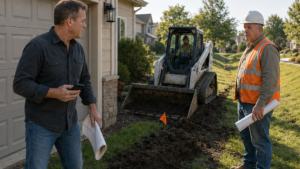
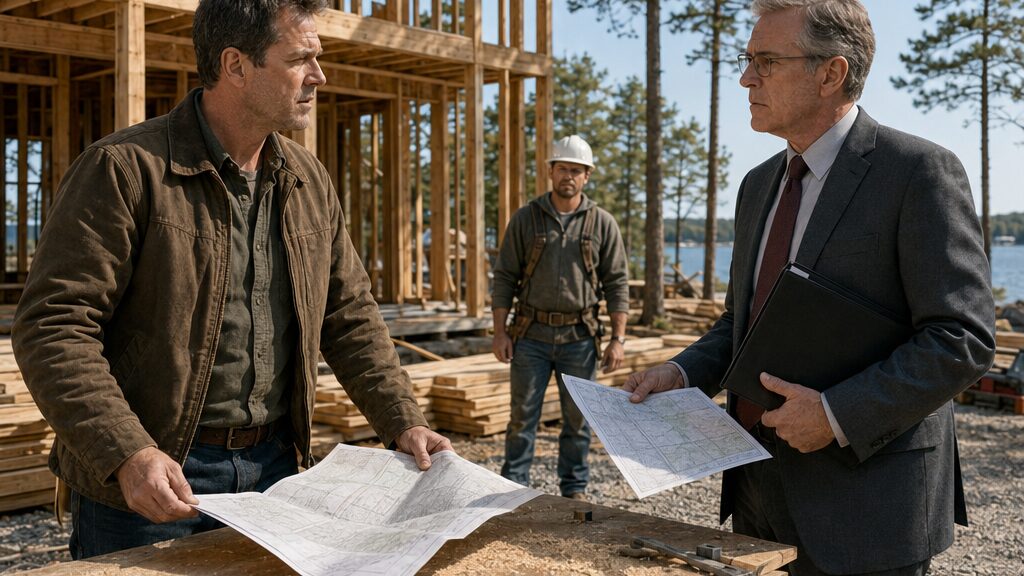
The gray SUV stopped in the gravel lane before Joshua Wright heard the saw shut down.
Richard Moore stepped out wearing a jacket too formal for a construction site and walked past the stacked lumber as though he had already been invited. He carried a leather portfolio under one arm and several sheets of paper in his other hand.
“Who’s running the job?”
The contractor lowered his nail gun.
Joshua came around the corner of the unfinished house. Behind him, wall studs framed squares of bright lake water where windows would eventually go.
“I am.”
Richard barely looked at him before turning back to the contractor.
“Construction stops today.”
No one moved.
Joshua heard the small tick of cooling machinery, the water against the shore, and then nothing else. Three men who had been setting roof joists looked toward him.
Joshua wiped sawdust from his palms.
“You want to tell me why?”
Richard held out the top sheet.
“Architectural work is continuing despite formal notice from the association. The property has not received design approval, landscape approval, or authorization for exterior materials.”
Joshua did not take the paper.
“My property isn’t in your association.”
Richard’s expression changed only slightly.
“We’ve been through that.”
“No. You’ve mailed me things. That isn’t the same as going through it.”
The contractor cleared his throat. “Josh, I need to know whether there’s an actual stop-work order from the county.”
Richard answered before Joshua could.
“This is an association enforcement matter.”
“That wasn’t what he asked,” Joshua said.
Richard turned fully toward him.
“The association has remedies available when an owner ignores covenants.”
Joshua disliked the word owner in Richard’s mouth. It sounded less like recognition than classification.
He looked toward the gravel road separating his parcel from the neat row of developed lake homes beyond the pines. When he bought the land, that road had seemed like the clearest line in the world. On one side were identical mailboxes, trimmed shrubs, stone entrance columns, and roofs in approved shades of gray. On the other was his rough lot, the old trees, and the lake.
He had never thought much about invisible lines until somebody tried to stand on one.
“Show me the covenant,” Joshua said.
Richard opened his portfolio.
“I brought the enforcement notice.”
“I didn’t ask for the notice. Show me the document that puts this parcel under those rules.”
Richard’s eyes moved toward the crew.
Joshua followed the glance.
“Everybody take ten,” he told them.
The contractor hesitated.
“Just ten.”
The men moved toward the trucks, but not far enough to pretend they weren’t listening.
Richard lowered his voice.
“You were offered an informal meeting before this escalated.”
“And I asked you to send me the recorded covenant.”
“You declined the meeting.”
“I declined a meeting about rules you haven’t shown apply to me.”
“That attitude is exactly why this has become more difficult than necessary.”
Joshua almost laughed, but didn’t.
For years he had rented places where somebody else decided whether a dog was too large, whether a shelf could be screwed into a wall, whether a truck could remain in a driveway overnight. He had saved, moved twice, delayed buying once when prices jumped, and finally found twelve wooded acres on the lake with an old access road and no house.
The day he signed the deed, he had sat alone on a fallen pine and imagined a place where every decision would finally be his.
Now Richard Moore was standing inside its frame telling his contractor when to work.
Joshua nodded toward the papers.
“One recorded instrument. Book and page. That’s all I’m asking.”
Richard looked through the packet.
The first page was a violation notice. The second was a photograph of the timber framing. The third listed architectural requirements. Richard moved past each one more quickly than the last.
Joshua watched his face.
“What book?”
Richard stopped turning pages.
“The association’s governing documents have been in effect for decades.”
“That’s not a book and page.”
“The property appears on our jurisdiction map.”
Joshua felt something colder than anger settle in his stomach.
“Appears?”
Richard stiffened.
“Your lot is identified as part of the Lakeshore residential area.”
“By the county?”
“By the association.”
“Recorded where?”
Richard closed the packet.
“The board does not re-litigate jurisdiction every time an owner dislikes a rule.”
Joshua stepped toward the temporary workbench. A framing square, tape measure, pencil, and half-empty coffee cup sat on plywood stretched across two sawhorses.
“This isn’t about disliking a roof color.”
“You received three notices.”
“And none of them answered the same question.”
Richard’s mouth tightened.
“If you continue today, any additional costs are your responsibility.”
Joshua looked back toward the contractor.
The contractor gave him a small, apologetic shake of the head.
“I can’t keep the crew moving with this hanging over the job,” he said. “Not until somebody tells me whether they can lien it or drag us into something.”
Joshua wanted to tell him to keep working.
The words rose immediately. So did the estimate in his head: labor, crane rental, material delivery, the interest on the construction loan.
He could order the crew forward out of principle and risk multiplying every cost.
Instead he said, “Secure what’s open.”
The contractor nodded.
That hurt more than Joshua expected.
One by one, tools went quiet. A stack of roof sheathing remained untouched beside the frame.
Richard seemed to relax.
Joshua noticed.
“This isn’t you winning,” he said.
“I didn’t come here to win.”
“Then show me what you came here with.”
For the first time, Richard looked almost reluctant.
He reached deeper into his portfolio and removed a folded sheet larger than the others.
When he opened it across the workbench, Joshua saw roads, lot numbers, shoreline curves, and a thick colored perimeter enclosing the developed neighborhood.
Then he saw his parcel.
It was inside the colored line.
Joshua stared at it long enough for Richard to mistake silence for concession.
“There,” Richard said. “That is the boundary the association has used for years.”
Joshua bent closer.
The gravel road was on the map.
The old pine line was there.
The shape of his parcel was recognizable.
But something about the thick boundary line bothered him.
It did not follow the subdivision edge he remembered from his closing documents.
It crossed the road.
It swallowed his property whole.
Joshua straightened.
“Where did this map come from?”
Richard folded his hands.
“It’s the association’s current jurisdiction map.”
Joshua kept looking at the line.
“That wasn’t my question.”
Chapter 2: Four Months Before the First Threat
The first HOA violation notice arrived before Joshua had walls.
He found it folded inside the contractor’s delivery packet, its corner held down by an invoice for framing lumber.
At first he assumed it had been left there by mistake.
He read the address twice.
His parcel number was correct.
The notice identified an unapproved construction project and instructed him to submit architectural plans for association review.
Joshua looked from the page to the open foundation behind him.
Across the gravel road, the nearest HOA house sat behind trimmed boxwoods and a uniform black mailbox. On his side, weeds still grew between tire tracks.
He called the number on the notice.
A recorded menu answered.
He hung up before choosing an extension.
That evening, at the rental house where he still lived among packed boxes, he opened his closing file across the kitchen table.
He found the deed first.
Then the title commitment.
Then the survey provided during purchase.
He read every reference to restrictions, easements, rights-of-way, and recorded instruments.
Nothing said Lakeshore Homeowners Association.
Nothing required architectural approval.
He searched the county property portal until nearly midnight.
The parcel had its own identification number and legal description. The subdivision plat he found nearby showed the developed lots stopping short of the gravel road.
Joshua leaned back.
The violation notice suddenly looked ridiculous.
He wrote a short response the next morning.
My deed does not identify this property as association-controlled. Please provide the recorded covenant or annexation instrument establishing jurisdiction over my parcel.
He mailed it certified.
Then he went back to work.
For two weeks, nothing happened.
The foundation was poured. Floor joists went in. Joshua spent Saturdays clearing brush near the future porch and marking where he wanted to leave the oldest pines untouched.
The house was not extravagant. Two bedrooms, a loft, wide windows toward the water, enough porch for a table and four chairs.
That simplicity mattered to him.
He had spent too many years arranging his life around leases.
This house was supposed to be the opposite of temporary.
The second notice arrived as the framing package was delivered.
This one was thicker.
It cited prohibited exterior finishes, roof-pitch standards, minimum landscape requirements, and restrictions on construction staging.
Joshua read it standing beside a bundle of lumber.
At the bottom was an invitation to attend an informal compliance meeting.
The date was three nights later.
He called the association office.
A woman answered.
“I need the covenant attached to my parcel.”
She asked for his address.
He gave it.
There was a pause.
“Yes, I see the violation file.”
“I’m not asking about the violations.”
“You can discuss your concerns at Thursday’s meeting.”
“I’m asking for the recorded document that gives you authority.”
Another pause.
“I can note that request.”
“Can you send it?”
“I can note it.”
Joshua closed his eyes.
“Fine. Note it.”
Thursday afternoon, he received an email reminding him of the meeting.
He did not go.
Instead, he sent another message stating that he would not participate in architectural review until the association established recorded jurisdiction.
It felt efficient.
Facts first. Meetings later.
The next morning Richard Moore called.
“You missed an opportunity to resolve this informally.”
Joshua stood in his rental driveway with the phone pressed between shoulder and ear while loading tools into his pickup.
“I’m still waiting for the document.”
“Your property is within the recognized Lakeshore community boundary.”
“Recognized by whom?”
“The association.”
“That’s circular.”
Richard exhaled.
“You purchased property adjacent to a managed residential community. These restrictions exist to protect owners from incompatible development.”
Joshua glanced at the boxes visible through his front window.
“I didn’t purchase inside your community.”
“Our records say otherwise.”
“Then send the record.”
Richard’s voice cooled.
“There are multiple governing documents.”
“Send whichever one attaches to my land.”
“You’re treating this as though decades of administration are meaningless.”
“I’m treating a property restriction like something that should be recorded.”
Neither man spoke for a moment.
Then Richard said, “You should understand that continued construction may expose you to enforcement costs.”
Joshua shifted the phone to his hand.
“Based on what?”
“You’ll receive formal notice.”
The call ended.
Joshua stood beside his truck, irritated less by the warning than by the refusal to answer the question.
That evening he drove to the county records office before it closed.
The recording clerk helped him locate the original subdivision plat and several later filings.
Joshua traced the boundary with his finger.
The oldest plat stopped on the far side of the gravel road.
His property lay beyond it.
He checked the deed book references listed on his title documents. Easements appeared. Utility rights appeared. A lake-access agreement appeared.
No HOA declaration did.
“You looking for something specific?” the clerk asked.
“Anything that puts this parcel into Lakeshore.”
She studied the parcel number.
“If it was annexed by recorded instrument, there should be a reference somewhere in the chain.”
“And if there isn’t?”
She gave him the practiced look of someone who had learned not to give legal opinions.
“Then I’d talk to a title professional.”
Joshua copied the relevant book and page numbers.
Driving home, he felt vindicated.
That feeling made him careless.
He stopped returning Richard’s calls.
When another association envelope arrived, Joshua left it unopened on the kitchen counter for two days.
He believed the problem had become simple: they were wrong, he had records, and eventually they would realize it.
What he did not understand yet was that institutions could continue acting on a mistake long after an individual would have stopped to reconsider it.
The third notice was delivered by certified mail.
Joshua opened it beside the half-framed house.
It stated that unauthorized work was continuing despite prior warnings and that further construction could result in additional enforcement action and recovery of association expenses.
At the bottom was Richard Moore’s signature.
Joshua folded the letter once.
Then again.
The contractor looked over from the slab.
“Problem?”
“No.”
Joshua put the notice in his truck.
But that evening, for the first time, he pulled out his closing survey and stared at the line dividing his land from the subdivision.
If Richard was bluffing, Joshua wanted proof strong enough to end it.
If Richard wasn’t bluffing, Joshua wanted to know what document he had missed.
He called Samuel Perez the next morning.
Chapter 3: Forty-Three Feet Beyond Their Line
Joshua took the folded survey from behind the seat of his truck while the crew secured exposed lumber around the unfinished house.
Richard was still standing beside the workbench.
“You asked what I was relying on,” Richard said. “I showed you.”
“You showed me your map.”
“It is the association’s map.”
Joshua walked past him.
“That doesn’t make it recorded.”
He set the folded survey on the plywood workbench and brushed away a thin layer of sawdust with his forearm.
Richard watched him unfold it.
Unlike the association sheet, Samuel Perez’s survey was dense with bearings, monuments, distances, parcel references, and certification language. Joshua had spent enough time studying it to know where his eyes needed to go.
He pointed to the subdivision boundary.
“Here.”
Richard leaned over.
Joshua moved his finger toward the gravel road.
“Here’s the edge of the recorded subdivision.”
Then he pointed to the nearest corner of his building footprint.
“And here’s my house.”
Richard’s expression remained flat.
Joshua took out a pencil.
“Forty-three feet.”
“Forty-three feet what?”
“From the nearest recorded subdivision line to the closest part of the structure.”
Richard looked again.
Joshua waited.
The pause lasted long enough for one of the crew members to glance over from the truck.
Richard finally said, “A physical subdivision line is not necessarily the same thing as covenant jurisdiction.”
It was not the reaction Joshua had expected.
For days, he had imagined the moment differently. He had expected embarrassment, maybe a reluctant apology, maybe Richard folding his papers and leaving.
Instead Richard sounded like a man adjusting his footing.
Joshua tapped the survey.
“You said my property was inside the boundary.”
“I said the association’s records show it inside the community.”
“And the county survey shows your line crossing land outside the recorded subdivision.”
“That survey establishes physical boundaries.”
“It establishes exactly where my property sits.”
“It does not, by itself, resolve whether later documents extended covenant authority.”
Joshua stared at him.
“Which later documents?”
“Historical community records.”
“Names.”
“I don’t have the complete archive with me.”
“Book and page.”
“Joshua.”
“That’s what I’ve been asking for since the first letter.”
Richard’s jaw tightened.
“The board has administered these edge parcels consistently for many years.”
Joshua almost answered too quickly.
He stopped himself.
Consistently.
There it was again. Not recorded. Not annexed. Not conveyed.
Consistently.
“You’re telling me you’ve done it a long time,” Joshua said.
“I’m telling you there may be documents your surveyor did not review.”
“Then show them.”
“I will ask the board to review the historical file.”
“And until then?”
“The enforcement remains in place.”
Joshua straightened.
“No.”
Richard’s eyebrows lifted.
“No?”
“You don’t get to stop my construction based on a map you can’t connect to a recorded document.”
Richard gathered the edges of his papers.
“The association has already issued notice.”
“That is your action. It is not your authority.”
The contractor stepped closer.
“Josh.”
Joshua knew what he meant.
Do not turn this into something worse.
He had already lost the day. Fighting Richard on-site would not put the crew back on the joists.
Joshua breathed once through his nose.
“How long is your review?”
“I can’t promise a timeline.”
“Three days?”
“No.”
“A week?”
“I said I can’t promise.”
Joshua looked through the open wall framing toward the lake.
Every day of delay had a price attached to it. Labor rescheduling. Material exposure. Loan interest. Weather windows.
Richard knew that too.
That was what changed Joshua’s anger.
Until that moment, he had viewed Richard as officious.
Now he understood that Richard had seen credible contrary evidence and was still willing to let the financial pressure continue.
“You saw the line,” Joshua said quietly.
Richard looked at him.
“You saw forty-three feet.”
“I saw one survey.”
“Prepared by a licensed surveyor using recorded county references.”
“And I am telling you there may be another layer.”
Joshua folded his arms.
“Then your job is to find it before you tell a man he can’t build on his land.”
For the first time, Richard’s certainty slipped.
Not much. Just a movement around his mouth.
Then it returned.
“My responsibility is to enforce the governing standards until the board determines otherwise.”
Joshua nodded once.
“That’s a choice.”
Richard gathered his portfolio.
“Yes. It is.”
He walked toward the SUV.
Joshua watched him go.
The contractor came to the workbench.
“So what now?”
Joshua looked at the survey.
“Now I find out whether he’s right about another layer.”
The contractor rubbed the back of his neck.
“I can hold your crew slot a few days. After that, I’ve got another job scheduled.”
Joshua knew what that meant.
If this went long enough, his project would not simply pause. It would lose momentum completely.
“I understand.”
The contractor left him beside the frame.
Joshua called Samuel before Richard’s SUV disappeared beyond the pines.
The surveyor answered on the fourth ring.
“I need you to tell me something carefully,” Joshua said.
“That sounds expensive already.”
Joshua ignored the joke.
“The HOA says the subdivision line on your survey doesn’t settle whether covenants reach my parcel.”
Samuel was silent for a moment.
“They’re correct about that much.”
Joshua looked down at the thick black line on the page.
“So the survey doesn’t prove I’m outside the HOA?”
“It proves where the surveyed boundary is. It proves where your parcel is in relation to the recorded subdivision plat I referenced. I’m a surveyor, not your attorney.”
Joshua felt his certainty shift.
Samuel continued.
“If a separate recorded declaration, annexation, or other instrument legally bound your parcel, that’s a title question. You need the chain.”
“I checked my deed.”
“Your deed is one link.”
Joshua rubbed his forehead.
“Could they have something older?”
“Could they? Sure. Do they? I have no idea.”
Joshua looked across the gravel road.
All this time, he had treated the road like a border because it looked like one.
The HOA had treated its colored map like a border because it looked official.
Now both assumptions seemed too easy.
“What would you check next?” Joshua asked.
“Original declaration. Every amendment. Every annexation instrument. Your complete title chain. And I’d compare the legal descriptions, not the colored shapes somebody drew later.”
Joshua looked again at Richard’s association map, still lying where he had left it.
The colored boundary curved neatly around Joshua’s parcel.
Too neatly.
“Samuel.”
“Yeah?”
“If their map is wrong, how does something like that stay wrong for years?”
Samuel did not answer immediately.
“Because maps get copied.”
Joshua said nothing.
“A line goes from one document to another,” Samuel continued. “Then somebody assumes the last person checked it.”
After the call, Joshua placed Samuel’s survey beside the association map.
On one sheet, the boundary stopped beyond the gravel road.
On the other, it reached across and enclosed him.
Two lines.
Two versions of the same place.
Only one could be supported by the records that mattered.
Joshua took photographs of both and drove to the title company that had handled his purchase.
The examiner agreed to begin a deeper chain review, but warned him it would take time.
“You’re asking us to go back through original subdivision filings and every later instrument touching the parcel.”
“That’s what I’m asking.”
“Then don’t expect an answer this afternoon.”
Joshua glanced toward the window.
“I’ve got a construction crew waiting.”
The examiner gave him a sympathetic look that did nothing to lower the cost.
That evening, Joshua returned alone to the unfinished house.
The workers had covered what they could. Loose material was strapped down. The lake was visible through every future room.
He stood where the kitchen would be and looked toward the gravel road.
For months, he had believed proving the physical line would end the dispute.
Now the forty-three feet felt less like an answer than an entrance.
His phone rang.
Samuel.
Joshua answered.
“I found one more thing in my project notes,” Samuel said. “The plat reference I used traces cleanly back to the original subdivision filing.”
“That’s good.”
“It’s good for the boundary.”
Joshua waited.
Samuel’s voice became more deliberate.
“But Joshua, listen to me. A clean boundary does not answer covenant jurisdiction. Those are two different questions.”
Joshua looked at the silent timber frame around him.
“So I need the original records.”
“You need all of them.”
Joshua glanced at the association map on the workbench, the thick colored line enclosing land the recorded subdivision line did not.
Tomorrow, he would start at the beginning.
Chapter 4: The Map Everyone Stopped Questioning
The title examiner called Joshua before nine the next morning.
“I found the problem.”
Joshua stopped halfway through locking his truck.
“What problem?”
“There’s no covenant attachment in your chain.”
He stood beside the unfinished house, looking through the bare wall studs toward the lake.
“You checked all of it?”
“I checked your deed history back through the conveyances tied to the original tract. I checked the subdivision declaration, the amendments indexed under the association, and the recorded annexations I could locate.”
“And?”
“Nothing I found legally describes your parcel as added property.”
Joshua tightened his grip on the phone.
“So Richard’s map is wrong.”
“That’s not what I said.”
He almost laughed.
“What else could it mean?”
“It means I cannot find a recorded instrument matching the boundary the association is using. If you want to know how that map came into existence, you need their records too.”
Joshua looked at the gravel road.
For weeks he had been asking one question: Did the HOA control his land?
Now he had another.
Why did they believe they did?
At the county archives, the recording clerk brought him the original subdivision plat on a large monitor.
The line was unmistakable.
It stopped beyond the gravel road.
Joshua compared it with a photograph of Richard’s association map.
The HOA version extended farther west, sweeping across several irregular parcels along the lake, including his.
“Can maps like this be updated without a deed filing?” Joshua asked.
“People can draw whatever map they want,” the clerk said. “Whether it changes property rights is another matter.”
Joshua studied the dates.
The original plat was decades old.
The association map had no recording stamp.
No book number.
No page reference.
Just a revision date in one corner.
He photographed it again.
That afternoon, the title examiner spread copies across a conference table.
“There’s something else.”
Joshua sat down.
The examiner placed an older annexation document beside the subdivision plat.
“This one adds a group of lots north of the original development. Proper legal descriptions, signatures, recording information. Clear.”
Then another.
“This adds the east section.”
Joshua followed the highlighted descriptions.
Neither came close to his property.
“So someone knew how to do this correctly.”
“Yes.”
“Then why isn’t there one for my side?”
“That’s the question.”
Joshua stared at the maps.
The answer he had wanted was in front of him, but it brought no relief.
If the HOA had simply made a mistake about one parcel, the dispute could end with his house.
If somebody had expanded a working map without matching legal records, the problem might not stop at his driveway.
He returned to the lake just before sunset.
A woman was standing near the gravel road.
Joshua recognized her from one of the houses farther south. He had seen her collecting mail but had never spoken to her.
“Joshua Wright?”
“Yes.”
“Nancy Johnson.”
She held a folder against her chest.
“I heard your construction got stopped.”
Joshua’s shoulders stiffened.
“From who?”
“It’s a small neighborhood.”
“I’m not in the neighborhood.”
Nancy gave him a look that might have been amusement if the situation had been different.
“That seems to be the issue.”
Joshua said nothing.
She opened the folder.
Inside was a copy of a parcel map.
Her lot sat along the same western edge.
“I’ve been looking at the map they use.”
Joshua stepped closer.
Her property was partially enclosed by the same sweeping colored line that crossed the gravel road.
“Why?”
“Because I recognized your parcel when Richard showed the map at the last board meeting.”
Joshua looked at her.
“He discussed my property at a board meeting?”
“They didn’t use much detail. Just said an owner was disputing jurisdiction.”
“I’m not an owner in their association.”
Nancy lowered the folder.
“Joshua, I’m not here to argue that.”
He heard the warning in her tone and stopped.
She pointed to her lot.
“My house was built before this version of the map. I bought twelve years ago. I’ve paid dues every year.”
“You have covenants in your deed?”
“I assumed I did.”
“That isn’t the same thing.”
“I know that now.”
The words landed harder than Joshua expected.
Nancy removed a faded copy of an older plat.
“My title documents reference road access and utility restrictions. I spent last night looking for the association declaration.”
“And?”
“I haven’t found it yet.”
Joshua stared at her parcel.
“How long have they been enforcing rules against you?”
Nancy gave a short, humorless laugh.
“How much time do you have?”
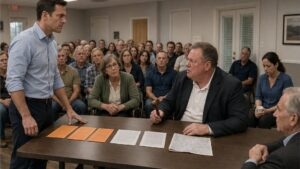
Two days later, Joshua attended his first HOA board meeting.
He disliked that fact before he entered the room.
The clubhouse smelled faintly of coffee and furniture polish. Richard sat near one end of a long table. Debra Lewis, the association president, sat at the center with an agenda in front of her.
Joshua placed copies of the two maps side by side.
“This is the recorded subdivision plat,” he said.
Then he touched the association map.
“This is what Richard brought to my property.”
Debra studied both.
Richard folded his arms.
Joshua traced the line.
“They are not the same.”
“We understand there’s a discrepancy,” Debra said.
“No. A discrepancy is a typo in an address. This line puts several parcels inside your jurisdiction that the recorded plat leaves outside.”
Richard leaned forward.
“You’re still assuming subdivision boundaries and covenant boundaries must be identical.”
“I’m not assuming anything anymore.”
Joshua looked at him.
“That’s why I checked the annexation records.”
The room went quiet.
Debra’s expression changed slightly.
Joshua noticed.
“I found annexations north and east. Proper descriptions. Recorded documents. Nothing extending this line across the western parcels.”
Debra spoke carefully.
“One title search does not justify overturning decades of association administration.”
There it was again.
Decades.
Administration.
As if duration could substitute for authority.
Joshua wanted to answer sharply.
Then Nancy placed something on the table beside him.
An old violation notice.
He turned toward her.
She looked pale but steady.
“Eight years ago,” she said. “They made me move a fence back six feet.”
Richard looked at the paper.
Nancy continued.
“I paid the violation assessment too.”
“How much?” Joshua asked.
“That isn’t the point.”
“It is if they never had authority.”
Nancy looked at him.
“No. The point is I changed my property because I believed they did.”
Joshua stopped.
That distinction unsettled him.
His fight had been about money and delay.
Nancy’s was about something already done.
She removed another document from the folder.
A receipt.
Then an old photograph showing the original fence line.
“I didn’t want to make trouble,” she said. “I still don’t.”
Debra pressed her lips together.
Richard looked away.
Joshua stared at the photograph.
Until that moment, he had imagined the boundary mistake as a line crossing his future.
Now he could see it reaching backward through someone else’s past.
Nancy slid the violation notice toward him.
At the bottom was an authorization signature from the association.
Joshua read the date.
Then the name beneath it.
Richard Moore.
Chapter 5: The Meeting Debra Tried to Contain
Debra Lewis began the private board session by offering Joshua exactly what he had wanted two weeks earlier.
“We are prepared to suspend enforcement against your parcel.”
Joshua did not touch the single-page proposal she pushed across the table.
The clubhouse was nearly empty. Debra sat opposite him. Richard was two chairs down, with the association attorney beside him. Nancy had been told the meeting concerned Joshua’s individual matter and had not been invited.
Joshua read the first paragraph.
The association would cease architectural and landscaping enforcement against his parcel while reserving all positions regarding historic jurisdiction.
He looked up.
“You’re releasing my property?”
“We’re agreeing not to enforce while the issue is reviewed.”
“For how long?”
“Indefinitely, unless new information establishes jurisdiction.”
Joshua read farther.
There was no reference to Nancy.
No reference to other edge parcels.
No admission that the map might be wrong.
He set the paper down.
“And the rest of them?”
Debra’s face remained composed.
“This proposal addresses your property.”
“I can see that.”
Richard shifted in his chair.
“You asked us from the beginning to leave your parcel alone.”
“I did.”
“And now we’re offering that.”
Joshua looked at him.
“Because you think I’m right?”
“Because continued dispute is expensive for everyone.”
The association attorney intervened.
“This is not an admission of legal conclusions.”
Joshua almost smiled.
Of course it wasn’t.
Two weeks earlier, he would have signed immediately.
He would have taken the paper back to the contractor, restarted the framing crew, and let the HOA argue with itself.
That was before Nancy placed the old fence violation on the table.
“What happens to her parcel?” Joshua asked.
Debra knew who he meant.
“We cannot expand this meeting into every historical enforcement issue.”
“Why not?”
“Because those issues may involve different facts.”
“Same map.”
“Possibly different governing instruments.”
“Have you found them?”
Debra paused.
“We are reviewing records.”
Joshua leaned back.
For the first time, he saw the structure of the offer clearly.
It was not a surrender.
It was containment.
Take Joshua out of the fight, restart his house, and the urgency disappears.
He looked at Richard.
“You signed Nancy Johnson’s fence violation.”
Richard’s face hardened.
“I signed hundreds of compliance actions.”
“Based on this boundary map?”
“Based on association records available to me.”
“Did you ever ask how those parcels got onto the map?”
Richard looked toward the attorney.
That answer irritated Joshua more than denial would have.
“You were happy to ask me to prove I wasn’t covered.”
Richard turned back.
“That is not fair.”
Joshua almost laughed.
“No?”
“No. I did not create the map. I inherited a compliance system used by boards before mine.”
“And kept using it.”
“Yes.”
Richard’s voice rose for the first time.
“Because uniform enforcement matters. Because the minute residents believe rules apply differently depending on who argues hardest, the entire system loses credibility.”
Joshua held his gaze.
“What happens when the rule never applied at all?”
Richard’s jaw moved.
“That is what we are trying to determine.”
“You kept enforcement in place after you saw the survey.”
Richard’s expression changed.
Not anger.
Something closer to fatigue.
“I had thirty-seven open compliance files when I came to your property.”
Joshua did not respond.
Richard continued.
“People call because somebody parks an RV for six months. They call because a retaining wall sends runoff onto the next lot. They call because one owner paints a house fluorescent orange and another says we’re destroying property values if we don’t act by Friday.”
The attorney shifted, but Richard kept going.
“Every time we make an exception, somebody points to it later.”
“That doesn’t give you jurisdiction.”
“I know that.”
The room became very still.
Joshua had not expected those words.
Richard stared at the table.
“I know that now.”
Debra turned toward him.
“Richard.”
But he continued.
“What I’m saying is that this wasn’t some scheme to take your property. I trusted records that had been used for years.”
Joshua thought about Nancy’s fence.
“Then when did you stop trusting them?”
Richard looked at the proposal.
“When your survey didn’t match.”
“And you still stopped my crew.”
“Yes.”
“Why?”
Richard answered after a long silence.
“Because if I withdrew enforcement immediately and the map turned out to be valid, I would have undermined every other open case.”
There it was.
Not greed.
Not secret profit.
Fear.
Institutional fear dressed as procedure.
Joshua understood it.
He still did not excuse it.
“That was your choice,” he said.
Richard nodded once.
“Yes.”
Debra closed the folder in front of her.
“We are getting away from the practical question.”
“No,” Joshua said. “I think we finally reached it.”
She looked at him.
“When did the board first hear that this map might be wrong?”
Debra’s eyes held his for a second too long.
Joshua felt something settle into place.
“You knew there had been a question.”
“I did not say that.”
“You didn’t need to.”
The attorney leaned forward.
“Joshua, speculation is not helpful.”
Joshua ignored him.
Debra stood and walked to the wall-mounted screen.
She opened a scanned set of old board minutes.
A map appeared beside them.
The same western edge.
The same widening line.
“This version dates back more than twenty years,” she said.
Joshua stared at the projected page.
“Where did it come from?”
“We don’t know.”
“You’ve had two weeks.”
“We found references indicating it was prepared during a management transition. Possibly to consolidate service areas.”
“Service areas?”
“Road maintenance, common-area access, administrative billing.”
Joshua looked at the map.
“And somehow a service map became a jurisdiction map.”
Debra did not answer.
He turned toward her.
“Did anyone ever challenge it?”
Debra’s hand remained on the remote.
Richard looked at her.
That was the moment Joshua knew the answer mattered.
Finally Debra said, “There was an inquiry.”
“When?”
“Years ago.”
“From who?”
“A prior owner along the western edge.”
“What happened?”
“The matter did not proceed.”
“That wasn’t my question.”
Debra’s composure thinned.
“The owner sold before the board completed its review.”
Joshua stood.
“And you kept using the map.”
“We had no definitive finding that it was incorrect.”
“You had enough doubt to start a review.”
“And no conclusion.”
Joshua looked at the unsigned proposal.
A private release for his parcel.
A clean exit.
His contractor could restart.
His costs would stop climbing.
He could go back to his house and let Nancy decide what she wanted to do about an eight-year-old fence.
For a few seconds, he wanted exactly that.
Then he remembered something Nancy had said.
I changed my property because I believed they did.
Joshua pushed the proposal back across the table.
Debra looked at it.
“What are you doing?”
“I’m not signing this.”
Richard stared at him.
“You’re turning down the relief you demanded.”
“I demanded proof. Then I demanded that you stop interfering with my land.”
“This does that.”
“For me.”
Debra’s voice sharpened.
“You are not authorized to negotiate for other owners.”
“I’m not.”
Joshua stood fully.
“But I’m not going to help you make the pressure disappear by carving me out.”
The attorney began to speak.
Joshua picked up his copies of the maps.
“If my parcel is outside, correct the map. If Nancy’s is inside, prove it. Do the same for every edge parcel.”
“That could take months,” Debra said.
“Then you should have checked twenty years ago.”
The words came out harder than Joshua intended.
Debra flinched.
For a moment he regretted them.
Then she looked toward the projected minutes.
When she spoke again, her voice was quieter.
“There was a memorandum.”
Richard turned.
“What memorandum?”
Debra did not look at him.
“From the prior management company. It recommended verifying the western service-area parcels against recorded covenant descriptions.”
Joshua felt his anger change shape.
“Was it given to the board?”
“Yes.”
“When?”
“Eleven years ago.”
“And what did the board do?”
Debra looked at him.
“Nothing that resolved it.”
The private offer on the table no longer looked like compromise.
It looked like eleven more years.
Chapter 6: The Line Became Everyone’s Problem
The second confirmed parcel appeared in the title examiner’s report three weeks later.
Joshua read the sentence twice.
No recorded covenant instrument located establishing annexation of subject parcel into Lakeshore Homeowners Association.
Nancy sat across from him at a table in the county records room.
“That’s not mine,” she said.
“No.”
The parcel belonged to an unnamed homeowner farther south.
Joshua turned the page.
The report identified the same pattern: original tract outside the subdivision boundary, later appearance on the association’s administrative map, years of dues and compliance history, no matching annexation found in the indexed record chain.
Nancy stared at the page.
“So now there are two.”
“Two confirmed besides mine.”
She rubbed her thumb along the edge of her folder.
For the first time since Joshua had met her, she looked less afraid of being wrong than of being right.
The independent review had begun only after the association attorney notified the board’s insurer about the historical memorandum Debra disclosed.
That changed everything.
What had been an argument between Joshua and the HOA became a risk file.
The insurer wanted records preserved.
The association attorney wanted enforcement on disputed edge parcels reviewed.
The title company was asked to identify which properties required deeper examination.
Joshua had imagined that kind of escalation would feel satisfying.
Instead it made the whole thing heavier.
Every new parcel contained another owner, another set of decisions, another number that might have been paid because someone trusted a colored line.
He and Nancy visited the second homeowner that afternoon.
They did not arrive with accusations.
Joshua had insisted on that.
“We’re checking records,” he said at the door. “Nothing more.”
The owner listened, wary at first, then brought out a file box.
Inside were dues statements, architectural applications, and violation notices going back years.
One document made Nancy stop turning pages.
It concerned a porch enclosure.
The homeowner had originally planned a screened structure facing the lake. The association rejected it under design standards and required a revised structure with different materials and roof alignment.
“How much did changing it cost?” Nancy asked.
The owner looked toward the porch.
“Difference between the original bid and the approved version? Around fourteen thousand.”
Joshua felt his stomach tighten.
“Did you appeal?”
“Why would I? I thought they had authority.”
The sentence echoed Nancy’s.
Joshua walked outside.
The disputed boundary was no longer abstract.
It had become lumber bought twice.
Fence posts pulled from the ground.
Fees written on checks.
Plans changed because ordinary people assumed an organization sending official-looking notices had already verified its own authority.
Nancy followed him.
“You okay?”
“I wanted them off my property.”
“That’s still reasonable.”
“I know.”
“But?”
Joshua looked toward the lake.
“But I thought that was the whole problem.”
Nancy folded her arms.
“You don’t have to fix all of it.”
Joshua almost agreed.
That had been his instinct from the start: take care of his parcel, his house, his documents.
But the private settlement Debra had offered now seemed impossible to forget.
He had been given a door out.
Others had not.
Back at the HOA records room, the board permitted limited access under supervision.
Boxes from old management companies filled metal shelving.
Richard was already there when Joshua and Nancy arrived.
He looked tired.
Not defeated.
Just worn down.
“We found six compliance files associated with western-edge parcels,” Richard said.
“Only six?” Joshua asked.
“Six that require review. Don’t turn that into six confirmed errors.”
“I didn’t.”
Richard looked surprised.
Joshua set his folder down.
“I’m trying not to.”
That seemed to lower the temperature in the room.
For two hours they compared parcel numbers against older maps.
Richard knew the internal files better than anyone.
Joshua knew the title questions.
Nancy recognized homeowners and property history.
It was the first time the three of them had worked on the same side of the table.
Then Richard opened a file containing a violation Joshua recognized.
Nancy’s fence.
Richard stopped.
“I remember this.”
Nancy looked at him.
“You should.”
He read the notice.
“I inspected it twice.”
“You told me the setback was mandatory.”
“It was under the standards I had.”
Nancy’s voice stayed level.
“You charged me when I didn’t move it fast enough.”
Richard lowered the paper.
“I know.”
Joshua watched him.
Richard did not apologize immediately.
Perhaps he knew anything quick would sound cheap.
Finally he said, “If your parcel is confirmed outside covenant jurisdiction, that assessment should never have happened.”
Nancy’s eyes filled but she blinked it away.
“That fence was my father’s last project.”
Richard looked at her.
Joshua had not known that.
Nancy continued.
“He helped me set the posts before he got sick. When the association made me move it, I told myself it was just wood.”
Her voice tightened.
“It wasn’t.”
No map could contain that.
No refund could return it.
Richard removed his glasses and rubbed the bridge of his nose.
“I’m sorry.”
Nancy looked down at the file.
“I’m not ready to tell you that fixes anything.”
“I understand.”
The moment changed Joshua more than any survey had.
Until then, accountability had meant proof.
Now he saw that proof only opened the door.
What followed required people to decide what they were willing to do with it.
Two days later, Nancy signed the formal complaint.
Her hand shook slightly.
Joshua noticed.
“You don’t have to.”
“Yes, I do.”
“You’ve said for weeks you don’t want the neighborhood turning against you.”
“I still don’t.”
She capped the pen.
“But I’m more afraid they’ll call this settled after they fix yours.”
Joshua said nothing.
That had once been exactly what he wanted.
The state consumer-protection office accepted the submission for review but made no promises. The association’s insurer and counsel moved faster.
An independent audit was formally requested.
All enforcement involving disputed western-edge parcels was flagged for legal review.
At the next board meeting, residents filled most of the chairs.
Some were angry at the HOA.
Others were angry at Joshua.
One man complained that reopening old cases would raise dues.
A woman asked whether the association would become uninsurable.
Someone near the back said Joshua should have taken his exemption and left everyone else alone.
Months earlier, that accusation would have sent him straight into an argument.
Now he let it sit.
Debra waited for the room to settle.
“We cannot pretend there are no consequences to reviewing historical enforcement,” she said. “There will be costs.”
Richard sat beside her.
Joshua expected him to defend the old map.
He didn’t.
Debra continued.
“There are also consequences to continuing enforcement when jurisdiction is uncertain.”
She looked down at the agenda.
“I am calling an emergency vote for next Thursday on temporary suspension of enforcement against all identified western-edge parcels pending independent review.”
A murmur moved through the room.
Joshua looked at Richard.
Richard did not look back.
Nancy’s hand rested on the old fence violation inside her folder.
For the first time, the line that had trapped Joshua’s unfinished house was no longer his line alone.
Next Thursday, the board would have to decide what mattered more: the authority it had practiced for years, or the authority it could actually prove.
Chapter 7: Where the New Boundary Finally Held
Debra Lewis placed the corrected map in the center of the board table before anyone spoke.
It was larger than the old association version, printed on heavy white paper with parcel numbers, survey references, and a clean boundary line verified against recorded documents. The western edge no longer curved conveniently around every lakeside property.
It stopped where the records said it stopped.
Joshua sat beside Nancy in the second row of the clubhouse.
The room was fuller than it had been the week before. Some residents stood against the back wall. The association attorney had a stack of folders beside him. Richard Moore sat at the board table with both hands folded over a yellow legal pad.
Debra tapped the microphone once.
“We have received the preliminary findings of the independent review.”
No one needed her to explain why they were there.
For weeks, rumors had moved faster than facts. Some residents believed the entire HOA was about to be dissolved. Others claimed Joshua had discovered a technical loophole and was using it to avoid rules everyone else followed. A few had begun asking whether years of dues should be refunded to half the neighborhood.
The review had produced something less dramatic and more difficult.
Specific parcels.
Specific documents.
Specific mistakes.
Debra looked down at the report.
“The independent examiner found that several properties along the western edge appear on association administrative maps despite no recorded covenant instrument establishing their annexation.”
A murmur traveled through the room.
Joshua did not move.
He had imagined hearing those words since the day Richard stepped onto his construction site.
Now that they had arrived, they did not feel triumphant.
They felt heavy.
Debra continued.
“The examiner also confirmed that the association’s working boundary map incorporated a service-area map created during a prior management transition. At some point, that service boundary began being used for compliance and billing purposes.”
Someone in the back called out, “By mistake?”
Debra looked toward the voice.
“That is the conclusion supported by the records currently available.”
Another resident spoke.
“So you charged people who weren’t members?”
The attorney leaned toward the microphone.
“Not every affected parcel presents identical facts. Individual title chains must still be reviewed.”
The room stirred again.
Joshua saw Nancy’s fingers tighten around her folder.
Her fence notice was inside.
She had carried it to every meeting.
Debra raised one hand.
“What is clear is that enforcement should not have continued on disputed parcels once the jurisdiction question became credible.”
Richard looked down at his legal pad.
Joshua watched him.
For most of the fight, Richard had occupied a simple place in Joshua’s mind: the man who had walked onto his land and shut down his house.
That had been easier.
Anger liked clean borders.
The last month had ruined those.
Richard had been wrong. He had also spent nights sorting old files and identifying decisions carrying his own signature. He had not quit when the records turned against him.
That did not erase what he had done.
It made the truth harder to flatten.
Debra moved to the first motion.
“Temporary suspension of all architectural, landscaping, assessment, and compliance enforcement against parcels identified as lacking verified covenant attachment until each title review is complete.”
The board secretary called the vote.
One member voted yes.
Then another.
Debra voted yes.
Richard was last.
He looked toward the corrected map.
Joshua could see the old western line faintly beneath a gray comparison layer. It crossed Joshua’s parcel, Nancy’s lot, and several others like a mistake someone had traced too many times.
Richard lifted his head.
“Yes.”
The word was quiet.
It changed years of decisions.
The motion passed.
No applause followed.
Joshua was glad.
The next motion established case-by-case review of assessments, fees, and physical compliance actions imposed on parcels later confirmed outside association jurisdiction.
That discussion was harder.
“How far back?” someone asked.
“What about legal fees?”
“Who pays for this?”
“Are our dues going up?”
The attorney answered some questions and refused others.
The insurer would participate in certain claims.
The association would create a reserve review.
Not every dollar could be refunded immediately.
Not every alteration could be undone.
Nancy leaned toward Joshua.
“This is the part people won’t like.”
“No.”
“You still glad you didn’t sign that deal?”
Joshua looked at the map.
“Yes.”
He meant it, but the answer no longer came with anger.
A month earlier, he had believed justice meant removing the association from his property.
Now he understood that the cleanest solution for him could have left everyone else standing under the same false line.
Debra called a short recess.
Joshua stepped outside.
Richard followed several minutes later.
For a while they stood without speaking beneath the clubhouse overhang.
Richard finally said, “Your contractor called the office yesterday.”
Joshua looked at him.
“Why?”
“To confirm the enforcement suspension.”
“And?”
“I told him your parcel is cleared pending final recording review.”
Joshua studied Richard’s face.
“Thank you.”
Richard gave a small nod.
It was the first uncomplicated exchange they had ever had.
Then Richard said, “I should have stopped when I saw Samuel’s survey.”
Joshua waited.
“I kept thinking if I backed off too quickly, every enforcement decision I’d ever made would look arbitrary.”
“Some of them might have been.”
Richard looked toward the parking lot.
“Yes.”
He did not defend himself.
Joshua found that harder to answer than an argument.
“You believed the map,” Joshua said.
“I chose to believe it after I had reason not to.”
That was closer to the truth.
Richard rubbed one hand over the other.
“Nancy’s fence file was mine.”
“I know.”
“I’ve offered to meet with her.”
“She’ll decide if she wants that.”
“I know.”
Another silence.
Then Richard looked at Joshua.
“You were right to push.”
Joshua almost accepted the sentence.
Instead he said, “I was wrong about one thing.”
Richard raised an eyebrow.
“I thought because my deed was clear to me, I didn’t owe anybody a conversation.”
“You skipped the first meeting.”
“I did.”
“You were difficult.”
Joshua smiled faintly.
“So were you.”
Richard almost smiled back.
“Fair.”
The recess ended.
Inside, Debra remained standing rather than returning immediately to her chair.
She held a single sheet of paper.
“I have one final matter.”
The room quieted.
Joshua knew before she began.
“I have submitted my resignation as association president, effective after transition of the current review to interim leadership.”
Several residents spoke at once.
Debra waited.
“I am not resigning because I created the original mapping error. I did not.”
Her voice stayed steady.
“I am resigning because eleven years ago this board received a recommendation to verify the western boundary against recorded covenant descriptions. I was on the board then.”
Joshua felt Nancy turn toward him.
Debra continued.
“We did not complete that work.”
She looked around the room.
“At the time, the concern appeared limited. The owner who raised it sold. Other matters took priority. We told ourselves that decades of practice meant the map was probably correct.”
Her eyes dropped briefly to the corrected line.
“That was not enough.”
No speech followed.
No attempt to transform the admission into heroism.
Debra simply placed her resignation beside the map and sat down.
Three weeks later, Joshua stood again inside the timber frame of his house.
This time the sound of a saw came from above him.
The contractor balanced on the upper framing while two crew members guided a new beam into position.
Joshua had expected the restart to feel dramatic.
Instead it felt wonderfully ordinary.
Measurements shouted across the frame.
A compressor kicked on.
A truck backed slowly down the gravel road.
Nancy arrived carrying two coffees.
“You look nervous,” she said.
“They’re lifting several hundred pounds over my future kitchen.”
“I meant about the house.”
Joshua took the cup she offered him.
“I’m getting used to it moving again.”
She looked toward the lake.
Her title review had been completed the week before.
Her parcel was outside the recorded covenant boundary.
The old assessment on her fence had been approved for reimbursement. The association had also offered to cover part of the cost if she chose to reconstruct the original fence alignment.
Nancy had not decided.
Joshua had not asked her to.
Some things were not repaired because paperwork changed.
Samuel arrived later that morning carrying the final boundary exhibit.
He unfolded it on the same temporary workbench where Joshua had confronted Richard.
The sawdust had returned.
Joshua brushed it aside.
Samuel pointed to several markers.
“The county references match. Title examiner agrees. This is the exhibit the association is adopting for its jurisdiction file.”
Joshua studied the line.
It looked almost disappointingly simple.
A narrow black mark stopping beyond the gravel road.
Forty-three feet from the closest part of his house.
For months, that distance had felt enormous.
Then dangerous.
Then insufficient.
Now it was simply measured ground.
Samuel tapped the paper.
“Want a copy?”
Joshua smiled.
“I think I have enough copies.”
Nancy laughed.
Above them, the contractor called for clearance.
Joshua stepped away from the workbench.
The new beam rose slowly between the walls.
For most of his life, Joshua had imagined independence as a place nobody else could enter without permission.
The lakefront lot had seemed to promise exactly that.
His land.
His decisions.
His line.
But the fight had taught him something he had resisted longer than he wanted to admit.
A boundary could protect what belonged to you without requiring you to stop caring about what happened on the other side.
The beam settled into place.
The contractor checked one end, then the other.
“Good.”
A nail gun cracked through the open frame.
Joshua looked past the pines toward the neighboring homes.
Nancy stood beside him, holding her coffee and watching the crew.
Across the gravel road, the boundary remained invisible.
For the first time, Joshua was comfortable with that.
He knew where it was.
And now, so did everyone else.
The story has ended.