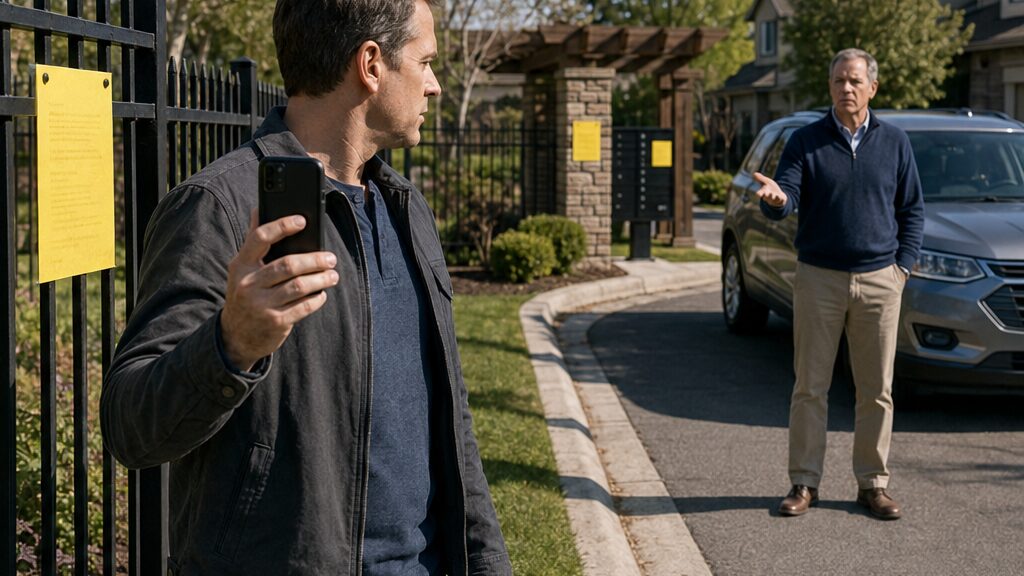
They Fined His Open-House Sign, So He Read the Rule They Thought Nobody Else Would Check
Chapter 1: The Two-Day Sign That Cost Two Hundred Dollars
The violation envelope was waiting beside the buyer-feedback sheet.
Raymond Walker noticed the red HOA logo first, then the number visible through the window: $200. He stood at the kitchen counter with one hand still on the stack of mail while the late-afternoon light fell across the empty half of the room where a bookshelf had already been packed.
For a moment, he thought it had to be something old.
He opened it.
NOTICE OF VIOLATION.
Temporary signage.
Two hundred dollars.
Raymond read the page twice, then looked through the front window toward the lawn.
There was no sign there now.
Amy Davis had removed the open-house sign Sunday evening, just as she had promised. For less than two days, a white real-estate placard had stood near the sidewalk with an arrow pointing toward Raymond’s driveway. Nothing flashing. Nothing oversized. Nothing attached to a tree or utility pole. Just an open-house sign for a property that Raymond was actively trying to sell.
He carried the letter outside.
The stake holes were still faintly visible in the grass.
Raymond walked to them and looked toward the curb, replaying Friday afternoon. Amy had arrived just after four. She had asked him whether he wanted the sign closer to the corner for visibility.
“No,” he had told her. “Keep it inside the lot.”
She had pushed the metal stakes into the lawn several feet back from the sidewalk.
He remembered because he had watched her do it.
Now the HOA letter claimed the sign violated the community’s restriction on temporary signage.
Raymond went back inside and picked up the buyer-feedback sheet.
Three groups had toured the house over the weekend. One had liked the kitchen but thought the upstairs bedrooms were small. Another had asked about school traffic. The third had written that the house showed well but the neighborhood rules seemed “strict.”
He read that word again.
Strict.
His phone rang.
Amy.
“I was just about to call you,” Raymond said.
“That doesn’t sound promising.”
“I got fined.”
There was a brief silence. “For what?”
“The open-house sign.”
“What?”
“Two hundred dollars.”
Amy exhaled sharply. “That thing was there Friday evening through Sunday.”
“I know.”
“And it was on your property.”
“I know that too.”
He could hear papers moving on her end.
“Send me a picture of the notice.”
Raymond photographed both pages.
Amy called back within two minutes.
“I still have the listing photos from Friday,” she said. “The sign is clearly inside your yard.”
“How long exactly was it up?”
“I put it out Friday at four-thirty. I picked it up Sunday a little after three.”
“So less than forty-eight hours.”
“Yes.”
Raymond looked again at the notice.
He had expected Amy to be angry on his behalf. Instead her tone shifted into the careful, practical voice she used when talking about inspections and closing schedules.
“Raymond, I know this is annoying.”
“Annoying?”
“I’m not saying it’s fair. I’m saying you’re selling. Sometimes the least expensive solution is the one that lets you move on.”
He looked around the kitchen.
Half the cabinets were already empty. Boxes sat against the dining-room wall with black marker labels: BOOKS. GARAGE. OFFICE.
Moving on.
That was what he had been telling himself for six months.
“Two hundred dollars isn’t the point.”
“I know.”
“Do you?”
Amy paused.
Then she said, “I know you’ve had problems with the board before.”
“Problems?”
“Raymond.”
He stopped.
She was right. He had complained about late landscaping notices. He had argued over a trash-can warning that arrived while he was out of town. He had sent three emails about a drainage repair that took two months. None of those disputes had been large enough to matter individually.
Together, they were one reason he wanted out.
Amy continued, “You have buyers looking. I don’t want this turning into something that scares people off.”
Raymond stared at the line in the violation letter citing the governing documents.
“I want to know what rule I broke.”
“That’s reasonable.”
“And then I’ll decide what to do.”
He ended the call and went to the hall closet where he kept property records.
The HOA documents were in a thick binder behind old insurance policies and appliance manuals. He pulled them out, but before opening the binder, he looked at the citation again.
Something about the language bothered him.
The notice said the open-house sign violated restrictions concerning “temporary signage placed or displayed within the community.”
That sounded broader than Raymond remembered.
He had read the rules carefully when he bought the house. He remembered sections about commercial signs, political signs, contractor advertisements, and postings on common property. He did not remember a flat ban on every temporary sign placed anywhere.
He searched the digital copy on his laptop.
“Temporary signage.”
Several results appeared.
None matched the sentence in the violation letter exactly.
Raymond leaned closer.
The citation referenced Section 5.2.
He clicked there, but the formatting in the old scanned document was poor. He would need to compare it with the printed binder.
Before he could, his phone buzzed with another message from Amy.
One of the weekend couples wanted a second showing.
That should have felt like good news.
Instead Raymond found himself wondering what would happen if the buyers requested the HOA disclosure packet before making an offer. Would the violation appear? Would the fine need to be cleared before closing? Would a dispute become another question he had to explain?
He shut the laptop.
For the first time, paying the two hundred dollars seemed tempting.
Not because he thought the board was right.
Because he was tired.
By Monday evening, Raymond had nearly convinced himself to write the check.
He placed the violation notice in a red folder and drove toward the grocery store.
At the neighborhood mailbox cluster, he slowed for a resident crossing the street.
That was when he saw it.
A bright HOA notice had been taped directly to the side of the shared mailbox structure.
Raymond drove another twenty feet before braking.
He looked in the rearview mirror.
The paper fluttered slightly at one corner.
Temporary.
Posted on common property.
Raymond put the car in reverse.
Chapter 2: Frank Closed the Door Before Raymond Finished Asking
Frank Roberts opened his front door with Raymond’s violation notice already in his hand.
That changed the conversation before Raymond said a word.
Frank stood behind the storm door in khaki pants and a dark pullover, reading glasses resting halfway down his nose. He did not look surprised to see Raymond.
“I figured you might stop by.”
Raymond glanced at the paper. “You’ve seen it.”
“I’m the board president.”
“I wanted to ask about the rule.”
Frank pushed the storm door open but did not step onto the porch.
“What about it?”
“The sign was on my property.”
“It was visible from the street.”
“That’s not what I asked.”
Frank lowered the paper slightly.
Raymond had rehearsed the exchange on the walk over. No accusations. No sarcasm. Just ask what section prohibited a temporary open-house sign on a privately owned front lawn.
He kept his voice even.
“The notice cites Section 5.2. I want to understand how that section applies.”
Frank’s expression tightened in a way Raymond recognized from past meetings. It was the look Frank used when a conversation stopped feeling administrative and started feeling like a challenge.
“It applies because temporary signage is controlled by the association.”
“Every temporary sign?”
“We regulate what’s displayed in the neighborhood.”
“That still doesn’t answer whether mine was on common property.”
Frank sighed.
“You’re getting hung up on wording.”
Raymond almost laughed.
“The fine is based on wording.”
“The board has to enforce standards consistently.”
Raymond looked past Frank into the entryway. On a narrow table sat a stack of community newsletters. Everything in Frank’s house seemed squared and aligned.
“Then I’m asking what standard you enforced.”
“The sign was unauthorized.”
“Who was I supposed to ask?”
“The board.”
“For a forty-eight-hour open house?”
“For signage.”
Raymond felt the argument tightening around them.
He could have raised his voice. Instead he put his hands into his jacket pockets.
“Was there a complaint?”
“That isn’t relevant.”
“So someone reported it.”
“I didn’t say that.”
“You didn’t have to.”
Frank looked toward the street, checking whether anyone was nearby.
That small gesture irritated Raymond more than the words.
“This isn’t personal,” Frank said.
Raymond stared at the violation notice in his hand.
“It feels fairly personal when you’re standing there with my fine before I even knock.”
Frank’s jaw shifted.
“We’ve had years of residents saying the board doesn’t enforce anything. Contractor signs stay up for weeks. Political signs show up early and disappear late. People tape advertisements to community structures. If we start making exceptions every time somebody says their situation is different, then there isn’t a rule.”
Raymond had not expected that answer.
For the first time, Frank sounded less like a man enjoying authority and more like someone tired of being accused of not using enough of it.
But then Frank added, “And frankly, Raymond, you’ve challenged nearly every notice you’ve received.”
“Because some of them were wrong.”
“That’s your opinion.”
“One came while I was out of state.”
“And it was corrected.”
“After three emails.”
Frank’s patience disappeared.
“The board runs the association. We were elected to enforce the covenants. You’re selling anyway. If you dislike how this neighborhood operates that much, you’re free to move.”
The words settled between them.
Raymond felt heat rise behind his face.
There it was.
Not the rule.
Not the sign.
The hierarchy.
He had imagined several responses on the way over. None sounded good now.
So he asked only one question.
“Are you saying Section 5.2 gives the board authority over temporary signs anywhere in the neighborhood?”
“I’m saying the citation stands.”
“That wasn’t my question.”
Frank reached for the storm door.
“We’re not going to litigate the covenants on my porch.”
“I’m not asking you to.”
“If you want to appeal, submit it through management.”
“I wanted a straight answer.”
“You have one.”
Frank closed the door.
Raymond remained on the porch.
Through the glass, Frank’s shape moved away into the house.
For several seconds Raymond did nothing.
Then he noticed something mounted near the walkway.
A small community information board stood at the edge of Frank’s property where the landscaped strip met a shared pedestrian path. A laminated HOA notice was pinned under its clear cover.
Raymond stepped closer.
He did not touch it.
The notice announced a landscaping schedule.
He looked from the paper to Frank’s closed front door.
The easy thing would have been to take out his phone and photograph it immediately.
Instead Raymond walked home.
He was angry enough that evidence collected in that moment would feel like ammunition, not information.
That distinction mattered to him, even if he could not yet explain why.
Inside his house, he opened the red folder and placed Frank’s copy of events beside his own.
Then he pulled the thick HOA binder onto the desk.
Section 5.
Architectural and Exterior Restrictions.
He ran one finger down the page.
5.1.
Then 5.2.
Raymond read the first sentence.
Then he read it again.
Temporary signs, notices, placards, or similar materials were prohibited on designated common-area structures, including community fencing, walls, utility fixtures, and other association-controlled property, unless prior written authorization had been granted.
He sat back.
That was not how Frank had described it.
Raymond picked up a pen and circled two words.
Common area.
Chapter 3: The Rule Looked Different When Raymond Read Every Line
Raymond searched the rest of the governing documents for an exception granting the board unrestricted use of temporary signs.
He found none.
At 10:43 Monday night, his kitchen table had disappeared beneath paper.
The governing binder lay open beside printed amendments, meeting-policy summaries, and the violation notice. Raymond had begun with Section 5.2. Then he moved backward and forward, looking for definitions.
“Common area” was defined elsewhere.
So was “lot.”
His front lawn fell within his privately owned lot.
The mailbox structure did not.
Neither did the greenway fence, community entrance columns, utility enclosures, or bulletin structures maintained by the association.
Raymond rubbed his eyes.
This still did not prove the fine was invalid. There could be another restriction. An architectural guideline. A board resolution. A policy distributed later.
He knew enough about HOA documents to know that one paragraph rarely told the whole story.
What bothered him was that Frank had spoken as though there were no distinction at all.
Temporary sign meant prohibited sign.
Anywhere.
Raymond returned to the search function.
Open house.
Real estate.
For sale.
Temporary display.
He found a separate provision concerning permanent commercial advertising. Another covered political signage during election periods. Nothing he found clearly said what Frank had claimed.
At 11:18, Raymond took out his phone and opened the photograph he had snapped from his car that afternoon.
The HOA notice on the mailbox cluster was unmistakable.
He zoomed in.
The paper itself might be authorized. Section 5.2 allowed prior written authorization.
That was the problem.
How was a resident supposed to know?
The next morning he drafted an email requesting the specific policy or authorization supporting his fine.
He deleted the first version.
It sounded angry.
He deleted the second too.
That one sounded worse because it tried not to sound angry.
The third was six sentences long.
He asked which rule applied, whether the board distinguished between private lots and common property, and how a resident could obtain the required approval.
Then he sent it.
No response came Tuesday.
None Wednesday.
Thursday afternoon, the property-management representative acknowledged receipt and said the issue would be forwarded to the board.
Raymond looked at that sentence for a long time.
Forwarded to Frank.
By Friday, Amy was back at the house preparing for another showing.
She noticed the binder on the counter.
“You’re still working on this?”
“I’m trying to figure out what rule I supposedly broke.”
Amy adjusted a stack of brochures.
“Any chance the answer is that the board interprets it differently?”
“Different from what it actually says?”
“That happens.”
“That doesn’t make it right.”
“No. But it can make it expensive.”
Raymond gave her a look.
“I don’t mean legal fees,” she said. “I mean time. Disclosures. Delays. Buyers asking questions.”
“You think I should pay it.”
“I think you should decide what outcome you want.”
“I want the fine removed.”
“Only that?”
Raymond did not answer.
Amy watched him for a moment, then went back to arranging the kitchen counter.
That question stayed with him after she left.
Saturday morning, Raymond took a walk.
He told himself it was exercise.
His phone was in his pocket.
At the mailbox cluster, the same HOA notice was still taped to the side panel.
Raymond stopped.
A neighbor sorting mail glanced at him.
“Something wrong?”
“No.”
Raymond took out his phone.
He framed the photograph so the shared mailbox structure was obvious, along with the notice attached to it.
Click.
One.
He checked the timestamp.
Then he kept walking.
Near the community entrance, a seasonal maintenance announcement had been fastened to a wooden post beside the landscaped monument.
Click.
Two.
At the greenway, two sheets were stapled to a section of association-maintained fencing.
One concerned pet waste. The other advertised a neighborhood cleanup morning.
Raymond photographed them separately.
Three.
Four.
He felt an unexpected surge of satisfaction.
That made him stop.
He lowered the phone.
This was exactly the point at which he could turn the walk into a hunt for reasons to be right.
So he forced himself to read Section 5.2 again from the photograph he had saved.
Unless prior written authorization had been granted.
He did not know whether any of these had authorization.
He resumed walking anyway.
The next notice appeared near the small recreation area, taped inside the clear panel of an association information case.
That one made him hesitate.
A board designed for notices might obviously have standing permission, even if the documents did not say so.
He photographed it but marked the note on his phone: POSSIBLE DESIGNATED POSTING AREA.
Five.
At the far end of the neighborhood, a bright paper reminder had been attached to a utility enclosure.
Six.
Another was zip-tied to temporary fencing around a landscaping project.
Seven.
By the time Raymond reached the second mailbox cluster, the experience had changed.
He was no longer searching for one contradiction.
He was seeing a system built on assumptions.
Somebody printed a notice. Somebody put it where residents would see it. Nobody stopped to ask whether the written rule technically required authorization because the board itself had always done it.
That did not necessarily make Frank dishonest.
It did make his certainty harder to defend.
Raymond photographed an announcement on the second mailbox structure.
Eight.
Then he heard a car slow behind him.
Frank’s SUV.
It rolled past, then stopped twenty yards ahead.
The driver’s window lowered.
Frank looked back.
Raymond’s phone was still raised.
Neither man spoke.
For a few seconds, Raymond felt the old urge return—the desire to cross the distance and make Frank acknowledge what he was seeing.
Instead he lowered the phone, nodded once, and continued walking.
Frank remained there.
Raymond did not look back.
The ninth notice was almost too ordinary to feel important.
It was taped to a community fence near the walking trail, one corner curled from overnight moisture.
Raymond photographed it at 11:47 a.m.
Nine.
Back home, he transferred all the images to his laptop.
He created a folder.
SIGNAGE.
Then subfolders.
COMMON PROPERTY.
POSSIBLE APPROVED AREA.
UNKNOWN.
He started a simple list with location, date, time, and surface.
For nearly an hour, he worked without thinking about Frank.
That surprised him.
The anger was still there, but it had become quieter.
Useful.
Raymond opened a draft complaint to the property-management company. He attached all nine images and wrote that they appeared to show repeated conduct inconsistent with the interpretation used to fine his open-house sign.
He paused over the word violations.
Nine violations.
That was what he wanted to call them.
But he did not know that yet.
He changed the sentence.
Nine documented postings requiring clarification under Section 5.2.
It was less satisfying.
It was also more accurate.
Raymond sent the request with one additional line:
Please provide any written authorizations associated with these postings.
Then he closed the laptop.
Nine photographs had felt like proof when he took them.
Now Raymond needed to know how many of them actually were.
Chapter 4: Nine Photographs Were Not Nine Easy Victories
Patricia Lewis laid four approval forms beside Raymond’s nine photographs.
“Those four are accounted for,” she said.
Raymond did not touch them.
The HOA management office was smaller than he had expected, a converted room beside the clubhouse with two filing cabinets, a copier, and a rectangular table covered in records Patricia had pulled before he arrived. His photographs sat in a neat row down the center.
Four had now been separated from the others.
Mailbox cluster.
Entrance post.
Greenway cleanup notice.
Information case near the recreation area.
Each photograph had a corresponding sheet bearing a date, board authorization, and Patricia’s initials.
Raymond looked at the remaining five.
“What about those?”
Patricia pushed her glasses higher and glanced at the folders again.
“I’m still looking.”
“That means there’s no approval?”
“It means I haven’t found one.”
“That’s different.”
“Yes.”
Her answer irritated him because it was careful.
It was also exactly the distinction he had demanded from Frank.
Raymond sat back.
Three days earlier, he had imagined this meeting differently. He had pictured nine photographs landing on the table and the board’s explanation collapsing under their weight.
Instead, four of the photographs were already weaker than he had assumed.
Patricia slid the approvals toward him.
“You asked for records. These are records.”
“I see that.”
“The entrance notice was approved at the March meeting. The cleanup notice had written authorization from two officers under the maintenance provision. The mailbox announcement was part of a temporary communication plan.”
“And the information board?”
“That location has standing authorization.”
Raymond pointed to his photograph.
“Where is that written?”
Patricia opened another folder.
“Here.”
She showed him a resolution adopted years earlier designating two enclosed boards as approved posting locations.
Raymond read the page.
It was legitimate.
He felt his confidence narrow.
Not disappear.
Narrow.
“What about these five?”
Patricia pulled one photograph closer.
The utility enclosure.
“I don’t see anything for this.”
Another.
The temporary construction fence.
“Nothing yet.”
The second mailbox cluster.
“No separate approval attached to the posting record.”
The fence near the trail.
“No.”
“And this one?”
A seasonal landscaping reminder.
Patricia frowned.
“That may have been treated as operational notice rather than temporary signage.”
“Section 5.2 doesn’t say operational notices are exempt.”
“I know.”
Raymond looked up.
Patricia’s voice had changed.
Not defensive.
Tired.
She opened a cabinet drawer and removed another stack of folders.
“The problem is that the board has done some of this informally for years.”
“Meaning?”
“Meaning someone says, ‘We need a notice at the east entrance,’ and somebody puts one there.”
“Without written authorization.”
“Sometimes.”
Raymond felt the satisfaction return.
He disliked how quickly it came.
“So five violations.”
Patricia stopped flipping through papers.
“No.”
He stared at her.
“You just said there aren’t approvals.”
“I said I haven’t located approvals. And even if none exist, whether each posting technically constitutes a violation is a question for the board’s interpretation or legal counsel.”
“The board’s interpretation is what got me fined.”
“I understand.”
“Do you?”
Patricia’s face tightened.
Raymond heard himself.
He had asked the question the same way he had asked Amy.
As if understanding him required agreeing with him.
He lowered his voice.
“Sorry.”
Patricia gave a small nod.
Then she tapped the four approved photographs.
“These matter too.”
“How?”
“Because your complaint says nine unauthorized postings.”
Raymond knew exactly where she was going.
“I wrote ‘requiring clarification.’”
“In the email, yes. In the complaint form you submitted afterward, you called them nine apparent violations.”
“Apparent.”
“You also asked management to invalidate your fine based on repeated board violations.”
Raymond looked at the red folder beside him.
She was right.
After the first email, anger had caught up with caution. He had written the formal complaint late that night and sharpened the language.
Nine photographs had become nine violations because that version felt cleaner.
Stronger.
Patricia separated the stack into two piles.
Four approved.
Five unresolved.
The visual certainty Raymond had carried into the room disappeared.
Approved and unapproved notices looked identical in the photographs.
Same bright paper.
Same tape.
Same fences and posts.
The difference existed only in records no homeowner walking past could see.
“I overstated it,” Raymond said.
Patricia looked at him.
“That doesn’t mean there isn’t a problem.”
He turned toward her.
She placed a finger on the five remaining photographs.
“I should be able to match every one of these with an authorization if authorization is required. Right now I can’t.”
That was smaller than the victory Raymond had expected.
It was also more solid.
“What happens now?”
“I finish the records search. Management sends the results to the board. Your appeal stays open.”
“And Frank?”
Patricia hesitated.
“He knows you’re here.”
“Of course he does.”
“He asked me to give you this.”
She took an envelope from beneath the files.
Raymond opened it.
Inside was a one-page settlement agreement.
The association would rescind the $200 charge.
No admission of improper enforcement.
Raymond would withdraw his complaint concerning association signage and consider the matter resolved.
He read the paragraph twice.
“That was fast.”
Patricia said nothing.
“He wouldn’t explain the rule on his porch. Now he wants to erase the fine.”
“You should read the whole thing before deciding.”
“I did.”
“You read it in fifteen seconds.”
“The important part is clear.”
Patricia folded her hands.
“Raymond, getting the fine removed was your original request.”
It was.
That irritated him too.
He picked up the agreement.
Two hundred dollars gone.
No disclosure fight over the unpaid assessment.
No reason for a buyer to worry about an active dispute.
Amy would tell him to sign before the ink finished drying.
Raymond looked at the nine photographs.
Then at the two piles.
Four he had been wrong about.
Five that still had no answer.
He could feel the dangerous part of pride working inside him—the part that wanted to reject anything Frank offered simply because Frank offered it.
So he forced himself to ask a different question.
If somebody else received the same citation next month, what would this agreement change?
Nothing.
He put the paper down.
“I’ll correct my complaint to remove the four documented postings.”
Patricia nodded.
“And the settlement?”
“I’m not signing it.”
“Are you sure?”
“No.”
That seemed to surprise her.
Raymond slid the agreement back across the table.
“But I’m still not signing it.”
Chapter 5: The Private Deal Revealed What the Fine Was Really About
The meeting note used Raymond’s house as an example.
Not his name.
Not quite.
The sentence read: Seller property on west loop provides clean opportunity to establish signage enforcement precedent before spring listing season.
Raymond read it again.
He was sitting in the clubhouse records room two days after refusing Frank’s settlement. Patricia stood on the opposite side of the table, watching him work through the board minutes she had produced in response to his expanded records request.
“Who wrote this?”
“The minutes summarize discussion,” Patricia said.
“Whose discussion?”
“Several people spoke.”
“Frank?”
Patricia did not answer immediately.
That was answer enough.
Raymond lowered the page.
“So this wasn’t just somebody seeing Amy’s sign and sending a notice.”
“No.”
“You discussed my property before the fine.”
“There had been complaints about signs.”
“That’s not what I asked.”
Patricia closed the records-room door.
The click sounded louder than it should have.
“Frank had been pushing the board to tighten enforcement since January.”
“Why?”
“Because residents kept accusing us of ignoring the covenants.”
“That’s his answer for everything.”
“It isn’t entirely wrong.”
Raymond frowned.
Patricia pulled out a chair.
“There were contractor signs left up for months. Yard-sale signs taped to poles. Flyers on fences. A political sign dispute last year that turned into three meetings and a threat of legal action. Frank’s position was that if the board didn’t enforce consistently, every exception would be used to justify the next one.”
Raymond tapped the meeting note.
“And my house was convenient.”
Patricia’s expression shifted.
“Yes.”
The word landed harder than Raymond expected.
Not because it proved corruption.
Because it proved intention.
“Why mine?”
“You were selling.”
“So?”
“Frank believed a seller had less incentive to fight a small fine.”
Raymond let out a humorless breath.
“That worked out well.”
Patricia almost smiled, but did not.
“He also thought the visibility of an open-house sign made it a useful example. His concern was that if residents saw one temporary sign and assumed it was allowed, others would follow.”
“On private property.”
“He believed the rule could be read broadly.”
“Could be.”
“Yes.”
“Not clearly.”
“No.”
Raymond stared at her.
The anger he had carried for a week suddenly felt less simple.
Frank had not fined him because of a personal grudge alone.
He had done something worse in a quieter way.
He had found ambiguity and decided to use Raymond to settle it.
“Did you object?”
Patricia looked down at the table.
“I said we should clarify the policy first.”
“And?”
“The board didn’t vote on a clarification.”
“Why not?”
“Because everyone thought enforcement would be easier.”
Raymond waited.
Patricia added, “Including me.”
That surprised him more than Frank’s role.
She did not defend herself.
“We’ve been handling too much by custom. A board member approves something in an email. Somebody posts a notice. The next board assumes it was allowed because the last board did it. It becomes practice.”
“Until practice is useful against a homeowner.”
“Yes.”
Raymond closed the folder.
For the first time since receiving the fine, he could see the shape of the problem without Frank filling the whole picture.
Sloppy habits.
Unwritten exceptions.
Residents demanding enforcement.
Board members afraid that flexibility looked like weakness.
And Frank, choosing certainty where the documents did not provide it.
Raymond still blamed him.
But blame was becoming more precise.
Outside the clubhouse, Frank was standing beside his SUV.
Raymond almost turned toward the other side of the parking lot.
Frank spoke first.
“Patricia showed you the minutes?”
“Yes.”
Frank nodded.
“You wanted records.”
“I wanted the rule.”
“You got both.”
Raymond stopped several feet away.
“You picked my house as a precedent because I was selling.”
“I supported enforcing the rule on a visible violation.”
“That isn’t what the minutes say.”
Frank folded his arms.
“You want me to apologize for wanting consistent standards?”
“I want you to stop calling it consistent when the board gives itself informal exceptions.”
Frank’s expression hardened.
“Community notices serve the association.”
“And my sign served the sale of my house.”
“Exactly. Private benefit.”
Raymond looked at him.
There it was.
A distinction Frank genuinely believed mattered.
“Then write that distinction into the rule.”
Frank’s jaw tightened.
“Not every operational decision needs a covenant amendment.”
“Then don’t fine people under language that doesn’t say what you want it to say.”
For several seconds, neither spoke.
Frank looked toward the clubhouse.
“When I joined the board,” he said, “people complained that nobody enforced anything. Then we started enforcing and they complained about that too.”
“That doesn’t give you the right to make me an example.”
“You were leaving.”
Raymond stared at him.
Frank seemed to realize what he had admitted.
He looked away.
“That made it cleaner,” he said finally. “A sign connected to a sale. Limited duration. Obvious use. We could establish how the rule would be handled.”
“Cleaner for who?”
“The neighborhood.”
“No. Cleaner for you.”
Frank opened the SUV door.
“The offer to rescind the fine is still available.”
“Why?”
“Because this has become bigger than it needs to be.”
Raymond almost answered.
His phone rang.
Amy.
He stepped away and took the call.
“I’m at the clubhouse.”
“I know,” Amy said.
Something in her voice made him glance back at Frank.
“What happened?”
“The couple from Saturday called.”
“The second-showing couple?”
“Yes.”
Raymond waited.
“They haven’t walked away,” Amy said. “But they asked whether there’s an active HOA dispute tied to the property.”
His stomach tightened.
“How did they know?”
“They requested additional disclosures. There’s an unresolved assessment.”
“It’s two hundred dollars.”
“It’s not the amount.”
Raymond looked at Frank.
Frank had started to get into the SUV but stopped when he saw Raymond’s face.
Amy continued.
“I need to tell you something else.”
Raymond’s grip tightened around the phone.
“What?”
“They asked me about HOA tension after the first showing.”
“When?”
“Sunday.”
Before the fine had even arrived.
Raymond said nothing.
“I didn’t tell you because it was vague,” Amy said. “They’d seen some neighborhood discussion online and wanted to know whether the association was difficult.”
“You knew that before I filed the complaint.”
“Yes.”
“And you didn’t tell me.”
“I didn’t want you reacting to something that might never matter.”
Raymond laughed once, quietly.
“That worked out too.”
“Raymond.”
He closed his eyes.
Amy had spent a week telling him not to let the dispute interfere with the sale while withholding the fact that buyers were already worried about the HOA.
Not maliciously.
Practically.
Everybody seemed to be deciding what information Raymond needed based on the outcome they wanted from him.
“The buyers want an answer by the end of the week,” Amy said.
“What kind of answer?”
“Whether the assessment will be resolved before closing.”
Raymond looked down at the red folder under his arm.
If he signed Frank’s agreement, the answer could be yes today.
“If it stays open,” Amy said carefully, “they may withdraw.”
Frank was still watching him across the parking lot.
For the first time, Raymond understood that winning the argument might cost him the thing he had been trying to achieve before any of this began.
Chapter 6: He Could Win His Money Back and Leave Everything Else Broken
The cancellation agreement arrived again the next morning.
This time, the withdrawal clause was highlighted.
Raymond stood at the kitchen counter reading the email while the coffeemaker clicked behind him.
Association will rescind the $200 violation upon execution of attached agreement and withdrawal of all related complaints concerning temporary association postings.
Simple.
Immediate.
Useful.
Amy had sent him a message twenty minutes earlier.
If you can resolve this today, I can reassure the buyers.
Raymond opened the attachment.
His signature line waited at the bottom.
He printed it.
Then he placed it beside the red folder.
For nearly an hour, he did nothing with either.
The house around him looked increasingly temporary. Two framed pictures remained on the living-room wall because he had run out of packing paper. A lamp sat on the floor where an end table had already been moved to storage.
He had wanted to leave this neighborhood before the sign dispute began.
That fact mattered.
If he refused the agreement simply because Frank wanted him to accept it, then Frank was still making Raymond’s decisions.
Raymond opened his complaint.
Nine photographs.
He began deleting.
The designated information board came out first.
Then the entrance announcement with formal approval.
The cleanup notice.
The mailbox communication covered by the temporary plan.
Four accusations disappeared.
He read the remaining five carefully.
Then he changed his language again.
Violation became undocumented posting.
Illegal became inconsistent with stated approval procedure.
Selective enforcement remained, but he supported it with the meeting note and the distinction between his privately placed sign and board postings on common property.
The revised complaint looked less dramatic.
It also looked harder to dismiss.
At noon, Raymond walked outside with a trash bag.
Near the side of his driveway, a small weatherproof placard was still tied to a wooden stake beside a patch of grass.
PLEASE KEEP OFF NEW SEED.
He had put it there weeks earlier after reseeding a damaged strip.
Raymond stopped.
It was on his property.
Temporary.
A sign.
He had never asked anyone for permission.
Under Frank’s broad interpretation, it might be another violation.
Under Raymond’s preferred interpretation, maybe not.
But if Raymond was asking for a rule clear enough to apply without guessing, then he could not pretend his own gray area was automatically harmless because he understood why he had put the sign there.
He untied it.
The action felt ridiculous.
Then unexpectedly important.
Equal rules could inconvenience him too.
He carried the placard into the garage.
His phone rang.
Patricia.
“I wanted to let you know the board meeting has been moved to Thursday.”
“Why?”
“Frank requested a signage-policy vote.”
Raymond went still.
“What policy?”
“I’m sending the draft now.”
The email arrived before the call ended.
Raymond opened the attachment.
The proposal created a broad exemption allowing the association, its agents, or contractors to place temporary notices on any common-area surface as deemed reasonably necessary for association business.
No written approval.
No defined duration.
No posting locations.
No record requirement.
Raymond read the last section.
The policy would take effect immediately upon adoption.
He understood the strategy.
If the board approved it, the missing authorizations would stop mattering going forward. Perhaps they would still matter historically, but the structural problem would be cured in the board’s favor.
“They’re writing themselves an exception.”
Patricia was quiet.
“That is one interpretation.”
“It’s the only interpretation.”
“Raymond.”
He stopped.
“I’m not telling you how to vote,” Patricia said. “I’m telling you the draft is broader than what I recommended.”
That mattered.
“How broad was your recommendation?”
“Designated locations. Defined time limits. Written authorization recorded with the secretary.”
“For everyone?”
“Yes.”
“Including the board?”
“Yes.”
Raymond walked back inside.
“Send me what you recommended.”
“I can send you the concepts. The draft itself wasn’t formally submitted.”
“Why not?”
“Frank believed it would slow down routine communication.”
There it was again.
Convenience.
The board’s convenience.
Raymond looked at the unsigned settlement on the counter.
He could sign it before Thursday.
His fine would disappear.
His buyers could be reassured.
The new policy could pass afterward and none of it would technically be his problem.
He was selling.
He was leaving.
Frank had counted on that from the beginning.
Raymond called Amy.
“If the fine is rescinded before Thursday, does that solve the buyers’ concern?”
“It helps.”
“That’s not what I asked.”
There was a pause.
“It probably solves the immediate issue.”
“And if I don’t sign?”
“I can’t promise they stay.”
Raymond stared through the front window at the empty place where the open-house sign had stood.
“What would you do?”
Amy exhaled.
“As your agent?”
“Yes.”
“Resolve it.”
“And if you owned the house?”
Another pause.
“I’d want to know whether I was resolving the problem or just making it disappear long enough to sell.”
Raymond smiled despite himself.
“That isn’t very helpful.”
“I know.”
After the call, he opened a blank document.
At the top he typed:
Temporary Sign and Notice Policy — Proposed Alternative.
He did not begin with his fine.
He began with definitions.
Private lot.
Common area.
Temporary sign.
Association notice.
Then designated posting locations.
Maximum duration.
Written approval.
Emergency exceptions with after-the-fact documentation.
The same record requirement whether the sign belonged to a resident, contractor, management company, or the board.
Raymond stopped there.
He read it again.
For the first time, the solution did not require proving Frank a hypocrite.
It required making hypocrisy harder.
By late afternoon, the proposal was three pages.
Raymond attached the five unresolved photographs, the four documented approvals, his own corrected complaint, and Patricia’s records summary.
He removed every sentence that sounded like punishment.
No demand for Frank’s resignation.
No request for sanctions.
No accusation that all nine signs had violated the covenants.
He hated deleting some of those lines.
That was how he knew they needed to go.
At 5:12 p.m., an email from Frank appeared.
The subject line read: Resolution Available Until Board Meeting.
Raymond opened it.
The settlement remained available until noon Thursday. After that, the matter would proceed under whatever policy the board adopted.
A deadline.
Frank was giving him one last easy exit.
Raymond opened the signature page.
Then his alternative policy.
For several seconds, both documents sat side by side on the screen.
He thought about the buyers.
The packed boxes.
Amy’s warnings.
The two hundred dollars.
Then he thought about the next homeowner receiving a letter that quoted a rule differently from the way it was written.
Raymond closed the settlement.
He emailed his alternative policy to Patricia, the property-management representative, and every board member listed on the association directory.
His message contained only four sentences.
The last one read:
I am asking the board to adopt a standard that does not depend on who is holding the tape.
He pressed Send.
Chapter 7: The Board Had to Choose Between Authority and a Rule Everyone Could Read
Frank Roberts opened the meeting by offering to erase Raymond’s fine.
The room went quiet before Raymond could even sit back fully in his chair.
The clubhouse meeting room was half filled, mostly with residents who had come for ordinary agenda items and discovered a thicker packet than usual waiting on the folding chairs. At the front table sat Frank, Patricia Lewis, the property-management representative, and two other board members.
On the table in front of Raymond were two documents.
The old Section 5.2.
His proposed temporary-sign policy.
Frank adjusted the microphone.
“Before we move into the signage-policy discussion, I want the record to reflect that the association is prepared to rescind Mr. Walker’s two-hundred-dollar violation.”
Several residents turned toward Raymond.
He felt the old impulse immediately.
Take the win.
Let Frank say whatever he wanted afterward.
Amy’s warning about the buyers had followed Raymond all day. The unresolved assessment was still the simplest thing standing between his house and a clean transaction.
Frank continued.
“Given the confusion that has developed around application of the existing language, I believe resolving the individual assessment is appropriate.”
Raymond raised his hand.
Frank looked reluctant, but nodded.
Raymond stood.
“Is the withdrawal requirement still attached?”
A few heads turned toward Frank.
Frank’s expression tightened.
“The association offered a complete resolution.”
“That wasn’t my question.”
Patricia looked down at her papers.
Frank said, “The agreement asks both parties to consider the matter closed.”
“Including my complaint about undocumented board postings.”
“Yes.”
Raymond sat down.
“Then I decline.”
A murmur moved through the room.
It was not applause.
Mostly surprise.
Frank leaned toward the microphone.
“Mr. Walker, the board is offering you exactly what you originally requested.”
“No. You’re offering to remove my fine if I stop asking how the rule works.”
Frank’s face hardened.
One of the other board members intervened.
“Let’s move to the policy.”
Patricia distributed another stack of documents.
Frank’s draft came first.
Raymond read it again even though he already knew every sentence.
The association and its agents could post temporary notices anywhere on common property when reasonably necessary for association business.
No recorded approval.
No specified locations.
No time limit except what the board considered reasonable.
Frank spoke for several minutes.
He did not sound angry.
That made his argument stronger.
“We have to communicate with residents,” he said. “We post maintenance notices, meeting reminders, safety information, landscaping schedules. Requiring formal written authorization every time someone needs to put up a notice creates unnecessary delay.”
A board member asked, “Would residents have the same flexibility?”
“No,” Frank said. “Association business is different from private use.”
Raymond looked at his copy of Section 5.2.
There was the real disagreement.
Not whether signs existed.
Who was entitled to decide when the rule stopped applying.
Frank continued.
“If we create too much process around ordinary board operations, we make basic management impossible.”
The property-management representative nodded slightly.
Raymond understood the appeal.
He had not spent the week pretending every HOA notice was malicious. Some were useful. Residents needed to know when irrigation would be shut off or when a walkway would be closed.
The problem was not communication.
The problem was discretion no one else could see.
When Frank finished, one of the board members turned to Raymond.
“You submitted an alternative.”
Raymond stood again.
He had written notes.
He left them on the table.
“My version doesn’t prohibit association notices.”
Frank leaned back.
Raymond continued.
“It creates designated posting areas. It allows emergency notices. It gives the board a process for temporary postings elsewhere. It just requires somebody to record who approved it, where it goes, and when it comes down.”
Frank shook his head.
“That sounds simple until you’re the one managing it.”
“Then simplify the form.”
“That isn’t the point.”
“It is exactly the point.”
Raymond stopped himself.
His voice had sharpened.
He looked around the room, then back at the board.
“I filed a complaint saying nine board postings violated the rule.”
Patricia looked up.
“Four of them didn’t,” Raymond said. “They had authorization or were in approved locations. I was wrong about those four.”
The room shifted.
Frank’s expression changed too.
Raymond knew what he had just surrendered.
Certainty.
But the remaining ground felt stronger.
“Five others didn’t have records,” he continued. “At least not records we could find. If the difference between an approved notice and an unauthorized one exists only in somebody’s memory, then homeowners have no way to understand the standard.”
One board member turned to Patricia.
“Is that accurate?”
Patricia took a breath.
“Yes.”
Frank looked at her.
She continued.
“Four of Mr. Walker’s photographs had clear documentation. Five did not have corresponding written authorizations in the records available to me.”
“Because some were operational,” Frank said.
Patricia nodded.
“That has been our practice.”
“Our established practice.”
“Yes.”
“Which means they were allowed.”
Patricia hesitated.
“It means we treated them as allowed.”
The distinction hung in the room.
A board member asked, “But the covenant says written authorization?”
“For postings covered by that section, yes.”
“And we don’t have written authorization for five?”
“Not that I can locate.”
Frank pushed his papers together.
“This is exactly why the policy needs clarification.”
Raymond almost smiled.
For once, they agreed.
Then the second board member asked the question Raymond had been waiting for.
“Why was Mr. Walker fined before we clarified it?”
Frank did not answer immediately.
The silence became uncomfortable.
Finally he said, “Because the board needed to begin enforcing a standard.”
“Why his sign?”
Frank looked at Raymond.
Raymond saw something in his face that had not been there on the porch.
Weariness.
Perhaps embarrassment.
Perhaps simply the realization that the private reasoning he had admitted in the parking lot now had nowhere to hide.
“It was visible,” Frank said. “It was clearly temporary. It was connected to a property sale.”
The board member waited.
Frank exhaled.
“And yes, I believed it would provide a clean enforcement example.”
A few residents shifted in their chairs.
Raymond did not feel triumphant.
He had imagined hearing that admission in public.
In imagination, it had sounded like victory.
In the room, it sounded smaller and sadder.
One board member frowned.
“You selected his property because he was selling?”
“I believed a clear case would help establish consistency.”
Raymond spoke before he could stop himself.
“Consistency for everyone except the board.”
Frank looked directly at him.
“That was not my intention.”
“No,” Raymond said. “I believe that.”
The answer seemed to surprise Frank.
Raymond continued.
“I think your intention was to make the rule easier to enforce. But you made it easier by deciding the board could interpret it one way for residents and another way for itself.”
Nobody spoke for several seconds.
Then Raymond picked up his proposed policy.
“This is not about removing every community notice. Some of them should be there. I photographed four that were properly approved. The answer isn’t pretending those were violations. The answer is making the approval visible in the records every time.”
He sat down.
The vote took another forty minutes.
Language changed.
The emergency-notice provision was narrowed.
Designated posting areas were listed.
Temporary association notices outside those locations would require recorded approval, even if approval came electronically.
Resident signs would follow defined categories and time limits rather than a blanket prohibition.
Frank argued against several provisions.
Not angrily.
Persistently.
He believed the board was burdening itself.
Raymond believed that was partly the point.
When the final motions came, Frank’s broad-exemption proposal failed.
The alternative framework passed instead, subject to final wording from management.
The old policy would be rewritten.
Documented approval would be required.
The board also directed management to review the five postings Patricia could not verify and remove any still displayed without proper authorization.
Frank gathered his papers after the vote.
Residents began filing out.
Raymond remained seated.
He had his fine.
His buyers.
His house sale.
None of those questions had disappeared.
Frank stopped beside him on the way to the door.
For a moment Raymond expected another argument.
Instead Frank looked at the copy of the old rule and then at Raymond’s alternative beside it.
“You made this harder than it needed to be.”
Raymond looked up.
“Maybe.”
Frank nodded toward the paperwork.
“So did we.”
Then he walked out.
Chapter 8: The Last Sign Came Down Without Anybody Winning Everything
The refund check arrived beside the new signage policy.
Raymond found both in his mailbox three weeks after the board meeting.
The check was for two hundred dollars exactly.
No apology.
No explanation.
Just the association name, the amount, and a memo line identifying the rescinded violation.
Behind it was the final policy.
Raymond stood at the mailbox cluster and read the first page before walking home.
Temporary resident signs were permitted within defined limits.
Open-house signs could be displayed during specified hours and removed promptly after the event.
Association notices outside designated posting locations required recorded authorization.
Emergency postings could go up immediately, but the approval and removal date had to be documented afterward.
The rule was not elegant.
It was clear.
That mattered more.
Raymond folded the check into the envelope and started toward his house.
At the corner, he saw Frank.
Frank was standing beside the utility enclosure where Raymond had taken photograph number six.
The old landscaping notice was still attached there.
Frank held one edge with his left hand and worked at the tape with his right.
Raymond slowed.
Frank saw him.
Neither man said anything at first.
The tape tore.
Frank gathered the paper into a loose fold.
“That one should’ve come down weeks ago,” he said.
Raymond looked at the bare metal surface.
“Probably.”
Frank rubbed adhesive residue with his thumb.
“We depended too much on people knowing what we meant.”
Raymond waited.
Frank added, “And on remembering who had approved what.”
“That’s hard to audit.”
“Yes.”
Raymond almost said, That was the whole point.
He decided Frank already knew.
Frank looked toward Raymond’s house.
“Still selling?”
“Yes.”
“Thought you might change your mind.”
“So did I.”
That was true.
The strange thing was that Raymond no longer wanted to leave for the same reason.
Before the fine, leaving had felt like escape.
During the dispute, staying had sometimes felt like resistance.
Now both ideas seemed too dramatic.
A house was a house.
A neighborhood was a collection of people making rules they sometimes understood less clearly than they believed.
Frank folded the removed notice again.
“I disagreed with the vote.”
“I know.”
“I still think the paperwork is excessive.”
“I know that too.”
Frank gave him a tired half smile.
“But at least I can tell people what the rule is now.”
Raymond nodded.
“That helps.”
It was not reconciliation.
Not exactly.
But it was the first conversation they had finished without one of them needing the other to lose.
Raymond walked home.
Amy’s car was already in the driveway.
She was standing on the front lawn holding a new open-house sign.
Raymond stopped.
“You’re kidding.”
She smiled.
“This one is approved.”
She held up her phone.
“Submitted yesterday. Confirmation this morning. Saturday and Sunday, nine to four. Front-lot placement. Remove by four-thirty Sunday.”
Raymond stared at the sign.
The first one had looked harmless.
This one looked almost ceremonial.
“That seems like a lot of work for two days.”
Amy pushed the stakes into the grass.
“Apparently somebody wanted clear rules.”
Raymond gave her a look.
She laughed.
Then her expression changed.
“I also have news.”
“The buyers?”
“Different buyers.”
Raymond felt his stomach tighten.
Amy handed him a printed offer summary.
The price was credible.
The closing date worked.
The financing appeared solid.
No unusual contingencies beyond inspection and standard HOA review.
Raymond read the page carefully.
“They know about the dispute?”
“They know there was a rescinded violation and a policy revision.”
“And?”
“They asked for the new policy.”
“That’s all?”
“That’s all.”
Raymond looked toward the street.
For months he had imagined the day an acceptable offer arrived.
He thought he would feel relief.
Instead he felt something quieter.
Choice.
Amy watched him.
“You don’t have to decide this second.”
“I know.”
That evening, Raymond sat at the kitchen table surrounded by fewer boxes than before. He had unpacked one accidentally during the dispute because he needed a printer cable. Another had opened when he searched for old closing documents.
For the first time, the house no longer looked entirely like a place he had already left.
He read the offer again.
Then he accepted it.
Not because Frank had won.
Not because Raymond had.
Because the house no longer felt like something he needed to flee in order to prove he still controlled his life.
Over the next two weeks, unauthorized notices disappeared from the utility enclosure and trail fence. Approved postings moved to designated boards. One maintenance notice appeared temporarily on a common fence with a small authorization number recorded in the management log.
Raymond noticed.
Of course he did.
He did not photograph it.
On the final Sunday showing, the approved open-house sign stood in the same patch of lawn where the first one had stood.
Prospective buyers came and went.
Amy answered questions.
Raymond spent most of the afternoon packing the garage.
At four twenty-five, he checked the time.
Five minutes remained.
He stood near the front window looking at the sign.
Once, it had meant he wanted out.
Then it had become evidence.
Then a challenge.
Now it was simply a temporary sign doing exactly what the rule said it could do.
At four thirty, Raymond walked outside.
Amy was finishing a phone call by her car.
“I can get that,” she said.
Raymond shook his head.
“I’ve got it.”
He gripped the metal frame and pulled.
The stakes came free from the soil with a soft scrape.
Across the street, Frank was collecting his mail.
He glanced over.
Raymond held up the sign slightly.
Frank checked his watch.
Then he gave one small nod.
Raymond nodded back.
He carried the sign toward Amy’s car.
Nothing dramatic happened.
Nobody applauded.
No one had lost a house, a position, or a reputation.
The board still had rules.
Frank still believed in enforcing them.
Raymond was still leaving.
But this time, when he looked back at the house, leaving did not feel like being pushed out.
It felt like a decision he had made for himself.
The story has ended.