The HOA Destroyed His Private Bridge Until They Learned Why He Let Them Tear It Down
Chapter 1: The Bridge Everyone Thought Was Only His
The excavator was already parked beside the lake when Ryan Jones stepped out of his truck.
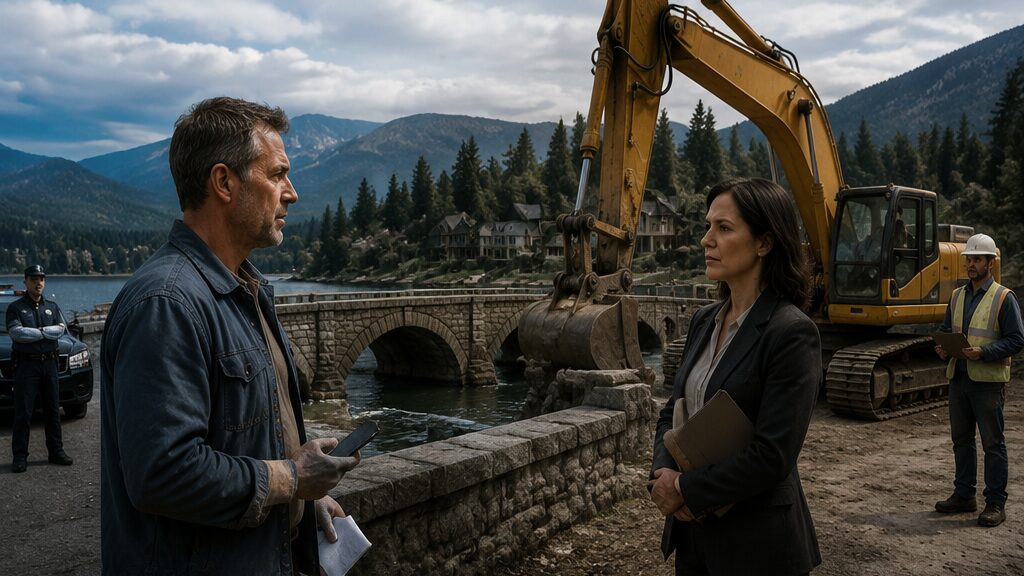
For a few seconds, he simply stood there with one hand still resting on the door. The machine’s engine rumbled low against the morning silence, its metal arm stretched toward the stone bridge that crossed the narrow inlet below his property.
The bridge had been there longer than most of the houses around the lake.
Gray stone arches rose above the clear water, built carefully decades earlier by people who had understood that a path between two sides of a mountain community was more than a decoration. It connected the homes along the eastern ridge to the main road. It allowed deliveries, maintenance crews, and residents to avoid the long route around the lake.
And now an excavator was waiting to tear it apart.
Ryan looked toward the orange cones placed around the work area. Then he looked at the white envelope attached to one of them.
A violation notice.
He had expected another letter.
Another meeting request.
Another argument about forms and approvals.
He had not expected the final decision to arrive with heavy machinery.
A door slammed behind him.
Barbara Hall walked across the gravel driveway wearing a bright jacket and carrying a folder pressed against her side. Two members of the HOA board followed several steps behind her. They stopped near the edge of the property line, careful not to move closer than necessary.
“Ryan,” Barbara said.
Her voice was calm. Too calm.
Ryan looked past her toward the excavator.
“You brought the machine before you brought the answer.”
Barbara tightened her grip on the folder.
“The answer was provided.”
“Where?”
“In the notice.”
Ryan picked up the envelope from the cone. He opened it slowly, even though he already knew what it contained.
Violation.
Unauthorized structure.
Removal required.
He read the words once, then folded the paper again.
“You denied the repair request.”
Barbara nodded.
“Yes.”
“You denied the engineering review.”
“Yes.”
“You denied the emergency reinforcement.”
“Yes.”
“And now you’re removing the bridge because it needs repairs.”
Barbara’s expression did not change.
“We are removing the bridge because it does not comply with community standards and approval requirements.”
Ryan looked at the stone structure behind her.
The bridge.
The thing everyone used.
The thing everyone photographed when they moved into the neighborhood.
The thing people pointed out when they brought friends to see the lake.
Now it was being described like a mistake.
“Community standards,” Ryan repeated.
Barbara opened her folder.
“The bridge was never approved under the current HOA guidelines.”
Ryan almost smiled.
Not because it was funny.
Because he had heard that sentence so many times it had started sounding like a machine itself.
A sentence designed to keep moving forward no matter what stood in front of it.
“I submitted repair plans three months ago,” Ryan said.
“And they were reviewed.”
“They were ignored.”
“They were reviewed.”
“Barbara.”
His voice stayed quiet.
That was what always bothered people about him. He rarely raised his voice when he was certain. They expected anger. They expected panic. They expected someone who would lose control when something important was threatened.
Instead, Ryan would stand there and make them explain themselves.
Barbara looked toward the bridge.
“The board cannot allow one homeowner to make decisions that affect the entire community.”
Ryan looked back at her.
“One homeowner?”
The question hung there.
Barbara shifted slightly.
“You own the land under the bridge.”
“Yes.”
“And the structure is attached to your property.”
“Yes.”
“Then you understand why approval was required.”
Ryan nodded.
“I understand approval.”
He folded the notice and placed it back into the envelope.
“What I don’t understand is why approval became permission to ignore a safety problem.”
One of the board members looked away.
Barbara noticed.
“Safety was considered.”
“No,” Ryan said. “The paperwork was considered.”
The excavator engine grew louder as the operator adjusted the controls.
Ryan glanced toward it.
The sound changed something in the air.
Until that moment, it had been a disagreement.
A meeting.
A process.
A stack of papers passed between people who believed time was unlimited.
The machine made it real.
Barbara stepped forward.
“Ryan, this does not need to become difficult.”
He looked at her.
“It already is.”
“We are trying to protect the community.”
“And I am trying to protect the bridge.”
Barbara shook her head.
“You keep making this personal.”
Ryan stared at the structure.
He remembered carrying materials across that bridge years earlier. He remembered replacing damaged stones himself because waiting for approval meant waiting through another winter. He remembered the first crack he noticed near the northern support.
He had not built the bridge.
But he had been the only person willing to keep it standing.
“It is personal,” he said.
Barbara waited.
Ryan looked at the houses along the ridge.
“Because people live here.”
For the first time, Barbara’s expression softened.
Only slightly.
But enough for Ryan to notice.
Then it disappeared.
“The removal order has been approved.”
That was the part Ryan had been waiting for.
Not the denial.
Not the threats.
The official decision.
The moment when everyone stopped talking about what might happen and accepted what they had chosen.
He reached into his truck and removed a small folder.
Inside were copies of repair requests, inspection notes, photographs of damaged stone, and emails.
Barbara noticed.
“You brought documents.”
“I always had documents.”
“Then why didn’t you provide them?”
Ryan looked at her.
“I did.”
The silence afterward was uncomfortable.
One of the board members cleared his throat.
Barbara looked down at her folder.
Then back at Ryan.
“The demolition will proceed.”
Ryan closed his folder.
The excavator operator looked toward Barbara, waiting.
Ryan stepped away from the bridge.
Barbara watched him carefully.
She seemed surprised.
She had expected an argument.
A threat.
A desperate attempt to stop the machine.
Instead, Ryan moved aside.
“Ryan?”
He looked at the bridge one more time.
Then at the excavator.
“Go ahead.”
Barbara frowned.
The operator looked uncertain.
“You’re giving permission?”
Ryan did not answer the operator.
He looked directly at Barbara.
“Yes.”
And for the first time that morning, she looked unsure.
Chapter 2: The Order That Turned Repairs Into Violations
By the time Ryan entered the HOA meeting room that evening, everyone already knew the bridge was going to be removed.
That was the problem.
They knew the decision.
They did not know the story.
The room was filled with residents who had spent the afternoon reading the notice posted near the community entrance. Some were angry. Some were confused. A few were simply curious.
The bridge had always been there.
People noticed things only when they were about to disappear.
Barbara sat at the front table with her folder open.
Ryan sat across from her.
Between them was the violation notice.
A single sheet of paper that had become heavier than it looked.
Barbara tapped the microphone.
“The board is here to address concerns regarding the unauthorized bridge structure.”
Ryan looked around the room.
Unauthorized.
That word had spread faster than anything else.
Not unsafe.
Not damaged.
Not neglected.
Unauthorized.
A word that made a thing sound like it had never belonged.
A resident near the back raised a hand.
“Is the bridge dangerous?”
Barbara paused.
“It requires significant repairs.”
“That wasn’t my question.”
The room became quieter.
Barbara looked toward Ryan.
“Mr. Jones believes the repairs can be completed without approval.”
Ryan shook his head.
“No. I believe repairs can be completed after approval was delayed for months.”
Barbara opened her folder.
“The board requested additional information.”
Ryan reached into his bag and placed copies on the table.
“The information you requested.”
Barbara looked down.
Photographs.
Inspection notes.
Repair estimates.
Dates.
The room shifted.
A few residents leaned forward.
“You had these?” someone asked Barbara.
She did not answer immediately.
“We received documentation.”
“Then why wasn’t anything done?”
Barbara looked toward the resident.
“Because the documentation did not resolve the approval issue.”
Ryan looked at the paper in front of him.
That was always how it happened.
The question changed.
The problem changed.
The person needing help became the problem that needed managing.
“You had a repair plan,” Ryan said. “You had the contractor information. You had the safety concerns.”
Barbara’s jaw tightened.
“We had concerns about setting a precedent.”
A few people exchanged looks.
Ryan noticed.
There it was.
The real reason.
Not the bridge.
Not the materials.
Not the appearance.
Fear.
Fear that approving one exception would mean admitting the rules were not designed for every situation.
“You were worried about precedent,” Ryan said.
“Yes.”
“Not whether the bridge could be repaired.”
“That is unfair.”
“Is it?”
Barbara closed the folder.
“The HOA has responsibilities.”
“So do homeowners.”
“Yes.”
“And I accepted mine.”
Ryan looked around the room.
“I repaired what I could. I reported what I couldn’t. I asked for approval. I waited.”
He placed his hand on the documents.
“What exactly was I supposed to do after that?”
No one answered.
Barbara looked uncomfortable, but she recovered quickly.
“The board cannot operate based on emotion.”
Ryan nodded.
“Agreed.”
That surprised her.
“I’m not asking for emotion.”
He pointed toward the papers.
“I’m asking you to look at what happened.”
The room stayed quiet.
Then one of the board members spoke.
“Barbara…”
She turned.
The board member hesitated.
“We did know the bridge was getting worse.”
The admission changed the room.
Barbara looked at him.
“That is not relevant.”
“It is relevant,” Ryan said.
The board member lowered his eyes.
“I thought the repair request was still under review.”
Ryan looked at Barbara.
It was a small sentence.
But it opened a crack.
Someone had known.
Someone had waited.
Someone had assumed there would always be more time.
Barbara gathered the papers.
“The decision has been made.”
Ryan watched her.
“And the crew?”
“They will arrive tomorrow morning.”
The residents reacted immediately.
“Tomorrow?”
“That soon?”
Barbara raised her hand.
“The structure has already been scheduled for removal.”
Ryan felt the room move away from paperwork and toward reality.
Tomorrow.
The bridge would no longer be a debate.
It would be a memory.
He picked up the violation notice.
The paper was still clean.
Still perfect.
No dust.
No cracks.
No missing stones.
Yet it was the thing that had started all of this.
Barbara looked at him.
“You seem calm.”
Ryan folded the notice.
“I’m not calm.”
That surprised her.
“What are you feeling?”
Ryan looked toward the window.
Through the glass, the lake was dark.
The bridge was barely visible.
“I’m wondering how many people will need to lose something before they understand why it mattered.”
The meeting ended without agreement.
As residents left, Ryan stayed behind.
Barbara approached the table.
“You could have fought this differently.”
Ryan looked at her.
“I did.”
“No. You could have made this public.”
“I tried making it correct first.”
She studied him.
“Why?”
Ryan picked up his folder.
“Because I thought the truth would be enough.”
For a moment, Barbara had no response.
Then her phone rang.
She answered.
A few seconds later, her face changed.
Not much.
But enough.
“What?”
She listened.
Then looked toward Ryan.
“The crew is confirmed.”
Ryan waited.
Barbara lowered the phone.
“They’ll be there at seven.”
Chapter 3: The Morning The Excavator Reached The Water
At 7:04 in the morning, the first piece of stone fell into the lake.
Ryan heard the crack before he saw it break.
He stood at the edge of the property holding his phone in one hand and the folded violation notice in the other.
The demolition crew had arrived before sunrise.
The excavator sat where it had been the day before.
Only now, there was no argument left to hide behind.
The machine was moving.
Dust covered the first section of the bridge.
A worker in a safety vest stepped back as the excavator arm pulled away from the damaged stone.
Barbara stood nearby with her folder.
A police officer watched from beside a vehicle parked on the gravel road.
The entire scene looked official.
That was what bothered Ryan most.
Everything had the appearance of order.
The cones.
The paperwork.
The uniforms.
The equipment.
All of it created the impression that because something was organized, it must be correct.
Barbara approached him.
“You need to stay behind the boundary.”
Ryan held up his phone.
“I’m documenting.”
“You are free to document.”
“Good.”
The demolition supervisor looked toward Barbara.
“Ready to continue?”
She nodded.
Ryan looked at him.
“Before you do, I want the removal order.”
Barbara turned.
“You received the notice.”
“I want the order authorizing today’s work.”
“It is part of the enforcement process.”
“That is not what I asked.”
The supervisor glanced between them.
Barbara’s expression hardened.
“Continue.”
The excavator moved.
Ryan did not step forward.
He did not shout.
He did not grab anyone.
He simply stood there and recorded.
The machine struck the upper section of the bridge.
Stone broke apart.
A cloud of gray dust rose above the water.
For a moment, nobody spoke.
Even Barbara looked away.
The bridge had looked permanent for so long that seeing it collapse felt wrong.
Not dramatic.
Wrong.
Like watching someone tear down a familiar wall inside their own home.
A resident who had come to watch whispered, “They’re actually doing it.”
Ryan heard her.
He kept filming.
The excavator pulled back another section.
More stone fell.
Barbara walked closer.
“You need to understand something, Ryan. This is not about hurting you.”
Ryan looked at her through the dust.
“I know.”
That answer seemed to surprise her.
“We are enforcing a rule.”
“I know.”
“We are protecting the community.”
Ryan lowered his phone slightly.
“No.”
Barbara stared.
Ryan looked toward the houses beyond the bridge.
“You are protecting the decision you already made.”
The excavator stopped briefly.
The supervisor checked something with Barbara.
Then he pointed toward the remaining structure.
Ryan saw it.
The bridge was no longer a bridge.
It was a damaged line of stone over open water.
The thing everyone thought was Ryan’s problem was becoming everyone’s problem.
A police officer walked toward him.
“Sir, are you planning to challenge the work?”
Ryan looked at the officer.
“No.”
The officer seemed confused.
“You’re not?”
Ryan looked back at the bridge.
“No.”
The officer glanced toward the excavator.
“Then why are you recording?”
Ryan looked down at the phone in his hand.
“Because everyone should remember who made this choice.”
The final strike came a few minutes later.
The center arch broke.
The stone collapsed downward.
Water rushed through the opening where the bridge had stood.
The crowd went silent.
Barbara stepped closer to the edge.
For the first time, she looked past the demolition.
She looked toward the road on the other side.
Then toward the community homes beyond it.
Her face changed.
“What happens now?”
Ryan did not answer immediately.
Because she was finally asking the right question.
Not who violated a rule.
Not who needed approval.
Not who owned the stone.
What happens now?
A resident walked closer.
“Barbara?”
She turned.
“The road on the east side…”
She stopped.
Everyone knew.
The bridge had been the connection.
Without it, the homes across the water had no direct access route.
Barbara looked at Ryan.
“You knew this would happen.”
Ryan folded the violation notice and placed it into his folder.
“I knew the bridge mattered.”
“You let us remove it.”
Ryan looked at the broken stone.
“No.”
His voice remained quiet.
“You chose to remove it.”
Barbara had no answer.
Behind them, the excavator engine shut off.
The silence that followed felt larger than the noise.
Then the demolition supervisor walked over holding a clipboard.
“Ma’am?”
Barbara looked at him.
“We have a problem.”
She stared at the broken bridge.
The supervisor pointed toward the far side of the lake.
“The access road is blocked now.”
Ryan watched Barbara read the same truth everyone else was beginning to understand.
The bridge had never only been his.
And now everyone would have to find out who it had really belonged to.
Chapter 4: The Access Problem Nobody Wanted To Own
The first emergency call came before sunrise.
By 5:30 in the morning, Ryan was standing beside the empty space where the bridge had been when his phone rang.
He almost ignored it.
Not because he did not care.
Because he already knew what it would be about.
The number belonged to one of the residents on the eastern side of the lake.
“Ryan,” the man said the moment he answered. “The ambulance route is blocked.”
Ryan looked across the water.
The words felt heavier than he expected.
“What happened?”
“My wife’s medication delivery was supposed to come through the east road. The driver had to turn around.”
Ryan closed his eyes briefly.
The bridge was gone.
The dust had settled.
The arguments had ended.
Now came the part nobody had planned for.
Consequences.
“I’ll come by,” Ryan said.
When he arrived at the eastern side of the community, several residents were gathered near the old road entrance. They were not angry anymore.
They were calculating.
How long would it take to drive around the lake?
Would delivery trucks still come?
What about emergency vehicles?
What about older residents who relied on the shorter route?
The missing bridge had turned from a private dispute into a daily problem.
Barbara Hall stood near the road with several board members.
Ryan noticed she was not carrying the folder anymore.
She was holding her phone.
Making calls.
Trying to solve a problem that had not existed two days earlier.
A resident approached her.
“You said this was only a structure issue.”
Barbara looked exhausted.
“It was.”
The resident pointed toward the empty space.
“Then why can’t we get across?”
Barbara had no immediate answer.
Ryan watched her.
He expected anger.
A defense.
A statement about rules.
Instead, she looked toward the water.
For the first time since he had met her, she looked like someone who had discovered that being responsible for a decision was different from approving one.
She saw Ryan.
“You knew this would happen.”
Ryan looked at the broken shoreline.
“I knew there was a reason people used it.”
“That’s not what I asked.”
He turned toward her.
“You asked if I knew this would happen.”
“Yes.”
Ryan nodded.
“Yes.”
Barbara’s expression hardened.
“Then why didn’t you tell everyone?”
The question landed harder because Ryan knew the answer was not simple.
He could have explained more.
He could have held another meeting.
He could have walked every resident through the records and the repair history.
Instead, he had trusted the documents.
Trusted that facts would force people to see what he saw.
That was his mistake.
“I thought showing the evidence was enough,” he said.
Barbara stared at him.
“And?”
Ryan looked back at the bridge site.
“It wasn’t.”
That admission surprised her.
Not because it solved anything.
Because Ryan rarely admitted he had handled something poorly.
A board member approached with a printed map.
“The east road is the only route affected.”
Ryan looked at the map.
“The only route affected?”
The board member hesitated.
“Well…”
Ryan took the paper.
A red line marked the community roads.
Another line showed the bridge connection.
The route was obvious.
The bridge was not a private shortcut.
It was the practical link between two parts of the neighborhood.
Barbara saw the map.
Her face changed.
“Why wasn’t this included in the review?”
The board member looked uncomfortable.
“I don’t know.”
Ryan looked at the paper.
That answer bothered him more than any argument.
Nobody knew.
Nobody had checked.
Everyone had simply followed the process.
A process that had never asked the most important question.
What happens after?
Later that afternoon, Ryan returned to his house.
The violation notice was still on his kitchen table.
He had left it there deliberately.
He wanted to remember what it represented.
At first, it had been proof that the HOA had authority.
Now it looked different.
A record of everything they had failed to understand.
His phone rang.
Gregory Wilson.
Ryan answered.
“Hello?”
“Ryan, I reviewed the photographs you sent.”
Gregory’s voice was calm and professional.
“You were right about one thing.”
Ryan sat down.
“Which thing?”
“The bridge was not just sitting on your property.”
Ryan waited.
Gregory continued.
“There is a larger access issue here.”
Ryan looked toward the lake.
“What kind?”
“I need to see the original agreements before I say more.”
Ryan frowned.
“What agreements?”
A pause.
Then Gregory answered.
“The ones connected to why the community was allowed to use that bridge in the first place.”
Ryan looked at the violation notice.
The paper suddenly felt different.
Not lighter.
Heavier.
Because the question was changing.
The bridge was no longer only about whether Ryan had permission to repair it.
It was about why everyone had permission to rely on it.
And who had been responsible for keeping it there.
Chapter 5: The Records That Changed The Meaning Of The Bridge
The old records were stored in a place nobody had looked for years.
A locked cabinet in the HOA office.
Barbara found them after searching through boxes labeled with dates from previous boards.
Most of the files had not been touched since before she became president.
She opened the first folder expecting maintenance reports.
Instead, she found maps.
Property diagrams.
Agreements.
The kind of paperwork that looked ordinary until someone realized what it meant.
Gregory Wilson stood beside her reading the documents.
“This is the problem.”
Barbara looked at him.
“What?”
He pointed to a section of the agreement.
“The bridge was built on private land.”
She nodded.
“We know that.”
“But access was granted to the community.”
Barbara looked closer.
“Yes.”
Gregory tapped the page.
“Read the condition.”
Her eyes moved across the paragraph.
The access agreement remained valid as long as the bridge was maintained as a safe crossing point.
Barbara stopped.
For several seconds, she said nothing.
Gregory watched her.
“You removed the bridge.”
Barbara looked away.
“We removed a structure that was not approved.”
“That’s not the same thing.”
The sentence sounded familiar.
Too familiar.
Because Ryan had said something similar.
Barbara closed the folder.
“This does not mean Ryan can do whatever he wants.”
“No.”
Gregory nodded.
“It means the HOA may have had responsibilities you didn’t consider.”
Barbara stood silently.
That was the part she hated.
Not being wrong.
Being incomplete.
There was a difference.
A wrong person could apologize and move on.
An incomplete decision meant people had acted with confidence while missing something important.
Her phone buzzed.
A resident message.
Then another.
People were asking questions.
How long would repairs take?
Who would pay?
Why had the bridge been removed?
Barbara looked at the growing list.
A week ago, she had believed the biggest problem was Ryan refusing to follow procedure.
Now she was beginning to wonder if the procedure had allowed everyone to avoid responsibility.
Across the lake, Ryan met Gregory at his house.
Gregory placed copies of the records on the table.
Ryan read them carefully.
“So they knew.”
Gregory shook his head.
“Not exactly.”
Ryan looked up.
“They knew the bridge existed. They knew residents used it. But whether everyone understood the maintenance obligation is another question.”
Ryan leaned back.
That was harder to accept.
Because anger was simple.
A person making a mistake was easier to understand than a group of people avoiding a responsibility because nobody wanted to own it.
“I should have explained this before,” Ryan said.
Gregory looked at him.
“You tried.”
“I showed paperwork.”
“That isn’t the same.”
Ryan looked down.
The statement bothered him because it was true.
He had spent years fixing things quietly.
When something broke, he repaired it.
When something needed attention, he handled it.
He believed that doing the work was the strongest argument.
But people did not always see the work.
Sometimes they only saw the silence afterward.
A knock came at the door.
Barbara stood outside.
Ryan looked surprised.
She held the old agreement folder.
“I found something.”
Ryan stepped aside.
She entered but did not sit.
For once, she looked like she was not there to deliver a decision.
She was there because she needed an answer.
“The access agreement,” she said.
Ryan looked at the folder.
“You found it.”
“Yes.”
“And?”
Barbara hesitated.
“The HOA may have had obligations connected to the bridge.”
Ryan waited.
The old version of him might have used the moment.
He might have reminded her of every warning she ignored.
Instead, he asked:
“What happens now?”
Barbara looked at him.
The question seemed to surprise her.
“You’re not angry?”
Ryan glanced toward the window.
“I am.”
That honesty caught her attention.
“But anger doesn’t rebuild anything.”
Barbara looked at the empty space beyond the trees.
“The board needs to decide what to do.”
Ryan nodded.
“Then decide.”
She turned toward the door.
Before leaving, she stopped.
“Ryan.”
He looked up.
“I thought you wanted to prove we were wrong.”
Ryan said nothing.
Barbara continued.
“But I think you wanted us to understand.”
Ryan looked at the violation notice still sitting on the table.
The paper that started everything.
“That was the part I should have explained.”
Barbara left without another word.
The next morning, the HOA sent out an emergency meeting notice.
This time, it was not about removing the bridge.
It was about what they had to do after removing it.
Chapter 6: The Responsibility Hidden Beneath The Rules
The HOA meeting room was full before Barbara arrived.
That alone told Ryan something had changed.
A week earlier, residents came because they wanted to watch an argument.
Now they came because they wanted answers.
The empty chair beside Barbara’s seat was the first thing Ryan noticed.
The chair where she usually placed her folder.
This time, there was no folder.
Only the old agreement documents.
Barbara stood when the room became quiet.
“I need to correct something.”
Nobody moved.
“The board treated the bridge as an unauthorized structure that needed removal.”
She looked down briefly.
“We did not fully consider why the bridge existed.”
Ryan watched her carefully.
This was not an apology.
Not yet.
It was something harder.
An admission.
Barbara placed the agreement on the table.
“The bridge provided access to this community under conditions that included maintenance responsibility.”
A resident spoke immediately.
“So we caused this?”
Barbara did not answer quickly.
“We made a decision without understanding the full impact.”
The room became restless.
Ryan expected someone to blame Barbara.
Someone to blame him.
Instead, a different question came.
“How do we fix it?”
Gregory stepped forward.
He explained the structural assessment.
The old bridge could not simply be rebuilt the same way.
It needed proper engineering, permits, and shared responsibility.
For the first time, nobody argued about whether the problem existed.
They argued about how to solve it.
Ryan sat quietly.
That was new.
For months, he had been the only person trying to make people look at the problem.
Now everyone was looking.
Barbara turned toward him.
“Ryan.”
He looked up.
“The board wants to discuss replacement options.”
He nodded.
“Okay.”
One resident frowned.
“Just like that?”
Ryan looked at him.
“No.”
The room quieted.
“I don’t want another rushed decision.”
He pointed toward the empty space outside.
“We already learned what happens when people move faster than they understand.”
The sentence stayed with everyone.
A replacement plan was discussed.
Engineering.
Funding.
Temporary access.
Long-term maintenance.
The conversation was practical.
Not emotional.
That was exactly why Ryan trusted it.
At the end of the meeting, Barbara remained behind.
Ryan gathered his papers.
“You were right about something,” she said.
He looked at her.
“That’s dangerous territory for you.”
A small smile appeared on her face.
The first one he had seen.
“You are difficult.”
Ryan almost smiled back.
“I’ve heard that.”
Barbara looked at the old agreement.
“You should have pushed harder.”
Ryan nodded.
“I should have explained better.”
The admission surprised her.
“You’re actually admitting that?”
“Yes.”
“Why?”
Ryan looked through the window toward the lake.
“Because being right doesn’t help if nobody understands what they’re risking.”
Barbara was quiet.
Then she picked up the replacement plans.
“The board will vote tomorrow.”
Ryan nodded.
As he walked outside, he saw the place where the bridge had stood.
The damage was still there.
The missing stones.
The broken shoreline.
The empty space.
But something else had changed.
For the first time, nobody was looking at the bridge as Ryan’s problem.
They were looking at it as something they all had to protect.
The next morning, Barbara arrived at the board meeting with the final proposal.
And this time, the decision waiting on the table was not about tearing something down.
It was about what they were willing to rebuild.
Chapter 7: The Bridge They Finally Learned To Protect
The first person to cross the new bridge was not Ryan.
That was intentional.
The morning the replacement structure opened, Ryan stood several feet away from the entrance, watching the community gather around something that had once been treated as his responsibility alone.
The new bridge was not made from the same stone.
It did not look exactly like the old one.
But it stood where the old bridge had stood, with stronger supports, updated engineering, and a maintenance agreement that everyone had signed before construction began.
For the first time in months, nobody was arguing about who had the right to make a decision.
They were discussing how to keep the decision from becoming someone else’s burden.
Barbara Hall stood beside the completed plans with a small group of residents.
She noticed Ryan watching from a distance.
“You’re not going to walk across?”
Ryan looked at the bridge.
“In a minute.”
Barbara followed his gaze.
“You waited this long.”
Ryan nodded.
“It seemed right.”
She understood.
The old bridge had always been connected to him.
The new one belonged to everyone.
A child ran across first, followed by two residents carrying groceries from the other side of the road.
Simple things.
Ordinary things.
The things that had been impossible when everyone was focused on paperwork.
Barbara walked toward Ryan.
“I wanted to thank you.”
Ryan looked at her.
“For what?”
“For not letting this become a fight where someone had to lose.”
He looked surprised.
“You still lost a bridge.”
Barbara looked back at the new structure.
“No.”
She paused.
“We lost the idea that being correct was the same as being responsible.”
Ryan was quiet.
That sentence mattered because he understood it better than most.
For months, he had believed the facts would speak for themselves.
He had believed that if he collected enough records, photographs, and repair requests, people would naturally arrive at the same conclusion.
But facts did not walk into rooms by themselves.
People carried them.
People explained them.
People decided whether they mattered.
“I should have told people why I cared,” Ryan said.
Barbara looked at him.
“You were maintaining a bridge.”
Ryan shook his head.
“No.”
He looked toward the residents crossing.
“I was protecting a connection.”
Barbara nodded slowly.
The distinction was small.
But it changed everything.
A bridge was a structure.
A connection was something people depended on.
Later that afternoon, the HOA held a final meeting about the bridge.
Not a violation hearing.
Not an enforcement meeting.
A maintenance meeting.
The difference was written clearly on the agenda.
Ryan noticed it.
Barbara noticed him noticing it.
“You like the wording?”
Ryan smiled slightly.
“It’s a start.”
During the meeting, the board approved a permanent inspection schedule.
Funding responsibilities were divided.
Emergency repairs had a clear process.
No one pretended rules were unnecessary.
That was never Ryan’s argument.
Rules mattered.
Approvals mattered.
Documentation mattered.
But they were supposed to prevent problems, not hide them.
When the meeting ended, Barbara remained behind.
She held the old violation notice.
Ryan recognized it immediately.
“You kept it.”
She looked at the paper.
“I thought about throwing it away.”
“Why didn’t you?”
Barbara folded it carefully.
“Because it reminds me how easy it is to turn a person’s problem into a procedure.”
Ryan looked at the notice.
Months earlier, that paper had represented everything standing against him.
Now it represented something else.
A mistake that had been corrected.
Not erased.
Corrected.
“That was never what I wanted,” Ryan said.
Barbara nodded.
“I know.”
They walked outside together.
The lake was quiet.
The rebuilt bridge reflected in the water.
Ryan stopped near the entrance.
Barbara continued walking, then turned back.
“You’re finally going to cross it?”
Ryan looked at the bridge.
“Yes.”
He stepped forward.
The first few steps felt strange.
Not because the bridge was unsafe.
Because it was different.
The old bridge carried years of memory.
The new bridge carried responsibility.
Halfway across, Ryan stopped and looked back.
For a moment, he saw the old structure.
The dust.
The excavator.
The moment everyone thought he had surrendered.
But he had not been surrendering.
He had been allowing the truth to become impossible to ignore.
When he reached the other side, he did not feel like he had won.
He felt like something had finally been put back where it belonged.
Not the stones.
Not the bridge.
The responsibility.
And for the first time since the demolition began, nobody was asking who owned the problem.
They were asking how they could protect what connected them.
The HOA Destroyed His Private Bridge Until They Learned Why He Let Them Tear It Down
The story has ended.