She Put the Lake Cleanup Bill Beside the Dead Fish and Expected Him to Sign
Chapter 1: The Bill Beside the Dead Fish
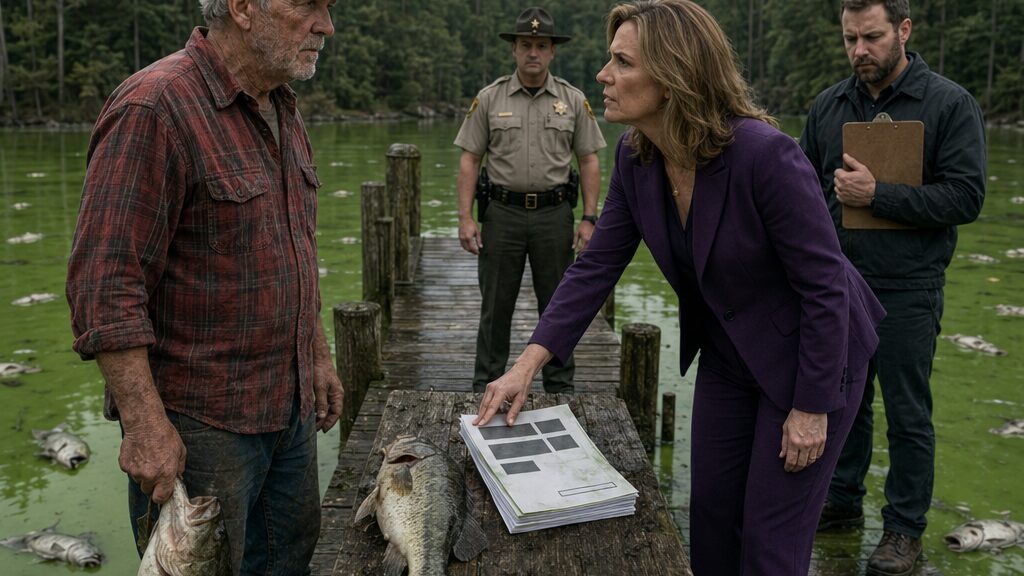
Donald Nelson lifted the dead bass from water the color of antifreeze just as Cynthia Walker said, “That one is going on your bill too.”
The fish hung heavy from his gloved hand, its mouth open, its pale belly streaked green. Three more floated beneath the dock, bumping softly against the pilings whenever the water shifted. Across the lake, the pines reflected in broken dark lines under the chemical sheen.
Donald laid the fish on the weathered bench at the end of the dock.
Cynthia stood six feet away in a purple suit that did not belong near mud, dead fish, or anything that smelled like this. Behind her, a man from the landscaping contractor held a clipboard against his chest. A county deputy waited near the patrol vehicle at the top of the slope, one hand resting on his belt, looking less like an investigator than someone assigned to keep two neighbors from making the morning worse.
Cynthia unfolded a packet and placed it beside the fish.
The top page had already picked up a damp green thumbprint from her hand.
“Eighty-four thousand six hundred dollars,” she said. “Initial response, wildlife removal, shoreline treatment, aeration, and emergency well testing.”
Donald looked at the number without touching the paper.
“You had that printed quickly.”
“We had professionals assess the situation.”
The contractor gave a small nod, though he did not meet Donald’s eyes.
Cynthia tapped the signature line. “The contamination entered through the drainage channel on your property. Your admission of responsibility allows the HOA’s carrier to begin work immediately.”
“My admission.”
“Your acknowledgment. Don’t make this harder than it needs to be.”
Donald looked beyond her toward the north inlet. The water there was darker, almost black beneath the green surface. A wind had come up from the development side, carrying the smell toward him again—sharp, metallic, with something sweet beneath it. It was the same smell he had noticed during the storm.
He moved his gaze back to the estimate.
The deputy came down the slope far enough that his boots touched the first dock plank. “Let’s keep some space between everybody.”
“I’m not crowding him,” Cynthia said.
She was.
Donald peeled off his right glove. The lining stuck to his fingers. He reached for the final page, not the signature line, and held the paper flat against the wind.
Cynthia’s mouth tightened.
At the bottom of the page, in small gray print, was a preparation date.
Donald read it twice.
The estimate had been generated at 4:18 p.m. the previous day.
The first county inspection had not begun until after six.
He looked at the contractor. “You priced the cleanup before anyone tested the water.”
The man shifted his clipboard.
Cynthia answered for him. “Emergency estimates are based on visible conditions.”
“You priced my responsibility too.”
“The point of entry is visible.”
“The point where water reaches the lake isn’t the same as the point where something got into it.”
Her expression changed only slightly, but Donald saw it. A narrowing around the eyes. A harder set to the jaw. The look of someone who had expected resistance to come later, after the signature.
She lowered her voice.
“Mr. Nelson, eighty-two families use this lake. Several homes draw from private wells. People are frightened. If you cooperate now, the board can treat this as a property-liability matter.”
“And if I don’t?”
“We submit the claim with the available evidence.”
The deputy looked from Cynthia to Donald. “I need to be clear. I’m not here to determine civil responsibility.”
Cynthia turned toward him. “No one said you were.”
“You mentioned fraud when you called.”
“That was a concern, not an accusation.”
Donald heard it then. Not guilt. Leverage.
Cynthia faced him again. “If you know your drainage channel released contaminated water and you refuse to disclose that to your insurer, it can become something more serious than a repair dispute.”
The contractor finally spoke. “The plume is strongest near his outlet.”
“Today,” Donald said.
The man frowned. “What?”
“You measured it today.”
“That’s when we were called.”
Donald let the final page drop back onto the packet. The green stain had spread from Cynthia’s thumb to the edge of the paper, as if the lake itself had signed first.
He picked up the dead bass by the tail.
“Where was the first dead fish found?”
Cynthia folded her arms. “Your shoreline.”
“That isn’t what I asked.”
“The damage is concentrated here.”
“Where was the first one found?”
The contractor looked toward the north inlet before catching himself.
Donald saw that too.
Cynthia stepped between them. “We are not conducting an amateur investigation on your dock.”
“No,” Donald said. “You’re collecting a signature.”
A smaller fish rolled in the water beside the bench. Its silver flank flashed once before the green film covered it again.
For almost thirty years, Donald had kept this dock repaired with salvaged cedar and galvanized screws. His wife had sat at the end of it every June with bare feet over the water, refusing to fish because she said she preferred watching things that knew where they belonged. Before she died, she had made him promise not to sell the house simply because living there alone became inconvenient.
He had expected that promise to be tested by winter, taxes, or age.
Not by a bill laid beside a dead fish.
Cynthia pushed the packet closer.
“You have until noon to sign voluntarily.”
“That isn’t much time.”
“The emergency is already costing residents money.”
Donald looked up at her. “Then you should be careful who you send the bill to.”
Her voice sharpened. “The board can place a claim against your property. If your insurer denies coverage and you refuse payment, we can pursue a lien.”
The deputy lifted a hand. “Again, that’s a civil process. Not something happening here today.”
“It will happen,” Cynthia said. “Unless Mr. Nelson chooses to cooperate.”
Donald set the fish back on the bench. A thin line of green water ran from its tail across the estimate and stopped just above the signature box.
The contractor stared at it.
Donald folded the pages once and handed them back to Cynthia.
She did not take them.
“You need to keep a copy.”
“I didn’t ask for one.”
“You’ve been formally notified.”
“Then leave it on the bench.”
She held his gaze for a long moment. Beneath the confidence, he saw strain. Not concern for him, and not grief for the lake. Something tighter. Something already counting losses.
Cynthia placed the packet down again.
“Forty-eight hours,” she said. “After that, the HOA submits the claim as uncontested.”
“It won’t be uncontested.”
“You don’t have counsel.”
“I have a calendar.”
For the first time, the contractor looked directly at him.
Cynthia turned toward the shore. “Forty-eight hours, Mr. Nelson.”
The deputy followed her up the slope, then stopped halfway and looked back.
“Document everything,” he said quietly.
Donald nodded once.
When the vehicles were gone, he stood alone at the end of the dock. The green-stained estimate lay beside the bass, its top page lifting and settling in the wind.
He picked it up carefully by the dry corner.
At the bottom of the final page, beneath the preparation date, was a job number.
He had seen the first four digits before.
Not on a cleanup estimate.
On the yellow service truck that had been parked near the HOA’s north inlet two days before the storm.
Chapter 2: Forty-Eight Hours Against His House
Heather found Donald at the kitchen table dividing eighty-four thousand six hundred by the number of years he thought he had left.
He had written the figures on the back of an unopened utility envelope.
“What are you doing?”
Donald put down the pencil.
The green-stained estimate lay open beside his coffee. The dead fish smell had followed it inside despite the plastic sleeve he had found in the garage.
“Seeing what they’re asking for.”
“I can see what they’re asking for.”
She dropped her keys beside the fruit bowl and pulled out the chair across from him. Heather had driven in from the city without calling. Her hair was still damp from a rushed shower, and she wore the same gray work pants she used at the medical office.
“Dad, this is more than a number.”
“It is exactly a number. That’s why they printed it.”
She pressed both hands against the table. “You cannot joke your way around a lien.”
“I’m not joking.”
“Then tell me what you’re going to do.”
Donald turned the estimate so she could see the preparation date.
“They wrote it before the inspection.”
Heather read the line. “Maybe they needed an emergency estimate.”
“They needed someone to attach it to.”
“That doesn’t prove they’re wrong.”
The words landed harder because they came from her.
Donald looked past her toward the window. From the kitchen, the lake had always been a strip of blue between two oaks. That morning it looked like tarnished glass.
Heather lowered her voice. “I’m not saying you did it.”
“You’re saying I should pay enough that nobody has to decide.”
“I’m saying we need to protect the house.”
The word we irritated him. Not because she did not belong to the house, but because she had started using the language of emergency before asking what had happened.
He pulled an old composition ledger from a stack on the chair beside him. The cover was black, the corners softened by years of damp hands.
“What’s that?”
“Drainage maintenance.”
“You still keep those?”
“I still own a drain.”
He opened to the latest pages. Dates, rainfall totals, culvert clearing, sediment depth, gate checks. His handwriting had grown less even over the years, but the habit had not changed.
Heather leaned closer.
On the page from two nights earlier, Donald had written:
6:10 p.m. Heavy rain. North inlet carrying foam. Sweet-metal smell uphill.
Below it, at 7:25:
Lake rising fast. Check lower spillway.
Heather traced the second line with one finger. “What does that mean?”
“It means I checked it.”
“Did you open it?”
Donald closed the ledger.
Her eyes moved toward the wall beside the pantry, where three hooks held a shed key, a truck key, and nothing.
The empty brass hook seemed suddenly larger than the other two.
“Where is the spillway key?” she asked.
“In the shed.”
“You always keep it there?”
“Most of the time.”
“That isn’t what I asked.”
Donald stood and carried his cup to the sink.
Behind him, Heather said, “Did you change the water flow during the storm?”
“The lake was rising.”
“Dad.”
He rinsed the cup though it was not empty.
The phone rang before she could ask again.
Donald checked the number and put it on speaker.
The insurance adjuster spoke in a careful, neutral voice. She confirmed that the HOA had opened a third-party property claim naming him as the suspected source of contamination.
“Do not sign an admission, acknowledgment, payment plan, or remediation authorization,” she said. “Any signed statement accepting causation may limit our ability to defend you.”
Heather sat down slowly.
Donald asked, “Have they submitted test results?”
“Not yet. They submitted photographs, a contractor narrative, and a map showing your channel as the release location.”
“Release location or source?”
There was a pause.
“The narrative uses both terms.”
“They aren’t the same.”
“I understand.”
“Does the contractor?”
Another pause, shorter this time.
“We will request clarification.”
Donald looked at the estimate. “They gave me forty-eight hours.”
“That deadline is theirs, not ours. But I need everything you have—maintenance records, photographs, prior drainage work, communications, and any action you took during the storm.”
Heather lifted her eyes toward him.
Donald kept his face still.
“What kind of action?” he asked.
“Anything that affected drainage, gates, pumps, culverts, or runoff.”
He said he understood.
When the call ended, Heather waited.
Donald picked up the ledger again. “The first dead fish weren’t found here.”
“How do you know?”
“Frank Martinez called me before sunrise. He said two carp were floating near the HOA inlet before anything washed down to my dock.”
“Will he say that officially?”
“I haven’t asked.”
“You need to.”
Donald went outside before the conversation could return to the missing key.
He walked the shoreline with the ledger under his arm. The old drainage channel ran along the western edge of his property, shallow now that the storm had passed. The mud was stained pale green where water had spilled over the stones.
He crouched near the outlet and touched the bank with a stick.
The flow marks pointed toward the lake.
But higher up, where the channel bent around the property line, a line of dead minnows had collected against grass flattened from the opposite direction.
Water had come down from the north.
From the development.
Donald wrote the observation in the ledger and added the time.
When he returned to the kitchen, Heather was holding his phone.
“I didn’t open anything,” she said. “It lit up.”
The screen showed a new HOA message addressed to all residents.
URGENT WATER SAFETY NOTICE.
Donald took the phone from her.
The message stated that a “private drainage failure at the Nelson property” was believed to have introduced contaminants into the shared lake. Residents were advised not to draw untreated water from private wells until testing was complete.
At the bottom, Cynthia had written:
The board is pursuing full reimbursement from the responsible property owner to protect association members from unnecessary assessments.
Heather read over his shoulder.
“They named you.”
Donald scrolled down.
Replies were already appearing.
One resident asked whether Donald’s insurer would cover bottled water. Another wanted to know why he had been allowed to maintain a private spillway beside a shared resource. A third said the board should restrict him from the HOA shoreline until the investigation ended.
Donald locked the screen.
Heather looked toward the empty key hook.
This time she did not ask the question.
She did not need to.
Chapter 3: The Water Moved the Wrong Direction
The sign had been nailed to the post at the public access path before Donald arrived.
KEEP THE POISONER OUT.
The letters were black marker on white poster board, crooked but heavy enough to show the writer had gone over each stroke more than once.
Donald stood with three clean glass jars in a canvas bag and read it without touching it.
A woman from one of the lake houses watched him from the opposite side of the path. She held a child by the shoulder, keeping the child behind her as though Donald himself might spill into the water.
“This is association property,” she said.
“The path is county access.”
“The shoreline isn’t.”
“I don’t need the shoreline.”
“You’ve done enough.”
Donald looked at the child. The child looked at the jars.
He walked past the sign and stopped at the legal access marker, a rusted metal stake he had helped the county place fifteen years earlier. He knelt, labeled the first jar with the date, time, and location, then used a telescoping sampler to reach beyond the reeds.
The woman lifted her phone.
“You’re recording me?” Donald asked.
“I’m documenting what you’re doing.”
“That makes two of us.”
He filled the jar, sealed it, and placed it in the bag.
At the second access point, two residents had stretched yellow rope between trees. Donald did not argue. He stepped back, followed the road shoulder, and entered at a drainage easement twenty yards farther uphill.
The water there was darker than at his dock.
Not greener. Darker.
A film clung to the edges of the culvert, and the sweet-metal smell was stronger when he disturbed the surface.
He filled the second jar.
“Don’t take that one to the county yet.”
Donald turned.
Frank Martinez stood near the trees in a brown work jacket, hands buried in the pockets. He had the posture of a man who wanted to be seen talking casually while making certain nobody could hear.
“Why not?” Donald asked.
Frank glanced toward the houses. “Because if they know you sampled here, they’ll say you contaminated it yourself.”
“With what?”
“I’m telling you how they’ll frame it.”
Donald capped the jar. “Then tell me what I’m sampling.”
Frank rubbed his jaw. “The board ordered a shoreline treatment.”
“When?”
“Tuesday.”
“Two days before the storm.”
Frank nodded.
“What kind?”
“Algae control. Copper-based, I think. Stronger mix than usual.”
“You think?”
“I wasn’t on the truck.”
“You worked for the company.”
“Worked.”
Donald waited.
Frank looked toward the north inlet. “They were trying to clear the green bloom before the holiday weekend. Residents had been complaining about smell and mosquitoes. Cynthia wanted the shoreline looking clean before the property tour.”
“What property tour?”
“Three houses were showing Saturday.”
Donald took out his ledger.
Frank’s expression hardened. “Don’t write my name.”
“I write what I hear.”
“Then write that you heard a rumor.”
“You came down here to tell me a rumor?”
“I came to tell you not to waste time looking at lawn fertilizer.”
Donald closed the ledger without writing.
Frank exhaled. “The concentration was high. The crew had trouble with the sprayer. That’s all I know.”
“Where did they clean it?”
“I don’t know.”
“Where did they usually clean it?”
Frank did not answer.
A maintenance truck turned onto the road above them. Frank stepped away from the culvert.
“I can’t get involved.”
“You already are.”
“No. I’m talking to an old neighbor.”
“You’re talking to the man they’re billing.”
Frank looked embarrassed, then angry at being made to feel it.
“I still pick up subcontract work from them. My daughter’s tuition doesn’t care who poisoned your lake.”
Donald nodded once. “Then don’t sign anything for me.”
Frank frowned.
“I won’t ask you to lie,” Donald said. “And I won’t ask you to lose work for something you didn’t do.”
For a second, relief crossed Frank’s face. Then shame followed it.
“The treatment order should have a route sheet,” he said. “Truck stops. Mix volume. Job number.”
Donald thought of the footer on the cleanup estimate.
“Do you know the number?”
“No.”
“I do.”
The maintenance truck slowed as it passed. Frank walked away without looking back.
Donald filled the third jar below the modified storm drain.
The drain had once emptied into a gravel swale that slowed runoff before it reached the lake. The HOA had replaced part of it the previous year with a smooth black pipe extending almost to the waterline. Faster discharge. Less standing water near the walking path. Cleaner landscaping.
Worse for anything spilled upstream.
Donald set the three jars on the hood of his truck in order: his outlet, county access, HOA drain.
Even without laboratory testing, the difference was visible. The jar from his outlet was cloudy green. The middle jar was darker. The jar from the HOA drain held a dense blue-green band near the bottom.
He photographed them beside the handwritten labels.
It was not proof of origin.
But water did not usually grow more concentrated as it moved downstream.
At the county laboratory drop box, the clerk opened the side window after seeing the jars.
“We’re not processing private submissions as enforcement samples,” she said.
“I know.”
“You’ll get screening results only.”
“That’s all I’m asking for.”
She checked the labels. “Chain of custody?”
“Mine.”
“That limits how this can be used.”
Donald slid his ledger through the opening. “The dates and collection points are recorded.”
The clerk read the first page, then looked at him more carefully.
“You used to do municipal work?”
“Storm systems.”
“That explains the handwriting.”
“It explains the jars.”
She almost smiled, but the expression disappeared when she held the third sample to the light.
“What did you say this was?”
“Runoff below a modified storm drain.”
“Any idea what they applied upstream?”
“Possible copper-based algae treatment.”
The clerk set the jar down gently.
“This color alone doesn’t tell us concentration.”
“I understand.”
“But if your collection is accurate, this is not what ordinary lawn runoff usually looks like.”
Donald felt no satisfaction. Only a tightening in his chest.
“How soon?”
“Preliminary screen by tomorrow. Full breakdown later.”
“My deadline is noon.”
“Then tell whoever gave you the deadline that chemistry doesn’t work for an HOA.”
When Donald returned home, the sign from the access path had been photographed and posted in the residents’ group. Beneath it, someone had written that he had been seen “collecting unknown substances” near the community shoreline.
Heather sat at the kitchen table with her laptop open and the green-stained estimate beside it.
“They think the jars are suspicious,” she said.
“People think whatever arrives first.”
She looked at the samples he had kept for reference. “Did you find anything?”
“Maybe.”
“That isn’t an answer.”
“It’s the only honest one.”
His phone rang before she could respond.
The laboratory clerk spoke without greeting.
“The screening on your third jar is preliminary,” she said. “Do not treat it as a final finding.”
Donald waited.
“The copper concentration is far above what we would expect from routine residential runoff.”
“How far?”
“Enough that I would be looking for a concentrated product source, equipment washout, or direct discharge.”
Heather had gone still across the table.
Donald looked at the job number printed at the bottom of Cynthia’s estimate.
The accusation had begun at his channel.
The chemical trail did not.
Chapter 4: The Gate He Opened in the Storm
Heather placed the muddy spillway key on top of Cynthia’s estimate and said, “What part of this did you decide I didn’t need to know?”
The key left a brown crescent across the green-stained page.
Donald stood at the kitchen counter with the laboratory clerk’s preliminary results still open on his phone. Behind Heather, the empty brass hook beside the pantry looked like an accusation of its own.
“I was going to tell you.”
“When?”
“When I knew what it meant.”
“You opened the gate.”
“The lake was rising.”
“That is not an answer.”
“It is the reason.”
Heather pushed the estimate toward him. “They are accusing you of changing the drainage. Your insurer asked whether you changed the drainage. You said you understood and then let me sit here believing Cynthia invented every part of this.”
“She invented the cause.”
“Did you open the gate or not?”
Donald looked at the key.
“Yes.”
Heather stepped back from the table as if the word had physical weight.
The gate sat half a mile below the house, where the lake narrowed into an old stone-lined spillway before draining toward county wetlands. It had been installed before the development existed, when seasonal flooding threatened only pasture and one gravel road. Most residents did not know it was there. Donald had maintained it under an easement inherited with the property.
During the storm, he had watched the lake climb six inches in less than an hour. Water had backed against the north inlet, spreading across the HOA walking path. Another foot would have put it over the low bank near the development’s first row of homes.
He had taken the key from the hook, driven through rain thick enough to erase his headlights, and opened the lower gate.
He had told no one.
Heather folded her arms. “Show me.”
They drove to the spillway in Donald’s truck. The road shoulder was still soft from the storm, and the tires left dark tracks behind them. At the gate house, mud covered the concrete platform. The wheel mechanism stood above the narrow channel, its iron teeth wet and dark.
Donald unlocked the access box.
Heather looked down at the water rushing through the partially open gate. “How far did you raise it?”
“Fourteen inches.”
“And that changed the whole lake?”
“It lowered the pressure at the north end.”
“By moving the water south.”
“Yes.”
“With whatever was in it.”
Donald did not answer.
Heather stared at him. “You knew.”
“I knew something smelled wrong. I didn’t know the lake was poisoned.”
“You knew enough to write it down.”
“I wrote down what I observed.”
“And then opened the gate anyway.”
“The water was within inches of the well-field access road.”
“That does not make this disappear.”
“I didn’t say it did.”
She turned toward the spillway. The water below the gate carried pale streaks of foam between the rocks. A dead sunfish had lodged against a branch near the bank.
Donald removed a folded map from the metal cabinet. The paper had softened along its creases from years of handling. He spread it across the concrete platform and held the corners with two stones.
“These are the old flood elevations,” he said.
Heather did not look at the map.
“Dad, I am not asking for a lesson.”
“I’m showing you what I saw.”
She finally lowered her eyes.
Donald traced the contour around the north inlet. “At the storm level, water was backing toward the development. Their well field sits here. The lower pumps are here.”
“And opening the gate pulled it away.”
“It lowered the lake and moved the current south.”
“Toward your property.”
“And across the main basin.”
Heather studied the lines. “Which could explain why the fish died everywhere after the storm.”
“Yes.”
The admission cost more than Donald expected.
Heather looked at him sharply. “Then Cynthia can say you spread it.”
“She can say it because it may be true.”
The water below them struck the stone channel with a hard, continuous sound.
“Why didn’t you tell the insurer?” Heather asked.
“Because I wanted to know whether opening the gate caused the contamination to enter the lake.”
“You already knew it did not.”
“I knew what I believed.”
“That is not the same thing?”
“No.”
She turned away.
Donald had spent most of his working life watching people defend the decisions they made during storms. Every operator could explain why a valve had been opened, why a pump had been delayed, why a warning had seemed uncertain. Sometimes the explanation was sound. Sometimes it was merely the shape regret took when written into a report.
He had not wanted his decision turned into Cynthia’s proof.
He had also not wanted anyone else deciding whether he had made the right call.
That was the part he could no longer defend.
“I should have told you,” he said.
Heather kept her eyes on the moving water.
“Yes.”
“I should have told the insurer.”
“Yes.”
“I’m going to.”
She faced him. “Now?”
“Now.”
Donald called from the truck. He put the adjuster on speaker and gave her the time he opened the gate, the approximate height, the water level, and the reason. He did not tell her what he hoped the action had prevented until she asked.
“Do you have records supporting those elevations?”
“Old flood maps. My rainfall notes. Gate markings.”
“Any independent measurements?”
“No.”
“Any witnesses?”
“No.”
Heather stared through the windshield.
The adjuster’s voice became more formal. “Mr. Nelson, this information may materially affect the claim. The HOA’s contractor could argue that your operation distributed contaminants through the lake.”
“I understand.”
“Why did you not disclose it during our first call?”
Donald looked at the mud drying on his boots.
“Because I was not certain what it meant.”
“That will not be a satisfactory answer to their counsel.”
“It is the accurate one.”
The adjuster was silent for a moment.
“Send the records today,” she said. “Do not alter the gate further. Do not discuss causation with residents. We will notify the other carrier.”
When the call ended, Heather let out a breath.
“You just made their case stronger.”
“Maybe.”
“And you sound relieved.”
“I’m tired of protecting the truth from people who might use it wrong.”
Heather’s expression softened, though not completely. “You mean you’re tired of protecting yourself from being judged.”
Donald folded the map carefully.
Back at the house, they spread the flood records across the kitchen table. Heather organized photographs by date while Donald copied the handwritten gate entry from his ledger.
At 7:25 p.m., he had written: Lake at north marker. Open lower spillway 14 in.
At 7:50: Level falling at inlet. Foam moving south.
At 8:15: Sweet-metal smell stronger. Fish surfacing near north path.
Heather stopped typing. “Fish were surfacing near the north path after you opened it.”
“Yes.”
“Not at your dock.”
“Not then.”
She compared the times with the first resident messages preserved in Donald’s phone. One post at 8:03 mentioned carp gasping beside the HOA inlet. Another at 8:19 asked whether anyone else could smell chemicals near the walking path.
The gate had moved the contaminated water.
But the contamination was already at the north end.
Heather laid the flood map beside the estimate. The map showed arrows pulling water away from the well field and through the central lake.
“You may have kept it out of their pumps,” she said.
“May have.”
“And killed more fish.”
“May have.”
She looked at him. “You don’t get to hide inside that phrase forever.”
“No.”
Donald photographed the map, ledger pages, and key. He sent everything to the adjuster.
An hour later, Cynthia’s emergency meeting notice arrived.
The subject line read: NEW ADMISSION REGARDING NELSON SPILLWAY OPERATION.
The message stated that Donald had acknowledged “manually releasing contaminated water from his private drainage system into the shared lake.” It called for a board meeting the following evening to review liability, emergency assessments, and enforcement options.
Heather read it twice.
“That is not what you admitted.”
“It is what they can make it sound like.”
At the bottom of the notice, Cynthia had attached Donald’s own statement from the insurer, reduced to one line:
I opened the lower spillway during the storm and changed the direction and speed of lake flow.
Donald looked at the muddy key resting on the green-stained estimate.
For two days, Cynthia had needed him to appear evasive.
Now his first act of full honesty had given her the sentence she wanted.
Chapter 5: The Report That Arrived Too Perfect
Cynthia was reading Donald’s spillway admission aloud before he reached his chair.
“‘I opened the lower spillway during the storm and changed the direction and speed of lake flow.’ Those are Mr. Nelson’s own words.”
The HOA clubhouse windows overlooked the poisoned lake. From inside, the green surface seemed almost decorative beneath the recessed lights, until a dead fish drifted past the glass.
Donald stopped at the back of the room.
Every chair faced the board table. Cynthia sat in the center with Jessica Adams on one side and the landscaping contractor’s representative on the other. A projector displayed an aerial map with a red arrow pointing from Donald’s channel into the lake.
Heather touched his arm. “Keep walking.”
He did.
Conversation thinned as they crossed the room. Someone whispered his name. Another resident slid a bottled water case farther beneath a chair, as if Donald might claim that too.
Cynthia set down the page.
“Mr. Nelson has arrived. We can proceed.”
Donald sat in the front row. He placed his folder on his knees but did not open it.
The contractor representative stood beside the projected map.
“Our revised assessment identifies the Nelson channel as the probable release location,” he said. “Water containing elevated copper levels entered the main basin through that outlet following manual operation of the lower spillway.”
Donald raised one hand.
Cynthia said, “There will be questions after the presentation.”
The representative continued. The report showed green shading across the lake and arrows spreading from Donald’s shoreline. It used photographs taken after the storm, when wind and gate flow had already pushed dead fish toward his dock.
No slide showed the north inlet before the gate opened.
No slide identified where the copper had entered the drainage system.
When the presentation ended, Cynthia invited questions from the board.
Donald stood.
“Your report says ‘release location.’ Does that mean source?”
The contractor representative adjusted his tie. “It identifies the location from which contaminated water was released into the lake.”
“The water was already in the lake.”
“It entered the main basin from your channel.”
“After passing the north inlet.”
Cynthia leaned toward her microphone. “Mr. Nelson, this is not a technical hearing.”
“You put a technical report on the screen.”
The room shifted. Not toward him, exactly, but away from certainty.
Donald opened his folder and removed the green-stained estimate.
“What chemical did I release?”
The representative said, “Copper concentrations are consistent with an algaecide or similar product.”
“Did you find that product on my property?”
“Our inspection was limited.”
“Did you find storage containers?”
“No.”
“Application equipment?”
“No.”
“Purchase records?”
Cynthia interrupted. “The absence of a container does not erase the water flow.”
“No,” Donald said. “It only fails to explain what was flowing.”
A man in the second row spoke without standing. “We have children drinking from these wells. Why are we arguing over words?”
Donald turned toward him. “Because one of those words decides who pays.”
“And while you decide, what are we supposed to do?”
“Test every well.”
“Who pays for that?”
Cynthia answered before Donald could. “The board has authorized emergency testing. We intend to recover those costs from the responsible property owner.”
The man looked back at Donald.
Fear had done what Cynthia’s estimate could not. It had made the number feel secondary to the need for a culprit.
Jessica leaned toward her microphone.
“Mr. Nelson, if the board confirms liability and your insurer contests coverage, the association may record a lien for unpaid remediation costs.”
Heather stiffened beside him.
Jessica’s voice was not cruel. That made it worse.
“The treasurer’s office can arrange a payment schedule,” she continued. “But you would need to acknowledge the obligation before additional legal expenses accrue.”
Donald looked at her. “You want me to finance an accusation.”
“I want to avoid costs that may fall on every household.”
“Then investigate before billing one.”
Jessica glanced at Cynthia.
The contractor representative advanced to the final slide. A bold heading read PRELIMINARY CAUSATION FINDING.
Below it was the same job number printed on Cynthia’s estimate.
Donald felt something settle into place.
He took the algae-treatment invoice from his folder. Frank had not given it to him; Donald had found the payment listed in the publicly circulated board expenditure summary. The invoice itself had been attached months earlier to a routine landscaping update.
Same company.
Same four-digit prefix.
Same job number.
He laid both documents on the table before the board.
“Why is the cleanup estimate using the algae-treatment job number?”
The representative picked up the pages.
Cynthia’s hand moved toward them, then stopped.
“It may be a billing sequence,” the representative said.
“Then why does the revised causation report use it too?”
“Projects are sometimes grouped.”
“The treatment was performed two days before the fish died.”
Cynthia said, “Routine algae treatment is not evidence of negligence.”
“I didn’t call it negligence.”
“Then what are you implying?”
“That your contractor priced the cleanup under the same file as the chemical application before anyone inspected my property.”
The residents began talking over one another.
The contractor representative returned the documents. “The number reflects the lake-maintenance account.”
Donald pointed to the red arrows on the screen. “Your report starts after the gate opened. Do you have a map from before?”
“We reconstructed the likely plume.”
“From photographs taken afterward.”
“We used observable conditions.”
“After the water moved.”
Cynthia struck the table lightly with the handle of her pen. “Mr. Nelson, you admitted moving it.”
“Yes.”
“And the fish kill expanded afterward.”
“Yes.”
A silence followed. Cynthia had expected denial.
Donald gave her none.
She sat straighter. “Then the board has a reasonable basis to hold you responsible for at least part of the damage.”
“Part of spreading it may be mine to answer for.”
Heather turned toward him.
Donald kept his eyes on Cynthia.
“Causing it is not.”
The distinction did not win the room. It divided it.
Some residents heard honesty. Others heard admission.
Cynthia called a recess.
In the hallway, she approached Donald alone. The purple jacket was gone, folded over one arm. Without it, she looked smaller and more tired, but the folder in her hand remained firm.
“The board can reduce the demand,” she said.
“To what?”
“Forty-two thousand three hundred. Half.”
“For half a cause?”
“For avoiding years of expense.”
“Whose expense?”
“Everyone’s.”
She opened the folder. A short agreement waited inside.
Donald read the first paragraph. Payment without admission of negligence. Mutual release. Confidentiality regarding contractor records, treatment applications, and insurance communications.
“You want me to pay and stay quiet.”
“I want a manageable resolution.”
“Before the county results.”
“The community cannot wait indefinitely.”
“It has been five days.”
“Property listings are already being pulled. The insurer is questioning exclusions. Residents are asking whether the board knew the treatment program posed a risk.”
Donald looked at her.
The last sentence had escaped before she could stop it.
“What risk?”
Cynthia closed the folder. “Every chemical treatment carries warnings.”
“Which warning did you receive?”
Her face hardened again. “The offer expires tonight.”
She walked back into the meeting room.
Donald remained in the hallway with the green-stained estimate under his arm.
Heather came out a moment later. “What did she want?”
“Silence for half price.”
“That means she’s afraid of something.”
“It means she thinks I am.”
The meeting ended without a vote. Cynthia announced that the board would reconvene after reviewing Donald’s documents, but the revised report remained in the official packet. Residents left in clusters, carrying bottled water and certainty in unequal amounts.
Jessica waited near the exit.
When Cynthia disappeared into the board office, Jessica stepped beside Donald and held out a folded sheet.
“I should not be giving you this.”
“Then don’t.”
Her mouth tightened. “I supported the claim because the reserve fund cannot absorb this. If our carrier denies coverage, every household gets assessed. Some of them cannot afford it.”
“That does not make the bill mine.”
“I know.”
It was the first time she had said it.
Donald took the sheet.
It was a printed board calendar with email timestamps attached to scheduled events. One entry, received the morning before the fish died, was marked:
CONTRACTOR WARNING—NORTH DRAIN WASHOUT / PRODUCT CONCENTRATION.
Recipient: Cynthia Walker.
Donald looked up.
Jessica had already moved toward the door.
“Why now?” he asked.
She stopped without turning.
“Because she told us the first warning came after your gate opened.”
Then she left him holding proof that Cynthia had known enough to be afraid before she ever walked onto his dock.
Chapter 6: The Lake Was Not His Confession
The board chair asked Donald whether he admitted opening the spillway gate.
“Yes,” Donald said. “Now ask what was already in the water.”
The emergency meeting room had been rearranged so the board faced the windows. Beyond the glass, the lake lay dull green under the evening sky. County testing equipment stood near the north inlet, orange cases lined along the walking path.
Donald placed four things on the table before him: the original estimate, the revised contractor report, the muddy spillway key, and three labeled water jars.
Cynthia watched each object appear.
The insurer’s representative attended by speakerphone. A county water official sat near the back with a binder closed on her lap. Heather remained in the front row. She had offered to arrange Donald’s papers and nothing more.
Cynthia addressed the residents first.
“No one disputes that contaminants were present near the north inlet,” she said. “The issue is how they entered the main lake and who increased the resulting damage. Mr. Nelson has admitted operating a private spillway without notifying the association.”
Donald waited until she finished.
Then he opened his ledger.
“At six-ten during the storm, I recorded foam and a chemical smell at the north inlet. At seven twenty-five, I opened the lower gate fourteen inches because lake water was nearing the well-field access road. At seven fifty, I recorded the level falling and foam moving south. At eight-fifteen, fish were surfacing near the north path.”
The contractor representative leaned forward. “Your notes are self-generated.”
“Yes.”
“They are not independently verified.”
“No.”
A resident muttered, “Then why should we believe them?”
Donald lifted his phone. “Resident messages began at eight-oh-three. One reported gasping fish at the north inlet. Another reported chemical odor at eight-nineteen. Both were posted before dead fish reached my dock.”
Cynthia said, “That still does not change the effect of opening the gate.”
“No.”
Her surprise showed again.
Donald picked up the spillway key.
“I changed the current. I moved contaminated water faster through the basin. The visible fish kill widened afterward.”
The room became still.
Heather’s hands closed around each other.
Cynthia’s voice softened, as if offering him the chance to finish surrendering. “Then you acknowledge responsibility.”
“For moving the water.”
“And increasing the damage.”
“Possibly.”
“Not possibly. The contractor modeled it.”
Donald turned to the projected map.
“The contractor modeled the lake after the gate opened. That is why every arrow starts at my channel.”
He replaced the map with an older county flood diagram. Blue contour lines spread around the northern well field.
“This shows the lake at the storm elevation. With the gate closed, the rising water backs toward these wells. With the gate open, it moves south into the basin.”
The county water official opened her binder.
Donald continued. “My decision may have increased the fish kill by spreading what was already in the lake. It also lowered the contaminated water below the well intake elevation.”
Cynthia said, “That conclusion is not yours to make.”
“No. It is theirs.”
Donald looked toward the county official.
She stood. “Preliminary hydraulic review supports the direction Mr. Nelson described. We are not issuing a final finding tonight, but the spillway operation appears to have reduced north-end water elevation during the critical period.”
A resident near the aisle asked, “Did it save the wells?”
“We cannot use that word yet,” the official said. “It likely reduced exposure risk.”
Cynthia gripped her pen. “And spread contamination.”
“Yes,” the official said. “Both can be true.”
Donald let the sentence remain in the room.
He had spent five days fearing it.
Now it belonged to everyone.
He held up the first water jar. “This came from my outlet.”
The second. “County access.”
The third, with its dense blue-green band. “Below the HOA storm drain.”
The contractor representative said, “Private samples have no enforcement chain of custody.”
“They do not prove liability,” Donald agreed. “They told me where to ask questions.”
He laid the algae-treatment invoice beside the cleanup estimate.
“Same job number. Treatment two days before the storm. Cleanup estimate prepared before the first inspection.”
Cynthia leaned toward her microphone. “Routine account coding.”
Donald unfolded Jessica’s calendar printout.
“Then this should be routine too.”
He read the entry aloud.
“Contractor warning—north drain washout, product concentration. Received by Cynthia Walker the morning before the fish died.”
The sound in the room changed. Not louder. Sharper.
Cynthia did not deny receiving it.
She looked toward Jessica.
Jessica stared at the board table.
Donald asked, “What did the warning say?”
Cynthia’s expression held for several seconds before fatigue broke through it.
“The contractor reported that a crew rinsed a sprayer near the maintenance area.”
“Near the modified drain?”
“They said runoff might have entered the swale.”
“The swale no longer reaches the lake slowly.”
“The drain modification was approved last year.”
“Was the county permit approved?”
Cynthia looked toward the water official.
The official said nothing.
Donald did not press the question. Not yet.
“What did you do after the warning?” he asked.
“I requested clarification.”
“Did you notify residents?”
“There was no confirmed contamination.”
“Did you notify the county?”
“No.”
“Did you stop well use?”
“No.”
“Did you tell your insurer?”
Cynthia’s jaw tightened. “The contractor said the amount was unlikely to cause significant harm.”
“Then the fish died.”
“Yes.”
“And you brought me an estimate.”
The room held that sequence in silence.
Cynthia pushed back from the microphone. “You are presenting this as if I knowingly poisoned the lake.”
“I am presenting it as if you knew there was another possible source before you priced my guilt.”
A resident stood. “Why weren’t we told about the washout?”
Another asked whether their children had bathed in contaminated well water.
The board chair called for order.
Cynthia’s control did not vanish. It narrowed.
“We had eighty-two homes at risk,” she said. “The carrier wanted an identified source before authorizing emergency work. The contractor’s preliminary analysis pointed to Mr. Nelson’s channel. If we had announced an unverified chemical spill, property values would have collapsed before we knew whether the report was accurate.”
Jessica spoke without lifting her eyes. “And if Donald signed, the claim stayed outside the association.”
Cynthia turned toward her.
Jessica continued. “That was the plan, wasn’t it?”
“The plan was to keep residents from absorbing costs caused by an external property.”
“Before causation was known.”
“The water was entering from his side.”
Donald placed one finger on the estimate’s preparation date.
“You needed my side to be the beginning because it was outside your insurance exclusions.”
Cynthia did not answer.
The contractor representative rose. “The company disputes any suggestion that routine equipment rinsing caused the event.”
Frank Martinez stood at the back of the room.
Every head turned.
He looked uncomfortable enough to leave, but he remained beside the wall.
“Was it routine?” Donald asked.
Frank swallowed. “Not that concentration.”
The representative said, “You were not on the crew.”
“No. But I trained two of them. The sprayer holds product in the feed line after shutdown. If they rinsed it full-strength before flushing the tank, the first discharge would be concentrated.”
“Speculation.”
“Yes,” Frank said. “That is why the route sheet matters.”
Donald looked at Cynthia. “Where is it?”
She looked toward the contractor representative.
He said, “Records are being compiled.”
“Five days after the fish died,” Donald said, “and three days after you compiled my bill.”
The insurer’s representative spoke through the conference speaker.
“We are suspending further action against Mr. Nelson pending receipt of the complete treatment records, route sheet, equipment-cleaning procedures, drainage-modification permits, and all board communications regarding the contractor warning.”
Nobody moved.
The voice continued. “The existing submission does not establish that Mr. Nelson introduced the contaminant. It establishes that his spillway operation affected distribution after contamination was present.”
Cynthia said, “Suspension is not withdrawal.”
“No,” the representative replied. “But the claim will no longer be treated as uncontested.”
Donald looked through the window.
A dead fish drifted against the far reeds, turning slowly in the current he had helped create.
He did not feel cleared.
He felt accurately burdened for the first time.
The board chair asked whether Donald wished to add anything.
He closed his ledger.
“I opened the gate,” he said. “Put that in every report. Put in that the water moved farther because I did. Then put in what was already in it, who knew, and why a bill was waiting on my dock before anyone asked.”
No one applauded.
The county official began collecting copies. Residents clustered around Jessica with questions about well testing. Frank slipped out through the side door. The contractor representative called someone from the hallway.
Cynthia remained seated.
When Donald gathered the estimate and key, she said, “This will not end cheaply for anyone.”
He met her eyes.
“It was never going to.”
His phone vibrated before he reached the door.
The insurer’s written notice had arrived.
The claim against Donald was formally suspended, and the HOA was ordered to preserve every treatment, drainage, and internal communication record.
For the first time since Cynthia had placed the bill beside the dead fish, the next deadline belonged to her.
Chapter 7: What Returned to the Water First
Cynthia returned to Donald’s dock without the purple suit and asked, “What will it take for this to end quietly?”
Three weeks had passed since the emergency meeting.
The lake was no longer fluorescent, but the water still carried a dull green cast beneath the morning light. Floating barriers divided the north inlet from the main basin. Aeration hoses trembled under the surface, sending up steady chains of bubbles. Along the HOA shoreline, workers in protective boots lifted stained vegetation into sealed containers.
Cynthia wore dark slacks and a plain blue sweater. She carried a thin document envelope instead of a board folder.
Donald remained beside the dock ladder, one hand resting on the rail. Beneath him, the water was clear enough to show the first two submerged steps.
“Quiet for whom?” he asked.
“For everyone.”
“That usually means the person holding the paper.”
She looked down at the dock bench.
The original cleanup estimate lay inside a clear sleeve where Donald had left it while sorting remediation records. Its green stain had dried into a permanent mark across the signature page.
Cynthia placed her envelope beside it.
“The demand against you has been withdrawn,” she said. “Formally. The insurer is redirecting the claim toward the association’s contractor and reviewing the board’s coverage.”
Donald did not reach for the envelope.
“And the lien?”
“There will be no lien.”
“The accusation sent to the residents?”
“A correction has been drafted.”
“Drafted.”
“It will be issued after the board reviews the wording.”
Donald looked across the water toward the clubhouse. “You reviewed my guilt faster.”
Cynthia accepted the sentence without answering it.
She opened the envelope and removed a four-page agreement.
“The association will acknowledge that you did not introduce the contaminant. We will also reimburse your testing costs and any reasonable expenses related to the claim.”
“In exchange for what?”
“No admission of wrongdoing by either party. No public statements regarding internal board communications or contractor records. No additional claims against the association.”
Donald took the agreement and read the first page.
The language was cleaner than the original estimate. That did not make it honest.
“You still want confidentiality.”
“We want the matter contained.”
“The contamination was contained poorly enough.”
Her expression tightened. “The county has notified residents. Well testing is underway. The contractor’s records are being reviewed. There is no public-safety benefit in extending a personal dispute.”
“Calling it personal makes it sound smaller.”
“It is personal now.”
“No. It became personal when you put my name on it.”
A pump motor started on the far shoreline. The low vibration traveled through the dock boards.
Cynthia looked older than she had during the first confrontation. Not defeated. Worn down by the cost of holding too many versions of the same event together.
“The board had hours to decide how to respond,” she said. “Residents were calling about dead fish, water odors, canceled showings, children using wells. Our insurer wanted a probable source. The contractor pointed to your channel.”
“And you had their warning.”
“I had an email saying there may have been washout near a drain. They said the amount was unlikely to be significant.”
“You chose the explanation that kept the cost outside the HOA.”
“I chose the explanation that appeared most supportable at the time.”
“Then you kept choosing it after it stopped being supportable.”
Cynthia’s gaze moved to the estimate.
“Yes.”
It was not a confession. It was smaller and more difficult than one.
Donald folded the agreement closed.
“What happens to the cleanup costs?”
“The contractor’s carrier may cover part. Our insurer may cover part.”
“And the rest?”
“A special assessment is possible.”
Donald looked toward the development. Eighty-two homes climbed the wooded slope beyond the north inlet. Some belonged to people who had called him a poisoner. Some belonged to people who had said nothing. A few belonged to retirees who had bought there after being told the association protected them from exactly this kind of expense.
“How much?” he asked.
“We do not know yet.”
“You knew enough to offer me half of eighty-four thousand.”
“That was before full remediation estimates.”
“How much, Cynthia?”
She hesitated. “Potentially several thousand per home.”
Donald handed the agreement back.
Her fingers did not close around it immediately.
“If you refuse,” she said, “you may still recover your direct expenses, but the process will be slower. The board will defend itself. The contractor will defend itself. Everyone’s costs increase.”
“That sounds familiar.”
“I am not threatening you.”
“No. You are explaining how expensive truth becomes after someone delays it.”
Cynthia took the document.
Donald turned toward the water. A county notice had been posted near the dock steps, reporting that the latest well samples showed no copper concentrations above the emergency threshold. The accompanying hydraulic review found that opening the lower spillway had reduced the peak water level near the well field.
It did not call Donald a hero.
It also noted that increased circulation had carried contamination farther through the lake and likely expanded the area of fish loss.
Both findings were printed in the same paragraph.
Heather had read it at the kitchen table and said, “This is what you were afraid of.”
Donald had answered, “It is what happened.”
Now Cynthia followed his gaze to the notice.
“The water official said your gate probably prevented the worst concentration from reaching our intake zone,” she said.
“Probably.”
“You could have used that sooner.”
“I did not know it sooner.”
“You suspected.”
“So did you.”
The pump motor stopped. For a moment the lake became quiet enough that Donald could hear water tapping inside the hollow dock posts.
Cynthia sat on the bench, leaving the unsigned estimate between them.
“What do you want?” she asked.
“Resident notification without softened language.”
“They have been notified.”
“They were told there was a treatment incident under investigation. Tell them a concentrated equipment washout entered the modified drain. Tell them the board received a warning before the fish died. Tell them the claim against me was unsupported.”
“That wording exposes the association.”
“The contamination already did that.”
“And if the special assessment forces people to sell?”
Donald considered the question.
Cynthia had used property values as a shield before. This time, there was no performance in her voice. She was thinking of actual mortgages, fixed incomes, and residents who would pay for decisions they had never seen.
“Do not hide the cost from them,” he said. “Show the contractor claim. Show the insurance review. Give them the records before asking for money.”
“And you will not sue the association?”
“I have not decided.”
Her shoulders stiffened.
Donald continued. “But I am not interested in taking money from neighbors who did not know what you knew.”
“What does that mean?”
“It means I will cooperate with the remediation plan. I will provide my flood maps and access to the spillway. I will not demand damages beyond my actual costs if the board issues the full correction and releases the treatment records.”
Cynthia studied him. “No confidentiality?”
“No.”
“No public campaign against the board?”
“I will answer accurately when asked.”
“That is not the same promise.”
“It is the only one you are getting.”
She looked down at the agreement in her hands, then tore the signature page away from the rest. The sound was quiet but final.
“The board will not like this.”
“The board did not like the laboratory schedule either.”
A brief, tired smile touched her mouth and disappeared.
She reached for the green-stained estimate.
Donald placed one hand on the clear sleeve.
“I need the original for the claim file,” she said.
“You can take it.”
He removed the document and made certain the job number and preparation date remained visible through the copy beneath it.
Cynthia noticed.
“You kept a copy.”
“I keep records.”
This time, she did smile, though there was no warmth in it and no resentment either.
She folded the original estimate into her envelope. The paper that had once threatened Donald’s house now looked small enough to lose in a desk drawer.
Before leaving, Cynthia stopped at the top of the dock.
“I did believe your channel was involved,” she said.
“It was involved.”
“That is what made it easy.”
Donald nodded. “Easy is not the same as true.”
She walked up the slope without replying.
Later that afternoon, the HOA correction arrived in every resident’s inbox. It stated that Donald had not introduced the contaminant, that the original financial demand had been withdrawn, and that the association had received a contractor warning before the first public notice. The language was formal and reluctant, but it was complete.
Attached were the treatment records, the preliminary insurance findings, and a schedule for open resident meetings.
Heather came down to the dock carrying two mugs of coffee.
“You made them publish everything,” she said.
“They published enough to begin.”
She handed him a mug and looked over the side.
Near the second submerged step, several tiny shapes moved together, vanished beneath the shadow of the dock, then returned.
Heather crouched.
“Are those fish?”
Donald set down his coffee.
A small school of minnows turned in the shallow water, their bodies flashing silver where sunlight reached through the lingering green.
There were no cheers from across the lake. No board members came down to apologize. The aerators continued their work, and sealed trucks still moved along the HOA shoreline. The water would need months of testing. The trust between the houses would take longer, if it returned at all.
Donald lowered one hand toward the surface without touching it.
The minnows scattered, then slowly gathered again beneath the dock.
They were not proof that the lake had healed.
They were simply the first living thing to come back where the dead fish and the bill had been.
The story has ended.