He Blocked My Garage Delivery, Then I Signed the Receipt on His Ruined Golf Cart
Chapter 1: The Chain Across the Only Legal Entrance
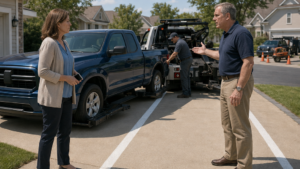
The truck boot hit the pavement with a metallic crack that made Brandon Jackson flinch behind the wheel.
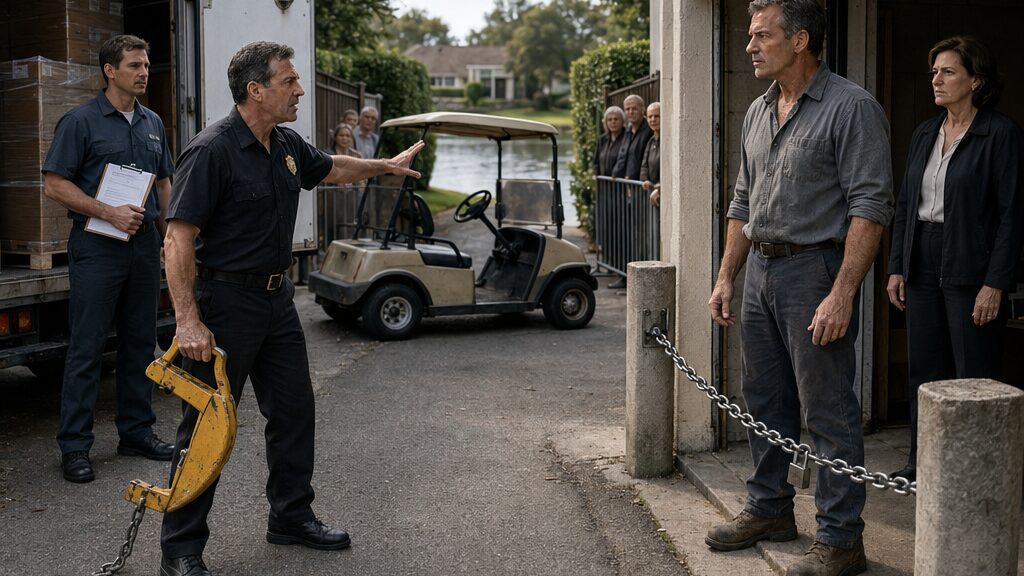
“Turn it around,” Gary Campbell shouted, planting one polished black boot beside the yellow clamp as if he had just dropped a weapon. “This is an illegal warehouse.”
The delivery truck filled nearly the whole rear alley, its white sides squeezing the morning light between two rows of fences, garage doors, trash bins, and narrow strips of decorative gravel the HOA insisted on calling landscape buffers. Behind it, the alley bent toward the main street. Ahead, less than twenty feet from the truck’s bumper, a thick industrial steel chain stretched between two concrete pillars at the entrance to Jonathan Brown’s garage apron.
The chain had not been there yesterday.
Brandon lowered his window halfway. “Sir, I have a scheduled delivery for this address.”
Gary tapped the black tablet tucked under his arm, though the screen was dark. A laminated badge clipped to his shirt read TRAFFIC WARDEN in large block letters, with the HOA logo printed small in one corner.
“No commercial vehicles past this point.”
“This is a delivery truck,” Brandon said. “That is what delivery trucks do.”
Gary smiled like he had been waiting for that sentence. “Not here.”
Jonathan heard the exchange from inside the garage before he saw the chain.
He had been standing at the back workbench with a utility knife in one hand, clearing space for the crates that had taken eleven months of forms, appeals, fees, inspections, and silence. He knew the engine note of the delivery truck before it turned into the alley. He knew because he had spent the last three mornings listening for it, then pretending not to be listening.
The garage behind his house did not look like a warehouse. It looked like a man had spent years refusing to let a workspace die. The concrete floor was swept clean. Pegboards held wrenches in exact rows. A hydraulic lift sat locked down beneath a tarp. The old drill press near the side wall wore a paper tag from the last HOA inspection, still stuck to it like a scar.
Jonathan set down the knife.
Outside, Gary’s voice grew louder.
“I said back it up.”
Brandon opened his door and stepped down carefully, his delivery clipboard tucked against his ribs. He was in his thirties, tall and cautious, wearing the expression of someone who had seen arguments become claims reports.
“I can’t back a loaded truck through that bend without a spotter,” he said. “And I can’t leave the freight in the alley.”
“That sounds like your problem.”
Jonathan walked to the open garage threshold and stopped.
The chain cut across the entrance at chest height. Not rope. Not a folding sign. A thick gray steel chain, new enough that the links still had manufacturing oil in their seams, pulled tight through the eyelets drilled into the two concrete pillars flanking his rear apron. A heavy padlock hung in the center. On the other side, Gary’s golf cart was angled diagonally in the alley, its front end pointed at the truck like a toy patrol car pretending to be a cruiser.
A portable metal traffic barricade stood beside the golf cart. It was too heavy for temporary neighborhood decoration. It had rubber feet, chipped orange stripes, and a rental label half-scraped from one side.
Jonathan looked at the chain for one long second.
Then he looked at Gary.
“Move it.”
Gary turned, slow and theatrical. “There he is.”
Brandon glanced between them. “You’re Mr. Brown?”
“Yes.”
“I need a clear path to the garage, sir. The bill of lading lists rear access only.”
“The rear access is clear,” Jonathan said. “Except for him.”
Gary barked a laugh. “No, the rear access is closed by order of neighborhood traffic enforcement.”
Jonathan’s eyes moved to the laminated badge. “Neighborhood traffic enforcement.”
“That is correct.”
“You are not law enforcement.”
“I am authorized by the homeowners association to manage vehicular compliance.”
Jonathan stepped out fully, his shoes scraping lightly over the concrete. He wore a faded gray work shirt with the sleeves rolled to the forearms, dark work pants, and old boots that had been resoled twice. He did not raise his voice. That irritated Gary more than shouting would have.
“This alley is my legal entrance,” Jonathan said. “That truck has permission to enter.”
Gary lifted the illegal boot by its handle. “This truck is overweight, oversized, and commercial.”
“It is a contracted delivery.”
“It is carrying commercial inventory.”
Jonathan did not answer fast enough.
Brandon noticed.
So did Gary.
The alley had begun to collect faces. Emily Clark stood behind the gate across the way, one hand holding it half-open, her other hand still in a gardening glove. Two other neighbors watched from their back steps. A dog barked once and was pulled inside.
Brandon lowered his voice. “Mr. Brown, I need to be clear. If there’s a property access dispute, I may have to call dispatch and get instructions. If they tell me to return the load, I can’t override that.”
Jonathan felt the words settle into the narrow alley like dust.
Return the load.
The crates inside the truck were strapped, sealed, insured, and scheduled down to a two-hour window. They were also the last pieces needed before the state inspector could walk into his garage and see the space as what it had finally been approved to become, not what the HOA had spent years calling it in warning letters.
He had told himself not to explain. Not to beg. Not to show anyone anything until the last stamped document was in his hand.
Silence had gotten him through worse than Gary Campbell.
But silence, he now realized, had also given Gary an empty stage.
“I’m asking once,” Jonathan said. “Take down the chain.”
Gary stepped toward him, stopping just beyond the tight line of steel. The padlock hung between them. “Or what?”
Jonathan’s jaw tightened.
Brandon shifted uneasily. “Gentlemen—”
Gary turned sharply on him. “You stay right there. You unload one box, I boot the truck.”
“You don’t have authority to do that,” Brandon said, but doubt weakened the sentence.
Gary held up the clamp. “Try me.”
Jonathan’s gaze lowered to the boot. It was the kind used in private lots by towing companies, not public agencies. A cheap decal had been slapped over one side. The decal had the HOA seal. It was already peeling at the edge.
“You brought a boot,” Jonathan said.
“I brought compliance.”
“You brought theater.”
Gary’s smile thinned. “No. I brought consequences.”
He swung the boot slightly, letting the metal jaws clack together. Then he pointed past Jonathan, into the garage.
“I know what you’ve got in there. Everyone does. Tools, machines, pallets, late-night noise. You think nobody notices? This is a residential neighborhood, Brown. Not a loading dock.”
“It’s my garage.”
“It’s a warehouse.”
The word hit the alley harder the second time.
Emily’s eyes flicked toward the open garage. Brandon’s grip tightened on his clipboard. The other neighbors leaned just enough to see inside without admitting they were looking.
Jonathan knew what they saw. The swept floor. The marked zones. The empty space waiting for crates. The workbench with forms weighted under a socket wrench. The old lift. The tarped equipment. To him, it looked orderly. To suspicious eyes, order could be turned into evidence.
Gary saw the shift and fed it.
He pointed at the truck’s sealed freight compartment. “Heavy crates. Rear alley unloading. Private garage workspace. Commercial inventory. You got caught.”
Jonathan’s face remained still, but his hands curled once and opened again at his sides.
Brandon took one step back toward the cab, already reaching for his phone.
Gary raised his voice so the fences could hear.
“Jonathan Brown has been operating an illegal warehouse out of this garage, and this delivery is being refused by neighborhood authority.”
Chapter 2: The Garage Everyone Was Told to Fear
“Jonathan,” Emily Clark called from behind her half-open gate, “is that true?”
The question slipped into the alley before Jonathan could stop it.
Gary turned toward her with the satisfaction of a man hearing a door unlock. Brandon, still near the truck cab with his phone in his hand, looked at Jonathan too. Even the neighbors who had pretended to be checking bins or watering plants had gone still.
Jonathan kept his eyes on Emily for a beat too long.
That was the mistake.
He saw her glance past his shoulder into the garage, saw her take in the clean floor, the marked tape lines, the shelving, the empty space waiting for freight. He saw the years of HOA warnings rearrange themselves in her mind into something that looked like proof.
“No,” Jonathan said. “It isn’t true.”
Gary snorted. “Then say what’s in the crates.”
Jonathan did not answer.
Not because he couldn’t. Because for three years the HOA had turned every answer he gave into another demand. Noise complaint. Storage complaint. Visual-impact complaint. Unauthorized work activity complaint. They had photographed his garage when the door was open, circled harmless equipment in red, and mailed him letters about “commercial suspicion” as if suspicion were a rule.
So Jonathan had learned to say less.
Now Gary held up a hand as if presenting evidence in court.
“You all heard that,” Gary said. “He refuses to identify the contents.”
Brandon’s phone buzzed in his palm. He looked at the screen but did not answer yet. “Mr. Brown, I don’t need to know your business. I just need to know whether this delivery can legally be received here.”
“It can,” Jonathan said.
Gary walked to the back of his golf cart and pulled a manila packet from under the seat. The cart’s tires were angled against the alley wall, blocking the small gap Brandon might have used to edge forward. Gary slapped the packet onto the cart roof and flipped it open.
“Let’s talk legal,” he said.
Jonathan’s stomach tightened when he saw the colored tabs.
Gary had copies.
Not originals, not complete filings, but copies of old notices. Jonathan recognized the top sheet: a warning letter from eight months earlier, printed on HOA letterhead, accusing him of “unauthorized commercial storage.” Someone had highlighted “commercial” three times in yellow marker. Beneath it was a photograph of Jonathan carrying a boxed vise from his pickup into the garage. Another showed the drill press. Another showed the hydraulic lift under its tarp, as if a tarp were a confession.
Emily came a step farther out of her gate.
Gary noticed and raised his voice. “The association has documented this pattern for months. Heavy equipment. Repeated freight inquiries. Industrial modifications. And now crates in a commercial truck.”
Brandon frowned. “Sir, with respect, a complaint packet is not an access order.”
Gary’s smile snapped toward him. “You want your company named in the violation?”
That quieted Brandon.
Jonathan felt the alley narrowing around him. Not physically; the chain did that already. But socially, invisibly. Every face at every fence tightened the space. He knew some of these people by their trash days, their dog names, their children’s bicycles. He had fixed a hinge for Emily once without charging her. He had hauled a fallen branch off the alley after a storm while Gary, who did not even live on the block, was nowhere in sight.
None of that mattered as much as paper in a loud man’s hand.
Emily’s voice came softer this time. “We did get notices about garage use. The board said there were inspections.”
Jonathan looked at her. “There were complaints.”
“That isn’t the same thing?” she asked.
“No.”
Gary laughed. “That is exactly how people talk when they’ve been caught.”
Jonathan’s hands moved once at his sides, a brief, restless motion. He wanted to go inside, get the newest document, slam it in front of them all, and end the performance. But the final court approval had not arrived in his hand when he came out. He had checked the state portal at dawn. Status pending. Hearing closed. Decision expected.
He had not told anyone that because he had been tired of everyone knowing the shape of his life before he did.
Gary flipped to another page.
“Notice of prohibited use,” he read. “Notice of excessive delivery activity. Notice of mechanical equipment inconsistent with residential character.”
Jonathan said, “Read the dates.”
Gary did not.
“Read them,” Jonathan repeated.
Gary’s jaw worked. “The pattern is what matters.”
“The dates matter.”
Brandon looked from one man to the other. The phone buzzed again. This time he answered.
“Jackson,” he said, turning slightly away. Then his shoulders shifted. “Yes, I’m at the address. Access is blocked by a private chain and a neighborhood representative.”
Jonathan hated how official that sounded.
Gary stood taller.
Brandon listened, eyes moving to the steel links, the boot, the golf cart. “No, I have not unloaded. No, the customer is present. Yes, there are residents disputing the delivery.”
Jonathan stepped toward him. “Tell them the customer confirms access.”
Brandon covered the receiver. “I did. They’re asking whether local restrictions prevent unloading.”
“No local restriction prevents it.”
Gary lifted the complaint packet. “That is not established.”
Jonathan said, “By you.”
“By the HOA.”
“Not law.”
Emily shifted at the gate again. “Jonathan, if you had approvals, why didn’t you tell anyone?”
The question was not cruel. That made it worse.
Jonathan looked at the chain instead of her. “Because every time I opened my mouth, someone made another obstacle.”
Gary tapped the packet against his palm. “There. Admission. He was hiding the operation.”
Jonathan turned on him then. Not fast, not wild, but with enough force in the movement that Gary took a half-step back before catching himself.
“I was appealing a bad restriction,” Jonathan said. “I was not hiding.”
“You were losing,” Gary said.
Jonathan’s silence returned, and Gary seized it.
Brandon lowered the phone. “Dispatch says if the delivery can’t be accepted through the listed access point within the hour, they may mark it refused and send the load back to the terminal.”
The words hit differently this time because everyone heard them.
The crates inside the truck seemed to become heavier in the imagination of the alley. Jonathan pictured them strapped in place: the precision lathe packed in shock foam, the sealed crates of calibrated parts, the panel kits that had been delayed twice already. Not inventory. Not contraband. Not proof of anything except that he had waited, paid, appealed, and endured.
Gary slid the complaint packet back into its folder with ceremony.
“I warned the board this would happen,” he said. “Men like this always wait until nobody’s watching.”
Jonathan almost laughed. The alley was full of watching.
Then a second golf cart whined into view from the far bend.
It was white, newer than Gary’s, with the HOA emblem printed on both sides and a clipboard clipped to the steering wheel. Donna Green drove with both hands, her sunglasses low on her nose. She did not look surprised to see the truck, the chain, the neighbors, or Gary holding the packet. She looked like she had arrived at a meeting already underway.
She parked behind Gary’s cart, blocking the alley even more completely.
Gary moved toward her before she had fully stepped out. His voice dropped, but not enough. “I’ve got him at the line.”
Donna’s eyes went to the sealed truck. Then to Jonathan. Then to the garage behind him.
For the first time that morning, Jonathan felt something colder than anger.
Donna did not ask what had happened. She did not ask why there was a chain drilled into his pillars. She did not ask why Gary had a boot.
She only looked at the truck and said, “Do not let one crate cross that line.”
Chapter 3: The Permit That Proves Too Little Too Soon
Jonathan came out of the garage with a blue folder in his hand, and Gary’s face lit up as if the folder itself had confessed.
“There it is,” Gary said, already lifting his phone. “Warehouse paperwork.”
Jonathan stopped at the chain. “You want documents. Here are documents.”
“No, I want compliance.”
“You want theater.” Jonathan slid two fingers under the folder flap and pulled out the first sheet. “This is my state zoning appeal acknowledgment.”
Gary leaned close enough to photograph it through the chain. The camera shutter clicked three times before Jonathan lowered the page.
“Don’t take pictures of my filings.”
Gary looked pleased. “You brought them outside.”
Donna had remained beside her golf cart, arms crossed, expression fixed in a calm that did not reach her mouth. Emily stood near her gate now with both gloves removed. Brandon waited by the truck’s rear door, his clipboard tucked under one arm, phone in the other hand, his dispatcher still on hold.
Jonathan held the page toward Brandon instead of Gary.
“The property has an existing rear service entrance,” he said. “The state acknowledged it as part of the appeal.”
Brandon read the top half without touching it. “This says appeal received.”
“Yes.”
“It doesn’t say final approval.”
Gary’s smile widened.
Jonathan felt the old familiar pinch behind his ribs. The document was real. It mattered. It had cost him months. But it was also exactly what Gary needed it to be in front of people who did not understand the difference between process and decision.
“It establishes standing,” Jonathan said.
Brandon’s eyes moved apologetically toward the truck. “I’m not a lawyer, Mr. Brown.”
“That makes two of us,” Gary said.
Jonathan ignored him. “I am the customer. The address is correct. The access point is correct. The cargo is lawful.”
Donna finally spoke. “Then show the permit allowing commercial unloading.”
Jonathan looked at her.
She had asked too quickly.
The words did not sound like curiosity. They sounded rehearsed. As if she already knew which page he would not yet have in his hand.
Jonathan slid the appeal sheet back into the folder. His thumb brushed the inner pocket where older inspection notices sat clipped in order. He hated that order suddenly. Hated how careful he had been. Hated that every clean page looked suspicious because the final one had not printed before the truck arrived.
“The final ruling is pending,” he said.
Gary barked, “Pending.”
“That appeal prevents you from acting before determination.”
Donna shook her head. “No, Jonathan. Pending means not approved. Until approval exists, the residential restrictions remain enforceable.”
“You cannot install a chain across my legal entrance.”
“We can restrict commercial access.”
“This isn’t your entrance.”
“It is an alley governed by association standards.”
“Association standards don’t override state access rights.”
Donna removed her sunglasses slowly. “Then show the ruling.”
The alley went quiet except for the truck’s idle and Brandon’s dispatcher murmuring through the phone.
Jonathan had checked at dawn. He had checked at 7:12. He had checked again at 7:46 while standing in the garage with coffee gone cold beside the drill press. Pending. Pending. Pending.
The truck had arrived at 8:03.
Gary lifted his phone and angled it toward the folder again. Jonathan snapped it closed.
“Careful,” Gary said. “Looks like you’re hiding evidence.”
Jonathan stepped closer to the chain. The padlock hung between them, scuffed already from Gary’s handling. “You drilled into my pillars.”
Donna said, “Temporary safety measure.”
“Who authorized it?”
“The board authorized traffic management.”
“Who drilled into my pillars?”
Gary glanced at Donna.
It was fast. Almost nothing.
But Emily saw it too. Her eyes narrowed.
Brandon cleared his throat. “Mr. Brown, I need to ask directly. Are these crates for residential use?”
Jonathan looked at the truck.
The question should have had an easy answer. But nothing about the last three years had left easy answers intact.
“No,” he said.
Gary slapped his hand against the golf cart roof. “There.”
Brandon’s expression tightened.
Jonathan turned toward him. “They are for a lawful workspace inside my garage.”
“Commercial workspace?” Brandon asked.
“Approved workspace.”
“Not approved,” Donna said. “Pending.”
Jonathan’s jaw hardened. “You do not get to rename my work because you dislike it.”
Gary pointed into the garage. “Work. He said work.”
“Yes,” Jonathan said, sharper now. “Work. Repair work. Fabrication. Small-batch parts. No storefront. No retail traffic. No loading dock. No employees in the alley. A permitted use under state classification once the restriction is voided.”
Emily’s face changed, not into certainty, but into something less ready to believe Gary. “You were appealing the residential restriction?”
Jonathan looked at her and said nothing.
That silence fell badly.
Gary photographed the folder from the side, catching the tabbed documents and the edge of an inspection diagram before Jonathan turned away. His thumbs moved fast over his phone.
Donna’s phone buzzed a second later.
She looked down.
Jonathan saw the photograph on her screen reflected faintly in her sunglasses.
Gary said loudly, “Documentation of commercial intent sent to the board chair.”
Jonathan shut his eyes for half a second.
He had not lost because he lacked truth. He was losing because he had allowed the wrong people to reveal pieces of it.
Brandon lifted the phone back to his ear. “Yes. Customer acknowledges commercial workspace use but does not have final permit in hand.” He listened. “Understood.”
Jonathan opened his eyes.
“What did they say?”
Brandon looked pained now. Professional caution was becoming personal discomfort, but it did not change his answer.
“They’re giving me thirty minutes. If I can’t unload with clear authorization and clear access, I have to leave. They’ll mark it customer site unavailable.”
“Not refused?” Jonathan asked.
“Site unavailable. Same result for the freight today.”
Gary made a soft clicking sound with his tongue. “Shame.”
Jonathan turned away from him before the anger could find his hands.
Inside the garage, his laptop sat open on the side bench, the state portal still logged in. The screen had dimmed. Beyond it, the work zones waited with taped outlines on the floor, empty rectangles where each crate was supposed to land. He had measured twice last night. He had swept the path from the alley to the back wall until there was nothing left to sweep.
He crossed the threshold, moved to the laptop, and touched the trackpad.
The portal woke.
Pending.
Jonathan stared at the word until the letters seemed stamped into him.
Behind him, Donna’s voice carried through the garage entrance. “Mr. Jackson, the board appreciates your cooperation. No one wants your company involved in an enforcement issue.”
Brandon said, “I just need someone with authority to clear the delivery.”
Gary replied, “You’re looking at him.”
Jonathan looked at the portal again. He refreshed it.
The page spun.
For one suspended second, the whole garage held its breath with him.
Then the same gray status returned.
Pending.
Outside, Brandon’s dispatcher spoke loud enough for Jonathan to hear through the phone.
“Driver, if the access dispute isn’t resolved in thirty minutes, depart the site and return to terminal.”
Chapter 4: The Fake Warden’s Real Fear
Gary leaned close to Donna’s golf cart and whispered, “You said if I stopped this one, the contract becomes permanent.”
Jonathan did not hear it.
Emily did.
She had moved from her gate to the trash bins near the bend, pretending to gather a fallen lid the morning breeze had not actually moved. From there, Gary’s lowered voice slid between the idling truck and the concrete wall. Not every word. Enough.
Donna’s reply was colder. “I said we would discuss a permanent position after you demonstrated effectiveness.”
“I chained it. I stopped the driver. I documented the paperwork.” Gary’s voice cracked at the edge of the last word. “That is effective.”
“Then keep it stopped.”
Gary straightened quickly when Brandon looked over.
Emily kept one hand on the trash lid and watched him differently.
Gary saw her watching and snapped his badge flat against his chest. “Neighbors should remain clear of enforcement activity.”
Emily’s eyes dropped to the badge. “Are you employed by the city?”
Gary blinked.
Donna answered before he could. “Mr. Campbell is contracted by the association.”
“That wasn’t what I asked.”
A small silence opened in the alley.
Gary shut it with movement. He strode to the front wheel of the truck, carrying the yellow boot by its handle. Brandon stepped between him and the tire.
“Don’t put that on my truck.”
Gary did not slow. “Move.”
“That equipment is not touching company property.”
Gary angled his body, trying to look past Brandon rather than up at him. Brandon was taller by several inches, but Gary had the performance of authority on his side and knew how often people stepped back from it.
“This vehicle is in violation,” Gary said.
“It is parked because you blocked it.”
“It is obstructing a controlled alley.”
“You put a chain across the entrance.”
Gary crouched with the boot. Brandon reached down and grabbed the top edge before it could close around the tire. The metal jaws scraped rubber.
“Do not,” Brandon said, and now his caution had a hard line in it.
Gary’s face flushed.
For the first time, Jonathan saw the fear beneath the theater. Not fear of Jonathan. Not exactly. Fear of failing in public. Fear of Donna watching him lose grip on the scene. Fear of becoming just a man in a cheap badge with a boot he had no right to carry.
Donna said, “Mr. Jackson, interfering with enforcement can create additional liability for your employer.”
Brandon’s hand loosened.
Gary used the opening. The boot snapped around the tire with a hollow metal clack.
Brandon swore under his breath and stepped back, phone already lifting. “Dispatch needs to know you just immobilized the truck.”
Gary stood, breathing fast through his nose. “Good. Tell them the site is under enforcement hold.”
Jonathan walked out of the garage slowly.
The word pending still burned behind his eyes. But the boot on the truck changed the shape of the morning. Until now, Gary had blocked. Now he had seized.
Jonathan stopped near the chain. “Take it off.”
Gary wiped one hand down the front of his shirt, smoothing it around the badge. “No.”
“You don’t have authority to immobilize that vehicle.”
“I have authority to protect this community.”
“From a delivery?”
“From you turning this alley into a freight lane.”
Jonathan looked at Donna. “You authorized him to boot a private delivery truck?”
Donna’s face remained composed, but a tendon moved in her neck. “I authorized him to prevent unlawful commercial unloading.”
“That wasn’t my question.”
“It is my answer.”
Emily stepped closer. “Donna, is he a real traffic warden?”
Gary’s head snapped toward her. “The badge says traffic warden.”
“That isn’t an answer either,” Emily said.
A murmur passed through the neighbors. Soft, uncertain, but different from before. Gary heard it and reached again for the complaint packet, as if paper could fill the crack.
“You people don’t understand what happens if this is allowed,” he said. “Today it’s crates. Tomorrow it’s customers parking in the alley. Then forklifts. Then noise at midnight. Then everybody’s property value drops because one man decided rules are for other people.”
For a moment, something almost human moved through his voice.
Jonathan heard it. He had expected smugness. He had not expected desperation. Gary believed at least part of what he was saying, or needed to. He had dressed his insecurity in neighborhood language and called it protection.
But the boot was still on the truck.
The chain was still across Jonathan’s entrance.
Donna checked her phone. “How much time before the truck leaves?”
Brandon looked at his screen. “Twenty-one minutes.”
Donna gave Gary a slight nod.
Gary seized the padlock at the center of the chain and shook it. “Then we wait twenty-one minutes.”
Jonathan stepped toward him.
Gary held his ground, but his fingers tightened around the padlock.
Jonathan stopped close enough that the chain nearly touched his shirt.
“You drilled into my pillars. You chained my entrance. You placed an illegal boot on a delivery truck. You’re using complaint letters as if they are court orders.” His voice was low, but every word carried. “I gave you room to back away from stupid.”
Gary swallowed.
Donna said, “Careful, Jonathan.”
Jonathan’s eyes did not leave Gary. “You just crossed from annoying to unlawful.”
Chapter 5: When the Barricade Hit the Pond
“Touch that barricade,” Gary said, voice climbing, “and I’ll have you arrested before lunch.”
The alley went still around the words.
Jonathan stood with the chain inches from his chest, the padlock hanging between him and Gary like a dare. Behind Gary, the portable traffic barricade leaned against the side of his golf cart, its orange stripes bright against the white body panel. Beyond the cart and the bend in the alley, the community pond flashed through a gap between two hedges, a harmless decorative circle of water the HOA maintained with more care than most people gave their roofs.
Brandon lowered his phone. “Mr. Brown, don’t do anything that puts this freight at risk.”
Jonathan did not answer.
Gary heard the warning and used it. “Listen to the driver. He understands liability.”
“No,” Brandon said. “I understand that my truck has been immobilized by a man who won’t show me a lawful order.”
Gary turned red through the neck. “You want your company dragged into this?”
“I want that boot off my wheel.”
Donna stepped forward. “Everyone needs to calm down.”
It was the first time all morning she had used a voice that sounded like concern instead of command. Jonathan noticed that too. Concern arrived only after the scene began slipping out of her control.
He looked at the chain. Then at the boot. Then at the barricade.
The chain was drilled into his pillars. The boot was clamped to Brandon’s truck. But the barricade stood loose, heavy and ugly and placed for only one reason: to make the blockade look official. It was the stage prop that made Gary’s costume convincing.
Jonathan stepped away from the chain.
Gary smiled, thinking he had backed down.
Then Jonathan walked around the concrete pillar toward the barricade.
“Jonathan,” Emily said, but it came out almost as a breath.
Donna’s hand lifted. “Do not touch association property.”
Jonathan stopped beside the barricade and looked down at its chipped metal frame. A torn rental sticker curled from the underside. Black marker showed half a company name and a faded barcode. He bent slightly, turned the edge with two fingers, and exposed the sticker to the alley.
“This isn’t association property.”
Gary’s mouth opened.
Jonathan read the sticker aloud. “Rental equipment. Temporary traffic control.”
Brandon leaned enough to see it. “That’s roadwork gear.”
Gary recovered quickly. “Authorized for community safety.”
“By whom?” Jonathan asked.
Donna’s face hardened.
Gary lunged for the barricade handle, but Jonathan’s hand closed around the metal first.
“Don’t,” Gary snapped.
Jonathan straightened.
The barricade was heavier than it looked. Its rubber feet dragged against the pavement at first, whining over grit. Jonathan adjusted his grip, one hand under the crossbar, one near the side support. Old muscle memory settled into his shoulders. Years of hauling engines, lifting frames, moving equipment alone because asking for help had always invited questions.
The alley watched the weight travel through him.
Brandon took a step forward. “Mr. Brown, damaging that could be used against you.”
Jonathan looked at him. “I’m not touching your truck.”
“That may not matter.”
“It matters to me.”
Gary moved in too close. “Put it down.”
Jonathan turned his head just enough for Gary to see his face. “Move away.”
Something in his voice worked. Gary stepped back.
Jonathan bent his knees and lifted.
The barricade came up with a grinding scrape, then cleared the ground. A neighbor gasped. The metal frame rose to Jonathan’s waist, then his chest. His arms trembled once, not from weakness but from the ugly balance of it. He shifted his feet, planted his boots, and drove upward until the barricade was above his head.
For the first time that morning, Gary had no words.
Jonathan pivoted toward the opening between the hedges.
Donna shouted, “This is being recorded!”
“Good,” Jonathan said.
He threw the barricade.
It did not fly cleanly. It turned sideways in the air, a clumsy metal animal, clipping leaves from the hedge before crashing into the community pond with a sound so loud it seemed to crack the morning open. Water exploded upward in a brown-green sheet. Ducks scattered. The splash slapped the pond stones and rained back through the hedges onto the ornamental grass.
For two seconds, nobody moved.
Then the barricade bobbed once, half-submerged, its orange stripes visible beneath ripples.
The alley changed.
Not into celebration. Not exactly. Into shock, stripped of Gary’s script.
Gary stared past Jonathan toward the pond. His lips moved without sound. Donna’s sunglasses had slipped down her nose. Brandon’s phone hung at his side, still connected to dispatch. Emily stood with both hands at her mouth, eyes wide, but not frightened of Jonathan. Frightened by how completely the performance had broken.
Jonathan turned back to the chain.
He had not touched Gary. He had not touched Donna. He had not damaged Brandon’s truck. He had not swung at the chain, not yet. He had removed the thing that made the blockade look sanctioned, and he had done it with a force nobody in the alley could pretend not to have seen.
Gary found his voice in pieces.
“You— you destroyed—”
“Your rented prop is wet,” Jonathan said.
“That was community safety equipment!”
“It was blocking my legal entrance.”
“It was part of an enforcement action.”
“It was part of a lie.”
Gary’s hand shook as he grabbed his phone. He backed toward Donna, but Donna did not immediately step beside him. That hesitation showed. Gary saw it and his panic sharpened.
He dialed with hard stabs of his thumb.
Brandon lifted his own phone again. “Dispatch, are you still on? You heard that impact? No, the truck is not hit. Repeat, the truck is not hit.”
Donna recovered enough to point at Jonathan. “You have made this much worse for yourself.”
Jonathan felt the heat in his arms now. The effort. The aftermath. For one brief, dangerous moment, he wanted the chain in his hands next. He wanted the padlock shattered, the links torn from the pillars, the whole stupid morning dragged apart link by link.
He looked at Brandon’s truck. At the boot. At the sealed cargo.
Not people. Not the truck.
Only the blockade.
That had to remain the line.
Gary pressed the phone to his ear. “Yes, I need an officer at the rear alley behind Jonathan Brown’s property. Destruction of community property, commercial violation, hostile resident, delivery truck involved.” He listened, then spoke louder. “Yes, he threw traffic control equipment into the pond. We have witnesses.”
Emily lowered her hands.
“It wasn’t community property,” she said.
Gary covered the phone. “Stay out of this.”
“You told us it was.”
Donna turned on Emily. “This is not the time.”
Emily’s face tightened, but she did not retreat to her gate.
Gary went back to the call. “He’s aggressive. He’s operating illegally. He’s refusing enforcement direction.”
Jonathan stood in the alley, breathing steady, hands open at his sides. The chain remained between the pillars. The boot remained on the truck. The crates remained sealed inside.
But Gary no longer looked like a warden.
He looked like a man shouting into a phone beside a golf cart, trying to rebuild a wall everyone had just watched crack.
Then Brandon’s phone buzzed again. He listened, eyes fixed on Jonathan.
“Yes,” Brandon said. “Understood.”
He lowered the phone slowly.
Jonathan did not look away from Gary. “What now?”
Brandon swallowed. “Dispatch says they need final authorization immediately. If law enforcement arrives before access is cleared, I’m ordered to keep the freight sealed and wait for return instructions.”
Gary heard it and pointed at Jonathan, voice rising into triumph because fear needed somewhere to go.
“You hear that? You just gave me the criminal record I needed.”
Chapter 6: The Morning the Authority Changed Hands
“He is violent, he is operating illegally, and he has already destroyed property,” Gary shouted into his phone, though everyone in the alley could hear him without help. “I need that noted. Yes, Jonathan Brown. Rear alley. Commercial warehouse activity.”
Jonathan’s laptop chimed from inside the garage.
The sound was small. One clean electronic note beneath the truck’s idle, beneath Gary’s voice, beneath the drip of pond water falling from the hedge leaves.
Jonathan turned his head.
Donna saw him move and followed his gaze. So did Emily.
The laptop sat on the side workbench just inside the open garage, its dimmed screen facing the alley. For a moment Jonathan did not trust himself to walk toward it. He had refreshed that page so many times that morning the word pending had become a bruise.
The laptop chimed again.
Brandon’s dispatcher said something through his phone. Brandon ignored it.
Jonathan crossed into the garage.
Behind him Gary shouted, “Do not walk away from an enforcement scene.”
Jonathan touched the trackpad.
The state portal filled the screen. His case number sat at the top. Under it, where the gray status line had read pending all morning, a green bar stretched across the page.
APPROVED.
Jonathan did not move.
The world did not become loud. It became very precise. The scratched workbench edge. The smell of machine oil. The folded blue folder beside the keyboard. The taped rectangles on the concrete floor waiting for crates. The thin tremor in his own fingers when he reached for the printer.
He clicked the document.
The first page loaded slowly enough to feel cruel.
Order entered: 8:31 a.m.
Commercial zoning permit approved.
Residential association restrictions void as applied to rear-access workshop use.
Jonathan printed two copies.
The printer began its rough mechanical pull, paper feeding one sheet at a time. Outside, Gary’s voice kept going, but Jonathan no longer heard the words clearly. Donna had gone silent.
When Jonathan stepped back into the alley, he carried the fresh pages flat in both hands.
Gary was still speaking into the phone. “He’s coming back out now. He may be holding more documentation. No, I am not approaching him because he has already—”
Jonathan slapped the first page onto the hood of Brandon’s truck.
The sound cut through Gary’s sentence.
Brandon leaned over it first.
Donna moved next, faster than she meant to. Emily came to the side of the truck, close enough to read but not so close that Donna could accuse her of interfering. Gary held the phone to his ear but stopped speaking.
Jonathan placed one finger on the timestamp.
“Read it,” he said to Donna.
Donna stared at the page.
“Read it,” Jonathan repeated.
Her mouth tightened. “This appears to be—”
“No. Read the line.”
Gary lowered the phone slightly. “Don’t let him intimidate you.”
Jonathan did not look at Gary. “The timestamp.”
Donna’s face had lost its color around the lips. She looked at the first page, then the second, then at Jonathan as if he had done something underhanded by letting the truth arrive late.
“Order entered at 8:31 a.m.,” she said.
Brandon looked at his phone. “That was before he threw the barricade.”
Gary’s head jerked. “That has nothing to do with—”
Jonathan tapped the next line. “Read the authority.”
Donna’s nostrils flared.
Emily’s voice came unexpectedly. “Read it, Donna.”
The board chair looked at her, and for a second all the old neighborhood habits were visible: who spoke, who stayed polite, who waited for the board to decide what was real. Then Donna looked back down.
“Commercial zoning permit approved,” she said, each word pulled out like a splinter. “Residential association restrictions void as applied to rear-access workshop use.”
The alley absorbed the sentence.
Brandon exhaled.
Gary stared at Donna. “Void?”
Jonathan took the second copy from under his arm and held it up where the neighbors could see the state seal. “Approved this morning. Your authority over this access ended at sunrise by decision, entered at 8:31 by order.”
Donna snapped, “Sunrise is not the legal entry time.”
Jonathan looked at her. “Then say 8:31.”
Her eyes flashed.
He pointed at the chain. “You drilled into my pillars after knowing the decision could arrive today.”
“We knew no such thing.”
Emily spoke before Jonathan could. “Gary said you hired him because the decision was coming.”
Gary went still.
Donna turned slowly. “What did you hear?”
Emily’s voice shook but held. “Enough. He said you told him if he stopped this one, his contract becomes permanent.”
“That is not what I said,” Gary snapped.
“It’s close,” Emily said.
Brandon looked at Gary with open disgust now. “You immobilized my truck to win a job?”
Gary’s fear returned, but this time it had nowhere respectable to hide. “I immobilized your truck because this man is changing the character of the neighborhood.”
Jonathan folded one copy of the permit and slid it into his shirt pocket. “No. You immobilized the truck because you thought twenty minutes would erase three years.”
Gary gripped the phone. “The boot stays until actual law enforcement arrives.”
Donna’s head turned sharply toward him. “Gary.”
He ignored her. “No. He doesn’t get to throw things into ponds and then wave a paper around.”
“The permit clears access,” Brandon said.
“The permit doesn’t clear destruction of property.”
Jonathan looked toward the pond, where the barricade still floated crookedly near the reeds. “Your rented barricade is recoverable.”
Gary’s voice broke. “That is not the point.”
“No,” Jonathan said. “The point is the boot.”
He stepped toward the front wheel.
Gary blocked him, or tried to. He put himself between Jonathan and the tire, shoulders squared, badge shining. But his hand, the one holding the phone, trembled hard enough that the screen flashed in the sun.
“You lay a hand on this enforcement device,” Gary said, “and I’ll add tampering.”
Jonathan stopped.
For a moment, the old habit returned. Let the paper speak. Wait for someone else to understand. Stay calm enough that no one could accuse him of force.
Then he looked at Brandon’s truck, trapped in front of his open garage with legal freight inside and a ticking dispatch order in the air. He looked at Emily, who had finally spoken but could not unlock anything. He looked at Donna, calculating what could still be saved.
Finally he looked at Gary.
“Give me the key.”
Gary laughed once. Too high. “No.”
Jonathan held out his hand. “Give me the key.”
Donna said, “Gary, remove it.”
Gary stared at her as if she had betrayed him. “You said keep it stopped.”
“I said remove it.”
“No. If I remove it, this looks like I was wrong.”
Brandon said, “You were wrong.”
Gary’s jaw worked. He reached to his belt, not for a key, but for a small removal tool clipped behind his radio. His fingers closed around it protectively.
Jonathan stepped closer.
Gary stepped back.
The golf cart bumper caught Gary behind the knee. He stumbled, and in catching himself, his hand came forward. Jonathan took the removal tool from his trembling grip without twisting, yanking, or striking. He simply closed his fingers around it and waited until Gary let go.
No one spoke while Jonathan crouched beside the truck wheel.
The boot lock resisted once, then gave with a dull click.
Jonathan opened the jaws, lifted the illegal clamp from Brandon’s tire, and set it on the pavement beside the broken line of the chain’s shadow.
He stood with the removal tool in one hand and the permit visible in his shirt pocket.
Gary looked smaller without the boot attached to anything.
Chapter 7: The Receipt on the Crumpled Hood
Brandon looked at the open garage, then at Jonathan, then at the boot lying useless on the pavement. “Do you still want the crates unloaded after all this?”
Jonathan almost answered too fast.
Yes had been waiting in him for months, longer than the truck ride, longer than the court case, longer than the chain across the alley. But the alley was watching him now in a different way. Gary was silent beside the golf cart. Donna held the permit copy as if it might stain her fingers. Emily stood near Brandon’s truck, no longer at her gate, no longer safely outside the scene.
Jonathan looked at the garage.
The taped rectangles on the floor were still empty.
“Yes,” he said. “Through the rear entrance.”
Brandon gave one sharp nod, like he had been waiting for a clean instruction. “Then I’m unloading.”
He turned to the truck, released the rear latch, and the freight door rolled up with a rattling climb. Inside, the crates sat in two strapped rows, dark wood, steel-cornered, stenciled with handling marks and serial labels. They looked heavy enough to deserve the morning they had caused.
Gary found his voice at the sight of them.
“So that’s it?” he said. “Everyone just pretends he didn’t admit this is commercial?”
Jonathan did not turn.
Donna folded the permit copy once, sharply. “Jonathan, you understand this approval will create neighborhood consequences.”
He looked back then.
There it was. Not a threat loud enough to be useful. A soft one. The kind that had come for years in polite letters and careful phrases. Consequences. Review. Concern. Character. Standards. Words that sounded administrative until they were wrapped around a person’s life.
“No,” Jonathan said.
Donna blinked. “No?”
“No more alley conversations about whether my work is legitimate.”
Her chin lifted. “The board still has a responsibility to residents.”
“And I have a permit.”
“There are relationships to consider.”
“There were relationships to consider before you chained my entrance.”
Emily’s eyes lowered at that. She had the grace not to defend herself. That mattered more to Jonathan than an apology would have.
Brandon lowered the liftgate. The hydraulic motor whined, and the platform settled onto the alley pavement with a firm metal kiss. He guided a pallet jack into the truck, checked the first crate’s straps, and worked with practiced economy. No drama, no announcement. Just the competence of a man finally allowed to do his job.
The first crate rolled onto the liftgate.
Gary watched it descend as if watching a verdict.
“This will spread,” he muttered. “You think people want parts fabrication behind their homes?”
Jonathan stepped near the garage threshold and pulled the tarp from the old drill press. The machine stood clean, bolted, wired, ordinary in the light.
“It’s repair work,” he said. “Specialized parts. Small jobs. No storefront. No walk-in traffic. No overnight loading. The state read the plan even if you didn’t.”
Brandon guided the pallet jack off the liftgate. “Where do you want the first one?”
Jonathan pointed to the nearest taped rectangle. “Right through my legal entrance.”
The crate crossed the line where the chain still hung slack from one pillar, its padlock resting uselessly against concrete. The wheels of the pallet jack bumped once over the edge of the apron, then rolled into the garage.
No one clapped.
That made it better.
The first crate settled exactly inside the tape. Brandon checked the label against his manifest. Jonathan stood beside him and saw the space change around the crate. Not finished. Not safe from future paperwork. But real. A thing could be real before anyone approved of it. He wished he had believed that sooner.
Behind them, Gary moved.
Not toward Jonathan. Toward his golf cart.
In the confusion after the barricade hit the pond, he had backed the cart too sharply against one of the concrete pillars. Jonathan had heard the crunch then but had not looked. Now the damage was obvious: the front hood bent inward in a broad shallow dent, white fiberglass spidered near the emblem. The fake traffic warden badge on the cart’s dash had fallen sideways into the cup holder.
Gary stared at the hood as if it had joined the betrayal.
Brandon finished unloading the second crate, then the third. Each one passed through the rear entrance with less hesitation than the last. The alley grew quieter with every successful crossing. The path that had been disputed became ordinary by being used.
When the final crate was placed, Brandon tore the top page from his clipboard and walked back out.
“I need a signature.”
Jonathan reached for the clipboard.
Gary, still beside the cart, snapped, “Don’t use my vehicle.”
Jonathan paused.
The clipboard was in Brandon’s hand. The truck hood was available. The workbench inside was available. Any ordinary surface would have done.
But the dented golf cart sat between the broken chain and the open garage, its ruined hood angled upward like a table built by consequence. It had blocked the alley. It had carried the complaint packet. It had held Gary’s borrowed badge and Donna’s confidence and the whole performance of authority until it folded under the morning it helped create.
Jonathan took the delivery sheet from Brandon and walked to the cart.
Gary stepped forward. “I said don’t.”
Jonathan laid the paper on the crumpled hood.
He did not slam it. He did not smile. He smoothed one corner with two fingers, took the pen from Brandon, and signed his name in a steady line.
The pen scratched loudly in the silence.
Jonathan handed the paper back.
Brandon looked at the signature, then at the open garage. “Delivery complete, Mr. Brown.”
Jonathan nodded. “Thank you.”
Donna stood with the folded permit in her hand and nothing left to enforce. Emily looked at the chain, then at Jonathan.
“I should have asked sooner,” she said quietly.
Jonathan’s eyes moved to her. For a moment he considered giving her the kind of answer he had given everyone for years: short, closed, unreachable.
Instead he said, “Yes.”
Emily accepted it with a small nod.
Gary picked up the boot from the pavement, but without the truck, without the chain, without Donna’s certainty, it looked too heavy for him. He carried it to the golf cart and set it on the passenger seat. The cart dipped slightly under the weight.
Jonathan walked back to the garage entrance.
The chain still hung from one pillar, but it no longer crossed anything. One end lay on the ground, dragged aside after the boot came off and Brandon needed room to pass. Its links were dusty now, ordinary metal stripped of threat.
Inside the garage, the crates waited in their marked places.
Jonathan stood on the threshold, neither inside nor outside, and looked down the alley that had been blocked that morning by people who mistook permission for power.
Then he stepped through his open entrance and pulled the first crate seal loose.
The story has ended.