He Paid to Restore the Yacht, Then the Cranes Revealed What the Contractor Hid
Chapter 1: The Yacht Looked Finished Until the Deck Moved
Raymond Lewis heard the crack before anyone else did.
It was not loud. Not the kind of sound that would make the crowd gathered along the marina dock turn their heads. It was a small, dry snap beneath his right foot, almost lost beneath the music playing from the speakers and the conversations of guests waiting to see the newly restored Blue Horizon return to the water.
But Raymond knew that boat.
He had spent fifteen years hearing every unusual vibration, every loose fitting, every change in the engine’s rhythm. The yacht was not just a vessel. It had carried his family business through good seasons and difficult ones. It had carried his wife beside him before illness took her. It had carried his promise that he would keep the charter company alive.
And now, standing on the gleaming white upper deck that was supposed to represent a new beginning, he felt the surface shift beneath his boot.
Raymond slowly removed his foot.
The white finish looked perfect.
That was what bothered him.
The deck beneath the polished coating should have felt solid. Instead, it had a slight give, a softness that did not belong on a newly restored yacht.
“Everything all right?” Nicholas Baker called from the dock.
Raymond looked over.
Nicholas stood near the entrance ramp wearing a dark pressed jacket instead of work clothes. He looked more like someone attending a business opening than someone responsible for finishing a restoration project. His smile was calm, practiced, and perfectly timed for the people watching.
“Just checking the surface,” Raymond said.
Nicholas laughed lightly.
“New materials always feel different. Marine composites have a different response than the old panels. That’s normal.”
Raymond looked back down.
Normal.
That word had appeared often over the last two months.
Normal delays.
Normal material adjustments.
Normal price changes.
Normal complications.
He wanted to believe it because believing Nicholas meant believing the boat would be ready.
The relaunch was supposed to happen today.
Several charter clients had arrived. Other boat owners from the marina stood nearby. Pamela Davis, the marina operations manager, moved between groups with a clipboard, trying to keep the event organized.
The summer schedule depended on this.
Raymond had already lost three weeks of potential bookings because Nicholas kept pushing the completion date. Every delay meant another explanation to customers who had trusted Raymond for years.
He could not afford another public failure.
Nicholas walked up the ramp.
“Raymond, you look worried.”
“I stepped on a section that moved.”
Nicholas glanced toward the deck but did not bend down.
“Which section?”
Raymond pointed.
Nicholas smiled.
“That’s exactly why you hire professionals. If every owner reacted to every little sensation, nobody would ever finish a project.”
The comment was gentle, but Raymond felt the message beneath it.
You do not understand this.
Raymond had heard that message before.
Not directly. Nicholas was too polished for that.
But every conversation carried the same idea: the contractor knew the boat, and Raymond only owned it.
A year earlier, Raymond would have accepted that.
Now he looked at the deck again.
A perfect surface.
A question underneath.
Pamela approached before he could respond.
“Raymond, I need the final safety clearance before we allow the launch.”
Nicholas immediately stepped forward.
“It has been handled.”
Pamela looked at him.
“Handled by who?”
“The survey process is complete.”
“I need the signed approval number.”
Nicholas reached into a folder and removed a printed email.
“This confirms everything is moving forward.”
Pamela read the page.
Her expression changed slightly.
“There is no approval number.”
Nicholas took the paper back.
“The final administrative details are being processed.”
Raymond felt something tighten in his chest.
The yacht was surrounded by people who thought they were watching a success.
But the person responsible for confirming that success was holding a piece of paper that did not prove anything.
Pamela lowered her voice.
“Raymond, I cannot release the launch without proper documentation.”
Nicholas stepped in.
“Pamela, we are talking about a technical delay. The vessel is finished.”
Raymond looked at him.
Finished.
The word no longer sounded reassuring.
It sounded like something Nicholas needed everyone to believe.
Later, after the crowd began leaving and the relaunch was officially suspended, Raymond stood alone beside the yacht.
Pamela gave him forty-eight hours.
After that, the berth would be reassigned. The charter schedule would be affected. Clients would need explanations.
Nicholas remained confident.
He told Raymond there was still a simple solution.
The work could continue.
The launch could happen.
The problem could disappear.
Then he handed Raymond a new invoice.
Forty-eight thousand dollars.
Raymond stared at the number.
“The contract was fixed price.”
Nicholas nodded.
“And the contract was written before we discovered additional issues.”
“What additional issues?”
Nicholas folded his arms.
“Structural complications.”
Raymond looked toward the white deck.
The same deck that had moved beneath his foot.
The same deck that everyone else thought was proof of success.
“How much work is actually finished?” Raymond asked.
Nicholas smiled.
“Enough that we should not waste time arguing.”
But Raymond did not answer.
For the first time since hiring Nicholas Baker, he stopped trying to protect the contractor from embarrassment.
He took the invoice.
Folded it.
And placed it inside his jacket beside the original agreement.
The next morning, he decided, he would stop asking Nicholas when the yacht would be finished.
He would start finding out what had already been hidden.
Chapter 2: He Brought Another Invoice to the Broken Boat
Nicholas Baker arrived the next morning carrying a folder instead of tools.
That was the first thing Raymond noticed.
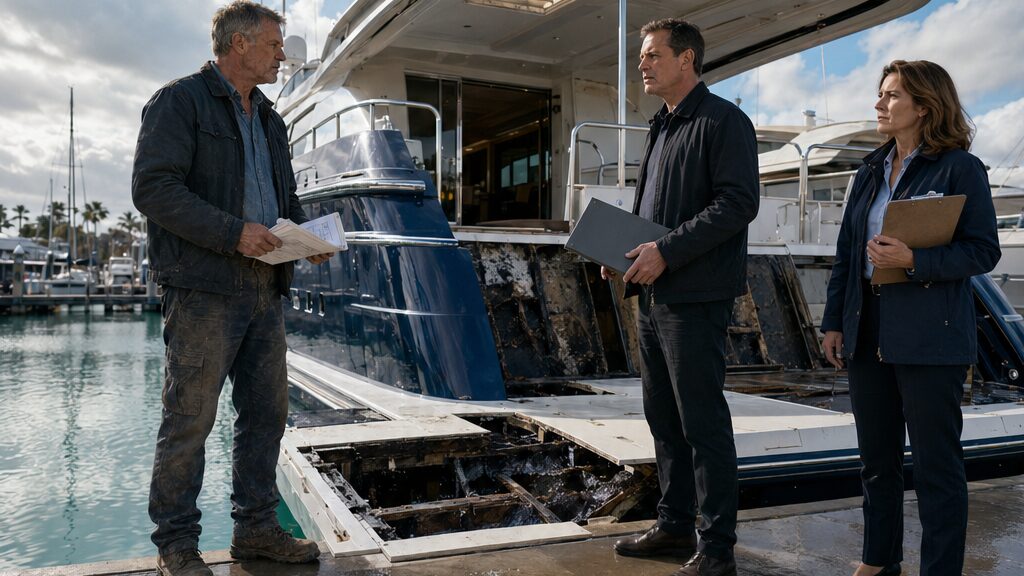
The yacht sat quiet in the morning light, the unfinished interior passage exposed where panels had been removed. The celebration atmosphere from the previous day was gone. No music. No guests. No cameras.
Only the boat and the problem beneath it.
Nicholas stepped onto the aft deck and looked around.
“You made your decision?”
Raymond stood near the opened section of flooring.
“Yes.”
Nicholas waited.
Raymond held up the invoice.
“No.”
The contractor’s expression barely changed.
“No?”
“No additional payment.”
Nicholas sighed as if Raymond had disappointed him.
“Raymond, I understand this feels frustrating. But this is exactly why construction projects become difficult. Owners see a problem and assume the contractor caused it.”
Raymond reached into his jacket and removed the fixed-price scope sheet.
“I paid one hundred eighty-six thousand dollars.”
Nicholas looked away.
“And the project changed.”
“The contract did not.”
“The materials market changed.”
“The contract did not.”
“The original inspection found issues.”
“The inspection you never showed me?”
For the first time, Nicholas paused.
Raymond noticed.
A small pause.
A small crack.
Just like the sound beneath the deck.
“I have been patient,” Raymond said. “I have accepted delays. I have accepted explanations. But I am not paying for work that was already included.”
Nicholas stepped closer.
“You are making a mistake.”
“Maybe.”
Raymond looked down at the exposed section.
“But I want to know what I am paying for.”
Nicholas looked toward the opening.
“Closing that section requires additional structural work.”
“Why?”
“Because we found damage.”
“When?”
Nicholas did not answer immediately.
Raymond pulled out his phone.
“I took photographs.”
Nicholas looked at the screen.
The first image showed the same open section from nineteen days earlier.
The second image showed it yesterday.
Almost identical.
“What changed?” Raymond asked.
Nicholas looked irritated.
“Photographs do not show everything.”
“They show that the same area was open for nineteen days.”
“That was temporary.”
“So where did the work happen?”
Nicholas stepped back.
“You are turning this into an accusation.”
“No.”
Raymond looked at him.
“I am turning it into a question.”
The distinction mattered.
He was not trying to win an argument.
He was trying to understand why a finished yacht was still sitting unfinished.
Nicholas’s voice became colder.
“If you refuse payment, I will have to protect my company.”
“What does that mean?”
“A lien.”
Raymond stared at him.
“You would put a lien on my boat while refusing to explain what was done?”
“I am entitled to payment.”
“Under the agreement?”
Nicholas looked away again.
The movement was small.
But Raymond saw it.
The confidence was still there.
The certainty.
The practiced control.
But now there was something else.
Pressure.
Nicholas collected the remaining tools from the dock workers and instructed them to remove unused materials.
As they carried equipment away, Raymond noticed a small label attached to a discarded piece of material near the work area.
He picked it up.
The supplier name was visible.
It was not the company listed on Nicholas’s invoice.
Pamela arrived shortly after Nicholas left.
She looked at the label in Raymond’s hand.
“Where did you get that?”
“Inside the debris.”
She examined it.
“This is not the material listed in your contract.”
Raymond looked back at the yacht.
The white upper deck reflected the morning sun.
Beautiful.
Expensive.
Carefully finished.
And suddenly it looked less like proof of restoration.
It looked like a cover.
Chapter 3: The Receipt Named a Supplier Who Sold Nothing
The supplier clerk looked at Raymond’s receipt twice before shaking his head.
“I’m sorry. That invoice number doesn’t belong to this project.”
Raymond stood behind the counter holding a copy of Nicholas Baker’s material records.
“Are you sure?”
The clerk turned the screen toward him.
“This number is attached to a different order.”
“From Nicholas Baker?”
“Yes.”
“What was purchased?”
The clerk hesitated.
“Exterior plywood.”
Raymond felt his stomach tighten.
“Marine-grade support beams?”
“No.”
The answer was simple.
Too simple.
He had spent months listening to Nicholas explain specialized materials, technical delays, and rising costs.
Now one phone call had created a question that could not be ignored.
Raymond thanked the clerk and walked back outside.
He did not feel victorious.
He felt tired.
Because every answer created another problem.
At the marina office, Pamela was already dealing with the consequences.
“I had two charter clients call this morning,” she said. “They heard the launch was canceled.”
Raymond placed the supplier records on her desk.
“I think the launch was canceled for a reason.”
Pamela studied the papers.
“You are sure?”
“No.”
Raymond paused.
“That is the problem. I spent months assuming Nicholas was right because he was the expert.”
Pamela looked at him.
“And now?”
“Now I am trying to separate what I know from what I hoped.”
That afternoon, Donna Green approached him near the docks.
She owned a smaller vessel two slips away.
“I heard you had problems with Nicholas.”
Raymond looked cautious.
“I’m trying to understand them.”
Donna looked toward the yacht.
“He used the same phrase with me.”
“What phrase?”
“Unexpected structural damage.”
Raymond said nothing.
Donna looked uncomfortable.
“I settled with him.”
“Why?”
“Because I wanted it over.”
Her voice became quieter.
“I thought fighting would cost more than losing.”
Raymond understood that feeling.
He had almost done the same thing.
Donna gave him a folder.
“I don’t know if this helps.”
Inside were old invoices and emails.
Not proof.
Not enough.
But patterns.
Similar explanations.
Similar timing.
Similar pressure.
Raymond returned to the yacht as the afternoon light faded.
Michael Clark, the independent marine surveyor Pamela recommended, arrived carrying equipment.
“I am not here to prove someone is guilty,” Michael said.
Raymond nodded.
“I need to know what is true.”
“That is the only thing I can help with.”
Michael examined the exposed sections carefully.
He ran a moisture meter along the interior support areas.
The device reacted immediately.
His expression changed.
“That is not good.”
Raymond watched him.
“What does it mean?”
“It means the problem may not be cosmetic.”
Michael moved farther along the deck.
“There is moisture beneath sections that were supposed to be rebuilt.”
Raymond looked at the polished surface above them.
The white panels.
The smooth finish.
The image Nicholas had sold him.
“How bad?”
Michael did not answer immediately.
“That depends on what is underneath.”
The words stayed with Raymond.
What is underneath.
That night, he stood beside the yacht with the original scope sheet in his hand.
He added dates.
Questions.
Contradictions.
The paper that once represented trust had become a map of everything he failed to ask.
Michael returned one final reading.
Then he looked at Raymond.
“We need to consider a destructive inspection.”
Raymond stared at the yacht.
“Meaning?”
“We remove enough of the finished structure to see what was actually built.”
The idea felt impossible.
The entire point of the restoration had been to make the yacht beautiful again.
Now the only way to know the truth might be to destroy the beauty.
Raymond looked at the white deck beneath the fading marina lights.
For the first time, he understood the real choice.
He could protect the appearance of the yacht.
Or he could protect the yacht itself.
The next morning, Michael’s moisture report would decide whether he still had a choice.
Chapter 4: The Polished Deck Was Hiding Something Worse
The probe disappeared through the support beam without resistance.
Raymond watched Michael Clark push the thin inspection tool into the section Nicholas Baker had called newly rebuilt. He expected pressure. He expected the tool to stop against solid material.
Instead, it slipped forward.
Michael withdrew it slowly.
No one spoke.
The silence on the yacht felt heavier than the machinery noise coming from the other side of the marina.
“What did you find?” Raymond asked.
Michael looked at the tool.
“Moisture.”
Raymond stared at the opening.
“There is moisture inside the support?”
“There is moisture where there should not be any.”
Michael crouched beside the exposed section and examined the edges of the white deck panel.
“This was sealed before the structure was ready.”
Raymond felt his jaw tighten.
“Can you prove that?”
Michael looked up.
“I can document what I see. I cannot tell you exactly what someone intended.”
That answer frustrated Raymond.
He wanted certainty.
He wanted someone to point at Nicholas and explain everything.
Instead, he had another piece of evidence that created another question.
Michael continued moving through the yacht, testing different sections.
The results were worse each time.
Some areas showed water intrusion. Others showed signs that materials had been replaced or reinforced incorrectly. One support area had been covered so neatly that the damage underneath was almost impossible to notice.
Almost.
Raymond ran his hand along the edge of the scope sheet inside his jacket.
The paper had become worn from being folded and unfolded.
A document that once represented a promise now represented a failure of trust.
“How bad is it?” Raymond asked.
Michael stood.
“I cannot answer that without opening more.”
“How much more?”
“Enough that you may not like what you find.”
Raymond looked toward the marina.
The yacht sat exactly where it had sat during the failed relaunch.
Beautiful from a distance.
Broken up close.
The same contradiction had followed him for weeks.
“Can we repair the damaged sections without removing the finish?” Raymond asked.
Michael hesitated.
“That is the question you need to answer.”
Raymond frowned.
“What do you mean?”
“You have to decide what matters more.”
Michael pointed toward the polished deck.
“The appearance of completion.”
Then he pointed toward the exposed structure.
“Or knowing what is actually holding the boat together.”
The words stayed with Raymond.
Because he already knew the answer.
He just did not want to accept the cost.
Later that afternoon, Nicholas sent a formal notice.
It arrived by email and printed copy.
A lien warning.
The language was careful, professional, and cold.
Nicholas claimed Raymond had interrupted the restoration, prevented completion, and refused payment for additional necessary work.
Raymond read the document twice.
The accusation felt backwards.
He had hired someone to restore his yacht.
Now he was being accused of causing the failure by asking questions.
Pamela found him standing outside the marina office with the notice in his hand.
“He filed already?”
Raymond nodded.
“He says I stopped the project.”
Pamela looked toward the yacht.
“Did you?”
Raymond opened his mouth.
Then stopped.
The honest answer was complicated.
He had delayed inspections.
He had accepted explanations.
He had pushed forward because the launch date mattered.
“I should have checked sooner,” he said.
Pamela studied him.
“That does not mean the work was acceptable.”
“No.”
Raymond folded the notice.
“But it means I need to be honest about my part.”
That evening, as workers prepared to secure the yacht for another night, someone approached from the far end of the dock.
Larry Hill.
He had worked on the fiberglass sections.
Raymond recognized him from the restoration crew.
Larry looked nervous.
“Can I talk to you?”
Raymond glanced toward the yacht.
“About what?”
Larry looked at the white deck.
“What’s underneath it.”
Raymond did not answer.
Larry reached into his truck and removed a small piece of fiberglass.
A broken section.
A piece from Blue Horizon.
“I need my wages,” Larry said.
Raymond looked at the fragment.
“You came here to ask me for money?”
“No.”
Larry swallowed.
“I came here because Nicholas is going to let everyone think this was my fault.”
Raymond looked at him carefully.
“You worked on the boat.”
“Yes.”
“You helped install those panels.”
Larry looked away.
“Yes.”
The answer was quiet.
Not defensive.
Not proud.
Just tired.
Raymond took the fragment from him.
“What happened?”
Larry looked back toward the marina lights.
“I can tell you.”
A pause.
“But I need to know you are not going to pretend I had nothing to do with it.”
Raymond studied the man.
Months earlier, he would have wanted someone simple.
A villain.
A victim.
A clear answer.
Instead, he had a contractor under pressure, a subcontractor afraid of losing income, and himself standing in the middle of a mistake he had helped hide by refusing to look closely.
“Tell me the truth,” Raymond said.
Larry nodded.
“But not here.”
He looked at the yacht.
“Not until you are ready to see how much of it is not what you paid for.”
Chapter 5: The Worker Who Stayed Silent Wanted His Money Too
Larry Hill placed the fiberglass fragment on the workbench like it was evidence from a crime scene.
But there was no dramatic reveal.
No single moment where everything became clear.
Only a damaged piece of a yacht and a man who looked exhausted from carrying something too long.
The marina workshop was empty except for the two of them.
Raymond kept the original scope sheet beside him.
He had learned something important over the last few days.
Every conversation needed something solid nearby.
A document.
A photograph.
A date.
Something that could survive after people changed their stories.
Larry noticed the papers.
“You’re keeping records.”
“I should have started earlier.”
Larry nodded slowly.
“I should have talked earlier.”
The admission sat between them.
Raymond looked at the fiberglass piece.
“Where did you remove this?”
“Near the upper deck support.”
“When?”
“Before Nicholas finished the surface.”
Raymond looked up.
“Finished?”
Larry rubbed his hands together.
“Nicholas told us the outside needed to look complete before inspection.”
“Why?”
“He said owners and inspectors react to what they see.”
Raymond felt something cold move through him.
The phrase sounded familiar.
Appearance.
Presentation.
Confidence.
The same things Nicholas had used from the beginning.
“What was underneath?” Raymond asked.
Larry hesitated.
“Damage.”
“How much?”
“I don’t know everything.”
Raymond waited.
Larry looked uncomfortable.
“There were sections that should have been replaced before the deck was closed.”
“But they were not.”
“No.”
“Why?”
Larry looked down.
“Because Nicholas said we would come back after launch.”
Raymond stared at him.
“After launch?”
Larry nodded.
“He said nobody would notice. He said the boat would be working, money would come in, and he could finish the repairs later.”
Raymond looked at the yacht through the workshop window.
That was the part he could not understand.
The risk.
Not just the money.
Not just the contract.
The risk of putting people on the boat.
Charter guests.
Families.
Employees.
“You knew it was unsafe.”
Larry closed his eyes briefly.
“I knew something was wrong.”
“That is not the same answer.”
“No.”
Larry looked at him.
“It isn’t.”
The honesty made the conversation harder.
Raymond had wanted a witness.
Instead, he had found someone who had also made a choice.
“Why tell me now?” Raymond asked.
Larry gave a bitter laugh.
“Because Nicholas stopped paying us.”
The answer surprised Raymond.
“You waited because you wanted your money.”
“Yes.”
Larry did not try to hide it.
“I have rent. Bills. A family.”
He looked at the floor.
“I told myself I was only following instructions. Then I told myself someone else would notice. Then I told myself it was too late.”
Raymond understood that kind of thinking.
He had done something similar.
Every delay from Nicholas had become easier to accept because admitting the truth meant admitting he had made a mistake.
“Did Nicholas use other materials?” Raymond asked.
Larry reached into his truck and returned with a folder.
Inside were photographs.
Not professional reports.
Not perfect evidence.
Phone pictures.
The yacht before the white panels were sealed.
Open sections.
Temporary supports.
Areas where the final surface existed only to hide what was unfinished beneath it.
Raymond studied each image.
The yacht he had imagined restoring was not there.
Only the version Nicholas wanted him to see.
“There’s more,” Larry said.
Raymond looked up.
“What?”
“Nicholas wasn’t just behind on your boat.”
Larry hesitated.
“He was moving money around.”
“From where?”
Larry looked uncomfortable.
“Other projects.”
Raymond thought of Donna.
Her folder.
Her settlement.
The same explanation.
The same pattern.
“Can you prove that?”
“No.”
Larry shook his head.
“But I can tell you what I saw.”
Raymond gathered the photographs.
“You will need to tell someone officially.”
Larry looked afraid.
“If I do that, I lose work.”
“If you don’t, someone else may lose more.”
Larry did not answer.
The next morning, Raymond met Pamela at the dock.
A storm front was moving closer.
The marina had issued a warning.
The compromised yacht could not remain exposed indefinitely.
Pamela looked at the survey reports.
“The service basin can handle the dismantling.”
Raymond knew what she meant.
Dismantling.
Not repair.
Not adjustment.
The finished deck would have to come apart.
The very thing Nicholas had used to convince everyone the yacht was restored would need to be destroyed to find the truth.
“How long?” Raymond asked.
“Not long.”
“And if we wait?”
Pamela looked toward the water.
“Then we risk the damage spreading.”
Raymond walked onto the yacht alone.
His hand moved across the white upper deck.
Months of payments.
Months of waiting.
Months of believing.
He had wanted the relaunch to prove he was still capable.
Still in control.
Now he had to accept the opposite.
The only way to protect what remained was to admit what had already been lost.
When he returned to the dock, Pamela was waiting.
“Raymond?”
He looked at the yacht.
Then at the cranes resting in the service area.
“Schedule the removal.”
Pamela was quiet.
“You understand what that means?”
“Yes.”
Raymond held the scope sheet in his hand.
For once, he was not trying to preserve an image.
He was trying to preserve the truth.
Chapter 6: He Ordered the Cranes to Tear Open His Own Yacht
The crane claws hung above Blue Horizon before sunrise.
Raymond had seen them used hundreds of times at the marina.
Moving equipment.
Lifting engines.
Transporting heavy materials.
Never for his own yacht.
Never above the boat he had spent his retirement savings trying to save.
Nicholas Baker arrived before the first panel was removed.
He stepped onto the dock wearing the same calm expression he always wore.
But this time Raymond noticed something different.
The confidence looked forced.
“You cannot do this,” Nicholas said.
Raymond stood beside Michael and Pamela.
“The inspection requires access.”
“You are destroying completed work.”
“No.”
Raymond looked at the yacht.
“I am removing what is preventing us from seeing the truth.”
Nicholas shook his head.
“You are making a terrible decision.”
Maybe.
Raymond accepted that possibility.
That was what had changed.
He no longer needed every decision to prove he was right.
He only needed it to be responsible.
Nicholas stepped closer.
“If you damage this vessel, you own the consequences.”
Raymond looked at him.
“Signatures matter, Nicholas.”
He held up the authorization form.
“So does what is underneath them.”
The crane operator waited.
The entire marina seemed quieter.
Other boat owners watched from a distance.
Some whispered.
Some recorded.
Raymond understood the irony.
The public moment had returned.
But this time there was no celebration.
No polished presentation.
No music.
Only a decision.
He signed the authorization.
Then he added one handwritten note.
All removed sections must be preserved for independent inspection.
Michael read it.
“Good.”
Raymond handed him the document.
“Start.”
The first crane moved.
The metal claw lowered toward the white upper deck.
Nicholas took a step forward.
“You are going to regret this.”
Raymond did not respond.
The claw closed.
The sound was not like an explosion.
It was worse.
It was the sound of something valuable being sacrificed.
The white surface cracked.
The polished finish broke apart.
Water sprayed from the exposed section as the crane lifted.
And beneath the beautiful exterior was exactly what Raymond had feared.
Dark, damaged supports.
Missing sections.
Improper materials.
The crowd became silent.
Michael moved closer, documenting everything.
Raymond stood still.
The yacht looked destroyed.
Anyone watching from the outside would have seen a man standing beside a ruined boat.
But Raymond saw something else.
A lie being opened.
The second panel came away.
Then the third.
The deeper they went, the clearer the pattern became.
The deck had not failed because of one hidden defect.
It had failed because the restoration had been built around appearances.
Michael held up a piece of material.
“This is not the specified support.”
Raymond looked at it.
The truth was finally visible.
But it did not feel like victory.
It felt like confirmation of a loss he had already known was coming.
Nicholas continued arguing.
“You are taking this out of context.”
Michael turned.
“The structure is the context.”
Nicholas looked toward Raymond.
“You think this proves everything?”
Raymond looked at the destroyed upper deck.
“No.”
Nicholas seemed surprised.
Raymond continued.
“It proves enough to keep looking.”
That was the difference.
He no longer needed one perfect moment.
One perfect document.
One person to save him.
He had spent weeks gathering pieces.
Now the pieces were finally meeting.
As another section lifted away, Michael stopped.
He looked underneath the removed structure.
“There is something here.”
Raymond moved closer.
A marking was visible on one of the removed supports.
A serial number.
Michael photographed it.
Then he checked another piece.
Same marking.
“This material came from another vessel.”
Donna, watching from the dock, stepped closer.
“What vessel?”
Michael looked at the records.
“I don’t know yet.”
But Raymond saw Donna’s expression change.
She recognized something.
“What is it?” Raymond asked.
Donna looked at the removed material.
“That number.”
She opened the folder she had brought weeks earlier.
“The same number appeared in my complaint.”
Raymond looked at the yacht.
The cranes continued pulling away the polished surface.
The same cranes Nicholas had warned would destroy everything were now exposing what he had hidden.
But the discovery created a new question.
If the materials came from another project…
How many others had been built the same way?
Chapter 7: The Boat Was Rebuilt, but Not the Trust He Spent
Nicholas Baker placed the settlement offer on the table before Raymond even sat down.
The number was larger than Raymond expected.
That was the problem.
For months, every decision had come down to money. Every delay. Every excuse. Every compromise.
Now Nicholas was offering enough to make the conflict disappear.
Raymond looked at the document.
“Withdraw the licensing complaint,” he said.
Nicholas leaned back.
“That is a reasonable condition.”
“No.”
Nicholas frowned.
“You have a chance to recover money quickly.”
Raymond looked around the small mediation room.
No marina crowd.
No cameras.
No polished yacht behind them.
Just paperwork, two chairs, and the reality of what had happened.
“You want me to sign away the only process that looks at the whole pattern.”
Nicholas folded his hands.
“There is no pattern.”
Raymond almost laughed.
Not because it was funny.
Because months earlier, he might have believed him.
The old Raymond would have searched for a way to avoid another fight.
He would have thought about the charter season.
The reputation.
The embarrassment.
The easier path.
But that version of himself had helped create the silence Nicholas depended on.
“I am not accepting this,” Raymond said.
Nicholas’s expression hardened.
“You are risking getting less.”
“I know.”
“You might not recover everything.”
“I know.”
The answer surprised even Raymond.
Because it was true.
He did know.
There would not be a perfect ending.
There would not be a check that restored every lost charter booking, every missed opportunity, every month spent worrying about whether the boat beneath him was safe.
The loss had already happened.
The question was what he would do with it.
The mediation ended without an agreement.
Three weeks later, Raymond sat before the licensing board intake officer with folders stacked in front of him.
Not one dramatic piece of evidence.
Not one document that solved everything.
A collection.
Photographs.
Supplier records.
The original contract.
Inspection reports.
Larry’s statement.
Donna’s records.
The removed materials from Blue Horizon.
The truth had arrived slowly.
That was the part Raymond understood now.
Nicholas had depended on speed.
Fast decisions.
Fast payments.
Fast explanations.
He had depended on people feeling too tired or embarrassed to look deeper.
Raymond had been one of those people.
When the intake officer reviewed the records, she asked a question Raymond had expected but still disliked hearing.
“Mr. Lewis, did you approve payments before receiving independent verification of progress?”
Raymond looked at the table.
“Yes.”
“Why?”
The old answer would have been complicated.
He could have blamed the deadline.
The pressure.
The promises.
Instead, he gave the simplest answer.
“Because I wanted the project to succeed.”
The officer waited.
Raymond continued.
“And because I did not want to admit I might have made the wrong decision.”
The room was quiet.
That admission did not weaken his complaint.
It strengthened it.
Because for the first time, Raymond was not trying to present himself as the perfect owner who had been fooled.
He was a person who trusted the wrong person and failed to ask enough questions.
That was exactly why the situation had lasted.
The final review took another month.
The bonding company approved a partial claim.
It did not cover everything.
It did not replace the lost summer income.
It did not restore the years of trust Raymond had built with Nicholas.
But it covered enough of the correction work to make rebuilding possible.
The licensing board also moved forward with a suspension review after multiple complaints were combined.
Donna submitted her records.
Larry provided his statement.
Even then, Larry did not walk away without consequences.
His own role was documented.
He had followed instructions.
But he had also helped cover damaged sections.
Raymond thought that mattered.
Everyone involved had choices.
Some choices were made under pressure.
Some were made out of fear.
But they were still choices.
Four months after the cranes opened Blue Horizon, the yacht sat back at the service dock.
Different.
The luxury finishes Nicholas had promised were gone.
The rebuilt upper deck was simpler.
Cleaner.
The inspection panels were visible instead of hidden.
The design looked less impressive from a distance.
Raymond preferred it that way.
Michael Clark walked across the deck during the final safety inspection.
He stopped near the center.
“Feels different.”
Raymond looked down.
“No movement.”
Michael smiled slightly.
“That is usually a good sign.”
Raymond placed his foot firmly against the surface.
Solid.
No cracking.
No softness.
No question.
The folded scope sheet sat inside a protective folder now.
He kept it.
Not as a reminder of Nicholas.
As a reminder of himself.
The mistake was not that he trusted someone.
Trust was necessary.
The mistake was believing that asking questions meant he had failed.
Pamela approached from the dock.
“You taking clients out next week?”
Raymond nodded.
“A smaller schedule.”
“Because of the money?”
“Partly.”
He looked at the yacht.
“Because I want to keep it manageable.”
Pamela smiled.
“That sounds different from the Raymond who tried to launch this boat before it was ready.”
Raymond looked out at the water.
“That Raymond was trying to prove something.”
“And now?”
Raymond ran his hand along the simple white railing.
“Now I just want the boat to do what it was built to do.”
The marina was quiet.
No crowd.
No presentation.
No applause.
Just the sound of water against the dock and the steady weight of a yacht that was finally safe.
The cranes that once looked like they were destroying everything had revealed what needed to be saved.
And Raymond finally understood that ownership was never about showing people what he had built.
It was about having the courage to face what was underneath.
The story has ended.