The Red Door Everyone Feared Was Hiding the One Thing Robert Could Not Lose
Chapter 1: The Red Door Nobody Could Stop Watching
The phone appeared above Robert Mitchell’s fence at 7:18 on a Tuesday morning.
Just the top half at first—a black rectangle held sideways, camera lens pointed into his yard. Then a hand rose beneath it, pale fingers gripping the case, and the phone tilted toward the weathered red door set into the stone wall behind Robert’s house.
Robert stopped with the hose running over his boot.
For two seconds, neither person moved.
Then Robert shut off the nozzle and crossed the lawn.
The phone vanished.
“Hey.”
A sneaker scraped concrete on the other side of the fence.
Robert reached the gate in time to hear quick footsteps retreating down the sidewalk. He did not open it. He stood with one hand on the latch, jaw tight, listening until the sound disappeared.
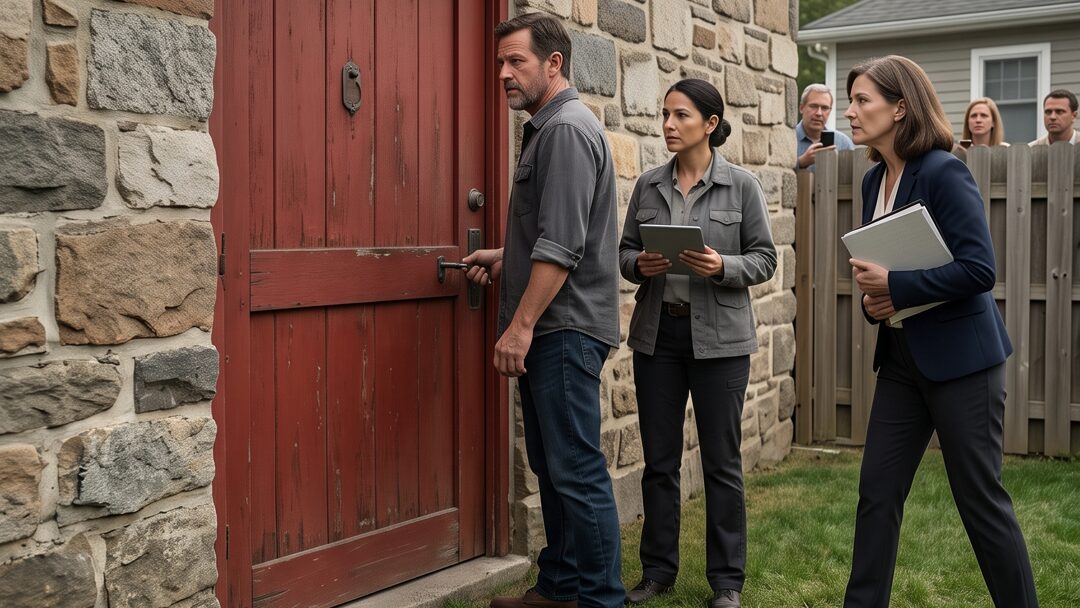
Behind him, the red door remained exactly as it had for years: five heavy vertical planks, faded unevenly by sun, iron hinges dark with age, a brass keyway beneath a thick steel hasp. It looked older than the house because most of it was. Robert had built it from salvaged oak, then painted it the particular deep red his wife had chosen from three sample cards spread across the kitchen table.
Nobody in the neighborhood knew that.
Lately, everybody seemed to know everything else.
He turned the hose back on.
At nine thirty, Virginia Hall rang the front bell.
Robert saw her through the narrow window beside the door and considered staying silent. Virginia held a folder against her ribs and wore the expression she brought to annual meetings when somebody had parked a boat trailer three inches beyond an approved line.
He opened the door.
“Morning, Robert.”
“Virginia.”
“I was hoping we could clear something up.”
“That usually means you already decided what it is.”
Her mouth tightened. “There have been complaints.”
“About?”
She glanced past him as if the answer might be visible through his house.
“The structure in your rear yard.”
“It’s been there twelve years.”
“The stone wall has been there. The question is what’s behind it.”
Robert rested one hand on the edge of the door.
Virginia noticed.
“I’m not asking out of personal curiosity.”
“Good.”
“I’m asking as HOA president.”
“That doesn’t give you the right to inspect the inside of my property.”
“No one said inspect.”
“You came with a folder.”
A pause.
Across the street, a lawn service truck idled beside the curb. Robert could hear a blower somewhere two houses down, rising and falling.
Virginia lowered her voice.
“People have seen deliveries.”
“People see a lot from windows.”
“They’ve seen you letting strangers through the side gate.”
“One stranger.”
“More than once.”
Robert looked at her.
Virginia took the look as resistance and pushed forward.
“There are concerns about commercial activity. There are concerns about electrical equipment. Timothy says he’s seen light coming through that structure late at night.”
Robert’s fingers hardened against the doorframe.
“Timothy watches my yard through binoculars now?”
“I didn’t say binoculars.”
“No. You were careful not to.”
Virginia exhaled through her nose. “Robert, nobody wants a fight. Tell me what the structure is used for, and I can probably settle half of this before lunch.”
Probably.
The word irritated him more than the rest.
He said, “It’s private.”
Her expression changed—not dramatically, but enough.
“That answer is becoming a problem.”
“For whom?”
“For you, if people keep filing complaints.”
Robert closed the door.
At noon, he carried a small brown-paper-wrapped pot from behind the red door to the side gate. An orchid customer waited there, a woman in running shoes holding an envelope.
“Sorry,” she said. “I only had twenties.”
Robert took out ten dollars and gave it back.
“You’re sure? Nicole said this one was harder to find.”
“Ten is fine.”
The woman glanced toward the back of the yard. “Is that the famous door?”
Robert went still.
She smiled uncertainly. “Sorry. Neighborhood group chat. My sister lives on Cedar.”
He handed her the plant.
“What are they saying?”
“Oh, nothing. People being people.”
“That isn’t an answer.”
The smile disappeared.
“That you built some kind of underground room. Somebody said maybe a workshop. Somebody else said the power usage was strange.” She lifted the orchid slightly. “I figured it was plant stuff.”
Robert said nothing.
The customer looked embarrassed now. She thanked him and left.
He locked the gate behind her.
Inside the red door, warm filtered light spread over rows of leaves. A fine mist ticked through one overhead line. Robert stood just inside until the automatic valve clicked off.
He moved among the benches without needing to read the labels. He knew which plants wanted more air, which ones punished impatience, which roots should be left alone even when they looked wrong.
At the far end, a white orchid leaned toward the glass.
Robert touched the edge of its wooden label with one finger.
The handwriting had faded but not disappeared.
He did not stay long.
That afternoon Timothy Brown called over the fence.
Robert was carrying a bag of bark mix toward the rear yard when Timothy’s head appeared above the cedar panels.
“You got a minute?”
“No.”
Timothy ignored that. He was seventy if he was a day, narrow-shouldered, white-haired, perpetually dressed as though he might need to repair a sprinkler.
“Virginia came by.”
“I know.”
“She asked me about the lights.”
Robert stopped.
“What did you tell her?”
“That I saw them.”
“Through my fence?”
“From my upstairs window. Robert, come on. It’s not like I’m spying.”
Robert looked at him until Timothy shifted his weight.
“What time?”
“What?”
“What time did you see the light?”
“Late.”
“That isn’t a time.”
“Eleven. Maybe later.”
Robert remembered the night. A temperature sensor had failed. He had sat on an overturned bucket replacing a relay while the greenhouse warmed too quickly around him.
Timothy rubbed his mouth.
“I told her it could be nothing.”
“Did you?”
“Yes.”
“And what did you think it was?”
Timothy looked toward the stone wall.
“That’s the problem, isn’t it? Nobody knows.”
Robert picked up the bag again.
Timothy said, “You could just tell people.”
Robert turned.
“No, Tim. I could tell you. Then you could tell Virginia. Then Virginia could tell the board. Then somebody could post it in a group chat. Then somebody who has never been inside my home could decide whether my reason is acceptable.”
Timothy’s face colored.
“I didn’t post anything.”
“I didn’t say you did.”
“You make it hard to be on your side.”
“I didn’t ask you to be.”
Robert walked away before Timothy could answer.
At five fourteen, the mail carrier left a certified envelope.
Robert knew the HOA management company’s return address before he picked it up.
He carried it to the kitchen and set it unopened beside the sink.
For nearly an hour, he made coffee, forgot to drink it, checked the thermostat behind the red door, tightened a loose hinge screw, and returned twice to the kitchen without touching the envelope.
At last he cut it open with a paring knife.
The first page was titled FORMAL REQUEST FOR INFORMATION AND RECORDS.
Below that sat a photograph of the red door.
Taken from above the fence.
Robert read the first paragraph once.
Then again.
The complaint cited possible unapproved commercial use, unregistered electrical modifications, and a concealed structure of unknown function.
Near the bottom, one phrase had been bolded.
Possible hazardous use.
Robert stood alone in the kitchen, the page trembling slightly between his hands.
Chapter 2: A Rumor Becomes an Official Record
Four days later, Robert walked into the HOA office and saw his red door printed across the first page of a violation packet.
The photograph had been enlarged until every crack in the paint looked sinister.
Virginia sat at the far end of a conference table. An HOA management representative occupied the chair beside her, laptop open. Robert remained standing.
“Who took that?”
Virginia looked at the photograph.
“I don’t know.”
“It was taken over my fence.”
“I understand your concern.”
“No, you don’t. Who took it?”
The management representative said, “Mr. Mitchell, today’s meeting is about resolving the underlying compliance questions.”
Robert pulled out a chair but did not sit.
“The underlying question is why somebody was photographing my yard.”
Virginia folded her hands.
“And my underlying question is why a longtime resident is refusing to identify the use of a structure that may involve unapproved electrical work and commercial traffic.”
“May involve.”
“Yes.”
“Meaning you don’t know.”
“That is why we are asking.”
Robert finally sat.
The packet contained six pages. Complaint summaries. A section of the covenants. Two photographs. A handwritten note reporting “repeated unknown visitors.” An email referencing late-night lighting. A screenshot from the neighborhood group chat had been included with usernames blacked out.
One message read:
Does anyone know if the city has checked that bunker thing?
Robert stared at it.
Virginia said, “I didn’t write that.”
“You included it.”
“As evidence of growing resident concern.”
“It’s evidence of gossip.”
The management representative tapped a pen against the table.
“We can narrow this substantially if you provide a description of use and allow a visual confirmation by an architectural-committee member.”
“No.”
Virginia leaned back.
“Robert.”
“No committee member enters my backyard because people invented a bunker.”
“Then provide records.”
“What records?”
“Original approval. Current use. Electrical permits if applicable.”
Something moved behind Robert’s ribs.
Not fear exactly.
Recognition.
He kept his face still.
Virginia saw something anyway.
“You have permits?”
“The wall was approved.”
“That wasn’t my question.”
“The wall and accessory structure were approved when built.”
“Under what classification?”
Robert closed the packet.
Virginia’s gaze sharpened.
The answer was in a manila folder in Robert’s desk at home, beneath tax records and a warranty for a refrigerator he no longer owned.
Accessory storage structure.
That was what the old paperwork said.
Storage.
Years later, after added glazing, environmental controls, irrigation, and electrical changes, the city had sent a routine inquiry following a property-record update. Robert had opened it during the last winter his wife was alive.
Then he had put it away.
Months after her funeral, another notice came.
He had put that away too.
The management representative said, “Mr. Mitchell?”
Robert stood.
“You can send me whatever formal request you believe you’re entitled to send.”
Virginia’s voice hardened. “We already did.”
“And I’m declining informal access.”
He left the packet on the table.
Virginia called after him.
“Silence doesn’t make this disappear.”
Robert stopped at the door but did not turn around.
“No. Apparently it makes people creative.”
By the time he got home, three neighbors who normally waved did not.
One pretended to be checking a mailbox. Another pulled a child closer to the sidewalk when Robert’s truck passed, a movement so slight he might have imagined it.
He did not imagine the phone in Timothy’s hand.
Timothy stood at the end of his driveway, reading something. When he saw Robert, he lowered the screen.
Robert kept walking.
In his kitchen, the violation packet waited where Nicole had placed it.
She was sitting at the table.
Robert stopped.
“You let yourself in.”
“You gave me a key.”
“That wasn’t criticism.”
“It sounded like it.”
Nicole had her mother’s way of going still before an argument. Not cold. Concentrated.
She tapped the packet.
“I got a call from Virginia.”
Robert’s face changed.
“She called you?”
“She asked whether I knew what the structure was being used for.”
“And?”
“I told her to talk to you.”
“Good.”
“No, Dad. Not good.”
Robert opened a cabinet.
“Coffee?”
“You’re changing the subject.”
“I’m making coffee.”
“You already made coffee.”
The pot on the counter was half full.
He shut the cabinet.
Nicole slid one page toward him.
“This says they requested permits.”
“I saw it.”
“Do you have them?”
“Yes.”
“All of them?”
Robert said nothing.
Nicole looked at him for several seconds, then stood.
“Where’s the old city file?”
“You don’t need it.”
“That means no.”
“It means I’ll handle it.”
She walked past him toward the small room he used as an office.
“Nicole.”
She opened the desk drawer.
Robert moved faster than he intended and caught the drawer before it came all the way out.
She looked down at his hand.
Then at him.
The shame came before the anger, and because it came first, he became angry.
“This is my house.”
Her voice dropped.
“I know.”
He released the drawer.
Nicole opened it slowly.
She found the folder in less than a minute.
Robert watched her read the first inquiry.
Then the second.
The room seemed too small for both of them.
The first notice was dated five years earlier.
The second, four years and eight months.
Nicole looked up.
“You knew.”
“It was an inquiry.”
“It says the recorded classification may no longer match the use.”
“It wasn’t a citation.”
“It asked you to schedule a review.”
“Your mother was sick.”
Nicole flinched so slightly another person might have missed it.
Robert did not.
He said, “That’s what was happening.”
“I know what was happening.”
“I didn’t have time to argue about a building classification.”
“And after?”
Robert’s mouth closed.
Nicole lifted the second notice.
“This came after.”
“Not long after.”
“Eight months.”
He looked away.
She set both pages on the desk.
“I could have helped.”
“I didn’t need help.”
“That’s your favorite sentence.”
Robert heard the bitterness in it and hated that he had earned some of it.
From outside came a car door shutting.
Nicole went to the window.
A white municipal vehicle had pulled to the curb.
A woman stepped out carrying a tablet and a document case.
Robert’s stomach tightened.
Nicole looked at him.
“You said you’d handle it.”
“I am handling it.”
“No. You’re waiting until handling it means somebody comes to the house.”
The doorbell rang.
The woman introduced herself as Elizabeth Torres from municipal code compliance. She was polite, efficient, and visibly uninterested in neighborhood drama.
“I’m not here to enter today,” she said. “This is notice of an assigned inspection request. We received a complaint involving possible unpermitted change of use and electrical modifications.”
“From the HOA?”
“I can’t discuss complainant details beyond the file.”
Virginia, then. Or somebody using Virginia’s language.
Elizabeth handed him the notice.
“We can schedule a voluntary access inspection. Otherwise, the city reviews next steps based on available records.”
Nicole stood behind him in the hallway.
Robert asked, “Do I have a choice about who attends?”
“For city access? Yes. The city inspector. Additional personnel only if required by safety conditions or separately authorized.”
“No HOA representatives?”
“Not unless you invite them.”
That was the first useful sentence Robert had heard all week.
He scheduled the inspection.
After Elizabeth left, Nicole remained by the front window.
Robert read the notice.
“You’re angry.”
She laughed once without humor.
“You think?”
“I mean about the paperwork.”
“I’m angry because you let this become bigger than it had to be.”
“They had no right to spread rumors.”
“I didn’t say they did.”
“You’re sounding like Virginia.”
Nicole turned.
“No. I’m sounding like your daughter.”
The words stopped him.
She took a breath.
“I know what’s behind that door. I know why you built it. I know why you lock it. But you don’t get to use Mom as an answer to every question you refuse to face.”
Robert folded the inspection notice once.
Then again.
Nicole’s eyes dropped to his hands.
“You think keeping everybody out means you’re protecting her.”
“Enough.”
“No.”
His head came up.
She was crying now, but quietly, and that made him more afraid than shouting would have.
“You are not the only person she left that place to.”
Chapter 3: When Robert Finally Turned the Key
The patrol car arrived six minutes before the city inspector.
Robert watched it stop across from his house and felt every curtain on the street become an eye.
The officer did not turn on the lights. He stepped out, spoke briefly into his radio, and walked toward Robert’s driveway with the careful neutrality of someone who had already been told the situation might become difficult.
Robert opened the front door before he could knock.
“Why are you here?”
“Good morning, sir. We were asked to provide a standby during a code access visit.”
“Asked by whom?”
“I don’t have that information.”
Robert almost laughed.
Of course not.
Across the street, a man he knew only by his dog had stopped walking. Two houses down, somebody stood beside a hedge holding a coffee mug. Timothy’s upstairs blinds were open.
Then Virginia appeared.
She came down the sidewalk carrying a binder.
Robert stepped onto the porch.
“No.”
She stopped at the foot of his driveway.
“I haven’t said anything.”
“You’re not coming into my yard.”
“I’m HOA president.”
“You’re standing on a public sidewalk.”
Her face tightened.
“The board has a legitimate interest in observing whether an unapproved use exists.”
“The city can tell you what the city finds.”
Virginia glanced toward the patrol officer, perhaps expecting reinforcement.
He said nothing.
Elizabeth Torres arrived at nine sharp.
She got out of the municipal vehicle, saw the officer, saw Virginia, saw the scattered neighbors pretending not to watch, and stopped beside Robert’s mailbox.
“This was described to me as a potentially contentious access situation.”
Robert looked at Virginia.
Virginia said, “There have been significant resident concerns.”
Elizabeth’s expression did not change.
“Mr. Mitchell, are you still consenting to the scheduled inspection?”
“Yes.”
“Any restrictions I should know before entering?”
“Yes.”
Virginia folded her arms.
Robert said, “I want the scope stated here. Out loud.”
Elizabeth glanced at him.
“The scope is visual inspection of the accessory structure identified in the complaint, including apparent use, observable electrical modifications, and any immediate life-safety concerns. I may photograph relevant conditions for the municipal file. This is not a general search of the residence or unrelated property.”
“And the HOA?”
“Is not conducting my inspection.”
Virginia said, “I’m entitled to—”
Elizabeth turned to her.
“You can address association rights separately. Today I’m performing a city function.”
For the first time in days, Robert felt something inside him loosen.
Not relief.
Room.
He opened the side gate.
Elizabeth entered. The patrol officer remained near the driveway until she glanced back and said, “You can stay outside unless I call.”
Virginia took one step forward.
Robert closed the gate.
The latch clicked between them.
He led Elizabeth along the narrow side path.
Neighboring fences rose on both sides. Above one, he saw the top of a phone.
He stopped.
Elizabeth followed his gaze.
The phone disappeared.
“You want to postpone?” she asked.
“No.”
At the rear yard, the red door waited in the stone wall.
Up close, it was less dramatic than the photographs had made it. The paint had thinned around the keyway. One lower plank bore a pale scar from a wheelbarrow handle. Moss grew between stones near the base.
Elizabeth studied it.
“This is the access?”
“Yes.”
“Any secondary exit?”
Robert hesitated.
“Other side. Exterior vented service passage.”
“Show me once we’re inside.”
He took the key from his pocket.
That was when he heard Virginia’s voice beyond the fence.
“Everyone stay back, please.”
Everyone.
Robert looked toward the sound.
He could imagine the scene without seeing it: Virginia managing the audience she had helped create, appearing responsible in front of people who had come because she had made danger sound plausible.
His hand closed around the key.
For one brief, ugly second he wanted to refuse.
Let them get an order.
Let them spend weeks proving what they had a right to see.
Let the door remain shut simply because they wanted it open.
Then he thought of Nicole at the kitchen window.
You are not the only person she left that place to.
Elizabeth said, “Mr. Mitchell?”
He inserted the key.
“Before I open it,” he said, “I want one thing clear.”
She waited.
“If there’s no hazard, that goes in your report.”
“If there’s no observed hazard, yes.”
“Not ‘inconclusive.’ Not ‘unable to verify.’”
“I document what I observe.”
Robert nodded once.
Then he turned the key.
The lock opened with a hard metallic snap.
Outside the fence, somebody murmured.
Robert lifted the hasp.
The red door swung inward.
Warm light spilled across the grass.
Elizabeth did not speak.
Beyond the doorway, rows of orchids rose in green tiers beneath translucent panels. White roots curled over bark. Purple blooms hung in clusters from suspended baskets. Fine mist caught the sunlight and turned briefly silver. Fans hummed high in the rafters. The air was warm and damp, carrying the faint clean smell of moss, wet wood, and fertilizer.
Nicole stood at the central bench with pruning scissors in one hand.
She looked at Robert.
He had not known whether she would come.
For a second, neither of them moved.
Then Elizabeth stepped through the doorway.
“Oh.”
It was the most human sound Robert had heard from her.
Nicole set down the scissors.
“Watch the hose by your left foot.”
Elizabeth moved around it and looked up.
“This is a greenhouse.”
“Yes,” Robert said.
From beyond the fence came another murmur, louder this time.
Virginia’s voice: “What is it?”
Nobody answered her.
Elizabeth walked between the benches, tablet lowered at her side.
“How many plants?”
Nicole said, “Depends what you count as established.”
Elizabeth looked at her.
“Approximately.”
“Three hundred eighty right now. Maybe four hundred with divisions.”
Robert watched the inspector’s attention shift to Nicole’s hands. She was checking leaf undersides as they spoke, turning one pot slightly away from direct light.
“You work here?” Elizabeth asked.
“Part-time. Mostly weekends.”
“Commercial operation?”
Nicole looked at Robert.
He said, “No.”
A beat.
Nicole said, “We sell some extras.”
Robert felt the words land.
Elizabeth’s eyes moved between them.
“What does ‘some’ mean?”
“Divisions. Plants we don’t have space for. Ten dollars, usually.”
“How often?”
Nicole answered carefully. “Not much.”
Robert said, “A few.”
Elizabeth made a note.
Outside, Virginia called again.
“Inspector Torres?”
Elizabeth ignored her.
Robert stared at Nicole.
“You could have let me answer.”
“You did answer.”
Her tone was quiet, but the meaning was not.
Elizabeth continued deeper into the greenhouse.
She examined the misting lines, then the electrical conduit mounted along the stone interior. Robert followed her gaze.
The conduit was clean. Professionally bent. Labeled at the panel.
He had done most of the carpentry himself, but not that.
“Who installed the electrical?” she asked.
“Licensed contractor.”
“Permit number?”
Robert said, “I’d have to look.”
Elizabeth crouched near an outlet enclosure.
“GFCI protection?”
“Yes.”
She tested it.
The power cut instantly.
A fan stopped.
Nicole said, “I’ll reset at the panel.”
“I’ll do it,” Robert said.
She was already moving.
Elizabeth watched Nicole open a narrow cabinet and reset the circuit without hesitation.
“You know the system well.”
Nicole closed the panel.
“I should.”
Robert heard it.
So did she.
Their eyes met for half a second.
Elizabeth went to the rear service passage, checked clearance, photographed the panel, the glazing, and the overhead equipment. She asked factual questions. Robert answered most of them.
Each answer seemed to reduce one kind of danger while increasing another.
No fuel storage.
No sleeping area.
No concealed basement.
No industrial machinery.
No chemical stock beyond ordinary horticultural products.
Yes, supplemental electrical circuits.
Yes, irrigation.
Yes, occasional plant sales.
No, Robert could not immediately produce a certificate reflecting greenhouse use.
At last Elizabeth stepped outside into the yard.
The spectators had multiplied.
Virginia stood beyond the fence with the binder pressed to her chest. Timothy was beside her, looking less pleased than curious. Two other residents hovered several yards back.
Robert felt heat rise into his face.
Elizabeth said, “I need to review the property file before I make any determination.”
Virginia asked, “Is there a hazard?”
Elizabeth looked directly at her.
“I did not observe evidence of the hazardous concealed use described in the complaint.”
Silence.
Somebody across the fence gave a small embarrassed laugh.
Virginia’s expression barely shifted.
“What is in there?”
Elizabeth said, “A greenhouse.”
Timothy blinked.
“A what?”
Nicole appeared in the open doorway carrying a pale yellow orchid she had been repotting.
The effect on the watchers was almost absurd.
For days, they had looked at the red door as though danger itself might be pressing against the other side.
Now Nicole stood framed by flowers.
Virginia stared.
Robert should have felt victorious.
Instead he felt exposed.
Not because they had seen anything shameful.
Because they had seen something that had never belonged to them.
Timothy said softly, “Well, I’ll be damned.”
Virginia looked toward Robert.
“You could have said that.”
The old anger returned at once.
“I could have.”
“You let this escalate.”
Robert stepped toward the fence.
“I let it?”
Elizabeth cut between them with a raised hand.
“This inspection is not a neighborhood meeting.”
Virginia’s face reddened.
“I’m simply pointing out—”
“No,” Robert said. “You’re trying to make the greenhouse my apology.”
Nicole said, “Dad.”
One word.
Enough.
He stopped.
Elizabeth returned to the doorway.
“I need to verify the original approval and subsequent modifications. Mr. Mitchell, do you have the permit history available?”
“Some of it.”
Nicole looked away.
Elizabeth caught the movement.
“How old is the structure?”
“Twelve years.”
“And the current greenhouse use?”
Robert hesitated.
“About nine.”
Elizabeth’s expression changed.
Only slightly.
She reopened the tablet.
“Your property record lists an accessory storage structure.”
The yard seemed to contract.
Virginia heard.
Robert knew because she became perfectly still.
Elizabeth continued.
“That doesn’t mean I’m making a finding here. It means the recorded classification does not appear to match the observed use.”
Virginia said, “So it is unapproved.”
“I did not say that.”
“But there’s a discrepancy.”
“There appears to be one.”
The patrol officer was still near the driveway. The neighbors were still watching. The greenhouse stood open behind Robert in full daylight, harmless and beautiful and suddenly more vulnerable than it had ever been.
Nicole came out beside him.
For one fleeting moment, Robert thought she might take his side without qualification.
Instead she said, very quietly, “Tell her about the inquiry.”
He did not look at her.
Elizabeth did.
“What inquiry?”
Robert felt the key in his palm.
He had forgotten he was still holding it.
“A letter,” he said.
“When?”
“Years ago.”
Virginia’s voice came from beyond the fence.
“You knew?”
Robert turned on her.
Elizabeth stepped closer.
“Mr. Mitchell, I’m going to ask you not to discuss this with anyone else right now. I need facts, not argument.”
She waited until he looked at her.
“Did the city previously contact you about a possible change-of-use discrepancy?”
“Yes.”
Nicole closed her eyes.
Elizabeth nodded once, all admiration gone from her face now, replaced by professional concentration.
“Do you still have that correspondence?”
“Yes.”
“I’ll need copies.”
The neighbors began drifting away, but not with the disappointed embarrassment Robert had imagined. The story had changed again.
The door hid no danger.
But Robert had known something was wrong with the record.
Virginia remained where she was.
Her certainty had been wounded, not destroyed.
Robert saw that clearly.
Elizabeth packed her tablet into its case. Then, before leaving, she drew him a few steps away from the fence.
Her voice was low enough that only Nicole might have heard.
“The greenhouse is beautiful,” she said.
Robert said nothing.
“And based on what I observed today, I saw no concealed hazardous operation.”
He waited.
Elizabeth glanced back at the electrical conduit, then toward the house.
“But your file is not clean.”
Chapter 4: The Beautiful Answer Was Not the Whole Truth
The correction notice was taped to the stone wall beside the red door.
Not mailed.
Not tucked into the front box.
Taped there.
Robert saw the white sheet from halfway across the yard and stopped with a bag of potting bark against his hip.
For days, that door had been the object everyone watched. Now a municipal notice fluttered beside it in the morning air, bright and official enough to be read from Timothy’s upstairs window.
Robert set down the bag.
The top line read:
NOTICE OF REQUIRED RECORDS CORRECTION.
He tore the paper free so hard one strip of clear tape remained on the stone.
Inside the greenhouse, the fans hummed steadily. A misting line clicked on above a bench of young plants. Everything looked exactly as it had before the inspection, which made the notice in Robert’s hand feel more intrusive.
He read the findings twice.
No observed evidence of hazardous concealed use.
No observed sleeping quarters.
No observed industrial operation.
No immediate electrical life-safety condition noted during visual inspection.
Then, lower down:
Apparent use inconsistent with recorded accessory storage classification.
Supplemental electrical and environmental-control modifications require permit-history review.
Possible accessory commercial activity to be clarified.
Robert folded the page.
The worst accusations had weakened.
But the paper in his hand still had teeth.
At ten, he drove to the municipal records office.
The clerk behind the counter brought up his property file and rotated the monitor slightly.
“Original approval is here,” she said. “Stone enclosure and accessory storage.”
“I know.”
“Then there’s a later electrical permit.”
Robert leaned closer.
“Which one?”
“Branch circuit addition. Closed permit.”
Relief moved through him too quickly.
Then the clerk scrolled.
“But I don’t see a final change-of-use approval.”
“There wasn’t a change of use when the wall went up.”
“I’m talking about later.”
“I had a contractor.”
“That’s not the same thing.”
Robert’s jaw tightened.
The clerk was not accusing him. That somehow made it worse.
She printed two pages and slid them across.
One was the old inquiry he already had.
The other was a notation he had forgotten.
PROPERTY OWNER CONTACTED. ADVISED TO REQUEST CLASSIFICATION REVIEW IF STRUCTURE USE HAS CHANGED.
His own initials appeared at the bottom.
Robert stared.
The clerk said, “Looks like you acknowledged receipt.”
“I was dealing with a family medical situation.”
“I’m sorry.”
He almost said, You don’t know what you’re sorry for.
Instead he folded the page.
“Can this be corrected?”
“Usually. Depends on current conditions and what the inspector requires.”
“Usually?”
“You’ll need to work with Inspector Torres.”
He left carrying facts he had spent years pretending were only possibilities.
Nicole was in the greenhouse when he returned.
She stood over the central bench, measuring fertilizer into a clear container.
Robert put the notice and printouts beside her.
“I went downtown.”
She did not look up.
“I can see that.”
“The electrical permit was closed.”
“Good.”
“The use classification wasn’t.”
That made her stop.
Robert waited for relief, sympathy, anything that would let them become allies again.
Nicole set the measuring spoon down.
“What do you need from me?”
“I need the plant inventory. Maybe sales records.”
“How far back?”
“I don’t know.”
“You should ask.”
“I will.”
She capped the fertilizer.
Robert said, “The safety claims are falling apart.”
Nicole looked at him.
“What?”
“Elizabeth’s report. No hazard. No industrial use. Virginia was wrong.”
“That’s good.”
He heard the flatness in her voice.
“You don’t sound like it.”
“I’m glad they were wrong about that.”
“About that?”
“Dad.”
Robert felt the old resistance rise.
“Say it.”
“You knew the file was wrong.”
“I knew there was a question.”
“You signed the acknowledgment.”
He looked at the pages.
“You went through my desk again?”
“No. You left them on the counter.”
A fan turned overhead.
Nicole wiped her hands on a towel.
“I’ll give you the inventory.”
“And the sales list?”
“No.”
Robert stared at her.
“Why?”
“Because I’m not helping you build an argument until you tell Elizabeth the whole part about the inquiry.”
“She has the file.”
“That isn’t the same as hearing it from you.”
“What exactly do you think I’m hiding now?”
Nicole’s expression changed.
That question had gone somewhere he had not intended.
She said, “I don’t know anymore.”
Robert looked away first.
By afternoon, the neighborhood group chat had discovered the report.
He knew because Timothy knocked on the side gate.
Robert nearly ignored him.
“Just a minute,” Timothy called.
Robert opened the gate but stayed in the opening.
Timothy held his phone.
“Virginia posted a board update.”
“Of course she did.”
“She says the city found no immediate hazard.”
Robert waited.
Timothy rubbed the back of his neck.
“She also says there may be commercial use.”
“Did she mention the bunker?”
“No.”
“The illegal chemical storage?”
“No.”
“The dangerous equipment?”
Timothy lowered the phone.
“No.”
Robert gave a short laugh.
“So the correction travels quietly.”
Timothy looked genuinely uncomfortable.
“I told Virginia I never said there was machinery.”
Robert’s attention sharpened.
“What did you say?”
“That I saw light. Late. And deliveries.”
“You said deliveries?”
“I saw people come through the side gate.”
“Customers.”
“I didn’t know that.”
“No. You didn’t.”
Timothy’s shoulders sagged.
“That’s kind of the problem we all had.”
Robert closed the gate.
An hour later, an email arrived from the HOA.
Virginia had not abandoned the matter. She had changed the ground beneath it.
The subject line read:
NOTICE OF POTENTIAL UNAPPROVED HOME-BASED COMMERCIAL ACTIVITY.
Robert read the message standing in the kitchen.
The association requested documentation of all sales, customer visits, signage, inventory, and business use. Pending review, the board reserved the right to seek fines and injunctive relief under the covenants.
The safety story was dying.
Virginia had found another story.
Nicole arrived just before dusk.
Robert had spread the city papers across the table.
“I need your help,” he said.
She set down her keys.
“With the permit?”
“With all of it.”
For a moment, hope crossed her face.
Then Robert added, “We need to show the sales are incidental.”
The hope disappeared.
“You mean you need me to prove Virginia wrong.”
“She is wrong.”
“Maybe about a business. That’s not the only thing happening.”
Robert pushed back from the table.
“What do you want me to do? Sit there while they turn this place into evidence?”
“I want you to stop acting like every question is an attack.”
“They photographed my yard over the fence.”
“Yes.”
“They called the police.”
“Yes.”
“They implied I was hiding something dangerous.”
“I know.”
“Then why are we arguing?”
Nicole looked at him for a long time.
“Because you think being mistreated means you can’t also be wrong.”
The sentence hit cleanly.
Robert stood.
Nicole moved toward the hallway.
“Where are you going?”
“To the greenhouse.”
“For what?”
She did not answer.
He followed.
Inside, she went to the rear cabinet where old tags and records were stored. She pulled out a shallow wooden box.
Robert knew it instantly.
“Put that back.”
Nicole held it against her chest.
The box contained handwritten orchid labels—hundreds of them, some stained with age, some written in ink that had faded from black to brown.
Her mother’s handwriting.
“Put it back.”
“No.”
Robert stepped closer.
“Nicole.”
“You’ve been telling people this is yours to protect.”
“I never said that.”
“You don’t have to.”
She opened the red door.
Robert stood among the orchids, unable to move.
Nicole looked back at him.
“I am not going to let you rewrite what Mom wanted just because you’re scared of what happens if things change.”
Then she carried the box out through the open red door.
Chapter 5: The Names Written Beside the Orchids
The rare orchid was gone.
Robert saw the empty space before he saw anything else.
A clean rectangle marked the bench where the pot had rested for nearly eleven years. The neighboring plants leaned slightly inward, leaves occupying space that had never been available to them before.
Robert stopped in the doorway.
“Nicole?”
No answer.
He crossed the greenhouse fast enough to knock his hip against a bench.
The missing plant was not valuable in the way Virginia would understand value. It was not the most expensive orchid in the collection. It had never won anything. Its flowers were small, pale, almost green.
But his wife had carried it home in her lap during the year before she became ill.
The label had been written in her hand.
Robert checked the lower shelves.
Nothing.
He opened the rear service passage.
Nothing.
By the time Nicole entered through the red door twenty minutes later, he was waiting.
“Where is it?”
She looked at him.
“What?”
“You know what.”
Nicole glanced toward the empty space.
“It’s at my apartment.”
Robert felt heat rise through him.
“You took it?”
“Yes.”
“Without asking.”
“Yes.”
He crossed the aisle.
“You bring it back.”
“No.”
The word was calm.
That made it worse.
“That plant has been here for eleven years.”
“And it was dying.”
“It was not.”
Nicole walked to the empty bench and touched the dry ring left by the pot.
“The roots were collapsing.”
“I checked them.”
“When?”
Robert opened his mouth.
Nicole waited.
He looked away.
She said, “Exactly.”
“I know every plant in here.”
“You used to.”
The greenhouse seemed suddenly full of mechanical noise—the fans, the irrigation valve, a faint vibration from the environmental controller.
Robert said, “You had no right.”
Nicole’s face tightened.
“I moved one plant before you killed it.”
“I was not killing it.”
“You were preserving the idea of it.”
He stared at her.
She did not retreat.
Robert turned toward the bench and saw, with unbearable clarity, the small signs he had missed. A pale patch where one root had dried. Bark mix overdue for replacement. The slight tilt of the neighboring pot from where he had moved it weeks earlier and never corrected it.
Nicole said, “I repotted it last night. Two roots might recover.”
“You should have told me.”
“I tried telling you things.”
“No, you took it.”
“And now you noticed.”
The sentence sat between them.
Robert gripped the edge of the bench.
Nicole walked to the cabinet at the rear.
She had brought back the wooden box of labels.
For one second he felt relief.
Then she set it on the central table and opened it.
The top labels were tied in bundles with faded cotton string.
Robert recognized the handwriting immediately.
Masdevallia—low light.
Cattleya division—Nicole liked this one.
Do not overwater after repotting.
Some labels carried dates. Some carried tiny notes. Some only names.
Robert reached toward one.
Nicole closed the lid halfway.
“Not yet.”
His hand stopped.
“What are you doing?”
“Making you remember.”
He laughed once, bitterly.
“You think I forgot?”
“I think you remember selectively.”
Robert stepped away.
The old red door stood open behind them. He went to it and shut it hard enough to rattle the glass panels.
Nicole flinched.
“Don’t.”
“Don’t what?”
“Use the door like punctuation.”
He looked at her.
That had been her mother’s phrase.
She had said it when he slammed kitchen cabinets during arguments.
Robert’s anger lost its shape.
Nicole opened the box again.
“Mom did not ask you to keep everything exactly the same forever.”
“She asked me to keep the collection alive.”
“Until.”
Robert’s face went still.
Nicole’s voice softened.
“Say the rest.”
He said nothing.
She pulled out a label.
The writing was faint but legible.
For Nicole when she is ready.
Robert looked away.
“You don’t know what she meant.”
“I asked her.”
His head turned sharply.
“When?”
“Near the end.”
“You never told me.”
“You never asked.”
Robert took a step toward her.
“What did she say?”
Nicole’s eyes filled, but she did not look down.
“She said you would try to keep every plant because you’d think losing one meant losing her twice.”
Robert’s mouth tightened.
Nicole continued before he could stop her.
“She said I should wait until I was ready. Then decide what stayed, what got divided, what got given away.”
“No.”
“She said the collection was living. Not a museum.”
Robert shook his head.
“She was medicated. She said a lot of things.”
The words left him before he understood what he had done.
Nicole’s face changed.
Not anger.
Something colder.
“You don’t get to do that.”
Robert knew immediately.
“I didn’t mean—”
“You don’t get to erase what she told me because it doesn’t match what you wanted.”
“That’s not what I said.”
“It is exactly what you said.”
He reached for the box.
Nicole put both hands on it.
For a moment they stood opposite each other over the labels.
Robert let go first.
He walked deeper into the greenhouse.
At the far bench, an old white orchid had opened two flowers overnight.
His wife used to call that particular plant stubborn.
Robert had almost thrown it away after a fungal infection.
She had stopped him.
You don’t decide what’s finished just because it looks bad.
The memory came with her voice so intact that he closed his eyes.
Behind him, Nicole said, “I never wanted to tear this place down.”
Robert turned.
She had sat on a low stool beside the table.
“I thought you did.”
“I wanted to move some plants.”
“You talked about donating them.”
“Yes.”
“Selling divisions.”
“Yes.”
“Changing everything.”
“Changing some things.”
Robert looked around.
Each bench had a history. Each hook. Each repaired slat. Each label.
Nicole said, “You hear change and think disappearance.”
He leaned against the frame of a bench.
“You were going to leave.”
“What?”
“After she died.”
Nicole stared at him.
“You talked about moving.”
“I was thirty-two.”
“You looked at jobs out of state.”
“So?”
“So you were going.”
“I didn’t.”
“You wanted to.”
Nicole stood.
“There it is.”
Robert’s chest tightened.
“What?”
“This was never only about Mom’s promise.”
He said nothing.
“You thought if I started choosing what happened to the plants, I’d finish choosing. Then I’d sell them, or donate them, or leave.”
“That’s not true.”
“Isn’t it?”
Robert looked at the closed red door.
Nicole’s voice was quieter now.
“You kept telling yourself you were waiting until I was ready.”
“I was.”
“No. You were waiting until I agreed with you.”
The truth of it did not arrive like revelation.
It arrived like recognition.
Slow.
Unwelcome.
Complete.
Robert sat on the edge of the bench.
Years earlier, when his wife had been too weak to walk to the greenhouse, he had carried pots into the bedroom one at a time. After she died, Nicole had come every weekend for months.
Then every other weekend.
Then less.
Robert had watched each reduction as though it were a warning.
He had never told her.
Nicole opened the box.
She took out several labels and arranged them on the table.
“Mom wrote notes for both of us.”
Robert looked.
Some said Robert.
Some said Nicole.
Some carried no name.
He had known that.
He had simply stopped reading them as instructions.
Nicole said, “The permit mess has to be fixed.”
“I know.”
“And the sales have to stop until it is.”
Robert looked up.
“You think Virginia is right?”
“I think Virginia was wrong about danger and reckless about the rumors.”
“And?”
“And I think you still have a problem.”
He stood slowly.
Nicole closed the box.
“I’ll give Elizabeth the inventory.”
Robert said nothing.
“I’ll support the correction plan.”
He looked at her.
Hope moved through him again, but this time she stopped it before it formed.
“Even if you refuse to.”
Robert stared.
Nicole picked up the box of labels.
“If you keep hiding behind Mom, I’ll tell the city what I know about the use history myself.”
Then she opened the red door and left him inside.
Chapter 6: Virginia Had Been Wrong, But Not About Everything
Robert entered the HOA meeting room and saw the red door filling an entire wall.
The photograph had been projected onto a screen at the front.
Five feet high, maybe six.
Every crack in the paint visible.
Every hinge exaggerated.
Robert stopped just inside the doorway.
Someone in the second row whispered, “That’s it.”
As though the door had arrived before him to testify.
Virginia stood near the screen speaking with the HOA management representative. She wore a dark blazer and held a stack of papers tabbed in yellow.
When she saw Robert, her expression gave nothing away.
“Mr. Mitchell.”
“Virginia.”
He chose a chair near the aisle.
Nicole had not come.
He had told himself he did not expect her.
The lie lasted until he sat down.
Timothy was already there, three seats away. He raised one hand in a small greeting.
Robert did not return it.
The meeting began with procedural language.
Virginia summarized the city inspection.
“No immediate hazardous concealed use was observed,” she said.
Robert noticed the precision.
Not: We were wrong.
Not: The allegations were unsupported.
She continued.
“However, substantial compliance concerns remain regarding classification, modifications, and possible home-based commercial activity.”
The photograph behind her stayed on the screen.
Robert listened as words replaced one another.
Hazard became use.
Danger became traffic.
Suspicion became enforcement.
When public comment opened, a resident asked whether the greenhouse affected insurance.
Another asked about customer parking.
A board member wanted to know how many sales counted as a business.
Robert waited.
Then Virginia displayed a list of dates.
“Observed visits associated with plant transfers,” she said.
Timothy shifted in his seat.
Robert saw it.
Virginia continued.
“These observations, combined with admitted sales, raise concerns about ongoing commercial use.”
Timothy lifted his hand.
Virginia hesitated.
“Yes?”
He stood slowly.
“I need to correct something.”
The room quieted.
Virginia said, “You can speak during comment.”
“This is about that list.”
He pointed at the screen.
Robert turned toward him.
Timothy cleared his throat.
“I gave Virginia some of those dates.”
Virginia’s jaw tightened.
“And?”
“And I didn’t say they were all sales.”
A murmur moved through the room.
Virginia said, “You reported repeated visitors.”
“Yes.”
“And exchanged items.”
“Sometimes.”
“You saw deliveries.”
Timothy looked uncomfortable.
“I said people came through the gate carrying things.”
“That is consistent with—”
“It’s also consistent with a daughter bringing groceries.”
The room changed.
Not dramatically.
But enough.
Robert watched Virginia.
She had the look of someone realizing a tool might cut the wrong direction.
Timothy continued.
“I also never said there was machinery running at night.”
Virginia said, “No one claimed you used that exact word.”
“You told me residents were concerned about equipment.”
“Other reports referenced electrical noise.”
“What electrical noise?”
Virginia’s voice sharpened.
“This is not a cross-examination.”
Timothy sat down.
“No. I guess it isn’t.”
Robert looked at him.
For the first time, Timothy met his eyes without defensiveness.
The rumor chain had become visible.
Not one lie.
Worse.
A series of small assumptions passing through careful language until nobody remembered where certainty began.
Virginia moved on.
She described a prior neighborhood incident involving an ignored retaining-wall complaint. The board at that time had dismissed resident concerns as personal friction. Months later, part of the wall failed, causing expensive repairs and an insurance dispute.
“I will not apologize,” Virginia said, “for refusing to repeat a history of inaction.”
Her voice was controlled, but Robert heard something underneath it.
Fear.
Not of him.
Of being the person who had failed to act.
For one uncomfortable moment, he understood her.
Then she put his photograph back on the screen.
Understanding ended there.
“The board must decide whether unresolved classification and admitted sales justify enforcement.”
Robert stood.
Virginia looked at him.
He had planned to argue the safety allegations first.
He had prepared three pages of notes.
He left them in his pocket.
“I knew about the classification question.”
The room went still.
Virginia’s expression changed.
Robert continued.
“The city contacted me years ago.”
A board member leaned forward.
“You received notice?”
“Yes.”
Virginia glanced down at her papers.
She had not known.
Robert saw it clearly.
He could have waited.
Could have forced her to discover it.
Could have let her appear triumphant when she did.
Instead he said, “I didn’t complete the review.”
“Why?” the management representative asked.
Robert looked toward the projected door.
“My wife was sick.”
Silence.
He could feel the room wanting more.
He refused to give it.
“That explains the first delay,” he said. “It does not explain all the years after.”
Virginia’s eyes narrowed slightly.
Robert said, “That part is mine.”
The words cost more than he expected.
A board member asked, “Are you admitting noncompliance?”
“I’m admitting I ignored a problem I should have corrected.”
Virginia recovered quickly.
“And the commercial use?”
“Small plant sales happened.”
“How many?”
“I’m compiling records.”
“You’ve had weeks.”
“I’m working with the city.”
Virginia turned to the board.
“Then I believe the appropriate response is immediate suspension of all sales and removal of the unapproved use pending full correction.”
Robert’s head came up.
“Removal?”
“Of the greenhouse use.”
“The structure was approved.”
“As storage.”
“You want me to empty it.”
“Until compliance is established.”
Timothy muttered something under his breath.
Virginia continued.
“The board has authority to seek injunctive relief.”
The management representative raised a hand.
“There is also a settlement option.”
A document was passed down the table.
Robert read it.
Temporary waiver of fines.
No admission by the association regarding prior statements.
Permanent cessation of greenhouse use.
Return of structure to approved storage classification within sixty days.
Robert read the last line twice.
He pictured empty benches.
Fans removed.
The misting lines dry.
Labels boxed away.
A clean solution.
The kind people liked because it made the problem disappear.
Virginia said, “This avoids prolonged enforcement.”
Robert looked up.
“And the false safety claims?”
“The agreement resolves all disputes.”
“Does it correct them?”
“It resolves them.”
“That isn’t what I asked.”
Virginia’s face hardened.
“This is an opportunity, Robert.”
He thought of Nicole saying he heard change and imagined disappearance.
He thought of the old inquiry with his initials.
He thought of the red door enlarged behind Virginia like evidence of his own silence.
Then he folded the settlement once and placed it on the table.
“No.”
The management representative said, “Mr. Mitchell, you may want counsel to review—”
“No.”
Virginia stared at him.
“You’re rejecting a waiver of fines?”
“I’m rejecting permanent removal.”
“Then the board proceeds.”
Robert nodded.
“For the first time,” he said, “so will I.”
He pushed the settlement back across the table.
Chapter 7: The Second Time the Red Door Opened
Robert removed the old lock eleven minutes before the compliance session began.
The steel body dropped into his palm with more weight than he expected.
For years, the lock had hung beneath the brass keyway like a second decision. The key alone had never seemed enough. Not after neighborhood children started cutting through yards. Not after his wife died. Not after Nicole began talking about moving plants.
Robert stood beside the stone wall with a screwdriver in one hand and the lock in the other.
Behind him, chairs scraped across the patio.
The special HOA session was being held in his backyard because Elizabeth needed final access to verify the proposed correction plan and the board had insisted on observing the portions relevant to association use restrictions. Robert had agreed on one condition: nobody entered the greenhouse until he opened it.
Not Virginia.
Not the board.
Not even Elizabeth.
He had spent two weeks learning the difference between cooperation and surrender.
Nicole arrived through the side gate carrying a binder.
Robert looked at her.
She looked at the missing lock.
“You took it off.”
“Yes.”
“Why?”
He placed it on the workbench.
“Because I’m tired of everybody treating that thing like the point.”
Nicole studied him.
“Is it?”
Robert looked toward the red door.
“No.”
That was all he said.
Virginia arrived with the HOA management representative and two board members. Elizabeth came separately, tablet under one arm. Timothy remained outside the formal session area until Robert noticed him near the gate.
“You here as committee?”
Timothy shook his head.
“Resident.”
Robert considered that.
Then nodded.
The red door stayed closed.
Virginia took her seat.
“I’d like the record to reflect that this site meeting does not constitute association approval.”
Robert said, “Fine.”
“And that unresolved use remains subject to enforcement.”
“Fine.”
Virginia looked almost disappointed.
Elizabeth opened the municipal file.
“Mr. Mitchell submitted a proposed correction package three days ago. I’m here to verify site conditions relevant to that package, not to decide the HOA dispute.”
The management representative said, “Understood.”
Robert stood.
He had prepared remarks.
Not many.
He had rewritten them so often that the first page had gone soft at the folds.
He left the pages on the chair.
“I’m stopping all plant sales until the city finishes its review.”
Virginia lifted her eyes.
Robert continued.
“No customer pickups. No cash sales. No advertising. If there are excess divisions, they stay here unless they’re donated through a documented noncommercial arrangement approved under the final plan.”
One board member asked, “And after approval?”
“That depends on what the city allows and what the covenants actually prohibit.”
Virginia said, “So you intend to resume.”
“I intend not to promise away something before anyone has decided the rule.”
Her jaw tightened.
Robert turned toward Elizabeth.
“The electrical contractor has provided the closed permit records. I’ve requested inspection of the environmental controls added later. I’ll pay for whatever correction is required.”
Elizabeth nodded.
“And classification?”
“I filed for accessory greenhouse review.”
The board member looked surprised.
Virginia did not.
She had likely known before arriving.
Robert went on.
“I should have done that years ago.”
The words still cost him.
Less than before.
But not nothing.
Virginia said, “Then you acknowledge the structure has been used outside its recorded classification.”
“Yes.”
The backyard went quiet.
A month earlier, Robert would have heard accusation in every silence.
Now he let the silence remain empty.
Virginia opened a folder.
“The association’s position is that the prolonged unapproved use justifies removal until final review.”
Robert looked at her.
“No.”
“You don’t dictate the board’s remedy.”
“No. But I’m not agreeing to that one.”
Virginia’s voice sharpened.
“Mr. Mitchell, you are asking for leniency after knowingly ignoring a city inquiry.”
“I’m asking you to separate a correctable records problem from claims that I was hiding something dangerous.”
“The board has already acknowledged the city found no immediate hazard.”
“You acknowledged the city’s sentence.”
Virginia’s eyes hardened.
Robert felt the old urge to push harder.
To make her say it.
To win in front of everyone.
He stopped himself.
That was another kind of lock.
Instead he said, “I’m correcting what I did wrong.”
Then he looked at the closed red door.
“There’s something else.”
Nicole became still.
Robert walked toward the stone wall.
Nobody told him to open it.
Nobody asked.
He placed his hand against the wood and pushed.
The red door swung inward.
Warm greenhouse air moved into the yard.
This time there was no murmur of shock.
No patrol officer.
No phones raised over fences.
Only rows of plants, filtered light, and the faint hiss of a misting valve.
Robert stepped inside.
After a moment, the others followed.
Nicole remained near the threshold.
Elizabeth moved directly to the electrical panel.
The board members looked around more cautiously than before, as if embarrassed by how dramatic the first reveal had been.
Virginia stayed beside the central bench.
Robert stopped near the box of handwritten labels.
He had asked Nicole to bring it.
She had.
Nothing more had been agreed.
Robert opened the lid.
“I told people I kept this place because of a promise to my wife.”
Virginia glanced at the board members.
Robert said, “That’s true.”
Nicole looked at him.
He continued.
“She wanted the collection kept alive until Nicole was ready to decide what happened next.”
The greenhouse seemed to narrow around the sentence.
Robert touched one faded label.
“For years I said Nicole wasn’t ready.”
Nicole’s face changed.
Robert kept his eyes on the label.
“The truth is, I wasn’t.”
Nobody moved.
He had imagined saying this privately.
Then not saying it at all.
He looked at Nicole.
“I thought if you started choosing, you’d choose all the way. Sell some. Donate some. Move. And I kept calling that protection because it sounded better than fear.”
Nicole’s lips parted.
Robert did not look away.
“I used your mother’s promise to delay your part of it.”
The words left no place to hide.
Virginia lowered her folder.
Elizabeth’s tablet stayed still in her hand.
Nicole said, “Dad.”
Robert shook his head slightly.
“I’m not finished.”
His voice nearly failed there.
He looked at the labels.
“I won’t give the neighborhood her medical history. I won’t explain every plant. I won’t turn this place into a tour because people decided privacy was suspicious.”
Then he faced the board.
“But I’ll correct the permits. I’ll stop the sales while the review is open. I’ll accept reasonable limits. And Nicole gets an equal say in what happens to the collection.”
Virginia said, “That last point is a family matter.”
Robert looked at her.
“Yes.”
A pause.
“That is exactly the point.”
Nicole covered her mouth with one hand.
Robert turned away before he could read too much in her face.
Elizabeth finished checking the panel.
“The proposed city correction path is workable from what I can verify today,” she said. “There may be required updates, but I see no basis for emergency cessation of occupancy or immediate removal of the greenhouse use pending review.”
Virginia stiffened.
“That does not bind the HOA.”
“No,” Elizabeth said. “It clarifies the municipal safety issue.”
The management representative began discussing options.
Temporary suspension of sales.
No customer traffic during review.
Completion deadlines.
Inspection access by appointment.
No permanent removal unless the correction process failed.
Virginia objected twice.
Not theatrically.
Precisely.
She argued that Robert had ignored notices for years, that exceptions weakened enforcement, that residents expected consistent application.
Robert listened.
For the first time, he did not hear a villain.
He heard a woman afraid that discretion would look like negligence.
When she finished, he said, “You’re right about one thing.”
Virginia looked at him.
“I should not get a free pass because people said worse things than what was true.”
Her expression shifted.
“But you don’t get a free pass either.”
The room went quiet again.
Robert did not elaborate.
He did not need to.
The vote took twelve minutes.
The motion for immediate removal failed.
One board member voted with Virginia.
The other opposed.
The deciding vote supported a conditional correction period tied to the municipal process, suspension of sales, and documented compliance milestones.
Virginia read the result without visible reaction.
Robert should have felt victorious.
Instead he felt tired.
Then Nicole stepped beside him.
Not across from him.
Beside him.
She put one hand on the box of labels.
Robert looked down at it.
“I want to go through these,” she said.
“With me?”
“If you can stand it.”
He almost smiled.
“Probably not.”
Nicole’s mouth moved.
“Good.”
The management representative handed Robert the written decision.
Ninety days to complete required corrections.
No emergency removal.
No commercial activity during review.
Final approval still contingent.
Robert signed acknowledgment of receipt.
The red door remained open behind him.
Chapter 8: What Stayed Behind the Door, and What Did Not
Three months later, Robert entered the greenhouse and found the rare orchid moved again.
He stopped.
The plant now sat near the eastern glass where filtered morning light reached the leaves without touching them directly.
A new wooden label stood in the pot.
Robert leaned closer.
The handwriting was Nicole’s.
Recovered after root loss. Keep air moving. Do not mistake survival for sameness.
Robert read it twice.
“You changed the light.”
Nicole’s voice came from behind him.
“The old spot was too warm.”
He turned.
She carried an empty plastic crate.
“Did you approve that with management?”
She stared at him.
Robert let the silence hold for one second.
Then smiled.
Nicole shook her head.
“You’re getting worse.”
“Probably.”
The greenhouse had changed.
Not dramatically.
That had surprised him most.
Three benches remained exactly where they had always been. The environmental controls had passed inspection after two updates and a new disconnect. The city had approved the accessory greenhouse classification. The HOA had accepted the correction plan with restrictions on customer traffic and future sales.
But twelve orchids were gone.
Another eight were tagged for donation to a local horticultural program.
Robert knew every empty space.
He no longer filled them immediately.
Nicole set down the crate.
“Mail’s on the bench.”
Robert picked up the envelope.
HOA letterhead.
He opened it.
The first paragraph confirmed final compliance.
The second addressed prior communications.
The association acknowledged that earlier references to potential hazardous concealed use had not been supported by the municipal inspection and should not have been presented in a manner implying established fact.
No apology.
Virginia’s name appeared at the bottom.
Robert read the paragraph again.
Nicole watched him.
“Well?”
“It’s accurate.”
“That’s all?”
He folded the letter.
“That’s more useful than sorry written by somebody who doesn’t mean it.”
Nicole considered that.
Then nodded.
Outside, the red door stood open while they worked.
Near noon, Nicole loaded four orchids into the crate.
Robert followed her to the threshold.
“That one too?”
She looked at the plant he meant.
“Yes.”
“Your mother had it twenty years.”
“I know.”
“The horticultural program may divide it.”
“That’s the idea.”
Robert’s hand tightened against the doorframe.
Nicole waited.
Three months earlier, he would have found a reason.
Wrong season.
Weak roots.
Incomplete records.
Not ready.
He looked at the orchid.
Then at Nicole.
“Put a copy of the old label with it.”
“I already did.”
Of course she had.
She lifted the crate.
Robert stepped aside.
The empty place left behind was visible from the door.
It hurt.
He let it.
By late afternoon, the greenhouse had cooled. Nicole returned the tools to the cabinet while Robert checked the misting line.
The red door was still open.
From outside came the ordinary sounds of the neighborhood: a mower starting, a dog barking, a delivery truck braking at the corner.
Nobody was watching.
Or if they were, Robert no longer cared enough to invent what they thought.
Nicole came to stand beside him.
“You keeping the old lock?”
Robert looked at the steel lock resting on the workbench.
“For now.”
“Why?”
He considered saying habit.
Instead he said, “I don’t know yet.”
Nicole nodded.
That answer, apparently, was allowed.
Robert reached into his pocket and took out the key.
He held it toward her.
Nicole looked at his hand.
“You sure?”
“No.”
She laughed softly.
Robert placed the key in her palm.
They stepped outside together.
Behind them, orchids moved faintly in the circulating air.
Robert pulled the red door almost closed, then stopped.
“You do it.”
Nicole looked at him.
He nodded toward the lock.
“Lock up when we’re finished.”
She closed the door.
The latch settled into place.
This time, Robert did not feel shut out.
The story has ended.