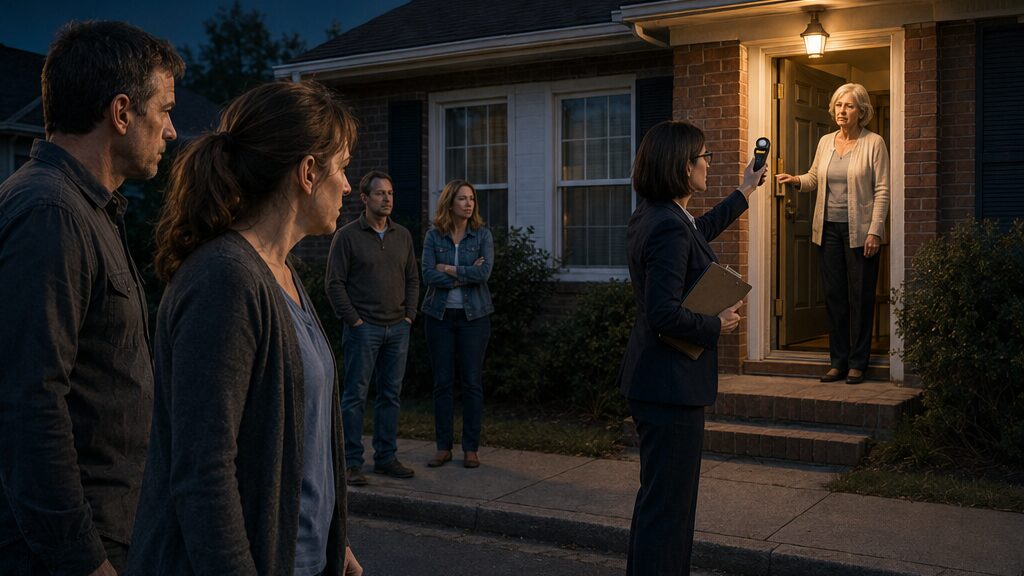
The Porch Light She Tried to Have Removed Was Keeping a Grieving Mother’s Promise Alive
Chapter 1: The Light Across the Fence Would Not Let Sandra Sleep
At 2:13 in the morning, Sandra Lewis opened her eyes to a bright rectangle lying across her pillow.
For several seconds she did not move.
The room was otherwise dark. Her phone rested facedown on the nightstand. The digital clock beside it glowed a dull red. The rectangle came through the slats of the blinds, crossed the empty half of the bed, and stopped against her cheek as cleanly as if someone outside had aimed it there.
Sandra sat up.
“Unbelievable.”
She pulled the blinds shut harder, though they were already closed. One slat clicked out of alignment. Light slipped through the new gap.
This was the sixth night in less than two weeks.
At first she had blamed passing cars. Then a security light. Then some motion sensor installed too high and adjusted too badly. But the beam stayed steady for hours, warm-white and relentless, cutting diagonally from somewhere beyond the side fence.
She had a conference call at six-thirty.
Her father had left two voicemails that evening, both saying he did not need help with the leaking pipe under his kitchen sink, which usually meant he had already made the problem worse.
And now the light.
Sandra threw back the blanket and crossed the room barefoot. From the window, she could see only fragments between houses: a strip of driveway, the dark crowns of shrubs, the edge of Joseph Allen’s roofline next door.
Beyond the fence, something glowed.
Joseph.
Of course.
Three evenings earlier she had seen him carrying a cardboard box toward his garage. A few weeks before that, a contractor’s truck had been parked in his driveway. Joseph served on the HOA architectural committee. He was exactly the sort of person, Sandra thought, who would install some new exterior fixture and assume that because he knew the rules, nobody could question him.
She found her robe and went downstairs.
By the time she stepped onto her driveway, the cool concrete had sharpened her anger into certainty.
Joseph’s house was dark except for a faint kitchen light. Sandra crossed the narrow strip of lawn and pressed his doorbell once.
Nothing.
She pressed it again.
A light came on inside. Footsteps approached.
Joseph opened the door wearing sweatpants and an old gray T-shirt, his hair flattened on one side. He stared at her.
“Sandra?”
“Your light.”
He blinked. “What?”
“The exterior light. It’s shining straight into my bedroom.”
Joseph looked over her shoulder as though expecting to find the explanation standing in the street.
“It’s two in the morning.”
“I’m aware.”
“No, I mean—” He rubbed his face. “What light?”
“The one you leave on every night.”
“I don’t.”
Sandra gave a short, humorless laugh. “Joseph, I’m not doing this for fun.”
“Neither am I.”
“It’s been happening for days. I haven’t slept properly all week.”
His expression changed then—not into guilt, but into something more irritating. Caution.
“Sandra, I don’t have a light on.”
She folded her arms. “I can see it from my room.”
“Okay.”
“Okay?”
“Come here.”
Joseph stepped out, leaving his front door partly open. He walked to the edge of his driveway and looked between their houses.
Sandra followed, already preparing herself for some technical explanation about lumens, property lines, or approved fixtures.
Instead, Joseph lifted one hand and pointed.
“Not mine.”
Sandra turned.
At first she saw only darkness.
Then she shifted half a step to the left, past Joseph’s maple tree.
The glowing porch sat two houses beyond his, across the bend in the street.
A small brick home. White trim. Narrow steps. A warm light above the front door burning steadily into the night.
Betty Wright’s house.
Sandra felt the heat leave her face.
The angle was obvious now that she saw it. The light crossed the open gap between two backyards and reached her second-floor window almost perfectly.
She looked at Joseph’s dark porch, then back at the distant glow.
“Oh.”
Joseph said nothing.
Sandra hated him a little for that.
“I thought—”
“I know what you thought.”
“You could have said something sooner.”
“I did. About thirty seconds after you woke me up.”
Her embarrassment flared into defensiveness.
“Well, someone needs to say something to her. That light is excessive.”
Joseph’s jaw tightened.
“It may not look excessive from here,” Sandra continued, “but from my bedroom it’s like somebody left a lamp pointed at the bed.”
“I believe you.”
“Then you understand the problem.”
“I understand there’s a problem.”
The distinction in his voice stopped her.
She looked at him. “What does that mean?”
Joseph stared toward Betty’s porch.
For a moment Sandra thought he would explain. Instead he said, “Don’t go over there tonight.”
“I wasn’t planning to.”
“Good.”
She almost asked why, but her phone buzzed inside the pocket of her robe. A message from her father: PIPE FINE. STOP WORRYING.
Sandra closed her eyes briefly.
When she opened them, Joseph was still looking at the other house.
“I already emailed management,” she said.
His head turned. “About Betty?”
“About the light. I didn’t know whose it was.”
“What exactly did you send?”
“A complaint. Not a lawsuit.”
“When?”
“Yesterday afternoon.”
Joseph exhaled through his nose.
That small reaction irritated her more than an argument would have.
“What?”
“Nothing.”
“No. You made a face.”
“I didn’t make a face.”
“You absolutely made a face.”
Joseph looked tired now, not merely sleepy.
“Just check what you sent in the morning.”
Sandra stared at him.
“I described the situation,” she said. “Repeated nighttime interference. Direct glare into a bedroom. I asked whether there was a lighting rule.”
Joseph nodded once, but his attention had gone back to Betty’s house.
The porch light remained steady.
Sandra followed his gaze.
“Why are you acting like I reported a crime?”
“I’m not.”
“Then tell me what I’m missing.”
A car turned at the far end of the neighborhood. Its headlights slid across garages and disappeared. Somewhere behind the houses, an air conditioner clicked on.
Joseph lowered his voice.
“She leaves it on for her son.”
Sandra waited.
When he said nothing else, she frowned. “What about her son?”
Joseph opened his front door.
“That’s not mine to tell.”
Chapter 2: The Explanation That Made Her Complaint Feel Smaller
At 7:04 the next morning, Sandra found a compliance case number attached to the email she had sent the HOA.
She was standing in her kitchen with coffee in one hand and her work laptop open beside the sink when the notification appeared.
CASE 24-1187: EXTERIOR LIGHTING NUISANCE
Sandra stopped drinking.
Her original email sat below the automated message. Reading it in daylight made it sound harsher than she remembered.
The repeated illumination is materially interfering with sleep and reasonable enjoyment of my property. Please confirm enforcement options available under the governing documents.
She had written it at 4:48 the previous afternoon after three nights of poor sleep and a call from her father in which he insisted a bucket under a leaking pipe counted as a repair.
At the time, the sentence had seemed precise.
Now it looked prosecutorial.
Sandra clicked the portal link.
Status: Open.
Assigned for review.
She found the withdrawal button and selected it.
A box appeared.
REASON FOR REQUESTED CLOSURE.
Sandra typed: Misidentified likely source. I am addressing directly.
She deleted “misidentified.”
Typed it again.
Deleted the whole sentence.
Finally she wrote: Please close. I no longer wish to pursue the complaint.
She submitted it and tried to start work.
At 8:16, her phone rang.
“Ms. Lewis?” a woman asked.
“Yes.”
“This is Kimberly Green with the association board. I’m calling about your lighting complaint.”
Sandra leaned back in her chair.
“I actually withdrew it.”
“I saw the request.”
“Good.”
A pause.
“It’s already been logged as a possible ongoing covenant violation.”
Sandra looked toward the ceiling, toward the bedroom above her.
“I’m telling you I don’t want to pursue it.”
“I understand. But the association has notice now.”
“Notice from me.”
“Notice is notice.”
Sandra set down her coffee.
“That makes no sense.”
“It does from an enforcement standpoint.”
Kimberly’s tone was controlled, neither cold nor warm.
“If the board receives a specific written report of an ongoing condition that may violate the exterior-lighting standard, we can’t necessarily pretend we never received it because the reporting owner changes their mind.”
“I’m not asking you to pretend anything. I’m saying I may have misunderstood the situation.”
“Did the light stop?”
Sandra looked at the bright morning beyond the kitchen window.
“No.”
“Then the underlying condition may still exist.”
“It’s more complicated than that.”
“I’m sure it may be.”
Something about the sentence made Sandra sit straighter.
Kimberly continued. “We’ll verify before taking action.”
“What does verify mean?”
“Usually a site review.”
Sandra thought of Joseph’s face the night before.
“Can you hold off?”
“Why?”
She had no answer that did not involve telling a stranger a story Joseph had refused to tell her.
“I need to speak with someone first.”
Kimberly was silent for a beat.
“I’ll note your request.”
“That isn’t the same as holding off.”
“No,” Kimberly said. “It isn’t.”
The call ended three minutes later.
By lunch, Sandra had accomplished almost nothing.
At twelve-forty she saw Joseph rolling his trash bin back from the curb and went outside before she could change her mind.
“Do you have a minute?”
Joseph stopped.
“You check your email?”
“How did you know?”
“Because management sends automated notices fast.”
Sandra glanced toward Betty’s house. In daylight it looked ordinary. A faded planter sat beside the steps. The porch fixture above the door was old, with slightly yellowed glass.
“I tried to close it.”
Joseph nodded.
“They won’t let me.”
“Probably not.”
“You could have warned me.”
“I tried.”
“No. You acted mysterious at two in the morning.”
Joseph rested one hand on the trash bin.
“Sandra, what did you want me to do? Stand in my driveway and explain Betty Wright’s family to you because you rang my bell angry?”
The words landed cleanly.
Sandra looked away.
“I just want to understand.”
“Do you?”
She turned back.
Joseph’s expression softened slightly.
“Paul’s her son,” he said. “He’s a firefighter. Municipal department.”
Sandra waited.
“He used to work a lot of late shifts. Still does, as far as I know. When he was younger, he’d come by after shift sometimes. Midnight. Two a.m. Later. Betty started leaving that light on.”
“For him.”
“For him.”
Sandra looked again at the porch fixture.
Joseph continued, quieter now. “She told me once he hated coming back to a dark house after a bad shift. Didn’t matter that he had a key. She wanted him to see the light before he got to the door.”
The irritation Sandra had carried for two weeks seemed to shrink without disappearing.
That made it worse somehow.
Her sleep loss was real. The beam really did cross her pillow. But the light had changed shape in her mind. It was no longer an anonymous offense committed by a careless neighbor. It belonged to an older woman waiting for her son to come home from work.
Sandra folded her arms against a sudden chill.
“Why didn’t she use a dimmer bulb?”
Joseph gave her a look.
“What?”
“I’m not saying the meaning doesn’t matter. I’m saying there are practical solutions.”
“Maybe.”
“A shield. Different fixture. Motion sensor.”
“Maybe.”
His repeated answer irritated her.
“You think I’m a terrible person.”
“I think you like solvable problems.”
“That’s supposed to be criticism?”
“No.”
But it was.
That evening, shortly after six, a white sedan pulled up in front of Betty’s house.
Sandra saw it from her upstairs office.
A woman carrying a clipboard stepped onto the front walk. Betty opened the door. Even from a distance, Sandra could see the envelope in the woman’s hand.
Her stomach tightened.
She went downstairs and stepped outside.
Joseph was already standing near his mailbox.
“You knew,” Sandra said.
He did not deny it.
The management representative handed Betty the paper. Betty looked down at it, then toward the porch fixture above her head.
Sandra crossed the street before she had fully decided to.
“Mrs. Wright?”
Betty looked up.
She was smaller than Sandra had expected, with silver hair cut just below her ears and a posture that made her seem more formal than frail.
“Yes?”
“I’m Sandra Lewis. I live—”
“I know where you live.”
Sandra stopped.
The management representative shifted uncomfortably.
Sandra glanced at the paper.
“Is that about the light?”
Betty folded the notice once.
“Yes.”
“I’m trying to get the complaint withdrawn.”
Betty’s face did not change.
“I didn’t know it was your light.”
“That improves it?”
Sandra felt Joseph watching from across the street.
“No,” she said. “I suppose it doesn’t.”
Betty opened her door.
Before stepping inside, she looked up at the fixture.
“Inspection is Friday.”
Then she closed the door.
Sandra stood on the walk as dusk gathered.
Later, at home, she opened the HOA portal again and read the uploaded notice.
Her eyes stopped at one line.
Repeated violation reports received regarding nighttime glare.
Sandra read it twice.
Then a third time.
She had filed one complaint.
Chapter 3: When the Board Turned One Complaint Into Public Proof
The HOA inspector raised a light meter toward Betty Wright’s porch, and three neighbors who had no reason to be there stopped pretending they were out for evening walks.
Sandra stood near the curb with her hands in the pockets of her jacket.
She had told herself she came only because her complaint had helped create this.
That explanation felt less convincing each time another person slowed down to watch.
Kimberly Green stood beside the management representative with a folder tucked under one arm. Joseph was near Betty’s steps, visibly uncomfortable. Betty herself remained at the front door beneath the warm glow of the disputed fixture.
“Could you switch it off for a baseline reading?” the inspector asked.
Betty did not move.
Kimberly stepped forward.
“Mrs. Wright?”
“I heard him.”
“We need the comparison.”
Betty’s right hand rose to the switch plate just inside the doorway.
The plastic was old and worn smooth around the toggle.
For reasons Sandra could not explain, that detail bothered her more than the clipboard, the meter, or the neighbors watching from the sidewalk.
Betty rested two fingers against the switch.
One of the neighboring homeowners spoke from behind Sandra.
“Why is this taking so long? It’s a light.”
Nobody answered.
The homeowner continued. “The rest of us have to follow the rules.”
Joseph turned.
“She is following the inspection process.”
“Looks like special treatment to me.”
Betty’s fingers remained on the switch.
Sandra could see the tension in Joseph’s jaw.
Kimberly’s voice stayed level.
“No one is receiving special treatment. We are documenting existing conditions.”
“Then document it.”
The homeowner gestured toward the fixture. “It’s on.”
Sandra wanted to leave.
The urge arrived suddenly and strongly. She could go home, close the blinds, let the board handle what the board had chosen to handle. She had already withdrawn her complaint. She had spoken to Betty. She had tried.
Then Kimberly opened the folder.
“We also have a documented impact statement from a nearby owner describing repeated sleep interference and direct illumination into a bedroom.”
Sandra’s stomach dropped.
Joseph looked at her.
The neighbors did too.
Kimberly had not said her name, but it hardly mattered.
One of them asked, “Which house?”
Sandra said, “Mine.”
The word came out before she could reconsider it.
Kimberly paused.
Sandra stepped away from the curb.
“That statement was mine.”
Silence spread across the small group.
The inspector lowered the meter slightly.
Sandra could feel heat rising into her face.
“I filed the complaint,” she said. “I thought the light belonged to somebody else.”
Joseph looked down.
The homeowner behind her gave a short laugh. “How do you mistake a house?”
Sandra turned.
“By not checking.”
The answer ended the laugh.
She looked at Betty.
“I complained before I spoke to Mrs. Wright. Before I even knew whose fixture it was.”
Kimberly closed the folder partway.
“Sandra, your complaint still describes a measurable impact. The source identification doesn’t change whether—”
“I know.”
Kimberly stopped.
Sandra forced herself not to rush.
“The glare is real. It does reach my bedroom. But I was wrong about how I handled it.”
The other neighbor folded her arms.
“So now there’s a sad story and the rules don’t count?”
Joseph moved one step forward.
“That isn’t what she said.”
“No, but everybody knows where this goes. One person gets an exception, then the next person wants one.”
Kimberly’s expression tightened almost imperceptibly.
Sandra saw it.
For the first time, she understood that Kimberly was not simply enjoying authority. The woman was watching every reaction, every sentence, as though each one might reappear later in an email accusing the board of favoritism.
The inspector cleared his throat.
“I still need the baseline.”
Betty looked at him.
Then she switched off the light.
Darkness fell over the porch.
The change was immediate and strangely severe.
Sandra had expected the house to look normal without it. Instead the front door seemed to recede. Betty became a pale shape inside a dark frame.
The inspector took a reading.
“Now back on, please.”
Betty did not move.
“Mrs. Wright?” Kimberly said.
Betty switched it on again.
Warm light returned across the steps.
The meter beeped.
The inspector walked toward the sidewalk, taking another reading, then angled himself toward Sandra’s property.
“Direct line of sight,” he said.
Kimberly glanced at Sandra.
Sandra nodded once. “Yes.”
Betty looked at her.
There was no accusation in the older woman’s face. Sandra almost wished there were.
The inspector continued across the grass toward the side gap between houses.
Joseph followed.
After a moment, Sandra did too.
From there the geometry became obvious. Betty’s porch sat slightly elevated. The open corridor between two houses created a clear path toward Sandra’s second-floor bedroom window.
The inspector pointed.
“That’s your room?”
“Yes.”
“So the report is credible.”
The phrase struck Sandra with unexpected force.
Credible.
As though credibility settled everything.
Kimberly opened the folder again.
“This is why the association has to proceed carefully. We have a documented nuisance condition, measurable spill, and repeated reports.”
Sandra turned.
“Repeated from whom?”
Kimberly looked at her.
“I filed once.”
“I can’t disclose complainant identities in an open inspection.”
“But there are others?”
“There have been multiple contacts.”
Betty gave a small sound behind them. Not surprise. Something closer to resignation.
Sandra looked back at her.
“You knew?”
Betty’s mouth tightened.
“People prefer forms.”
Sandra felt the sentence as if it had been aimed directly at her.
The homeowner behind them said, “Well, maybe people used forms because talking didn’t work.”
Joseph faced her.
“Did you talk to Betty?”
The woman’s expression hardened.
“That’s not the point.”
“It’s exactly the point you just made.”
“Joseph,” Kimberly warned.
He stepped back, but the scene had changed.
What had begun as an inspection now felt like a hearing conducted on somebody’s front lawn.
Kimberly turned to Betty.
“Mrs. Wright, there are several possible paths. A shield may reduce the spill. A lower-output bulb may help. Re-aiming or replacing the fixture—”
“No.”
It was the first firm word Betty had spoken.
Kimberly kept her tone even.
“No to which option?”
“All of them.”
A murmur came from the sidewalk.
Sandra closed her eyes briefly.
There it was—the refusal that would make everything simpler for everyone who wanted Betty to be unreasonable.
Kimberly said, “We are trying to avoid enforcement.”
“You already sent enforcement.”
“A notice is not a fine.”
“Yet.”
Kimberly’s face changed slightly.
“No. Not yet.”
The older homeowner near the curb spoke again.
“Why does it have to be that exact light?”
Joseph said, “Leave it.”
But Betty looked at the woman.
“Because it does.”
“That isn’t an answer.”
“It’s the one I have.”
Sandra saw the impatience move through the small crowd. She recognized it because it resembled her own.
A problem. Several obvious solutions. One person refusing all of them.
She also recognized the dangerous comfort of that interpretation.
Sandra stepped closer to Betty.
“Joseph told me about Paul.”
Joseph’s head lifted sharply.
Betty’s eyes went to him.
He said, “Only what people already know.”
Something passed across Betty’s face.
Sandra hurried on. “He said you leave the light on when your son works late.”
The neighboring homeowner exhaled.
“There. So get a smaller bulb.”
Betty looked at Sandra for a long moment.
Then she said, “Paul hasn’t come through that door in eight months.”
Nobody moved.
Sandra heard the faint mechanical hum of the inspector’s meter.
She turned toward Joseph.
He looked stricken.
“You said—”
“I said she leaves it on for her son.”
“You said he came after late shifts.”
“He did.”
“Eight months ago?”
Joseph rubbed a hand across his mouth.
Betty’s voice remained quiet.
“Joseph was trying to be kind.”
The simple sentence cut through every version of the story Sandra had been building.
The firefighter son was not arriving at two in the morning.
Betty was not watching for his truck after each shift.
The warm explanation Sandra had used to soften her own guilt was wrong—or at least unfinished.
Kimberly shifted the folder under her arm.
“Mrs. Wright, I’m sorry. But if your son is no longer—”
Betty looked at her.
Kimberly stopped.
For the first time that evening, the board president seemed uncertain whether procedure had supplied the right next sentence.
Sandra stared at the porch light.
Eight months.
Every night, according to Joseph.
Through winter. Through spring. Through evenings when nobody came.
“Where is he?” Sandra asked.
Joseph said her name softly. A warning.
But Betty answered.
“Alive.”
Sandra had not realized until then that some part of her had already prepared for another answer.
Betty turned toward the house.
The inspector lowered his meter completely.
Kimberly said, “We can reschedule the remaining discussion.”
“No,” Betty replied.
She stepped inside.
For a second Sandra thought she would close the door.
Instead Betty placed her fingers on the worn switch again.
The porch went dark.
A neighbor shifted on the sidewalk.
Then Betty switched it back on.
Warm light spread over the same steps, the same railing, the same empty stretch of walkway.
She looked at Sandra.
“He knows what I promised.”
Then she cl
Chapter 4: The Son Who Was Alive but Still Did Not Come Home
Sandra saw Paul Wright alive on a Tuesday morning.
She was supposed to be approving a batch of corrected billing reports when Joseph knocked on her front door and held out his phone without explanation.
On the screen was a photograph from three weeks earlier.
Paul stood beside a fire engine at what looked like a retirement lunch, one arm around an older firefighter. He was broader than Sandra had imagined, with close-cropped dark hair and a face that seemed younger than the story surrounding him. A pale scar ran from near his temple into his hairline.
Alive.
Smiling, even.
Sandra looked up.
“Where did you get this?”
“Public department page.”
“You searched him?”
Joseph took the phone back. “After the inspection.”
Sandra stared at him. “You didn’t know where he was?”
“I knew he was alive.”
“That is not the same thing.”
“No.”
She folded her arms.
Joseph looked toward Betty’s house. The porch light was off in daylight, the old fixture dull above the door.
“I told you what Betty lets people say,” he said.
Sandra felt the old irritation return, though weaker now.
“You told me he came home after late shifts.”
“He did.”
“Eight months ago.”
“Before that, yes.”
“You made it sound current.”
Joseph’s mouth tightened. “I made it sound survivable.”
The answer stopped her.
He slid the phone into his pocket.
“People ask. Betty says Paul works difficult shifts and she leaves the light on. That used to be true exactly. Now it’s true in a different way.”
“That sounds convenient.”
“It is not convenient for anyone.”
Sandra looked at him for a long moment.
“What happened?”
Joseph shook his head.
“I don’t know enough.”
“You know more than you told me.”
“Yes.”
The admission came without defense.
Sandra almost respected it.
Almost.
“Then tell me what you actually know.”
Joseph leaned against the porch rail.
“Paul got hurt on a call last year. Not killed. Not permanently disabled. But bad enough that he was out for a while.”
Sandra glanced at the photograph again in her mind, at the scar.
“And?”
“And Betty was terrified.”
“That seems reasonable.”
“It was.”
Joseph paused.
“Until it wasn’t.”
He would say nothing more.
By noon, Sandra had returned to her laptop and failed to concentrate again.
She kept thinking about the photograph.
The story had been easier when Paul was a firefighter coming home late to a waiting light. It had even been easier when she briefly feared he might be dead. Death was terrible, but it had a shape people understood.
An alive son who stayed away was different.
At two-thirty her father called.
“I fixed the pipe.”
“With what?”
“A clamp.”
“What kind of clamp?”
“The kind that clamps.”
Sandra pinched the bridge of her nose.
“Dad.”
“Don’t start.”
“I’m asking a question.”
“You ask questions like subpoenas.”
She went still.
On the other end, he sighed.
“Look, it’s not leaking.”
“That doesn’t mean it’s fixed.”
“It means my kitchen floor is dry.”
“You need a plumber.”
“I need you to stop treating every problem like I’ve failed an inspection.”
The line went quiet.
Sandra looked toward the blinds.
Her father spoke first.
“I’ll call somebody if it leaks again.”
“That is exactly what you said last time.”
“And there you go.”
He ended the call before she could answer.
Sandra sat with the phone in her hand.
An hour later, she drove to the municipal fire station.
She told herself she was not looking for Paul.
That distinction mattered.
She parked in the visitor area and remained behind the wheel for nearly five minutes. The station was plain brick, with three large apparatus bays and a flag moving lazily above the front entrance.
When Sandra finally got out, a firefighter in a navy department shirt was crossing the lot carrying a paper cup.
“Excuse me?”
He stopped.
“I’m looking for information about someone who used to work here. Paul Wright.”
The firefighter’s expression changed only slightly.
“Why?”
Sandra had rehearsed several answers.
None survived the question.
“I live near his mother.”
That made the man more cautious, not less.
“Is she okay?”
“Yes. Physically, yes.”
“Then I can’t give you personal information.”
“I understand.”
She almost left.
Then she said, “There’s a dispute about her porch light.”
The firefighter stared at her.
Sandra heard how absurd it sounded.
“It’s complicated.”
“Usually is.”
“I’m not asking where he lives.”
“Good.”
“I only need to know whether the story I’ve been told is wrong.”
He took a drink from the cup.
“What story?”
“That she leaves a light on because he comes home after late shifts.”
Something passed over his face.
Not surprise.
Recognition.
“He used to.”
“That’s what I’ve heard.”
The firefighter looked toward the station doors.
“Paul transferred.”
“When?”
“A while back.”
“After he was injured?”
The man’s gaze sharpened.
Sandra immediately regretted the question.
“I’m sorry.”
“You should be careful.”
“I know.”
“No,” he said. “I mean with the story.”
She waited.
The firefighter lowered his voice.
“People hear firefighter, injury, mother leaving a light on, and they build something nice out of it.”
Sandra said nothing.
“He got hurt. He recovered enough to return. That part’s public enough. The rest was family.”
“Did his mother want him to quit?”
The man gave a tired half-smile.
“You already know more than you should.”
“She was afraid.”
“Sure.”
“But?”
“But fear can become control if you keep calling it love.”
The sentence landed harder than Sandra expected.
The firefighter looked toward her car.
“Paul hated being treated like the injury had proved everyone else right about his life.”
“Everyone else?”
“I said enough.”
He started to walk away.
Sandra called after him.
“Was the injury why he stopped coming home?”
The man stopped.
For several seconds, his back remained to her.
Then he turned.
“No.”
That single word rearranged the story again.
“What was?”
He looked at Sandra with an expression that held no hostility, only reluctance.
“The injury started the argument. It wasn’t the reason he stayed away.”
“What did she do?”
“That’s not how I’d phrase it.”
“Then how would you?”
The firefighter rubbed his thumb against the paper cup.
“Two frightened people decided the other one was the threat.”
He left her with that.
That evening, Sandra found Joseph near the community mailbox.
“You knew Paul transferred.”
Joseph nodded.
“You knew the injury wasn’t why he left.”
Another nod.
Sandra felt anger rise.
“Why do you keep making me drag every piece out of you?”
“Because it isn’t your story.”
“My complaint is costing Betty money.”
“That doesn’t make her family history yours.”
“I am trying to fix what I started.”
Joseph turned toward her.
“And there it is.”
“What?”
“You keep saying fix.”
Sandra stared at him.
“What would you prefer? Damage?”
“I’d prefer you stop assuming everything broken is waiting for you to become efficient.”
The words struck close enough to make her cruel.
“At least I’m doing something.”
Joseph’s face closed.
Sandra regretted it immediately.
He looked across the street.
“Paul’s injury scared Betty badly. She wanted him out of the department.”
“That much I know.”
“She pushed.”
“How hard?”
“Hard enough.”
Sandra waited.
Joseph seemed to decide something.
“The last time I saw Paul at that house, they were shouting.”
“When?”
“Eight months ago.”
The number made her stomach tighten.
“What did she say?”
Joseph’s eyes stayed on Betty’s porch.
“I only heard the end.”
Sandra stepped closer.
“What end?”
He answered quietly.
“She told him if he walked back into another fire station, he shouldn’t bother walking back through her door.”
Sandra felt the evening go still around them.
“That was her ultimatum?”
Joseph nodded.
“And he left?”
“Yes.”
“Did she mean it?”
Joseph looked at her then.
“No.”
Chapter 5: A Rule Could Be Withdrawn More Easily Than Its Damage
Kimberly Green read Sandra’s own sentence aloud at the HOA meeting.
“‘The repeated illumination is materially interfering with sleep and reasonable enjoyment of my property.’”
Sandra sat at the end of a folding table beneath fluorescent lights that made everyone look more tired than they were.
Kimberly placed the printed complaint on the table.
“Those are your words.”
“Yes.”
“Are they still true?”
Sandra looked at the two board members, the management representative, and the stack of folders arranged before Kimberly.
“The light still reaches my bedroom.”
“That wasn’t my question.”
Sandra exhaled.
“Yes. The glare is real.”
Kimberly leaned back slightly.
“Then I need you to understand why I’m struggling with your request.”
“My request is to stop penalties while we find another solution.”
“Your email requested closure of the violation.”
“Before I understood the process.”
Kimberly gave a restrained nod.
“Exactly.”
Sandra felt the rebuke.
She had come prepared to argue that the board was being inflexible. She had printed sections of the exterior-lighting standard, highlighted language about discretionary remedies, and written three points on a legal pad.
Now her own complaint sat between them.
The management representative turned a page.
“There have been four contacts regarding the fixture over approximately eleven months.”
Sandra looked up.
“Four?”
“Yes.”
“From four people?”
“I can’t disclose identities.”
“So I wasn’t the first.”
“No.”
Relief came so quickly that Sandra hated herself for it.
Kimberly saw.
“But yours was the first detailed impact statement from an affected bedroom,” she said.
The relief vanished.
Kimberly tapped the page.
“Specific hours. Frequency. Sleep disruption. Direct line of sight. You asked about enforcement options.”
Sandra remembered writing each phrase.
She had wanted to be taken seriously.
She had succeeded.
“So my complaint triggered this.”
“It moved the matter from informal contact to documented nuisance review.”
Sandra looked down at her legal pad.
The highlighted provisions suddenly seemed childish.
“I withdrew it.”
Kimberly’s expression remained steady.
“And if the board closes an active violation immediately after the reporting owner learns a sympathetic fact about the violator, what do I tell the next homeowner?”
“That facts matter.”
“They do.”
“Then act like they do.”
One board member shifted in his chair.
Kimberly’s face tightened.
“You think I don’t?”
Sandra almost answered yes.
Instead she waited.
Kimberly opened another folder.
“We have an owner on the east side threatening formal action because we required him to replace two unapproved floodlights last year. He has already emailed asking whether Mrs. Wright is receiving an exemption.”
Sandra sat back.
Kimberly continued.
“Another owner was denied a decorative fixture that exceeded brightness standards. A third has complained that we enforce only when someone is unpopular.”
“This is not the same.”
“No two cases are.”
“Then why pretend consistency means treating them as if they are?”
Kimberly’s voice sharpened for the first time.
“Because the association can be challenged when discretion looks like favoritism.”
The room went quiet.
Sandra saw then what she had missed.
Kimberly was afraid.
Not of Betty. Not of Sandra. Of being the person whose exception became evidence that every prior decision had been arbitrary.
That did not make her right.
But it made her legible.
Sandra said, “You could pause the fine.”
“We offered modification options.”
“Before anyone understood why she refused.”
“And now we understand more. That does not eliminate the glare.”
“No.”
Kimberly studied her.
Sandra forced herself not to look away.
“No,” she repeated. “It doesn’t.”
The admission changed the room.
She picked up her complaint.
“I am not saying I lied. I am saying I handled it badly.”
Kimberly folded her hands.
“What are you asking for now?”
“A temporary hold.”
“For how long?”
“I don’t know yet.”
“That is the problem.”
The management representative slid a notice across the table.
Sandra read the date.
Ten days.
“What is this?”
“Compliance deadline,” Kimberly said.
“After that?”
“Daily fine schedule becomes available to the board.”
“Available?”
“Not automatic.”
Sandra looked at her.
“So you do have discretion.”
A pause.
“Yes.”
“Then use it.”
Kimberly’s expression hardened again.
“I am willing to consider a short extension if Mrs. Wright submits a proposed modification. She has submitted nothing.”
“She doesn’t trust the process.”
“That does not suspend it.”
Sandra pushed back from the table.
For one reckless second she wanted to accuse Kimberly of hiding behind rules.
Then she remembered herself standing in her kitchen, typing the sentence Kimberly had just read.
She had hidden there first.
The meeting ended without a waiver.
Kimberly agreed only to place a temporary penalty hold on the next board agenda if Betty submitted a concrete proposal before the deadline.
Outside, Sandra found Joseph waiting near her car.
“Well?”
“Ten days.”
He closed his eyes.
“Unless she proposes a modification.”
“She won’t.”
“I know.”
“You don’t know Betty well enough to know that.”
Sandra looked at him.
“She said no to every option in front of half the street.”
“Because half the street was watching.”
The answer irritated her because it was probably true.
That night, the light crossed her bedroom again.
Sandra sat on the edge of the bed instead of closing the blackout panel she had temporarily wedged behind the blinds.
The beam looked softer now.
It was not.
Meaning had changed. Physics had not.
At 9:20 she crossed the street with an envelope in her hand.
Betty answered after the second knock.
She looked at the envelope.
“What is that?”
“Money.”
Betty’s face went blank.
“For the fine,” Sandra said quickly. “If it gets that far.”
“No.”
“You haven’t even—”
“No.”
“Betty, please.”
The older woman’s eyes sharpened at the use of her first name.
Sandra lowered her voice.
“My complaint triggered the enforcement review. They told me today.”
“I assumed it did.”
“There were other reports.”
“Then pay theirs too.”
Sandra flinched.
“I’m trying to take responsibility.”
“By writing a check?”
“It is not just a check.”
“It is exactly a check.”
Betty started to close the door.
Sandra put one hand against the frame, then immediately removed it.
“I am sorry.”
Betty stopped.
Sandra swallowed.
“I should have spoken to you first.”
“Yes.”
“I should have verified the source.”
“Yes.”
“I should have told management as soon as Joseph denied it was his.”
Betty looked at her.
Sandra felt every defense she had carried into the conversation collapse.
“I didn’t,” she said.
For a moment, Betty’s face softened.
Then she looked at the envelope again.
“Keep your money.”
“If they fine you—”
“The money is not what you took from me.”
Sandra went still.
Betty’s hand tightened around the edge of the door.
“You made me explain why I turn on my own light.”
The words were quiet.
That made them worse.
“To a board. To neighbors. To people with meters standing in my yard.”
Sandra could not answer.
Betty continued.
“And now you know just enough to feel sorry for me.”
“That isn’t—”
“Yes, it is.”
The door began to close.
Sandra said, “Then tell me what I’m missing.”
Betty looked at her through the narrowing gap.
“No.”
The door shut.
Sandra remained on the porch with the envelope in her hand.
Above her, the light burned steadily.
Chapter 6: The Promise Hidden Inside an Ordinary Porch Switch
Two nights later, Betty Wright opened her front door and said, “Come inside. I want to show you something.”
Sandra had not knocked.
She had been walking past the house after taking the long route home from the community mailbox when Betty called her name.
Now Sandra stood in the doorway, startled.
Betty stepped aside.
“Unless you’ve decided you only like my house from a distance.”
Sandra entered.
The front room was smaller than she expected. A couch. Two straight-backed chairs. A row of framed photographs on a low shelf. No shrine to Paul, no dramatic display of firefighter memorabilia.
Betty pointed toward the window facing Sandra’s property.
“Stand there.”
Sandra obeyed.
“Look up.”
Through the glass, she could see the edge of her own second-floor bedroom window.
Betty switched on a small lamp beside the couch, then off again.
“Not that,” she said. “The porch.”
She walked to the front door and placed her fingers on the worn switch.
Sandra recognized the motion from the inspection.
Betty turned the porch light off.
Then on.
From inside, Sandra saw how the old fixture cast a broad cone beyond the steps, across the lawn, through the open corridor between houses.
Straight toward her bedroom.
Betty looked at her.
“You were telling the truth.”
Sandra did not know what answer was safe.
“Yes.”
“I checked.”
“When?”
“Last night.”
Sandra stared at her.
Betty returned to the chair by the couch.
“I walked to your side of the street.”
“You could have asked me.”
Betty gave a dry laugh.
“That would have been efficient.”
Sandra felt the deserved edge.
She remained standing.
Betty nodded toward the other chair.
Sandra sat.
For several seconds, neither spoke.
Then Betty said, “Joseph told me you went to the fire station.”
Heat rose into Sandra’s face.
“I didn’t ask for Paul’s address.”
“No. You just went looking for the parts of my life I would not hand you.”
Sandra looked down.
“I thought understanding would help.”
“Help who?”
Sandra almost answered.
Then she stopped.
Betty noticed.
“That is the first useful thing you’ve done,” she said.
Sandra looked up.
“What?”
“Not answer immediately.”
The porch light cast a pale band across the front-room floor.
Sandra folded her hands.
“I’m listening.”
Betty’s mouth tightened, as though the phrase itself annoyed her.
But after a while, she spoke.
“Paul was twelve when his father died.”
Sandra stayed still.
“After that, I became very good at keeping things from happening.”
Betty looked toward the photographs.
“Forms signed. Doors locked. Doctor appointments made. Tires replaced before the tread got bad. I thought if I stayed ahead of enough things, the world might run out of surprises.”
Sandra thought of her father’s leaking pipe and said nothing.
“When Paul joined the department, I hated it.”
“You told him?”
“Constantly.”
There was no self-pity in Betty’s voice.
“He thought I would get used to it. I thought he would grow out of it. We were both arrogant.”
The porch light hummed faintly outside.
Betty continued.
“When he got hurt, I believed fear had finally proved me right.”
Sandra watched her.
“What happened?”
“A ceiling section came down during a commercial fire. He was struck. Concussion. Shoulder damage. Burns that looked worse than they turned out to be.”
Her eyes moved toward one photograph on the shelf but did not settle there.
“He recovered.”
“Yes.”
“And wanted to go back.”
“Yes.”
Betty’s jaw tightened.
“I told him I had already buried one man I loved.”
Sandra felt the room narrow.
“I told him I would not sit and wait to bury another.”
“That was the argument.”
“That was the beginning of it.”
Betty leaned back.
“Paul said I had spent his whole life confusing my fear with his responsibility.”
Sandra thought of the firefighter’s words in the parking lot.
Fear can become control if you keep calling it love.
“What did you say?”
Betty looked directly at her.
“I said things mothers say when they want obedience and cannot admit that is what they want.”
Sandra waited.
“I told him if he went back to the department, he should not come back here expecting me to watch him destroy himself.”
The room was silent.
“And then?”
“He asked if I meant it.”
Betty’s voice thinned, but did not break.
“I could have stopped.”
Sandra did not move.
“I could have said no.”
Betty looked toward the door.
“I said if he walked back into another fire station, he should not bother walking back through mine.”
Sandra closed her eyes briefly.
Joseph had heard the end.
“What did Paul do?”
“He left.”
The answer was almost soundless.
“Did you call him?”
“Before he reached the highway.”
“And?”
“He did not answer.”
Betty’s fingers pressed into the arm of the chair.
“I left a message.”
Sandra looked at the porch switch.
The question had been following her for days.
“What did you promise?”
Betty did not answer immediately.
Outside, a car moved slowly past the house. Light swept across the front wall and disappeared.
Finally Betty said, “I told him I was wrong.”
Sandra waited.
“I told him I had no right to make my door conditional.”
Betty’s eyes remained on the floor.
“I said I would leave the porch light on. Every night. So if he ever chose to come back, he would know I had not locked him out again.”
Sandra felt something inside her shift.
Not because the story was beautiful.
It was not.
A mother had said something cruel out of terror. A son had stayed away. A light had become an apology that could not require an answer.
Betty looked at her.
“He does not need that light to find this house.”
Sandra said nothing.
“He has a phone. A map. A key, unless he threw it away.”
Her mouth trembled once, then steadied.
“The light is not for directions.”
Sandra understood.
Betty stood and walked to the switch.
“I turn it on because I made the promise after spending years making promises for him.”
Her fingers rested on the toggle.
“This one is mine to keep whether he comes back or not.”
Sandra looked toward the broad beam spilling beyond the porch.
“And the glare?”
Betty followed her gaze.
“It is real.”
Sandra blinked.
Betty gave a tired shrug.
“I am proud, not blind.”
“Then maybe a shield—”
“No.”
The answer came immediately.
Sandra stopped herself.
Betty noticed that too.
“A shield may work,” Sandra said more carefully. “Or it may not.”
Betty studied her.
“I will not use a motion sensor.”
“Okay.”
“I will not make it turn itself off.”
“Okay.”
“I switch it on.”
Sandra nodded.
Betty’s face changed slightly.
“That matters.”
“I know.”
“No, you are beginning to know.”
Sandra accepted the correction.
When she left, the porch light followed her across the street.
Upstairs, she stood in her bedroom and looked at the blackout panel she had wedged behind the blinds.
For months, whenever her father refused help, she had responded by finding a new form, a new contractor, a new argument. Whenever work became chaotic, she made a checklist. Whenever a neighbor’s light crossed her bed, she filed a complaint.
She pulled the blackout panel free.
The bright rectangle returned to the wall.
Sandra took a tape measure from the hall closet.
Then she opened the blinds.
From her bedroom, she measured the height of the light across the glass, marked the angle on a notepad, and photographed the beam path from three positions.
At 10:42, she crossed to Joseph’s house with the measurements.
He opened the door and looked at the tape measure in her hand.
“What are you doing?”
Sandra glanced toward Betty’s glowing porch.
“Trying to solve the right problem this time.”
Chapter 7: Sandra Stopped Asking the Board to Pretend Nothing Happened
“I am not withdrawing the claim that the old light disturbed my sleep.”
The room went still.
Sandra stood at the end of the HOA hearing table with two photographs mounted on plain white paper. One showed her bedroom wall under Betty’s existing fixture: a hard diagonal band of light cutting across the blinds and onto the bed. The other showed the same wall after the electrician had temporarily tested a lower-lumen shielded fixture at the same mounting point.
In the second photograph, the wall was dark.
Kimberly Green looked from the photographs to Sandra.
“That is a different position from the one you took two weeks ago.”
“Yes.”
“You asked us to close the violation.”
“I was wrong.”
The words came more easily than Sandra expected.
Not comfortably.
Just clearly.
A board member shifted in his chair. The management representative had the deadline notice open beside a laptop. Joseph sat against the wall, arms folded, saying nothing. Betty had come too, but she had chosen a chair nearest the door.
Sandra looked at her only once.
“I thought fixing what I had done meant making the complaint disappear,” Sandra continued. “It doesn’t.”
Kimberly rested one hand on the table.
“Then what exactly are you asking us to approve?”
Sandra turned the two photographs around.
“A replacement fixture with a full upper and side shield, lower output, warm color temperature, and the same manual wall switch.”
Kimberly glanced at the management representative.
“Has this been submitted through architectural review?”
“Draft application is attached,” Sandra said.
Joseph raised his eyebrows.
Sandra ignored him.
“The electrician tested beam spread from the existing mount. Joseph verified the property-line sightline. I measured from my bedroom.”
Kimberly’s expression tightened.
“You entered Mrs. Wright’s property for testing?”
“With her permission.”
Every face in the room turned toward Betty.
Betty did not react.
Kimberly looked back at Sandra.
“And you believe this eliminates the nuisance?”
“I believe it eliminates direct glare into my bedroom.”
“That is not the same thing.”
“No.”
Sandra took a breath.
“I’m trying very hard not to make that mistake again.”
For a moment, nobody spoke.
The board member nearest Kimberly picked up the darker photograph.
“How large is the reduction?”
Sandra answered.
The management representative asked about fixture dimensions. Sandra answered that too. Kimberly questioned whether the shield would create an unapproved visual profile from the street.
Joseph finally spoke.
“It sits inside the fixture housing.”
Kimberly looked at him.
“You are on the architectural committee.”
“I am.”
“And you participated in preparing this?”
“I checked measurements.”
“Which could be seen as prejudging a pending application.”
Joseph’s mouth tightened.
“I did not vote on anything.”
Kimberly leaned back.
“This is exactly the problem.”
Sandra felt the old anger stir.
She let it pass.
“What problem?”
Kimberly gestured toward the room.
“A violation remains open for months. The owner rejects offered modifications. A complainant changes position after learning personal circumstances. A committee volunteer becomes involved in designing a remedy. Now we are being asked to waive or delay enforcement.”
“Not waive.”
Kimberly looked at her sharply.
Sandra continued.
“I’m not asking the board to pretend Betty complied when she didn’t. I’m asking you to use the discretion your own rules give you while a concrete correction is pending.”
The management representative glanced at Kimberly.
Sandra saw it.
So did Kimberly.
Her voice cooled.
“And why should this owner receive flexibility after refusing prior options?”
There it was.
The question Sandra had known would come.
She looked toward Betty.
The older woman’s hands rested in her lap.
Sandra answered carefully.
“She should not receive flexibility because her son is a firefighter.”
Betty’s eyes lifted.
“She should not receive it because her story is sad. She should not receive it because I feel guilty.”
Kimberly said nothing.
“She should receive the same discretionary consideration the board says it uses when an owner presents a workable correction before fines begin.”
“That correction has not been approved.”
“Then review it.”
“You are simplifying—”
“No.”
Sandra’s voice was firmer than she intended.
She stopped, then continued more quietly.
“I know what simplifying looks like. I did it first.”
The words settled over the table.
Sandra touched the photograph of the bright band across her bed.
“This was real.”
Then the darker one.
“This is also real.”
She looked directly at Kimberly.
“Both can be true.”
Kimberly’s face changed, not into agreement but into fatigue.
She opened the governing documents.
“The board can defer fines for a pending cure proposal.”
“Yes.”
“For a limited period.”
“Yes.”
“And only if the owner consents to the proposal.”
Sandra turned toward Betty.
That was the part she had not been able to solve.
The electrician had found the fixture. Joseph had checked angles. Sandra had prepared the application and paid the testing fee despite Betty’s refusal to accept money for fines.
But Betty had not signed.
Kimberly followed Sandra’s gaze.
“Mrs. Wright?”
Betty looked at the papers.
Then at Sandra.
“I did not ask her to do all this.”
“No,” Sandra said.
“Do you understand that?”
“Yes.”
Betty stood.
For one terrible second, Sandra thought she was leaving.
Instead Betty walked to the table and studied the two photographs.
Her finger paused over the image of Sandra’s bedroom.
“That is where it hit?”
“Yes.”
“Every night?”
“Most nights.”
Betty looked at the darker image.
“And this one?”
“Same switch. Same location. The light stays on until you turn it off.”
Betty’s expression sharpened.
“No timer?”
“No.”
“No sensor?”
“No.”
“I switch it.”
“Yes.”
The board room seemed to shrink around those two words.
Betty picked up the application.
Kimberly said, “You are not required to decide this second.”
Betty gave her a dry look.
“You required quite a few other things quickly.”
Kimberly accepted the remark without response.
Betty took the pen.
Sandra held her breath.
The older woman signed.
The management representative immediately reached for the form.
Kimberly stopped her with one hand.
“Wait.”
Everyone looked at her.
Kimberly read the first page, then the fixture specifications.
Finally she said, “I will support holding fines pending expedited review, provided installation occurs within the cure period if approved.”
Sandra felt the pressure behind her ribs loosen.
Not disappear.
Loosen.
The board member beside Kimberly nodded.
“So moved.”
There was no applause.
No one smiled broadly.
The management representative entered the motion into the record.
Three days later, after approval, the electrician stood on Betty’s porch with the new fixture boxed beside his ladder.
Sandra watched from the walk.
Joseph held a flashlight. Kimberly had not come.
Betty stood inside the doorway with one hand near the old switch.
The electrician asked, “Ready?”
Betty looked up at the existing light.
Then at Sandra.
“Not tonight.”
Sandra felt Joseph glance at her.
The electrician lowered his screwdriver.
Betty’s fingers settled on the worn switch.
“One more night,” she said.
Chapter 8: The Light Stayed On, but It No Longer Meant Waiting Alone
The message reached Betty at 5:47 the next evening.
Sandra knew because Betty crossed the street without a coat, holding her phone in both hands.
She stopped at the bottom of Sandra’s steps.
“He answered.”
Sandra did not move.
Betty looked down at the screen.
Four words.
I got your message.
Nothing else.
No promise to visit.
No apology.
No date.
Sandra read the words once and handed the phone back.
“That’s all?”
Betty nodded.
Her mouth trembled, but she gave a small, almost irritated breath.
“It is not nothing.”
“No.”
“It is also not everything.”
“No.”
Betty looked toward her own house.
The old porch light was still mounted above the door.
The electrician’s truck waited at the curb.
For a moment Sandra thought Betty might postpone again.
Instead she crossed the street.
The old fixture came down in less than twenty minutes.
Betty stood beneath the porch roof and watched every step. When the electrician lifted the replacement from its box, she touched the metal shade with one finger.
“This is the one?”
“Yes, ma’am.”
“And I still switch it?”
“Yes.”
She nodded.
“Then put it up.”
At dusk, the electrician finished.
Joseph came outside but stayed near his own driveway.
Sandra went upstairs to her bedroom.
She did not close the blinds.
Across the gap between houses, Betty stood inside her doorway.
Her hand moved to the switch.
The new porch light came on.
Warm light spread across Betty’s steps and stopped there.
Sandra waited.
No bright rectangle crossed her pillow.
No diagonal bar climbed the wall.
The bedroom remained dark.
She went back downstairs.
By the time she reached the street, Betty was still standing under the new light.
Sandra approached but stopped at the edge of the walk.
“How is it?”
Betty looked up at the fixture.
“Different.”
Sandra nodded.
“I can ask the electrician to—”
Betty raised one hand.
Sandra stopped.
After a moment, Betty said, “Different is not the same as wrong.”
The words stayed between them.
Weeks passed.
The HOA fine never began. The cure was recorded as completed. Kimberly sent a brief formal email confirming closure of the violation and nothing more.
Paul did not come home.
But once, Betty mentioned that they had exchanged three messages.
Another time she said he had called and stayed on the phone for six minutes.
She offered no details.
Sandra did not ask.
Her father’s pipe began leaking again. This time, when he insisted he could handle it, Sandra nearly sent a plumber anyway.
Instead she called.
“You want the number,” she asked, “or do you want me to leave it alone?”
There was a long pause.
“The number.”
She gave it to him.
That was all.
One evening several weeks after the fixture changed, Sandra woke shortly after midnight.
Her room was dark.
For a confused moment she missed something she had once hated.
She got out of bed and looked through the blinds.
Across the street, Betty’s porch light glowed softly around the doorway.
Betty stood beneath it.
Sandra watched her reach for the switch.
But she did not turn it off.
Instead Betty stepped back inside and closed the door.
The light remained on.
For the first time, she did not stand there waiting beneath it.
Sandra let the blind fall closed.
The story has ended.