The HOA Turned His Private Driveway Into a Neighborhood Shortcut—Then One Missing Easement Changed Everything
Chapter 1: The Gravel Was Already Crossing His Driveway
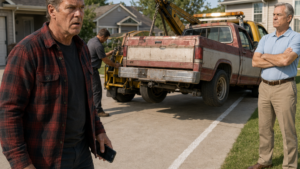
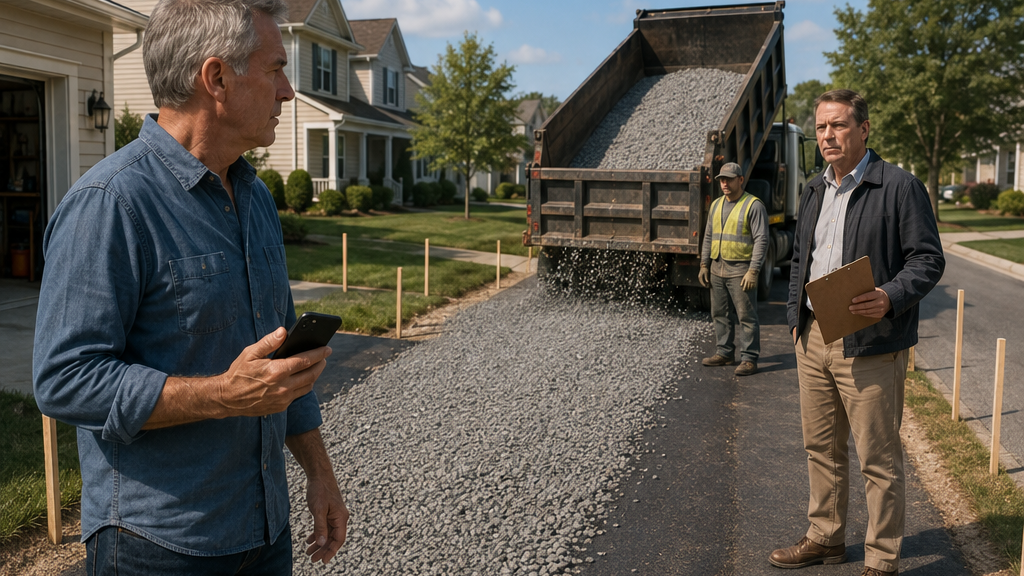
Dennis Miller saw the dump truck before he saw his house.
It was backed sideways across the mouth of his side driveway, its steel bed raised high enough to block half the view of the garage. Gray stone poured from the tailgate in a rattling sheet, striking the pavement and spreading across the clean blacktop Dennis had sealed himself the previous fall.
He braked at the corner.
For several seconds, he simply watched.
A worker in a fluorescent vest guided the driver backward with one hand. Another worker stood near the grass with a rake. Fresh wooden stakes had been driven along the edge of Dennis’s lot, forming a straight line from the street toward the rear of the property.
The line crossed his driveway.
Dennis pulled into the main drive, shut off his pickup, and walked toward them.
“Who authorized this?”
The worker with the rake stopped.
“Association job.”
“That wasn’t my question.”
The man glanced toward the street.
Dennis followed his eyes and saw Frank Campbell coming across the cul-de-sac.
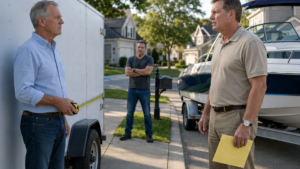
Frank was HOA president, a position he treated less like a title than a permanent condition. He carried a clipboard against his chest and wore the expression of someone arriving to explain something that should already have been understood.
“Dennis,” he said. “I was going to talk to you.”
Dennis looked behind him. Gravel continued pouring.
“You picked an interesting time.”
Frank lifted a hand toward the workers. “They’re almost finished with this section.”
“This section is my driveway.”
“It’s the side access.”
Dennis looked at him.
“My side access.”
“The neighborhood has used it for years.”
Dennis turned toward the gravel again. The truck had moved another ten feet. Stone now covered the narrow strip where his asphalt widened beside the garage.
He felt anger rising, but anger had never made machinery stop faster in any plant he had managed. For thirty-two years, he had supervised crews who could turn one bad instruction into twenty thousand dollars of damage before lunch. The first rule was always the same: establish who ordered what.
He took out his phone and began photographing the truck, the stakes, the gravel, and the workers.
Frank frowned.
“You don’t need to make this adversarial.”
Dennis took another picture.
“Then show me the easement.”
Frank paused.
“The what?”
“The recorded easement. Plat reference, deed reference, whatever gives the association the right to build an access lane across my property.”
Frank’s expression changed only slightly, but Dennis noticed it.
“This has been an established access corridor for years.”
“That isn’t a document.”
“Everyone knows this is how people get through when the street is crowded.”
Dennis nodded once.
“Then showing me the document should be easy.”
The dump truck’s bed lowered with a hydraulic whine.
Frank stepped closer.
“We’ve had delivery trucks use this. Residents have parked through here. You’ve never objected.”
“I’ve let people use it.”
“Exactly.”
“No. Not exactly.”
A worker approached Frank and asked whether they wanted the stakes left in place.
Dennis answered before Frank could.
“Nothing else goes into the ground until somebody shows me authority.”
The worker looked between them.
Frank’s jaw tightened. “Dennis, these people are contractors. Don’t put them in the middle.”
“I didn’t hire them.”
Frank motioned for the worker to wait.
Then he turned back to Dennis. “The board approved improvements to the access corridor. We’ve had complaints about mud and standing water. Gravel solves that.”
Dennis looked down at the stone. It was clean, pale gray, and thick enough that several inches now sat over part of his asphalt and along the grass shoulder.
“How much of this was supposed to be on my property?”
Frank’s eyes flicked toward the stakes.
“That boundary has always been treated as common access.”
“Treated by whom?”
“The neighborhood.”
“That’s still not a deed.”
Frank exhaled.
“You’ve lived here nine years, Dennis. You know perfectly well people have used this route.”
Dennis did know.
Barbara Green had used it when her daughter graduated and half the family arrived at once. A moving truck had crossed it when the house behind Dennis changed owners. A plumber had backed through there because the main street was blocked by roofing crews.
Dennis had said yes every time anyone bothered to ask.
Other times, he had simply watched through the kitchen window and decided it was not worth making an issue of.
He had always considered that neighborliness.
Standing beside several tons of gravel he had not ordered, he wondered when everyone else had begun calling it something different.
“I’m asking one question,” Dennis said. “Where is the recorded right?”
Frank tapped the clipboard against his leg.
“I’ll have the management office send you the relevant materials.”
“So you don’t have it.”
“I didn’t bring property records to a gravel job.”
“You brought a gravel job to my property.”
For the first time, Frank had no immediate answer.
Dennis looked at the contractor.
“Is the truck empty?”
“Pretty much.”
“Then finish unloading somewhere that isn’t mine.”
The worker rubbed the back of his neck. “We were given this layout.”
Dennis held up his phone.
“I understand. I’m not blaming you. But I’m telling you there’s a property dispute now.”
Frank said, “You don’t have the authority to stop association work.”
Dennis looked at him for a long moment.
“On association property, maybe not.”
The workers did not continue.
That was Dennis’s first small victory, though it did not feel like one. Most of the work had already been done. Gravel covered the side drive from the street nearly to his garage, and the wooden stakes made the change look deliberate, planned, permanent.
Frank walked back toward the street after telling him the management office would follow up.
Dennis stayed outside until the contractor left.
Only then did he notice what bothered him most.
The gravel did not merely sit near his driveway. It crossed the edge where the asphalt changed color from a repair he had made three summers earlier. Dennis knew that line. He had patched a drainage crack there himself.
The new stone ignored it completely.
That afternoon, he cleaned none of it up.
He photographed everything again from wider angles. He measured the distance from the garage wall to the stakes. Then he went inside, washed the dust from his hands, and waited for the paperwork Frank had promised.
Nothing came by email.
At four-thirty, Dennis walked to the mailbox.
Inside was a white HOA envelope.
He opened it on the spot.
The notice thanked him for his “continued cooperation” regarding the neighborhood’s established access corridor and stated that the gravel work was intended to improve drainage and year-round usability.
Dennis read the phrase twice.
Continued cooperation.
It made his permission sound like an obligation.
It made years of saying yes sound like he had never possessed the right to say no.
He folded the notice carefully and looked back toward the gray strip cutting across his driveway.
Frank had not sent him an easement.
He had sent him a claim that the easement did not need to exist.
Chapter 2: Nine Years of Courtesy Became Their Evidence
The first thing Dennis found was a message from Barbara Green.
It was six years old.
He sat at the kitchen table with his laptop open, the HOA notice beside it, and searched his email for the words side drive.
Barbara’s message appeared near the top.
Family coming Saturday. Street may get packed. Any chance we can use the side drive for a couple cars?
His answer was underneath.
Sure. Use the side drive if you need it.
Dennis leaned back.
Outside the kitchen window, the fresh gravel looked almost blue under the security light.
He searched again.
A delivery company had once asked whether a furniture truck could turn around beside his garage.
Fine with me.
A neighbor organizing a graduation party had asked whether guests could pull through if the street filled.
No problem.
A contractor working on the house behind him had needed access for two mornings.
Use it when you need it. Just don’t block the garage.
Dennis stared at that last sentence longer than the others.
There was nothing legal in it. Nothing permanent. Nothing that said HOA. Nothing that transferred ownership.
But Frank’s argument no longer seemed invented from nothing.
Dennis had spent nine years making the answer easy.
He got up and went to the small room off the hallway where he kept tax records, appliance manuals, closing documents, and the things he had always promised himself he would organize properly someday.
The property folder was in the bottom drawer.
He put it on the kitchen table beside the old messages.
The contrast irritated him.
On one side: survey sheets, deed copies, closing disclosures, carefully printed legal descriptions.
On the other: casual sentences written in thirty seconds because saying yes had been easier than explaining why someone should ask.
Dennis found the survey but did not open it yet.
Instead, he kept searching.
The pattern became clearer.
He had never invited the neighborhood generally. People had asked for specific reasons, and he had agreed. But there were gaps. Years when he could remember cars passing through and could not find any request at all.
That was his own doing too.
The first few times, he had stepped outside.
Later, he had stopped.
He had disliked the version of himself who might stand at the edge of a driveway telling neighbors, You need my permission.
So he had substituted silence for a rule.
Now Frank was using the silence as the rule.
Dennis shut the laptop and walked outside.
A sedan came slowly down the street and stopped near Barbara’s house. The driver looked toward the side drive, noticed the gravel, then continued around the block.
Barbara herself was getting mail.
She saw Dennis and raised a hand.
“Looks like they finally fixed that mess.”
Dennis crossed the street.
“What mess?”
“The muddy edge. When people cut through after rain.”
“They weren’t supposed to be cutting through without asking.”
Barbara lowered her mail.
“I thought you were okay with it.”
“Sometimes.”
She studied him.
“Dennis, you’ve been okay with it for years.”
“That’s not the same thing.”
“I didn’t say it was yours to give away.”
“That’s what Frank’s notice makes it sound like.”
Barbara’s face tightened slightly. “What notice?”
He told her.
She listened without interrupting.
When he finished, she said, “I thought the board had worked something out with you.”
“No one worked anything out with me.”
“Well, that’s different.”
Dennis had expected relief from hearing her say it.
Instead, he felt something closer to embarrassment.
“Did you think it was common property?”
“No.” She looked toward his house. “But I thought it had become one of those neighborhood arrangements.”
“What does that mean?”
“It means nobody thought they were stealing your driveway.”
He almost answered sharply.
Then he remembered the message on his laptop.
Use the side drive if you need it.
Barbara shifted the envelopes in her hand.
“You’re mad at Frank.”
“I’m mad at whoever decided permission meant ownership.”
“That’s fair.”
“But?”
“But if you’re asking whether people understood there was a hard boundary there, I don’t think they did.”
Dennis looked across the street at the fresh gravel.
The line had always been obvious to him because he knew where his property ended. He knew where the patched asphalt sat. He knew what the survey looked like.
Everyone else had known only what he had allowed.
Back inside, he finally unfolded the survey.
It was the original recorded plat from his closing packet, with the lot dimensions printed along straight black lines. His side driveway sat entirely inside those boundaries.
He traced the edge with one finger.
No shared-access strip was marked.
No cross-hatching.
No notation.
No easement running toward the adjoining street.
He pulled out the deed and read the exceptions. Utility easement. Drainage easement near the rear. Standard subdivision restrictions.
Nothing about vehicle access.
He checked the covenants next.
They were tedious enough to test anyone’s patience, but Dennis had spent decades reading equipment manuals written by people who seemed personally offended by clarity.
He went through them slowly.
No general access right over private driveways.
No association corridor across his lot.
By midnight, the table was covered with paper.
Dennis felt better and worse at the same time.
Better because the property records supported what he had believed.
Worse because Barbara had been right about something he had not wanted to admit.
Frank may have crossed a legal line, but Dennis had spent years erasing the social one.
The next morning, he called the county recorder’s office to confirm he was reading the plat correctly. The clerk would not give legal advice, but directed him to the recorded instruments associated with his parcel.
Dennis checked every reference.
There was no access easement.
He laid the plat beside Frank’s notice.
One document contained precise boundaries recorded years before Dennis bought the house.
The other used the phrase established access corridor without identifying who had established it, when, or by what authority.
Dennis picked up his phone.
He was no longer wondering whether he had overlooked the easement.
Now he wanted to know why Frank had behaved as though one existed.
Chapter 3: The Missing Easement Was Only Half the Truth
Elizabeth Walker put her finger on an empty part of the survey.
“If the association had what Mr. Campbell is claiming,” she said, “I would expect to see something here.”
Dennis sat across from her desk Wednesday morning, the property folder open between them.
Elizabeth moved her finger along the edge of his lot.
“Or here. Depending on how it was created.”
“But there’s nothing.”
“Not on this recorded plat.”
She turned to the deed.
“And I don’t see a recorded access easement referenced here either.”
Dennis let out a breath he had been holding since Tuesday afternoon.
“So that’s it.”
Elizabeth looked up.
“No.”
The answer irritated him more than he expected.
“What do you mean, no?”
“I mean it answers one question. It doesn’t answer every question.”
She turned his laptop toward herself. Dennis had brought printouts of the old messages too.
“You gave permission.”
“To individual people.”
“I agree.”
“For individual situations.”
“I agree with that too.”
“Then what’s left?”
Elizabeth tapped Barbara’s old message.
“The neighborhood story.”
Dennis frowned.
“I’m not suing the neighborhood story.”
“No, but if this becomes a board dispute, a mediation, or litigation, people will describe what they believed. You need to understand that before deciding what you want.”
“What I want is my driveway back.”
“That part is straightforward.”
She pulled the HOA notice closer.
“This language is more concerning. ‘Established access corridor.’ ‘Continued cooperation.’ They’re describing a property right without identifying its source.”
“That’s what I told Frank.”
“And he still authorized physical work?”
“It was nearly finished when I got home.”
Elizabeth sat back.
“Did you receive advance notice?”
“No.”
“Board meeting notice?”
“No.”
“Request for consent?”
“No.”
“Survey?”
“No.”
She nodded slowly.
“That is useful.”
Dennis almost smiled.
Elizabeth noticed.
“Useful isn’t the same as finished.”
“You lawyers really work to keep people from enjoying themselves.”
“We bill extra for disappointment.”
That got a short laugh out of him.
Then she became serious again.
“The strongest position isn’t that nobody ever used your driveway. They clearly did. The strongest position is that use occurred by permission, and the association then converted permissive use into physical construction without establishing a legal right.”
Dennis looked at the old messages.
“I should have stopped this years ago.”
“Maybe you should have clarified it.”
“That sounds nicer.”
“It’s also more accurate.”
He did not answer.
Elizabeth folded her hands.
“You seem to think admitting you were too loose about boundaries weakens you.”
“Doesn’t it?”
“Legally, not necessarily in the way you mean. Personally, it may matter a great deal.”
Dennis looked toward the window.
He had come expecting confirmation. A clean declaration that Frank was wrong and he was right.
Instead, Elizabeth had given him something more annoying: leverage with responsibility attached.
She drafted an initial letter requesting the legal basis for the claimed corridor and demanding that no further work occur.
Before she sent it, Dennis’s phone buzzed.
An email from the HOA property manager.
He opened it.
The message stated that, pending review, residents were expected to maintain existing traffic patterns and that Dennis should not obstruct the side access.
Attached was a one-page notice bearing Frank’s name as president.
Dennis read it twice.
Then handed the phone across the desk.
Elizabeth’s eyebrows rose.
“They’re telling you not to block it?”
“Yes.”
“After you challenged the underlying right?”
“Apparently.”
“Good.”
Dennis stared at her.
“Good?”
“Good for clarity.”
She forwarded the email to herself.
“If they had simply paused the work and investigated, this might remain a misunderstanding. This says they intend to continue treating the route as theirs while they review whether it is.”
The difference landed harder than Dennis expected.
Frank was not merely defending what had already happened.
He was asking Dennis to accept the result until the HOA decided whether it had been entitled to create it.
Elizabeth rewrote two paragraphs of her letter.
This time the language was firmer.
She cited the recorded plat, deed, and absence of any identified easement instrument. She demanded that the association provide whatever authority it relied upon before taking further action.
Then she added a sentence reserving Dennis’s right to restrict access within his property boundary.
Dennis read it.
“Does that mean I can close it?”
“It means I don’t see anything in these documents giving the HOA a right to stop you.”
“That wasn’t exactly my question.”
“It’s the answer I’m comfortable giving before I check local restrictions on gates and setbacks.”
Dennis leaned back.
“Fair enough.”
Elizabeth spent the next hour confirming the subdivision restrictions, municipal setback requirements, and association architectural provisions that could apply to a gate. Nothing gave the HOA automatic vehicle access. A gate placed within Dennis’s boundary would require ordinary compliance but was not prohibited outright.
By noon, Dennis felt the first solid ground beneath him since seeing the dump truck.
The easement appeared not to exist.
The covenants did not rescue Frank’s position.
And the board had now put its insistence in writing.
Then Elizabeth received a reply from the property manager.
She read it silently.
“What?”
Elizabeth turned the monitor slightly away, as though she wanted to reread before answering.
“They’re sending board materials.”
“That sounds promising.”
“Maybe.”
A few minutes later, another email arrived with attachments: meeting minutes, a contractor estimate, and an internal approval form for the gravel work.
Elizabeth opened the minutes first.
The board had discussed traffic congestion near the subdivision entrance. It had discussed drainage. It had discussed “secondary access improvements.”
Dennis leaned forward.
“Does it say my property?”
“Not clearly.”
She opened the contractor estimate.
There was the approximate length of the route. Gravel depth. Labor. Equipment.
Dennis recognized the measurements.
“That’s my side drive.”
Elizabeth nodded.
Then she opened the approval form.
Frank Campbell’s signature sat at the bottom.
The date was Monday.
Elizabeth went back to the board minutes.
The formal vote authorizing the access project was scheduled for Thursday.
Neither spoke for several seconds.
Dennis finally said, “He signed the contractor before the board approved it.”
“Yes.”
“Could he do that?”
“Maybe under emergency authority, depending on the bylaws.”
“Was this an emergency?”
Elizabeth scrolled through the attached documents.
“No emergency is mentioned.”
Dennis looked again at Frank’s signature.
Until that moment, he had assumed Frank’s confidence came from some document Dennis had missed.
Now the missing easement was no longer the strangest part.
Frank had ordered the gravel before his own board had formally approved the project.
And Dennis suddenly wanted an answer to a different question.
What had made Frank so certain there would never be time to ask permission?
Chapter 4: The Gate Solved One Problem and Created Another
The steel posts arrived just after dark.
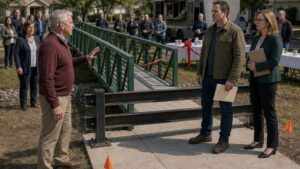
Dennis stood at the end of his driveway while the installer unloaded them from a flatbed trailer, each one wrapped in cardboard at the base. Two horizontal gate sections followed, black powder-coated steel, plain enough that no one could mistake them for decoration.
Elizabeth had called an hour earlier.
“You’re inside the setback,” she had said. “Nothing I found prohibits the gate itself.”
“And the HOA?”
“They may complain.”
“That wasn’t what I asked.”
“I know. They don’t appear to have authority to require you to leave an unrecorded access route open.”
That was enough.
Dennis had spent the afternoon watching cars use the fresh gravel as if nothing had happened. Every tire track made the decision easier.
The installer marked the post locations with chalk.
“You sure about this line?”
Dennis looked down.
The chalk sat just inside the boundary shown on his survey.
“I’m sure.”
The drill started at nine-thirty.
Concrete dust rose into the work lights as the bit cut through the edge of the drive. The sound bounced off the neighboring houses, loud enough that curtains moved in two windows across the street.
Dennis expected someone to come out.
No one did.
By ten-thirty, the posts were seated.
By eleven, the gate hung square.
The installer swung it twice to make sure the hinges cleared the pavement, then attached the lock mechanism.
Dennis watched the two sections meet in the center.
For nine years there had been no visible line there. Anyone looking down the side drive saw pavement, grass, and a convenient path toward the adjoining street.
Now there was steel.
The installer handed Dennis the keys.
“You want the sign up tonight?”
Dennis looked at the small private-drive notice he had bought with the gate.
“Yes.”
The installer fixed it to the center panel.
When the truck finally pulled away, Dennis locked the gate.
The sound was smaller than he expected.
One metal click.
That was all.
He stood there another minute, feeling something he had not felt since Tuesday.
Relief.
The route was closed.
No contractor could spread more gravel. No resident could drift through because it happened to be easier. Frank could send all the notices he wanted, but the physical assumption had ended.
Dennis went inside convinced he had solved the problem.
At 6:17 the next morning, pounding on the front door told him otherwise.
Frank stood on the porch without his clipboard.
“You put up a gate.”
Dennis looked past him toward the side drive.
“Yes.”
“You did that last night?”
“Yes.”
Frank stared at him as though waiting for an explanation.
Dennis gave none.
“You can’t just obstruct established access.”
“Then show me the easement.”
“We are reviewing that.”
“You told me yesterday to keep the route open while you reviewed whether you had a right to it.”
“The board has residents relying on that route.”
“They can stop relying on it.”
Frank’s face reddened.
“This is exactly why we try to work these things out instead of turning everything into a legal dispute.”
Dennis almost laughed.
“You put gravel on my property without asking me.”
“We improved an existing route.”
“You improved something you don’t own.”
Frank stepped closer.
“You’ve allowed this for years.”
Dennis could hear Elizabeth’s voice in his head.
The neighborhood story.
“I allowed people through,” he said. “I didn’t give the association my driveway.”
“You knew people treated it as access.”
“I knew people used it.”
“That distinction seems very convenient now.”
Dennis felt the words land.
They were unfair.
They were also not entirely empty.
He gripped the edge of the door instead of answering.
Frank continued.
“We have delivery traffic. We have overflow parking. When cars stack up near the entrance, this route relieves congestion. You know that.”
“I also know nobody asked me before putting down several tons of gravel.”
Frank looked toward the gate.
“If you keep this locked, there are going to be complaints.”
“Then give them my number.”
“Dennis.”
“No. If someone thinks I promised them permanent access, they can tell me themselves.”
Frank shook his head.
“You’re making this bigger than it needed to be.”
Dennis closed the door before he said something he would regret.
For the next two hours, he enjoyed the silence.
Then Barbara knocked.
She stood on the porch holding a coffee cup.
“I suppose you’re the reason nobody can get through.”
“If by nobody you mean people driving across my property, yes.”
Barbara’s mouth tightened.
“I’m not here to fight.”
Dennis stepped outside and closed the door behind him.
She looked toward the gate.
“It’s substantial.”
“That was the idea.”
“I figured.”
A landscaping truck reached the end of the street, slowed near the blocked side drive, then reversed and made a three-point turn.
Barbara watched it.
“You know people really did think that route was staying.”
“You told me yesterday you knew it was mine.”
“I did.”
“Those two thoughts don’t fit together very well.”
“They do if you believed there was an arrangement.”
“With whom?”
“The board.”
Dennis turned toward her.
Barbara lowered her coffee.
“Last winter, when they were talking about traffic changes, Frank told us the side route was part of the solution.”
Dennis felt his shoulders tighten.
“What exactly did he say?”
“That it would be improved and made more reliable.”
“When?”
“December, maybe January.”
“Did he say he had my approval?”
Barbara hesitated.
“He said access had been used with the owner’s cooperation for years.”
Dennis stared at her.
“That is not the same as approval.”
“I know that now.”
“Did you know it then?”
Barbara looked toward the ground.
“No.”
The answer took some of the anger out of him.
Not because it excused anything.
Because it changed who the anger belonged to.
Barbara continued.
“A lot of people assumed you and the board had already worked it out. Why wouldn’t we? You’d never complained before.”
Dennis looked at the gate again.
Yesterday, the steel had felt like a boundary finally made visible.
Now it looked like something else too.
A correction issued years late.
Barbara said quietly, “People weren’t sitting around planning to take your property, Dennis.”
“I know.”
“Do you?”
He did not answer immediately.
She nodded toward the gate.
“I’m not saying you should open it. I’m saying some of us honestly thought this was settled.”
Dennis folded his arms.
“Frank told you that?”
“He told several of us the route would become permanent once the surface work was done.”
Dennis’s eyes returned to her.
“Permanent.”
Barbara nodded.
“Months ago.”
The morning seemed to narrow around that word.
Frank had been promising a permanent route long before gravel arrived.
Long before any board vote.
Long before anyone had asked Dennis.
Chapter 5: The Shortcut Was Cheaper Than Admitting Failure
Dennis saw his driveway on the HOA traffic map before the meeting officially began.
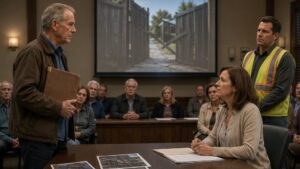
A large printed plan had been taped to the wall behind the folding tables in the clubhouse. Arrows showed vehicle flow through the subdivision in blue marker. One arrow ran from the main street, across the edge of Dennis’s lot, and out through the side road.
Someone had labeled it secondary access.
Dennis stood in front of the map until Frank noticed him.
“That diagram is conceptual,” Frank said.
Dennis pointed at the line crossing his property.
“It was conceptual enough to send a gravel truck.”
Frank said nothing.
Residents filled the chairs behind them. Some looked uncomfortable when Dennis turned around. Others looked irritated. A few avoided his eyes entirely.
Barbara sat near the aisle.
Elizabeth took a seat beside Dennis with a legal pad on her lap.
The property manager called the meeting to order.
Frank began with traffic congestion.
He spoke calmly. No accusations. No raised voice.
The subdivision had grown busier. Delivery vehicles were larger. Holiday parking routinely narrowed the entrance. An earlier proposal to widen the turnaround area had become more expensive than expected.
Dennis listened.
For the first ten minutes, Frank sounded reasonable.
That almost made things worse.
One board member described two occasions when service vehicles had struggled to turn around. Another mentioned complaints from residents near the entrance about cars blocking mailboxes.
Frank gestured toward the traffic map.
“The side corridor has functioned as a practical secondary route for years.”
Dennis waited.
Elizabeth had told him not to interrupt unless someone made a factual claim about his ownership.
Frank continued.
“The recent gravel work was intended to stabilize that route and improve drainage.”
Dennis raised his hand.
The property manager acknowledged him.
“Was the board aware that the route shown on that map crosses my privately owned driveway?”
Frank answered.
“We understood there was longstanding access.”
“That wasn’t my question.”
The room went quiet.
One of the board members looked down at the papers in front of him.
Frank said, “We understood the route had been used with your cooperation for a significant period.”
“Did the board have a recorded easement?”
No one answered immediately.
HOA counsel, seated at the far end of the table, spoke.
“We have not identified one.”
The sentence changed the room.
A resident in the second row whispered something.
Dennis looked at Frank.
“So why was it on the plan as association access?”
Frank folded his hands.
“Because operationally, that is how it functioned.”
Elizabeth spoke for the first time.
“Operational use and property rights are not interchangeable.”
Frank glanced at her.
“No one is suggesting they are.”
Dennis almost responded, but Elizabeth touched one finger to her legal pad.
Wait.
The property manager moved to the next item: the contractor authorization.
The minutes showed the board was scheduled to vote Thursday.
The gravel had been ordered Monday.
Dennis asked, “Who authorized the work before the vote?”
Frank answered.
“I did.”
A board member turned toward him.
“Under what authority?”
Frank’s expression hardened.
“We had already discussed the project repeatedly.”
“That’s not a vote,” the board member said.
“No, but we had contractor availability, and the price was going to increase if we delayed.”
There it was.
Not an easement.
Not an emergency.
A schedule and a price.
Dennis looked at the traffic map again.
The blue arrow across his driveway was not there because anyone had proven a right.
It was there because somebody needed a route.
The discussion moved to the earlier access project.
Dennis had heard vague references to it before, but now the property manager produced the numbers.
The HOA had considered modifying the subdivision entrance and expanding the turnaround area. Drainage work and utility relocation pushed the estimate far above the original budget.
The project was postponed.
Frank explained that the board could not justify another assessment.
“We had already told residents we were addressing congestion,” he said. “We needed a workable alternative.”
Dennis looked at him.
“So you chose mine.”
Frank’s eyes met his.
“We chose an existing route.”
“My driveway.”
“A route people had been using for years.”
“Because I let them.”
Frank’s voice sharpened.
“And you never told anyone that permission was temporary.”
Several heads turned toward Dennis.
The comment stung because it was the same truth Barbara had already forced him to face.
Dennis took a breath.
“You’re right.”
Frank seemed unprepared for that.
Dennis continued.
“I should have been clearer. I should have told people to ask every time. I should have put something in writing years ago.”
The room became very still.
“But none of that gave you permission to hire a contractor.”
Frank’s face closed again.
Dennis pointed toward the map.
“You didn’t come to me because asking meant I could say no.”
No one spoke.
Frank looked down at his papers.
Then he said, “I believed you would agree.”
“You didn’t ask.”
“We were solving a real problem.”
“You still didn’t ask.”
That was the line Dennis had been looking for.
Not because it won the room.
Because it separated the two truths cleanly.
Frank had a problem.
Dennis had been careless about boundaries.
Neither fact gave the HOA ownership.
A resident near the back raised her hand.
“What happens now if the gate stays closed?”
The property manager answered that vehicle circulation would return to the main entrance and existing turnaround.
Another resident said, “That’s going to be a mess during events.”
Someone else replied, “It’s still his property.”
The disagreement spread without becoming hostile.
That surprised Dennis.
People were not dividing neatly into sides.
Some accepted that he owned the driveway and still wanted him to open it.
Some blamed Frank.
Some blamed Dennis for waiting nine years to object.
Barbara said nothing.
Elizabeth leaned toward Dennis.
“This is useful.”
He whispered, “Everyone keeps saying that when things get worse.”
“They’re not getting worse. They’re getting clearer.”
HOA counsel asked to review the contractor paperwork.
For several minutes, pages moved around the table.
Frank sat motionless.
Then counsel looked toward the board.
“I need to be careful because I haven’t completed a full title review.”
Dennis felt every person in the room turn toward him.
“But based on the recorded materials provided, I have not seen an easement granting the association general vehicular access across Mr. Miller’s property.”
Frank rubbed his thumb along the edge of his folder.
Counsel continued.
“If that remains the case, the association should not continue asserting ownership or access authority it cannot document.”
A board member asked, “What about the gravel?”
“That creates a separate issue.”
“What issue?”
“Unauthorized improvement to private property.”
The words seemed heavier because they came without drama.
No accusation.
No performance.
Just classification.
Frank finally spoke.
“We can remove the gravel if that’s what Dennis wants.”
Elizabeth looked at counsel.
“And restore the affected surface and shoulder.”
Frank turned toward Dennis.
“How much are we talking about?”
“That will depend on the contractor,” counsel said. “But if the work was unauthorized, the association may be responsible for the full cost.”
Dennis looked at the blue arrow on the wall.
Two days earlier, he had wanted Frank to feel what he had felt standing beside the dump truck.
Now, watching Frank calculate the consequences in front of his own board, Dennis found he did not want humiliation.
He wanted the line corrected.
The meeting ended without a final decision.
As residents stood, some approached Dennis.
One apologized.
Another said she hoped he would consider some form of limited access.
A third simply said, “I didn’t know.”
Dennis believed her.
Frank remained at the table.
For the first time since Tuesday, he did not look like a man defending authority.
He looked like a man staring at the cost of a shortcut.
Chapter 6: Five Business Days Put a Price on Assumption
Elizabeth sent the restoration demand at 8:12 Friday morning.
Five business days.
Remove the gravel placed on Dennis Miller’s property without documented authorization. Repair any damage to the paved surface and adjoining shoulder. Confirm in writing that the association would not claim general vehicular access unless it could produce a valid recorded right.
Dennis read the letter twice before she sent it.
“You want anything stronger?” Elizabeth asked.
“No.”
“You’re sure?”
“Yes.”
She studied him.
“You were more aggressive Wednesday.”
“I was angrier Wednesday.”
“That doesn’t answer the question.”
Dennis looked through her office window toward the parking lot.
“I want them off my property. I don’t need them embarrassed.”
Elizabeth nodded and clicked send.
By noon, the HOA’s counsel acknowledged receipt.
By Monday, a contractor was at Dennis’s driveway taking measurements.
The man stretched a tape across the gravel and marked the original edge of the asphalt with chalk.
Dennis watched from beside the garage.
The old driveway line emerged in pieces beneath the stone.
At one point the contractor brushed gravel away with his boot, exposing the darker strip where Dennis had repaired the crack years earlier.
“There,” Dennis said.
The contractor looked down.
“That your original edge?”
“Yes.”
He made a mark.
For Dennis, the line had always existed.
What had changed was that other people were finally measuring it.
Tuesday afternoon, Elizabeth called.
“The association’s counsel has advised the board not to defend the access claim.”
Dennis set down the screwdriver he was using at his workbench.
“That quick?”
“They can keep researching title if they want. But there’s no obvious instrument supporting what Frank represented.”
“And the gravel?”
“They’re collecting restoration bids.”
Dennis waited for satisfaction.
It came, but less sharply than he expected.
“What kind of numbers?”
“Several thousand.”
“For putting it back the way it was.”
“That tends to be how restoration works.”
He smiled despite himself.
A few hours later, Frank appeared at the gate.
He did not knock.
He stood outside it until Dennis noticed him from the garage.
Dennis walked down but did not unlock it.
Frank placed both hands on the top rail.
“We got the preliminary estimates.”
“I heard.”
“This is going to cost the association.”
Dennis looked at him.
“It already did.”
Frank ignored that.
“If we remove everything, would you consider leaving some limited access?”
Dennis almost answered no.
The word came naturally now.
That alone surprised him.
For years, yes had been easier.
Now no was easy.
Maybe too easy.
“What kind of access?”
“Deliveries when the main road is blocked. Emergency situations. Major neighborhood events.”
“That sounds a lot like what we had before.”
“It worked before.”
“Until you paved it without asking.”
“Graveled.”
Dennis stared at him.
Frank gave a tired exhale.
“Fine. Graveled.”
Dennis rested one hand on the gate.
“Why should I trust another informal arrangement?”
“It doesn’t have to be informal.”
That was the first useful thing Frank had said.
Dennis waited.
Frank continued.
“We could document it. Limited circumstances. No general resident traffic.”
“And who controls the gate?”
“You.”
The answer should have felt like victory.
Instead, Dennis heard Barbara’s voice.
People really did think that route was staying.
He imagined a written agreement solving what nine years of friendliness had failed to solve.
Then he looked at Frank.
“You still haven’t answered the part that matters.”
Frank frowned.
“What part?”
“Why didn’t you ask me in the first place?”
“I told you. We had traffic problems.”
“That explains why you wanted access.”
Dennis stepped closer to the gate.
“It doesn’t explain why you ordered work before your own board voted.”
Frank looked away.
“That’s a board matter.”
“No. You’re asking me for access now. It’s my matter.”
Frank’s hands came off the rail.
“The board will restore the driveway.”
“That’s not the same as an answer.”
“You’re getting what you wanted.”
Dennis felt something settle inside him.
A week earlier, that sentence might have ended the argument. He would have accepted the practical result to avoid prolonging an uncomfortable conversation.
That was how the problem had begun.
Take the easy peace.
Leave the hard sentence unsaid.
Not this time.
“I haven’t told you what I want yet.”
Frank looked back at him.
Dennis continued.
“I know the association had a traffic problem. I know the entrance project got too expensive. I know people expected this route to stay open.”
Frank said nothing.
“I also know you signed the contractor order before the board vote.”
The silence stretched between the black bars of the gate.
“So if you want me to consider limited access later, tell me why you thought asking me wasn’t necessary.”
Frank’s jaw tightened.
“You want an apology?”
“No.”
“What, then?”
“The truth.”
Frank glanced toward the street, where two neighbors were walking a dog.
He lowered his voice.
“This isn’t the place.”
Dennis almost smiled.
For the first time, Frank seemed concerned about crossing a boundary.
“Then come back when you’re ready to talk.”
Frank looked at the locked gate.
“When?”
“When you can answer the question.”
Dennis turned toward the house.
Behind him, Frank called, “The restoration estimate is almost sixty-two hundred dollars.”
Dennis stopped.
He looked back.
Frank appeared exhausted rather than angry.
Six thousand two hundred dollars.
For gravel nobody had needed to buy.
For removal nobody would have needed to perform.
For a shortcut that would have cost nothing to discuss before treating it as a right.
Dennis nodded once.
“Then I’d say asking would have been cheaper.”
He left Frank outside the gate.
For the first time since the truck arrived, the association was no longer deciding what happened next.
Dennis was.
And before he opened that gate for anyone again, Frank Campbell was going to tell him why he had counted on Dennis never closing it.
Chapter 7: Frank Finally Asked Instead of Declaring
Frank came back Wednesday evening without a clipboard, folder, or HOA badge clipped to his belt.
He stopped outside the locked gate.
Dennis saw him from the porch and waited.
Frank did not rattle the chain. He did not call through the bars. He simply stood on the street side with both hands in his jacket pockets until Dennis walked down the driveway.
“That’s different,” Dennis said.
Frank looked at the gate.
“What is?”
“You waited.”
A trace of irritation passed across Frank’s face, then disappeared.
“I figured entering without permission would weaken my argument.”
Dennis almost smiled.
“You still think you have an argument?”
“No.”
That answer stopped him.
Frank looked tired. Not defeated exactly. More like a man who had spent several days defending one decision from too many directions.
“The board accepted counsel’s recommendation,” he said. “The gravel comes out.”
“I heard.”
“And the association will cover restoration.”
Dennis rested one forearm against the gate.
“So why are you here?”
Frank looked past him toward the garage.
“To answer your question.”
Dennis waited.
Frank took a breath.
“The entrance redesign was supposed to be done by spring.”
“The expensive project.”
“Yes.”
“What happened?”
“Utility relocation. Drainage. Then the contractor revised the estimate.”
Dennis had already heard the broad version at the meeting.
Frank knew that.
He continued anyway.
“We’d been telling people for months that congestion would be addressed. Then we had to postpone it.”
“You could have told them that.”
“I did.”
“Apparently not the whole truth.”
Frank looked down the street.
“No.”
A pickup passed slowly. The driver lifted two fingers from the steering wheel. Neither man responded.
Frank said, “People were angry. They’d already paid increased dues the year before. Another assessment would have been a disaster.”
“So you needed something cheaper.”
“We needed something workable.”
Dennis waited.
Frank finally looked at him.
“And your driveway was already being used.”
“There it is.”
“I’m not pretending that makes what I did right.”
“But you used it to convince yourself.”
“Yes.”
The bluntness changed the temperature of the conversation.
Frank stepped closer to the gate, though he still stayed outside.
“I thought if I came to you formally, you’d start asking questions.”
Dennis stared at him.
“That was the problem?”
“I knew you.”
“You knew I’d ask whether you had the right.”
“I knew you’d want surveys, minutes, numbers, approvals.”
Dennis let out a short, humorless laugh.
“You say that like it’s unreasonable.”
“At the time, it felt like delay.”
“So instead you skipped me.”
Frank’s mouth tightened.
“I thought the board would approve it Thursday. I thought once the route was improved, you’d complain for a day or two and then let it go.”
Dennis said nothing.
Frank continued more quietly.
“You’ve let things go before.”
There it was.
Not a property document.
Not a budget.
Not a misunderstanding.
Dennis himself.
Frank had counted on a pattern.
“You knew I wouldn’t want trouble,” Dennis said.
“I believed you wouldn’t make trouble over something everyone already used.”
“That’s not the same thing.”
“No.”
Frank looked directly at him.
“I know that now.”
Dennis felt the anger rise again, but it was cleaner than before.
Frank had not mistaken silence for legal authority by accident.
He had mistaken silence for permission to proceed first and apologize later.
“You didn’t think I’d say yes,” Dennis said.
Frank frowned.
“What?”
“If you thought I’d say yes, you would’ve asked.”
Frank did not answer.
“You thought I might say no.”
“Yes.”
The word sat between them.
Dennis nodded slowly.
“Thank you.”
Frank looked surprised.
“For what?”
“For finally saying it.”
They stood in silence for several seconds.
Then a voice came from behind Dennis.
Barbara was walking up the driveway from the house next door, carrying an envelope.
“I hope I’m not interrupting.”
“You probably are,” Dennis said.
She stopped a few feet away.
“I can come back.”
Frank said, “No. Stay.”
Barbara looked between them.
“I heard the board is restoring the driveway.”
Dennis nodded.
“Looks that way.”
She held up the envelope.
“I wrote something down.”
Dennis raised an eyebrow.
“That sounds dangerous.”
“It’s not legal language.”
“That sounds worse.”
Barbara ignored him.
“What if emergency use stayed available, but only through Dennis?”
Frank looked at her.
She continued.
“No general traffic. No event parking. No delivery shortcut just because it’s easier. But if the main entrance is physically blocked, or emergency services need another way through, Dennis controls the gate.”
Dennis looked at her.
“You’ve been thinking about this.”
“Everyone has.”
“That’s what worries me.”
Barbara gave him a tired smile.
“This time we’re asking.”
The words landed harder than she intended.
Dennis looked at the steel gate.
A week earlier, he had installed it because he wanted a boundary no one could reinterpret.
Now Barbara was proposing something different: not removing the boundary, but using it deliberately.
Frank said, “We could put that in writing.”
Dennis looked at him.
“And the association admits the driveway is private.”
“Yes.”
“No language about established access.”
Frank hesitated.
Then nodded.
“No established access.”
“No resident entitlement.”
“Fine.”
“And the gate stays under my control.”
“Yes.”
Dennis looked at Barbara.
She said, “That seems fair.”
It did.
That almost made him distrust it.
For years he had confused being agreeable with being generous. He had thought boundaries made kindness smaller.
Now he understood that the opposite might be true.
A favor meant more when everyone understood it was a favor.
“I’ll consider it,” Dennis said.
Frank exhaled.
“That’s more than I expected.”
“One condition first.”
Frank’s face tightened again.
“What condition?”
Dennis looked toward the street, then back at him.
“The board corrects the record.”
“What does that mean?”
“The same way you told residents this route was permanent, you tell them it isn’t.”
Frank did not respond immediately.
Dennis continued.
“Meeting minutes. Written notice. Whatever you use. My driveway is private. The HOA had no recorded general access right. Any future emergency use is permission, not ownership.”
Frank’s jaw worked once.
“That’s going to make the board look bad.”
Dennis nodded.
“You asked why I installed the gate.”
Frank looked at the black steel between them.
Dennis touched the top rail.
“This is why.”
For the first time, Frank did not argue.
Chapter 8: The Line Stayed, but the Shortcut Changed
The gravel came out two weeks later.
Dennis stood near the garage while a small loader scraped gray stone from the shoulder and fed it into a waiting truck.
The work looked strangely similar to the morning the trouble began.
Heavy equipment.
Workers in reflective vests.
Stone moving across his property.
But this time every measurement started from Dennis’s survey.
The contractor had marked the original driveway edge with chalk. Where gravel had covered the darker repaired strip in the asphalt, workers exposed it carefully rather than cutting across it.
The line was visible again.
Dennis watched one worker rake the last loose stones from the grass.
“You want this section reseeded too?” the contractor asked.
“Yes.”
“It’ll take a little while to blend.”
“That’s fine.”
Dennis had learned something about lines.
They did not have to disappear to stop looking hostile.
Sometimes they simply needed time.
Later that morning, Elizabeth arrived with the final settlement documents.
She set them on Dennis’s kitchen table in the same place where his old survey folder had lain among years of casual emails.
“The board approved everything,” she said.
Dennis read slowly.
The association acknowledged that his driveway was privately owned.
No general vehicular easement had been identified.
The HOA would not represent the route as association-controlled.
Any emergency access would exist only under a separate written permission revocable under specified conditions.
Dennis stopped at that paragraph.
Elizabeth noticed.
“You can still remove it.”
“No.”
“You’re comfortable with it?”
“I’m getting there.”
She slid another paper toward him.
“The restoration invoice.”
Dennis looked at the total.
Six thousand two hundred dollars.
Exactly enough to turn a cheap shortcut into an expensive lesson.
He expected the number to satisfy him more than it did.
Instead, he thought of dues.
Residents paying for gravel they had not ordered, then paying again to remove it.
Frank had caused that.
But revenge against the association would not somehow make the money come from Frank’s pocket alone.
Dennis set the invoice down.
“It’s a waste.”
Elizabeth nodded.
“It is.”
“That may bother me more than if they’d fought.”
“Why?”
“Because none of it had to happen.”
“No.”
“One conversation.”
Elizabeth closed her folder.
“One boundary.”
Dennis looked toward the window.
“Yes.”
That evening, the HOA held a short special meeting.
Dennis attended because the written correction had been his condition.
Frank read it himself.
There was no dramatic apology.
No room full of cheering residents.
The language was dry.
The association confirmed that Dennis Miller’s side driveway was private property. The board acknowledged that prior neighborhood use did not constitute a general HOA access right. Future use would be restricted according to the written emergency-access agreement.
Frank did not look at Dennis while reading.
Dennis was grateful for that.
The statement did not need theater.
It needed to exist.
When Frank finished, one board member moved to add a new procedure requiring documented property authority and written owner consent before any association-funded work could occur on land not clearly identified as common property.
The motion passed.
Barbara was sitting three chairs behind Dennis.
Afterward, she caught up with him outside.
“So.”
“So.”
“You keeping the fortress?”
Dennis looked toward his house.
“The gate?”
“The gate.”
“Yes.”
Barbara smiled.
“I figured.”
“But I’m changing the lock.”
Her smile disappeared.
“Oh.”
Dennis let the silence hold for one beat too long.
Then he handed her a small folded card.
Barbara opened it.
A gate code was written inside.
She looked up.
“What’s this?”
“Emergency use.”
“You trust me with it?”
“I trust the agreement.”
Barbara laughed.
“That sounds like something Elizabeth would say.”
“She’d charge me for it.”
Barbara looked at the card again.
“So what counts as an emergency?”
Dennis pointed toward the attached copy of the agreement in her hand.
“You can read.”
“You really have changed.”
“I’m trying.”
She folded the card carefully and put it in her wallet.
A few minutes later they walked toward the driveway together.
The restoration was complete.
The gravel was gone.
Fresh seed covered the disturbed shoulder. The asphalt repair Dennis had made years earlier was visible again, a slightly darker line running beside the gate post.
Frank stood near the street speaking with the property manager.
When he noticed Dennis, he walked over.
“The notice went out to everyone,” he said.
“I saw it.”
“No complaints yet.”
“Give it time.”
Frank almost smiled.
Then he looked at Barbara.
“You have the code?”
She nodded.
“Dennis gave it to me.”
Frank looked back at Dennis.
“You’re sure?”
Dennis understood the question beneath the question.
Was he sure he wanted to allow anything after everything that had happened?
He thought about nine years of open pavement.
Then the gravel.
Then the gate.
The problem had never been generosity.
The problem had been leaving generosity undefined until everyone could choose their own meaning for it.
“Yes,” Dennis said. “I’m sure.”
Barbara stepped through while Dennis entered the code to demonstrate the lock.
The gate released.
He opened one side.
She passed through and turned around.
“Feels strangely official.”
“That’s the point.”
Frank remained on the street side.
He did not move toward the opening.
Dennis noticed.
Two weeks earlier Frank would have walked through while explaining why he believed he could.
Now he waited.
Dennis looked at him.
“You can come through.”
Frank hesitated.
“You sure?”
Dennis nodded.
“This time I’m asking you to.”
Frank stepped across.
It was a small thing.
Almost ridiculous after lawyers, contractors, board meetings, and sixty-two hundred dollars.
But Dennis felt the difference immediately.
Permission had become visible.
Not because of steel.
Because someone had asked, and someone else had answered.
Barbara walked back toward her house.
Frank headed toward the street.
Dennis remained beside the gate.
Before leaving, Frank turned.
“For what it’s worth, I should’ve asked the first time.”
Dennis considered telling him it had cost the association six thousand two hundred dollars to learn that.
He decided the number had already said enough.
“Yeah,” he said. “You should have.”
Frank nodded and walked away.
Dennis closed the gate.
The two steel halves came together above the restored driveway line.
He entered the code, tested the latch, and slipped the card with the written agreement back into his pocket.
The gate remained.
So did the boundary.
But the shortcut no longer belonged to whoever happened to assume it was open.
Dennis looked once at the clean strip of asphalt, then turned toward his house.
Behind him, the lock clicked into place.
The story has ended.