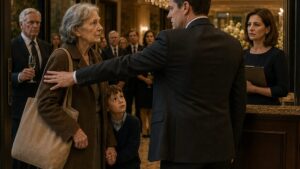
They Built a Bridge Across Jack’s Property, Then Asked Why He Wouldn’t Be a Good Neighbor
Chapter 1: The Bridge Was Ready Except for One Thing
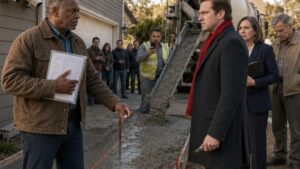
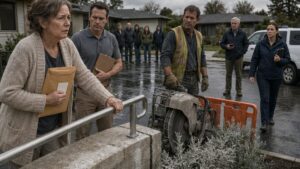
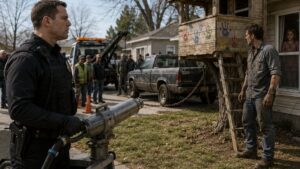
The contractor’s hammer drill screamed into the new concrete at 6:55 Saturday morning, less than two hours before the neighborhood planned to cut a ribbon across the bridge.
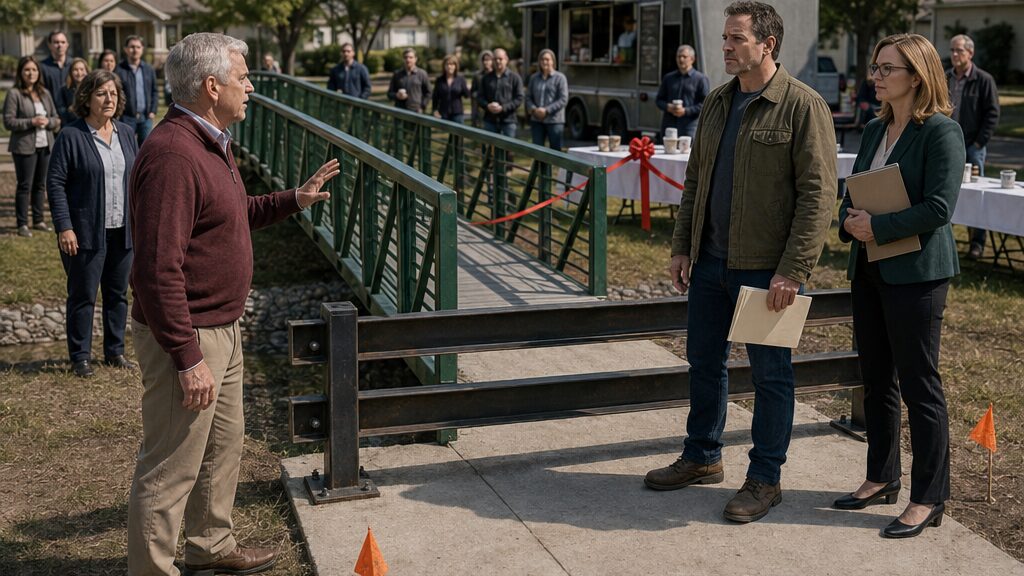
Jack Harris stood beside him with a folded permit in one hand and a paper cup of coffee he had stopped drinking in the other. Twenty feet away, white folding tables waited under a pop-up canopy. Somebody had tied green and silver balloons to the park fence. Beyond them, the pedestrian bridge curved over the drainage ditch like a piece of civic pride dropped into the wrong backyard.
At Jack’s feet, three faded orange survey flags leaned in the grass.
The contractor shut off the drill.
“One more anchor on this side.”
Jack nodded.
The first steel barrier already stood across the landing, waist-high and heavy enough that nobody could mistake it for temporary caution tape. The second lay on padded sawhorses waiting to be bolted down.
The contractor glanced toward the park entrance. “You expecting trouble?”
“I’m expecting people.”
“That wasn’t what I asked.”
Jack looked at the bridge.
Its green rails were clean. The decking still had the dull, untouched look of something installed for photographs. From the park side, it crossed the ditch exactly as the HOA had promised. From the other side, it landed on twelve feet of ground Jack had owned for eleven years.
His ground.
His taxes.
His deed.
And, according to the documents in the folder inside his truck, no recorded easement belonging to the homeowners association.
“We’re permitted,” Jack said.
The contractor shrugged. “That part I know.”
He picked up the drill again.
Jack had spent weeks imagining this morning. In most versions, Jerry Campbell arrived after everything was finished. He stopped at the edge of the crowd, stared at the barriers, and finally understood what it felt like to have a decision made for him.
Jack had never admitted that part to Sarah Adams.
His attorney would have recognized it too quickly.
The second drill hole began.
Jack looked toward one of the orange flags.
Eight weeks earlier, that flag had been bright enough to catch his eye from the kitchen window.
He had stepped outside carrying a trash bag, thinking a utility crew had marked a line near the drainage ditch. Instead, he found three orange flags planted in the strip he mowed every Saturday. No notice on his door. No letter in his mailbox. No message from the HOA.
Just flags.
At first he had pulled one halfway out before stopping himself.
There had been handwriting on the plastic stem, but nothing that meant anything to him. He pushed it back where it had been and took a picture.
Two days later, a notice appeared on the community board near the park.
Pedestrian connection.
Drainage crossing.
Improved trail access.
The plans showed a bridge.
The route showed the landing.
The landing showed Jack’s land.
He had stood at that board long enough for a woman walking a dog to ask whether he was waiting for somebody.
“No,” Jack had said.
He was waiting for the drawing to become less ridiculous.
It never did.
Now, eight weeks later, the ridiculous drawing had become steel, concrete and a ceremony with food trucks.
The contractor killed the drill again.
“That’s all four.”
Jack checked his watch. 7:08.
“Set it.”
Together they lifted the second barrier. It was heavier than Jack expected even with the contractor taking most of the weight. They guided its base plates over the anchors and lowered it into place.
Metal settled against concrete with a dull clunk.
For the first time since the project began, the bridge was physically unable to continue across Jack’s property.
It was a strange thing to see.
Not damaged.
Not demolished.
Not touched, really.
Just stopped.
The contractor began tightening the bolts.
Jack walked several steps back.
From the park, the bridge looked complete until the final few feet. Then the two barriers turned its elegant curve into a dead end.
He should have felt relief.
Instead, he noticed the canopy, the balloons and a stack of small paper cups on one of the tables.
People had volunteered for this morning.
Somebody had probably gotten up before dawn to pick up coffee.
Children might come with bikes.
None of those people had planted survey flags in his yard.
None of them had ignored his survey.
That thought irritated him because it complicated a morning he had spent weeks making simple.
The contractor straightened. “You want the warning placards now?”
Jack nodded. “Keep them on my side.”
The signs contained only the necessary access restriction and permit information. Sarah had insisted everything be done cleanly.
No homemade messages.
No accusations.
No clever signs directed at Jerry.
“Give them nothing unnecessary,” she had told him.
At the time, Jack had thought she meant legally.
He was beginning to understand she had meant something else too.
A vehicle turned into the park entrance.
Jack heard the tires before he saw it.
Both men looked up.
A dark SUV rolled slowly past the community mailbox cluster and entered the lot. A folded table was visible through the rear window.
“Seven fifteen,” the contractor said. “Early crowd.”
Jack felt his chest tighten.
For weeks, every step had been paperwork: photographs, surveys, emails, recorded notices, permit applications, measurements.
Paper created distance.
Headlights did not.
The SUV stopped.
A volunteer stepped out, stared toward the bridge, then stared again.
Jack could see the moment the person noticed the steel barriers.
The volunteer left the rear hatch closed and pulled out a phone.
The contractor slipped the wrench into his tool bag.
“Well,” he said.
Jack set his untouched coffee on the concrete.
The volunteer was already making a call.
And the second barrier had only been standing for four minutes.
Chapter 2: Twelve Feet Nobody Thought They Needed Permission For
The first orange flag had appeared less than ten feet from Jack’s back fence.
The second stood near the drainage ditch.
The third was planted farther down the narrow strip toward the public trail, all three forming a line through grass Jack had cut, edged and paid taxes on for eleven years.
He photographed them before touching anything.
That habit—verify first, argue second—had kept him out of more than one pointless neighborhood fight.
By noon, he had walked the entire strip with a copy of his closing survey from the file cabinet in his home office.
The strip was awkward property. Only twelve feet wide in places, it ran between the edge of the HOA’s park and the trail beyond the ditch. Jack rarely used it for anything except mowing and access to the back side of his lot.
That did not make it public.
On Monday morning he emailed the association management address and attached photographs.
He asked a simple question.
Why were survey markers placed on his parcel?
No answer came that day.
On Tuesday, a laminated project notice appeared on the board beside the park entrance.
Jack read it twice.
The HOA planned to build a pedestrian bridge over the drainage ditch, creating direct access from the park to the public trail. The improvement had been discussed at meetings Jack rarely attended because his house sat just outside the association boundary even though his rear property touched the common area.
He found the conceptual drawing at the bottom.
The bridge crossed the ditch.
Its western landing ended almost exactly where the orange flags stood.
Jack took a picture of that too.
Then he called the number on the notice.
A board member answered and sounded surprised by his question.
“I thought access was already worked out.”
“With who?”
A pause.
“I’m not sure. Jerry’s handling the project.”
Jack asked for Jerry Campbell’s number.
The board member suggested he send another email instead.
So Jack did.
He attached his deed this time.
By Thursday, wooden stakes appeared beside the orange flags.
That was when he stopped assuming the problem would correct itself.
The licensed surveyor arrived Friday afternoon with a tripod, measuring equipment and the patient manner of someone accustomed to standing between neighbors who each believed a fence was six inches wrong.
Jack handed him the deed and old survey.
“I don’t need you to tell me what I want to hear,” Jack said. “I need to know where it is.”
“That makes this easier.”
The surveyor started at a known corner marker near Jack’s driveway, then worked toward the rear lot. Jack followed at first, but the equipment and calculations quickly became meaningless to him.
He waited.
The surveyor moved one of his measuring poles near the park fence, checked a reading and looked toward the orange flags.
Then he measured again.
Jack felt the first real drop in his stomach.
Not because he feared being wrong.
Because the surveyor’s expression suggested he wasn’t.
Near the ditch, the surveyor drove a temporary marker into the soil.
“The recorded line runs here.”
Jack looked toward the orange flag.
It was several feet inside.
“And that one?”
“Inside.”
“The third?”
The surveyor glanced down the corridor. “We’ll verify the whole run, but based on what I’m seeing, yes.”
By late afternoon there was no ambiguity left.
Every critical construction marker connected to the bridge landing sat within Jack’s recorded parcel.
The surveyor showed him the measurements without dramatizing them.
“The association may have some access right that isn’t obvious from your old closing packet,” he said. “Utility easement, pedestrian easement, something recorded separately. I’m not doing title work.”
“But the property line?”
“That part is not close.”
Jack looked down the narrow strip.
Twelve feet.
Barely enough space to feel important until someone else decided it belonged to them.
The surveyor prepared a stamped boundary sketch the following business day. Jack emailed it to the HOA management address, Jerry, and the board contact he had spoken with.
His message was short.
The proposed bridge landing was within his property boundary. Before any work began, he requested documentation showing the HOA’s legal right to use the land.
For several hours he felt calmer.
This was the part he understood.
A question had been raised.
Evidence had answered it.
Now reasonable people would stop and sort out whatever had happened.
The next morning, a flatbed truck arrived.
Jack saw it from his kitchen.
Workers unloaded lumber and steel stakes near the ditch.
He went outside.
One worker was measuring the ground beside the orange flags.
“Morning,” Jack called.
The worker looked over.
“Are you starting the bridge?”
“Layout today.”
“There’s a boundary dispute on this landing.”
The worker lowered his tape measure. “You need to talk to the association.”
“I did.”
The worker’s expression changed just enough to say he did not want to become part of whatever was happening.
“We build where they tell us.”
Jack pointed toward his temporary survey marker. “Did anyone give you the survey I sent yesterday?”
“No idea.”
The crew did not pour anything that morning. They marked positions and set forms.
Jack took photographs from his own land.
At 10:17 he sent another email.
At 11:03 he called the HOA number.
Voicemail.
At 12:40 he received a reply from the management inbox thanking him for his concern and saying the board was reviewing the matter.
At 2:15 a small excavator arrived.
Jack stood at the back edge of his lawn watching it track toward the ditch.
A neighbor on the park path stopped.
“Finally happening,” the man said, nodding toward the equipment. “That road walk is awful with kids.”
Jack looked at him. “The bridge?”
“Yeah. They’ve been talking about it forever.”
The neighbor smiled and continued walking.
That sentence stayed with Jack.
They’ve been talking about it forever.
Everyone seemed to know except the man whose property they needed.
The following morning, Jack heard hammering before breakfast.
When he stepped outside, workers were staking the exact location of the bridge foundation.
His stamped survey had been in the HOA’s inbox for less than twenty-four hours.
One of the new stakes stood inches from an orange flag.
Jack took another photograph.
Then he called Jerry Campbell directly.
This time, Jerry answered.
Chapter 3: The Question Jerry Refused to Answer
“Do you really want to be that neighbor?”
Jerry Campbell asked it in a tone so mild that Jack almost missed what the question was doing.
Jack stood in his kitchen with one hand pressed against the counter. Through the back window he could see workers carrying boards near the drainage ditch.
“I’m asking whether the HOA has an easement,” Jack said.
“I understand what you’re asking.”
“Then answer it.”
Jerry exhaled.
“We’ve been working on this connection for almost two years. The entire neighborhood supports it. Parents use that trail. Older residents use it. Right now people have to walk out to the road.”
“That doesn’t answer my question.”
“There are development documents covering that corridor.”
“Is there an easement on my property?”
Another pause.
Jerry’s voice became firmer.
“Jack, you can push back if you want. That’s your choice. But there’s a bigger community here, and sometimes one homeowner has to look at the larger benefit.”
Jack watched a worker place another form beside the orange flags.
“I’m not in your HOA.”
“You border our common area.”
“That isn’t the same thing.”
“Nobody is trying to take your house.”
Jack almost laughed.
Instead he said, “Send me the recorded document that allows the bridge landing on my parcel.”
Jerry did not say yes.
He did not say no.
He said, “Do you really want to be that neighbor?”
Something in Jack went still.
Until then, he had been treating the problem as a mistake.
A map problem.
A communication problem.
Maybe an old easement nobody had found yet.
Jerry had turned it into a character test.
If Jack objected, he was selfish.
If he asked for proof, he was obstructive.
If fifty families wanted something that required twelve feet of his property, his role was apparently to become reasonable enough to disappear.
“Thanks, Jerry,” Jack said.
“For what?”
“For answering.”
“I didn’t—”
Jack ended the call.
He did not call back when Jerry rang five minutes later.
Instead, he searched for a real-estate attorney.
Sarah Adams’s office was in a low brick building near the county courthouse. Two days later, Jack sat across from her while she reviewed his deed, survey and photographs.
She did not react much.
That made him trust her.
When he finished describing the call with Jerry, Sarah tapped the boundary sketch.
“You’re asking me two different questions.”
“What are they?”
“Do you own this strip, and does someone else have a legal right to use part of it?”
“The survey says I own it.”
“Correct. Ownership doesn’t automatically eliminate easements.”
“I know.”
“You say that now. You’d be surprised.”
She turned to her computer.
“We need title documents, recorded plats, easements, development agreements, anything tied to the original subdivision.”
Jack nodded toward the window. “They’re building while we look.”
“If you want immediate court action, that’s a different conversation.”
“Can we first find out what they actually have?”
Sarah studied him for a moment. “Yes.”
It took three days.
During that time Jack photographed each stage of construction. Every image included something that established position or date where possible: the fence, the survey pins, the orange flags, the progression of the forms.
On the third afternoon Sarah called.
“No pedestrian easement recorded against your deed.”
Jack sat straighter.
“Nothing?”
“No recorded pedestrian easement that gives this HOA the right to put that landing where the survey shows it.”
“What about what Jerry said? Development documents?”
“There is something.”
His satisfaction stalled.
Sarah emailed him a scanned plan from decades earlier.
Jack opened it.
Most of the lines meant little to him, but Sarah directed him toward a notation running near the area behind his property.
Future pedestrian connection.
Jack read it again.
“So they do have it?”
“No.”
“It says pedestrian connection.”
“It says somebody intended one. That is not the same as a recorded easement across the parcel you later purchased.”
“Then what is it?”
“Context.”
Jack leaned back.
Context was exactly the kind of word he did not want.
Sarah continued. “It explains why the HOA may sincerely believe this route was always supposed to exist. It does not, based on what I’ve found, give them the right to build on your land.”
“So Jerry isn’t completely making it up.”
“I didn’t say that.”
“But he saw this and assumed.”
“Possibly. Or somebody before him did.”
Jack looked at the old plan on his screen.
For the first time, the problem acquired a history longer than Jerry Campbell.
That should have made Jack less angry.
Instead, it made Jerry’s refusal to answer feel worse.
If Jerry had shown him the plan and said, We think this gives us a claim, Jack could have understood the dispute.
Instead, Jerry had asked whether he wanted to be a bad neighbor.
Sarah said, “I recommend we send formal notice immediately.”
“Do it.”
“And I recommend we request that construction pause while title is resolved.”
“Do that too.”
The notice was drafted that afternoon.
It identified the disputed area, referenced Jack’s deed and survey, and stated that continued construction could constitute an encroachment. Sarah also prepared the documents needed to place notice in the county property records so nobody later could say the dispute had appeared after completion.
Jack read every line.
“Too soft?” Sarah asked.
“No.”
“You look like you think it’s soft.”
“I think Jerry understands plain English.”
“Then the goal is to create a record, not entertain him.”
She filed the notice.
The county recording clerk stamped it into the system.
For the first time since the flags appeared, Jack felt the ground beneath the conflict become solid.
Jerry could talk about community benefit.
The old plan could mention a future connection.
But Jack had a current deed, a licensed survey and no recorded easement authorizing the landing.
That evening Jerry called.
Jack answered.
“I got your attorney’s letter.”
“Good.”
“This is getting unnecessarily adversarial.”
Jack looked through the kitchen window.
Fresh lumber framed the edge of the drainage ditch.
“You’re building on my property while telling me I’m the one making it adversarial.”
“We have a project deadline.”
“Stop the project.”
“We can’t just shut down a funded contract every time somebody raises an objection.”
Jack felt his grip tighten around the phone.
“I sent you a professional survey.”
“And we have historical planning documents.”
“Then show me the easement.”
Jerry went quiet.
Again.
That silence had become the only honest part of their conversations.
Finally Jerry said, “If we miss the construction window, we could lose funding. The contractor schedule is fixed. We’re trying to resolve access while keeping the project moving.”
There it was.
Not legal authority.
Momentum.
Jack understood the calculation immediately.
Every day the bridge advanced, stopping it became more expensive.
Every dollar spent made Jack look more unreasonable for objecting.
Every neighbor who expected the new connection increased the pressure.
Jerry was not waiting for proof.
He was waiting for inevitability.
Jack said, “You’re gambling with my property.”
“I’m trying to finish something the community has wanted for years.”
“Those aren’t mutually exclusive.”
Jerry’s voice hardened. “You should think about what happens if you force everyone to lose this project.”
Jack ended the call.
The next morning Sarah invited him back to her office.
She had prepared several options.
One was negotiation.
One was a demand for immediate suspension.
The third involved seeking court relief if the HOA refused.
Sarah slid the papers across the desk.
“If your goal is to stop construction now,” she said, “we can take the next step.”
Jack looked at the documents.
Outside her window, people moved in and out of the courthouse carrying folders much like his.
He thought about Jerry’s silence when asked for the easement.
He thought about the orange flags.
He thought about the phrase force everyone to lose.
Then he looked at Sarah.
“What happens,” Jack asked, “if I don’t stop them yet?”
Chapter 4: The Day Jack Chose Not to Stop Them
Sarah did not answer Jack immediately.
She closed the folder containing the draft court papers and pushed it an inch away from him.
“If you don’t stop them,” she said, “they may keep building.”
“I understand that.”
“No. You understand the sentence. I’m not sure you understand what comes with it.”
Jack leaned back in the chair.
Sarah pointed toward the photographs spread between them. Forms had been set near the ditch. Materials were staged. The bridge was still early enough that stopping construction would be painful, but manageable.
“Every week you wait,” she said, “more money gets spent. More people assume the project is settled. More pressure gets created around you.”
“That pressure is already what Jerry is using.”
“Yes.”
“So maybe he should find out it works both ways.”
Sarah watched him carefully.
There it was.
Jack knew it as soon as he heard himself say it.
Not property rights.
Not documentation.
Not even the bridge.
Jerry.
Sarah gathered the papers into a neat stack.
“If your purpose is protecting your land, we have tools for that.”
“And if my purpose is letting him finish what he started?”
“Then I would tell you not to pretend that’s the same thing.”
Jack looked toward the courthouse through her window.
He could still seek immediate relief. He could send one more demand. He could force the argument into a room where deeds and surveys mattered more than Jerry’s neighborhood speeches.
Instead he said, “Keep the notice in place.”
Sarah’s mouth tightened slightly.
“And construction?”
“For now, I document it.”
She gave him the kind of silence that made him feel more judged than an argument would have.
“You’re allowed to make that decision,” she said at last. “But don’t confuse legal patience with moral cleanliness.”
Three days later, concrete went into the ground.
Jack stood at the edge of his yard with his phone raised while the crew poured the first footing.
He took six photographs.
One showed the temporary survey pin.
Another showed the orange flag beside the form.
A third captured the wet concrete flowing into a space that, according to every current document Jack possessed, belonged to him.
He could have called Sarah.
Instead he adjusted the angle and took another picture.
The bridge rose quickly after that.
Steel arrived.
The drainage crossing took shape.
Workers installed green railings and deck sections while residents slowed along the park path to watch.
Jack began to recognize the rhythm of construction by sound alone.
Metal clanging before eight meant railing work.
Short bursts from power tools meant decking.
Truck engines idling near the park meant another delivery.
He photographed everything.
The orange flags stayed in the grass.
As the bridge grew, they looked smaller.
One afternoon Jack was standing near the corridor when Rebecca Green approached from the park.
He knew her by sight. She had lived in the neighborhood longer than he had owned his house, and he had seen her at board events and cleanup days. She carried a canvas grocery bag and stopped when she noticed him taking another photograph.
“You’re documenting the project?”
“I’m documenting where it is.”
Rebecca glanced toward the bridge.
“It’s looking good.”
Jack lowered the phone.
“That depends what you mean.”
Her expression changed.
“Oh.”
“What did Jerry tell the board about access?”
Rebecca shifted the bag against her hip.
“You’d have to ask Jerry.”
“I did.”
“And?”
“He asked whether I wanted to be the kind of neighbor who stopped the whole project.”
Rebecca looked genuinely confused.
“I thought the property issue was handled.”
“Handled how?”
“I don’t know. Permission, easement, whatever was required.”
“Did the board see one?”
She hesitated.
That hesitation was enough.
Jack looked back at the bridge.
Rebecca followed his gaze.
“The connection really is needed,” she said.
“I didn’t say it wasn’t.”
“There are people who walk all the way out to the entrance because they can’t cross here. The shoulder on that road is narrow.”
“I know where the road is.”
“I’m not trying to argue.”
“It sounds like you are.”
Rebecca frowned.
Then, instead of snapping back, she pointed toward the park path.
“Last fall one of the older residents nearly got clipped by a pickup walking around to the trail entrance. A couple of parents stopped letting their kids bike there. That’s when people started pushing hard for this.”
Jack said nothing.
He had assumed Jerry wanted the bridge because Jerry liked projects.
Signs.
Improvements.
Things that could be presented at annual meetings as evidence that someone was getting things done.
He had not thought much about the people who would actually use it.
Rebecca looked toward the orange flags.
“If this is really your land, they should’ve dealt with you before they started.”
“It is my land.”
“I believe you.”
The words surprised him.
“But,” she added, “I also understand why people want the bridge.”
“So do I.”
“Do you?”
Jack looked at her.
Rebecca did not back away from the question.
For the first time since the dispute began, somebody had challenged him without trying to erase his ownership.
That made it harder.
“I’m not against a bridge,” Jack said.
“What are you against?”
“Being told my consent is a scheduling problem.”
Rebecca nodded slowly.
“That I understand.”
She started walking, then stopped.
“For what it’s worth, Jerry told us the access issue had been taken care of.”
“When?”
“Before construction started.”
Jack felt something tighten behind his ribs.
“Those exact words?”
“More or less. He said the route had been cleared.”
Jack lifted his phone again and looked at the bridge through the screen.
Cleared.
Not resolved.
Not documented.
Cleared.
That evening Sarah called.
“You’ve seen today’s work?”
“Yes.”
“Then you understand the structure is becoming expensive.”
“That seems like Jerry’s problem.”
“Eventually it becomes everyone’s problem.”
Jack opened his refrigerator, stared inside without seeing anything, then shut it again.
“Rebecca says residents were told access was handled.”
“That doesn’t surprise me.”
“It should.”
“Professionally? No.”
Jack rested one hand on the kitchen counter.
Sarah said, “You still have options.”
“So does Jerry.”
“He does.”
“He keeps choosing construction.”
“And you keep choosing not to stop him.”
Jack did not answer.
Sarah let that sit.
“When this ends,” she said, “you’re going to have to live next to whatever happens.”
The call ended without Jack changing course.
Two more weeks passed.
The bridge deck was completed.
Then the railings.
Then crews finished the approach from the park side.
From Jack’s kitchen window, it became harder to see a dispute.
It simply looked like a bridge.
That disturbed him more than he expected.
The orange flags were still there, but now the structure dominated them.
One Thursday evening, a neighborhood email appeared in Jack’s inbox because he had subscribed years ago to park notices.
COMMUNITY TRAIL CONNECTION GRAND OPENING.
Saturday morning.
Ribbon cutting.
Coffee.
Food trucks.
Local media invited.
Jack read it once.
Then again.
At the bottom, a photograph showed Jerry standing beside the nearly completed bridge.
Jack’s eyes moved from the screen to the real structure outside his window.
For six weeks Jerry had been building inevitability.
Now he had scheduled the moment when everyone would celebrate it.
Jack forwarded the email to Sarah.
Then he opened the folder containing every survey, photograph and notice he had collected.
For the first time, the question was no longer whether he could stop the bridge.
It was whether he had been waiting for exactly this invitation.
Chapter 5: Six Weeks of Notice and One Saturday Morning
The finished bridge looked almost peaceful from Jack’s kitchen Friday evening.
That irritated him.
Its green railings caught the last light. The deck curved over the drainage ditch and landed neatly beside the grass he had maintained for eleven years. Someone from the HOA had already placed small directional signs near the park path for the next morning’s ceremony.
Jack’s phone buzzed.
A reminder from the neighborhood email list.
Ribbon cutting at nine.
He deleted it.
Then he walked outside.
The remaining orange survey flags were faded now. One had bent low enough that the plastic nearly touched the grass.
Jack crouched and straightened it.
For weeks those flags had marked the invasion.
Now they marked the evidence.
His phone rang.
Sarah.
“I assume you saw the reminder.”
“I did.”
“And?”
Jack stood.
“The barrier permit cleared.”
“I know.”
“The contractor can be here at six forty-five.”
“I know that too.”
He looked at the bridge.
Sarah had helped him identify a lawful way to restrict entry where the structure attempted to continue onto his property. Nothing would be attached to HOA-owned bridge components. Nothing would be destroyed. The barriers would sit on Jack’s side, anchored into a permitted concrete strip and positioned to prevent unauthorized access across the disputed landing.
Clean.
Documented.
Legal.
Sarah had used all three words.
Now she used another.
“Jack, negotiate.”
He said nothing.
“I’m not telling you to give them an easement,” she continued. “I’m not telling you to surrender the claim. Call Jerry tonight. Tell him the bridge cannot open tomorrow unless there’s an interim agreement.”
“He’s had six weeks.”
“Yes.”
“He got the recorded notice.”
“Yes.”
“He built anyway.”
“Yes.”
“So why is tonight different?”
“Because tomorrow isn’t about whether you’re right.”
Jack looked toward the park.
“It seems exactly about that.”
“No. Tomorrow is about what you choose to do with being right.”
He almost laughed.
“Did Jerry hire you?”
“Don’t do that.”
Jack regretted the line before she finished saying it.
He rubbed the back of his neck.
“Sorry.”
Sarah’s voice softened by one degree.
“I know why you’re angry. I also know you’ve been imagining what his face will look like when he sees those barriers.”
Jack stared at the bridge.
He could have denied it.
Instead he said, “Maybe.”
“That matters.”
“He tried to use the neighborhood against me.”
“And if you do this tomorrow, part of what you’re doing is using the neighborhood against him.”
“That’s not why the barrier is necessary.”
“I didn’t say it was.”
Jack walked farther down the strip.
The bridge landing sat only yards away.
“I’m installing it.”
Sarah was quiet.
Then: “All right.”
“That’s it?”
“You’re my client. You’re making a lawful choice. My job is to make sure you understand its consequences.”
“I do.”
“No, Jack. You understand what happens to the bridge. You don’t know what happens to the people.”
He ended the call ten minutes later with the plan unchanged.
He slept badly.
At 5:48 Saturday morning, Jack was awake before his alarm.
By 6:30 he had coffee, the permit packet, the recorded encroachment notice, the current deed, the survey and a folder of dated photographs in his truck.
The contractor arrived fifteen minutes later.
He unloaded the barriers without conversation.
They were simple steel frames, powder-coated dark gray, heavy enough to make their purpose unmistakable.
The contractor pointed toward the boundary markers.
“We stay entirely this side.”
“Yes.”
“You want me to verify before drilling?”
“Yes.”
They measured twice.
The first hole began at 6:55.
The sound carried across the empty park.
Jack expected triumph.
Instead he felt exposed.
Every turn of the drill made the private dispute more physical.
Paper could remain inside folders.
Steel could not.
At 7:08 they set the second barrier in place.
At 7:15 the first HOA volunteer arrived, stared at the blocked landing and immediately made a phone call.
Jack knew what would happen next.
The park woke fast.
Another car arrived.
Then a pickup carrying folding tables.
A food-truck worker walked halfway across the grass before stopping to look at the barrier.
The contractor finished tightening the last bolt and brushed concrete dust from his gloves.
“All done.”
Jack examined the installation.
No part touched the bridge.
No opening remained wide enough for someone to casually pass through.
The contractor pointed to the permit placard mounted on Jack’s side.
“You want anything else?”
“No.”
“Then I’m packing up.”
At 7:31 Jack received his first call from Jerry.
He let it ring.
A second call came at 7:33.
Then a text.
CALL ME NOW.
Jack put the phone in his pocket.
The contractor noticed.
“Popular morning.”
“Apparently.”
Before leaving, the contractor paused beside one of the orange flags.
“This staying?”
“Yes.”
“For the survey?”
“For now.”
The contractor nodded and drove away.
Jack remained beside the bridge.
At eight, residents began arriving.
Some came early to help. Others clearly wanted coffee before the crowd.
They approached from the park side, walked toward the bridge and stopped.
A few read the permit placard.
Others stared at Jack.
Nobody applauded.
Nobody needed an explanation to see there was a problem.
A woman Jack recognized from the neighborhood asked, “Is the bridge closed?”
“Yes.”
“For construction?”
“No.”
She waited.
Jack did not volunteer more.
By 8:20 whispers moved faster than people.
Someone said property dispute.
Someone else said easement.
A man told another man that Jack had waited until the opening on purpose.
Jack heard it and felt heat rise into his face.
The accusation bothered him because it was not entirely false.
Sarah arrived at 8:34 carrying a slim folder.
“You didn’t have to come,” Jack said.
“Yes, I did.”
She looked at the barriers.
“They’re properly placed.”
“They are.”
“That wasn’t praise.”
Jack almost smiled.
Sarah stood beside him.
Across the park, volunteers were rearranging tables because nobody knew whether the ceremony was still happening.
Rebecca arrived a few minutes later.
She saw the barriers and stopped.
Her eyes found Jack.
She walked toward him.
“You did this this morning?”
“Yes.”
“Legally?”
“Yes.”
Rebecca looked at Sarah.
Sarah said, “The installation is permitted and entirely within Jack’s property.”
Rebecca turned back toward the bridge.
For several seconds she said nothing.
Then she asked, “Did Jerry know you were going to do this?”
“No.”
“Did you know the ceremony was today?”
“Yes.”
That answer landed.
Rebecca’s expression did not become hostile.
It became disappointed.
“That’s going to matter.”
Jack looked away.
At 8:48 a local news camera operator crossed the parking lot carrying equipment.
At 8:51 the first food truck pulled beside the curb.
At 8:56 more residents entered the park behind a dark sedan.
Sarah saw it first.
“Jack.”
He turned.
Jerry Campbell’s car was coming down the park drive.
The vehicle slowed as people shifted aside.
Jerry could not yet see the landing clearly through the gathering crowd.
Jack felt the anger he had carried for six weeks sharpen into something almost clean.
Beside him, Sarah said quietly, “You still decide what kind of morning this becomes.”
Jerry parked.
He stepped out.
Then he looked toward the bridge.
And stopped walking.
Chapter 6: The Ribbon Was Cut Nowhere
Jerry Campbell stood beside his car with the driver’s door still open.
His eyes moved from the bridge to the steel barriers, then to Jack.
For one brief second, Jerry’s face contained exactly what Jack had imagined.
Disbelief first.
Then recognition.
Then the realization that dozens of neighbors were watching him understand it.
Jack felt a hard pulse of satisfaction.
It lasted maybe three seconds.
Jerry shut the car door.
“What is this?”
He crossed the grass quickly.
People moved aside.
Behind him, the ribbon-cutting table was already set with paper cups and a ceremonial pair of oversized scissors. The absurdity of it hit Jack all at once.
Jerry stopped several feet from the barrier.
“You blocked the bridge.”
Jack kept his voice level.
“I restricted access across my property.”
“You cannot do this.”
Sarah stepped slightly forward.
“The barrier is permitted and placed entirely within Mr. Harris’s parcel.”
Jerry recognized her immediately.
“This is your attorney?”
“Yes,” Jack said.
Jerry turned back toward him.
“You waited until this morning?”
Jack did not answer the question.
Jerry gestured toward the park.
“People are here. We have vendors. We have media coming.”
“The media is already here,” someone behind him said quietly.
Jerry’s jaw tightened.
“You need to remove this.”
“No.”
That one word changed the crowd.
Conversation fell away around them.
Jerry lowered his voice.
“Jack, don’t make a scene.”
Jack looked at the tables, the balloons, the gathering residents and the camera operator twenty yards away.
“I didn’t schedule the scene.”
Jerry stared at him.
Jack knew the line was satisfying.
He also knew Sarah had heard it.
Her silence beside him felt like a warning.
Jerry walked to the barrier and looked at the base plates.
“You drilled into the landing.”
“My property,” Jack said.
“This is part of the bridge approach.”
“It’s my concrete.”
“We constructed that.”
“After notice.”
Jerry turned sharply.
“We’re going to litigate this if that’s what you want.”
Sarah opened her folder.
“That option has always been available.”
Jerry’s attention moved to her.
She removed a copy of the recorded notice.
“This encroachment notice was filed six weeks ago. Your management office received the corresponding demand. The association was also provided the licensed boundary survey.”
Jerry did not reach for the paper.
Sarah continued.
“If the association intends to claim a recorded pedestrian easement, please identify it.”
A board member standing behind Jerry said, “Jerry?”
Jerry looked over his shoulder.
“We have development documents.”
Jack almost smiled.
It was the same answer again.
Sarah did not.
“The historical plan referencing a future pedestrian connection?”
Jerry’s expression changed.
Sarah nodded once.
“We have that too.”
The board member asked, “That isn’t the easement?”
“No,” Sarah said. “It shows contemplated future access. It does not, by itself, grant this association a recorded right across Mr. Harris’s parcel.”
The words moved through the crowd in fragments.
No easement.
Private property.
Six weeks.
Survey.
Jack watched Jerry absorb the shift.
For weeks Jerry had possessed the easiest explanation: one difficult homeowner was obstructing a popular improvement.
That explanation had survived because almost nobody had seen the documents underneath it.
Now it was failing in public.
Jerry pointed toward Sarah’s folder.
“This is not the place to try a title issue.”
“You chose this place,” Jack said.
Jerry faced him again.
“You knew exactly what you were doing.”
Jack held his gaze.
“So did you.”
Jerry’s face flushed.
For the first time, his anger looked less like authority and more like fear.
A resident near the tables asked, “Did the board know there was a dispute?”
Rebecca Green stepped forward before Jerry could answer.
“We knew there had been a property question.”
Jack looked at her.
Rebecca did not hide behind Jerry.
“But I was told access had been handled before construction.”
One of the board members turned toward Jerry.
“Wasn’t it?”
Jerry’s shoulders stiffened.
“The original subdivision plan clearly contemplated this connection.”
“That isn’t what she asked,” Jack said.
Jerry snapped, “You don’t get to run a board meeting in the middle of the park.”
Rebecca’s voice stayed calm.
“Then answer as president. Did we have a recorded easement?”
Jerry looked around.
There were too many people now.
Parents.
Older residents.
Volunteers.
People who had come expecting coffee and a walk across a new bridge.
The camera operator remained back, recording the general scene rather than pushing into anyone’s face.
Jerry said, “The title review was ongoing.”
Rebecca went still.
Jack heard Sarah inhale softly.
A board member said, “Ongoing?”
Jerry turned toward him.
“We had counsel checking historical access.”
“Before we broke ground?”
Jerry did not answer immediately.
That delay changed the morning more than anything Jack had done.
Rebecca looked at the bridge.
“How much has been paid on this project?”
“This is not helping,” Jerry said.
“I’m the treasurer.”
“I know your position.”
“Then answer me.”
Jack felt the satisfaction return.
This was the moment he had wanted.
Jerry surrounded by the very people whose support he had used as pressure.
Jerry forced to explain why a finished bridge ended at a steel wall.
Jerry discovering that momentum did not become ownership merely because enough money had been poured into concrete.
Jack looked at the barrier.
One faded orange flag stood beside it, flicking in the breeze from people walking past.
Then Rebecca turned to him.
“And you.”
The satisfaction vanished.
Jack looked up.
Rebecca folded her arms.
“When did you know you could stop this?”
Jack glanced at Sarah.
Sarah gave him nothing.
“That depends what you mean.”
“It doesn’t.”
Rebecca pointed toward the steel.
“When did you know the HOA probably did not have the recorded access right Jerry said was being handled?”
“About six weeks ago.”
Several people murmured.
Rebecca’s eyes narrowed.
“And you watched them keep building?”
“I filed notice.”
“I understand that.”
“They had the survey.”
“I understand that too.”
Jack could feel people looking at him now instead of Jerry.
Rebecca said, “Did your attorney give you a way to try to stop construction earlier?”
Sarah spoke before Jack could decide whether the question invaded privilege.
“There were earlier legal options available. Mr. Harris was not obligated to use any particular one.”
Rebecca nodded.
“I’m not asking whether he was obligated.”
She looked at Jack.
“I’m asking why nobody prevented us from spending weeks building something both sides knew might not be usable.”
Jerry seized on it immediately.
“Exactly.”
Rebecca turned on him.
“No.”
The single word stopped him.
“You do not get to hide behind that question. You were president. You were managing the project. If title was unresolved, construction should not have been presented to us as cleared.”
Jerry’s mouth closed.
Rebecca faced Jack again.
“But you don’t get to hide behind him either.”
Jack looked past her toward the bridge.
Children had gathered near the park path with bicycles.
One boy leaned over his handlebars, staring through the green railing at the steel barrier on the far end.
Jack suddenly saw the bridge as the children saw it.
A route almost open.
Almost useful.
Stopped by an argument they had nothing to do with.
Rebecca lowered her voice.
“My mother uses that trail.”
Jack looked at her.
“She stopped walking the road section last year after a pickup came too close. That bridge mattered to people who never knew your name.”
“I never said it didn’t.”
“No. But did you care?”
The question hit harder than Jerry’s accusation about being a good neighbor because Rebecca was not asking Jack to surrender anything.
She was asking whether being right had become the only fact he allowed himself to see.
Jack said, “They couldn’t build on my land.”
“I agree.”
Jerry stared at her.
Rebecca continued.
“And if they did, they need to fix it. But if you had a chance to force the issue before this became a finished bridge, then that matters too.”
Jack looked at Sarah.
Weeks earlier, in her office, she had pushed the court papers toward him.
If your goal is to stop construction now, we can take the next step.
Jack had asked what happened if he didn’t.
Now he knew.
Fifty people standing beside a useless bridge happened.
Sunk money happened.
Rebecca happened.
Jerry stepped toward Jack.
“So take them down.”
Jack’s guilt hardened instantly.
“No.”
Jerry threw up his hands.
“This is ridiculous.”
“No,” Jack said. “What happened here is ridiculous. The barriers stay until my property rights are resolved.”
Sarah glanced at him.
That was different.
Not forever.
Not punishment.
Until resolution.
Rebecca heard the difference too.
She turned toward the board members.
“We need an emergency meeting.”
Jerry shook his head.
“Not today.”
“Today.”
“We have procedure.”
“We also have a bridge we cannot legally open.”
“You’re assuming his interpretation is final.”
“No. I’m saying we need the documents you used when you told us access was handled.”
Jerry’s face tightened again.
Rebecca pointed toward the community building beyond the parking area.
“I want the complete project file. Title review, board approvals, correspondence, counsel comments, everything.”
A board member nodded.
Another looked at Jerry.
Jerry remained silent.
That silence no longer belonged only to Jack.
The ribbon-cutting scissors still rested on the table.
No one touched them.
The food trucks remained parked.
People began drifting into small groups, talking in low voices. Some looked angry at Jerry. Some looked angry at Jack. Most simply looked confused.
The camera operator packed one piece of equipment but stayed nearby.
Sarah closed her folder.
Jack stared across the blocked bridge.
He had won the morning he had imagined.
Jerry had arrived confident and discovered he could not simply cross Jack’s land.
The documents had held.
The threat of litigation had not frightened him.
Everyone finally understood that his objection was real.
Yet the victory did not feel the way it had in his kitchen.
Rebecca walked toward the community building with two board members.
Before she left, she turned.
“Monday evening,” she said. “Emergency meeting.”
Jerry said, “Rebecca—”
She ignored him.
“And bring the full file.”
Jerry looked toward Jack.
For the first time since the orange flags appeared, he did not look dismissive.
He looked cornered.
Jack had wanted that.
Now, standing beside a bridge that went nowhere, he was no longer sure what it would cost to find out why.
Chapter 7: The Last Orange Flag Came Out by Hand
The emergency meeting began with a document Jerry Campbell had never shown the full board.
Rebecca Green placed three stapled pages in the middle of the conference table and slid copies toward the other members.
“This came from the project file.”
Jerry did not reach for his copy.
Jack sat at the far end beside Sarah Adams. Through the community-room windows, part of the bridge was visible beyond the parking lot, still closed behind the steel barriers.
Rebecca tapped the first page.
“The title review was completed before construction reached the landing.”
One board member looked at Jerry. “You said it was still being researched.”
“It was.”
Rebecca turned the page.
“The attorney reviewing the property records wrote that no recorded pedestrian easement had been located and recommended resolving access before permanent construction crossed the parcel.”
Silence settled over the room.
Jerry finally picked up the document.
“I saw this.”
Nobody moved.
He looked around the table.
“I also saw the original development plan. The connection was always intended.”
Sarah spoke quietly.
“Intended access and granted access are different things.”
Jerry looked at her. “I understand that now.”
Jack almost answered, but the words stopped behind his teeth.
Now.
That single word was tempting.
He could have used it to reopen every phone call, every unanswered question, every morning spent watching workers build past the orange flags.
Instead he waited.
Rebecca said, “Why didn’t you circulate this?”
Jerry put the report down.
For the first time, he looked tired rather than defensive.
“We had a grant deadline.”
One board member shifted in his chair.
Jerry continued.
“If we suspended the contract, we risked losing the funding. The contractor had another municipal job scheduled after ours. If we gave up the slot, there was no guarantee we got them back this year.”
“So you gambled,” Rebecca said.
Jerry looked at Jack.
“I thought we could resolve the easement before the bridge opened.”
“By asking me?” Jack said.
Jerry’s mouth tightened.
“By reaching an agreement.”
“You never offered one.”
“I thought once the project was physically there, everyone would understand why it made sense.”
Jack stared at him.
There it was.
Not corruption.
Not confusion.
A calculation.
Jerry had believed concrete could negotiate for him.
Once enough money had been spent, once enough neighbors expected the connection, once the bridge existed in steel and decking, Jack would be the one forced to explain why he stood in the way.
“You thought I’d give in,” Jack said.
Jerry did not deny it.
“I thought you’d accept a reasonable easement.”
“You never asked what I considered reasonable.”
“No.”
The answer was so plain that Jack had nothing ready for it.
Rebecca leaned back.
“That decision cost the association money.”
“I know.”
“It also put Jack in a position where he had to defend property we had no proven right to use.”
Jerry nodded once.
“I know.”
Jack should have enjoyed hearing it.
Instead he noticed the bridge through the window.
The barriers were still there.
So were the consequences.
Rebecca looked toward him.
“There’s another part of this meeting.”
Jack knew before she spoke.
Sarah had warned him in the parking lot.
Tell the truth before somebody else tells half of it.
Rebecca folded her hands.
“Sarah’s correspondence shows an earlier option to seek immediate relief.”
Jack glanced at Sarah.
She stayed still.
Rebecca said, “You didn’t pursue it.”
“No.”
“Why?”
Jerry looked up.
Jack had spent two days preparing answers to that question.
None of them survived the room.
He could say court action cost money.
True.
He could say he hoped the recorded notice would make Jerry stop voluntarily.
Also true, at first.
He could say he had no obligation to rescue the HOA from its own decisions.
Legally true.
But not complete.
Jack looked down at his hands.
“Because after a while,” he said, “I wanted him cornered.”
Nobody interrupted.
Jack continued.
“When the flags first went in, I wanted the work stopped. When I got the survey, I wanted somebody to admit they had made a mistake. Then Jerry asked me whether I wanted to be ‘that neighbor.’”
Jerry looked away.
“I stopped wanting just a solution.”
Jack looked toward the windows.
“I wanted him to arrive at that ceremony and find out he couldn’t make the decision for me.”
Rebecca said nothing.
Jack gave a small nod toward the bridge.
“So I let him keep making his mistake.”
One board member exhaled.
Jerry asked, “And you think that makes us even?”
“No.”
Jack met his eyes.
“That’s the problem.”
The answer changed something in the room.
Not forgiveness.
Not agreement.
Just the temperature.
Rebecca opened another folder.
“We have a proposed correction.”
A revised site plan was passed around.
The bridge itself would remain. The landing, however, would be redirected several feet along the association-controlled side of the drainage corridor. A short connecting section would be rebuilt so the permanent route stayed entirely off Jack’s parcel.
Sarah studied the drawing.
“This works with the boundary survey.”
Jack looked at the narrow line representing his twelve-foot strip.
Untouched.
Rebecca continued.
“The association would reimburse Jack for the survey and reasonable legal costs related to the encroachment. The board would also formally acknowledge that no permanent pedestrian easement exists across his parcel.”
Jerry looked at the plan.
“What about construction access?”
Rebecca turned to Jack.
“That’s the complication.”
The contractor could redesign the landing without obtaining a permanent easement, but equipment would need temporary room from Jack’s side to remove part of the approach and install the corrected section.
Jerry gave a humorless laugh.
“So after all this, we still need his permission.”
“Yes,” Rebecca said.
Every face turned toward Jack.
For a moment, the old feeling returned.
Leverage.
He could say no.
The association would need a slower, more expensive construction method.
Jerry would have to explain another delay.
Jack could preserve every inch not only as property, but as punishment.
Sarah did not look at him.
She did not need to.
Jack studied the revised drawing again.
The bridge no longer crossed his land.
The permanent route no longer depended on his consent.
The HOA would pay what his refusal had cost him personally.
What remained was temporary access so they could undo the part they should never have built.
“What terms?” Jack asked.
Rebecca looked surprised.
Sarah answered.
“Limited dates. Defined work area. Restoration of your ground afterward. Insurance. No permanent rights created by the temporary access.”
“And it gets recorded?”
“The acknowledgment of your boundary and absence of a permanent easement can be documented properly. The temporary license expires automatically.”
Jack looked at Jerry.
“You don’t get to call it cooperation as proof the old route was acceptable.”
Jerry nodded.
“No.”
“You don’t get to tell people I donated access.”
“No.”
“And the board reviews property rights before approving construction next time.”
Rebecca said, “Already in the proposed policy.”
Jack looked once more at the bridge.
“Then I’ll allow temporary access.”
Nobody applauded.
He was grateful for that.
Two weeks later, workers removed the misaligned section of the landing.
Jack watched from his yard as equipment crossed the temporary access lane marked on Sarah’s agreement. The contractor stayed inside the boundaries they had signed for. When the work was finished, the ground was graded and reseeded.
The steel barriers came down only after the city inspector approved the corrected approach.
The bridge opened on an ordinary weekday morning.
No ribbon.
No oversized scissors.
No news camera.
Jack preferred it that way.
Rebecca walked across first carrying a folder from the final inspection. Behind her, an older resident stepped onto the bridge and continued toward the public trail without having to walk along the road.
Jerry arrived later.
He stopped near Jack’s fence.
For several seconds neither man spoke.
Finally Jerry said, “I should’ve asked before I assumed.”
Jack looked toward the bridge.
“I should’ve tried harder to stop it before I tried to teach you something.”
Jerry nodded.
That was all.
It was not friendship.
It was enough truth for one fence line.
After Jerry left, Jack walked down the twelve-foot strip.
The construction markers were gone. New boundary pins had been verified, and the corrected bridge curved away before reaching his property.
One old orange survey flag remained near the ditch.
Its plastic had faded almost pale yellow.
Jack bent down and wrapped his fingers around the thin metal stem.
Eight weeks earlier, the flags had looked like somebody else’s decision planted in his ground.
Later they had become proof.
Then ammunition.
Now there was nothing left for this one to prove.
Jack pulled it free by hand.
The soil released it easily.
He folded the flag against the stem and carried it back toward the house while, behind him, footsteps crossed the bridge and continued safely toward the trail.
The story has ended.