The Night The Seattle Highway Wire Snapped In Cold Rain
CHAPTER 1: THE WEIGHT OF STEEL
The hydraulic whine of the underlift was the only steady sound above the roar of Puget Sound gale winds. Rain drove sideways off Elliott Bay, sheeting across the cracked asphalt of the upper viaduct in gray waves. Marcus Vance knelt in three inches of standing slush, his oil-stained leather gloves biting into the cold links of a five-sixteenths grade-seventy transport chain. He did not rush. When you worked under forty thousand pounds of rolling iron on an elevated bridge deck, rushing got your fingers pinched off or your skull cracked against a differential.
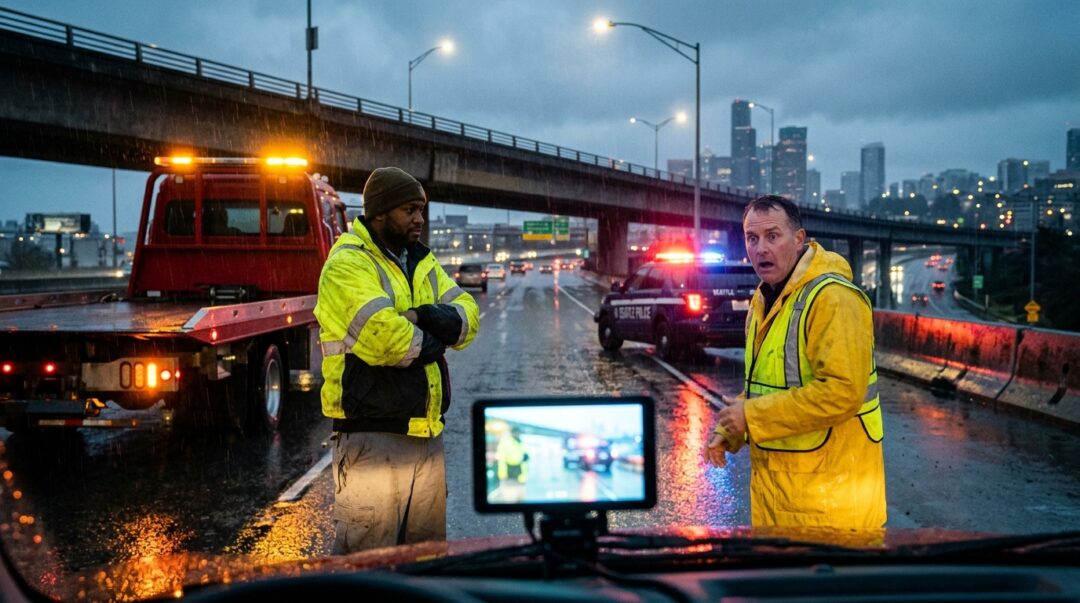
Behind him, the amber halogen strobes atop his Peterbilt heavy-wrecker pulsed in steady three-quarter time, carving arcs of sulfur-yellow light through the Pacific Northwest mist. The disabled vehicle was a late-model silver sedan with blown front struts and a crumpled radiator support. Inside the passenger compartment, a rain-soaked cardboard box sat taped on the floorboard. Marcus locked the J-hooks around the reinforced crossmember, stood upright, and reached for the remote pendant clipped to his chest harness.
A piercing air-horn blast cut through the storm.
A municipal police cruiser, its light bar slicing blue and red into the driving rain, skidded to a violent halt three feet from Marcus’s rear outrigger. The cruiser’s front bumper nudged so close to the Peterbilt’s steel dock bumpers that Marcus could smell the scalded coolant from its grill.
The cruiser door flew open. Officer Greg Danvers stepped out into the rain, his yellow rubber slicker billowing like a sail. He did not pull his hood up. He wanted Marcus to see his face—the tight, broken capillaries around his nose, the gray stubble on his sunken cheeks, and the sneer of a man accustomed to having men step backward into the ditch when he spoke.
“Unhook that iron, Vance!” Danvers shouted, his voice cracking against the wind. “Step back from the vehicle right now!”
Marcus did not drop the remote pendant. He wiped a streak of greasy water from his cheek with the back of his canvas sleeve and turned his square frame toward the patrolman. At thirty-four, Marcus had spent eight years running recovery rigs along the Cascade mountain passes after four years in the Navy Seabees. He did not rattle easily.
“Driver called Vance Marine dispatch forty minutes ago, Officer,” Marcus said, his voice low, steady, and audible beneath the rain. “Private property impound release is signed and transmitted. The owner had a blown water pump and hailed us before the tow rotation hit city dispatch.”
Danvers reached into his slicker and brought out a heavy metal citation book. He smacked the aluminum cover against his palm with a wet crack. “I do not give a damn about your dispatch, Vance. This vehicle is obstructing an arterial transit corridor. King County Municipal Code thirty-two dash eight. That makes it an automatic police impound. Apex Harbor Towing is already en route with the contract flatbed. Unhook those chains, or I am taking your commercial operator endorsement tonight.”
Marcus looked past Danvers’ shoulder. Down the slick ramp of the viaduct, two miles south, the bright halogen array of an Apex Harbor heavy-duty recovery rig was already creeping through traffic. Apex was the city’s preferred contractor—a sprawling, corporate monolith owned by former port commissioner Ronald Sterling. For eighteen months, Apex had been aggressively squeezing out every independent operator from West Seattle to Ballard, using friendly precinct officers to hijack calls, slap predatory storage liens on captured cars, and strip them for salvage.
“Apex does not hold the municipal exclusive on private roadside calls, Danvers,” Marcus said. “The owner requested me. Here is the digital manifest.” Marcus held out a ruggedized tablet inside a waterproof rubber case. The screen displayed the owner’s digital signature, a valid registration number, and the time-stamped request logged at eight-twelve that evening.
Danvers did not look at the tablet. He took two aggressive strides forward until his breath, smelling of sour coffee and tobacco, hit Marcus’s chin. “I am not asking, boy. Your paper is worthless. You got two minutes to drop those chains and clear your truck off my bridge, or I will cite your rig for unauthorized commercial interference and hook your Peterbilt behind Apex’s wrecker.”
Marcus did not move an inch. His broad shoulders remained level. He slowly reached up with his left hand, not toward his radio or his wrench, but toward the passenger windshield of his Peterbilt cab.
Mounted directly above the steering wheel, nestled beneath the tinted visor, was a dual-channel 4K telematics camera with an exterior auxiliary monitor wired into the side storage box. Marcus hit the exterior auxiliary toggle switch on the steel toolbox frame.
A high-brightness, sunlight-readable nine-inch display sprang to life beneath the Peterbilt’s tool door, shielded from the downpour by a steel awning.
On the screen, in razor-sharp ultra-high-definition, video footage began to play in a continuous loop. The timestamp read 8:03 PM—nine minutes before the sedan’s owner had called dispatch. The footage showed Officer Danvers’ marked cruiser pulling onto the red-painted curb directly adjacent to an emergency fire hydrant outside the customs warehouse on Alaskan Way. The footage captured Danvers stepping out, scanning both directions, and jimmying the passenger lock of the very same silver sedan with a slim-jim tool before taking a thick Manila folder from the glove box and sliding it under his own cruiser’s driver seat.
Marcus leaned forward slightly, his eyes cold and calm. “That is your unit, Danvers. Nine minutes before this car even broke down on the ramp. Parked over a federal fire hydrant while you entered a private vehicle without a warrant.”
Danvers froze. The blood drained from his face so fast his skin turned the color of wet river gravel. Rain poured off the brim of his cap, streaming down his slack jaw. His right hand, which had been resting on his duty belt near his service weapon, twitched.
“Where did you get that feed?” Danvers whispered, his voice suddenly stripped of all its venom.
“The Peterbilt carries three-hundred-and-sixty-degree rolling telematics, cloud-synced over cellular broadband,” Marcus replied, his voice flat as an anvil. “My mother is watching the upload from the dispatch desk right now. Shall I radio the shift captain at the South Precinct, or are you going to put that ticket book away?”
Danvers stared at the glowing screen. On the monitor, the footage looped again, zooming in on the officer’s hands as he tucked the stolen Manila envelope into his cruiser. Then Danvers’ eyes snapped back to Marcus, filled with a sudden, desperate fury.
“You think you are clever, Vance,” Danvers hissed, his fingers curling into tight, shaking fists. “You think that camera protects you. Look closer at the screen, mechanic.”
Marcus glanced at the monitor. As the high-resolution frame zoomed in on Danvers reaching inside the sedan, Marcus caught what he had not noticed during the initial transfer: behind Danvers’ shoulder, standing in the shadows of the warehouse doorway, was Marcus’s younger brother, Luke, his wrists bound with plastic zip-ties.
CHAPTER 2: COLD WATER AND HOT BRAKES
The rain redoubled its fury, slamming against the Peterbilt’s steel fenders like handfuls of buckshot. Marcus kept his hand hovering two inches above the remote pendant, his heartbeat pounding against his ribs like a sledgehammer on iron plate. He did not blink. He kept his gaze locked on Danvers’ face, though every nerve in his body screamed to grab the officer by the lapels of his slicker and drag him across the wet hood.
“What is Luke doing at the customs wharf?” Marcus demanded. The flat calm in his voice had turned into something far more dangerous—a cold, metallic edge that made Danvers instinctively take half a step backward toward his cruiser.
Danvers tried to recover his swagger, wiping rainwater from his chin with the sleeve of his coat, but his eyes were darting toward the viaduct ramp. The distant twin beacons of the Apex wrecker were climbing the incline, their amber lights strobing against the swollen low clouds.
“Your little brother likes fast money, Vance,” Danvers spat, though his voice lacked the arrogance it had possessed three minutes earlier. “He thought he could haul hot freight off Pier Ninety-One without paying the port authority assessment. Sterling’s people caught him three hours ago. He is in the cage at the South Yard. Now, you unhook this sedan and let Apex take it, or your brother goes down for grand larceny and federal customs tampering.”
Marcus did not hesitate. He swung his heavy boot up onto the Peterbilt’s running board, grabbed the remote pendant, and jammed the main hydraulic lever forward. The twin heavy-duty cylinders groaned, the hydraulic lines stiffening as twenty tons of lifting capacity hoisted the silver sedan’s front end three feet off the deck.
“What the hell are you doing?” Danvers yelled, reaching for his sidearm.
“I am doing my job,” Marcus answered without looking back. “The owner paid for recovery to Vance Marine. That car is going on my yard. If you want to pull your service weapon on an active recovery operator with three independent live cameras broadcasting to King County Emergency Services, go right ahead, Officer. Pull it.”
Danvers’ hand hovered over the thumb-break of his holster. He looked at the Peterbilt’s cab roof, where the green data lights of the live streaming uplink blinked steadily through the rain. He looked down at the sedan, whose rear tires were now locked into the self-loading wheel-grids. He knew the department protocol on recorded civilian interactions. If he fired, or even drew his weapon without a logged threat, the footage would hit the internal affairs server within sixty seconds.
“You will not make it to Fourth Avenue,” Danvers snarled, backing toward his driver’s door. “Sterling owns the municipal corridor. You will not even get off the Spokane Street ramp.”
Marcus climbed into the Peterbilt’s high-backed air-ride seat and slammed the heavy door, shutting out the howl of the storm. The cab was warm, smelling of stale coffee, diesel fuel, and damp wool. On the secondary console, the dispatch radio crackled to life.
“Marcus? Marcus, do you copy?” His mother’s voice came through the speaker, tight and brittle with terror. Evelyn Vance had been running the dispatch radios since Marcus’s father had died under a dropped transmission ten years ago. She never rattled on air, but tonight her voice trembled. “I saw the video feed on the terminal. Marcus… that was Luke in the warehouse. What have they done with him?”
“Stay calm, Mama,” Marcus said, shifting the heavy Eaton-Fuller thirteen-speed transmission into low gear. He eased his foot off the clutch, feeling the Peterbilt’s six-cylinder turbocharged diesel bite into the grade. The sixteen-ton wrecker surged forward, towing the silver sedan behind it down the slick concrete incline. “Luke is at the Apex South Yard. Danvers tried to use him as leverage to hand over the sedan.”
“Why do they want that car so badly?” Evelyn asked, the keyboard keys clicking rapidly in the background as she cross-referenced the vehicle identification number against municipal databases. “The registration came back ten minutes ago. It is not a private commuter, Marcus. That car belongs to the State Auditor’s Office. The registered driver is David Chen—the special investigator assigned to the Port of Seattle contract audits.”
Marcus gripped the leather-wrapped steering wheel, his jaw clenching until his teeth ached. “Chen was looking into the impound auctions. Danvers broke into the car to grab Chen’s audit files before Apex could tow it to the compactor.”
“Marcus, listen to me,” Evelyn said, her voice dropping to a tense whisper. “Two Apex heavy wreckers just left their terminal on East Marginal Way. They are tracking your transponder. They are not going to let you reach our shop.”
Through his side mirror, Marcus saw Danvers’ cruiser swing into a sharp U-turn across the viaduct lanes, its siren wailing as it tucked in two hundred yards behind him. Ahead, the viaduct dipped toward the industrial basin of Spokane Street. The sprawling web of rail lines, container cranes, and rusted steel warehouses looked like an iron graveyard beneath the driving rain.
At the base of the off-ramp, two sets of massive high-beam headlamps flared into existence. Two forty-ton Apex Century wreckers, their steel push-bumpers reinforced with welded railroad ties, moved into position side-by-side, effectively barricading the two-lane exit.
Marcus reached for the pneumatic brake valve, his knuckles whitening. Behind him, Danvers was closing the distance at seventy miles per hour. Ahead, eighty tons of Apex steel blocked the only path to the safety of Fourth Avenue.
Marcus flicked his high beams twice. The Apex drivers did not budge. They sat idling in the dark, their engine exhaust billowing like gray specters into the storm.
Marcus’s eyes shifted to the right shoulder of the ramp—an unpaved maintenance access road running along the railroad embankment, separated by a rusty chain-link fence and a steep gravel slope.
“Mama,” Marcus spoke calmly into the microphone, “call the King County Fire Marshal. Tell him there is an uncontrolled hazardous chemical transport fire about to happen on the Spokane Street spur.”
“Marcus, what are you doing?”
“I am taking the bypass,” Marcus said, and slammed his foot down on the throttle.
CHAPTER 3: THE LEDGER UNDER THE FLOORBOARDS
The Peterbilt’s turbocharged diesel screamed as the manifold pressure spiked to forty pounds. Marcus did not touch the service brakes. Instead, he dropped the transmission down two gears, grabbed the trailer brake trolley valve to keep the towed sedan from jackknifing, and yanked the heavy steering wheel hard to the right.
The heavy steel push-bumper of the Peterbilt plowed directly through the chain-link barrier. Galvanized steel links tore with a sound like ripping canvas, the metal poles snapping at their concrete bases. The big wrecker plunged down the forty-degree gravel embankment, twenty tons of kinetic energy violently jarring Marcus against his seatbelt harness. Rocks and ballast stone exploded against the undercarriage, ringing off the heavy-duty oil pan like shrapnel.
Behind him, the silver sedan lurched, its rear tires bouncing wild over the railroad ties, but Marcus’s grade-seventy chains held fast. He feather-footed the throttle, letting the twin locking differentials find traction in the wet ballast, and powered the rig up onto the abandoned freight spur running parallel to the Duwamish River.
In his rearview mirror, the two Apex wreckers were left stranded on the elevated asphalt, their massive tires unable to follow down the steep embankment without rolling over. Officer Danvers’ cruiser skidded to a halt at the breach in the fence, its headlights illuminating the torn wire, but the sedan and the wrecker were already disappearing into the dark warehouse alleys of the industrial waterfront.
Ten minutes later, the reinforced corrugated doors of Vance Marine & Recovery rolled up. Marcus backed the Peterbilt inside the cavernous concrete bay, and Evelyn slammed the electric override button. The heavy steel door crashed down into its floor locks with a resounding thud.
The sudden silence inside the garage was deafening, broken only by the steady tick-tick of cooling exhaust manifolds and the rhythmic patter of rain on the corrugated tin roof.
Evelyn Vance stood by the hydraulic lift controls, an iron tire iron held firmly in her right hand. Her silver hair was pulled back into a tight bun, her lined face pale but resolute. When she saw Marcus step down from the cab uninjured, she lowered the iron, her shoulders sagging with relief.
“You wrecked the right steer tire,” she said, her voice shaking slightly as she pointed to the shredded rubber on the Peterbilt’s front axle. “And you took half a chain-link fence with you.”
“Better than taking an eight-ton steel push-bumper to the radiator,” Marcus said, unzipping his wet jacket and letting it drop onto a wooden workbench. He walked straight to the towed sedan, unhooking the safety chains with quick, practiced motions. “Where is Chen?”
“I tried calling the State Auditor’s hotline,” Evelyn said, walking over with a flashlight. “The line is dead. An automated message said the special investigations unit has been temporarily placed on administrative recess pending an internal review. Sterling’s reach goes all the way to Olympia, Marcus. He has friends in the governor’s cabinet.”
Marcus did not reply. He grabbed a crowbar from the tool board and forced open the driver’s door of the sedan. The vehicle’s interior was stripped bare—Danvers had already cleaned out the glove compartment and the center console. But Marcus knew how federal and state investigators operated. When Chen was auditing port syndicates, he would not leave his master files in a cardboard box or an unlocked glove box.
Marcus dropped to his knees, peeling back the wet carpet on the transmission tunnel. Beneath the sound-deadening foam, he found what he was looking for: a custom aluminum access hatch secured with four Torx-head tamper-proof screws.
Two minutes with a battery-powered impact driver, and the plate came free.
Inside the hollowed frame rail sat a matte-black Pelican micro-case, sealed with waterproof rubber gaskets. Marcus popped the latches and opened the lid.
Inside was not a stack of paper, but a high-capacity encrypted solid-state hard drive and a hand-written spiral notebook bound with duct tape. Marcus flipped the notebook open under the glare of Evelyn’s flashlight.
The handwriting was neat, meticulous, and dense. It contained dates, vehicle identification numbers, badge numbers, and cash amounts.
“Look at this, Mama,” Marcus whispered.
Evelyn leaned in, her eyes widening behind her spectacles. “Mother of God… that is every impound logged in South Precinct for the last three years.”
It was the complete operational ledger of Apex Harbor Towing. For every independent operator forced out of business, Officer Danvers and three other traffic division patrolmen received an eight-hundred-dollar kickback in cash. But that was only the surface. The bottom half of every page tracked container numbers originating from Terminal 91.
Whenever a high-value cargo container arrived from overseas carrying undeclared microchips, rare electronics, or luxury automobile components, Danvers would stage a fraudulent traffic hazard or mechanical violation on the transport truck. The vehicle would be seized under emergency municipal powers and hauled directly to Apex’s secure yard. There, the cargo would be offloaded into Apex’s private warehouses before the transport company was even granted a hearing. By the time the legitimate carriers paid the exorbitant impound fees, their cargo had been replaced with scrap iron.
“Chen was not just doing an audit,” Marcus said, the horror dawning on him. “He was building a federal racketeering case. And Danvers found out.”
Suddenly, the red emergency beacon above the garage office flashed twice.
The external security monitors lit up. Outside the locked perimeter fence on Fourth Avenue South, four blacked-out SUVs and an unmarked police cruiser had just pulled to the curb.
Through the rain-streaked camera feed, Marcus saw Ronald Sterling step out of the lead SUV, his expensive overcoat flapping in the wind. Beside him stood Officer Danvers, his sidearm drawn, and between two private security guards stood Luke Vance, his face bruised and swollen, his wrists still bound in plastic cuffs.
The garage’s external intercom buzzed. Sterling’s voice came through the speaker, crisp, cultured, and devoid of mercy.
“Marcus Vance. We know you have Mr. Chen’s personal property. You have exactly ten minutes to bring the case outside, or your brother Luke will be found at the bottom of the Duwamish shipping channel before sunrise.
CHAPTER 4: THE SOUND OF HYDRAULIC OIL
The metallic click of the intercom switching off seemed to echo indefinitely in the high-ceilinged repair bay. Evelyn’s hand flew to her mouth, stifling a sob, but Marcus stood rigid, his eyes boring into the security monitor.
On the screen, Sterling stood under a large black umbrella held by a private security guard. The industrialist checked his gold wristwatch with casual indifference. Beside him, Danvers was pacing like a caged wolf, looking over his shoulder toward the empty street, nervous about the visibility of the operation. Luke hung his head between the two guards, a split lip dripping dark blood onto the wet pavement.
“Marcus, we have to give them the case,” Evelyn pleaded, clutching her son’s arm. “Nothing on that drive is worth your brother’s life. We give Sterling the drive, we close the shop, and we leave Seattle tonight.”
“If I hand Sterling this case, Mama, none of us leaves this bay alive,” Marcus said quietly. He turned to face her, his gaze steady and resolute. “Chen gave this to the sedan’s frame rail because he knew Sterling does not leave witnesses. The second Sterling gets his hands on this drive, Danvers burns this building to the ground with us inside and calls it an accidental electrical fire from a severed power line. That is how they operate.”
“Then what do we do?” Evelyn whispered, tears welling in her eyes. “They have six armed men out there. We have tow trucks.”
“A tow truck is thirty thousand pounds of counterweighted steel and hydraulic pressure, Mama,” Marcus said. “And this is our yard.”
Marcus moved with surgical speed. He grabbed the encrypted solid-state drive and the notebook, sliding them into an internal waterproof pocket of his canvas vest. Then he walked to the main shop distribution panel, threw the breaker for the exterior lighting, and plunged the perimeter into pitch darkness.
Outside, the sudden blackout caused Danvers to jump, his service weapon coming up toward the closed garage door.
“Sterling!” Danvers hissed, his voice picked up by the directional microphone on the eaves. “They are killing the lights! They are getting ready to run!”
“They are not running anywhere,” Sterling said, his voice cold and smooth. “The perimeter is blocked. Danvers, take two men and breach the side pedestrian door. Secure the drive. If the mechanic resists, consider him an active threat to officer safety.”
Inside the darkened bay, Marcus did not touch the light switches. He knew every square inch of the concrete floor by memory—every grease pit, every steel chain hoist, every air line. He climbed into the cab of the shop’s oldest rig: a 1984 Kenworth twin-steer rotator, equipped with a fifty-ton hydraulic boom and a six-cylinder Cummins engine that had been tuned to deliver two thousand foot-pounds of low-end torque.
He did not turn on the ignition. Instead, he reached beneath the dash and activated the pneumatic auxiliary air starter. With a sharp hiss of compressed nitrogen, the massive Cummins roared to life without a single spark or headlight showing.
At the side pedestrian door, the deadbolt rattled. A heavy steel halligan bar forced the jamb open with a screech of shearing screws. Officer Danvers slipped through the opening, his flashlight beam cutting through the airborne dust and oil haze. Two private security guards in tactical windbreakers followed behind him, their compact submachine guns held at low ready.
“Vance!” Danvers shouted, his voice echoing off the tin ceiling. “Drop to your knees with your hands behind your head! We know you are in here!”
Marcus sat high in the Kenworth’s cab, his hand on the pneumatic valve controlling the fifty-ton boom’s hydraulic slewing ring. He waited until the three men stepped past the hydraulic floor hoist, right into the center of the service bay.
Marcus yanked the valve wide open.
With a deafening hiss of high-pressure fluid, the massive six-inch hydraulic cylinders of the fifty-ton boom extended violently sideways. The three-ton solid-steel underlift arm swept through the darkness two feet above the concrete, striking the side of a scrap industrial engine block sitting on a wooden pallet.
The four-hundred-pound cast-iron block was launched across the bay like a bowling ball, smashing directly into the legs of the two private security guards. The impact cracked like thunder. The two guards went down instantly with shattered femurs, their weapons clattering harmlessly across the slick floor into the open grease pit.
Danvers dove sideways, scrambling on hands and knees behind a stack of semi-truck tires, his flashlight beam trembling violently against the walls. “Sterling! He is using the heavy equipment! Shoot the cab! Shoot the cab!”
Automatic gunfire erupted from outside the pedestrian door. Bullets punched through the thin corrugated metal of the garage walls, zipping through the darkness, shattering glass jars and sparking off the Kenworth’s armored headache rack.
Marcus did not flinch. He engaged the Kenworth’s heavy-duty power take-off, threw the transmission into reverse, and let the massive rear dual tires spin against the concrete. With a violent shudder, the thirty-ton wrecker surged backward, not toward the street, but straight through the rear wooden dividing wall that separated Vance Recovery from the adjoining municipal storm canal.
The wooden timbers splintered into kindling. The Kenworth burst into the torrential rain of the rear alleyway, its twin exhaust stacks belching black smoke into the stormy sky.
Before Danvers could scramble out of the wreckage, Marcus pivoted the Kenworth on its rear bogies, swung around the perimeter fence, and aimed the massive steel push-bumper directly at the rear of Sterling’s armored SUV.
Sterling, still standing by the front gate, looked up in sudden terror as thirty tons of roaring steel emerged from the shadows of the storm canal like an enraged leviathan.
“Sterling!” Marcus’s voice boomed through the Kenworth’s roof-mounted public address loudspeaker, cutting through the thunder and gunfire. “Drop your weapons and let my brother walk across that gate, or I will crush that six-figure truck into a two-foot cube of scrap with you inside it!”
Sterling stood frozen, the umbrella slipping from his assistant’s trembling fingers. But just as Luke lunged toward the gate, the sharp crack of a high-powered rifle shot echoed from the roof of the adjacent warehouse, and the Kenworth’s right front steer tire exploded in a geyser of sparks and shredded steel.
CHAPTER 5: THE AFFIDAVIT ON WATERFRONT WAY
The high-caliber rifle slug tore through the Kenworth’s heavy steer tire, sending the massive rig listing violently to the right. Marcus fought the steering wheel with every ounce of upper-body strength he possessed, his forearms straining against the pneumatic power steering as the steel rim ground into the wet asphalt with a shower of brilliant white sparks.
On the warehouse roof across the street, a silhouette in dark tactical gear racked the bolt of a precision rifle. Sterling was not just relying on dirty beat cops and low-level muscle—he had brought in contract marksmen to ensure no one left Fourth Avenue alive.
“Luke! Down!” Marcus bellowed through the shattered side window.
Luke Vance did not hesitate. Despite his bound wrists, the nineteen-year-old dropped flat into the gutter, rolling behind the concrete base of a municipal light pole just as a second rifle round cracked through the air, pulverizing the curb where he had stood a second before.
Marcus did not try to save the Kenworth. The steering axle was ruined. He kicked the driver’s door open, grabbed a heavy-duty three-foot steel pry bar from behind the seat, and vaulted down into the shadows between the wrecker and the perimeter fence.
Danvers came stumbling out of the breached pedestrian door of the garage, holding his side where a flying timber had bruised his ribs. He spotted Luke pinned behind the light pole and raised his service weapon with a snarl of desperation.
“You are done, kid!” Danvers screamed, closing the distance.
Marcus moved faster than a man his size had any right to move. He closed the gap from behind the Kenworth in four long strides, swinging the steel pry bar in a short, controlled arc. The heavy iron struck Danvers’ forearm with a sickening crunch. The Glock 17 flew from the officer’s broken grip, splashing into the flooded storm gutter.
Danvers shrieked in pain, collapsing against the chain-link fence, clutching his shattered wrist. Marcus stepped into his space, grabbing the front of the officer’s wet slicker with one massive hand and lifting the older man until his toes barely brushed the asphalt.
“Where is the federal liaison?” Marcus demanded, his face inches from Danvers’. “Chen had a direct contact in the U.S. Attorney’s office. Give me the name, Danvers, or I leave you in the middle of this street for your marksman to finish off!”
Danvers was sobbing now, the cold rain washing the grease and sweat from his gray face. The arrogance was completely gone, replaced by the sheer, unadulterated terror of a man who realizes he is entirely disposable to the men paying him.
“Special Agent Miller!” Danvers choked out, spit flying from his lips. “Coast Guard Investigative Service… at the Terminal Ninety-One sector command! He is the one Chen was reporting to! But it does not matter, Vance! Sterling is already at the pier! They are loading the seized containers onto the Pacific Monarch right now! The ship clears port at two in the morning! Once it is in international waters, the evidence is gone!”
A third rifle round pinged off the Peterbilt’s steel headache rack twenty feet away. The sniper was recalibrating his elevation.
Marcus shoved Danvers into the mud, sliced Luke’s zip-ties with a pocket utility blade, and hauled his younger brother to his feet. “Can you drive, Luke?”
“Left hand is bruised, but I can shift,” Luke gasped, rubbing his raw wrists.
“Get inside the shop. Take Mama out through the storm culvert on the quad bike. Head straight for Uncle Ray’s marina in Ballard. Do not stop for traffic lights, do not use your cell phones. You stay off the grid until you see the morning news.”
“Marcus, what about you?” Luke grabbed his brother’s coat, his young face pale with fear. “You cannot take on Sterling’s security team alone!”
Marcus reached into his vest, pulling out the duct-taped notebook and handing it to Luke. “Keep this safe. If I do not make it to the terminal, you deliver that notebook to the federal courthouse on Fifth Avenue yourself. Now move!”
Luke hesitated for half a heartbeat, looking into Marcus’s unrelenting eyes, then nodded and bolted through the rear breach into the garage.
Marcus turned back toward Fourth Avenue.
Sterling’s armored SUV had already turned around, speeding north toward the shipping terminals with its emergency flashers cutting through the downpour. But Marcus was not walking.
Sitting in the secondary service bay, untouched by the gunfire, was the Peterbilt heavy-wrecker he had driven down the viaduct. The silver sedan was still chained to the wheel-lift, its rear tires locked in place, carrying David Chen’s encrypted hard drive bolted securely inside the frame rail.
Marcus climbed into the Peterbilt, fired the engine, and dropped the clutch. The sixteen-ton beast surged out into the rain, its dual rear wheels biting into the wet pavement, throwing twin rooster tails of water thirty feet into the nocturnal sky.
As he cleared the industrial district and hit the lower waterfront roadway, Marcus reached over to the radio console. He patched the Peterbilt’s multi-camera telematics feed directly into the open maritime VHF channel sixteen—the international distress frequency monitored by every tugboat, container vessel, and Coast Guard cutter on Puget Sound.
“Mayday, Mayday, Mayday,” Marcus’s voice cut through the static on every bridge in the harbor. “This is commercial recovery vessel Vance One, broadcasting from Alaskan Way. I am transporting verified evidence of active maritime cargo theft and federal civil rights violations toward Pier Ninety-One. Any law enforcement agency not on Ronald Sterling’s payroll, converge on the container terminal immediately.”
Behind him, through the rain-lashed rear window, Marcus saw two sets of high-beam headlights appear in the darkness. Two unmarked black pickup trucks, their grilles equipped with heavy steel brush-guards, were accelerating rapidly, closing the gap at eighty miles per hour.
CHAPTER 6: MIDNIGHT AT TERMINAL NINETY-ONE
The salt spray off Elliott Bay hit the Peterbilt’s windshield like frozen needles. Pier 91 loomed ahead—a sprawling two-hundred-acre forest of stacked shipping containers, towering gantry cranes, and massive sodium-vapor floodlights that turned the falling rain into a yellow glare.
Behind Marcus, the two black pursuit trucks were weaving through the slick curves of Alaskan Way, attempting to perform a rolling pit maneuver on the Peterbilt’s rear axles. But twenty tons of American iron with an active underlift does not spin easily. When the lead pickup lunged forward to clip Marcus’s right rear quarter, Marcus tapped the air brakes and cut the wheel hard into the blow.
The Peterbilt’s heavy steel outrigger hit the pickup’s front quarter panel with a bone-jarring crash. The smaller truck was instantly spun across three lanes of wet asphalt, slamming sideways into the concrete base of an overhead signal gantry in an explosion of tempered glass and radiator steam.
The second pickup backed off, keeping its distance, but Marcus knew the trap was already sprung ahead.
The main security gate of Terminal 91 had been barricaded. Two forty-foot refrigerated containers had been dropped across the roadway, leaving only an eight-foot gap leading toward the private deep-water berth where the container ship Pacific Monarch lay tied to the bollards. Thick black smoke was already pouring from the vessel’s twin exhaust funnels; its mooring lines were being singled up by deckhands in orange oilskins.
Standing on the elevated loading ramp beside the ship’s stern was Ronald Sterling, flanked by four heavily armed private security contractors carrying automatic carbines. Beside them sat a massive four-hundred-horsepower industrial scrap shredder—a machine typically used to reduce junk automobiles into fist-sized chunks of metal within forty-five seconds.
The plan was brutally simple: drop David Chen’s sedan into the shredder, load the shredded scrap directly into an open container, hoist it aboard the Pacific Monarch, and steam into international waters before the federal prosecutor’s office opened at eight in the morning.
Marcus did not slow down. He shifted into eighth gear, laid his palm flat against the air horn, and aimed the Peterbilt directly at the eight-foot opening between the shipping containers.
“Take out the driver!” Sterling’s frantic order screamed over the private security frequency, echoing through the gatehouse monitors.
The four guards raised their carbines, unleashing a volley of five-point-five-six rounds. The bullets starred the Peterbilt’s thick laminated safety glass, spider-webbing the windshield into white frost, but the reinforced ballistic glass installed during Marcus’s military contract days held. The rounds ricocheted into the wet night air with high-pitched whines.
Marcus ducked low behind the steel dashboard, steering by the reflection of the yellow floodlights on the hood ornament. The Peterbilt sheared through the security gate’s wooden barrier like paper, the tires screaming as Marcus executed a four-wheel drift across the grease-slick concrete wharf.
He slammed on the trailer brakes and yanked the steering wheel hard over, sliding the entire sixteen-ton rig sideways until the Peterbilt’s heavy tailboard jammed directly into the intake mouth of the industrial shredder.
The steel teeth of the shredder bit into the Peterbilt’s rear tow bumper with a deafening screech of grinding alloy, but the heavy twenty-ton frame refused to yield. The shredder’s electric motors began to whine in agony, circuit breakers popping in the control cabinet as smoke poured from the hydraulic drive pumps.
Marcus observed the tactical movements of the crane operators across the high gantry catwalks. Every man on the midnight shift knew the sound of twenty-ton pneumatic iron, and they were watching the confrontation from behind the heavy steel stanchions. The port workers were silent witnesses to the corporate shakedown, their radio headsets picking up every tremor in Sterling’s voice.
Marcus kicked his door open and stood upright on the running board, the salt wind whipping his canvas vest. In his right hand, held high above his head for every camera and floodlight on the pier to see, was the matte-black Pelican case containing David Chen’s encrypted master drive.
“Sterling!” Marcus roared over the scream of the ship’s engines. “It is over! The entire VHF network heard your dispatch orders! The Coast Guard cutter Terrapin is already clearing Magnolia Bluff!”
Sterling stepped forward onto the steel gangway, his silver hair plastered to his forehead by the storm, his face twisted into an ugly mask of patrician rage. He pulled an antique silver-plated Colt Commander from his coat pocket and leveled it straight at Marcus’s chest.
“You pathetic grease monkey,” Sterling snarled, his voice trembling with venom. “You think a radio broadcast matters in King County? I built this port. I own the judges who sign the warrants, and I own the commissioners who approve the contracts. You drop that case into the harbor right now, or you will not live to see your brother go to prison.”
Marcus stood motionless on the steel step, rain dripping from his chin, his eyes unwavering.
“You do not own the water, Sterling,” Marcus said quietly.
Sterling smiled a cold, dead smile and pulled back the hammer of the Colt. “I own everything on this pier, mechanic. Including your life.”
Behind Sterling, from the dark waters of Elliott Bay, a blinding three-million-candlepower searchlight suddenly erupted into existence, pinning the industrialist against the ship’s white hull like an insect on a pinboard.
A thunderous klaxon split the storm, followed by the amplified voice of a federal tactical officer booming across the water:
“Federal agents! Drop your weapon! Drop your weapon or you will be fired upon!”
Sterling froze, blinded by the glare. But instead of lowering his gun, he spun wildly toward the light, his finger tightening on the trigger, as the private security contractors raised their carbines toward the approaching vessel.
CHAPTER 7: THE FINAL TIMBER ON THE WHARF
The twin high-output diesels of the United States Coast Guard forty-five-foot Response Boat-Medium roared like low-flying aircraft as the tactical craft sheared through the wake of the Pacific Monarch. Its forward-mounted searchlight illuminated every rivet on the pier, every shell casing on the concrete, and the frozen, terrified face of Ronald Sterling.
“Drop the weapon! Drop it now!” the loudspeaker thundered again, backed by the distinctive, metallic clatter of a mounted fifty-caliber machine gun being chambered on the cutter’s forward deck.
Sterling’s security contractors were professional mercenaries, but they were not suicidal. The moment they saw the Coast Guard tactical law enforcement team in dark maritime armor lining the gunwales, their weapons clattered to the steel grating. They raised their hands high, backing away from the shipping containers with their fingers laced behind their heads.
Sterling stood alone on the gangway. The silver-plated Colt felt absurdly small against the backdrop of federal steel and blinding light. He looked down at Marcus, who remained standing calmly on the Peterbilt’s running board, holding the black Pelican case against his ribs.
“You destroyed fifty years of family legacy for thirty-seven dollars of impound fees,” Sterling whispered, his voice cracking into high-pitched hysteria.
“I did not destroy your legacy, Sterling,” Marcus answered, his voice carrying clearly through the salt air. “You destroyed it the day you decided working men were just scrap to be fed through your shredder.”
Sterling’s hand trembled. For a second, it looked as though he might turn the pistol toward the cutter, but the cold reality of twenty tactical rifles aimed at his chest finally broke his nerve. The gun slipped from his fingers, clattering down the steel gangway stairs before plunging into the black, churning waters of Puget Sound.
Two Coast Guard boarding officers vaulted over the gunwales, followed closely by half a dozen Washington State Patrol cruisers that came screaming down the pier access road, their sirens painting the shipping containers in brilliant streaks of red and blue.
Special Agent Miller, a tall, gaunt man in a dripping Gore-Tex windbreaker bearing federal insignias, walked straight to the Kenworth’s tailboard. He flashed his gold credentials to Marcus and held out a gloved hand.
“Marcus Vance?” Miller asked, his eyes taking in the bullet-starred windshield, the shredded tow bumper, and the calm giant standing before him.
“I am Vance,” Marcus said. He handed the Pelican case to the agent. “David Chen’s master hard drive. Unaltered, verified time-stamps. Contains the complete kickback ledger, the container theft logs, and the names of four officers in the South Precinct who were facilitating the illegal seizures.”
Miller unclipped the case, verified the integrity of the tamper seals, and let out a long, slow breath that misted in the morning chill. “We have been hunting this paper trail for fourteen months, Vance. Chen nearly died trying to get this out of the administrative office yesterday afternoon. He is in protective custody at Harborview Medical Center right now. He told us if anyone in this city had the backbone to bring this car in without selling out, it would be an independent operator with Vance on the door.”
Marcus looked down the pier. A State Patrol cruiser pulled up, and two troopers escorted Officer Greg Danvers out of the back seat in double handcuffs. Danvers’ arm was splinted in rough cardboard, his head bowed, unable to meet the eyes of the port workers and state troopers who watched him in disgusted silence.
“What about my brother?” Marcus asked.
Miller gestured toward an unmarked sedan that had just stopped beside the cutter. The rear door opened, and Luke Vance stepped out, followed by Evelyn. Luke’s lip was stitched, and his jacket was torn, but he was walking under his own power, his head held high.
When Evelyn saw Marcus standing uninjured beside his heavy wrecker, she broke into a run, her boots splashing through the puddles, throwing her arms around her oldest son’s neck with a fierce, trembling embrace.
“It is over, Mama,” Marcus whispered, wrapping his massive arms around her shoulders. “The yard is safe. The shop is safe.”
“I heard the radio, Marcus,” Evelyn said, wiping away tears that mingled with the Puget Sound rain. “The whole waterfront heard you. Every tug captain between here and Tacoma was ready to ram Sterling’s ship if he tried to clear the headlands.”
Three weeks later, the gray clouds over Seattle broke, revealing the snow-capped jagged peaks of the Olympic Mountains across the blue waters of Elliott Bay.
Outside Vance Marine & Recovery on Fourth Avenue South, the fresh scent of cedar shavings and wet asphalt filled the morning air. A new steel overhead door gleamed in the sunlight, installed by half a dozen independent mechanics who had spent their weekend helping Marcus rebuild the shop’s perimeter fence.
Sitting parked in the primary bay was the Peterbilt, its bullet-scarred windshield replaced, its heavy-duty Vulcan underlift freshly painted in gleaming industrial black and safety yellow. Stenciled in crisp gold lettering across the door was a newly minted municipal crest.
The King County Board of Commissioners had unanimously canceled Apex Harbor’s municipal contract, voting instead to establish an independent cooperative oversight board, with Marcus Vance appointed as the chief technical advisor for commercial maritime recovery.
Marcus stood on the concrete apron, wiping grease from his hands with a clean blue rag, watching Luke adjust the tension on a new pneumatic winch line. The kid was smiling, his hands sure and confident on the steel cable.
Evelyn walked out of the office, holding two steaming ceramic mugs of black coffee. She handed one to Marcus, her eyes bright and serene as she looked out over the bustling yard.
“State auditor dropped by while you were checking the winch,” she said softly. “David Chen. He left a signed commendation on the desk. Said the state is recovering forty-two million dollars in stolen freight from Sterling’s offshore shell companies.”
Marcus took a slow sip of the hot coffee, feeling the warmth spread through his chest. He looked up at the viaduct, where traffic moved in a steady, unbroken rhythm beneath the wide Pacific sky.
“He does not need to leave paper, Mama,” Marcus said, looking down at his calloused knuckles with a quiet, enduring smile. “Around here, the work speaks for itself.”