The Morning They Called Ruth’s Safety Light Ugly, She Stopped Protecting Them From the Truth
Chapter 1: The Yellow Notice Covered the Light Dennis Built
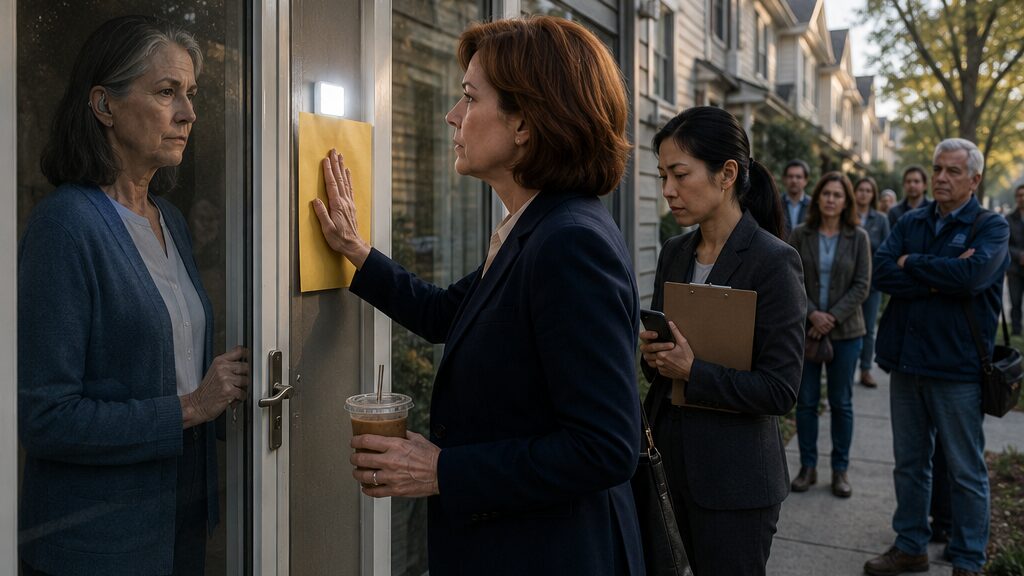
The yellow paper appeared before Ruth knew anyone was standing outside.
It covered the center of the storm door, bright enough to show through the frosted glass, its black block letters cutting across the pale morning like a warning sign. Behind it, the small white strobe beside the frame flashed twice.
Someone had pressed the doorbell.
Ruth set down her coffee and crossed the kitchen without hurrying. Through the narrow uncovered edge of glass, she saw Jessica Clark on the porch in a navy blazer, one hand wrapped around a plastic cup of iced coffee. Susan Lee stood a step behind her holding a clipboard and a phone.
Jessica pressed the bell again.
The strobe pulsed against the yellow notice.
Ruth unlocked the inner door but left the storm door closed.
Jessica lifted the clipboard so Ruth could see it. “Good morning.”
Ruth caught only part of the sound through her hearing aids. She pointed to the laminated card taped beside the doorframe.
PLEASE FACE ME WHEN SPEAKING.
Jessica glanced at it, then shifted half a step without fully turning toward Ruth.
“This is a formal violation,” she said. “Exterior decorative lighting. It needs to be removed today.”
Ruth looked at the notice rather than Jessica. The adhesive strip crossed the glass exactly where the light reflected most strongly.
“Decorative,” Ruth repeated.
Jessica smiled with professional patience. “The community standards prohibit unauthorized fixtures. We sent reminders.”
“You received my accommodation request.”
“I’m not discussing paperwork on a porch.”
“You brought paperwork to my porch.”
Across the street, a garage door had stopped halfway open. The retired postal worker who lived there stood beneath it with his arms folded. Two houses down, a woman in a robe had stepped onto her walkway with a small dog tucked against her chest.
Jessica noticed them. Her posture changed almost imperceptibly. Her shoulders settled. Her voice became clearer.
“We’re enforcing the same appearance rules for everyone,” she said. “No exceptions have been approved.”
Ruth watched her mouth.
“I requested an accommodation three months ago.”
Jessica took a drink of coffee. “What you installed looks like party lighting.”
Susan looked down at the clipboard.
The strobe was a white rectangle no larger than Ruth’s palm. Dennis had mounted it carefully beside the brick trim, sealing the edges so rainwater would not reach the wiring. When someone pressed the bell, the light flashed in the kitchen, bedroom, and front hall. It had warned Ruth when a delivery driver arrived with medication. It had told her when her grandson stood outside after school. Once, two years earlier, it had alerted her to paramedics checking the wrong address after a neighbor fell.
Jessica reached past the doorframe and pressed the bell again while Susan raised her phone.
The strobe flashed behind the violation notice.
“There,” Jessica said toward the phone. “You can see the intensity.”
Ruth looked from the phone to Jessica. “Are you recording my accommodation device?”
“We’re documenting the violation.”
“It is not a violation.”
“That determination belongs to management and the board.”
Jessica pulled a pen from the clipboard. “Sign here to acknowledge receipt.”
Ruth did not open the storm door.
Jessica’s smile tightened. “Refusal to sign won’t stop enforcement. Continued noncompliance can result in daily fines. Your vehicle may also be subject to towing under the resident enforcement policy.”
“My car has nothing to do with the light.”
“Outstanding violations affect parking privileges.”
The retired postal worker crossed the street slowly and stopped at the edge of Ruth’s lawn.
Jessica continued before he could speak. “If the account remains delinquent, the association has lien remedies.”
The word was delivered evenly, almost gently.
Ruth felt heat rise behind her ears. Not fear exactly. Something older. The particular anger that came when authority used calm language to disguise cruelty.
She opened the storm door just wide enough to take the pen.
Jessica passed it through with the clipboard.
Ruth read the acknowledgment line. It stated only that she had received the notice, not that she agreed with it. She drew a line through the blank space beneath the signature, initialed the change, and signed with the exact time.
Jessica watched her do it.
“You have until five,” she said.
Ruth returned the clipboard.
Jessica turned toward Susan and gave a small sideways glance that might have been amusement or approval. Susan’s mouth moved as if she had said something, but her face was turned away. Ruth caught none of it.
The women stepped off the porch. Jessica spoke to the neighbors in the practiced tone of someone explaining an inconvenience caused by another person.
Ruth closed the storm door.
For a moment she remained in the entryway, looking at the yellow notice. Dennis had once stood in that same spot with a level pressed to the brick, asking her to trigger the bell again.
“Too bright?” he had said.
“Not unless you plan to signal aircraft.”
He had laughed and adjusted the angle anyway.
Ruth took out her phone. She photographed the notice from the kitchen, capturing the strobe behind it. Then she stepped outside and took wider photographs showing the fixture, the door, the unit number, Jessica walking away, Susan beside her, and the phone still in Susan’s hand.
The retired postal worker waited near the walkway.
“You all right?” he asked.
Ruth read his face more than she heard him.
“Yes.”
“That wasn’t right.”
“I know.”
“Need me to tell somebody what I saw?”
The instinctive answer came to her lips.
No. I can handle it.
She almost said it.
Instead she replied, “Write down the time while it’s fresh.”
He nodded.
That small request unsettled her more than Jessica’s threat had.
Inside, Ruth peeled the notice from the glass without tearing it. The tape resisted at one corner. She slid a letter opener beneath it, preserving the strip, then placed the entire page in a clear document sleeve.
At the kitchen table, three certified-mail receipts lay beside her laptop. The first accommodation request had been delivered ninety-one days earlier. The second had been signed for fifty-eight days earlier. A third envelope contained a short letter from her audiologist explaining why an audible-only doorbell did not provide meaningful access.
Ruth opened a folder labeled HOME—DO NOT TURN INTO WORK.
She had created it after Dennis died.
At first, it held utility bills, repair warranties, and the closing documents for the townhouse. Later she had added her accommodation requests, though she had told herself that was only household organization. She had not cross-referenced statutes. She had not built a chronology. She had not called old colleagues.
Not then.
Her screen woke to a blank document.
Ruth placed the yellow notice beside the keyboard. She typed the date, then the time Jessica had first pressed the bell.
At 7:03 a.m., the property manager placed a violation notice across the front storm door, partially obscuring the visual alert associated with the doorbell.
Her fingers stopped.
The sentence sounded like her old voice. Precise. Bloodless. Built to survive people who would later claim they had misunderstood.
She opened the directory she had not touched in six years.
Inside were complaint templates, investigative checklists, sample preservation letters, and annotated decisions from cases she had handled during eleven years in housing compliance. The oldest files still carried her federal office’s naming conventions.
Ruth selected one marked REASONABLE ACCOMMODATION—FAILURE TO RESPOND.
Comments appeared in the margin in her own handwriting.
Document the request.
Document receipt.
Document knowledge.
Document adverse action.
She looked toward the front hall.
The strobe flashed once as the retired postal worker pressed the bell, holding up a handwritten statement through the glass.
Ruth turned back to the screen and began filling in the blanks.
Chapter 2: The Career Ruth Had Promised to Leave Behind
The handwriting inside the strobe housing belonged to Dennis.
Ruth found it after removing the small interior cover to photograph the model number. On a strip of white electrical tape, faded to the color of old paper, he had written:
FRONT—KITCHEN—BEDROOM. TEST MONTHLY. DON’T LET HER SAY SHE’S FINE.
Ruth sat back on her heels.
Dennis had labeled every circuit he touched, but the last sentence was not for an electrician. It was for himself.
Or perhaps for whoever remained after him.
She closed her eyes until the pressure behind them passed. Then she photographed the note, replaced the cover, and tested the bell. White light filled the front hall in three measured pulses.
At the kitchen table, the complaint template waited.
Ruth had completed the factual section before eight-thirty. At nine, she began deleting it.
The first paragraph sounded too much like an investigation. The second cited the wrong subsection for the administrative stage. The third included Jessica’s lien threat but omitted the towing threat because Ruth had not yet confirmed the exact parking policy language.
She reopened the policy packet.
By ten, the table had disappeared beneath documents.
That was how it used to begin.
One file became three. A single question became a chronology. Dinner cooled in another room while Ruth searched for the missing date that would make every other date hold together.
Dennis had once stood in the doorway of her home office at midnight with two untouched plates in his hands.
“You won,” he had said.
“I haven’t submitted the finding.”
“You found what happened.”
“That’s not the same.”
“It is in this house.”
She had resented him for saying it. Later, she resented herself because he had been right.
Ruth pushed the laptop away.
She did not need to become that woman again. She needed the light approved. She needed the notice withdrawn. Nothing more.
Her phone flashed with an incoming text.
Laura Miller: I think you need to see this.
A screenshot followed.
The email header showed Jessica’s name, Susan’s, and three board addresses. The subject line read: EXTERIOR MODIFICATIONS—PENDING ITEMS.
Jessica’s message was brief.
The Anderson unit has installed tacky party lighting beside the front door. Resident is framing it as an accessibility issue. Recommend no response until we complete the neighborhood standards sweep. Approval would invite similar requests.
Beneath it, someone had replied: Is there medical documentation?
Jessica’s answer appeared twelve minutes later.
Probably. Susan can check. The appearance problem remains.
Ruth read the exchange twice.
The email was dated six weeks before the yellow notice.
Before Jessica had stood on the porch claiming no accommodation had been approved.
Before she recorded the flashing light as though management had discovered it that morning.
Ruth called Laura through video so she could read lips.
Laura answered from her car. “I was board secretary last year. They never removed me from one of the internal folders.”
“Where did you get the screenshot?”
“Old shared archive. I was looking for roof bids.”
“Do not forward anything else yet.”
Laura frowned. “Why?”
“Because access matters. If you were authorized when the file was created, that is different from searching material you no longer have permission to view.”
“They forgot to remove me.”
“That does not make everything in there ours.”
“Ruth, they called your safety light a party decoration.”
“I can read.”
Laura’s expression tightened. “You always do that.”
“Do what?”
“Turn everything into a rule when someone tries to help you.”
Ruth almost ended the call.
Instead she said, “Save the original email with the header. Do not edit it. Do not post it. Write down how you found it.”
Laura studied her for a moment. “You’ve done this before.”
Ruth looked at the federal certificate still hanging in the narrow hallway beyond the kitchen. Dennis had wanted her to take it down after retirement. She had refused, then covered it with a framed photograph of the two of them at the lake.
“Eleven years,” she said.
Laura leaned closer to the screen. “Doing what?”
“Housing compliance.”
The answer changed Laura’s face. Her indignation gave way to surprise, then expectation.
“So you know exactly how to stop them.”
Ruth disliked that look more than pity.
“I know how a process begins.”
By noon, she had called the management office twice. Both calls went to voicemail. She sent a written demand requesting withdrawal of the violation, suspension of towing and lien activity, preservation of all records, and confirmation that the accommodation request had been received.
Then she logged into the certified-mail tracking page.
The first request showed delivered and signed. The second showed delivered to the management office. Her audiologist’s letter had been included with the second packet.
Ruth opened her email archive and searched the tracking number.
A message appeared from Susan, sent fifty-seven days earlier.
Received. We will route this for review.
There it was.
Knowledge.
Not presumed. Not inferred. Confirmed.
Ruth printed the message and set it beside Dennis’s handwritten label.
For several minutes she did nothing.
Her old instincts urged her onward. Build the index. Identify every recipient. Compare policy dates. Find whether the board had delegated accommodation authority. Preserve metadata. Request the contract.
Dennis’s voice lived in the silence between those tasks.
You found what happened.
The front-door strobe flashed.
Laura stood outside holding a manila folder.
Ruth let her in.
“I followed your rules,” Laura said. “Original copies. Notes on where each came from. No social media.”
She placed the folder on the table.
Inside were three emails unrelated to Ruth.
One concerned a resident who had requested a handrail near a sloped walkway. Management had categorized it as an exterior alteration and requested architectural drawings.
Another involved reserved parking for a resident receiving dialysis. The email chain had been marked incomplete despite an attached physician’s letter.
The third concerned a door lever requested by someone with limited grip strength. That file had been placed in a folder labeled AESTHETIC EXCEPTIONS.
Ruth kept her face still.
“Are these all from the archive?”
“Yes.”
“Did you know about them when you were secretary?”
“One. Not the others.”
“And what did you do?”
Laura looked away. “I assumed management was handling them.”
The answer hung between them.
Ruth understood it too well.
People rarely chose harm in one dramatic moment. More often, they handed responsibility to someone else and called the transfer reasonable.
She opened the parking request. The attached physician’s letter was visible in the email chain. Below it was an internal reply from Susan.
Please move this into architectural review pending site consistency.
Ruth scrolled farther.
The routing field displayed the wrong resident name.
Not a typo. The entire request had been attached to another household’s exterior-paint application.
Ruth checked the timestamp.
The reassignment had occurred three minutes after Susan acknowledged receipt of the medical letter.
Laura watched her. “What does that mean?”
Ruth looked at the yellow notice preserved in its clear sleeve, then at the three misplaced requests.
“It means mine may not be the first request they failed to review.”
Her phone flashed with a new email from Jessica.
Management acknowledges your correspondence. The violation remains valid pending board determination. Continued noncompliance may result in additional enforcement.
Ruth read it once, then added it to the chronology.
She no longer had only a dispute over a light.
She had a pattern, and someone had arranged it carefully enough to look accidental.
Chapter 3: The Board Had Budgeted for Everyone’s Silence
Timothy Hill called at 8:12 the next morning and asked Ruth not to file anything until they had spoken privately.
He appeared on her phone screen seated beneath fluorescent office lights, his tie slightly crooked, a calculator and a yellow legal pad visible beside him.
“I’m not asking you to waive anything,” he said. “I’m asking for forty-eight hours.”
Ruth angled the phone so she could see his mouth clearly. “For what?”
“To understand what happened.”
“You are the board treasurer.”
“That doesn’t mean I see every operational file.”
“You approved the enforcement contract.”
His eyes shifted toward something offscreen. “That is why I’m calling.”
They met that afternoon in the HOA office, a converted model-home garage where filing cabinets lined one wall and framed photographs of trimmed hedges lined the other. Jessica was not present. Timothy had requested the meeting without management.
He closed the door after Ruth entered.
“I want this resolved,” he said.
Ruth placed a narrow folder on the conference table. “Then withdraw the violation and suspend enforcement.”
“I can’t do that alone.”
“Call an emergency vote.”
“That creates a record before we know our exposure.”
Ruth sat down.
There it was. Not whether she had been wronged. Exposure.
Timothy opened a spreadsheet on his laptop and turned it toward her. “You should understand the board’s position.”
Rows of numbers filled the screen. Roof repairs. Drainage work. Insurance increases. Legal expenses from an unrelated contractor dispute. The reserve balance had fallen below the level recommended in the most recent study.
A separate column listed compliance revenue.
Late fees.
Administrative review fees.
Parking reinstatement fees.
Violation-processing charges.
Each row was highlighted yellow.
Ruth scrolled slowly. “You budgeted fines as operating income.”
“We budgeted enforcement revenue based on the management company’s projection.”
“Fines are supposed to correct conduct, not fund operations.”
“They said consistent enforcement would reduce long-term maintenance costs.”
“And the renewal bonus?”
Timothy’s mouth tightened.
At the bottom of the management contract summary, a performance incentive increased if collected enforcement revenue exceeded the prior year’s total.
Ruth looked up.
Timothy rubbed one hand over the edge of his legal pad. “We had a choice between a special assessment and a more aggressive compliance program.”
“You did not have a choice between solvency and federal law.”
“I know how that sounds.”
“It sounds accurate.”
He stood and walked to the filing cabinet. “Jessica told us the Anderson matter was an unauthorized decorative fixture with no completed accommodation packet.”
“She told you that when?”
“At the last executive meeting.”
“My packet was received nearly two months before that.”
“I have seen your receipt.”
“Did the board review my request?”
He did not answer immediately.
Ruth waited.
“No,” he said.
The admission gave her less satisfaction than she expected.
Timothy returned to the chair. Without the spreadsheet between them, he looked older. “The requests do not come directly to the board. Management screens them.”
“Management decided the outcome and then withheld the request from the decision-maker.”
“That may be what happened.”
“You are still protecting the sentence.”
“What sentence?”
“The one that says may.”
His face hardened. “And you are speaking as though you have completed an investigation.”
Ruth felt the old reflex sharpen in her. “I have enough.”
“For your case, perhaps.”
“For at least three others.”
Timothy stared at her.
Ruth regretted the disclosure as soon as she saw his reaction. Laura had supplied the records under questionable continuing access, and Ruth had not yet spoken with the residents involved.
“Where did you get them?” he asked.
“I will address sources through the proper process.”
“So you’re withholding information while accusing us of withholding information.”
“That is not the same.”
“It never is when you are the one deciding.”
The words landed because Dennis had once said something similar.
Ruth closed the folder. “Withdraw my notice. Freeze all accommodation-related enforcement. Preserve every routing record.”
Timothy looked down at the table. “Give me until tomorrow.”
“No towing. No lien activity.”
“I’ll tell Jessica.”
“That is not what I asked.”
Before he could respond, someone knocked. The board president stepped in and said the management company’s regional office was calling.
The meeting ended without a commitment.
Laura arrived at Ruth’s house before sunset carrying a list of unit numbers.
“I spoke to the handrail resident,” she said. “And the woman who requested parking. There’s another one involving a trash-bin exception for a man who can’t walk to the collection area.”
Ruth stared at her. “You contacted them?”
“I asked whether their requests were resolved.”
“You had no right to identify them from those files.”
“I didn’t tell anyone else.”
“You used confidential information.”
Laura’s jaw set. “And now three people know they weren’t alone.”
“That does not erase how you learned it.”
“You would have waited until every box was checked.”
“Yes.”
“While Jessica kept issuing notices.”
Ruth turned away, then forced herself back. “Did they consent to speak?”
“They consented to meet. Here. Tomorrow.”
“No.”
Laura looked stunned. “Why not?”
“This is my home.”
“And theirs are at risk too.”
The answer came too quickly. “I am not running a neighborhood legal clinic.”
Silence widened between them.
Laura lowered the list. “No. You’re making sure nobody can ask enough of you to become important.”
Ruth felt the insult before she understood the truth inside it.
Laura left the paper on the table and walked out.
At seven-thirty, Timothy emailed a short update.
The board would review Ruth’s matter within five business days. No admission was made. No enforcement suspension was included.
Attached was a revised account ledger showing a new administrative fee.
Ruth called him.
“You said you would speak to Jessica.”
“I did.”
“And?”
“She says enforcement has to remain consistent until the board votes.”
“She is adding charges while the request is under review.”
“I told her not to tow.”
“Told her, or instructed her?”
Timothy’s mouth stopped moving for a moment. The video froze, then resumed.
“I do not control daily operations.”
“You signed a contract that pays her more when she collects more.”
“That is not fair.”
“No,” Ruth said. “It is not.”
He ended the call.
The next morning, Ruth woke before dawn to a soft pulse of white light on her bedroom wall.
Not the front-door signal.
This flash came from the exterior motion sensor.
She put on her robe and crossed the hall. Through the kitchen window, amber hazard lights turned across the parking lane.
A tow truck backed toward her car.
The operator stepped down, checked a paper clipped to his visor, and began lowering the wheel lift.
Ruth looked at the authorization form through the glass.
At the bottom, beneath the management company logo, was Jessica Clark’s signature.
Chapter 4: Ruth Won the Light and Nearly Lost the Case
The wheel lift was already under Ruth’s rear tires when the front-door strobe began flashing.
She saw the white pulses from the kitchen and ran outside in her robe, one hearing aid still on the bathroom counter. The tow operator had his back to her. Amber lights rotated across the parked cars and townhouse windows.
Ruth stepped between the truck and her car.
The operator turned. “Ma’am, you need to move.”
She caught only the shape of the words.
Ruth pointed to her ear, then to his clipboard. “Show me the authorization.”
He hesitated, glanced toward the cab, and handed her the page.
The order listed unpaid compliance charges and suspended parking privileges. Jessica’s signature appeared at the bottom beside a timestamp from 4:46 the previous afternoon—less than an hour after Timothy had told Ruth he would stop the tow.
“This account is disputed,” Ruth said.
The operator shook his head. “I just have the order.”
“You cannot take the vehicle while I am standing here.”
“I’m not going to touch you, but you can’t block the equipment.”
A porch light came on across the lane.
Ruth gripped the edge of the paper. Her hands were shaking now, though not from the cold.
“Lower it.”
“I need management approval.”
“Lower my car.”
The operator moved toward the controls.
Ruth stepped closer to the wheel lift.
“Ma’am.”
“Do not move it.”
The word came out louder than she intended.
More doors opened. The retired postal worker crossed the lane in sweatpants and slippers. Someone raised a phone.
Then the strobe flashed again through Ruth’s front window.
Laura was at the door.
She saw Ruth outside and hurried toward them, coat half-buttoned. “What happened?”
“They’re towing the car.”
Laura turned on the operator. “On what authority?”
He held up both hands. “I’m not arguing with anybody.”
Ruth took out her phone and called Timothy on video.
He answered after six rings, his face dimly lit.
“What is this?” she demanded.
He blinked. “Ruth?”
“The truck is here.”
“I told Jessica not to proceed.”
“You did not instruct her.”
“I’m calling her now.”
“You signed a contract that rewards this.”
Laura touched Ruth’s arm. “Let him stop it.”
But Ruth had crossed the point where stopping felt sufficient.
“You knew they were using fines to fund operations,” she said. “You knew requests were not reaching the board, and you allowed enforcement to continue anyway.”
Timothy’s expression changed. “I did not know that.”
“You chose not to know.”
“That is not a fact you can establish.”
“It is what happened.”
“No. It is your conclusion.”
The sentence struck with the clean force of a gavel.
Ruth heard herself answer before judgment could catch up.
“You and Jessica built a system to conceal disability requests and generate revenue.”
Laura went still.
Timothy’s eyes narrowed. “Do you have evidence that I participated in concealing requests?”
Ruth looked down at the tow authorization.
She had evidence of the contract. She had evidence that Jessica withheld her request. She had evidence that other files were misrouted.
She did not have evidence that Timothy had designed the concealment.
The operator shifted his weight beside the controls.
Ruth could feel every phone pointed toward her.
“I have evidence that the board benefited,” she said.
“That is not what you just accused me of.”
Timothy ended the call.
A minute later, the operator’s phone rang. He listened, said yes twice, then lowered Ruth’s car.
“The tow is canceled,” he said. “For now.”
The wheel lift scraped the pavement as it withdrew.
A small sound came from the gathered neighbors—relief, perhaps—but Ruth did not feel victorious. She watched the tow truck leave and saw the accusation she had made hanging in the space it vacated.
Laura walked her inside.
“You stopped them,” Laura said.
“I overstated what I could prove.”
“They were taking your car.”
“That does not change the standard.”
“You’re allowed to be angry.”
“Anger is not evidence.”
Laura looked as though she wanted to argue, then saw Ruth’s face and did not.
By nine, Timothy had sent a formal email.
The board had suspended towing and lien activity pending review. Ruth’s visual doorbell received temporary authorization for thirty days. The message also stated that several comments she had made during the morning confrontation were “unsupported and potentially prejudicial.”
That phrase followed her into the state civil-rights intake call two days later.
The intake attorney appeared in a small video window, speaking slowly enough for Ruth to follow.
“Your documentation of the request and adverse action is strong,” the attorney said. “But you should separate what you know from what you suspect.”
“I understand.”
“Do you?”
Ruth held the question without answering.
“The board treasurer submitted a written statement denying knowledge of any misclassification,” the attorney continued. “That does not end the inquiry. But broad accusations can make cooperative witnesses defensive.”
“He was defending the system.”
“Perhaps. We still need him to tell us how it worked.”
Ruth felt the old embarrassment of being corrected by someone using principles she had once taught junior investigators.
That evening, she revised her chronology.
She deleted every sentence that assigned motive without support. She replaced concealed with failed to route. She replaced designed to generate revenue with financially incentivized enforcement structure.
The language became narrower.
The case became stronger.
A week after the tow attempt, a courier delivered a temporary accommodation approval signed by the board president. The light could remain in place during the investigation. All charges associated with it were suspended.
Ruth read the document twice.
It was what she had asked for.
The strobe would stay.
Her car would remain.
No lien would be filed.
For several minutes, she allowed herself to feel the relief.
Then she turned to the second page.
Management proposed a permanent resolution. Ruth’s light would be approved, all charges erased, and the association would confirm in writing that she had acted in good faith.
In exchange, she would withdraw the federal and state complaints, return all internal records, and agree not to discuss the matter with other residents.
The language was polished and neutral.
A personal solution to a personal misunderstanding.
Ruth placed the offer beside the photograph of the yellow notice.
The front-door strobe flashed.
Susan Lee stood outside alone.
She did not carry a clipboard.
When Ruth opened the door, Susan kept glancing toward the street.
“I can’t talk here,” she said.
Ruth watched her mouth carefully.
Susan swallowed. “Jessica checks the office cameras. She checks my calendar too.”
“Then why did you come?”
“Because she’s going to say I lost your request.”
Ruth said nothing.
Susan looked past her at the flashing light.
“I need to show you where the other requests went,” she said. “But not anywhere she can see us.”
Chapter 5: Susan’s Fear Was Not the Same as Innocence
Susan placed a sealed resignation letter on the diner table before she removed her coat.
The restaurant was nearly empty. A ceiling fan turned above the counter, and the morning rush had left behind the smell of coffee and fried onions. Ruth chose the booth because its high back blocked the entrance from view and the light fell evenly across Susan’s face.
“You haven’t submitted that,” Ruth said.
Susan shook her head.
“Why bring it?”
“So you know I’m not asking you to save my job.”
Ruth looked at the envelope. “What are you asking me to save?”
Susan stared at her hands.
“My name, maybe.”
“That depends on what you did.”
The waitress poured coffee. Susan waited until she left.
“Accommodation requests came into the same inbox as architectural applications,” Susan said. “Jessica said that was more efficient.”
“Who reviewed them?”
“At first, she did. Then she told me to screen them.”
“Based on what criteria?”
“Whether the change was visible from the street.”
Ruth kept her face still. “That is not an accommodation review.”
“I know that now.”
“You knew it then.”
Susan’s mouth tightened.
Ruth leaned forward. “You acknowledged receipt of my audiologist’s letter.”
“Yes.”
“Then you moved the request.”
“Yes.”
“Why?”
“Jessica said anything attached to an exterior fixture had to go through architectural review first.”
“And the other files?”
Susan looked toward the window. “Same thing. Handrails. parking signs. door hardware. Trash collection exceptions if they changed where bins were stored.”
“How many?”
“I don’t know exactly.”
“You routed them.”
“I did what the system told me to do.”
“No. You did what Jessica told you to do.”
Susan flinched.
Ruth let the silence remain.
Finally Susan said, “She told me the board didn’t want to see every medical story. She said our job was to filter out people trying to get around the rules.”
“And you believed her?”
“At first.”
“What changed?”
Susan’s eyes lifted. “Your light.”
Ruth said nothing.
“I stood on your porch,” Susan continued. “I watched it flash through the notice. I knew why it was there. Jessica had already shown me your doctor’s letter.”
The words came slowly now.
“She told me to record the intensity. Then she made that joke about party lights. I laughed.”
“You left two voicemails using the same language.”
Susan looked down.
“Yes.”
“Why?”
“She was in the office when I called.”
“That explains the audience. Not the words.”
Susan’s face reddened. “I wanted her to think I was on her side.”
“And were you?”
“For longer than I should have been.”
That answer mattered more than an apology would have.
Ruth picked up her coffee but did not drink.
“What did Jessica mean when she said she would blame you?”
Susan opened her bag and removed a blank organizational chart. No resident names appeared on it. Only boxes, arrows, inbox labels, and review categories.
“She changed the routing rules after you sent your demand letter,” Susan said. “Now the system shows accommodation requests were supposed to go directly to me for completion review.”
“Were they?”
“No. Before last week, they went to Jessica.”
“Can that be verified?”
“Email instructions. Shared-drive permissions. Audit logs.”
“You brought copies?”
Susan shook her head quickly. “Not resident files. I’m not taking anything else out.”
Ruth felt a flicker of approval she did not want to give too cheaply.
“Then what are you offering?”
“A map. Dates. Names of the folders. The person investigating can request the records properly.”
She slid the chart across the table.
It showed how an accommodation entered the general inbox, moved to a screening folder, then split. Requests affecting visible features went to architectural review. Requests with parking implications went to compliance. Only requests that required neither were sent to the board.
At three different points, Jessica had sole authority to close or reclassify the file.
“Why preserve this?” Ruth asked.
“I started writing it down after the dialysis parking request.”
“You knew that one was mishandled.”
“The resident called crying because she’d been cited for using an unassigned space after treatment.”
“And what did you do?”
“I asked Jessica to reconsider.”
“That is not what I asked.”
Susan’s eyes filled, but her voice stayed steady. “I moved the file where she told me.”
Ruth looked at the resignation letter.
Fear had shaped Susan’s choices. It had not made them harmless.
“What did Jessica threaten?” Ruth asked.
“She said mistakes in the routing system were mine because I handled the inbox. She reminded me that I was still in my probationary year. My husband had just been laid off.”
Ruth waited.
Susan gave a small, bitter laugh. “That sounds like I’m asking you to excuse me.”
“It sounds like you are explaining yourself.”
“Is there a difference?”
“There has to be.”
Susan pushed the resignation letter closer. “I’ll give a statement.”
“Then give a complete one.”
“I’ll lose my job.”
“You may lose it anyway.”
“I know.”
Ruth studied her face. Susan was not brave in the way stories liked people to become brave. She was frightened, calculating, ashamed, and still hoping to limit the cost.
That did not make the truth less useful.
It made it human.
Back at home, Ruth converted Susan’s chart into a list of records that investigators could lawfully request: inbox permissions, routing logs, folder-creation dates, contract incentive terms, board packets, and the revision history of the accommodation procedure.
She did not include Susan’s resignation letter.
At four, the state investigator called to confirm receipt of Ruth’s supplemental submission.
“This is better,” the investigator said. “It identifies the process without overstating intent.”
Ruth heard the gentle correction inside the praise.
“Will you contact Susan?”
“With her consent.”
“She will provide it.”
“Has she retained counsel?”
“I advised her to consider it.”
The investigator paused. “You’re not representing her, Mrs. Anderson.”
“I know.”
It was the second time someone had reminded Ruth that week where her role ended.
After the call, Laura came by with written consents from three residents. She placed them on the table without triumph.
“I did it properly this time,” she said.
Ruth examined the forms.
“You did.”
Laura glanced at Susan’s process map. “Is that what I think it is?”
“It shows how requests were diverted.”
“So we have them.”
“No.”
Laura’s frustration surfaced. “What more do you need?”
“A verified record. Statements. The board’s response. Insurance review.”
“They offered you a deal, didn’t they?”
Ruth looked toward the window.
Laura followed her gaze to the settlement packet.
“You’re going to take it.”
“I have not decided.”
“They approve your light, erase your fines, and everyone else starts over?”
“That is not what I said.”
“It’s what you’re considering.”
Ruth’s voice sharpened. “I am considering whether I want to spend the next year turning my house into an office again.”
Laura went quiet.
Ruth wished she could take the sentence back, not because it was false but because it exposed too much.
“I didn’t ask you to save everyone,” Laura said.
“You brought them to my table.”
“Because you know how.”
“And that means I am required?”
“No.”
The answer came softly.
“No, Ruth. It means we hoped you would help us understand what to do. That isn’t the same as making you do all of it.”
Ruth looked at the consent forms again.
The front-door strobe flashed as a courier arrived.
The envelope carried the insurance company’s name.
Inside was a formal settlement proposal. Permanent approval of Ruth’s visual alert. Removal of all fines. Reimbursement of legal and administrative expenses. A written acknowledgment that management should have responded sooner.
The release applied only to Ruth.
It required confidentiality.
It prohibited her from using materials obtained from internal association systems in support of any other resident’s claim.
At the bottom, beneath the signature line, was a seven-day deadline.
Everything Ruth had asked for was on the page.
Nothing that had happened to anyone else was mentioned.
Chapter 6: The Offer That Would Make Ruth Safe and Everyone Else Invisible
The settlement draft described the flashing light as a “personal exception granted without precedential effect.”
Ruth read the phrase three times.
Personal exception.
Not an accommodation.
Not access.
Not a right management had failed to consider.
An exception—a favor that could be isolated, hidden, and denied to the next person.
She placed the unsigned agreement beside the cracked plastic lens she had removed from the exterior strobe. The tow truck’s vibration had loosened one corner of the housing. A new replacement sat unopened in a box, but Ruth chose the old lens.
Dennis had fitted it by hand.
She cleaned the crack, applied clear resin, and held the pieces together while the seal cured.
Her phone flashed with a message from the insurance representative.
The offer expires Friday at 5:00 p.m.
A second message arrived from Timothy.
Emergency board meeting scheduled for Friday, 6:00 p.m. Residents may attend.
The order was deliberate. Settlement first. Hearing second.
By noon, Ruth sat in a conference room across from the insurance representative and the association’s attorney. The attorney spoke carefully and kept his hands visible on the table so Ruth could follow his face without distraction.
“This resolves your individual injury,” he said.
“It relabels it.”
“The language is negotiable.”
“Is the confidentiality clause?”
“Standard.”
“Is the provision preventing use of internal records?”
“The association has concerns about improperly accessed materials.”
“Will the board review the other accommodation requests?”
The attorney glanced at the insurance representative.
“We cannot discuss claims by persons who are not present.”
“You can discuss process.”
“We are reviewing process.”
“Will Jessica Clark remain in authority during that review?”
The insurance representative answered. “The management contract is a board matter.”
“Will the insurer cover other claims?”
“That depends on facts not yet established.”
Ruth folded her hands over the settlement.
“If I sign, does the investigation end?”
“Your complaint would be withdrawn.”
“That was not my question.”
The attorney’s expression tightened slightly. “Other agencies control their own inquiries.”
But Ruth understood the practical truth. Her case was the cleanest. Her documentation connected the request, receipt, knowledge, ridicule, adverse action, and attempted towing. If she withdrew quietly, the pattern would become harder to prove and easier to call a series of clerical mistakes.
The insurance representative leaned forward.
“Mrs. Anderson, prolonged litigation may affect every owner in the community. Defense costs, deductibles, reserve depletion. You have an opportunity to resolve this without placing that burden on your neighbors.”
The appeal was not false.
That made it effective.
Ruth pictured the retired postal worker across the street. Laura’s aging roof. The residents already worried about assessments. She had spent years telling housing providers that correction did not require destroying the institution.
But correction required more than saving the easiest claimant.
“I will respond before the deadline,” she said.
At home, Laura was waiting beside the repaired strobe housing.
“You went to the meeting,” Laura said.
“Yes.”
“And?”
“I have until five Friday.”
Laura stared at the settlement folder in Ruth’s hand. “You’re taking it.”
“I did not say that.”
“You didn’t have to.”
Ruth set the folder down harder than she intended. “You think refusing costs nothing because the invoice will not have my name alone on it.”
Laura’s face changed. “I know what an assessment would do.”
“Do you? Timothy says reserves may not cover the deductible.”
“So that makes this acceptable?”
“No.”
“Then what are we arguing about?”
“We are arguing about your assumption that I owe everyone the use of a life I left.”
Laura went still.
Ruth heard the sentence after it was spoken and understood that it had been waiting years for someone undeserving to receive it.
Laura looked toward Dennis’s tools on the table.
“I never asked you to become an investigator again.”
“You brought files into my house.”
“I brought people who were scared.”
“And I was not?”
The question silenced them both.
Laura sat slowly.
Ruth remained standing.
Months before the yellow notice, Laura had casually mentioned the dialysis parking dispute while they were trimming roses near the shared walkway. Ruth had recognized the warning signs immediately: medical documentation treated as optional, a request routed as a parking violation, delayed responses framed as resident noncompliance.
She had changed the subject.
Later, when the handrail resident complained at the mailbox kiosk, Ruth had suggested submitting the request by certified mail. She had not asked whether management responded.
She had seen fragments of the pattern.
She had chosen not to assemble them.
“I knew enough to wonder,” Ruth said.
Laura looked up.
“I did not know the scope. But I knew the explanations were wrong.”
“Why didn’t you say anything?”
Ruth picked up the repaired lens.
“Because the last year Dennis was alive, I kept telling him one more case would settle down. One more report. One more hearing.”
She ran a thumb over the hardened resin.
“He used to wait for me to stop working. After he died, I decided the work had taken something from us that I could never repay. So when I heard what was happening here, I told myself it belonged to someone else.”
Laura said nothing.
“I was protecting my peace,” Ruth continued. “At least that is what I called it.”
“And now?”
“Now I know peace purchased with someone else’s silence is only distance.”
That evening, Ruth invited the three affected residents to her dining room.
She did not sit at the head of the table.
She explained the settlement offer. She explained the financial risk of refusing it. She explained that her complaint could support a broader investigation, but that no outcome was guaranteed.
Then she told them she had seen signs earlier and looked away.
The handrail resident folded both hands over a cane. “Are you asking us what you should do?”
“Yes.”
The dialysis patient answered first. “I don’t want you to lose your home for me.”
“I am not at immediate risk of losing it.”
“Then don’t make yourself the only one at risk.”
The resident with limited grip strength slid her consent form across the table. “Use my case. With my name. Not hidden behind yours.”
Laura placed a blank page in the center.
“What would a real resolution look like?” she asked.
For the first time, no one looked only at Ruth.
They built the list together.
Suspend all accommodation-related enforcement.
Independent review of pending and denied requests.
Written procedures with direct board oversight.
Removal of incentive pay tied to fines.
Resident notification.
Training.
Preservation of claims.
No confidentiality requirement.
Ruth added one more item: no single resident would be designated as permanent adviser or representative.
Laura read it and nodded.
The next afternoon, Timothy came to Ruth’s porch.
The repaired strobe lens was back in place.
“It looks the same,” he said.
“That was the purpose.”
He did not smile.
“The insurer briefed us,” he said. “If the matter expands, there may be a deductible the reserves cannot cover.”
“How much?”
He told her.
The number was not catastrophic, but it was large enough to require a limited assessment if insurance refused part of the claim.
“Jessica says your evidence is contaminated by Laura’s archive access,” Timothy continued.
“Some evidence may be challenged. The routing logs will not be.”
“She also says Susan acted outside instructions.”
“Then the audit history will support her.”
Timothy rubbed his forehead. “You make this sound simple.”
“No. I make it sound verifiable.”
“What do you want from the board?”
Ruth handed him the residents’ proposed resolution.
He read the first page, then the second.
“Terminate management immediately?”
“Pending transition.”
“That could leave us without operational staff.”
“Then arrange temporary administration.”
“Remove enforcement revenue from the budget?”
“It should never have been there.”
He looked at her. “If we accept this, owners may still pay.”
“If you reject it, they may pay more.”
“You’re asking the board to admit failure.”
“Yes.”
He folded the pages once.
“Jessica will fight this.”
“She should be permitted to respond.”
Timothy gave a tired laugh. “You still care about procedure.”
“I care about what survives after anger.”
At 4:42 on Friday, Ruth opened the insurer’s settlement portal.
The signature line waited beneath the words PERSONAL EXCEPTION.
She closed the document without signing.
At 4:47, she emailed the board, the insurer, the state investigator, and the management company.
Attached was the alternative resolution drafted by the residents.
At 5:56, four minutes before the emergency hearing, the board president’s assistant carried printed copies into the crowded clubhouse.
Jessica stood at the front table reading the first page.
When she reached the line requiring termination of the management contract, she looked across the room at Ruth.
The doors closed behind the last resident.
Timothy lifted the gavel, but Jessica spoke before he could call the meeting to order.
“This proposal is financially reckless,” she said.
Chapter 7: The Light Stayed, but Ruth Refused to Stand Alone
“This proposal is financially reckless,” Jessica said.
The clubhouse fell still.
She stood behind the management table with Ruth’s alternative resolution in one hand and the management contract in the other. The yellow violation notice had been enlarged on the projection screen behind her, its black lettering stretched wide enough for every resident to read.
Timothy lowered the gavel without striking it.
“Ms. Clark,” he said, “you’ll have time to respond after the presentation.”
“I am responding now. Mrs. Anderson is asking this association to terminate essential services, admit liability before the investigation is complete, and expose every owner here to an assessment.”
Several residents shifted in their folding chairs.
Ruth could not hear the murmurs clearly, but she saw their effect move through the room. Heads turned. Arms folded. A man near the back looked down at the resolution as though it had become an invoice.
Jessica understood money better than she understood silence.
Ruth stood.
“I am asking the board to discuss the proposal before voting on a settlement designed to prevent that discussion.”
Jessica looked directly at her. “You were offered full relief.”
“For myself.”
“You are the complainant.”
“I am one complainant.”
The board president motioned toward the front table. “Mrs. Anderson, please proceed.”
Ruth connected her laptop to the projector.
The yellow notice disappeared. In its place came a simple chronology: request submitted, receipt confirmed, medical documentation acknowledged, internal ridicule, violation issued, towing authorized.
No adjectives.
No accusation of conspiracy.
Only dates, documents, and actions.
“This is the sequence I can prove,” Ruth said.
Jessica leaned toward her attorney. Ruth waited until both women faced forward again.
“My first mistake was believing that proof alone would tell everyone what to do. My second was saying more than I could establish when the tow truck came.”
Timothy looked up.
“I accused the board treasurer of helping design the routing system. I do not have evidence of that. I withdraw the accusation.”
The room changed.
Jessica’s expression flickered with surprise.
Ruth continued before anyone could mistake correction for surrender.
“I do have evidence that the board approved a contract that rewarded enforcement revenue. I have evidence that accommodation requests were diverted into categories where appearance rules replaced disability review. I have evidence that management knew what my light was before calling it decorative.”
She changed the slide.
The photograph taken through her storm door filled the screen. The small white strobe flashed behind the yellow violation notice. Jessica stood visible through the glass, holding her iced coffee. Susan stood behind her with the phone raised.
No one spoke.
Ruth looked toward Susan, seated at the side of the room beside the state investigator. Susan’s resignation letter was not visible. Her signed statement was.
“I also have evidence that employees followed improper instructions,” Ruth said. “That does not remove their responsibility. It does not place all responsibility on them either.”
Jessica rose. “Susan Lee has admitted to mishandling the inbox.”
Susan’s face drained of color.
Ruth turned toward Jessica. “She admitted what she did. Will you?”
Jessica gripped the back of her chair.
“I was hired to enforce the governing documents consistently,” she said. “This community was facing deferred maintenance, falling reserves, and widespread noncompliance. Every exception created another dispute over where the line should be.”
“A disability accommodation is not an exception to consistency,” Ruth said. “It is part of lawful consistency.”
“You know how residents behave. One porch fixture becomes twenty. One parking deviation becomes an argument over every assigned space.”
The words were controlled, but something beneath them had begun to show.
Fear.
Not fear of Ruth. Fear of disorder. Fear of losing the authority that had made Jessica valuable to the board and indispensable to herself.
“I promised this board measurable results,” Jessica said. “They did not want another assessment. They wanted enforcement.”
Timothy stood.
“No,” he said. “We wanted revenue without calling it revenue.”
Jessica stared at him.
He faced the residents instead.
“I approved the projection. I approved the contract incentive. I accepted management’s assurances that screening was administrative rather than substantive.”
The board president shifted uneasily. Timothy kept speaking.
“I told myself I was protecting owners from immediate costs. I did not ask what those savings required management to ignore.”
Ruth saw Laura exhale from the second row.
Timothy picked up the insurer’s letter.
“The association’s carrier has agreed to cover defense costs and most eligible claims if the board preserves records, discloses the routing failures, suspends disputed enforcement, and replaces current management.”
A murmur passed through the room.
Jessica’s attorney stood. “That letter does not require immediate termination.”
“No,” Timothy said. “It requires corrective action acceptable to the carrier. Their representative has advised us that retaining the same decision-maker would jeopardize coverage.”
Jessica looked toward the insurance representative seated near the wall.
The representative gave one small nod.
For the first time since Ruth had met her, Jessica appeared to have no prepared posture.
The board president called a recess.
Residents clustered in the aisles. Questions came from every direction—how much the deductible might be, whether fines would be refunded, who would manage payroll, whether the assessment could be delayed.
Laura moved toward Ruth.
“You did it,” she said.
“Nothing has been voted on.”
“You changed the room.”
“We changed it.”
Laura glanced at the affected residents seated together near the aisle.
Ruth followed her gaze.
The handrail resident held a copy of the proposal. The dialysis patient was speaking to a board member directly. The resident with limited grip strength had marked three sections with a pen.
None of them were waiting for Ruth to speak for them.
The front-door alert application on Ruth’s phone flashed.
Someone had pressed the bell at her house.
A second later, a message appeared from her grandson.
At your door. Forgot you had the meeting.
Ruth looked at the image from the door camera. He stood beneath the repaired strobe, backpack over one shoulder, waving at the lens.
Dennis’s light was working.
Ruth sent him the keypad code and returned her attention to the room.
When the meeting resumed, the vote came in three parts.
First, the board suspended all accommodation-related enforcement and approved an independent review.
Unanimous.
Second, it terminated the management contract, effective upon appointment of temporary administration.
Four votes to one.
Jessica closed her folder.
She did not make a final speech. She gathered the contract, the yellow notice copies, and her untouched bottle of water. At the aisle, she paused beside Susan.
Susan stood.
Neither woman apologized.
Jessica said something too quietly for Ruth to hear. Susan answered with one sentence.
Jessica’s face tightened, then softened for an instant with exhaustion. She walked out without looking back.
The third vote concerned money.
Insurance would not cover the full deductible or the cost of independent review. Each household would face a limited reserve contribution, spread across six months.
The room resisted that vote longest.
Residents asked why they should pay for failures they had not caused. Others pointed out that the board had represented them when it signed the contract. One man demanded that Jessica’s company pay everything before any owner contributed a dollar.
Ruth understood the anger.
She also understood the danger of turning accountability into another search for someone who could absorb every cost alone.
When the board president opened public comment, Ruth did not approach the microphone.
The dialysis patient did.
“I cannot afford another bill,” she said. “I also could not afford to keep getting cited after treatment because nobody reviewed my parking request.”
The handrail resident spoke next.
“I will pay my share if the accounting is public and the process changes.”
Laura added that residents should elect the accommodation-review committee and publish quarterly reports.
The final measure passed narrowly.
There was no applause.
Only signatures, objections entered into the record, and residents lining up to volunteer for work that management had once performed behind a closed office door.
Three months later, Ruth was replacing the batteries in the kitchen receiver when the strobe flashed.
She looked toward the front hall.
White light filled the room in three measured pulses.
Ruth opened the door before her grandson could knock.
He stood on the porch holding a paper bag from the bakery.
“How did you know it was me?” he asked.
“I didn’t.”
He grinned. “Could’ve been trouble.”
“I’ve learned to open the door anyway.”
Across the lane, temporary management staff were installing a handrail beside the sloped walkway. Two accessible parking signs stood near the clubhouse. Laura was helping a resident complete a request form at a folding table, while Susan—working under the independent reviewer’s supervision—explained where the form would be logged and who would see it.
The management company had entered a negotiated dissolution after losing several contracts and absorbing uncovered legal costs. Jessica’s license remained under review. Susan had accepted formal discipline and temporary restrictions on her work.
None of it felt like conquest.
It felt like repair: expensive, incomplete, and visible.
Her grandson pointed to the clear line along the strobe lens.
“You fixed the old one?”
“Yes.”
“Why not use the new light?”
Ruth touched the repaired casing.
“Because this one still works.”
Inside the housing, Dennis’s label remained beneath the cover.
FRONT—KITCHEN—BEDROOM. TEST MONTHLY. DON’T LET HER SAY SHE’S FINE.
For years, Ruth had read the last sentence as evidence of how well Dennis knew her stubbornness.
Now she understood something else.
He had not built the light so she would never need anyone.
He had built it so she would know when someone was there.
Ruth stepped aside and let her grandson enter.
Behind him, the light Dennis built gave one final pulse, bright enough to reach the kitchen, the bedroom, and every part of the home Ruth no longer had to defend alone.
The story has ended