The Neighbor Who Called His Garage Piano Junk Never Asked Who Was Waiting to Play It
Chapter 1: The Violation Tag on the Piano
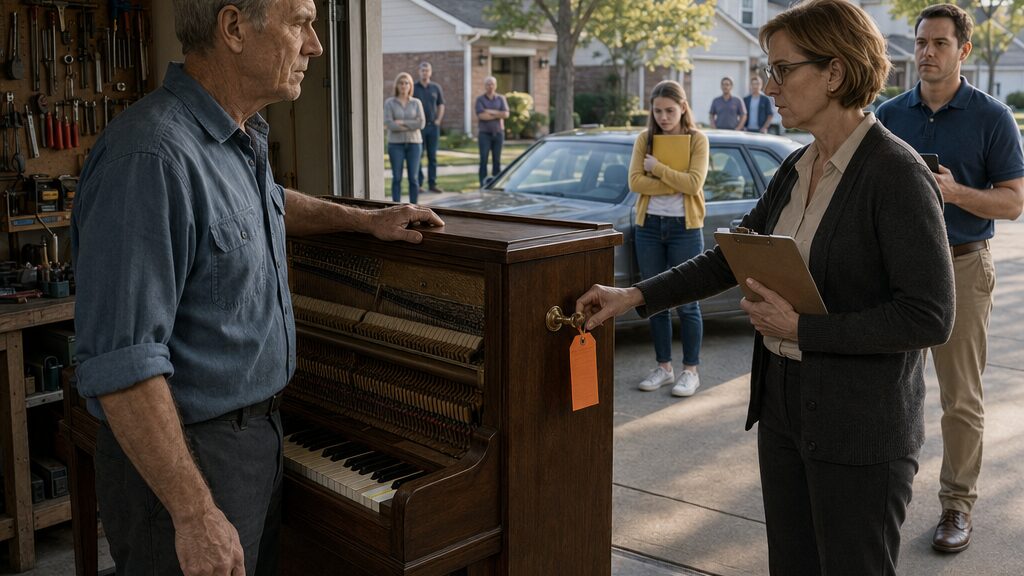
Debra Campbell tied the orange violation tag to the piano before she spoke to Michael.
The plastic loop clicked shut around the tarnished brass handle. Against the dark walnut case, the tag looked almost fluorescent.
DISCARDED HOUSEHOLD MATERIAL, it read.
Michael stood at his workbench with a tuning hammer in one hand and a strip of red felt in the other. He had opened the garage door for the morning light, not for an inspection. The sun reached only halfway across the concrete, stopping just short of the piano’s front legs.
Debra stepped back as though she had labeled something at the curb.
“You can’t attach that to my property,” Michael said.
Her hand remained on her clipboard. “It’s removable.”
“That isn’t what I said.”
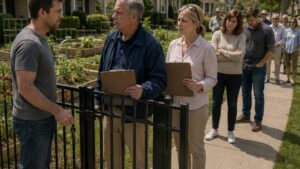
Beside her, the HOA property manager lowered his phone without taking the photograph he had been preparing. He was younger than Michael had expected, dressed in a blue polo with the association logo stitched over the chest. Behind them, two neighbors had slowed near their mailboxes. Another stood beside a running lawn mower, pretending to clear grass from its wheels.
Debra pointed toward the upright piano.
“This is exactly what the exterior storage rule addresses. Large unused household items visible from the street.”
“It isn’t unused.”
She looked at the missing front panel, the exposed action, the labeled envelopes of screws on Michael’s folding table.
“It has been sitting here for months.”
“I’ve been repairing it for months.”
“That doesn’t change what residents see.”
Michael set the felt strip down. “Residents see a piano.”
“They see a broken piano taking up half a garage.”
“It doesn’t take up half.”
Debra’s mouth tightened. She had lived next door for nine years, long enough to know that Michael corrected measurements when he had no intention of discussing anything else.
The property manager cleared his throat. “Mr. Allen, this is only a preliminary inspection. We’re documenting the condition and giving you an opportunity to respond.”
“Then document that it’s under repair.”
Debra turned to him. “Photograph the exposed mechanism and the storage around it.”
The storage around it consisted of a rolling toolbox, two lidded plastic bins, a narrow cabinet, and the bench Michael had built for Elizabeth twenty-three years earlier. Nothing blocked the car bay. His pickup was parked inside the other half of the garage.
The manager raised his phone.
Michael stepped between the camera and the piano.
The movement was not fast, but it stopped everyone.
“You can photograph from the sidewalk,” he said.
Debra glanced toward the edge of the driveway. “The garage is open.”
“That doesn’t make the driveway common property.”
For a moment, only the ticking of the piano action filled the garage, tiny wooden parts settling after Michael’s last adjustment.
The property manager lowered the phone again. “We can take a general exterior photo.”
Debra looked displeased, but she moved back two steps.
Michael returned to the piano. One ivory-colored key near the center sat lower than the others. The original keytop had cracked years ago, and the replacement did not match. He rested two fingers over it without pressing.
Debra noticed.
“Does it even play?”
“Some of it.”
“So it is broken.”
“It is being repaired.”
“By a licensed technician?”
“By me.”
The answer drew a small sound from one of the neighbors. Not quite laughter. Not quite disbelief.
Michael had spent thirty-one years repairing doors, lockers, cafeteria tables, stage curtains, and anything else a public school could not afford to replace. He had learned piano work slowly, first because Elizabeth hated waiting three weeks for a technician, later because the technician showed him how to regulate a sticking key. He did not explain any of that.
Debra made a note on her clipboard.
“What are you writing?”
“Owner confirms the instrument is partially nonfunctional.”
“You could write that the owner is repairing it.”
“I’ll include your statement.”
The distinction was deliberate. Michael heard it and said nothing.
Across the street, a car door shut softly.
Anna Baker had arrived home from summer music practice with her mother. She stood partly hidden behind their parked sedan, a canvas school bag hanging from one shoulder. Michael saw only the yellow edge of her folder and one white sneaker.
He looked away before Debra followed his gaze.
The property manager took a photograph from the sidewalk. In the image, Michael knew, the piano would appear dark and oversized behind him. The open garage would frame every tool as clutter. The orange tag would be the brightest thing in the picture.
Debra tapped the piano’s side with one fingernail.
“You’ve had informal notice twice.”
“You asked me twice why I kept it. That wasn’t notice.”
“I told you residents had concerns.”
“You told me nobody wanted to hear it.”
“No one does.”
From behind Christine’s car came a single piano note.
It was soft but unmistakable.
The repaired key rang cleanly through the open garage, held for less than a second before the dampers settled over the strings.
Everyone turned.
Anna stood beside the piano now. Michael had not seen her cross the driveway. Her fingertips hovered above the mismatched key, and her face had gone pale.
“I’m sorry,” she said.
Debra stared at her. “Were you inside the garage?”
“She came to return something,” Michael said.
Anna looked at him. The yellow folder was pressed to her chest.
Debra’s expression shifted—not softer, only more alert. “Does she play this?”
Michael closed the fallboard over the keys. The wood met the frame with a muted knock.
“The piano is not discarded,” he said.
“That wasn’t my question.”
“It’s the question that matters to the notice.”
Christine called Anna’s name from across the street. There was strain in it.
Anna backed away. Her eyes dropped to the orange tag, then to the two neighbors watching from their driveways. She crossed the street without opening her folder or returning whatever Michael had claimed she carried.
Debra watched her go.
“So there has been playing.”
“One note.”
“There have been complaints about sound.”
“There has been one complaint. Yours.”
“You don’t know that.”
“I know what I’ve heard.”
The property manager shifted the tablet under his arm. “We should keep this focused. The issue today is visible storage. Any sound complaint would be separate.”
Debra gave him a sharp look. “The use affects whether this is ordinary storage.”
Michael gripped the edge of the fallboard. He could have told them about the felt he had replaced, the cracked hammer shank, the afternoon Anna first touched the keys while Elizabeth sat wrapped in a blue blanket near the garage heater. He could have explained that the piano was moving toward something, not waiting to be thrown away.
Instead, he reached for the wall control.
The garage door began to descend.
Debra stepped backward into the sunlight. “Closing it doesn’t resolve the violation.”
“No,” Michael said. “It ends this inspection.”
The slatted door lowered between them. Debra’s shoes vanished first, then the clipboard, then the orange tag hanging from the piano. Just before the outside light narrowed to a strip, Michael saw Anna watching from her front window.
The door sealed with a rubber sigh.
Inside, the garage felt smaller than it had five minutes earlier.
Michael untied the tag but did not throw it away. He placed it on the workbench beside the tuning hammer. Then he opened the piano and pressed the repaired key.
The note sounded clean.
By noon, the photograph had been entered into the HOA file as evidence of discarded material.
At four seventeen, Michael received an email with a formal notice attached.
He printed it and read the final line twice.
The piano had to be removed from view—or removed from the property—within seven days.
Chapter 2: The Girl Who Stopped Practicing
Anna’s sheet music was folded inside the piano bench so tightly that the pages held the curve of her hand.
Michael found it that evening beneath a box of spare felts. The title page had been turned inward, but he recognized the piece from the first measure: the one Anna had been preparing for the regional school audition.
Several passages were marked in pencil. Above the difficult left-hand entrance, she had written, Breathe first.
Michael smoothed the pages against the bench lid.
The garage door remained closed. The restriction had not yet taken effect, but after the morning inspection he could not bring himself to open it. The overhead bulbs flattened everything—the walnut case, the concrete floor, the orange tag on the workbench—into the same tired color.
A knock sounded at the side door.
Christine Baker stood outside in her scrubs, a lunch bag looped around one wrist. She looked as though she had come directly from work.
“Can we talk?”
Michael stepped aside.
She entered but did not approach the piano. Her gaze found the printed violation notice taped near the light switch.
“Anna told me what happened.”
“She shouldn’t have crossed the driveway during an inspection.”
“She thought Debra was going to make them take it.”
“She touched one key.”
“She thinks that one key proved everything Debra was saying.”
“It didn’t.”
Christine folded her arms, then seemed to notice the gesture and let them fall. “That isn’t how it felt to her.”
Michael placed the sheet music on the bench.
“She left this.”
“I know.”
“She needs it for Saturday.”
“No, she doesn’t.”
He looked at her.
Christine’s expression held for a second, then broke around the edges. “I’m asking you to stop the lessons.”
“They aren’t lessons.”
“You sit with her. You correct her fingering. You make her start measures over.”
“That’s practice.”
“That’s a lesson to anyone looking through an open garage.”
“The garage doesn’t need to be open.”
“That isn’t the point.”
Michael heard the exhaustion beneath her irritation. Christine worked rotating shifts at a rehabilitation center and took weekend bookkeeping jobs when she could get them. She had refused money from Elizabeth more than once and accepted casseroles only when they were left without discussion.
“The piano is nearly ready,” he said.
“For what?”
He looked at the mismatched key.
Christine followed his gaze. “Michael.”
“For Anna.”
The words entered the garage more heavily than he expected.
Christine stared at him. “You were fixing it for her?”
“Yes.”
“To use here?”
“To have.”
Her head moved once, a small refusal before she spoke. “No.”
“It isn’t charity.”
“I didn’t say it was.”
“You were thinking it.”
“I was thinking about how we would move an upright piano into a two-bedroom rental when the owner barely lets us hang pictures.”
“Then it can stay here until you have somewhere.”
“And now the HOA has a file with my daughter in it.”
“Her name isn’t in the notice.”
“It will be if this keeps going.”
Michael picked up the printed violation letter, then set it down without reading it. “Debra doesn’t get to decide whether Anna plays.”
“No, but Anna does.”
Christine opened the side door. “She withdrew from the audition this afternoon.”
For a moment Michael thought he had misheard.
“She what?”
“She told the music teacher she wasn’t ready.”
“She is ready.”
“She doesn’t feel ready.”
“She played the full piece yesterday.”
“She feels like the entire street is listening for a reason to complain.”
Christine’s hand stayed on the doorknob. “I know you meant well. Elizabeth meant well too. But Anna isn’t a project either of you gets to save.”
The door closed behind her.
Michael stood beside the piano until the automatic garage light clicked off.
Two days later, he drove to the high school during the final fifteen minutes of summer rehearsal. Students emerged through the auditorium doors carrying instrument cases and water bottles. Anna came out last, her yellow folder absent.
She stopped when she saw his pickup.
Michael lowered the passenger window. “Your music is at my house.”
“I don’t need it.”
“You told your teacher you weren’t ready.”
“I’m not.”
“That isn’t true.”
Anna glanced toward the remaining students. “Can we not do this here?”
He got out but stayed beside the truck.
“The audition is Saturday.”
“I withdrew.”
“You can ask for the slot back.”
“No.”
“You worked six months for it.”
Her face tightened. “And now Mrs. Campbell thinks my practice is an HOA violation.”
“She thinks the piano is one.”
“She asked if I played it.”
“And I didn’t answer.”
“That made it worse.”
Michael started to object, but Anna continued.
“Everyone knew anyway. The neighbors were staring at me like I got you in trouble.”
“You didn’t.”
“The notice is because I was playing.”
“The notice says discarded furniture.”
“And the sound complaint?”
“One person complained.”
“One person who runs the committee.”
A car moved through the pickup lane behind them. Michael stepped closer to the truck.
“I’m repairing that piano for you,” he said quietly.
Anna’s expression changed, not into gratitude but alarm.
“What?”
“It will be yours when it’s finished.”
“I never asked for it.”
“No.”
“Did my mom know?”
“Not until this week.”
Anna looked back at the auditorium. “Why didn’t you tell me?”
Michael had answers that felt true separately and dishonest together. Because it was not ready. Because Christine would refuse. Because he had promised Elizabeth. Because saying the plan aloud would make Elizabeth’s absence part of it.
“I wanted to finish it first,” he said.
Anna studied him long enough to know there was more.
Then she shook her head. “I can’t take it.”
“You don’t have to decide today.”
“I decided.”
She walked toward Christine’s car at the far end of the lot.
That evening, Michael placed Anna’s music back inside the piano bench. The repaired key worked, but two neighboring hammers still struck unevenly. He adjusted one until his hands began to ache.
When he finally closed the bench, a small sheet of notebook paper slid onto the floor.
Anna had written only two lines.
Please sell the piano before they fine you.
I don’t want to be the reason you lose anything else.
Chapter 3: A Rule Written for Something Else
The photograph in Michael’s HOA file had been taken from six feet inside his driveway.
He knew because the angle showed the left side of the piano, the workbench, and the narrow gap behind his pickup—none of which could be seen from the sidewalk.
He laid the printed photograph on the property manager’s desk.
“Who took this?”
The manager adjusted his glasses. “It was uploaded with the inspection report.”
“By whom?”
“I’d have to check the metadata.”
“Check it.”
The HOA office occupied the converted front room of the clubhouse. A copier hummed behind a half wall. Through the window, Michael could see the empty pool deck and three stacked patio tables.
Debra sat at the small conference table with a binder open before her. Gregory Jones, the board president, had placed himself between them.
“Michael,” Gregory said, “we’re here to discuss compliance, not litigate photography angles.”
“The notice relies on a photograph taken from my property.”
Debra turned a page. “The garage was open during a scheduled inspection.”
“The manager was told to photograph from the sidewalk.”
“I took a supplemental image after you closed the door halfway.”
Michael looked at her. “You walked onto my driveway after I told you not to.”
“I stepped forward to document the condition before visibility was obstructed.”
Gregory rubbed a thumb along the edge of his notepad. “Debra, was the manager present?”
“He was at the curb.”
The manager looked down at his tablet.
Michael sat back. The admission should have felt like an advantage. Instead it confirmed how easily his silence had been treated as permission for someone else to complete the story.
Gregory pulled a copy of the governing standards toward him.
“The relevant language is Section Eight, Subsection Three. Garages may not be used for the long-term storage of discarded furniture, appliances, or household materials visible from neighboring lots or common areas.”
“The piano isn’t discarded,” Michael said.
Debra replied, “It is partially dismantled and not in ordinary household use.”
“It’s under repair.”
“For months.”
“Repairs can take months.”
“By qualified professionals.”
Michael looked at Gregory. “Show me where the rule says that.”
Gregory scanned the paragraph. “It doesn’t.”
Michael placed three photographs on the table: the replaced bridle straps, the cleaned action, and the repaired key with its mismatched top.
“The piano has improved every week. It is maintained, covered when I’m sanding, and kept inside a vehicle-accessible garage.”
The property manager leaned forward. “The car bay is still usable?”
“My pickup is parked there every night.”
Debra said, “That does not address sound or residential business use.”
“There is no business.”
“Are you teaching?”
“No.”
“Is the Baker girl playing?”
Michael did not answer.
Debra closed the binder. “This is the problem. Every direct question produces another refusal.”
“My neighbor’s child is not part of an exterior storage inspection.”
“If the instrument is being used regularly, then its use is relevant.”
“If it is used, it isn’t discarded.”
The property manager’s mouth moved as though suppressing a reaction.
Gregory raised one hand. “Both of you are proving why this needs a narrower solution.”
He turned to Michael.
“The board can suspend enforcement under a temporary condition. The piano may remain in the garage if the door stays closed except for vehicle access and if the instrument is not played while the review is pending.”
Michael stared at him. “Not played at all?”
“It avoids the nuisance question.”
“There hasn’t been a verified nuisance.”
“There has been a complaint.”
“From the person deciding whether the complaint matters.”
Debra’s expression cooled. “I do not vote on my own compliance referrals.”
“You write the findings.”
“I document facts.”
“You labeled an instrument junk before asking whether it worked.”
“I asked. You refused to explain.”
Gregory slid the proposed agreement across the table. It consisted of one page and a signature line.
“Fourteen days,” he said. “No fines. The board reviews the classification. In exchange, the garage stays closed and the piano stays silent.”
Michael read the condition twice.
Fourteen days would carry them beyond Anna’s audition. But Anna had already withdrawn. Christine had asked him to stop. The piano could remain where Elizabeth had left it. No delivery workers would strap it to a dolly. No fine would accumulate. Nothing would be lost immediately.
He signed.
Debra gathered her papers. “This could have been resolved earlier if you had cooperated.”
Michael capped the pen. “It could have been resolved earlier if you had asked a question without deciding the answer.”
Her gaze held his, but she did not respond.
At home, Michael lowered the garage door and taped the temporary agreement beside the wall control. The line prohibiting use was printed in bold.
He spent the afternoon repairing the soft pedal mechanism without sounding a note. Each adjustment had to be tested by touch. He pressed keys slowly enough that the hammers rose but did not strike the strings.
The work felt like repairing a clock while forbidden to let it tick.
Near sunset, the side door opened.
Anna stood on the threshold.
“My mom said you went to the HOA office.”
Michael wiped his hands. “It’s handled for now.”
She saw the paper on the wall.
“What does that mean?”
“Temporary review.”
Anna stepped closer and read the bold line.
THE INSTRUMENT SHALL NOT BE PLAYED DURING THE REVIEW PERIOD.
Her eyes moved from the notice to the piano.
“So it can stay,” she said.
“For now.”
“But nobody can use it.”
“Fourteen days.”
“My audition was this weekend.”
“I know.”
She looked toward the closed garage door. Thin lines of evening light showed around its edges, but none entered far enough to reach the piano.
“You signed this?”
“It stops the fines.”
Anna gave a small, humorless laugh. “Then Mrs. Campbell won.”
“No one won.”
“You kept the piano.”
“That matters.”
“To who?”
Michael looked at the bench where her folded music remained hidden.
Anna reached for the wall control. For one second he thought she meant to open the door. Instead, she pulled the temporary agreement loose from the tape and held it between them.
“You saved the part that can’t help anybody,” she said.
Then she pressed the paper back onto the wall, smoothing the corners until the condition lay perfectly flat.
She left through the side door without touching a key.
Chapter 4: The Quiet Compromise That Failed
Michael heard the music through the Baker kitchen window, but no sound came with it.
Anna sat at the table across the street, both hands moving over a sheet of printer paper on which she had drawn a keyboard in black marker. Her shoulders rose and fell with the rhythm. Her fingers crossed, lifted, and struck silent keys while Christine stood at the sink with her back turned.
Michael watched from behind his closed garage door.
The temporary agreement remained taped beside the wall control. Each time he entered the garage, the bold line caught his eye before the piano did.
THE INSTRUMENT SHALL NOT BE PLAYED DURING THE REVIEW PERIOD.
He had followed it exactly.
For six days, no hammer had touched a string. He repaired by measurement, pressure, and memory. He aligned keys with a steel ruler, replaced worn felt, and adjusted dampers without testing their sound. At night, when the house settled around him, he imagined every defect he might be creating.
He told himself fourteen days was not permanent.
He told himself Anna had withdrawn anyway.
He did not tell himself that she was practicing on paper because he had signed away the real keys.
The next afternoon, he drove to the high school auditorium. A printed audition schedule was taped to the glass entrance door. Anna’s name was no longer on it.
The school music teacher met him in the lobby.
“She gave up the slot,” the teacher said. “I held it until yesterday.”
“She was ready.”
“I thought so too.”
“Can you put her back?”
“Not without removing someone else.”
Michael looked through the auditorium doors. A student at a grand piano was repeating four measures while the teacher’s assistant marked time.
“She said she wasn’t prepared,” the teacher continued. “Then she asked whether a digital keyboard would count as proper practice.”
“What did you tell her?”
“That it depends on the instrument.”
Michael knew what Anna had heard: not good enough.
Outside, he sat in his pickup without starting it. The temporary agreement was folded in his shirt pocket. He had brought it in case the teacher asked why Anna no longer had access to the piano. The question never came.
On the drive home, he saw Debra carrying grocery bags from her car.
He stopped at the edge of her driveway.
“We need to talk.”
Debra shifted both bags into one hand. “About the review?”
“About what you wanted.”
“I wanted compliance.”
“You wanted the piano silent.”
“I wanted the use clarified.”
“It’s clarified. A girl lost her audition slot.”
Debra’s gaze moved toward the Baker house. “That was not an HOA decision.”
“It was a consequence.”
“Of her withdrawal.”
“Of being made to feel like she was doing something wrong.”
Debra set the bags on the porch step. One contained canned soup, the other pharmacy items.
“You could have explained the arrangement at the beginning.”
“I shouldn’t have to publish a child’s circumstances because you don’t like what you see in my garage.”
“No. But once you involved her in an unapproved use, you had an obligation to answer basic questions.”
“There was no business. No crowd. No regular traffic.”
“There was sound.”
“During daylight.”
“There were complaints.”
“Yours.”
Debra’s jaw tightened. “You keep saying that as though one resident’s concern is automatically invalid.”
“One resident’s assumption became a violation tag.”
“Because you gave us nothing else.”
Michael glanced toward her front door. A faint rectangular discoloration remained on the brick beside the steps, lighter than the wall around it. Four bolt holes had been filled but not concealed.
He had noticed them before without asking.
“What was there?” he said.
Debra followed his gaze.
“That has nothing to do with your piano.”
“A railing?”
“A ramp.”
The word came flatly.
Michael waited.
Debra picked up the grocery bags, then set them down again.
“My husband needed it for eleven months,” she said. “The old board approved a temporary accessibility modification. Then a neighbor complained about the angle and the handrail color.”
Michael said nothing.
“The board inspected twice. They sent notices while he was in the hospital. They required screens around the medical equipment on the porch because it was visible from the street.”
Her voice stayed controlled, but one hand gripped the plastic bag hard enough to stretch it around a soup can.
“I asked for flexibility,” she continued. “Every answer was that rules had to apply consistently. After he died, they gave me thirty days to remove everything.”
“I didn’t know.”
“No one did. I didn’t stand in the clubhouse and describe his final months so people would feel generous.”
Michael looked at the repaired bolt holes.
Debra lifted the bags.
“So now you make sure no one gets flexibility.”
“I make sure no one has to wonder whether decisions depend on who tells the saddest story.”
“That isn’t consistency.”
“It is when you are the person blamed for every exception.”
She opened her front door, then paused.
“You think I enjoy this?”
“I think you decided what the piano was before you asked.”
“And I think you decided silence made you principled.”
The door shut between them.
Michael remained on the porch for several seconds. He had expected defensiveness, not recognition. Debra’s story did not excuse the photograph, the tag, or the pressure she had applied. But it made the edges of the conflict less clean.
That evening, Christine called.
“The audition list is final,” she said. “Anna got the email.”
Michael looked at the piano.
“Is she home?”
“She doesn’t want to see anyone.”
“I can talk to the teacher again.”
“No. Don’t fix this by pushing harder.”
“I’m the reason she lost practice time.”
“You’re not the only reason.”
The pause that followed was not forgiveness.
Christine lowered her voice. “She told me she was relieved.”
“Relieved?”
“She said now nobody has to fight over her.”
Michael closed his eyes.
After the call, he entered the garage without turning on the overhead lights. The piano was a broad shadow against the wall. He opened the bench to retrieve Anna’s folded music, intending to carry it across the street whether she wanted it or not.
His hand struck something beneath the wooden tray.
The false bottom had shifted.
Michael lifted it carefully. Beneath the spare felts lay an envelope yellowed at the corners, pressed flat under a tuning record.
Anna Baker was written on the front in Elizabeth’s handwriting.
Below the name was a date from eight days before Elizabeth died.
Chapter 5: The Promise Inside the Piano Bench
Anna,
Michael stopped reading after the first word.
Elizabeth’s handwriting leaned slightly to the right, every line steady despite the date. He carried the letter into the kitchen and placed it beneath the pendant light, but the paper seemed brighter than everything around it.
He had known she wrote notes during hospice. Lists for the pharmacy. Instructions about the furnace filter. Reminders to call Christine if the Baker car failed again. He had found envelopes addressed to him in the desk drawer after the funeral.
He had never found this one.
Anna,
You are not ready for this piano yet, which is different from not deserving it.
Michael lowered himself into a chair.
Elizabeth wrote that she had listened from the bedroom on afternoons when Anna believed she was practicing alone. She described the pauses before difficult passages, the way Anna started over without being asked, and the single wrong note she always corrected more gently than the others.
The next line had been crossed out.
Michael could still read it beneath the ink.
When I am gone—
Elizabeth had begun again.
When you are ready, the piano should be yours. Michael knows what must be repaired. He will complain about the action and pretend the bass strings are the real problem, but he will make it playable.
Michael pressed his thumb against the edge of the table.
The letter continued.
Do not accept it because you feel sorry for us. Accept it only if music is still somewhere you want to go.
At the bottom, Elizabeth had written:
Michael, if she says no, ask whether she is afraid of the piano or afraid of needing something.
The sentence ended there. No signature followed. The final stroke of the pen trailed toward the margin.
Michael read the unfinished instruction three times.
At midnight, he carried the letter back to the garage. He opened the door only six inches, enough to let cooler air move across the floor but not enough for anyone outside to see the piano. The narrow opening cast a pale line under the instrument.
He sat on the bench and placed the letter beside him.
For months, he had told himself he was finishing Elizabeth’s work. Now he understood how much of the work he had chosen because it could be done without speaking.
Wood could be measured. Felt could be cut. A cracked shank could be replaced. Grief did not stay still long enough for tools.
In the morning, Michael crossed the street.
Christine opened the door wearing a cardigan over her scrubs. She looked at the envelope in his hand and stepped back without asking why he had come.
Anna was at the kitchen table. The paper keyboard had been folded in half and pushed beneath a stack of mail.
Michael placed the envelope in front of her.
“I found this in the piano bench.”
Anna recognized the handwriting before she touched it.
“Is that from Elizabeth?”
“Yes.”
Christine sat beside her.
Anna read silently. At the crossed-out line, she stopped. Her lips moved over the words, but no sound came.
When she finished, she did not cry. She folded the letter along its old crease and set it down carefully.
“She never told me.”
“She didn’t tell me either.”
Christine looked at Michael. “You knew about the promise?”
“She asked me to make the piano playable for Anna.”
“That’s not the same as saying it belonged to her.”
“No.”
“Why didn’t you show us this sooner?”
“I found it last night.”
“I mean why didn’t you tell us what Elizabeth asked?”
Michael looked at Anna.
“I thought finishing it was enough.”
Anna’s hands tightened around the letter. “Why me?”
Michael could have answered with talent. It would have been true and incomplete.
Christine spoke first.
“You remember those afternoons you came over after school?”
Anna nodded.
“You said you were helping me by sitting with Elizabeth while I picked up extra shifts.”
“I was.”
Christine looked down at her hands. “You were also afraid Michael would be alone with her.”
Anna’s face changed.
“I heard you tell the school counselor,” Christine said. “You said he always looked like he was waiting for somebody to tell him what came next.”
Michael turned toward the window.
Anna stared at her mother. “You never said you heard that.”
“You were thirteen.”
“I didn’t want him to know.”
Michael looked back at her.
She seemed younger than she had in the school parking lot.
“You kept coming because of me?” he asked.
Anna shrugged once, but her eyes had filled. “Elizabeth asked me to play because it gave you something to fix afterward. She said you needed problems with screws.”
A laugh escaped Christine before she could stop it. Michael felt the sound catch inside him.
Elizabeth had known. Of course she had.
The gift was not rescue moving in one direction. Anna had filled the house with scales and mistakes because Elizabeth understood that Michael could remain in a room with sorrow if there was also something practical to adjust.
He had reduced that exchange to a secret promise and a repaired object.
“The piano is yours,” he said.
Anna shook her head.
“You don’t have to move it yet.”
“No.”
“You read what she wrote.”
“I did.”
“Then what are you afraid of?”
The question sounded harsher aloud than Elizabeth’s unfinished line on paper.
Anna stood.
“I’m afraid every time I touch it, somebody will decide you’re breaking a rule for me.”
“That is not your responsibility.”
“You made it my responsibility when you wouldn’t say why it mattered.”
Michael opened his mouth.
Anna held the letter against her chest. “You let everyone think it was junk. You let them think I was sneaking around. Then you signed something saying nobody could play, like keeping the piano mattered more than what it was for.”
“I was trying to protect you.”
“From what? Being named?”
“From having your family discussed at a board meeting.”
“My family is already being discussed.”
Christine said her name softly, but Anna continued.
“I don’t want the piano if I have to pretend it has nothing to do with me.”
Michael looked at the paper keyboard beneath the mail.
“What do you want me to do?”
It was the first time he had asked.
Anna placed Elizabeth’s letter on the table.
“Stop treating me like the secret part.”
Michael returned home alone.
The garage door was still raised six inches. He stood outside and looked through the narrow gap at the piano’s front legs and the strip of light beneath them. For months, he had believed the closed door kept other people from taking ownership of Elizabeth’s promise.
Instead, it had kept Anna outside it.
He entered the house and opened his laptop.
The HOA hearing request form allowed one hundred and fifty words for the nature of the dispute. Michael typed, deleted, and typed again.
He did not describe Elizabeth’s illness. He did not mention Christine’s finances. He did not call Debra unreasonable.
He wrote that the piano had been misclassified, that the restriction had harmed an intended user, and that the matter required a full hearing rather than private review.
Under AFFECTED RESIDENTS, he entered his own name.
Then he added Anna Baker.
Chapter 6: The Hearing Where Silence Became Evidence
“Mr. Allen’s refusal to answer ordinary questions is not separate from the violation,” Debra said. “It is the reason the association could not verify his claim.”
The photograph of Michael’s closed garage door filled the portable screen behind her.
A strip of driveway showed beneath it. Nothing else.
To Michael, the image looked less like evidence than an accusation against absence.
The clubhouse chairs had been arranged in four rows. Gregory Jones sat at the center of a folding table with the two other board members beside him. The property manager had placed the orange violation tag, printed photographs, and correspondence in labeled folders.
Anna sat with Christine in the second row. She had agreed to attend only after Michael promised she would not be required to speak.
Debra turned toward the board.
“The owner repeatedly declined to identify the instrument’s use, frequency of use, or users. The committee therefore relied on observable condition: partial disassembly, long-term garage placement, and visibility from the street.”
Michael waited until Gregory nodded to him.
“The rule says discarded,” Michael said.
His voice sounded too loud through the tabletop microphone.
He placed photographs of the repaired mechanism beside the violation tag.
“The piano was never discarded. It was under active repair.”
One board member adjusted her glasses. “Was it being used for lessons?”
“No paid lessons.”
“That was not the question.”
Michael looked toward Anna, then back at the board.
“A neighborhood student practiced on it.”
Debra lifted one hand. “Which confirms regular use not disclosed during inspection.”
“It confirms the object was not abandoned.”
“It may also create a separate nuisance issue.”
Gregory intervened. “The current hearing covers classification, enforcement procedure, and the temporary restriction. We are not deciding a sound violation tonight unless evidence supports one.”
The property manager opened a folder.
“For the record, there were two sound entries in the portal. Both were submitted from the same household. Neither included dates, recordings, or decibel readings.”
Debra’s face did not change.
Michael saw Anna glance at Christine.
Gregory turned to the property manager. “What was your initial recommendation after inspection?”
The manager hesitated.
“Informal mediation and proof of repair.”
Debra looked at him. “That recommendation was preliminary.”
“Was it forwarded to the committee?” Gregory asked.
“Yes.”
“And rejected?”
The manager looked down at the file. “The compliance chair requested formal classification because the owner would not confirm use.”
A quiet movement passed through the room—not outrage, only the sound of people adjusting in their chairs.
Gregory faced Debra. “You overrode mediation?”
“I escalated an unresolved inspection. That is within the committee’s role.”
“Why is the recommendation absent from the board packet?”
“I did not consider it determinative.”
The board member beside Gregory wrote something down.
Michael should have felt vindicated. Instead he remembered the bolt holes in Debra’s brick and the way she had said no one should have to tell the saddest story to receive fair treatment.
He took Elizabeth’s sealed letter from his folder but did not open it.
“This is why I didn’t answer,” he said.
The room quieted.
“The piano belonged to my wife. Before she died, she asked me to repair it for Anna Baker.”
Anna’s name seemed to move through the room even though no one spoke.
Michael kept his eyes on Gregory.
“The details are private. Some of them belong to Anna and Christine, not to me. I thought refusing to explain protected that.”
He looked at the photograph of the closed garage door.
“It did not.”
Debra’s hands rested on her binder.
Michael continued.
“My silence gave the committee room to call the piano whatever was convenient. It also made Anna feel that her connection to it was something embarrassing. She withdrew from a school audition after the restriction stopped her practice.”
Christine lowered her gaze.
“That is not all the association’s fault,” Michael said. “It is mine too. I signed the restriction because it let me keep the piano without doing the harder thing.”
One of the board members asked, “What was the harder thing?”
“Admitting that an object can be private without being purposeless. And admitting that privacy does not excuse me from proposing a responsible use.”
Debra leaned toward her microphone.
“You are asking the board to treat personal history as grounds for an exception.”
“No.”
Michael slid the temporary agreement across the table.
“I am withdrawing my request for a private exception.”
Anna looked up sharply.
Gregory frowned. “Then what relief are you seeking?”
“First, correct the file. The piano is maintained property, not discarded material.”
The property manager nodded once.
“Second, remove the no-playing condition. It was imposed without a verified nuisance.”
Debra opened her binder. “The board still has authority to regulate garage use.”
“I know.”
Michael placed a single sheet on the table.
“I am proposing regulation.”
Gregory picked it up.
Michael had spent ten days building the plan. Approved hours. No paid instruction. No more than four students at a time. Felt pads beneath the casters. Vehicles restricted to one side of the driveway. Parent supervision for minors. A sign-in sheet. A ninety-day trial with a review after thirty days.
The board member beside Gregory scanned the page.
“This would be a neighborhood music room?”
“A limited community-use pilot.”
“In your garage?”
“Yes.”
Debra gave a short breath. “That creates exactly the kind of precedent the committee was trying to avoid.”
“It creates terms,” Michael said. “A precedent without terms is favoritism. A pilot with published conditions can be evaluated.”
Gregory continued reading.
“Who manages scheduling?”
“I will at first. Christine has agreed to help if the board approves.”
Christine looked surprised but did not contradict him.
“And liability?”
“I spoke with my insurer. Supervised, noncommercial use can be added with an endorsement. I’ll pay for it.”
Debra turned toward Anna. “And the primary user?”
Michael answered before Anna could be drawn into it.
“She decides whether she participates.”
The room went still again.
Michael looked at Anna now.
“I am not asking the board to give her the piano. It is already hers if she wants it. I am asking for a structure that does not require her to hide.”
Anna’s eyes remained on him.
Gregory set the proposal down.
“The board can correct the classification tonight,” he said. “The photographs and repair records support that.”
The property manager moved the orange tag into a separate folder.
“But regular private lessons are not an approved residential use,” Gregory continued. “Even unpaid instruction may fall outside current garage-use standards.”
Michael felt the room tilt toward another compromise that preserved the piano and silenced it.
Gregory held up the proposal.
“A time-limited association-sponsored pilot may be possible if it is open under equal conditions, insured, and reviewed for noise and traffic.”
Debra shook her head. “The board has never operated a program from a private garage.”
“The board has never misclassified an actively repaired piano as discarded material either,” Gregory said.
The correction was quiet, but Debra stopped speaking.
Gregory turned to Michael. “Are you prepared to open the space to residents beyond Anna?”
Michael thought of the garage door descending during the inspection. He thought of Anna’s paper keyboard and Elizabeth’s unfinished instruction.
“Yes.”
“Are you prepared to let the association inspect the setup, publish the hours, and terminate the trial if documented problems occur?”
“Yes.”
“Even if that means you no longer control who uses the piano?”
Michael’s hand moved toward Elizabeth’s sealed letter, then stopped.
“That is the point,” he said.
Gregory looked to the other board members. They exchanged brief remarks over muted microphones.
The vote would not occur that night. Insurance documents, scheduling rules, and written resident comments were required first. The violation file would be corrected immediately, but the no-playing restriction would remain for two more weeks.
It was not victory.
It was a path.
As the chairs began to scrape backward, Debra gathered her binder.
Michael approached the table and removed the orange violation tag from the evidence folder.
“You can’t take association records,” she said.
“The manager marked it as withdrawn.”
The property manager nodded. “He can keep the physical tag.”
Debra looked at the plastic card in Michael’s hand.
“I still think you should have answered sooner,” she said.
“I should have.”
The agreement surprised her more than an argument would have.
Michael folded the tag once, but the plastic resisted.
“I also think you knew the manager recommended mediation.”
Debra’s eyes shifted toward Gregory.
“I believed formal review was safer.”
“For whom?”
She did not answer.
Outside the clubhouse, Anna waited beside Christine’s car.
“You said the piano was mine,” she said.
“If you want it.”
“And then you offered it to the neighborhood.”
“I offered the room. Not your ownership.”
“That sounds complicated.”
“It is.”
For the first time in weeks, the corner of her mouth moved.
Michael held out the pilot proposal.
“You should read the schedule before the board does.”
Anna took it.
At the bottom, beneath the hours and supervision requirements, Michael had added one final condition:
No student may be identified publicly without consent.
Anna read the line twice.
Then she looked toward the dark clubhouse windows.
“Do you think they’ll approve it?”
Michael glanced at the closed garage-door photograph still glowing faintly on the screen inside.
“I think they’ll have to decide in public.”
He returned to the table before the board members could leave.
“I want the proposal entered tonight,” he said. “Ninety days. Published rules. Open enrollment.”
Gregory looked from Michael to the other board members.
Then he stamped the first page RECEIVED.
Chapter 7: The Door Opened Under New Terms
At ten o’clock on the first Saturday of the pilot, the garage door stood open to exactly forty-eight inches, and no student would cross beneath it.
Michael had marked the approved height with a strip of blue painter’s tape on the track. The opening was high enough for children to duck through and low enough, according to the board’s conditions, to limit sound and keep the space from appearing like an unsupervised gathering.
Inside, the piano waited beneath two new LED fixtures. Felt pads sat beneath each caster. Folding chairs lined one wall. Christine had taped a printed schedule beside the side door, and a sign-in sheet rested on the workbench beneath a cup of sharpened pencils.
Three families had registered.
All three remained in the driveway.
A father studied the garage as though it might contain a hidden fee. A mother held the shoulders of a boy carrying beginner music books. Two sisters stood beside their bicycles, whispering.
Michael glanced at Christine.
“Did I write the start time wrong?”
“No.”
“Then why are they standing out there?”
“Because this neighborhood spent a month arguing about whether the piano should exist.”
Michael looked toward the families.
“You can come in,” he called.
No one moved.
The younger sister pointed at the blue tape. “Are we allowed under that?”
Christine covered a smile with her clipboard.
“Yes,” Michael said. “That is the purpose of the opening.”
The boy entered first. He bent far lower than necessary and emerged inside with his music books pressed against his chest. The others followed cautiously.
Anna watched from her front porch.
She had agreed to help Christine prepare the schedule but had refused to list herself as a participant. When Michael asked whether she would demonstrate the piano, she said the pilot should not depend on her.
The first half hour was clumsy.
The children took turns pressing keys while Michael explained how the pedals worked. One mother asked whether they needed to bring cleaning wipes. The father asked where to park next time. The older sister played the opening notes of a song, stopped after an error, and apologized to everyone in the garage.
“No apologies for wrong notes,” Michael said.
“That isn’t on the rules,” Christine told him.
“It is now.”
She added it to the bottom of the schedule in pen.
A sedan stopped at the curb.
Debra stepped out carrying a roll of gray felt under one arm and a document folder in the other.
Conversation inside the garage faded.
Michael met her at the opening.
“The inspection was yesterday.”
“I’m not here to inspect.”
She lifted the felt roll.
“The sound committee recommended pads beneath the bench and along the back wall. These were left over from the clubhouse renovation.”
Michael looked at the printed schedule in her folder.
“You made changes?”
“I made a copy with the approved parking diagram. Your version leaves the west curb unrestricted.”
“That curb has always been unrestricted.”
“Not during the pilot.”
“Of course.”
Debra held out the pages. “It also includes the complaint procedure. Written dates and times. No anonymous entries.”
Michael took them.
That condition had not appeared in the original proposal.
“Was that your addition?”
“Yes.”
The answer came without defense.
Behind Michael, the boy struck three loud notes. Debra flinched slightly, then adjusted the felt beneath her arm.
Christine approached.
“We can use the pads,” she said. “The bench slides.”
Debra stepped under the garage door. She did not duck as much as the children had.
Together, she and Michael lifted the bench while Christine positioned the felt beneath its legs. Debra’s hands were steady, though she avoided touching the piano itself.
One of the mothers approached the sign-in sheet.
“Is this open every Saturday?”
“For ninety days,” Christine said. “Then the board reviews it.”
“My daughter’s school cut its after-hours music room.”
The father beside her nodded. “Ours doesn’t have a piano at all. Just keyboards with broken headphones.”
Another parent, still near the driveway, said her son had been practicing scales on a phone application.
Michael looked around the garage.
Until that morning, he had thought the pilot was a structure built around Anna. Now the empty chairs were filling with people whose needs had existed without his knowledge.
The piano had not been the only thing hidden behind closed doors.
The session lasted forty-five minutes longer than planned. No one complained. Debra recorded the finish time anyway.
When the final family left, Anna crossed the street.
Christine handed her the completed sign-in sheet.
“Six students,” she said. “Three registered, three added.”
Anna scanned the names.
“That’s good.”
“You could take the last slot next Saturday.”
“No.”
Michael began stacking chairs.
Debra closed her folder. “The pilot review requires at least one demonstrated intermediate-level use.”
Anna looked at her. “Then find someone intermediate.”
“You are the only one registered in the neighborhood survey.”
“I didn’t register.”
“Your school music teacher submitted the skills inventory with your mother’s permission.”
Christine raised a hand. “That was before the hearing.”
Anna set the sheet down.
“So this still depends on me.”
“No,” Michael said.
She turned toward him.
“The pilot can continue without you. If the board requires a demonstration, I’ll ask the school teacher to recommend someone.”
“And everyone will know why.”
“They already know there is a piano.”
“That isn’t the same.”
Michael wiped dust from the bench. “No. It isn’t.”
Debra moved toward the driveway.
Before leaving, she paused beside the orange violation tag hanging from a nail above Michael’s workbench.
“You kept that.”
“Yes.”
“Why?”
“So I remember what happens when a label arrives before a question.”
Debra looked at him, then at Anna.
“That can happen in either direction,” she said.
She left without asking him to take it down.
Anna sat on the bench but kept the fallboard closed.
Michael opened the small tool drawer beneath the workbench. From the back, he removed a narrow brass plate. Elizabeth Allen was engraved across it in worn script.
The plate had been screwed above the keyboard for twenty-three years. He had removed it the previous night, leaving two clean holes in the wood.
Anna stared at it.
“What did you do?”
“I took her name off.”
“You shouldn’t have.”
“It was her piano.”
“So why remove it?”
“Because it cannot become yours while it still announces itself as hers.”
Anna did not reach for the plate.
Michael placed it in her palm.
“This does not erase her,” he said. “And accepting the piano does not replace her.”
Anna closed her fingers around the brass.
For several seconds, the only sound came from the garage door motor cooling above them.
Then she looked at the two empty screw holes over the keys.
“What goes there now?”
Michael stepped back from the bench.
“That is not mine to decide.”
Chapter 8: The First Note Was Not Applause
Anna sat at the piano on the final Saturday of the pilot and kept her hands in her lap.
The garage door was fully open.
Michael had raised it past the blue tape without asking the board. The trial period ended at noon, and the final review inspection had already been completed. For the first time since the violation tag appeared, the doorway belonged only to the people inside it.
Christine stood beside the workbench. Gregory waited near the driveway with the property manager. Three families occupied the folding chairs, though Anna had asked that no recital be announced.
Debra arrived last and remained near the curb.
Michael placed a document on the piano bench beside Anna.
She glanced at the first page.
“What is this?”
“Transfer paperwork.”
Her eyes moved to the signature lines.
“The piano?”
“Yes.”
“To me?”
“To you. It can remain here during the community-use schedule until you and your mother have another arrangement.”
Christine read over Anna’s shoulder. “You already signed it.”
Michael nodded.
Anna looked at him. “What if I still say no?”
“Then it remains yours to refuse.”
“That doesn’t make sense.”
“It does to me.”
She looked down at the keys.
The mismatched key sat near the center, its replacement top slightly brighter than the others. Michael had polished it but had not disguised the repair.
Anna lifted one hand.
Conversation in the driveway stopped.
She placed a finger on the repaired key and pressed.
The note rang cleanly into the open street.
It was not applause. It was not a declaration. It was only one tone, steady and complete, traveling past the garage where Debra had once called the piano discarded.
Anna pressed the neighboring key, then another.
She began the piece she had prepared for the audition, but she did not play it as she had before. The tempo was slower. At the difficult left-hand entrance, she paused.
Michael remembered the pencil note on her folded music.
Breathe first.
Anna took one breath and continued.
The piece remained unfinished. Halfway through the final section, she stopped and let the last chord fade.
No one moved to clap.
Christine had warned them.
Anna turned toward Michael.
“I’m not ready to perform it.”
“I know.”
“But I want to finish it.”
He nodded.
She picked up the transfer pages and signed beneath her name.
Gregory approached the piano only after she capped the pen.
“The board voted this morning,” he said. “The pilot will continue for six months under the same hours. After that, it becomes a standing community program if there are no documented violations.”
The property manager handed Christine a revised schedule.
“No anonymous complaints,” he said.
Debra looked toward the garage.
“And no special exceptions,” she added.
Michael met her eyes.
“No,” he said. “Published terms.”
She gave a small nod.
The families began gathering their music. One child asked Anna whether she would help with a fingering problem next week. Anna did not answer immediately.
Then she moved over on the bench.
“Show me the measure.”
Michael stepped outside.
From the curb, the open garage looked different than it had during the inspection. The tools were still visible. The bins remained against the wall. The piano still occupied the same section of concrete.
Nothing about the object had changed enough to justify the difference.
Only its meaning had been allowed into view.
At the HOA office later that afternoon, Debra opened the old compliance file. The first photograph showed the orange tag hanging from the brass handle, Michael standing behind it with one hand over the damaged key.
She removed the photograph from the sleeve.
The property manager watched from his desk.
“Records retention requires the image,” he said.
“The corrected digital file retains it.”
Debra looked at the printed photograph once more.
Then she placed it in the shred bin and inserted the board’s correction notice in its place.
From across the street, faint through the clubhouse windows, Anna began the piece again.
This time, when she reached the difficult measure, she did not stop.
The story has ended.