The Twelve-Dollar Fine That Exposed the Forged Covenant Beneath Cedar Bluff
Chapter 1: The Yellow Notice on the Screen Door
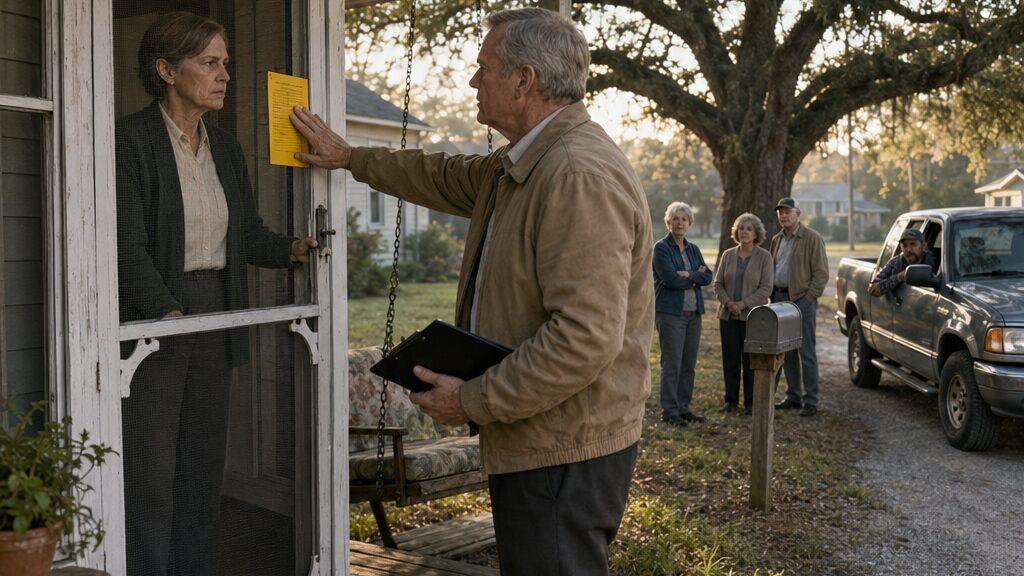
Ronald Baker pressed the yellow notice against Kathleen Miller’s screen door with one palm and said, loud enough for the neighbors backing out of their driveways to hear, “The sheriff can become involved if you keep refusing lawful directives.”
The paper crackled beneath his hand.
Kathleen stood inside the doorway in her house shoes, one hand resting on the latch. Beyond Ronald’s shoulder, headlights moved slowly along Cedar Bluff’s gravel lane. A pickup paused at the stop sign longer than necessary. Across the road, a garage door stopped halfway down.
It was seven minutes past seven.
“How much do you say I owe?” Kathleen asked.
Ronald lifted his clipboard as though the answer had already been entered into a permanent record.
“Twelve dollars.”
The number hung between them, too small for the threat he had attached to it.
Kathleen looked at the notice. The heading was printed in heavy black letters. Beneath it, her two ceramic garden gnomes were listed as unapproved exterior ornaments. A second line cited a pumpkin that had remained beside her steps three days beyond the association’s seasonal-decoration deadline.
Ronald wore a pressed tan jacket and polished walking shoes. He had dressed for the encounter. Kathleen had not.
“You came to my door before breakfast,” she said, “to threaten sheriff action over twelve dollars and two garden gnomes.”
“I came to prevent escalation.”
His voice had the calm, measured quality of a man who believed volume was unnecessary because his position supplied the force. Before retiring, Ronald had adjusted insurance claims. He often spoke as though every conversation contained a loss that needed to be limited.
Kathleen opened the screen door.
Ronald stepped back, but only half a pace.
The yellow notice remained taped at eye level.
“Then let’s prevent it,” she said. “What is the recording book and page number for the covenant you’re enforcing?”
The pickup at the stop sign rolled forward.
Ronald’s gaze shifted from Kathleen to the clipboard.
“The association has maintained these standards for years.”
“That was not my question.”
His mouth tightened.
Kathleen had spent twenty-nine years in the Beaufort County records office. She knew the difference between a rule quoted from memory and a restriction tied to recorded land. She also knew how quickly ordinary people stopped asking questions once someone placed an official-looking sheet of paper in front of them.
Ronald tapped the notice with one finger.
“You received the handbook.”
“A handbook is not a recorded covenant.”
“The board adopted the enforcement schedule in September.”
“Under what authority?”
A car passed behind him. The driver did not wave.
Ronald lowered his voice. “You work at the courthouse, Kathleen. That does not place you above your neighbors.”
“No. It means I know where property restrictions are supposed to be found.”
For a moment, the practiced steadiness left his face. His eyes moved toward the pecan tree beside the porch, then to the wooden swing hanging from one thick branch. Kathleen’s father had installed it eleven years earlier, bracing the rope with knots he had insisted would outlive them both.
The swing moved slightly in the morning air, though no one sat on it.
Ronald recovered.
“The documents exist.”
“Then give me the book and page.”
“I do not carry archival references door to door.”
“You carried a threat.”
His jaw flexed.
Kathleen wished immediately that she had not said it. Not because it was untrue, but because two neighbors were now standing beside a mailbox pretending to examine a newspaper. She had spent most of her life avoiding the particular silence that formed around public disagreements.
Ronald noticed them too.
He raised his voice again.
“The association has been patient. Your refusal to comply creates unnecessary costs for every homeowner in Cedar Bluff.”
Kathleen felt heat rise along her neck. He had turned twelve dollars into a civic failure, and her front porch into a hearing she had not agreed to attend.
She could have paid him. Twelve dollars would not affect her grocery budget or her electric bill. She could remove the gnomes, put the pumpkin in the compost pile, and close the door.
That was what she usually did when someone made a small wrong difficult enough to challenge.
Years earlier, at the courthouse, a family had arrived with a filing receipt proving they had submitted an estate document before a deadline. Kathleen had noticed that the clerk’s stamp had been entered under the wrong case number. She had told herself the supervising clerk would correct it. She had said nothing during the first meeting because she did not want to embarrass a colleague.
The mistake was eventually fixed.
By then, the family had spent months and money proving what Kathleen had known on the first day.
Ronald pulled another sheet from beneath the top page of his clipboard.
“This is not only about you.”
He held it where she could see the address.
Debra Harris.
Kathleen’s eyes moved down the page. Architectural noncompliance. Unauthorized access structure. Corrective action required within ten days.
“You cited Debra’s ramp?”
“It was built without approval.”
“She uses a wheelchair.”
“The board offered her an opportunity to submit revised plans.”
“The ramp has been there for six years.”
“That does not make it compliant.”
Ronald slid the sheet back beneath the clip. His expression had changed. He seemed almost relieved to discuss a larger violation, one that made the gnomes appear reasonable by comparison.
Kathleen stepped onto the porch.
“Has the board reviewed federal accessibility requirements?”
“This is private property governance, not a federal building.”
“That isn’t an answer either.”
“You are creating confusion where none exists.”
“No,” Kathleen said. “I’m asking for the paper beneath your paper.”
The phrase came out before she could soften it.
Ronald stared at her.
The neighbors by the mailbox had stopped pretending to read.
Kathleen pointed to the yellow notice. “Record book. Page number. Execution date. Certified source. Put those in writing, and I’ll review what you claim applies.”
“You can review the governing documents at the clubhouse.”
“I asked for the recorded instrument.”
“The clubhouse copy is sufficient for homeowners.”
“Not for what you just threatened.”
His grip tightened around the clipboard. One corner pressed into his palm.
Kathleen saw then that he was not simply annoyed. He was searching for an answer he had expected never to need.
She had watched that look cross hundreds of faces at the records counter: heirs certain a deed existed, contractors certain a lien had been released, neighbors certain an easement said what someone had always told them it said.
Certainty changed when a book and page number were requested.
Ronald pulled the yellow notice from the screen door, smoothed the tape, and pressed it back harder.
“You have until Friday.”
“To do what?”
“Pay the fine and remove the violations.”
“And Debra?”
“Her hearing is Thursday evening.”
“That is before anyone can obtain and review a certified covenant.”
“The board is not postponing its schedule because you have decided to make a performance out of basic compliance.”
Kathleen looked past him toward Debra’s roof, visible two houses down through the trees.
“What book and page, Ronald?”
He took one step off the porch.
Then another.
At the walkway, he turned.
“The originals were lost years ago,” he said. “Everyone knows that.”
He walked toward the lane before Kathleen could answer.
The yellow notice stirred against the mesh, its lower corner lifting and falling with each breath of wind.
Kathleen stood watching it.
Lost was not the same as unrecorded.
And if Ronald truly believed the originals were lost, he should not have looked frightened when she asked where they had been filed.
Chapter 2: The Ramp Ronald Called an Eyesore
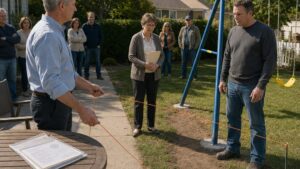
Debra Harris had stretched a metal tape measure across the width of her wheelchair ramp by the time Kathleen reached her house.
One end was hooked beneath the outer rail. The yellow tape ran diagonally over Debra’s knees and disappeared into the red casing clenched in her left hand. Her right wheel rested inches from the ramp’s edge.
“Don’t move,” Kathleen said.
Debra looked up. “I wasn’t planning to launch myself into the hydrangeas.”
Kathleen caught the loose tape before it slipped beneath the wheel. “What are you doing?”
“Finding out what it costs to become attractive.”
The ramp extended from Debra’s front porch in a gentle turn, built from weathered wood that matched the house better than most additions in Cedar Bluff. Someone had recently painted two small sample squares on the outer rail, one gray and one dark brown.
A folded yellow notice protruded from Debra’s coat pocket.
Kathleen took hold of the tape and reeled it in. “Ronald said you have a hearing Thursday.”
“He was kind enough to put it in writing.”
“You’re not taking this down.”
Debra rested both hands on her wheels. “The board says I am.”
“The board cannot order you to remove safe access without even reviewing alternatives.”
“They reviewed something.”
“What?”
Debra nodded toward a manila envelope on the porch. Kathleen climbed the ramp, retrieved it, and opened the flap.
Inside was a contractor’s sketch showing narrower rails, a privacy lattice, and paint matched to the house trim. The proposal preserved the ramp’s grade and turning platform. A short letter stated that the modifications could be completed without affecting accessibility.
Across the first page, someone had written REJECTED in blue ink.
“No explanation?” Kathleen asked.
“Ronald said the structure remained too visible from the lane.”
Kathleen looked toward the road. From there, the ramp could be seen through two camellia bushes and the open section of Debra’s front yard. It was no more conspicuous than a porch, a carport, or the satellite dish on the next roof.
“Who paid for this proposal?”
“I did.”
“How much?”
Debra named an amount large enough to make Kathleen close the envelope carefully.
“You should have told me.”
Debra gave her a dry look. “You should have asked before this morning.”
The words landed without cruelty, which made them harder to dismiss.
Kathleen placed the envelope on Debra’s lap. “I did not know it had gone this far.”
“You knew Ronald had started measuring everybody’s lives with that clipboard.”
“I knew he was issuing foolish notices.”
“Foolish is when he tells you your pumpkin has overstayed its welcome. This is how I get into my house.”
Kathleen glanced at the ramp beneath them.
Debra turned her chair and started upward. Halfway to the porch, she stopped.
The chair’s motor hummed softly.
“What is it?” Kathleen asked.
“Nothing.”
“Debra.”
Debra looked toward the side yard. A narrow path led around the house, where three wooden steps rose to a rear entrance.
Kathleen followed her gaze.
“You have been using those steps?”
“Only when the board sends someone to photograph the front.”
“How?”
“With a folding chair at the bottom and the railing.”
Kathleen stared at her.
Debra’s mouth tightened. “Do not make that face.”
“What face?”
“The one people make right before they begin speaking to me as if my legs have taken my judgment with them.”
Kathleen lowered her voice. “You could fall.”
“Yes.”
“Then why?”
“Because Ronald said continued use of an unapproved structure would count as a separate violation each day.”
The morning air seemed to thin.
Kathleen looked again at the yellow paper in Debra’s pocket. On her own door, it had felt insulting. Here, folded against Debra’s coat, it looked like a threat with physical weight.
“Has he added daily fines?”
“Not yet. He said the board would consider them Thursday.”
Kathleen took the handles behind Debra’s chair and pushed gently. “Go inside.”
“I can manage.”
“I know. Go inside anyway.”
In the kitchen, Debra set coffee between them without asking whether Kathleen wanted any. The room smelled faintly of cinnamon and furniture polish. On the refrigerator, a photograph showed Debra standing years earlier beside the retention pond, one hand shielding her eyes from the sun.
Kathleen opened the contractor’s proposal again.
“Who attended the meeting where this was rejected?”
“Ronald, Michael Garcia, and two board members. Michael did not say much.”
“He rarely does.”
“He looked at the floor when Ronald called the ramp an eyesore.”
Kathleen traced the edge of the contractor’s letter. “Did they give you minutes?”
“No.”
“A written decision?”
“Only the notice.”
“Did they identify the covenant section?”
Debra smiled without humor. “You are beginning to sound like yourself.”
Kathleen looked up.
“At the courthouse,” Debra said. “Not here.”
Before Kathleen could respond, a golf cart rolled slowly past the front window. Ronald sat behind the wheel. One of the board members rode beside him with a folder on her lap.
The cart did not stop, but Ronald looked directly at the house.
Debra lifted her coffee cup. “Neighborhood inspection.”
Kathleen felt the familiar urge to wait. To gather every page. To verify every date. To avoid making a claim until no one could challenge a word of it.
That instinct had made her careful at work.
It had also made her late before.
She took out her phone and photographed the contractor’s proposal, the rejection mark, and Debra’s notice.
“I will check the county filing this afternoon.”
Debra’s expression did not soften. “And then?”
“I will tell you what I find.”
“Privately?”
Kathleen put the phone down.
Outside, the golf cart stopped near the clubhouse bulletin board. Ronald stepped out and pinned a white sheet beneath the monthly dues reminder.
Kathleen could not read it from the window, but she saw the heading when the breeze lifted the page: NOTICE OF VIOLATION HEARING.
Debra wheeled closer to the glass.
“He moved it up,” she said.
The hearing was scheduled for six o’clock that evening, not Thursday.
Kathleen stood so quickly that her chair legs scraped the floor.
“He cannot give you six hours’ notice.”
“He just did.”
Kathleen gathered the proposal and reached for the yellow notice.
Debra held it back.
“One question,” she said.
Kathleen waited.
“If you find what you think you will find, will you stand up in that clubhouse and say it where everybody can hear?”
Through the window, Ronald smoothed the hearing notice against the board.
Kathleen had no answer that was both honest and kind.
So she took her coat from the chair and said, “First I need to see what was recorded.”
Debra watched her leave without saying whether that was enough.
Chapter 3: Five Names Beneath One Notary Seal
The official index contained no corrected covenant, no amended execution page, and no later instrument replacing the document recorded in 1994.
Kathleen checked twice.
Then she checked under Cedar Bluff’s former development name, under the original parcel owner, and under each variation of the association’s title. The same result returned every time: one declaration, one plat reference, one set of restrictions.
No correction.
No re-recording.
No replacement.
She sat at a public terminal in the records office, though her own secured workstation was less than twenty feet away. The distinction mattered. She was a homeowner conducting personal research, not an employee using privileged access.
The county archivist passed behind her carrying a gray storage box.
“You staying late?”
“I need a certified copy of an older declaration.”
“Book?”
Kathleen read the number from the index.
The archivist stopped.
“That section is on film and paper. Paper copy may be in off-site storage.”
“I need whatever is available to the public today.”
The archivist studied her for half a second, then nodded toward the reproduction counter. “Submit the request there. I’ll pull the film.”
Kathleen filled out the form by hand.
At the bottom, beneath purpose of request, she wrote: Property review.
She nearly added possible defective execution, then stopped. Conclusions did not belong on request slips.
The microfilm image appeared twenty minutes later, pale and scratched at the edges. Kathleen advanced through the pages slowly: legal description, use restrictions, architectural controls, assessments, enforcement provisions.
The document looked ordinary.
That unsettled her more than an obvious fraud would have.
Most harmful papers did not announce themselves. They sat quietly in binders and indexes, borrowing authority from their location.
She printed each page at the public rate and paid at the counter.
At an empty worktable near the archive room, she arranged the copies in order. Her yellow violation notice remained folded in her purse. After a moment, she took it out and used it to mark the execution page.
Five names appeared beneath the declaration.
Each signature had supposedly been witnessed and acknowledged before the same notary on the same date in June 1994.
Kathleen read them once without judgment.
Then again.
The first signature slanted sharply upward. The second was narrow and cramped. The third and fourth seemed similar, but similarity alone proved nothing. Families shared habits. Business partners copied forms. Repeated letter shapes could result from the same pen, the same table, the same rushed meeting.
She reminded herself of this while requesting enlarged copies.
At the reproduction machine, she increased the scale to two hundred percent and printed the signature page three times. The machine warmed the paper, leaving a faint chemical smell on her fingers.
She returned to the table.
The third signature began with a looped capital, dipped beneath the line, and ended in a long upward stroke.
So did the fourth.
So did the fifth.
Kathleen placed one enlargement over another against the archive room’s glass partition. The loops matched. The descenders matched. Even the hesitation midway through the final stroke appeared in the same place.
Her pulse changed.
Not proof, she told herself.
A strong irregularity.
She borrowed a sheet of translucent preservation paper from the archivist and traced only the outlines, careful not to mark the copies. When she overlaid the forms, the three signatures aligned so precisely that the differences looked less like handwriting and more like copying pressure.
The archivist returned and set a thin folder on the table.
“Paper duplicate,” she said. “Not the original. Original instrument was returned to the submitting party after recording.”
“Any correction attached?”
“No.”
“Any notary journal?”
“For 1994? Depends on the notary. We do not automatically hold those.”
Kathleen looked at the seal.
The notary’s name was readable, though the embossed portion had flattened in reproduction.
“Can you check whether a journal was deposited later?”
The archivist nodded. “I can check the accession list.”
Kathleen turned back to the five names.
One of them was familiar.
Not personally. From the courthouse.
She had seen it in a probate index.
She opened the public probate database and entered the name.
An estate case appeared.
Date of death: October 1993.
Kathleen stared at the screen.
The declaration had been notarized in June 1994, eight months later.
She printed the index summary, then sat without touching it.
A dead owner’s name on a property declaration could have several explanations. An estate representative might have signed improperly. A prior draft could have been attached by mistake. The recording date might differ from execution. A name could belong to another person.
She checked the parcel records.
Same address.
Same full name.
Same spouse listed in an older deed.
Kathleen placed the probate printout beside the declaration.
The room seemed suddenly too public. A clerk laughed softly at the front counter. A cart squeaked in the hallway. Somewhere, a stamp struck paper in a steady rhythm.
She thought of all eighty-four homes in Cedar Bluff. Mortgages had been issued. Properties had been sold. Dues had been collected. Buyers had relied on title searches and closing packages. Even if the declaration was defective, decades of later conduct might still carry legal weight.
Or it might not.
The archivist returned with an accession ledger.
“No deposited journal under that notary’s name.”
“Was the commission active?”
“That is Secretary of State territory. You can request the historical commission record.”
Kathleen nodded.
The absence of a journal proved nothing. She wrote that in the margin of her notes.
Then she wrote:
Three apparently duplicated signatures.
Named signer deceased before stated acknowledgment.
No corrected declaration located.
Original returned after recording.
She read the list and felt no triumph.
At Debra’s house, the front ramp waited beneath a removal deadline. At the clubhouse, Ronald was preparing a hearing. Kathleen had wanted a clear answer she could carry into the room like a shield.
Instead, she had found a door opening into questions large enough to affect every deed in the neighborhood.
Her phone vibrated.
A message from Debra: Hearing postponed until Friday. Ronald says you caused disruption. Did you find anything?
Kathleen typed, Yes.
She erased it.
She typed, I found irregularities.
She erased that too.
At last she wrote: I need legal advice before I say what it means.
Debra’s reply came quickly.
That is not the same as saying nothing.
Kathleen folded the yellow notice around the signature page and carried the copies to the certification counter.
In the parking lot, she called Amanda Rivera.
Her cousin answered on the fourth ring with traffic noise behind her.
“Kathleen? Is everything all right?”
“I need you to look at a recorded declaration.”
“What kind?”
“Homeowners association. Nineteen ninety-four.”
Amanda was quiet for a moment. “Your association?”
“Yes.”
“What did you find?”
Kathleen sat in her car with the certified envelope across her knees. She described the repeated signatures, the probate date, the missing correction, and Ronald’s inability to identify the record he was enforcing.
Amanda asked precise questions. Had Kathleen seen the original? No. Was the deceased person’s estate open at the time? Yes. Did later deeds reference the declaration? Kathleen had not checked all of them. Was there evidence Ronald knew of the defects? None yet.
When Kathleen finished, Amanda exhaled.
“You have enough to ask serious questions,” she said.
“Could the declaration be void?”
“Possibly defective. Possibly challengeable. Possibly partly enforceable through later deeds or conduct. Those are not the same thing.”
“He threatened sheriff action over twelve dollars.”
“That may matter separately.”
“And Debra’s ramp hearing is Friday.”
“That may matter urgently.”
Kathleen looked through the windshield at the courthouse windows reflecting the late-afternoon sky.
“If those signatures were traced—”
“Do not finish that sentence as a conclusion.”
“I know what matching lines look like.”
“You know what irregular records look like. A court decides what they prove.”
Kathleen tightened her hand around the phone. “So what do I tell the neighborhood?”
“For now? Nothing.”
“Amanda—”
“I mean nothing definitive. Do not tell anyone the HOA is dead.”
The words struck harder than Kathleen expected.
She had imagined the discovery shrinking Ronald’s authority. Instead, it had expanded Kathleen’s responsibility.
Amanda continued, her voice lower.
“Send me every page. And Kathleen, keep the original yellow notice.”
“Why?”
“Because a questionable covenant is one issue. A president making threats beyond powers he can document is another.”
Kathleen looked down at the paper folded around the certified copy.
For the first time that day, the twelve-dollar notice no longer looked small.
Chapter 4: The Victory Kathleen Could Not Claim
Amanda Rivera placed three legal pads side by side on her desk and wrote a different outcome at the top of each one.
“First,” she said, tapping the left pad, “the court could decide the declaration was never validly executed.”
Her pen moved to the middle.
“Second, it could decide the defects are serious but that later deeds, purchases, and payments created some enforceable obligations.”
Then the right.
“Third, it could separate the association’s maintenance functions from its power to fine people.”
Kathleen stood beside the office window, looking down at a narrow Charleston street where delivery vans squeezed between parked cars. The certified copies lay open across Amanda’s conference table. The yellow violation notice had been photocopied and clipped to the front of the file.
“Which one protects Debra’s ramp?” Kathleen asked.
“Potentially all three. But not in the same way.”
“That sounds like something lawyers say when they do not want to answer.”
Amanda capped her pen. “It is something lawyers say when the answer depends on forty pages of deeds, thirty years of conduct, and a judge who will not appreciate us pretending uncertainty does not exist.”
Kathleen turned from the window.
She had driven to Charleston before sunrise, carrying the certified declaration, the probate printout, the contractor’s proposal, and every notice Ronald had issued. She had imagined Amanda looking at the repeated signatures and confirming what Kathleen already believed.
The covenant was rotten at its root.
Instead, Amanda had spent two hours making the matter larger.
Some Cedar Bluff deeds expressly referred to the 1994 declaration. Others used vague language about restrictions of record. Several newer deeds named the association without quoting any authority. Homeowners had paid dues for decades. The association had maintained the retention pond, paid insurance on the clubhouse, and arranged streetlight service.
“People can act as though an arrangement exists,” Amanda said, “even when the original paper has defects. A court may preserve some practical obligations while rejecting others.”
“So Ronald can keep fining people.”
“I did not say that.”
“He will hear only the part that helps him.”
“Then stop giving him your conclusions before we can support them.”
Kathleen looked at the three legal pads.
She had wanted certainty because certainty felt clean. You found the right page, compared the dates, showed the error, and the error stopped governing people.
But land records carried the weight of everything done after them.
Amanda slid Debra’s contractor proposal closer. “This is where we may get immediate relief. The ramp decision appears arbitrary, the notice period is short, and Ronald’s enforcement authority is disputed. We can ask the court to halt the hearing and any removal action while the record is reviewed.”
“Can we do that by Friday?”
“I can send a demand today. If they refuse, we prepare for emergency relief.”
Kathleen sat.
It was not the sweeping victory she had imagined in the archive room. It was smaller, slower, and more useful.
Amanda pointed to the yellow notice.
“And this language about sheriff removal helps show urgency.”
“He was bluffing.”
“Probably. That does not make it harmless.”
Kathleen thought of the pickup idling at the stop sign and the neighbors watching from the mailbox. Ronald had understood exactly what the word sheriff would do on a quiet street.
Amanda leaned back. “What has he said publicly since you requested the records?”
“Nothing directly to me.”
“That was not my question.”
Kathleen looked away.
A message had circulated through Cedar Bluff’s neighborhood email list that morning. Ronald had written that one homeowner was challenging long-settled standards and risking higher legal expenses for everyone. He had not named Kathleen. He had not needed to.
“I did not respond,” she said.
“Why?”
“Because I do not yet know enough.”
“You know enough to correct the claim that you are attacking the whole neighborhood.”
“If I answer, it becomes a public fight.”
Amanda’s expression remained still.
Kathleen heard her father’s voice in the silence between them: Keeping peace is not the same thing as doing right.
He had said it once after she refused to challenge a contractor who had overcharged an elderly relative. Kathleen had dismissed him then. She had preferred the peace.
Amanda gathered the copies into order. “Uncertainty is not silence, Kathleen. You can say what you know and admit what you do not.”
The words followed her back to Cedar Bluff.
By six that evening, the clubhouse parking lot was full.
Ronald stood at the front of the meeting room beneath a framed photograph of the retention pond. Debra sat near the aisle, her folded yellow notice on her lap. Kathleen took a chair beside her.
On the wall behind Ronald, a projector displayed two figures.
Required drainage repairs.
Proposed special assessment.
A murmur moved through the room.
“The engineer’s report confirms erosion along the eastern bank,” Ronald said. “If we delay, insurance and repair costs will rise.”
Someone asked why the reserve account could not cover it.
Ronald’s answer came too quickly.
“The reserve account was not designed for a project of this scale.”
Kathleen looked toward Michael Garcia, seated at the board table. He kept his eyes on a stack of papers.
Ronald changed the slide.
The proposed assessment was more than many homeowners had expected.
Voices rose.
A man near the back asked whether the board had obtained competing bids. A woman asked why no financial statement had been distributed. Another homeowner demanded to know whether the HOA even possessed the authority to impose the assessment.
Ronald looked directly at Kathleen.
“This confusion is exactly what happens when individuals with personal grievances begin casting doubt on established community obligations.”
Every face turned toward her.
Kathleen felt the old instinct close around her ribs.
Wait until you are certain.
Do not embarrass anyone.
Do not make yourself the center.
Debra’s hand tightened around the yellow notice.
Kathleen stood.
“I have not told anyone to stop paying dues,” she said. “I asked for the recorded authority supporting enforcement actions and received no answer.”
Ronald folded his hands. “Mrs. Miller is attempting to use technical irregularities to jeopardize property values and essential maintenance.”
“I have not made a legal conclusion.”
“Yet you contacted counsel.”
“Yes.”
The room shifted again.
Ronald gave a small, disappointed nod, as if she had confessed to harming them.
Kathleen forced herself not to defend her character. “The board can release the governing documents, the reserve statement, and the engineer’s report. Then homeowners can evaluate facts instead of accusations.”
Michael finally raised his head.
Ronald spoke over him.
“The board will distribute appropriate materials after legal review.”
“When?” someone called.
Ronald’s jaw tightened. “When that review is complete.”
The meeting ended without a vote. People gathered in tense clusters near the door. Debra left with the help of a neighbor, saying little.
Kathleen waited until the room thinned.
As she reached for her coat, Michael passed behind her.
He did not stop.
A folded sheet touched her hand.
“Do not say where you got it,” he murmured.
Then he walked out through the side door.
Kathleen opened the paper beneath the clubhouse’s dim exit light.
At the top was a reserve-account summary.
The balance was less than half the amount Ronald’s presentation had implied.
Chapter 5: The Reserve Account Behind the Rules
The reserve account could not pay even the first stage of the drainage work.
Kathleen spread Michael’s summary across her kitchen table beside the engineer’s estimated costs. The numbers did not merely show a shortfall. They showed a pattern: deferred pond maintenance, rising insurance premiums, unpaid dues, and transfers from reserves to cover ordinary operating expenses.
At the bottom of the page, someone had handwritten a warning.
Coverage renewal contingent upon corrective drainage plan.
Kathleen read it twice.
The association was not only worried about an eroding pond bank. It was facing the possibility of losing affordable insurance for the clubhouse and shared property.
Her phone rang.
Michael.
She answered without greeting.
“You gave me an incomplete statement.”
“I gave you what I could remove without anyone noticing.”
“Where is the rest?”
Silence.
Kathleen looked through the kitchen window. The retention pond lay beyond two rows of houses, hidden by trees, but she could hear pumps running in the distance.
“Michael.”
“Not on the phone.”
He told her to meet him near the pond in twenty minutes.
His car was parked behind the clubhouse when she arrived. He sat in the driver’s seat with the engine off and the windows fogged from his breathing.
Kathleen opened the passenger door.
Michael glanced toward the building. “Close it.”
She did.
A stack of yellow violation notices lay on the back seat beside three contractor estimates. The notices were arranged by address. Some were marked paid. Others had red circles around increasing balances.
“You helped prepare these,” Kathleen said.
“I am the treasurer.”
“That was not an answer.”
He rubbed both hands over his face. “The dues collections dropped after Ronald raised the annual amount. We had people paying late, people refusing the increase, people asking for audits. The pond report came in at the same time.”
“And the insurance?”
“Renewal is in January. They want proof we are addressing drainage.”
Michael passed her a contractor estimate.
The cheapest proposal still exceeded the reserve balance.
“So Ronald started issuing fines,” Kathleen said.
“He said enforcement would improve collections generally. Show people the board was functioning.”
“By charging twelve dollars for pumpkins.”
“The small fines were supposed to establish consistency.”
Kathleen turned toward him. “And Debra’s ramp?”
Michael stared through the windshield.
“Ronald said if we made an exception without formal approval, everybody would claim one.”
“It is a wheelchair ramp.”
“I know what it is.”
“Then why did you vote to reject the modification?”
“I abstained.”
Kathleen let the paper fall into her lap. “That is how you voted.”
His face hardened, then collapsed again.
“I have a mortgage here too,” he said. “If the association falls apart, if the pond fails, if buyers cannot get clean title opinions—what happens to the value of eighty-four homes?”
The question did not sound rehearsed. It sounded frightened.
Kathleen had expected money to explain Ronald’s behavior, but not like this. No stolen funds. No private contract. No secret profit.
Only a shrinking account, an expensive pond, and men who had decided fear justified certainty.
“When did Ronald learn the covenant file was incomplete?” she asked.
Michael did not answer.
Kathleen waited.
“February,” he said at last.
Nine months earlier.
“How?”
“We requested a legal review before raising dues. The attorney asked for a certified declaration. Ronald brought the clubhouse copy, but it was missing the execution page.”
“And then?”
“The attorney said we needed the recorded version. Ronald looked it up himself.”
Kathleen’s fingers tightened around the estimate. “He saw the signatures.”
“He saw enough to stop the review.”
“Why did the board continue?”
“Ronald said old associations often had imperfect records. He said residents had complied for thirty years and questioning the foundation would create more damage than the defects.”
“Did he tell the full board?”
“Not everything.”
“Did he tell you?”
Michael looked at the notices on the back seat.
“He told me we could not afford panic.”
Kathleen understood then why Ronald had hesitated on her porch. He had not been surprised by her question.
He had been afraid she knew the answer.
Michael reached beneath his seat and withdrew a copy of a meeting agenda. One item had been crossed out in black ink: Review of recorded declaration and counsel recommendation.
“Why give me this now?” Kathleen asked.
“Because he is preparing a lien notice against you.”
She turned.
“Over twelve dollars?”
“The fines have increased. Administrative fees. Hearing costs. He wants the board to authorize filing.”
“As an example.”
Michael did not deny it.
Kathleen stared at the fogged windshield. Understanding Ronald’s motive did not make the harm smaller. It made it more deliberate. He had known there was a problem and chosen stronger enforcement precisely because exposure frightened him.
“Will you sign an affidavit?” she asked.
Michael flinched. “Not yet.”
“You gave me records.”
“That is different.”
“No. It is quieter.”
His eyes met hers.
Kathleen heard the accusation in her own words because it belonged to her too.
She opened the car door.
“Ronald was right about one thing,” Michael said behind her.
She paused.
“If homeowners believe the association has no authority, some will stop paying immediately. The pond will not wait for a judge.”
Kathleen looked toward the dark water beyond the trees.
“I am not trying to destroy the pond,” she said.
“No. But you may destroy the only organization paying for it.”
That evening, a sheriff’s civil-process deputy knocked on Kathleen’s door.
He was polite. He did not threaten removal. He handed her an envelope and asked her to sign for receipt.
Inside was a notice of intent to file a lien if the accumulated balance was not resolved.
The amount had grown from twelve dollars to three hundred and eighty-six.
Administrative charges.
Hearing fees.
Daily noncompliance penalties.
Kathleen placed the notice beside the original yellow sheet.
At eight thirty, Ronald called.
“I can stop this,” he said.
Kathleen said nothing.
“Pay the original twelve dollars, withdraw the records request, and confirm in writing that you will not challenge the special assessment. I will recommend that the board waive the rest.”
“And Debra?”
A pause.
“Her matter is separate.”
Kathleen looked out at the pecan tree. The swing moved slowly beneath it.
Ronald’s voice softened.
“This does not need to become a war.”
“No,” Kathleen said. “It needs to become a record.”
Chapter 6: The Offer Beneath the Pecan Tree
Ronald came the next evening without his clipboard.
Kathleen noticed that first.
He crossed her yard with empty hands and stopped beneath the pecan tree, where the old wooden swing hung still in the fading light. The yellow violation notice remained pinned beneath one of the metal hooks Kathleen’s father had driven into the branch support years before.
Ronald looked at it.
“You keep that outside now?”
“I wanted to see what it looked like without your hand over it.”
He accepted the remark without answering.
For once, he did not stand like an official arriving to inspect something. His shoulders sloped beneath his jacket. Gray showed along his jaw where he had missed shaving.
“I spoke to the board,” he said. “The offer stands.”
Kathleen remained beside the porch steps.
“Twelve dollars and my silence.”
“Withdrawal of a challenge that could injure every homeowner here.”
“You left that part out on the phone.”
“I assumed you understood it.”
“I understand what you are afraid of.”
His eyes moved toward the neighboring roofs.
“You have seen the numbers.”
Kathleen did not ask how he knew.
“The reserves are inadequate,” he continued. “Insurance may not renew. The pond bank is failing. Half the people shouting at meetings will refuse a five-dollar increase, then blame the board when water reaches their crawl spaces.”
“So you decided fear would collect what trust could not.”
“I decided rules mean nothing if enforcement is optional.”
“You knew the declaration might not survive scrutiny.”
Ronald’s face changed.
Not surprise.
Exhaustion.
He walked to the swing and placed one hand on its wooden seat.
“The attorney raised concerns,” he said.
“In February.”
“Michael has been talking.”
“Answer me.”
Ronald pushed the swing once. It moved forward and returned.
“Yes. I knew there were defects.”
The admission entered the yard quietly.
Kathleen had expected satisfaction. Instead, she felt the weight of all the months between February and the notice on her door.
“Why did you stop the review?”
“Because counsel wanted a full title analysis. Every deed. Every amendment. Every owner acknowledgment. We did not have the money.”
“You had money for violation hearings.”
“We had a system already in place.”
“A system you did not know was valid.”
“A system people had accepted for thirty years.”
“Debra did not accept losing her ramp.”
Ronald looked away.
“I was trying to preserve Cedar Bluff.”
“You were trying to preserve your promise.”
He turned back sharply.
At the election meeting, Ronald had told the neighborhood he would restore order, stabilize dues, and protect values. Kathleen remembered the applause. She remembered how pleased he had looked when people began bringing him complaints.
“My reputation is not the issue,” he said.
“It became the issue when admitting uncertainty meant admitting you could not fix everything.”
The swing returned and touched his leg.
For a moment, he looked older than she had ever seen him.
“You think I enjoy walking door to door?” he asked. “You think I wanted to cite pumpkins?”
“I think you found smaller rules easier to control than larger problems.”
His mouth tightened, but he did not deny it.
Kathleen stepped into the yard.
“If you had told the homeowners the truth in February, they might have helped decide what to do.”
“They would have stopped paying.”
“Some might have.”
“And the rest would carry them. Until they stopped too.”
“You did not trust them.”
“I know them.”
The answer came with such certainty that Kathleen recognized her own flaw inside it. Ronald had waited for perfect obedience the way she waited for perfect proof. Both habits left no room for other people to act responsibly.
The difference was that Ronald had used authority to force the outcome he wanted.
A phone rang inside Kathleen’s house.
She ignored it.
Then it rang again.
Ronald glanced toward the porch.
Kathleen went inside and answered.
A neighbor’s voice came fast and breathless. Debra had fallen at her rear entrance. She was conscious. An ambulance was on the way.
Kathleen was already reaching for her coat.
At Debra’s house, the folding chair lay on its side beside the rear steps. Debra sat against the railing with one hand pressed to her shoulder. A neighbor knelt beside her.
“I slipped,” Debra said before Kathleen could speak. “Do not turn it into a funeral.”
The paramedics arrived moments later. They examined her shoulder, checked her head, and helped her onto a stretcher. The injury appeared minor, but Debra’s face tightened when they lifted her.
Ronald stood at the edge of the yard.
He looked from the rear steps to the front ramp.
No one asked why Debra had used the dangerous entrance. The yellow notice folded in her coat pocket supplied the answer.
At the ambulance door, Debra caught Kathleen’s wrist.
“Did you find enough?” she asked.
Kathleen looked at Ronald.
He lowered his eyes.
“Yes,” Kathleen said. “Enough to speak.”
Later that night, Amanda arrived with an affidavit and a petition for emergency relief. They sat at Kathleen’s kitchen table beneath the hard white light over the stove.
The document did not claim the HOA was dead.
It listed only what Kathleen could prove: the missing correction, the repeated signature forms, the deceased signatory, Ronald’s undocumented threat, Debra’s pending removal order, and the lien notice prepared after Kathleen requested records.
Amanda pointed to the signature line.
“Once you sign, your name becomes part of the public case.”
Kathleen thought of the family at the courthouse years earlier, waiting while an error she had recognized became someone else’s burden. She thought of her father beneath the pecan tree, telling her that peace purchased with silence was not peace at all.
She signed.
Outside, the yellow notice moved beneath the swing hook, tapping lightly against the wood.
Chapter 7: What the Covenant Could Not Prove
Ronald’s threat was read aloud in a courtroom before anyone mentioned the forged signatures.
Amanda stood at the lectern with the original yellow notice sealed inside a clear evidence sleeve.
“If the balance remains unresolved,” she read, “the association may pursue all remedies available, including civil enforcement and removal through the appropriate authorities.”
Across the aisle, Ronald sat beside the association’s attorney. His eyes remained fixed on the table.
The county judge looked over her glasses.
“Removal from what?”
The association’s attorney rose. “Your Honor, the wording was imprecise. The association did not possess, and did not intend to suggest, any immediate power to remove Mrs. Miller from her home.”
Kathleen sat behind Amanda with her hands folded tightly in her lap.
The yellow paper looked smaller under the courtroom lights than it had on her screen door. Its corners had curled. A faint line marked the place where Ronald’s thumb had pressed it flat.
The judge turned to Amanda. “And this notice relates to the original twelve-dollar assessment?”
“It began there,” Amanda said. “Administrative charges and daily penalties later increased the claimed balance to three hundred and eighty-six dollars, followed by notice of a proposed lien.”
A rustle moved through the benches behind Kathleen, where several Cedar Bluff residents had gathered.
The judge silenced them with a glance.
The hearing concerned temporary relief, not a final determination of every title question. Amanda had repeated that to Kathleen twice before they entered the courtroom. The court would decide whether disputed fines and enforcement should continue while the declaration’s validity was examined.
It would not erase Cedar Bluff before lunch.
The association’s attorney began with thirty years of conduct.
Homeowners had paid dues. The association had insured the clubhouse, maintained the retention pond, arranged lighting, and enforced standards. Buyers had accepted deeds referencing restrictions. Even if the 1994 declaration contained defects, he argued, decades of reliance could not be discarded because of irregular signatures on one execution page.
Kathleen listened carefully.
The argument was stronger spoken aloud than it had seemed in Amanda’s office.
The pond still needed repair. Insurance still needed renewal. Homeowners had received benefits from shared payments. Ronald had not invented those facts.
Then the attorney turned to Debra’s ramp.
“The association has never opposed accessibility,” he said. “It sought only architectural review and visual modification.”
Debra sat in the second row with her injured shoulder supported by a sling.
Amanda placed the rejected contractor proposal before the judge.
“The proposed modification preserved access and matched the home,” she said. “It was rejected without written findings. Meanwhile, Mrs. Harris was warned that continued use could trigger daily violations.”
The judge read the blue word across the proposal.
REJECTED.
“Who made this decision?”
Ronald’s attorney conferred with him.
“The board.”
“Based on which recorded standard?”
The attorney opened a binder.
For several seconds, the only sound was the turning of pages.
Kathleen recognized the silence.
It was the same silence from her porch, enlarged to fill a courtroom.
When Amanda called her as a witness, Kathleen walked to the stand carrying no papers. The certified declaration, probate index, signature enlargements, and recording history had already been marked.
She swore to tell the truth and sat.
Amanda began with her work.
Kathleen described the county recording system, the distinction between public and secured access, and the steps she had taken as an ordinary member of the public. She explained the index search, the absence of a corrected filing, and the certified copies.
Amanda placed the enlarged signatures on the display screen.
Three names appeared beneath one notary seal.
“What did you observe?” Amanda asked.
Kathleen chose each word before releasing it.
“The forms of the third, fourth, and fifth signatures align unusually closely. The opening loops, descending strokes, and terminal marks appear substantially identical.”
“Do you conclude that they were forged?”
“No.”
A murmur rose behind her.
Amanda waited.
Kathleen continued. “I am not a handwriting examiner. I conclude that the similarities are sufficient to require investigation.”
Amanda displayed the probate record.
“And this?”
“The recorded declaration states that this owner acknowledged the document in June 1994. The county probate index lists his death in October 1993.”
“So the declaration is invalid?”
Ronald looked up.
Kathleen felt the room waiting for the answer people wanted from her.
“Yes” would have been clean. It would have transformed every uncertain hour into a victory.
But it would not have been true.
“I cannot say what legal effect the defect has on every deed or every shared obligation,” Kathleen said. “I can say the filing does not prove what the association has repeatedly claimed it proves.”
The judge leaned forward.
“What does it fail to prove?”
“That five living owners personally executed and acknowledged that page on the stated date.”
Amanda nodded once and sat down.
On cross-examination, the association’s attorney asked whether Kathleen had paid dues during her eleven years in Cedar Bluff.
“Yes.”
“Used the streetlights?”
“Yes.”
“Benefited from pond maintenance?”
“Yes.”
“Accepted a deed referencing restrictions?”
“My deed references restrictions of record. It does not identify this declaration by book and page.”
“But you understood an association existed.”
“I understood people acted as though one did.”
The attorney paused.
“And only challenged it after receiving a fine.”
Kathleen saw Ronald watching her.
“That is when I asked for its authority,” she said. “It is not when the defects began.”
The judge’s ruling came after a recess that lasted less than an hour and felt longer than the preceding eleven years.
She did not dissolve Cedar Bluff.
Several residents visibly sagged when she said so. Ronald closed his eyes briefly, perhaps in relief.
The judge found that shared maintenance obligations could not be resolved on the limited record before her. Decades of payments, deeds, and reliance required fuller review.
Then her tone changed.
The association had failed to establish clear authority for escalating fines, architectural penalties, or threatened lien enforcement under the disputed declaration. Its handling of Debra’s ramp raised immediate concerns, and Ronald’s language regarding sheriff involvement had been unsupported and coercive.
All disputed fines against Kathleen were suspended.
The proposed lien was barred.
No action could be taken against Debra’s ramp while the case remained pending.
The board was ordered to provide full financial records, preserve all governing documents, and hold a transparent homeowner vote on whether to reauthorize a limited governance structure under valid procedures.
Ronald’s attorney rose. “Your Honor, the association requires continuity to address urgent drainage obligations.”
“The order does not prevent collection of voluntarily paid maintenance dues,” the judge said. “It prevents the use of disputed punitive powers to compel them.”
She looked toward Ronald.
“An institution facing uncertainty does not gain authority by speaking more forcefully than its documents permit.”
No one applauded.
Kathleen was grateful.
Outside the courtroom, residents formed uneven groups along the hallway. Some thanked her. Others asked whether they should keep paying dues. One man accused her of endangering everyone’s property value.
“I cannot tell you not to pay,” Kathleen said. “The pond still belongs to all of us.”
He seemed disappointed that she would not offer a simpler enemy.
Michael stood near the stairwell. When their eyes met, he gave a small nod, then turned toward Ronald.
Ronald remained alone beside the courtroom door until Kathleen approached.
“You did not get what you wanted,” he said.
Kathleen looked through the glass panel at the yellow notice still lying beside the certified 1994 declaration.
“No,” she said. “I got what I could prove.”
A clerk opened the door and handed Amanda the signed order.
At the bottom, beneath the suspended fines and protected ramp, was the date of Cedar Bluff’s reauthorization vote.
The neighborhood now had forty-five days to decide whether it could govern itself without pretending uncertainty was disobedience.
Chapter 8: The Blank Paper Returned to the Door
Ronald attended the reauthorization vote, but he did not sit at the board table.
He chose a chair against the clubhouse wall beneath the old photograph of the retention pond. His clipboard was absent. A sealed records box rested beside his shoes.
At the front of the room, a blank meeting agenda lay at every seat.
Kathleen had insisted on that.
No prewritten motions. No hidden attachments. No decisions announced before discussion.
The proposed charter covered only shared maintenance, insurance, drainage, lighting, basic safety, and a narrow architectural review process. Fines required written authority, notice, evidence, and appeal. Accessibility modifications received presumptive approval unless a documented safety issue existed. Financial statements would be available to every homeowner.
Some residents thought the plan was too weak.
Others thought it was still too much.
For nearly two hours, Cedar Bluff argued without anyone threatening to remove anyone else from a home.
When the vote was counted, the limited charter passed by nine votes.
The result brought no cheer. People exhaled, gathered papers, and began asking who would serve.
Debra raised her uninjured hand.
“I nominate Kathleen Miller for president.”
Heads turned.
Kathleen remained seated.
“No,” she said.
Debra’s eyebrows lifted. “That was quick.”
“I do not want the office.”
“You seem to enjoy the paperwork.”
A few people laughed, softly enough that it did not become applause.
Kathleen looked toward Ronald. He had not moved.
“I will oversee records access for the first year,” she said. “Every filing, contract, notice, and set of minutes. But somebody else should run the meetings.”
Debra studied her, then nodded.
Service without control.
The distinction mattered.
Michael accepted the treasurer’s position only after two residents agreed to review the accounts with him each quarter. Debra joined the accessibility committee and required the contractor’s original ramp proposal to become the first document entered under the new charter.
When the room emptied, Ronald remained by the wall.
Kathleen approached the records box.
“Is that everything?” she asked.
“Everything I had.”
He lifted the lid.
Inside were old minutes, contractor estimates, insurance letters, unpaid invoices, and a thin folder marked Legal Review—February.
The file Michael had said was missing.
Ronald placed it in Kathleen’s hands.
“I should have released it then,” he said.
It was not an apology.
It was closer than silence.
“Yes,” Kathleen said.
He looked toward the table where the new charter had been signed.
“They will learn the rules do not become easier because they are lawful.”
“No,” Kathleen said. “They only become theirs.”
Ronald left without answering.
The following morning, Kathleen stopped at Debra’s house.
The ramp remained exactly where it had been. Fresh paint covered the rails in the dark brown shade from the rejected proposal, chosen now because Debra liked it rather than because anyone required it.
Kathleen walked behind the wheelchair as Debra moved upward.
“You know,” Debra said, “you could have accepted the presidency and spent the rest of your life rejecting decorative pumpkins.”
“I have already had enough authority for one month.”
At the porch, Debra turned.
“Thank you for speaking.”
Kathleen rested one hand on the rail.
“I should have spoken sooner.”
“Yes,” Debra said. “You should have.”
Then she opened her door and went inside.
Kathleen returned home carrying the empty records box.
The original yellow notice still hung beneath the pecan-tree swing hook. Sun and rain had faded it from bright yellow to the color of old straw.
She removed the pin.
For a moment, she held the paper between both hands. Twelve dollars. Two garden gnomes. One pumpkin. A sheriff threat that had never possessed the authority it borrowed.
She carried it inside and placed it in the new Cedar Bluff archive.
On her screen door, she taped a blank meeting agenda for the first records committee session.
No heavy heading.
No warning.
Only a date, a time, and space for anyone to add a question.
When Kathleen stepped back into the yard, the pecan-tree swing was moving.
The morning was nearly still, but the ropes creaked as the wooden seat traveled forward and returned, forward and returned.
She placed one hand on it as it passed.
Then she let it move without holding it in place.