She Fined My Folding Chairs, So I Built the Bookshop Beyond Her HOA Fence
Chapter 1: The Violation Waiting on Susan’s Chair
Margaret Campbell slid the violation across the table before Susan Mitchell had finished pulling out her chair.
The paper stopped beneath Susan’s hand, its red border bright against the gray laminate. At the top, in block letters, were the words FORMAL NOTICE OF COMMERCIAL ACTIVITY.
Susan looked at the notice, then at Margaret.
“I haven’t opened a business.”
Margaret remained standing. She wore a lavender jacket buttoned to the throat and held the association binder against one hip as if it were evidence in a trial.
“The board has received a complaint.”
“From whom?”
“That isn’t relevant.”
“It is if the complaint is false.”
Two other board members sat along the far side of the table. Neither looked at Susan. Stephen Jones, the treasurer, adjusted the corner of a yellow legal pad until it aligned with the table edge.
Margaret tapped the notice. “Eight people entered your home last Thursday evening. Several carried books. Refreshments were served. The gathering continued past nine.”
Susan stared at her.
“We read a novel.”
“That is your description.”
“It was a book club.”
Margaret’s mouth tightened. “The activity had commercial undertones.”
For a moment, Susan thought she had misheard.
“What undertones?”
“Organized attendance. Material distribution. Hospitality.”
“The material was one used paperback. Lisa found it at a yard sale for two dollars.”
The board member nearest the wall shifted in his chair, but Margaret did not.
“There was no sale,” Susan continued. “No fee. No advertising. No one earned a dime.”
Margaret opened the binder to a tab marked SECTION 41 and turned it around.
“No retail or commercial activity shall be conducted from any residence within the association.”
Susan read the paragraph twice. It said nothing about private gatherings, clubs, shared meals, or books.
“This doesn’t apply.”
“That is the board’s interpretation.”
“Was there a vote?”
Margaret closed the binder.
“The president is authorized to enforce the governing documents.”
“That wasn’t my question.”
The room seemed to shrink around the silence. Susan could hear the wall clock clicking above the framed photograph of the subdivision entrance.
Stephen finally looked up. “The fine is three hundred dollars.”
Susan turned toward him. “For eight neighbors sitting in my living room?”
“For a first commercial-use violation,” Margaret said.
Susan placed both palms flat on the table. She had spent years in rooms where people hid weak positions behind thick binders and measured voices. She knew the rhythm. The refusal to name the complainant. The citation of a broad rule. The confidence meant to make resistance seem expensive.
She also knew anger could be used against her.
So she folded the notice once and put it in her purse.
“I will appeal.”
“You may submit a written request within ten days.”
“I’ll submit it tomorrow.”
Margaret sat at last. “Until the board reviews the matter, similar gatherings should cease.”
Susan paused with her hand on the back of the chair.
“You’re ordering me not to have neighbors in my home?”
“I’m advising you not to repeat the violation.”
Susan left before the answer forming in her mouth became useful to Margaret.
At home, the living room still looked almost exactly as it had Thursday night. The coffee table held a metal kettle, three mismatched mugs, and the paperback they had been discussing. Four folding chairs stood open in a loose circle. The other four had been collapsed and leaned against the wall after Lisa left.
Susan picked up the book. Its cover was creased, and someone had underlined a sentence in blue ink years before any of them had owned it.
She set the violation on one of the chairs.
Commercial activity.
The phrase looked absurd there.
Lisa called before Susan could begin the appeal letter.
“How bad was it?”
“Three hundred dollars.”
“For what?”
“Hospitality, apparently.”
Lisa gave a short laugh, then stopped when Susan did not join her.
“You’re serious.”
“Section Forty-One. No retail or commercial use.”
“But nobody sold anything.”
“I explained that.”
“And?”
“Margaret has decided organization itself is commercial.”
Lisa was quiet. “Do you think this is because we sat on the porch afterward?”
Susan remembered Margaret driving slowly past near the end of the evening. Her headlights had swept across the porch where Lisa and two others were finishing coffee.
“I don’t know.”
But she did know Margaret had watched.
Susan spent an hour drafting the appeal. She quoted the covenant, defined commercial use, listed the names of no businesses because there were none, and attached a photograph of the two-dollar receipt Lisa had found tucked inside the paperback.
At seven the next morning, she opened her front door and found another envelope taped at eye level.
The second notice cited “temporary furniture visible from the public right-of-way.”
Fine: two hundred dollars.
Susan stepped onto the porch.
One folding chair stood beside the railing. Lisa had carried her coffee outside and forgotten to bring it back in.
Margaret was across the street, walking a small white dog. She did not wave.
Susan pulled the envelope from the door and crossed the lawn.
“Margaret.”
The dog stopped. Margaret shortened the leash.
“You fined me for a chair?”
“For noncompliant exterior storage.”
“It was outside for less than an hour.”
“It was visible.”
“So are porch swings.”
“Porch swings are outdoor furniture.”
“A folding chair becomes illegal because it folds?”
Margaret glanced toward two neighboring houses where curtains had shifted.
“This is exactly why we have standards, Susan. Exceptions become habits.”
Susan looked at Margaret’s controlled expression and understood that this was no longer about the book club. Perhaps it never had been.
She went back inside and folded every chair. She stacked them against the living-room wall with their metal legs facing outward.
By noon, she had finished the appeal and printed three copies.
At three, a third envelope appeared beneath her door.
This one contained a table.
Chair one: visible from street.
Chair two: partially visible through open garage.
Chair three: exterior use associated with prohibited gathering.
Each line carried a separate assessment.
Susan read the total once. Then she carried the paper into the living room and placed it on top of the stacked chairs.
She no longer wanted Margaret’s apology.
She wanted to know exactly how much authority Margaret truly had.
Chapter 2: The Rule Margaret Needed Everyone to Fear
Lisa stood on Susan’s porch holding an unopened HOA envelope as if it might stain her fingers.
“We can’t meet Thursday.”
Susan looked past her toward the street. Two houses down, a neighbor was rolling a trash bin toward the curb. When he saw them, he turned the bin around and busied himself with the lid.
“What did they send you?”
Lisa handed over the envelope.
The notice was not a fine. It was worse in a quieter way.
Residents were reminded that participating in unapproved commercial gatherings could expose individual homeowners to enforcement action.
Susan read the sentence again.
“You didn’t host anything.”
“No, but I attended yours.”
“They can’t fine you for sitting in my living room.”
“I know what they can’t do.” Lisa lowered her voice. “I also know I don’t have time to fight them. I have work, school pickup, my mother’s appointments. I can’t have letters coming every week.”
Susan wanted to say that giving in would teach Margaret the tactic worked. Instead, she folded the notice and gave it back.
“We’ll postpone.”
Lisa’s shoulders loosened with relief, which hurt more than an argument would have.
Inside, the chairs remained stacked against the wall. Their curved backs made a row of narrow shadows in the afternoon light.
Susan had not told Lisa about her years in commercial real estate. Not fully. The neighborhood knew she had worked “in property” before retiring, but she had allowed them to imagine open houses and cheerful closings. She had never explained the land-use hearings, title defects, lease negotiations, or the project that had ended her career.
She was not ready to explain them now.
Instead, she requested access to the association’s enforcement records.
Margaret delayed three days, then said the files could be reviewed only in the HOA records room between ten and noon on Wednesday. The room was a converted storage space behind the pool office, with a metal desk, one chair, and shelves of binders labeled by year.
Stephen met her there.
“I have to remain while you review them.”
“Because I might commercialize the minutes?”
He did not smile.
Susan started with the current year. The enforcement log listed lawn height, unapproved paint colors, trash containers, and a basketball hoop left at the curb. Her own name appeared four times in Margaret’s neat handwriting.
There was no board motion attached to the first fine.
She checked the meeting minutes.
Nothing.
She went back two years. A holiday cookie exchange had brought twelve residents into one home. No violation. A weekly card group met in another garage throughout winter. No violation. One homeowner had offered paid piano lessons for six months before receiving a warning, not a fine.
Susan looked at Stephen.
“Where is the vote adopting Margaret’s interpretation of Section Forty-One?”
He shifted his weight. “I don’t know that there was a formal vote.”
“The notice says ‘the board has determined.’”
“The president handles routine enforcement.”
“This isn’t routine if the rule has never been applied this way.”
Stephen lowered his voice. “You should pay under protest while the appeal is pending.”
“Why?”
“Because unpaid assessments can accrue fees.”
“Can become a lien?”
His silence was answer enough.
Susan closed the binder.
“You know these fines are defective.”
“I know the process may not be as clear as it should be.”
“That is a careful sentence.”
“I’m the treasurer, Susan. I’m trying to keep the association out of a larger problem.”
“By letting Margaret create one?”
His jaw moved, but he said nothing.
On her walk home, Susan noticed how empty the sidewalks had become. People who once stopped to talk now lifted hands from a distance and kept moving. Margaret’s letter had done what a direct order could not. It had made ordinary contact feel risky.
At the corner near the subdivision fence, Susan slowed.
Beyond the black metal pickets lay a narrow strip of weeds and broken gravel. She had passed it hundreds of times. Most residents treated it as leftover land, too small to matter and too neglected to belong to anyone.
A faded utility marker leaned near the drainage ditch.
Susan studied the fence line.
It did not run straight.
At home, she opened the county parcel viewer on her laptop. The subdivision boundary appeared in blue. The narrow lot beside it was outlined separately.
She enlarged the map.
Parcel 18-447B.
Not common area.
Not association-owned.
The following morning, she returned to the records room and asked for the original subdivision plat.
Stephen brought out a cardboard tube from the lowest shelf.
“You’re looking at land now?”
“I’m looking at boundaries.”
“That parcel won’t help with your appeal.”
“I didn’t say it would.”
He watched her unroll the plat across the desk. The paper smelled faintly of dust and old glue.
Susan found the fence easement, the drainage line, and the subdivision’s eastern limit. The legal boundary ended before the fence did, leaving a three-foot offset before the adjacent parcel began.
A tiny notation in the margin referenced an older commercial tract.
Her pulse changed.
She copied the parcel number and the recording reference.
Stephen leaned over the desk. “What did you find?”
Susan rolled the plat carefully.
“Something Margaret should have checked before she started measuring chairs.”
At home, she unfolded one chair and placed it before the laptop. She opened the county planning archive and entered the recording number.
A scanned zoning map loaded slowly, section by section.
The subdivision was pale yellow.
The narrow parcel beside it was red.
General commercial.
Effective date: 1987.
Susan sat very still.
For years, she had believed she was finished with plats, overlays, conditional uses, access points, and frontage calculations. Yet the old vocabulary returned without effort. Setback. Curb cut. Ground lease. Permitted use.
She should have felt only relief.
Instead, she felt something sharper.
By dusk, she had located the parcel’s tax mailing address and written the owner’s name on a legal pad.
Frank Rivera.
She placed the old plat beside the stack of violation notices.
The chairs were no longer evidence of what Margaret had taken away.
They had become the first thing Susan imagined placing beyond the fence.
Chapter 3: Three Feet Beyond the Board’s Authority
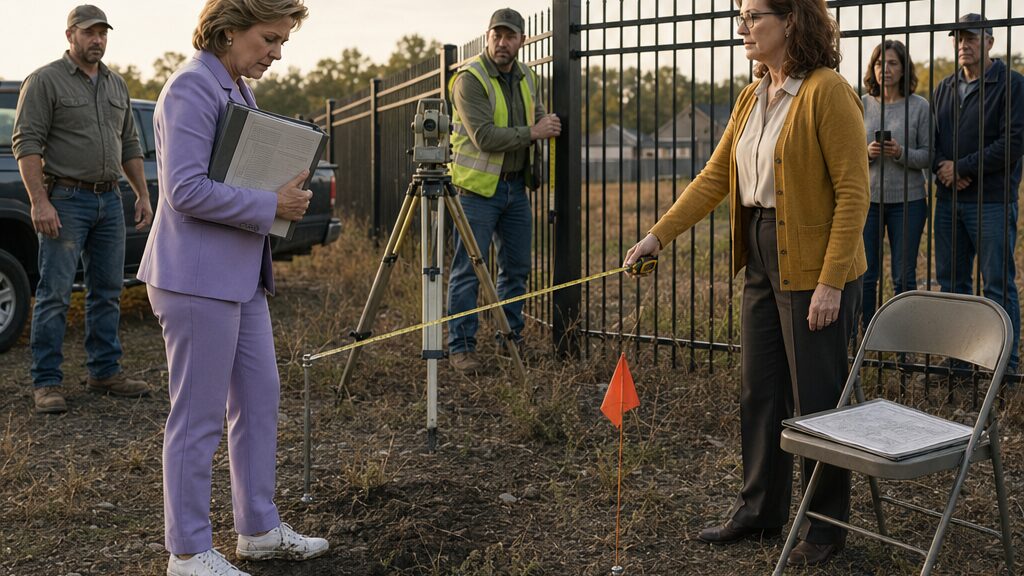
The orange survey flag appeared beside the HOA fence at eight on Monday morning.
By eight-ten, Margaret Campbell was standing over it.
Susan watched from the vacant parcel as Margaret bent, read the surveyor’s mark, and looked toward the contractor’s truck parked on the gravel shoulder.
“What is this?” Margaret called.
The surveyor kept his attention on the transit.
Susan walked through the weeds carrying a folded metal chair under one arm and a certified copy of the plat beneath the other.
“It’s a boundary marker.”
“I can see that.”
Margaret wore white sneakers unsuited to the wet ground. Grass seeds clung to the cuffs of her lavender slacks.
“Who authorized work here?”
“The owner.”
“This land is adjacent to association property.”
“Yes.”
“That means any improvement affecting the community requires board review.”
“No.”
Margaret turned toward the contractor. “You need to stop until this is resolved.”
The contractor glanced at Susan.
Susan set the folding chair beside the orange flag and opened it. Its legs sank slightly into the soft earth. She laid the plat across the seat, weighted one corner with her phone, and took a steel measuring tape from her bag.
“Would you hold this?” she asked the surveyor.
He caught the hook at the fence post.
Susan pulled the tape toward the survey pin.
Margaret folded her arms. “This performance is unnecessary.”
Susan stopped at thirty-six inches.
“The subdivision boundary ends here.”
She tapped the line on the plat.
“The fence ends there. The parcel begins three feet beyond it. Parcel eighteen-four-four-seven-B.”
“You’re using an old map.”
“This is the recorded plat. The county certified it Friday.”
Margaret looked from the paper to the flag.
“The fence has always defined the community.”
“The fence is not the legal boundary.”
“You’re exploiting a technicality.”
“No. I’m reading a survey.”
The contractor coughed into one hand to hide something that might have been a laugh.
Margaret’s face hardened. “What exactly are you planning?”
“A site evaluation.”
“For what?”
Susan folded the tape measure and put it away.
“That isn’t part of today’s inspection.”
Margaret stepped around the chair and onto the parcel.
“The board has a responsibility to protect residents from incompatible development.”
Susan looked down at Margaret’s white sneakers, now planted on Frank Rivera’s land.
“You are on an active worksite.”
“I am the association president.”
“On the other side of the fence.”
For the first time, Margaret’s certainty flickered.
Susan kept her voice level. “The county planning file confirms general commercial zoning dating to 1987. The owner authorized this survey. The inspection request is logged. If you have a question, you can submit it through the county.”
Margaret glanced at the surveyor. “Is that accurate?”
The surveyor adjusted the tripod. “My scope is the boundary. The boundary is where she said it is.”
Margaret looked toward the subdivision. Two residents had stopped near the sidewalk. One held a phone, though Susan could not tell whether it was recording.
“The board will call an emergency meeting,” Margaret said.
“You may.”
“We will challenge any access, lighting, parking, signage, noise, drainage, or commercial use that affects our residents.”
“Those are legitimate subjects for public review.”
Margaret seemed unprepared for agreement.
“But they do not give the HOA ownership of this parcel,” Susan added.
The words landed cleanly.
Margaret stepped back over the pin. Mud marked one white sole.
Susan should have felt satisfied when Margaret turned away. She did feel it—briefly, brightly, with a force that embarrassed her.
The chair stood between them with the certified plat spread across its seat. The same kind of chair Margaret had listed as evidence now held proof of the limit of her authority.
Susan watched Margaret walk back toward the gate.
The pleasure lasted too long.
At the county planning office later that morning, a clerk pulled the archived zoning folder and confirmed what the map showed.
“General commercial, nonconforming frontage allowances preserved under the original tract,” the clerk said. “You’d still need access review, stormwater approval, building permits, probably a traffic note depending on square footage.”
“What about a small bookstore with coffee service?”
The clerk raised an eyebrow. “That specific?”
“Hypothetically.”
“Retail and food service are permitted. Outdoor seating would need to stay inside the site plan. Hours could be conditioned if neighbors object.”
Susan wrote everything down.
“And HOA approval?”
“Not for this parcel.”
The answer should have closed the question. Instead, it opened several more.
At home, she spread her notes across the kitchen table. A bookstore was not merely a clever use. It was rent, insurance, construction, inventory, staffing, health permits, parking, accessibility, and enough cash to survive the first year.
She knew that.
She also knew the parcel sat where every resident entering the subdivision would see it.
That knowledge had begun to feel like motive.
The phone rang at four.
“Frank Rivera,” the man said. “You left two messages about my half-acre.”
“Yes.”
“You the retired broker who worked the East County corridor?”
Susan’s hand tightened around the receiver.
“A long time ago.”
“I remember your name.”
She waited for the rest. It did not come.
Frank continued, “I’ve had that parcel listed off and on for six years. Too small for most chains. Too close to houses for anything noisy. What do you want with it?”
“A ground lease.”
“For what use?”
“A neighborhood bookstore and coffee room.”
Frank was silent.
Then he said, “That sounds expensive for an argument with an HOA.”
Susan looked toward the living room, where the folding chairs were still stacked against the wall.
“It isn’t only an argument.”
“That answer usually means it is partly an argument.”
She did not deny it.
Frank asked for a meeting.
His office occupied the rear of a low industrial building near the highway. He listened without interrupting while Susan described the zoning, proposed footprint, parking limitations, and possible patio. When she finished, he slid a blank legal pad toward himself.
“You’ve done your homework.”
“I used to do this for a living.”
“I know.”
Again, there was something in his tone she did not ask about.
Frank wrote a figure on the pad and turned it around.
The annual rent was lower than she expected but still high enough to make the project dangerous.
“Ten-year term,” he said. “Option period first. Forty-eight hours. You pay for due diligence. If you proceed, rent begins when permits issue or after six months, whichever comes first.”
Susan stared at the number.
“You already had terms prepared.”
“I’ve had six years to prepare terms.”
“And if the HOA sues?”
“You defend your use. I defend title. We each pay our own costs.”
Reasonable. Clean. Unforgiving.
Frank leaned back.
“I’m not interested in leasing land for a stunt. If you want to embarrass your board president, find a cheaper hobby.”
Susan thought of Margaret standing in the weeds, one muddy sneaker beyond the line. She thought of the neighbors watching from the sidewalk. She thought of how good it had felt to tell Margaret to step off the worksite.
Then she imagined shelves, coffee, and eight folding chairs arranged where no notice could reach them.
Frank placed a two-page option agreement on the desk.
“If you want the parcel,” he said, “this expires Wednesday at four.”
Susan took the papers home without calling Lisa.
The deadline had already begun.
Chapter 4: The Lease Susan Signed Without Asking Anyone
Frank Rivera placed the option agreement between them and set his phone beside it, screen awake.
“Forty-seven minutes,” he said.
Susan looked at the signature line.
Frank’s office smelled faintly of machine oil from the warehouse beyond the wall. A delivery truck backed somewhere outside, its warning beeps counting down the silence between them.
“You said Wednesday at four.”
“It is Wednesday at three-thirteen.”
“I can read a clock.”
“I know. I’m reminding you this is an option, not a conversation.”
Susan turned to the page listing the annual rent, due-diligence costs, access conditions, and six-month permit deadline. None of it was unreasonable. That made the decision harder.
She had spent the previous night building a preliminary operating model. Twelve hundred square feet. Used and new books. Coffee, tea, simple pastries from a licensed supplier. Six indoor tables. A small patio. Limited evening hours.
The numbers were thin but possible.
What she had not done was call Lisa.
Frank watched her scan the pages again.
“You have financing?”
“Enough for due diligence and the initial design.”
“That wasn’t my question.”
“I have a lender willing to review the project after entitlement.”
“Meaning no.”
“Meaning conditional.”
Frank leaned back. “And community support?”
Susan capped her pen.
“The parcel is commercially zoned.”
“That also wasn’t my question.”
She disliked him for asking the right ones.
“I’m not applying for a popularity contest.”
“No. You’re putting a public-facing business beside people’s backyards.”
“On land that has allowed commercial use for nearly forty years.”
Frank tapped the agreement. “Lawful and welcome are different words.”
Susan heard another man say something similar years earlier in a county hearing room. She had dismissed him then because the traffic study was complete, the zoning was correct, and the developer had satisfied every written condition.
Six months later, delivery trucks had begun idling behind twelve houses at five in the morning.
She picked up the pen.
“This will not be that kind of project.”
“You sound sure.”
“I know how to condition a lease.”
Frank’s expression did not change. “Then do it.”
Susan signed at three twenty-one.
The relief arrived first. Then the weight of what she had done settled into her hand as Frank countersigned.
“You now have forty-five days for due diligence,” he said. “If you exercise the ground lease, you’re committed.”
Susan slipped the papers into her folder.
As she stood, Frank said, “Tell your neighbors before the sign goes up.”
She did not answer.
The first planning meeting took place at Susan’s kitchen table six days later. The general contractor spread a preliminary site plan over the same surface where the book club had once balanced mugs and the two-dollar paperback.
Susan had drawn the concept herself.
A narrow building near the road. Parking along the commercial side. Delivery access away from the subdivision. A six-foot landscape buffer. Outdoor seating inside the parcel line.
The contractor traced the patio with one finger.
“Eight tables?”
“Six.”
“You drew eight.”
Susan looked down. She had.
Each table held two small chair symbols.
Sixteen seats facing the HOA fence.
“Make it six tables,” she said.
The contractor marked the change.
“Lighting?”
“Low fixtures. Shielded toward the road.”
“Hours?”
“Seven to nine.”
“Seven in the morning?”
“Yes.”
He glanced toward the houses beyond Susan’s back window.
“That’s going to be a fight.”
“It’s a coffee shop.”
“It’s a quiet street.”
Susan stiffened. “The parcel is commercial.”
The contractor raised both hands. “I’m not arguing zoning. I’m telling you what the hearing comments will be.”
She crossed out the opening time and wrote eight.
When Lisa arrived that evening, the plans were still on the table.
Susan had intended to explain everything in order: the parcel, the zoning, the lease option, the bookstore, the safeguards. Instead, Lisa saw the title block before Susan could turn the paper over.
CHAPTER ONE BOOKS AND COFFEE — PRELIMINARY SITE PLAN.
Lisa stopped beside the table.
“What is this?”
“A proposal.”
“For the lot?”
“Yes.”
“You already have drawings.”
“Only preliminary.”
Lisa looked at the date in the corner.
“This was started last week.”
Susan closed the folder containing the signed option agreement.
Lisa noticed.
“What did you sign?”
“An option.”
“You leased it?”
“Not yet. I secured the right to.”
“And when were you planning to tell us?”
“I’m telling you now.”
“Because I walked in and saw it.”
Susan stood. “I had forty-eight hours.”
“You had my phone number.”
“The parcel would have been gone.”
“To whom? There hasn’t been anything there for years.”
“That doesn’t mean Frank would hold it.”
Lisa stepped back from the table as if the plan had widened between them.
“So this is real.”
“It can be.”
“A bookstore?”
“With coffee. A small meeting room. Community programming.”
“And sixteen patio chairs facing Margaret’s fence?”
“Those are being reduced.”
Lisa stared at her.
The silence made Susan hear how the sentence sounded.
“They fined us for sitting together,” Susan said. “This puts the same thing where they cannot touch it.”
“Is that why you’re doing it?”
“No.”
The answer came too quickly.
Lisa looked toward the stacked chairs against the living-room wall.
“Then why didn’t you ask whether we wanted to be part of it?”
Susan’s face warmed. “I didn’t need permission to protect an opportunity.”
“You didn’t need permission. You needed trust.”
“I’m the one carrying the fines.”
“They warned all of us.”
“And all of you stopped coming.”
Lisa flinched.
Susan regretted the words at once, but pride kept her from taking them back.
“I stopped because I have a life that can’t absorb Margaret’s obsession,” Lisa said. “You decided that meant we were cowards.”
“I didn’t say that.”
“You didn’t have to.”
Lisa picked up the paperback from the sideboard, then put it down again.
“I wanted the book club back. I didn’t ask for a business built to make Margaret look at it every morning.”
“It’s more than that.”
“Then make it more than that before you ask me to defend it.”
She left without taking the book.
Within two weeks, the preliminary plan became public.
Three written comments reached the county. One raised traffic concerns. Another objected to patio noise. A third warned that commercial lighting would reduce privacy along the rear homes.
None were signed by Margaret, though Susan recognized phrases from HOA notices.
At a neighborhood information meeting, residents asked practical questions Susan had prepared to answer.
Where would customers park?
Would delivery trucks use the subdivision entrance?
Could the building become a bar if the bookstore failed?
Would outdoor events continue after dark?
Susan explained the separate road access, lease restrictions, limited food service, downward-shielded lighting, and proposed hours. Several people listened. Others folded their arms.
One neighbor pointed to the site plan.
“Why are there no chairs on the patio now?”
Susan looked at the revised drawing. After the first objections, she had removed the outdoor seating entirely.
“I’m reconsidering the layout.”
Margaret sat in the back row without speaking.
That was worse than interruption. Her stillness suggested Susan was proving every warning correct without assistance.
After the meeting, Lisa approached the empty table where Susan was gathering plans.
“A bookstore could be good,” she said.
Susan waited.
“But you keep changing the parts that make it a community place while defending the parts that make it a business.”
“I am responding to concerns.”
“You’re trying to get approval.”
“There is nothing wrong with that.”
“No. But I don’t know what you actually want anymore.”
The following morning, Susan received an email from the lender.
The project review had been suspended pending documentation of local support, final operating restrictions, and evidence that anticipated opposition would not materially delay permitting.
Susan read it twice.
The lease option had not disappeared. The zoning had not changed. The survey pin remained where it had always been.
But the money had stopped.
She printed the email and laid it across the signed agreement.
For the first time since finding the parcel, Susan could not solve the problem by reading the rule more carefully.
Chapter 5: The Cost Hidden Inside Margaret’s Enforcement
Stephen Jones found the legal invoice while reconciling the reserve account.
He called Susan at seven-thirty on a Thursday morning.
“Did you hire the association attorney?”
Susan held the phone away from her ear and looked at it.
“Why would I hire the HOA attorney?”
“There’s a four-thousand-eight-hundred-dollar payment marked land-use consultation.”
“That sounds like a question for Margaret.”
“I asked her.”
“And?”
“She said it was authorized.”
“Was it?”
Stephen was silent long enough to answer.
Susan set down her coffee.
“What exactly did the attorney review?”
“I don’t know yet.”
“Then why are you calling me?”
“Because your parcel number appears in the billing description.”
The next board meeting drew more residents than chairs.
Susan arrived early and took a seat near the front. One chair at the board table remained empty. Margaret’s nameplate stood before it, but she did not enter until two minutes after the scheduled start.
She carried the association binder and a separate legal folder.
Stephen sat at the opposite end, papers squared before him.
Margaret called the meeting to order.
“We have one urgent matter,” she said. “The commercial development proposed beside the eastern boundary presents foreseeable risks to property values, traffic, drainage, and residential character.”
Susan kept her hands in her lap.
Margaret continued. “Counsel has advised that the association may need to pursue injunctive relief.”
A murmur moved through the room.
Stephen leaned toward his microphone.
“Before we discuss further action, we need to address the invoice already paid.”
Margaret did not look at him. “Legal consultations are within the president’s enforcement authority.”
“Not at that amount.”
“The circumstances were time-sensitive.”
“There was no recorded vote.”
“The executive committee was informed.”
“I am the treasurer. I was not informed before payment.”
Margaret’s face changed only slightly, but Susan saw the strain around her mouth.
Stephen lifted a page.
“The bylaws require board authorization for unbudgeted legal expenses above fifteen hundred dollars. This invoice was four thousand eight hundred.”
“The board can ratify it tonight.”
“That is not the same as prior approval.”
Margaret turned toward the audience.
“This is procedural noise while a commercial operation is being pushed against residents’ homes.”
Susan raised her hand.
Margaret ignored it.
Stephen said, “She has the floor if we are discussing her parcel.”
Margaret looked at Susan. “Briefly.”
Susan stood.
“The county has not approved a final site plan. No construction permit has been issued. There is no operation to enjoin.”
“Because the association intervened early.”
“Your attorney’s own invoice describes research into whether the HOA has jurisdiction over parcel eighteen-four-four-seven-B.”
Several residents looked toward Margaret.
Susan continued. “What conclusion did counsel provide?”
“That communication is privileged.”
“Then the board should review it before spending more money.”
Margaret’s fingers tightened on the binder.
“The absence of direct covenant jurisdiction does not eliminate secondary harm.”
It was the closest Margaret had come to admitting the parcel lay outside her authority.
Susan sat down.
Stephen opened another folder. “There is also an enforcement issue. The commercial-use fines against Susan were imposed without a board vote, and the records do not show consistent prior application of Section Forty-One.”
Margaret turned to him sharply.
“You approved the assessment entries.”
“I recorded them after they were issued.”
“You did not object.”
“No,” Stephen said. “I should have.”
The room became quiet.
Susan had expected him to retreat into procedure. Instead, he looked directly at the residents.
“I believed silence kept the board stable. It did not.”
Margaret closed the legal folder.
“You are all treating this as if I invented the risk.”
Her voice had lost its polished distance.
“At my previous home, a commercial tract was approved behind our street. We were told it would be small. We were told deliveries would be limited. We were told lighting would be shielded.”
Susan felt the room lean toward her.
Margaret went on. “Within two years, the original tenant failed. The next use opened before dawn. Trucks idled behind the houses. Three families sold at losses because no one stopped the first approval when there was still time.”
No one interrupted her.
“I moved here because the documents promised residential stability,” Margaret said. “When residents elected me, they expected enforcement before exceptions became permanent.”
For the first time, Susan saw fear beneath Margaret’s rigidity—not fear of chairs or coffee, but of being the person who had failed to prevent something she had already survived once.
It did not excuse the notices.
It made them legible.
Susan rose again.
Margaret looked exhausted rather than angry.
“My project is not the development you lived beside,” Susan said.
“That is what every applicant says.”
Susan almost answered with setbacks, lease clauses, restricted hours, and use limitations. The arguments were ready.
Then Lisa’s words returned: I don’t know what you actually want anymore.
Susan looked at the residents behind her. Some had attended the original book club. Some had signed objections. Several had simply come because association money was disappearing into a fight no one understood.
“I found the parcel because Margaret fined my chairs,” Susan said.
A few people shifted.
“I told myself the bookstore was a constructive answer. Part of that is true.”
Margaret watched her.
“But I also wanted her to see it every day.”
The admission felt worse than any accusation.
Susan continued before pride could close her mouth.
“I wanted a lawful thing placed exactly where she could not control it. That influenced the first plan. It influenced the patio. It influenced how quickly I signed the option without speaking to the people who would live beside it.”
Lisa sat along the wall. Her expression did not soften, but she did not look away.
“The project can still be useful,” Susan said. “But legal permission is not enough. I know that better than I have acted.”
Margaret’s face remained still.
Stephen cleared his throat. “We still need to address the expenses.”
The board voted to obtain the attorney’s written opinion, suspend further legal spending, and review the fines at the next meeting. Margaret voted against all three motions.
Afterward, residents gathered in small groups near the doors.
Susan packed her documents slowly. Lisa approached when the room had nearly emptied.
“That was honest,” she said.
“It was late.”
“Yes.”
Susan slid the legal invoice into her folder.
“The lender wants proof of support.”
“I heard.”
“I could reduce the hours again. Remove the patio. Limit events.”
“That’s not enough.”
Susan looked at her.
Lisa rested one hand on the back of the empty chair at the board table.
“If you want us to support it, the limits cannot be promises you can change after opening.”
“You want deed restrictions?”
“Lease conditions. Operating covenants. Whatever makes them real.”
“That could make the project unfinanceable.”
“It might.”
“And if it does?”
“Then maybe the version you can afford isn’t the version we should defend.”
Susan glanced toward Margaret, who stood alone at the far end of the room placing papers into her binder.
Lisa lowered her voice.
“I will help you organize support. But only if the hours, lighting, deliveries, patio use, and future tenants are restricted in writing.”
Susan held the folder against her chest.
The choice was no longer between building and surrendering.
It was between controlling the project herself and creating something the neighborhood could trust without trusting her.
Chapter 6: The Bookshop Could Not Open for Revenge
The revised budget ended with a number so small Susan thought the spreadsheet had dropped a formula.
She checked the cells.
The community version of Chapter One Books and Coffee would clear less in its first year than she had once earned from a single commercial lease commission.
Frank sat across from her at the design workshop, reading the proposed restrictions.
“No deliveries before eight,” he said. “No alcohol. No amplified outdoor sound. Patio closes at seven. Retail limited to books, stationery, coffee, tea, and prepared food from approved vendors.”
“Correct.”
“Future tenant assignment requires the same use restrictions.”
“Yes.”
“And no drive-through.”
“There was never going to be a drive-through.”
“I want it written because someday you may not be the tenant.”
Susan looked at the revised lease rider.
That was the point of Lisa’s demand. The rules had to survive Susan’s good intentions.
Frank tapped the page.
“You know this lowers the land’s future value.”
“It narrows the uses.”
“It lowers the value.”
“Yes.”
“And you want me to accept the same base rent.”
“I want you to accept annual increases tied to actual revenue after year three.”
Frank gave a humorless laugh. “You still negotiate like a broker.”
“I am trying to keep the doors open.”
“You’re trying to make the neighbors your silent partners without giving them equity.”
Susan folded her arms. “They bear some of the external cost.”
“And I bear the internal cost.”
For two hours they worked through terms. Frank rejected the first extension proposal and marked up the second. By noon, he agreed to hold the parcel another thirty days if Susan secured county approval and final financing.
“One more condition,” he said.
“What?”
“The operating restrictions become part of the ground lease, not a side letter.”
Susan hesitated.
A side letter could be amended quietly. A recorded lease memorandum with use restrictions would bind future operators.
Frank noticed the pause.
“You asked me to believe this is not a stunt.”
“It isn’t.”
“Then make it expensive to become one later.”
Susan signed the revised term sheet.
The neighbors met the following Saturday inside the unfinished shell. The walls were framed but open, and every voice carried through the rafters.
Lisa brought folding chairs from Susan’s house. The same dull metal seats that had once been stacked like contraband now stood in different arrangements across the concrete floor.
They tested four chairs near the proposed meeting-room wall, then eight in a semicircle. A resident using a cane asked for wider spacing. Another stood near the rear property line while people spoke at normal volume on the patio.
“Turn the chairs toward the road,” someone suggested.
“Then customers face the parking lot,” Susan said.
“They also stop facing our bedroom windows.”
Susan moved them.
The adjustment cost nothing and changed the atmosphere immediately.
The general contractor marked the final patio line in chalk. Every chair remained several feet inside the commercial boundary.
Lisa watched Susan measure the clearance.
“You don’t have to prove the three feet anymore.”
“I’m checking accessibility.”
“I know.”
The words carried neither accusation nor full forgiveness.
At the county hearing, Margaret filed one final objection. She did not claim the HOA owned the parcel. Instead, she argued that the bookstore’s meeting room constituted an assembly use requiring additional parking.
The planning clerk reviewed the occupancy calculation.
“The proposed room is accessory to retail,” the clerk said. “Maximum posted occupancy remains within the approved parking ratio.”
Margaret opened her binder. “And if events attract more people than available spaces?”
“Then the operator is responsible for compliance, as with any permitted business.”
Susan stood when invited to respond.
“We have added a reservation cap, prohibited simultaneous indoor and outdoor events, and included two off-site employee spaces under a written agreement.”
Margaret looked at her.
Susan did not smile.
The objection was denied.
Outside the hearing room, a representative from a regional coffee company approached Susan with a proposal. The company would finance most of the interior build-out in exchange for taking the beverage operation and extending hours to eleven on weekends.
The offer would solve the lender problem.
It would also add branded signage, evening traffic, delivery windows beginning at six-thirty, and the right to seek expanded food service after two years.
Susan carried the proposal to her car.
She sat behind the wheel reading the number at the bottom of the page.
It was enough to turn the project from fragile to safe.
Her phone rang.
The lender wanted an answer by morning.
At home, Susan placed the coffee company’s offer beside the restricted lease rider. One document gave her money. The other gave everyone else a reason to believe her.
She thought of the old project that had ended her career. The developer had complied with every condition Susan negotiated. The harm came later, after assignments, amendments, and uses no one had thought to restrict because the first tenant seemed harmless.
Technical correctness had protected the deal.
It had not protected the street.
Susan called the representative.
“I’m declining.”
There was a pause. “May I ask why?”
“The operating terms do not fit the site.”
“We can adjust the branding.”
“It isn’t the branding.”
“You understand this removes the build-out contribution.”
“Yes.”
“You may not finance the project without it.”
“I understand.”
When the call ended, Susan sat in the quiet kitchen until someone knocked.
Lisa stood outside holding the two-dollar paperback.
“I thought you might want this back.”
Susan took it carefully. The cover had begun to separate at the spine.
“For the opening display,” Lisa said.
“We don’t have an opening date.”
“You will.”
Susan looked down at the faded yard-sale sticker.
“I turned down the coffee partnership.”
Lisa’s eyes narrowed. “The one with late hours?”
“Yes.”
“That was a lot of money.”
“Yes.”
Lisa stepped inside.
They set the book on the kitchen table where the first site plan had once shown sixteen chairs facing Margaret’s fence.
By the end of the month, the lender approved a smaller loan based on the revised lease, community support letters, and Susan’s increased personal contribution. Frank executed the ground lease. Construction resumed.
At the site, the contractor installed the patio posts inside the chalked boundary. Susan unfolded six chairs and arranged them in two quiet clusters, leaving wide paths between them.
From across the fence, Margaret watched for less than a minute before walking away.
Two days later, Stephen delivered a formal notice to Susan’s door.
The board would vote Friday on three matters: cancellation of the commercial-use fines, adoption of new enforcement-review procedures, and recovery of legal expenses incurred without authorization.
Susan read the agenda twice.
Opening day was Saturday.
For months, she had imagined justice arriving as a clean line on a map.
Instead, it would arrive through a vote she could not control, one day before she unlocked the bookshop built from the conflict.
Chapter 7: One Empty Chair at the Edge of Chapter One
The board’s decision arrived at eight-fourteen on Saturday morning, forty-six minutes before Susan was supposed to unlock the bookshop.
The email subject read FINAL DETERMINATION.
She stood behind the new counter with one hand on the unopened message. Around her, Chapter One Books and Coffee smelled of fresh paint, roasted beans, and cardboard from boxes not yet broken down. Lisa was arranging cups near the sink. The barista applicant was testing the register. Outside, six folding chairs waited on the patio inside the painted boundary line.
Susan opened the email.
The board had voted four to one to cancel every commercial-use and exterior-furniture fine assessed against her. All late fees would be removed. Any payment already made would be credited back to her account.
The board had also adopted a new enforcement procedure requiring written legal authority, documented board approval, and an opportunity for informal resolution before fines could begin.
The final paragraph concerned the legal invoice.
Because Margaret had authorized the consultation without the required vote, the association would seek repayment of the portion determined to be personal rather than properly incurred for association business. Margaret had thirty days to reimburse the amount or enter a payment agreement.
There was no apology.
Susan read the message again.
Lisa watched from the other end of the counter. “Good?”
“The fines are gone.”
Lisa set down a stack of lids. “All of them?”
“All of them.”
“And the legal fees?”
“They’re making Margaret repay the unauthorized portion.”
Lisa exhaled slowly. “Then you won.”
Susan looked through the front windows at the HOA fence beyond the narrow landscaped strip.
The word did not feel wrong. It simply felt smaller than it once had.
At eight-thirty, Frank arrived carrying a paper bag of pastries from a bakery across town.
“I’m not donating these every week,” he said.
“I wouldn’t accept them every week.”
“You accepted the rent reduction.”
“That was negotiated.”
“So are the pastries.”
He set the bag beside the coffee machine and looked around the shop. The room held low wooden shelves, a long community table, and a small meeting space separated by movable bookcases. The two-dollar paperback stood on a display near the register beneath a handwritten card: THE BOOK THAT STARTED THE FIRST MEETING.
Frank nodded toward it.
“You left out the fines.”
“They aren’t the reason to read it.”
At nine, Susan turned the sign from CLOSED to OPEN.
There was no ribbon. No podium. No speech.
Lisa opened the door, and the first customers were the two neighbors who had once sat in Susan’s living room. One carried a reusable mug. The other brought a folding chair of her own, then laughed when she saw the patio.
“I guess you have enough now.”
“More than enough,” Susan said.
By ten, every indoor table was occupied. A parent read to a child near the front window. Two residents who had submitted objections sat together over coffee, comparing the actual lighting fixtures with the drawings Susan had shown at the hearing.
“They’re lower than I expected,” one admitted.
“That was the point,” Susan said.
On the patio, Lisa arranged the original book club into a loose semicircle. The chairs no longer faced the HOA fence. They angled toward one another, with the road and subdivision reduced to background.
Susan joined them carrying the battered paperback.
“We never finished discussing the last chapter,” Lisa said.
“We were interrupted.”
“Repeatedly.”
A few people smiled.
Susan sat, but the chair beside her remained empty.
The gathering lasted forty minutes. No one bought admission. No one signed a membership form. Coffee was optional. When a customer asked whether the discussion was a store event, Susan answered, “It is a book club meeting in a bookstore.”
The simplicity of the sentence pleased her.
In the afternoon, the flow slowed. Frank left. The contractor stopped by to check a cabinet hinge and refused payment for the adjustment. Residents drifted home carrying paper bags with books inside.
Susan moved between the shelves straightening titles that did not need straightening.
At five-thirty, Lisa touched her arm.
“Outside.”
Margaret stood at the edge of the parking lot.
She wore a plain navy sweater instead of her lavender jacket. There was no binder beneath her arm.
Susan stepped through the door.
Margaret remained several feet from the patio.
“I received the board’s letter,” Susan said.
“I assumed you would.”
“The procedures were overdue.”
Margaret looked at the shop windows, the low lights, and the few customers still inside.
“The board believes so.”
“And you?”
“I voted against the repayment provision.”
“I know.”
Margaret’s jaw tightened. “The attorney was consulted because the association faced a real concern.”
“Without authorization.”
“Yes.”
The word came reluctantly, but it came.
Susan waited.
Margaret looked toward the fence. “The boundary was never ours.”
It was not an apology. It did not mention the book club, the warnings sent to neighbors, the individual chair fines, or the months of pressure.
Still, it was the first time Margaret had spoken the truth without wrapping it in a qualification.
“No,” Susan said. “It wasn’t.”
Margaret glanced toward the patio chairs.
“I expected more noise.”
“There may be some during scheduled events.”
“The hours are restricted.”
“They are.”
“And the lease prevents another type of tenant.”
“It does.”
Margaret looked at her. “You gave up a considerable amount of flexibility.”
“Yes.”
“Why?”
Susan could have said because Lisa demanded it, because the lender required support, because Frank would not extend the lease otherwise, or because she remembered what technically correct development could do to people who had no control over it.
Instead, she said, “Because I wanted the rules to protect people after I was gone.”
Margaret looked away.
For months, Susan had imagined this moment with sharper edges. She had pictured Margaret admitting she was wrong in front of the residents, perhaps standing beside the survey pin while Susan recited every cost the conflict had caused.
Now the parking lot was nearly empty. No one was recording. Lisa had gone back inside.
Susan found that she did not need an audience.
At the far end of the patio, one folding chair stood alone near the painted edge of the site plan. Susan had placed it there that morning without deciding whom it was for.
She walked over and rested one hand on its metal back.
“You may sit if you’d like.”
Margaret’s expression closed.
“This is not reconciliation.”
“I didn’t say it was.”
“You still believe I acted out of control.”
“I believe you were afraid and used authority you did not have.”
Margaret absorbed the sentence without answering.
Susan released the chair.
“The coffee is still hot.”
She went inside.
Through the window, she watched Margaret remain beside the patio for nearly a minute. Then Margaret stepped across the painted line—not the property line, only the edge of the seating area—and lowered herself into the empty chair.
She did not stay long.
When she rose, she pushed the chair neatly beneath the small table before walking back toward the subdivision.
Susan turned away from the window.
Lisa was placing the two-dollar paperback into the hands of a new reader.
At the community table, three neighbors had opened another book and were waiting for Susan to join them.
She crossed the room, pulled out a chair, and sat down.
The story has ended.