The HOA President Measured Robert’s Trash Can Twenty Centimeters Wrong And Exposed His Own Corruption
Chapter 1: The Twenty Centimeter Violation At Dawn
Robert Martinez opened his garage door and found George Campbell crouched at the curb with a measuring tape stretched from the wheel of Robert’s trash can to a faded white mark on the asphalt.
The tape clicked tight.
George looked up as if he had caught Robert sneaking out of his own house.
“Twenty centimeters,” he said.
Robert stood with one hand still on the garage remote. Behind him, the newly paved driveway glowed in the pale morning light, each natural stone set by hand, each seam brushed clean the night before. He had stayed out after dark rinsing the dust from it, watching the water run between the stones like thin black thread.
Now George’s polished shoes were planted at the edge of it.
“Morning, George,” Robert said.
George did not answer the greeting. He tapped the measuring tape with one finger, then wrote in the small black penalty citation book he always carried under his arm. The cover was cracked at the spine from use, but George handled it with ceremony, like a judge opening a case file.
“Trash receptacle placed twenty centimeters beyond approved curb position,” George said, speaking each word as he wrote it. “Visible from street during restricted morning window. Noncompliance after neighborhood standardization notice.”
Robert glanced at the trash can. It was upright, closed, clean, and maybe the width of a hand farther from the curb than usual. Collection had already passed. The truck’s tire marks were still visible in the damp strip near the gutter.
“You watched them empty it,” Robert said.
“I observed the violation before pickup.”
“You were out here measuring my trash can before sunrise?”
George smiled without warmth. He was in a navy blazer though the air still held the coolness of morning. His hair was trimmed close at the sides, his collar sharp, his HOA badge clipped to his breast pocket. The badge had no legal weight, but George wore it like a shield.
“Rules don’t sleep because residents do.”
Robert exhaled through his nose. He had promised himself he would not start the day with an argument. He had coffee waiting in the kitchen, a loose hinge on the side gate to tighten, and three leftover stones to stack beside the garage. His knees ached from kneeling on gravel for two weeks. His hands still carried pale cuts from fitting the last row of stone near the drain.
“Move it back, then,” Robert said. “Write your warning if you need to. I’m not fighting over a trash can.”
George snapped the tape back into its case. The sound was sharp enough to make Robert’s jaw tighten.
“Unfortunately, warnings are for first-stage violations.”
Robert looked at him more carefully then.
George had not come alone. Not exactly. At the far end of the block, a white utility pickup idled near the corner with its hazard lights blinking. Its driver stayed inside, a shadow behind the windshield. In George’s citation book, Robert saw his own address already written in dark ink across the top line. Beneath it, the date was filled in. So was a box marked enforcement authorized.
Robert took one step down the driveway.
George angled the citation book away.
“You already wrote it,” Robert said.
“I prepared the form.”
“You prepared the penalty before measuring.”
George’s eyes flicked to the driveway, then back to Robert. “The measurement confirms the infraction.”
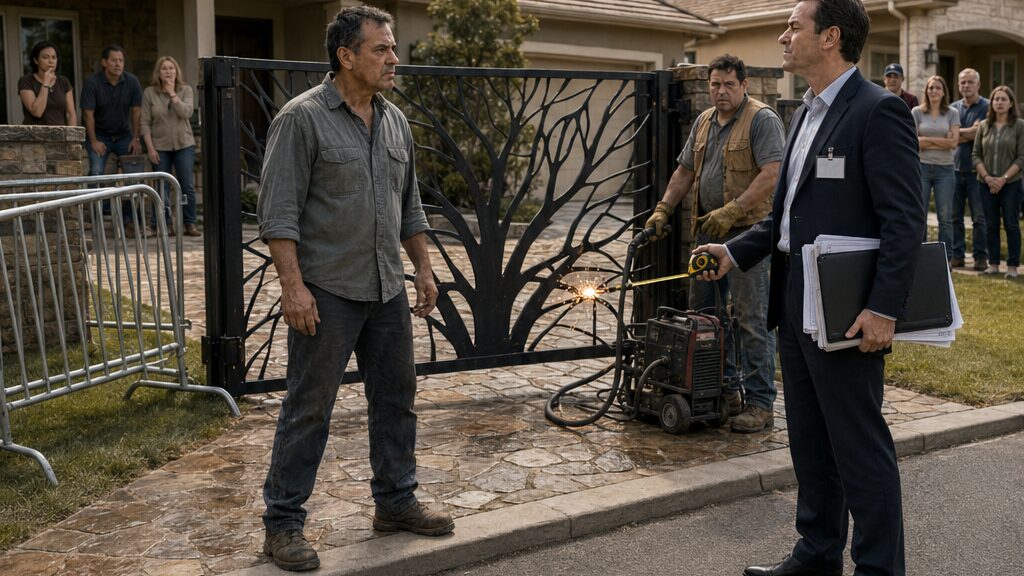
Robert’s driveway had become impossible not to look at. It did not match the smooth beige concrete pads approved in the HOA booklet. It was natural stone, gray and rust and dark blue, arranged in a pattern Robert had sketched on cardboard and revised a dozen times. The stones curved slightly toward the artistic metal gate he had built at the side entrance, black iron with a pattern of branching lines that looked almost like roots.
The driveway was not loud. It was not ugly. It was simply not from the approved catalog.
George had slowed his car in front of it three times during the installation. He had said nothing then. That silence now felt like a tape measure pulled tight.
Robert stepped to the edge of the curb and picked up the trash can by its handle. “There,” he said, dragging it back until it touched the old white mark. “Problem solved.”
George tore the citation from his book.
“Not solved. Corrected after documented violation.” He held out the paper between two fingers. “Three hundred dollars.”
Robert did not take it.
“For twenty centimeters?”
“For noncompliance.”
“I watched the trash truck put it down crooked last week. Nobody measured that.”
“The resident is responsible for final receptacle positioning.”
Robert looked down the street. Curtains shifted in the house across from him. Emma Lee’s front porch light was on, though the sun was already up. A shape moved behind her screen door, then stilled.
George noticed the direction of Robert’s gaze.
“The board has been patient with this property,” George said, louder now. “The stonework. The gate. The visible deviation from community standards. We’ve tried to be neighborly.”
Robert almost laughed, but the sound stopped in his chest. “Neighborly?”
“You were given every opportunity to submit proper materials.”
“I submitted the driveway repair notice.”
“You submitted a repair notice. You did not submit an approved surface modification request.”
“It was cracked concrete. I replaced it on my property.”
“With off-catalog stone.”
Robert’s hand tightened on the trash can handle. He let go before George could look at it.
There had been nothing peaceful about installing that stone, but the work itself had steadied him. After years of fixing other people’s things, he had wanted one part of his own home to show the care he kept giving away. Every stone had weight. Every line had intention. The gate had taken longer, welded in the garage with the door cracked open at night, sparks dying on the concrete while the neighborhood slept.
George stepped closer to the driveway but did not put his shoe on it.
“Your personal taste does not override association standards.”
“My taste isn’t blocking anyone.”
“Standards are not only about obstruction. They’re about uniformity. If one resident decides he is special, the whole street becomes a patchwork of exceptions.”
Robert held George’s stare. “This is about a trash can.”
George lifted the citation. “Today’s violation grants the association the right to proceed with corrective enforcement on related exterior noncompliance.”
“That’s not how that works.”
“It is when repeated refusal creates visible disorder.”
Robert reached for the paper, but George pulled it back just enough to make Robert’s hand close on air.
“Take the citation, Mr. Martinez.”
The form trembled slightly in the morning breeze. Robert saw the printed language at the bottom, dense and official-looking, with boxes checked in black ink. Lawn access authorized. Receptacle confiscation authorized. Temporary barricade permitted.
His irritation thinned into something colder.
“Confiscation?” Robert said.
George’s smile returned. “Your trash can was left twenty centimeters out of place. We have the right to confiscate it and barricade your lawn.”
Robert looked from the paper to the grass beside the driveway. “You’re not putting anything on my lawn.”
“It’s common enforcement procedure.”
“It’s my lawn.”
“It’s association-facing frontage.”
“It’s my lawn.”
The white utility pickup at the corner started rolling toward them.
George slid the citation under the clip on his penalty book and squared his shoulders. “I was hoping you’d cooperate. I really was. But cooperation means understanding that property rights in a planned community come with obligations.”
The pickup slowed in front of Robert’s house. Behind it came a flatbed truck Robert had not seen before. It turned wide around the corner and crawled toward them with a stack of metal barricades strapped to one side.
Under a gray tarp at the back of the flatbed was something large and wheeled.
Robert felt the garage remote hard against his palm. The door behind him hummed, forgotten, still open to the shelves where his tools hung in careful rows.
George tucked the measuring tape back into his blazer pocket and lifted his chin toward the truck.
“Let’s keep this orderly,” he said.
The flatbed stopped at Robert’s curb with a hydraulic sigh, and the covered machine on the back shifted under its tarp like something waiting to be unwrapped.
Chapter 2: Off-Catalog Stone And Old Fear
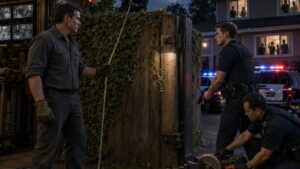
The first barricade hit Robert’s lawn with a metal crack that made him move before he decided to.
“Pick that up,” he said.
The worker who had dropped it looked toward George instead of Robert.
George raised one hand, calm and flat-palmed. “Proceed.”
Two more barricades came off the flatbed. They were the kind used around construction trenches, dull silver, jointed at the corners, heavy enough to leave dents in the grass. One was set directly over the line where Robert had spent Saturday edging the lawn by hand.
Robert stepped in front of the next one.
“No,” he said.
George sighed, as though Robert had disappointed him by failing a simple test. He opened his penalty book again and clicked his pen. “Resident interfering with corrective action.”
“Corrective action for what? A trash can?”
“For a pattern.” George pointed the pen toward the driveway. “This. That gate. The nonstandard frontage. The board has received concerns.”
“From who?”
George’s mouth tightened. “Residents are entitled to confidentiality.”
Robert looked across the street.
Emma Lee stood inside her doorway with one hand on the frame. She was in a pale housecoat, hair pinned back badly, phone held low at her side. Her eyes met Robert’s for a second, then slid away when George turned his head.
George smiled at her porch.
“Good morning, Emma.”
Her door closed halfway.
Robert felt something sink in him, not anger yet, not exactly. Recognition. George did not need everyone to support him. He only needed everyone to fear being next.
The flatbed driver began unstrapping the gray tarp.
Robert moved toward the side of the driveway, putting his body between the workers and the gate. The artistic metalwork caught the morning light in black curves and branching lines. He had built the gate from salvaged steel, hammering each branch by hand until it looked grown rather than assembled. The hinges were overbuilt because he liked things that lasted.
George walked after him, measuring tape now in hand again.
“Gate clearance,” George said, pulling the tape across the entrance without permission. “Eight centimeters beyond acceptable decorative projection.”
Robert stared at him. “Decorative projection?”
“Your branches extend outward.”
“They don’t cross the sidewalk.”
“They alter the approved visual plane.”
Robert almost missed the phrase because it sounded so absurd. Then George bent, placed one end of the tape along the driveway edge, and stretched it toward the gate post.
“Driveway border variance,” he said. “Non-catalog stone. Irregular coloration. Unapproved pattern.”
The worker nearest the flatbed paused with one strap in his hand. Even he seemed unsure whether those words belonged to a real problem.
George noticed and hardened his voice. “The association standard exists to keep homes marketable. People buy here because they know what the street will look like.”
Robert looked down at the stone. Gray. Rust. Blue-black. Each one fitted into the next with a patient care George would never understand. “People buy homes to live in them.”
“And then someone decides to turn his frontage into a personal art project.”
There it was. Not the trash can. Not the twenty centimeters. The driveway. The gate. The fact that Robert had made something with his hands and had not asked George’s permission for beauty.
Robert took one slow breath. “You’re standing at my property line. You can measure all morning from there. You cannot touch the gate.”
George snapped open a rolled sheet of paper one of the workers handed him. The paper had been folded hard, its corners already dirty. He smoothed it on the hood of the utility pickup and motioned Robert closer as though offering education.
Robert did not move.
George lifted it anyway. “Corrective frontage plan.”
The top of the sheet showed a rough outline of Robert’s driveway and front lawn. A red line marked the edge of the grass near the sidewalk. Another line cut close to the gate opening. Robert saw blocks drawn where the barricades now sat.
“Who drew that?” Robert asked.
“Approved contractor.”
“For a trash can?”
“For cumulative frontage correction.”
George spoke louder when the nearest curtains moved. “This is what happens when residents ignore courtesy notices. The association is not your enemy, Robert. We are protecting everyone’s investment.”
Emma’s door opened again, just a crack.
George looked straight at it. “Some residents understand that. Some pay their fines, correct their hedges, repaint their trim, move on with dignity.”
Emma flinched.
Robert saw it.
“What did you do to her hedge?” he asked quietly.
George’s face changed by only a fraction. The smile stayed, but the eyes flattened. “That matter was resolved.”
“By her paying you?”
“By her respecting process.”
Robert turned toward Emma’s house. The hedge along her walkway was cut low and blunt, still brown at the edges where too much had been taken. He remembered seeing the trucks there two months before. He had thought she was renovating.
He had not asked. He had been in his garage, welding the gate, keeping to himself.
The realization had weight. His silence had not been neutral. It had been convenient.
George stepped onto the first row of Robert’s driveway stones.
Robert’s gaze dropped to the polished shoe on the stone.
“Step off,” Robert said.
George looked pleased. “You see? Emotional attachment. That is exactly why standards cannot depend on individual taste.”
Robert moved closer until George had to look up at him. “Step off the stone.”
For a moment neither man moved.
Then George lifted his foot with theatrical care and set it back on the curb. “Documenting hostility.”
“You do that.”
The tarp came off the machine.
It was not a mower or a pressure washer or a cart for hauling barricades. It was a portable plasma cutter on a wheeled frame, hoses coiled around its side, torch handle clipped in front. Its casing was scratched, industrial, ugly against the clean street.
Robert stared at it.
George folded his blueprint with satisfaction. “Some portions of the gate hardware may need to be removed to meet frontage safety and clearance standards.”
“You brought a cutter to remove gate hardware over a trash can?”
“Over cumulative noncompliance.”
The crew foreman climbed down from the flatbed. He was broad-shouldered, wearing work gloves and a faded company vest. His expression was wary, not eager. George turned to him with relief, as if professionalism had arrived.
“William,” George said. “Set up near the side gate. We’ll begin with the protruding elements.”
William Johnson looked at Robert, then at the gate. “We were told barricades and possible trimming.”
“Corrective trimming,” George said.
“Metal cutting wasn’t on the first work scope.”
George’s voice cooled. “It is on today’s authorization.”
Robert caught that. First work scope.
George handed William a packet of papers and tapped one page with his measuring tape.
William read it, jaw shifting. “You want this done now?”
“I want the violation corrected before residents start thinking rules are optional.”
Emma’s door opened wider. A phone appeared at chest height, angled downward, not quite recording openly.
George turned his head.
The phone vanished.
Robert saw the whole neighborhood in that motion. Doors cracked, then closed. Curtains moved, then stilled. Everyone knew George. Everyone had measured something for him, paid something to him, trimmed something smaller than they wanted, swallowed something because it seemed easier.
William wheeled the plasma cutter down the flatbed ramp. The wheels clattered onto the street.
Robert stepped back to the gate, one palm resting on the cool black metal. He felt the tiny ridges of his welds beneath his fingers.
George opened the blueprints again, this time holding them high enough for the crew and the street to see.
“Begin at the gate clearance,” he said.
William connected the torch, lowered his face shield, and tested the flame against a scrap piece of metal on the truck bed.
The cutter screamed alive.
A white-blue spark burst outward, bright enough to flash against Robert’s stone driveway and dance across the black branches of the gate.
Chapter 3: The Order Written Before The Offense
Robert saw the number before he understood why it mattered.
It was printed in the top right corner of George’s authorization packet, just above the HOA seal and beneath a bold line that read EMERGENCY FRONTAGE CORRECTION. The number ended in 417. Robert remembered numbers the way he remembered tool sizes, hinge widths, cut lengths. The trash citation in George’s book had ended in 426.
A later number.
Robert looked from the packet to the cutter, which William was adjusting near the curb. Sparks still smoked on the scrap metal. George was speaking to a worker about barricade placement, his measuring tape hanging from one hand like a leash.
“George,” Robert said. “Let me see that order.”
George did not look over. “You’ve already seen enough to understand your position.”
“I saw the number.”
That made George turn.
Robert pointed to the packet. “That authorization was written before the trash citation.”
George smiled too quickly. “You’re confused.”
“No. The citation ends 426. That order ends 417.”
“Administrative sequencing does not concern you.”
“It concerns me if you wrote the punishment before the offense.”
For the first time that morning, George closed the packet instead of waving it.
William watched from beside the machine.
Robert felt the moment narrow. If he pushed too hard without proof, George would make him look paranoid. If he waited, the cutter would move closer to the gate.
“I’m going inside,” Robert said. “Nobody touches the gate while I’m checking something.”
George’s laugh was small. “You don’t get to pause enforcement.”
Robert looked at William. “You cut anything on that gate before I come back, you’re cutting private property under a disputed order.”
William’s gloved hand rested on the torch handle. He did not answer, but he did not lift it either.
Robert walked into the garage and hit the button on the wall. The door began to lower, then stopped when he slapped the control again, leaving it open halfway. He wanted George to see he was not hiding. He also wanted the street to see George if he moved.
His garage office was hardly an office, just a scarred workbench with a laptop, file trays, and a metal cabinet where he kept receipts for every improvement he had made. He opened the HOA portal with stiff fingers. The password failed once because he typed too fast.
Outside, George’s voice rose.
“Residents do not get to invent delays by pretending confusion.”
Robert found the notices folder. There were old emails about paint colors, sprinkler runoff, seasonal decorations. Then there was last month’s design reminder, sent to the whole neighborhood after he had already finished laying half the driveway. Approved materials preserve community standards. Exterior modifications require full review.
He clicked the attachment. No enforcement number.
He searched his address.
Three results appeared. Two were old. The third was restricted. He clicked it and got a blank page asking for board access.
Robert stared at the screen.
From outside came the grind of metal wheels. The cutter was moving.
“Not yet,” he muttered.
He pulled open the metal cabinet and found the folder labeled DRIVEWAY. Receipts. Stone supplier. Repair notice. Photos of the cracked concrete before replacement. A printed copy of the HOA acknowledgment: Repair notice received. No obstruction to shared drainage confirmed.
No approval. No denial. Just acknowledgment.
His own mistake sat in those words. He had taken silence as permission because he wanted the work done and did not want to sit through another meeting where George measured people’s mailbox heights.
A shadow crossed the garage opening.
Robert looked up.
Emma Lee stood just outside, one foot on the driveway, one on the street, as if even the stone required courage.
“Don’t let him see me helping you,” she said.
Robert closed the laptop halfway. “Then don’t.”
She swallowed. “He did this to my hedge.”
“I know.”
“No, you don’t.” Her voice was low, quick. “He fined me for twelve centimeters. Said it blocked the sight line. I paid because he said if I didn’t, they’d hire a crew and charge me. The crew came the same afternoon.”
“The same day?”
“Within hours.”
Robert’s eyes went to the open street beyond her shoulder. George was watching them now.
Emma shifted so her back hid her mouth. “It was the same company he keeps using for trees and frontage. They cut it down to sticks. Then the bill came through the HOA for emergency maintenance.”
“Do you have the notice?”
She hesitated.
Robert knew that look. Fear dressed as practicality.
“I’m not asking you to stand in front of him,” he said.
“I can’t afford another fine.”
“I know.”
“No, Robert. I really can’t.” She glanced across the street at her small house, then at the gate. “But I have the notice.”
“Send it to me.”
Her thumb moved over her phone. A second later, Robert’s laptop chimed.
George’s voice cut across the lawn. “Emma, I hope you’re not inserting yourself into an enforcement matter.”
Emma stepped back as if pulled by a string. “I’m just asking whether the noise will last long.”
George smiled. “As long as compliance requires.”
Her face closed. She crossed the street without looking at Robert again.
Robert opened the file she had sent. The layout matched George’s current paperwork. Emergency frontage correction. Same contractor name. Same language about resident refusal, though Emma had just told him she paid.
The order number was old, but the invoice attached to it was dated the same day as the fine.
Robert took a picture of George’s visible packet from the garage doorway, zooming in until the authorization number blurred but could still be read. He put it beside the citation number he had glimpsed and wrote both down on a scrap of cardboard.
417 before 426.
Outside, a car pulled to the curb behind George’s pickup. Sharon Rivera stepped out with a folder clutched to her chest. She was dressed for work, blouse tucked sharply, hair smooth, face pale in a way that did not match the morning.
George saw her and frowned. “Sharon, this isn’t necessary.”
“I was passing by,” she said.
“No, you weren’t.”
The words came out before Robert could stop them.
Sharon’s eyes moved to him, then away. “Robert, I can’t discuss board records.”
“I didn’t ask yet.”
“That’s why I’m saying it now.”
George walked toward her. “This is under control.”
Sharon held her folder tighter. “Then keep it clean.”
Robert heard the crack in that sentence. Not defiance. Warning.
He stepped out from the garage. “What does that mean?”
Sharon’s lips pressed together. She glanced at George, at the cutter, at Emma’s house, then at Robert’s gate.
“Some invoices,” she said carefully, “do not belong in public.”
George’s face hardened. “Sharon.”
She flinched, but she did not take the words back.
Robert felt the morning tilt.
“What invoices?” he asked.
Sharon opened her folder just enough to remove a folded sheet. She did not hand it to him directly. She set it on the edge of his stone driveway, as if placing it there made it less of a choice.
“I was never here to give you that,” she said.
Then she turned and walked back to her car.
George moved fast, but Robert got there first. He picked up the folded sheet.
It was a printout of payment entries. Contractor names. Dates. Amounts. Emergency correction labels. Beside three of them, someone had circled the same company in red.
George’s voice dropped. “You are interfering with association property.”
Robert folded the sheet and slipped it into his back pocket. “No, George. I’m starting to understand it.”
George stared at him for one long second. Then he turned, tore a bright orange notice from his packet, and slapped it against the center of Robert’s artistic metal gate.
The adhesive caught on the black branches.
TEMPORARY VIOLATION NOTICE. EMERGENCY CORRECTIVE ACTION AUTHORIZED TODAY.
William looked from the notice to Robert.
George tapped the orange paper with his measuring tape.
“Now,” he said, “we proceed.”
Chapter 4: Invoices Beneath The Penalty Book
Robert opened the scanned invoice and saw the same company name three times before the printer in his garage finished spitting out the first page.
Greenline Tree & Frontage Services.
The name appeared under Emma’s hedge correction, under a mailbox clearance dispute two streets over, and under an emergency lawn restoration charge tied to a house Robert knew had been vacant for months. Different violations. Different addresses. Same contractor. Same rush label.
Outside, the plasma cutter’s wheels scraped against pavement.
Robert looked through the half-open garage door. George stood beside the orange notice on the gate, speaking with William and tapping the authorization packet against his palm. Every few seconds, George glanced toward the garage as if measuring how long Robert had left.
Robert pulled Sharon’s printout from his back pocket and laid it beside Emma’s file on the workbench. The paper had already picked up a crease from his fingers. He smoothed it flat and opened the HOA records portal again.
His hands were steady now, but not calm.
The anger had shifted into the part of him that knew how to solve problems: find the break, trace the line, test the joint before trusting it. He had fixed engines that way, gates that way, drainage that way. The trouble was that paperwork did not smoke when it overheated. It hid.
He searched Greenline.
The portal gave him meeting minutes, payment approvals, and contractor renewals. Most were dull enough to make his eyes blur. Then he noticed the amounts. Not huge at first glance. Six hundred here. Eleven hundred there. Emergency consultation fee. Corrective mobilization fee. Reinspection charge. Each one attached to a resident who had probably decided paying was cheaper than fighting.
Robert clicked the newest file.
The invoice showed today’s date.
His own address was listed on the second line.
Frontage correction mobilization. Gate projection adjustment. Stone border access preparation.
The amount sat at the bottom like a threat waiting to become real.
Robert’s throat went dry. He had not yet refused anything in writing. No hearing had happened. No appeal had been offered. Yet Greenline had already billed the neighborhood improvement fund for work at his house.
He printed the invoice, grabbed it hot from the tray, and set it beside the others.
Outside, George’s voice rose. “Mr. Martinez, every minute you delay increases your billable noncompliance.”
Robert ignored him and opened a public business registry search. Greenline’s listing loaded slowly, with a registered agent, a mailing address, and a shareholder attachment. He leaned closer.
No George Campbell.
For one clean second, the whole suspicion seemed to collapse.
The principal owner was listed as an investment holding company Robert did not recognize. The registered agent was a downtown office. No HOA president, no obvious self-dealing, no signature smugly waiting for him.
He sat back.
The cutter whined as William tested a power line. The sound dug into Robert’s teeth.
Maybe George was just cruel. Maybe he was just petty. Maybe Robert was building a theory out of anger and folded papers because he could not bear the simpler truth: George had rules, Robert had ignored one part of the process, and the machine outside was what happened when men like George found the crack.
His eyes went to the driveway repair acknowledgment. Repair notice received. No obstruction to shared drainage confirmed.
He had wanted that sentence to be enough. He had wanted not to ask permission for every stone. He had told himself that if he did the work beautifully, no one could object without looking ridiculous.
That pride had helped George.
A knock came at the side frame of the garage.
Robert turned.
Emma stood there again, but this time she held a folded packet in both hands. She did not step inside.
“He’s looking at me,” she whispered.
Robert glanced past her. George was staring hard from the lawn.
“You don’t have to do this,” Robert said.
“I know.” Emma pushed the packet toward him. “That’s why I’m angry.”
Robert took it.
Her old fine notice was inside, along with a payment receipt and a Greenline bill marked paid through HOA assessment adjustment. She had highlighted one line in yellow.
Emergency hedge reduction required due to resident refusal.
Robert looked up. “You refused?”
“I paid the same morning.”
The shame in her voice was quiet and sharp. Not shame that she had paid. Shame that she had let them write otherwise.
“He told me if I challenged the wording, the board would review my entire property,” she said. “I had just refinanced. I couldn’t have a lien threat show up.”
Robert held the packet like something fragile. “Why didn’t you tell anyone?”
Emma gave him a tired smile. “Why didn’t you?”
That landed harder than George’s insults.
Before Robert could answer, his laptop chimed.
An email from an address he recognized as Sharon’s personal account, not the HOA one. The subject line was blank.
There was no message, only an attachment.
Robert opened it.
A shareholder transfer record filled the screen. The name Greenline did not appear on the first page. The holding company did. Beneath it, a transfer from the neighborhood improvement fund. Then a private share allocation notation.
G.C. Campbell.
Not full enough for a courtroom by itself, maybe. But enough to show a path. Enough to make George explain why HOA money had become shares in a company that profited from HOA enforcement.
Emma saw Robert’s face change. “What?”
He printed it without speaking.
Outside, George clapped his hands once. “William, move into position. We’ve indulged this long enough.”
William’s voice answered, lower, uneasy. “The homeowner is disputing the order.”
“The homeowner is obstructing. There’s a difference.”
Robert gathered the pages. Emma’s notice. Sharon’s printout. The pre-billed invoice for his own gate. The shareholder transfer. The old contractor charges. He did not have a neat case. He had a stack of ugly facts that leaned in the same direction.
He pulled a thick brown folder from the cabinet. It had once held stone receipts. Now he slid the papers inside and clipped them with a black binder clip from the workbench.
Emma watched him. “Are you calling someone?”
Robert looked at his phone. Police would take time. The HOA would sound official. George would talk first. William might cut before anyone arrived.
“I should have taken this to the neighbors last month,” Robert said.
“You knew last month?”
“Not this. But I knew something was wrong.”
Emma’s expression shifted. Hurt, then understanding, then something less easy. “You kept it to yourself.”
“I thought I needed proof.”
“No,” she said softly. “You needed company.”
The garage seemed smaller around him.
George’s voice came again, louder now, pitched for the street. “For the record, Mr. Martinez has withdrawn into his garage and refused lawful correction. The association will bill all delays.”
Robert tucked the dossier under his arm and stepped to the open door.
George stood beside the gate with the orange notice fluttering against the metal branches. The measuring tape was out again, stretched from the gate post to the driveway border as though the tape itself had authority over stone and steel.
William had wheeled the plasma cutter closer.
Too close.
Robert saw the torch cable uncoiled across the pavement. Saw the machine angled toward the hinge plate he had welded twice because the first seam had not satisfied him. Saw George’s blueprints folded under one arm, the penalty book tucked in the other hand.
Robert’s phone buzzed.
Another message from Sharon.
This one had only six words.
Fund transfer was not board approved.
A second attachment appeared below it.
Robert opened it just long enough to see a bank transfer record, the neighborhood improvement fund account number, the holding company name, and George’s initials in the authorization note.
Outside, George raised his hand toward William.
Robert printed the record, grabbed it before the tray finished settling, and shoved it into the dossier.
For one second, he stood in the garage with the folder against his chest and the old version of himself still trying to calculate whether it was enough.
Then the plasma cutter ignited near his gate.
Chapter 5: The Sparks Reach The Property Line
A white spark jumped from the test plate and landed on the lower branch of Robert’s gate.
It died almost instantly, leaving no mark Robert could see, but his body moved toward it as if the metal had flinched under his hand.
“Stop,” he said.
William lifted the torch a few inches. The blue-white glare shrank, but the machine stayed alive, humming on its wheeled frame. Its cooling fan blew grit along the curb and rattled the corner of the orange violation notice stuck to the gate.
George stepped into Robert’s path with the enforcement packet raised.
“Do not approach the equipment.”
Robert did not slow. “Move it back.”
“Mr. Martinez, your tone is being documented.”
“Move it back from my gate.”
George turned slightly toward the houses, making sure the street could hear. “The resident has been given repeated opportunities to comply peacefully.”
Robert saw two curtains shift. Emma’s front door was open now, though she remained half hidden behind the frame. A neighbor farther down stood at the edge of a garage in socks, arms folded tightly, watching the way people watched accidents.
George knew how to use that. He projected his voice with the smoothness of practice.
“This is not a dispute over taste. This is a safety correction under association authority. The gate has protruding elements. The driveway border is nonstandard. The receptacle violation triggered review because small violations reveal larger disregard.”
Robert felt the dossier under his arm like a second heartbeat.
“You wrote the order before the trash can was measured.”
George’s smile twitched. “Again, administrative sequencing.”
“You billed my address before touching anything.”
“Mobilization costs are standard.”
“You authorized work through a company tied to HOA funds.”
George’s eyes sharpened. “Careful.”
The single word told Robert more than denial would have.
William lowered his face shield but did not relight the torch. He looked between them, the torch cable slack in his gloved hand.
“Mr. Campbell,” he said, “I need you to confirm the cut point.”
George swung toward him. “The plans confirm it.”
“You changed the scope.” William kept his voice flat, but his shoulders had tightened. “My crew was booked for barricades and frontage access. Gate hardware cutting wasn’t in the first work order.”
“It is in the corrected authorization.”
“Corrected when?”
George took two steps toward him, lowering his voice, but not enough. “You are a contractor. You are not here to audit governance.”
“No. I’m here to avoid cutting the wrong thing.”
Robert looked at William then, really looked. The man was not on his side. Not yet. He was a worker who had a truck, a crew, a bill to collect, and a bad feeling he did not want to own. But he had stopped.
That small hesitation opened air in Robert’s chest.
George sensed it too. He snapped his measuring tape open and stepped to the driveway edge.
“The line is here,” he said, hooking the tape against the curb, dragging it over the stone. “Association-facing frontage extends to the visible plane.”
Robert stared at the metal strip lying across his driveway.
“That is not the property line.”
“The HOA defines frontage.”
“You define appearances. Not ownership.”
George yanked the tape tighter, the metal edge scraping faintly over the stone Robert had polished by hand. “You agreed to the covenants when you bought here.”
“I didn’t agree to let you cut my gate.”
“You agreed not to install unapproved exterior features.”
Robert stepped close enough that George had to pull the tape back or let it bend.
George did not move it.
The strip of metal trembled between them.
“You keep saying community standards,” Robert said. “But you don’t mean community. You mean you.”
George’s face flushed at the jawline. “I mean the reason this street does not become a junk row of personal statements. People invested here. Families. Retirees. They rely on order. Then you decide your driveway should look like a lodge entrance and your gate should look like sculpture, and suddenly everyone wants exceptions.”
“Who is everyone?”
George pointed the rolled blueprint toward Emma’s house without looking away from Robert. “People who understand consequences.”
Emma stepped back from her doorway, but this time she did not close it.
George turned toward William. “Cut the protruding gate elements first.”
William did not move.
“Now,” George said.
The crewman beside the flatbed shifted uncomfortably. A delivery driver had slowed near the intersection, watching through the windshield before easing past.
Robert felt the street holding its breath.
Then George raised his voice again, louder and cleaner. “For the record, the homeowner is physically intimidating the contractor and refusing a lawful corrective order. If the association is forced to involve law enforcement, all costs will be assessed to this property.”
Robert understood exactly what George was building: a scene where Robert’s anger became the evidence. A man on his own driveway, holding a folder, standing too close, speaking too sharply. By noon George could turn it into obstruction, threat, noncompliance, another line in the penalty book.
Robert took one step back.
George smiled.
It hurt, that smile. Not because George had won, but because Robert recognized the trap and had still nearly stepped into it. His whole life he had solved disrespect by doing better work, keeping cleaner records, making things strong enough that no one could question them. But George did not care how strong the hinge was. He cared who controlled the paper.
Robert turned toward the open houses.
“Emma,” he said.
Her face appeared behind the screen.
George laughed. “Do not drag your neighbors into your violation.”
Robert swallowed the old instinct to say never mind.
“Did Greenline cut your hedge after you paid the fine?” he asked.
Emma’s fingers tightened on the doorframe.
The street went still.
George’s head snapped toward her. “Emma, you are not required to participate in this harassment.”
Robert did not look away from her. “You don’t have to answer him. Answer me if you want.”
For a moment, she looked smaller than her doorway.
Then she said, “Yes.”
The word was not loud. It did not need to be.
Robert nodded once. “Thank you.”
George slapped his penalty book against his palm. “This is irrelevant. William, proceed.”
William raised the torch, but slowly.
Robert saw the choice forming in him and knew it would not hold long against the man paying the contract. The machine was too close. The cutter was alive. The orange notice shook against the gate like a warning flag.
George stepped beside William and thrust the enforcement order in front of him. “Here. Corrective action authorized. Gate projection adjustment. Driveway border access. Do the job you were hired to do.”
William took the paper and studied it.
George looked back at Robert, triumph returning. “Last chance to step aside.”
Robert’s eyes fell to the bottom corner of the blueprint George held beneath the order.
The folded edge had slipped, revealing a red line Robert had not seen before. It did not stop at the decorative branches. It ran across the hinge plate and into the stone border, marking a wider removal path than George had admitted.
Robert’s breath caught.
“You were going to cut the hinge.”
George tucked the blueprint tighter. “Technical correction.”
“That gate drops if you cut there.”
“It will be removed safely if you cooperate.”
“You said protruding elements.”
“I said corrective action.”
The difference was the whole lie.
William looked at the blueprint now. “That’s not trimming.”
George shoved the order against his chest. “Cut.”
The cutter flared brighter.
Robert saw the flame angle toward the gate, saw the red line in his mind crossing years of work, saw the stone dust under his nails, Emma’s hedge cut to sticks, George’s invoices turning fear into money. The old patience inside him did not break loudly. It simply ended.
George raised the enforcement order high, like a warrant.
“Proceed,” he said.
Robert stepped forward.
Chapter 6: The Papers Enter The Cooling Fan
Robert walked straight through the sparks and took the papers out of George Campbell’s hands.
For half a second, no one seemed to understand what had happened. The enforcement order came loose first, then the blueprint folded beneath it. George’s fingers closed on air. William lifted the torch away from the gate with a startled jerk, the flame hissing sideways into empty space.
“Do not touch those!” George shouted.
Robert did not stop.
He backed onto the stone driveway, unfolded the blueprint with one sharp flick, and saw the red cut line in full. It ran from the gate’s decorative branchwork down through the hinge plate and into the stone border, marked with small notations that called handmade steel an obstruction and the driveway edge an access impediment.
It was not a correction.
It was removal dressed as measurement.
George lunged for the papers. Robert turned his shoulder, keeping them out of reach.
“You told him to trim the gate,” Robert said.
George’s face had gone bright red. “Return association property.”
“You marked the hinge.”
“You are not qualified to interpret contractor plans.”
Robert held the blueprint toward William. “You see this?”
William lifted his face shield. His eyes moved over the red line. He did not answer quickly enough for George.
“William,” George snapped.
The foreman’s jaw worked once. “That line goes into the hinge assembly.”
“The plan is approved.”
“That gate could sag or drop if cut wrong.”
“Then cut it right.”
The street heard that.
Robert saw Emma step fully onto her porch. A neighbor near the garage lowered his arms. Another face appeared behind a second-floor window.
George realized he had spoken too plainly. He straightened, smoothing his blazer with one hand.
“Mr. Martinez is creating a dangerous situation,” he announced. “He has seized official documents. He is interfering with equipment. This will be referred for enforcement escalation.”
Robert looked at the order. At the seal. At the checked boxes. At the date that came before the trash-can citation. At the neat phrases designed to make theft look procedural.
For years, he had hated waste. Scrap metal went into bins. Old bolts went into jars. Receipts went into folders. Broken parts could teach you what failed.
But this paper had only one use left.
He tore the order in half.
George made a sound that was almost a gasp.
Robert tore it again.
“Robert,” Emma said, her voice carrying from across the street, not warning him exactly, but afraid for him.
George stepped toward him. “You have just destroyed HOA property.”
Robert tore the blueprint across the red cut line, splitting the planned wound in two.
“No,” he said. “I stopped you from creating evidence after the fact.”
George reached for the papers again.
Robert moved faster. He crossed to the plasma cutter before William could block him. The machine’s cooling fan spun inside its side casing, whining as it pulled air through the vent. Robert knew machines. Knew what they could take, what they could not, how quickly a system failed when something that did not belong entered the moving parts.
He did not put his hand near the fan.
He threw the shredded papers into the intake.
The fan caught them with a hungry slap.
White scraps vanished through the vent, then burst back against the inner grate. The machine coughed. The hum wobbled. A torn piece of the orange-marked blueprint fluttered inside like a trapped bird. William swore and killed the torch. The cutter sputtered, rattled, and shut down with a metallic shudder that left the whole street suddenly too quiet.
George stared at the dead machine.
Then he turned on Robert.
“You just assaulted an HOA order.”
Robert stood beside the cutter, breathing harder than he wanted anyone to see. He could feel heat on his forearm from where sparks had passed close. His hands were empty now. That mattered. He opened them at his sides.
“Your order was false.”
“You damaged contracted equipment.”
“I stopped it before it crossed the property line.”
“You are finished in this neighborhood.” George’s voice cracked at the edge, then sharpened. “Do you understand me? Finished. I will have law enforcement here. I will have fines attached to your property before lunch. I will file a lien if that is what it takes to make clear that you do not get to behave like this.”
Robert heard the words, but they no longer entered him the same way. Something had changed when the machine died. The threat was still real. George could still call. Could still lie. Could still use forms and seals and confident language. But the cutter was silent, and the gate stood untouched.
William crouched beside the machine and looked through the vent. “Paper jammed the fan.”
George pointed at Robert without looking at William. “Document it.”
William did not move.
“Document it,” George repeated.
The foreman slowly stood. “I’m documenting that the work scope is disputed and the equipment is shut down.”
George turned on him. “You work for the association.”
“I work under a contract.” William removed one glove and wiped sweat from his forehead. “And I don’t cut private gate hinges under a shouting match.”
“It is not private when it violates frontage standards.”
Robert stepped back toward the driveway. “Then you can explain that after you explain these.”
He went to the garage and picked up the brown folder from the workbench.
George’s expression flickered.
Not much. Just enough.
The flicker told Robert that George knew what a folder could become when a man stopped keeping it private.
Emma had moved off her porch now. She stood at the edge of her walkway, phone in hand, not raised yet but no longer hidden. A few more neighbors had drifted to the ends of their driveways. They were careful not to stand too close to one another, as if gathering itself were a violation.
Robert walked back to the center of the stone driveway.
The dossier felt heavy, not because of the paper, but because of everything he had almost kept locked in the garage until it was too late.
George pulled out his phone. “I am calling this in as destruction of property and interference with authorized enforcement.”
“Call,” Robert said.
George’s thumb hovered.
Robert knelt and opened the folder on the driveway. The first page was today’s invoice with his address printed above the words gate projection adjustment. He set Emma’s hedge notice beside it. Then Sharon’s payment entries. Then the shareholder transfer record.
The pages looked stark against the natural stone, white rectangles on gray and rust and blue-black.
George lowered the phone slightly.
Robert looked up at him.
“You measured my trash can,” he said. “Now let’s measure where the money went.”
Chapter 7: The Dossier On The Stone Driveway
Robert slammed the next page onto the stone so hard the binder clip snapped sideways and skittered between two dark seams.
The sound shut everyone up.
Even the cutter seemed quieter dead than it had alive, its fan ticking down with a faint, embarrassed click. George stood over the open dossier with his phone still in his hand, thumb frozen above the screen. The measuring tape dangled from his other hand, half extended, the metal strip bowed uselessly toward the ground.
Robert spread the first three pages with both palms.
“This is today’s invoice,” he said.
George found his voice. “You have no authority to display association records.”
“My address is on it.”
“That does not make it yours.”
“It was billed before your crew touched anything.” Robert turned the paper so William could see. “Gate projection adjustment. Stone border access preparation. Mobilization fee.”
William stepped closer despite himself.
George moved to block him. “Do not engage with a hostile homeowner.”
William looked over George’s shoulder anyway. “That’s my company’s invoice number.”
“Then read the scope,” Robert said.
George snapped, “William.”
The foreman’s face tightened. “I said it’s the invoice number.”
Robert laid Emma’s notice beside it. Then her receipt. The two pages looked almost identical except for the address and the date.
“This one says Emma refused emergency hedge correction,” Robert said. “She paid before the crew came.”
George laughed, but the laugh came out thin. “A resident’s selective memory is not evidence.”
Emma’s phone rose.
Not hidden at her waist now. Up, steady, pointed at the driveway.
“I have the receipt,” she said.
George turned toward her slowly. “Emma, I would advise you not to expose yourself to liability by participating in defamatory conduct.”
Her hand trembled, but the phone stayed up. “You told me if I complained, the board would inspect my whole property.”
“That was a courtesy explanation of procedure.”
“You said you’d find something.”
A murmur moved through the neighbors. It came from lawns and porches and half-open garages, from people who had been pretending to check mail, water pots, unload groceries that were not there. The sound was small, but it was the first sound not made by George.
Robert felt it behind him and almost turned toward it. He didn’t. If he looked too quickly, they might retreat.
George pointed his phone at Robert. “This is exactly what I mean. One resident’s emotional outburst becomes neighborhood disorder. The board exists to prevent this.”
“The board exists to hide this?” Robert put down Sharon’s payment entries.
The red circles on the printout glared in the sun. Greenline Tree & Frontage Services. Emergency correction. Mobilization. Adjustment. Removal. Reinspection. The same phrases repeated across different homes until the words felt less like administration and more like a machine.
George’s face changed when he saw the circles.
“Where did you get that?”
Robert answered with silence.
George looked toward the street. Sharon Rivera had returned without Robert noticing. She stood near her car, one hand gripping the open door, face pale but set. She did not come closer.
“Sharon,” George said, warning tucked under her name.
She looked at the pages on the driveway, then at the dead cutter, then at the orange notice stuck to Robert’s gate.
“I told you not to use emergency correction on occupied properties without review,” she said.
George’s eyes flashed. “This is not a board meeting.”
“No,” she said. “That’s the problem.”
Robert saw George shift tactics before the words came. He straightened, smoothed his blazer, and tucked his phone away as if returning to order by physically arranging himself.
“Fine. Since we are apparently conducting theater in the street, let’s be precise.” He tapped the shareholder transfer page with the toe of his shoe, not quite touching it. “This proves nothing. A transfer to a holding company is not proof of personal ownership. There is no full signature. No direct payment to me. No embezzlement. You are waving unrelated documents because you damaged equipment and need a distraction.”
For one terrible second, Robert felt the street lean back.
George had found the weak seam. The transfer record showed initials, account numbers, a holding company, and fund movement. To Robert, the pattern was obvious. To a frightened neighbor, to a contractor, to someone watching a man with torn papers and a jammed machine, obvious might not be enough.
George saw the hesitation and stepped into it.
“Mr. Martinez altered his property without approval. He placed his trash receptacle improperly. He interfered with a lawful correction. He destroyed documents. Now he wants to avoid consequences by smearing volunteers who keep this neighborhood stable.”
Robert looked down at his own hands on the folder. They were marked with soot and dust. One knuckle had split when he grabbed the papers. His driveway, perfect that morning, now held scattered pages, a broken binder clip, and bits of torn blueprint.
He suddenly understood how easily George could make beauty look like disorder.
Then Sharon moved.
She did not come all the way onto the driveway. She took three steps from her car, stopped at the curb, and lifted one sheet from the folder she carried.
“The transfer record is real,” she said.
George swung toward her. “Do not.”
Her voice shook, but she read from the paper anyway. “Neighborhood improvement fund disbursement. Authorized under emergency vendor stabilization. Recipient: holding company associated with Greenline Tree & Frontage Services. Initialed by George Campbell.”
George’s mouth hardened. “Associated is not owned.”
Sharon looked at Robert, then at the neighbors.
“The share allocation came back after the disbursement,” she said. “I saw it after the fact. I asked him to reverse it.”
George’s voice dropped. “You approved fund movement.”
“I approved vendor stabilization because you told me three crews would stop working if we didn’t secure availability.” Her eyes shone now, not from bravery alone but from the cost of arriving late to it. “I did not approve buying shares.”
A neighbor down the block said, “Shares?”
Robert placed the final transfer page on the stone. “Greenline gets paid when George declares emergencies. George used neighborhood funds to buy into the company connected to those emergencies.”
George laughed again, louder. “Listen to yourselves. Do you hear how ridiculous this is? A tree company? A hedge? A trash can? This is not a felony. This is mismanagement at worst, and even that would require context.”
William, still beside the cutter, looked at the invoice on the ground. “Today’s bill was submitted before setup.”
George glared at him. “You want to be careful too.”
William did not step back. “My office submits after dispatch. Not before work confirmation.”
That hit differently. It came not from Robert, not from a frightened resident, but from the man hired to do the job.
Emma walked across the street.
Robert finally turned his head toward her. She was still recording, but her face was pale. At the edge of the driveway, she paused as if crossing onto Robert’s stone meant crossing another line too.
Then she stepped onto it.
George pointed at her. “You are trespassing on an active enforcement area.”
Emma looked at Robert instead of George. “Is it all right if I stand here?”
Robert swallowed once. “Yes.”
She stood beside the first page and angled her phone down so the documents filled the frame. “Say it again,” she said.
George blinked. “What?”
Robert’s heart thudded. “Say what?”
“What you said in the garage,” Emma said. “About measuring where the money went.”
A few of the neighbors moved closer.
Not many at first. Three. Then five. People came down driveways with old envelopes, phones, folded notices. A man from the corner held a faded warning letter. A woman across the street had a receipt clipped to a refrigerator magnet. No one rushed. No one cheered. They approached like people expecting punishment for walking too far.
George saw them and raised both hands.
“Everyone stop. Anyone participating in this defamatory display may face legal consequences.”
The movement slowed.
Robert felt the old fear ripple through them. He felt it in himself too. George still had the badge, the book, the vocabulary, the practiced tone. Robert had papers on the ground and a machine he had disabled.
He could still gather everything, retreat into the garage, call a lawyer, and let each neighbor decide alone whether to stay afraid.
Instead, Robert picked up the measuring tape from where George had dropped its end across the driveway. He held the thin metal strip between two fingers.
“This is what he used on all of us,” Robert said. His voice did not boom. It didn’t need to. “Twenty centimeters. Twelve centimeters. Gate projection. Hedge line. Mailbox clearance. Always a number small enough to make you feel foolish for fighting it.”
George’s face was rigid.
Robert let the tape fall back onto the stone. “But every number led to a fee. Every fee led to an emergency. Every emergency led to Greenline.”
He looked at Emma. “I should have said something sooner.”
Her phone lowered slightly.
Robert faced the neighbors then, and the exposure of it burned worse than anger. “I thought if I kept records long enough, I could make it clean before asking anyone to stand with me. That was wrong. I let him make each of us feel alone.”
No one spoke.
Then Emma placed her hedge receipt beside the dossier.
A man from the corner stepped forward and laid down his mailbox clearance notice.
Another neighbor added a reinspection fee.
Paper by paper, the stone driveway became a map of small humiliations made visible.
George backed up one step. “This is mob behavior.”
“No,” Robert said. “This is evidence.”
George pulled out his phone again. “I am calling police. I am calling counsel. I will sue every person standing here if a single private record is shared.”
Emma raised her phone again. “They’re our records.”
“They involve association business.”
“They involve our money,” a neighbor said.
The words were simple, but they opened something. More doors opened. More people came out. Not clapping. Not yet. Just watching without hiding.
George turned to William. “Restart the cutter. Pack nothing. We are proceeding while I contact authorities.”
William looked at the dead machine, then at the orange notice on the gate, then at the papers spread across the stone.
“No,” he said.
George stared. “Excuse me?”
William unclipped the torch line from the machine and coiled it once around his arm. “I’m not restarting it.”
“You are under contract.”
“And I’m suspending work until my office reviews scope, authorization, and payment timing.” William stepped away from the cutter. “Whatever this is, I’m not putting my torch on that gate.”
George’s authority did not explode. It drained. One inch from his shoulders, one shade from his face, one breath from the crowd.
The cutter remained silent beside the untouched black metal branches, and for the first time all morning, George Campbell gave an order no one obeyed.
Chapter 8: Twenty Centimeters Cost Him Everything
George demanded the crew pack up and called the whole scene “a misunderstanding,” but no one moved to protect him.
Not William. Not the worker by the flatbed. Not Sharon at the curb with the folder pressed to her ribs. Not Emma, who stood on Robert’s stone driveway with her old hedge receipt at her feet and her phone still recording.
George looked from face to face as if searching for the neighborhood he had trained into silence.
“This matter has become disorderly,” he said. “The responsible action is to pause, clear the area, and allow the board to review documentation in a proper setting.”
Robert almost laughed at the word proper.
The proper setting had been George alone at the curb before sunrise. George measuring a trash can. George bringing a crew before any hearing. George placing an orange notice on a handmade gate and calling the destruction of it correction.
Now that the street could see him, he wanted walls.
“No,” Emma said.
The word surprised even her. She lowered the phone a little, then lifted her chin. “No more private reviews.”
George’s eyes narrowed. “Emma.”
She bent, picked up her hedge receipt, and placed it squarely beside Robert’s pre-billed invoice. “This is mine. I want it included.”
A neighbor from the corner came next. He laid down a mailbox clearance fine that had creased so many times it split at one fold. A woman added a lawn restoration assessment. Someone else brought a printed email about holiday lights left up nine hours past deadline. Each paper looked small alone. Together, they covered the driveway stones in a ragged white field.
Robert stood back from them.
The stone had never looked less clean. Yet it had never looked more like what he had built it for: something strong enough to hold weight.
George tried one last smile, but it would not settle on his face. “I understand emotions are high. I understand some residents may have felt inconvenienced by standards. But standards preserve value.”
“You preserved your value,” Sharon said.
Everyone turned.
She had not moved from the curb, but she no longer looked ready to run. Her folder was open now. The top page shook in her hand.
George’s voice was low. “Think very carefully.”
“I have,” Sharon said. “Too late, but I have.”
The admission passed through the street without drama, and that made it heavier. She was not pretending innocence. She was not asking to be praised. She looked frightened and ashamed and relieved to finally let the truth cost her something.
“The board must freeze payments to Greenline immediately,” she said. “All emergency correction invoices need independent review. The improvement fund transfers have to be turned over.”
George stepped toward her. “You do not have unilateral authority to freeze anything.”
“No,” Sharon said. “But I can stop co-signing. And I can send the records to the remaining board members and the association attorney.”
George’s face changed again. The public anger gave way to something private and smaller. Calculation, maybe. Fear.
“You approved them,” he said.
“I approved what you misrepresented.” Sharon’s mouth tightened. “And I’ll answer for that. You should too.”
For the first time, Robert saw George not as a giant of authority, not as the man with the tape and the book and the seal, but as a person standing on a street with too much sunlight on him.
George looked at Robert.
“This is what you wanted?” he said. “To turn neighbors against the people trying to keep this place from falling apart?”
Robert’s hands had begun to shake. He noticed because the edge of the dossier trembled when he touched it. He could have hidden them behind his back. Instead he let them be.
“I wanted you to leave my gate alone.”
George glanced at the gate then, the black branches untouched, the orange notice still stuck crookedly across them. For a moment his eyes held something like resentment deeper than the morning’s fight.
“You people always think craftsmanship excuses procedure,” George said. “You make one exception and everyone wants to be special.”
Robert followed his gaze to the driveway stones. “No. You made rules into a business.”
The street was quiet enough for the dead cutter’s cooling metal to tick.
William began loading the torch line back onto the flatbed. His worker joined him. Not fast, not dramatically. Just done. George watched them and did not stop them this time.
A neighbor started clapping.
It was one sharp clap, then another, uncertain and almost embarrassed. Emma looked toward the sound. The man with the mailbox notice joined in. Then the woman with the lawn assessment. Then more hands, from porches and driveways and open garages.
The applause did not swell like a celebration at first. It broke loose unevenly, as if each person had to decide separately whether they were allowed to make noise.
Then it grew.
Robert felt it hit him from behind, from the sides, from across the street. Not worship. Not rescue. Recognition. The sound of people realizing the threat had a shape, a name, and a paper trail.
George backed away from the driveway.
His measuring tape slipped from his hand.
It hit the stone with a small metallic click and lay there half open, the numbers facing up, measuring nothing.
No one picked it up.
Emma lowered her phone and looked at Robert. Her eyes were wet, though she was smiling in a tired, disbelieving way.
“You should have told us sooner,” she said.
“I know.”
“You really should have.”
“I know.”
She nodded, accepting the answer because it was not an excuse.
Robert bent and gathered the pages carefully, including the ones neighbors had placed down. He did not stack them as if taking ownership of their pain. He asked each person before touching theirs, and one by one they nodded. Sharon offered her folder without crossing fully onto the driveway.
When Robert took it, their fingers brushed. She flinched.
“I’m sorry,” she said.
Robert looked at her for a moment. “Help fix it.”
She nodded once. “I will.”
George had reached the curb. His blazer looked too formal now, his badge too small. He held the penalty book against his side, but it no longer looked like authority. It looked like a habit he did not know how to set down.
“You have not heard the end of this,” he said.
Robert looked at the dead cutter, the loaded barricades, the untouched gate, the neighbors still standing outside with their doors open behind them.
“No,” Robert said. “I don’t think we have.”
George stepped backward, then turned toward his pickup. No one followed. No one needed to. His retreat was public enough.
Robert walked to the gate.
The orange notice was still stuck to the black metal branches. He peeled it off slowly, careful not to leave adhesive on the finish. The paper tore around one welded leaf, and he had to work the last piece free with his thumbnail.
When it came loose, the gate stood clean again.
His hand rested on the hinge plate George had meant to cut. The metal was warm from the morning sun and faintly rough where Robert’s weld had cooled months ago. He could feel every imperfection he had once wanted to grind smooth. Now he left his palm there and let the neighborhood see his hand shaking against the thing he had protected.
The applause faded into voices, then into movement, people speaking to one another across lawns they had crossed only in silence before.
Behind him, Emma picked up George’s measuring tape from the stone driveway. She looked at Robert, then at the neighbors, then folded it shut with one clean snap.
George paused beside his pickup at the sound.
Emma set the closed tape on top of the penalty book he had dropped near the curb.
“Twenty centimeters,” she said, loud enough for the street to hear.
George did not answer.
Robert stood beside the untouched gate, the dossier under one arm, his other hand still on the metal branches. Across the driveway, neighbors kept adding their papers to the growing stack on the stone, each one no longer a private embarrassment but part of the truth.
George got into his pickup with his badge crooked on his blazer and his measuring tape left behind.
The story has ended.