The Engineer in the Mechanic Uniform Destroyed the Gala After His Name Was Erased From the Machine
Chapter 1: The Man in the Service Corridor
William Anderson stopped beneath the ballroom entrance because Eric Scott’s name was already glowing twenty feet high across the wall.
Not the company name.
Not the laboratory name.
Not the team name.
Eric Scott.
Under it, in white letters sharp enough to cut through the gold light of the hotel lobby, the screen read:
SOLE VISIONARY BEHIND THE QUANTUM ENGINE
William stood with one hand on the strap of his worn tool bag and the other wrapped around a slim black folder that had begun to bend from the pressure of his grip. A waiter passed him carrying a tray of champagne flutes. The waiter glanced at William’s gray mechanic uniform, the oil mark near his cuff, the badge clipped low against his chest, then looked away with the polite blindness reserved for staff.
Beyond the velvet ropes, guests in dark suits and glittering dresses moved toward the grand ballroom as if entering a temple. Cameras flashed. Crystal chandeliers poured light onto marble floors. Somewhere inside, a string quartet was being drowned by the low electronic hum of the demonstration system.
William could hear that hum clearly.
He had heard it first in a windowless build room at 2:11 in the morning, when the engine had stabilized for four seconds and Heather Johnson had started laughing with both hands over her mouth because she was too tired to believe it. He had heard it through cheap speakers, through thermal shields, through emergency shutdown cycles. He knew the sound the way a parent knew a child’s breathing.
Now it was hidden under music, applause, and Eric’s name.
“Service entrance is around the side,” the man at the velvet rope said.
William lifted his badge. “I’m on the technical team.”
The man read the badge, then looked at the uniform again.
“Emergency technical support,” he said. “Around the side.”
“I need to get inside before the presentation begins.”
“You and every florist, server, and light technician in this building.” The man tilted his chin toward a hallway marked STAFF ACCESS. “Around the side.”
William almost opened the folder then. Almost spread the first diagram across the polished marble and pointed to the timestamp in the corner, the initialization protocol, the architecture notes that still had his handwriting in the scanned margins.
Instead he swallowed it.
The work would speak better than anger. It always had.
That was what he had told himself through three unanswered emails to Karen Brown. Through the meeting Eric had canceled. Through the updated gala access sheet that had arrived that morning listing him not as senior systems engineer, not as prototype architect, but as technical support.
Emergency, after-hours, non-presenting.
A label small enough to erase a decade.
William went through the staff hallway.
The hotel changed behind the door. The carpet ended. The gold light turned fluorescent. The air smelled of heated metal, dish soap, and panic. Servers lined up beside rolling carts. A florist knelt over a crushed arrangement of white lilies. A stagehand hurried past with a coil of cable over one shoulder and nearly clipped William’s folder.
“Watch it,” the stagehand muttered, then saw the badge. “You’re engine support?”
William nodded.
“Control booth’s crazy tonight. Marketing keeps changing cues.”
Marketing. Not engineering. Not safety. Not systems.
Marketing.
He kept moving.
At the end of the corridor, a backstage door stood half open. Through it, William saw the edge of the grand ballroom and, beyond the stage curtain, the quantum engine.
For a moment, everything else fell away.
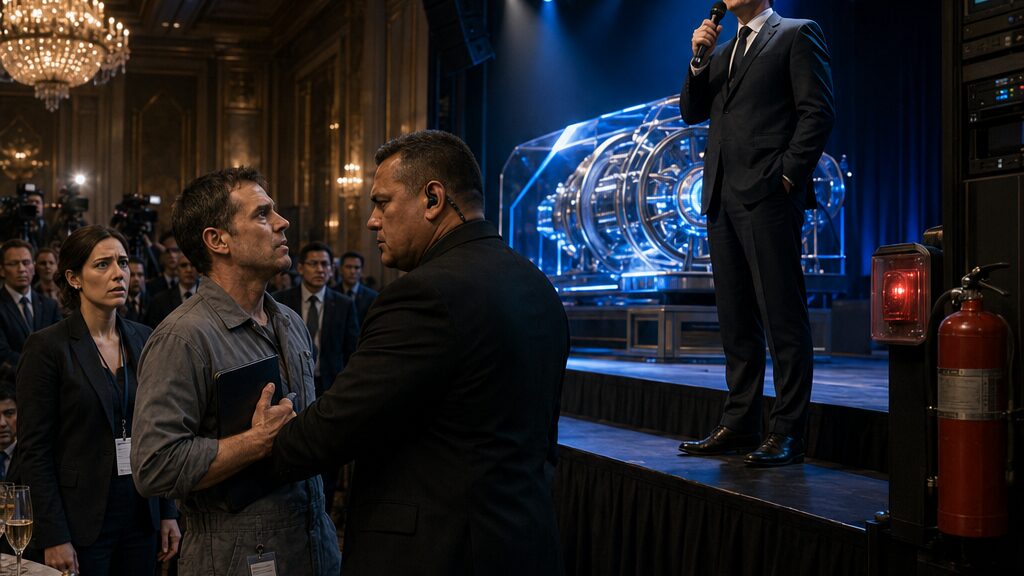
The prototype sat center stage inside a transparent containment cradle, a dark oval core suspended between silver rings. Blue-white light pulsed through it in slow waves, as if the machine had captured lightning and taught it patience. The crowd could not see the scuffed stabilizer bracket beneath the left ring. They could not see where William had filed down the housing by hand after the supplier sent the wrong tolerance. They could not see the safety patch Heather had written during a thunderstorm when the backup generators kept kicking the test system offline.
They saw a miracle.
William saw labor.
A woman in a headset blocked the door. “You can’t stand there.”
“I need the event program,” William said.
She slapped a glossy booklet against his chest without looking at him. “If the containment lights go red, tell booth two. If they go amber, wait for Eric’s cue. Nobody crosses stage unless told.”
William looked down at the program.
On the cover was the engine, photographed at an angle that made it look like an artifact from another century. Beneath it: THE FUTURE, UNLOCKED.
Inside, Eric had written a note.
This breakthrough began as a belief: that imagination, not machinery, changes the world.
William’s thumb moved down the page.
Eric Scott, Marketing Director, Chief Visionary for Launch Strategy.
Karen Brown, Board Liaison.
Jeffrey Thomas, Lead Venture Partner.
No engineering team.
No Heather Johnson.
No systems division.
No William Anderson.
He turned the next page, then the next, more quickly now. Product timeline. Market projections. Leadership photograph. Eric smiling in a black suit beside the engine cradle. There was a two-page spread about storytelling and courage. There was not one sentence about the build room, the failed coils, the redesign after the third thermal surge, the junior engineers who had slept under desks.
William felt something quiet inside him shift—not break, not yet, but slide out of alignment.
His folder suddenly seemed too thin.
“William?”
Heather stood near a rack of black stage curtains, wearing a formal blazer over a dress she clearly hated. Her hair was pinned too tightly, and her event badge was turned backward as if she did not want anyone reading it.
For half a second, relief crossed her face. Then fear smothered it.
“You came,” she said.
“I emailed Karen. She didn’t answer.”
Heather looked toward the ballroom. “They changed everything.”
“I saw the program.”
“No, I mean everything. The deck, the credits, the speaking order. This morning.” Her voice dropped. “Eric said after acquisition, the new structure would be lean. He said anyone trying to complicate authorship tonight might not be essential.”
William held the folder between them. “I have the originals.”
Heather looked at it as if it were both a weapon and a child. “He knows you have something. Security has your name.”
Before William could answer, a broad man in a dark suit stepped into the corridor. He wore an earpiece and moved with the calm heaviness of someone used to being obeyed.
“William Anderson?” he asked.
William turned. “Yes.”
“Charles Garcia. Head of security for tonight.” His eyes moved once over William’s uniform, badge, folder, tool bag. “You’re cleared for technical access only.”
“I need to speak to Karen Brown.”
“You can contact corporate during business hours.”
“The launch is tonight.”
Charles’s expression did not change. “And you are not part of the presentation.”
William opened the folder just enough for the top diagram to show. “I built the system they’re presenting.”
Charles glanced at the paper the way a man glanced at a ticket someone was trying to use at the wrong gate. “Sir, I’m not here to adjudicate workplace disputes.”
“It’s not a workplace dispute.”
“Then you should have brought it through proper channels before arriving in a restricted service area during a high-security investment event.”
Heather flinched at the phrase proper channels. William saw it. Charles did not.
William forced his voice lower. “If they start the demonstration with the revised cue stack, someone from engineering needs to be at the main console.”
“You can monitor from booth two.”
“I need sightline to the stage.”
“Your badge does not allow ballroom floor access.”
The sentence landed with bureaucratic finality. Not because it was true, but because everyone around them had decided it would be treated as true.
William looked past Charles, through the door crack, at the engine’s glow.
The machine pulsed again.
Beautiful. Obedient. Stolen.
Inside the ballroom, applause began to rise. The stage lights dimmed from gold to blue. A microphone came alive with a soft pop.
Charles turned his head slightly, listening through his earpiece. “Presentation is starting.”
William tried to step around him.
Charles put a hand against his chest.
It was not a punch. It was not even rough. It was worse than rough. It was practiced. A quiet, public correction of someone who had forgotten his place.
“Booth two,” Charles said.
William looked down at the hand on his uniform, then at the folder bending in his own hand.
From inside the ballroom, Eric Scott’s voice rolled out warm and confident, amplified until it seemed to belong to the building itself.
“Tonight,” Eric said, “the world finally sees what I built.”
Chapter 2: The Credits That Vanished Under Crystal Light
The first credit slide appeared while William was still trying to enter from the side aisle, and he watched the entire engineering team disappear in one smooth transition.
There had been a version of that slide with twenty-three names.
Heather Johnson had built the visualization sequence. Matthew from thermal had earned two lines for the stabilizer redesign. Three interns had their names in smaller type, but they were there. William had argued for that. Everyone who touched the engine belonged somewhere in the record.
Now the slide showed Eric alone.
Eric Scott
Founder of the Quantum Launch Vision
The ballroom applauded.
William stood half hidden behind a black curtain, blocked by Charles’s shoulder and a line of waiters carrying trays through the service gap. Above him, chandeliers scattered light across hundreds of glasses. Investors leaned back in velvet chairs. Press cameras angled toward the stage. The engine pulsed inside its cradle, blue-white light sliding over Eric’s polished shoes.
Eric smiled as if the applause were a natural resource he had discovered.
“When we began,” he said, “they told me it couldn’t be done.”
William’s jaw tightened.
They.
Eric let the word hang in the room. It swallowed every exhausted person who had kept the prototype alive while he visited the lab once a week to ask whether the glow could be made more “emotionally premium.”
Heather appeared beside William, her face pale under the stage spill.
“I tried,” she whispered.
William did not look away from the stage. “When?”
“This morning. I saw the new deck. I went to Eric before rehearsal.”
“And?”
“He said the investors weren’t buying a committee. They were buying leadership.”
On stage, Eric turned toward the engine and rested one hand lightly on the containment rail. William’s body reacted before his thoughts did. The rail was not decorative. It had conductive sensors beneath the surface. Eric was touching it like a prop.
Heather saw William’s hand twitch. “It’s in display lock. He can’t hurt it.”
“That’s not the point.”
“I know.”
A photographer crouched near the front row. Eric gave him the angle—chin lifted, hand on the rail, engine glow filling the space between his fingers like captured dawn.
Heather’s voice became smaller. “He told us anyone who raised authorship questions tonight would be classified as nonessential after acquisition.”
William turned then.
She met his eyes for one second, then looked down.
“He said the acquiring group wanted a lean structure,” she said. “No internal friction. No legacy resentments.”
“Legacy resentments,” William repeated.
“He meant you first. Then the rest of us.”
The words should have made William angrier at her. He had expected anger. He had imagined, in the elevator up to the hotel, that if the junior engineers stayed silent, it would be betrayal.
But Heather’s hands were clenched so tightly around her program that the glossy paper had buckled. Her badge still faced backward. She was not hiding from him. She was hiding from what her silence had made her.
William looked back at the stage.
For years, he had told them the same thing: Document everything. Let the build speak. Do the work cleanly enough that nobody can bury it.
He had believed that was wisdom.
Now Eric was proving that clean work could be carried onto a stage by a dirty story.
“I need Karen,” William said.
Heather glanced toward the front tables. “She won’t stop it now.”
“She may not have seen the final deck.”
“She approved the run of show.”
“That’s not the same.”
Heather gave him a look full of pity and fear. “Tonight it is.”
William stepped past the curtain anyway.
The ballroom’s attention was fixed on Eric, but the edges of the room noticed William immediately. A maintenance uniform crossing a carpeted aisle during a venture gala was more visible than a shouted protest. Two guests glanced at him and frowned. A server shifted aside. Charles followed at a controlled distance, speaking softly into his wrist.
Karen Brown sat near the front at a reserved table with Jeffrey Thomas and three board members. She wore a dark gown and a small expression of permanent calculation. Her tablet lay beside a champagne glass, open to the event schedule.
William stopped behind her chair.
“Karen.”
She turned, irritation flashing before recognition. “William. You’re not supposed to be here.”
“I need two minutes.”
“This is not the time.”
“It is exactly the time.” He placed the folder on the edge of her table. “The credits were changed. The authorship statement is false.”
Jeffrey Thomas looked over, more annoyed than curious. “Is there a problem?”
Karen’s smile appeared instantly, smooth and chilled. “No problem. Internal technical staff.”
William opened the folder. The top page showed the original architecture diagram, his name in the metadata footer, the engine serial block, the first stabilized output sequence.
Karen put one hand over the page before Jeffrey could see it fully.
“Not here,” she said.
“Then where?” William asked. “After the commitment? After the public record? After Eric signs the invention to investors under his name?”
Her eyes sharpened. “You need to lower your voice.”
On stage, Eric said, “Great technology does not come from fear. It comes from boldness.”
William almost laughed. It came out as one breath through his nose.
Karen leaned closer. “William, I understand you feel strongly about contribution language—”
“Contribution language?”
“—but the event narrative was finalized for investor clarity.”
“He erased the engineering team.”
“The team will be handled in internal documentation.”
“There is no internal after tonight.”
Karen’s expression hardened. “There is a deal after tonight. There are jobs after tonight. There is funding after tonight. If you damage that, you do not restore anyone’s credit. You endanger everyone’s future.”
That was the first thing anyone had said all evening that was not entirely false.
William looked at Heather, standing several yards back near the aisle edge. She had heard enough. So had two other engineers clustered near the rear table. Their faces were tight, humiliated, pleading with him and afraid of him at the same time.
Karen followed his glance.
“Please,” she said, softer now. “Let the evening finish. Bring me the documentation tomorrow. I will review it.”
“You had it three days ago.”
“I had allegations.”
“You had timestamps.”
“I had one side of a complicated internal matter.”
William closed the folder slowly. “No. You had the quiet side.”
Karen’s mouth tightened. “Charles.”
The head of security was already beside him.
“Mr. Anderson,” Charles said, “you need to return to your assigned station.”
William did not move.
At the stage, Eric had reached the center of his speech. The massive screen behind him shifted into a cinematic animation: the engine rendered as a rising sun, its rings unfolding into lines of market projections.
Still no names.
No lab.
No team.
Just Eric’s voice.
“We stand,” Eric said, “at the edge of a future most people lacked the courage to imagine.”
William felt Heather watching him. He felt Karen’s hand still guarding the folder from Jeffrey’s view. He felt Charles waiting for one wrong movement that could justify removing him cleanly.
For the first time that night, William understood the room as Eric understood it.
Not as a place where truth would be weighed.
As a machine.
The lights, music, seating chart, security instructions, press angles, investor timing, even the champagne—all of it had been engineered toward one conclusion before William ever walked in.
Eric did not need to disprove him.
He only needed to make him look disruptive.
William reached for the folder.
Karen held it down. “Tomorrow,” she said.
William looked at her hand on his evidence. “You are helping him.”
Something flickered in her face. Not guilt. Not enough for guilt. Recognition, maybe, quickly buried under duty.
“I am protecting the company,” she said.
Charles moved between them.
As William stepped back, Eric turned his head from the stage and saw him.
For one suspended second, the smile on Eric’s face became private. Smaller. Sharper.
Then Eric lifted the microphone slightly, and the ballroom speakers warmed with a new, dangerous clarity.
Chapter 3: A Failure Like You Carries Zero Weight
Charles shoved William back just as the cameras turned.
It was not the hard shove of an angry man. It was worse—measured, professional, clean enough to look reasonable from a distance and humiliating up close. William’s heel caught the edge of the aisle carpet. The folder struck his ribs. A few diagrams slipped loose and fanned against his chest before he trapped them with his forearm.
The nearest guests stopped pretending not to watch.
On stage, Eric lowered his chin with theatrical concern.
“Is there an issue down there?”
The microphone carried his voice through the ballroom, polished and warm. The engine glowed behind him, patient as a witness that had not yet been called.
William straightened.
“No issue,” Charles said quietly, angled toward William. “Return to booth two.”
William looked past him. “Eric.”
A ripple moved through the tables. First-name familiarity from a man in a mechanic uniform had offended the room before they even knew why.
Eric let the silence gather.
“William,” he said at last, as if granting a child permission to interrupt dinner. “I wondered whether you would make tonight difficult.”
Heather’s face went still near the aisle.
William felt the trap close around the sentence. If he answered sharply, he became difficult. If he stayed quiet, Eric owned the room.
“You removed the engineering credits,” William said.
His voice did not reach far. Eric’s microphone did.
Eric smiled with regret crafted for the back row. “Ladies and gentlemen, I apologize. Every great leap forward attracts emotion. Sometimes from people who contributed in small ways and imagined those contributions were larger than they were.”
William’s fingers tightened on the folder.
“Open the original build files,” he said. “Show them the metadata.”
Eric gave a soft laugh. One person near the front joined him, then stopped when nobody else did.
“The original build files?” Eric repeated. “William, this is a venture capital gala, not a maintenance review.”
The word maintenance did its work. William felt it move through the ballroom. Eyes dropped to his uniform, his scuffed shoes, the oil mark on his sleeve.
Charles shifted closer. “Sir.”
William kept his eyes on Eric. “You changed the deck this morning.”
Eric turned slightly toward Jeffrey Thomas’s table, not enough to seem nervous, enough to remind William who mattered. “We refined the narrative. Investors came here to understand a market breakthrough, not to sit through a list of every technician who tightened a screw.”
Heather closed her eyes.
William heard the intake of breath from someone behind him, one of the junior engineers. He did not turn. If he looked at them now, he might ask them for courage they had already been threatened out of.
“That machine does not run because you refined a narrative,” William said.
Eric’s smile thinned.
“No,” he said. “It runs because someone had the courage to move it out of the basement and into the world.”
There it was. Eric’s truth, ugly because he believed it.
He had visited the build room with investors while William’s team hid unfinished housings under cloth. He had demanded less caution in every report. He had said, more than once, that engineers confused delay with integrity. William had dismissed him as a nuisance because Eric did not understand the machine.
That had been William’s mistake.
Eric understood rooms.
Eric understood hunger.
Eric understood that the person who explained the miracle often owned it before the person who built it could object.
William lifted the folder. “These are the original diagrams.”
Eric’s face changed, just slightly.
Then he recovered.
“Are those the same diagrams attached to your delay memo?” he asked.
William went still.
The massive screen behind Eric shifted. A slide appeared: INTERNAL RISK OBJECTION — EXCERPT.
William recognized the sentence immediately.
The current launch configuration carries unresolved instability under live-stage synchronization conditions.
It was his memo. Cropped. Stripped of the section explaining how to fix the issue. Stripped of the approval chain. Stripped of the final note that the risk existed only if marketing insisted on linking the engine visualization to the stage control system.
The room read the sentence the way Eric wanted them to read it.
Fearful engineer opposes bold launch.
Eric looked wounded now, almost noble. “William has been anxious about this project for some time. I respect caution. Truly. But caution cannot become sabotage. Not when hundreds of jobs and years of work depend on forward motion.”
William heard Karen’s chair scrape softly at the front table. She had not expected the memo slide. That much was clear. But she did not stop it.
Jeffrey Thomas leaned back, watching William with the cool interest of a man evaluating risk.
William spoke louder. “Read the next paragraph.”
Eric tilted his head. “Excuse me?”
“The next paragraph explains the synchronization flaw. It explains the correction. It explains why the stage cue stack was not supposed to be rebuilt outside engineering.”
Eric’s eyes hardened.
The microphone hid it from the room. The spotlight did not.
“Enough,” Charles said.
William stepped around him.
Charles caught his arm.
The folder bent sharply between them. A page slipped free and landed faceup near a guest’s black shoe. The guest looked down, saw equations and diagrams, and moved his foot away as if the paper might stain him.
Eric watched it fall.
Then he laughed—not loudly, not cruelly in an obvious way. Just enough.
“Look at this,” he said, spreading one hand toward William. “This is exactly why leadership matters. Genius, real genius, requires discipline. It requires communication. It requires the strength to carry an idea into the world without collapsing under insecurity.”
William’s face grew hot. Not because Eric was lying.
Because some part of it pierced.
He had avoided the stage. Avoided the board dinner. Avoided translating the engine into the language of money and applause. He had told himself it was purity, but there had been fear in it too. Fear of rooms like this. Fear of men like Jeffrey Thomas. Fear that if he stepped into the bright air where things were sold, he would become smaller than the work.
Eric had walked into that fear and built a throne there.
William said, “You stole it.”
The words came out plain and clean.
The room heard them.
Eric no longer smiled.
For the first time, something human and panicked moved under his face. He looked toward Karen, then Jeffrey, then the press row. The investment commitment timer glowed on a small confidence monitor near the stage stairs. Seven minutes.
Eric had seven minutes to complete the story he had written.
He lifted the microphone closer.
“The whole world is honoring me,” Eric said, each word sharpened for public memory. “The words of a failure like you carry zero weight.”
The sentence hit William harder than Charles’s hand.
The ballroom did not erupt. It murmured. That was worse. A soft turning away, a collective permission. A few guests looked embarrassed for him. One photographer lowered his camera, then raised it again.
Heather took one step forward.
Then stopped.
William saw that too.
Eric had not only humiliated him. He had made everyone choose whether to be seen beside him.
Charles reached for the folder.
“Sir, now.”
William looked down at the diagrams, at his own hands, at the mechanic uniform he had put on because the access sheet required it. He had worn it thinking it was only fabric. Now it felt like a verdict.
Charles’s fingers closed on the folder’s edge.
William held on.
For one second, the two men stood locked in a silent tug-of-war at the center aisle while Eric’s amplified breathing filled the room.
Then William’s eyes moved past Charles’s shoulder.
Near the stage control booth, behind a small velvet barrier, red emergency glass glinted under the blue light. Beside it hung an industrial fire extinguisher, larger than the hotel’s decorative brass fixtures, its hose clipped tight against the cylinder.
Beyond that, through the control booth window, William saw the synchronized display computers.
Three towers. Shared cue bus. Live visualization feed. Blueprint fallback path.
The folder was proof.
But the system was a witness.
Charles pulled harder, and the folder began to tear.
Chapter 4: The Original Layer Beneath the Lie
The folder tore with a sound too small for the ballroom and too loud inside William’s chest.
Pages spun loose between him and Charles. One slid beneath a guest table. Another landed near the toe of Eric’s polished shoe on the stage step. A third drifted faceup onto the aisle carpet, showing the original containment map, the version with the correction Eric had just hidden from the room.
William reached for it.
Charles reached faster.
“Do not make this worse,” Charles said, low enough that the microphone did not catch him.
William looked at the papers scattered under the crystal light. For two days, he had believed those pages were the center of his defense. Original diagrams. Internal timestamps. Signed revision history. The respectable language of proof. He had imagined Karen Brown turning one page, then another, the lie collapsing under documentation because the world was supposed to respect records.
But now the records were on the floor.
Guests leaned away from them.
Karen guarded the table.
Eric held the microphone.
And the investment commitment timer near the stage stairs kept counting down.
Six minutes.
Eric watched William over the bright curve of the engine cradle. He was still smiling, but there was sweat at his temple now. The engine’s blue-white pulse flickered across his face and made him look, for one cold second, like a man lit from below by something he did not understand.
William stopped reaching.
That was when Heather moved.
She slipped from the side aisle and crouched as if picking up a dropped napkin. Her fingers covered one of the torn diagrams before a server stepped on it. Charles saw her and snapped, “Ma’am, stay back.”
Heather froze.
Eric’s eyes cut toward her.
The old fear returned to her face. William could see her calculate her job, her rent, her references, the acquisition list Eric had threatened them with that morning.
Then she straightened, the diagram hidden against her program.
“I’m sorry,” she whispered, not to Charles.
To William.
Charles reached again for the remaining half of the folder.
William let him take it.
The surrender surprised Charles. His grip tightened around the folder as if suspecting a trick. There was one. Just not in the paper.
William’s gaze moved to the control booth.
Three black tower computers sat behind glass, their indicator lights blinking in sequence with the engine visualization. Above them, a monitor showed the cue stack that Marketing had rebuilt: light sequence, engine pulse overlay, investor projection animation, closing commitment slide. Everything was synchronized. Too synchronized.
That had been the risk.
William saw, in memory, the build room at 2:11 a.m. Months earlier. No chandeliers. No champagne. Just stale coffee, burned dust from an overheating power strip, and Heather sitting cross-legged under the console because the visualization feed kept desynchronizing from the containment model.
“It wants the original layer,” she had said, half laughing, half delirious. “Every time the display crashes, it crawls back to source.”
“It doesn’t want anything,” William had answered.
“Fine. The architecture wants the original layer.”
That was how tired they had been—arguing with a machine as if it had a soul.
The fallback protocol had been his decision. Not elegant, but safe. If the live demonstration interface failed, the visualization would revert to the original blueprint file instead of freezing on corrupt projections. The board had never cared. Marketing had never asked. The fallback existed below the deck, below the exported graphics, below the glossy story Eric had built.
And underneath that original blueprint, hidden in the deep graphic layers no presentation export would show unless the system reverted all the way to source, was the watermark.
WILLIAM ANDERSON.
He had not added it out of vanity.
He had added it at 3:46 a.m., after the company’s first acquisition rumor, after Eric had joked in a leadership meeting that “engineering is a department, not a brand,” after William had watched one of Heather’s safety notes become a marketing phrase without her name attached. He remembered the cursor blinking in the lower layer field. He had hesitated for almost a minute.
Then he typed his name.
Not because he wanted a crown.
Because some part of him had known.
Heather was beside him now, close enough that Charles could not easily push her away without making another scene.
“He rebuilt it from exports,” she breathed.
William did not move. “What?”
“The deck. The animation. The launch visuals. He didn’t use the source blueprint for the final sequence.” Her voice shook. “He told the design vendor to make it cleaner. I saw the package. Flattened files. No layer tree.”
William’s throat went dry.
If Eric had used only the flattened exports, the watermark would never appear. It would remain buried in the original file, intact but invisible, like a name carved under a floor no one would lift.
“But the fallback path?” William asked.
Heather’s eyes flicked toward the booth. “Still mapped. I think. They were too scared to touch your safety architecture.”
“You think?”
“I know the source file is still on the local stack,” she said. “I saw the path during rehearsal. But William—”
Charles stepped between them. “Enough.”
William looked at the timer.
Five minutes.
On stage, Eric recovered the room with professional gentleness. “I apologize for the distraction. The truth is, when you move this fast, not everyone can keep up. That does not make them bad people.”
The insult was softer now. More dangerous.
Eric turned toward Jeffrey Thomas. “But the future does not wait for personal comfort.”
A few people applauded, uncertain at first, then grateful for permission to return to the show.
Karen rose from her chair and approached the aisle. Her face had lost its smoothness.
“William,” she said quietly, “you are done here.”
“I warned you about this exact configuration.”
“And your warning was reviewed.”
“No. It was cropped.”
Her eyes flicked toward the slide Eric had shown, then back to him. “This is not the forum.”
“You keep saying that because this forum is the lie.”
Karen’s mouth tightened. “The investor signing begins in less than five minutes. If you interfere further, you will not be treated as an employee with a grievance. You will be treated as a threat.”
William heard the word employee. The last little thread of institutional hope inside him pulled tight.
An employee could be reviewed tomorrow.
A threat had to be stopped tonight.
That was the line Karen was offering him. Step back into the small room where disputes could be delayed, softened, buried in legal phrasing—or stay here and be turned into the danger Eric needed him to be.
Charles took the torn folder under one arm and reached for William’s elbow.
“Booth two,” he said again.
The command had become absurd. The room had already seen too much for booth two. Eric’s voice poured over them.
“Before we move to the commitment phase, I want to say something personal,” Eric said. “This engine represents belief. Mine, yes, but also the belief of everyone who refused to let fear slow progress.”
William looked at the engine.
Its glow cycled through the display pattern, brighter now, staged to rise toward the signing moment. The containment cradle was safe. The core was stable. The machine was not the thing that had lied.
The performance around it had.
William’s eyes moved from the engine to the booth. Three towers. Shared cue bus. Visualization feed. Local source fallback.
Heather’s hand closed around his sleeve.
“William,” she said, barely audible, “if you do anything, they’ll say you proved him right.”
He looked at her.
There was no accusation in her face now. Only terror. Not for herself. For him. For all of them. For the ugly possibility that the truth might require an act that looked exactly like guilt before it became proof.
William thought of the emails he had sent. The polite phrasing. The attached documents. The requests for review. The way Karen’s assistant had replied: Received, thank you. The way he had sat at his kitchen table that morning with the mechanic uniform folded beside him, telling himself he would go to the hotel calmly, professionally, with evidence.
He had waited so long to avoid looking unstable that Eric had built an entire stage on top of his restraint.
Charles’s fingers closed around his arm.
This time, William did not pull away.
He simply shifted his weight, let Charles think he had won, and looked once more at Heather.
“The work has to speak,” he said.
Her eyes filled.
“It won’t,” she whispered.
William looked at Eric, at the microphone, at the screen, at the countdown.
Four minutes.
“No,” he said. “Not by itself.”
Charles began guiding him toward the side corridor. William took two steps with him. The guests relaxed. Karen exhaled. Eric turned back to the front tables, sensing victory, ready to turn William’s removal into a clean final note.
Then William planted his left foot.
Charles felt it too late.
William twisted out of the grip, not wildly, not with a shout, but with the efficient motion of a man who had spent years moving around live equipment without wasting force. Charles grabbed for him again. William ducked under his arm and drove toward the stage wing.
The ballroom gasped as one body.
“Stop him!” Karen shouted.
Eric’s smile vanished.
William did not run for the engine.
He ran past it.
Past the glowing stolen miracle, past the velvet barrier, past a photographer who stumbled backward with his camera still raised.
He reached the red emergency panel.
For one heartbeat, his reflection stared back from the fire alarm glass—pale face, gray mechanic uniform, eyes clear in a way they had not been all evening.
Then he stopped reaching for the scattered papers behind him and drove his elbow into the glass.
Chapter 5: White Foam Across the Million-Dollar Stage
The fire alarm shrieked so loudly that Eric’s microphone died in the middle of his own name.
Red light strobed across the chandeliers. The string quartet stopped as if cut by a blade. Somewhere above the ballroom, hidden sprinklers armed themselves with a metallic clunk that made half the front row look up in panic.
William’s elbow burned. A bright line of blood slid from his sleeve cuff, but he barely felt it. He yanked the alarm handle down until it locked, then turned to the industrial extinguisher mounted beside the control booth.
Charles was already coming at him.
William ripped the extinguisher free with both hands. It was heavier than he remembered from lab drills, dense and awkward, its hose clipped tight, its metal body cold against his palm. Charles reached him just as William broke the safety pin.
“Drop it!”
William swung the hose away from Charles and stepped backward toward the booth window.
Eric’s voice came back through the room, unamplified now, stripped of warmth. “Get him away from there!”
The difference was shocking. Without the microphone, Eric sounded smaller. Angrier. Human.
William aimed at the booth door panel.
A hotel technician, pale and frozen behind the glass, raised both hands.
“Move,” William said.
The technician moved.
Charles lunged.
William squeezed the trigger.
White foam exploded from the hose with a violent cough, slamming across the booth door, the glass, the equipment rack beyond. The first blast missed the towers and coated the monitor bank in thick chemical snow. Guests screamed. A camera hit the floor. The engine’s glow brightened and dimmed in confused sync with the alarm lights.
Charles grabbed William from behind.
William twisted, keeping the hose pointed through the open booth gap. Foam roared again. This time it struck the three black tower computers directly.
Not the engine.
Not the containment cradle.
The computers.
Their indicator lights vanished under white.
A crackle snapped through the booth. One monitor went black. Another flashed warning amber. The stage projection above Eric shuddered, splitting his frozen launch graphic into blue bars.
William heard Heather shout his name, but could not tell whether it was warning or grief.
Charles drove a shoulder into him. The extinguisher slammed against William’s ribs. Pain burst white-hot through his side. He nearly dropped the hose. For one sick second, the nozzle swung toward the engine cradle.
“No,” William gasped, and wrenched it back toward the booth.
That was when Jeffrey Thomas stood.
“What is he doing?” Jeffrey demanded.
No one answered.
Because now it was obvious to anyone watching closely that William was not attacking the prototype. He was protecting it from the spectacle around it. He planted one boot against the velvet barrier and flooded the control stack again, sweeping the hose low across the server vents, the cable ports, the shared cue bus beneath the desk.
The stage lights flickered hard.
The engine’s public visualization collapsed into static.
The actual core remained inside its cradle, still pulsing, still alive.
William saw Karen understand that distinction before anyone else. Her face went from fear to calculation to something sharper.
“He’s targeting the display system,” she said.
Eric heard it.
“No,” he snapped. “He’s destroying the launch.”
The word launch mattered more to him than engine. Even in chaos, William heard that.
The room had become a storm of alarms and expensive panic. Guests pressed toward exits, then hesitated when hotel staff blocked the main doors to control evacuation. Investors shielded their phones from foam spray. Press cameras caught everything. The chandeliers, still blazing between red alarm flashes, made the white foam look almost beautiful as it slid down the control booth glass.
Charles hit William from the side.
This time, William went down.
His shoulder struck the carpet near the stage stairs. The extinguisher rolled half out of his hands, still coughing weak bursts across the floor. Charles pinned one knee beside him and grabbed his wrist.
“Enough!”
William fought once, not to escape, but to look at the screen.
Black.
The massive projection above the stage had gone dead.
For half a second, terror opened inside him.
Not fear of arrest. Not fear of Eric. Fear that he had been wrong. That the fallback path had been removed, or corrupted, or bypassed by the flattened marketing package. Fear that his one irreversible act had created only the image Eric wanted: an unstable technician attacking a room full of investors.
Eric climbed down the stage steps, face flushed, suit jacket spattered with tiny flecks of foam.
“You saw that,” he shouted to the front tables. “All of you saw that. This is exactly what I warned about.”
Charles forced William’s arm behind his back.
William did not resist now. He listened.
Beneath the alarm, beneath the guests, beneath Eric’s voice, the booth equipment made a sound he knew.
Not a failure tone.
A reboot sequence.
Three notes, staggered. The old local stack. The one they had left because nobody in Marketing understood why a display system needed architectural fallback when a polished animation looked better.
William closed his eyes for one breath.
Then opened them.
The engine glow had dimmed but not died. It pulsed behind Eric, slower now, as if waiting.
Heather stood near the aisle with one of the torn diagrams pressed flat against her chest. Her face was wet. She looked not at William, but at the screen.
Eric followed her gaze.
“Cut power,” he shouted. “Cut the whole thing.”
The hotel technician inside the booth shook his head, backing away from the smoking control rack. “I can’t access the panel.”
“Then unplug it!”
Karen moved toward the booth, but stopped when another electrical pop snapped from beneath the desk. A small puff of gray smoke curled into the foam.
The ballroom lights dropped to half-strength.
Emergency strips glowed along the floor. Red alarm lights kept turning. Phones floated in the dark like small witnesses.
On the black screen above the stage, a single white cursor appeared.
The crowd noise changed.
Not silence. Not yet. Something thinner. Attention beginning to form out of panic.
A raw file path blinked into view.
LOCAL_STACK / QE_ORIGINAL_ARCHIVE / BLUEPRINT_MASTER / LAYER_RESTORE
William felt Charles’s grip loosen by a fraction.
Eric stared at the screen.
For the first time all night, he did not seem to recognize what he was looking at.
Chapter 6: The Name Eric Forgot to Erase
“Arrest him,” Eric screamed, just as the first blueprint layer appeared behind him.
No microphone carried the words, but the alarm had dropped to a pulsing warning tone, and his voice cut through the room bare and sharp. “Charles, arrest him right now.”
Charles had William half pinned near the stage stairs, one hand locked around his wrist, the other hovering near the cuffs on his belt. But his eyes had left William and gone to the screen.
Everyone’s had.
The massive projection no longer showed Eric’s rising-sun animation, market forecasts, or courage slogans. It showed a raw technical drawing: the quantum engine’s containment geometry, gray lines on a black field, rotation markers, thermal bands, warning annotations. It was ugly compared with the gala visuals. Dense. Unpolished. Alive with the kind of information Eric had spent months sanding away.
William stayed on the floor and breathed through the pain in his ribs.
Eric turned toward the booth. “Shut it off.”
The hotel technician did not move. Foam dripped from the console in slow white ropes.
Karen stepped forward. “Nobody touch that panel until electrical safety clears it.”
Eric spun on her. “This is an active sabotage event.”
“This is evidence now,” Karen said.
The sentence struck the room harder than the alarm.
Eric heard it too. His face tightened, but he recovered fast. “Evidence of his instability. Evidence that he came here prepared to destroy a launch he opposed from the beginning.”
Jeffrey Thomas, still standing beside the front table, looked from Eric to the screen. The investment partner no longer looked annoyed. He looked awake.
“What layer is that?” Jeffrey asked.
Eric blinked. “What?”
“That diagram,” Jeffrey said. “You presented this engine as your architecture. What layer are we looking at?”
Eric’s mouth opened.
On the screen, the blueprint restored another level. A transparent ring unfolded around the core. Labels populated the edges in small white text.
CONTAINMENT REVISION 4.7
STABILIZER GEOMETRY
SYNC-SAFE DISPLAY FALLBACK
Eric forced a laugh. “Jeffrey, this is not the moment for technical—”
“It seems exactly the moment,” Jeffrey said.
The room held still around them. Even the guests near the exits had slowed, phones raised but bodies turned back toward the stage.
Eric pointed at William. “Ask him why he flooded a million-dollar event with fire suppressant.”
“Because your cue stack was tied into the live visualization,” William said from the floor.
His voice was not loud, but it carried in the changed room.
Charles looked down at him.
William drew another breath. His ribs pulled. “The engine is safe. The performance system isn’t.”
Jeffrey’s gaze sharpened. “The performance system?”
“The stage computers, lighting cues, investor animation, and blueprint visualization were all running through the same synchronized control stack. I warned against it.”
Eric snapped, “He warned against launch itself.”
“No,” William said. “I warned against letting Marketing rebuild the cue sequence outside engineering.”
Karen turned toward Eric.
That one sentence moved something in her face. A memory, maybe. A file subject line. A warning she had skimmed and categorized as internal friction because the deal had been bigger than the discomfort of reading closely.
The screen restored another layer.
Heather stepped forward before she seemed to know she was doing it. “That path is from the original archive.”
Eric rounded on her. “Heather, be very careful.”
She stopped, but she did not step back.
“You told us the deck was final,” she said, voice thin but audible. “You told us authorship would be handled after acquisition.”
Eric’s eyes widened with fury. “This is not your area.”
“It was when I built the visualization recovery sequence.”
The room shifted again.
William looked at her.
Heather’s hands were trembling. The torn diagram she held had buckled against her chest, but she stood under the red alarm light and did not lower her eyes.
A second junior engineer rose from a rear table. Then another. They did not cheer. They did not speak. Their standing was quieter and more damaging than applause.
On screen, the blueprint zoomed automatically into the layer tree.
Eric saw it a heartbeat before the others did.
His face went pale.
William knew that look. He had seen it in engineers when a test result contradicted everything they had told a supervisor. The instant when denial was still possible but no longer useful.
Nested under the master geometry file, one layer expanded.
ORIGIN_MARK / DEEP_AUTHOR_WATERMARK
A murmur moved through the ballroom.
Eric stepped toward the screen as if physical closeness could stop it.
“Cut it,” he said, but now the command had nowhere to land.
The layer rendered slowly, crawling into visibility through static and foam-damaged refresh lines. At first it looked like a faint gray pattern under the containment diagram. Then the letters sharpened.
WILLIAM ANDERSON
Not in the corner.
Not as a signature pasted onto a slide.
Embedded through the deep layer structure itself, woven beneath the original containment model in repeating microtext, invisible in exported graphics, undeniable inside the source blueprint.
No one clapped.
Not yet.
The room was too busy understanding.
Eric turned around, and in that silence he became smaller than the stage he had built. “That could have been added later.”
William pushed himself up on one elbow. Charles did not stop him.
“The checksum is beside it,” William said.
Jeffrey leaned toward the screen.
William pointed with his free hand. “Bottom left. Original hash. Creation timestamp. It predates the investor deck by eleven months.”
Jeffrey looked at Eric. “Is that true?”
Eric’s lips moved once.
No answer came.
William stood slowly. Charles’s hand stayed near his arm but no longer held him. Foam soaked the carpet near their feet. The mechanic uniform clung cold against William’s shoulders. His torn folder lay open under a chair, almost empty.
But the machine was speaking now.
Jeffrey turned to Eric again. “Explain the sync-safe fallback.”
Eric’s eyes flicked to the board table, to Karen, to Heather, to the phones recording him. “Our technical division handles those mechanisms.”
“Who designed it?”
Eric’s face hardened. “This is absurd.”
“Who designed it?”
William answered from beside the stage stairs.
“I did.”
Jeffrey did not look away from Eric. “And the stabilizer geometry?”
Heather spoke before William could. “William led it. Matthew from thermal revised the bracket. The junior team built the recovery model.”
Another engineer from the rear said, “Eric asked us to remove the build-room footage from the gala loop.”
Eric pointed toward the back. “You are all risking your positions.”
That was the wrong sentence.
Everyone heard the threat inside it because the proof was now above his head.
Karen closed her eyes for half a second. When she opened them, she looked older.
“Eric,” she said quietly, “stop talking.”
But Eric could not.
He lunged toward William, his polished shoes slipping slightly on the damp carpet. “You think this makes you a hero? You shorted out a public launch. You endangered guests. You sabotaged the company because you couldn’t stand not being center stage.”
Charles stepped between them, but Eric shoved past his shoulder.
William did not move.
The screen behind Eric zoomed again, the damaged system magnifying the watermark layer until William’s name filled the ballroom wall in white letters.
WILLIAM ANDERSON
The same size Eric’s had been at the start of the night.
Eric saw the faces before he saw the letters. The investors. The board. The engineers standing now one by one. The cameras. Karen’s silence. Jeffrey’s cold withdrawal.
Then he turned and saw the name he had forgotten to erase.
Chapter 7: The Uniform Left on the Thief’s Face
Karen reached William before Eric did.
“Wait,” she said, one hand lifted as if approaching damaged equipment. “William, wait. The board can correct the record.”
The ballroom still pulsed red with alarm light. Foam clung to the stage stairs. The quantum engine flickered inside its cradle, no longer bright enough to dominate the room, but alive. Behind it, William’s name remained enormous on the damaged screen, white letters trembling through occasional bands of static.
WILLIAM ANDERSON
For a few seconds, nobody moved as if the letters themselves were holding the room in place.
William stood with one sleeve torn, one cuff marked with blood, the mechanic uniform heavy with sweat and extinguisher dust. Charles had stepped back from him. Not far, but enough. The handcuffs remained on Charles’s belt.
Eric stared at the screen with the look of a man watching a locked door open from the wrong side.
Karen lowered her voice. “Come with me. Not out there. Not yet.”
William looked at her.
She seemed sincere now, and that made it worse.
“We need to preserve chain of custody on the files,” she said. “We need statements from engineering. We need to make sure this is handled properly.”
“Properly,” William said.
Karen heard the echo of the word. Her face tightened.
“I was wrong to delay your complaint,” she said. “But if you walk out now, you make this harder to protect.”
“For who?”
“For the team. For the company. For you.”
A half hour ago, those three things had been fused in William’s mind. The work, the team, the institution that housed them. He had believed damage to one meant damage to all.
Now he could see the seams.
The company had protected the launch. The team had protected their jobs. He had protected the work by staying quiet until silence became another tool in Eric’s hand.
Heather stood near the aisle, still holding the torn diagram. Around her, the junior engineers had risen from their tables one by one. They looked awkward in their formal clothes, exposed without podiums or microphones, but they did not sit back down.
Jeffrey Thomas spoke to one of the board members in a low voice, his expression flat. A man from the press row filmed the screen, then William, then Eric. Guests whispered into phones. Hotel staff hovered near the exits, waiting for someone important to decide whether the emergency was over.
Eric turned from the screen at last.
His face had recovered its shape, but not its color.
“This is insane,” he said. “All of you are letting a vandal dictate the story.”
Nobody answered quickly enough for him.
That silence frightened him. William saw it land.
Eric pointed at the extinguisher lying on the carpet. “He caused a system failure during a live investor demonstration. He risked millions. He risked guests. He risked the company’s future.”
Jeffrey looked at the foam-covered booth. “The prototype appears intact.”
Eric’s jaw worked. “That is not the point.”
“It is very much part of the point,” Jeffrey said.
Karen stepped between them slightly, not defending Eric now, but trying to contain the collapse. “No further statements until counsel is present.”
Eric laughed once. “Counsel? For me?”
“For everyone,” Karen said.
William nearly smiled at that. At last, the room had discovered caution.
Heather crossed the aisle.
She did not come quickly. Every step seemed to cost her. The torn diagram trembled in her hand, but when she reached William, she held it out like something returned from a fire.
“I should have spoken this morning,” she said.
William took the page.
The containment map was creased through the stabilizer ring. A shoe print darkened one corner. His initials were visible in the revision box, small and half smeared.
Heather swallowed. “When Eric threatened the acquisition list, I told myself waiting wasn’t the same as lying.”
William looked at the standing engineers behind her. Some looked ashamed. Some angry. Some looked as if they had just woken from a long, obedient sleep.
“It feels almost the same after a while,” Heather said.
The apology cut deeper than Eric’s insults because it did not ask to be excused. It simply stood there, ugly and true.
William folded the damaged diagram once and held it against his side.
“I taught you to document everything,” he said.
Heather nodded, eyes wet.
“I should have taught you to speak before the documents are buried.”
Her mouth twisted, not quite grief, not quite relief.
Behind them, Eric stepped closer. “Listen to him. Listen to the noble martyr act. He destroys the room, then lectures everyone on courage.”
William turned.
Eric was only a few feet away now. His suit jacket was flecked with white foam. His polished shoes stood in the wet edge of the ruined carpet. Behind him, the engine glowed weakly through the containment cradle, still beautiful, still indifferent to the men fighting over its name.
“You think this proves creation?” Eric said. “You hid a name in a file. I brought this into the world. I brought the investors. I brought the stage. I made them care.”
William looked at him for a long moment.
There it was again. Not a defense. A confession wearing the shape of one.
“You made them care about you,” William said.
Eric’s eyes flashed. “Because someone had to.”
“And you thought that made the work yours.”
Eric leaned in, voice low enough now that only the nearest people heard the rawness under it. “You would have kept it in a lab until it became obsolete. You and your warnings. Your revisions. Your little midnight fixes. Men like you always think being necessary means being important.”
William felt the sentence search for the old wound. It found it, but it did not own it anymore.
He had been afraid of rooms like this. Afraid of sounding small beside men who could turn uncertainty into performance. Afraid that the work would shrink if he had to sell it in bright light. So he had let Eric own the bright light.
That was true.
But it was not the same as theft.
Karen came closer again. “William, please. Let us stabilize this.”
William looked down at himself.
The mechanic uniform had been issued that afternoon in a plastic garment bag by a logistics assistant who had not met his eyes. Gray shirt. Gray trousers. Service patch. Temporary access. He had put it on because arguing with wardrobe had seemed beneath the emergency.
Now the fabric was stiff with foam and sweat. It smelled of chemicals and scorched wiring. It had done exactly what Eric wanted: told every important person in the room that William belonged below the stage.
He unbuttoned the shirt.
The movement pulled everyone’s attention. Even Eric stopped speaking.
William worked slowly. One button, then the next. His hands shook only once, near the bloodstained cuff. Underneath, he wore a plain dark T-shirt, the one he had put on at home before the uniform because he had expected to return late and alone.
Charles watched him, uncertain.
Karen’s eyes narrowed. “William—”
He pulled the uniform shirt free and slipped it off one shoulder, then the other. The ballroom air hit his damp skin cold. He folded nothing. Smoothed nothing. He held the gray shirt in one hand like something already dead.
Eric stared at it.
“Don’t be ridiculous,” he said.
William stepped toward him.
Charles shifted, but did not intervene.
For one suspended second, the whole gala seemed to balance between the old order and whatever came after it: the chandeliers above, the foam below, the engine breathing blue-white light behind its cradle, the damaged screen still holding William’s name in public view.
William threw the mechanic uniform into Eric’s face.
The cloth struck him across the mouth and cheek, soft but absolute. Eric stumbled back, grabbing at it with both hands. A sharp breath moved through the room. Not laughter. Not yet. Something cleaner.
William turned away before Eric pulled the shirt down.
“William,” Karen said.
He stopped once.
“If the board wants the truth,” he said, “ask the people who built it.”
Then he looked at Heather and the engineers behind her.
“The work was never mine alone,” he said. “But silence almost made it his.”
Heather stood straighter. So did the others. One engineer began clapping. The sound was small, uncertain, almost embarrassing in the vast damaged ballroom.
Then Heather joined.
Then another.
The applause spread only through the engineers at first, the people who knew the smell of burned dust in the lab, the sound of the engine failing at two in the morning, the weight of being told their work would be recognized later. It was not the smooth applause Eric had received under perfect lighting. It was uneven, human, full of anger and shame and release.
William did not turn it into a bow.
He walked toward the ballroom doors.
Guests parted. Some watched him with phones raised. Some lowered their eyes. Jeffrey Thomas stepped aside without speaking. Charles looked once at Karen, then let William pass.
In the lobby, the hotel’s gold light waited untouched by the chaos inside. The huge promotional screen above the entrance still showed Eric’s portrait beside the words SOLE VISIONARY, but the live feed beneath it had frozen on the recovered blueprint.
William walked past both.
Behind him, through the open ballroom doors, the applause from the junior engineers grew louder. Not polished. Not unanimous. Not enough to fix what had been done.
Enough to prove it had ended.
William pushed through the glass doors and stepped out of the building without the uniform.
The story has ended.