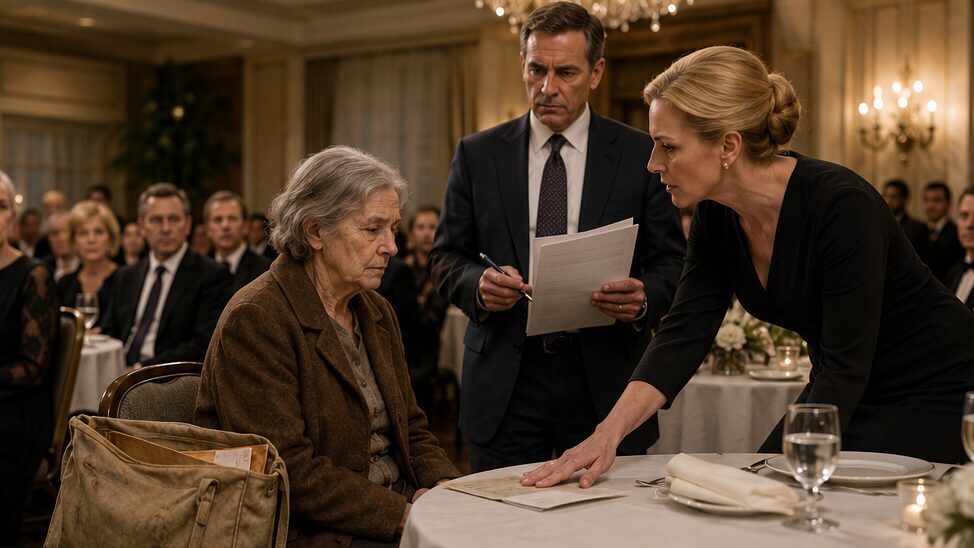
They Dumped Her Bag At The HOA Dinner And Demanded She Pay For A Wall She Never Broke
Chapter 1: The Repair Bill On The White Tablecloth
The repair bill landed beside Ruth Allen’s plate before she had taken her first bite.
It slid across the white tablecloth with a soft hiss, stopping against the folded napkin the clubhouse staff had shaped into a little fan. Ruth looked first at the black numbers printed in the bottom corner, because numbers had always found her eyes before faces did.
$8,760.00.
The room around her kept shining.
The chandeliers over the HOA banquet hall made every glass of water sparkle. People from the neighborhood sat in pressed jackets and dark dresses, laughing over roasted chicken, salad, and little rolls tucked in silver baskets. Someone at the front of the room was still speaking into a microphone about community pride, but the voice grew thin in Ruth’s ears as Susan Clark stepped close enough that her perfume settled over Ruth’s plate.
“That is what your tree has cost me,” Susan said.
Ruth did not touch the bill. Her hands stayed folded in her lap, one thumb pressed against the other, steadying the tremor that sometimes came when a room turned too quickly toward her.
Susan stood with one hand on the back of the chair next to Ruth’s. She wore a black dress that caught the light at the shoulders. Her blonde hair was pinned smooth, and her smile looked arranged more than felt. Behind her, Brian Harris, the HOA treasurer, moved in with his jacket buttoned and his face already set in the patient expression people used when they believed they were being reasonable.
“Susan,” Ruth said quietly, “this is dinner.”
“This is eight thousand seven hundred and sixty dollars,” Susan replied, tapping the estimate with one painted fingernail. “And I have tried to be polite.”
A few heads turned at the nearby tables. Ruth felt them more than saw them. The pause in forks. The shift of chairs. The careful silence of people grateful trouble had chosen someone else.
Brian gave a small clearing cough. “Ruth, maybe we should step aside.”
But he did not step aside. Neither did Susan.
The paper lay in front of Ruth, its typed lines too crisp under the chandelier light: pool-house retaining wall repair, cracked masonry, drainage damage, root intrusion suspected. At the top was Daniel Wright’s contractor letterhead. Ruth recognized the company because she had seen the truck outside Susan’s property three days earlier. She had watched from her kitchen window as a man in work boots measured the wall behind Susan’s pool house.
She had not known her name was being measured too.
“My orange tree is inside my fence,” Ruth said.
Susan gave a laugh that was light enough for the room and sharp enough for Ruth. “Roots don’t respect fences.”
“No,” Ruth said. “People don’t always either.”
The younger woman’s smile changed.
Brian leaned closer, lowering his voice as if kindness could make pressure less public. “The board reviewed Susan’s complaint this afternoon. Since your property borders the damaged area, we need your acknowledgment of responsibility so insurance can proceed. If you sign tonight, we may be able to avoid late penalties or legal escalation.”
“May be able,” Ruth repeated.
“It is better for everyone if this doesn’t become formal.”
Ruth looked at him then. Brian had been treasurer for four years, long enough to know every late fee by code number and every neighbor by whether they paid early or waited for the second notice. He had not been rude to Ruth before. Not exactly. But he had spoken to her in the slow, raised voice of a man who believed age was the same thing as distance.
Susan reached toward the paper again. “You don’t have to make this ugly.”
Ruth’s beige shoulder bag rested against the leg of her chair. It was old canvas with worn handles, the kind of bag that could carry mail, medicine, a sweater, and half a kitchen drawer if Ruth forgot to clean it out. Susan’s heel caught the strap as she shifted closer. Whether by accident or not, the bag tipped.
The sound was small at first.
A dull metal clack.
Then the bag folded open, and Ruth’s things spilled onto the polished floor.
Her reading glasses. A peppermint. A folded grocery receipt. A small metallic box with one corner dented. A cloth pouch. The orange-stained folder that had been tucked inside since the afternoon. Papers slid halfway out of it, the rust-colored blotch on the top sheet bright against the cream tile.
Someone at the next table murmured.
Susan bent halfway, then stopped as if touching the items might make her responsible for them. “Oh, Ruth.”
It was the pity in her voice that made Ruth’s face grow warm.
Brian looked down. His gaze went to the folder, then to the small tin box, then to the estimate on the table. He did not help pick anything up. Instead, he pointed toward the orange-stained page with two fingers.
“What is that?”
“My folder,” Ruth said.
“Related to this matter?”
Ruth slowly leaned down, her knees protesting. Before she could reach the folder, Susan stooped and picked it up by one edge. A couple of papers slipped free and fluttered back to the floor.
“I think the board should see what she’s carrying,” Susan said, turning just enough for the people nearest them to watch. “If she has records, wonderful. Let’s clear this up.”
Ruth stood upright again without the folder.
The banquet hall had gone quiet in rings. Closest first. Then farther out, where people stopped pretending they were not listening. At the front, the microphone squealed and died, leaving the room with only the clink of ice in glasses.
Susan placed the stained folder on the table beside the repair bill like another piece of evidence.
The orange mark spread across the corner of the top page, old and uneven, the color of rust or dried fruit juice. Ruth knew exactly when it had happened. She knew the day, the kitchen counter, the jar that had leaked from Jerry’s hand when his fingers had stopped obeying him well.
But Susan did not know that.
Brian did not know that.
The room only saw an old woman in a plain brown coat, a shabby bag on the floor, and a stain that made her papers look careless.
Susan touched the repair estimate again. “You see? She knew there was an issue.”
“I knew there was a tree,” Ruth said.
A soft laugh passed through the nearest guests before dying away.
Brian picked up a pen from his jacket pocket and laid it beside the bill. The gesture was gentle, almost ceremonial. “Ruth, no one is trying to embarrass you. But refusing to cooperate could make this worse. Susan has damage. The contractor has identified possible root and drainage involvement. Your property is adjacent. The board needs something in writing.”
Ruth looked at the pen.
It was silver, with Brian’s name engraved near the clip. He used it at meetings when he wanted people to notice decisions being made.
“I didn’t break Susan’s wall,” Ruth said.
Susan’s voice hardened. “Then why are you carrying old papers about it?”
Ruth reached for the folder. This time Susan let her take it.
The paper was warm from the room. Ruth slid it back toward herself and pressed her palm flat over the orange stain. She felt the thin ridges where the paper had dried years ago.
“This stain,” Ruth said, “is older than Susan’s wall.”
A few people leaned in. Not much, just enough that the room seemed to tilt.
Susan blinked once. “That doesn’t even make sense.”
“No,” Ruth said. “Not yet.”
Brian’s mouth tightened. “Ruth, this is not the time for riddles.”
“It isn’t a riddle.”
“Then sign the acknowledgment, and we’ll investigate further.”
Ruth looked from the estimate to the pen to the belongings scattered by her chair. Her glasses lay near Susan’s shoe. The metallic box had stopped under the table, lid dented but closed. It had been Jerry’s, once used for fishing hooks, then for screws, then for the small papers he insisted mattered because houses had memories even when people did not.
Ruth bent again.
No one helped.
She picked up the glasses first, then the peppermint, then the receipt. Last, she reached for the tin box. Her fingers closed over it, and the cool metal steadied her more than the chair did.
When she straightened, Brian still held the responsibility form.
“Ruth,” he said, “if you refuse tonight, the board can add late fees after formal notice. I don’t want to do that.”
Ruth slipped the tin box into her bag. Then the folder.
“I know,” she said.
Susan smiled as if she had won something.
Ruth looked at the repair bill one more time, long enough to remember the number. Eight thousand seven hundred and sixty dollars. More than her winter heating money. More than a year of careful grocery choices. More than enough to make Mary worry and neighbors whisper and Brian write her name into minutes she had not asked to enter.
Then Ruth picked up the silver pen and placed it back in front of Brian.
“I’m not signing for a wall I never broke.”
The room held its breath for one second too long.
Brian took the pen slowly. “Then we’ll proceed.”
Ruth lifted her bag onto her shoulder and stood there in the chandelier light, the old folder pressed against her side like a small, stained shield.
Chapter 2: The Bag She Would Not Leave Behind
At home, Ruth put the beige shoulder bag on the kitchen table and sat across from it as if it were another person who had been shamed that night.
The house was quiet except for the refrigerator’s uneven hum and the tick of the clock over the stove. In the banquet hall, silence had belonged to the crowd. Here, it belonged to her. She kept her coat on for several minutes because taking it off felt like admitting the evening was finished, and it was not finished. Not while the repair bill lay folded in her bag. Not while Brian Harris’s warning kept repeating in the back of her mind.
Late fees.
Formal notice.
Legal escalation.
Ruth untied her scarf, hung her coat on the chair, and took out the bill. She smoothed it on the table with both hands. The paper still had a faint crease where Susan’s finger had pressed it down.
$8,760.00.
She had more than that in the bank. That was the frightening part. If she had nothing, they could not make her imagine surrender so clearly. But she had enough to be drained. Enough to pay and then count what was left. Enough to survive badly.
She pulled her checkbook from the drawer beside the stove and set it near the bill.
The blue cover was cracked along the fold. Jerry had teased her about keeping checks after everyone else learned to pay on phones. Then he had been grateful for them when numbers on screens began to confuse him.
Ruth opened the register and ran her finger down the entries. Insurance. Electric. Groceries. Prescription copay. Church donation. HOA dues, paid early, because she had always believed giving people no reason to look at you was a kind of peace.
The blank check waited.
She closed the book.
“No,” she said into the kitchen.
The word sounded smaller than it had in the banquet hall, but it belonged completely to her.
She lifted the beige bag and turned it over carefully. Everything came out this time by her choosing: glasses, receipts, peppermint, folded tissues, the orange-stained folder, and the dented metallic box. She placed the box in front of her and let her fingertips rest on the lid.
Jerry Allen had kept things most people threw away. Appliance warranties. Fence repair slips. A diagram from when he and the neighbor before Susan had discussed the property line. A receipt for tree trimming from a company that no longer existed. Little notes in his square handwriting.
A house forgets nothing if you keep the paper, he used to say.
Back then Ruth had rolled her eyes, though she had saved the papers anyway. Now the box sat before her like a stubborn old heart.
The lid resisted, then popped open.
Inside were rubber-banded stacks and folded scraps. Some smelled faintly of dust and garage shelves. On top lay a receipt for gutter cleaning from years ago. Beneath that, a small envelope labeled in Jerry’s hand: backyard / west fence / orange tree.
Ruth’s throat tightened.
The orange stain on the folder had happened the spring before Jerry died. He had insisted on helping her sort the papers, though his hands were bad that week. She had made tea. He had asked for marmalade on toast. The jar slipped, struck the edge of the folder, and spread orange sweetness across the pages before either of them could stop it.
He had apologized like he had broken something precious.
“It’s only paper,” she had told him.
“No,” he had said, with the seriousness illness had not taken from him. “It’s how you prove you weren’t asleep through your own life.”
At the time, she had laughed because crying would have frightened him.
Now she unfolded the stained folder. The mark had darkened over the years, more rust than orange, but it still carried that morning with it: toast gone cold, Jerry’s embarrassed smile, her hand over his.
Ruth took out the first page. Old notes. A tree service estimate. A sketch of the backyard with the orange tree marked by a crooked circle. She did not yet know what mattered. That was the trouble with old paper. It waited quietly until life caught up to it.
She laid each item in a row.
Tree pruning receipt.
Fence board replacement.
Drainage complaint from years before Susan bought the house.
A handwritten note from Jerry: water after storms runs west to Clark lot only if their side drain blocked.
Clark lot. It had not been Susan then. The house had changed hands twice. The land had not.
Ruth leaned closer. Jerry’s pencil had faded, but not enough.
Her phone rang and made her flinch.
Mary Garcia’s name lit the screen.
Ruth let it ring twice before answering. “Hello, honey.”
“Mom?” Mary’s voice came fast. “What happened at the dinner? Someone texted me that there was some kind of scene.”
Ruth looked at the papers spread across the table. “There was a disagreement.”
“A disagreement? Mom, I got a message saying people were gathered around your table.”
“People gather when they’re interested.”
“That is not funny.”
“I wasn’t trying to be.”
Mary exhaled. Ruth could picture her daughter standing in her apartment kitchen, one hand on her hip, work shoes still on, worry turning her sharp because softness took longer.
“Did Susan Clark accuse you of damaging her wall?”
“She handed me a bill.”
“How much?”
Ruth did not answer at once.
“Mom.”
“Eight thousand seven hundred and sixty dollars.”
The silence on the line changed.
“Okay,” Mary said, quieter now. “Okay. We’ll figure it out.”
“I’m figuring.”
“I mean with help.”
Ruth touched the old folder. “I have help.”
“From who?”
“Your father, apparently.”
Mary did not laugh. “Mom, please don’t do this alone.”
“I’m not alone. I’m in my kitchen.”
“That’s exactly what I mean.”
Ruth closed her eyes for a second. She loved Mary for worrying. She also knew worry could become a hand on the back of your neck, pushing you toward the fastest exit whether it was safe or not.
“Brian said there could be late fees,” Ruth said.
“Brian Harris?”
“Yes.”
“He said that in front of everyone?”
“Not everyone. Just enough.”
Mary muttered something Ruth could not quite hear.
“I’m coming over,” Mary said.
“It’s late.”
“I’m coming over.”
Ruth knew that tone. She had used it herself when Mary was sixteen and pretended a fever was only tiredness.
After the call ended, Ruth did not move for a while. Then she stood, filled the kettle, and put two mugs on the counter.
While the water heated, she looked again at the checkbook.
It would be easy in one way. Write the amount. Tear the check. Mail away the fear. Let Susan repair her wall, let Brian close his file, let the banquet room forget the old woman in the brown coat.
But the folder remained open.
A house forgets nothing if you keep the paper.
Ruth took the checkbook and returned it to the drawer.
When Mary knocked twenty minutes later, Ruth had the table arranged in careful rows: the repair bill, the orange-stained folder, the dented metal box, and a single old receipt she had not yet unfolded because the date on the outside had made her hand pause.
Mary came in with a worried face and no coat, as if she had driven too fast to remember one.
“Oh, Mom,” she said, looking at the table.
Ruth heard the pity first. Then the fear beneath it.
Mary pulled out a chair. “Maybe paying is safer than fighting.”
Ruth kept her hand on the old receipt.
Outside, a car passed slowly along the dark street, its headlights sliding over the kitchen wall like a searchlight.
Chapter 3: The Crack Beside Susan’s Pool House
By morning, Susan Clark had already opened the gate between the properties.
Ruth saw it from her kitchen window while the kettle clicked off behind her. The gate had been Jerry’s idea years ago, back when the house behind them belonged to a widower who borrowed Ruth’s ladder and brought over tomatoes. It was meant for neighborly things. A pie carried across. A rake returned. A quick conversation over grass.
Now Susan stood beside it in slim black pants and sunglasses, holding a folder of her own.
A white contractor truck idled in the driveway beyond her pool house. Daniel Wright stood near the cracked retaining wall with a measuring tape clipped to his belt and a clipboard in one hand. He looked younger than Ruth had expected, though not young. His boots were dusty at the toes. He had the expression of a man who wanted the work more than the argument attached to it.
Ruth put the orange-stained folder into her beige bag and walked outside.
The morning was bright and already warm. Her orange tree cast a broken shade over the back lawn, leaves glossy, fruit small and hard among the branches. Its roots rose slightly near the base, as old roots did, lifting the soil in slow knuckles. They did not cross the fence. Ruth had checked more than once since Susan moved in and began speaking of landscaping as if land should behave like furniture.
Susan pointed before Ruth reached them. “There. You can see it from here.”
Ruth stopped on her side of the property line.
The crack in Susan’s pool-house wall ran diagonally from the lower corner toward a small window. It was not wide, but it was long enough to look serious. A pale mineral stain marked the wall beneath the pool deck coping, trailing down in uneven lines. Near the ground, the concrete was darker, as if it had stayed wet after the rest dried.
Daniel measured from the wall to the fence. “Morning, ma’am.”
“Good morning,” Ruth said.
Susan gave a bright, brittle smile. “I hope you brought your papers.”
“I brought my eyes.”
Daniel glanced up from the tape.
Susan’s smile thinned. “Your tree roots are pushing toward my structure. Daniel can explain it. And the drainage from your side has been soaking this area for years.”
Ruth looked at the ground.
On her side, the soil under the orange tree was dry except for last night’s dew. On Susan’s side, near the base of the wall, the mulch was dark and flattened. A narrow plastic line disappeared behind decorative stones near the pool equipment. Ruth had seen the workers install something there last spring, carrying pipe in short white lengths.
Daniel wrote a number on his clipboard.
“Mr. Wright,” Ruth said, “did you inspect my yard before writing that estimate?”
He paused. “I inspected the visible damage from Mrs. Clark’s side.”
“Susan,” Susan corrected, though softly.
Daniel nodded once. “From Susan’s side.”
“But you named my tree.”
Susan stepped forward. “Because anyone can see the tree.”
Ruth turned her head toward her orange tree. “Seeing a thing is not the same as knowing what it did.”
The contractor’s mouth moved as if he might agree, but he looked down instead.
Susan opened her folder and pulled out a printed photograph. It showed the base of Ruth’s orange tree from an angle that made the roots look larger, almost reaching under the fence. Ruth recognized the picture. It had been taken through the slats, probably from Susan’s side. The angle cut off the strip of dry soil between the root and the property line.
“You’ve neglected it for years,” Susan said.
Ruth looked at the photograph, then at Susan. “That tree was here before your pool house.”
“That doesn’t give it permission to damage my property.”
“I didn’t say it did.”
Daniel crouched near the wall and ran a finger along the crack. “There’s definitely movement here.”
“From roots,” Susan said.
He looked toward the tree, then back at the wall. “Possibly from several factors.”
Susan’s head snapped slightly. “But roots are one of them.”
“One of them,” he said carefully. “I haven’t done excavation. I can’t confirm without opening the soil.”
Ruth held onto that sentence.
Susan heard it too, and disliked it. “But your estimate said root and drainage involvement suspected.”
“Suspected,” Daniel said.
Brian Harris appeared at the far side of Susan’s patio, coming from the driveway with a tablet under his arm. He was not dressed for yard work. His shoes were too polished for wet mulch.
“Good,” he said. “Everyone’s here.”
Ruth did not remember agreeing to everyone.
Brian gave her the same practiced smile from the night before. “Ruth, we thought it might help to look at the site together. This way there’s transparency.”
“Transparency usually begins with an invitation,” Ruth said.
Susan crossed her arms. “You were invited when you were given the bill.”
A bird moved in the orange tree above Ruth, shaking one leaf loose. It spun down and landed near her shoe.
Brian opened his tablet. “The board’s concern is exposure. If Susan’s insurance names your property as the source and you refuse to acknowledge responsibility, the HOA may be pulled into a dispute. We need to show we acted promptly.”
“Promptly,” Ruth said. “Not correctly?”
Brian’s jaw shifted. “Those are not opposites.”
“They can be.”
Daniel stood, wiping dust from his fingers. “For what it’s worth, I’d need to see where water collects during rain.”
Susan waved toward Ruth’s yard. “It comes from there.”
Ruth looked again at the wall. The white mineral streaks began above ground level, not at the base where roots would push. They started below a short pipe opening near the pool equipment, half hidden behind ornamental grass. Every few seconds, a faint drip fell from it into the mulch.
Ruth watched one drop land.
Then another.
“Does that pipe always drip?” she asked.
Susan followed her gaze. “That has nothing to do with this.”
Daniel looked at the pipe.
Brian looked too, but only briefly, as if attention itself might become inconvenient.
“It’s condensation,” Susan said.
“From what?” Ruth asked.
“The pool system. It’s normal.”
Ruth did not argue. She knew the value of letting people attach their own labels to things. Labels could be checked later.
She opened her bag and touched the edge of the orange-stained folder, but she did not pull it out. Not yet. The papers inside were old, and old papers could be dismissed if shown too early, before the right question had made room for them.
Daniel stepped closer to the pipe and crouched. “This area has been wet.”
Susan’s voice sharpened. “Because water drains from Ruth’s property.”
“But the stain pattern—”
“Daniel.”
It was the first time Susan said his name like a warning.
The contractor stopped.
Ruth looked from Susan to Daniel to Brian. There it was: a small break in the story they had carried to her table, thin as the crack in the wall but real.
Brian closed his tablet halfway. “We don’t need to resolve every technical detail this morning. Ruth, the board still expects your written response.”
“I’ll give one.”
“Soon, I hope.”
“When I know what I’m responding to.”
Susan gave a short laugh. “You’re responding to a damaged wall and a bill you caused.”
Ruth turned toward the crack once more. She had lived long enough to know that some people mistook loudness for proof because loudness filled the space where proof should stand.
Daniel rolled his measuring tape back into its case. “My estimate doesn’t prove cause,” he said.
The words came out low, but not low enough.
Ruth looked at him.
Susan stepped between them. “It proves the repair cost. That is what matters right now.”
Daniel’s eyes flicked toward Ruth, apologetic and trapped.
Brian cleared his throat. “We’ll proceed through the proper channels.”
Ruth adjusted the strap of her beige bag on her shoulder. The orange-stained folder pressed against her side, unopened.
On Susan’s wall, another drop fell from the pipe and darkened the mulch beneath it.
Ruth watched it disappear into the soil.
Then she looked at the crack again and understood, not fully, but enough to know the story Susan told at dinner had begun at the wrong end.
Chapter 4: The Date Circled In Orange Ink
Two days later, Ruth found the receipt behind a box of Christmas candles and an old jar of screws.
The garage was warmer than the house, and dust clung to the shelves in soft gray fur. Ruth had meant to sort the garage after Jerry died. Then she had meant to sort it after winter. Then after the roof repair, after Mary’s move, after the year turned over. The shelves had waited without complaint, holding the marriage in layers: paint cans, garden gloves, cracked flowerpots, bundles of twine, and the square plastic bin Jerry had labeled HOUSE PAPERS — NOT TRASH in black marker.
Ruth stood on the small step stool and brought the bin down one careful inch at a time.
Her knees disliked the work. Her hands were not as steady as they used to be. Twice, she had to stop and rest one palm against the shelf until the trembling passed. Each time, she heard Susan’s voice from the banquet hall.
You see? She knew there was an issue.
The words had found a bad place in Ruth’s mind. Not because they were true, but because they sounded like something other people might believe. It was strange how quickly public shame could make a person doubt the order of their own life. Ruth had known her house for thirty-seven years. She knew where rain gathered by the back step, which window stuck in August, which floorboard answered at night.
Still, when Susan pointed at the tree, Ruth had felt the room tilt.
Maybe you missed something.
Maybe you forgot.
Maybe age had taken a small fact and hidden it somewhere no folder could reach.
She carried the bin to the kitchen and set it beside the orange-stained folder. The stain looked darker in daylight, spread across the top corner like a warning. Ruth touched it once, then opened the bin.
Jerry’s handwriting appeared everywhere.
West fence.
Tree trimming.
Drain line, rear yard.
Old neighbor agreement.
Ruth sorted slowly. Anything with a date went into one pile. Anything with a diagram went into another. Anything connected to the orange tree, drainage, Susan’s property, or the old owners behind them went beside the repair bill.
By noon, the kitchen table had become a paper map of her home.
Ruth made tea and forgot to drink it.
She found a tree service receipt from eight years earlier, then another from four years earlier. She found a note from an arborist who had looked at the orange tree after a windstorm and written, no removal recommended; roots stable; no visible encroachment at fence line. The date made Ruth sit back.
It was before Susan’s pool renovation.
She checked again, pressing a finger under each number.
The arborist had inspected the tree in March. Susan’s pool work had begun that following June, if Ruth remembered the white trucks, the dust, and the sound of saws that had made her close her bedroom window every afternoon.
Remembered.
The word did not feel safe enough.
Ruth went to the drawer where she kept old calendars. She had almost thrown them away many times, but Jerry had used them like diaries, circling appointments, storms, repair days, doctor visits, and the little ordinary things Ruth sometimes found harder to look at than the large ones.
The calendar from that year was at the bottom.
March had a circle around the nineteenth. Jerry had written tree man 10 a.m. in orange ink because the black pen had gone missing that week.
June had another note, this one in Ruth’s handwriting: Clark pool work starts. Loud.
Ruth lowered herself into the chair.
The distance between the two dates was not proof of everything. She knew that. Paper did not explain soil movement, drainage, cracks, or blame. But it gave her a shape. It told her the tree had been seen and cleared before Susan changed the back of her property.
She slid the arborist receipt behind the stained page in the folder.
The metal box sat open at her elbow. Inside, beneath a folded warranty for the water heater, she found a smaller paper clipped to a sketch Jerry had drawn of the back fence. The sketch showed Ruth’s yard, the orange tree, the fence line, and the old drainage swale behind the neighboring lot. Jerry’s pencil note ran along the edge: water runs west if rear drain kept clear; do not block with patio fill.
Ruth read it three times.
Patio fill.
She remembered Susan’s landscapers bringing in loads of pale stone after the pool house went up. She remembered thinking it looked clean, expensive, and too level, as if the yard had been made to forget it had ever carried water.
The phone rang once, then stopped. A message appeared a moment later from Brian Harris.
Formal written notice attached. Response required within seven days to avoid additional assessment and administrative late fees.
Ruth did not open it at first.
She looked at the table. At Jerry’s calendar. At the arborist receipt. At the orange ink circling a date that now seemed to glow.
Her hands still trembled, but not in the same way.
At the banquet hall, the folder had looked like a mess. On her kitchen table, it became a sequence. A small, plain argument made of dates.
Ruth opened Brian’s message.
The notice was polite in the cold way official things could be polite. It said the board had received a property-damage complaint. It said preliminary documentation suggested runoff and root-related impact from Ruth’s lot. It said failure to respond could result in fines, late charges, and referral to the HOA’s insurance process.
Preliminary documentation.
Ruth took out a lined notepad.
She did not write a check. She wrote questions.
Who photographed tree roots?
When did Daniel inspect Ruth’s yard?
When was Susan’s pool drainage installed?
Who approved the change?
Why does wall stain begin at pipe height?
At the bottom of the page, after a long pause, she wrote one more.
Why was Susan’s drainage changed after tree cleared?
The question sat there, simple and heavy.
Ruth slipped the notepad into the orange-stained folder, behind the receipt with the circled date. Then she closed the folder and rested both hands on top of it.
For the first time since the dinner, she did not see Susan’s hand dropping the repair bill onto the white tablecloth.
She saw Jerry’s orange circle.
And she trusted it enough to keep going.
Chapter 5: Mary Asked Her To Just Pay
Mary arrived Saturday afternoon with a folder of printed bank statements and the face she wore when she was trying not to sound frightened.
Ruth saw the folder before Mary had even sat down.
It was new, blue, clean at the corners. Ruth almost smiled at the difference between Mary’s folder and her own orange-stained one, but the smile would have come out tired, and Mary would have misunderstood it.
“I brought copies,” Mary said. “Just so we can look at options.”
“Options,” Ruth repeated.
“I’m not saying you did anything wrong.”
“But?”
Mary placed the blue folder on the kitchen table beside the repair estimate. “But sometimes being right costs more than settling.”
The words landed softly. That made them harder.
Ruth had cleared the table before Mary came, then put everything back because hiding the papers felt childish. The $8,760 estimate lay beside Brian’s notice. The checkbook sat near the sugar bowl because Ruth had taken it out that morning, not to use it, only to remind herself what refusing meant. The orange-stained folder rested closed, its corner visible beneath Ruth’s hand.
Mary pulled out a chair and sat across from her. She looked tired from work and worry, with her hair pulled back too tightly. “Susan told someone you refused mediation.”
“She never offered mediation.”
“Brian said the HOA may have to get insurance involved.”
“They keep saying may.”
“That doesn’t mean they won’t.”
Ruth looked at her daughter’s hands. Mary had Jerry’s hands in shape, but not in stillness. Her fingers kept moving around the edge of the folder she had brought.
“How much do you think I should pay?” Ruth asked.
Mary flinched. “I didn’t say that.”
“You said settling.”
“I called and asked what these disputes can turn into. Administrative fees, letters, claims, more inspections. Even if you win, Mom, you’ll be dragged through it.”
“I was already dragged through it.”
Mary’s eyes softened. “I know.”
“No,” Ruth said. “You know what someone told you. You didn’t stand there while my bag was on the floor.”
The room changed after that. Ruth regretted the sharpness, but not enough to take back the truth inside it.
Mary looked down. “I wish you had called me.”
“So you could tell me to sign before dessert?”
“That’s not fair.”
“No. It isn’t.”
The kettle began to rattle on the stove. Ruth had forgotten she turned it on. She rose and switched it off, then stood with her hand on the knob longer than necessary.
Behind her, Mary said, “I’m scared for you.”
Ruth closed her eyes.
There it was, underneath the folders and numbers. Not distrust. Not entirely. Fear. Mary had been afraid since Jerry’s illness, afraid of missed appointments, unpaid bills, loose rugs, phone calls after dark. She had turned worry into management because management gave her something to do.
Ruth poured hot water into two mugs.
“When your father started dropping things,” she said, “everyone wanted to help by taking things away from him. Knives. Car keys. The ladder. The checkbook.”
“Some of that was necessary.”
“Yes,” Ruth said. “Some. But not all at once.”
She carried the mugs to the table. Mary wrapped both hands around hers.
Ruth sat again and opened the orange-stained folder.
Mary’s gaze went to the stain.
“That’s the folder from the dinner?”
“Yes.”
“Mom, people said Susan was holding it up.”
“She was.”
Mary’s mouth tightened. “That woman.”
Ruth pulled out the arborist receipt, the old calendar page copied by hand, and Jerry’s property sketch. She laid them between the estimate and the checkbook.
“Your father kept these.”
Mary leaned forward despite herself.
Ruth pointed to the date. “Tree inspected in March. Marked stable. No visible encroachment at fence line.”
“That was years ago.”
“Yes.” Ruth moved her finger to the calendar note. “Susan’s pool work started in June of the same year. After that, she changed the patio, the drainage, and the stones by the wall.”
Mary studied the papers, trying to see what Ruth saw and trying not to hope too quickly. “Does this prove she caused it?”
“No.”
Mary exhaled.
“It proves they have no right to say I caused it without checking.”
Mary sat back. “That may not be enough for Brian.”
“It’s enough for me not to write a check out of fear.”
The sentence came out stronger than Ruth expected. The kitchen seemed to settle around it.
Mary opened her blue folder. “I printed your account summaries because if they start adding fees, we need to know what you can handle.”
“I know what I can handle.”
“Mom.”
“I know the electric bill. I know the tax escrow. I know what the roof repair left. I know how much the medicine costs when insurance decides a pill is suddenly special.” Ruth touched the checkbook but did not open it. “I am not confused because I am old.”
Mary’s eyes filled, though she did not cry. “I never said you were.”
“No. But sometimes you talk as if trouble is automatically bigger than me.”
Mary looked toward the window over the sink. Outside, the orange tree moved lightly in the wind.
“I don’t want them making you the neighborhood story,” Mary said.
“They already tried.”
“I don’t want it getting worse.”
“It gets worse if I teach them the price of my silence.”
Mary looked back at her.
Ruth had not planned to say that. The words embarrassed her a little, like standing too straight in a room that expected her to bend.
Mary reached for the repair estimate. “May I?”
Ruth nodded.
Mary read the first page, then the second. Her brow folded. “Mom.”
“What?”
“This date.”
Ruth waited.
Mary tapped the top corner of the estimate. “Daniel Wright’s estimate is dated Tuesday.”
“Yes.”
“But you said he came to Susan’s wall Thursday. You saw his truck Thursday.”
Ruth took the paper.
Mary was right. The estimate had been prepared two days before the contractor had measured the crack in Ruth’s presence. Ruth had seen the truck from her kitchen window on Thursday morning. Daniel had asked questions then. He had measured then. He had said his estimate did not prove cause then.
But the accusation had already been typed.
Root and drainage involvement suspected from adjacent Allen property.
Ruth read the line until the words seemed to loosen from the page.
Mary whispered, “How did he know to write that before he looked?”
Ruth looked from the estimate to her orange-stained folder, then to the checkbook lying closed beside them.
The room felt very still.
She slid the checkbook away from the repair bill and toward the drawer.
“I think,” Ruth said, “that is the first question I’ll ask him.”
Chapter 6: The Estimate That Knew Too Much
On Monday morning, Ruth called Daniel Wright before she could talk herself into waiting.
She stood in the kitchen with the phone on speaker, the repair estimate open beside the orange-stained folder. The house smelled faintly of toast she had not eaten. Her first cup of tea had gone cold. She had written Daniel’s number on a scrap of paper, though it was printed clearly at the top of the estimate. Copying it by hand made the call feel less like being summoned and more like choosing.
The phone rang five times.
“Wright Residential Repair,” Daniel said.
“This is Ruth Allen.”
There was a pause long enough to tell her he knew why she was calling.
“Mrs. Allen. Good morning.”
“I have a question about your estimate.”
“Sure.”
“The date on it is Tuesday. You measured Susan Clark’s wall with me present on Thursday.”
Another pause.
Ruth looked at the orange stain on her folder and waited. She had learned, over the last few days, that silence made some people show where the weak boards were.
Daniel cleared his throat. “I did an initial estimate from photos before the site visit.”
“Photos from whom?”
“Mrs. Clark sent them.”
“And the phrase ‘root and drainage involvement suspected from adjacent Allen property’ came from your inspection?”
“It came from the information provided at the time.”
“That wasn’t my question.”
The quiet after that was different. Not empty. Working.
Daniel lowered his voice. “Mrs. Allen, estimates often include client-reported conditions.”
“Does the estimate say that?”
“No, ma’am.”
“Then it reads as if you suspected it.”
He sighed. “I understand your concern.”
Ruth did not like that phrase. It was the kind people used when they understood nothing except that you had become inconvenient.
“I am not asking whether my concern is understandable,” she said. “I am asking whether you saw my yard before writing that line.”
“No.”
Ruth wrote no beside his name.
She heard movement on his end, papers shifting, maybe a door closing.
“Mrs. Allen,” Daniel said, “I don’t want to be in the middle of an HOA dispute.”
“I don’t want to be in one either.”
“That estimate was for repair cost. Not final causation.”
“Then why does Susan Clark have a bill with my name inside the cause before you inspected my side of the fence?”
He did not answer quickly.
Ruth looked through the window at her orange tree. A squirrel moved along the fence, stopped, and vanished into Susan’s side as if property lines meant nothing to small bodies.
Daniel said, “She sent close-up photos of roots near the fence. She said there had been long-term drainage from your yard. She asked for language her insurance company would understand.”
“Did she mention her pool overflow line?”
Another silence.
Ruth leaned closer to the phone.
“She has a pool system discharge near that wall,” Daniel said carefully.
“Is that the pipe dripping above the wet mulch?”
“I noticed moisture there Thursday.”
“Did you notice it Tuesday when you wrote the estimate?”
“I only had her photos Tuesday.”
“Did her photos show that pipe?”
“No.”
Ruth wrote that down too.
Daniel’s voice became more guarded. “Moisture around a wall can come from multiple sources. Roots, drainage, hydrostatic pressure, improper backfill—”
“Could it come from her side?”
“Yes.”
The word was small, but Ruth felt it move through the kitchen.
“Could it come from work done after my tree was inspected and cleared?”
“I’d need dates and installation details.”
“I have dates.”
“I’m not saying that proves—”
“I know what it doesn’t prove,” Ruth said. “People keep telling me what my papers don’t prove. I’m asking what Susan’s paper proves.”
Daniel let out a slow breath. “It proves repair cost. It does not prove legal responsibility.”
Ruth closed her eyes for one second. Not relief. Not yet. But air.
“Will you put that in writing?”
“Mrs. Allen.”
“Mr. Wright.”
“I have a business relationship with Mrs. Clark.”
“I have a home.”
That held him.
When he spoke again, his voice had less polish in it. “I can clarify that my original estimate was based on client-provided photos and statements, and that cause would require further inspection.”
“That would be accurate?”
“Yes.”
“Then accuracy should not trouble anyone.”
Daniel gave a tired laugh without humor. “You haven’t met many HOA boards.”
“I met one at dinner.”
He did not laugh after that.
Ruth asked if she could come by his office to pick up the clarification. He hesitated, then agreed to have a note ready after lunch. She hung up and stood still with the pen in her hand until she realized she had been pressing its tip into the paper hard enough to make a dot through to the page below.
Mary called just as Ruth was putting on her coat.
“What did he say?”
“That Susan sent photos before he inspected.”
“I knew it.”
“Knowing is not the same as having it on paper.”
“Are you going there?”
“Yes.”
“I can drive you.”
“I can drive myself.”
“Mom—”
“I need to do this part.”
Mary went quiet. Ruth softened her voice. “You can come to the meeting later. But this question is mine.”
Daniel Wright’s office was in a low brick building near a row of repair shops and small insurance agencies. The waiting area smelled of sawdust and coffee. A receptionist behind the counter asked Ruth to take a seat, but Daniel came out before Ruth had settled.
He looked uncomfortable without the wall, the truck, and Susan’s confident voice around him.
“Mrs. Allen,” he said.
He handed her a single printed page.
Ruth read it standing.
The note was brief. It said the estimate dated Tuesday had been prepared using photographs and statements supplied by the property owner. It said no excavation or full cross-property drainage inspection had been performed. It said observed moisture near the pool-house wall during the Thursday visit could be consistent with more than one possible source. It said final causation was undetermined.
Undetermined.
Not innocent. Not finished. Not enough to make Susan withdraw. But enough to stop the repair bill from pretending to be a verdict.
Ruth folded the page once and placed it in the orange-stained folder.
“Thank you,” she said.
Daniel rubbed the back of his neck. “Mrs. Clark won’t like that.”
“I don’t suppose she will.”
“And Brian Harris called me this morning.”
Ruth paused. “About what?”
“He asked whether I would attend the follow-up meeting if needed. Said the board wants to settle the matter efficiently.”
“Efficiently,” Ruth said.
Daniel looked toward the front window. “There’s something else. I shouldn’t speculate.”
“Then don’t.”
He looked back at her.
“Tell me what you observed,” Ruth said.
His mouth tightened, but after a moment he nodded. “The crack pattern could match lateral pressure from saturated backfill. If the pool overflow or discharge line has been emptying near that wall, especially after they changed the patio grade, that could contribute.”
“Changed the patio grade,” Ruth repeated.
“You’d need installation dates. Drainage approval. Maybe original plans.”
Ruth thought of Jerry’s sketch. Do not block with patio fill.
“Would the HOA have approved that work?” she asked.
“Likely. Pool drainage modifications usually go through the architectural committee.”
Brian, Ruth thought.
Not proof. But another date to find.
Daniel lowered his voice. “I can’t fight the HOA for you.”
“I didn’t ask you to.”
“Just be careful. Once boards decide a clean story, they don’t enjoy a messy one.”
Ruth held the folder against her chest. “My life is not messy because their story is wrong.”
Outside, the afternoon sun flashed against windshields in the parking lot. Ruth sat in her car before starting it, the new clarification tucked behind the stained page, the old arborist receipt, Jerry’s sketch, and Mary’s discovered date.
For the first time, the folder felt heavier than the bill.
Not because it accused her.
Because it could answer back.
Chapter 7: The Folder Opened In Front Of The Board
The clubhouse meeting room used the same chandeliers as the banquet hall, but without music and dinner plates the light looked harder.
Ruth sat in the second row with the beige shoulder bag upright at her feet. Mary sat beside her, hands folded too tightly over her purse. Across the room, Susan Clark had chosen a chair near the board table, close enough to lean forward whenever Brian Harris spoke. Daniel Wright stood near the back wall in work pants and a clean shirt, holding nothing but his phone and a paper folded into quarters.
Ruth had expected to feel afraid when she walked back into that building.
Instead, she felt the floor.
The polished tiles were the same ones her belongings had scattered across. The same pale shine. The same chill rising through her shoes. For a moment she saw the peppermint, her glasses, the dented metal box sliding under the table. Then Mary touched her sleeve, and the room returned to the present.
Brian tapped his engraved pen against the table. “We’ll call this special property review meeting to order.”
No one corrected the grandness of that sentence. The room had only five board members, Susan, Ruth, Mary, Daniel, and a few neighbors who had come because quiet streets loved loud trouble.
Brian glanced at Ruth, then at the papers in front of him. “The matter concerns damage to Mrs. Clark’s pool-house retaining wall and the question of adjacent property impact.”
“Susan,” Susan said.
Brian blinked. “Susan Clark’s property, yes.”
Ruth kept both hands in her lap.
Brian continued, “The board’s aim tonight is not to punish anyone unnecessarily. It is to determine a practical path forward before the claim becomes more expensive for all parties.”
A practical path. Ruth knew that path. It ran downhill toward her checkbook.
Susan rose before Brian asked her to. “I’ll be brief. My wall is cracked. My contractor estimated the repair at eight thousand seven hundred and sixty dollars. Ruth’s tree and drainage are directly beside the damage. I have tried to be neighborly, but delays increase costs.”
She did not look at Ruth when she said neighborly.
Brian nodded. “Thank you.”
He lifted a form. Ruth recognized it from the dinner: acknowledgment of responsibility, payment arrangement pending final insurance review. The words looked softer than what they meant.
“Ruth,” Brian said, “the board is prepared to allow a thirty-day payment schedule if you sign tonight. This avoids additional administrative fees.”
Mary shifted beside her.
Ruth bent down and lifted the beige bag onto her lap.
The room watched.
She heard someone in the back whisper, “That’s the bag.”
Ruth opened it slowly. Not because she needed drama, but because the zipper caught unless she eased it around the worn corner. She took out the orange-stained folder, the dented metal box, and Daniel’s clarification. She set them on the chair beside her, then stood.
“I have a few questions before anyone asks me to sign,” she said.
Brian’s expression tightened. “Questions can be submitted after the board reviews—”
“No,” Ruth said. “The bill was given to me in public. I’ll ask in public.”
Mary looked down quickly, but Ruth saw the small movement at the corner of her daughter’s mouth. Not a smile exactly. Recognition.
Susan crossed her arms. “This is wasting time.”
Ruth opened the folder.
The orange stain showed bright under the meeting room light. She did not cover it this time.
“This was on the floor at the dinner,” Ruth said. “People looked at it like it meant I was careless. It is older than Susan’s wall, older than her pool house, and older than the claim against me.”
Brian leaned back. “Ruth, no one is questioning your housekeeping.”
“Yes,” Ruth said, “they were.”
The room went quiet enough for the air conditioner to be heard.
Ruth took out the arborist receipt. “My orange tree was inspected on March nineteenth, years ago, after a storm. The report says roots stable, no visible encroachment at fence line.”
Susan gave a short laugh. “A years-old tree receipt doesn’t prove what happened now.”
“It proves the tree was checked before your renovation.”
“My renovation has nothing to do with this.”
Ruth placed Jerry’s sketch beside the receipt. His faded pencil lines looked fragile, but they held. “This is my husband Jerry’s sketch of the back drainage. He marked the old swale behind your lot. He wrote that water runs west if the rear drain is kept clear and not blocked with patio fill.”
Brian looked at the paper despite himself.
Ruth turned to him. “When did the architectural committee approve Susan’s pool patio and drainage changes?”
Susan’s face changed first. Not much. Just enough.
Brian picked up a page from his packet. “That isn’t the central question tonight.”
“It is my question.”
“The central issue is current damage.”
“The current damage is being blamed on my property. So I’m asking when the work changed the drainage beside that wall.”
One of the board members leaned toward Brian and murmured something. Brian’s jaw set.
Mary sat very still.
Daniel unfolded his paper near the back wall.
Brian looked down at his packet. “The pool-house improvement request was approved June seventh of that year.”
Ruth nodded once. “After my tree inspection.”
Susan stood. “That doesn’t matter. Roots grow.”
“They do,” Ruth said. “So do stories.”
A faint sound passed through the room, quickly swallowed.
Brian held up a hand. “Let’s keep this civil.”
Ruth took out Daniel’s clarification and faced him, not as an enemy, but as a man who had written something carelessly and then corrected it carefully.
“Mr. Wright, did your original estimate prove my tree or my yard caused Susan’s wall damage?”
Daniel’s face colored. “No, ma’am.”
Susan turned toward him. “Daniel.”
He did not look at her. “The estimate identified repair cost. It was based initially on client-provided photos and statements. I did not inspect Mrs. Allen’s yard before that language was included.”
Brian rubbed his thumb along the edge of his pen. “But you observed possible root involvement.”
“I observed possible multiple factors,” Daniel said. “Including moisture near the pool equipment discharge area.”
Susan’s voice sharpened. “That is normal condensation.”
Daniel looked uncomfortable. “It may be. It may also contribute to saturated backfill if improperly discharged or if grading directs water toward the wall. I can’t assign final cause without further inspection.”
Ruth placed the clarification beside the estimate. “Then the estimate does not make me responsible.”
No one answered.
The silence was not friendly. It was better than friendly. It was useful.
Ruth opened the metal box. She had brought only what mattered: the old receipt, Jerry’s sketch, the calendar page with the orange circle copied neatly beside the original, and Brian’s notice threatening fees. She laid the notice last.
“This says failure to respond could add fines,” she said. “I am responding. I did not break Susan’s wall. I will not sign a responsibility form based on photographs I did not take, wording I did not approve, and an estimate written before my yard was inspected.”
Susan’s face flushed. “You are making me sound dishonest.”
“I am saying your paperwork ran ahead of the truth.”
Brian looked at the board members. One avoided his eyes. Another whispered, “We need to be careful.”
Ruth heard it and felt, for the first time, the weight in the room shift away from her shoulders.
Susan gathered her folder. “So what? I’m supposed to pay while she hides behind old scraps?”
Ruth looked at her then.
“I am not hiding,” she said. “You saw to that at dinner.”
Susan’s mouth opened, then closed.
Mary’s hand went to Ruth’s chair back, not to steady her, only to be near.
Brian lowered his gaze to the acknowledgment form. The silver pen lay beside it, unused. He picked up the form, hesitated, then set it aside.
“The board,” he said slowly, “will not request Ruth Allen’s signature on the responsibility acknowledgment tonight.”
Susan stared at him. “Brian.”
He did not look at her. “We will require additional inspection before assigning cost responsibility. Administrative fees related to nonresponse will be suspended pending review.”
“Suspended?” Ruth asked.
Brian met her eyes for half a second, then looked down. “Withdrawn for now.”
Ruth stood with her folder open in both hands. “And the minutes?”
His fingers tightened around the pen.
“The dinner,” Ruth said. “The accusation. The bill. I want the minutes to reflect that the estimate did not prove responsibility.”
Brian’s face showed the smallest flash of irritation. Then he saw the board member beside him watching, saw Daniel standing in the back, saw Mary with her phone face down but close to her hand, saw Susan too angry to help him.
He turned to the meeting notes.
Ruth waited.
The room waited with her.
Brian lifted the paper and paused before reading the correction into the minutes.
Chapter 8: No Check Written Out Of Fear
Several days later, the corrected notice arrived in a plain white envelope.
Ruth did not open it at the mailbox. She carried it inside, set it on the kitchen table, took off her coat, and made tea first. The old fear still rose when official envelopes came. That had not vanished just because Brian Harris had cleared his throat in a meeting room and read words he did not enjoy reading.
She sat down only when the kettle was quiet.
The envelope opened neatly under the butter knife.
The notice was shorter than the first. It said the HOA had withdrawn the administrative fine threat. It said no responsibility would be assigned to Ruth Allen without independent review. It said Susan Clark had been advised to revise any insurance statement implying confirmed causation from Ruth’s property. It said Daniel Wright had amended his estimate language to clarify that cause remained undetermined pending further inspection.
No apology.
No warmth.
No admission that they had let a repair bill become a weapon in a room full of neighbors.
Ruth read it twice anyway.
Then she placed it beside the orange-stained folder.
The house felt different, but not because everything was fixed. The refrigerator still hummed unevenly. The kitchen chair still wobbled if she leaned too far left. Outside, the orange tree still dropped leaves where it pleased. Susan’s wall was still cracked. Somewhere behind the fence, there would be men with tools, invoices, insurance forms, and opinions.
But Ruth’s checkbook remained closed.
That mattered.
Mary came by after work with soup in a paper bag and a face that tried too hard to be casual. She found Ruth at the kitchen table, sorting papers back into the metal box.
“Did it come?” Mary asked.
Ruth handed her the notice.
Mary read it standing. Her shoulders lowered before she reached the end. “Mom.”
“It’s not finished for Susan,” Ruth said. “But it’s finished with my signature.”
Mary put the paper down carefully, as if rough handling might undo it. “I should have trusted you faster.”
Ruth slid the arborist receipt back into the folder. “You were scared.”
“That’s not an excuse.”
“No,” Ruth said. “But it’s not a crime either.”
Mary sat across from her. For a while, they worked together without speaking. Ruth kept the original papers. Mary made copies to place in a new envelope, writing labels in her neat hand: tree inspection, contractor clarification, HOA correction, drainage notes. She did not try to take over. That was her apology before she found words for one.
At last Mary touched the orange stain on the folder corner. “Is this from Dad?”
“Marmalade.”
Mary gave a small laugh that broke at the end. “Of course it is.”
“He was upset when it spilled.”
“He hated making messes.”
“He hated being thought careless.” Ruth closed the folder. “I understand that better now.”
Mary looked at her, and this time the worry in her face did not push. It stayed where it belonged, beside love instead of in front of it.
Later, Ruth walked to the property line alone.
The afternoon had softened. Sunlight caught in the orange tree leaves, turning them glossy and dark. On Susan’s side, a pool repair crew had pulled back stones near the wall. A temporary hose ran away from the pool equipment toward the driveway, carrying a thin trickle of water into the street.
Ruth stood at the fence and watched it go.
Susan came out after a few minutes.
She wore a pale sweater and no sunglasses. Without the banquet hall, without Brian’s table, without a folder held like a shield, she looked smaller. Not sorry. Not yet. But less certain.
“They’re making me redo the claim language,” Susan said.
Ruth did not answer.
“The insurance adjuster wants drainage records now.”
Ruth rested one hand on the fence gate. “That seems reasonable.”
Susan gave a dry laugh. “Reasonable.”
The word hung between them, bruised from overuse.
A worker called from behind the pool house, asking Susan about shutting off the overflow line. Susan turned her head, then looked back at Ruth.
“I didn’t think it would become such a scene,” she said.
Ruth looked through the slats at the place where the wall crack disappeared behind plastic sheeting.
“You brought the scene to my table.”
Susan’s face tightened. “I was angry.”
“I know.”
“I thought you’d ignore me otherwise.”
Ruth studied her. “You never asked me before the bill.”
Susan had no quick answer for that.
The silence was not forgiveness, but it was not war either. It was a fence with both women standing on their own sides.
Finally Susan said, “I’ll correct what I said to the insurance company.”
“Yes,” Ruth said. “You will.”
Susan looked as though she wanted to resent Ruth for saying it so plainly, but the repair crew called again, and she turned away.
Ruth stayed a moment longer. She did not need Susan to become gentle for the ending to be real. She did not need the neighbors to gather around and admit what they had enjoyed watching. She did not need Brian Harris to learn tenderness from procedure.
She needed her name removed from a false bill.
She needed her savings left untouched.
She needed to know that the next time someone slid a paper toward her and expected shame to bend her hand, she would remember the weight of the folder and the sound of her own voice.
Inside, Ruth returned the orange-stained folder to the dented metal box. The corrected notice went in last, folded once. She placed the box on the garage shelf, then thought better of it and brought it back to the kitchen cabinet where she could reach it without a stool.
The beige shoulder bag hung by the door.
Its handles were frayed, its canvas worn pale at the corners. Anyone could look at it and think it carried scraps.
Ruth knew better.
She opened the drawer by the stove and took out the checkbook. For a moment she let it rest on the counter. The blank check inside still bore the faint curve from where her hand had nearly pressed it flat.
She closed the cover.
Then she placed the unpaid checkbook back in the drawer, behind the tea towels, where it belonged.
The story has ended.