The Neighbor Moved Daniel’s Boundary Stake, but the Garden Cameras Remembered Everything
Chapter 1: The Hammer Stopped Above the Garden
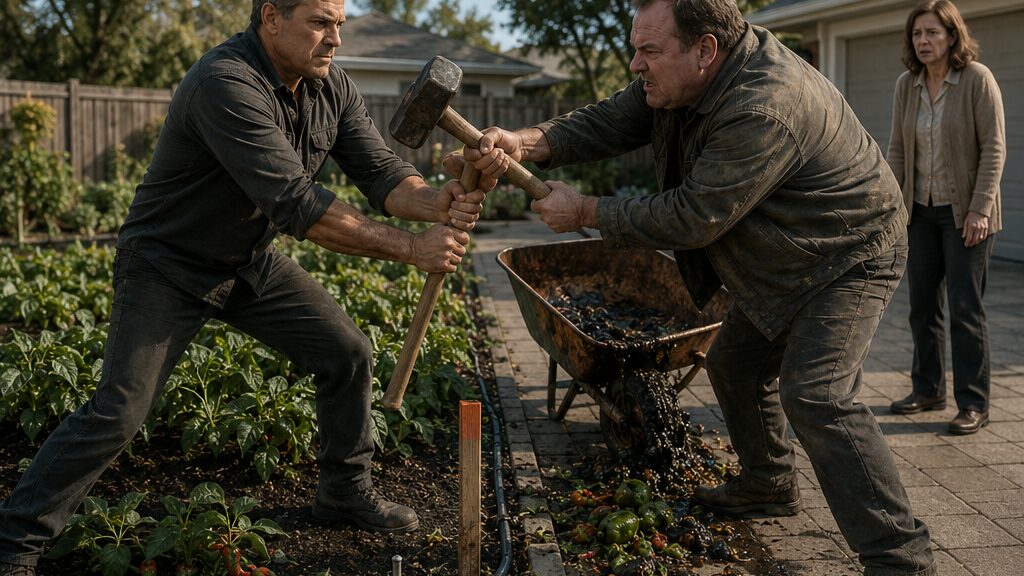
The sledgehammer stopped less than six inches above Daniel Garcia’s hand.
The steel head hung over the narrow garden bed, heavy enough to split the irrigation pipe beneath the soil and crush the roots of the pepper plants beside it. Anthony Walker still had both hands on the handle. His shoulders were turned into the swing. His face had already formed the expression of a man expecting impact.
Daniel’s right hand locked around the hickory shaft.
For one second neither man moved.
The wood gave a small, strained creak between their grips.
“That stake is on my property,” Daniel said.
Anthony’s mouth tightened. Sweat shone along his hairline despite the mild morning. Behind him, a rusted wheelbarrow leaned against the edge of the patio, its front tire sitting just over the pale seam that separated the two properties. Dark liquid dripped from the tray and gathered between the paving stones.
The wooden stake stood inside Daniel’s vegetable bed at an angle. Anthony had driven it through the mulch between two straight rows of peppers, nearly three feet from the surveyed boundary.
“You don’t need all this land,” Anthony said.
Daniel looked past him toward the neighboring yard. The side gate on Anthony’s property sagged inward. One hinge had torn loose from the post, leaving the narrow passage behind it clogged with a broken trellis, old bags of soil, and a lawn mower with no rear wheel.
Then Daniel looked down again.
The false stake had not been planted randomly. It sat directly above the irrigation branch running from the main line to the southern beds. If Anthony drove it deeper, the sharpened end would puncture the pipe. The stake also created a new imaginary edge that cut through two complete garden rows.
It was a claim made with lumber and force.
“Let go,” Anthony said.
“No.”
“It’s my hammer.”
“You swung it while I was standing here.”
“I was driving my marker.”
Daniel shifted his feet without releasing the handle. One boot rested beside the exposed corner of a metal survey cap buried flush with the soil. Catherine Lee had set that marker when Daniel rebuilt the patio and installed the raised beds. From the patio seam to the cap was thirty-four inches. From the cap to the center of Anthony’s stake was another thirty-one.
Daniel had measured it twice before Anthony arrived with the wheelbarrow.
“The property line runs from that pin to the rear marker,” Daniel said. “Thirty-four inches from the paving seam here. Your stake is sixty-five inches in.”
Anthony’s eyes flicked toward the metal cap.
It was a brief movement, but Daniel saw it.
“You’ve got some paper you paid for,” Anthony said. “I’ve got the original drawing.”
“What drawing?”
“The old layout. Before you started moving everything around.”
“I didn’t move the boundary.”
“You moved the drainage. You built those beds up. You paved over the old edge and then acted like your survey made it true.”
Daniel felt the hammer shift.
Anthony was testing his grip.
Daniel tightened his hand and stepped sideways, moving himself out of the direct path of the steel head. He could smell sour compost from the wheelbarrow. Several pepper plants behind Anthony lay bent under clumps of wet leaves and blackened stems.
The garden had taken Daniel three seasons to shape. Every bed had been leveled by hand. He had replaced the compacted soil, run irrigation beneath the rows, and aligned the patio stones so rainwater moved away from both houses. Nothing crossed the boundary. Nothing depended on goodwill.
That had been the point.
Anthony glanced toward the house.
Daniel followed his gaze and saw the small black camera under the eave above the back door.
“You recording me?” Anthony asked.
“The property is recorded.”
“So you admit it.”
Daniel did not answer.
Anthony suddenly released the hammer.
The full weight dropped into Daniel’s hand. He caught it against his forearm and stepped back to keep the steel head from striking the soil.
By the time he regained his balance, Anthony had already taken out his phone.
He raised it in both hands.
Daniel stood beside the shattered pepper plants holding the sledgehammer across his body.
Anthony backed onto his own side of the paving seam and began filming.
“Put it down,” he said loudly.
Daniel stared at him.
“Put the weapon down, Daniel.”
The performance was so clean that it chilled him more than the swing had.
“You brought it here.”
Anthony kept the phone aimed at him. “You took it from me.”
“You swung it beside my hand.”
“I was installing a boundary marker, and you attacked me.”
Daniel lowered the hammer head until it touched the mulch. He did not release the handle. If he placed it on the ground between them, Anthony could grab it again. If he carried it away, the video would show him walking through the garden with a weapon.
Anthony had arranged the scene before the first swing.
The wheelbarrow blocked the narrow route between the beds. The false stake stood inside Daniel’s property. The damaged plants and leaking debris looked like a messy argument unless someone knew when each thing had arrived.
Anthony’s phone would show only the moment after Daniel stopped the hammer.
“You knew the line before you came over,” Daniel said.
“I know where the line used to be.”
“You know where the survey pin is.”
“I know what you paid someone to tell you.”
Anthony lowered the phone long enough to tap the screen.
Daniel heard the emergency call connect.
“My neighbor has a sledgehammer,” Anthony said. His voice changed, losing its edge and gaining a breathless tremor. “He took it from me. He threatened me with it.”
Daniel looked toward the cameras.
One above the rear door. One beneath the garage light. Another disguised in the dark housing beside the rain gutter.
They had seen Anthony cross the seam. They had seen the wheelbarrow. They had seen the stake. At least one should have caught the swing.
Should was not the same as certainty.
Anthony gave the address, then looked directly at Daniel while speaking.
“Yes,” he said into the phone. “He’s still holding it.”
Chapter 2: What the Blower Left Behind
Four mornings earlier, Daniel’s irrigation timer clicked at 6:10, and black water rose between the lettuce plants.
He saw it from the kitchen window.
The first spray should have been clear, a low silver arc passing beneath the leaves. Instead, thick gray water pushed through the mulch and carried shreds of rotting stems across the bed.
Daniel was outside before the timer reached its second zone.
He shut the main valve beside the patio and knelt at the southern bed. The soil smelled sour. A cluster of lettuce nearest the irrigation head had collapsed under a coating of dark sludge. Tiny white threads clung to the underside of one leaf.
Fungal growth.
He removed the affected plants with gloved hands and placed them in a plastic tub. Beneath the mulch, the irrigation tubing had been nicked near the property edge. The cut was shallow, more crushed than sliced, but wide enough to pull contaminated runoff into the line when pressure changed.
A few feet away, a trail of wet debris led toward Anthony’s yard.
Daniel followed it to the paving seam.
The trail stopped there.
On Anthony’s side, the ground was dry except for two narrow tire marks from a wheelbarrow.
At 6:35, Anthony appeared with a gas-powered leaf blower strapped across his back.
He did not look at Daniel. He pulled the starter cord twice, and the engine erupted into a hard mechanical roar.
Anthony aimed the nozzle along his driveway. Dust lifted from the cracks. Leaves, gravel, and scraps of dried grass moved in a widening wave toward the space between the houses.
Daniel stood beside the damaged lettuce bed and watched the nozzle turn.
The blast crossed the boundary.
Dust struck the patio first, then small stones. Dead leaves spun against the legs of Daniel’s workbench. A torn fertilizer bag skated across the paving stones and lodged beneath a planter.
Daniel stepped to the seam and raised one hand.
Anthony kept the blower running.
The nozzle lifted slightly, directing the stream at Daniel’s chest. Dirt struck his shirt and face. He closed his eyes and turned his head until the blast moved past him.
When Anthony finally released the throttle, the sudden quiet seemed almost artificial.
“You’re blowing debris onto my property,” Daniel said.
Anthony pulled one earplug free. “It’s wind.”
“You aimed it.”
“You think you own the air now?”
Daniel wiped grit from his cheek. “Keep your equipment and waste on your side.”
Anthony looked over the garden. The tomato vines were tied evenly to cedar stakes. The patio tools hung beneath the awning in labeled rows. Even the watering cans sat upside down on a steel rack.
“You make the whole place look like a display,” Anthony said.
“It’s a garden.”
“It’s showing off.”
Daniel glanced toward the camera under the garage light. Anthony followed his eyes, then smiled without humor.
“Go watch your movie,” he said.
Later that morning, the wheelbarrow appeared.
Anthony pushed it along the shared side passage with both hands. Its tray was rusted through in two places. Wet material dripped onto the paving stones: spoiled leaves, grass clippings, moldy squash, and soil that smelled of standing water.
“You can’t bring that through here,” Daniel said.
Anthony stopped with the front wheel on Daniel’s side of the seam.
“I’m moving yard waste.”
“Use your driveway.”
“My gate’s blocked.”
“That doesn’t make this your route.”
Anthony pushed forward.
Daniel stepped in front of the wheelbarrow and placed one hand against the metal tray.
They remained that way for several seconds, Anthony leaning into the handles, Daniel holding the weight without shoving it back.
Then Anthony let go.
The wheelbarrow tipped sideways.
A heavy clump of debris slid out beside the pepper bed. Rotten liquid spread across the patio seam and seeped into the mulch.
Anthony looked down at it as though surprised.
“You knocked it over,” he said.
Daniel did not move his hand.
“You released it.”
Anthony took out his phone.
He photographed the wheelbarrow, the spill, and Daniel standing beside both.
Daniel noticed the angle. The camera frame included the blackened debris on his property but excluded the tire track leading from Anthony’s yard.
That evening Daniel sat in his home office and opened the security archive.
The cameras were synchronized to the same internal clock. He selected three views and moved through the morning minute by minute.
The rear-door camera showed Anthony aiming the blower across the seam. The garage camera caught the wheelbarrow entering from Anthony’s side. A narrow side camera recorded Anthony releasing the handles while Daniel’s palm rested flat against the tray.
Daniel exported the clips and placed them in a folder marked PROPERTY LINE.
Then he watched again.
At 8:17, after Daniel had gone inside for garbage bags, Anthony returned to the spill. He did not clean it. He crouched and used his shoe to press a second wheel track into the soft ground beside the garden.
Then he stepped back and photographed it.
Daniel paused the image.
Anthony had created the mark deliberately.
The photographs were not trophies. They were evidence for a story he intended to tell.
Daniel opened a blank incident form from the local government website. He entered the date, time, and description. At the line asking whether law enforcement had been contacted, he stopped.
Reporting the incident would bring questions, statements, perhaps a patrol car in the driveway. Anthony would turn it into a neighborhood spectacle. Debra would stand behind him looking exhausted. The argument would spread beyond the seam Daniel had kept so exact.
The cameras had everything.
Daniel saved the form without submitting it.
He told himself the archive was enough. Anthony knew the cameras were there. Once he understood that the spill, the blower, and the staged wheel tracks were preserved from several angles, he would retreat.
Daniel preferred consequences that did not require strangers.
The next day he repaired the irrigation line, removed the contaminated soil, and scrubbed the patio. He did not speak to Anthony.
On the third evening, an alert appeared from the side camera.
Anthony stood near his damaged gate holding a tape measure.
Daniel watched him extend it from the edge of his driveway to the paving seam. Anthony wrote the number on his palm. Then he measured from the seam across Daniel’s southern garden bed.
He walked the route twice.
On the third pass, he pushed the tape farther, stopping near the center of the pepper rows.
Daniel zoomed in.
Anthony turned toward his rear yard, sighting along the measurement as though imagining a clear passage through the garden.
Chapter 3: The Survey Drawing That Proved Too Little
Catherine Lee pressed her probe into the soil and frowned.
“The pin has moved.”
Daniel stood beside her at the front corner of the property. Catherine’s survey vehicle was parked in his driveway with the rear doors open. Cases of equipment lined the interior, each fitted into its own foam compartment.
“How far?” Daniel asked.
“Not far enough to relocate the legal boundary. Far enough to tell me someone disturbed it.”
She cleared soil from around the metal cap with a narrow hand tool. The pin leaned slightly toward Daniel’s garden. Fresh scratches marked one side, and the earth around it had been loosened in a rough oval.
Catherine looked up at him.
“When did you first notice this?”
“Yesterday.”
“That wasn’t my question.”
Daniel said nothing.
She sat back on one heel. “When did you first notice something was wrong at this corner?”
“The wheelbarrow came through four days ago.”
“And before that?”
“The blower.”
“Daniel.”
He looked toward Anthony’s house.
Anthony stood in his driveway holding a folded sheet of paper.
Catherine followed Daniel’s gaze and stood.
“You called me to verify a line,” she said quietly. “You didn’t tell me somebody had been interfering with the monuments.”
“I wanted verification before I made accusations.”
“The pry marks are verification.”
Anthony crossed his driveway before she could say more.
“There,” he said, opening the paper. “That’s the original.”
The sheet was yellowed and creased into quarters. It showed both properties from above, with a handwritten title identifying a landscaping proposal from more than twenty years earlier. A hedge was marked between the houses in a broken green line.
Anthony tapped it.
“That hedge was the boundary.”
Catherine accepted the paper by one corner. She studied the title block, the scale, and the handwritten notes.
“This is a landscape sketch,” she said.
“It shows the line.”
“It shows a hedge.”
“The hedge separated the lots.”
“That doesn’t make it a legal boundary.”
Anthony pointed toward Daniel’s garden. “The hedge was over there. Everybody knew it.”
“Where is it now?”
“Removed before we bought the place.”
“Then you never saw it.”
“I have the drawing.”
Catherine handed the sheet back. “This document was prepared for planting placement. It does not identify survey monuments, deed bearings, or recorded parcel dimensions.”
Anthony’s face reddened. “You work for him.”
“He hired me to survey his property. The recorded measurements don’t change according to who pays for the fieldwork.”
Daniel watched Anthony fold the sketch with unnecessary force.
Catherine placed a small instrument near the driveway and took a reading toward the rear of the lots. Then she unspooled a bright survey cord and stretched it from the front pin toward the rear marker.
The cord passed along the edge of Daniel’s patio, clear of every garden bed. It ran more than two feet from the closest pepper row.
Anthony stepped over it.
“You moved that,” he said.
Catherine looked down at his shoe beside the cord. “Step back, please.”
He did, but only after a pause.
“You people come in with machines and numbers,” he said. “You don’t know how the properties were used.”
“Use does not move a deed line by itself.”
Anthony took out his phone. He opened a series of photographs and held the screen toward Catherine.
The first showed the overturned wheelbarrow beside Daniel’s garden. The second showed two tracks in the damp soil. The third showed rotten debris spread near the pepper plants.
“He’s been dumping on that strip,” Anthony said. “Then he blames me.”
Daniel felt the accusation arrive before Catherine looked at him.
“I have footage,” he said.
Anthony gave a short laugh. “Of course you do.”
Catherine enlarged one photograph. “When was this taken?”
“Four days ago.”
“Who owns the wheelbarrow?”
Anthony’s expression changed.
“It’s old,” he said. “Could belong to anyone.”
“It came from your yard,” Daniel said.
“That’s what you say.”
Catherine returned the phone. “Photographs of debris do not establish ownership of land.”
“They establish use.”
“No. They establish that debris was present when you took the pictures.”
For the first time that morning, Anthony seemed uncertain. The hesitation lasted only a moment.
Then he pointed at the garden.
“He built everything after buying the place. Beds, paving, irrigation. Now water comes toward my foundation.”
Daniel answered before Catherine could.
“The patio grade moves water toward the street.”
“You don’t know what happens underground.”
“I installed it.”
“That’s the problem. You think because you built something, you control everything.”
The words struck closer than Daniel expected.
Catherine knelt beside the loosened pin again. “This monument was installed during the subdivision survey and verified when Daniel’s improvements were planned. The marks around it are recent. Someone tried to shift it.”
Anthony folded the old drawing and put it under his arm.
“Maybe your installation was bad.”
“The pin is older than either of us owning these houses.”
“You can say whatever you want.”
“No,” Catherine said. “I can say what the measurements support.”
Anthony looked at Daniel. “This isn’t finished.”
He returned to his driveway, carrying the obsolete sketch like a verdict.
Catherine waited until his door closed.
“You need to create an official record today,” she said.
“I have recordings.”
“Recordings stored in your house.”
“And backed up remotely.”
“That isn’t the point.”
“It proves what happened.”
“It may prove individual events. It does not explain why you allowed repeated access without reporting it.”
Daniel’s jaw tightened. “Allowed?”
“You saw the interference. You saw the dumping. You knew the monument might have been disturbed. Yet there is no complaint, no neutral inspection, and no dated notice to him.”
“I called you.”
“After several days.”
“You verified the line.”
“And I’m telling you the line is only part of the problem.”
Daniel gathered the loose end of the survey cord. “I don’t need a patrol car in my driveway because a neighbor dumped yard waste.”
Catherine looked toward the damaged lettuce bed, where the replacement plants were smaller than the rest.
“You may not get to choose how large this becomes.”
He wound the cord more quickly than necessary.
“I asked you to check the markers.”
“I checked them. One has been tampered with. The old drawing has no authority. Your beds are inside your property.” She placed the probe back into its case. “Those facts help you. Your silence does not.”
Daniel carried the equipment case to her vehicle without answering.
Catherine closed the rear doors.
“Send him written notice,” she said. “Submit an incident report. Preserve the footage. Do not touch anything else he places near the line until it has been documented.”
“I know how to handle my property.”
Her expression hardened.
“That is what you keep saying.”
She drove away.
Daniel remained in the driveway until the survey vehicle turned out of sight. The bright cord still stretched along the exact boundary, dividing the clean patio from Anthony’s uneven strip of gravel.
A movement near the side passage caught his attention.
Debra Walker stood beside the sagging gate.
She looked toward Anthony’s windows before approaching. She stopped on her side of the paving seam and held out a photograph.
Daniel took it.
The image showed Anthony in his garage, shaping the point of a wooden stake with a power saw. A sledgehammer rested against the workbench behind him.
Debra kept her voice low.
“He isn’t making just one.”
Edit
Chapter 4: Debra’s Warning Came With a Condition
“The next stake won’t be a bluff,” Debra said. “He already put the sledgehammer in the wheelbarrow.”
She stood on Anthony’s side of the paving seam, her arms drawn close to her body despite the warm evening. Daniel remained on his porch step, holding the photograph she had given him.
In the image, Anthony leaned over a workbench in the garage, sharpening one end of a wooden stake. Two more lengths of lumber rested beside him. The sledgehammer against the wall was the same one Daniel had seen Anthony use to break paving stones the previous summer.
“When did you take this?” Daniel asked.
“This afternoon.”
“Does he know?”
“No.”
Debra looked toward her house. The garage door was closed now, but a narrow line of light showed beneath it.
Daniel turned the photograph over. Nothing was written on the back.
“What did he say he was going to do?”
“Put the boundary back where it belongs.”
“He knows where it belongs. Catherine showed him.”
“He says she’s protecting you.”
“She measured it in front of him.”
“I know what she did.”
Her voice sharpened, then softened again. “That doesn’t matter to Anthony anymore.”
Daniel folded neither the photograph nor his expression. He studied Debra instead. She had been present during several arguments over the past year, usually standing behind Anthony with one hand against her opposite wrist. She had never agreed with him aloud. She had never contradicted him either.
“Why are you telling me?” he asked.
Debra’s gaze dropped to the seam between them.
“Because his gate is worse than he admits.”
Daniel waited.
“The retaining edge beside the passage has started collapsing. He can’t get the mower or the small trailer through anymore. A contractor told him the gatepost and the wall both need to be rebuilt.”
“That has nothing to do with my garden.”
“He thinks it does.”
She pointed toward the back of the properties. From where they stood, Daniel could see the upper corner of Anthony’s sagging gate and the narrow route beyond it.
“He wants to come through your side,” she said. “From the driveway, across the edge of the patio, then through that lower garden strip to the rear yard.”
Daniel pictured the measurements recorded by the camera: from Anthony’s driveway to the seam, from the seam through the pepper beds, then toward the back.
“He wants an access lane.”
“He says it used to be open before you built the beds.”
“It was never his access.”
“He says the old hedge proves people treated it that way.”
“The old hedge proves someone planted a hedge.”
Debra rubbed her thumb against the side of one finger. “The repair estimate is more than he can pay.”
Daniel looked toward Anthony’s house again. The peeling trim, the cracked driveway edge, the gate leaning under its own weight—he had seen all of it. He had not connected the damage to the campaign against his garden.
“He could have asked,” Daniel said.
“He did ask.”
“No. He told me I should remove the southern beds because they made the space crowded.”
“That was him asking.”
“That was him deciding what the answer should be.”
Debra gave a small, tired nod. “That’s how he asks now.”
A car passed at the end of the street. Both of them watched it until the sound faded.
“What does he plan to do with the stake?” Daniel asked.
“Drive it in. Take pictures. Then wait for you to pull it out.”
Daniel looked at the photograph again.
“He expects me to remove it.”
“He says once you destroy a boundary marker, he can prove you knew it was real.”
“It isn’t a boundary marker.”
“I know.”
“He knows too.”
Debra did not answer.
That silence carried more weight than agreement.
Daniel stepped down from the porch. Debra immediately moved back, keeping the seam between them.
“He’s been taking pictures of the mess he creates,” Daniel said. “The wheelbarrow tracks. The debris.”
“I saw some of them.”
“He staged the tracks.”
“I believe you.”
“He loosened the real survey pin.”
Her face changed. Not surprise exactly. More like confirmation of something she had hoped was still untrue.
“Did you report it?” she asked.
“I called Catherine.”
“That isn’t what I asked.”
Daniel felt irritation rise, partly because her question sounded too much like Catherine’s.
“I have recordings.”
“Recordings don’t stop him from swinging a hammer.”
“I’m not going to let him swing it.”
Debra looked directly at him then.
“That is exactly what he wants you to think.”
Daniel held the photograph at his side.
“I can move the visible cameras,” he said. “Add another angle near the rear bed. If he crosses the line, it will be recorded before he touches anything.”
“You’re talking about cameras again.”
“They show what happened.”
“After it happens.”
“He won’t get far.”
Debra’s expression closed.
“You think because you’re stronger than he is, you can control how this ends.”
Daniel did not answer.
The accusation felt unfair. It also felt accurate enough to anger him.
“I have never threatened your husband.”
“I didn’t say you had.”
“I have kept this on my property.”
“I know.”
“I repaired the damage myself. I didn’t involve the street. I didn’t call people over to watch.”
“I know.”
“Then what are you asking me to do?”
Debra glanced toward the closed garage.
“Stop him without telling him I warned you.”
“That leaves me with cameras.”
“You could call someone.”
“And say what? My neighbor made wooden stakes in his garage?”
“You have the photograph.”
“A photograph you asked me to hide.”
Her mouth tightened.
Daniel saw the trap they had made together before either of them admitted it. She wanted intervention without exposure. He wanted proof without outside involvement. Both required Anthony to act first.
“Has he threatened you?” Daniel asked.
“No.”
The answer came too quickly.
“Debra.”
“He hasn’t touched me.”
“That wasn’t my question.”
She took another step backward. “This is about the property.”
“It stopped being only about the property when you came here in secret.”
For a moment she looked as if she might leave. Then she reached into her pocket and took out a small brass key.
“The side gate padlock,” she said. “He changed it last week so I couldn’t move the mower out through the driveway.”
Daniel did not take the key.
“Why?”
“Because I told him to pay for the repair and leave your garden alone.”
The garage light went out.
Debra closed her fingers around the key.
“He said I always take everyone else’s side,” she continued. “The contractor’s. Catherine’s. Yours.”
“I don’t want you in the middle.”
“I’m already there.”
A shadow moved behind the blinds of Anthony’s kitchen.
Debra lowered her voice. “I told him if he crossed onto your property again, I was done defending him.”
Daniel looked at the photograph. “Does he believe you?”
“He thinks I’ll calm down.”
“And will you?”
Her eyes moved toward the house, then back to Daniel.
“That depends on what he does next.”
She turned before he could answer.
“Debra.”
She stopped.
“If this happens tomorrow, I may have to show the photograph.”
“Not unless there is no other choice.”
“There may not be.”
“Then make sure there isn’t.”
She walked back toward her driveway without crossing the seam.
Daniel remained beside the porch until her door closed.
Inside, he opened the camera system.
He changed the side camera’s angle to include the lower garden bed. He activated a small unit concealed beneath the rain gutter and another inside the dark housing above the tool rack. The visible camera over the garage remained where Anthony expected it.
Daniel placed Debra’s photograph in the PROPERTY LINE folder, then hesitated before adding her name to the file description.
He left it unnamed.
At 4:48 the next morning, his phone vibrated on the bedside table.
A motion alert filled the screen.
Anthony stood beneath the garage camera carrying a short ladder. He climbed, covered the lens with one hand, and tore the camera from its mount.
The feed went black.
Three smaller windows continued recording.
In one of them, Anthony climbed down and smiled at the dead camera in his hand.
Chapter 5: The False Line Became a Weapon
The wheelbarrow struck the edge of the pepper bed and tipped before Daniel reached it.
Rotten leaves, blackened squash, and wet soil slid over the rim. The load poured across Daniel’s shoes and buried three young pepper plants beneath a sour, steaming heap.
Anthony held the handles until the last clump fell.
Then he let the wheelbarrow drop.
“You’re done,” Daniel said.
Anthony pulled a wooden stake from beneath the tray.
Its point had been sharpened cleanly. Pencil marks crossed one side at six-inch intervals. Near the top, Anthony had painted a band of bright orange.
He carried it into the garden.
Daniel stepped between him and the bed. “Take it back.”
“This is where the line goes.”
“You watched Catherine mark the line.”
“I watched someone you hired string a cord through my property.”
“The pin is behind your heel.”
Anthony looked down but did not move.
The true metal cap sat partly exposed near the paving seam. Daniel had cleared the soil around it that morning and photographed it from four angles. From there, the legal boundary ran straight toward the rear marker, outside every cultivated row.
Anthony planted the false stake more than two feet inside that line.
“You’re blocking access I’ve had for years,” he said.
“You never used this as access.”
“It was open before you built all this.”
“This is my land.”
“You don’t need every inch.”
Anthony pressed the stake into the mulch by hand.
Daniel glanced toward the wheelbarrow. The sledgehammer lay beneath a strip of stained canvas.
“Move the stake,” Daniel said.
“No.”
“Move the wheelbarrow and get off my property.”
Anthony took out his phone and photographed the stake standing among the pepper plants.
The frame excluded the true survey pin.
“You know what happens now?” he asked.
Daniel’s hands remained at his sides.
“You spend months arguing about whether that belongs there. You pay another surveyor. You call the city. You drag papers around. Meanwhile, it stays.”
“No, it doesn’t.”
Anthony smiled.
“That’s what I’m counting on.”
He took another photograph.
Daniel understood then that removing the stake was only the first trap. Anthony wanted an image of it upright and another of it destroyed or missing. The time between those images would become whatever story Anthony needed.
Daniel stepped around him and gripped the wheelbarrow handles.
“I’m moving this back across the line.”
Anthony put one boot against the front wheel.
“Don’t touch my property.”
“It’s on mine.”
“Everything’s yours, isn’t it?”
Daniel pulled once. The wheel caught against the patio edge.
Anthony leaned his weight into it.
The rusted tray shifted sideways, grinding over the buried pepper plants. Dark liquid leaked through a hole in the metal and ran into the irrigation trench.
Daniel released the handles before the wheelbarrow crushed more stems.
Anthony laughed under his breath.
“There. Patience.”
Daniel looked at him.
“That’s what you like people to think,” Anthony said. “That you’re patient.”
“I’m giving you a chance to leave.”
“No. You’re waiting for the right camera angle.”
Daniel’s eyes flicked toward the empty mount above the garage.
Anthony noticed.
“I took care of that.”
“You took care of one.”
The smile left Anthony’s face.
For the first time that morning, he scanned the eaves, gutter, and porch.
Daniel wished he had said nothing.
Anthony reached beneath the canvas and lifted the sledgehammer.
The handle scraped along the wheelbarrow tray. He rested the steel head on one shoulder and walked toward the stake.
Daniel moved in front of him.
“Put it down.”
“I’m setting my marker.”
“You have no right to drive anything into this bed.”
“Then stand aside and let the paperwork decide.”
“The paperwork already did.”
“Your paperwork.”
Anthony lowered the hammer head beside the stake. “You think those vegetables make you important? You think because your patio is clean and your tools hang straight, you get to decide how everybody else lives?”
“This isn’t about how you live.”
“You built a wall without building a fence.”
“I stayed on my side.”
“You made your side look like mine was failing.”
Daniel stared at him.
The anger in Anthony’s face did not erase the humiliation beneath it. The broken gate was visible behind him. So was the leaning retaining edge and the mower trapped beyond the passage.
“You could have asked for temporary access,” Daniel said.
“I shouldn’t have to ask for what was already there.”
“It was never yours.”
Anthony gripped the hammer with both hands.
“Move.”
Daniel did not.
The space between them narrowed to the width of the handle.
“If you swing that,” Daniel said, “you may hit me.”
“Then don’t stand where my property is.”
Anthony raised the hammer.
Daniel stepped sideways, trying to reach the stake first. If he could pull it free and place it intact on the patio, the cameras would show restraint. His fingers closed around the orange-painted top.
Anthony shifted toward him.
The hammer rose higher.
Daniel looked up.
Anthony’s eyes were not on the stake. They were on Daniel’s hand.
“Don’t,” Daniel said.
The swing began.
Daniel released the stake and caught the handle below Anthony’s grip. The impact drove through his wrist and shoulder. The steel head stopped above the bed, close enough to stir the leaves.
Anthony pushed down.
Daniel turned his body, bringing the handle across his forearm instead of fighting the weight directly.
“Let go,” Anthony grunted.
Daniel pivoted.
Anthony’s momentum carried him one step forward. Daniel twisted the shaft, stripped the upper grip free, and pulled the hammer against his chest.
Anthony stumbled into the wheelbarrow.
For one clean second, Daniel held the weapon and Anthony held nothing.
Daniel could have set it down.
He could have stepped back and waited.
Instead, he looked at the false stake standing among the crushed peppers.
The days of grit, sludge, staged photographs, loosened metal, and silent threats compressed into the orange band near its top.
Daniel turned the hammer.
He drove the steel head downward.
The impact split the stake through its center.
Wood burst across the garden. One half folded into the mulch. The other shot over the paving seam and landed near Anthony’s shoe.
Silence followed.
Daniel’s hands remained on the handle.
A hard satisfaction passed through him—brief, hot, unmistakable.
Then he saw Anthony’s phone.
It rested against the wheelbarrow tray, propped upright. Its camera faced the garden.
From that angle, it might not have captured the swing Anthony initiated. The wheelbarrow blocked the lower half of Daniel’s interception. What it clearly showed was Daniel holding the hammer and smashing a painted stake.
Anthony reached for the phone.
“You threatened me,” he said.
Daniel lowered the steel head to the ground.
“You swung first.”
“You destroyed a boundary marker with a sledgehammer.”
“You brought both.”
“You attacked me.”
Anthony backed toward his driveway, phone raised.
Daniel looked at the scattered splinters. Some lay on his side. Some had crossed the true line. The orange-painted section rested beside the exposed metal survey cap, false color next to recorded steel.
A siren sounded at the end of the street.
Anthony pointed at Daniel as the first patrol vehicle turned into view.
Daniel still held the sledgehammer.
Chapter 6: Every Camera Saw a Different Truth
“Drop the hammer and step away from it.”
The officer’s command came before the patrol car door had fully closed.
Daniel released the handle.
The sledgehammer struck the patio with a dull steel sound. He raised both hands and stepped backward between the garden beds.
Anthony stood in his driveway filming.
“That’s him,” he called. “He took it from me and smashed the marker.”
The officer looked from Anthony to Daniel, then to the broken stake, crushed plants, and overturned wheelbarrow.
“Keep your hands where I can see them,” the officer told Daniel.
Daniel obeyed.
A second officer arrived and moved toward Anthony. The two men were separated to opposite sides of the driveway while the first officer photographed the hammer where it lay.
“Who owns it?” he asked.
“Anthony does,” Daniel said.
Anthony answered from several yards away. “He stole it out of my hands.”
The officer looked at Daniel. “Did you take it from him?”
“I stopped him from swinging it while I was beside the stake.”
“So yes?”
“Yes. I took control of it.”
“Then what happened?”
“I broke the false stake.”
The officer’s expression did not change. “Why?”
Daniel looked at the splintered wood.
“Anger.”
Anthony gave a sharp laugh. “There. He admitted it.”
The second officer told him to remain quiet.
The first officer asked Daniel to sit at the patio table. “Do you have identification?”
“In the house.”
“Anyone else inside?”
“No.”
The officer retrieved the identification with Daniel’s permission, then returned to the table.
Anthony approached the edge of his driveway holding his phone and the folded landscaping sketch.
“I have proof,” he said.
The second officer accepted both.
On the phone, Anthony played a short clip. It began with Daniel already holding the hammer. Anthony’s voice came from behind the camera.
Put it down, Daniel.
The clip showed the steel head rising and crashing into the painted stake. It ended before the sirens arrived.
The first officer watched it twice.
“That’s not the beginning,” Daniel said.
“It’s what I recorded,” Anthony replied.
The officer unfolded the old sketch. “And this?”
“The original boundary.”
“It’s a landscaping plan,” Daniel said.
“Let him talk,” the officer replied.
Anthony pointed toward the broken stake. “That line was there before he bought the property. He built the garden across it, and when I marked it, he came at me with the hammer.”
Daniel felt the scene narrowing around the easiest image: him standing with a weapon beside shattered wood.
“I have security footage,” he said.
Anthony folded his arms. “Of course he does. He records us constantly.”
“How many cameras?” the officer asked.
“Four covering this area. One was disabled this morning.”
“Disabled by whom?”
“Anthony.”
Anthony turned toward him. “You can’t prove that.”
Daniel almost answered. Then he stopped.
“I can show you.”
The officer allowed him to bring a tablet from the house while the second officer remained at the door. Daniel opened the security archive and selected the visible garage camera first.
The footage showed Anthony climbing the ladder and tearing it down.
“That’s my privacy,” Anthony said. “It was aimed at my house.”
“It was aimed at Daniel’s driveway,” the officer replied.
Daniel switched to the rear-door view.
At first, it seemed useful. Anthony entered the garden with the stake and wheelbarrow. But the corner of the house blocked the start of the hammer swing. By the time both men appeared clearly, Daniel had already taken the handle.
Anthony pointed at the screen. “There. He grabbed it.”
The garage-light camera showed the wheelbarrow tipping, but the tray obscured Anthony’s hands. The gutter camera captured the swing from above, though the angle compressed the distance between the hammer and Daniel’s body.
No single view told the whole story.
The officer leaned closer. “Can these be synchronized?”
“Yes.”
Daniel opened the timeline controls and aligned all three recordings by timestamp.
The screens played together.
In the first window, Anthony tipped the wheelbarrow and planted the false stake. In the second, he placed his phone against the tray. In the third, he raised the hammer while Daniel’s hand remained on the stake.
Daniel slowed the playback.
Anthony’s shoulders turned. The hammer descended.
Daniel released the stake and caught the handle.
The officer watched without speaking.
Daniel continued through the moment he stripped the weapon away, paused, then smashed the stake.
“That last strike wasn’t necessary to protect yourself,” the officer said.
“No.”
Anthony seized on the answer. “Exactly.”
“But the earlier swing was toward him,” the second officer said.
“I was hitting the marker.”
“With him beside it,” the first replied.
Anthony’s face reddened. “He stepped in front of me.”
Daniel opened earlier footage: the blower, the wheelbarrow spill, the staged wheel tracks, the measurements across the garden. Then he displayed Catherine’s survey file and photographs of the loosened pin.
The evidence did not produce the clean silence Daniel had imagined. It produced more questions.
“Why didn’t you report the earlier incidents?” the officer asked.
“I documented them.”
“That isn’t what I asked.”
Daniel looked at the tablet.
“I thought the recordings would make him stop.”
“Did you tell him he was being recorded?”
“He knew about the visible cameras.”
“Did you know he intended to return with a hammer?”
The question settled over the patio.
Anthony looked toward Debra’s house.
Daniel felt the unnamed photograph inside the digital folder like an object in his pocket.
“I knew it was possible,” he said.
“How?”
Daniel did not answer immediately.
The officer closed the tablet cover halfway. “This matters.”
“I received a warning.”
“From whom?”
Anthony stepped forward. “What warning?”
The second officer blocked him with one arm.
Daniel saw Debra standing inside her open doorway. She had been there long enough to hear the question.
He had promised not to expose her unless there was no other choice. That promise had helped him avoid making the call Catherine recommended. It had also allowed him to believe he could build the perfect record by letting Anthony cross the line again.
Daniel looked at Debra.
“I should have reported it when you gave me the photograph,” he said.
Anthony turned toward her.
“What photograph?”
Debra remained in the doorway.
Daniel continued before she could retreat.
“I thought I could control the situation. I thought the cameras and the survey would be enough. They weren’t.”
The officer looked at Debra. “Ma’am, did you warn him?”
She stepped outside slowly.
Anthony’s voice dropped. “Debra.”
She crossed the driveway but stopped short of the paving seam.
“Yes,” she said. “I warned Daniel.”
Anthony stared at her.
“You took pictures of me?”
“I took one.”
“You went behind my back.”
“I asked you to stop.”
“You helped him set this up.”
“No.”
“You gave him evidence.”
“I gave him a warning because you put a hammer in that wheelbarrow.”
Anthony looked at the officers. “She’s angry about money. This has nothing to do with the property.”
“It has everything to do with what you keep doing when somebody tells you no,” Debra said.
He took one step toward her.
The second officer moved between them.
Debra did not move back.
“I told you the last time you crossed that line,” she said, pointing toward the seam, “that I would not stand beside you again.”
Anthony’s mouth opened, but she kept speaking.
“You crossed it this morning. You took the hammer. You knew exactly what that meant.”
The patio fell quiet.
Debra looked at Daniel only once.
Then she faced Anthony.
“I already packed.”
Edit
Chapter 7: The Boundary Held After Everyone Left
Anthony pointed at Debra as though the officers had misunderstood which person required restraint.
“Tell them,” he said. “Tell them Daniel turned you against me.”
Debra did not answer. She walked to her car, opened the rear door, and removed two suitcases already packed tightly enough that the fabric bulged around the zippers.
Anthony stared at them.
“You planned this.”
“I prepared for what you kept promising to do.”
“I was fixing the property line.”
“You were breaking another thing we couldn’t afford to repair.”
His face tightened. “This is about money now?”
“It has been about money for months.”
The responding officer stepped between them before Anthony could move closer. Daniel remained beside the patio table, the tablet closed beneath one hand. Beyond them, the wheelbarrow still leaked into the mulch. Broken pieces of the orange-painted stake lay across both properties.
Debra set the suitcases beside the car.
“I paid the plumbing bill when you said the contractor cheated you,” she said. “I covered the gate estimate you never paid. I told people the yard looked like that because we were waiting for materials.”
Anthony glanced toward the officers. Shame passed across his face, then hardened into anger.
“You told him all this?”
“No.”
“She didn’t,” Daniel said.
Anthony turned toward him. “Stay out of my marriage.”
Daniel almost replied that Anthony had brought the marriage into the garden himself. He stopped before saying it. The argument no longer needed another edge.
The officer asked Debra whether she felt safe entering the house to retrieve anything else.
“I took what I needed last night.”
Anthony looked at her as if the suitcases had become more damaging than the footage.
“You thought I would do this.”
“I hoped you wouldn’t.”
“You photographed me in my own garage.”
“I photographed the hammer because you told me you were going to make Daniel remove the stake.”
“I said he’d show his true colors.”
Debra looked toward the shattered wood.
“He did lose his temper,” she said. “And then he admitted it.”
Anthony’s eyes moved to Daniel.
Daniel felt no victory in the comparison. The broken stake had given him one second of satisfaction and left him standing with a weapon when the patrol cars arrived. The footage explained the danger. It did not erase his choice.
The officer returned to the patio table with a form.
“We have enough to document trespass, property damage, interference with the survey monument, and the attempted strike,” he said. “The exact charges will be reviewed. But for the property offenses, Mr. Garcia needs to state whether he wants to proceed.”
Anthony laughed once. “Of course he does.”
Daniel looked at the form.
His name had already been printed at the top. Beneath it was a blank line for his signature.
Signing felt different from saving video. A recording remained private until needed. A signed complaint left his hands and entered a system he could not arrange, repair, or control.
“Can the damage be documented without me signing this now?” he asked.
“It can be photographed and noted,” the officer said. “But your willingness to cooperate matters.”
Anthony shook his head. “He knows this was mutual.”
Daniel looked at the crushed pepper plants, then at the exposed metal survey cap. One bright splinter lay beside it, the false marker close enough to touch the real one.
A vehicle stopped at the curb.
Catherine stepped out carrying a hard equipment case. Daniel had sent her a message after the officers arrived, asking whether she could provide the survey file. He had not expected her so quickly.
She approached the driveway, took in the officers, the hammer, and the broken stake, then looked at Daniel.
“You waited,” she said.
It was not a question.
“Yes.”
Catherine placed the case on the ground and showed the officer her identification and the recorded survey. She explained the pin positions, the fresh disturbance around the front monument, and the difference between the legal parcel line and Anthony’s landscaping sketch.
Her account was precise and unsympathetic to everyone.
When the officer asked whether the destroyed wooden stake could have been mistaken for an official marker, Catherine examined a fragment.
“No survey identification, no cap, no license number, no reference mark,” she said. “It was recently cut and painted.”
Anthony pointed toward the old drawing. “The line is on that paper.”
“The hedge is on that paper,” Catherine replied. “The line is in the recorded measurements.”
She turned to Daniel.
“And the record should have begun when the first marker was disturbed.”
Daniel looked again at the unsigned form.
“I thought documenting everything myself was enough.”
“It documented the acts,” Catherine said. “It did not stop the next one.”
Anthony made a sound of disgust. “So now everybody gets to lecture me while he walks away clean?”
Daniel met his eyes.
“No.”
He picked up the pen.
“I smashed the stake after I had the hammer under control. That was mine.”
The officer nodded once. “It will be included.”
Daniel signed.
Not because Anthony was watching. Not because Debra had packed. Not because Catherine had been right.
He signed because the next boundary could not depend on whether he happened to be stronger than the person crossing it.
The officers placed Anthony in handcuffs only after he refused twice to remain separated from Debra. There was no struggle. He looked smaller without the phone, the sketch, or the hammer in his hands.
As they guided him toward the patrol car, he looked back at Daniel.
“You got what you wanted.”
Daniel stood beside the damaged bed.
“No,” he said. “I got what I should have done earlier.”
The car door closed.
Debra loaded the suitcases into her vehicle. She did not look relieved. She looked exhausted.
At the edge of the driveway, she paused beside Daniel.
“I asked you to keep me out of it.”
“I know.”
“You should have called anyway.”
“I know that too.”
She glanced at the garden. “Are the peppers ruined?”
“Some.”
“I’m sorry.”
Daniel looked toward Anthony’s empty driveway, the sagging gate, and the passage that had started the entire dispute.
“So am I.”
Debra drove away without waving.
By late afternoon, the officers were gone. Catherine had placed temporary flags along the verified line and sent Daniel copies of the updated field notes. The hammer had been taken as evidence. The leaking wheelbarrow remained where Anthony had abandoned it until Daniel received permission to move it.
The garden looked worse in the quiet.
Daniel lifted contaminated soil into heavy bags. He removed crushed plants, flushed the damaged irrigation branch, and separated pieces of the false stake from the mulch. Proof had protected the truth. It had not protected the lettuce, the peppers, or the hours required to restore them.
The next morning, Daniel replaced the broken tubing.
He worked without opening the camera application.
At 6:10, the irrigation timer clicked.
For a moment, nothing happened.
Then clear water rose beneath the leaves in low, even arcs.
Daniel watched the soil darken around the surviving plants. At the boundary, he found one final splinter marked with orange paint.
He swept it across the paving seam onto Anthony’s side.
The cameras continued recording above him.
Daniel left them running.
He did not look up.
The story has ended.