The Police Broke His Gate Before Learning Whose Ground They Had Entered
Chapter 1: The Vapor Beyond the Steel Gate
The Halligan tool struck the reinforced gate before Jonathan Hall finished reading the first air-quality report.
Steel rang across the compound with the flat violence of a dropped girder. On the monitor beside him, a patrol officer stepped back from the gate while the man in charge lowered one hand as if the blow had been a reasonable way to knock.
Jonathan looked from the screen to the diagnostic panel.
Oxygen normal. Carbon monoxide undetectable. Refrigerant pressure stable. Exterior particulate level lower than the morning average for the street.
Another white plume rolled above the privacy fence, thinned in the sunlight, and vanished.
The workshop’s cooling system was doing exactly what it had been designed to do.
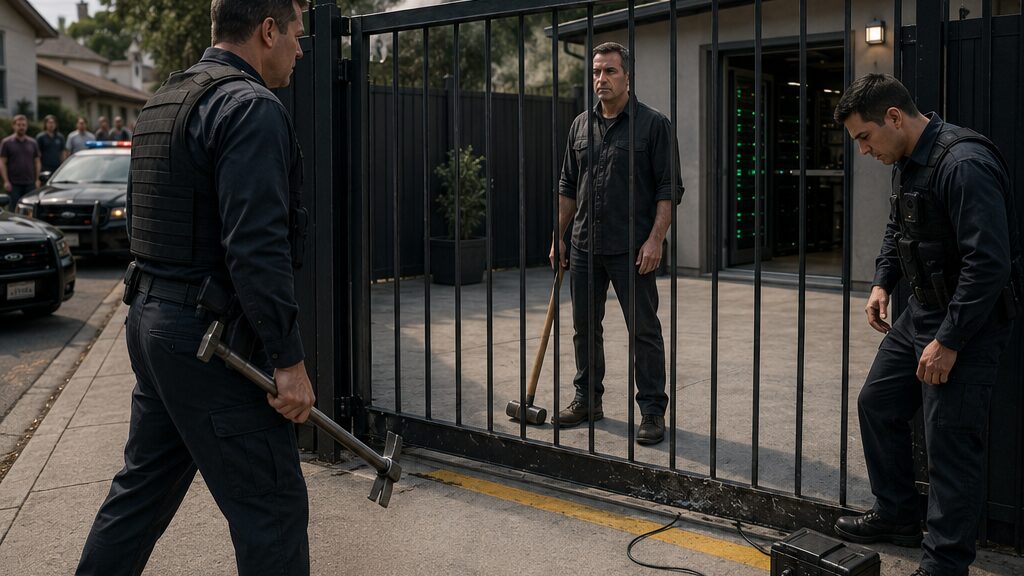
Jonathan left the detached building and crossed the concrete yard. The reinforced rolling gate blocked the driveway from pillar to pillar. A narrow yellow line followed its inner track, marking the legal boundary with almost excessive clarity.
Beyond it stood three officers and two cruisers.
The patrol supervisor was broad through the chest, his dark uniform strained beneath a protective vest. His nameplate read MITCHELL.
“Jonathan Hall?” he called.
“Yes.”
“Paul Mitchell. Patrol supervisor.” He pointed toward the vapor drifting above the eastern wall. “We received multiple reports of a possible hazardous discharge.”
“It’s water vapor from the heat-exchange system.”
“We need to verify that.”
Jonathan stopped several feet behind the line. “I’ve already verified it.”
Paul’s expression did not change. “We need to verify it.”
“Do you have a warrant?”
“This is a public-safety check.”
“That wasn’t my question.”
One of the officers glanced at Paul. The Halligan tool remained in his hands, its hooked end resting near the lower gate rail.
Paul stepped closer. “A resident reported that your system is venting poisonous gas into the street.”
“No gas is entering the street.”
“There’s a cloud over your fence.”
“There’s condensation above my fence.”
“You understand how that sounds?”
Jonathan looked past him. A woman in a robe stood across the street with one arm around a boy in school clothes. Two other neighbors watched from behind a parked car.
The woman raised her voice. “My son started coughing when that stuff came out.”
The boy looked embarrassed rather than sick. He pulled at his backpack strap while his mother pointed toward the vapor as if it were smoke from a burning building.
Jonathan felt the first tightening behind his ribs.
He had spent six months designing the exterior sensor array so no accusation like this could survive contact with measurements. The data was mirrored locally, time-stamped, and stored on hardware physically isolated from the protected systems inside the workshop.
Preparation was supposed to prevent improvisation.
He pressed a control on his phone. A weatherproof display mounted on the inner gatepost lit up.
Temperature. Humidity. Airborne particles. Volatile compounds. Carbon monoxide. Refrigerant traces.
Every indicator showed green.
“That is a live exterior reading,” Jonathan said. “The sensor is three feet from the public sidewalk. You can photograph it without entering.”
Paul studied the display for only a moment. “Your sensor.”
“Yes.”
“Connected to your system.”
“An independent environmental controller.”
“Maintained by you.”
Jonathan heard the trap in the rhythm. Anything under his control would be treated as evidence of deception. Anything beyond his control would be demanded as permission to enter.
“I can give the fire department a live feed,” he said.
Paul looked toward the workshop roof. The building had no sign, no windows facing the road, and no visible business name. Only intake housings, exhaust stacks, security cameras, and a steel service door broke its plain exterior.
“What exactly are you running back there?”
“A private computing workshop.”
“What kind of computing?”
“The lawful kind.”
Paul’s jaw shifted.
Jonathan had answered accurately. He also knew how it sounded.
The supervisor gestured toward the gate. “Open it. We’ll inspect the cooling unit, confirm there’s no hazard, and leave.”
“No.”
The answer landed harder than Jonathan intended.
The officer with the Halligan tool looked at him more carefully.
Paul said, “You’re refusing a safety inspection?”
“I’m refusing warrantless entry onto secured property. You may inspect from the public side. You may review the environmental data. You may request the fire department. You may seek a warrant.”
“There could be people exposed right now.”
“There aren’t.”
“You can’t be the only person who decides that.”
“And you can’t make entry lawful by changing its label.”
For the first time, Paul’s composure slipped. It was only a slight tightening around the eyes, but Jonathan recognized it. He had seen the same look on officials who believed the uniform itself should end discussion.
Paul turned to the other officers. “Start a perimeter check.”
Jonathan moved closer to the gate. “Do not touch the fence, the gate mechanism, or anything extending across the marked line.”
Paul looked down at the yellow paint.
“What’s that supposed to be?”
“The property boundary.”
“The fence already tells us where the property is.”
“The line tells you precisely.”
A radio crackled at Paul’s shoulder. He listened, answered with a code, then walked several steps away. Jonathan watched his posture change as he spoke. His voice remained controlled, but his gestures sharpened.
The woman across the road had begun filming.
So had another neighbor near the corner.
Jonathan returned to the workshop long enough to bring up the camera grid. Three officers. Two cruisers. The woman and her son. The vapor plume recurring at forty-second intervals as the cooling loop shed heat.
On the firewall display, every protected segment remained dark to the outside world.
Exactly as intended.
When he looked back at the exterior feed, a third cruiser turned onto the street.
Then a fourth.
Jonathan went outside again.
Paul stood near the center of the road now, speaking to arriving officers. “Block vehicle access from both ends. Keep residents back until we know what we’re dealing with.”
“You know what you’re dealing with,” Jonathan called.
Paul faced him. “I know a man with industrial equipment behind a fortified gate is refusing to let us confirm whether his neighbors are safe.”
“You have data.”
“I have numbers you control.”
“You have no medical calls, no alarms, no odor report, and no visible leak.”
Paul walked toward the gate until only steel separated them.
“Open it voluntarily,” he said, lowering his voice, “because the next step will not be a request.”
Jonathan’s fingers closed around the edge of his phone.
Behind him, the workshop fans maintained their steady mechanical breath. Above the fence, another harmless white plume rose into view.
Paul turned toward the cruisers and pointed to both ends of the street.
“Lock it down.”
Officers moved their vehicles into position.
Then Paul looked back through the gate.
“This gate opens one way or another.”
Chapter 2: A Warrant Nobody Intended to Bring
The camera grid changed from three uniforms to twelve in less than twenty minutes.
Jonathan counted them twice because the first number felt theatrical, something staged for a street larger than this one. Four cruisers blocked the intersections. Two more sat angled near his driveway. Officers gathered behind open doors, near radios, beside equipment cases that had not been present when Paul arrived.
Across the street, the neighbor had moved her son indoors but remained on the porch filming.
Jonathan stood at the workshop console and opened a narrow outbound data path.
The firewall displayed the temporary channel as a thin green bar against a field of black.
One path. Environmental data only. No server inventory. No internal routing. No protected storage map.
He sent the access code to Paul’s department address.
Outside, Paul’s phone vibrated.
“You now have a live feed from the exterior sensors,” Jonathan called through the gate intercom. “Read-only. Time-stamped. Independent controller.”
Paul opened the link. An officer beside him leaned close enough to see.
Humidity rose whenever the vapor appeared. Chemical readings remained flat.
“What refrigerant?” Paul asked.
Jonathan named it.
“How much is stored on-site?”
“Below the reporting threshold.”
“Where?”
“In a sealed service loop.”
“Inside that building?”
“Yes.”
“Then we inspect the building.”
“No.”
Paul lowered the phone. “You keep offering proof that ends exactly where your gate begins.”
“I’m offering proof relevant to the complaint.”
“You decide what’s relevant.”
“The alleged poisonous discharge is relevant. My server inventory is not.”
A younger officer approached Paul from the side. His nameplate read TORRES. His face was composed, but he spoke quietly enough that Jonathan could hear only fragments through the intercom microphone.
“No fire dispatch… no hospital call… no chemical alarm…”
Paul answered without looking at him. “The complaint is enough to investigate.”
“For the perimeter, yes,” Michael Torres said. “But dispatch has nothing confirming exposure.”
Paul’s eyes flicked toward the cameras pointed at him from three houses.
Jonathan saw the moment he might have stepped back.
Paul glanced down at the live sensor feed again. The data was clean. The vapor plume had already been reduced from mysterious hazard to predictable condensation.
Then a neighbor called from behind the police tape, “Are you going to let him keep poisoning us?”
The hesitation vanished.
Paul handed the phone to Michael. “Verify whether the feed loops.”
Jonathan leaned toward the intercom. “It does not loop.”
Paul ignored him. “Check timestamps against visual output.”
Michael watched the numbers while another plume lifted above the wall. Humidity climbed by three points, temperature dropped, then both settled.
“It’s live,” Michael said.
Paul stared at the display.
“Then show us the source,” he called.
“The source is the external heat exchanger.”
“And what does it cool?”
“Computers.”
“What kind?”
Jonathan let the silence sit too long.
He knew that.
He felt it happening and still did not answer.
The protected racks inside the workshop held offline Linux systems used for archival transfer, encrypted communications staging, and controlled data recovery. None of it was illegal. None of it belonged in a public street confrontation. None of it became police business because a neighbor had seen vapor.
But silence was never empty once authority began filling it.
Paul stepped closer to the gate. “You’re running enough hardware to require industrial cooling, but you won’t tell us what it is.”
“I told you what it is.”
“You told us one word.”
“It is the only word you need.”
Paul gave a short humorless laugh. “That attitude is why we’re still here.”
Jonathan felt irritation rise through his practiced calm. “We are still here because you arrived expecting permission instead of obtaining authority.”
Michael looked down.
Paul’s voice sharpened. “A family complained that your equipment made a child cough.”
“A cough is not evidence of poisoning.”
“You want me to gamble on that?”
“No. I want you to use the instruments available to you.”
The words struck somewhere Jonathan had not intended.
Paul stepped away from the gate. For several seconds he said nothing. Then he looked toward the eastern end of the street, where the cruisers formed a blue-and-black wall.
“There was a gas leak on Campbell Street eighteen months ago,” he said. “The first supervisor believed the property owner when he said everything was fine. Six people went to the hospital.”
Jonathan had read about it. An old service line had failed beneath a rental property. The reports had criticized the delay.
“You were the supervisor,” Jonathan said.
Paul’s face hardened.
That was answer enough.
Jonathan lowered his voice. “This is not Campbell Street.”
“No,” Paul said. “On Campbell Street, the owner opened the door.”
He turned to Michael. “Have someone contact the fire department again.”
“They declined entry without an active alarm or visible emergency.”
“Then ask for a supervisor.”
Jonathan watched Paul assemble reasons after the conclusion had already been reached.
Inside the workshop, a timer warned that the temporary data path would close in sixty seconds. Jonathan extended it by five minutes. The concession tasted wrong, though it was harmless.
He could have opened a video feed showing the exterior cooling manifold. He could have displayed the maintenance logs. He could have activated the liaison channel he had been instructed to use if local authorities threatened protected operations.
He did none of those things.
The law should have been sufficient without a special title.
A citizen should not need diplomatic weight to make the word no matter.
Paul looked up at one of the cameras mounted above the gate. “You record audio too?”
“Yes.”
“Good.”
The answer seemed to please him.
He motioned two officers forward. One carried a flashlight. The other held a compact inspection mirror.
“Examine the gate,” Paul said. “Track, lock housing, emergency release.”
Jonathan stepped out of the workshop. “For what purpose?”
Paul did not look at him. “Emergency-access assessment.”
“There is no emergency.”
“There is an unresolved hazard.”
“You have live environmental proof.”
“I have selective information from a person refusing inspection.”
The two officers approached the rolling mechanism. Michael followed more slowly.
Jonathan moved to the yellow line.
“You may observe from the public side,” he said. “Do not insert anything into the gate, touch the motor housing, or cross the boundary.”
Paul folded his arms.
One officer crouched near the lower rail and aimed the flashlight into the track.
Michael studied the yellow line, then the gate’s steel rollers.
“Supervisor,” he said, “the track sits inside the property.”
Paul’s gaze remained on Jonathan.
“Document all possible access points,” he said. “If we need emergency entry, I want to know where to start.”
Chapter 3: The First Tool Inside the Line
The crowbar’s teeth scraped a bright wound through the black paint.
Jonathan heard it from inside the workshop.
The sound was thin at first—a metallic drag beneath the deeper pulse of cooling fans. Then came a hard knock as the tool struck the lower rail, followed by the short grunt of someone applying pressure.
He reached the gate before the officer reset his grip.
“Remove that tool.”
The officer froze.
The hooked end of the crowbar had passed through the gap beneath the steel gate and rested several inches across the yellow line.
Paul stood behind him.
“We’re testing the track,” he said.
“You are prying the gate.”
“We’re determining whether it can be opened in an emergency.”
“You do not create an emergency by damaging the obstacle you want removed.”
Paul nodded toward the gate. “If it opens normally, open it.”
Jonathan looked at the strip of exposed metal where the paint had been stripped away.
“No.”
Paul gestured to the officer.
The crowbar moved again.
Jonathan lifted his phone and selected camera twelve. A close overhead view appeared, centered on the lower rail, the boundary line, and the tool crossing both.
“Your action is being recorded from three angles,” he said. “The tool is on my property. The gate mechanism is being damaged. Withdraw it.”
Michael Torres stepped closer and looked down.
“He’s right about the line,” he said.
Paul’s head turned.
Michael pointed. “The bar is across it.”
“Then document its position.”
“That’s not what I meant.”
Paul’s expression stayed level, but the silence carried warning.
“You were assigned to document,” he said.
Michael’s mouth tightened. He raised his body camera slightly toward the damaged rail.
Jonathan noticed the movement. Not defiance. Not yet. But not blindness either.
The officer pulled the crowbar out. For one breath, Jonathan believed the pressure might ease.
Then another officer brought forward the Halligan tool.
Its forked end was narrower.
Paul pointed toward the same gap. “Check whether the emergency release can be reached.”
“There is no external emergency release,” Jonathan said.
“We’ll verify.”
Jonathan stared through the gate at him. “You already have.”
The Halligan’s fork slid beneath the steel.
The sound changed.
Not scraping now. Prying.
A sharp vibration traveled through the gate and into the concrete beneath Jonathan’s shoes. The lower rail flexed inward, then returned with a heavy clang.
Something old opened inside him.
Not a memory at first. A sound.
Casters rattling across a concrete floor. Metal cases striking a doorframe. Men speaking over David Jones as though he were not standing there.
Years earlier, Jonathan had been twenty-nine and still believed that if officials were wrong, someone older or braver would correct them. Inspectors had arrived at David’s workshop under a broad safety order after a complaint about stored batteries. They had found no active danger, but one agency had called another, and uncertainty had become authority.
David had told Jonathan to photograph everything.
Jonathan had held the camera.
He had watched them roll out the archive racks.
He had said nothing when a crate tipped from a loading ramp and split against the pavement.
Months of appeals had returned fragments. Drives with broken housings. Tape cartridges exposed to rain. Technical work accumulated across three decades reduced to lists of property that could not be restored.
Jonathan had recorded every second.
He had mistaken documentation for resistance.
The Halligan struck the rail again.
“Stop.”
His voice cracked across the yard so sharply that the officer paused.
Paul looked at him with renewed attention. “Open the gate.”
Jonathan tightened his grip on the phone until the case pressed painfully into his palm.
Behind him, on a shelf beside the firewall console, sat a gray storage box labeled D. JONES—RECOVERY SET. He had transferred the surviving fragments into it himself. He had kept the label because replacing it felt like erasing the damage.
Paul could not see the box.
But Jonathan could.
He forced his voice lower. “Your officer has already bent the lower guide. Continued pressure may disable the rolling mechanism.”
“Then save us both the trouble.”
“You are treating my refusal as proof of danger.”
“I’m treating your refusal as refusal.”
“That is not probable cause.”
Paul stepped nearer. “You have a fortified building, industrial cooling, undisclosed computer systems, and a neighborhood complaint. You’re standing behind a steel gate telling twelve officers we have no right to see what’s happening.”
“You do not.”
One of the neighbors called out that the police should cut the lock.
Another voice answered that there was no smoke.
The street had divided into spectators and judges.
Jonathan looked toward camera nine, mounted low on the east pillar. Its lens captured the tool crossing the line at gate level. Camera twelve covered the top angle. Camera four recorded Paul’s face and commands. Each feed wrote to separate local storage.
He had designed the system for this.
The realization brought no comfort.
Preparation had not prevented the moment. It had only given the moment better resolution.
The officer applied pressure again.
The rail bent with a dull pop.
Jonathan moved before he had decided to. He crossed half the distance to the gate, stopping with his boots inches behind the yellow line.
The officers outside shifted. Hands moved toward belts. Paul raised one palm, not to calm Jonathan but to hold his own line.
“Stay back,” he ordered.
“This is my side.”
“Stay back from the gate.”
“You are reaching through it.”
Paul’s face flushed. “Do not interfere with officers conducting a safety operation.”
Michael looked from Paul to the warped track.
“Supervisor,” he said, “we should stop until legal confirms the entry basis.”
Paul turned on him. “Legal is not on this street.”
“No,” Jonathan said. “The boundary is.”
Paul ignored him.
“Continue documenting,” he told Michael.
Then, to the officer with the Halligan: “One more test.”
The fork entered deeper.
The gate shuddered so violently that dust fell from the motor housing. A steel guide bracket twisted, leaving the bottom edge misaligned by nearly an inch.
The officer withdrew the tool.
Jonathan pressed the remote-close control on his phone.
The motor engaged.
The gate moved half an inch, groaned, and stopped.
A red fault symbol appeared on the screen.
For the first time since the cruisers arrived, fear entered Jonathan’s anger. The gate was not merely scarred. It might no longer close if opened. The primary physical boundary of the compound had been turned into a damaged machine.
Paul heard the motor fail.
“Mechanical problem?” he asked.
“You caused it.”
“That’s your interpretation.”
“The recording will not require interpretation.”
Paul’s radio crackled. He stepped away to answer.
Jonathan remained near the line, breathing through the old sound of David’s archive being dragged across concrete.
Inside the workshop, a tone chimed.
Not the environmental alert.
A network-status warning.
Jonathan looked toward the open service door.
One green indicator on the wall panel turned amber.
Then red.
A second followed.
Then a third.
The secure outbound monitor went dark in sections, lights dying from left to right as though an unseen hand were closing doors inside the system.
No officer had crossed the gate.
No one had entered the workshop.
Yet by the time Jonathan reached the console, six protected status channels were gone.
Chapter 4: When the Workshop Suddenly Went Dark
The cooling fans kept turning, but every secure outbound channel on Jonathan’s console turned red.
He moved across the keyboard, checking the physical links first. The fiber loop between the racks was intact. Internal storage remained mounted. The environmental controller still reported normal temperatures and clean air. Nothing inside the workshop had failed.
Only the paths leading outward were gone.
On the gate camera, Paul lifted one hand toward the officers as if the darkening systems had confirmed something.
“He’s shutting it down,” Paul said.
Jonathan opened the intercom. “I am not shutting anything down.”
Paul looked directly at the camera above the gate. “Then explain why your equipment went offline the moment we examined the property.”
“It did not go offline. External communications are being blocked.”
“By what?”
Jonathan did not answer until he knew.
He switched to the spectrum monitor. Noise had flooded frequencies that should have been nearly empty. The interference was directional, dense, and close enough to overpower even the hardened backup link.
Not a fault.
A device.
Jonathan brought up the eastern cameras. The first showed only officers and the privacy fence. The second caught a black equipment case on the sidewalk beside a cruiser. A short antenna rose from its lid, angled toward the compound.
He enlarged the image.
The case sat inches from the fence. One corner overlapped the yellow extension marker painted through the gate and along the wall. The antenna itself projected through a narrow gap between two steel panels.
Across the boundary.
Jonathan left the console and stepped into the yard.
“What did you deploy against my network?”
Paul did not look toward the black case. “We’re maintaining scene safety.”
“That is a signal jammer.”
“It’s department equipment.”
“That does not answer the question.”
Paul’s face showed no surprise that Jonathan had identified it. “We have officers operating around an unknown electronic installation. We’re preventing remote activation while we assess the threat.”
“There is no threat.”
“You refuse to tell us what the system does.”
“You are interfering with lawful communications because I refused a warrantless search.”
Paul pointed toward the workshop. “You began shutting systems down.”
Jonathan walked toward the eastern fence, staying inside the painted line. The closer he came, the stronger the interference reading on his phone became.
“This device caused the loss,” he said. “Remove it.”
Paul folded his arms.
“The unit stays until we finish.”
Michael Torres stood near the gate with his body camera aimed toward the yard. His gaze shifted to the black case.
“Supervisor,” he said, “was communications authorization cleared?”
Paul turned slightly. “Operational decision.”
“For this type of equipment?”
“We’re not broadcasting into a hospital.”
Jonathan stopped at the fence. “You are broadcasting into protected infrastructure.”
The words came out before he could pull them back.
Paul heard the change.
“Protected by whom?”
Jonathan looked at the workshop.
Inside, rows of status lights continued blinking steadily. The systems were alive, isolated now not by design but by force. The distinction mattered. A firewall decided what could pass. A jammer allowed nothing to pass at all.
He returned to the console and activated the narrowband emergency receiver. Static filled the speaker. He adjusted the frequency, changed modulation, and routed the signal through a low-power directional antenna mounted beneath the roofline.
A voice surfaced in broken pieces.
“—Hall, respond—backup channel—”
Jonathan keyed the microphone.
“Carol, I read you weakly.”
The answer arrived beneath a wash of noise. “We lost the annex heartbeat nine minutes ago. What is happening?”
He looked toward the gate camera. Paul was speaking to two officers near the damaged track. One carried the crowbar. The other held the Halligan tool upright.
“Local police deployed a jammer,” Jonathan said. “They are preparing forced entry.”
A pause followed.
“Have you issued formal status notice?”
“No.”
“Jonathan.”
“They have no warrant.”
“That is not what I asked.”
“They should not need diplomatic consequences explained before they obey the law.”
Static swallowed part of her response.
“—not a test of principle. The protected systems are isolated. If you authorize disclosure, I can invoke—”
“No.”
The word came too quickly.
Carol’s voice sharpened through the interference. “You are beyond the threshold for discretion.”
“The annex was designed to remain low-profile.”
“It was also designed to remain operational.”
Jonathan looked at the gray box on the shelf.
D. JONES—RECOVERY SET.
Years earlier, he had believed the documents would be enough. Then the photographs. Then the appeals. Each time he had waited for a process to recognize the boundary after it had already been crossed.
Now Carol was asking him to use a stronger boundary—the kind that came with seals, protocols, and consequences unavailable to an ordinary property owner.
He hated that it might work.
“I can resolve the jammer without disclosure,” he said.
“How?”
He did not answer.
Outside, the black case shifted.
An officer had dragged it closer to the fence.
The interference meter climbed until the backup channel nearly vanished.
Carol’s final words broke apart.
“Jonathan, do not—alone—authorize—”
The speaker returned to static.
He went back into the yard.
Paul stood by the gate with the officers. “We’re giving you five minutes,” he called. “Open voluntarily, step away from the equipment, and place your hands where we can see them.”
“You have disabled communications and damaged my gate.”
“We have secured the scene.”
“You created the only active hazard on it.”
Paul checked his watch. “Five minutes.”
Jonathan pointed toward the eastern fence. “Your jammer is across the property line.”
“The device is on the sidewalk.”
“The battery housing overlaps the marked boundary. The antenna is physically inside.”
Paul glanced toward it, then back at Jonathan.
“Move it closer,” he told the officer beside the case.
Michael stepped forward. “Supervisor—”
“Closer. Maximum effective range.”
The case scraped against concrete until it touched the fence.
Paul raised his voice so the neighbors and every camera could hear.
“In five minutes, we breach the gate.”
Chapter 5: The Sledgehammer Beside the Boundary
Jonathan came out of the workshop carrying the sledgehammer as the officer raised the Halligan tool.
The movement outside stopped.
Twelve officers watched him cross the yard. Several shifted behind cruiser doors. One hand dropped toward a holster. Paul stepped away from the gate and lifted his arm, signaling Jonathan to halt.
Jonathan did not stop until both boots stood six inches behind the yellow line.
The sledgehammer hung at his side, its head pointed toward the concrete.
“Put that down,” Paul ordered.
“No.”
“Drop it now.”
“It is a lawful tool on my property.”
“It becomes a weapon when you carry it toward officers.”
Jonathan looked at the Halligan tool poised beside the damaged rail.
“Then perhaps we should both be careful with definitions.”
Paul’s face tightened. “This is your last chance. Open the gate and step away from the hammer.”
Jonathan turned his attention to the eastern fence.
The black jammer case had been pressed so close that one rubber foot rested over the painted boundary extension. Its antenna projected between the steel uprights. A cable ran from the case to an external battery pack that had been shoved partly under the fence.
On his side.
He raised his phone and opened the spectrum display.
“You are blocking protected communications,” he said. “Your equipment has crossed the marked line. Remove it immediately.”
Paul followed his gaze. “Nobody is entering your property.”
“The equipment is.”
“It’s touching a fence.”
“The battery pack is six inches inside.”
Michael moved toward the eastern side and crouched without crossing the gate. He looked along the line, then at the cable and battery housing.
“He’s correct,” Michael said.
Paul did not respond.
Michael stood. “The battery is over the line. So is the antenna.”
“Pull it back two inches,” Paul told the officer operating the jammer.
Jonathan’s voice cut across the street. “No. Remove it and switch it off.”
Paul looked at him. “You don’t give orders here.”
“On my property, I give warnings.”
The officer reached toward the case but hesitated.
Paul said, “Leave it.”
The interference tone from Jonathan’s phone rose into a harsh electronic whine.
Behind him, inside the workshop, the backup receiver failed entirely. One by one, the external status indicators went dark. The protected systems remained alive, but blind and voiceless.
Jonathan’s fingers tightened around the sledgehammer shaft.
He could feel the old scene trying to fit itself over the present one: David’s workshop door held open, officials rolling out racks, Jonathan standing with a camera while each boundary became an argument offered too late.
But this was not that workshop.
Paul was not those officials.
And Jonathan was no longer twenty-nine.
He returned to the console without lowering the hammer. Paul shouted after him, but Jonathan ignored the command.
The local archive remained accessible. He opened the recovery directory stored beside David’s surviving files. Most of it contained damaged images, partial index records, and technical notes reconstructed from fragments.
One audio file sat near the bottom.
FIREWALL_LECTURE_FINAL.
David had recorded it for a training session years before the seizure. Jonathan had heard it dozens of times, though not recently. He played the final minute.
David’s voice emerged thin but clear through the workshop speakers.
“A firewall is not a wall in the childish sense. It does not survive by pretending nothing exists outside it. It decides what may pass, under which rules, and what must be denied. Control is not the absence of contact. Control is the discipline of choosing.”
Jonathan stopped the recording.
For years, he had remembered only the denied part.
He returned to the yard.
Paul was speaking into his radio. “Subject is armed with a striking tool and refusing lawful commands.”
Jonathan stopped at the line again. “Record this accurately.”
Paul lowered the radio.
Jonathan pointed at the jammer. “Your device is interfering with my network. Its antenna and battery pack are physically across the property boundary. You have been told to remove it. If it remains there and continues operating, I will take possession of the portions on my property and disable them.”
“You touch department equipment, you will be arrested.”
“Then move it.”
“You don’t set deadlines.”
“You set one five minutes ago.”
For a moment, neither man spoke.
The neighbors had gone quiet. Even the woman who had made the original complaint held her phone motionless at chest level.
Michael moved nearer to Paul. “Supervisor, we should power it down.”
Paul’s eyes stayed on Jonathan. “Why?”
“Because he has identified the boundary, the device is across it, and we don’t have written authorization for communications interference.”
“We have an active safety operation.”
“We also have clean air readings.”
Paul looked at him then.
Michael continued, quieter. “And no warrant.”
The words changed the street.
Not because Jonathan had not said them. He had said them repeatedly. But now they came from inside Paul’s line of authority.
Paul’s jaw flexed.
“Return to your position,” he said.
Michael did not move immediately. Then he stepped back, but not toward the gate. He stopped beside the cruiser and kept his camera trained on the jammer.
Paul looked at the operator.
“Maximum power.”
The officer stared at him.
“That’s an order.”
The operator turned the control.
Jonathan’s phone display spiked.
The last weak signal from the annex vanished.
A red indicator appeared: EXTERNAL LINK LOSS—COMPLETE.
Jonathan set the phone on the concrete behind him.
Then he placed the sledgehammer head down beside it.
Paul seemed to take the movement as compliance.
“Now step away from—”
Jonathan crossed the yard toward the eastern fence.
Officers shouted.
He did not run. He did not look at them. He walked directly to the point where the cable passed through the steel uprights.
The battery pack lay inside the line. The jammer case remained outside, but its cable and antenna had crossed.
Jonathan grabbed the battery handle.
The operator seized the other end of the cable from the sidewalk.
“Release it,” Jonathan said.
Paul shouted, “Do not touch that equipment!”
Jonathan pulled once.
The case slammed against the fence. The antenna snapped between the bars and fell onto his concrete.
The operator let go.
Jonathan dragged the battery pack fully inside, reached through the fence gap, caught the edge of the jammer case, and wrenched it hard enough to tip it across the line.
It struck the concrete on his side with a crack.
Officers surged toward the gate.
Jonathan lifted the case by its handle and smashed it down again. Plastic split. A metal panel tore loose. The electronic whine faltered but did not stop.
He stepped back, picked up the sledgehammer, and looked through the fence at Paul.
“This is the final warning.”
Paul’s face had gone rigid. “Put it down.”
Jonathan raised the hammer.
“Jonathan!” Michael called.
Not a threat.
A plea.
Jonathan saw the distinction and held the hammer in the air.
The battery indicator continued pulsing red beneath the cracked housing. The device was still transmitting.
He brought the sledgehammer down once.
The battery pack collapsed under the steel head. A burst of sparks snapped against the concrete and vanished. The jammer’s whine died instantly.
From inside the workshop came a rapid succession of tones.
Green status lights returned along the wall.
One channel.
Then three.
Then all of them.
Jonathan rested the hammer head on the crushed battery and looked toward the gate.
Paul’s hand shot forward.
“Breach it.”
Chapter 6: The Order That Crossed Too Far
“Breach it,” Paul shouted before the broken battery stopped skidding across the concrete.
The officer at the gate drove the Halligan fork toward the damaged rail.
Michael caught the shaft with one hand.
“Wait.”
Paul turned on him. “Move.”
“We have a jurisdictional notice on the live feed.”
“What notice?”
Jonathan had already left the sledgehammer beside the ruined jammer. He crossed the yard toward the workshop as officers shouted commands through the gate.
“Face us!”
“Keep your hands visible!”
“Step away from the building!”
He did not run. He raised both empty hands long enough for the cameras to see them, then entered the service door.
The restored communications panel flashed with incoming alerts. Carol’s emergency channel was active. So were three automated jurisdictional systems that had awakened when the jammer died.
Jonathan opened one narrow path through the firewall.
Not the whole network.
One channel, under one rule, for one purpose.
Carol appeared on the secure monitor. Her face was tense and colorless beneath office lighting.
“Authorize disclosure,” she said.
Jonathan looked at the gate feed. Michael still held the Halligan shaft. Paul stood inches from him, speaking with clipped fury.
“Authorize it,” Carol repeated, “or I cannot invoke protection.”
Jonathan’s hand hovered above the confirmation key.
This was the choice he had avoided since the first cruiser arrived. Once made, the annex’s low-profile status would be compromised. The property might never disappear back into the neighborhood. Every officer, neighbor, and phone camera would carry away part of the truth.
He pressed the key.
“Authorized.”
Carol disappeared from the monitor for three seconds.
Then the jurisdictional seal filled the screen.
Jonathan sent it to the exterior gate display.
Outside, the environmental numbers vanished. In their place appeared a formal designation, an annex identification code, restricted-property coordinates, and an instruction to suspend local enforcement activity pending diplomatic verification.
Paul stared at it.
“What is this?” he demanded.
Jonathan returned to the yard carrying a sealed document sleeve and his phone. He stopped behind the yellow line.
“This property is a designated consular annex,” he said. “The workshop supports protected sovereign communications. Your department has damaged annex property and interfered with its systems.”
Paul looked from the display to Jonathan.
“No flag. No plaque. No diplomatic vehicles.”
“Low-profile does not mean unprotected.”
“You expect us to believe your driveway is foreign territory because a screen says so?”
“No.” Jonathan raised the document sleeve. “I expect you to verify it before committing another violation.”
Paul turned to Michael. “Get out of the way.”
Michael did not release the Halligan tool.
“Supervisor, the notice includes a federal authentication route.”
“We are not taking legal instruction from his equipment.”
“It’s also coming through dispatch.”
Paul stopped.
His radio crackled.
A dispatcher’s voice requested his unit identifier, then instructed him to hold all entry actions while command verified a foreign-affairs notification.
Every officer on the street heard it.
Paul reached for the radio. “We have a subject who destroyed police equipment and threatened officers with a sledgehammer.”
Jonathan lifted his phone. “The complete sequence has been transmitted.”
Paul pointed at him. “You dragged our equipment through the fence and smashed it.”
“After its antenna and battery crossed the boundary, after it disabled protected communications, and after you refused repeated notice.”
“You don’t get to destroy evidence.”
“You called it safety equipment two minutes ago.”
The officers nearest the gate looked away.
Paul keyed his radio. “Request immediate authorization to arrest for destruction of department property.”
Before dispatch answered, Carol’s voice came through Jonathan’s phone, amplified over the yard.
“Supervisor Mitchell, this is Carol Garcia, authorized foreign-affairs liaison for the annex identified on your verified channel.”
Paul’s eyes fixed on the phone.
“You are currently directing local officers against a protected consular facility,” Carol continued. “Withdraw all tools from the property boundary and suspend electronic interference.”
Paul stepped toward the gate. “Your custodian attacked department equipment.”
“He disabled an unauthorized jammer after it crossed a marked boundary and disrupted protected communications. That incident will be reviewed. It does not authorize entry.”
Paul glanced toward the neighbors filming.
“People reported poisonous gas.”
“The environmental feed your officers received shows no hazardous release.”
“He refused inspection.”
“He was entitled to refuse.”
The statement landed without force, which made it heavier.
Paul’s face reddened. “Then why didn’t he identify this place when we arrived?”
Carol was silent for half a second.
When she spoke again, her voice changed.
“He should have invoked the emergency protocol earlier.”
Jonathan felt the words turn toward him.
Carol continued. “Mr. Hall was instructed to authorize disclosure if local interference threatened annex operations. He delayed doing so.”
Paul seized on it. “So he withheld critical information during a public-safety response.”
“Yes,” Carol said. “That decision will be reviewed by the appropriate authority. It does not legalize your actions.”
Jonathan looked at the bent gate rail.
For hours he had insisted that the law should protect him without special status. He still believed it. But belief had become stubbornness when the protected systems began failing and Carol offered the channel he refused to open.
His delay had not caused Paul to pry the gate.
It had not placed the jammer across the line.
But it had narrowed every remaining option until the confrontation required a hammer.
Jonathan stepped closer to the intercom.
“I should have activated the liaison channel when the interference began,” he said.
Paul gave a bitter laugh. “That’s convenient.”
Jonathan met his eyes. “My delay is mine. The crowbar, the Halligan tool, the jammer, and the breach order are yours.”
The street went still.
Michael released one hand from the Halligan shaft but kept the tool from moving.
Paul looked at him. “Officer Torres.”
Michael’s voice remained respectful. “I will not insert this tool until command addresses the verified notice.”
“You are refusing an order.”
“I am requesting confirmation before entering protected property without a warrant.”
Paul looked around at the other officers.
No one stepped forward to replace him.
The silence shifted the balance more completely than any document.
Paul raised his radio again, but before he could speak, dispatch interrupted.
“All units at the Hall property, stand by for priority directive.”
A second voice followed, older and measured.
“Local personnel are ordered to cease attempted entry, remove all equipment from the marked boundary, and withdraw to public roadway positions immediately. No detention or seizure is authorized at this time. Supervisory command will contact Sergeant Mitchell directly.”
Paul did not move.
The body cameras remained fixed on him. The neighbors’ phones remained raised. The damaged gate stood between him and Jonathan, its scraped paint bright in the afternoon light.
The directive repeated.
Paul looked at the Halligan tool in Michael’s hands, then at the crushed jammer on Jonathan’s concrete.
At last, he lowered his radio.
“Hold positions,” he said.
“That is not withdrawal,” Carol’s voice answered from the phone.
Paul stared through the gate at Jonathan.
Then the radio at his shoulder rang with a private command call he could not ignore.
Chapter 7: The Coffee After the Cruisers Left
Paul ended the private command call without looking at Jonathan.
For several seconds he held the radio against his chest, his thumb pressed against a button he was no longer using. Then he turned toward the officers at the gate.
“Remove the tools.”
No one moved at first.
Paul’s voice hardened, though its force had nowhere left to go.
“Halligan and crowbar. Clear them from the boundary.”
Michael released the shaft he had been holding. The other officer pulled the Halligan tool from beneath the damaged rail and carried it toward the nearest cruiser. The crowbar followed. Its hooked end left a final silver scratch beside the bright strip already torn through the gate’s black paint.
The withdrawal happened without sirens, shouted apologies, or sudden understanding.
It looked like work being undone.
Officers stepped away from the fence. The remaining electronic equipment was packed into cases. One cruiser reversed from Jonathan’s driveway, then another. At both ends of the street, the blockade loosened enough for traffic to pass.
The neighbors continued filming.
Paul spoke briefly to Michael, keeping his back toward the gate. Jonathan could not hear the words, but Michael’s answer was a small, controlled nod.
When Paul finally faced the compound, he looked first at the ruined jammer, then at the warped gate track.
“This scene is being transferred to command review,” he said. “Do not move the department equipment.”
“The battery pack is on protected property,” Jonathan replied.
Paul’s jaw tightened, but the fight did not return.
“Leave it where it is.”
He walked toward his cruiser.
There had been a time, not long ago, when Jonathan had imagined what such a retreat would feel like. Not this exact retreat, but the moment authority discovered it had crossed too far and was forced to reverse.
He had expected relief.
Instead, he felt the workshop behind him running on exposed nerves.
The gate stood damaged. The annex designation had been broadcast across police channels and neighborhood phones. The emergency disclosure could not be pulled back through the firewall now that it had passed.
Carol’s voice came through his phone.
“Jonathan, return to the secure channel.”
He went inside.
The workshop appeared unchanged at first glance. Fans turned. Status lights pulsed. Rack temperatures remained stable. Yet every green indicator now carried a different meaning. The systems had survived because he had opened a path he had spent years preparing never to use.
Carol waited on the monitor.
“The withdrawal is confirmed,” she said. “A diplomatic incident report is already open.”
“What happens to the annex?”
“That depends.”
“On the exposure?”
“On the exposure, the local review, and you.”
Jonathan looked at her.
Carol folded her hands on the desk before her. “You delayed the emergency protocol after communications interference began.”
“I know.”
“You were instructed to protect operational secrecy unless continued secrecy threatened the systems.”
“I know what I was instructed.”
“You decided the principle mattered more than the threshold.”
“The principle does matter.”
“Yes.” Carol’s answer came without hesitation. “So does the system you were trusted to protect.”
Jonathan glanced toward the gray storage box on the shelf.
David’s name remained visible beneath years of dustless care.
Carol followed his gaze through the camera. “This is not his workshop.”
Jonathan said nothing.
“You cannot rebuild that day until it ends differently,” she continued. “Today ended differently because you acted. It also nearly became worse because you refused help that was already authorized.”
Outside, an engine started.
Jonathan watched the security feed. Another cruiser pulled away from the curb.
“What are you proposing?” he asked.
“A restricted emergency liaison. Separate hardware. Independent power. No route into the core network. It would permit authenticated contact from local emergency command and our office before either side begins guessing.”
“I rejected that during installation.”
“I remember.”
“It creates another point of contact.”
“Not another point of entry.”
The distinction irritated him because it was accurate.
A firewall did not pretend there was nothing outside.
Jonathan muted the channel and stepped back into the yard.
Only three cruisers remained. Paul stood beside one, speaking with a senior voice over his radio. He never looked toward the gate.
Michael approached the damaged track carrying a bent fragment of the lower guide. He stopped outside the line and held it up.
“This broke loose during the prying,” he said.
Jonathan moved closer.
“Your department may want it for evidence.”
Michael looked toward Paul, then back at the metal.
“It came off on your side.”
He crouched and placed the fragment just inside the yellow line rather than passing it through the gate.
It was a small act. Careful enough to deny symbolism, precise enough to carry it.
Jonathan picked up the piece.
Michael straightened. “The air readings were clean.”
“They were clean when you arrived.”
“I know.”
He walked back to his cruiser before Jonathan could answer.
The last officers cleared the eastern fence. Paul entered his vehicle. One by one, the cruisers left the street until only Michael’s remained near the corner.
Jonathan pressed the gate control.
The motor engaged, strained, and stopped with a mechanical groan.
The gate had shifted in its track. Its lower edge dragged against concrete, leaving an opening wide enough to see the yellow line beneath it.
Carol’s channel chimed again from inside.
Repair crews could arrive later. Security personnel could be posted. Procedures could compensate for the broken mechanism.
Jonathan could also leave the gate where it stood and retreat into the workshop.
For years he had treated every barrier as valuable only when it closed completely.
He set the bent guide fragment aside, gripped the steel frame with both hands, and pulled.
The gate resisted.
Its weight traveled into his shoulders and down his back. Metal scraped across concrete with the same harsh sound that had followed him from David’s workshop through every locked room he had built since.
Jonathan stopped breathing for a moment.
Then he pulled again.
The rollers shifted over the damaged section. The gate moved six inches, then a foot. He changed his grip and dragged it steadily across the driveway until the two steel edges met.
The automatic lock would not engage.
He lowered the manual bolt into its ground socket.
The gate closed with a deep mechanical clang.
Not sealed forever.
Closed until it could open correctly.
Back inside, Jonathan restored the exterior air-quality display. The readings remained green. A fresh plume of cooling vapor lifted above the fence, ordinary and harmless, carrying heat away from the servers.
Carol was still waiting.
Jonathan sat at the console.
“Separate hardware,” he said. “Independent power. No access to the internal network.”
“And authenticated contact only.”
“One-way status by default.”
“Agreed.”
He opened the configuration panel and created a restricted liaison channel beside the core firewall. Not through it. Beside it.
When the new indicator turned green, a message appeared from David’s archive account. Carol had routed it from an old scheduled file recovered during the annex installation.
Jonathan opened it.
David’s recorded voice filled the workshop.
“You were never responsible for men who chose not to listen. But if you turn every door into a wall, they take the rest of your life too.”
The recording ended.
Jonathan left the file open.
On the security monitor, Michael’s cruiser pulled away from the corner. It moved without lights or siren, shrinking between the houses until the street was empty again.
Jonathan crossed to the small counter beside the server racks. The coffee in the pot had gone cold during the siege. He poured it out, measured fresh grounds, and started another cycle.
Steam rose from the cup when he carried it back to the console.
Beyond the monitor, the repaired line on the screen remained green. The physical gate remained closed. The new liaison channel pulsed once, quietly alive beside the firewall.
Jonathan lifted the coffee and watched the final cruiser disappear.
The story has ended.