The HOA Tried to Stop Him From Mowing an Old Man’s Field—Then the Property Line Exposed What They Had Been Hiding
Chapter 1: The Woman Waiting Beyond the Mower Line
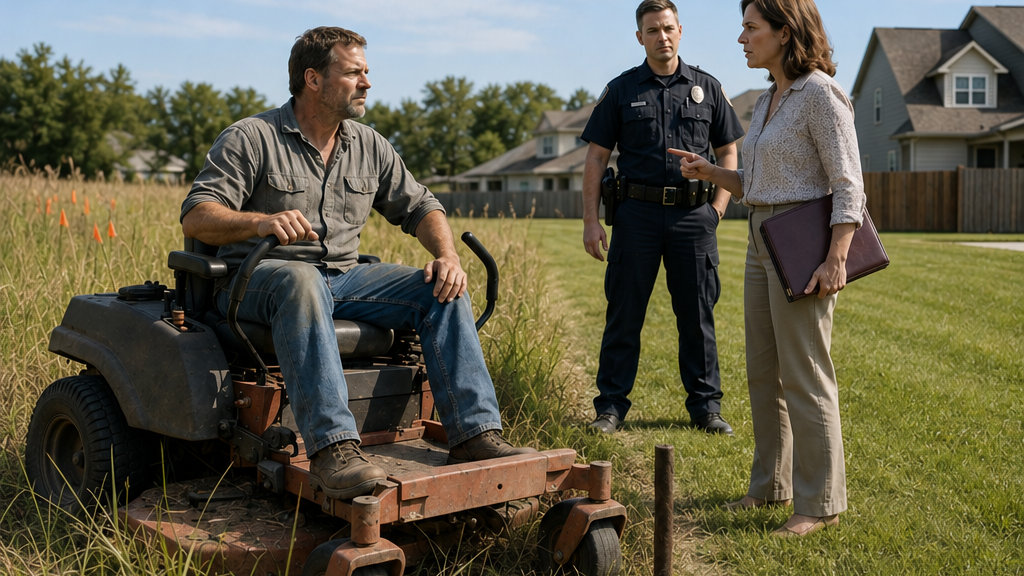
Stephen Miller killed the mower engine when the woman stepped directly into his path.
One second the machine was chewing through waist-high grass at the edge of Andrew Nelson’s property. The next, the blades were slowing beneath him, and a woman in a pale blue shirt stood fifteen feet ahead with her arms crossed.
Stephen left one hand on the steering lever.
Beyond her, the neighboring subdivision looked almost unnaturally neat. Short grass. Young maples spaced at even intervals. Matching mailboxes. Concrete sidewalk curving behind a row of back fences.
On Stephen’s side, the field looked like what it was—land that had gone nearly a year without proper attention.
The woman pointed toward the mower.
“You need to stop.”
Stephen glanced behind her, expecting a loose dog, a buried utility flag, maybe a child he hadn’t seen.
“For what?”
“This property is in violation.”
“Of what?”
She seemed annoyed that he had asked.
“Zoning. Community standards. There are restrictions on this kind of operation next to the neighborhood.”
Stephen looked at the mower, then at the cut grass behind him.
“This kind of operation?”
“You know what I mean.”
He didn’t.
That morning had started with nothing more complicated than an old man asking for help.
Andrew Nelson had called three days earlier. His voice had sounded tired enough that Stephen initially thought he was sick.
“I’ve got more ground than I can handle now,” Andrew had said. “I just need it knocked down. Nothing fancy.”
Stephen had expected a large yard.
Instead, he had found several acres wrapped around a weathered one-story house, with an old equipment shed farther back and the remains of what had once been open farmland stretching toward the newer subdivision.
Andrew had stood on the porch while Stephen walked the ground.
He was somewhere in his seventies, thin through the shoulders, with the deliberate movements of someone who had learned not to waste strength.
“Used to do all this myself,” Andrew had said.
There was no self-pity in it.
That made Stephen notice the sentence more.
They agreed Stephen would cut the accessible sections first, then return for the rougher edges after he saw how the mower handled them.
For almost twenty minutes, everything went normally.
Then Stephen noticed the woman.
At first she had been standing beyond the edge of the tall grass, near the subdivision’s maintained strip. She hadn’t waved. Hadn’t called out. She simply watched.
Stephen kept working.
When he turned for the fourth pass, she was still there.
When he turned again, she had moved closer.
Now she was standing in front of his machine telling him the work was illegal.
Stephen shut the mower completely down and climbed off.
“My customer owns this property.”
“That doesn’t mean he can do anything he wants with it.”
“No,” Stephen said. “But mowing seems like a pretty safe place to start.”
Her mouth tightened.
“You’re being dismissive.”
“I’m asking what rule I’m supposedly breaking.”
Before she could answer, the screen door on Andrew’s house slapped shut.
Stephen looked over.
Andrew had come off the porch.
The change in him was immediate.
The old man who had casually pointed out fence posts and low spots an hour earlier now walked toward them with his shoulders slightly rounded and his eyes fixed on the woman.
“Carolyn,” he said.
So they knew each other.
Carolyn White turned toward him.
“I told you this couldn’t continue.”
Andrew stopped several yards away.
“I hired him to cut my field.”
“You were warned about altering this area.”
“Warned by who?”
“The association.”
Andrew gave a tired shake of his head.
“I’m not in your association.”
Carolyn looked at Stephen as if Andrew had just confirmed something embarrassing rather than decisive.
“The HOA has obligations to the community,” she said. “What happens on adjoining property can still affect residents.”
Stephen could accept that sentence.
What he couldn’t accept was the way she kept using it as though it answered a different question.
“Is there a county restriction?” he asked. “A written order? Something that says this field can’t be mowed?”
Carolyn hesitated.
Only for a moment.
But Stephen noticed.
“There are protections and drainage requirements along this boundary.”
“Okay. Show me where.”
“You’re standing near it.”
“Near what?”
“The regulated area.”
Stephen looked down.
There were no stakes. No paint. No signs. Just a ragged meeting point between Andrew’s tall grass and the subdivision’s clipped common strip.
He turned back to Carolyn.
“I’m happy to stay out of anything that’s actually marked or restricted. But I’m not shutting down an entire job because you say there’s something somewhere near the edge.”
“That is exactly the attitude that creates problems.”
“No. Unmarked rules create problems.”
Andrew shifted behind him.
“Stephen.”
The quiet warning surprised him.
Not because Andrew disagreed.
Because Andrew sounded worried.
Carolyn noticed too.
Her posture straightened.
“I’m giving you both an opportunity to handle this without enforcement.”
Stephen felt something harden in him.
He had heard that tone before: not quite a threat, delivered as a favor.
Years earlier, a relative of his had spent months backing away from a property dispute because every letter sounded official and every person speaking sounded certain. By the time anyone actually checked the records, most of the damage was already done.
Stephen had never forgotten how little confidence had been required to make everyone else surrender ground.
“Enforcement by who?” he asked.
Carolyn’s eyes narrowed.
“You’ll find out if you continue.”
Stephen looked at Andrew.
“This your land?”
Andrew nodded.
“All the way to the old boundary.”
“You hired me to mow it?”
“Yes.”
Stephen turned back toward the mower.
Carolyn stepped aside, but only barely.
“If you start that machine again,” she said, “I’m making this official.”
Stephen climbed into the seat.
He didn’t answer.
He restarted the engine.
The blades dropped into the grass with a low mechanical roar.
Carolyn stood there another thirty seconds before walking back toward the subdivision.
Stephen expected satisfaction.
Instead, when he looked toward Andrew, the old man had gone pale.
Stephen shut the blades off again.
“What was that about?”
Andrew stared after Carolyn.
“Nothing you need to get mixed up in.”
“I’m already mixed up in it.”
“No. You’re cutting grass.”
“She just threatened enforcement over your land.”
Andrew rubbed one hand along his jaw.
Stephen waited.
Finally Andrew said, “Finish the middle. Leave the far edge today.”
“Because she told us to?”
“Because I’m asking you to.”
That answer Stephen respected, even if he didn’t like it.
He spent the next two hours cutting broad lanes through the center acreage. Every time he approached the subdivision side, he turned early.
Carolyn never came back.
By noon, the place looked different. Not finished, but reclaimed enough that Andrew stood on the porch staring across it for a long time.
Stephen loaded the mower onto the trailer.
When he tightened the rear strap, Andrew came down the driveway carrying two bottles of water.
He handed Stephen one.
“You didn’t have to stand up to her.”
“I asked her for a rule.”
“That counts as standing up to her around here.”
Stephen twisted the cap loose.
“What happened before?”
Andrew looked toward the subdivision.
The closest houses had been built where, judging from the slope and old tree line, open ground must once have continued.
His expression closed.
“She’s tried this before.”
“Tried what?”
Andrew started back toward the house.
“Make sure you call before you come Monday.”
“That doesn’t answer me.”
“No,” Andrew said without turning. “It doesn’t.”
Chapter 2: The Parcel That Was Never Inside Their HOA
The county parcel map showed Carolyn White had been standing on the wrong side of her own argument.
Stephen enlarged the image on his phone and held it beside the view from Andrew’s porch.
The lines weren’t perfect at that scale, but they were clear enough.
Andrew’s acreage formed an irregular block beside the subdivision. The HOA common area stopped short of the field Carolyn had claimed was subject to community restrictions.
By several yards.
Stephen looked at Andrew.
“You knew this.”
Andrew sat in an old metal chair with a coffee mug between both hands.
“I know where my property is.”
“That’s not what I asked.”
Andrew stared into the field.
Monday morning sunlight made the newly cut center look almost orderly. The uncut perimeter stood around it in darker bands.
Stephen had spent most of Sunday evening looking up the subdivision’s public filings, county GIS maps, and recorded plats. He disliked paperwork enough that his invoices sometimes sat in his truck for a week, but once he suspected someone was bluffing about authority, he became stubborn.
He had found no indication that Andrew’s parcel had ever been annexed into the HOA.
No covenant reference.
No lot number belonging to the subdivision.
Nothing.
“Why didn’t you just show her the parcel record?” Stephen asked.
“I have.”
“And?”
“She changes the subject.”
That sounded plausible, but Andrew’s refusal to say more was starting to bother him.
Stephen set the phone on the porch railing.
“I’m going to talk to their manager.”
Andrew looked up sharply.
“Don’t.”
“Why?”
“Because then it becomes a whole thing.”
“It already is a whole thing.”
“No. Right now it’s Carolyn making noise.”
“She said enforcement.”
Andrew’s mouth pressed thin.
“She likes that word.”
Stephen leaned against the post.
“If the HOA has no claim, getting that in writing helps you.”
Andrew looked toward the field again.
“I’ve spent enough of my life explaining my own property to people who bought houses after I was already here.”
There it was.
Not fear exactly.
Resentment hardened by time.
Stephen understood it more than he wanted to.
He also knew resentment made poor paperwork.
An hour later, he called the management company listed on the HOA’s public contact page.
Melissa Rivera answered after he had been transferred once.
Stephen kept it simple.
“My name is Stephen Miller. I’m doing landscaping work for Andrew Nelson on the parcel adjoining your community. Your board president told me the property is subject to HOA restrictions. I’m trying to identify what document she’s referring to.”
There was a short pause.
“Are you the owner?”
“No.”
“Then I can’t discuss an owner account with you.”
“He doesn’t have an owner account.”
Another pause.
Stephen could almost hear her shift attention.
“What address?”
He gave it.
Keyboard clicks followed.
“Mr. Nelson’s parcel is adjacent to the association.”
“Right. Is it part of it?”
“Not according to what I’m looking at.”
Stephen glanced toward Andrew, who was standing inside the screen door pretending not to listen.
“So the HOA doesn’t have covenant authority over his field.”
“I’m not giving you a legal opinion.”
“Fair enough. Do your records show his property as an HOA lot?”
“No.”
That was enough for Stephen.
Then Melissa added, “There may be separate recorded agreements affecting that area.”
“What agreements?”
“I’d have to review the historical file.”
“Carolyn said mowing violated restrictions.”
“I can’t confirm that.”
“Can you confirm any HOA restriction against mowing his property?”
Melissa’s voice became more careful.
“Not from the records immediately available to me.”
Stephen thanked her and ended the call.
Andrew stepped onto the porch.
“Well?”
“She can’t find anything putting your parcel in the HOA.”
“I told you that.”
“You told me Carolyn was wrong. That’s different.”
Andrew gave him a look.
Stephen ignored it.
“Let’s mark the line before I cut the rest.”
“No need.”
“There absolutely is now.”
By early afternoon, Stephen had used the county map and visible corner references to estimate where not to cross until a proper survey could confirm it. He wasn’t pretending his phone made him a surveyor. He simply wanted a conservative working boundary.
The difference was visible once he knew where to look.
The HOA’s maintained grass formed a smooth green strip beside the backs of several homes.
Andrew’s property began beyond an older, uneven grade where the soil rose slightly.
Stephen walked the edge slowly.
At one point he found the top of something metal nearly swallowed by dirt and grass.
He crouched.
It looked like an old iron pin.
He didn’t touch it.
Instead, he took a photograph.
“Andrew.”
The old man came halfway across the field.
Stephen pointed.
“That yours?”
Andrew looked down at it for several seconds.
“Could be.”
“You’ve seen it before?”
“Long time ago.”
Again, the answer carried more weight than the words.
Stephen stood.
“What aren’t you telling me?”
Andrew’s gaze shifted beyond him.
Stephen followed it.
Bright orange flags had appeared farther down the field.
They formed a loose line through the lower ground, angling away from the property edge and toward a shallow depression behind the subdivision.
Stephen frowned.
“Those weren’t here Saturday.”
“No.”
“Did you put them there?”
“No.”
They walked toward them.
The flags were new, the thin wire stems pressed into damp soil at intervals. There was no company name attached, no explanation.
Stephen stopped before crossing the first one.
For the first time since Carolyn had confronted him, he felt his confidence loosen.
The flags didn’t follow the property boundary.
They cut across Andrew’s land.
Andrew stared at them without speaking.
“You know what these are?” Stephen asked.
Andrew’s face had gone unreadable again.
“Could be utility.”
“Could be something else.”
Stephen noticed a folded sheet tucked beneath the handle of Andrew’s mailbox when they returned toward the house.
It hadn’t been there earlier.
The top carried the county seal.
Andrew reached for it, but Stephen was closer.
He pulled it free and handed it over.
Andrew unfolded the notice.
His eyes moved across the first page.
Then stopped.
“What?”
Andrew folded it once.
“Inspection.”
“For what?”
“Drainage.”
Stephen held out his hand.
After a moment, Andrew gave him the paper.
The notice referenced a county stormwater site review and a recorded drainage corridor crossing the Nelson parcel.
Stephen read the description twice.
Then he looked at the orange flags cutting straight through land the HOA did not own.
The property line had answered one question.
It had opened a worse one.
Chapter 3: The Survey Pin Beside the Stopped Mower
The patrol car was parked beside Stephen’s trailer before he even lowered the ramp.
He sat behind the wheel of his truck for a moment, looking at the cruiser, Carolyn White’s SUV, and the orange flags beyond the cut field.
Andrew stood on his porch.
Nobody waved.
Stephen got out.
The patrol officer met him near the trailer.
“Stephen Miller?”
“That’s me.”
“Were you planning to do work here today?”
“Yes.”
Carolyn came across the HOA grass before the officer could continue.
“I told him last weekend the work had to stop.”
Stephen looked at the officer.
“Did she tell you this isn’t HOA property?”
Carolyn exhaled sharply.
“That is not the issue.”
“It was the issue last time.”
“The issue is that he’s altering a protected buffer.”
Stephen looked toward the orange flags.
“When did it become a protected buffer?”
“It always was.”
“Then why wasn’t it marked until Monday?”
The officer raised a hand.
“I’m not here to determine zoning or property rights.”
Carolyn pointed toward Stephen’s mower.
“He has already cut into the regulated area.”
Stephen felt the first real pinch of uncertainty.
He had cut close to the low strip Saturday.
The flags had not been there then.
He didn’t know exactly where the recorded drainage corridor ran.
But he was not going to let uncertainty turn into submission to a different claim.
He lowered the trailer ramp.
“I’m staying away from every orange flag until the county inspector gets here.”
“You shouldn’t be mowing at all,” Carolyn said.
“On whose authority?”
“The association has issued a stop.”
Stephen looked at her.
“Show it to me.”
Carolyn held a folder against her side but didn’t open it.
“This doesn’t need to become a roadside argument.”
“Good. Show the officer whatever document gives your association control over Andrew’s field.”
The officer looked at Carolyn.
“Do you have something identifying the parcel as part of the HOA?”
Carolyn’s expression changed almost imperceptibly.
“We have a responsibility to protect neighboring homes.”
“That wasn’t his question,” Stephen said.
The officer glanced at him.
“Let her answer.”
Carolyn opened her folder.
She pulled out a printed map, then another sheet.
Stephen waited.
She showed the officer the map.
“That drainage area directly affects association property.”
The officer studied it.
“Does this show ownership?”
“It shows the affected area.”
“Does it show this parcel belongs to the HOA?”
Carolyn’s jaw tightened.
“No. Not in those terms.”
Stephen almost smiled.
Almost.
Then he saw Andrew watching from the porch and remembered the county notice.
Being right about one line did not mean he understood the other.
“I want to show you something,” Stephen said.
He walked toward the edge he had photographed Monday.
The officer followed. Carolyn came too.
Stephen found the iron survey pin beneath the grass.
He crouched and brushed loose clippings away without disturbing the soil.
The mower deck, once unloaded, would pass within inches of it if he continued his normal cutting line.
“That looks like one of the old boundary markers,” Stephen said. “County map puts the subdivision on that side.”
He pointed toward the manicured strip.
Carolyn spoke quickly.
“The buffer crosses the boundary.”
“Maybe it does,” Stephen said. “That still doesn’t make the whole field yours.”
“It isn’t about ownership.”
“Then stop telling people your HOA ordered work stopped on property it doesn’t govern.”
The officer straightened.
“That’s the part I can speak to. If this is Mr. Nelson’s private property and there’s no court order or enforceable notice directing me otherwise, I’m not ordering his contractor off it.”
Carolyn flushed.
“So we just wait until he causes more damage?”
“No,” the officer said. “You use whatever civil or county process applies.”
For the first time, Carolyn looked less angry than exhausted.
“You haven’t seen the homes after a storm.”
Stephen noticed that.
Not because it changed the property line.
Because it sounded nothing like her threats from Saturday.
Before he could answer, a county vehicle pulled onto the shoulder.
A stormwater inspector stepped out carrying a tablet and a rolled plan sheet.
Carolyn turned toward him immediately.
Stephen stayed where he was.
The inspector introduced himself by role, checked the address, then asked who owned the parcel.
Andrew finally left the porch.
“I do.”
The inspector looked at him.
“You received the notice?”
“Yes.”
“Good. I need access to the flagged corridor.”
Andrew nodded once.
Stephen watched his face.
No surprise.
That bothered him.
The inspector began walking the orange flags.
Stephen joined him at a distance.
The corridor followed the low ground through the field, crossed near the subdivision’s rear common area, then continued toward a culvert.
It was obvious once someone traced it.
Water had shaped the land long before any HOA existed.
Near the middle, the inspector stopped.
He looked at the grass.
Then at Stephen’s mower.
“Did you cut this section?”
Stephen stepped closer.
The vegetation inside the flagged corridor was shorter than the grass beyond it.
Not scalped. Not destroyed.
But cut.
He remembered Saturday.
Carolyn standing at the edge.
Andrew asking him to leave the far side.
Stephen had turned early afterward, but before the confrontation he had already made several passes through the low ground.
“Yes,” he said.
Carolyn folded her arms.
“I told you.”
Stephen ignored her.
He looked at the inspector.
“There were no flags when I cut it.”
“When?”
“Saturday morning.”
“These were placed Monday.”
“So yes. I cut part of it before it was marked.”
The words cost him something.
He could have softened them.
Could have blamed Carolyn for making such broad claims that he stopped listening.
Could have said Andrew gave him permission.
None of that changed where the mower had gone.
The inspector tapped the screen of his tablet.
“I’m not saying you committed a violation. I need to document existing conditions. Some vegetation here may have been helping stabilize the drainage path.”
“Did I damage it?”
“I don’t know yet.”
That answer landed harder than an accusation.
Stephen looked toward Andrew.
The older man avoided his eyes.
Carolyn stepped closer.
“This is exactly why I wanted the mowing stopped.”
Stephen turned.
“No. You wanted all mowing stopped because you said the property was under HOA restrictions.”
“And now you see there was a reason for concern.”
“A reason for concern isn’t the same as authority.”
Her face tightened.
“No, but your refusal to listen didn’t help either.”
Stephen had no immediate answer.
That irritated him because she was partly right.
The patrol officer had already begun walking back toward his cruiser.
“This sounds like the county’s issue from here,” he said.
Carolyn objected.
“What about the association order?”
The officer looked at her.
“Ma’am, I haven’t seen anything showing your association has authority to order this man off Mr. Nelson’s parcel.”
The sentence was calm.
It still changed the air.
Carolyn looked toward the nearby houses.
A man stood on one back patio watching. Another homeowner had stopped near the sidewalk.
There would be no dramatic declaration. No applause.
Just people seeing that her certainty had limits.
Stephen should have felt vindicated.
Instead he looked at the shorter grass inside the orange flags.
The inspector unrolled the plan sheet on the hood of his county vehicle.
A narrow shaded band crossed Andrew’s parcel.
Stephen pointed.
“That’s the drainage corridor?”
“Yes.”
“And this line?”
“Property boundary, according to the recorded plat reference. Surveyor would confirm exact ground location.”
“So they’re two separate things.”
“Correct.”
Carolyn said, “But the corridor serves the subdivision.”
The inspector looked at her.
“It appears connected to subdivision drainage.”
“Then the HOA has jurisdiction.”
“Not necessarily.”
Her voice sharpened.
“How can it serve our development but not fall under our authority?”
“An easement can create rights or obligations without transferring ownership.”
Stephen looked at Andrew.
The old man’s face had gone still.
Too still.
“You knew about an easement,” Stephen said.
Andrew did not answer.
The inspector looked between them.
“I’ll need the recorded instrument.”
Carolyn immediately said, “Management should have it.”
Andrew finally spoke.
“No.”
Everyone turned toward him.
He looked at the plan on the vehicle hood.
“I have it.”
Stephen stared.
“You have what?”
“The old agreement.”
Carolyn’s expression shifted.
“You told us there was no agreement.”
“I told you there was no agreement making my property part of your HOA.”
“That’s not the same thing.”
“No,” Andrew said quietly. “It isn’t.”
Stephen felt the entire dispute tilt.
Not collapse.
Tilt.
Carolyn had overstated her authority.
Andrew had withheld something important.
And Stephen had driven a mower through a corridor he hadn’t bothered to understand because he had become too focused on proving one woman wrong.
The inspector rolled the plan closed.
“Mr. Nelson, I need to review that document before I determine what the corridor requires.”
Andrew nodded.
Stephen looked at the iron survey pin beside the mower deck, then at the orange flags crossing well inside Andrew’s property.
For days he had treated the boundary as the answer.
Now it looked more like the beginning.
The inspector tucked the plan beneath his arm.
“The HOA boundary isn’t my concern,” he said. “This easement is.”
Chapter 4: The Agreement Andrew Never Wanted Opened Again
Andrew recognized the easement number before Stephen finished reading it aloud.
They were sitting at the kitchen table, the county notice between them, when Stephen reached the string of recording references printed near the bottom.
Andrew’s hand stopped halfway to his coffee.
“That’s the old drainage agreement.”
Stephen lowered the paper.
“The one you told the inspector you have?”
Andrew looked toward the window.
Outside, orange flags crossed the low part of the field in a crooked line. Beyond them, the subdivision roofs rose where open ground had once continued.
“You want to show me?” Stephen asked.
“No.”
Stephen waited.
Andrew’s answer had come too quickly to be uncertainty.
“The county wants it,” Stephen said.
“Then the county can see it.”
“I’m not the county.”
“Exactly.”
Stephen leaned back.
Three days earlier, he might have accepted that as Andrew’s right and left it alone. Then he had driven a mower through part of a drainage corridor because he had assumed Carolyn’s claims were all bluff.
He was done making decisions with half the facts.
“You hired me to work out there.”
“I hired you to mow.”
“And I cut through something you knew existed.”
Andrew’s eyes hardened.
“There were no flags.”
“That isn’t the point.”
“It matters.”
“So does the fact you knew there was an agreement.”
Andrew pushed his chair back.
For a moment Stephen thought he would leave the room.
Instead, the old man crossed to a narrow cabinet beside the refrigerator and opened the bottom door.
He took out a worn brown folder.
The corners had softened with age. Several sheets protruded at uneven angles, along with a folded plat that had yellowed along its creases.
Andrew set it on the table without opening it.
“There.”
Stephen looked at him.
“That folder been sitting there this whole time?”
“Most of thirty years.”
Andrew sat again.
Stephen opened the cover carefully.
The first pages were copies of old correspondence. Development-company letterhead. County notes. A hand-drawn drainage sketch. Then the recorded agreement.
Stephen read slowly.
The language was dense but not mysterious.
Andrew and the subdivision developer had agreed to allow stormwater from part of the future development to pass through a defined drainage corridor on Andrew’s land. The developer received access rights for inspection and maintenance.
Stephen ran his finger down the page.
“This doesn’t say they own the land.”
“They don’t.”
“It doesn’t put your property under their covenants either.”
“No.”
“So Carolyn was wrong.”
Andrew gave a humorless smile.
“I knew that already.”
Stephen kept reading.
The agreement described access to the corridor, limits on obstruction, and obligations to keep the route functional. There was nothing remotely close to the sweeping authority Carolyn had claimed over mowing the entire property.
But there was enough to explain why the county cared.
Stephen closed the folder halfway.
“You could’ve shown me this Saturday.”
“I could’ve shown Carolyn a dozen times. Wouldn’t change how she talks.”
“I’m not Carolyn.”
“No.”
“Then why treat me like I am?”
Andrew’s expression changed.
Not anger.
Something closer to weariness.
“You think because you asked straight, I owe you thirty years of this mess?”
“No. I think because I’m operating equipment on top of it, I need to know where I can safely work.”
That landed.
Andrew looked down at the folder.
Stephen softened his voice.
“I was so busy proving she didn’t control the field that I stopped listening when anybody mentioned anything else. That’s on me. But you knew there was more.”
Andrew rubbed his thumb over a split in the folder’s edge.
“They built that neighborhood in stages,” he said. “First phase was maybe a dozen houses. Then more. Back then the low ground always carried water after storms. Developer wanted a clean route to the county ditch.”
“So you agreed.”
“I agreed to let them use what was already there.”
“For free?”
“They paid for some grading. Put in the culvert. Supposed to maintain their share afterward.”
Stephen reopened the agreement.
“That’s in here?”
“Keep reading.”
Before he could, Stephen noticed several newer envelopes tucked behind the older documents.
Same management-company return address.
He pulled one free.
The date was four months earlier.
Andrew reached for it.
Stephen held it still.
“You got recent letters.”
“Requests.”
“You said Carolyn was just making noise.”
“She was.”
“You ignored these?”
Andrew’s jaw set.
“They kept writing like I was one of their homeowners.”
Stephen opened the top letter.
The language was formal but less dramatic than Carolyn’s threats. It requested access to evaluate drainage vegetation and asked Andrew to coordinate clearing along the corridor.
“You answer?”
“No.”
“Any of them?”
“No.”
Stephen put the paper down.
“So while Carolyn was overstating what the HOA could order, you were refusing to answer what might have been a legitimate maintenance issue.”
“They don’t get to tell me what to do on my land.”
“That agreement might.”
Andrew’s chair scraped the floor.
“There it is.”
“What?”
“You sound like them now.”
Stephen felt his temper rise.
He forced it down.
“No. I sound like somebody who doesn’t want to be wrong twice.”
Silence filled the kitchen.
Outside, a vehicle moved slowly along the subdivision street.
Andrew finally looked away.
“They started with requests,” he said. “Then every year the wording got stronger. ‘Required access.’ ‘Required correction.’ ‘Association standards.’ They took one narrow agreement and kept stretching it.”
“That doesn’t mean the agreement disappeared.”
“I know.”
The answer was so quiet Stephen almost missed it.
That mattered more than another argument.
He opened the document again and continued.
Halfway through the maintenance section, he found language neither of them had mentioned.
The developer agreed to share reasonable inspection, clearing, and repair costs associated with subdivision runoff using the corridor.
A later paragraph extended those obligations to successors responsible for the development’s common drainage facilities.
Stephen read it twice.
“Andrew.”
The old man didn’t respond.
Stephen turned the page toward him.
“This says their side has to contribute.”
Andrew looked at the clause.
“I remember.”
“Not just access. Maintenance costs.”
“Yes.”
“If the HOA inherited the developer’s drainage system—”
“They inherited more than they like remembering.”
Stephen looked at the newer letters again.
Every one he had seen so far demanded cooperation from Andrew.
None mentioned shared expenses.
He closed the folder around his finger to hold the page.
The question had changed again.
Carolyn had been wrong to claim the HOA controlled Andrew’s property.
Andrew had been wrong to treat every demand as meaningless.
But if this agreement still governed the drainage corridor, responsibility had never belonged to only one side.
Stephen tapped the clause.
“Then we need to find out when they stopped paying.”
Chapter 5: The Missing Expense Behind the Flooded Basements
Matthew Baker’s basement wall had a brown water mark almost four inches above the baseboard.
“You think I care who wins an argument over grass?” he asked.
Stephen stood at the bottom of the stairs while Matthew pointed toward the stain.
A dehumidifier hummed in the corner. Two cardboard storage boxes had been moved onto a folding table.
“This happened twice last year,” Matthew said. “Again three weeks ago. Same side of the house.”
The anger in his voice wasn’t theatrical.
That unsettled Stephen more than Carolyn’s threats had.
Matthew was the HOA treasurer and one of the homeowners whose property backed toward Andrew’s acreage. Stephen had expected another lecture about rules.
Instead, Matthew showed him a warped section of trim and a stack of repair estimates.
“My wife hears heavy rain now and comes down here with a flashlight,” he said. “That’s where we are.”
Stephen looked toward the small basement window.
“You were told Andrew’s field caused it?”
“We were told drainage on his parcel wasn’t being maintained.”
“Same thing?”
Matthew paused.
“That’s how it was presented.”
By afternoon, Stephen was sitting across from Melissa Rivera in the HOA management office with copies of Andrew’s agreement spread between them.
Melissa had agreed to meet only after Andrew signed a short authorization allowing Stephen to discuss the drainage matter.
She read the relevant clause twice.
“This should be in the historical association file.”
“Is it?”
“I found a copy after you called.”
“Then why didn’t anybody mention the cost-sharing part?”
Melissa’s face remained composed.
“I’m trying to determine that.”
Carolyn sat at the far end of the table.
She had insisted on attending once she learned Stephen was bringing the agreement.
“This doesn’t erase current conditions,” she said.
Stephen looked at her.
“I didn’t say it did.”
“The corridor has been neglected.”
“Probably.”
Carolyn seemed caught off guard by the answer.
Stephen continued.
“And Andrew ignored letters he should’ve answered. I mowed part of a flagged inspection area before I understood what it was.”
Melissa glanced at him.
Carolyn leaned back.
“Then we agree there was a problem.”
“We agree there are several problems.”
Stephen slid the agreement toward her.
“One is that you kept calling Andrew’s property association-controlled.”
“I was referring to the drainage area.”
“No. You told me the property was violating HOA restrictions.”
“Because activity there affects HOA property.”
“That isn’t the same statement.”
Melissa raised one hand before Carolyn answered.
“I want to focus on what the recorded agreement actually requires.”
She had requested old financial records from archived association files. Several budget sheets lay beside her laptop.
The first were more than twenty years old.
Stephen understood little of the accounting shorthand, but one recurring line stood out.
Drainage maintenance.
It appeared under common-area expenses.
Again the next year.
And the next.
Matthew, who had joined them after work, pulled his chair closer.
“How long does that continue?”
Melissa flipped forward.
“For quite a while.”
The amounts changed. Some years were minor. One included culvert work. Another listed vegetation clearing and shared access maintenance.
Then, several years back, the line became smaller.
Two years after that, it vanished.
Matthew frowned.
“What replaced it?”
Melissa scanned the page.
“Nothing directly.”
Carolyn leaned forward.
“We cut a number of discretionary expenses after the reserve study.”
“Was this discretionary?” Stephen asked.
“I wasn’t president then.”
“But you were on the board?”
Carolyn hesitated.
“Yes.”
Melissa opened another file.
“The association was dealing with increased insurance premiums and deferred common-area repairs. There were reductions across several categories.”
Matthew looked at her.
“I remember that vote. I don’t remember anyone saying we were ending maintenance on an off-site drainage obligation.”
Carolyn’s voice sharpened slightly.
“We didn’t knowingly abandon an obligation.”
Stephen watched her carefully.
“What did you think Andrew was supposed to do?”
“Keep the corridor clear.”
“At his expense?”
“He owns the land.”
Matthew pointed at the agreement.
“That isn’t what this says.”
Carolyn’s expression tightened.
“It also says he can’t obstruct drainage.”
“Did he?”
“We have vegetation, sediment, standing water—”
Melissa cut in.
“Those conditions may involve maintenance on both sides.”
The room went quiet.
For the first time, Stephen could see the shape of the dispute without needing anyone to be entirely innocent.
Andrew had stopped responding.
The HOA had stopped paying attention to an old obligation.
Residents experienced real consequences.
Carolyn had faced those residents every month while insurance costs and repair complaints accumulated.
None of that gave her jurisdiction she didn’t possess.
But Stephen understood why she had reached for the strongest language available.
After the meeting, Matthew asked Stephen to walk the drainage route with him.
They started behind Matthew’s home, crossed HOA common ground, then followed the low swale toward Andrew’s field.
The property boundary was easier to see now. A survey technician had placed temporary stakes near the likely line pending final confirmation.
Stephen stopped beside one.
“This is what everyone kept mixing together.”
Matthew looked down the swale.
“Our water doesn’t care about that stake.”
“No.”
“But authority does.”
Matthew rubbed the back of his neck.
“I backed Carolyn because something had to be done.”
“I get that now.”
“She gets calls whenever somebody’s yard floods. People don’t care whether the solution is in a thirty-year-old agreement.”
“They will if the wrong person gets stuck with the bill.”
Matthew nodded reluctantly.
At the office the next morning, Melissa called Stephen back.
Her tone was different.
“I found correspondence attached to the county complaint.”
“What kind?”
“The submission Carolyn sent requesting inspection.”
Stephen straightened in his truck seat.
“And?”
“There’s a description of the Nelson parcel.”
He heard paper move.
Melissa read only the relevant phrase.
“Association-controlled drainage property.”
Stephen looked through the windshield toward Andrew’s field.
“That’s not what the deed says.”
“No.”
“Did she know that?”
A pause.
Melissa did not answer immediately.
At that afternoon’s follow-up meeting, Stephen asked Carolyn himself.
“When you called the patrol officer, did you already know Andrew’s parcel wasn’t under the covenants?”
Carolyn held his gaze.
“Yes.”
Matthew shifted beside her.
Stephen felt something colder than anger.
“Then why tell everyone the association ordered work stopped?”
“Because Andrew would not respond, runoff complaints were escalating, and you were actively cutting an area we needed inspected.”
“That explains why you were worried.”
“I was more than worried.”
“It doesn’t explain why you claimed power you knew you didn’t have.”
Carolyn looked down at the table.
When she spoke again, some of the certainty was gone.
“I believed the drainage agreement gave us authority to protect the corridor.”
“The corridor,” Stephen said. “Not his whole field.”
She didn’t answer.
Melissa slid a printed copy of the county complaint into the center of the table.
Matthew read the description.
Then read it again.
His face changed.
“You called this association-controlled property?”
Carolyn said nothing.
Matthew looked at her.
“That’s what you told the county?”
For the first time since Stephen had met him, Matthew no longer sounded like a homeowner afraid of water.
He sounded like a board member wondering what else he had approved without knowing the whole story.
Chapter 6: When Being Right Was No Longer Enough
“I’d fill the ditch before I’d sign anything with that HOA.”
Andrew said it while standing beside the orange flags with a shovel in his hand.
Stephen stopped walking.
“Don’t even joke about that.”
“I’m not joking.”
“Then put the shovel down.”
Andrew looked at the shallow drainage corridor, then toward the houses beyond it.
“They want control? Let them deal with their own water.”
Stephen took two steps closer.
“That water has crossed here for decades.”
“Because I allowed it.”
“Because you signed an agreement.”
Andrew drove the shovel blade into the ground—not digging, just planting it there like a marker.
“An agreement they ignored whenever it cost them money.”
“That doesn’t cancel your side.”
Andrew gave him a hard look.
A week earlier Stephen might have stood beside him and called that loyalty.
Now it looked too much like the same mistake Carolyn had made: taking one legitimate grievance and stretching it until it justified everything.
The final board meeting was scheduled for that evening.
Melissa had circulated copies of the drainage agreement, archived budgets, parcel records, and the county inspection notes. The county had not concluded that Stephen’s mowing caused significant damage, but it had recommended leaving part of the corridor undisturbed until maintenance plans were coordinated.
Stephen had accepted that.
Andrew had not accepted much of anything.
“Walk with me,” Stephen said.
“No.”
“Then I’ll walk and you can stand there being mad.”
He started along the newly marked property line.
After several seconds, he heard Andrew follow.
Temporary survey stakes ran between the maintained HOA ground and Andrew’s acreage. A second set of orange flags cut diagonally away from that boundary through the low swale.
Two lines.
Two entirely different meanings.
Stephen stopped where they crossed.
“This is the part I got wrong.”
Andrew said nothing.
“I saw Carolyn trying to claim all of this.” Stephen swept one hand toward the field. “So every warning after that sounded like the same bluff.”
“She made it that way.”
“She helped.”
Andrew looked at him.
Stephen continued.
“But I still drove through the flagged area before I understood it.”
“The flags weren’t there.”
“The corridor was.”
“You didn’t know.”
“I didn’t bother finding out.”
The admission tasted worse spoken aloud.
Stephen had built his working life around competence. Machines maintained. Edges clean. Promises kept. He liked problems with visible answers.
That made it easy to despise paperwork until paperwork happened to define where his mower should stop.
Andrew pulled his cap lower.
“You’re going to apologize to them tonight?”
“I’ll tell the truth.”
“Same thing, far as they’re concerned.”
“No.”
Stephen faced him.
“That’s the problem. You keep treating any admission like surrender.”
Andrew’s eyes flashed.
“You haven’t lived next to them for thirty years.”
“Then tell me what I’m missing.”
Andrew looked toward the subdivision.
For a while, Stephen thought he would refuse again.
Then Andrew said, “Those first houses weren’t the problem.”
His voice had lost its edge.
“The developer came out here before they poured half the foundations. Said the county needed a drainage path. The low ground already carried runoff. He asked if they could improve it instead of building another outlet.”
“You agreed.”
Andrew nodded.
“First people who moved in were decent. Young families. Kids riding bikes where the street ended. When the ditch clogged, I’d clear my side. Developer sent somebody for theirs.”
“So what changed?”
“Developer left. Boards changed. Management changed. Houses kept coming.”
Andrew nudged the soil with the shovel.
“One year they sent me a thank-you letter. A few years later it was a maintenance reminder. Then an access requirement. Then Carolyn started talking like this land was some ugly extension of their common area.”
Stephen understood.
“You stopped answering.”
“I stopped helping them pretend.”
“And they started assuming silence meant responsibility was yours.”
Andrew stared at the line of houses.
“I gave permission because it helped people. Somehow that became a reason I was supposed to take orders.”
There was the wound beneath all the paper.
Not drainage.
Not mowing.
The conversion of generosity into entitlement.
Stephen could understand it without agreeing with what Andrew had done next.
“You should’ve fought the wording,” he said. “Not ignored the actual problem.”
Andrew’s mouth tightened.
“I know that now.”
It was the first time he had admitted it without qualification.
A vehicle door shut near the driveway.
Carolyn approached alone.
No officer.
No folder tucked against her chest this time.
“I wanted to speak before tonight,” she said.
Andrew turned away.
Stephen stayed where he was.
Carolyn stopped several feet short of the marked boundary.
“I’m prepared to withdraw the county complaint language about association control.”
“That should happen regardless,” Stephen said.
“Yes.”
Andrew gave a dry laugh.
Carolyn ignored it.
“In exchange, if Andrew accepts responsibility for future maintenance of the corridor on his parcel, I think we can resolve this without further action.”
Stephen stared at her.
“Full responsibility?”
“For the portion on his property.”
“Who pays?”
“He does.”
Andrew reached for the shovel.
Stephen put one hand on the handle before he could pull it from the ground.
Carolyn continued.
“The association can maintain its common areas. He maintains his.”
“That isn’t what the agreement says,” Stephen said.
“It’s a practical solution.”
“It’s a cheap solution for the HOA.”
Her face hardened.
“We have homeowners with real damage and limited reserves.”
“And Andrew has an agreement saying the development’s successor shares reasonable maintenance costs tied to its runoff.”
“We can debate successor obligations.”
“At the board meeting.”
Carolyn lowered her voice.
“If this turns into attorneys and engineering studies, everybody spends more.”
Stephen almost accepted the logic.
Then he noticed what the offer required.
Carolyn would correct a statement she should never have made—but only if Andrew surrendered a right the HOA had forgotten.
That wasn’t compromise.
It was trading one error for another.
“No,” Stephen said.
Andrew looked at him.
Carolyn’s expression went still.
“You’re not the property owner.”
“No. He is. And he can decide what to sign. But I’m not helping sell him a deal built on pretending half this document doesn’t exist.”
She glanced at Andrew.
“Is that your position too?”
Andrew looked at the shovel, the property stakes, then the orange flags.
“Yes.”
Carolyn nodded once.
“Then we’ll address it tonight.”
She walked back toward the subdivision.
Stephen watched until she crossed the maintained strip.
Andrew pulled the shovel from the soil.
This time he carried it toward the shed.
At dusk, Stephen parked outside the community clubhouse.
Andrew came in a separate truck but remained seated behind the wheel for several minutes.
When he finally stepped out, Stephen was holding the worn brown folder.
Andrew looked at it.
“You sure about this?”
Stephen tucked it under his arm.
“No.”
That surprised a faint smile out of the old man.
Stephen looked toward the clubhouse doors.
“But I know what I’m not doing.”
“What’s that?”
“Pretending being right about the boundary makes us right about everything.”
Together, they crossed the parking lot and carried the folder inside.
Chapter 7: The Meeting Where Every Boundary Had to Be Named
Carolyn White opened the meeting by asking the board to authorize legal action against Andrew Nelson.
Stephen had barely taken his seat.
The clubhouse meeting room was crowded but quiet, with folding chairs arranged behind two narrow tables pushed together for the board. A large printed plat rested face down beside Melissa Rivera’s laptop. Andrew sat next to Stephen with the brown folder across his knees.
Carolyn spoke without looking at them.
“We have an ongoing drainage problem affecting association property and individual homes. We’ve attempted informal resolution. We’ve attempted direct communication. We now need authorization to protect the association.”
Matthew Baker shifted in his chair.
“What kind of legal action?”
“Whatever counsel determines is necessary to compel compliance.”
Andrew’s hand tightened around the folder.
Stephen leaned toward him.
“Let her finish.”
Andrew gave him a sharp glance but stayed seated.
Carolyn summarized the flooding complaints, the county inspection, and Andrew’s failure to answer earlier letters. Everything she said was true.
That was what made it dangerous.
She did not mention that Andrew’s parcel sat outside the HOA covenants.
She did not mention the maintenance-cost clause.
And she described Stephen’s mowing as though it had happened after the drainage corridor had been clearly marked.
When she finished, Melissa said, “Before a motion is made, I recommend the board review the documents circulated this afternoon.”
Carolyn frowned.
“They’ve had them.”
“I’m recommending we review the key points in the room.”
Matthew nodded.
“I agree.”
Carolyn looked at the other board members.
No one moved to authorize anything.
Melissa turned the plat face up.
It was larger than the version Stephen had seen before. Two lines had been highlighted.
One followed the boundary between Andrew’s property and the subdivision.
The other crossed Andrew’s acreage at an angle.
Melissa pointed to the first.
“This is the recorded property boundary referenced by the survey technician and county plat.”
Then the second.
“This is the drainage easement.”
The distance between them was obvious.
Carolyn folded her hands.
“No one disputes that they’re separate.”
Stephen almost laughed.
Instead, he said, “That’s exactly what was disputed when I was told the HOA had ordered all work stopped.”
Carolyn looked at him.
“You’re not on the agenda.”
Melissa intervened.
“He was invited to speak because he performed work in the area under review.”
Stephen stood.
He had spent the afternoon deciding what to say.
Most of the versions he imagined began with Carolyn’s mistake.
That was no longer where he wanted to begin.
“I cut part of the drainage corridor before I understood what it was.”
Andrew turned toward him.
Several homeowners in the back shifted.
Stephen continued.
“The flags weren’t there when I first cut it. But I also didn’t know there was an easement. Once Carolyn made claims about HOA authority that didn’t hold up, I started treating every warning like it was the same kind of bluff.”
Carolyn’s face changed slightly.
Stephen looked at the board.
“That was my mistake.”
For several seconds, nobody spoke.
Then Matthew asked, “Did the county say the mowing caused the flooding?”
“No.”
Melissa answered from her notes.
“The inspector has not attributed the existing drainage problems to Mr. Miller’s mowing.”
Stephen nodded.
“But that doesn’t make cutting before understanding the corridor a good decision.”
He sat down.
Andrew leaned toward him.
“You didn’t have to give them that.”
“Yes, I did.”
Carolyn looked at the homeowners behind them.
“This is what I’ve been trying to say. People have been acting without regard for the drainage system.”
Stephen looked back at her.
“And now we should talk about the association doing the same thing.”
Melissa opened the archived financial records.
Matthew pulled his copy closer.
Melissa explained the expense history without embellishment. For years, the association—or before it, the developer—had paid for clearing, inspection, culvert work, and shared maintenance connected to the drainage corridor.
Then the amounts declined.
Eventually they disappeared.
One board member asked, “Was there ever a vote to terminate that obligation?”
Melissa shook her head.
“I found no such vote.”
“Legal opinion?”
“None in the files.”
Carolyn said, “We inherited incomplete records.”
“That’s possible,” Melissa replied. “But the recorded agreement remained in force.”
Matthew looked at the highlighted clause.
“And it says successors responsible for the development’s common drainage facilities.”
“Yes.”
“That sounds like us.”
Carolyn tapped the table.
“It also imposes responsibilities on the property owner.”
“No one’s denying that,” Stephen said.
Andrew moved beside him.
Stephen expected him to object.
Instead Andrew opened the folder.
He removed one of the old letters and slid it toward Melissa.
“First year they cleaned the culvert,” he said. “They sent me notice before they came in. I opened the gate. That was all it took.”
Carolyn looked at him.
“And when we sent notices recently, you ignored them.”
Andrew met her gaze.
“Yes.”
It was the first time he had admitted it in front of her without trying to justify it.
Several people in the room went still.
Andrew continued.
“I should have answered. I didn’t because every letter sounded a little more like you owned something you didn’t.”
Carolyn’s expression tightened.
“That doesn’t excuse refusing access.”
“No.”
The simple answer seemed to disarm her.
Andrew folded his hands.
“But refusing your wording didn’t erase the water. I know that.”
Stephen watched Matthew.
Something in the treasurer’s posture had changed.
He no longer looked like a man choosing between two sides.
He looked like someone recalculating what each side owed.
Matthew turned toward Carolyn.
“When did you know Andrew’s parcel wasn’t in the HOA?”
Carolyn hesitated.
“Before the patrol call.”
“And you still described the property to the county as association-controlled?”
“I described the drainage property that way.”
“You described his parcel that way.”
Carolyn glanced at Melissa.
Melissa did not rescue her.
Carolyn’s voice dropped.
“I was trying to get someone to respond.”
Matthew leaned back.
“My basement took water. I wanted action as much as anybody. But if we had an agreement we weren’t maintaining, and we told the county we controlled property we didn’t control, that matters.”
Carolyn looked tired now.
Not defeated.
Tired.
“You weren’t taking the calls I was taking,” she said.
Matthew’s face softened, but only slightly.
“No. I wasn’t.”
Carolyn looked toward the homeowners.
“Every storm, somebody wanted to know what the board was doing. Insurance renewal was already bad. Reserves were thin. Andrew wouldn’t answer. The county kept redirecting us. I believed getting immediate control of the corridor was the only way to stop the problem from getting worse.”
Stephen understood the logic.
He also understood where it had crossed the line.
“You had a real problem,” he said. “That didn’t give you a bigger boundary.”
Carolyn met his eyes.
“No.”
It was the first time she had said it.
Melissa turned to the board.
“My recommendation is that the association withdraw the inaccurate property-control language from the county complaint, formally acknowledge that the Nelson parcel is outside the association covenants, and negotiate maintenance under the recorded drainage agreement.”
One board member asked, “What does Andrew have to do?”
Melissa looked at him.
“Provide reasonable access to the corridor and participate in upkeep obligations applicable to the landowner.”
“And us?”
“Restore the association’s share of reasonable drainage maintenance tied to subdivision runoff.”
Matthew nodded slowly.
“I’d also like a requirement that future external enforcement complaints involving non-HOA property be reviewed by management before submission.”
Carolyn looked at him.
“That’s aimed at me.”
“It’s aimed at what happened.”
Silence.
Then Matthew pushed Carolyn’s proposed legal-action authorization away from himself.
“I’m not voting for this.”
Another board member shook her head.
“Neither am I.”
The legal threat ended without drama.
No cheering came from the chairs behind them.
A homeowner near the wall asked whether the drainage would actually be repaired.
That question mattered more.
Melissa outlined the practical next steps: inspection, scope, shared cost estimates, scheduled access.
Andrew listened.
Then came the part Stephen knew would be hardest.
Melissa looked directly at him.
“Mr. Nelson, none of this works unless you agree to reasonable access.”
Andrew’s mouth tightened.
“And maintenance.”
“Yes.”
“Under the recorded agreement.”
“Yes.”
“Not HOA rules.”
“No.”
Carolyn said quietly, “We need something signed.”
Andrew looked at Stephen.
Stephen did not nod.
Did not tell him what to do.
For once, he left the decision where it belonged.
Andrew opened the brown folder and removed the old plat.
He looked at the two lines on Melissa’s enlarged copy.
One marked ownership.
One marked obligation.
“I’ll sign a maintenance arrangement,” he said.
Carolyn released a breath.
Andrew raised one finger.
“After the minutes say plainly that my property is not part of this HOA.”
Carolyn began to speak.
Matthew got there first.
“That should be in the record anyway.”
Andrew looked toward Melissa.
“Plain language. No ‘association-controlled parcel.’ No ‘community property.’ My land is my land. The easement is the easement.”
Melissa nodded.
“I can draft that.”
Andrew closed the folder.
“Then we can talk.”
Stephen looked again at the two lines on the plat.
For weeks, everyone had been arguing as though only one of them could matter.
Now the solution depended on respecting both.
Chapter 8: The Grass Grew Back on Both Sides
Stephen returned several weeks later to the exact spot where Carolyn White had once stepped in front of his mower.
The iron survey marker was easier to see now.
A permanent stake stood nearby, and the grass around it had been trimmed carefully enough that no one would mistake where the line ran.
Twenty feet beyond it, fresh green growth followed the repaired drainage corridor.
Stephen lowered the mower deck.
Then stopped.
He checked the marker one more time.
Andrew, watching from the porch, noticed.
“You planning to measure every pass now?”
Stephen looked over.
“Maybe.”
Andrew smiled.
It was the kind of smile that lasted less than a second but changed his whole face.
The weeks after the board meeting had been busier than either of them expected.
The HOA formally amended its county complaint.
The new filing described Andrew’s acreage as privately owned land outside the association covenants and identified only the recorded drainage rights affecting the corridor.
Melissa had sent Andrew a copy before filing it.
The board minutes contained almost the exact language he had demanded.
The Nelson parcel was not an HOA lot.
No covenant authority extended over it.
The association’s interest was limited to rights and obligations established by the recorded drainage agreement and applicable county requirements.
Andrew had read that paragraph three times.
Then he had signed the maintenance arrangement.
The association restored a drainage expense line to its operating plan and approved an initial shared clearing and repair project. Andrew agreed to provide scheduled access and to keep his own activities from obstructing the corridor.
The county inspector returned once more.
No major damage from Stephen’s mowing had been found, though a section of vegetation was left to reestablish naturally.
Stephen accepted the instruction without argument.
That bothered Andrew enough to tease him about it.
“You getting soft?”
“Getting tired of being corrected.”
“Different thing.”
The board also adopted Matthew’s proposal requiring management review before anyone submitted an outside complaint asserting HOA authority over property beyond the subdivision.
Carolyn remained president.
Stephen had wondered whether that would become another fight.
It didn’t.
There was no recall campaign, no dramatic resignation, no public humiliation.
Carolyn had made the correction in the record herself.
That mattered more than Stephen expected it to.
It did not erase what she had done.
But it meant she had stopped defending it.
Stephen had cut nearly half the field when a maintenance truck pulled near the entrance.
He shut the blades down.
Carolyn got out of her SUV behind it.
She was alone.
No officer.
No stack of notices.
She stopped at the boundary marker.
“Morning.”
Stephen nodded.
“Morning.”
She looked toward Andrew’s house.
“We’re here for the downstream clearing.”
“I figured.”
“Do you know where he wants the crew to enter?”
Stephen almost answered.
He knew exactly where the access route had been marked.
Then he saw Andrew coming down the driveway.
“Ask him.”
Carolyn looked at Stephen, then at Andrew.
The old man walked toward them at his steady pace.
Carolyn stayed on her side of the boundary until he reached them.
“We need to bring the small excavator through,” she said. “Melissa said the route had been coordinated, but I wanted to confirm it before they unload.”
Andrew pointed toward the old farm gate.
“Use that entrance. Stay between the white stakes until you reach the swale.”
Carolyn nodded.
“Thank you.”
It was a small exchange.
Stephen found himself watching it more closely than he had watched their arguments.
A month ago, Carolyn would have told Andrew where the crew needed to go.
Now she asked.
A month ago, Andrew might have refused simply because she was the one asking.
Now he answered.
That was what the paperwork had changed.
Not who owned the ground.
How people crossed it.
Carolyn glanced toward the repaired corridor.
“The board approved the second phase too.”
Andrew nodded.
“I saw the letter.”
“Good.”
She hesitated.
Stephen recognized the moment before she spoke.
“I owe you an apology.”
Andrew’s face closed slightly.
Carolyn continued anyway.
“I had reason to be concerned about the drainage. I didn’t have reason to describe your property the way I did.”
Andrew looked at the survey marker.
“You corrected it.”
“Yes.”
“That’s enough.”
Carolyn seemed disappointed.
Perhaps she had expected something warmer.
Andrew did not give it.
But he didn’t turn away either.
“I wasn’t asking you to forget it,” Carolyn said.
“Good.”
Stephen pretended to inspect the mower controls.
Carolyn gave a small nod.
“The crew will stay inside the access route.”
Andrew pointed again toward the gate.
“I’ll unlock it.”
He walked back toward the house for the key.
Carolyn watched him go.
“He still hates me.”
Stephen looked at her.
“I don’t think hate is the word.”
“What is?”
“He remembers.”
Carolyn absorbed that without answering.
Then she walked back to the maintenance truck.
By noon, the crew was working along the drainage corridor while Stephen mowed the upper field.
The sound of the small excavator carried across the low ground, but the work stayed within the marked route.
No one wandered across the rest of Andrew’s acreage.
No one needed to.
Matthew appeared briefly near the back of his property and spoke with the crew. The drainage path had already handled one heavy rain without water reaching his basement wall.
It was too soon to call the problem permanently solved.
But it was working.
Stephen made another pass along the edge of the field.
When he reached the crossing where the property boundary and drainage corridor came closest, he slowed.
For weeks, he had thought the lesson was about learning which line mattered.
Now he understood that both did.
One line said where Carolyn’s authority ended.
The other said where Andrew’s responsibility began.
Neither erased the other.
He remembered the first Saturday—Carolyn standing in front of the mower, Andrew pale behind him, himself so certain that asking “Whose land is this?” would settle everything.
It had been the right question.
Just not the only one.
Stephen turned the mower and followed the boundary back toward the house.
Andrew was sitting on the porch with the brown folder beside him.
The folder looked thinner now.
Most of the useful documents had been scanned and copied. Melissa had returned the originals in a protective sleeve, but Andrew still kept them in the old cover.
Stephen parked near the porch to refill his water.
Andrew nodded toward the folder.
“Thinking of throwing that thing away.”
“No, you’re not.”
“No.”
Stephen laughed.
Andrew picked it up.
“Funny. I kept this because I didn’t trust anybody else with what it said.”
“And then didn’t show anybody what it said.”
Andrew looked at him.
“You going to keep bringing that up?”
“Probably.”
“Good thing I’m paying you to mow.”
“You’re barely paying me enough for that.”
Andrew smiled again.
Across the field, the maintenance crew finished clearing a clogged section and began loading equipment.
Carolyn stood near the access gate speaking with the crew leader. When they were done, she waited for Andrew to come down and lock the gate himself.
She did not cross into the field.
Stephen finished his water and returned to the mower.
There was one strip left.
It ran parallel to the subdivision, close enough to the permanent boundary markers that his first pass weeks earlier would probably have cut right over them.
He lowered the blades.
Andrew remained on the porch.
Carolyn’s SUV pulled away.
Stephen started forward.
The mower passed beside the iron marker, not across it.
Freshly cut grass settled on Andrew’s side.
On the other side, the subdivision lawn remained untouched.
Farther down, the repaired drainage corridor curved across both worlds without belonging completely to either one.
Stephen reached the end, turned, and looked back.
The old survey marker was still visible between the two properties.
That was the difference now.
No one needed to pretend the line wasn’t there in order to work together.
The story has ended.