The Neighbor Who Tried to Demolish My Father’s Shed Uncovered What I Had Been Hiding Inside
Chapter 1: The Complaint Photographs Were Already Circulating Before Rebecca Opened Her Door
At 5:47 Monday morning, Rebecca Martin found a photograph of her father’s shed in her inbox with the word HAZARD stamped across it in red.
She had not yet opened her bedroom curtains.
For a few seconds she lay propped against the headboard, phone cold in her hand, staring at an image taken from an angle she recognized immediately: Jennifer White’s side yard, just beyond the six-foot privacy fence.
The photograph made the shed look worse than it did from Rebecca’s kitchen window.
Not much worse, she admitted.
The corrugated metal roof had rust along its lower edge. One gutter corner sagged. The western boards had grayed almost silver, and two near the sill had darkened after years of sprinkler overspray. A hinge bled orange streaks down the door.
Under the picture, Jennifer had written:
Several homeowners have raised concerns about the abandoned structure adjoining my property. Possible pest activity, structural instability, and continuing deterioration should be addressed before someone is injured.
Rebecca read the sentence twice.
Several homeowners.
She scrolled.
The email had gone to the HOA president, the management representative, both architectural committee members, and eleven residents whose addresses Rebecca recognized. Jennifer had attached six photographs.
One showed a gap below the siding.
One showed the roof.
One showed the closed door.
That last photograph held Rebecca longer than the others.
The door looked swollen in its frame, the latch dark with age, the upper panel marked by a pale vertical scar where Donald Martin had once dragged a cabinet hinge against it and refused to sand the mark out.
“Door still closes,” he had said when Rebecca complained.
“That isn’t the same as fixing it.”
“Depends what you think a door is for.”
She locked the phone and got out of bed.
By six ten she was outside in slippers and an old sweatshirt, wet grass darkening the fabric around her ankles.
The shed stood at the back of the lot beneath two mature maples. From the house, it was partly screened by shrubs. From Jennifer’s raised patio, every ugly inch of its western wall was visible.
Rebecca walked to the door and wrapped her fingers around the latch.
Still locked.
She tested it twice.
She did not open it.
On the other side of the fence, a sliding door moved.
Rebecca released the latch.
Jennifer appeared on her patio wearing exercise clothes and holding a coffee mug. Her hair was tied back neatly. She looked surprised only for the length of a breath.
“Morning,” Jennifer said.
“You sent photographs of my property to half the neighborhood.”
“I sent documentation to the people involved.”
“Eleven homeowners are involved?”
Jennifer set the mug on the patio table. “People have asked me what’s happening.”
“Then you could have told them you don’t know.”
“I know the structure has been deteriorating.”
Rebecca looked at the fence rather than at Jennifer. “You wrote that it has pests.”
“I wrote possible pest activity.”
“There are no pests.”
“There’s a gap underneath.”
“It’s screened from inside.”
Jennifer paused.
That tiny pause gave Rebecca the first clean satisfaction of the morning.
“You’ve been inside?” Jennifer asked.
Rebecca’s hand tightened around the shed key in her sweatshirt pocket.
“Yes.”
“Recently?”
“That isn’t your business.”
Jennifer exhaled through her nose. “Rebecca, this is exactly the problem. Nobody can get a straight answer from you.”
“I got three notices about exterior maintenance. I know what they say.”
“Three notices you ignored.”
The satisfaction vanished.
Rebecca looked again at the western wall. Near the bottom, the darkened boards seemed almost black in the damp morning.
“I’m dealing with it.”
“You’ve been dealing with it for two years.”
“That doesn’t give you permission to advertise my property as dangerous.”
“No,” Jennifer said. “But being on the architectural committee gives me an obligation to document unresolved conditions.”
There it was: the voice Jennifer used in meetings, each word set squarely on the table as if minutes were being taken.
Rebecca turned away.
“Have the HOA contact me directly.”
“They have.”
Rebecca went inside before Jennifer could say anything else.
At eight twelve, she forwarded Jennifer’s email to the management representative with three sentences denying active pest infestation. At eight nineteen, she attached a photograph of the galvanized mesh Donald had installed beneath the lower framing.
At eight forty-one, the representative replied.
Thank you. We will amend the pest-related notation pending inspection. Remaining exterior maintenance concerns are unchanged.
A small victory, and Rebecca hated how much she needed it.
She spent the next hour pretending to work.
On her computer screen, a technical illustration of a pump assembly waited for corrected dimensions. Rebecca adjusted one line, deleted it, restored it, then opened the HOA portal.
Three violation notices sat in the archive.
The first was eleven months old.
Peeling protective finish. Rusted roof edge. Drainage concern.
The second added damaged lower siding.
The third warned that continued noncompliance could result in a hearing.
Rebecca had answered none of them.
She had told herself she would find a carpenter after tax season. Then after the anniversary of Donald’s death. Then after replacing the house furnace. Each delay had contained just enough truth to survive another month.
At 10:06, someone knocked.
Not Jennifer.
A uniformed city employee stood on the porch holding a white envelope and a tablet.
“Rebecca Martin?”
“Yes.”
“Notice of property inspection. Complaint was referred to building safety.”
The words seemed to move apart.
Rebecca accepted the envelope.
The employee gave her the neutral expression of someone who delivered consequences for a living. “Contact information is on page two.”
“What exactly was alleged?”
“Potential unsafe accessory structure. I don’t determine the complaint.”
“Is this an order?”
“It’s notice of inspection.”
Behind him, across the street, a neighbor slowed while bringing a trash bin back from the curb.
Rebecca stepped farther onto the porch and lowered her voice. “Do they need interior access?”
“Inspector determines scope.”
The employee left.
Rebecca remained outside until his vehicle turned the corner.
Then she opened the envelope.
The inspection had been assigned to Timothy Anderson.
Proposed date: Wednesday.
She read the notice standing in the doorway, aware of the shed behind the house as distinctly as if it were another person waiting in a locked room.
At noon, the HOA president sent a message to the architectural committee and copied Rebecca.
If the municipality identifies the structure as unsafe, the Association will review available enforcement remedies, including correction, stabilization, or removal subject to governing documents and applicable law.
Removal.
Rebecca pushed back from her desk so abruptly that the chair struck the wall.
For the first time that day, she went to the kitchen cabinet above the refrigerator.
Behind expired appliance warranties and a folder of property tax records sat a narrow cardboard file box.
She took it down.
Dust marked the shelf beneath it.
The lid lifted half an inch before she stopped.
Inside were papers she had not looked at since the week after Donald’s funeral: invoices, pencil rubbings, photographs, a black notebook, folded plans.
Rebecca pressed the lid closed.
Her phone rang.
“Ms. Martin?” a man said when she answered. “Timothy Anderson, city building inspection. I’m calling about the accessory structure complaint.”
She looked through the kitchen window.
The shed door was barely visible between the shrubs.
“I received the notice.”
“I can be there Wednesday at two. Exterior first. Depending on conditions, I’ll need access inside.”
Rebecca said nothing.
“Ms. Martin?”
“Yes.”
“Will the structure be accessible?”
Her thumb moved over the edge of the phone.
She thought of the old bench beneath the north window. The cabinet doors. The planes arranged by length. The last curled shavings still caught beneath a stool because she had never brought herself to sweep them.
She thought of strangers stepping across the threshold.
Then she thought of the word removal.
“I’ll be there,” she said.
“That isn’t quite what I asked.”
Rebecca closed her eyes.
“Yes,” she said finally. “I have the key.”
Chapter 2: When the Inspector Opened the Shed, Nobody Got the Victory They Expected
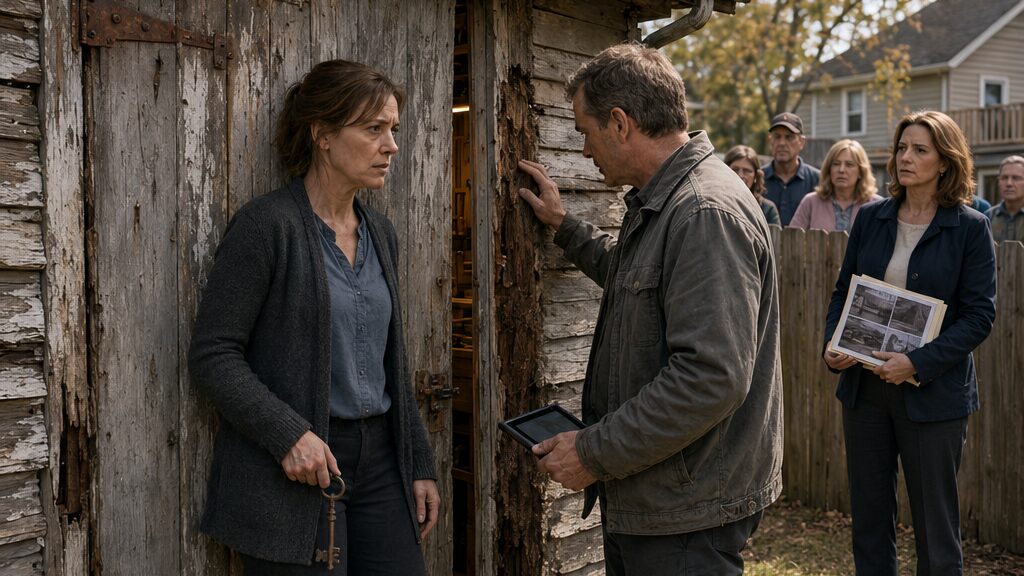
Timothy Anderson pressed two fingers into the corner post, and the wood yielded.
Not dramatically. It did not crumble.
That made it worse.
Rebecca saw the slight indentation remain after he removed his hand.
Timothy crouched beside the western sill with a flashlight. He wore work boots and a city polo beneath a lightweight jacket, and he had arrived carrying no air of rescue or condemnation. Only a clipboard, a moisture meter, and the weary patience of a man who had already inspected three things that day which somebody insisted were somebody else’s fault.
“Water’s been collecting here,” he said.
“The sprinkler was redirected.”
“When?”
“Last year.”
He looked up.
Rebecca corrected herself. “Late last year.”
A few feet away, Jennifer stood beside the fence gate holding a blue folder.
She had asked whether she could attend.
Rebecca had said no.
Jennifer had appeared anyway, explaining that the inspector might need access to observe conditions from the adjoining property. Two neighbors had found reasons to work in their yards at two on a Wednesday afternoon.
Timothy rose.
“Any known insect damage?”
“No.”
Jennifer opened the folder. “There were concerns about—”
“I’m asking the owner,” Timothy said without looking at her.
Jennifer closed her mouth.
Rebecca almost smiled.
“There’s screening beneath the gap,” Rebecca said. “I emailed a photograph to the HOA.”
Timothy crouched again, angled the flashlight, and nodded. “I see it. No obvious active infestation from here.”
Jennifer’s grip shifted on the folder.
The small vindication warmed Rebecca for perhaps five seconds.
Then Timothy touched the sagging gutter.
“This needs correction.”
“I know.”
“And I want the roof runoff addressed. It’s feeding the problem at the sill.”
“The roof doesn’t leak.”
“I didn’t say it did.”
He moved around the structure, making notes. At the north wall he studied a patched section beneath the window. At the east corner he photographed a junction box.
“Power inside?”
Rebecca’s mouth went dry.
“Yes.”
“Active?”
“I don’t use it.”
“That wasn’t my question.”
“I believe so.”
Jennifer turned toward her. “You have live electricity in there?”
Rebecca ignored her.
Timothy wrote something down. “We’ll check what we can visually.”
He returned to the front.
The door stood beneath its rust-streaked hinges, shut as it had been every day since Donald died.
Timothy held out his hand, not for the key but toward the structure.
“Interior access now.”
Rebecca did not move.
Behind the fence, someone’s rake scraped once over concrete and stopped.
Jennifer said, “This is the part nobody has been able to verify.”
Rebecca looked at her.
Jennifer’s expression was controlled, but expectation lived beneath it. She had brought enlarged photographs in the blue folder. Rebecca had seen the corners of the prints.
“You described it as abandoned,” Rebecca said.
“I described what it looks like.”
“From your yard.”
“From every yard that can see it.”
Timothy stepped slightly between them. “I’m not here to referee that.”
Rebecca put her hand in her pocket.
The key was brass, heavy for its size. Donald had attached a flattened leather tab to it decades ago, stamped with a crooked D.
She had carried it all morning.
Now she fitted it into the lock.
It resisted.
Jennifer folded her arms.
Rebecca turned the key harder. The mechanism released with a blunt metallic click.
Her hand remained on the latch.
For one irrational second she considered telling Timothy the door was swollen beyond opening.
Then he glanced at the soft corner post, and she knew what a lie like that would cost.
Rebecca pulled.
The lower edge dragged across the threshold.
The door opened twelve inches.
A smell escaped first: cedar, machine oil, old pine, dry dust.
Timothy’s posture changed.
Rebecca opened the door farther.
Afternoon light reached across the floorboards.
Behind the ruined gray exterior stood a room held in almost impossible order.
Hand planes occupied a long wall rack, smallest to largest. Chisels rested in fitted slots beneath a cabinet. Two workbenches, scarred but clean, ran beneath the windows. Wooden templates hung from pegs with penciled dates. Clamps formed dark vertical lines along the rear wall. A treadle lathe stood beneath a canvas cover. Glass-front cabinets held marking gauges, braces, molding planes, and boxes labeled in Donald’s square handwriting.
The center bench was bare except for one folded apron.
No collapsed cardboard.
No lawn mower.
No nests.
No abandoned junk.
Jennifer uncrossed her arms.
One of the neighbors near the fence whispered, “What the hell?”
Timothy did not answer.
He stepped to the threshold and looked up at the rafters, then across the benches.
“Ms. Martin,” he said, “who built this interior?”
Rebecca’s fingers locked around the edge of the door.
“My father.”
Timothy entered.
“Please,” Rebecca said sharply.
He stopped.
The word had come out louder than she intended.
She pointed at the center workbench. “Don’t touch that one.”
Timothy looked from the bench to her face.
“All right.”
Jennifer moved closer but remained outside. Her sunglasses were pushed onto her head now.
“You said you didn’t use the building.”
“I don’t.”
“This is all in here?”
Rebecca turned on her. “You can see that.”
“I mean all this time?”
Timothy raised a hand. “Let me work.”
He examined the nearest wall without disturbing the tools. A set of curved wooden pieces hung above the bench, each marked with measurements and lot numbers.
He leaned closer.
“These templates original?”
Rebecca said nothing.
“Some of them look old.”
“My father kept things.”
Timothy read one penciled marking. “Lot fourteen. Nelson elevation B.”
Jennifer’s expression shifted.
“What?” she asked.
Timothy pointed through the open door. “Your house number?”
Jennifer hesitated. “Fourteen.”
He examined another piece.
The wooden template was curved like the profile of decorative trim.
Jennifer stepped nearer despite herself.
“My dining room has that molding.”
Rebecca knew.
She had always known.
Donald had pointed it out when she was nineteen, driving too fast through the subdivision because she was late for work.
Made that crown in Lopez’s first year, he had said.
Rebecca had rolled her eyes. You made half the neighborhood, Dad.
Not half.
He had sounded offended.
Maybe a third.
Timothy moved along the wall.
There were dates from the late seventies through the nineties. Jig patterns. Cabinet profiles. Stair brackets. Handwritten addresses.
“This isn’t my specialty,” he said, “but you may have material worth documenting.”
Jennifer stared at him. “Documenting as what?”
“Historic resource evaluation, possibly. Craft history. Local development history. I’m not making that determination.”
“But you’re not ordering it demolished?”
Timothy turned.
“I haven’t finished inspecting it.”
The words dropped into the open doorway.
Rebecca felt the brief, dangerous lift inside her chest disappear.
Timothy took out the moisture meter.
“The contents being interesting doesn’t cure structural deterioration.”
He checked the lower interior wall.
A number appeared on the screen.
His jaw tightened slightly.
“Elevated moisture.”
Rebecca stepped closer. “How elevated?”
“Enough that I want the sill exposed in this area.”
He pointed toward the west side.
“The drainage issue is real. I also need an electrician to verify this installation.”
“My father did the wiring.”
“When?”
“I don’t know.”
Jennifer looked at her.
Rebecca heard the answer the way Jennifer must have heard it: another closed door.
Timothy studied the junction box inside. “Some of this is older work. Some appears altered.”
“It’s been fine for years.”
“That sentence keeps me employed.”
One neighbor laughed before thinking better of it.
Timothy continued his inspection.
Rebecca stood just inside the doorway, watching him pass through a space where no stranger had stood since the funeral.
The room remained orderly because Donald had left it orderly.
That was the truth she told herself.
Another truth lay under it.
After his death, Rebecca had come in once with trash bags and a broom. She had reached the center bench and found three curled maple shavings beneath the vise.
She had left without touching anything.
Now Timothy knelt beside the same bench, careful not to place his hand on it.
“Built-ins are unusual,” he said. “These cabinets too.”
“My father was a finish carpenter.”
“Professionally?”
“Yes.”
“Any records? Permits for modifications? Business records? Photographs?”
Rebecca’s gaze moved involuntarily toward the cabinet above the refrigerator inside her house, as though walls did not exist.
Timothy noticed.
It was only a fraction of a second, but she knew he noticed.
Jennifer did too.
“There must be records,” Jennifer said.
Rebecca faced her.
“You don’t get to inventory my family.”
“I didn’t say I did.”
“You’ve spent a week telling people this place is abandoned.”
Jennifer’s cheeks colored. “Because nobody knew what was in it.”
“You didn’t ask.”
“I asked you about this shed six months ago.”
“You told me it was hurting property values.”
“And you shut the door in my face.”
Rebecca had no answer that would not also be an admission.
Timothy straightened.
“Here’s where we are. I do not see evidence that this building is on the verge of immediate collapse. That is not the same as saying it’s compliant.”
Jennifer’s eyes dropped.
Rebecca felt the small victory return, sharper now.
Timothy continued before she could enjoy it.
“I see drainage-related deterioration. Possible sill damage. Exterior maintenance issues. Electrical work that needs evaluation. I am not ordering emergency demolition today.”
Rebecca exhaled.
“But I am documenting deficiencies.”
The breath stopped halfway out.
“And regarding any historical value,” Timothy said, “that goes to another office. Age and interesting contents do not automatically exempt a structure from code.”
Jennifer looked almost relieved.
Rebecca hated her for it, then hated herself because Timothy was pointing at the exact boards she had watched darken for two years.
He packed away the moisture meter.
“One more question. Who built the shop, specifically? You said your father. Donald Martin?”
Rebecca looked at him.
“You know his name?”
“There are initials on several fixtures. And the property record lists the prior owner.”
Timothy tapped his clipboard.
“If there are drawings, invoices, project lists, apprentice records, anything tying this shop to original construction in the subdivision, they could matter to a preservation review.”
Inside Rebecca’s house, in a cardboard box, those things waited.
She could picture the black notebook.
She could picture the folded plans.
She could picture another bundle at the bottom that she had not unfolded in nearly four years.
Jennifer watched her.
Timothy waited.
Rebecca heard herself answer in an even voice.
“I don’t know where the records are.”
The lie entered the workshop and seemed to occupy more room than any of them.
Chapter 3: The Beautiful Workshop Still Failed the Question Rebecca Wanted to Avoid
The correction order arrived Thursday morning, eleven hours after a neighbor posted that the city had “cleared” Rebecca’s shed.
The neighbor was wrong.
Rebecca stood at her kitchen counter reading the city notice while coffee cooled beside her.
CORRECTIVE ACTION REQUIRED.
The words were less dramatic than HAZARD and more dangerous.
Roof drainage management.
Assessment of deteriorated sill and lower wall materials.
Qualified electrical evaluation.
Exterior weather protection.
Thirty days to submit evidence of correction or an acceptable repair schedule.
At the bottom, Timothy had added a note:
No finding of imminent collapse at time of inspection. Potential historical significance is outside scope of building safety determination.
Rebecca read that sentence three times.
It should have felt like vindication.
Instead, it divided the problem neatly in two and left her responsible for both halves.
By nine, three people had forwarded her the neighborhood post claiming Jennifer’s complaint had “backfired spectacularly.” Someone had added a laughing emoji.
Rebecca deleted every message.
At ten fifteen, she sat across from Timothy in a municipal office with gray carpet and a wall calendar featuring storm-drain maintenance.
“You said the workshop might matter,” she said.
“I said it might be worth documenting.”
“Then why issue this immediately?”
“Because the sill doesn’t become dry while another department considers history.”
She placed the order on his desk. “Thirty days.”
“To provide correction or a credible schedule.”
“That’s not much better.”
“It is if you use the thirty days.”
Rebecca leaned back.
Timothy removed his glasses and rubbed the bridge of his nose.
“Ms. Martin, I’m going to be direct. Yesterday everybody standing in that yard wanted me to choose a side.”
“I didn’t.”
“You wanted me to stop them from touching the building.”
She said nothing.
“That’s a side.”
He put his glasses back on.
“The interior surprised me. It may surprise other people. But I can’t inspect grief, family history, or neighborhood politics. I inspect conditions.”
Rebecca folded the notice once.
“You also asked for records.”
“Yes.”
“I told you I don’t know where they are.”
Timothy looked at her long enough that she felt heat rise in her neck.
Then he said, “All right.”
No accusation.
That was worse.
He slid a card across the desk.
“City preservation planner. Separate process. No guarantee. They’ll want provenance, age, context, documentation. And they’ll still ask how you intend to keep the building standing.”
Rebecca picked up the card.
“Can you pause enforcement?”
“Not based on a room full of old tools.”
She left with the card in her pocket and the correction order in her bag.
The HOA meeting began at six thirty that evening.
Rebecca had considered not attending until she received the agenda.
Accessory Structure Enforcement Review.
Jennifer stood near a portable screen at the front of the management room, speaking quietly with the HOA president. She wore a navy blazer and had arranged her materials in a straight stack.
Rebecca took a seat in the second row.
The first slide appeared.
It was the closed shed door.
Underneath, in bold text:
UNVERIFIED INTERIOR / CONTINUING ACCESS CONCERNS
Rebecca stared at it.
Jennifer began carefully.
“First, I want to acknowledge that the city inspector did not find imminent collapse.”
A committee member nodded.
“However, the city did identify active maintenance and inspection issues. The fact that the interior contains a woodworking shop does not answer the Association’s concerns about the exterior.”
Rebecca’s jaw tightened.
Jennifer changed the slide.
Photographs of the sill.
The gutter.
The junction box.
No enlarged picture of the beautiful interior.
Of course not.
Rebecca raised her hand.
The HOA president looked at her. “You’ll have time to respond.”
Jennifer continued.
“The owner has repeatedly declined informal resolution.”
“That’s not accurate,” Rebecca said.
The president sighed. “Rebecca.”
“I declined one site meeting.”
Jennifer turned from the screen. “And did not answer three notices.”
The room went still.
Rebecca could have described the notices as repetitive. Aggressive. Procedurally flawed.
Instead she said, “I did not answer them.”
Jennifer’s expression changed slightly, as if she had expected a fight and found herself stepping forward without resistance.
The next slide showed a proposed timeline.
Repair plan.
Verification.
Possible enforcement hearing.
Jennifer pointed to the final date.
“I’m asking for consistency. Last year we required another homeowner to replace a deteriorated fence after repeated notice. We can’t decide standards matter only when enforcement is comfortable.”
One of the committee members said, “A fence isn’t a historic workshop.”
“We do not know that this is historic.”
Rebecca felt the preservation planner’s card in her pocket.
Jennifer looked toward her.
“Because the owner has provided no documentation.”
The sentence struck exactly where intended.
After the meeting, Rebecca cornered Jennifer in the parking lot.
“You knew I had less than a day to respond to the city order.”
“I didn’t set the agenda date.”
“You built a presentation.”
“I chair the committee.”
“You used a photograph of a locked door as evidence.”
“As evidence that access and condition couldn’t be verified for months.”
“It was verified yesterday.”
“By the city. After the complaint.”
Rebecca stepped closer.
“Say what you actually want.”
Jennifer’s face went still.
“I want it repaired.”
“No. You wanted it gone.”
“I wanted the problem resolved.”
“You told people it should be removed.”
“Yes,” Jennifer said. “Because for two years you acted like nobody else was affected.”
The directness stopped Rebecca.
Jennifer looked away toward the nearly empty parking lot.
When she spoke again, her voice was lower.
“I have an appraisal next week.”
Rebecca frowned.
Jennifer gave a humorless laugh.
“There. Now you can decide I’m exactly as shallow as you think.”
“I didn’t say that.”
“You didn’t have to.”
She picked up the blue folder from the hood of her car.
“My refinance is pending. After the divorce, I had to buy out part of the equity arrangement to stay in the house. My rate is bad. Very bad. I need a new valuation.”
Rebecca said nothing.
Jennifer continued, each sentence seeming to cost her.
“The appraiser already asked about visible deferred maintenance on adjoining property. He saw the shed from the upstairs bedroom.”
“So this is about your loan.”
“It is partly about my loan.”
“At least that’s honest.”
Jennifer’s eyes hardened. “And partly about the fact that I made a sixty-eight-year-old widow replace rotted porch railings last spring because the rules said she had to. How do I look at her and say yours don’t count because you refuse to answer email?”
The question landed where Rebecca had no prepared defense.
Jennifer opened her car door.
“I was wrong about pests.”
“Yes.”
“And the inspector did not say it was about to fall down.”
“Yes.”
“But you were wrong too.”
Rebecca wanted to reject the symmetry.
The dark boards at the sill would not let her.
Friday afternoon, the HOA management representative called.
“The board is offering a short extension before formal removal review.”
“How short?”
“Ten business days for a repair and compliance plan.”
Rebecca stood at the kitchen window.
“That’s absurd.”
“It is more time than the governing documents require after repeated unanswered notices.”
“Are you threatening to demolish it?”
“I’m explaining the process. If the city identifies unresolved safety concerns and the owner does not submit a credible corrective plan, the board may consider remedies available under the declaration. Removal would require additional steps.”
“But it’s on the table.”
A pause.
“Yes.”
After the call, Rebecca finally took the cardboard file box from above the refrigerator.
She placed it on the kitchen table.
This time she removed the lid.
The black notebook lay on top.
Beneath it were invoices, photographs of unfinished houses, penciled trim profiles, apprentice hour sheets, and envelopes in Donald’s handwriting.
Rebecca touched none of them.
She closed the box again.
At five twenty, she went outside.
The shed door looked different now that other people knew what stood behind it.
Worse, somehow.
Not because the boards had changed.
Because secrecy no longer looked like privacy. It looked like a choice.
Rebecca crossed the yard and checked the latch.
Locked.
“You still do that the same way.”
She spun around.
A man stood at the back gate.
Late sixties, perhaps older. Gray hair, work jacket, broad hands resting on the top rail. Rebecca recognized him before she allowed herself to.
Anthony Lopez.
She had not seen him since Donald’s funeral.
“What are you doing here?”
Anthony looked toward the shed.
“Heard the city finally got inside.”
“From who?”
“Does it matter?”
“Yes.”
“No, Rebecca. Not anymore.”
She moved between him and the path.
“This is private property.”
“I know.”
“Then leave.”
Anthony’s eyes settled on her face, and whatever anger she expected from him was not there.
That made her more uneasy.
He nodded toward the closed door.
“Your father built that shop twice.”
Rebecca frowned.
“What does that mean?”
“The first time, he built a room.”
Anthony’s hand dropped from the gate.
“The second time, he built what it was for.”
Rebecca felt the key in her pocket.
“I don’t know what you’re talking about.”
Anthony looked at her for a long moment.
Then he said, quietly, “Yes, you do.”
He opened the gate only after she failed to stop him.
“I know why Donald built that shop, Rebecca.”
And before she could answer, he added, “I also know why he put your name in the book.”
Chapter 4: Her Father Had Built More Than a Workshop, and Rebecca Had Known Enough to Fear It
Anthony Lopez pressed his thumb against a dark mark beneath the lowest tool cabinet.
A wooden catch clicked.
Rebecca stared as a narrow drawer slid out of a place she had believed was solid framing for most of her life.
“You knew about that?” she asked.
Anthony gave her a sideways look. “I made it.”
They were standing inside the workshop less than ten minutes after Rebecca had reluctantly opened the shed door for him. She had expected Anthony to look around with nostalgia, perhaps touch a bench and say something unbearable about Donald.
Instead, he had gone directly to the cabinet beneath the east window.
Inside the hidden drawer lay a row of small steel stamps, three sharpened pencils wrapped in paper, and a stack of index cards held together by a cracked rubber band.
Anthony lifted the cards carefully.
“Lot numbers,” he said.
Rebecca remained by the door.
“You could have told me this at the gate.”
“You would’ve shut the gate.”
“I almost did.”
“I noticed.”
He placed the cards on the bench. Each bore an address, a date, and a brief description in Donald’s blocky handwriting.
STAIR BRACKET — WEST MODEL
DINING CROWN — LOT 14
MANTEL REPAIR — ANDERSON PLAN
Rebecca recognized addresses from streets she had driven since childhood.
Anthony tapped one card.
“Your neighbor’s molding.”
“Jennifer’s.”
“Whatever her name is.”
“You know exactly who she is. Everyone apparently does.”
Anthony’s mouth tightened.
“I heard about the complaint because people called me after the inspector went inside.”
“So now the workshop is neighborhood entertainment.”
“No.” He looked at her. “Now people who worked here know it may disappear.”
Rebecca folded her arms.
“You worked here. That doesn’t make it yours.”
“No.”
The answer came too quickly to fight.
Anthony turned toward the wall rack. “Did your father ever tell you why those planes are numbered?”
“They’re sizes.”
“Some are.”
He removed none of them. He pointed instead.
“Those four were assigned.”
Rebecca looked closer. Tiny marks had been burned into the handles: A.L., R.N., T—
She stopped.
“Apprentices?”
Anthony nodded.
“Not employees exactly. Not always. Kids from the vocational program. Men between jobs. A couple guys coming back from military service who needed something steady. Your dad wasn’t running a charity. He made that clear every fifteen minutes.”
Despite herself, Rebecca heard Donald’s voice.
If I’m paying you to watch me work, you’ve misunderstood employment.
Anthony smiled faintly, as though he had heard it too.
“He could be difficult,” Rebecca said.
“He was difficult.”
The agreement irritated her.
Anthony continued, “He also taught people who couldn’t afford to waste material. Made us flatten scrap before he’d let us touch good stock.”
“You’re making him sound generous.”
“I’m making him sound like Donald.”
He replaced the cards.
“Generous when it suited him. Proud all the time. Terrible at saying he was worried about somebody.”
Rebecca looked toward the center bench.
The folded apron remained where it had been during Timothy’s inspection.
“My father built cabinets,” she said. “He did trim work. That doesn’t make this some public institution.”
Anthony watched her.
“No. The people did.”
The words struck harder than she expected.
He walked to the rear cabinet, opened one door, and exposed rows of narrow wooden templates. Rebecca had seen them the day of the inspection but never understood the markings.
Anthony pulled out one curved piece.
“Come on.”
“Where?”
“My garage.”
“I have things to do.”
“You have ten business days.”
Rebecca’s eyes narrowed.
He shrugged. “People talk.”
Twenty minutes later, she followed Anthony’s pickup three streets over.
His garage was cleaner than most kitchens. A modern table saw occupied one side, but the wall above it held old wooden jigs almost identical to Donald’s. Anthony placed the curved template from the shed beside a finished strip of molding stored on a shelf.
The profiles matched.
“That came from the original house on Nelson Drive,” he said. “When the owners renovated, they called me because nobody could reproduce the trim.”
“You could.”
“Because your father made me do it until I stopped ruining the inside radius.”
Anthony opened a metal cabinet and removed a black composition book.
Rebecca’s stomach tightened before he placed it on the workbench.
It resembled the notebook in her cardboard box.
“This is mine,” he said. “Donald made duplicates of certain records because he didn’t trust anybody’s filing system except his own.”
“Did he know you had it?”
“He gave it to me.”
Anthony turned pages.
Names.
Dates.
Hours.
Projects.
Notes written in Donald’s clipped hand.
Lopez — rushed dovetail. Make him cut six more.
Another page:
Good eye. Still talks too much.
Anthony snorted. “He wasn’t wrong.”
Rebecca did not smile.
Then he turned farther.
A page headed FUTURE USE.
Three names appeared beneath it.
Anthony Lopez.
A role description rather than another name: school liaison.
Rebecca Martin.
Rebecca stopped breathing for a second.
Beside her name, Donald had written:
records / drawings / administration if she’ll do it
She stepped back.
“That means nothing.”
Anthony closed the notebook halfway. “It means he was planning.”
“He planned constantly. Most of it never happened.”
“He talked to me.”
“About what?”
“Opening the shop two Saturdays a month. Small groups. No production work. Teaching.”
Rebecca’s face hardened.
“No.”
Anthony studied her.
“What?”
“He never said that.”
“Yes, he did.”
“Not to me.”
The lie was smaller than the one she had told Timothy.
It hurt more.
Anthony looked down at the notebook.
“Then maybe I’m wrong.”
Rebecca hated the mercy in his voice.
She walked to the open garage door.
Across the street, a house had decorative brackets beneath the porch roof. She recognized the shape now. One of Donald’s patterns.
Anthony spoke behind her.
“You knew he wanted people back in there.”
She turned.
“You don’t know what I knew.”
“I know what happened at the funeral.”
“What does that mean?”
“You wouldn’t let any of us go into the shop.”
“My father had just died.”
“Yes.”
“It was my property.”
“Yes.”
“Stop agreeing with me like that.”
Anthony’s face changed.
For the first time, anger showed.
“Fine. You want a fight? You shut everybody out. You stopped returning calls. You let that building rot while telling yourself you were protecting it.”
Rebecca went still.
Anthony’s voice lowered.
“And I stayed away because I was angry enough to make it worse. That part is mine.”
The admission broke the clean shape of her resentment.
He tapped the notebook.
“But don’t tell me Donald built that room to sit untouched.”
Rebecca looked again at her own name.
A memory rose before she could stop it.
Donald at the kitchen table, four years earlier, pushing a typed page toward her.
Just help me set it up right.
I have a job, Dad.
You understand paperwork.
That isn’t a reason.
I thought maybe it could be yours to manage.
She had laughed once, without humor.
So I get to manage strangers in your workshop while you give away the only thing you ever cared about?
Donald had stared at her.
That’s what you think this is?
She had left before he answered.
Three weeks later, he suffered the stroke that began his final decline.
Rebecca closed Anthony’s duplicate notebook.
“I’m going home.”
He did not stop her.
Back in her kitchen, the cardboard file box waited on the table.
Rebecca stood over it until dusk darkened the windows.
Then she emptied everything.
Invoices.
Photographs.
Project lists.
The black notebook.
At the bottom lay a manila envelope she remembered too clearly.
She had found it after the funeral.
She had opened it once.
Then she had placed it beneath everything else and spent four years pretending that forgetting where it was counted as innocence.
Rebecca pulled out a folded document.
The first page carried no signature.
DRAFT — WORKSHOP CONTINUITY AND APPRENTICESHIP USE AGREEMENT
Her own name appeared halfway down.
She sat.
The shed key pressed against her thigh through her pocket.
She had told Timothy she did not know where the records were.
She had told Anthony the workshop was private.
Now the paper lay open beneath her hands, and Rebecca remembered exactly why she had hidden it.
Chapter 5: Jennifer’s Cruelest Claim Was False, but Rebecca’s Best Defense Was Not Honest
The word COLLAPSE filled the projection screen before Rebecca had even taken her seat.
She stopped in the aisle.
Jennifer stood near the front table with a remote in one hand.
POTENTIAL COLLAPSE RISK, the slide read above a photograph of the shed’s darkened western sill.
Rebecca looked across the room at Timothy Anderson.
He had been invited to answer questions about the city order. His expression changed the instant he saw the slide.
Not surprise.
Disapproval.
Rebecca felt a clean rush of anger.
Good, she thought.
For once, good.
She took her seat and put her bag beneath the chair.
Inside it lay Donald’s draft agreement.
The shed key was in her coat pocket.
She had brought both.
Only one felt possible to touch.
The HOA president opened the hearing with procedural language about unresolved violations, owner response periods, and available remedies. Rebecca heard almost none of it.
Her eyes remained on COLLAPSE.
Jennifer began.
“We have an exterior structure with documented moisture intrusion, deteriorated lower materials, unresolved electrical questions, and—”
Timothy raised one hand.
“Before this goes further.”
Jennifer stopped.
He pointed at the screen.
“That phrase is not from my inspection.”
The room shifted.
Jennifer’s shoulders stiffened. “I said potential.”
“I did not identify imminent collapse or a specific collapse mechanism.”
“I’m summarizing the concern.”
“You’re expanding it.”
Silence settled over the folding chairs.
Rebecca looked down so no one would see the satisfaction on her face.
Jennifer set the remote on the table.
“Then I’ll correct the wording.”
“You should.”
The HOA president cleared his throat. “Let’s keep findings attributed accurately.”
Jennifer changed the slide.
The photograph remained.
The word disappeared.
Rebecca should have felt victorious.
Instead, Timothy opened his folder.
“My correction is not a clearance,” he said. “I documented drainage-related deterioration, elevated moisture in a lower wall area, exterior weathering, and electrical work requiring qualified evaluation.”
Rebecca looked up.
Timothy continued in the same neutral tone.
“The owner has received a corrective action notice.”
One committee member asked, “Would you call the structure safe?”
“I would call that question too broad.”
“Would you order demolition?”
“Not based on my current findings.”
A small murmur moved through the room.
Jennifer sat down.
Rebecca saw the color high in her cheeks.
Timothy added, “But no one should interpret interesting contents or possible historical value as a substitute for maintenance.”
The satisfaction drained from Rebecca as neatly as water through a hole.
The HOA president turned to her.
“Ms. Martin, do you have a repair plan?”
“Not finalized.”
“Contractor estimates?”
“I’m obtaining them.”
“Electrical report?”
“Scheduled.”
That was true only in the sense that she had left two messages.
The president removed his glasses.
“You’ve had repeated notices.”
“I know.”
“Why didn’t you respond?”
Rebecca felt the draft agreement inside her bag.
She could submit it now.
The city preservation planner had told her by phone that any documentation connecting the workshop to neighborhood development or long-term apprenticeship activity might justify preliminary review. Not protection. Not exemption. But review.
The draft could prove intent.
Anthony’s notebook could prove use.
Donald’s project cards could tie the shop to the subdivision.
Rebecca had enough to change the hearing.
She also knew what the first question would be.
When did you find these records?
She slid one hand beneath the table and touched the bag.
Jennifer spoke.
“I’d like to answer one thing, if I may.”
Rebecca looked up sharply.
Jennifer faced the board, not her.
“I used stronger language than the inspector’s findings supported. That was my error.”
The admission was clipped and uncomfortable.
Then Jennifer continued.
“But the underlying condition remains unresolved, and this association has enforced maintenance requirements against other owners.”
A committee member said, “You also have a personal financial interest.”
Jennifer’s face tightened.
Rebecca had not disclosed the refinance.
Someone else had.
Perhaps neighborhood gossip. Perhaps the appraiser had been seen.
Jennifer looked briefly at Rebecca.
Rebecca shook her head once.
Not me.
Something unreadable crossed Jennifer’s face.
Then she said, “Yes. I have a refinance pending.”
The HOA president leaned back.
“That should have been disclosed earlier.”
“I did not vote on the initial referral.”
“You advocated for enforcement.”
“I did.”
The room no longer had a clean villain.
Rebecca hated that.
A week ago she could have pointed at Jennifer’s photographs and called the entire process harassment. Now Jennifer had exaggerated the risk, admitted part of it, and still remained correct about the unanswered notices.
The HOA president turned back to Rebecca.
“Do you have documentation supporting historical significance?”
Her hand tightened around the bag strap.
“Yes.”
The word escaped before she had decided.
Timothy looked at her.
Jennifer did too.
The president said, “Can you provide it?”
Rebecca saw the kitchen table in her mind.
Donald’s unsigned agreement.
Her name.
The future-use notes.
She imagined strangers reading the document and understanding what Anthony already understood: that she had not merely failed to discover her father’s intentions.
She had buried them.
“Not tonight,” she said.
Timothy’s expression became still.
The president frowned. “Why?”
“I need to review ownership and privacy issues.”
“What privacy issues?”
“Personal records.”
“If they’re necessary to your defense—”
“They are mine.”
The words came out too sharply.
The room cooled around them.
Jennifer stared at her, and for the first time Rebecca saw not triumph but recognition.
A closed door.
Again.
The president folded his hands.
“Then the board can only act on what has been submitted.”
Rebecca knew that.
She said nothing.
The hearing continued for another forty minutes.
A committee member proposed a preservation pause contingent on immediate documentation.
Without the records, the proposal died for lack of support.
The board scheduled a final enforcement vote for the following week.
Removal would remain among the available remedies if Rebecca failed to present a credible plan.
In the parking lot, she sat behind the steering wheel without starting the car.
The draft agreement remained in her bag.
She took it out.
Under the harsh dome light, Donald’s name looked darker than everything else on the page.
A knock struck the passenger window.
Rebecca jumped.
Anthony stood outside.
She unlocked the door.
He opened it but did not get in.
“You had the paper,” he said.
She looked straight ahead.
“How do you know?”
“I saw your hand go into the bag.”
“That proves nothing.”
“Rebecca.”
She turned on him.
“Jennifer stood there talking about collapse like the building was going to fall on children.”
“She was wrong.”
“And I’m supposed to expose my family to stop her?”
Anthony leaned one arm on the open door.
“No. You’re supposed to decide what you’re actually trying to save.”
“I am saving the shop.”
“From who?”
“The HOA.”
“Only them?”
Rebecca’s eyes burned.
She hated him for asking quietly.
“I don’t owe these people my father’s private papers.”
“No.”
“You keep agreeing with me.”
“Because some of what you say is true.”
He looked at the folded agreement in her lap.
“That’s what makes this hard.”
Rebecca swallowed.
Anthony’s voice roughened.
“Your dad was not easy. He made decisions for people and called it helping. He assumed you’d come around because that was easier than apologizing.”
She looked at him.
This was not the version of Donald she expected Anthony to defend.
“But,” Anthony said, “I’m not going to stand in that room and pretend you didn’t know he wanted the shop used.”
Rebecca looked away.
“I can’t do that for you.”
She started the engine.
Anthony stepped back.
Before closing the door, he said, “The final vote is Tuesday.”
“I know.”
“If you ask me what happened here, I’ll tell the truth.”
The passenger door shut.
Rebecca sat gripping the steering wheel.
On the seat beside her lay the paper that might help save the shed.
And for the first time she understood that using it would require her to stop lying about why it had been hidden.
Chapter 6: The Paper That Could Save the Shed Also Proved Rebecca Had Betrayed Its Purpose
Rebecca unfolded Donald’s draft agreement at the workbench and found his handwriting on the back.
She had never turned the last page over.
For four years, she had remembered the document as something she had read completely.
Now, in the bright Saturday light of the workshop, six penciled words waited beneath a smear from Donald’s hand.
Ask Rebecca before making it final.
Below that, in smaller writing:
She sees problems I miss.
Rebecca sat down hard on the stool.
The shed door stood open behind her.
She had opened it that morning without looking toward Jennifer’s patio, without checking the fence line, without listening for neighbors. The act had felt reckless for only a second.
Now the room seemed altered by daylight.
Dust showed on shelves she had imagined perfectly preserved. Rust had begun on one clamp screw. A leather honing strop had dried at the edges.
Preservation, she thought.
The word had been doing more work than she had.
Anthony arrived at nine carrying coffee and stopped at the threshold.
“You left it open.”
“I know.”
He stepped inside.
Rebecca pushed the agreement across the bench.
Anthony read the handwritten note.
His jaw moved once.
“He never told me about that.”
“He didn’t tell me either.”
“You found it after?”
“After the funeral.”
Anthony looked up.
Rebecca forced herself not to look away.
“I read the agreement. I saw my name. I put it in a box.”
“You thought it was final?”
“No.”
The answer was barely audible.
Anthony waited.
Rebecca pressed both palms flat against the bench.
“I knew what he wanted.”
There.
The room did not change.
No wall opened. No punishment arrived.
“I knew enough,” she continued. “Not the trust structure. Not all the names. But we argued about people coming back.”
Anthony pulled out the other stool.
Rebecca stared at Donald’s note.
“He wanted weekend sessions. He wanted me to handle scheduling and insurance and whatever else he didn’t understand.”
“He understood more than he pretended.”
“That makes it worse.”
Anthony almost smiled, then didn’t.
Rebecca said, “I told him he spent my whole childhood fixing everybody else’s houses and then expected me to organize strangers around the one place that was ours.”
Anthony looked toward the tools.
“What did he say?”
“That I was making it smaller than it was.”
She swallowed.
“I told him maybe smaller was all he had left.”
Anthony closed his eyes briefly.
“Yeah,” he said. “That would’ve hit him.”
“He had the stroke three weeks later.”
“That wasn’t your fault.”
“I know.”
The speed of her answer betrayed her.
Anthony rubbed one thumb over a scar on his hand.
“Donald came to my place after you two fought.”
Rebecca stared.
“He didn’t tell me details. Just said you thought he was giving things away.”
“He was.”
“No.”
Anthony shook his head.
“He was deciding for you. Different problem.”
Rebecca said nothing.
“He thought putting your name on something proved he trusted you.”
“It felt like a job assignment.”
“I told him that.”
Her head lifted.
“You did?”
“He told me to mind my business.”
A laugh escaped Rebecca before she could stop it.
It broke halfway out and became something else.
Anthony looked down.
“I should’ve come after the funeral,” he said. “Not to take tools. Not to make claims. Just to tell you what he had been planning.”
“Why didn’t you?”
“Because you shut the door on me.”
“I had just buried my father.”
“I know.”
“And?”
“And I was angry.”
His voice hardened with old shame.
“I thought you were erasing all of us because you never liked that he taught people. So I decided you could sit in that house with your inheritance.”
Rebecca absorbed this.
Anthony had become, in her memory, another person who wanted something from Donald.
Now he sat across from her admitting he had chosen resentment because it was easier than knocking again.
“My father was impossible,” she said.
“Frequently.”
“He could have apologized.”
“Yes.”
“He could have asked instead of writing my name in a plan.”
“Yes.”
Rebecca stared at the pencil note.
She sees problems I miss.
The sentence was not an apology.
It was not enough.
It was also more than she had allowed herself to remember.
At noon, Rebecca carried the records to the city preservation office.
The planner examined photographs, project cards, apprenticeship notes, and neighborhood addresses without promising anything.
“This is meaningful context,” the planner said.
“Meaning it can’t be demolished?”
“No.”
Rebecca’s shoulders dropped.
“Meaning we may have grounds for preliminary review. But review is not immunity.”
“What do you need?”
“A condition plan. A credible use proposal if community significance is part of your argument. Ownership clarity. Repair estimates. Electrical evaluation.”
“How quickly?”
The planner looked at the calendar.
“If an enforcement vote is Tuesday, immediately.”
Rebecca almost laughed.
“Of course.”
The planner tapped Donald’s draft agreement.
“This helps.”
Rebecca looked at the page.
“It also proves I had it.”
The planner glanced at her.
“That sounds like a different kind of problem.”
By four, Rebecca had made six calls.
A carpenter agreed to inspect the sill Monday morning.
An electrician could come late Monday afternoon.
The preservation office would issue a letter confirming preliminary review if she submitted a coherent packet.
Not protection.
Not rescue.
A pause, perhaps.
A chance.
At five thirty, Rebecca stood in Jennifer’s driveway holding a thick folder.
Jennifer was taking groceries from her car.
She saw Rebecca and stopped.
“If this is about the hearing—”
“It is.”
Jennifer closed the trunk.
Rebecca held out the folder.
Jennifer did not take it.
“What is that?”
“The records I refused to submit.”
Jennifer’s face changed.
Rebecca continued before she could lose nerve.
“My father intended the shop to be used for apprentices. Limited sessions. He drafted an agreement.”
“You knew?”
“Yes.”
The word felt cleaner this time.
Jennifer looked toward Rebecca’s yard, though the shed was hidden behind the houses.
“How long?”
“Since after his funeral.”
Jennifer let out a breath.
“And you let everyone think there were no records.”
“Yes.”
“You lied to the inspector.”
Rebecca’s grip tightened on the folder.
“Yes.”
Jennifer gave a short, incredulous laugh.
“You stood in that parking lot acting like I was the only person twisting facts.”
“I know.”
“That’s convenient.”
“It isn’t.”
“No?”
Jennifer stepped closer.
“My appraisal came back low.”
Rebecca stopped.
Jennifer looked exhausted rather than angry now.
“Not only because of your shed. Before you ask. Interest rates, deferred work on my own place, market changes. But the appraiser noted adjoining maintenance.”
“I’m sorry.”
Jennifer’s mouth tightened.
“I don’t need that.”
“All right.”
“What do you need?”
Rebecca looked down at the folder, then back at her.
“One night.”
Jennifer stared.
“The final vote is Tuesday,” Rebecca said. “I can get repair estimates. Preservation review may pause removal. But the proposal will be stronger if it addresses the neighborhood concerns instead of pretending they don’t exist.”
“You want me to help you.”
“Yes.”
“After you hid records.”
“Yes.”
“After calling my complaint harassment.”
“Yes.”
Jennifer folded her arms.
“Why would I do that?”
Rebecca could have said because the workshop mattered.
Because Jennifer had been wrong.
Because demolition would destroy something irreplaceable.
Instead she said, “Because you were right about one thing. I acted like nobody else was affected.”
Jennifer’s face remained guarded.
Rebecca held the folder out again.
“And because you were wrong about another. The answer isn’t tearing it down.”
For several seconds neither woman moved.
Then Jennifer took the folder.
She opened it to the first page.
Her eyes stopped on Donald’s draft agreement.
“This would require access?”
“Limited.”
“Insurance?”
“I’m working on it.”
“Parking?”
“I don’t know yet.”
“Noise?”
“I don’t know.”
Jennifer looked up.
“You don’t have a proposal.”
“No.”
Rebecca forced herself to remain still.
“I have records, two appointments Monday, a preliminary review, and one night before I start pretending again.”
Jennifer studied her.
The garage light clicked off automatically behind them.
At last she tucked the folder under one arm.
“One night,” she said.
Rebecca exhaled.
Jennifer lifted a hand.
“That is not agreement.”
“I know.”
“And if this doesn’t protect neighboring properties, I will say so.”
“I know.”
Jennifer looked down at Donald’s papers.
Then back at Rebecca.
“Come inside.”
For the first time since the complaint began, Rebecca crossed Jennifer White’s threshold carrying no defense she could hide behind.
Chapter 7: At the Final Vote, Rebecca Stopped Asking Anyone Else to Save Her Father’s Shed
The motion to remove the shed was already printed when Rebecca entered the community room.
She saw it before she saw Jennifer.
A stack of white pages sat beside the HOA president’s chair, the title visible beneath the fluorescent lights:
PROPOSED ENFORCEMENT ACTION — ACCESSORY STRUCTURE
Rebecca stopped just inside the door.
For years she had imagined the worst thing that could happen was someone forcing the workshop open.
Now she understood that a closed door could be lost entirely.
Anthony sat in the back row. He gave her one nod.
Jennifer stood near the side table with a legal pad and a folder Rebecca recognized as her own. They had worked until after midnight at Jennifer’s kitchen table, reducing anger and history to practical columns.
Drainage.
Sill repair.
Electrical inspection.
Insurance.
Hours of use.
Parking.
Supervision.
No power tools during early morning or evening hours.
No more than four apprentices at a time.
Jennifer had challenged nearly every line.
Rebecca had resented nearly every challenge.
By dawn, they had a proposal neither woman liked enough to mistake for fantasy.
The HOA president called the meeting to order.
Rebecca sat at the front.
The shed key was in her hand.
She realized she was gripping it and placed it on the table beside her packet.
The small brass object looked ordinary there.
The president began with the record: unanswered notices, municipal findings, unresolved maintenance, preliminary preservation interest, final enforcement authority.
Then he lifted the printed motion.
“Unless there is a sufficient alternative compliance proposal, the board will consider further action, including removal proceedings subject to required process.”
Rebecca felt the room waiting for her to defend herself.
She stood.
“I have an alternative proposal.”
She distributed copies.
A committee member skimmed the first page.
“Conditional preservation?”
“Yes.”
“Based on what legal status?”
“Not legal protection yet.”
The answer caused immediate discomfort.
Rebecca continued.
“The city preservation office has accepted the workshop materials for preliminary review. That review does not override the HOA or the building correction order.”
Timothy sat along the wall, invited only to clarify his findings. He gave no sign of approval.
Rebecca was grateful.
She did not want rescue now.
“The west sill will be opened and repaired by a licensed contractor. I have an estimate and schedule. The gutter and drainage correction can begin this week. The electrical evaluation was completed yesterday.”
She placed the report on the table.
“Two circuits need correction. One older modification will be removed.”
The president looked through the documents.
“And the proposed use?”
Rebecca glanced once at Anthony.
Then at Jennifer.
“Limited apprenticeship sessions. Two Saturdays a month during the first six months. Maximum four participants. Supervised. No retail operation. No exterior storage.”
One committee member frowned.
“That sounds like a new neighborhood problem replacing the old one.”
“It could be,” Rebecca said.
The room quieted.
She had not intended to say it that way.
But it was true.
“So I’m proposing a one-year conditional agreement. If parking, noise, insurance, safety, or maintenance requirements are violated, the use can be reviewed.”
The president tapped the packet.
“Why was none of this provided earlier?”
There it was.
Rebecca looked at the key.
She could still reduce the answer.
Family grief.
Confusion.
Incomplete records.
All true.
She picked up Donald’s draft agreement instead.
“My father planned this before he died.”
Anthony lowered his eyes.
Rebecca continued.
“He intended the workshop to train people. He named Anthony Lopez in his notes. He named me too.”
She held the paper long enough for everyone to see it.
“I found this after his funeral.”
The room became perfectly still.
The president asked, “When?”
“Four years ago.”
Jennifer’s face did not change. She already knew.
Others did.
A committee member leaned back.
“You had this the entire time?”
“Yes.”
“And you told the city you didn’t know where records were?”
Rebecca felt Timothy’s attention on her.
“Yes.”
The word seemed to clear something, though nothing became easier.
“I lied.”
No one moved.
Rebecca looked toward Timothy.
“I’m sorry.”
He did not absolve her.
He simply nodded once.
That was enough.
Rebecca turned back to the board.
“I also ignored three HOA notices. Jennifer exaggerated the danger. She called the structure a potential collapse risk without support from the inspector.”
Jennifer stiffened.
Rebecca continued before anyone could mistake the direction.
“But that does not erase what I did.”
She placed the draft on the table.
“I kept the workshop locked because my last serious argument with my father was about opening it to other people. After he died, I told myself I was preserving it.”
Her throat tightened.
She did not stop.
“The truth is, I was preserving the argument. I kept everything exactly where he left it because that meant I never had to decide whether he had been right, whether I had been right, or whether either of us had been fair.”
Anthony looked down at his hands.
Rebecca heard a chair creak in the back row.
“My silence made the maintenance worse. It made the HOA’s concern look like an attack when some of it was legitimate. And it nearly destroyed the thing I claimed I was protecting.”
She sat.
No applause came.
She was relieved.
The HOA president studied the packet for nearly a minute.
Then Jennifer stood.
Rebecca’s pulse quickened.
Jennifer faced the board.
“I need to correct the record.”
She spoke without looking at Rebecca.
“My earlier written materials used language suggesting imminent collapse. The city inspector did not make that finding.”
Timothy said nothing.
Jennifer continued.
“I believed the deterioration could become serious. I still believe the Association had reason to act. But I presented possibility as if it were established fact.”
One committee member asked, “Are you withdrawing your support for enforcement?”
“No.”
Rebecca looked at her.
Jennifer finally met her eyes.
“I’m supporting different enforcement.”
A murmur moved through the room.
Jennifer held up the joint proposal.
“Deadlines. Inspection. Drainage correction. Electrical correction. Exterior maintenance. Insurance before apprenticeship use. Review after six months and one year.”
The president said, “You helped draft this?”
“Yes.”
“Despite your refinance concern?”
Jennifer’s jaw tightened.
“Because of it, in part. I still need the neighboring property maintained.”
She paused.
“But maintained is not the same as removed.”
The distinction settled over the table.
Discussion lasted nearly an hour.
The board wanted proof of insurance.
The management representative wanted written access limits.
A committee member demanded quarterly exterior photographs.
Rebecca objected to that, then stopped herself.
“Fine,” she said. “From agreed locations.”
The preservation review letter was read aloud. It promised nothing except that the evidence merited evaluation.
Timothy confirmed that the structure was not under emergency demolition order and that the repair schedule addressed his current concerns if completed and verified.
At last, the HOA president lifted the original removal motion.
Rebecca watched his thumb rest on the corner.
“I move that this be withdrawn without prejudice and replaced with a conditional one-year preservation and compliance agreement.”
The second came from one of the committee members.
The vote was not unanimous.
It passed.
Rebecca did not move.
The printed removal motion was placed face down.
A new document slid toward her.
The president pointed to the signature line.
“You understand that failure to meet these conditions reopens enforcement.”
“Yes.”
“You understand that proposed workshop use is contingent on insurance and safety requirements.”
“Yes.”
“And that historical review does not excuse ongoing maintenance.”
Rebecca looked at Timothy.
Then at Jennifer.
“Yes.”
She signed.
Outside the community room, Anthony waited beside the vending machines.
“Well?” he asked, though his face suggested he already knew.
Rebecca held up the agreement.
“One year.”
Anthony smiled.
Then she said, “Don’t.”
His smile faded.
“What?”
“Don’t make this a victory yet.”
He looked at her for a moment.
“All right.”
Jennifer emerged carrying her folder.
She and Rebecca stood facing each other in the narrow hallway.
No friendship had appeared between them.
Too much had happened for that.
Jennifer nodded toward the agreement.
“Contractor starts Thursday?”
“Eight in the morning.”
“I’ll move my car so they can access the side.”
“Thank you.”
Jennifer hesitated.
“Rebecca.”
“Yes?”
“If the classes become a problem, I will say so.”
Rebecca almost smiled.
“I know.”
Jennifer left.
Anthony walked toward the exit.
Rebecca remained behind for a moment.
She opened her hand.
The shed key had left a faint red indentation in her palm earlier that evening.
Now it lay loosely against her fingers.
The board had not saved the workshop.
Timothy had not saved it.
Anthony had not saved it.
Even Donald’s papers had not saved it.
Rebecca had signed for repairs, inspections, access, accountability, and a future she could no longer control by locking a door.
She closed her fingers around the key again.
This time, not tightly.
Chapter 8: The First New Wood Shavings Fell Beneath a Door That No Longer Stayed Locked
The sound of the hand plane stopped Rebecca halfway across the yard.
A clean whisper.
Then another.
Steel meeting fresh wood.
She stood beside the repaired path and listened.
Six months had passed since the final vote.
The west sill was new oak. The gutter ran straight. The rusted roof edge had been sealed and repaired without disguising the shed’s age. The electrical work had passed inspection on the second visit after one correction Rebecca had complained about and then admitted was necessary.
The swollen door no longer dragged.
Today it stood propped open.
Inside, Anthony leaned over the side bench with a young apprentice whose name Rebecca still had to remind herself not to repeat like an attendance clerk.
“Again,” Anthony said. “With the grain this time.”
The apprentice adjusted the board.
The plane moved.
A pale ribbon curled upward.
Rebecca’s chest tightened.
Donald had once stood exactly there, watching her ruin a piece of maple when she was seventeen.
You’re fighting the wood.
It’s wood, Dad.
It’s winning.
She had thrown the plane onto the bench.
Now the apprentice paused and looked at Anthony.
“It keeps tearing near the end.”
Before Anthony could answer, Rebecca said from the doorway, “You’re changing direction too late.”
Both of them looked up.
Rebecca immediately regretted speaking.
Then the apprentice turned the board.
“Oh.”
The next shaving came away nearly whole.
Anthony said nothing.
His expression was unbearable.
“Don’t,” Rebecca warned.
“I didn’t say anything.”
“You were about to.”
“I absolutely was.”
Fresh shavings had begun collecting beneath the bench.
For years, Rebecca had preserved three old curls of maple beneath the center vise because they were the last ones Donald had left.
Those were gone now.
Not discarded carelessly.
Rebecca had swept them herself on the morning the first session began.
She had cried afterward in the kitchen and told nobody.
A shadow crossed the doorway.
Jennifer stood outside holding a wooden drawer.
Rebecca stared.
Jennifer lifted it slightly.
“This is not an HOA matter.”
Anthony coughed into his hand.
Rebecca said, “What happened?”
“Kitchen drawer sticks. Front is separating.”
“You brought it here?”
“I was told this is a workshop.”
The words carried just enough dryness to prevent them from becoming an apology.
Jennifer looked past Rebecca at the apprentices.
“Can they examine it?”
Anthony said, “They can examine anything. Fixing it is another question.”
Jennifer handed him the drawer.
The young apprentice turned it over and traced the joint with one finger.
Rebecca recognized the profile before anyone spoke.
Donald’s work.
Lot fourteen.
Jennifer saw recognition on her face.
“My house?” she asked.
Rebecca nodded.
“My father’s template is still on the wall.”
Jennifer looked toward the old wooden patterns.
For several seconds she said nothing.
Then she moved aside so afternoon light could reach farther into the room.
The apprentice began explaining what he thought had failed.
He was partly wrong.
Anthony let him finish.
Rebecca stood at the threshold, feeling the old instinct rise in her: protect the tools, correct the hands, limit the room, close the door before something changed.
Then the plane whispered again.
A new shaving dropped onto the floor.
Rebecca stepped outside.
On the wall beside the door, the brass key hung from its ordinary hook.
Donald’s crooked D remained stamped into the worn leather tab.
Rebecca touched it once.
Then she left it there.
Behind her, Anthony asked for a square.
Jennifer argued that the drawer had never been abused.
The apprentice laughed.
The workshop continued without Rebecca.
She crossed the yard toward the house.
The door stayed open.
The story has ended.