The HOA Changed His Gate Code Without Permission—Then the Old Access Agreement Changed Everything
Chapter 1: The Code That Stopped Working
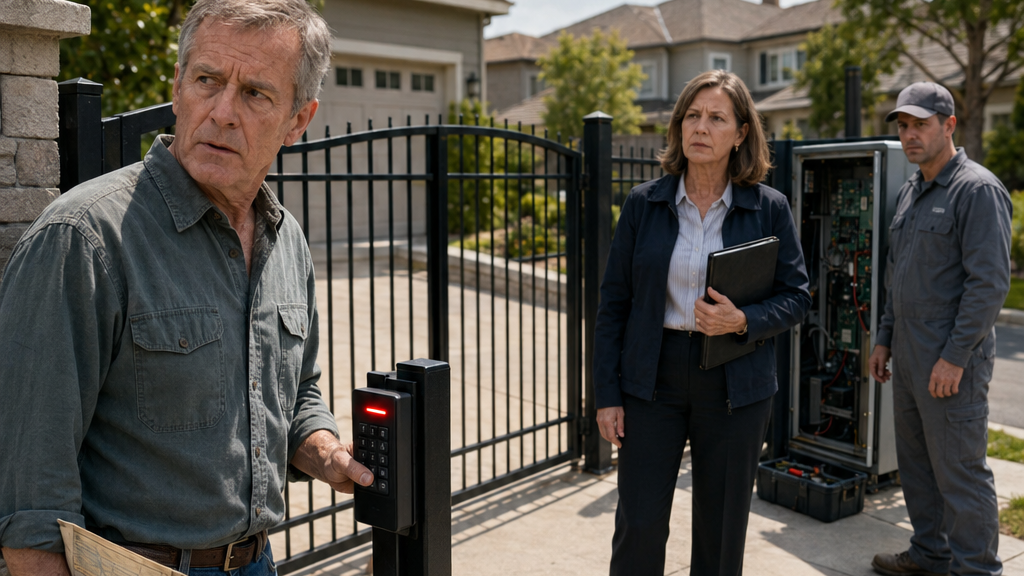
Thomas Anderson entered the same four digits he had used for years.
The keypad chirped once.
A red light came on.
He stared at it, then entered the code again more slowly, pressing each rubber button with the flat of his thumb.
Red again.
Beyond the black metal gate, his own side driveway curved toward the detached garage behind his house. Thomas could see the mower he had left near the shed the evening before. Nothing on the other side had changed.
Only the fact that he could no longer get there.
The control cabinet beside the gate stood open. A man in a gray work shirt was packing a screwdriver and a small programmer into a hard plastic case.
Thomas looked from him to the keypad.
“What did you change?”
The technician stopped.
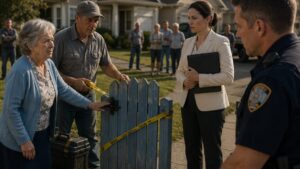
Before he answered, Kathleen Davis stepped from the shoulder of the road. She had a folder tucked against one hip and the expression she wore at HOA meetings when she had already decided a matter was settled.
“We standardized the access system this morning.”
Thomas looked at her.
“You did what?”
“All neighborhood-controlled gates are on the new system now.”
“This isn’t a neighborhood gate.”
Kathleen gave the technician a quick glance, as if she did not want him pulled into the argument.
“The management map lists it with the other access points.”
Thomas put one hand on the gatepost.
The post was old cedar, replaced twice since he and his father had set the first one. The keypad was newer. The strip of asphalt leading through it was newer still. But the narrow drive itself had existed long before the subdivision had grown around the back edge of the Anderson property.
“I wasn’t notified.”
“A notice went out.”
“Not asking permission.”
Kathleen’s mouth tightened slightly.
“It was a security update, Thomas. We’ve had too many different codes floating around.”
“That doesn’t answer what I asked.”
The technician closed his case.
Kathleen said, “Residents will be issued new credentials through management.”
Thomas let the word residents sit between them.
Thirty-one years in the same house, and suddenly someone was explaining how he would be allowed to enter the side of his own property.
He could feel his temper climbing, and that was exactly why he said nothing for several seconds.
He had spent most of his working life repairing equipment for people who became louder when they understood less. He had learned early that noise rarely fixed machinery.
Or people.
Finally he asked, “Did you check the recorded access agreement before you authorized this?”
Kathleen’s eyes shifted.
Not much. Just enough.
“What agreement?”
Thomas looked at the technician.
“You finished?”
“Yes, sir.”
“Then I’m not holding you up.”
The man picked up his case and walked toward his truck without argument.
Kathleen remained beside the gate.
“Thomas, if you have documentation, send it to Nicole. We can review it.”
“I asked whether you checked it before changing the code.”
“We reviewed the information in the association file.”
“That isn’t what I asked either.”
Kathleen exhaled.
“The vendor database identifies this as an association access point.”
Thomas looked again at the keypad. The red light had gone dark.
A vendor database.
He almost laughed, but there was nothing funny in it.
“Wait here.”
He walked back toward the house.
Kathleen called after him. “Thomas, I have another appointment.”
“Then you can leave.”
He went through the mudroom, past the kitchen, and into the small office that had once been his father’s bedroom after climbing the stairs became difficult for him.
The metal file cabinet stood beneath the window.
Thomas opened the bottom drawer.
Insurance.
Survey.
Tax records.
A folder with a cracked plastic tab.
He pulled it free.
The paper inside had yellowed at the edges. One corner bore a county recording stamp. A faded map showed the Anderson parcel before the last phase of the subdivision had been built.
Thomas traced the side drive with one finger.
There it was.
A narrow marked strip running from the county road, through his gate, along the east side of the property.
He carried the folder outside.
Kathleen was on her phone near her SUV.
When she saw him coming, she ended the call.
Thomas opened the map across the hood of his pickup.
“This gate.”
He tapped the marked entrance.
“Separate access.”
Kathleen leaned over the paper.
Her eyes moved along the lines.
“That map is old.”
“Yes.”
“I can see that.”
“Old doesn’t mean imaginary.”
“I didn’t say it did.”
Thomas pointed to the county stamp.
Kathleen looked closer.
For the first time that morning, her certainty weakened.
Not vanished.
Weakened.
She took out her phone and photographed the upper corner of the page.
“Can I send this to Nicole?”
“You can photograph it. The original stays with me.”
“Fine.”
She took two more pictures.
Thomas folded the map carefully back into the folder.
Kathleen said, “I’m still not promising the gate gets changed back.”
“I didn’t ask you to promise anything.”
“You’re treating this like we randomly decided to lock you out.”
“You changed my access without asking me.”
“We changed a system we were told belonged to the association.”
“Told by whom?”
“The management records.”
Thomas held her gaze.
“That database you mentioned.”
“Yes.”
He nodded once.
There it was again.
A screen somewhere said something, so a contractor had arrived Saturday morning and changed the rules at his gate.
Kathleen shut her folder.
“If this agreement is still controlling, we’ll deal with it.”
“If?”
She looked toward the old map in his hand.
“I’ve been on the board six years, Thomas. I’ve never seen that document.”
“That doesn’t erase it.”
“No. But it means we need to find out why it isn’t in our governing file.”
She opened her SUV door, then paused.
“The documents Nicole sent us before this project don’t show any separate owner-controlled gate here at all.”
Thomas looked at the keypad again.
The red light was gone, but the insult of it remained.
A minute earlier he had been angry because Kathleen had changed his code.
Now he was wondering about something else.
How could an agreement recorded with the county disappear from the very files the HOA used to decide what it controlled?
Chapter 2: The Page Missing From Their File
The first thing Thomas noticed was not what the old agreement contained.
It was what the HOA copy did not.
By eight Sunday morning, his kitchen table had disappeared beneath papers.
The county-stamped map lay beside a mug of coffee gone cold. Thomas had logged into the county records portal, found the original instrument number, and downloaded the scanned document attached to it.
Fourteen pages.
The copy Nicole Rivera had emailed him late Saturday contained thirteen.
Thomas counted twice.
Then a third time.
Page nine in the county scan carried a section titled ACCESS AND MAINTENANCE RIGHTS. In Nicole’s PDF, page eight jumped directly to what the county copy labeled page ten.
Thomas leaned back in his chair.
He disliked mysteries that could be explained by sloppy scanning almost as much as mysteries that could not.
He printed both versions.
At ten twelve, his phone rang.
Nicole.
“Mr. Anderson?”
“Thomas is fine.”
“I’m looking at the document you sent.”
“Which one?”
A pause.
“The county version.”
“Good.”
Another pause.
“I see the problem.”
Thomas looked at the two stacks in front of him.
“You mean the missing page.”
“Yes.”
“So it is missing.”
“From the association’s digital file, yes.”
“And from the packet the board used before changing the gate.”
“Yes.”
Nicole’s voice was measured, professional.
Not defensive.
That made Thomas listen more carefully.
“Do you know why?”
“No. The file predates our management contract by years. It may have been scanned incompletely before it was transferred to us.”
“Convenient.”
“I’m not saying it’s acceptable.”
Thomas said nothing.
Nicole continued.
“I’ve also verified the recording number. What you have is in the county index.”
“So the agreement is real.”
“I never suggested otherwise.”
“Somebody did yesterday.”
“I wasn’t there yesterday.”
That stopped him.
Fair enough.
Thomas looked at page nine.
The language was dense, written by someone who had believed sentences improved when they became longer.
But one section was plain enough.
The owner of the Anderson parcel retained control over ordinary locking and access mechanisms at the side entrance, subject to specific emergency and utility rights described elsewhere in the instrument.
Thomas underlined the sentence.
Nicole said, “I’m forwarding this to association counsel.”
“Then when is my code restored?”
“I can’t authorize that today.”
Thomas looked toward the kitchen window, where the top of the side gate was visible through the trees.
“You’ve confirmed the document.”
“I’ve confirmed that it was recorded.”
“What’s the difference?”
“The board has to determine whether that provision remains operative after the later amendments.”
Thomas’s jaw tightened.
“Now we’re going hunting for a reason it doesn’t count.”
“No. We’re determining whether it still governs.”
There was a knock at the back door.
Thomas turned.
Timothy Green stood outside holding a paper grocery bag.
Thomas nearly ignored him.
Instead he told Nicole, “Send me whatever counsel says.”
“I will.”
He hung up and opened the door.
Timothy lifted the bag.
“My wife made too many biscuits.”
“You came over here to discuss pastries?”
“No.”
“Thought so.”
Thomas stepped aside.
Timothy put the bag on the counter and saw the spread of documents.
“You found something.”
“I found what your board didn’t.”
Timothy pulled out a chair.
He had lived three streets over for eighteen years and had served as treasurer long enough to regard every unusual arrangement as a future invoice.
Thomas pushed page nine toward him.
Timothy read it slowly.
Then he read the next paragraph.
“This is from the original development period.”
“It’s recorded.”
“I can see that.”
“Apparently nobody else could.”
Timothy ignored the comment.
“This might have expired when the temporary development easements ended.”
Thomas tapped the paragraph.
“Show me where.”
“I’m saying it might.”
“You voted for the change.”
“Yes.”
“Based on a packet missing a page.”
“I didn’t know it was missing.”
“That improve it?”
Timothy’s face hardened.
“No.”
For a moment they sat without speaking.
Then Timothy turned back to the document.
“You know what I hate about old property files?”
Thomas almost smiled.
“No. Tell me.”
“They’re never old enough to stop costing money.”
Thomas gave a short breath through his nose.
Timothy traced the clause.
“If this survived the amendments, Kathleen had no business authorizing the change without dealing with you first.”
“That’s what I told her.”
“But if it didn’t survive—”
“You’ll be relieved.”
“I’ll be relieved if we know what the actual rule is.”
That was Timothy: irritating in a way Thomas sometimes respected.
By Sunday afternoon, Nicole sent another email.
The county recording had been authenticated.
The document had not been released or formally terminated in the county index.
That was not a final legal conclusion, she wrote, but it meant the board could not simply treat the side gate as ordinary common access.
Thomas read the sentence twice.
A small release moved through his chest.
Not victory.
Something steadier.
Proof that he had not imagined the line everyone else had stepped across.
Then he reached the final paragraph.
Pending review by association counsel, the HOA would not restore the prior configuration.
Thomas set his phone down.
So they admitted the agreement existed and still would not return his code.
He walked to the office and removed another folder from the cabinet.
Old correspondence.
Years of notices.
Utility work.
Board letters.
He had barely begun sorting when his phone buzzed again.
A forwarded document from Nicole.
Subject: INSURANCE RISK RECOMMENDATION.
Thomas opened it.
The letter was only six weeks old.
It warned the association that inconsistent credentials and undocumented emergency entry procedures at multiple controlled gates created a potential delay risk for emergency responders and service access.
One sentence was highlighted.
Standardize controlled access points wherever operationally feasible.
Thomas reread it.
Then he looked out toward the side gate.
For the first time since the red light had denied him entry, Kathleen’s decision did not look entirely like a power grab.
It looked like something more inconvenient.
A bad decision made in response to a problem that might actually be real.
Chapter 3: The Reason Kathleen Changed Everything
Thomas was standing beside the main neighborhood entrance Monday morning when Nicole told him an ambulance had lost almost four minutes at another gate.
He thought he had misheard her.
“How long?”
“Just under four minutes, according to the incident report.”
Cars passed through the open resident lane beside them. The new keypad on the visitor side matched the one Kathleen had installed at Thomas’s property: same black face, same small green status light, same vendor decal.
Nicole held a tablet against her chest.
“The crew had an older emergency code. That gate had been updated by a previous vendor. Nobody had corrected the emergency list.”
“Was anyone hurt because of it?”
“I don’t know.”
“That matters.”
“Yes, it does. But the delay matters even if the outcome was fine.”
Thomas looked toward the gate arm.
He could picture the scene too easily: flashing lights, somebody leaning from a cab toward a dead keypad, precious seconds turning into minutes because three different people thought someone else had updated a number.
Nicole said, “That incident is what accelerated the access project.”
“Accelerated.”
“Yes.”
“Meaning Kathleen pushed it through.”
“Meaning the board asked for a faster schedule.”
Thomas glanced at her.
“Careful wording.”
“I manage associations for a living.”
They drove separately to the HOA office, a converted room in the clubhouse with two desks, metal filing cabinets, and a printer that always seemed to be warming up.
Kathleen was already there.
Timothy sat at the small conference table with a spreadsheet open on his laptop.
Thomas placed the county copy of the agreement on the table.
Kathleen looked at it but did not touch it.
Nicole began.
“Counsel has confirmed the document was recorded and has found no recorded release.”
Thomas looked at Kathleen.
She met his eyes.
Nicole continued.
“They are still reviewing how later declarations affect it. In the meantime, we need to separate two issues. Ownership and access authority on Thomas’s side gate is one. Emergency compatibility is another.”
“That’s what I’ve been saying,” Thomas said.
Kathleen’s expression sharpened.
“No. You’ve been saying we had no reason to touch it.”
“I said you had no right to touch it without asking.”
“You also refused to participate when we asked residents to report private access systems last year.”
Thomas paused.
Timothy looked up from his laptop.
There it was.
A fact Thomas had preferred to leave out of the argument.
The management company had sent a questionnaire nearly ten months earlier asking residents to identify gate codes, private access controls, utility locks, and other nonstandard entry points.
Thomas had deleted it.
Not accidentally.
At the time, the HOA had been circulating proposals about cameras, common-area key fobs, and contractor tracking. Thomas had read the questionnaire as one more step toward inserting the association into places it did not belong.
“My gate wasn’t their system to inventory.”
Kathleen leaned forward.
“That answer is exactly why we had incomplete information.”
“And incomplete information gave you permission?”
“No.”
The speed of her answer surprised him.
Kathleen folded her hands.
“No. It didn’t.”
Thomas waited.
She glanced at Nicole, then back at him.
“I approved the side-gate change before title review was complete.”
Timothy stopped typing.
Thomas said, “Why?”
“Because we had an insurer telling us our emergency procedures were inconsistent, residents complaining about codes being shared with contractors, and an incident report showing responders delayed at a gate.”
“So you guessed.”
“I made a decision with the records we had.”
“Records you now know were incomplete.”
“Yes.”
The room became quiet.
Thomas had imagined this admission more than once over the weekend.
In every version, it had felt better.
Now that Kathleen had said it aloud, satisfaction barely arrived.
Because the ambulance delay was still sitting in the room with them.
Nicole turned the tablet so Thomas could see a system diagram.
“The vendor’s plan places every gate on one management platform. Resident codes can differ, but emergency credentials are supposed to work across all controlled access points.”
Thomas studied the screen.
His side gate was marked in the same color as the common entrances.
“That’s the map Kathleen relied on?”
“Yes.”
“Where did your vendor get it?”
“From our property-management database.”
“And where did the database get it?”
Nicole hesitated.
“Legacy records.”
Thomas gave her a look.
“So nobody knows.”
“We know the source files. We do not yet know why your exception was omitted.”
Kathleen said, “Which is why I’m asking you not to touch the gate until counsel finishes.”
Thomas looked at her.
“I’ve been locked out since Saturday.”
“You can access your property from the house and front drive.”
“That isn’t the point.”
“I know it isn’t.”
“Do you?”
“Yes.”
Kathleen’s voice lowered.
“But if you independently reset that controller and break the emergency credential, we are right back where this project started.”
Thomas leaned back.
He disliked how reasonable the sentence sounded.
He disliked even more that part of him had already planned to call someone.
Timothy closed his laptop.
“What if we authorize a temporary owner code through the vendor?”
Nicole shook her head.
“The controller at Thomas’s gate is now configured under the association account. Changing credentials while counsel is reviewing control could create another dispute.”
Thomas almost laughed.
“So your solution to an unauthorized change is to preserve it until your attorney decides whether it was unauthorized.”
Nicole did not argue with the description.
Kathleen said, “Forty-eight hours.”
“You said that Saturday.”
“I said we were reviewing it Saturday.”
Thomas stood.
He gathered his papers.
Kathleen looked at him.
“Don’t reset it yourself.”
Thomas slid the county agreement into his folder.
“You’ve made your position clear.”
“And have I made the reason clear?”
He stopped.
That question bothered him more than a threat would have.
He looked at the system diagram again.
The green lines connecting every entrance.
One credential meant to work everywhere.
A four-minute delay at a different gate.
Kathleen had overreached. He still believed that.
But she had not invented the problem.
Thomas walked out without answering.
At home, he sat in the small office beside the file cabinet and looked at the gate through the window.
His father had once kept a brass key on a nail by the back door for the old chain lock.
No vendors.
No database.
No board portal.
Anyone who needed through that gate had knocked.
Thomas knew that world was gone.
He also knew he was not ready to surrender control simply because modern systems preferred everything under one account.
At three fifteen, he called a licensed gate technician whose company had serviced the property years earlier.
Thomas gave him the controller model and described what had been changed.
The technician asked, “Do you own the gate?”
“Yes.”
“Do you have documentation?”
“Yes.”
“Any active emergency-access requirement?”
Thomas looked toward the county map spread on the desk.
There were markings on it he had not examined closely in years.
“Possibly.”
“That matters.”
“I know.”
The technician was silent for a second.
“I can look at it Wednesday morning. I won’t bypass anything illegal.”
“I’m not asking you to.”
Thomas ended the call and wrote the appointment on a notepad.
Wednesday, 9:00.
Then he looked again at the faded map.
He could have waited two more days for the HOA attorney.
Instead, he had chosen the one thing Kathleen had specifically warned him not to do.
The appointment was set.
Chapter 4: The Fix That Made Things Worse
At 9:07 Wednesday morning, Thomas entered his old code.
The keypad flashed green.
The gate rolled open.
For one clean second, relief moved through him so fast it felt like triumph.
The licensed technician stood beside the open control cabinet with a meter clipped to one wire and a laptop balanced on the hood of his service van.
“Your owner code is back,” he said.
Thomas looked through the gate at the strip of driveway beyond it.
His driveway.
His gate.
His code.
“Good.”
The technician did not close the cabinet.
Thomas noticed.
“What?”
“I want to test the other credentials.”
Thomas’s satisfaction cooled.
“The HOA ones?”
“The emergency profile. If this controller was enrolled in the new network, I want to see what stayed and what didn’t.”
Thomas folded his arms.
“I didn’t ask you to preserve their control.”
“No. You asked me to restore yours without damaging anything else.”
The distinction irritated him because it was accurate.
The technician selected a credential from his equipment case, keyed a sequence into the panel, then walked to the keypad.
He entered the emergency code.
Red.
He tried again.
Red.
Thomas stared at the light.
The technician went back to the cabinet.
“That’s what I was afraid of.”
“What happened?”
“Your controller is older than the three at the common entrances. The vendor pushed a new network profile onto it Saturday. When I restored the local configuration, it accepted your owner settings again, but the master emergency credential dropped out.”
Thomas looked toward the road.
“So put it back.”
“I can’t put their credential back without their system administrator issuing it.”
“You have the equipment.”
“I have service access to this controller. I don’t have authorization to generate association master credentials.”
Thomas’s jaw tightened.
“That sounds like their problem.”
The technician straightened.
“If this gate is part of an emergency access plan, it becomes your problem too.”
Thomas almost replied immediately.
Instead he looked at the green light, now dark again.
He had gotten what he wanted.
And somehow the gate felt less settled than it had five minutes earlier.
A black SUV turned onto the shoulder.
Kathleen.
Thomas closed his eyes briefly.
“That was fast.”
The technician looked at him.
“You notify them?”
“No.”
Kathleen got out before the SUV had fully settled.
She walked directly to the keypad.
“You changed it.”
Thomas said, “I restored my access.”
“After I specifically asked you not to.”
“Asked.”
Kathleen ignored the word.
She looked at the technician. “Does the emergency credential still work?”
The technician did not answer quickly enough.
Kathleen entered a code herself.
Red.
Her face changed.
Not anger first.
Fear.
Then anger.
She turned to Thomas.
“This is exactly what I told you could happen.”
Thomas felt heat rise into his neck.
“You changed my gate without permission.”
“And now an emergency credential doesn’t work.”
“Because your vendor tied my controller into a system without resolving the ownership issue.”
“And you broke that system before we resolved the emergency issue.”
“I restored what was there.”
The technician stepped between the rhythm of their voices.
“Nothing is physically damaged. The controller can support both configurations. It just needs the association credential reissued after ownership settings are finalized.”
Kathleen pointed at the gate.
“If an ambulance needs through here today?”
“The gate has manual release,” Thomas said.
“From the inside.”
“There’s a keyed exterior release.”
“Who has the key?”
Thomas did not answer.
Kathleen did.
“You.”
He disliked the way that sounded.
Not because it was false.
Because it reduced three decades of ordinary control to one ugly question: who could open the gate if Thomas was not there?
The technician said, “There are several ways to solve this. Remote relay. Emergency receiver. Separate master credential. You don’t need to transfer ownership.”
Kathleen looked at him.
“Can it be done today?”
“Not without the system administrator.”
Thomas said, “Then call them.”
Kathleen gave him a sharp look.
“You think they’re going to alter an active association profile because you hired somebody privately?”
“My gate.”
“Our emergency plan.”
The argument followed them into the clubhouse that afternoon.
Timothy sat at the boardroom table with Nicole. The HOA attorney joined by speakerphone.
Thomas placed the technician’s written service note in front of them.
The attorney’s voice came through a black conference unit in the center of the table.
“Mr. Anderson, I need to be clear. The association is not conceding ownership of the controller today.”
Thomas leaned back.
“And I’m not asking you to.”
Kathleen looked at him.
“You reset it.”
“I restored my code.”
“You removed emergency access.”
“I didn’t know your emergency access depended on taking over the controller.”
Nicole raised one hand.
“That is the issue we need to clarify.”
She turned her laptop so they could see a diagram.
The vendor’s new configuration showed four gates.
Three common entrances.
And Thomas’s.
A single digital line connected all four to a box labeled emergency master access.
Thomas said, “Why is mine on there?”
Nicole answered, “Because the legacy property file identifies the side entrance as a secondary service and emergency route.”
Thomas went still.
“What legacy file?”
Nicole opened another document.
The scan was faint, almost gray.
A utility map.
Thomas recognized the old road alignment before he read anything else.
His side drive.
A notation ran beside it.
SECONDARY EMERGENCY / UTILITY ACCESS.
Timothy leaned closer.
“I’ve never seen that.”
Neither had Thomas.
Or at least he could not remember seeing it in years.
Kathleen looked at him.
“You said this was just your private gate.”
“It is my gate.”
“That isn’t what I said.”
Thomas heard the accusation underneath her sentence.
He almost pushed back.
Then his eyes returned to the old note.
A memory surfaced.
His father standing at the kitchen sink twenty years earlier, telling a utility crew to use the east drive because they would tear up the lawn if they brought the truck through the main entrance.
Another memory.
A fire department pickup testing the old chain gate when the subdivision’s last phase was still under construction.
Thomas had not thought of either in years.
The attorney said, “The recorded agreement may separate ordinary control from emergency access rights. That would explain why both documents exist.”
Thomas looked at the speakerphone.
“So the HOA had emergency rights.”
“Possibly.”
“But not ordinary control.”
“Possibly.”
Kathleen let out a quiet breath.
Thomas looked at the faded utility map again.
He had spent four days insisting everyone else had failed to understand the gate.
Now a second document was telling him he had not understood all of it either.
Nicole slid the copy toward him.
“There’s a reference number in the corner. County archives may have the full instrument.”
Thomas took the page.
The paper felt suddenly heavier than the agreement that had seemed so decisive two days earlier.
His code worked again.
But beneath the faded line marking his driveway were three words he could no longer ignore.
Secondary emergency access.
Chapter 5: Why the Side Drive Was Different
The county clerk unfolded the map across a counter and pointed to a handwritten note Thomas had missed for years.
“See this reference?”
Thomas leaned closer.
The number was written in faded blue ink along the eastern boundary of his parcel.
“Yes.”
“That sends us to an easement instrument filed six months after the original subdivision agreement.”
Timothy stood beside him.
“You found it?”
The clerk nodded.
“Give me a minute.”
She disappeared through a door behind the records counter.
Thomas looked at Timothy.
“You didn’t have to come.”
“I’m treasurer.”
“That suddenly make county archives exciting?”
“No. But if the association has relied on your land for thirty years without carrying the right correctly in our file, I’d like to know before somebody sends me the bill.”
Thomas gave him a sideways look.
“That sounds more like you.”
The clerk returned with a scanned copy on a monitor and printed the relevant pages.
The language was old but clear enough.
The side drive remained under the Anderson parcel owner’s ordinary possession and control.
Emergency vehicles and designated utility providers retained nonexclusive access when required.
The association or its predecessor could maintain an emergency mechanism only so long as that mechanism did not interfere with the owner’s ordinary access or transfer day-to-day control.
Timothy read the paragraph twice.
Then he said, “So both sides were wrong.”
Thomas frowned.
“Be careful.”
“I mean us as a board and you as a person who said this had nothing to do with emergency access.”
“I said it was my gate.”
“It is.”
Timothy tapped the page.
“And we’ve apparently depended on it.”
Thomas took the document from him.
The clerk pointed to another paragraph.
“This provision was renewed when the last phase was annexed. There’s no termination attached.”
Thomas read that part slowly.
The exception had not been a favor.
It had been a compromise.
The developer had needed a secondary route across the Anderson side parcel to satisfy utility and emergency planning. Thomas’s father had refused to surrender the driveway outright. The resulting agreement preserved private control while granting limited access for specific purposes.
Thomas could suddenly hear his father’s voice.
Don’t sign away the whole road just because somebody needs to cross it twice a year.
He had repeated versions of that sentence for decades.
What he had forgotten was the other half of the arrangement.
People were still supposed to be able to cross when it mattered.
On the way back, Timothy drove.
Thomas sat with the file on his lap.
At a stoplight, Timothy said, “You knew some of this.”
Thomas looked out the passenger window.
“Some.”
“How much?”
Thomas did not answer immediately.
Ten months earlier, Nicole had sent the access questionnaire.
He had deleted it.
Before that, two previous management companies had asked residents to identify unusual utility arrangements.
He had ignored those requests too.
Not because he had forgotten the agreement.
Because he had resented the questions.
Every few years, some new management company arrived with a spreadsheet and a password-protected portal and asked people who had lived there for decades to explain their own property to strangers.
Thomas had decided they could do their own homework.
Now he said, “I knew emergency crews had been allowed through historically.”
Timothy glanced at him.
“And you never put that in the questionnaire.”
“No.”
“Why?”
“Because the questionnaire asked for private access systems.”
“This was a private access system with an emergency easement.”
Thomas looked at him.
“I know that now.”
“No. You knew enough then.”
The sentence landed harder because Timothy did not raise his voice.
Thomas looked down at the county pages.
“I didn’t trust where the board was headed.”
“With cameras?”
“With all of it. Codes. vendors. databases. Every year something else that used to belong to the homeowner becomes part of a system.”
Timothy nodded once.
“I get that.”
“Do you?”
“Yes. But refusing to tell us an emergency route exists didn’t protect your gate. It made it easier for somebody to misunderstand it.”
Thomas said nothing.
Back at the property, they walked the side drive with the old map.
Timothy held one corner while Thomas aligned the faded boundary line with the present fence.
The route made sense immediately.
The side entrance offered the straightest path behind the last row of houses. Utility boxes sat along the rear easement. If the main entrance was blocked or inaccessible, the narrow drive gave service vehicles another way in.
Timothy looked toward the houses.
“We’ve been benefiting from this the whole time.”
Thomas folded the map.
“Apparently.”
“And paying nothing for it.”
“The agreement never required payment.”
“That’s not what I mean.”
Thomas understood.
The board had spent days talking about Thomas’s exception as if it were a personal privilege.
But the exception existed because his family had allowed the neighborhood something too.
That afternoon, Nicole and Kathleen came to the property.
Thomas placed the two recorded instruments on the hood of his pickup.
Nicole read the newer document first.
“This fixes part of the legal ambiguity.”
Kathleen looked at Thomas.
“Part.”
He nodded.
“Ordinary access stays under owner control. Emergency access survives.”
Kathleen read the clause herself.
When she finished, she said, “Then our new system was trying to preserve a right we actually have.”
Thomas felt the old irritation return.
“By taking one you don’t.”
“I said trying.”
“You authorized it.”
“Yes.”
Nicole interrupted before the argument could harden.
“The system can be configured around both rights. The problem is the association files never distinguished them.”
Thomas said, “Your files.”
Nicole looked directly at him.
“Our files were incomplete.”
Then she added, “And our resident update requests went unanswered.”
Thomas knew who she meant.
Kathleen did too.
He could have said the requests were badly worded.
He could have said management should have checked county records.
Both were true.
Instead he said, “I ignored them.”
Kathleen’s face changed slightly.
Thomas went on.
“I thought if I started giving the association details about the gate, eventually somebody would decide the gate belonged to the association.”
Kathleen looked at the keypad.
“And I proved your suspicion right.”
“For about four days.”
“Long enough.”
That was as close to shared admission as either of them had reached.
Nicole gathered the documents.
“The cleanest solution is dual control. Owner credentials administered by Thomas. Emergency credential maintained separately and documented.”
Kathleen did not answer.
She walked a few steps down the driveway and looked toward the rear easement.
Then she returned.
“There’s another option.”
Thomas already disliked her tone.
“The association could assume permanent control of the controller,” she said. “Thomas retains unlimited personal credentials. Emergency access stays centralized. No split administration. No future confusion.”
Thomas stared at her.
“You read all that and your answer is still to take control?”
“I’m proposing the simplest operational arrangement.”
“For you.”
“For everyone.”
“No.”
Kathleen folded her arms.
“Then give me something better.”
Thomas looked at the faded map, then at the keypad.
For the first time, simply proving her wrong was not enough.
Now he had to find a solution that protected what belonged to him without pretending the neighborhood had no legitimate right to pass through when it truly mattered.
Chapter 6: The Meeting Where Neither Side Won
Kathleen opened the board meeting by putting a one-page proposal on the table that transferred permanent administration of Thomas’s gate controller to the HOA.
Thomas read the first paragraph and stopped.
“No.”
Seven people sat around the clubhouse conference table, but only Kathleen, Timothy, Nicole, and Thomas were speaking.
Kathleen tapped the paper.
“You haven’t read the whole thing.”
“I read the part where the association controls my gate.”
“You retain personal access.”
“That isn’t control.”
“It guarantees you access.”
Thomas looked at her.
“So did my old code until Saturday.”
Timothy rubbed his forehead.
Nicole had brought a technical diagram from the gate vendor. Two separate credential columns ran beside a drawing of the controller.
She said, “Before we repeat the same argument for an hour, the vendor confirmed something this afternoon.”
Kathleen looked over.
“What?”
“We do not need association ownership of the controller to preserve emergency credentials.”
Silence.
Thomas looked at Nicole.
She rotated the diagram toward the board.
“The controller can run two credential classes. Thomas can retain administrative authority over ordinary owner access. The association can maintain one restricted emergency credential through a separate relay profile.”
Kathleen studied it.
“Who can revoke the emergency credential?”
“The system requires both profiles to be altered separately.”
“So Thomas could still disable ours.”
Thomas said, “And you could still disable mine if you owned the whole thing.”
“That’s the problem.”
“No. That’s the point.”
Timothy leaned forward.
“What if neither side can alter the other profile without written notice except during a verified security event?”
Nicole nodded.
“That can be drafted.”
Kathleen looked at Thomas.
“You’re willing to leave an association credential on your controller?”
Thomas hesitated.
Three days earlier he would have said no.
Not because the emergency right was illegitimate.
Because letting the HOA maintain anything on the keypad felt like the beginning of losing it.
Now the old easement sat in his folder.
His father’s compromise.
Private control and limited community access occupying the same strip of pavement without becoming the same thing.
Thomas said, “Emergency credential only. No contractor code. No resident code. No management override for convenience.”
Kathleen said, “We need utility access.”
“Only where the recorded agreement allows it.”
“Then the utility credential should be included.”
“Separate credential.”
“That’s unnecessary.”
“It’s auditable.”
Nicole looked at Kathleen.
“He’s right.”
Kathleen’s mouth tightened.
Thomas almost enjoyed that.
Almost.
Nicole continued.
“If emergency and utility functions use separate credentials, there’s a record of which right is being exercised.”
Timothy said, “And if a landscaping contractor gets somebody’s code, it doesn’t become an emergency credential.”
Kathleen looked down at the proposal in front of her.
The room had shifted.
Not toward Thomas exactly.
Toward something less comfortable than victory.
A system that required everyone to admit the original categories mattered.
Kathleen said, “What about maintenance?”
Thomas answered, “I maintain the physical gate. If the HOA’s emergency hardware fails, the HOA pays for its component.”
“And if your controller fails and blocks emergency entry?”
“I repair it.”
“How quickly?”
“Reasonably.”
“That word will get us nowhere.”
Thomas leaned back.
“Twenty-four hours for a noncritical fault. Immediate manual access during an active emergency.”
Nicole made a note.
Kathleen said, “Who holds the exterior release key?”
Thomas was ready with the answer.
“One secured copy with me. One sealed emergency copy in a lockbox accessible only to designated responders.”
Kathleen glanced at Nicole.
“Can that work?”
“Yes.”
Thomas looked at the diagram.
Something had changed in him over the last week.
He could feel it most clearly in the fact that he was proposing safeguards he once would have rejected simply because the HOA was involved.
But accepting a legitimate shared function did not require pretending ownership was shared.
That distinction had become more important than winning.
Kathleen slid her original proposal aside.
“Then I want the protocol recorded in the association files and referenced in the property-management database.”
Thomas said, “Agreed.”
Nicole looked up.
“And attached to the parcel record in the internal system.”
Thomas almost objected out of habit.
He caught himself.
“Agreed.”
Timothy looked at him with faint surprise.
Thomas ignored it.
Kathleen said, “The association also needs protection if the owner changes.”
“The recorded agreement already runs with the parcel.”
“The operational protocol should too.”
Thomas considered that.
“Yes. But it cannot expand the easement.”
Nicole wrote again.
“No expansion without owner consent and whatever approval the governing documents require.”
Kathleen looked toward the board members seated farther down the table.
“We also have to address how this happened.”
No one spoke.
She continued.
“The board approved the gate conversion using incomplete records.”
Timothy said, “The management file was missing a recorded page.”
Nicole added, “And the legacy mapping collapsed two different access rights into one category.”
Thomas said nothing.
Kathleen looked at him.
“And the homeowner declined multiple opportunities to identify the exception.”
There it was.
Thomas felt the familiar resistance in his chest.
He could challenge the wording.
Declined multiple opportunities sounded like language designed for minutes.
But it was not false.
He said, “Put it in.”
Kathleen blinked.
Thomas continued.
“Put all of it in. The missing page. The database error. My unanswered questionnaires. Your authorization before title review.”
Timothy looked between them.
Kathleen asked, “You’re serious?”
“If we fix the record by leaving out the parts that make us uncomfortable, somebody else will be sitting here doing this again.”
For the first time that evening, Kathleen gave him something close to respect.
Not warmth.
Not forgiveness.
Recognition.
Nicole turned to a new page in her notes.
“Then the corrected file should include a procedural change. Any future access-system alteration affecting individually owned property requires title and easement verification before implementation.”
Timothy nodded.
“Good.”
Thomas looked at Kathleen.
She did not argue.
The original takeover proposal remained face down beside her hand.
At last she said, “If counsel can draft the dual-access protocol the way we’ve discussed, I’ll withdraw the permanent-control proposal.”
Thomas said, “And the association reimburses the cost of undoing Saturday’s unauthorized programming.”
Kathleen looked at Nicole.
Nicole said, “That can be negotiated as part of the resolution.”
Thomas shook his head.
“No. Not negotiated into disappearing.”
Kathleen’s eyes narrowed.
“The emergency issue was real.”
“So was the unauthorized change.”
Neither looked away.
Finally Kathleen said, “Documented invoice. Reasonable charges. If counsel confirms the board exceeded its authority, I’ll support reimbursement.”
Thomas nodded.
It was not an apology.
He realized he did not need one as much as he had thought.
Nicole gathered the marked-up diagram and the county documents.
“I’ll circulate a draft.”
Kathleen picked up her original proposal and tore it once down the center.
Not theatrically.
Just enough to make clear it was no longer the working document.
Then she looked at Thomas.
“If you sign the formal protocol, I’ll put the withdrawal of permanent HOA control on the agenda as part of the same motion.”
Thomas closed his folder.
For the first time since the keypad had flashed red, the next decision belonged partly to him again.
But this time, keeping control would require him to sign his name to responsibilities he had spent years refusing to write down.
Chapter 7: The Gate Opens Differently Now
The technician entered the first code at 8:14 on a Thursday morning.
The keypad flashed green.
The gate rolled open.
He waited until it stopped, closed it again, then entered a second code from a laminated card Nicole held against her clipboard.
Green again.
Thomas stood a few feet away with his hands in his jacket pockets.
For three weeks he had imagined this test.
He had expected satisfaction.
What he felt instead was something quieter.
The gate had not become his again that morning. It had never stopped being his. What had changed was that everyone standing beside it finally understood what that ownership did—and did not—mean.
The technician returned to the open control cabinet.
“Owner profile is independent. Emergency credential is independent. Utility credential is separate and restricted to the authorized window.”
Nicole checked the diagram attached to the new protocol.
“And management can’t alter the owner profile?”
“Not without owner authorization.”
Kathleen stood beside her.
“And Thomas can’t accidentally wipe the emergency credential by changing his personal code?”
“Not with this configuration.”
Thomas looked at the keypad.
“That would’ve been useful three weeks ago.”
Kathleen glanced at him.
“Yes.”
There was no defensiveness in the answer.
No apology either.
Thomas had learned not to expect conversations with Kathleen to become cleaner than the people having them.
The technician closed the cabinet and locked it.
“One more test.”
He handed Thomas a small card.
Thomas frowned.
“What’s this?”
“Temporary service credential. I want you to verify it fails.”
Thomas entered the number.
Red.
He looked at the technician.
“Good.”
“That’s the point.”
Nicole made a check on the page.
Emergency.
Utility.
Owner.
Three different functions that the old management database had once reduced to a single colored dot.
Thomas thought about how much trouble could fit inside one wrong category.
Kathleen reached into her folder.
“Before everyone leaves, we need signatures.”
They moved to the hood of Thomas’s pickup.
The final access protocol was six pages long.
Thomas had read every version.
The first draft had made him responsible for any delay caused by “owner-controlled equipment,” language broad enough to make him liable for almost anything that happened near the gate.
He had crossed it out.
The second draft had allowed the HOA to temporarily seize administrative control during a “security concern.”
He had crossed that out too.
The third version was better.
Ownership remained with the Anderson parcel.
Ordinary access remained under Thomas’s control.
Emergency and utility rights were limited to the recorded easement.
The HOA was responsible for maintaining its credential components and responder information.
Thomas was responsible for maintaining the gate in operating condition and providing manual access during a verified emergency if the electronic system failed.
Neither side could expand its rights by convenience.
Nicole handed him a pen.
Thomas read the reimbursement paragraph one last time.
The HOA would reimburse the licensed technician’s original restoration charge and the additional programming required to establish the corrected dual-access system.
No penalty.
No damages.
No dramatic settlement.
Just the cost of undoing a mistake.
He signed.
Kathleen signed beneath him.
Nicole signed as management representative.
Timothy arrived a few minutes later carrying the board-approved resolution in a plain folder.
“Recorded in the minutes,” he said.
Thomas took the folder.
The resolution acknowledged that the original gate conversion had been authorized using incomplete association records and before completion of title and easement review.
It also acknowledged that Thomas had failed to respond to previous requests for clarification about unusual private access arrangements.
His name was there too.
Not protected.
Not blamed for everything.
Just included.
Thomas looked at Timothy.
“You really put all of it in.”
“You told us to.”
“I know.”
“Regretting that?”
Thomas thought about it.
“No.”
Timothy nodded toward the gate.
“Then maybe this one lasts longer than the last file.”
They drove to the clubhouse for the final administrative meeting.
Nicole had rebuilt the property record.
The old county map appeared first.
Behind it was the easement instrument.
Then the board resolution.
Then the new technical diagram.
Then the signed protocol.
No missing page.
No unlabeled exception.
No single database entry claiming more than the records supported.
Kathleen sat across from Thomas at the conference table.
“The insurer accepted the revised emergency plan.”
“That was fast.”
“They wanted a documented system. We now have one.”
“And the other gates?”
“Being audited.”
Thomas raised an eyebrow.
Kathleen gave him a tired look.
“Yes, Thomas. All of them.”
Timothy smiled into his coffee.
Nicole placed another document in front of Thomas.
“This is the reimbursement authorization.”
Thomas looked at the amount.
It matched the invoices.
No subtraction for the fact that he had independently restored the code.
No invented administrative fee.
He signed the receipt.
Kathleen said, “I want one thing on the record.”
Thomas looked up.
“The security issue was real.”
“I know.”
“The emergency delay at the other entrance could have happened again.”
“I know that too.”
“And I would still support standardizing the common gates.”
Thomas waited.
Kathleen continued.
“What I would not support again is assuming that something is common because a vendor database says it is.”
Thomas leaned back.
“That sounds expensive to learn.”
“It was.”
He looked at her.
“I should’ve answered Nicole’s questionnaire.”
Kathleen seemed almost more surprised by that than she had been when he agreed to the dual-access system.
Thomas continued.
“I thought keeping the details to myself kept the board out of my business.”
“And?”
“It kept accurate information out of your file.”
Nicole stopped writing.
Thomas looked down at the copy of the original easement.
“My father believed in putting agreements on paper. I spent years acting like remembering them was enough.”
Kathleen said nothing for a moment.
Then she tapped the new protocol.
“Apparently neither method works if nobody can find the paper.”
Thomas gave a small laugh.
That was the closest they came to reconciliation.
It was enough.
Later that afternoon, Thomas returned to the side gate alone.
The technician had removed his cones and packed away the tools. Nothing remained on the shoulder except the keypad and the old cedar post.
Thomas entered his code.
Green.
The gate opened.
He drove through, stopped inside, and watched it close behind him.
For years, the keypad had been nothing more than a convenience.
Then for three weeks it had become a boundary marker, an accusation, proof of somebody else’s assumption, and proof of his own stubbornness.
Now it was simply a gate again.
Almost.
On the passenger seat sat Thomas’s copy of the updated access packet.
He carried it into the house and walked to the old office.
The bottom drawer of the metal cabinet was open.
For a moment, he almost placed the packet inside with the original map and the old agreement.
That was where important things had always gone.
Safe.
Private.
Under his control.
Thomas stood there with the folder in his hand.
Then he closed the drawer without putting it inside.
He drove back to the clubhouse.
Nicole was still at her desk.
Thomas placed the packet in front of her.
She looked at him.
“You already have a copy.”
“I know.”
“This one’s yours.”
“No.”
He pushed it toward the records shelf.
“This one stays here.”
Nicole studied him for half a second, then opened the association file cabinet.
She placed the packet behind the Anderson parcel tab.
Thomas watched until the drawer closed.
Outside, the side gate stood beyond the trees where it always had.
His property.
Their emergency route.
Both facts written down this time.
The story has ended.