They Tried To Tear Down His Winter Ramp During Dinner Before Reading The Permit
Chapter 1: The Police Lights Behind The Holiday Table
The first screw came out of the ramp while the turkey was still steaming.
Benjamin Carter heard the sharp whine of the drill before he understood what it was. It cut through the soft clink of silverware, through Justin’s laugh, through the low winter music playing from the small speaker tucked near the porch post. For half a second, Benjamin thought something had fallen from the string-lit pergola over the side entrance.
Then he saw the man kneeling at the bottom of the ramp.
The worker wore a dark jacket, orange gloves, and a knit cap pulled low over his ears. One boot rested on the first board Benjamin had sanded by hand three nights earlier. The drill jerked in his grip, and the screw spun free into the snow.
Michelle’s fork stopped halfway to her plate.
“Ben,” she said quietly.
Benjamin stood so fast his chair scraped the pavers.
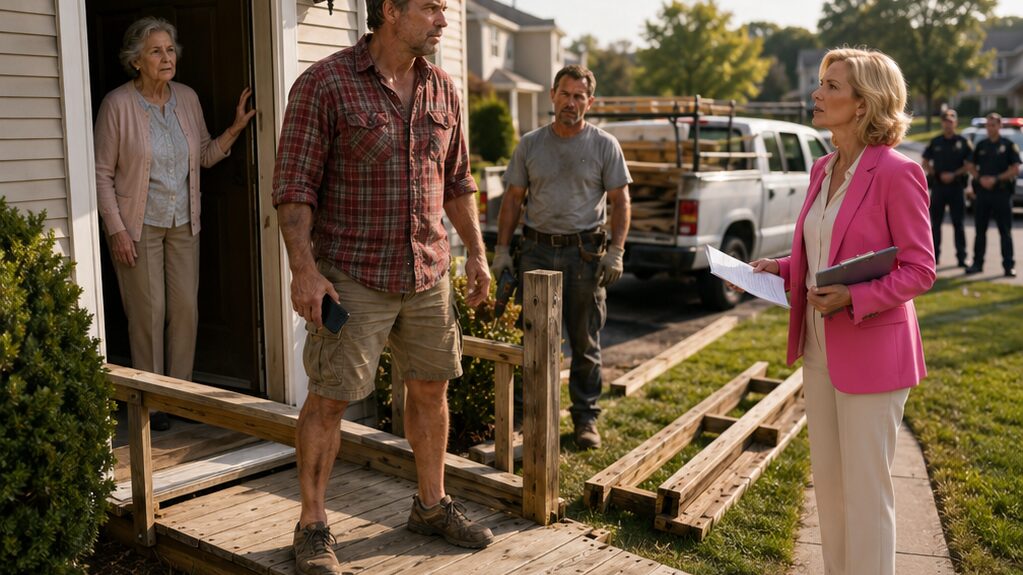
Behind the long table, past the candles and the cranberry dish and Justin’s untouched roll, red and blue lights washed over the snow. A police SUV sat at the curve of the driveway with its engine running. Two officers stood near it, not reaching for anything, not speaking, just present enough to make the backyard feel like it no longer belonged to the family.
The lake beyond the pines was black and still. The reflection of the Christmas lights stretched across the ice like something peaceful trying not to be noticed.
“Sir,” the worker said, rising with the drill in his hand. “You need to step back from the work area.”
Benjamin looked down at the loose screw half-buried in snow.
“What work area?”
The man glanced toward the driveway.
A woman in a bright pink winter coat was walking toward them, one gloved hand holding a stack of papers against her chest. Even before Benjamin saw her face clearly, he knew who she was. Deborah Scott never walked onto a property like a guest. She walked like she had already found the mistake and was simply waiting for everyone else to admit it.
“Mr. Carter,” she called, her voice bright and hard in the cold. “This is an enforcement action. Please don’t interfere with the contracted crew.”
Justin pushed back from the table. “Dad?”
“Stay by your mother,” Benjamin said.
Michelle had gone very still. Her dark green coat was buttoned to her throat, but Benjamin could see her hand pressing lightly against the edge of the table. Not gripping. Not yet. Just testing whether it would hold if she needed to stand.
Benjamin stepped off the patio and onto the packed snow beside the ramp. The ramp rose from the cleared path to the side entrance of the house, covered by the narrow wooden frame he had built to keep ice from forming over the boards. He had hung string lights from the frame because Michelle loved light in winter, and because Justin said it made the house look less like a place where everyone had learned to move carefully.
It was not decorative. It was not a party deck. It was six feet of safe passage between the driveway and the only door Michelle could use without stairs.
“What are you enforcing?” Benjamin asked.
Deborah did not hand him the papers.
She walked past him and gave them to the nearest police officer.
The gesture was small, but Benjamin felt it land. She had come to his property, brought a crew onto the ramp he built, placed officers behind his family dinner, and still acted as if he was the last person who needed to know why.
The officer took the papers but did not open them immediately. “Ma’am, I’m here for civil standby only.”
“And I appreciate that,” Deborah said. “The association is acting under its governing documents. This structure was installed without approval, in violation of exterior appearance standards and winter hazard provisions.”
Benjamin stared at her. “You started taking it apart before giving me notice?”
“We left notice on the door.”
“When?”
Deborah’s mouth tightened. “This morning.”
Benjamin looked toward the side entrance. The paper had not been there when he carried out the turkey. It had not been there when Justin hung the last ornament from the pergola frame. It had not been there when Michelle crossed the ramp slowly, carefully, smiling because she had made it outside without asking Benjamin for his arm.
“This morning,” he repeated, “and your crew is here tonight?”
Deborah held her chin up. “You were instructed not to proceed with unapproved exterior construction.”
“I submitted the application.”
“You submitted a request for a temporary winter access cover. It was incomplete.”
“It was attached to a city temporary safety permit.”
“That does not equal HOA approval.”
The worker at the ramp shifted his weight. Another man stood near a pickup truck at the driveway, its bed lined with tarps and straps. Benjamin saw a stack of boards already inside it and felt his stomach drop.
“You’ve already removed pieces?”
The first worker looked away.
Benjamin moved toward the ramp, but Deborah raised one hand.
“Do not obstruct the crew.”
“That ramp is attached to my house.”
“That structure is unauthorized.”
“My wife used that ramp to get to this table.”
Deborah glanced at Michelle, then back at Benjamin too quickly. “Medical issues were not included in the architectural request.”
Michelle’s eyes lowered.
Benjamin felt the old instinct rise in him: cover it, contain it, keep strangers from turning Michelle’s body into a discussion point. He had filled out the form that way on purpose. Temporary winter access cover. Ramp stabilization. Handrail. Anti-slip surface. He had written the truth in pieces because he believed the pieces should have been enough.
Now Deborah stood in the snow with a police SUV behind her and treated those missing words like permission.
Justin lifted his phone.
“Put it down,” Benjamin said, without looking at him.
“But Dad—”
“Justin.”
The boy lowered it, though not all the way.
The officer finally glanced through the papers. “Ms. Scott, this appears to be an HOA matter. We’re not removing anyone from private property tonight.”
Deborah’s face did not change, but her fingers tightened on the remaining pages. “The crew is authorized to remove noncompliant material from common-view exterior modifications.”
“This is not common property,” Benjamin said.
“No one said it was.”
“You sent strangers onto my ramp during dinner.”
Deborah looked past him at the table. The candles flickered in their glass holders. The turkey sat half-carved. Michelle’s napkin had slipped from her lap to the snow-dusted stone beneath her chair.
“You chose to host an outdoor event around a structure you knew was under review,” Deborah said.
Benjamin heard the sentence the way it would sound in a meeting room. Clean. Procedural. Empty of cold air, loose screws, and a woman trying not to let anyone see she was afraid to stand.
“What company are you with?” he asked the worker.
The man hesitated. “Garcia Property Services.”
“Your name?”
“Jonathan Garcia.”
Benjamin took out his phone, opened the camera, and began recording. His hand was steadier than he felt.
“Jonathan Garcia,” he said, keeping his voice low. “You are removing boards from a ramp attached to my home on Christmas Eve at the direction of Deborah Scott and the Lakeview Pines HOA. Is that correct?”
Jonathan looked toward Deborah.
Deborah snapped, “You don’t have to answer that.”
Benjamin kept the phone raised. “Then stop touching the ramp until I have the order in writing.”
“You have the order,” Deborah said.
“No. The officer has the order. You haven’t given me anything.”
For the first time, Jonathan lowered the drill.
The cold seemed to move closer.
Deborah stepped toward Benjamin and pulled one page from the stack. “Fine.”
She held it out.
Benjamin did not reach for it immediately. He looked at the page, then at the screw lying in the snow, then at Michelle. Her face was composed, but the hand on the table had closed now.
He took the paper.
At the top, in bold letters, it read: IMMEDIATE REMOVAL OF NONCOMPLIANT EXTERIOR STRUCTURE.
The words blurred for a breath.
“This is the only way she gets through winter,” Benjamin said.
Deborah’s eyes flicked toward Michelle again. “Then you should have submitted the proper documentation before building it.”
Benjamin folded the paper once and held it at his side.
From the driveway, the police lights painted the ramp red, then blue, then red again. The colors slid over the removed board, the dinner plates, Justin’s pale face, Michelle’s hand pressed to the table.
Deborah turned to Jonathan.
“Continue with the lower section tonight,” she said. “The entire structure needs to be gone before morning.”
Chapter 2: The Notice Left After The Crew Arrived
“This morning?” Benjamin asked.
Deborah stared at him as if the question was beneath the temperature.
The worker’s drill hung at his side. The police officer stood near the edge of the driveway, holding the papers Deborah had first given him, his eyes moving between the ramp and the family table. Behind him, the SUV lights pulsed without sound, turning the snow into something official.
“You said the notice was left this morning,” Benjamin said. “What time?”
Deborah exhaled through her nose. “I don’t have the exact minute.”
“You came onto my property with a crew already scheduled, and you don’t know when I was notified?”
“The notice was posted.”
“When?”
“It was posted today.”
Benjamin looked toward the side entrance. A torn strip of tape still clung to the glass storm door. He had not seen it before because they had been carrying dishes through the kitchen door, avoiding the side entrance after Jonathan removed the first board. That was the trick of it. The notice existed now, therefore Deborah could say it had existed when it mattered.
He held up his phone. “I’m asking again. What time?”
Deborah’s jaw set. “Approximately nine this morning.”
“At nine this morning, were the contractors already hired?”
She said nothing.
Jonathan shifted beside the ramp.
Benjamin turned to him. “When did you get the work order?”
“Mr. Carter,” Deborah cut in.
Jonathan rubbed a gloved thumb along the drill handle. “Yesterday afternoon.”
Justin made a small sound from the table.
Deborah turned sharply. “This is not a trial.”
“No,” Benjamin said. “It’s my home.”
The words surprised even him. Not because they were loud. They weren’t. But something in them had changed. He had spent weeks trying to handle the ramp the clean way: forms, measurements, diagrams, emails with polite greetings and attached PDFs. He had told himself that people responded to clear documentation. He had told Michelle they would not need to explain more than they wanted to.
Now a crew had arrived before the notice meant to justify them.
Benjamin walked to the ramp and knelt by the missing board. He took a photo of the exposed joist, another of the screw holes, another of the tire tracks near the cleared path. He photographed Jonathan’s truck, the boards already stacked in the bed, the orange cones placed beside the side entrance after the crew had begun.
Deborah watched him with visible irritation. “Documenting does not change the violation.”
“No,” Benjamin said. “It shows how you handled it.”
The police officer stepped closer. “Mr. Carter, I need everyone to keep distance from the tools.”
“I’m not touching him. I’m touching my ramp.”
“Sir.”
Benjamin rose. He forced his shoulders down.
Michelle called from the table, “Ben.”
He turned.
She was looking at Justin, not him. Justin’s phone was up again, half-hidden behind the centerpiece of pine branches and small gold ornaments.
“Put it away,” Michelle said softly.
Justin’s mouth tightened. “They’re lying.”
“Put it away.”
He lowered it to his lap, but the screen stayed lit.
Deborah moved toward the ramp with her papers. “The structure exceeds the approved dimensions for seasonal coverings, includes decorative lighting, and was used tonight as part of an outdoor entertainment area.”
Benjamin looked at the string lights. “They’re low-heat LED bulbs.”
“That is not the point.”
“What is the point?”
“The point is that it looks like a party deck.”
Justin’s phone rose an inch.
Deborah did not notice.
Benjamin did.
This time, he did not tell his son to stop.
“A party deck,” Benjamin repeated.
Deborah gestured toward the table. “You have a full dining setup outside.”
“It’s Christmas Eve.”
“You built an unapproved exterior structure and hosted an event under it while the board was reviewing your violation.”
“My wife needed a covered ramp before the first ice storm.”
“Again,” Deborah said, crisp and cold, “no medical necessity was submitted.”
Michelle’s face changed. Not much. Just a small withdrawal around the eyes, as if someone had opened a door she had asked to keep closed.
Benjamin felt shame move through him, hot under his coat.
Because Deborah was not entirely wrong.
He had submitted photos, dimensions, the city safety permit, a note about winter access. He had not submitted Michelle’s doctor’s letter. He had not uploaded the occupational therapy recommendation that explained why uneven ice, missing rail height, and exposed steps created a fall risk. He had not wanted a committee of neighbors to discuss Michelle’s body in a clubhouse under fluorescent lights.
He had thought he was protecting her.
Now the missing words were being used to take apart the thing that protected her.
The officer cleared his throat. “Ms. Scott, I’m not here to validate an HOA violation. I’m here to keep the peace. Without a court order, I’m not removing the homeowner from his property.”
Deborah’s expression flickered. “The association has removal authority under section 7.4.”
“That may be. But I’m not forcing him to stand aside tonight.”
For one brief moment, the air loosened.
Benjamin saw Jonathan lower the drill completely. One of the other workers at the truck stopped pulling a strap over the stacked boards.
Then Deborah said, “Loose materials and safety hazards may still be removed.”
Benjamin turned toward her. “What loose materials?”
She pointed at the rail section Jonathan had unscrewed from the lower ramp. “That has already been detached. It can’t remain.”
“You detached it.”
“Because it was installed without authorization.”
“You can’t create a hazard and then call the hazard your reason to remove more.”
Deborah’s eyes hardened. “Mr. Carter, if you continue escalating, the board may impose daily fines.”
Benjamin stepped closer to the lower ramp, leaving enough space that no one could say he had touched the crew. “Jonathan, do not load another board.”
Jonathan looked tired. Not angry. Tired in the way of a man who had thought this was a clean job and now understood he was standing in the middle of someone’s Christmas.
“I have a signed work order,” he said.
“From who?”
“The HOA.”
“Not the court. Not the city. Not me.”
Deborah snapped, “You are not the only person with rights in this community.”
Benjamin almost answered too quickly. He stopped himself. He looked back at Michelle.
She was sitting in the cold because he had promised her they could have one normal dinner. She had picked the dark green coat because it looked festive without being bright. She had laughed when Justin put too many candles on the table. She had crossed the ramp slowly but without pain showing on her face, and Benjamin had pretended not to watch because she hated being watched.
He turned back.
“You’re right,” he said. “I’m not. That’s why I followed the process.”
Deborah made a short, humorless sound. “You started building before approval.”
“The city issued temporary safety clearance.”
“The city does not control architectural standards inside Lakeview Pines.”
“The city controls whether a ramp is safe.”
“And the HOA controls whether it can be there.”
The words hung between them, clean as a locked gate.
Benjamin lifted the violation notice. “Then put in writing that your architectural standard matters more than access to the home.”
Deborah’s face flushed in the cold. “Do not twist this.”
“I’m asking for your rule.”
“You have it.”
“No. I have a conclusion.”
For several seconds, no one moved.
Then Jonathan spoke quietly. “I’ll take the detached rail and the lower board already removed. That’s all I’m comfortable doing tonight.”
Deborah turned on him. “You were contracted for full lower section removal.”
“And I’m telling you I’m not cutting anything else while the homeowner is disputing authority and police are standing here saying they won’t move him.”
Benjamin did not thank him. Not yet. Gratitude could be used later as agreement. He only recorded Jonathan’s statement, then lowered his phone.
The crew loaded the detached rail into the truck. Justin’s eyes followed it as if someone were carrying away part of the house. Michelle folded her napkin once, then again, then placed it carefully beside her plate.
When the truck finally backed down the driveway, it left two dark tracks through the snow.
The police SUV stayed a minute longer. The officer returned the papers to Deborah, spoke to her too quietly for Benjamin to hear, and walked back to his vehicle.
Deborah remained by the ramp.
“This isn’t over,” she said.
“No,” Benjamin answered. “It isn’t.”
She left without looking at Michelle.
Only after the police lights disappeared through the pines did the backyard seem dark. The string lights still glowed, but they looked smaller now.
Benjamin turned toward the table. “Let’s get you inside.”
Michelle put both hands on the arms of her chair and pushed herself up. She stood carefully, letting her weight settle.
“I can do it,” she said.
“I know.”
She took one step toward the ramp.
Then she saw the gap where the lower rail had been.
Her body stopped before her face admitted why. One hand reached out to empty air where wood had been an hour earlier. Her foot hovered over the first icy patch near the exposed edge.
Benjamin moved toward her.
Michelle did not look at him. She looked at the missing rail, then at the door beyond it, and whispered, “I can’t cross that.”
Chapter 3: The Permit That Did Not Say Enough
Michelle used a kitchen chair as a handrail the next morning.
Benjamin found her halfway between the breakfast table and the side entrance, one hand pressed to the chair back, the other braced against the counter. She had dragged the chair three feet at a time across the tile, leaving faint half-moon scratches he knew she would notice later and apologize for, as if the floor had been the one inconvenienced.
“Michelle.”
“I needed to see it in daylight.”
He stopped in the doorway.
Through the glass, the ramp looked wounded. The missing lower rail left one side open to the snowbank. The exposed joist where Jonathan had removed the board had collected a thin crust of ice overnight. The string lights still hung above it, absurdly cheerful in the gray morning.
Michelle stared at the gap. “It looks smaller when you’re sitting down.”
Benjamin came beside her but did not touch the chair. “You should have called me.”
“I did not want to start today being carried.”
The words landed harder than anger would have.
On the counter, his laptop was open beside a folder of printed documents. He had been awake since before dawn, searching email chains, downloading attachments, taking screenshots of the HOA portal before anything could disappear. His coffee had gone cold in the mug Justin had given him two Father’s Days ago.
Michelle looked at the screen. “Did you find it?”
“I found what I sent.”
“And?”
Benjamin looked at the document title.
Temporary Winter Access Cover and Ramp Stabilization Request.
He hated every careful word in it.
“I didn’t say enough,” he said.
Michelle turned from the door. “Ben.”
“I wrote it like a construction note.”
“You wrote it the way I asked you to.”
“No.” He shook his head. “I wrote it the way I wanted to believe they’d accept it.”
The application had seemed sensible at the time. Dimensions. Materials. Non-permanent anchors. Anti-slip treads. City temporary safety permit attached. Photos of the side entrance. A note explaining that winter icing made the existing path unsafe.
He had not attached the medical letter.
He had not written mobility impairment. He had not written fall risk. He had not written that Michelle could not use the front steps reliably after the last progression of weakness in her left leg. He had not written that the last fall on the old icy path had left a bruise across her hip that turned yellow at the edges for two weeks.
He had especially not written that he had been at the hardware store buying salt when she fell.
Michelle moved the chair another inch and sat down slowly. “I didn’t want them discussing me.”
“I know.”
“Do you?”
He looked at her.
She was not accusing him. That made it worse.
“I know you wanted privacy,” he said. “I also know I wanted to keep being the person who could fix it without asking anyone for understanding.”
The house was quiet except for Justin upstairs, moving around more heavily than usual. He had barely spoken since the night before. At breakfast he had asked whether the HOA could take their whole house if they wanted to. Benjamin had said no too quickly, and Justin had known it was not the full answer.
Benjamin’s phone buzzed.
The city clerk’s number showed on the screen.
He answered before the second vibration. “Benjamin Carter.”
“This is the clerk from Building Services. You asked about permit copy distribution?”
“Yes. Thank you for calling back.”
“I have the temporary safety clearance issued for your side access ramp. It was approved for winter stabilization pending final inspection.”
Benjamin closed his eyes briefly. “Was it sent to the HOA?”
There was a pause, keyboard clicks, then the clerk said, “It was emailed to the Lakeview Pines architectural address three days ago. There’s a delivery receipt.”
“Can you send me that receipt?”
“I can send the record. I should clarify, Mr. Carter, city clearance doesn’t waive private association rules.”
“I understand.”
But for one brief moment, he had wanted it to. He had wanted one document to say enough, to be large enough to cover all the missing words, strong enough to push Deborah and her papers off the ramp.
The clerk continued, “What it does say is that our office did not order removal. If someone told you the city required removal, that would not be accurate.”
Benjamin opened his eyes.
Michelle was watching him.
“Can you put that in writing?”
“I can send a confirmation email.”
“Please.”
When the call ended, Benjamin repeated the words to Michelle. “The city didn’t order removal.”
Her shoulders loosened, but only a little. “That helps?”
“It helps one piece.”
“One piece.”
He hated that she understood the shape of it already.
By noon, the email had arrived. Benjamin printed it, along with the delivery receipt, the temporary safety clearance, and the photos from last night. He paused over the one Justin had sent him despite being told not to film.
The image was shaky. Deborah stood near the ramp, pink coat bright against the snow, one hand raised toward the string lights. Behind her, the dinner table glowed gold and red. The caption Justin had typed beneath it was only three words: She said party.
Benjamin walked upstairs and found Justin sitting on the edge of his bed, phone in both hands.
“You recorded after we told you not to.”
Justin did not look up. “I know.”
“That could have made things worse.”
“They were already worse.”
Benjamin sat beside him. The room smelled faintly of pine candle and wet wool. A model airplane hung above Justin’s desk, turning slightly in the heat from the vent.
“I’m not mad,” Benjamin said. “I need you to understand something. A video doesn’t always tell the whole truth. Sometimes people use the part they want.”
Justin looked at him then. “Like she did?”
Benjamin had no answer ready.
Justin tapped the screen. “She called it a party deck. Mom heard her.”
“I know.”
“Then why didn’t you just say why it’s there?”
Benjamin looked toward the hallway. “Because it’s your mother’s choice how much people know about her.”
“But they’re using not knowing against her.”
There it was, from a child, plain and impossible to organize into a polite email.
Benjamin’s phone buzzed again.
This time it was from the HOA portal.
Emergency Violation Hearing Scheduled: December 26, 6:00 p.m.
He opened the notice. Deborah’s name appeared under the filing. The attached evidence list included unapproved exterior construction, decorative lighting, expansion of use, and failure to comply with removal directive.
At the bottom was a line that made his jaw tighten.
Continued noncompliance may result in full removal by association contractor and daily assessment.
Michelle stood in the doorway. He had not heard her come up.
“When?” she asked.
“Tomorrow night.”
She nodded, once. “Then we send the letter.”
Benjamin knew which letter she meant.
The doctor’s letter sat in the locked file box under their bed, still sealed in the envelope Michelle had asked him not to upload unless there was no other way. It named her condition. It described her limitations. It used words that belonged in medical offices, not neighborhood arguments.
“We can redact parts,” he said.
Michelle gave him a tired half-smile. “You’re still trying to make me invisible enough for them to approve me.”
Before he could answer, another email arrived.
This one was from Deborah.
The subject line read: Supplemental Evidence.
Attached was a photo taken from the edge of their property the night before. The holiday table filled the foreground. Candles. Turkey. Justin’s place setting. Michelle seated beneath the lights. The ramp roof behind them had been framed to look like a festive outdoor dining structure, not a safe passage to the side entrance.
Deborah’s message contained one sentence.
This image confirms recreational use of the unapproved structure.
Chapter 4: The Board Called It A Party Structure
The first image on the clubhouse screen was not Benjamin’s permit.
It was the dinner table.
The photo filled the pull-down screen at the front of the room: candles glowing in the snow, turkey in the center, Justin’s red napkin beside his plate, Michelle seated under the string lights with her face turned slightly away. The ramp’s covered frame stood behind them, cropped so the handrail disappeared outside the edge of the picture.
Someone in the back row murmured.
Benjamin felt Michelle stiffen beside him.
Deborah Scott stood near the projector with a remote in one hand and a folder in the other. She wore the same pink coat, unzipped now over a cream sweater, as if the coat itself had become part of the evidence. The board table stretched behind her. Three members sat with paper packets and water bottles. Amy Lewis sat at the far end, glasses low on her nose, a pen resting against her notebook.
“This,” Deborah said, “is the exterior structure in question as it was being used on December twenty-fourth.”
Benjamin rose before he meant to.
Michelle’s fingers touched his sleeve. Not pulling him down. Only reminding him where he was.
He sat again.
Deborah clicked the remote. The next slide showed a closer crop of the lights hanging from the frame. No ramp boards visible. No handrail. No side door.
“Decorative lighting,” Deborah said. “Outdoor entertainment setup. Seasonal event use.”
Benjamin looked at the packet in front of him. His city safety clearance was on page nine. His application on page eleven. His photos of the ramp before the crew touched it were after that, small and gray, as if someone had printed them reluctantly.
He waited until Deborah finished.
The board chair, an older member whose name Benjamin never remembered because he only ever spoke in motions and seconds, turned toward him. “Mr. Carter, you’ll have an opportunity to respond.”
“Will I be responding to the permit or to the photograph taken through my yard?”
A soft sound moved through the room.
Deborah’s eyes snapped to him. “The photo was taken from common-view frontage.”
“It was taken of my family eating dinner.”
“It documents use.”
“It documents a moment you interrupted.”
Michelle lowered her gaze to the folder in her lap.
Benjamin sat back before his voice could sharpen further. He had promised himself he would not give Deborah a scene she could use as proof of volatility. He had also promised Michelle he would not make her sit through strangers discussing what she could and could not do with her own body.
The problem was that both promises were starting to fight each other.
Deborah clicked again. A table appeared: alleged violations, applicable sections, recommended remedies.
“Section 7.4 requires written architectural approval before exterior alteration,” Deborah said. “Section 7.8 limits seasonal coverings. Section 9.2 authorizes the association to remedy visible noncompliance after notice.”
Benjamin lifted his packet. “Where is the emergency access provision?”
Deborah paused for less than a second. “That provision requires complete documentation.”
“Where is it?”
The board chair frowned and shuffled his papers. Amy Lewis flipped two pages ahead.
“Page seventeen,” Amy said.
Deborah did not look at her.
Benjamin turned to page seventeen. There it was, printed in smaller type beneath a heading he had never seen in the online application portal.
Temporary Safety and Accessibility Accommodations.
His chest tightened.
He read quickly. Temporary modifications related to access, mobility, medical necessity, or safety risk could be maintained during review if delay created a foreseeable hazard. The board could require reasonable conditions. The board could not remove or disable the access feature while documentation was pending unless an immediate structural danger existed.
Benjamin looked up slowly.
“You knew this was in the rules?”
Deborah’s expression held. “I know all the governing documents.”
“You classified my application under aesthetic review.”
“Because you did not submit medical documentation.”
“I submitted a city safety permit.”
“That is not medical documentation.”
“It said winter access ramp.”
“It said temporary winter access cover and ramp stabilization,” Deborah replied. “It did not identify a disability, condition, or accommodation request. The board cannot infer medical necessity from vague language.”
Benjamin felt the trap close around his own words.
Michelle’s hand tightened around the edge of her folder.
Amy leaned forward. “Deborah, did anyone ask the Carters whether they intended the submission as an accommodation request before enforcement?”
Deborah turned her head. “The burden is on the homeowner to submit complete materials.”
“That isn’t what I asked.”
The room went quiet enough for Benjamin to hear the hum of the projector.
Deborah placed the remote on the table. “The association received an incomplete request for a visible exterior modification. The structure was then expanded, decorated, and used for outdoor dining while still under review. We are also operating under an insurance warning regarding unapproved elevated structures and ramps. This is not a matter of personal dislike.”
For the first time that evening, Benjamin saw something beneath her stiffness that was not simply pride. Fear, maybe. Or the habit of speaking fear in the language of rules.
The board chair tapped his pen. “Mr. Carter, do you have anything additional?”
Benjamin stood with the packet in both hands.
He had rehearsed this in the car. The permit. The dates. The email receipt. The fact that the city had not ordered removal. He had planned to keep Michelle out of it as much as possible.
Then he saw Deborah’s photo again on the screen behind her, his wife turned into proof of recreation because the picture had caught her under lights instead of beside the missing rail.
“The ramp was built because the side path freezes,” he said. “The front steps are not safe for my wife in winter. I submitted the city clearance and the measurements. I should have used the word accommodation. I didn’t.”
Michelle looked at him.
“I didn’t,” he repeated, quieter. “That part is mine.”
Deborah’s pen moved over her notes.
“But there is a difference between an incomplete file and permission to send a crew onto my property before the notice was in my hand.”
He placed three pages on the table: the city email receipt, the permit, and a photo of the removed lower rail.
“The notice was served the same day as removal. The work order was issued the day before. The city confirms it did not order removal. And the crew removed a rail that made the ramp unsafe while my wife still had to get back inside.”
Amy picked up the photo before Deborah could.
Her face changed slightly. She turned it toward the board chair. “This is the lower rail?”
“Yes,” Benjamin said.
Amy looked at Deborah. “Was there a finding that the rail itself was structurally dangerous?”
Deborah opened her folder. “The entire structure was unauthorized.”
“That’s not the same.”
Deborah’s face flushed. “Unauthorized structures create liability.”
“So does removing a safety rail from a ramp someone is actively using.”
Benjamin heard Michelle’s breath catch.
Not dramatically. Not enough for anyone else to notice, maybe. But he noticed. He looked down at the sealed medical letter in her lap. Her thumb had rubbed the corner soft.
The board chair cleared his throat. “We need the complete documentation before we can consider accommodation status.”
Benjamin nodded. “We can provide documentation.”
“By noon tomorrow,” Deborah said quickly.
Amy turned to her. “Why noon?”
“Because removal was already paused once. The structure remains in violation. We can’t allow indefinite delay.”
“It’s been one day,” Benjamin said.
Deborah met his eyes. “And you had weeks before building.”
Michelle’s chair scraped.
Every head turned.
She did not stand fully. She only shifted forward enough that the folder slid from her lap onto the table. Her voice, when it came, was even but thin.
“We had weeks before the ice,” she said. “Not weeks before my leg decided it didn’t care about your review calendar.”
Benjamin felt the room change. Not soften exactly. Become less comfortable.
Michelle looked at no one but the folder. “I don’t want my medical file passed around this room. But I also don’t want my husband punished because he tried to write about me like I was still allowed privacy.”
Benjamin closed his eyes for a breath.
Deborah did not speak.
The board chair looked down at his papers, then toward the other members. “We will continue this matter pending additional documentation.”
Amy’s pen stopped moving. “And removal?”
The board chair hesitated.
Deborah answered before he could. “The prior directive remains unless documentation is received and reviewed.”
“Which means?” Benjamin asked.
Deborah picked up the remote again as if reclaiming the room. “The contractor will not proceed before noon if complete documentation is received. If documentation is not received by that time, removal continues.”
Benjamin heard the careful shape of the sentence. Not approved. Not safe. Not paused because the rail was gone. Only delayed until the next deadline.
The board voted in language that sounded like a compromise and felt like a knife left on the table.
In the parking lot, Michelle moved slowly over the salted walkway, one hand on Benjamin’s arm. Neither of them spoke until they reached the car.
Then Benjamin’s phone buzzed.
An HOA notification lit the screen.
Deborah had uploaded the holiday dinner photo again, this time labeled: Evidence of Recreational Use During Pending Violation.
Michelle read it over his arm.
“So,” she said quietly, “what proof is enough when they already chose what they want to see?”
Chapter 5: The Woman In The Pink Coat Had A Reason
The insurance warning was clipped to Benjamin’s file with a red digital tag he had not seen before.
He found it just after midnight in the HOA document portal, buried under archived board attachments from four winters ago. The portal should not have allowed homeowners to see old internal memos, but someone had scanned the warning into the wrong folder, then linked it to every ramp, deck, and raised walkway request filed since.
Benjamin sat alone at the kitchen table with the laptop glow lighting his hands.
Michelle had gone upstairs after the hearing without the sealed doctor’s letter. She had left it beside his coffee mug, not as permission exactly, but as a decision she was too tired to discuss again. Justin had tried to stay up with him until his head dropped against the back of the couch.
The house was dark now except for the screen and the small tree lights reflected in the kitchen window.
Benjamin opened the warning.
The letter came from the association’s insurer after a fall on an unapproved ramp at a different house. Insufficient rail height. Poor traction. Untreated ice. Pending claim exposure. Strong recommendation that Lakeview Pines immediately enforce architectural review requirements for exterior access structures.
Below the scan was an old board note.
President Scott emphasized that informal exceptions create danger and liability. Homeowner sympathy cannot replace code review.
Benjamin read the line twice.
Then a private message appeared in the portal chat.
It was from Amy Lewis.
Are you still awake?
Benjamin typed back: Yes.
Three dots appeared, vanished, appeared again.
I shouldn’t send this through the portal. Check your email.
A minute later, his inbox chimed.
Amy’s message contained no greeting.
That old incident involved Deborah’s mother. It wasn’t officially in the minutes because she wasn’t a Lakeview resident. She was visiting. Fell on a neighbor’s temporary ramp. Deborah found her. After that, Deborah pushed every ramp/access structure into strict review. I don’t agree with what happened at your house, but you should know she isn’t just inventing the risk.
Benjamin leaned back.
For most of the past two days, he had imagined Deborah as a woman who loved rules because they gave her height. The pink coat. The papers. The way she handed the notice to the officer instead of him. The way she looked at Michelle and then looked away.
Now another image pushed itself beside that one: Deborah standing over an injured mother on icy boards, learning the wrong lesson with absolute certainty.
It did not excuse the crew.
It did not put the rail back.
But it made the story less clean, and Benjamin resented that almost as much as he needed it.
He typed: Thank you.
Amy replied: I still need complete documentation to vote for accommodation. Not details beyond what’s necessary. But enough.
Benjamin looked at the sealed letter.
A minute later another message came in.
And Benjamin? The board chair may let Deborah set the timing. Don’t assume noon is safe.
He sat forward.
Before he could respond, headlights swept across the kitchen window.
Benjamin rose so quickly the chair legs knocked against the floor. For one irrational second he thought the crew had returned in the middle of the night. He crossed to the window and looked out.
A car sat across the road near Deborah Scott’s house, not in his driveway. Its headlights clicked off. Deborah stepped out, coat draped over one arm, and stood beside the driver’s door without moving.
Her porch light came on.
Benjamin watched her look toward his house.
The distance across the snow was too far to read her face, but the posture was not victorious. She stood like someone holding up a door she could not let close.
Then her phone lit in her hand.
Benjamin’s phone buzzed almost immediately.
An email from the HOA board chair.
Updated Enforcement Schedule.
His mouth went dry before he opened it.
Pursuant to tonight’s continued violation status, contractor access for final removal is scheduled for 8:00 a.m. tomorrow. Homeowner may submit additional documentation before 12:00 p.m. for board review. Submission does not automatically stay enforcement.
Benjamin read the last sentence again.
Submission does not automatically stay enforcement.
He grabbed his coat from the chair and stepped onto the back porch without fastening it.
Cold struck through his shirt. The ramp below lay under a thin silver crust. The missing rail left the lower section open like a broken promise.
Across the road, Deborah was walking toward her porch.
“Deborah,” Benjamin called.
She stopped.
The quiet after his voice seemed to travel all the way to the lake.
She turned slowly.
Benjamin crossed the cleared path to the edge of his driveway but went no farther. He would not stand on her property the way she had stood on his. “You scheduled removal before the documentation deadline.”
Her face was shadowed. “The violation remains active.”
“You told the board noon.”
“I said documentation must be received by noon.”
“You let them think nothing would happen before then.”
“I did not say that.”
The worst part was that she sounded tired, not triumphant.
Benjamin’s hands curled inside his coat pockets. “You know what that ramp is for now.”
“I know what you’ve claimed.”
He stared at her.
Something in Deborah’s face flickered, as if the word had come out sharper than she intended. She looked toward the dark shape of the ramp.
“I know what unsafe access structures can do,” she said.
“So do I.”
“You built before approval.”
“My wife fell before approval.”
The words left him before he decided to say them.
Deborah went still.
Benjamin felt the old guilt open in him, bright and bitter. He saw again the bag of ice melt in his trunk, the receipt from the hardware store, the missed call from Michelle he had not heard over the cart wheels. He had come home to find her sitting on the floor by the side entrance, one hand gripping the baseboard, saying she was fine before he even reached her.
He had built the ramp three days later.
Deborah looked away first.
“I’m sorry that happened,” she said.
It sounded real enough to hurt.
“But an unsafe ramp does not become safe because the reason is sympathetic.”
“That’s why I got the city permit.”
“And that is why you should have waited for final conditions.”
“Winter didn’t wait.”
Neither of them spoke.
From inside Benjamin’s house, a curtain shifted. Michelle, maybe. Or Justin. Someone watching him repeat the same mistake: trying to hold the line alone.
Deborah pulled her coat tighter over her arm. “Submit what you have.”
“And at eight?”
“The contractor has instructions.”
Benjamin laughed once, without humor. “You can understand the danger and still send the crew.”
Deborah’s voice hardened again, but her eyes did not. “I can understand danger better than you think.”
“No,” Benjamin said. “You understand one danger so well you stopped seeing the other.”
That landed.
For a moment, he thought she might answer differently.
Instead she walked up her porch steps.
At the door, she turned back. “Keep your wife off the ramp until it is reviewed.”
“She has to live in the house, Deborah.”
“Then use another entrance.”
“The other entrance has stairs.”
She opened her door.
“Eight o’clock,” she said, and went inside.
Benjamin stood in the snow until the porch light went dark.
When he returned to the kitchen, Michelle was waiting near the counter, one hand resting on the chair back. The sealed letter lay open now. Three pages beside it. Her doctor’s signature visible at the bottom.
“I heard,” she said.
“I’m sorry.”
“For what?”
“For saying it across the road.”
Michelle looked down at the letter. “Maybe it needed to be said somewhere besides this kitchen.”
Benjamin picked up the pages carefully. “We can redact diagnosis details. Leave functional limitations, fall risk, access requirements.”
She nodded.
His phone buzzed again.
This time it was a text from a number he did not know.
Mr. Carter, this is Jonathan Garcia. I’m not supposed to contact you directly. But you should know the truck is loaded. We were told to arrive at 7:45 and begin at 8.
A photo followed.
In the dim light of a garage or yard, Benjamin saw his ramp rail lying in the back of Jonathan’s truck beside orange cones, saws, straps, and stacked boards.
Michelle looked at the screen over his hand.
Neither of them spoke.
Then Benjamin folded the doctor’s letter, slid it into the front of his folder, and set his phone on top of it like a weight.
Chapter 6: Before That Machine Touches Anything Else
The saw started before Benjamin opened the front door.
Its sound ripped through the house at 7:52, high and metallic, followed by the dull thud of something heavy being set on wood. Benjamin was already in his coat, the folder tucked under one arm, his phone recording in his hand. Michelle stood behind him in the hall, one palm against the wall instead of the kitchen chair. Justin hovered near the stairs, pale and furious.
“Stay inside,” Benjamin said.
Michelle’s eyes narrowed. “Don’t start this morning by giving orders.”
He stopped with his hand on the knob.
Outside, another engine turned over. Not the police SUV this time. A compact loader idled in the driveway, its bucket raised slightly above the snow. Jonathan’s truck was backed near the ramp, tailgate down, orange cones already placed in a line that crossed Benjamin’s cleared path to the side entrance.
Deborah stood near the loader with her folder pressed to her chest.
Benjamin opened the door.
Cold air rushed in with the smell of exhaust and fresh-cut wood.
Jonathan saw him first. His face changed under the brim of his cap, not enough to call guilt, but enough.
“Stop the saw,” Benjamin called.
One of the workers looked toward Jonathan.
Jonathan lifted a hand. The saw died.
The sudden quiet made the engine sound larger.
Deborah walked toward Benjamin. “Mr. Carter, you have been notified.”
“You scheduled removal before the documentation deadline.”
“Submission does not stay enforcement.”
“It does when you’re removing an access accommodation under review.”
“That status has not been granted.”
Benjamin stepped onto the porch and down to the cleared landing before the damaged ramp. The missing rail opened to his left. Beneath the thin crust of snow, the boards he had installed still held. He knew every screw, every brace, every place where he had measured twice because he could not bear the thought of Michelle trusting wood that might shift under her.
He raised his phone.
“Jonathan Garcia,” he said, “do you have a court order authorizing removal from my property?”
Jonathan looked at Deborah, then at Benjamin. “No.”
“Do you have a city order?”
“No.”
“Do you have anything besides the HOA work order?”
Deborah cut in. “The association’s governing documents authorize enforcement.”
Benjamin kept the camera on Jonathan. “I’m asking the contractor.”
Jonathan swallowed. “I have an HOA authorization.”
“Thank you.”
Benjamin lowered the phone slightly and stood directly in front of the remaining ramp section.
Deborah’s face tightened. “Do not obstruct.”
“Before that machine touches anything else, I want your name, the board chair’s name, the contractor’s authorization, and the legal basis in writing for removing a ramp while medical documentation is pending.”
“You have been given writing.”
“I’ve been given a violation notice. I’m asking for authority to dismantle the only accessible entrance to this home.”
The loader engine rumbled.
Across the road, a neighbor had stepped onto a porch with a phone in hand. Benjamin saw Justin notice from inside the doorway and lift his own phone again.
“Justin,” Benjamin said without turning, “inside.”
“No.”
The answer came from Michelle.
Benjamin turned.
She had stepped out onto the porch.
Her coat was not buttoned properly. One hand gripped the doorframe, and the other held the doctor’s letter in a clear plastic sleeve. The cold struck color into her cheeks, but her mouth was set in a line Benjamin knew better than to challenge.
“Michelle,” he said softly.
She looked past him at Deborah. “Do not talk about me like I’m not here.”
No one moved.
Deborah’s expression changed in a way Benjamin could not immediately read. Alarm, maybe. Or recognition.
Michelle came down the first step with care. Benjamin moved toward her, but she gave him one look and he stopped.
She reached the landing and stood beside him, not behind him.
“This is the letter,” she said. Her voice shook once, then steadied. “It says what I need. It does not give you permission to discuss every part of me in front of my neighbors.”
Amy Lewis’s car turned into the driveway then, tires crunching over packed snow.
Deborah looked startled. “Amy, this is an enforcement action.”
Amy got out without closing her coat. “I’m aware. I saw the updated schedule.”
“You are not required to be here.”
“No,” Amy said. “That’s why I came.”
Benjamin kept his eyes on Deborah.
Michelle held out the plastic sleeve, but not to Deborah. To Amy.
Amy took it carefully, as if it weighed more than paper. She read the first page, then the second. Her nurse’s face appeared before her board member’s face could stop it: a small tightening around the eyes at the words fall risk, assisted access, winter traction, continuous rail support.
“Is this enough documentation to pause removal?” Benjamin asked.
Amy looked toward Deborah. “It should be enough to trigger accommodation review.”
Deborah’s voice flattened. “The board has not voted.”
“Then stop the crew until the board votes.”
“We have an active violation.”
“We also have a medical letter in hand before noon.”
“The structure may still be unsafe.”
Jonathan spoke quietly. “That’s what inspections are for.”
Deborah turned toward him as if he had stepped out of line.
Jonathan held up both hands. “I’m not refusing the job. I’m saying I don’t want to be the guy who cuts a rail off a medical ramp while everyone argues about paperwork.”
The loader engine continued to idle.
Benjamin pointed toward it. “Turn that off.”
Deborah said, “No.”
Jonathan looked at the operator and made a downward motion. A moment later, the engine died.
The silence that followed felt like a door opening.
Deborah’s face flushed. “Mr. Garcia, your contract is with the association.”
“And my license is mine,” Jonathan said.
Amy handed the letter back to Michelle. “Deborah, we need an emergency meeting.”
“We had one.”
“We need another.”
“The homeowner failed to disclose.”
Benjamin felt the words strike Michelle. He stepped forward, then stopped himself. Not because Deborah deserved restraint, but because Michelle had asked not to be spoken over by anyone.
Michelle lifted her chin. “I failed to agree to be displayed.”
Deborah looked at her, and for once she did not answer immediately.
Benjamin could see the woman across the road from the night before: tired, frightened, locked inside an old lesson. But the ramp was still missing a rail. Michelle was still standing in the cold. Understanding Deborah did not make the loader less real.
Deborah opened her folder and pulled out a fine schedule. “Continued obstruction of enforcement can result in daily assessments of two hundred dollars. Suspension of community amenities. Legal fees if the association is required to seek an injunction.”
Justin made a sound from the doorway. “That’s not fair.”
Michelle turned. “Justin, inside.”
This time he listened, but he left the door open.
Benjamin took the fine schedule. “You’re threatening amenities while my wife can’t use an entrance.”
“I’m informing you of consequences.”
“Then inform me in writing that you received the medical letter at 8:04 and still intended to proceed.”
Deborah’s eyes hardened.
Amy looked at Benjamin. “Raymond Green is on his way.”
Deborah turned. “You called the city inspector?”
“I called Building Services,” Amy said. “If safety is your concern, let the safety official speak to safety.”
Deborah’s jaw worked once.
The standoff lasted twenty more minutes.
Jonathan moved his crew away from the ramp and told them to load nothing else. The neighbor across the road kept filming until Benjamin looked directly at him, and then the phone dropped to his side. Justin watched through the storm door with both hands pressed flat against the glass.
Michelle stood until her left leg began to tremble.
Benjamin saw it, said nothing, and moved a patio chair behind her without touching her arm. She sat with a small breath that hurt him more than any accusation Deborah had made.
At 8:31, a city vehicle rolled into the driveway.
Raymond Green stepped out wearing a dark inspection jacket and carrying a clipboard. He looked at the loader, the cut rail, the exposed lower boards, the orange cones, the gathered people, and then at Benjamin.
“I’m Raymond Green,” he said. “Who authorized work after the temporary safety clearance?”
Deborah stepped forward. “The association did. The structure remains under HOA review.”
Raymond nodded once, not agreeing, only placing the words somewhere. He walked to the ramp and crouched near the missing rail. He touched the exposed bracket, then looked at the path, the slope, the door, and Michelle seated under the half-lit frame.
“This permit is valid,” he said.
Benjamin felt the first real breath in his chest since the saw began.
Then Raymond stood.
“But it is not enough by itself,” he added. “Not if the association is challenging accommodation status and final conditions haven’t been issued.”
The breath stopped.
Deborah’s shoulders eased slightly.
Benjamin looked at the ramp, then at Michelle, then at the folder in Amy’s hand.
Raymond tapped his clipboard. “So somebody needs to decide right now whether this is an aesthetic violation, an unsafe structure, or a temporary access accommodation under review. Because it can’t be all three only when convenient.”
Chapter 7: The Clause Deborah Did Not Read Aloud
Deborah asked for fines before Benjamin had even taken off his coat.
The emergency meeting had been moved from the main clubhouse room to the smaller office behind it, where the ceiling lights hummed over a table crowded with folders, paper cups, and one long cardboard box labeled HOA EVIDENCE. Benjamin saw the word evidence before he saw what was inside.
His ramp boards.
The lower rail Jonathan’s crew had removed on Christmas Eve lay on top, its screw holes dark and raw where the wood had been pulled loose. One of the boards still had a thin line of gold glitter stuck to its edge from Justin’s holiday centerpiece.
Benjamin stopped in the doorway.
Michelle stopped beside him.
Deborah stood at the head of the table without the projector this time. Her pink coat hung over the back of her chair like a flag she had not yet lowered. Amy Lewis sat with the doctor’s letter in a closed folder in front of her. Raymond Green stood near the wall, clipboard tucked under one arm, not seated, not quite part of the board and not willing to be mistaken for decoration.
“The homeowner obstructed authorized enforcement this morning,” Deborah said. “I move that daily assessments begin immediately and that the association preserve its right to seek legal recovery for contractor delays.”
Benjamin laughed once under his breath.
Michelle looked at him, and he stopped.
The board chair blinked at Deborah. “We haven’t opened the matter.”
“I am opening with the enforcement update.”
“You’re opening with punishment,” Amy said.
Deborah’s eyes moved to her. “I’m opening with consequence.”
Benjamin took the chair nearest the door. Michelle lowered herself beside him, carefully, her hand braced on the table. He wanted to help. He did not. That small restraint felt harder than standing in front of the loader.
The board chair shuffled his papers. “Let’s proceed in order. Mr. Carter submitted additional documentation this morning. Ms. Lewis has reviewed it in her professional capacity only as a board member with medical background. Mr. Green is present to clarify city safety conditions.”
“City conditions do not override our governing documents,” Deborah said.
Raymond looked up. “No one said they did.”
The cardboard box sat between them.
Benjamin could not stop looking at the rail.
On Christmas Eve, that rail had been warm from Michelle’s glove. She had crossed beside it slowly, laughing at herself because Justin had insisted on carrying out the cranberry sauce like it was fragile crystal. Then strangers had lifted it into a truck under police lights, and now it lay on a clubhouse table as if it had committed the violation.
Amy opened a binder. “Before we discuss fines, we need to read section 11.6 into the record.”
Deborah’s face hardened. “Section 11.6 is not automatically triggered.”
“Then it should be easy to read.”
The board chair glanced at Amy, then nodded.
Amy adjusted her glasses and read from the binder, her voice steady.
“Temporary Safety and Accessibility Accommodations. When a resident submits notice of a temporary modification related to access, mobility, medical necessity, or foreseeable safety risk, the association shall permit the modification to remain during reasonable review, provided no immediate structural danger has been identified. The association may impose reasonable temporary safety conditions but shall not remove, disable, or materially obstruct the access feature while documentation is pending.”
No one spoke.
The hum of the lights seemed louder.
Amy looked up. “That is the clause I asked about yesterday.”
Deborah folded her hands on the table. “The key word is notice. Mr. Carter submitted an architectural request, not an accommodation request.”
Benjamin opened his folder. “My application used the words ramp and winter access. I attached the city safety clearance. I also attached photographs showing the side entrance and slope.”
“You did not attach medical documentation.”
“No,” Benjamin said. “I didn’t.”
Deborah looked almost relieved.
Benjamin placed the doctor’s letter on the table, still in its plastic sleeve, with the diagnosis details covered by clean strips of white paper. “That was a mistake. Mine. Not because the ramp was unnecessary, but because I thought I could protect my wife’s privacy and still be understood.”
Michelle’s hand shifted beside him.
He continued before he could retreat into safer language. “The letter states functional limitations, fall risk, continuous rail support, and winter traction requirements. It does not invite discussion of anything beyond access.”
Amy nodded. “It is sufficient to establish medical necessity for temporary accommodation review.”
Deborah turned toward the board chair. “Sufficient now. Not sufficient when enforcement began.”
Raymond cleared his throat. “May I?”
The board chair gestured.
Raymond stepped to the table and laid down his inspection notes. “The ramp as originally photographed appears to have been built with adequate slope for temporary use, though final approval would require rail height confirmation, anti-slip strip installation along the lower run, and snow-shed adjustment on the cover. The removal of the lower rail created a greater immediate access hazard than the conditions I observed.”
Deborah’s lips parted.
Raymond kept his voice even. “That does not mean the association had no review authority. It means removal was the wrong safety response if safety was the stated concern.”
Benjamin looked at Deborah then.
For the first time, she did not look ready with an answer.
The board chair reached for the work order packet. “When was final removal scheduled?”
Deborah said, “This morning.”
Amy slid another paper across the table. “At 8:00 a.m. Documentation deadline was noon. The updated notice states submission would not automatically stay enforcement.”
The board chair read it, and the change in his face was slight but real. Not outrage. Calculation. The quiet recognition that the process had become harder to defend.
“Deborah,” he said, “why schedule removal before the documentation deadline?”
“Because the structure remained in violation.”
“After we continued the matter?”
“Pending documentation.”
“Which was due at noon.”
Deborah looked at the cardboard box, then at Michelle, then away. “I believed delay increased liability.”
Amy’s voice softened but did not lose firmness. “Delay in review, or delay in removal?”
Deborah did not answer.
Benjamin saw the strain in her face. He remembered the old insurance memo, the note about her mother, the way she had said she understood danger. For a moment, his anger had somewhere to go besides forward.
Then Michelle shifted in her chair, and the table edge pressed against her hand because she had no rail to grip outside.
Understanding was not the same as consent.
The board chair leaned back. “We may need to consider withdrawing the removal order pending revised safety conditions.”
Deborah’s head came up. “If we do that without controlling the record, every homeowner will claim medical exception after building first.”
“Then write a better process,” Benjamin said.
All eyes turned to him.
He had not meant to speak so sharply, but he did not take it back.
Deborah studied him. Something in her expression changed from resistance to strategy. She opened a side folder and pulled out a single-page document.
“There may be a way to resolve this without expanding the issue,” she said.
Amy’s brows drew together. “What is that?”
“A private accommodation agreement.” Deborah slid it toward Benjamin. “The association can allow the ramp temporarily while you complete final safety corrections. In exchange, both parties agree the prior enforcement was conducted in good faith and that no public statements, recordings, or claims will be made regarding the removal attempt.”
Benjamin did not touch the paper.
Michelle read it upside down, then looked at him.
The offer was everything he had wanted two days ago. Keep the ramp. Stop the crew. End the fight. Let Michelle cross into her own home without turning their life into a neighborhood case study.
He imagined signing. He imagined carrying the boards back himself before dark. He imagined telling Justin it was over.
Then he saw the next family filling out the same vague portal box, the next ramp classified as decorative, the next notice posted the same day the crew arrived.
“No,” Benjamin said.
Deborah’s face closed. “You should consider your wife’s immediate needs before making this broader than necessary.”
Michelle’s chair scraped faintly.
Benjamin’s hand flattened on the table, not in anger, but to steady himself. “Do not use her access as leverage to protect the process that took it away.”
The board chair said, “Mr. Carter—”
“No. I’m not asking for a favor. I’m asking you to follow the rule you already have.”
Deborah’s eyes flashed. “You built without approval.”
“And you removed without review.”
The room went quiet again.
Benjamin picked up the private agreement and slid it back without signing. “Approve the ramp by rule, or deny it by rule — but put the reason in writing.”
Deborah looked at the page between them as if it had betrayed her.
Amy closed the binder. “I move to stay all removal, withdraw fines pending accommodation review, require immediate temporary safety corrections under city inspection, and schedule a vote on an emergency accommodation timeline for future cases.”
The board chair looked at Deborah.
Deborah did not speak.
For several seconds, no one moved toward a vote.
Then Raymond Green reached into the cardboard box, lifted the removed rail with both hands, and placed it gently on the table between Benjamin and the board.
“Whatever you decide,” he said, “someone needs to put this back before dark.”
Chapter 8: The Ramp They Had To Put Back
Jonathan Garcia returned with the same boards his crew had taken.
He arrived two mornings later in a truck without orange cones lined across the driveway, without a loader idling by the snowbank, without police lights turning the windows red and blue. The rail lay in the truck bed beside new brackets, anti-slip strips, sealed fasteners, and a bundle of treated boards Raymond Green had required for the lower edge.
Benjamin stood at the side entrance with a thermos of coffee in one hand and the revised approval packet in the other.
Jonathan stepped out of the truck and looked at the ramp before he looked at Benjamin.
“I brought the pieces back,” he said.
Benjamin nodded. “I see that.”
“I should have asked more questions the first night.”
“You asked enough by the second.”
Jonathan accepted that without defending himself. He pulled on his gloves, then paused. “Do you want me here?”
Benjamin glanced toward the kitchen window.
Michelle stood behind the glass, one hand resting on the counter, watching. Justin was beside her, pretending not to.
“Yes,” Benjamin said. “But we do it Raymond’s way.”
By nine, the driveway had become a work site again, but a different one. No cones blocking the door. No papers waved at officers. Jonathan measured rail height while Raymond checked the slope with a level. The two removal workers moved quietly, carrying boards back to the frame they had helped strip. Every screw that went in sounded different from the screws that had come out. Not softer. More deliberate.
Benjamin stayed close but did not hover. That was harder than he expected.
When Jonathan set the old lower rail across two sawhorses, Benjamin saw the glitter still caught in the edge. Justin came outside, noticed it too, and picked at it with one fingernail.
“Leave it,” Michelle called from the doorway.
Everyone turned.
She had her coat on. Properly buttoned this time. She stood just inside the threshold with her cane in one hand, not coming out yet.
Justin smiled a little. “The glitter?”
“The glitter,” she said. “Let them inspect that.”
Raymond’s mouth twitched, but he kept writing.
At 10:15, Deborah Scott arrived.
Benjamin saw her car slow before it turned into the driveway. For a moment, he expected the pink coat. The flash of authority. The bright, unmistakable color that had stood beside police lights and violation notices.
She stepped out in a plain dark wool coat instead.
The absence of pink did not make her smaller. It made her harder to read.
She carried a folder under one arm and walked toward the ramp, stopping several feet from the work area. Jonathan looked at Benjamin before continuing.
Deborah noticed.
“I’m not here to stop work,” she said.
Benjamin waited.
She opened the folder and removed two documents. “The board voted last night. Temporary accommodation approved pending final inspection conditions. Violation withdrawn. Fines withdrawn. Removal order rescinded.”
She held the papers out.
Benjamin took them, but he did not thank her.
Deborah seemed to expect that. Her gaze moved to Michelle, who had come to the threshold again.
“I owe you an apology,” Deborah said.
Michelle did not step outside. “For what?”
The question caught Deborah unprepared.
She looked at the folder in Benjamin’s hand. “For allowing enforcement to proceed too quickly.”
Michelle’s expression did not change.
“That sounds like a sentence for minutes,” she said.
Deborah’s fingers tightened around the folder.
Benjamin looked down at the withdrawal notice. The words were correct. Careful. Formal. Practical. They did what they needed to do. Still, Michelle was right. There was a difference between withdrawing a violation and naming harm.
Deborah looked toward the ramp, where the lower rail was being set back in place.
“My mother fell on a ramp that never should have been built,” she said. “Years ago. Not here. Not exactly. But close enough that I stopped trusting anything built quickly for a reason people said was urgent.”
Jonathan stopped tightening a bracket.
Amy Lewis, who had arrived behind Deborah with a binder tucked under her arm, looked down at the snow.
Deborah continued, not loudly. “That fear was mine. I treated it like policy. I should not have done that to you.”
Michelle watched her for a long moment.
Then she said, “I am sorry about your mother.”
Deborah nodded once.
Michelle’s voice stayed even. “But you did not protect me by taking away the rail.”
“No,” Deborah said. “I didn’t.”
The words were small. They did not fix the missing days or the way Justin had watched men take apart his mother’s way into the house. But they landed somewhere real.
Raymond called from the ramp. “Ready for traction strips.”
The conversation ended because the work mattered more.
By noon, the lower boards were secured. By one, the rail stood continuous from driveway to side door. By two, Raymond had made Jonathan adjust the snow-shed angle on the cover so meltwater would not drip onto the lower run and freeze. Benjamin watched, learned, handed tools when asked, and said less than his nerves wanted.
At 2:40, Raymond crouched at the bottom of the ramp and ran one gloved hand over the anti-slip surface.
“Good,” he said.
Jonathan exhaled.
Raymond signed the inspection form on the hood of his vehicle. “Temporary approval under safety conditions. Final review in spring if it remains.”
Benjamin took the form.
This time, he did say thank you.
Raymond nodded toward Michelle. “It’s ready when you are.”
The driveway went still.
Michelle stood at the side entrance, cane in hand, looking down the ramp. Benjamin knew better than to offer his arm first. Justin stood beside the kitchen door, holding his breath so visibly that Amy looked away to give him privacy.
Michelle stepped onto the first board.
Her hand closed around the restored rail.
Benjamin felt that grip in his own chest.
One step. Pause. Another step. The cane touched the anti-slip strip. Her foot followed. The string lights above the cover were not on yet, but the pale winter sun caught the small bulbs and made them look like they were waiting.
Halfway down, Michelle stopped.
Benjamin took one step forward despite himself.
She looked at him.
“I’m fine,” she said.
He stopped.
She continued to the bottom and stood on the cleared path, both feet steady on the packed snow.
Justin let out the breath he had been holding. Jonathan turned away and busied himself with a toolbox. Deborah looked at the ground.
Michelle looked back up at the house.
“It works,” she said.
No one clapped. No one cheered. The sentence did not need it.
By New Year’s Eve, the HOA had emailed a new emergency accommodation review timeline to all residents. Amy’s name was on the committee. Deborah’s was too, though beneath Amy’s. The language was still stiff, still full of clauses and conditions, but one line mattered: No access-related safety feature may be removed while accommodation documentation is pending unless an immediate structural danger is confirmed in writing.
Benjamin printed it and put it in the same folder as the withdrawal notice. Then he closed the folder and left it in the kitchen drawer instead of on the table.
That evening, Justin rehung the string lights under the ramp cover. He left the tiny line of glitter on the rail. Michelle pretended not to notice him checking every bulb twice.
They did not set out the whole Christmas dinner again. The turkey was gone, the candles burned low, and none of them wanted to recreate the night that had been taken from them. Instead, Benjamin carried out bowls of soup, thick bread, and three mugs of cider. He cleared the snow from the patio himself, then watched Michelle cross the ramp without asking if she needed him.
At the bottom, she paused beside him.
“You know I still don’t trust them,” she said.
“I know.”
“I don’t want that to be the only thing this place means now.”
“It won’t be.”
She looked at the ramp, the restored rail, the lights Justin had wrapped too close together near the bottom post. “It might take a while.”
Benjamin nodded. “Then we give it a while.”
Across the road, Deborah’s porch light was on. No one came over. No one filmed. No police SUV turned into the driveway. The lake beyond the pines held the last dull shine of the year, quiet and dark.
Michelle took her seat at the outdoor table under the lights.
Justin placed the cider mugs down with unnecessary ceremony. Benjamin sat last, facing the ramp, because part of him still needed to see it whole.
The candles flickered in their glass holders. Their light touched the plates, the rail, the snow, Michelle’s hand resting open beside her mug.
This time, nothing flashed over them but candlelight.
The story has ended.