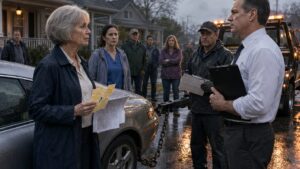
They Put A Repair Bill In Front Of The Old Man At The Roadhouse Table
Chapter 1: The Bill Landed Before The Beer Stopped Dripping
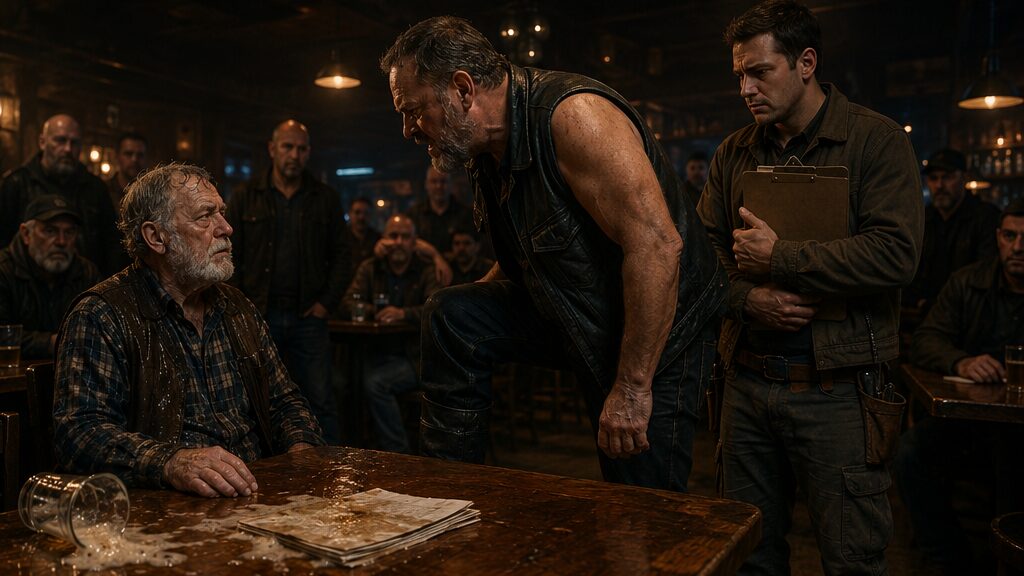
The beer hit Larry Walker before the glass stopped spinning.
Cold foam splashed across his shirtfront, ran under the collar of his brown vest, and dripped from his white beard onto the scarred wooden table where a folded paper had just landed like a threat. The glass rolled in a slow circle near his elbow. Around him, men in leather vests laughed too loudly, the way people laughed when they wanted silence from the person in the chair.
Larry did not reach for the glass.
He looked first at the paper.
Then at Jack Campbell’s boot planted on the rung of the chair beside him, close enough that mud from the sole had dropped in dark flakes near Larry’s knee.
“Read it,” Jack said.
Jack owned Campbell’s Roadhouse, the low brick bar that sat just beyond Larry’s back fence, glowing red and yellow every night until two in the morning. He was broad through the shoulders and thick through the neck, with gray in his beard and a voice that could fill the whole room even when the jukebox was running. Tonight he had two fingers hooked in the pocket of his leather vest and the other hand flat on the table, pressing the paper down so the beer could soak into one corner.
Larry lifted his eyes to him.
Jack leaned closer. “Don’t look at me like you don’t know what that is.”
Larry’s shirt was sticking to his chest. Beer crawled cold down his ribs. A few patrons had turned on their stools. Others pretended not to watch but kept their faces angled toward the corner table. The roadhouse smelled of spilled lager, fryer oil, wet denim, and old smoke buried in wood.
Larry had come in because Jack had called twice and left one message saying, “You need to hear this from me before insurance hears it from somebody else.”
Larry should have let the phone ring.
But his house shared a property line with the bar, and when a neighbor said insurance, a man on a fixed income listened.
Jack slapped the paper with the back of his fingers. “Eighteen thousand seven hundred forty dollars.”
The number sat in bold halfway down the page, blurred slightly now under the beer.
Larry reached into his shirt pocket and took out his reading glasses. The room laughed again, softer this time, meaner because it had found a new thing to laugh at.
“Careful,” someone near the bar said. “He might need help with the big numbers.”
Larry unfolded the glasses and put them on.
The paper was a repair estimate from Eric Smith Contracting. Rear room flooring. Baseboard removal. Mold treatment. Asphalt cutting and replacement near loading door. Emergency pump rental. Drainage evaluation. Labor. Materials. Disposal.
At the bottom was the total.
$18,740.00.
A second page was stapled behind it. Responsibility acknowledgment. Neighboring-property drainage contribution. Signature line.
Larry blinked once.
Jack tapped the line with a thick finger. “That pipe on your side backed water under my rear wall. Storm came through Wednesday, and by Thursday morning I had two inches of water in storage, buckled flooring, and asphalt cracked clear up by the loading door.”
Larry looked past him toward the back hallway, where a neon sign flickered against a door marked Employees Only. Beyond that was the rear lot. Beyond the lot was the low fence, the scrubby strip of grass, and Larry’s property, where an old drainage pipe had not carried water anywhere in years.
“My pipe’s capped,” Larry said.
Jack smiled as if he had expected those exact words and enjoyed hearing them. “That’s what you told people. Maybe you believe it. Doesn’t make it true.”
Eric Smith stood behind Jack with a clipboard under one arm. He was younger than Jack by twenty years, clean-shaven, wearing work boots too new to have seen much mud. A measuring tape clipped to his belt flashed under the bar lights.
“I followed the water line,” Eric said. “It comes right out of that low side behind your yard.”
Larry studied him. “You followed it tonight?”
Eric’s mouth tightened. “I inspected the damage.”
“That isn’t what I asked.”
Jack’s hand dropped hard on the table. The glass jumped. “You’re not going to twist this into some road crew argument. I’ve got damage. I’ve got an estimate. I’ve got witnesses who saw runoff pouring from your side.”
The word witnesses carried across the room. A few men shifted, eager to be counted.
Larry removed his glasses, wiped beer from one lens with the dry inside edge of his vest, and put them back on. His fingers moved slower than he wanted. The cold had reached his skin now, and something in his right hand trembled once before he closed it.
He would not let Jack see that.
Jack slid the responsibility page closer. “Sign tonight. I’ll tell insurance you cooperated. Otherwise they can name you, and once they do, it gets uglier. Lawyers, fees, court. You want that at your age?”
At your age.
Larry heard that phrase more often since Carol died, though no one in the room knew how often. At your age, maybe sell the house. At your age, let someone else clean the gutters. At your age, don’t get worked up. At your age, pay it and move on if moving on costs less than fighting.
He looked down again.
Beer had spread across the estimate in a dark crescent. It blurred the contractor logo but not the line items. Larry read them carefully, not because Jack told him to but because paper told truths people missed when they were shouting.
Rear room flooring. Mold treatment. Asphalt cutting. Emergency pump rental.
His eyes stopped.
Emergency pump rental — Tuesday, 7:30 p.m.
Tuesday.
The storm Jack blamed had rolled in after midnight Wednesday. Larry knew because he had been awake listening to rain hammer the kitchen vent, and because he had circled the date on the calendar to remind himself to check the back ditch the next morning. Old habits from thirty years of county road maintenance did not leave a man just because his knees did.
Larry let his gaze move once more over the line.
Tuesday, 7:30 p.m.
Before the storm.
Jack shoved a pen across the table. It struck Larry’s wrist and rolled against the wet glass.
“Don’t make this harder than it has to be,” Jack said. “Everybody knows that old pipe’s been a problem. You’ve had people telling you for years to fix that yard.”
Nobody had told him that for years. People had told Jack to stop pushing gravel into the back trench. People had told the bar manager to keep leaves away from the loading door drain. People had told a lot of things after storms, mostly while holding coffee and pointing at other people’s land.
Larry folded the estimate along its original crease.
Jack’s face darkened. “I didn’t say keep it.”
Larry took a paper napkin from the metal holder and pressed it against the beer-soaked corner. The cheap paper came away brown and torn.
“I’ll answer,” Larry said, “after someone checks the pipe you keep pointing at.”
The room went quieter.
Not silent. The jukebox still hummed. A glass clinked at the bar. Someone near the pool table made a low sound that might have been a laugh if it had not died so quickly.
Jack leaned in until Larry could see the tiny red veins along his nose. “You already answered by letting your property rot.”
Larry slipped the folded estimate into the inside pocket of his wet vest.
Jack grabbed his wrist.
For a moment, no one moved.
Larry looked at Jack’s hand around his wrist. Thick fingers. Grease under one nail. Too much pressure, not enough to bruise if Jack was careful, enough to let everyone see who had control.
Larry did not pull away.
“Take your hand off me,” he said.
His voice was low. It did not travel far, but it reached Jack.
Jack held him for one second longer, then released him with a little shove, as if the letting go had been his idea.
“You walk out with that, you’re admitting you got it.”
“No,” Larry said. “I’m preserving it.”
Eric shifted behind Jack. His eyes flicked once toward the pocket where the estimate had gone.
Larry noticed.
Jack missed it.
The old man stood. His knees resisted for the first inch, then steadied. Beer dripped from the hem of his shirt onto the plank floor. He picked up the pen from the table and set it neatly beside the empty glass.
“I’m not signing tonight,” he said.
Jack laughed, but there was less room in it now. “Then I’ll come to your house in the morning with Eric. We’ll measure it in daylight. Maybe your daughter can explain what this costs when you pretend not to understand.”
Larry’s mouth tightened at Christine’s mention. Jack knew enough. People always knew just enough to aim.
He walked past the men who had laughed. One of them did not move his boot until Larry had to angle around it. Another muttered, “Should’ve stayed home.”
At the door, Larry paused under the red glow of the beer sign. Rain from earlier still shone on the gravel lot outside. His old pickup sat under a crooked light at the edge of the parking area, dwarfed by larger trucks and motorcycles. Beyond the fence, his house was a dark rectangle behind two maples.
He reached into his pocket, took out his phone, and pressed a number he had not used in months but had kept because old road men kept useful numbers.
The call rang three times.
A sleepy voice answered at the county after-hours line.
Larry looked back through the window. Jack stood inside with both hands on the wet table, watching him.
“This is Larry Walker on County Line Road,” Larry said. “I need to leave a message for stormwater inspection. It concerns a drainage claim at Campbell’s Roadhouse.”
He listened, then nodded once.
“No, ma’am. Not an emergency tonight. But I’d appreciate if Pamela Davis could see it before anybody files the wrong paper.”
Across the road, far down past the bend, headlights appeared one after another through the damp night, white and low, stretching over the gravel as cars came toward the roadhouse.
Larry held the phone to his ear and watched them arrive.
Chapter 2: Christine Wanted Him To Pay Before Morning
By the time Larry got home, the beer had dried sticky along his shirt and the repair estimate had softened in his vest pocket.
He entered through the side door because the front steps were slick, then stood in the mudroom under the weak yellow bulb and listened to his house settle around him. The kitchen clock ticked above the stove. The refrigerator clicked on. Somewhere in the walls, old pipes gave a tired knock.
For thirty-nine years, the house had sounded different when Carol was in it.
Now every small noise seemed to ask whether he had remembered to lock the door, turn off the burner, take his pills, call his daughter, check the mail, sit down before he fell down. Everyone thought an old man living alone needed reminders. Nobody ever asked whether the reminders wore a groove in him.
Larry took the folded estimate from his pocket and laid it on the kitchen table.
The paper sagged at the corner where beer had soaked through. He placed a coffee mug on the dry edge to keep it flat, then went to change his shirt.
When he came back, Christine Rivera was already in the kitchen doorway, hair pulled back, coat half-buttoned, eyes moving from his clean shirt to the wet vest hanging over a chair.
“You didn’t answer when I called,” she said.
“I was driving.”
“You shouldn’t have been there at all.”
Larry filled the kettle with water. “I didn’t invite myself.”
Christine stepped closer to the table. Her gaze landed on the estimate. She read the total before touching it, and the breath went out of her like someone had pressed a hand to her ribs.
“Dad.”
He set the kettle on the stove and turned the burner low. “It’s not mine.”
“Eighteen thousand dollars?”
“Eighteen thousand seven hundred forty.”
“That’s not better.”
“No.”
She sat down slowly, as if standing made the number larger. Her fingers hovered over the responsibility form but did not pick it up. Christine had her mother’s hands, long-fingered and careful. Larry remembered those same hands as a child’s, sticky with peach juice, leaving prints on the back door every summer. Now they were steady in the way adult children made themselves steady when they were frightened for a parent.
“What happened to your vest?” she asked.
“Beer.”
“Jack threw beer on you?”
“Glass tipped.”
“That’s not what I asked.”
Larry took two mugs from the cabinet. One had a faded county road department logo. The other had a bluebird on it, Carol’s old mug, though Christine used it whenever she came over.
“He was loud,” Larry said.
Christine shut her eyes briefly. “Dad.”
He poured instant coffee before the kettle fully boiled. It made a bitter smell. He did not want coffee, but he wanted something to do with his hands.
Christine pulled the estimate closer. “He says your drainage pipe caused water damage.”
“He says it.”
“And there’s a contractor?”
“Eric Smith.”
“Is he licensed?”
“I didn’t ask.”
“Dad, you have to ask these things.”
Larry set her mug down. “I was busy getting blamed.”
Her face changed. Regret first, then impatience with herself for showing it. “I’m sorry. I’m not blaming you. I’m trying to understand what we’re dealing with.”
“We’re dealing with Jack wanting money.”
“We’re dealing with insurance, a contractor, maybe court.” Christine tapped the signature page. “If they’ve already put this in writing, they’re serious.”
Larry lowered himself into the chair across from her. His right knee ached from standing too long at the bar. He placed both hands around his mug so she would not see whether they shook.
Christine saw anyway.
Her voice softened. “You can’t take on something like this alone.”
“I didn’t cause the damage.”
“That doesn’t mean it won’t cost you to prove it.”
The kitchen seemed smaller with the number on the table. Larry looked toward the window over the sink. Beyond the glass, the backyard disappeared into darkness. Past the far fence, a stripe of neon from the roadhouse sign glowed faintly through the trees.
Christine followed his gaze. “How much do you have in savings?”
He looked back at her.
“I’m not asking to pry,” she said. “I need to know if this turns into legal bills.”
“You know enough.”
“I know Mom’s medical bills ate more than you ever admitted.”
Larry’s grip tightened on the mug.
Christine’s face folded a little around the words. She had not meant to open that room in the house. Neither of them entered it often.
The kettle hissed softly on the cooling burner.
Larry reached for the checkbook he kept in the drawer beside the placemats. It was an old habit; Carol used to write every payment in a narrow hand, never trusting bank statements to remember what people owed. After she died, Larry kept the same checkbook cover because it still held a grocery list she had written and never used.
He placed it beside the invoice.
Christine stared at the two things together: the beer-stained demand and the worn checkbook.
“I can help,” she said.
“No.”
“You don’t even know what I was going to say.”
“You were going to say you can move money around.”
“I can.”
“You have your own bills.”
“You’re my father.”
“And this is my house.”
“It was Mom’s house too.”
Larry looked down.
That one landed where she meant it to, though maybe not as hard as she feared. The house was Carol in a hundred small ways: the blue curtains she chose because the kitchen faced east, the pencil marks inside the pantry door where they had measured Christine’s height, the small dent in the hallway wall from the day Larry carried in the first Christmas tree after retirement and misjudged the corner.
Jack was not just asking for money. He was putting a price on Larry’s right to stay unbothered in the last place that still held his wife in ordinary things.
Christine rubbed her forehead. “Maybe you don’t have to pay the whole thing. Maybe if we talk to him before morning, he’ll take less. It’s awful, but sometimes settling costs less than being right.”
Larry let the words sit between them.
That was how false things grew. Not because every person pushing them was cruel. Sometimes fear did half the work.
“I saw something on the estimate,” he said.
Christine leaned forward. “What?”
“A pump rental.”
“What about it?”
“The date.”
She looked at the page. “It’s smeared.”
“I saw it before it smeared.”
“Are you sure?”
Larry looked at her, and for the first time that night, hurt moved plainly across his face.
Christine went still.
He did not raise his voice. “Yes.”
She swallowed. “I didn’t mean—”
“I know what you meant.”
But he did know. She meant: you’re tired. You were upset. It was dark in the bar. You had beer on your glasses. You are old enough now that people will ask if you are sure even when all your life you made a living being sure about water, grade, culverts, shoulders, ditch lines, and which way a road would fail before the first crack showed.
Christine turned the invoice carefully, reading what she could. “The storm was Wednesday night?”
“Early Wednesday morning.”
“And the pump?”
“Tuesday evening.”
She frowned. “Why would he rent a pump before the storm?”
“That’s what I’d like somebody else to ask.”
The coffee cooled untouched.
After a while, Christine said, “What if Jack changes the paperwork?”
Larry reached for the invoice and slid it farther from the damp ring left by the mug. “Then it’s good he spilled beer on this copy.”
She looked confused.
“It makes it harder to pretend I got it tomorrow.”
Outside, a motorcycle coughed to life at the roadhouse and faded down the road.
Christine pressed both palms flat on the table. “Promise me you won’t go over there alone again.”
Larry did not answer quickly enough.
“Dad.”
“I won’t go looking for trouble.”
“That is not the same promise.”
“No,” he said. “It isn’t.”
Her mouth trembled, but she looked away before it became anything more. He hated that he had made her afraid. He hated more that she thought fear was the safest guide.
Larry stood, slower this time, and walked to the door that led to the basement stairs. Christine rose as if to help him, then stopped when he gave the smallest shake of his head.
He went down three steps, reached to the shelf built under the stairwell, and pulled out a flat metal box with a bent latch. Dust came off on his fingers. He carried it back to the kitchen and set it beside the invoice and checkbook.
On top, in Carol’s handwriting on masking tape, were the words:
Drainage / Back Lot.
Christine looked at the box, then at him.
Larry opened the latch.
Inside were old receipts, folded maps, county notices, photographs, and inspection cards arranged by year in envelopes gone soft at the edges.
He touched the top envelope with one finger.
“Your mother used to say paper remembers better than people,” he said.
Christine sat back down.
This time, she did not tell him to pay.
Chapter 3: The Contractor Measured The Wrong Side Of The Pipe
Eric Smith’s measuring tape snapped across the cracked asphalt like he was laying a trap.
Larry stood near the back fence the next morning with his coat zipped to his throat and the old property folder tucked under one arm. The air smelled of damp gravel and sour beer from the roadhouse dumpster. Sunlight had not yet reached the rear lot, and puddles sat black in shallow dips behind the loading door.
Jack had brought three men out with him, though only Eric seemed to have work to do. One leaned against a pickup drinking coffee. Another smoked near the dumpster. The third kept taking photographs with his phone, mostly of Larry.
“You getting my good side?” Larry asked.
The man lowered the phone.
Jack came around the corner carrying a paper cup and wearing the satisfied look of someone who believed daylight made him official. “Morning, Larry. Glad you decided to show.”
“This is my fence,” Larry said. “I didn’t have far to go.”
Eric crouched near the cracked strip of asphalt that ran behind the bar’s loading door. He extended the tape toward Larry’s side of the lot, pulling it across wet gravel, over a shallow depression, and toward the old line of grass where Larry’s property began.
“There,” Eric said. “Low point runs toward his yard.”
Larry watched the tape, not Eric’s hand. The metal blade skimmed the ground, passing six feet to the right of the loading-door trench.
“You skipped that drain,” Larry said.
Eric glanced up. “We’re measuring the runoff path.”
“That trench is part of the runoff path.”
Jack gave a short laugh. “Here we go.”
Larry did not look at him. “It sits lower than the fence line.”
Eric stood. “The trench is on Jack’s property. We’re talking about water coming from yours.”
“You can’t talk about water by ignoring where it goes.”
The smoking man smiled around his cigarette. “Old man came with a lecture.”
Jack pointed toward Larry’s yard. “That pipe comes out right there behind your grass. Everybody knows it.”
Larry looked where he pointed. Years ago, a rusted pipe mouth had shown in the bank below the fence, half-hidden by weeds. It had been an eyesore then, and Jack had complained about it when he first bought the roadhouse. Larry remembered the exact conversation because Carol had been alive, standing beside him with garden gloves in one hand, annoyed that Jack had interrupted breakfast to talk about “old-man drainage.”
That pipe had been capped after the county changed the roadside ditch grade. Larry had the receipt in the folder. He had the inspection card too. But he did not pull them out yet.
Eric stretched the measuring tape again, this time from the cracked asphalt to the fence post nearest Larry’s property. “See? Eleven feet from damage to the line.”
“Measure from the loading door,” Larry said.
“That’s not the source.”
“You haven’t shown the source.”
Jack stepped closer. “Larry, you want to play county engineer because you used to ride around in a truck with a shovel. Fine. But Eric does this for a living now.”
Larry’s thumb pressed against the folder’s cardboard edge. He could feel the softened corners of old maps inside.
“I rode around in a truck with a shovel,” Larry said, “because water doesn’t care what people write on estimates.”
Eric’s expression tightened. “I don’t need to be insulted.”
“Then don’t insult the grade.”
For one clean second, nobody answered.
Larry had not meant it to sound sharp. It came out that way because he was cold and tired, and because the back of his shirt still seemed to remember last night’s beer.
Eric turned away first. He crouched by the cracked asphalt and made a mark with yellow chalk. “Damage begins here.”
Larry stepped closer.
The asphalt near the rear loading door had lifted in two uneven plates. A dark waterline stained the concrete block under the door frame. Mud had dried in a fan shape, but not from Larry’s fence. It had spread outward from the wall, then curled toward the low ground where Eric had placed his tape. Anyone looking too quickly could mistake the last place water settled for the place it came from.
Larry had seen washouts do that after storms. People blamed the ditch at the end because that was where the mess waited. But the beginning usually hid upstream, behind leaves, under gravel, inside a blocked channel someone did not want to dig open.
“Where was the pump?” Larry asked.
Jack’s face changed so slightly that maybe only an old man with nothing else to do would have caught it.
“What pump?”
“The one on the estimate.”
Eric looked at Jack.
Jack looked at Eric.
Then Jack shrugged. “Standard equipment line. You wouldn’t understand how contractors write things.”
Larry nodded as if that settled something. “Tuesday evening standard equipment.”
Eric snapped the tape back into its case too fast. “The estimate is preliminary.”
“Preliminary enough for my signature?”
Jack stepped between them. “You had your look. You got until Monday to decide if you want to cooperate. After that, insurance handles it.”
“Insurance already seen this?”
“They will.”
“That’s not what I asked.”
Jack threw his coffee into the gravel. The cup bounced once and rolled near Larry’s shoe. “You got a habit of asking the wrong questions.”
Larry looked down at the cup. Coffee spread into the gravel in thin brown veins, following the slope away from him and toward the loading door.
He bent slowly, picked up the cup, and set it upright on the edge of the dumpster pad.
Jack stared. “You cleaning up now?”
“Watching the water.”
“It’s coffee.”
“It still runs downhill.”
The smoking man muttered something, but no one laughed this time.
Larry turned toward the fence and walked the property line, careful where the ground dipped. The old pipe mouth was mostly covered now by grass and packed soil. Jack had told people for years it was “that open drain,” because once a thing had a name in a neighborhood, people kept using it long after the thing itself was gone.
Larry crouched with one hand on the fence post.
His knees complained. His back stiffened. He ignored both.
The cap was still there, half-buried, a rusted metal plate bolted across the old pipe with two square-headed fasteners. Mud streaked the rim, but there was no fresh washout around it, no fan of silt, no channel cut through the grass.
He touched the top bolt.
Dry under the mud.
Eric did not come over to look.
Instead, the contractor walked back toward the loading door and spoke quietly to Jack. Jack shook his head once. Eric gestured toward the ground with a short, irritated motion.
Larry noticed where Eric’s boot landed.
Not on the asphalt crack. Not near Larry’s side. Near the loading-door trench.
The trench ran along the back wall, narrow and shallow, lined years ago with broken concrete pieces. Larry had watched different bar owners neglect it, clear it, neglect it again. Jack had widened the rear lot two summers ago and pushed fresh gravel across the low strip so delivery trucks could back up more easily.
Now the trench was hard to see.
Too hard.
Larry rose and walked toward it.
Jack’s voice cut across the lot. “Stay off my loading area.”
Larry stopped just before the trench. “This where the pump sat?”
Eric’s jaw worked. “I told you, it’s preliminary.”
“Where did the hose drain?”
No answer.
Larry looked down. Fresh gravel had been packed into the trench along the wall, cleaner than the surrounding stone, pale gray instead of oil-dark. Someone had spread it recently, then raked it flat. At the edge nearest the downspout, water had pooled and left a crescent of silt against the concrete.
He had seen cover-ups before that were not meant as crimes. Sometimes men covered a soft spot so trucks could pass. Sometimes they dumped gravel before rain because they were busy and tired and hoped it would hold. Sometimes the small cheap fix became the expensive damage later.
Larry moved one step closer.
Jack’s boots crunched behind him. “I said stay off.”
Larry pointed with the folder, not touching anything. “That gravel’s new.”
“This is a bar lot. Gravel gets moved.”
“After Tuesday?”
Jack’s face hardened. “You writing a book?”
“No,” Larry said. “Just reading the ground.”
Eric gave a short laugh, but it came too late.
Larry turned toward his own fence again. He had seen enough for the morning. Not enough to win. Enough to know where to keep looking.
Jack followed him halfway. “Monday, Larry. I’m not kidding. You can drag your feet, but the claim’s going in with your name on it if you don’t sign.”
Larry opened the folder and took out a blank sheet of notebook paper he had tucked inside before leaving the house. He wrote three things in pencil while standing beside the fence:
Pump Tuesday.
Measure skipped trench.
Fresh gravel behind loading door.
Jack watched him write.
The sight bothered him more than any argument had.
Larry folded the paper into the folder and held it against his chest.
As he stepped back through the narrow gate onto his own property, he looked once more at the old trench behind Jack’s loading door. Morning light had finally reached it, catching the pale gravel in a thin line that did not match the rest of the lot.
Larry closed the gate softly behind him.
Under the new gravel, something had been buried in a hurry.
Chapter 4: The Old Folder Remembered What Everyone Forgot
The garage smelled of dust, cardboard, and motor oil that had soaked into the concrete long before Larry retired.
He stood just inside the open door with the metal box balanced on his workbench, watching afternoon light settle across tools he did not use as often anymore. The wall pegboard still held the shape of his life: wrenches arranged by size, two levels with yellowed vials, a coil of twine, a flashlight with tape around the handle, and a shovel with its edge sharpened from years of scraping culverts clean.
Christine had followed him out but stopped near the doorway.
“You don’t have to go through all this right now,” she said.
Larry lifted the bent latch on the box. “Yes, I do.”
“You haven’t eaten.”
“I ate toast.”
“That was at seven.”
He did not answer. He spread the contents across the workbench in careful piles: envelopes, inspection cards, receipts, county notices, small photographs with dates stamped in orange along the bottom. Carol had believed in labels. She had believed the world became less able to push you around if you could open a box and find the year it was lying about.
Christine stepped closer, her arms folded tight against herself.
Larry found the first envelope marked 2009. Inside were photographs of the back lot before Jack owned the roadhouse. The building looked tired even then, its old owner having patched everything with whatever was cheap. In one picture, the rear loading door sat above a narrow trench, clear and open, running toward the roadside ditch. Larry touched the edge of the photo.
“That trench used to show,” he said.
Christine leaned over. “Behind the bar?”
“Along the wall. It caught runoff from the loading pad.”
“Was it legal?”
“It existed before the zoning change. That doesn’t make it good. It makes it something the county knew about.”
He reached into another envelope and pulled out a folded county map. The paper had softened along the creases from being opened many times, but the lines were still visible: property boundary, roadside ditch, drainage easement, old culvert. Larry smoothed it with his palm.
The shape of his land was familiar as his own hand.
He remembered walking it with Carol the first spring after they bought the place, both of them younger than Christine was now, both of them pretending they were not scared of the mortgage. Carol had stood at the back fence, looked toward the roadhouse, and said, “We’ll plant trees thick enough that their music has to ask permission before coming through.”
They planted two maples. The music came through anyway. But the trees grew.
Larry found the inspection card next. It was tucked behind a receipt for pipe fittings, dated thirteen years ago.
County Stormwater Review
Back Lot Drainage Adjustment
Old lateral capped after roadside ditch revision
Inspected and accepted
At the bottom was a faded signature. Not Pamela Davis. Someone older, probably retired now. But the card was official enough, with the county stamp pressed into the paper.
Christine read it twice. “This says your pipe was capped.”
“Yes.”
“Why didn’t you show Jack this morning?”
“Because Jack wasn’t there to learn.”
She looked up.
Larry slid the card into a clean plastic sleeve. “He was there to make me argue where his men could watch. If I handed him this by the fence, he’d say it didn’t cover the new damage. Or he’d say the cap failed. Or he’d take a picture and twist that too.”
Christine touched the old card lightly. “Then what are you going to do with it?”
“Put it where someone has to read it.”
They carried the box to the kitchen because the garage was too dim for the smaller print. Larry set the beer-stained invoice beside the county map. The contrast bothered him: one paper clean, old, and quiet; the other swollen at the corner, smelling faintly of the roadhouse.
Christine took out her phone. “We should scan these.”
“Later.”
“Dad.”
“Later,” he repeated, not harshly. “First I need to know what they say.”
So they read.
The receipts showed the pipe cap had been installed by a drainage crew after the county lowered the roadside ditch in 2011. The work order described the old lateral as “inactive” and “no longer contributing to rear-lot flow.” Larry remembered the day clearly because Carol had made sandwiches for the workers, and one of them had tracked mud across the back step, then apologized so many times she laughed.
He found two photographs from that day. In one, the old pipe mouth was open. In the next, the cap was bolted across it, the soil freshly packed around the rim. Larry’s younger self stood at the edge of the frame, half cut off, holding a shovel.
Christine looked from the photo to him. “You kept everything.”
“Your mother did.”
“You kept it after.”
He folded the tissue paper that had separated the photographs. “Paper doesn’t take much room.”
The kitchen clock moved toward four. Light shifted across the table. Christine made sandwiches neither of them finished. Larry kept reading.
The deeper he went, the more the years arranged themselves. Old owners. County ditch revision. Pipe cap. Inspection. Then Jack buying the roadhouse five years later. Then Jack grading the rear lot two summers ago to make more room for delivery trucks. Larry remembered that too: gravel trucks backing in at dawn, the scrape of a blade, the sour smell of turned mud after a hot night.
He found no permit for that.
Not in his box, at least.
He opened the envelope marked Boundary / Back Lot. Inside was a copy of the property survey from when Jack had first complained about the fence. Carol had insisted on ordering it, not because she disliked Jack then, but because she believed clear lines made better neighbors.
Larry spread the survey over the county map.
Christine held down one corner with the bluebird mug.
The survey showed Larry’s fence, the old capped pipe, the drainage easement, and the roadhouse’s rear wall. But the trench behind the loading door was only a faint hand-drawn mark on one older copy, not on the official updated map.
Larry brought the photograph from 2009 closer.
There was the trench, plain as a scar.
Then he placed beside it a newer aerial printout Carol had ordered when Jack expanded the gravel lot. In that one, the trench was partly covered, the pale stripe of gravel running where open channel had been.
Christine saw it when he did.
“Is that what you saw this morning?” she asked.
Larry nodded. “Fresh gravel over old water.”
“But if the trench isn’t on the county map—”
“Then someone needs to explain when it changed.”
“Could Jack say it was always like that?”
“He can say anything.”
Christine sat back, rubbing both hands over her face. “This is more complicated than just showing them your pipe was capped.”
“Usually is.”
She gave him a tired look. “You sound almost pleased.”
“I’m not pleased.”
But there was something in his chest that had loosened. Not joy. Not victory. More like finding his footing after stepping into mud. Last night at the roadhouse, the wet invoice had made him feel for one brief moment like the world had already voted. Jack had the bill, the crowd, the loud voice, the contractor, the number large enough to make anyone panic.
Now the table held older voices.
Carol’s labels. County stamps. A photograph with sunlight on the old trench. A receipt showing work done, paid for, inspected. Larry’s own pencil note from that morning, written in small block letters: Fresh gravel behind loading door.
Christine picked up the inspection card again. “What if Pamela Davis won’t come out?”
“She will.”
“You don’t know that.”
“I know how to ask.”
“And if Jack files before then?”
Larry looked at the beer-stained invoice. The total had dried into a wavering blur, but the pump line was still partly legible if held at an angle.
“Then I’ll answer with dates.”
Christine’s eyes moved to his hand. It had begun trembling again, not much, but enough that the edge of the map fluttered under his fingers.
He put his palm flat.
She reached toward him, then stopped, as if afraid he would take comfort as doubt.
“I’m scared,” she said.
“I know.”
“I’m scared you’ll spend what you have fighting something that should never have landed on you.”
Larry looked toward the back window, where the maples stood between his house and the roadhouse. In daylight, he could see the top of Jack’s sign through the branches.
“I’m scared if I sign one lie,” he said, “the next one gets easier for them.”
Christine said nothing.
He stacked the papers slowly. Inspection card first. Receipts. Photographs. Survey. County map. Then, on top, the beer-stained invoice.
The new paper looked ugly there, but useful. A bully’s paper among patient ones.
As he slid everything into the folder, one corner of the older map unfolded itself. Larry paused.
There, in faint blue pencil, was a line he had almost missed: a service trench sketched behind the roadhouse loading door, dated before Jack’s lot expansion. Beside it, in a county note, were three words:
Maintain open flow.
Larry looked at Christine.
She had read it too.
Outside, somewhere beyond the trees, a truck backed up with a long warning beep.
Larry closed the folder carefully.
Jack’s buried trench had once been someone’s written instruction.
Chapter 5: The Reduced Settlement Still Felt Like A Trap
Jack Campbell came to Larry’s porch Monday morning carrying a clean copy of the bill, which told Larry more than the smile did.
The porch boards were still damp from overnight mist. Larry had been sweeping maple seeds from the steps when Jack’s truck pulled up too fast beside the mailbox and stopped with one tire on the grass. Eric Smith got out of the passenger side holding a clipboard. Jack came around the front with a manila envelope tucked under his arm.
Larry kept sweeping.
Jack stopped at the bottom step. “You got a minute?”
“You’re already here.”
Christine’s car was not in the driveway. Larry had not told her Jack might come. He had considered it, then decided one kind of worry did not need help multiplying.
Jack glanced at the broom, then at Larry’s face. “I’m trying to be neighborly.”
Larry swept two more maple seeds into the dustpan. “Early start.”
Eric stayed near the truck, looking everywhere but at the porch.
Jack climbed one step without being invited. “We got off wrong the other night.”
Larry rested both hands on the broom handle. His joints felt thick in the morning. He had slept badly, waking twice to imagine the number $18,740 written across the kitchen ceiling.
“You spilled beer on me and asked for my signature,” Larry said. “That’s one way to put it.”
Jack’s smile thinned. “A glass got knocked over. Nobody was trying to embarrass you.”
“No?”
“I had damage, Larry. I was upset.”
Larry watched him open the envelope. Jack pulled out a fresh estimate, unstained, flat, official-looking. Behind it was another document clipped with a blue paperclip.
“I talked to Eric,” Jack said. “We’re willing to reduce your contribution.”
“My contribution.”
“Your share.”
“I haven’t agreed I have a share.”
Jack sighed, the way a man sighed when patience was being performed for witnesses. “This is exactly what I’m trying to avoid. Back-and-forth. Hard feelings. Insurance investigators crawling all over both properties. You don’t want that. I don’t want that.”
Eric shifted near the truck. The clipboard stayed against his chest like a shield.
Jack held up the new page. “Nine thousand even. You sign today, I absorb the rest and tell insurance we handled it privately.”
Larry looked at the paper but did not take it.
“Nine thousand,” Jack repeated. “That’s me eating almost half.”
“Generous.”
“You think I like this?” Jack’s voice sharpened. “You think I want to stand on your porch asking an old neighbor to do the right thing?”
Larry’s hand tightened on the broom. The loaded word sat between them.
Old.
Jack caught himself and softened his voice again. “Look. I know things have been harder since Carol passed. I’m not blind. I know Christine worries. I don’t want this becoming some mess that lands on your daughter.”
Larry lifted his eyes.
Jack had aimed at Christine again. Not loudly this time. Not with a crowd behind him. Worse, almost gently.
“You leave my daughter out of your paperwork,” Larry said.
Jack’s jaw moved. “Then keep her out by signing before this grows.”
He extended the clipped document.
Larry did not move.
After a moment, Jack stepped onto the porch and laid the pages on the small metal table beside Carol’s empty flower pot. The top sheet was the reduced estimate. The second was an insurance letter.
Larry saw his own name halfway down before Jack covered it with his hand.
“Let me read it,” Larry said.
Jack hesitated. “It’s standard.”
“Then it won’t mind being read.”
Eric looked toward the road.
Jack took his hand away.
Larry set the broom against the porch rail and picked up the letter. It was from an insurance adjuster assigned to Jack’s property claim. The words were polite and cold. They referred to water intrusion, rear structural damage, possible third-party drainage contribution, and neighboring property owned by Larry Walker.
Possible had been doing too much work.
At the bottom was a request for supporting documentation from the claimant.
Larry looked at the date.
Friday morning.
Before Jack had called him to the roadhouse. Before the beer. Before the table. Before Jack pretended the signature would keep insurance from hearing his name.
“You already filed,” Larry said.
Jack looked away for half a second. “I notified them there was damage.”
“With my name in it.”
“I had to identify the neighboring property.”
“You told me Friday night I could sign before insurance made it worse.”
“That was still true.”
“No,” Larry said. “It was already worse.”
Jack stepped closer. “Don’t start splitting words with me.”
Larry folded the letter once, not creasing it, only bringing the pages together so they would not shake in the wind. “Words are what claims are made of.”
Jack’s face reddened. “Claims are made of damage. You can stand here with your broom and your old file boxes and act like this is some puzzle, but my floor is buckled. My asphalt is cracked. I’ve got storage I can’t use and vendors asking why my back door is a swamp. That costs money every day.”
For the first time, Larry heard the fear under the anger.
It did not make the accusation true.
“Nine thousand,” Jack said. “You can borrow it, move it, pay over time. I don’t care. I’m giving you a chance.”
“To admit something before inspection.”
Eric finally spoke. “Inspection won’t change where the water settled.”
Larry turned to him. “No. But it might change where someone admits it started.”
Eric’s mouth shut.
Jack snatched the letter from Larry’s hand. “You’ve been talking to the county?”
“I left a message.”
“You had no right bringing them into my business.”
“You brought my property into yours.”
The porch went still except for wind dragging leaves along the steps.
Jack leaned closer, voice low now. “You think a county inspector is going to come out here and save you? They’ll look, they’ll shrug, and they’ll tell two neighbors to work it out. By then the claim’s open, my insurance has your name, and your daughter gets letters she doesn’t understand.”
Larry looked past him to the truck. Eric’s clipboard had a yellow carbon form clipped under the top page. Larry could see the edge of it fluttering. He wondered how many copies of the same accusation already existed.
“You want me rushed,” Larry said.
“I want this settled.”
“No. You want it signed before anyone reads Tuesday.”
Jack’s eyes narrowed.
Larry knew then the pump line mattered.
Not enough yet, maybe. Not proof by itself. But enough to make Jack hear the floor shift.
“What’s Tuesday?” Jack asked.
Larry did not answer.
Jack laughed once. “You don’t even know what you’re saying.”
Larry picked up the reduced estimate and the insurance copy from the table. “I’m keeping these.”
Jack reached for them, then stopped. Maybe he remembered the wrist at the roadhouse. Maybe he saw the front window curtain move and thought Christine was inside. She was not.
“I gave you those to review,” Jack said.
“That’s what I’m doing.”
“You have until five.”
“No.”
Jack stared at him. “No?”
“I won’t answer by five.”
“You don’t set the schedule.”
Larry turned toward the front door. “On my porch, I do.”
For a moment, he thought Jack might follow him inside. The thought passed through both men. Larry saw it in Jack’s shoulders. But the road was visible, the neighbor across the way had paused near a mailbox, and Eric was watching too hard.
Jack stepped back.
“You’re making a mistake,” he said.
Larry opened the door. “Maybe. But it’ll be mine.”
Inside, he locked the door for the first time in daylight in longer than he could remember.
His breath came shallow. He stood with one hand on the knob until Jack’s truck started, reversed, and drove away too fast, gravel snapping under the tires.
Only then did Larry carry the papers to the kitchen table.
The beer-stained invoice lay in the folder from Saturday. He placed the clean reduced estimate beside it. Same logo. Same total changed by hand. Same pump rental line, now missing.
Larry sat down.
The absence was louder than the number.
He took out the notebook paper and wrote:
Clean copy missing pump line.
Insurance named me Friday.
Jack wants signature before county.
Then he reached for the phone book he still kept in the drawer because he liked paper numbers when phones decided to be clever. He found the county office, dialed, and waited through the recorded menu.
A clerk answered.
“This is Larry Walker on County Line Road,” he said. “I left a message Friday night about Campbell’s Roadhouse.”
The clerk asked him to hold.
Larry looked at the two invoices. One stained, one clean. One careless enough to tell the truth. One careful enough to hide it.
When the clerk came back, Larry asked for Pamela Davis by name.
Chapter 6: Headlights Came Back To The Roadhouse
By dusk Monday, the roadhouse windows glowed like hot glass in the wet dark.
Larry stood at the edge of his yard with the old folder under his arm and watched headlights turn off the county road one by one. First came a dark county SUV with a white emblem on the door. Behind it came a sedan Larry did not recognize, then a pickup with a utility rack and a yellow beacon that was not flashing. Their lights stretched across the gravel lot, catching dust, puddles, chrome, and the rear wall of the bar.
For a moment, it looked too much like Friday night.
Headlights arriving. Men watching. Jack standing under the roadhouse sign with both hands on his hips.
Only this time, Larry had called them.
Christine stood beside him, wrapped in a coat she had thrown on after work. She had not argued when he told her Pamela Davis was coming. She had only asked, “Do you want me there?” and looked relieved when he said yes.
“You okay?” she asked.
Larry adjusted the folder against his ribs. “Not particularly.”
She nodded. “Good. I was worried you’d say yes.”
They walked together through the narrow gate and along the fence line into the rear lot. Gravel shifted under Larry’s shoes. The air smelled like damp earth and fryer grease. Near the loading door, the cracked asphalt lay chalk-marked from Saturday, yellow lines fading under tire tracks.
Pamela Davis stepped out of the county SUV with a flashlight in one hand and a rolled plan tube under the other arm. She was in her fifties, perhaps, with short dark hair threaded with gray and the practical expression of someone who had heard too many neighbors tell only half a story.
“Mr. Walker?” she asked.
Larry nodded. “Thank you for coming after hours.”
“I was in the north district this afternoon. Your message said paperwork might be moving quickly.” She looked past him toward Jack. “That usually means the ground needs to be seen before it gets improved.”
Jack came forward before Larry could answer. “Pamela, appreciate you coming. This is straightforward. Rear water intrusion after last week’s storm. We’ve got contractor measurements showing runoff from Larry’s side.”
Pamela did not shake his hand because he did not quite offer it. “I’ll look at everything.”
Eric stood near the loading door with the same clipboard. Tonight he wore a clean jacket and no expression.
An insurance adjuster had come too, a role-only man in a dark coat who stayed near the sedan and took notes without introducing himself to Larry until Pamela asked him to.
“We’re not determining civil liability tonight,” Pamela said. “I’m looking at drainage conditions and whether anything on file contradicts the claim.”
Jack smiled tightly. “Of course.”
Larry knew that smile. It was the one Jack used for people he could not bully in front of witnesses.
Pamela turned to Larry. “You said there was an old capped pipe?”
“Yes.”
“Show me.”
Jack began, “The damage is over here—”
“I’ll start where the allegation starts,” Pamela said.
Larry led her to the fence. He moved slower than he wanted, aware of everyone behind him measuring his pace the way Eric had measured the asphalt. The old pipe cap sat low in the bank, half-mudded and dull in the flashlight beam.
Pamela crouched without complaint. She brushed away loose grass with a gloved hand and tapped the cap.
“How long has this been sealed?”
Larry opened the folder and handed her the inspection card in its plastic sleeve. “Accepted in 2011 after the roadside ditch revision.”
Pamela read it under the flashlight. “You kept the card.”
“My wife did.”
Christine looked down at the ground.
Pamela’s face softened by one degree, then returned to work. “Do you have any records of flow after that?”
“Photos. No complaints after the cap. Not from the county.”
Jack crossed his arms. “That cap doesn’t mean water can’t come overland.”
“No,” Pamela said. “It doesn’t.”
Jack seemed encouraged.
Larry was not bothered. Pamela had said the true thing.
They moved back toward the loading door. Eric unhooked his tape measure, perhaps glad to be doing something. He showed Pamela the cracked asphalt, the waterline at the wall, the chalk marks, the low settlement near Larry’s fence.
“Water collects here,” Eric said. “From that direction.”
Pamela shone her flashlight along the ground. “Collecting is not the same as originating.”
Larry felt Christine glance at him.
Jack exhaled hard through his nose. “That’s what he keeps saying like it means something.”
“It does,” Pamela said.
Silence settled briefly around the group.
From inside the bar, music thumped behind the wall. A man stepped out the rear door, saw the cluster of people, and went back in without speaking.
Pamela asked Eric for his estimate.
Eric handed her a copy from the clipboard.
Larry watched carefully.
It was the clean copy. No pump line.
Pamela scanned it. “This is the revised estimate?”
Eric hesitated. “Current estimate.”
“Was there an earlier version?”
Jack answered before him. “Just drafts. Nothing official.”
Larry opened his folder and removed the beer-stained copy.
The paper had dried stiff, wrinkled at the corner, marked by the crescent of the glass and the brown stain of the roadhouse table. He did not feel embarrassed holding it now. What had been humiliation had become texture, time, proof that the paper had passed through Jack’s hands before it was cleaned.
Pamela took it carefully.
Jack’s eyes went to it and stayed there.
“This was the copy given to me Friday night,” Larry said. “At that table inside.”
Pamela looked at the stain but said nothing about it. She read down the line items. The flashlight beam moved with her eyes.
Eric shifted his weight.
Pamela stopped.
“Emergency pump rental,” she said.
Jack looked toward the bar door. “That was a possible equipment charge.”
Pamela kept reading. “Tuesday, 7:30 p.m.”
“Like I said, draft.”
“The storm event referenced in your claim began early Wednesday morning,” Pamela said.
Jack’s voice tightened. “We had water before the storm too. Some seepage. The main damage was after.”
The insurance adjuster looked up from his notes.
Larry heard Christine’s quiet inhale.
Pamela turned to Eric. “Did you rent or recommend a pump Tuesday evening?”
Eric’s mouth opened, then closed. “There was standing water behind the loading door.”
“Before the storm?”
“A little.”
“How much is a little?”
Eric looked at Jack.
Pamela did not.
“Mr. Smith,” she said, “how much standing water?”
Eric rubbed the back of his neck. “Enough that Jack wanted it gone before deliveries.”
Jack spread his hands. “Because the ground was already saturated from prior rain. That doesn’t mean Larry’s property didn’t make it worse.”
“No one said it did,” Pamela replied.
Larry let the words settle. He had not won anything. Not yet. But something had changed shape in the dark. Friday night, Jack had used the room to make Larry smaller. Tonight, each fact made the circle around him widen.
Pamela walked to the loading-door trench. She shone the flashlight along the gravel-packed strip.
“Is this the trench noted on older county sketches?” she asked.
Larry handed her the map with the blue pencil note.
Pamela unrolled her own plan from the tube and compared them on the hood of the county SUV. Larry stood beside her, close enough to see but not so close that he crowded. Christine held one corner down against the breeze.
The county plan did not show the trench as it existed in the old photograph. Larry’s older sketch did. Pamela flipped to another sheet, then another. Her finger moved from the rear wall to the roadside ditch.
“Who regraded this loading area?” she asked.
Jack answered carefully. “We added gravel a couple summers back. Maintenance.”
“Did you alter the trench?”
“No.”
Eric looked at the ground.
Pamela saw that too.
“Mr. Smith?”
Eric cleared his throat. “I wasn’t on that job.”
“But you measured this one.”
“Yes.”
“And your Saturday measurement did not include the loading-door trench.”
Eric’s grip tightened on the clipboard. “We were focused on the suspected source.”
“Which was Mr. Walker’s yard.”
“Based on where water settled.”
Pamela turned her flashlight back toward the wall. “I need the trench opened enough to see whether it’s carrying flow.”
Jack’s response came too fast. “Not tonight.”
Pamela looked at him.
“It’s dark,” Jack said. “Customers inside. Liability issue. We can schedule it.”
The insurance adjuster wrote something.
Larry felt the old urge to fill silence, to explain, to push. He held it back. Pamela had not asked him. He had spent enough years around inspections to know when talking helped and when talking gave someone fog to hide in.
Pamela looked at the fresh pale gravel. Then at the cracked asphalt. Then at the stained invoice in her hand.
“This review is not complete,” she said.
Jack’s relief showed for half a second.
Then she added, “But the claim should not be advanced as written until the pre-storm water condition and the trench status are clarified.”
Jack’s relief vanished.
Christine’s hand brushed Larry’s sleeve, not grabbing, just touching once.
Pamela handed the stained invoice back to Larry. “Keep that copy.”
“I intend to.”
She turned to Eric.
Her voice was even, almost mild.
“Before we leave tonight, Mr. Smith, I want to understand why your first estimate mentions a pump rental before the alleged damage date, and why the
Chapter 7: The Trench Behind The Loading Door
The next morning, Jack had a stack of pallets sitting over the trench.
Larry saw them from his side of the fence before he saw Jack. Four wooden pallets, two empty beer kegs, and a broken sandwich board had been dragged along the rear wall of the roadhouse and placed over the pale strip of gravel as if the loading area had always been cluttered that way.
Pamela Davis saw them too.
She stood beside her county SUV with a paper cup of coffee in one hand and her plan tube under the other arm. She looked at the pallets, then at Larry, then at Jack, who had come out of the back door wiping his hands on a towel he did not need.
“Busy morning?” Pamela asked.
Jack threw the towel over his shoulder. “Deliveries.”
“There are no delivery trucks here.”
“They come early.”
Larry kept his folder tucked against his side. Christine had wanted to come, but he had asked her to go to work. She did not like it. He had not liked asking. Still, this was the kind of morning when one person needed to keep his eyes on the ground and not on his daughter’s worry.
Eric Smith arrived a few minutes later in his pickup. He parked near the dumpster and sat behind the wheel longer than necessary. When he finally got out, he did not bring the clipboard at first. Then he seemed to remember himself, reached back into the cab, and carried it to the group.
Pamela looked at the pallets again. “They need to move.”
Jack’s voice turned hard. “That’s operating equipment.”
“It is sitting on the area I asked to inspect.”
“You asked to inspect drainage. Drainage runs from Larry’s side.”
Pamela did not raise her voice. “Mr. Campbell, I’m not here to debate your preferred conclusion. I’m here to see whether the site supports it.”
Jack glanced toward the bar windows. A couple of patrons had gathered inside, watching through dusty glass. Without the darkness, without the beer lights, without the room packed around Larry, Jack looked less large. Still large enough. Just less certain where to put it.
He pointed at Larry. “This is what I mean. He gets everybody chasing some old trench because he doesn’t want to pay what he owes.”
Larry looked at him for a long moment.
“I don’t owe you a blocked drain,” he said.
The words came out quiet, but they changed the air.
Eric looked down at his boots.
Pamela set her coffee on the hood of the SUV. “Move the pallets.”
It took Jack, Eric, and the man from the bar several minutes. They lifted the pallets one by one, dragged the kegs aside, and cleared the sandwich board. Underneath, the pale gravel was flattened and damp. It had been spread thicker at the point nearest the loading door, where the concrete wall showed the same dark water stain Pamela had photographed the night before.
Pamela knelt and pushed a gloved hand into the gravel. It shifted loosely. Too loose for old fill. She scraped a narrow line aside, revealing darker mud beneath.
“Mr. Smith,” she said, “do you have a shovel?”
Eric hesitated.
Larry had brought one.
He walked back through the gate to his garage, took the short-handled trench shovel from its hook, and returned with it balanced in one hand. The metal edge had been sharpened years ago and kept clean out of habit. Jack looked at the shovel as if it had accused him.
Pamela accepted it. “Thank you.”
She did not dig like someone trying to prove a point. She dug like someone opening a question. Slow, shallow, careful. Gravel scraped. Mud lifted. Water seeped into the first cut, not much, but enough to make the bottom shine.
After a few minutes, the shovel struck concrete.
Pamela cleared around it with her hand.
A broken concrete liner appeared, angled beneath the gravel, part of the old trench Larry remembered from the photograph. Leaves were packed against it, black and compressed. A plastic bottle cap sat wedged in the muck. Beyond that, the channel disappeared under more gravel toward the downspout and loading door.
“There it is,” Larry said.
Jack folded his arms. “So there’s an old trench. That doesn’t prove anything.”
“No,” Pamela said. “It starts the inspection.”
She handed the shovel to Eric. “Open another three feet toward the wall.”
Eric looked at Jack.
Pamela waited.
Finally Eric took the shovel. He dug with short, irritated motions, more force than care, until Pamela told him to slow down. The trench emerged piece by piece, not open but packed. Gravel, leaves, mud, cigarette filters, and broken bits of asphalt filled the channel that should have carried water along the wall and away from the building.
Larry watched the line of it.
The old map in his folder had not been wrong. Carol’s labeled envelope had not been wrong. His memory had not been a stubborn old man’s trick.
Pamela crouched and placed a small level along the exposed channel. She checked the grade, then looked toward the loading door. “This trench is supposed to move water toward the roadside ditch.”
Jack said nothing.
“It’s blocked on this end,” she continued. “And the newer gravel appears to have raised the edge along the loading pad.”
Eric wiped his forehead with his sleeve. “Water could still have come from Larry’s yard.”
Pamela glanced at the capped pipe near the fence. “Possible overland contribution is not the same as primary cause.”
Larry opened the folder and took out the old county map with the blue pencil note. He also removed the stained invoice. He held both until Pamela stood, then handed them over together.
She placed the old map on the hood of the SUV and set the invoice beside it. The beer stain had dried into the paper like an old bruise. The pump rental line was still visible when the page was held flat.
Pamela pointed to the date. “Tuesday evening pump rental.”
Then to the trench. “Standing water before the storm.”
Then to the map note. “Maintain open flow.”
The insurance adjuster had arrived again and stood nearby taking photographs. His pen moved more often now.
Jack looked at the adjuster. “This doesn’t mean I caused anything. This place has had drainage headaches for years. Larry knows that.”
Larry almost smiled. He did not.
“That’s the first true thing you’ve said about it,” he said.
Jack’s eyes snapped to him.
Larry kept going, not loudly. “The roadhouse had drainage headaches before me. Before you. That’s why the trench was there. That’s why the county changed the ditch. That’s why my pipe got capped. You knew there was water back here Tuesday because you rented a pump. Then you handed me a bill Friday and told people my pipe caused it Wednesday.”
Eric spoke before Jack could. “The revised estimate removed the pump because Jack said it confused the issue.”
Jack turned on him. “Eric.”
Eric’s jaw tightened. “It did confuse the issue.”
Pamela looked at Eric. “Did the pump operate before the storm event?”
“Yes.”
“Where was it placed?”
Eric pointed, reluctantly, to the area behind the loading door. Not toward Larry’s fence.
Pamela wrote that down.
Jack’s face had gone still in a way Larry recognized. Not calm. Containment. A man trying to calculate how much of the story could still be held.
“You’re all acting like I tried to hide a murder,” Jack said. “I had water. I had damage. I did what any business owner would do.”
“You filed a claim naming me before you asked me about my side,” Larry said.
Jack’s mouth opened.
Larry held up one hand. Not dramatic. Just enough.
“And you asked me to sign after you’d already named me.”
The bar door creaked open. One of the patrons looked out, then stepped back inside. No laughter came through the door this time.
Pamela walked the exposed trench toward the downspout. She shone her flashlight into the channel though it was morning. “This section is obstructed heavily enough that stormwater from the roof and loading pad would back toward the wall.”
“How long?” the adjuster asked.
Pamela tapped the compacted material with the shovel tip. “Not from one storm.”
Larry let that settle inside him. Not from one storm. Not from his yard. Not from a thing he had forgotten or failed to fix.
Jack rubbed both hands over his face. For the first time, he looked tired instead of angry. “I’ve been trying to keep this place open,” he said, not to anyone exactly. “You know what repairs cost now? You know what insurance does if they think you neglected maintenance?”
Larry looked at the roadhouse wall, the stained block, the cracked asphalt, the trench that should have been open.
“Yes,” he said. “I know what repairs cost.”
Jack’s eyes flicked to him, and for a second there was no crowd between them, no beer, no table. Just two aging men near a failing building, both afraid of a number too large to carry.
Then Jack looked away.
Pamela closed her notebook. “The claim cannot remain written as currently filed. The drainage source and pre-existing condition need to be corrected before any responsibility is assigned to neighboring property.”
The adjuster nodded once.
Jack’s face hardened again, but something behind it had collapsed.
Larry put the stained invoice back into his folder. His fingers were muddy from holding the map corners. He did not wipe them yet.
Pamela handed him the old county map. “Mr. Walker, keep this with your records.”
“I will.”
“You may be asked for copies.”
“I’ll make them.”
Jack gave a bitter laugh. “Of course he will. He’s got a museum in that folder.”
Larry looked at him. “No. Just the things people told me didn’t matter.”
No one answered.
Pamela turned toward Jack. “You’ll need to submit a revised statement.”
Jack stared at the exposed trench. “And if I don’t?”
The insurance adjuster capped his pen. “Then the file will reflect what was observed today.”
A delivery truck rumbled past on the county road without turning in.
Larry looked at the muddy channel behind the loading door. Water had begun to move through the opened section, slowly at first, then in a thin brown ribbon toward the ditch. It did not rush. It did not announce itself. It simply went the way it had always been meant to go once the blockage was cleared.
Pamela followed his gaze.
“The record will have to change,” she said.
Larry nodded.
The fear in him did not vanish. It thinned. It moved aside enough for breath.
But one question remained, sharp and necessary.
Whether Jack would correct the lie where he had first spoken it.
Chapter 8: Larry Asked For The Correction In Writing
Jack wanted to drop the whole thing quietly.
He said it in the small community room behind the HOA office, under fluorescent lights that made everyone look tired. The room had six folding tables, a coffee urn no one had plugged in, and a corkboard covered in notices about lawn care, lost pets, and the upcoming neighborhood cleanup.
Larry sat with the old folder on the table in front of him.
Christine sat to his right. She had taken the morning off without asking him whether he wanted her there. This time he had not objected. Her hand rested near the folder, not on it, close enough to help but not close enough to take over.
Across from them sat Jack, Eric, the insurance adjuster, the HOA secretary, and Pamela Davis. Jack’s leather vest was gone. He wore a gray work shirt buttoned wrong at one cuff. Without the roadhouse around him, he looked like a man who had slept badly and blamed the chair.
“I’m saying,” Jack said, “the claim can be amended and everybody moves forward. No need to turn it into a public hanging.”
Larry looked at the corkboard. Someone had pinned a flyer there about drainage maintenance after storms. He wondered how long it had been hanging unnoticed.
Pamela slid a packet across the table. “The county review states the capped lateral on Mr. Walker’s property was not found to be an active source of the rear water intrusion. It also notes obstruction in the loading-door trench and pre-storm standing water documented by the contractor’s initial estimate.”
Eric kept his eyes on the table.
The insurance adjuster added, “The third-party responsibility language will be removed from the pending claim.”
Christine’s shoulders loosened, just slightly.
Larry did not move.
Jack looked at him. “There. That’s what you wanted.”
“No,” Larry said.
Jack’s mouth tightened. “What now?”
Larry opened the folder and removed the beer-stained invoice. He set it in the center of the table. The paper looked out of place among the clean packets and typed forms. Its wrinkled corner curled upward. The stain crossed the contractor logo and reached toward the total like spilled shadow.
“This was placed in front of me at your bar,” Larry said.
Jack looked away.
“You said in front of your customers that my property damaged yours. You told me to sign before insurance made it worse. You had already named me.”
Jack leaned back. “I was angry.”
“Yes.”
“I had water coming into my building.”
“Yes.”
“I thought—”
Larry waited.
The room waited too.
Jack’s voice dropped. “I thought your side was part of it.”
“That’s not what you said.”
Jack’s jaw worked.
The HOA secretary shifted in her chair, uncomfortable with the plainness of it. “Maybe the minutes can reflect that the matter was resolved.”
Larry turned to her. “Resolved how?”
She blinked. “Well, that no payment is owed.”
“By whom?”
“By you.”
“Because?”
The secretary looked at Pamela, then at the insurance adjuster, then at Jack.
Larry did not enjoy making her uneasy. That was not the point. But he had learned in the last few days how people used soft words to hide hard ones. Resolved. Contributed. Possible. Neighboring property. Words could carry a bill to a man’s door and pretend they were only passing through.
Pamela said, “Because the available evidence does not support assigning responsibility to Mr. Walker’s property.”
Larry nodded once. “That sentence will do.”
Jack gave a short, humorless laugh. “You want a ceremony?”
“No.”
“An apology?”
Larry looked at him then.
He thought of the roadhouse table, the beer soaking into his shirt, the men laughing because they thought age had made him easy. He thought of Christine’s face over the checkbook. He thought of Carol’s handwriting on masking tape, patient and practical, waiting all these years in a metal box.
“No,” Larry said. “I want it in writing.”
Jack stared.
Larry touched the stained invoice with two fingers. “This came in writing. The correction can too.”
Silence moved through the room.
Christine looked down, and for a moment Larry thought she was upset. Then he saw her mouth pressed tight, not with anger but with the effort not to speak for him. He loved her for that.
The insurance adjuster cleared his throat. “A corrected claim notice can be issued. It will state that Mr. Walker is not responsible for the claimed damage under the current findings.”
Pamela added, “The county can provide its drainage review letter.”
Larry looked at Jack. “And you?”
Jack’s eyes narrowed. “What about me?”
“You told people I owed you money.”
“I’ll tell them it’s handled.”
“That is not the same thing.”
Jack’s face flushed. For a second, the old roadhouse version of him rose up: the voice, the shoulders, the need to fill the room before anyone could question him. But there were no patrons here, no wet table, no boot on a chair. Only papers.
Eric spoke quietly. “Jack.”
Jack turned on him. “Don’t.”
Eric looked at the stained invoice. “He’s right.”
Jack stared at the contractor as if betrayal had come from the wrong direction.
Eric swallowed. “The first estimate should not have been changed without noting the pump line. I should’ve left it. I knew there was water before the storm.”
Pamela wrote something down.
Jack rubbed a hand over his beard. “Fine.”
Larry waited.
Jack looked at the HOA secretary. “Put in your minutes that Larry doesn’t owe the roadhouse for the water damage.”
Larry said nothing.
Jack’s face worked as if each word cost more than the repair bill. “Put that the claim shouldn’t have named him based on what we had.”
The secretary wrote slowly.
Larry looked at the pen moving across the paper. It was not dramatic. No one clapped. No one rose to say he had been wronged. Outside, a mower started somewhere beyond the community room wall. Ordinary life went on, rude and comforting.
The insurance adjuster slid a printed confirmation toward Larry before the meeting ended. Pamela gave him her card clipped to a county review summary. The HOA secretary promised a copy of the minutes by the end of the day.
Jack stood quickly, chair legs scraping. He did not offer his hand. Larry did not offer his.
At the doorway, Jack paused without turning fully around. “I shouldn’t have grabbed your wrist.”
Larry looked at him.
Jack’s shoulders lifted once, then fell. “Or brought Christine into it.”
Christine went still beside Larry.
The apology was incomplete. Maybe that was all Jack could manage. Maybe that was all Larry cared to receive.
“No,” Larry said. “You shouldn’t have.”
Jack nodded once and left.
Eric lingered long enough to say, “I’ll send a corrected invoice showing no charge assigned to you.”
Larry gathered his papers. “Send it to the insurance adjuster too.”
“I will.”
“And keep the pump line on your copy.”
Eric’s face colored. “Yes, sir.”
The sir surprised both of them.
Later, in Larry’s kitchen, the afternoon light lay warm across the table. Christine brought the mail in and placed the HOA minutes beside Pamela’s review letter and the insurance confirmation. Three clean pages. Three separate ways of saying he did not owe $18,740 for damage he had not caused.
Larry read each one before filing them.
Christine watched from the counter. “You were right.”
He slid the county review into a plastic sleeve. “I was careful.”
“That too.”
He looked up.
She came to the table and touched the edge of the old folder. “I’m sorry I pushed you to settle.”
“You were scared.”
“I didn’t trust what you saw.”
Larry closed the sleeve. “You trusted what the number could do.”
Her eyes filled, but she did not look away. “I hate that he made me think paying a lie might be safer than believing you.”
Larry reached across the table and put his hand over hers. His fingers still shook a little. He let them.
“Fear does that,” he said.
She turned her hand and held his carefully, as if learning the difference between helping and taking hold.
When she left, he stayed at the kitchen table with the folder open. One by one, he arranged the papers in order: old county map, inspection card, photographs of the capped pipe, the sketch marked Maintain open flow, Pamela’s review, insurance correction, HOA minutes.
Last, he picked up the beer-stained invoice.
For a moment, he considered throwing it away. The thing had done its damage. It had crossed a wet table under Jack’s hand and landed in front of him like a verdict. It had made his daughter afraid and his savings feel thin. It had carried laughter in its wrinkled corner.
But it had also remembered Tuesday.
Larry placed it on top of the folder, stain facing up, and closed the metal box.
Before he latched it, he took a pencil and wrote on a fresh strip of masking tape:
Drainage / Back Lot / Corrected Claim.
He pressed the label onto the lid, smoothing it with his thumb the way Carol used to do.
Outside, beyond the maples, the roadhouse sign flickered on for the evening. Its red light blinked through the branches, softer in daylight’s last minutes, no longer reaching his kitchen as far as it had before.
Larry carried the box back to the garage and set it on the shelf under the stairs.
Then he stood there a moment, hand resting on the lid, listening to the quiet house remember with him.
The story has ended.