They Brought Sale Papers To Her Front Door Before Asking Why She Still Kept The Porch Light On
Chapter 1: The Phone Call Outside The Warm Front Door
Laura Carter was halfway up her grandmother’s front walk when her phone rang.
She almost let it go. The late afternoon had already left her with too many things in her hands: a paper grocery bag balanced against her hip, a pharmacy envelope tucked beneath her arm, and the spare key Debra Bennett had given her years ago pinched between two fingers. The porch light was on, though the sky had not darkened yet. It cast a honey-colored square over the weathered welcome mat and the brass mail slot her grandfather had polished every Sunday until his hands became too stiff.
Laura smiled at it before she answered. That porch light was always on too early. It had become one of those things in the neighborhood nobody questioned.
“Hello?”
For a second there was only breathing.
Then the home-care nurse said, “Laura, I’m sorry to call you like this, but are you near your grandmother’s house?”
Laura stopped on the bottom step. The grocery bag crackled against her coat.
“I’m here now. Is she okay?”
“She’s all right physically. At least she was when I left this morning.” The nurse lowered her voice. “But your uncle Scott called the agency asking if we could provide a written statement saying your grandmother needs twenty-four-hour supervision.”
Laura’s fingers tightened around the key. “What?”
“I told him we don’t write statements like that unless there’s an assessment. He said the house was unsafe. He said there was a family meeting today.”
“No one told me about a meeting.”
“That’s why I’m calling. He mentioned a realtor. And another man, maybe a notary. I thought you should know before—”
The front door opened.
Laura looked up.
Her grandmother stood in the entryway, small and straight-backed in her pale blue cardigan, one hand resting on the edge of the door. Behind her, warm lamplight filled the narrow hall. It caught the framed photographs on the wall: Debra and her husband at the county fair, Scott and Kevin as boys with missing teeth, Laura in a graduation gown with her grandfather’s arm around her shoulders. The house smelled faintly of furniture polish, old wood, and the lemon cake Debra made whenever she was trying not to worry.
Debra’s eyes moved from Laura’s face to the phone at her ear.
“Who is it, honey?”
Before Laura could answer, a man in a charcoal suit stepped into view behind Debra. He carried a slim navy folder against his chest and wore the practiced half-smile of someone who had already decided the afternoon was business.
“Mrs. Bennett,” he said gently, “we were just going to take a few preliminary photos while the light is still good.”
Laura felt the nurse’s voice still coming through the phone, but the words blurred.
Another man stood near the hallway mirror, older than the first, with silver-rimmed glasses and a leather folio tucked under his arm. He was not smiling. Beside him, Scott Bennett adjusted his watch as if the whole thing were running behind schedule.
“Laura,” Scott said, too brightly. “You made it.”
“No,” Laura said into the phone, though she was looking straight at him. “No, I didn’t know.”
The nurse went quiet.
Debra looked from one face to another. “Know what?”
Scott stepped around his mother with the strained patience he used when he thought people were being difficult. “Mom, we talked about this. We said we’d have someone come look at the place. Just look. There’s no harm in looking.”
“You said Kevin might stop by,” Debra said.
Kevin appeared from the living room carrying two mugs. His cheeks were flushed. “Mom, don’t make it sound like we tricked you.”
Laura ended the call without saying goodbye.
The man with the navy folder glanced at her grocery bag, then her phone, then past her toward the street where his dark sedan sat at the curb. “I’m Paul Reed,” he said. “I’m just here for an initial valuation.”
“Valuation of what?” Laura asked.
Scott exhaled. “The house.”
The word landed in the doorway like something heavy dropped on a table.
Debra did not move. The porch light glowed above her shoulder, soft and steady, turning the white in her hair gold at the edges. She had put lipstick on. Laura noticed because her grandmother only did that for church, doctor’s appointments, or when she wanted her sons to think they had not frightened her.
“Grandma,” Laura said softly, “did you ask them to come?”
Debra’s hand slid from the doorframe to the knob. Her fingers rested around it, knuckles pale.
“I asked my sons to come talk,” she said. “I did not ask anyone to sell my house.”
Scott’s expression tightened. “Nobody is selling anything today.”
“That’s not what I asked.”
Kevin set the mugs down on the little table by the stairs. One tipped slightly in its saucer, spilling a brown ring onto the wood.
The second suited man cleared his throat. “Mrs. Bennett, for clarity, I’m Timothy Harris. I was asked to bring documents for review only. No one can require your signature today.”
“Of course not,” Scott said quickly.
Laura looked at him. “Then why is there a realtor taking photos?”
Paul Reed lifted one hand in a calming gesture. “I haven’t taken any photos of Mrs. Bennett. Only the room dimensions and exterior—”
“Exterior?” Laura stepped back and looked toward the yard.
At the edge of the porch, a metal measuring wheel leaned against the railing. A small camera hung from Paul’s wrist. The sight of it made Laura’s stomach turn. She imagined him standing out there beneath the porch light, framing the clapboard siding, the hydrangeas, the old swing that had lost one chain years ago and still had not been removed because Debra said it made the porch look like it was waiting for someone.
The nurse’s warning echoed in Laura’s head. A written statement. Twenty-four-hour supervision. Unsafe.
Scott had not just come to talk.
Debra turned slowly toward her son. “You told them the house was unsafe?”
Scott rubbed a hand over his mouth. “Mom, the back steps are soft. The upstairs bathroom leaks. Last month you left the burner on.”
“I turned it off.”
“After Kevin smelled gas.”
“I turned it off,” Debra repeated, quieter.
Kevin stared at the floor.
Laura stepped inside. The warmth of the house closed around her, but it did not feel comforting now. It felt crowded. The hallway seemed too narrow for all the bodies in it, too full of other people’s plans.
“Grandma,” she said, “do you want them here?”
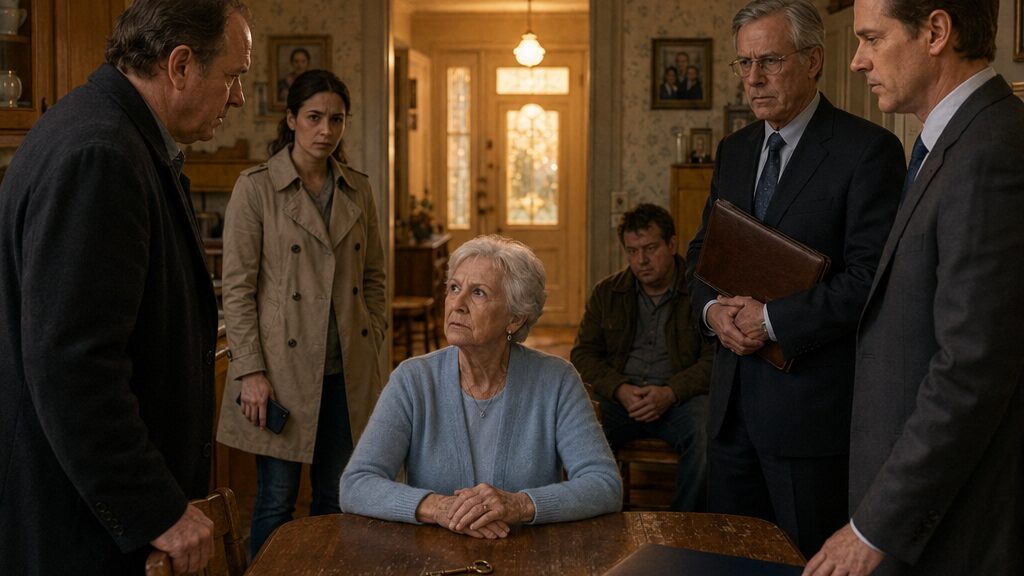
Debra looked at Paul’s folder, then Timothy’s folio, then Scott’s watch. Her face did not crumple. That would have been easier to bear. Instead, her mouth settled into a line Laura had seen only at funerals and hospital desks.
“I want my sons to remember I am standing in the room,” Debra said.
No one answered.
From the living room came a faint electronic sound: a camera shutter.
Paul turned sharply. “That was only the room exposure.”
Debra’s eyes closed for the smallest second.
Laura put the grocery bag down by the umbrella stand. Something inside shifted and thudded against the canned soup. She had come to drop off prescriptions, maybe stay for tea, maybe ask why Debra had sounded distracted the night before.
Now she stood at the threshold of the house where she had learned to read, where her grandfather had measured her height on the pantry door, while strangers decided how well the afternoon light would sell the place.
Outside, the porch light hummed faintly in its glass shade.
Scott reached for the navy folder. “Let’s all sit down. We can be reasonable.”
Debra opened her eyes.
“Reasonable,” she said, as if testing whether the word still meant what it used to.
Laura watched her grandmother turn toward the living room. For a moment Debra seemed smaller than she had five minutes before. Then she straightened, lifted her chin, and walked ahead of them all into the room Paul had already begun to photograph.
Chapter 2: The Listing Folder On Her Kitchen Table
Debra Bennett had spent fifty-two years learning the sounds of her house.
She knew the sigh in the baseboard heater before rain. She knew the second stair complained louder in winter. She knew the pantry door clicked twice if it was closed gently and once if someone was angry. She knew the porch light hummed when the bulb was old, and she had meant to change it that morning before Scott called to say he and Kevin were “coming by to help sort a few things out.”
Now she sat at her kitchen table listening to sounds that did not belong.
Paul Reed’s folder opened with a slick whisper. Timothy Harris’s pen tapped once against his folio before he seemed to catch himself and stop. Kevin shifted in the chair closest to the back door, making the vinyl cushion wheeze. Scott stood because he always stood when he wanted the room to know he was in charge.
Laura remained near the counter, her beige trench coat still buttoned, her phone clutched in one hand.
Debra wished the girl would sit. Standing made her look like she was bracing for bad weather.
“Mom,” Scott began, “we are not here to take anything from you.”
Debra folded her hands. “Then why did you bring a man who sells houses?”
Paul looked down at his folder.
Scott’s jaw tightened. “Because we need information.”
“You need my permission.”
“We need to know what we’re dealing with. The house has equity. A lot of equity. And it also has problems.”
“Most old things do.”
“That’s exactly the point.” Scott softened his voice, which somehow made it worse. “You’ve done a beautiful job here. Nobody is saying you haven’t. But Dad’s been gone four years. You’re alone. The maintenance is too much. The neighborhood’s changed. The stairs—”
“I use the downstairs bathroom.”
“The back steps are rotting.”
“I called someone.”
“You said that last year.”
“I called someone yesterday.”
Scott glanced at Kevin, then back. “Mom, this is what I mean. You say things are handled, but they don’t get handled.”
Debra felt Laura shift behind her. The girl wanted to jump in. Debra could sense it the way she sensed weather, but she kept her own gaze on Scott. If Laura fought the battle, Scott would only decide Debra needed a spokesperson.
Paul carefully slid a printed packet onto the table. The top page showed a photo of another house on another street, brightened until the grass looked too green. Beside it was a list of numbers and words Debra did not care to read.
“This is not a listing agreement,” Paul said. “It’s just a market overview. Comparable homes. Possible sale range.”
“Possible,” Debra repeated.
Kevin leaned forward. “Mom, look, nobody wants to upset you. But if you wait until something happens, then we’re all making decisions in a crisis. Wouldn’t it be better to choose now?”
“I did choose.”
“Staying exactly the same isn’t choosing,” Scott said.
Debra looked at him then. Really looked. His hair had gone thinner at the temples, and he had shaved badly, leaving a pale nick near his chin. He had his father’s hands but not his patience. He had been a boy who lined up his toy trucks by size and cried when Kevin moved one. She used to think order made him feel safe. Now he wore it like armor.
“What did you tell the nurse?” she asked.
Scott blinked. “What?”
Laura’s fingers tightened around the phone.
“You called the agency,” Debra said. “You asked for something in writing.”
Kevin’s face drained a little.
Scott shot him a look. “I called to understand options.”
“You asked them to say I need supervision.”
“That’s not—” Scott stopped, swallowed, tried again. “Mom, you left the burner on.”
“I forgot a burner. Once.”
“It only takes once.”
“I know that.” Her voice came out sharper than she intended. She lowered it. “I know what fire can do, Scott.”
The room went very still.
No one said her husband’s name. They rarely did when the conversation was about the house, as if the house had become valuable only after he was no longer in it.
Timothy Harris closed his folio halfway. “Mrs. Bennett, I want to be clear. Any documents I brought today would require your informed consent. If this is not a good time—”
“It’s a fine time,” Scott interrupted. “We’re not signing. We’re discussing.”
Debra turned to Timothy. “What documents?”
Scott placed a hand on the back of the empty chair beside him. “Mom.”
“What documents?”
Timothy hesitated. He looked at Scott, then at Debra, and seemed to choose carefully. “A limited power of attorney draft. A preliminary authorization allowing your sons to speak with certain agencies and professionals about housing, repairs, and sale preparation. Again, only for review.”
Debra’s hands remained folded. Beneath the table, one thumb pressed into the other until it hurt.
Laura spoke at last. “Did she ask for that?”
Scott’s patience cracked. “Laura, you’re not the one getting calls when the gutter falls or the insurance premium changes. You come by with groceries and everyone thinks you’re a saint, but you don’t know what it takes to keep this place going.”
Laura flinched, but she did not step back.
Debra’s chair scraped softly as she stood.
All the men stopped moving.
She walked to the front hallway. No one followed at first. She passed the wall of photographs, the little table with the saucer Kevin had spilled coffee onto, the umbrella stand with Laura’s grocery bag leaning against it. The front door was open just enough for the porch light to show as a golden blur through the storm glass.
She reached for the switch.
Click.
The porch light went off.
Dusk had settled faster than anyone noticed. Without the light, the entryway lost its warmth. The windows turned gray. Debra waited one breath, two.
Then she turned the light back on.
Click.
The porch returned. The old mat, the brass mail slot, the cracked paint on the railing, the place where her husband used to stamp snow from his boots.
She faced her family from the hallway.
“Which one of you decided I was already gone?”
Kevin’s eyes filled before he looked away.
Scott’s mouth opened, but nothing came out.
Paul Reed slowly closed the navy folder.
Debra walked back to the kitchen table. Her knees ached, and she hated that they did. She hated that Scott would notice the careful way she lowered herself into the chair. She hated that part of what he said was true. The back steps were soft. The upstairs leak had stained the ceiling. She had left the burner on, and the shame of it still woke her at night.
But shame was not consent.
Scott recovered first. “Mom, that is not fair.”
“No,” Debra said. “Bringing strangers to photograph my living room before asking me if I wanted to leave it is not fair.”
“We’re trying to protect you.”
“From what?”
“From being trapped here.”
Debra touched the edge of Paul’s folder with one finger and pushed it back across the table.
“This house is not a trap because you are tired of worrying about it.”
Kevin whispered, “Mom, we are worried.”
“I believe you.” She looked at him, and his face softened with relief too soon. “But worry does not give you my signature.”
Scott let out a breath that was almost a laugh. “So what? We do nothing until you fall? Until a pipe bursts? Until you call us from a hospital?”
Debra’s throat tightened. She reached for the house key beside her placemat, the old brass one with the worn teeth. It had been there since morning because she kept meaning to have Laura make another copy.
“Your father carried this key for forty-eight years,” she said. “Even when he was too sick to drive, he kept it in his robe pocket. Said a man ought to be able to come home, even if he only made it as far as the porch.”
Scott looked away.
Paul’s eyes dropped to the folder.
Debra closed her hand around the key. “This house protects more than me. And I will not explain that to a man who came here to measure my walls.”
The words were not loud, but they emptied the kitchen.
For a while the only sound was the refrigerator humming and the porch light faintly buzzing beyond the hall.
Scott gathered the papers too neatly. “We’ll come back tomorrow,” he said. “Without Mr. Reed, if that makes everyone less dramatic.”
Paul stood. “Mr. Bennett, I think—”
Scott ignored him. “Kevin and I will bring boxes. Not to move you. To clear hazards. If we can’t talk about selling, we can at least make the place safer.”
Debra kept the key in her fist.
Laura stepped forward. “Uncle Scott—”
“No,” Debra said.
Everyone turned to her.
She meant no to Scott, no to Laura, no to the whole machinery of people speaking over her. But her voice had come out tired, and Scott mistook tiredness for defeat.
He buttoned his coat.
“Tomorrow morning,” he said. “We’ll start with the spare room.”
Debra’s hand tightened so hard around the key that the worn brass edge bit into her palm.
The spare room.
For the first time that day, fear moved plainly across her face.
Kevin saw it. Laura saw it. Scott did not, because he was already looking down at his calendar.
Chapter 3: The Boxes Arrive Before Permission
The boxes came before breakfast.
Debra heard them before she saw them: cardboard edges bumping against the porch rail, Scott’s low instruction to Kevin, the squeak of the front storm door being held open with one hip. She had been standing at the stove, watching one egg sit untouched in a pan that was not yet hot. The burner was off. She had checked it twice.
The porch light was still on.
She had meant to turn it off when the sun came up, but after Scott left the night before, she had stood in the hallway too long, staring at the glass shade. Eventually she had gone to bed without touching the switch. It seemed foolish in daylight, a bulb burning against morning, but she left it.
Kevin knocked, though the door was open. “Mom?”
Debra took the pan off the stove, though there was no heat beneath it. “In the kitchen.”
Scott entered first carrying flattened moving boxes under one arm and a roll of packing tape around his wrist like a bracelet. Kevin followed with a stack of plastic bins. Neither wore a suit today. That somehow made it worse. Yesterday had been an ambush dressed as business. Today looked like chores.
“Morning,” Scott said, with a cheerfulness that had been chosen in the driveway.
Debra looked at the boxes. “I said no.”
“To selling,” Scott said. “You said no to selling. We heard you.”
Kevin set the bins near the back door. “This is just clearing walkways. Making things easier.”
“For whom?”
Kevin’s face tightened. “For you, Mom.”
She turned off the stove knob again because her hand needed something to do. “I haven’t eaten.”
“We won’t be in your way,” Scott said. “Start with breakfast. We’ll take the spare room.”
Debra left the egg in the pan and walked past them.
The hallway seemed longer than usual. She passed the framed height marks on the pantry trim, the closet with winter coats, the narrow table where her husband used to leave receipts and peppermints. Scott had already reached the spare room door by the time she got there.
His hand was on the knob.
“Don’t,” she said.
He paused, but only for a second. “Mom, it’s packed floor to ceiling.”
“It is not.”
“Kevin nearly tripped in there last month.”
“I told him the lamp cord was loose.”
“It shouldn’t be loose.”
“Then fix the cord.”
“That’s what we’re trying to do.” Scott opened the door.
The spare room smelled of cedar, paper, and closed curtains. Morning light pressed around the edges of the shades. A narrow bed stood against one wall with a folded quilt at the foot, though no one had slept there in years. Beside it sat the wooden chair her husband had used when walking from the bedroom to the porch became too far. On the dresser were a comb, an old watch that no longer ticked, and a small dish of cough drops fused together with age.
Kevin stopped in the doorway.
Scott stepped inside and looked around with a contractor’s impatience. “See? This is exactly what I’m talking about.”
Debra saw what he saw: newspapers stacked too high, a carton of old tax folders, a box of Christmas ornaments nobody had hung since before her husband died, a walker folded beside the closet, the stain on the ceiling near the window.
She also saw what he did not: the winter her husband slept in that bed because the stairs had become impossible; the way he would wake before dawn and ask if the porch light was on; the chair turned slightly toward the window because he liked to see when she came back from the mailbox; the last morning he had asked her to leave the light burning even after sunrise.
Scott pulled open the first box. “We’ll sort. Keep, donate, trash.”
Debra moved to the dresser and picked up the watch.
Kevin said softly, “Mom, maybe sit down while we do this.”
The sentence was kind. It still hurt.
“I am standing.”
“I know, I just meant—”
“She knows what you meant,” Laura said from the hallway.
All three turned.
Laura stood at the spare room door, hair pulled back, trench coat gone, sleeves rolled as if she had come prepared to work. She held two paper cups of coffee and a brown pharmacy envelope.
Scott’s eyes narrowed. “Did Mom call you?”
“No,” Laura said. “The neighbor did. She saw boxes.”
Debra closed her fingers around the watch.
Scott gave a short laugh. “Wonderful. Now the street is involved.”
“The street saw a realtor here yesterday,” Laura said. “That involved it first.”
Kevin stepped between them a little. “Can we not do this in Mom’s hallway?”
Scott grabbed a stack of newspapers from the chair. “Fine. Then let’s actually help.”
The top paper slid loose. A yellowed church bulletin fell to the floor. Debra bent for it, but Scott reached first.
“Mom, you don’t need every scrap.”
“Give it to me.”
“It’s from years ago.”
“Give it to me.”
He held it out. She took it carefully, smoothing the crease with her thumb. Her husband’s handwriting ran across the margin: Leave light on. D home by 6.
Scott saw it. For a second, his face changed. Then the change vanished.
“This is what I mean,” he said, quieter now. “You attach meaning to everything.”
Debra looked at the bulletin. “Not everything.”
“Enough that nothing can move.”
She turned from him, walked to one of the empty boxes, and set the bulletin inside. Then she placed the watch beside it. Scott’s expression eased, mistaking the motion.
Debra lifted the box herself.
“Mom,” Kevin said, reaching for it.
She stepped back before he could take it. The box was light, but the movement pulled at her shoulder. She kept her face still.
“This one stays in my room,” she said.
Scott rubbed his forehead. “That defeats the purpose.”
“No. It defines it.”
Laura hid a smile behind one of the coffee cups.
Debra carried the box down the hallway herself. Each step was careful. She hated how slowly she moved. She hated the silence behind her as everyone watched and measured the distance between her will and her body.
In her bedroom, she set the box on the cedar chest at the foot of the bed. Her palm throbbed from gripping the watch. She let herself breathe once before returning.
When she came back, Kevin was holding the assisted-living brochure.
It was glossy, folded in thirds, with a smiling woman in a pink sweater on the cover standing beside a window that looked out onto a garden too perfect to be real. The brochure had been tucked under her husband’s old mail tray. Debra had not put it there.
Kevin’s face flushed. “I didn’t—”
Scott came up behind him and took it. “I brought that.”
Debra stood in the doorway.
Laura’s voice was flat. “You hid it in her room?”
“I didn’t hide it. I left it where she could look when she was ready.”
Debra looked at the woman on the cover. She wondered if the woman in the pink sweater had a porch light. She wondered if anyone had asked her what she was ready for before they posed her beside the window.
Scott held the brochure out, not quite toward Debra, not quite away.
“Mom, it’s a nice place. It’s not a punishment.”
“I didn’t say it was.”
“Then why won’t you even look?”
Debra walked to the hall table. Her fingers found the porch light switch. For a moment she rested them there without pressing.
Because looking would become considering. Considering would become agreeing. Agreeing would become everyone saying she had chosen what they had already decided.
She did not say that.
Instead, she turned the porch light off.
The morning filled the hall without it, colder and clearer.
“I will look at anything handed to me honestly,” she said. “Not planted in my husband’s room like evidence.”
Kevin stared at the floor.
Scott folded the brochure once, too sharply. “We’re trying to prevent a crisis.”
Debra looked toward the spare room, where the chair still faced the shaded window.
“You keep saying that,” she said. “But you brought the crisis with you.”
Chapter 4: The Room They Called Empty
By the time Scott and Kevin left, the spare room looked worse than before.
The boxes had not emptied it. They had disturbed it. A strip of packing tape clung to the quilt like a bandage. The newspapers Scott had lifted sat crooked in a chair. The closet door stood open, showing the hanging shapes of coats Debra had not touched in years because they still held the faint smell of cedar and winter.
Laura stayed after them.
She did not ask right away. That was one of the things Debra loved about her and one of the things that made her dangerous. Laura could sit with silence longer than either of Debra’s sons.
They stood together in the doorway of the spare room while morning slid toward noon.
“I can put things back,” Laura said.
Debra shook her head. “Not yet.”
The room had been called many things in the last four years. Guest room. Junk room. Hazard. Storage. Wasted space. Kevin, once, had called it “Dad’s room” by accident and then turned so red Debra pretended not to hear.
She stepped inside and lifted the packing tape from the quilt.
Laura watched from the doorway. “Grandma?”
“It used to be the sewing room,” Debra said.
“I remember the machine.”
“It jammed more than it sewed. Your grandfather said it sounded like a lawn mower full of spoons.”
Laura smiled, but carefully.
Debra folded the tape back on itself, sticky side hidden. “When he got sick, the stairs became too much. Not at first. At first he fought them like they had insulted him personally. Then one night he stopped halfway up and sat down.” She looked toward the narrow bed. “He told me he was admiring the banister.”
Laura did not move.
“So I made this the bedroom. He hated that. Said no man should sleep next to a box of Christmas lights and my old ironing board.”
The room held the words gently, as if it remembered them.
Debra walked to the chair by the window. Its wooden arms were worn pale at the front where her husband’s fingers had rubbed them. She touched one arm with the back of her hand.
“He sat there in the mornings,” she said. “Couldn’t sleep much near the end. I would go out to get the paper, or to the pharmacy, or sometimes just stand on the porch where he couldn’t see me cry.”
Laura’s face changed.
Debra kept her eyes on the chair. “He asked me to leave the porch light on when I went out. Said if the light was on, he knew I was coming back.”
Outside, a truck passed slowly. The window glass trembled in its frame.
“The last week,” Debra said, “he woke before sunrise and asked if the light was still on. I told him yes. He said, ‘Good. Then I’m not lost yet.’”
Laura pressed one hand to her mouth.
Debra turned from the chair. “That is what your uncle calls clutter.”
“He doesn’t know.”
“No,” Debra said. “He doesn’t ask.”
She moved to the dresser and set the old watch beside the dish of cough drops. The watch had stopped at 6:12. It had been stopped so long the time had become less a number than a mark.
“Grandma,” Laura said, “you told him you called someone about repairs.”
“I did.”
“Who?”
Debra gave her a look.
Laura lifted both hands. “I’m not asking to take over.”
“You are all asking to take over in different voices.”
The words were sharper than Debra intended. Laura accepted them without flinching, which somehow made Debra feel worse.
“I’m sorry,” Debra said.
“I know.”
Debra sat carefully on the edge of the bed. It was too low. Her knees complained. She had meant to replace it, but replacing it felt like erasing the shape of the last months, and keeping it gave Scott one more piece of evidence.
“I called the man who fixed the porch railing for the neighbor,” Debra said. “He’s coming next week to look at the back steps. I called a plumber, too. Left a message. I have not heard back.”
Laura leaned against the doorframe. “That’s good.”
“It is not enough for Scott.”
“Scott doesn’t get to decide what enough is.”
Debra looked down at her hands. They were older than she expected every time she noticed them. Veins raised, skin loose, nails clean but ridged. Hands that had typed school attendance records, packed lunches, changed sheets, held babies, signed checks, squeezed her husband’s fingers while a doctor spoke gently past them both.
“I did leave the burner on,” she said.
Laura’s expression softened. “Grandma.”
“No, don’t make it small. It was not small. I frightened myself.” Debra rubbed one thumb over the other. “I was heating soup. The phone rang. Kevin asked about the insurance bill. I went to find the folder and forgot the flame. When he came over, the kitchen smelled like gas.”
“That doesn’t mean you can’t live here.”
“It means I must be honest.” She looked toward the window. “But if I tell Scott I am frightened, he will pack the whole house by Friday.”
Laura said nothing because they both knew it was true.
A car door shut outside. Debra stiffened, but it was only the neighbor across the street.
The porch light was off now. The hallway beyond the spare room looked plain without its glow, just old wallpaper and family pictures hung slightly unevenly.
Laura stepped into the room and picked up a small framed photo from the dresser. It showed Debra and her husband sitting on the front steps, younger by decades, laughing at something outside the frame.
“I always thought Grandpa kept the light on for you,” Laura said.
Debra smiled faintly. “At first he did. When I worked late at the school, he would turn it on before dark. Said a woman should never come home to a black porch.” Her smile slipped. “Then later, I kept it on for him. After he died, I suppose I kept it on for both of us.”
“Did you ever tell Scott?”
“I tried once.” Debra reached for the photo, and Laura gave it to her. “He said Dad wouldn’t want me rattling around in a house I couldn’t manage.”
Laura winced.
“He may be right about part of it,” Debra said.
“About the house?”
“About rattling.” She held the photo carefully. “Some nights the rooms are too loud.”
That confession cost more than she expected. She felt it leave her like breath in cold air.
Laura came and sat beside her on the low bed. For a moment they were quiet together, grandmother and granddaughter shoulder to shoulder in the room everyone else wanted to empty.
“You don’t have to prove you need nothing,” Laura said.
Debra looked at the stopped watch.
“No,” she said. “But I do have to prove needing something is not the same as being gone.”
In the hallway, the phone rang.
Both women turned.
Debra knew from the sound that it was the kitchen phone, not Laura’s cell. It rang again, bright and ordinary. Laura rose, but Debra put a hand out.
“I’ll get it.”
Her knees protested as she stood. She walked slowly, refusing to hurry in her own house. By the time she lifted the receiver, the fourth ring had begun.
“Hello?”
A man’s voice said, “Mrs. Bennett? This is Timothy Harris. I hope I’m not disturbing you.”
Debra looked down the hallway toward the spare room, where Laura stood watching.
“No,” Debra said. “You’re not.”
“I wanted to follow up after yesterday.” He paused. “And to ask whether you understood the documents your sons requested.”
Debra’s fingers tightened around the receiver.
The porch light switch waited on the wall beside her, untouched.
Chapter 5: The Repair Estimate Nobody Asked Her About
Debra did not tell Scott about Timothy Harris’s call.
She wrote it down instead.
That was what she had done for forty years at the school office whenever a parent claimed one thing, a teacher remembered another, and the truth needed a place to sit until people calmed down. She took a yellow legal pad from the drawer beside the phone and wrote: Timothy Harris called. Asked if I understood documents. Sounded concerned. Did not ask me to sign.
Then she underlined did not.
The next morning, she put on her gray coat, tucked the legal pad into her purse, and took the bus downtown.
Laura would have driven her. Kevin would have insisted. Scott would have called it proof she should not go alone. So Debra went before anyone knew she was gone.
The bus smelled of damp wool and coffee. She sat near the front with both hands on her purse and watched the town move past in pieces: pharmacy, dry cleaner, church lawn, bank, the old hardware store that had become a phone repair shop. She had not taken the bus in years. Her husband used to say she drove like she had a personal disagreement with every stop sign, and after he died, she had let the car sit until Scott sold it “before it became another thing to worry about.”
At the bank, the clerk spoke slowly until Debra answered two questions before the woman finished asking them. After that, the clerk straightened a little and printed what Debra requested: savings balance, monthly pension deposit, tax escrow statement, insurance premium. Debra folded each page into her purse with care.
At the county records office, another clerk showed her where to request a copy of the deed. Debra already knew whose names were on it, but she wanted the paper anyway. Not because it would solve anything. Because Scott liked papers. If he wanted to speak in documents, she would bring her own.
The repair estimate came in the afternoon.
The man from the neighbor’s railing job arrived in a dented white truck and spent forty minutes tapping boards, crouching beside the back steps, and looking up at the stained bathroom ceiling.
Debra stood with him as long as she could. When her hip began to ache, she sat on the kitchen chair by the back door and made herself stay there instead of pretending.
“Well?” she asked when he returned with sawdust on one sleeve.
The man removed his cap. “Steps need replacing. Not just patching. Bathroom leak’s probably from the old supply line. I’d get a plumber in first before anyone closes that ceiling. Porch railing’s solid enough, though I’d reinforce the left post.”
“How much?”
He named a number that made Debra look down at the table.
It was not impossible.
It was not small.
The man saw her face and added, “Could stage it. Steps first. Leak second. Railing can wait a bit. I wouldn’t wait on the steps.”
Debra nodded. “Write it down, please.”
He did, carefully, on a carbon form from his truck. When he left, Debra stayed at the table with the estimate in front of her and let herself feel the weight of Scott being partly right.
That was the worst part.
If he had been entirely wrong, she could have dismissed him cleanly. If the house had been sturdy and she had been steady and all the bills had lined up in neat little rows, she could have stood in the kitchen and felt righteous.
Instead, the back steps needed replacing. The bathroom leak had spread. The gutter had pulled loose near the corner. Her pension was enough for daily life but not for endless repairs. Her left knee sometimes trembled on the basement stairs. The burner had happened.
She took off her glasses and pressed her fingers to her eyes.
The house needed help.
So did she.
The thought sat there without cruelty until she could look at it.
Near dusk, Laura came by with soup. Debra showed her the estimate before Laura removed her coat.
Laura read it without speaking. “Okay,” she said at last.
“Just okay?”
“It’s information. Not a verdict.”
Debra almost smiled. “You sound like me.”
“I learned from someone.”
Debra reached into her purse and took out the bank papers, the deed copy, the insurance statement, and the legal pad. She laid them on the table one by one.
Laura’s eyes widened. “Grandma.”
“I am making a plan.”
“I see that.”
“I can pay for the steps. The leak may require moving money from savings. I will not touch the emergency account without knowing the plumbing cost. The railing can wait.” Debra tapped the legal pad. “I called the home-care agency and asked what a weekly safety check would cost. Not daily. Weekly. I asked about stove knobs that turn off automatically. They said a handyman can install them.”
Laura sat slowly.
Debra waited for the girl to look pleased. Instead Laura looked close to tears.
“What?” Debra asked.
“Nothing. I just wish they’d asked you.”
The words opened something Debra had been holding shut all day.
She looked toward the front hall. The porch light was not on yet. The square of glass above the door had gone blue with evening. For once the house did not feel like it was waiting for her to perform a ritual. It felt as if it might wait until she was ready.
“I wish I had told them sooner,” Debra said.
Laura frowned. “Told them what?”
“That I was afraid of the stairs. That I don’t go down to the basement unless I have to. That sometimes I stand in the kitchen and forget why I came in.” She picked up the repair estimate and set it down again. “I thought if I gave them one true thing, they would use it to take everything.”
Laura did not rush to deny it.
That was why Debra trusted her.
The kitchen phone rang while Laura was putting soup into bowls.
Debra looked at the number on the small display. She recognized none of it, but something in her chest tightened before she answered.
“Hello?”
“Mrs. Bennett, this is Timothy Harris again. I apologize for calling twice in one week.”
Laura turned from the stove.
Debra sat straighter. “What can I do for you, Mr. Harris?”
“I received a message from your son Scott asking whether we could schedule a signing for Saturday. He said the family had reached an understanding.”
Debra closed her eyes.
Laura turned the burner off.
“No,” Debra said. “The family has not.”
A pause.
“I suspected I should confirm,” Timothy said. “The document in question is broader than what we discussed at your table. It would authorize your sons to manage sale preparation and certain financial communications related to the property.”
Debra looked at the papers she had gathered herself.
“I see.”
“I cannot advise you legally,” Timothy said. “But I can refuse to proceed if I believe there is confusion or pressure.”
Debra almost laughed, not because anything was funny, but because the word pressure sounded so small for what had entered her house.
“There is pressure,” she said. “There is not confusion.”
Another pause, softer this time.
“Would you like me to cancel the appointment?”
Debra looked at Laura. Laura’s face said yes with every feature.
Debra looked at the porch light switch in the hallway.
“No,” she said.
Laura’s mouth parted.
Debra kept her voice steady. “Let them come Saturday.”
“Mrs. Bennett—”
“I will not sign their papers,” she said. “But I have papers of my own.”
That night, after Laura left, Debra spread everything across the kitchen table. Bills, estimates, agency notes, bank printouts, the copy of the deed, the yellow legal pad. She worked slowly. Her handwriting, once office-neat, wavered when her hand tired. She crossed things out. She started again.
At nine o’clock she rose, joints stiff, and turned on the porch light.
The glow filled the entry.
She stood beneath it with the repair estimate in her hand and imagined her husband in the spare room asking if she was coming back.
“Yes,” she whispered to the empty hall. “But not empty-handed.”
Chapter 6: The Papers She Would Not Sign
Scott arrived Saturday with his good coat and the expression of a man prepared to be patient for exactly as long as patience served him.
Kevin came behind him carrying a bakery box. Debra knew at once it had been his idea. He had always brought sweetness when he did not know how to bring courage.
Timothy Harris arrived alone, his leather folio tucked beneath one arm. Paul Reed was not with him. Debra noticed and said nothing.
Laura was already in the kitchen, setting cups on the counter. Debra had told her she could come, but she had also told her not to speak first. Laura had nodded, though it had cost her.
The dining room table had been cleared except for two stacks of papers. One was Scott’s, though he did not know it yet: the folder Timothy carried, the proposed authorization, the clean lines of other people’s plans. The other was Debra’s: repair estimate, bank statements, home-care agency notes, stove safety information, plumber appointment card, and three pages written in her own hand.
The porch light burned in the late afternoon behind them. Its glow reached the dining room in a faint gold bar across the floor.
Scott looked at the table and smiled cautiously. “This looks promising.”
Debra sat at the head of the table, the place her husband had used for years because he liked to see both the kitchen and the front door. “Sit down, Scott.”
He did.
Kevin sat beside him. Timothy took the chair farthest from Debra, careful, observant. Laura remained near the doorway with her hands wrapped around her mug.
Scott nodded toward Timothy. “I think we all want the same thing.”
“No,” Debra said. “We want different things and have been using the same words.”
Kevin looked at the bakery box. “Mom—”
“Not yet.”
Scott’s smile thinned. “All right.”
Timothy opened his folio but did not remove the papers. “Mrs. Bennett, before anything is discussed, I need to confirm that you understand no document has to be signed today.”
“I understand.”
“And that you may ask anyone to leave.”
“I understand that too.”
Scott shifted. “Nobody is forcing anybody.”
Debra looked at him until he looked away.
Timothy placed the proposed document on the table. It was clipped neatly, each page aligned. Scott leaned forward as if order itself might persuade her.
Debra did not touch it.
“Before we look at that,” she said, “we will look at mine.”
She slid her handwritten pages to the center.
Scott frowned. “What is this?”
“My plan.”
He did not pick it up. Kevin did.
Debra watched her younger son read the first lines. His lips moved slightly as they had when he was a child sounding out library books at this same table.
“Back steps replaced within thirty days,” Kevin said quietly. “Plumber inspection scheduled. Stove safety knobs. Weekly home-care check. Laura listed for emergency contact. Monthly family review by phone, not unannounced visits.”
Scott took the pages from him. His eyes moved quickly.
“This isn’t enough.”
“You have not finished reading.”
“I don’t need to finish reading to know this doesn’t solve the larger issue.”
“The larger issue being?”
“The house.” His voice rose and then lowered with effort. “Mom, this house is too much.”
“For whom?”
“For all of us.”
There it was.
The sentence sat between them more honestly than anything he had said all week.
Kevin closed his eyes.
Debra felt the old urge to soften the room, to rescue her son from the discomfort of his own truth. She had done that too often when the boys were young. Smoothed over Scott’s sharpness, translated Kevin’s silence, made peace before anyone learned how.
Not today.
“Thank you,” she said.
Scott blinked. “For what?”
“For finally including yourself in the reason.”
Color rose up his neck. “That’s not fair.”
“Perhaps. But it is true.”
He pushed back from the table. “Do you know what it’s like to wait for the call? Every time the phone rings late, I think this is it. She fell. She burned herself. She’s lying at the bottom of the stairs because she wouldn’t listen.”
Debra’s hands tightened in her lap.
Scott’s voice broke at the edge, which angered him more. “And then I come here and you act like I’m stealing from you because I don’t want to find you dead in a house full of memories.”
Laura flinched. Kevin stared at the table.
Debra let the words pass through the room. Some of them were cruel. Some were afraid. Both could be true.
“I know about waiting for calls,” she said.
Scott looked away.
“When your father was sick, every ring after midnight took a year off me. When you boys were young and late coming home, I stood at that window and imagined ditches, hospitals, police officers. Fear does not make us wise, Scott. It only makes us fast.”
He said nothing.
She reached for the proposed authorization and turned the first page around so she could read it. Her glasses were beside her. She put them on slowly. The words were dressed politely, but they did what Timothy had said they did. They opened doors. They let her sons speak where she had not chosen to be silent. They made preparation sound harmless.
She set it down.
“I will not sign this.”
Scott’s chair creaked. “Then what are we doing here?”
Debra placed her plan on top of his document.
“We are deciding whether you want to help me live safely in my home, or whether you only want my agreement to leave it.”
Kevin rubbed both hands over his face.
Scott stared at the papers. “Mom, the market is good right now.”
“I am not a market.”
“No one said you were.”
“You brought a realtor to photograph my living room.”
“That was a mistake.”
Debra waited.
Scott’s jaw worked. “Fine. It was a mistake.”
Kevin looked at him. “Scott.”
“What do you want me to say?”
“The truth,” Debra said.
The porch light hummed faintly in the hall.
Scott looked smaller suddenly, though he was still standing. “I want this settled,” he said. “I want to stop wondering how bad it has to get before you admit you can’t do everything. I want Kevin to answer his phone. I want Laura to stop looking at me like I’m the villain. I want Dad’s house to stop being the thing we all orbit because nobody knows how to talk about him.”
The last sentence took the room with it.
Debra felt tears rise, but she did not let them fall yet.
“It is not your father’s house,” she said quietly. “It is mine.”
Scott looked at her then.
“He loved it. He worked for it. He fixed things badly and proudly. He died in it. But he left it to me, not as a shrine and not as a burden. As a home.”
Kevin’s eyes were wet now.
Debra turned to him. “And you. You do not get to hide behind your brother and call it peace.”
Kevin nodded once, ashamed.
She looked back at Scott. “I am not refusing help. I am refusing surrender.”
No one spoke.
Timothy Harris closed his folio. “I will not notarize the authorization today.”
Scott gave a bitter little laugh. “Of course.”
Debra lifted one hand. “He is not rescuing me. I had already decided.”
Timothy inclined his head, accepting the correction.
Debra pushed the bakery box toward Kevin. “You may open that.”
Kevin laughed once, broken and grateful, and untied the string.
Scott remained standing.
Debra held out the proposed authorization. “These papers leave this house today.”
For a moment she thought he might argue again. His face tightened, loosened, aged. Then he took the document.
“And you?” she asked.
“What about me?”
“You may stay for dinner if you can sit at my table without trying to sell it.”
Laura looked down quickly, but not before Debra saw her smile.
Scott looked toward the hallway. The porch light was visible from where he stood, glowing over the front door though it was not yet dark.
“I don’t know how to do this,” he said.
Debra felt the truth of it. He had always known how to organize, how to decide, how to push. Sitting still with an unresolved thing was foreign country to him.
“Then start by washing your hands,” she said. “Dinner does not make itself.”
Kevin opened the bakery box. Inside was a lemon cake, slightly crushed on one side.
For the first time all week, Debra almost laughed.
Scott stood a moment longer, the unsigned papers in his hand. Then he walked to the kitchen sink. Laura moved aside to let him pass.
Debra watched him go, then reached to straighten her own handwritten pages at the center of the table. Her plan was imperfect. The house was imperfect. Her sons were imperfect. She was tired, frightened, stubborn, and still here.
Outside, the porch light waited for evening.
Chapter 7: When She Chose To Leave The Light On
Two weeks later, the back steps smelled of new lumber.
Debra stood at the kitchen door with one hand on the frame and watched the repairman gather his tools. The old boards had been hauled away in a splintered pile. In their place were three solid steps, pale and raw against the weathered siding, with a new handrail that did not wobble when she tested it.
“Give the stain a few dry days,” the repairman said. “Don’t rush it.”
“I have been told I rush nothing,” Debra said.
He smiled, unsure if she was joking, and carried his toolbox to the truck.
Kevin came up the driveway just as the repairman left. He had work clothes on and a paper bag in one hand. For a moment he stopped at the sight of the new steps, then put one foot on the bottom board and pressed down.
“Solid,” he said.
“That was the idea.”
He looked embarrassed and pleased at once. “I brought lunch.”
“Did I ask for lunch?”
“No.” He lifted the bag. “That’s why I brought only sandwiches and not opinions.”
Debra let him in.
They ate at the kitchen table, where her handwritten plan had been moved to a folder of its own. Not Scott’s navy folder. Hers was green, taken from a box of old school supplies, with BENNETT HOUSE written across the tab in her careful hand.
Kevin noticed it but did not reach for it.
That was progress.
He told her about a problem at work, about a driver who kept parking behind the loading dock, about a leak in his own bathroom he had ignored for three months. Debra listened, chewing slowly. It occurred to her that Kevin had spent years being the son who called after decisions had been made. He was not innocent, but he was not only weak either. Weakness, she was learning, could become a habit if no one asked it to stand up.
After lunch, he washed the plates without being asked.
“You don’t have to do that,” Debra said.
“I know.”
He dried his hands. “Scott wants to come by tonight.”
Debra looked toward the hallway.
“He said he’ll call first,” Kevin added quickly.
“Good.”
“He’s trying.”
“I know.”
Kevin leaned against the sink. “He’s angry.”
“I know that too.”
“At himself, mostly.”
Debra folded the sandwich paper into a small square. “That may be useful if he does not try to hand it to me.”
Kevin gave a small, rueful smile.
The home-care nurse came the next morning for the first weekly check. She looked at the stove knobs, the new note pad by the phone, the emergency numbers taped inside the cabinet door. She did not act as if Debra were a child. She asked questions and waited for answers. When she left, Debra felt tired but not diminished.
The plumber came Friday. The bathroom leak was not as simple as Debra had hoped, but not as ruinous as Scott had predicted. She wrote the appointment and estimate in the green folder. She wrote paid deposit beside the back steps and underlined it once.
Scott arrived Sunday at four, alone.
The porch light was not on yet.
He stood on the mat with both hands in his jacket pockets. He had called first. He had arrived at the time he said he would. These were small things, but Debra had lived long enough to know small things were often where change began.
“Come in,” she said.
He stepped inside and glanced toward the dining room, then the living room, then the hallway. She saw him notice what had not changed. The photographs were still crooked. The spare room door was still closed. The old house key still sat on the kitchen table in a small dish. No boxes waited by the wall.
“I saw the steps,” he said.
“Yes.”
“They look good.”
“They are good.”
He nodded.
She had made coffee because she wanted some, not because he was coming. She poured him a cup anyway. They sat in the living room, where Paul Reed had taken his photos. The thought no longer stung as sharply. A room could survive being misunderstood.
Scott held the coffee with both hands. “I called Paul.”
Debra’s fingers stilled on her saucer.
“I told him there won’t be a listing.” He looked at the cup. “Not unless you call him yourself someday.”
Someday sat between them carefully. Not gone. Not decided. Not stolen.
“Thank you,” Debra said.
Scott nodded once. “I also called Timothy.”
Debra waited.
“I told him I was out of line.”
“That must have hurt.”
He looked up, and for a second she saw the boy who had hated being teased and the man who hated being wrong.
“It did,” he said.
Debra did not reward the confession by making it easier. She took a sip of coffee and let him sit with it.
After a while, Scott said, “I kept thinking if I got everything arranged, then no one could say I failed you.”
“Who was going to say that?”
He rubbed his thumb along the mug handle. “Me.”
The house settled around them. The baseboard gave its soft pre-rain sigh though the sky was clear.
“I am not your test,” Debra said.
“I know.”
“Do you?”
He looked toward the front window. The porch light fixture was visible through the sheer curtain, unlit in the gray afternoon.
“I’m trying to.”
That was not enough for forgiveness. It was enough for another cup of coffee.
Laura came later, near dusk, with a small paper bag from the hardware store. She found Debra on the porch, sitting in the old chair beside the door. The air was cool enough for a sweater. Across the street, the neighbor’s curtains glowed blue with television light.
“I brought the spare key copies,” Laura said.
Debra held out her hand.
Laura dropped two bright new keys into her palm. They looked almost too shiny beside the old brass one Debra had carried for decades.
“One for you,” Debra said, closing Laura’s fingers around a key.
Laura’s eyes searched her face. “Are you sure?”
“I am not giving you permission to manage me.”
“I know.”
“I am not handing you the house.”
“I know.”
Debra looked through the storm door into the hallway. Scott had left an hour ago. Kevin had promised to come Tuesday to carry the broken boards to the curb. The nurse would come again next week. The plumber had a date on the calendar. The green folder rested on the kitchen table.
The house was still too big on some nights.
The stairs still made her careful.
Grief still moved from room to room without asking.
But the house felt less like something she had to defend with both arms and more like a place she could inhabit honestly, with locks that opened from the inside.
“I am giving you a way in,” Debra said, “in case I ask.”
Laura closed her hand around the key. Her face crumpled a little, then steadied.
“Okay,” she said. “In case you ask.”
Debra reached for the porch light switch beside the door. Her fingers rested there.
For years, she had turned the light on for the man in the spare room, then for the memory of him, then against the dark, then against the fear that leaving it off meant admitting he was not waiting anymore.
Now she looked at the street, the repaired steps, the darkening windows, the granddaughter beside her with a key she had not taken but received.
She turned the light on.
The porch warmed at once.
Laura smiled, but did not speak.
Debra sat back in the chair and let the glow settle over her hands. She could sell one day. She could move one day. She could wake some morning and decide the rooms had become too much, and if that day came, she would not call it defeat.
But not because a folder said so.
Not because fear spoke louder than love.
Not because her sons had mistaken concern for ownership.
Tonight, the house was hers. The light was hers. The choice, finally named and defended, was hers.
Inside, the kitchen phone rang once, then stopped. A wrong number, maybe. Or Kevin checking and thinking better of it. Debra smiled to herself.
Laura leaned against the railing. “Do you want me to stay for dinner?”
Debra looked through the open doorway, toward the kitchen where the green folder lay beside the old key dish, then toward the spare room at the end of the hall. The room was not empty. It had never been empty.
“Yes,” she said. “But you can set the table.”
Laura laughed softly and went inside.
Debra remained on the porch a little longer. The evening gathered around the edges of the yard. The porch light held its small circle against it, neither proof nor plea, only a sign that someone was home.
The story has ended.