The Old Veteran Reached For His Fallen Medal While Everyone Watched The Boy Laugh
Chapter 1: The Medal Fell Beside The White Sneaker
The medal struck the brick pavement with a small, hard sound that seemed too light for the weight it carried.
George Bennett heard it before he saw where it landed. A thin metallic click, then a scrape as the blue ribbon dragged half an inch across the damp brick. The sound cut through the evening traffic, through the hiss of tires at the corner, through the soft chatter outside the coffee shop. It was the kind of sound an old man noticed because old men noticed what they could still lose.
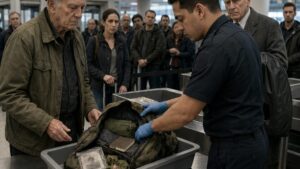
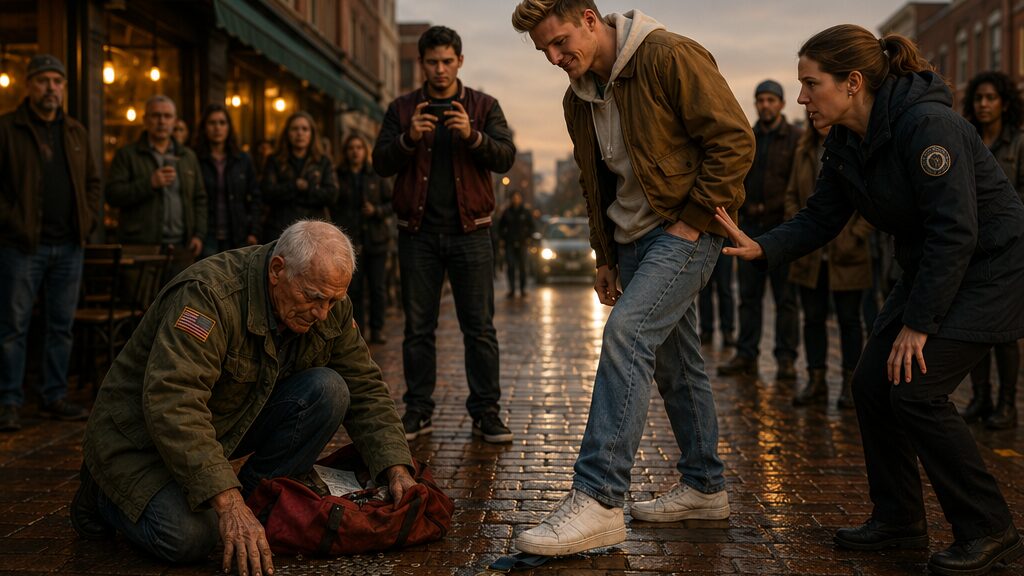
His right knee was already down. The fall had not been dramatic. He had stepped off the curb too slowly, the red canvas bag sliding from his hand when a shoulder brushed him from behind, and then the bag had tipped open at his feet. Quarters and nickels rolled into the cracks between bricks. A folded memorial program, bent at one corner, slipped halfway out. The medal came last, turning once in the air, catching a strip of pale dusk, and landing near a clean white sneaker.
George’s hand went out by instinct.
“Whoa,” the young man said, laughing. “Careful there, grandpa.”
George did not look up right away. He could see the sneaker. Bright white, hardly scuffed, planted too near the medal. The toe hovered just above the blue ribbon. The young man wore slim jeans and a tan jacket over a hoodie, the kind of clothes that looked chosen to appear effortless. Behind him, another young man lifted a phone.
George placed one palm on the pavement. The brick was cold and gritty. His old green jacket pulled tight across his shoulders as he leaned forward. The American flag patch on his sleeve had faded at the edges, the red stripes gone dull after years of rain, storage, and use. He had meant to sew the corner down again. He had meant to do a great many things before today.
“Move your foot, please,” George said.
The blond young man glanced down as if noticing the medal for the first time. Then he looked back at his friend’s phone, his mouth curling.
“This yours?” he asked.
George kept his gaze on the ground. “Yes.”
“You drop it for sympathy or what?”
The words reached the small cluster of people outside the coffee shop. A woman with a paper cup paused near the door. A man in a dark vest turned his head but did not step closer. Someone gave an uncomfortable half laugh, the kind people made when they did not yet know what they were agreeing to.
George’s fingers stretched toward the medal. His joints were stiff from the evening cold. He could still reach, if the boy moved his foot. If he did not hurry too much. If he did not make the wrong kind of scene.
“Just move your foot,” he said again.
The young man bent at the waist, bringing his face closer to George’s. He smelled faintly of mint gum and cologne. “I’m not on it.”
The toe of the sneaker nudged the ribbon.
George stopped moving.
Something in the air changed. The phone behind the boy angled lower, framing the pavement, the shoe, the old man’s hand. George saw the black rectangle in the corner of his eye. He knew enough about phones to know when one was pointed at him. He knew enough about young faces to know when embarrassment was being turned into entertainment.
“Ryan, hold on,” the one filming said, laughing under his breath. “This is crazy.”
Ryan.
The name settled somewhere in George’s mind, not because he wanted to remember it, but because the mind held onto names at the wrong times. Ryan with the white shoes. Ryan with one foot by the medal. Ryan with a smile that had not yet learned what it was doing.
George shifted his weight. His left knee protested. The red bag lay open beside him, its zipper teeth catching the light. A few coins had come to rest against the bag’s frayed strap. The folded program showed a line of printed letters, not enough for anyone standing above him to read. He reached back with one hand and pushed it deeper into the bag.
Ryan noticed. “Oh, there’s more stuff in there?”
George’s hand closed around the bag’s edge. “Leave it.”
“I’m just asking.” Ryan’s grin widened for the phone. “You got a whole act?”
George looked up then.
The boy was younger than he had first seemed. Early twenties, maybe. Smooth face, restless eyes, a confidence too loud to be real. Behind him, the friend filming had dark hair and a red face from trying not to laugh. Other people had begun to watch from a safe distance. Some pretended not to. Their eyes slid away when George met them.
He had been stared at before. In airports. In hospitals. At checkout counters when he counted bills too slowly. On buses when he asked the driver to wait until he found his pass. The world had a way of making old men visible only when they were in the way.
George lowered his eyes back to the medal.
It lay face down now, the ribbon twisted. The blue was dulled by dirt and wet brick dust. Not his medal, not in the way the boy thought. Not a thing to show. Not a thing to trade for pity. It belonged to a promise folded inside the red bag, to a voice he could still hear when the house was quiet.
He reached again.
Ryan moved his shoe half an inch closer.
“Don’t,” George said.
The word came out low. Not loud. Not angry. It was the kind of warning that depended on the listener having a conscience.
Ryan’s expression flickered. For one brief second, uncertainty touched him. Then his friend snorted behind the phone, and the uncertainty hardened into performance.
“Relax,” Ryan said. “Nobody’s touching your little medal.”
George’s fingers hovered over the ribbon. He did not grab. He would not give the boy the satisfaction of seeing him snatch like a desperate man. He placed two fingers carefully on the blue cloth and began sliding it toward himself.
The sneaker came down on the ribbon’s end.
Not hard. Not enough to crush anything. Enough.
George stopped breathing for a moment.
A bus sighed at the corner. Somewhere a car horn tapped twice. From inside the coffee shop came the muffled beat of music and the clink of dishes. The ordinary evening continued around him, refusing to understand that a line had been crossed.
George lifted his eyes to Ryan’s shoe, then to Ryan’s face.
“Please,” he said.
The word cost him more than anger would have. He felt it leave him like heat through an open door.
Ryan looked down, still smiling, but less surely now. “You always carry this around?”
George did not answer.
“Were you even in the Army?” Ryan asked. “Or is this just part of the setup?”
A few bystanders shifted. The woman with the paper cup frowned. The man in the vest took one step forward, then stopped as if remembering he had somewhere else to be.
George slowly withdrew his hand from the ribbon. He braced it on the brick instead and pushed himself more upright on one knee. Pain ran from his hip to his ankle. He let it pass through without showing much.
“I asked you to move your foot,” he said.
Ryan’s friend lowered the phone just enough to look over it. “Dude, maybe just—”
Ryan cut him off with a glance. He was trapped now by the camera he had invited. To step back would mean admitting the old man had power. To keep going meant becoming someone he perhaps had not planned to be.
George knew that trap. Pride made prisoners of all ages.
He looked past Ryan toward the street.
At the far end of the block, beyond the parked cars and the hanging baskets outside the shops, headlights turned slowly into view. One vehicle, then another. Dark sedans, moving at procession speed. Their lights stretched along the wet bricks, trembling gold over the scattered coins.
George’s fingers tightened on the red bag.
He had taken too long. The memorial escort was arriving.
Ryan noticed George looking. He turned his head. “What’s that?”
The first car eased toward the curb. Its doors opened with quiet, practiced timing. Men and women in dark formal coats stepped out, some wearing caps, some carrying folded banners, their movements subdued rather than theatrical. The street noise seemed to thin around them.
A tall older woman with a clipboard crossed behind the first car, speaking quickly to a driver. A patrol officer near the intersection raised one hand to slow traffic. Another pair of uniformed volunteers stepped onto the sidewalk and looked toward the gathering crowd.
Ryan’s smile faded.
George did not move toward them. He stayed on one knee, one hand on the pavement, the other holding the red bag closed. The medal still lay partly under Ryan’s shoe.
The boy looked from the arriving procession to George, then back to the phone in his friend’s hand.
For the first time, no one laughed.
Chapter 2: The Red Bag Was Not For Begging
Amanda Walker had seen the old man three times before she knew his name.
The first time, he had been sitting on the bench outside the closed pharmacy, both hands resting on the handle of a red canvas bag. The bag looked too bright against his dull green jacket, as if it belonged to someone younger or to a different life. She had been carrying a box of donated scarves to the outreach table and had asked if he needed coffee. He had thanked her, said no, and looked past her toward the courthouse clock.
The second time, she had found him standing at the corner near the veterans memorial wall, reading the names without moving his lips. Rain dotted his cap and collected in the creases of his face. She had offered him a bus voucher. He had smiled politely, folded it twice, and tucked it into his jacket without using it.
The third time was that evening, when she heard laughter outside the coffee shop and turned from the memorial check-in table to see him on one knee.
At first, she saw only the shape of trouble: a young man leaning over an old one, a phone raised, people watching from a distance that excused them from responsibility. Then the details came together. The red bag tipped open. Coins on the bricks. George’s hand braced flat against the pavement. A blue ribbon trapped beneath the toe of a white sneaker.
Amanda put down the stack of name cards she had been sorting.
“Excuse me,” she called, already walking.
No one moved.
The blond young man glanced over his shoulder at her, then back at George. The one with the phone kept recording, though the angle lowered as Amanda approached. She had seen that gesture before. People wanted evidence until they were part of it.
“Sir,” Amanda said to George, “are you all right?”
He did not look at her. His eyes stayed on the shoe. “I’m fine.”
He was not fine. His voice was thin from holding something back. There was dirt on the heel of his palm. His jacket sleeve had twisted up enough for her to see the faded flag patch and the little line of stitching where someone had repaired it badly. His red bag was open just enough to show papers inside, carefully stacked despite the spill.
Ryan gave a soft laugh. “He’s fine. He just dropped his stuff.”
Amanda looked at the foot on the ribbon. “Then let him pick it up.”
“I’m not stopping him.”
“You are.”
Ryan’s face changed in the quick, irritated way of someone who had expected the world to stay on his side. “Lady, you didn’t see what happened.”
“I’m seeing it now.”
Behind him, the friend with the phone shifted. “Ryan.”
Ryan ignored him.
Amanda crouched, not too close to George. In her work, she had learned that help could become another kind of force if offered badly. Still, urgency pushed at her. The escort vehicles were approaching. Donna Hayes would be looking for her. The ceremony was already behind schedule. But the old man’s fingers were trembling on the brick.
“Can I pick up your bag?” Amanda asked him.
George’s hand tightened immediately. “No.”
The refusal was sharp, not rude. Protective.
“All right,” she said. “I won’t.”
Ryan made a small sound. “See? He’s got some secret stash in there.”
Amanda turned on him. “Enough.”
The word came out more tired than angry. She was tired of people mistaking cruelty for humor. Tired of phones appearing before hands. Tired of old men becoming obstacles in the path of young men who had never had to move slowly.
George shifted the bag closer to his knee. A folded paper slipped again toward the opening. Amanda saw the top line this time.
Memorial Service and Name Dedication.
Beneath it, in smaller letters, was that morning’s date.
She glanced toward the street, where the first pair of headlights rolled closer. Then she looked back at George. Something cold moved through her. He was not simply passing by. He was trying to get there.
“Were you coming to the memorial?” she asked softly.
George’s eyes closed for half a breath, as though the question touched a place he had been guarding. “Yes.”
Ryan looked between them. “What memorial?”
Amanda ignored him. “We can still get you checked in.”
George shook his head once. “The medal.”
Only then did Amanda see the whole shape of it. The blue ribbon. The careful distance of his hand. The way he would not yank it free while Ryan’s shoe held the edge. Not because he was too weak, but because the medal deserved better than a tug-of-war on a dirty sidewalk.
Amanda looked up at Ryan. “Move your foot.”
Ryan’s jaw flexed.
The phone was still pointed at them. People were still watching. The coffee shop door had opened, and the manager stood halfway out, wiping his hands on a towel, uncertain whether this was business, trouble, or something in between.
Ryan lifted his foot at last, but not with grace. He dragged it back just enough to release the ribbon, then held both hands out as if he had been falsely accused. “There. Happy?”
George reached forward.
His fingers touched the ribbon first, straightening it before lifting the medal from the brick. He did not wipe it on his jacket. He did not kiss it or hold it up or perform grief for the people watching. He cradled it in his palm and studied the dirt along one edge.
Amanda saw his mouth tighten.
“Sir,” she said, “we should get you up.”
George tucked the medal against his chest. “Not yet.”
He began gathering the coins.
The gesture stunned her more than the refusal. The procession was arriving. The program was slipping from the bag. The medal had nearly been stepped on. Yet he reached for quarters one by one, pressing them into his palm with stubborn care.
“Leave those,” Ryan muttered.
George did not answer.
Amanda understood then that the coins were not merely money. They were proof that his things were still his. Proof that the spill had not emptied him. She began collecting the ones farthest from him, placing them near his hand without touching the bag.
After a moment, the coffee shop manager stepped forward and picked up a nickel from beside the door. The woman with the paper cup bent for a dime. Small movements, embarrassed and late.
Ryan watched them, his expression turning sour. “This is ridiculous.”
Amanda looked up. “What part?”
“He’s making everyone feel bad.”
“No,” Amanda said. “You did that.”
The friend’s phone lowered completely.
At the curb, the first dark sedan stopped. Doors opened. Volunteers in formal coats stepped out, carrying folded flags and small lamps for the memorial wall. Their shoes clicked against the bricks in a quiet rhythm. Donna Hayes, silver-haired and brisk, came around the front of the car with a clipboard clutched to her chest.
“Amanda?” Donna called. “We need the family cards sorted. The escort is early.”
Amanda did not stand. “I found someone who may be part of the dedication.”
Donna’s eyes moved over the scene: George kneeling, Ryan standing too close, the red bag open, coins gathered in little piles, bystanders pretending they had only just arrived.
Her face tightened with concern and impatience, the two emotions fighting for space.
George finally slid the last visible coin into his bag. Then, with care, he opened the red canvas just wide enough to return the medal.
Amanda saw inside.
Not trash. Not a stash. Not the random clutter of a man wandering with nowhere to go.
A folded program. A yellowed envelope bound with a rubber band. A cloudy photograph in a plastic sleeve. A pair of dark gloves. A small cloth, clean and white, wrapped around something rectangular. Everything arranged with the order of a person who had packed for a task, not a life on the street.
George caught her looking and closed the bag.
“I’m sorry,” Amanda said.
He gave her a tired glance. “For looking?”
“For assuming.”
He did not answer. That was answer enough.
Donna stepped closer, her voice quieter now. “Sir, are you here for the memorial dedication?”
George pushed one foot beneath himself. Amanda reached out, then stopped before touching him. He noticed. After a moment, he gave the smallest nod. She offered her forearm. He used it only as much as he needed.
When he stood, the effort passed through his body visibly, but he made no sound.
Ryan took a step back.
The red bag hung from George’s hand. The medal was hidden again. The crowd’s attention had shifted from mockery to discomfort, but discomfort was not the same as respect.
Ryan looked at the bystanders, then at Jonathan. “Come on. We’re leaving.”
Jonathan hesitated. “Maybe delete it.”
Ryan’s face hardened. “No. He was putting on a show.”
George turned his head then, not sharply, but enough that Ryan had to meet his eyes.
For a moment Amanda thought George might speak. Might correct him. Might say the words that would make everyone understand.
Instead, George adjusted his grip on the red bag and looked toward the memorial lights at the end of the block.
“Some shows are for the living,” he said quietly. “Some are not.”
No one knew what to do with that.
Ryan gave a hollow laugh, but it did not land. He turned away, and Jonathan followed, the phone still in his hand.
Amanda watched them go. Then she looked back at George and saw that he was staring at the red bag as if checking its weight by memory.
“Mr. Bennett,” Donna said suddenly.
George’s eyes lifted.
Donna looked down at her clipboard, then back at him. “George Bennett?”
He did not seem surprised that she had his name. Only weary.
“Yes,” he said.
Donna’s impatience drained away. “We’ve been waiting for you.”
George looked toward the bag.
Amanda followed his gaze.
The zipper was not fully closed.
Chapter 3: The Video Made Him Smaller Than He Was
Ryan Carter watched the video eleven times before he admitted he looked bad in it.
The first time, he laughed because Jonathan laughed. The second time, he paused on the frame where the old man’s hand hovered over the medal and said, “See, he’s milking it.” The third time, he noticed the woman from the memorial table staring at him like he had dropped something worse than the old man had.
By the fourth time, the laugh track in his head began to fail.
They sat in the last booth of the diner two blocks from the memorial, the kind of place that kept the lights too bright and the coffee too hot. Ryan had one foot stretched into the aisle, white sneaker rocking at the heel. Jonathan sat across from him, elbows on the table, phone between them.
The video was already moving.
Jonathan had posted it before Ryan told him not to, though Ryan had not exactly told him not to. At first it had seemed funny in the mean, quick way things were funny online. Old guy drops medal. Ryan calls him out. Memorial people show up like a movie. The kind of clip people argued over in comments while the person inside it disappeared.
A waitress passed their booth and glanced at the screen. Her expression changed just enough for Ryan to notice.
He locked the phone. “Stop playing it.”
Jonathan leaned back. “You wanted me to get it.”
“I didn’t say post it.”
“You didn’t say don’t.”
Ryan looked toward the window. Outside, the sky had gone fully dark. The downtown lamps made the wet bricks shine. Farther down the street, people moved near the memorial wall in slow clusters. Small lights flickered there now, one by one, like stars being arranged by hand.
The ceremony should have bored him. Usually did. Every year, banners, speeches, folded flags, old songs played too softly through rented speakers. People saying words like honor and sacrifice while everyone else checked parking signs. Ryan had grown up around those words. They had hung in his house like framed pictures no one dusted.
His mother kept a folded flag in a wooden case in the hallway. Not his father’s. His grandfather’s. A man Ryan barely remembered except through photographs where he looked young, straight-backed, and impossible to know. When Ryan was little, adults told him he should be proud. Later, when bills stacked up and his mother cried quietly at the kitchen sink, pride seemed like something people gave you when they did not intend to help.
So when he saw the old man kneeling with a medal and coins, something sour had risen in him before thought. He had seen men outside stadiums wearing old jackets with patches, telling stories for cash. He had seen online videos staged to make strangers feel guilty. He had told himself that was what this was.
He had needed it to be that.
Jonathan unlocked the phone again. “Comments are insane.”
Ryan reached for his soda and missed the straw. “Don’t read them.”
“Too late.”
“Jonathan.”
“I’m just saying, people are picking sides.”
Ryan forced a laugh. “Good. That’s what gets views.”
Jonathan did not laugh back.
The silence bothered Ryan more than criticism would have. He looked at his friend, really looked, and saw that Jonathan’s face had lost its earlier shine. The thrill of catching something had turned into the burden of having caught it.
“What?” Ryan said.
Jonathan turned the phone around.
The top comment showed a profile picture of a dog wearing sunglasses. The words beneath it were plain.
That old man wasn’t begging. He was trying to get to the memorial.
Ryan stared at it. “Anybody can say that.”
“There’s more.”
“I said don’t read them.”
Jonathan scrolled anyway. “Someone says his name is George Bennett. Someone else says he’s on the dedication list.”
Ryan felt heat rise in his neck. “People make stuff up.”
“Maybe.”
“Not maybe. Definitely.” Ryan grabbed the phone, but Jonathan held it back.
“Dude, you stepped on the ribbon.”
“I didn’t step on anything.”
“You put your shoe on it.”
“Barely.”
“That’s still stepping on it.”
Ryan shoved himself out of the booth. The vinyl seat squealed. A man at the counter turned to look.
“You’re acting like I beat him up,” Ryan said.
Jonathan’s mouth tightened. “No. I’m acting like maybe we were jerks.”
“We?”
“I was filming.”
Ryan wanted to throw that back at him. Wanted to say Jonathan always had a choice. Wanted to say nobody forced him to post it. But the truth sat between them, bright and ugly as the diner lights: Ryan had performed for the camera because the camera had been there.
He walked to the window.
Across the street, the memorial procession had slowed near the wall. The dark sedans were parked along the curb. Volunteers held small lamps. An older woman with silver hair moved briskly between groups, clipboard in hand. Amanda, the woman from the sidewalk, stood near the check-in table, searching through papers.
Ryan did not see George at first.
Then he noticed the red bag.
The old man sat on a low stone ledge near the edge of the ceremony, not in the center, not where anyone would naturally look. The red bag rested between his shoes. His shoulders were slightly bowed, and his hands were folded over the handle as if keeping it from floating away.
No one was laughing at him now.
That should have made Ryan feel better. It did not.
Jonathan came to stand beside him, phone in hand. “We can delete it.”
Ryan watched the old man.
“If we delete it now, it looks worse,” he said.
“It is worse.”
“Shut up.”
Jonathan flinched, and Ryan hated him for it. Then hated himself for noticing.
The diner door opened. A gust of cold air moved through the room, carrying the smell of wet pavement and exhaust. Two older men entered, both wearing dark coats with small service pins on their lapels. Ryan turned slightly away, suddenly aware of his jacket, his shoes, his hands.
One of the men glanced at the phone in Jonathan’s hand. “That the video?”
Jonathan froze.
Ryan said, “What video?”
The man’s eyes moved to him. Not angry. That was worse. Measured. Disappointed in advance.
“The one with George Bennett,” he said.
Ryan let out a short breath. “I don’t know who that is.”
The other man, thinner, with a cane hooked over his arm, looked through the window toward the memorial. “That’s part of the problem.”
They moved to the counter without saying more.
Ryan stood still until Jonathan whispered, “We should go.”
“Yeah,” Ryan said.
But he did not move.
On the street, Amanda had approached George. She bent slightly, speaking to him. He shook his head. She waited. Whatever she asked, he refused it without making her small. Ryan could see that even from across the street. The old man had a way of saying no that did not push, did not perform, did not beg to be understood.
Ryan looked down at his shoes.
The left one had a faint dirty line across the toe from the wet blue ribbon.
He rubbed it against the back of his jeans. The mark remained.
Jonathan’s phone buzzed again.
Ryan grabbed it this time and read before he could stop himself.
His eyes caught one comment and held there.
That medal was for the Ward dedication today. My aunt helped organize it. Whoever filmed this should be ashamed.
Ryan’s stomach tightened.
Ward. He did not know what that meant. A last name, probably. Another old name on another stone. Another ceremony for people who already had enough ceremonies.
But the old man’s face came back to him then: not pleading, not angry, only still. His hand hovering over the ribbon. His voice saying please like the word had been dragged over gravel.
Jonathan spoke quietly. “Ryan.”
Ryan looked up.
Across the street, George stood with effort, lifting the red bag by its handles. Amanda reached as if to help him, then stopped. George nodded once, allowing only the smallest support.
The ceremony lights flickered along the memorial wall.
For a second, Ryan imagined walking over there, saying something, maybe even making it right in a way that did not cost too much. Then his pride rose fast, panicked and hot.
He tossed the phone back to Jonathan. “People online don’t know anything.”
Jonathan caught it against his chest. “Do we?”
Ryan opened his mouth.
No answer came.
Outside, the old man took one careful step toward the memorial, the red bag swinging lightly at his side. Ryan watched until a passing delivery truck blocked the view, and when the truck moved on, George had disappeared into the crowd.
Chapter 4: A Promise Folded Inside An Old Program
George did not go to the microphone when Donna Hayes called for the dedication families to gather.
He stayed on the stone bench near the edge of the memorial wall, the red bag balanced across his knees. The lamps along the base of the wall had been lit one by one, their small flames sealed behind glass, bending in the wind but not going out. Names cut into dark stone caught the light in pieces. Some were old enough that the engraved edges had softened. Some looked freshly carved, too clean to have history yet.
George kept his thumb hooked through the red bag’s handles.
Donna passed near him twice, clipboard tucked under one arm, her voice low and controlled as she directed families into place. Amanda stood beside the check-in table, sorting cards with one hand while watching him with the other half of her attention. George could feel her looking. Not staring, exactly. Waiting. It was a kinder thing than staring, but still a weight.
He had not meant to be late.
He had left his apartment before sunset, though the walk from the bus stop was shorter than it used to feel when his legs belonged to him more than they did now. He had packed the red bag twice, once in the morning and once after lunch, laying everything on the kitchen table in the order it had been given to him. Program. Letter. Photograph. Medal wrapped in cloth. Gloves. Bus voucher. Two dollars and change. The photograph sleeve had clouded along one edge, but the faces inside were still clear enough if he held it near a lamp.
He had not wanted to bring the coins.
But old habits were hard to break. You carried bus fare even if you had already paid. You carried coffee money even if you did not plan to buy coffee. You carried enough to get home because pride was a poor shelter after dark.
A woman in a dark coat touched his shoulder lightly. “Mr. Bennett?”
George turned. Donna stood beside him. Up close, she looked more tired than stern. Her silver hair had come loose near one temple, and the clipboard pressed a crease into her coat.
“We’re about to begin the Ward dedication,” she said.
George’s fingers tightened.
Donna lowered her voice. “You’re listed as the presenter.”
“I know.”
“If you need a few minutes after what happened—”
“No.”
The word came too fast. He softened it by looking down at the bag. “No, thank you.”
Donna waited. She had the discipline of a person who wanted to move but knew enough not to. George respected that. He had spent half his life among people who mistook urgency for importance.
Amanda approached, stopping several feet away. “Can I bring you water?”
George shook his head.
The memorial speaker crackled once. Families turned toward the wall. A child whispered and was hushed. Somewhere behind them, a car door closed with a dull, final sound.
George slid the zipper of the red bag open. Just enough.
The program was on top, bent where it had slipped onto the sidewalk. He smoothed the corner with his thumb. Beneath it lay the yellowed envelope, the photograph, the gloves, the folded white cloth.
He did not immediately touch the cloth.
Instead he removed the envelope.
The rubber band around it had gone brittle. He eased it free and unfolded the top sheet, careful along the creases. The handwriting leaned to the right, dark ink fading brown.
George,
If my hands get too shaky, you take it. Not because you owe me. Because you’re the only one who knows where I mean for it to go.
He did not need to read the rest. He had read it every morning for six days after the letter arrived, then once more before leaving the apartment. The words had begun to live behind his eyes.
The letter was from a family, yes, but it carried another voice beneath theirs. Ward had never liked long instructions. He would have said it plainly, maybe while pretending not to care. Take the thing down there, George. Don’t let them make a circus out of it. Put it where it belongs.
Ward had pulled him out of mud once.
That was the simple version, and simple versions were the only kind people wanted after enough years had passed. They wanted a moment. A phrase. Saved my life. Good man. Brave man. But George remembered other things: Ward’s laugh when the rain came through the canvas roof, Ward stealing peaches from a crate and sharing them without apology, Ward writing letters home with his tongue caught between his teeth like a schoolboy. Ward, who had never let George stay ashamed in front of others if there was a way to stand beside him instead.
There had been one day, long ago, when George had frozen. Not for long. Long enough. A noise, a field, a command he did not hear because fear had shut the world down. Afterward, he had expected the others to know. Expected laughter, contempt, the kind of memory that followed a man home. Ward had simply handed him a canteen and said, loud enough for everyone, “Bennett’s got dirt in his ear. Happens to men who still have ears.”
The others had laughed at the joke, not at George.
It was not rescue in the way stories liked to tell rescue. It was smaller. Better. Ward had given him room to stand again.
George folded the letter.
At the microphone, Donna began speaking. Her words moved over the crowd in an even stream: welcome, gratitude, dedication, families, names. George heard only parts. The rest sank into the cold air.
Amanda had remained nearby, not hovering, but close enough. “Mr. Bennett,” she whispered, “when they call you, I can walk with you if you want.”
“I can walk.”
“I know.”
He looked at her then.
She did not look away. There was no pity in her face now, or less of it. Concern, yes. Some apology still. But she had learned, at least for tonight, to ask without taking.
George nodded once. “Beside me. Not ahead.”
“Yes, sir.”
The title struck him oddly. He had not been called sir by anyone who meant it in a long time.
Donna’s voice rose slightly. “Today we remember Steven Ward, whose family asked that this dedication include a personal token carried by the man who served beside him.”
George closed his eyes.
Served beside him. That was one of those phrases clean enough for ceremonies. It did not mention mud, fear, canned peaches, or the shame Ward had kept from becoming George’s name.
He reached into the red bag for the white cloth.
His fingers touched the folds. Empty softness.
He paused.
For one second, his mind refused to understand what his hand already knew. He lifted the cloth out and unfolded it on his lap. Nothing inside. He checked the bag again, slower. Program. Letter. Photograph. Gloves. Coins in the bottom seam. Bus voucher. No medal.
The noise of the ceremony dulled around him.
Amanda whispered, “Mr. Bennett?”
George searched the bag again, though there was nowhere for the medal to hide. His breath shortened. He saw the pavement. The white sneaker. The ribbon under the toe. His own hand returning the medal to the bag, or what he had thought was the medal. Had he tucked it beneath the program? Had it slipped out when he stood? Had someone picked it up? Had Ryan—
Donna turned from the microphone, eyes scanning the edge of the crowd.
George folded the empty cloth once, then again, because his hands needed an order to follow.
Amanda crouched beside him. “What is it?”
George stared into the red bag.
The thing he had carried all day, the thing he had promised to place where it belonged, was gone.
Chapter 5: The Boy Who Filmed Could Not Delete What He Saw
Ryan found the medal in his jacket pocket after he got home and kicked off his shoes.
It fell onto the kitchen table when he pulled out his keys, landing beside a stack of mail and a half-empty glass of water. The sound was small and bright, just like it had been on the sidewalk. He froze with one hand still in his pocket.
For a few seconds he only stared at it.
The blue ribbon had dried twisted. A thin line of dirt marked the edge where his shoe had held it down. The medal itself was heavier than he expected, not big, not dramatic, just solid in a way that made the room feel too quiet.
He did not remember picking it up.
That was not true. He remembered a flash of it. After the old man stood, after Amanda and the memorial woman turned away, after Jonathan said maybe delete it, Ryan had seen the medal near the curb. Or thought he had. Maybe George had dropped it again. Maybe Ryan had bent down because someone else might step on it. Maybe he had meant to hand it back but the arrival of the cars, the watching faces, the sudden heat in his neck had scrambled him.
He had shoved it into his pocket.
Now it lay under the yellow kitchen light like an accusation.
From the living room, his mother’s television murmured. A game show, applause, someone winning money for knowing a word. Ryan reached for the medal, then stopped before touching it. His left shoe sat near the doorway, the dirty blue mark still visible on the toe.
His phone buzzed.
Jonathan.
Delete it or I’m taking it down from my page.
Ryan let out a breath through his nose and typed back.
Do what you want.
Three dots appeared. Disappeared. Appeared again.
You have the medal?
Ryan’s hand tightened around the phone.
How would I have it?
Because I just rewatched the end. I think you picked something up.
Ryan looked toward the living room. His mother laughed softly at the television, tired and automatic.
He typed nothing.
The phone buzzed again.
Ryan, this is bad.
He locked the screen and dropped it on the table, face down. The medal remained where it was.
He went to the sink and ran water over his hands though they were not dirty. The pipes rattled behind the wall. The kitchen smelled faintly of dish soap and reheated soup. Everything in the room was familiar: the chipped mug by the coffee maker, the magnet from a grocery store on the fridge, the wooden case in the hallway where the folded flag sat under glass. He had passed that case every day of his life and trained himself not to see it.
“Ryan?” his mother called. “You home?”
“Yeah.”
“You eat?”
“Not hungry.”
“You always say that.”
He shut off the water and dried his hands on a towel.
His mother came into the kitchen wearing her robe, her hair pinned badly at the back of her head. She stopped when she saw his face.
“What happened?”
“Nothing.”
She looked at the table.
The change in her was immediate, not loud. Her eyes moved to the medal, then to his jacket, then to his shoes by the door.
“Where did you get that?”
Ryan rubbed the back of his neck. “It’s not mine.”
“I know it’s not yours.”
He hated how calmly she said it.
“There was this old guy downtown,” he said. “He dropped it.”
“And you brought it home?”
“I didn’t mean to.”
His mother stepped closer but did not pick it up. “Is this about the video?”
Ryan’s head snapped up. “What video?”
She gave him the look she had given him when he was twelve and lying about a broken window.
“A woman from church sent it to me,” she said. “Asked if that was my son.”
Ryan’s stomach sank. “Of course she did.”
“She didn’t ask to gossip. She asked because she was worried.”
“That’s what people say when they gossip.”
His mother looked at him for a long moment. “Were you the one with your foot on the ribbon?”
Ryan turned away. “You didn’t see the whole thing.”
“I saw enough to know you were enjoying it.”
The words landed harder because they were not shouted.
Ryan gripped the counter. “He looked like he was scamming people.”
“Did you ask?”
“He had coins everywhere. The jacket. The medal. Come on.”
His mother’s face tightened, not with anger first, but with disappointment that had nowhere to go. “Your grandfather came home with a jacket like that.”
Ryan laughed once, bitterly. “Here we go.”
“No. You don’t get to do that tonight.”
He looked at her.
Her voice stayed even, but her eyes had sharpened. “You don’t get to use pain you barely remember as an excuse to be cruel to someone standing in front of you.”
“I wasn’t cruel.”
She glanced at the medal. “Then why is that here?”
Ryan had no answer.
The refrigerator hummed. The game show audience cheered in the other room for someone else’s correct answer.
His mother pulled out a chair and sat slowly, as if her knees hurt. She looked older in the kitchen light than she had that morning.
“That memorial downtown,” she said, “was for a Ward dedication.”
Ryan said nothing.
“Steven Ward. Your grandfather used to mention him.”
That caught him despite himself. “What?”
“I don’t know the whole story. Just the name. Ward. Bennett. A few others. Men from the same unit. Your grandfather didn’t talk much, but when he did, those names came up.”
Ryan looked at the medal again.
The room seemed to tilt slightly, not enough to fall, enough to make balance something he had to think about.
His phone buzzed and buzzed against the table. This time his mother picked it up before he could. She did not unlock it. She only looked at the notifications lighting the screen.
“People are sharing it,” she said.
“I know.”
“Is that what you wanted?”
He pushed a hand through his hair. “I don’t know what I wanted.”
That was the first true thing he had said since coming home.
His mother’s face softened, but only a little. “Then start with what you have to do.”
Ryan stared at the medal. “Return it.”
“Yes.”
“And say sorry.”
“That would be a beginning.”
He gave a humorless laugh. “He’s going to hate me.”
“He might.”
“You’re supposed to say he won’t.”
“No,” she said. “I’m supposed to tell you that whether he forgives you is not the reason to do it.”
The words embarrassed him. Not because they were sentimental. Because they were practical.
He sat across from her and finally touched the medal. It was cold. He lifted it by the ribbon, then corrected himself and placed it flat in his palm. He did not know why that felt more respectful. Maybe because of how the old man had reached for it, two fingers first, as if it could be hurt.
His phone buzzed again. He unlocked it.
Jonathan had sent a screenshot. The video had spread beyond his page. Comments stacked under copied versions, some angry, some mocking Ryan, some arguing whether the old man was real, whether the scene was staged, whether anyone had the right to judge from a clip. In the middle of the noise was another comment from someone whose profile picture showed a memorial lamp.
The family is waiting for the medal. If anyone knows George Bennett, tell him Donna Hayes is looking for him.
Ryan read it twice.
His mother stood. “Get your jacket.”
“It’s late.”
“The memorial is still going.”
He looked at her. “You’re coming?”
“No. You are.”
He wanted to argue. Wanted to say he needed Jonathan, needed time, needed a way to make it less humiliating. Instead he looked down at the medal, at the dirt his shoe had left on the ribbon.
His mother took a clean handkerchief from the drawer and placed it beside his hand.
“Don’t polish it like you’re hiding what you did,” she said. “Just carry it carefully.”
Ryan wrapped the medal loosely, leaving the ribbon visible.
At the door, he slipped his feet back into the white sneakers. The mark on the left toe remained. He rubbed it once with his thumb, then stopped.
For the first time all night, he let it stay.
Chapter 6: No One Could Apologize For Him
Amanda found George behind the memorial wall, sitting on a low concrete border where the light did not quite reach.
The ceremony had thinned but not ended. Families remained in small groups, speaking quietly, touching names, taking photographs they did not smile for. Donna had delayed the Ward dedication as long as she could without explaining too much to the crowd. The lamps burned steadily along the base of the wall, their flames trembling behind glass.
George sat with the red bag closed in his lap.
He had not gone home. Amanda had feared he would. For twenty minutes she had moved between Donna, the check-in table, and the sidewalk where the incident had happened, searching the bricks with her phone light. No medal. Only a penny pressed deep between two pavers and a dark smear where someone’s shoe had dragged wet dirt.
When she saw George alone, she slowed.
“Mr. Bennett?”
He did not turn. “They still waiting?”
“For a little while.”
“That’s kind of them.”
The words had no bitterness, which made them harder to hear.
Amanda sat on the border a respectful distance away. Her knees clicked when she bent them, and she nearly laughed at herself. Tonight everyone seemed to be learning the language of old bones.
“I checked the sidewalk,” she said. “The coffee shop manager checked inside. Donna asked the volunteers.”
George nodded.
“I’m sorry.”
He looked at the bag. “You keep saying that.”
“I keep meaning it.”
“That doesn’t make a thing appear.”
“No.”
A long silence settled between them. From the other side of the wall came the murmur of Donna’s voice thanking people for patience. A child cried once and was carried away. Traffic moved beyond the blocked street, ordinary and impatient.
Amanda folded her hands together. “Can I ask you something?”
“You can ask.”
“Why didn’t you tell Ryan what it was for?”
George’s mouth moved slightly, not quite a smile. “Would he have listened?”
“I don’t know.”
“I do.”
She accepted that.
He opened the red bag and took out the cloudy photograph sleeve. Under the memorial lights, the plastic reflected more than it revealed. He angled it until the glare slipped away. Three young men stood in the picture, their arms thrown over one another’s shoulders, all of them too thin, too sun-browned, too alive to know what time would do. George touched the edge, not the faces.
“Ward is the one in the middle,” he said.
Amanda leaned only enough to see. “Steven Ward?”
“Yes.”
“And you?”
George tapped the young man on the left. “That fool there.”
She smiled softly. “You look serious.”
“I was trying to look older.”
“Did it work?”
“No.”
For a moment, something like warmth entered his face. Then it passed.
He slid the photograph back into the bag. “Ward’s daughter mailed me the medal. Said he asked for it to be placed here when his name went up. She couldn’t travel. Her husband’s sick. She wrote that he trusted me to do it right.”
Amanda swallowed. “And now it’s missing.”
“Now it’s missing.”
She looked toward the walkway. “I think Ryan may have it.”
George did not react.
“You thought that too,” she said.
“I thought many things.”
“Donna can call the officer. If he took it—”
“No.”
The word cut cleanly through the air.
Amanda turned to him.
George’s hand rested on the red bag, fingers spread across the worn canvas. “No officer.”
“Mr. Bennett, if he stole it—”
“If he picked it up, he can bring it back.”
“And if he doesn’t?”
George looked at the memorial wall. “Then I will write Ward’s daughter and tell her the truth.”
“That it was stolen?”
“That I failed to keep hold of it.”
Amanda felt the unfairness of that like a slap. “That is not the truth.”
“It is part of it.”
“You were knocked down.”
“I fell.”
“You were mocked.”
“Yes.”
“You were trying to protect it.”
“Yes.”
“Then why carry the blame alone?”
George’s eyes moved to her, tired but clear. “Because blame is easy to pass around. Responsibility is not.”
She had no answer for that, though part of her wanted one. Part of her still wanted to fix the night in visible ways: call the officer, find Ryan, force an apology, make a public correction strong enough to counter the public harm. She wanted the world to rebalance where everyone could see.
George seemed to know it.
“I don’t need him dragged over here by his collar,” he said. “I need him to know what his hands are for.”
Amanda looked down.
Footsteps approached from the walkway. Donna came around the edge of the wall, followed by Ryan.
He had changed and not changed. Same tan jacket. Same jeans. Same white sneakers, one toe still marked faintly blue-gray. But his shoulders were different. They sat lower now, as if the night had put weight on them. In both hands he held a folded white handkerchief.
Amanda stood.
George did not.
Ryan stopped several feet away. Donna remained behind him, clipboard held against her chest like a shield she no longer needed.
“I found him near the check-in table,” Donna said quietly. “He asked for you.”
Ryan looked at Amanda first, then at George, then down at the handkerchief.
“I have it,” he said.
George’s face did not change, but his fingers pressed once into the red canvas.
Ryan stepped forward and extended the handkerchief.
George did not take it.
The silence stretched.
Ryan’s hands trembled, just enough to move the cloth. “I didn’t mean to take it.”
George looked at him. “But you did.”
“Yes.”
“You posted the video?”
Ryan glanced at Amanda. “Jonathan did.”
George waited.
Ryan’s throat moved. “I let him.”
That was better. Not enough, but better.
Donna shifted as if to speak, then stopped herself.
Ryan unfolded the handkerchief. The medal lay inside, ribbon visible, dirt still along one edge. He had not polished it clean. Amanda noticed that, and from George’s eyes she thought he noticed too.
“I’m sorry,” Ryan said.
The words came out small, stripped of performance.
George looked at the medal, then at the young man’s shoes. “Don’t hand it to me standing up.”
Ryan’s brow tightened. “What?”
George’s voice remained quiet. “You heard me.”
Amanda felt Donna glance at her, uncertain. Around the corner, the memorial crowd murmured, unaware that the night had narrowed to this small exchange behind the wall.
Ryan looked at the concrete beneath his feet. At his sneakers. At the handkerchief. His face flushed.
For a second Amanda thought pride would ruin him again.
Then Ryan lowered himself to one knee.
Not smoothly. Not gracefully. He looked awkward and ashamed, one knee on the cold pavement, shoulders bent, the handkerchief held in both hands. The posture echoed the sidewalk so clearly that Amanda had to look away for a breath.
George leaned forward.
He did not snatch the medal. He did not make Ryan hold the pose longer than necessary. He took the handkerchief with both hands, then unfolded the ribbon and looked at the dirt.
Ryan spoke quickly. “I can clean it. Or pay for—”
“No.”
George placed the medal on top of the red bag. “Some marks tell the truth.”
Ryan stayed kneeling.
George watched him for a moment. “Stand up.”
Ryan did, slowly.
Amanda thought the apology might continue, that Ryan might say all the things people said when silence frightened them. But George lifted the medal and tucked it into the white cloth, then into the red bag beside the letter and photograph.
Donna cleared her throat. “Mr. Bennett, if you’re ready, we can still—”
George zipped the bag halfway and stood with effort. Amanda moved without thinking, then stopped. George saw and gave the slightest nod. She offered her forearm. He took it, lightly.
Ryan remained where he was, empty-handed.
George looked at him. “You want to be sorry?”
Ryan nodded.
“Then come tomorrow morning.”
Ryan blinked. “Where?”
George pointed with his chin toward the brick sidewalk beyond the memorial wall. “Where the coins scattered.”
Ryan’s face tightened with confusion, then understanding.
George adjusted the red bag in his hand.
“We’ll start there,” he said.
Chapter 7: He Knelt Where The Coins Had Scattered
Ryan arrived before George the next morning.
He had expected the street to look different in daylight, easier somehow, stripped of the lamps and headlights and watching faces. It did not. The brick pavement held the night in small ways: a dark stain near the curb where rainwater had gathered, a flattened paper cup under the bench, a faint line of dirt where George’s red bag had scraped when it fell.
The coffee shop was open. People moved in and out with cups and paper bags, glancing at Ryan without recognizing him at first. He stood near the place where the medal had fallen, hands buried in the pockets of his tan jacket, left sneaker resting beside a crack between bricks.
He had cleaned neither shoe.
That had been his mother’s advice, though she had not called it advice. When he left that morning, she had looked at the blue-gray mark still dulling the toe and said, “Some things you don’t scrub off before you’ve learned from them.”
He had rolled his eyes because that was easier than answering.
Jonathan had texted three times before sunrise. The video was gone from his page, but not from everywhere. Nothing truly disappeared once enough strangers had touched it. Someone had clipped Ryan’s face, slowed down the moment his shoe pressed the ribbon, added captions that made him look exactly as bad as he had been. Maybe worse. Maybe not.
He deserved some of it. That thought came and went like a toothache.
The coffee shop manager came outside with a broom. He paused when he saw Ryan.
“You waiting for someone?”
Ryan nodded. “Mr. Bennett.”
The manager studied him. “You the kid?”
Kid. Yesterday Ryan would have hated that. Today it seemed more accurate than man.
“Yeah,” he said.
The manager swept near the doorway, pushing leaves into a little pile. “He comes, you don’t make trouble.”
“I won’t.”
The manager’s broom rasped over the brick. “Trouble’s easy to make after it’s already made.”
Ryan did not know what to say, so he stood there and took it.
At nine-thirty, Amanda appeared from the memorial direction, walking beside George Bennett.
George wore the same old green jacket, the flag patch faded and loose at the corner. The red bag hung from his right hand. In daylight, it looked smaller and more worn, the canvas thin at the edges, one handle darker from years of use. He walked slowly but not weakly. Amanda kept herself beside him, not ahead.
Ryan stepped forward, then stopped.
George saw him and continued at the same pace.
“Morning,” Ryan said.
George looked at the pavement before he looked at Ryan. “You came.”
“Yeah.”
“You bring your phone?”
Ryan hesitated. “It’s in my pocket.”
“Give it to her.”
Ryan looked at Amanda.
She said nothing.
He pulled out his phone and handed it to her. The screen felt heavier leaving his hand than the medal had. Amanda accepted it without triumph and slipped it into her coat pocket.
George moved to the spot near the curb and looked down. “Here.”
Ryan followed his gaze. “Here?”
“You remember.”
He did.
George set the red bag on the bench, not on the ground. Then he opened it and took out a small paper envelope, folded at the top. He handed it to Ryan.
“Those are not all the coins,” George said. “Those are what were found after you left.”
Ryan opened the envelope. Inside were two quarters, three nickels, a dime, and a penny darkened almost black.
His face warmed. “I can pay you back.”
George’s eyes lifted. “You think I asked you here for sixty-six cents?”
“No. I just—”
“Then don’t.”
Ryan closed the envelope.
George pointed to the brick pavement. “There are still some down there. In the cracks. I can hear them when people step.”
Ryan almost asked how a person could hear coins in cracks beneath morning traffic. Then he remembered the sound of the medal hitting the pavement. Some sounds stayed.
He crouched, but George’s voice stopped him.
“Not like that.”
Ryan looked up.
George stood with both hands resting on the red bag’s handles. “Yesterday I was on one knee because I fell. You stood over me because you could.”
Ryan swallowed.
Amanda looked away toward the coffee shop window, giving him no rescue.
Slowly, Ryan lowered one knee to the brick.
The pavement was cold through his jeans. The position made his body feel awkward and exposed. People passing slowed. A woman leaving the coffee shop recognized him, her eyes moving from his face to his shoe. She did not speak, but she did not need to.
Ryan bent closer to the ground.
At first he saw nothing but brick and sand. Then a nickel flashed in a crack near the curb. He worked it loose with his fingernail. Farther over, near the table leg outside the coffee shop, a quarter sat half-hidden under a dried leaf. He picked it up and placed it in the envelope.
George watched without comment.
The silence was worse than being told what to do. It gave Ryan room to hear himself. The scrape of his nail on brick. The cough of an old man passing. The small clink of each coin going into the envelope. The memory of his own laugh, sharp and eager, when George had been on the ground.
Jonathan arrived ten minutes later, breathless, hair uncombed.
Ryan looked up from the pavement. “What are you doing here?”
Jonathan held up both hands. “Amanda texted me from your phone.”
Amanda’s expression remained calm. “You filmed it. You can help repair it.”
Jonathan’s face reddened. “Right.”
He knelt too, less reluctantly than Ryan had expected. Together they searched the cracks. The coffee shop manager came out once and lifted the metal chair legs so they could check underneath. A few bystanders watched. One older man from the diner stood near the curb, arms folded, not smiling, not scowling.
Ryan found the last coin near the gutter: a dime wedged against a cigarette butt. He picked it up, wiped only the wet grit away with his thumb, and added it to the envelope.
George extended his hand.
Ryan placed the envelope in it.
“Counted?” George asked.
Ryan nodded. “Seventy-six cents with what was inside.”
“That sounds right.”
“You knew?”
“I knew what I had.”
Ryan looked down.
George tucked the envelope into the red bag. Then he removed the white cloth. Inside it lay the medal, ribbon still marked by dirt. The sight of it made Ryan’s throat tighten.
George held it for a moment, then looked at Ryan. “You will carry it to the wall.”
Ryan’s eyes flicked up. “Me?”
“You carried it away.”
Ryan had no defense against that.
Amanda stepped closer. “Mr. Bennett, are you sure?”
George’s gaze did not move from Ryan. “I didn’t say he would place it.”
Ryan reached out, then stopped. “How?”
George adjusted the ribbon so it lay flat across the cloth. “With both hands. Not by the ribbon. Not like a thing you found. Like a thing that was trusted to you for a short distance.”
Ryan took the cloth.
The medal’s weight settled into his palms. Not heavy enough to hurt. Heavy enough that he had to notice it.
George lifted the red bag from the bench. For a moment, the old man swayed almost imperceptibly. Amanda saw and offered her arm. George accepted.
They walked toward the memorial wall with Ryan a step behind, Jonathan farther back. No one filmed. Amanda still had Ryan’s phone. Jonathan’s phone stayed in his pocket.
The morning crowd near the wall was smaller than the night before. Donna waited near the dedication plaque, speaking quietly with a family who had stayed in town overnight. She looked toward George, then at Ryan holding the white cloth, and her face tightened with understanding.
George stopped before the wall.
The name Steven Ward had been cut into a fresh dark panel, the letters clean and sharp. Beneath it, a narrow ledge waited for tokens. A few flowers lay there already, their stems wrapped in damp paper. A small lamp burned at one end though the sun was up.
Ryan stood beside George, unsure where to put himself.
George looked at him. “Kneel.”
Ryan did.
This time no one had to tell him how. He lowered himself slowly, both hands steady around the cloth. The white sneaker bent beneath him, the dirty mark visible against the brick. He held the medal up to George.
George did not take it immediately.
He looked at Ryan’s face, then at the hands, then at the wall.
“You thought I wanted people to see me,” George said.
Ryan’s voice was rough. “Yes.”
“I wanted one man to know I remembered.”
Ryan looked at the name. “I’m sorry.”
“I heard you.”
“I know. I just don’t know what else to say.”
George’s fingers closed over the medal. “Then don’t use more words.”
Ryan nodded.
George lifted the medal from the cloth. For a moment the ribbon hung between his hands, blue against the old green jacket. He turned toward the wall and raised it.
Then he stopped.
The whole morning seemed to pause with him.
His hand trembled once, not from weakness alone. Amanda could see the decision move across his face, private and difficult. Donna stepped back. The family near the plaque fell silent.
George lowered the medal slightly and looked at Ryan, still kneeling on the brick.
“You stay,” he said.
Ryan did not move.
Chapter 8: The Quietest Respect Was The One He Chose
George had imagined the moment differently.
In his apartment, at the kitchen table with the red bag open before him, he had pictured himself arriving early. He would stand before the wall before too many people gathered. He would take out Ward’s letter, not to read aloud, just to hold close enough that the promise felt witnessed. Then he would place the medal beneath the name, straighten the ribbon, and step away.
No speech. No attention. No one asking him what it had been like.
He had not imagined coins in the street or a shoe on the ribbon. He had not imagined a boy on one knee holding the medal in a white cloth. He had not imagined Amanda watching with wet eyes she was trying to hide, or Donna standing still for once, or Jonathan with both hands empty because there was nothing useful for him to hold.
But life had rarely asked George what he imagined before giving him what he had to carry.
He looked at Ward’s name.
Steven Ward.
The fresh letters had no weather on them yet. Rain had not softened their edges. Dust had not settled in the cuts. The name looked new in a way Ward himself had never been in George’s memory. Ward had always belonged to noise, mud, sweat, bad jokes, and impossible mornings. Stone made him seem too quiet.
George held the medal against his palm.
Ryan remained kneeling. The boy’s face was flushed, but he did not look around to see who watched. That mattered. Not enough to erase anything. Enough to begin.
George turned the medal over once. Dirt still marked the ribbon. He could have cleaned it at home. He could have asked Amanda for a cloth. He could have rubbed away every sign of the sidewalk and let the morning pretend the night had not happened.
Instead he left it.
Ward would have understood that. Ward, who believed a polished lie was still a lie.
George placed the medal on the narrow ledge beneath the name. The ribbon folded unevenly at first. He adjusted it with two fingers until the blue fell straight. Then he took the cloudy photograph from the red bag and leaned it against the stone behind the medal.
Three young men looked out through aged plastic. One in the middle, grinning as if the world had not yet found a way to hurt him. One on the left, trying to look older than he was. One on the right with his eyes half closed against the sun.
George touched the plastic sleeve once.
Amanda stepped beside him but did not speak. Her silence had improved since yesterday. He appreciated that more than he could have said.
Donna cleared her throat softly. “Mr. Bennett, would you like us to make an announcement? The family asked that if you wanted—”
“No.”
Donna stopped.
George looked at the medal, then at the small group nearby. Ward’s relatives who had managed to come stood together, hands clasped, faces worn from travel and grief. He did not know them well. He knew the shape of their loss.
“They know?” he asked.
Donna nodded. “They know you brought it.”
“That’s enough.”
The family’s older woman took a step forward. She did not hug him. Perhaps someone had warned her, or perhaps she simply understood. She held out both hands, palms up.
George took them.
Her fingers were cold. “He talked about you,” she said.
George looked down.
“Not often,” she added, and a faint smile moved through her sadness. “But when he did, it stayed.”
George nodded because words had crowded too close to his throat.
The woman squeezed his hands once and released them.
Behind him, Ryan shifted slightly on his knee but did not rise. George had forgotten for a moment that he had told him to stay. He turned back.
“You can stand,” George said.
Ryan rose carefully. There was dust on one knee of his jeans. He looked younger with it there.
Amanda handed him his phone.
Ryan accepted it but did not look at the screen. “Jonathan deleted the original,” he said.
George looked at Jonathan.
Jonathan nodded quickly. “I did. I know it’s still out there in places. I can’t stop all of it, but I took mine down. I posted that I was wrong to film it.”
Ryan swallowed. “I’ll post too.”
“No,” George said.
Ryan blinked. “No?”
“No video. No long apology for people to clap at. No making a second show to fix the first.”
Ryan looked confused, then ashamed. “Then what do I do?”
George looked toward the brick walkway. The morning had brightened. People moved around the memorial with programs folded in their hands. A city maintenance worker collected empty lamp boxes near the curb. The coffee shop door opened and closed, sending out little bursts of roasted air.
“You start by learning when not to hold up a phone,” George said.
Ryan nodded slowly.
“And when you see a man on the ground, you ask if he wants help before deciding what he is.”
“Yes, sir.”
George almost corrected the sir, then let it pass. Not because he needed it, but because Ryan seemed to need a word that placed him somewhere lower than his pride.
Donna approached with the memorial book. “Mr. Bennett, the family wondered if you would sign beside Mr. Ward’s name. Only if you’re comfortable.”
George took the pen. His hand stiffened around it, the fingers not as reliable as they once had been. For a moment the blank line blurred. He felt Amanda’s attention, Ryan’s, Donna’s, the family’s. Not pressure exactly, but presence.
He wrote slowly.
George Bennett.
The letters wavered but held.
Below his name, after a pause, he added four words.
I kept my word.
He capped the pen and handed it back.
The red bag sat open on the ledge beside him. Without the medal, without the photograph, without the letter he had tucked behind the sleeve for the family, it seemed almost weightless. Inside remained the gloves, the folded program, the bus voucher, and the envelope of coins Ryan had gathered from the bricks.
George lifted the bag and felt the difference.
For years, he had mistaken carrying things alone for keeping them safe. There had been good reasons. People mishandled what they did not understand. They turned pain into stories that suited them. They rushed, praised, pitied, forgot. But the bag was lighter now, and his hand did not know what to do with the relief.
Ryan stood beside him, not too close.
“Mr. Bennett,” he said, “can I walk you back?”
George looked at him. “Back where?”
“To the bus. Or wherever you’re going.”
Amanda started to speak, then stopped herself.
George saw the effort and almost smiled.
He considered refusing. Refusal came easily. It protected a man from owing and from being owed. But Ward’s voice moved through him then, dry and amused.
Let the boy carry something useful.
George held out the red bag.
Ryan stared at it.
“Not like luggage,” George said.
Ryan took the handles carefully.
The bag looked strange in his young hands. Too bright, too worn, too ordinary for the solemnity of the wall. Yet that was what most burdens were, George thought. Ordinary-looking until someone had to carry them.
They began walking down the brick path.
Amanda fell in on George’s other side, keeping pace. Donna returned to the family, her clipboard lowered at her side. Jonathan remained near the wall, watching them go, phone still in his pocket.
At the place where the coins had scattered, George stopped.
The bricks looked clean now. Not perfect. A few dark seams remained. The world did not restore itself completely by morning.
Ryan stopped with him, red bag in hand.
George looked down at the pavement, then at the faint mark on Ryan’s white sneaker. “That may not come out.”
Ryan followed his gaze. “I know.”
“Good.”
They stood there a moment while people passed around them, giving them only brief glances. No one applauded. No one gathered. No one knew the whole of what had happened, and George found that he preferred it. The morning belonged to errands, coffee, traffic, names on stone, and small repairs no camera would reward.
Ryan shifted the red bag gently in his hand. “Is it heavy?”
George looked at him.
Ryan’s face changed. “I mean—”
“I know what you mean.”
The bag was not heavy now. Not in the old way. But George did not say that. Some things lost meaning when turned into words too quickly.
He started walking again.
At the bus stop, Amanda checked the schedule posted under scratched plastic. “Ten minutes.”
George nodded.
Ryan held out the red bag.
George took it, then paused. From the side pocket, he removed the envelope of coins and placed it in Ryan’s hand.
Ryan frowned. “These are yours.”
“They were.”
“I don’t understand.”
“Buy coffee for someone who needs it. Not today for show. Some other day, when no one is looking.”
Ryan closed his hand around the envelope.
The bus appeared at the far end of the street, its windows flashing sunlight.
Amanda touched George’s sleeve lightly. “Will you be all right?”
George looked at the red bag, then at the memorial wall in the distance, then at Ryan. The boy stood with the envelope in one hand and his phone in the other, and after a moment he put the phone into his pocket.
“Yes,” George said.
The bus sighed to the curb.
Ryan stepped forward as if to help, then stopped and waited.
George climbed the first step slowly. His knee hurt. His hand shook on the rail. No one behind him complained. When he reached the top, he turned back.
Ryan stood on the sidewalk, eyes lifted, the dirty mark still on his shoe.
George gave him a nod.
It was not forgiveness, not fully. It was not absolution. It was a door left unlatched.
Ryan nodded back.
George took a seat by the window, the red bag resting light against his leg. As the bus pulled away, the downtown bricks slid past, then the coffee shop, then the memorial lamps glowing faintly in the morning sun.
He placed one hand over the bag and let it rest there.
For the first time in a long while, he was not holding it closed.
The story has ended.