They Told Him the Shore Was Community Property While His Sister’s Ramp Was Being Torn Apart
Chapter 1: The Morning the Red SUVs Arrived
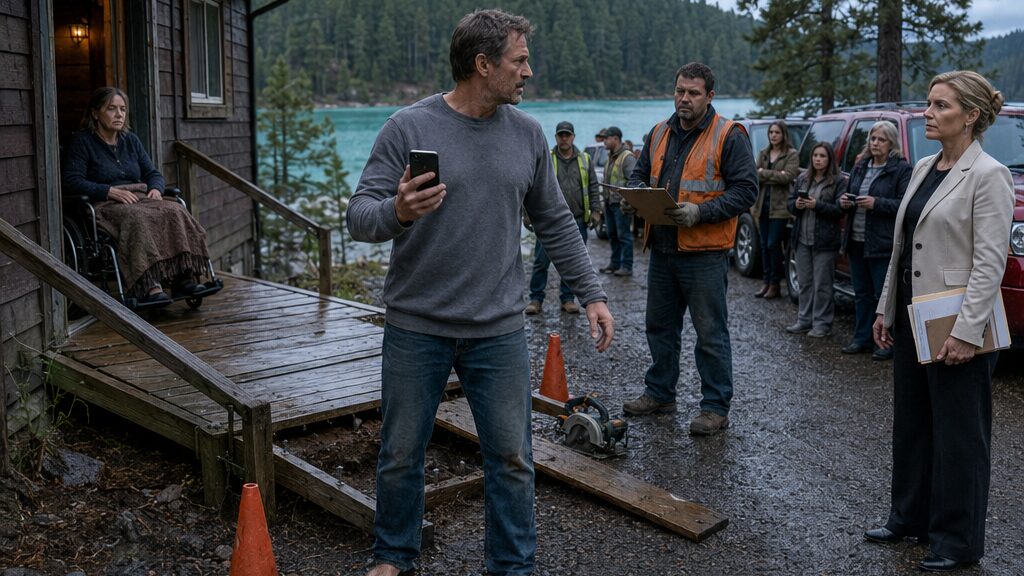
The saw was already biting into the ramp when Andrew Walker reached the porch.
For one second, he did not understand the sound. It did not belong to the lake at that hour. Morning usually came to the cabin with rope knocking softly against the dock, pine needles scraping the roof, Ruth’s kettle clicking on inside. This sound was sharper, meaner, metal teeth against wood, and it was coming from the shoreline path he had finished bracing two nights ago.
He stepped out barefoot onto the cold porch boards.
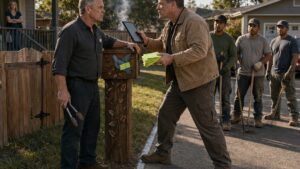
Below the cabin, three men in work gloves stood around the ramp. One had a reciprocating saw pressed against a side rail. Another had already pried up a plank and set it on the wet gravel beside two orange cones. A white work truck idled behind them, and beyond that, blocking the driveway in a crescent, were red and dark SUVs, too many for any repair call, lined bumper to bumper as if someone had staged them for a warning.
Andrew gripped the porch rail.
“Hey!” he called.
The saw stopped. Every head turned.
A woman in a cream jacket stood near the first red SUV with a folder tucked against her chest. Behind her, lake residents clustered in a loose line, arms crossed, phones raised, faces guarded against the morning chill and against him.
Catherine Roberts did not wave. She did not look surprised to see him. She only glanced toward the half-loosened board, then back up at Andrew.
“Mr. Walker,” she said. “You need to stay clear of the work area.”
Andrew came down the steps without shoes, feeling the damp grit bite into the soles of his feet. The lower path curved toward the lake, then widened where the ramp sloped over the uneven ground to the dock approach. Or where it had sloped. A section near the bend now hung open, exposing wet soil and silver bolts pulled crooked from their anchors.
“Put the saw down,” Andrew said.
The man holding it lowered the tool but did not set it aside. He looked toward a stocky man by the truck.
The stocky man lifted a clipboard. “I’m Matthew Harris. We were hired to remove a non-compliant structure.”
“You were hired to remove my ramp?”
Catherine stepped forward before Matthew could answer. “An unauthorized structure constructed across association shoreline.”
“It’s not association shoreline.”
“It is community property,” Catherine said, louder now, for the people behind her. “You were notified.”
Andrew looked at the crowd. A woman in sunglasses had her phone pointed at him. A man near a black SUV muttered something Andrew could not catch, and two others shifted closer as if the ramp itself might run off if they did not guard it.
“I was notified when?” Andrew asked.
Catherine opened the folder and slid out a paper clipped to a copy of a map. “Notice of violation. Emergency removal authorization. Approved by the lake association enforcement committee.”
Andrew did not take it. He looked past her to the board lying on the gravel. Two screw holes had torn wide where the worker had pried instead of unscrewed. The board was cedar, sanded smooth because Ruth hated splinters in her palms when she transferred. He had sealed it himself under a shop light with a brush that kept shedding bristles.
“Matthew,” Andrew said, keeping his voice level, “do not touch another board.”
Matthew’s jaw tightened. “Sir, I’m not here to argue the order.”
“Then show me the order that lets you enter my property and dismantle a medical accommodation before I receive notice.”
The words changed the air, though only slightly. One of the workers looked toward the cabin. Catherine’s eyes narrowed.
“A medical accommodation,” she repeated, careful, almost flat.
“Yes.”
“That claim was not included in your application.”
“My application was for emergency access repair after the storm.”
“Your application was incomplete.”
“You never answered it.”
Catherine lifted the paper between them. “That does not give you the right to build across community land.”
Andrew finally took out his phone. He opened the camera and pointed it at the ramp, then the cones, then the SUVs pressed across his driveway. He said the date aloud. His voice sounded strange in the cold air, too calm even to himself.
Catherine lowered the notice. “Mr. Walker, recording residents without consent is not going to help you.”
“I’m recording work being done on my property.”
“Again,” she said, turning slightly toward the watching line, “this is community property.”
Andrew moved to the exposed gap in the ramp and stood between the saw and the remaining planks.
One of the residents laughed under his breath. “There he goes.”
Catherine’s face tightened, not with anger exactly, but with the annoyance of someone whose meeting had gone off agenda. “Get lost, Andrew. It’s community property. This has been explained.”
The words landed behind him and spread. Someone’s phone tilted higher. Andrew saw himself in the black glass of it: gray sweatshirt, bare feet, unshaved face, standing in front of a torn ramp like a man who had woken too late.
He wanted to shout that they had no idea what they were doing. He wanted to tell them the ramp was not a deck, not an improvement, not some private grab at lakefront access. He wanted to say Ruth’s name loudly enough to make all their faces change.
Instead, he remembered her voice from the hospital bed six months earlier, low and embarrassed.
Don’t let them turn me into a neighborhood project.
Andrew put his phone between Catherine and the ramp.
“Say that again,” he said.
Catherine blinked. “Excuse me?”
“Say on camera that you are ordering removal of a medical access ramp before delivering notice.”
“That is not what this is.”
“Then say what it is.”
Matthew shifted his weight, the clipboard lowering an inch. The worker with the saw set it finally on the ground.
Catherine looked from the phone to the residents, then back to Andrew. “The association is removing an unauthorized encroachment from community shoreline under section nine of the lakefront use rules.”
“Who authorized the crew to start before handing me notice?”
“The notice was delivered.”
“When?”
“It was placed at your door this morning.”
Andrew looked up the slope to his porch. No paper had been there when he opened the door. He had come out because of the saw.
“This morning after the saw started?”
Catherine did not answer quickly enough.
A dark SUV door opened, and Michelle Garcia stepped out holding a travel mug and a tablet. “Catherine,” she said quietly, “we should keep this moving.”
Andrew knew Michelle from two annual meetings and one argument about dock lights. She was practical, numbers-minded, not warm but not theatrical. If Michelle was here, Catherine wanted the board’s financial fingerprints on the morning.
Matthew cleared his throat. “I’ve paused the work.”
“Thank you,” Andrew said, without looking away from Catherine.
“Temporarily,” Matthew added.
Catherine slid the enforcement order toward Andrew. He took it this time. The paper was clean, official-looking, and signed with Catherine’s name at the bottom. The map attached to it showed a red line drawn across the very bend of shoreline where the ramp turned toward the dock.
Andrew’s stomach went cold.
The line was wrong.
Not wildly wrong. Not obviously wrong in a way he could disprove by pointing. It was wrong in the dangerous way that official paper could be wrong: close enough to persuade everyone who had not stood there with a shovel in storm runoff, close enough to make him look like the one inventing boundaries.
“You signed this,” he said.
“As association president.”
“Before anyone came inside. Before anyone spoke to me.”
“We are not required to negotiate after a violation.”
From inside the cabin came the hard thump of something striking wood.
Andrew turned.
The sound came again. Then Ruth’s voice, strained through the screen door.
“Andrew?”
Every face near the driveway seemed to sharpen.
He took one step toward the cabin.
Ruth called again, breathless this time. “Andrew, I can’t get down the steps without the ramp.”
Chapter 2: The Notice Left After the Saw Started
The violation notice was not taped to the door. It was folded under the doormat, half hidden beneath the woven edge, as if someone had pushed it there with a shoe and hurried away.
Andrew found it after helping Ruth back from the threshold.
The timestamp on the first page read 7:12 a.m. His phone showed 7:46. The saw had woken him before 7:30.
He photographed the notice where it lay, then photographed it again beside his phone screen. Down by the shoreline, the crew waited with the embarrassed stillness of men being paid by the hour to stand beside a mistake. Catherine remained near the red SUV, speaking to Michelle with her folder tucked tight under one arm.
Behind Andrew, Ruth sat just inside the doorway in her chair, one hand gripping the brake, the other resting on a folded blanket across her knees. She had pulled a sweater over her nightshirt but had not brushed her hair. The indignity of that showed more plainly on her face than fear.
“Don’t you dare bring them in here,” she said.
“I’m not.”
“You were about to.”
“I was about to make them understand what they’re tearing apart.”
Ruth looked past him to the porch boards and the steps below them. From the front door, the ramp could not be seen. That had been one of the reasons they built it from the side path, angled down through the pines to the dock approach and the flat parking area beyond. It gave Ruth a way out without having to be carried down the cabin stairs like cargo.
“You promised,” she said.
Andrew folded the notice along the crease someone else had made. “I promised not to make you a spectacle.”
“That’s what this is becoming.”
Outside, a resident said something Andrew could not hear. A few people laughed—not loud, not openly cruel, but enough.
Ruth heard it. Her face closed.
Andrew’s hand tightened around the paper.
He went back outside, shutting the screen door softly behind him. He had the feeling that if he slammed it, he would not stop with the door.
Matthew met him halfway down the slope. He had taken off his cap and was rubbing one thumb against the brim.
“I need your work log,” Andrew said.
Matthew frowned. “That goes to the association.”
“A photo of the start time, then.”
“I don’t know if I can do that.”
“You started removing a ramp before notice was delivered.”
Matthew’s eyes cut toward Catherine. “We were told notice would be handled before arrival.”
“Before arrival?”
“That’s what I was told.”
Andrew stepped closer, lowering his voice. “What time did Catherine tell you to be here?”
“Six forty-five.”
“And what time did the residents get here?”
Matthew hesitated.
“Matthew.”
“Around seven. Some before. She said she wanted witnesses in case you interfered.”
Andrew absorbed that with the same quiet care he used when setting a blade depth. Too much force and you ruined the cut. Too little and nothing changed.
“Did she tell you it was a medical access ramp?”
“No.”
“Did she tell you there was an open application?”
Matthew looked at the torn section. “She said your request had been denied.”
“It wasn’t denied.”
“That’s above me.”
“Not anymore. You’re standing in the middle of it.”
For the first time, Matthew looked toward the cabin door with something like discomfort. “I’m sorry if there’s someone inside who needs it.”
“If?”
“I mean—”
“No,” Andrew said. “That word is doing a lot of work.”
Matthew exhaled. “I’ll keep the crew paused until she gives me written instruction to continue.”
“That’s the minimum.”
Andrew photographed the exposed anchor bolts, the saw blade, the removed board, the tire marks near the edge of the gravel, the cones positioned as if the crew had a right to mark off his home. He took a photo of the red SUVs, each plate visible where possible. He took one of Catherine holding the enforcement order. When she noticed, she started toward him.
“You are escalating this unnecessarily,” she said.
“I’m documenting it.”
“This could have been handled through the application process.”
“I submitted the application four weeks ago.”
“Incomplete.”
“You did not request anything else.”
Catherine held out her hand. “Then submit a completed packet and remove the structure pending review.”
Andrew stared at her. “You already started removing it.”
“You forced our hand by building first.”
“The storm washed out the lower path. Ruth had a home-health appointment Monday. The contractor couldn’t get her down safely. I called your office three times.”
Catherine’s expression shifted at Ruth’s name, not with sympathy but calculation. “If there are medical factors, they need to be formally documented. We cannot make decisions based on verbal statements during enforcement.”
“Then why did you make an enforcement decision before reviewing the original request?”
Michelle came closer, her tablet held against her chest. “Andrew, no one wants this to be personal.”
“It became personal when you parked half the association in my driveway.”
Michelle looked back at the SUVs. For a moment, she seemed to see them not as neighbors but as a barricade. “People were concerned.”
“About what?”
“About precedent. About the shoreline. About private structures creeping into common use areas. About liability if someone uses what you built and gets hurt.”
Andrew glanced at the torn ramp. “Someone will get hurt because you took it apart.”
Michelle’s mouth pressed into a thin line. She did not answer.
Inside the cabin, the kettle began to whistle. Ruth had insisted on making tea herself after Andrew had lifted the small tray down from the shelf. He could picture her now, maneuvering the chair in the kitchen, pretending none of this had shaken her.
Catherine handed him another copy of the enforcement order. “The board will meet tonight at seven. Emergency session. You may attend and provide relevant documents.”
“Tonight?”
“The sooner this is formalized, the less confusion.”
“Formalized,” Andrew repeated.
“The removal will remain paused until the meeting,” Catherine said. “After that, if the board upholds the order, the structure comes out.”
Matthew’s shoulders eased slightly, as if grateful for any delay that removed him from the center of the morning.
Andrew looked down at the ramp. One missing board had turned the whole structure into a trap. The gap sat at the bend where Ruth needed the smoothest turn. Her chair’s front wheels would catch there. Her walker would drop through. Even if he laid plywood over it, the angle would shift under her weight.
He walked to the removed plank and crouched beside it. Along one edge were three shallow crescent marks from the pry bar. He set the folded notice beside the plank and took another photograph.
“What are you doing?” Catherine asked.
“Putting the notice where it belongs,” Andrew said. “After the damage.”
By late morning, the SUVs began leaving in pairs, red taillights flashing between pines. Some residents watched him as they went, as if waiting for him to shout now that the cameras were lowering. He did not give them that.
Matthew stayed behind until the last worker loaded the saw.
At the truck door, he paused. “Off the record,” he said, “they asked me yesterday if a larger machine would fit down that slope.”
Andrew turned. “Yesterday?”
Matthew nodded once. “I told them yes, but it’d chew up the gravel.”
“Who asked?”
“Catherine.”
The truck pulled away, leaving the orange cones and the open wound of the ramp behind.
Andrew returned to the cabin with the notice, the photos, and the shape of the next problem already forming. Ruth waited by the kitchen table with two mugs of tea. Her hands were steady, but her eyes were not.
“I heard ‘medical factors,’” she said.
Andrew sat across from her. “They’re meeting tonight.”
“No.”
“They’ll vote to finish removing it.”
“No, Andrew.”
“I don’t have to say everything.”
“You never do,” Ruth said. “That’s the problem.”
The words cut cleaner than the saw.
He looked down at the table. Between them lay the association notice, creased where it had been hidden under the mat. Ruth reached for it before he could stop her. She read slowly, her face tightening at phrases like unauthorized encroachment and emergency removal.
When she finished, she folded it with care and slid it back.
“I am not going to be the woman they whisper about at the clubhouse,” she said.
“I know.”
“And I am not going to be trapped in this cabin because Catherine Roberts thinks a ramp is ugly.”
Andrew lifted his eyes.
Ruth’s jaw trembled once, then set. “Find another way.”
Before he could answer, his phone buzzed on the table. An email from the lake association had arrived, marked urgent.
Emergency Board Meeting: Ratification of Enforcement Action, Walker Shoreline Encroachment.
Andrew opened it. The agenda had one item.
Removal authorization pending final vote.
Chapter 3: What the Ramp Was Really Holding
By morning, the rain had taken the soil.
Andrew found it before sunrise, crouched beside the torn section of ramp with a flashlight in his teeth and mud soaking through the knees of his jeans. The gap under the missing board had widened overnight. Water from the slope had run beneath the bracing and carved a narrow channel toward the lake, leaving two anchor bolts exposed like pulled teeth.
He shut off the flashlight and listened.
The lake moved softly beyond the pines. Inside the cabin, Ruth was still asleep, or pretending to be. The orange cones Catherine’s crew had left stood crooked in the mud, bright and ridiculous against the washed-out path. The ramp had never been only a ramp. Andrew had known that when he built it, but he had not written it clearly enough for people who only believed what fit in a packet.
He took more photos.
Then he took out the folder he had kept in the shed: receipts from the storm repair, sketches from the contractor, handwritten measurements, the copy of the application he had sent four weeks earlier. He had called it Temporary Shoreline Access Stabilization. He had not written Ruth’s diagnosis. He had not included the home-health schedule. He had not attached the therapist’s note saying stairs were unsafe.
He had thought privacy was protection.
Now the mud was making an argument better than he had.
At seven thirty, he called the county records office and stood by the kitchen window while the line clicked through three menus and a hold message about office hours. Ruth rolled into the kitchen halfway through the second loop, hair combed, sweater buttoned, chin lifted as if she were arriving at a meeting.
“You’re calling someone,” she said.
“Records office.”
“About the ramp?”
“About the land.”
She watched him over the rim of her mug. “You think Catherine’s map is wrong.”
“I know the old survey had the property line running past the bend.”
“You know because Dad said so.”
“I know because he made me dig out that marker when I was sixteen.”
Ruth looked toward the side window, where the shoreline dropped away through the pines. “Dad also said the old dock would outlive both of us.”
“It nearly did.”
A clerk came on the line before she could answer. Andrew gave the parcel number, then the cabin address, then waited while keys clicked softly on the other end.
“There’s a lake association plat from 2009,” the clerk said.
“That’s probably what they’re using.”
“There’s also a reference to an older maintenance easement tied to the original cabin lot.”
Andrew straightened. “Can you send that?”
A pause. “The index is here, but the image file is incomplete. It references a survey book and page number. You may need to request the physical archive scan.”
“How long?”
“Standard request is five to seven business days.”
“I don’t have five days.”
“I understand, sir, but—”
“They’re voting tonight to continue removing the only accessible route from my sister’s home.”
The clerk was silent long enough for Andrew to regret the way the words had come out. Ruth set her mug down quietly.
When the clerk spoke again, her voice had softened but stayed official. “I can give you the reference number. If you come in person, someone may be able to pull the book. No promises.”
Andrew wrote the number on the back of the notice: Survey Book 14, Page 208. He circled it twice.
Ruth looked at the paper. “That’s something.”
“It may be nothing.”
“It’s still something.”
He went back outside with a shovel, not to dig, only to clear the mud around the place where the old survey marker should have been. He remembered it as a rusted cap near a flat stone, half covered by moss, down where the shoreline bent before the dock. After twenty minutes, his shovel struck metal with a dull ring.
Andrew froze.
He dropped to one knee and cleared the mud by hand. A round marker emerged, stained brown, the stamped numbers almost unreadable beneath grit and water. It sat farther toward the lake than Catherine’s map had shown.
Not proof. Not enough.
But not nothing.
He photographed it from four angles, then placed a tape measure from the marker to the torn ramp anchor. The ramp was not wildly inside his lot. It was at the seam between old rights and newer association assumptions, exactly the kind of place where a board could call certainty what was really convenience.
By noon, that convenience had grown teeth.
His phone started buzzing before he came inside. First a message from a resident whose number he barely recognized.
You should see what they’re saying.
Then a link.
He did not open it at first. He washed mud from his hands, changed his jeans, made Ruth lunch, and set her chair near the window where she could see the water without seeing the torn section below. He avoided the link until the phone buzzed again.
This time it was from the same resident.
I don’t think this is fair, but it’s spreading.
Andrew opened it.
The video began with a drone shot of his cabin, beautiful and isolated in a way that made it look like a prize. Then the angle cut to the SUVs, the residents, Catherine’s cream jacket bright in the foreground. A red arrow pointed toward the shoreline. Bold white letters with a red outline flashed across the image:
GET LOST! IT’S COMMUNITY PROPERTY!
The clip cut to Andrew standing barefoot in front of the crew. No sound of Ruth calling from inside. No view of the exposed bolts. No notice under the mat. No medical accommodation, no storm runoff, no application submitted and unanswered.
Just his cabin, the crowd, and the accusation.
The caption under it read: Cabin owner caught stealing community beach.
Ruth rolled close enough to see his face, not the screen. “What is it?”
Andrew locked the phone.
“Andrew.”
He placed it on the table, face down. “They made a video.”
“Of this morning?”
“Of what they want people to think this morning was.”
Ruth looked toward the side door. “Show me.”
“No.”
Her eyes hardened. “Don’t start that again.”
He slid the phone across.
She watched without speaking. The only change in her expression came when the words filled the screen. Get lost. It’s community property. Her mouth moved once, not forming sound. When the video ended, she pushed the phone back with two fingers.
“They cut me out,” she said.
Andrew did not answer.
“No,” Ruth said quietly. “Not me. The reason. They cut out the reason.”
That was worse, somehow, than anger.
Andrew picked up the phone again and reopened the photos he had taken: the notice, the timestamp, Matthew’s crew, the old marker in the mud, the exposed soil under the ramp. The evidence looked smaller on the screen than the accusation did. Less dramatic. Less easy to share.
A new message appeared at the top.
From the lake association.
Residents are advised not to engage with ongoing enforcement. Unauthorized shoreline structures present safety and property-value concerns.
Andrew read it twice.
Then he opened a blank email to the county records office and typed the survey reference number into the subject line. His fingers were steady now.
At the bottom of his screen, the viral clip kept collecting comments he did not read.
Chapter 4: A Board Meeting About Property Values
The first thing Andrew saw when he opened the clubhouse door was his own cabin on the wall.
Someone had projected the video onto a pull-down screen beside the fireplace. His roof, his shoreline, his barefoot body standing between a saw and a broken ramp—everything stretched larger than life above rows of folding chairs. The words flashed again in red and white.
GET LOST! IT’S COMMUNITY PROPERTY!
A few heads turned when he entered. Several did not. They kept watching the clip as if the real man in the doorway was less convincing than the edited version of him.
Ruth was not with him. She had insisted he go alone, then had hated him for agreeing so quickly. Before he left, she had put one finger on the folded therapist note beside her mug and said, “That is mine to decide.” He had not taken it.
Now the empty space in his folder felt heavier than the papers inside.
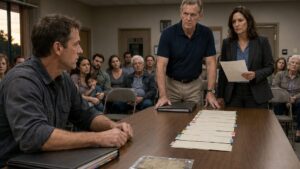
Catherine Roberts stood at the front table, composed in a dark jacket, the association seal on a binder in front of her. Michelle Garcia sat two seats away, tablet ready, eyes moving between Andrew and the screen. Other board members sat along the table. Behind Andrew, residents filled the chairs, whispering in low bursts that stopped whenever he looked back.
Catherine clicked the remote. The video froze on Andrew’s face.
“This emergency meeting concerns unauthorized construction on lake association shoreline,” she said. “We are here to ratify enforcement action already initiated for safety and liability reasons.”
Andrew remained standing near the back. “You mean the removal you started before notice was delivered.”
The room shifted.
Catherine did not look at him. “You’ll have time to speak.”
“You gave the crew permission before I had notice.”
“Mr. Walker, please sit down.”
He walked to the aisle seat closest to the front and sat with his folder on his knees. The chair was too small. The room smelled of coffee, wet coats, and old pine cleaner.
Catherine brought up a map. A bright red outline marked the disputed shoreline. It cut directly across the bend where Andrew had found the muddy survey cap.
“This area,” she said, using a laser pointer, “is common access shoreline under the 2009 lakefront plat. Any structure placed here must be approved before installation. Mr. Walker installed a ramp and support bracing without approval, creating exposure for the association and changing the shoreline appearance.”
A resident raised a hand. “So he built on everybody’s beach?”
“That is the concern,” Catherine said.
Andrew felt the sentence enter the room and settle there as fact.
He opened his folder. His thumb found the application copy. He had printed the email timestamp, the attachment list, the automated confirmation from the association office. No one had replied. No one had asked for more. No one had said denied until the saw arrived.
Michelle leaned toward her microphone. “There is also an insurance issue. We had a dock injury last season. Our renewal is under review. If we allow unapproved structures on common land, and someone uses them, we may risk coverage complications.”
She sounded tired more than hostile. That made it worse. People trusted tired voices.
Andrew stood. “That ramp was not built for general use. It connects my side entrance to the stable path below the cabin.”
Catherine folded her hands. “Across common shoreline.”
“According to one map.”
“The official association map.”
“I found an older marker this morning.”
A few residents murmured. Catherine’s expression did not change.
“Do you have a certified survey?” she asked.
“Not yet.”
“Then we cannot base enforcement on a marker you uncovered yourself.”
Andrew took out the application and held it up. “I submitted this four weeks ago. Temporary Shoreline Access Stabilization. I attached repair sketches, storm photos, contractor measurements. I called three times.”
Catherine nodded slightly, as if she had expected this. “Your request was incomplete.”
“You never said that.”
“It lacked material specifications, elevation drawings, proof of boundary, and any medical accommodation documentation.”
The last phrase landed exactly where Andrew had feared it would. He heard one resident whisper, “Medical?” Another said, “Now it’s medical?”
Andrew looked down at his folder. Ruth’s note was not there. He had left it on the kitchen table because he had promised, and because some stubborn part of him still thought he could win without making her life part of public record.
“The need was stated as access,” he said.
“Access to what?” Catherine asked. “The dock? The water? The same shoreline everyone uses?”
“My home.”
“Your home is accessible through the front steps and driveway.”
“No,” Andrew said.
The room waited. Catherine waited too. She knew he had to either explain or look evasive.
He saw Ruth’s hand on the therapist note. That is mine to decide.
“No,” he repeated, quieter. “Not safely.”
Michelle leaned forward. “Andrew, if there is a medical need, the board needs documentation. Not because we want private information. Because we have to apply rules consistently.”
“You applied them before asking.”
“You built before approval.”
“I built because the storm took out the safe route.”
Catherine tapped the binder. “And that is exactly why owners cannot self-authorize construction on common land. Emergencies do not erase procedure.”
Andrew opened his mouth, then shut it. He had the photos. He had the timestamp. He had the old survey reference. But Catherine had the room, the screen, and the map with the red line.
A board member asked whether the ramp could remain temporarily if Andrew posted a warning sign. Michelle shook her head.
“Temporary exceptions become precedent,” she said. “If someone else builds stairs, a deck, a boat rack, we lose control of the shoreline. Our insurer has already flagged unapproved lakefront alterations.”
Andrew turned toward her. “You’re talking about boat racks. I’m talking about a person getting out of a house.”
Michelle looked away first.
That was not victory. It was only a crack.
Catherine brought the discussion back to the vote. “Motion to ratify the enforcement action and continue removal unless Mr. Walker produces county-recognized documentation establishing a right to maintain the structure in the disputed area.”
“How long?” Michelle asked.
Catherine hesitated. “Forty-eight hours.”
Andrew looked at her. “You want a certified right to a shoreline easement in forty-eight hours?”
“I want proof before the association accepts liability for your structure.”
The motion passed with only one abstention. Michelle’s hand went up after a long pause, not in opposition, but not fully with Catherine either.
Andrew gathered his folder while residents stood around him. Some avoided his eyes. One man near the aisle muttered, “Should’ve asked first.” Another said, “Everybody has a story.”
At the door, Michelle caught up with him.
“Andrew,” she said, “I don’t think you’re lying.”
He stopped.
“But if you had documentation, you should have brought it tonight.”
“I brought what I had.”
“You didn’t bring the reason.”
His fingers tightened around the folder.
Michelle’s voice dropped. “Catherine is scared of the insurance review. She won’t say it like that in there, but she is. If the inspector sees an unapproved structure on common shoreline, she thinks we’re exposed.”
“Then she should have reviewed the application.”
“I know.”
The admission was so small it nearly vanished.
Andrew stepped outside into the cold air. Across the parking lot, his phone buzzed. A message from the association appeared before he reached his truck.
Board action ratified. Removal may resume unless county-recognized right is provided within forty-eight hours.
Below it was Catherine’s name.
Andrew stood under the yellow clubhouse light, the frozen image of his cabin still glowing faintly through the window behind him, and realized the next saw would not stop for his word alone.
Chapter 5: The Survey Flags Under the Waterline
The deed page was real, but the sentence Andrew needed had bled into a gray smear.
He stood at the county archive counter with both hands flat on the laminate while the clerk angled the old book under a scanner light. The page smelled of dust and paper gone soft with age. Near the bottom, beneath the legal description of the original cabin lot, a line began clearly enough—together with right of access for maintenance and stabilization along the—then dissolved into a stain that swallowed the last words.
“Can you enhance it?” Andrew asked.
The clerk adjusted the screen. The smear darkened, sharpened, then became a darker smear.
“I’m sorry,” she said. “Water damage, maybe. Or ink transfer from the facing page.”
Andrew looked at the clock above the counter. Thirty-one hours left.
He had driven down before the office opened, leaving Ruth with her phone, tea, and the home-health nurse who arrived twice a week and pretended not to notice tension unless it interfered with medication. Ruth had told him to stop looking at her like he was abandoning her.
“Go find your paper,” she had said. “Then come back before they steal the rest of my floor.”
Now he had the paper, but not enough of it.
The clerk turned another brittle page. “Here’s the survey reference. Book 14, Page 208. It shows original lot corners and a notation near the shoreline.”
“Can I get a certified copy?”
“Of what’s legible, yes.”
He almost laughed.
The clerk glanced at him with sympathy she was trying to keep professional. “There’s also an erosion maintenance note filed later. County environmental office might have it.”
“How much later?”
“Looks like 1987.”
“Can you print the reference?”
She did. Andrew watched the page slide from the printer and felt the thinness of what he had: a right that might exist, a note he had not seen, a boundary that depended on the waterline. Paper enough to keep hope alive, not enough to stop a machine.
Outside, he called the county environmental office from his truck. He was transferred twice before a man answered and identified himself as James Davis.
Andrew explained quickly: cabin parcel, lake association, ramp removal, exposed erosion, old maintenance easement, pending enforcement.
James did not interrupt. When Andrew finished, there was a pause filled with office noise.
“Mr. Walker,” James said, “the association map may not be wrong.”
Andrew closed his eyes.
“It may also not be complete,” James continued. “Those older lake parcels sometimes have maintenance rights layered over common shoreline access. It depends on the exact language and current conditions.”
“They’re giving me forty-eight hours.”
“I can’t certify a boundary over the phone.”
“I’m not asking you to.”
“You’re asking me to stop work.”
“I’m asking you to inspect an active erosion and access hazard before they remove the structure holding it.”
That landed differently. Andrew heard papers move.
“Send me photos,” James said. “The exposed soil, the marker, the ramp location, and the removal notice. Include the survey reference.”
“I can do that now.”
“If there’s an erosion-control issue, I can come out tomorrow afternoon. I can’t promise the conclusion you want.”
“I’m not asking for the conclusion I want.”
“No,” James said, “but most people are.”
Andrew sent everything from the truck before driving home: marker, mud channel, torn board, notice timestamp, Catherine’s map, the old deed copy. His phone battery dropped into the red by the time he reached the pines.
At the cabin, Ruth was waiting near the side window.
“Don’t make that face,” she said when he came in.
“What face?”
“The one where you found something bad and want to wrap it in newspaper before handing it to me.”
He set the certified copies on the kitchen table. “There’s an easement. The key phrase is damaged. James Davis from county environmental can inspect tomorrow afternoon.”
“Tomorrow afternoon,” she repeated.
“Yes.”
“That sounds good.”
“It would, except Catherine has until tomorrow night.”
Ruth watched him. “Except?”
Andrew’s phone buzzed before he could answer. An email from the lake association.
Due to ongoing exposure and resident safety concerns, removal activity may resume at 6:30 a.m. pending final documentation. Owners are advised to keep clear of the shoreline work area.
Ruth read it over his shoulder.
“Tomorrow morning,” she said.
Andrew nodded.
She rolled back from the table and looked toward the side door. “Then she moved faster than the inspection.”
He did not correct her. That was exactly what Catherine had done.
That afternoon, Andrew went back down to the shoreline and placed small survey flags around the marker and along the ramp line, not because flags had legal power but because they made uncertainty visible. Thin orange strips flickered in the wind. One bent so low at the waterline that the lake licked it with every small push.
He photographed each flag. He measured from the cabin wall to the exposed bolts. He marked the erosion channel with stakes from the shed. The work felt both necessary and childish, like drawing a line in sand against a tide already coming.
Near dusk, a dark SUV stopped at the end of the driveway.
Michelle stepped out alone.
Andrew stayed by the ramp. “If Catherine sent you—”
“She didn’t.”
Michelle wore lake boots and a quilted vest, not board-meeting clothes. She looked at the missing board, the mud, the flags, then the cabin. “I wanted to see it without everyone standing here.”
“And?”
“And I see why you’re angry.”
“That’s not the same as saying you were wrong.”
“No.” She crouched carefully near the exposed bolts. “It’s not.”
Andrew handed her a printed copy of the deed page. She held it by the edges and studied the damaged line.
“This doesn’t prove everything,” she said.
“It proves enough to wait for inspection.”
“I’ll tell Catherine that.”
“She won’t wait.”
Michelle did not deny it.
Before leaving, she looked back at the cabin window where Ruth’s silhouette was visible behind the curtain. “For what it’s worth,” she said, “I’m sorry about the video.”
“Did you share it?”
“No.”
“Did you stop it?”
Her silence answered.
After her taillights disappeared, Andrew stayed outside until the flags were barely visible. He was gathering his tools when his phone buzzed again.
Matthew Harris.
The message was short, and the words seemed to brighten against the dimming shoreline.
They told us to bring the bigger machine tomorrow.
Andrew looked at the torn ramp, the wet flags, and the cabin light behind Ruth’s window.
Then he typed back one word.
What?
The reply came almost immediately.
Compact loader. 6:15 a.m. Catherine wants it finished before noon.
Chapter 6: Catherine’s Rule Was Not the Whole Truth
The compact loader was already idling beside the torn ramp before the sun cleared the pines.
Its headlights cut pale tunnels through the morning mist, catching on wet survey flags, orange cones, exposed bolts, and the raw edge where the missing board had been. The machine’s bucket hovered low over the gravel path like a jaw waiting to close.
Andrew stood in front of it with his phone recording.
Behind him, the cabin door remained shut. Ruth had argued until her breath shortened, then stopped because both of them knew that if she came outside, Catherine would either use her or ignore her, and both choices would wound.
Matthew Harris climbed down from the loader’s side step before Andrew reached the bucket.
“I’m not operating while you’re standing there,” Matthew said.
“Good.”
“Andrew, I don’t want this.”
“Then don’t do it.”
Matthew’s mouth tightened. “It’s not that simple.”
“It is if the order is wrong.”
“Wrong doesn’t always stop invoices.”
The first red SUV rolled up the driveway at 6:23. Catherine stepped out in a dark coat with her folder under one arm and a white envelope in the other. Michelle arrived behind her in a gray SUV, moving quickly, her face drawn tight with the look of someone who had slept badly or not at all.
Catherine took in Andrew, the phone, the idling loader, and the survey flags.
“This is unsafe,” she said.
“Yes,” Andrew replied. “That’s what I’ve been telling you.”
“You need to move away from the equipment.”
“I want the removal authority in writing, the time notice was delivered, and confirmation that you are proceeding despite a county inspection request logged for today.”
Catherine’s eyes flicked toward Matthew. “Mr. Harris has his work authorization.”
“Signed by whom?”
“The association.”
“Not good enough.”
Michelle came up beside Catherine. “Andrew sent the inspection request last night. I saw the county email copy.”
Catherine’s jaw tightened. “An inspection request does not suspend enforcement.”
“It should suspend demolition,” Michelle said.
The words came out quietly, but they changed the shape of the morning. Matthew looked between them. One of his workers stepped away from the tools.
Catherine turned to Michelle. “We discussed this.”
“We discussed removal after the deadline.”
“The deadline remains. He has not produced a certified right.”
“He produced enough to question our map.”
Catherine’s hand closed around the envelope. “Our insurer is reviewing lakefront conditions next week. If they see an unapproved structure on disputed shoreline, we all pay for it. Every owner. Every assessment. Every dock. You know that.”
Andrew heard the strain under her control then. It was not kindness, and it did not excuse the loader idling in front of his home, but it was the first honest thing she had said within earshot.
Michelle lowered her voice. “Then we should have reviewed his request when it came in.”
Catherine looked at her sharply.
Andrew caught the pronoun. We.
“What happened to my application?” he asked.
Neither woman answered.
He stepped around the loader bucket, keeping the phone raised. “I submitted it four weeks ago. It was not denied. It was not returned. It was moved. Who moved it?”
Catherine’s face hardened. “Your incomplete submission was classified under enforcement because work had begun without approval.”
“It had not begun when I submitted it.”
Michelle looked down.
Andrew turned to her. “You know that?”
Michelle’s fingers pressed against her tablet case. “The request was in the board inbox. It was flagged for architectural review. Then after the storm photos came in, Catherine moved it to enforcement because there were already materials on site.”
“Materials,” Andrew said. “Boards stacked by the shed.”
Catherine spoke over him. “You had begun staging unauthorized construction.”
“I had bought lumber.”
“And then built.”
“Because no one answered.”
“Because your submission lacked required documentation.”
“You never asked for it.”
The loader engine rumbled between them. Its vibration moved through the gravel and up Andrew’s legs. He could smell diesel, wet cedar, and the raw earth exposed beneath the ramp.
Matthew held up his clipboard. “I need clarity before I proceed.”
Catherine turned on him. “You have clarity.”
“No,” he said, surprising everyone, including himself. “I have a work order from the association. I have an owner claiming medical accommodation and county inspection. I have exposed erosion. If you want me to run that machine today, I need personal authorization from whoever is directing it.”
Catherine stared at him.
Andrew stopped recording for one second, opened the camera again, and started a new file.
“Say that again, Matthew,” he said.
Matthew did not look happy about it, but he did not back down. “I need written authorization that the association wants removal completed today despite the inspection request.”
Catherine’s face had gone pale in the cold. “This is unnecessary.”
“So was bringing a loader before sunrise,” Andrew said.
A worker brought the clipboard. Catherine took it, pulled a pen from her folder, and wrote in tight, hard strokes. When she signed, the sound of the pen scraping paper seemed louder than the engine.
Matthew took the page back, read it, then set it on the hood of the loader without starting work.
Catherine looked at him. “Well?”
“I said I needed it,” Matthew replied. “I didn’t say I was comfortable with it.”
Andrew photographed the signed authorization where it lay beside a grease mark on the yellow paint. Catherine’s signature sat below the printed work description: remove remaining ramp structure and supports from shoreline access area.
The phrase remaining ramp structure made his chest tighten.
From the cabin, the side curtain moved. Ruth was watching.
Andrew lowered the phone, then lifted it again. Not for the residents. Not for the internet. For the record he had failed to build in time the first time.
“I am informing you,” he said to Catherine, “that this ramp is the only safe exterior route for a mobility-limited resident of my home, that a county erosion inspection is scheduled today, and that the work already performed has exposed soil and created an access hazard. If you proceed, you are doing it after notice of those facts.”
Catherine’s eyes flashed. “You are not an attorney, Mr. Walker.”
“No. I’m the person who has to get my sister out of the house if something happens.”
For the first time, Catherine had no ready sentence.
A white county vehicle turned into the driveway at 6:58.
It did not come fast. It moved carefully between the red and dark SUVs now gathering near the road, then stopped short of the cones. A man in a county jacket stepped out carrying a field folder and looked first at the loader, then at the torn ramp, then at Catherine’s signed authorization on the hood.
“Who continued work after my inspection request was logged?” James Davis asked.
No one answered quickly enough.
Chapter 7: Andrew Puts the Order on Record
James Davis marked Catherine’s map with a red pen and wrote one word across the shoreline line: incomplete.
Not false. Not void. Not enough.
Andrew watched the pen lift from the paper and felt the room inside his chest tighten instead of open. Around them, the compact loader sat silent at last, its bucket lowered to the gravel. Matthew’s crew had stepped back near the truck. Catherine stood with both arms folded, her signed authorization clipped under James’s field folder as if it had already become evidence. Michelle hovered near the cones, staring at the exposed soil under the torn ramp.
“Incomplete how?” Catherine asked.
James capped his pen. “This plat shows common access shoreline. It does not show the older maintenance easement referenced in the original cabin deed. It also doesn’t address current erosion-control needs at this access bend.”
“So the ramp is allowed?” Andrew asked.
James looked at him. “I didn’t say that.”
Catherine’s posture sharpened.
James crouched near the exposed bolts, careful not to put weight on the broken edge. “What I’m saying is that removing the rest of this before review may worsen erosion and may create an access hazard. The support bracing appears to be doing more than providing travel surface.”
“It was temporary,” Andrew said. “Until the lower path could be stabilized.”
“Temporary structures still need standards,” James replied. “Width, slope, edge protection, anchoring. If this is a medical access route, that needs to be part of the record.”
There it was again. The opening Andrew had avoided, now standing directly in front of him with a county jacket and a clipboard.
Catherine spoke before he could. “No medical documentation has been provided to the association.”
Andrew turned toward her. “Because you started with a saw instead of a request.”
“Because you built first.”
James looked between them, then down at the torn board. “I’m not here to referee the association’s process. I’m here to prevent shoreline damage and document conditions. But I will write that continued removal should pause pending review of easement language, erosion-control requirements, and any accommodation request submitted by the owner.”
“Should pause,” Catherine said. “Not must.”
James looked at her for a long second. “If you proceed after that recommendation, make sure your file shows why.”
Matthew exhaled under his breath.
Catherine gathered her folder. Her face had color now, but it was not embarrassment. It was calculation under pressure. “The board can consider a revised proposal,” she said. “A narrower temporary walkway entirely outside the disputed area. No side rails. No shoreline bracing. Removable mats, perhaps.”
Andrew stared at her. “Ruth can’t use mats on wet slope.”
“I don’t know what Ruth can use because you still have not submitted documentation.”
The words were procedural, and because they were procedural they nearly passed for reasonable. Andrew felt that old instinct rise—to close the door, to keep Ruth’s name out of their mouths, to fix the boards himself at night and dare anyone to stop him.
Then he looked at the loader bucket and the torn edge where Ruth’s front wheels would drop if he failed.
“No,” he said.
Catherine blinked. “No?”
“No to a narrower walkway that doesn’t work. No to pretending this is about appearances. No to restarting removal while you wait for me to make a mistake in your process.”
Michelle looked up.
Andrew turned to James. “What do I need to file so this is reviewed as both access and stabilization?”
James opened his folder and tore a blank sheet from a pad. “A written accommodation request from the resident or authorized household member. Medical necessity doesn’t need a full diagnosis, but it needs functional limitations and the access requirement. A revised sketch showing slope, width, rail, anchor points, and erosion-control purpose. Photos. Contractor statement, if you have one. Easement copy, even damaged. I’ll attach my field note once completed.”
Catherine’s mouth tightened at the list.
Andrew took the paper. His hand shook once. He folded it before anyone could see.
Inside the cabin, Ruth was waiting at the kitchen table.
She had placed the therapist note in the center of it. Beside it lay the removed ramp board Andrew had carried up after James left. It stretched across the table like a piece of wreckage from a small boat, its torn screw holes dark against the cedar grain. Mud had dried along one edge despite Andrew’s attempt to wipe it clean.
Ruth looked at the folded county list in his hand.
“They asked for me,” she said.
“They asked for documentation.”
“That means me.”
“Not all of it.”
“Andrew.”
He sat across from her. For a while neither of them touched the papers. Outside, the loader had gone. The silence left behind felt almost as heavy.
“I thought I was keeping them from using you,” he said.
“You were keeping me out of my own fight.”
He looked at the board. “I heard them laughing that first morning. I heard them say I was stealing the beach. I didn’t want your name in that.”
“My name is already in it whether they say it or not. Every board they pull up is under my wheels.”
He closed his eyes.
Ruth pushed the therapist note toward him, then pulled it back before he could take it. “Not this.”
“Ruth—”
“Not the diagnosis. Not the medication list. Not the things that make people tilt their heads and talk softer.” She reached for a blank page. “We write what matters.”
Andrew watched her uncap a pen. Her fingers were slower than they used to be, but her handwriting still had the same upright, no-nonsense shape from the grocery lists she used to leave him when they were younger and he lived here only on weekends.
She wrote: I am a full-time resident of the cabin. I cannot safely use the front steps. I require a stable, railed exterior route from the side entrance to the vehicle and dock access path. Removal of the existing ramp prevents safe entry and exit.
She stopped, breathing through a spasm of pain she tried to hide by adjusting the paper.
Andrew reached to steady the page. She let him.
“Add the storm damage,” he said softly.
“You add that. You know the dirt better than I do.”
So they wrote together. Ruth gave the boundaries of her privacy. Andrew filled in the slope measurements, the washed-out path, the exposed anchors, the county reference, the application date. He attached photos in order: ramp before removal, notice under the mat, saw marks, mud channel, survey marker, Catherine’s signed authorization, James’s preliminary field note.
At dusk, Catherine emailed a proposed compromise. A three-foot removable walkway, no rail, no permanent anchoring, to be removed after thirty days pending architectural review.
Andrew read it twice. It looked like a solution if no one had to use it.
Ruth read over his shoulder. “That would put me in the lake.”
“It would keep them from saying no.”
“It would keep them from saying yes.”
Andrew opened a new email. He addressed it to the board, copied James Davis, Michelle Garcia, Catherine Roberts, and the association office. His hands no longer shook.
He wrote that he was rejecting the proposed walkway because it did not meet the documented access need and would create an unsafe route. He requested a special vote on the complete accommodation and stabilization packet. Then he attached Catherine’s signed removal authorization directly beneath Ruth’s statement.
Before sending, he turned the laptop toward Ruth.
She read every line. At the end, she nodded once.
“Now it’s mine too,” she said.
Andrew pressed send.
The message left the outbox at 7:18 p.m. By 7:21, Michelle replied to all with one sentence: I request that the board convene a special session before any further removal activity occurs.
Chapter 8: The Shoreline Opens Without Applause
The association secretary read the timeline aloud while Catherine Roberts sat with her hands folded on the table and said nothing.
“Application received April 3. No written request for supplemental materials issued. Enforcement classification entered April 18. Removal crew scheduled April 29. Notice timestamped April 30 at 7:12 a.m. Work began prior to owner acknowledgment. County inspection request logged May 1. Additional removal authorization signed May 2.”
No one played the video this time.
The clubhouse screen showed only documents: Andrew’s application, Ruth’s statement, James Davis’s field note, the damaged deed page, the map with incomplete written across it. The room was full again, but quieter. The residents who had stood by the red SUVs now sat with their arms uncrossed or their eyes lowered. A few had brought printed packets. Most had brought nothing.
Andrew sat beside Ruth near the aisle.
She had insisted. He had argued once, softly, and stopped when she looked at him. The home-health nurse had helped her into the truck. Matthew had laid a temporary plywood sheet over the torn ramp edge that morning, not as repair, he had said, only so Ruth could leave safely for the meeting. He had not billed Andrew for it.
Catherine lifted her eyes when the secretary finished. “The board acted on the information available at the time.”
Michelle Garcia leaned toward her microphone. “The board also failed to review information already submitted.”
A sound moved through the room—not outrage, not applause, just the shift of people realizing the meeting had turned.
Catherine’s face stayed composed. “I accept that the process could have been cleaner.”
Ruth made a small sound beside Andrew. Not a laugh. Something sharper.
Andrew placed one hand near her wheel, not touching, only there if needed.
James Davis stood at the side wall, county folder under his arm. “For clarity,” he said, “my office is not determining association governance. My field note states that the shoreline bend has active erosion, that full removal of bracing before stabilization review is not recommended, and that the older deeded maintenance reference must be considered alongside common access rights.”
A board member asked, “So we can’t just tell him to remove it?”
James paused. “You can make your decision. But you should make it with the whole record.”
That phrase stayed in the room.
The whole record.
Andrew felt Ruth’s shoulder move beside him as she breathed in. He thought of all the pieces that had not been in the first record because he had kept them out: her chair by the threshold, the therapist note, the storm rut, the old marker, the unanswered application. Privacy had felt like a shield. In the wrong hands, it had become a blank space for someone else’s story.
Michelle lifted a page. “I move that the violation against Andrew Walker be withdrawn, that removal activity remain halted, and that the association approve a revised temporary access and shoreline stabilization plan, subject to county safety measurements and final architectural recordkeeping.”
Catherine looked toward her. “Michelle.”
Michelle did not look away. “And I move that the association adopt a written accommodation review process so medical access requests are not routed through enforcement without board review.”
A resident in the back stood. He was one of the men who had been beside the black SUV the first morning. “Does this mean anyone can build whatever they want if they say medical?”
Ruth turned her chair slightly before Andrew could answer.
“No,” she said.
The room went still.
“It means if someone says they cannot get out of their home, you ask what they need before you send a machine.”
The man sat down.
Andrew looked at his sister. Her hands rested on the wheels of her chair, knuckles pale, chin steady. She did not look smaller for being seen. He wondered how long he had confused secrecy with dignity.
The vote was not unanimous. Two board members opposed, citing precedent. Catherine abstained. Michelle voted yes, and the motion carried.
No one clapped.
That was better.
Catherine gathered her papers slowly. At the end of the meeting, she approached Andrew and Ruth near the door. For a moment, Andrew thought she might apologize, and he found he did not know what he would do with one.
Instead, she said, “I’m resigning from enforcement review.”
Ruth looked at her. “Not from the board?”
“No.”
“Then learn the difference between a rule and a reason,” Ruth said.
Catherine accepted the sentence without visible reaction. “The revised plan will need exact measurements.”
“It will have them,” Andrew said.
A week later, the red and dark SUVs were gone from the driveway, replaced by Matthew’s white truck and the repair contractor’s flatbed. This time, the boards came off in order and went back stronger. The new ramp followed nearly the same bend but with deeper anchors, a safer slope at the turn, a rail that met Ruth’s grip height, and drainage stone packed beneath the section where the water had carved its channel.
James inspected the bracing. Michelle arrived with the final approval letter and stood awkwardly near the cones until Andrew took it from her.
“I should have asked to see it sooner,” she said.
“Yes,” Andrew replied.
She nodded, accepting that he had not softened it for her.
When the last board was fastened, Ruth waited at the side door while Andrew swept sawdust from the surface. The new cedar was brighter than the old, almost too clean against the weathered cabin. But at the bend, near the rail post, the old anchor scars remained visible in the gravel and soil. Matthew had not covered them. Andrew had not asked him to.
Ruth rolled forward.
The wheels crossed the threshold, then the first board, then the gentle slope where the torn gap had been. At the bend, she stopped. Her hand moved over the rail, testing the height. Below them, the lake shone cold and blue between the pines.
“Too smooth,” she said.
Andrew looked at her, startled.
She glanced up at him. “I like to complain a little.”
He smiled then, but only a little, because behind her joke was the week they could not get back. The mornings she had stayed inside. The video still living somewhere on strangers’ phones. The way a clean board could cover a wound without erasing it.
That evening, after Ruth had gone in, Andrew carried one of the damaged cedar planks to the shed. It was the board with the pry marks along the edge and the torn screw holes darkened by mud. He leaned it against the wall beside the shovel and the roll of survey flags.
For a long time, he stood looking at it.
Then he took a marker and wrote one date on the back. Not for court. Not for the board. Not for anyone else to see.
A reminder.
Outside, the shoreline path was open. The cones were gone. The driveway was empty. And when Ruth called from the porch that the kettle was whistling, Andrew shut the shed door and went inside without locking it.
The story has ended.