They Ordered Him To Open The Lake Road Before Learning Why He Locked It
Chapter 1: The Loader Was Already At The Gate
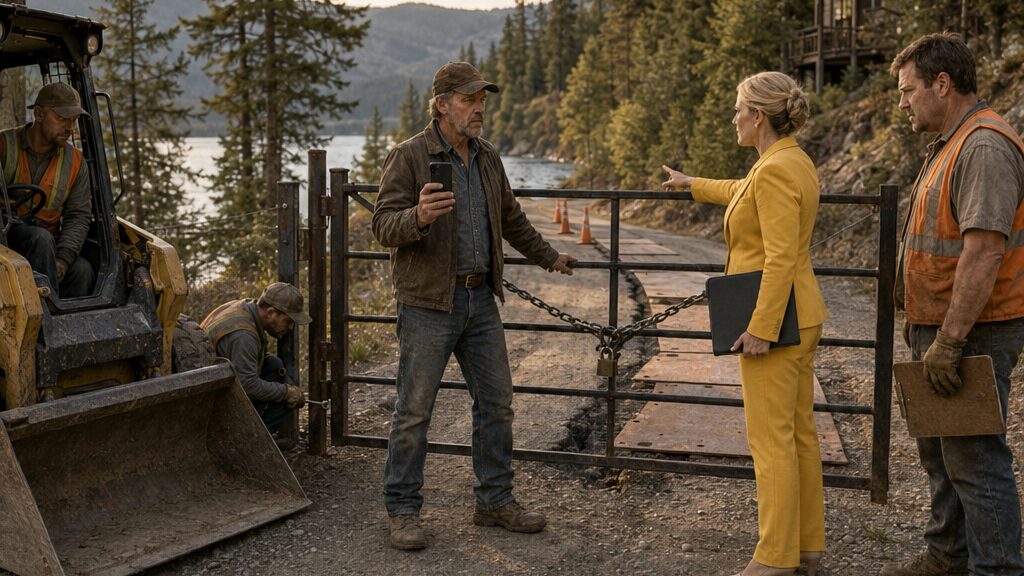
The loader was already running beside Paul Carter’s gate when he stepped off the porch.
Its bucket hovered inches from the left post, teeth angled under the packed gravel where Paul had poured temporary footings three weeks earlier. Two orange cones lay on their sides near the steel plates, and one of Joseph Thompson’s crewmen had a wrench on the hinge bolt. The chain across the gate trembled every time the machine idled.
Paul did not shout.
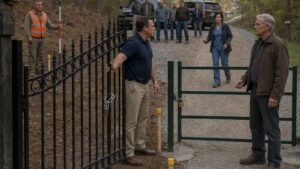
He crossed the road in his work boots with his phone in one hand and the padlock key in the other, moving slowly enough that every man there had time to see him coming. Beyond the gate, the lake held the late-afternoon light like glass. Behind him, the cabin sat quiet among the pines.
Joseph looked up first. He was broad-shouldered, dusty, and uncomfortable in the way men got when they had already started a job and discovered the owner was home.
“Mr. Carter,” Joseph said over the engine. “You need to stand clear.”
Paul stopped in front of the loader bucket.
The operator eased his boot off the pedal. The engine kept growling.
“Shut it down,” Paul said.
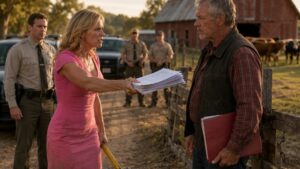
Joseph glanced toward the road below, where a white SUV had pulled onto the shoulder. Sharon Rivera stepped out wearing a yellow suit bright enough to look unnatural against the trees. She had a folder tucked against her ribs and sunglasses pushed onto her head. She walked fast, as if speed itself could make her lawful.
“Mr. Carter,” she called, “you were notified.”
“No,” Paul said, keeping his eyes on Joseph. “I wasn’t.”
Sharon reached the gate and held out a paper with the HOA seal printed at the top. “The association issued a removal order. Unauthorized gate, unauthorized steel plates, unauthorized road closure, and unauthorized modification to common access frontage.”
Paul looked at the paper but did not take it.
Behind the bars of the gate, the private lake road curved past the pines toward his cabin. Just beyond the bend, where the shoulder dropped toward a ditch, three steel plates covered the place the asphalt had begun to sink. Paul knew exactly how the cracked culvert sounded when water moved under it after rain. He had spent half his life around roads, gravel, drainage, and men who pretended a hairline crack was not a problem until a tire found it.
“Joseph,” Paul said, “did she show you a court order?”
Joseph’s mouth tightened. “I was hired by the association.”
“That isn’t what I asked.”
Sharon stepped between them, holding the paper higher. “This road serves lake access for multiple members. You don’t get to block it because you dislike the board’s decision.”
Paul turned on his phone camera. The small red timer appeared on the screen.
Sharon noticed. “Recording me won’t change the violation.”
“No,” Paul said. “But it’ll help keep everybody precise.”
One crewman took his hand off the hinge bolt. The other stared at the gravel.
Sharon’s face hardened. “Mr. Carter, the board denied your exterior alteration request because it was incomplete. You installed a metal gate that does not match community standards. You placed industrial road plates on a visible roadway. You obstructed access without approval. We are proceeding with removal today.”
Paul looked past her to the steel plates. One corner of the nearest plate had been shifted, leaving a dark crescent of wet soil visible beneath it.
“Those plates cover a failed culvert,” he said. “That gate keeps people from driving over it.”
Sharon exhaled through her nose, controlled and impatient. “That is your opinion.”
“It’s Benjamin Flores’s report. I sent it to the board.”
“You sent an estimate,” she said. “Not an approved plan.”
“It said the road could give way under vehicle weight.”
“It also included a guardrail design that was never approved.” Sharon tapped the folder. “This is not complicated. Submit the right form, wait for architectural review, and stop making unilateral changes to association-facing property.”
Paul let the word hang there. Association-facing. It was the kind of phrase that made a hole sound like a paint color.
The loader engine coughed louder for a moment. Paul did not move.
Joseph shifted his weight. “Mr. Carter, I don’t want anybody hurt. But I’ve got an order to remove the obstruction.”
“Then you need better instructions,” Paul said. “Because if that machine pulls this gate and somebody opens this road, the first heavy truck that crosses that bend may drop a wheel into a washed-out culvert.”
Sharon cut in. “That’s exactly the kind of exaggeration that has made this impossible.”
Paul turned his camera toward the gate post, then the plate, then Sharon’s paper. “What time was notice served?”
“This morning,” Sharon said.
“What time?”
“It was posted in accordance with the enforcement policy.”
“What time?”
A brief flicker crossed Joseph’s face.
Sharon looked at him, then back at Paul. “The timing is not the issue.”
“It is if your crew was already here.”
Joseph lowered his voice. “We arrived a little after three.”
Paul looked at the sun. “It’s three-twenty.”
Sharon’s jaw set. “The notice is on the gate.”
Paul stepped aside just enough to look. A white sheet had been taped to the outside bar with blue painter’s tape. The tape was fresh, edges clean, no dust under it. He had walked through that gate before lunch to check the plate after the delivery driver turned around. There had been no notice then.
“You posted it after the engine started,” Paul said.
“That is not accurate.”
Joseph did not look at her.
The crewman by the hinge took a step back from the gate.
Sharon’s voice sharpened. “Continue the removal.”
No one moved.
Paul stepped closer to the loader bucket, close enough that the operator’s hands rose off the controls. He held the phone steady at chest height.
“Stop the machine,” Paul said. “Show me the court order.”
Sharon gave a short, humorless laugh. “An HOA enforcement order is sufficient.”
“No,” Paul said. “Not to enter my property and remove a safety barrier from a road I’ve documented as unsafe.”
“The road is not yours alone.”
“The culvert under that section is on my parcel before it meets the shared easement. You know that. Your attorney knows that. Benjamin’s map showed that.”
For the first time, Sharon’s confidence seemed to tighten around something other than annoyance. She glanced toward the bend, where the plates caught the low sun.
“You had no authority to install that gate.”
“I had responsibility to keep people alive until the repair was approved.”
A pinecone dropped somewhere on the slope behind them. The small sound seemed louder than the idling machine.
Sharon leaned closer, voice lowered. “You cannot hold an entire lake community hostage because your application was denied.”
Paul felt the old heat rise in him, the kind that wanted one clean sentence sharp enough to cut through her folder, her suit, her certainty. He swallowed it. Anger made people remember tone and forget facts.
“I submitted the repair request four weeks ago,” he said. “I submitted the contractor’s warning. I submitted photos. Nobody answered until I locked the road.”
“You locked the road before approval.”
“I locked it after the shoulder dropped two more inches.”
Sharon looked toward Joseph. “Mr. Thompson, proceed.”
Joseph rubbed his thumb along the edge of his clipboard. “I’m not comfortable moving equipment with him standing there.”
“He has been told to stand clear.”
“And I’m telling you,” Paul said, “if that bucket touches this post, you’re removing evidence from an unsafe road.”
Sharon’s cheeks flushed. “Evidence? This is not a courtroom.”
“Then don’t act like you brought an order from one.”
For a moment the whole road held still: the loader idling, the crew waiting, the lake bright beyond the gate, the chain hanging between Paul and the woman who wanted it gone.
Sharon took out her phone.
Paul kept recording.
“What are you doing?” Joseph asked quietly.
“Calling the sheriff,” Sharon said, already tapping the screen. “If Mr. Carter wants to turn a compliance matter into a legal standoff, we will document that he is blocking lawful access.”
Paul looked once toward the bend in the road, where the steel plate had shifted enough to show the dark washout beneath it. Then he looked back at the gate.
The chain trembled again, but this time nothing touched it.
Sharon lifted the phone to her ear and said, very clearly, “I need a deputy at Lake Ridge Road. A homeowner is refusing to open the road.”
Chapter 2: The Notice Came After The Engine Started
Sheriff’s lights rolled across the lake before the deputy reached the gate.
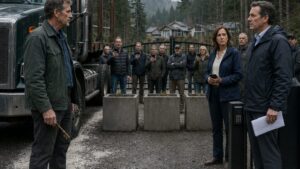
Red and blue flashed over the water, over Sharon’s white SUV, over Joseph’s loader sitting silent now with its bucket lowered. The crew had stepped away from the gate and gathered near their truck. The violation notice still clung to the bar with fresh tape, stirring in the wind each time a vehicle passed below on the main road.
Paul stood with one hand resting on the padlock.
He had not unlocked it. He had not put away his phone.
The deputy parked behind Sharon’s SUV and stepped out without hurry. He took in the machine, the crew, Sharon in her yellow suit, Paul at the gate, and the road curving beyond them toward the cabin. His expression did not change, but his eyes stayed a second longer on the loader bucket and the loosened gravel around the post.
“Who called?” he asked.
“I did,” Sharon said. “I’m Sharon Rivera, president of the Lake Ridge Homeowners Association. Mr. Carter is obstructing a community access road and interfering with an authorized removal.”
The deputy turned to Paul. “Mr. Carter?”
Paul nodded.
“Anybody hurt?”
“No.”
“Anybody threatened?”
“No.”
Sharon said, “He placed himself in front of machinery.”
Paul lifted his phone slightly. “After they started pulling my gate.”
The deputy held up one hand. “One at a time.”
Sharon opened her folder before he finished speaking. “The HOA has authority under the governing documents to remove unapproved exterior modifications and assess costs to the owner. We issued notice.”
The deputy took the paper and read the top half. Paul watched his eyes move. The deputy flipped to the second page, then looked at the gate. “When was this served?”
“This morning,” Sharon said.
Paul said nothing.
The deputy looked at him anyway.
Paul pointed to the sheet taped on the gate. “That notice was not there before lunch.”
Sharon’s smile was thin. “Mr. Carter has been avoiding compliance for weeks.”
“That isn’t an answer,” the deputy said.
A small silence followed.
Joseph cleared his throat. “We got here just after three.”
Sharon turned to him sharply.
The deputy looked at Joseph. “You’re the contractor?”
“Crew supervisor. Joseph Thompson. We were told there’d be a notice posted and that the owner had been advised.”
“Was the notice already there when you arrived?”
Joseph’s eyes moved to Sharon, then to Paul’s phone, then to the gate. “No, sir. Not when I pulled up.”
Sharon’s lips parted. “Joseph—”
He kept talking, quieter but clear. “It was posted after we unloaded.”
The wind pushed the taped notice against the bars. It made a dry ticking sound.
Paul did not look at Sharon. He kept his hand on the padlock and felt the metal warm from the day.
The deputy folded the removal order once. “Ms. Rivera, I’m not here to interpret every HOA covenant on the side of the road. But an association order is not the same thing as a court order.”
Sharon straightened. “Deputy, the road serves association members.”
“And this gate is on whose property?”
Sharon hesitated. “The easement area is disputed.”
Paul said, “The gate is on my parcel. The road beyond it crosses my parcel before it reaches the shared portion. The failed culvert is under that stretch.”
The deputy looked beyond the gate. “Failed culvert?”
Paul unlocked his phone and opened the photos. He did not step away from the gate. He held the screen out through the bars: asphalt cracked in a crescent, one steel plate bridging the dip, muddy water beneath the edge after the last storm.
The deputy studied the images. “When were these taken?”
“Yesterday morning. The one with the measurement stick was Sunday. The contractor report is in the truck.”
Sharon said, “Those plates are also unauthorized.”
Paul looked at her then. “They are the only reason your crew truck didn’t put weight on the soft edge when Joseph backed in.”
Joseph glanced toward his truck and said nothing.
The deputy handed Sharon’s paper back. “I’m not ordering him to open that gate today.”
Sharon’s face changed in a way Paul recognized from board meetings he had attended years before, back when the biggest fights were dock colors and short-term rentals. It was not embarrassment. It was calculation under pressure.
“So he can simply ignore the governing documents?” she asked.
“No,” the deputy said. “You can pursue whatever civil process you believe applies. But I’m not standing here while equipment removes a gate from private property without clear authority, especially if there’s a claimed road hazard behind it.”
Paul felt no triumph. Only a loosening in his shoulders he had not allowed before.
Sharon turned to him. “This does not end here.”
“I know,” Paul said.
“You will receive daily fines starting tomorrow. We will schedule an emergency board action. And if the association incurs costs because you are blocking access, we will assess those costs to your account.”
The deputy looked at Paul, as if expecting an answer.
Paul kept his voice even. “Put every demand in writing.”
Sharon’s eyes narrowed. “You seem very comfortable hiding behind paperwork when it benefits you.”
“No,” Paul said. “I’m comfortable when people who bring machinery to my gate have to prove they can use it.”
Joseph shifted beside the loader. “Should we load up?”
Sharon did not answer immediately. Her gaze was fixed on the padlock, then the chain, then the bend in the road. For one strange second, Paul wondered if she had ever actually walked past that bend, ever stood over the culvert and listened to water moving under the asphalt.
“Load up,” she said at last. “For now.”
The words carried more threat than retreat.
The crew moved quickly. Metal ramps clanged against the trailer. The loader backed away from the gate, leaving two deep tire marks in the gravel shoulder and a rough semicircle where the bucket had disturbed the post footing. Paul recorded until the machine was chained down.
The deputy handed Paul a card. “Get your documents together. If there’s a safety issue, get the county to look at it. Not just the association.”
“I will.”
“And Mr. Carter?”
Paul looked up.
“Don’t put yourself under a bucket again unless you have no other choice.”
Paul almost smiled, but it did not reach his face. “I didn’t plan to do it the first time.”
When the deputy left, the lake seemed too quiet. Sharon’s SUV remained for a moment after the patrol vehicle disappeared down the road. She stood by her open door, folder pressed to her side.
“You could have avoided all this,” she said.
“So could you.”
“You think being calm makes you right.”
“No,” Paul said. “I think the road being unsafe makes me careful.”
Sharon gave him one last look and drove away.
Paul stayed at the gate until the dust settled. Then he removed the taped notice and read every line. Unauthorized structure. Immediate correction required. Cost recovery. Daily fine. Emergency access interference. He folded it and slid it into his back pocket.
A car came fast up the lower road just before sunset, tires popping gravel. Emily Carter stepped out before the engine was fully quiet. She wore scrubs under a denim jacket, and her face had the tight, pale look of someone who had driven too quickly while imagining three bad outcomes.
“Where’s Mom?” she asked.
“At the cabin.”
“Did they touch the gate?”
“Loosened one post. Didn’t take it.”
Emily looked at the loader tracks, the disturbed gravel, the notice sticking out of his pocket. “And Sharon?”
“Called the sheriff.”
Emily stared at him. “You let it get that far?”
Paul’s jaw tightened. “I stopped the machine.”
“That’s not what I asked.” She stepped closer, lowering her voice even though no one else was there. “Dad, why are you still acting like this is just about the road?”
Paul looked past her to the bend, to the steel plates darkening in the cooling light.
Emily followed his gaze and then looked back at him with anger and fear mixed together.
“Why haven’t you told them about Mom’s transport?”
Chapter 3: The Locked Road Was Not The Problem
Lisa Carter’s walker caught on the gravel lip before breakfast.
The sound was small—one rubber foot scraping, then sticking—but Paul heard it from the sink and turned fast enough to see her shoulders pitch forward. She caught herself on the porch rail with both hands. The coffee cup she had been carrying tipped, spilling a brown line across the boards.
“Don’t,” she said before he reached her.
He stopped with one hand already out.
Lisa stood still, breathing through the pain with her eyes closed. She wore a blue sweater though the morning was warm, and her hair was pinned badly on one side, the way it got when her hands were tired before the day had properly started.
“I was only going to take the cup,” Paul said.
“I know what you were going to take.”
He picked up the cup from the boards anyway, because leaving it there would insult both of them.
Emily stood near the screen door, arms folded, watching the place where the porch ramp met the temporary gravel path. The gravel had shifted after the crew trucks turned around near the upper drive. The steel plate over the road dip was forty yards farther down, partly visible between the pines.
“That lip wasn’t there yesterday,” Emily said.
“It settled,” Paul said.
“Because the road edge is moving.”
Lisa opened her eyes. “The road edge has been moving since the storm.”
“And Dad locked the gate because of it,” Emily said. “Which everybody now thinks is about him being stubborn.”
Paul set the cup on the porch rail. “Emily.”
“No. If a machine was at the gate yesterday, we’re done pretending this is private.”
Lisa looked toward the lake. The water was bright and flat beyond the trees, the kind of morning that made other people talk about blessings and views. She gripped the walker harder.
“I asked him not to make my body an agenda item,” she said.
Emily’s anger softened, but only slightly. “Mom, they’re trying to tear out the thing that keeps vehicles off the bad part of the road.”
“They don’t need my medical schedule to understand a cracked culvert.”
“They don’t understand it,” Emily said. “Or they don’t want to.”
Paul looked down at the dark coffee spreading between the boards. He remembered another stain years earlier, not coffee but rainwater tracked across the old porch after he told Lisa the loose step could wait until Saturday. It had taken one fall to teach him that some things did not wait because a man was tired.
He had fixed that step by lantern light the same night she came home from urgent care. He had never told her how long he sat on the bottom stair afterward with the bent screw in his palm.
A truck horn sounded once from below.
Paul turned.
Benjamin Flores’s pickup crawled up the road and stopped before the steel plates. He got out wearing work pants, a reflective vest, and the look of a man who had measured trouble and disliked the number.
He walked to the plate, crouched, and peered into the exposed crescent where Joseph’s crew had shifted the edge.
“That wasn’t open yesterday,” Benjamin called.
Paul left the porch and went down.
The closer he got, the more he could smell wet earth. Not surface dampness. Deep washout. The kind that meant water had been taking soil from under the road while the asphalt stayed polite on top.
Benjamin slid a flashlight under the plate. “You see that?”
Paul crouched beside him. Under the steel, the culvert pipe showed a cracked seam and a dark hollow where packed fill should have been.
“How much worse?” Paul asked.
“Enough.” Benjamin stood and wiped his hand on his vest. “If a delivery truck hits this outside edge, maybe nothing happens. Maybe it drops six inches and scares everybody. Or maybe the whole shoulder breaks and pulls the lane with it.”
Emily had come down behind them. Lisa remained on the porch, watching from the rail.
“What about a medical transport van?” Emily asked.
Benjamin looked from her to Paul, realizing he had walked into a conversation already underway. He chose his words carefully.
“I would not put a van over it unless those plates are centered and the driver knows exactly where to track. Even then, I’d want the repair done first.”
Lisa looked away.
Paul stood. “I told the board.”
“You sent them my warning,” Benjamin said. “I know. I was copied.”
“And?”
Benjamin reached into his truck and pulled out his phone. “And this came last night.”
He handed the screen to Paul.
The email was from the HOA management account. Subject: Stop Work / Unauthorized Modification. It named Benjamin’s company directly. Continued work on the culvert, guardrail, gate, plate placement, gravel shoulder, or related exterior alteration would be treated as participation in an unapproved modification. The association reserved the right to notify licensing and insurance carriers if work proceeded without approval.
Paul read it twice. The first time for meaning. The second because his hands wanted something to do besides shake.
Emily saw his face. “They threatened your contractor?”
Benjamin took the phone back. “They threatened paperwork. That’s not the same as being right, but I can’t ignore it.”
“You said the road wasn’t safe,” Paul said.
“I stand by that.”
“Will you put that in writing again?”
“I already did.”
“Stronger.”
Benjamin looked toward Lisa on the porch. “Paul—”
“Stronger,” Paul repeated. “Plain enough that a person pretending not to understand has to work at it.”
Benjamin nodded slowly. “I can do that. But it won’t pour concrete. And it won’t stop them from fining you.”
Lisa came down the porch ramp with care. Paul watched every step and forced himself not to move toward her. She reached the gravel edge and stopped several feet from the damaged road, looking at the plate as if it were something alive.
“They sent a van back last Thursday,” she said.
Emily turned. “What?”
Lisa kept her eyes on the road. “The transport driver wouldn’t cross after he saw the dip. He called dispatch from the lower gate and said he couldn’t risk the vehicle. Your father drove me down in the truck.”
Emily’s face went still. “You told me the appointment moved.”
“I said the appointment was handled.”
“That is not the same thing.”
“No,” Lisa said. “It is not.”
Paul felt Emily’s gaze on him. He deserved it.
“You both lied to me?” she asked.
Paul said, “I didn’t want you leaving work.”
Emily laughed once, sharp and hurt. “You didn’t want me making noise.”
That landed closer to the truth than Paul liked. He had not wanted her making calls, confronting board members, posting warnings in neighborhood groups, bringing the whole lake down on Lisa’s porch. He had told himself he was protecting peace. But peace had given Sharon room to call the gate an obstruction and the plates a visual hazard.
Benjamin cleared his throat. “I’ll update the letter. I’ll include the transport concern if you want it.”
“No,” Lisa said.
Emily looked at her. “Mom.”
“No.” Lisa’s voice was quiet but hard. “I am not becoming a paragraph in a fight about road aesthetics.”
Paul looked at the plate, at the hollow under it. “It’s not aesthetics.”
“That doesn’t mean they won’t make it feel that way.”
No one answered.
A delivery van appeared at the lower gate and stopped. The driver got out with an envelope, saw the chain, and looked up the road helplessly. Paul walked down to meet him. The man handed over a certified letter through the bars.
“Sorry,” the driver said. “Says signature required.”
Paul signed on the handheld screen.
The envelope carried the HOA management company’s return address.
He opened it before walking back. The paper inside was heavier than the taped notice, printed cleanly, with Sharon’s signature above the management company’s footer.
Final Notice of Emergency Correction.
Remove unauthorized gate and associated materials within twenty-four hours. Restore access. Failure to comply will result in association-arranged removal, cost recovery, and daily fines.
Paul read the last paragraph once, then folded the page.
Emily reached for it. He let her take it.
Her mouth tightened as she read. “They’re coming back.”
Benjamin looked at the road plate. Lisa looked at Paul.
Paul placed the padlock key on top of the folded notice in Emily’s hand, then took it back before she could ask why.
For the first time since the loader had rolled up to the gate, the lock felt less like control than a clock.
“They gave us twenty-four hours,” Emily said.
Paul looked down the road toward the chain, the cones, the steel plates, and the lake shining beyond all of it.
“No,” he said. “They gave themselves twenty-four hours to make the wrong thing official.”
Chapter 4: The Board Called Safety A Design Issue
Sharon opened the emergency meeting with a photograph of Paul standing in front of the loader.
The image filled the clubhouse screen behind her: Paul in his work jacket, one hand raised with his phone, the metal gate locked behind him, the loader bucket lowered like a threat at his knees. Someone in the room made a low sound—not quite a laugh, not quite a gasp. From the angle of the photo, Paul looked less like a man stopping machinery and more like a man blocking a road because he had decided the road belonged to him.
Paul sat in the second row with his folder on his lap. He knew the picture had been chosen carefully. It did not show the shifted steel plate. It did not show the hollow under the asphalt. It did not show the taped notice going up after Joseph’s crew had unloaded.
Sharon stood at the front table, composed in a pale jacket this time, her yellow suit replaced by something softer but no less deliberate.
“This is not how a community operates,” she said. “No individual owner can install a gate, block shared access, place industrial material on a visible roadway, and then force everyone else to negotiate afterward.”
A few heads nodded.
The clubhouse windows looked out over the same lake Paul could see from his porch, but from here it looked managed—dock lights aligned, flower beds trimmed, bylaws framed near the entrance. He had always disliked this room. It made messy facts feel like they had to wipe their boots before entering.
Sharon clicked a remote. Another photo appeared: the steel plates at the bend, orange cones standing around them.
“Visual hazard,” she said. “Unapproved materials. Improper placement. Potential association liability.”
Paul looked down at his folder until he trusted his face.
Michelle Anderson sat beside Sharon with a tablet in front of her. She had not looked at Paul when he came in, but she had watched the screen with a tightness around her eyes. David Robinson sat two rows ahead, arms crossed. He turned once, saw Paul, then turned forward again.
Sharon continued. “Mr. Carter was asked to submit a complete architectural application. He did not do so before installing the obstruction.”
Paul rose before she could click to the next slide.
“I submitted the contractor’s report four weeks ago.”
Sharon smiled without warmth. “You submitted a partial repair estimate.”
Paul opened his folder. “Report from Benjamin Flores. Photos from before and after the storm. Measurements of shoulder drop. Proposed temporary closure. Emergency culvert repair plan.”
He placed copies on the front table. Not dramatically. One stack for Sharon, one for Michelle, one for the unnamed board members.
Sharon did not touch hers.
Michelle reached for the top page.
Paul saw her read the first paragraph, then the second. Her brows pulled together.
“When was this sent?” she asked.
“May twenty-eighth,” Paul said. “Certified email to the management account, copy to the architectural committee.”
Sharon’s hand settled on top of her folder. “The submission lacked approved drawings for the gate and guardrail.”
“It was not a request to beautify a gate. It was a temporary closure until the road could be repaired.”
“The gate changes the exterior character of the lake road.”
“The culvert changes whether the lake road holds a vehicle.”
The room went quiet enough for the air conditioner to hum.
Sharon turned slightly toward the audience. “This is precisely the problem. Mr. Carter continues to conflate an alleged maintenance concern with his unilateral decision to block access. The association cannot operate on one owner’s emergency declaration.”
Paul looked at the faces. Some curious, some annoyed, some already tired. These were the people who had been inconvenienced by the chain. Their guests had to park below and walk. Kayaks had to be carried. One delivery truck had refused the hill. He understood the irritation. He had caused it. But irritation was not the same as danger.
David stood before Paul could answer.
“My dock contractor couldn’t get up there last week,” David said. “I had to reschedule. I pay dues like everybody else. If Paul gets to lock the road every time he’s unhappy with a response, what stops the rest of us?”
A murmur moved through the room.
Paul turned toward him. “David, you saw the shoulder after the storm.”
David’s face closed. “I saw a dip. Roads get dips.”
“You also saw the water running through the crack.”
“I saw water everywhere. It rained for two days.”
Paul could have pushed harder. He could have said David had stood by the bend with his hands on his hips and muttered that somebody ought to look at it before a tire went through. But David’s wife was in the room, and David’s cheeks had already reddened. Paul let it go, and felt Emily’s absence like a hand between his shoulder blades. She would not have let it go.
Michelle lifted the report. “Sharon, did the architectural committee review this section? The part where he requested an emergency temporary closure?”
Sharon’s expression held, but Paul saw the corner of her mouth tighten.
“The committee reviewed the submission as incomplete,” she said.
“That isn’t what I asked.”
A board member shifted in his chair.
Sharon’s voice cooled. “The committee cannot approve a gate design without specifications.”
Michelle looked down at the report again. “The contractor says the road should not remain open to uncontrolled vehicle traffic until the culvert is inspected.”
“And the contractor was hired by Mr. Carter.”
Paul said, “Call him.”
“That is not the process tonight.”
“Then what is?”
Sharon faced him fully. “The process tonight is determining whether the association proceeds with emergency enforcement to restore access and preserve our standards.”
“Our standards?” Paul asked.
“Yes.”
“Does the standard cover a road collapsing under a van?”
Sharon blinked. Only once. “There is no verified collapse risk.”
Paul knew then where the wall stood. Not between him and Sharon. Between verified and visible. Between danger on his road and danger in their minutes.
He took out a photograph and held it up. It showed the cracked culvert seam below the lifted edge of the plate. The room leaned forward slightly, drawn despite itself.
“This is under the bend,” Paul said. “That dark space is where fill used to be.”
Sharon turned toward the board. “Again, unverified.”
Michelle set down the report. “We can verify it.”
“The insurer is reviewing lake-road access next month,” Sharon said, sharper than before. “We cannot present a community where owners install barriers and industrial plates wherever they choose.”
There it was. Not the whole thing, maybe, but enough for Paul to hear the strain beneath the rule language.
Michelle’s eyes flicked to Sharon.
Paul noticed.
Sharon gathered herself quickly. “Property values depend on consistency. Liability depends on process. If we allow Mr. Carter’s actions to stand, we create precedent.”
Paul looked at the room. “If you remove that gate and somebody drives over that culvert before it is repaired, what precedent is that?”
No one answered.
Sharon clicked the remote. The photo of Paul in front of the loader returned to the screen.
“This is not a safety plan,” she said. “This is obstruction.”
The word landed harder with the picture behind her. Paul felt the heat rise again, the urge to tell them about Lisa’s walker, the transport van, the appointment that had been “handled” because he drove her down the lower road himself. He heard Lisa’s voice instead: I am not becoming a paragraph in a fight about road aesthetics.
So he closed his folder.
“I’m asking for an emergency repair approval,” he said. “Not permission to win an argument.”
David stood again, this time turning so the whole room could hear him.
“And I’m asking whether the rest of us are supposed to lose access all summer because Paul Carter says so.”
A few people nodded more firmly now. Someone said, “Exactly.”
Paul looked at Sharon. She did not smile, but she did not have to. The room had begun to choose the easier story.
David pointed toward the projected image. “That road belongs to the community too. If he can lock it today, what stops him from locking us out tomorrow?”
Paul’s folder felt suddenly too thin in his hands.
Chapter 5: The Sheriff Asked For The Court Order
Fresh tire tracks curved away from the gate before sunrise.
Paul found them while the lake road was still gray, two dark arcs pressed into the gravel shoulder near the post Joseph’s crew had loosened. They stopped at the chain, reversed, and cut toward the lower turnout. Whoever had come in the night had not crossed, but they had tried close enough that one orange cone lay crushed under a tire.
Paul stood over the cone with his coffee cooling in his hand.
The twenty-four-hour notice sat folded in his shirt pocket. The board meeting had ended without a vote to approve the repair. Sharon had promised written action by noon. David’s question still followed Paul down the hill: If he can lock it today, what stops him from locking us out tomorrow?
Paul picked up the cone, bent it back into shape, and set it beside the steel plate.
The road made a sound under his boot.
Not a crack. Not yet. A dull settling noise, like wet soil accepting weight.
He stepped back.
At the cabin, Lisa was still asleep in the recliner, her blanket pulled to her waist, one hand resting on the arm as if she had only paused there. He did not wake her. He placed the coffee in the sink and took his folder to the truck.
At the lower gate, he sat behind the wheel and called the county road office three times before someone answered. The clerk listened politely until he said “private road,” then transferred him. The second person said the county did not inspect private HOA roads unless there was a complaint involving drainage impact, emergency access, or public safety. Paul said all three. He was put on hold.
While the hold music clicked and looped, a text came through from Joseph Thompson.
Crew told to return after lunch. I don’t like this. Do you have something official coming?
Paul stared at the message until the voice on the phone returned.
“Sir? Are you still there?”
“Yes.”
“If there’s an immediate hazard, you can submit an emergency inspection request. Photos, location, ownership information, and description of risk.”
“I have all that.”
“You’ll need to state who is affected by the access restriction.”
Paul looked up through the windshield at the locked chain.
“People who use the road,” he said.
“That may not be enough for emergency priority. If there’s medical access, fire access, disabled access, something like that, include it.”
Paul closed his eyes.
The clerk waited.
“I’ll include what’s necessary,” he said.
He drove to the county office anyway. A phone form felt too easy for someone else to misplace. The building was a low beige structure beside a parking lot full of pickup trucks and faded sedans. Inside, fluorescent lights flattened everyone into paperwork. Paul filled out the emergency inspection request on a clipboard chained to the counter.
Description of hazard.
He wrote: failed culvert under lake road, visible shoulder drop, void under asphalt, uncontrolled vehicle access unsafe.
Affected access.
His pen stopped.
A woman behind him cleared her throat softly. Paul moved closer to the counter to give her room, though she had not asked.
He wrote: residential access for upper lake parcel.
Then he scratched a line through it.
The clerk glanced over. “Need a new form?”
“No.”
He wrote beneath it: medical transport access for resident with mobility limitations.
His handwriting looked strange to him, like someone else had put Lisa into public ink.
He attached Benjamin’s report, photographs, the HOA notice, and a copy of the sheriff’s card with the date written in the corner. When the clerk stamped the packet, the sound was small but final.
“Inspection may take a few days,” she said.
“They’re bringing a crew back today.”
The clerk looked at the form again. “I’ll mark urgent. I can’t promise more than that.”
Outside, Paul sat in the truck without starting it. He took the padlock key from his pocket and turned it in his fingers. It had worn smooth on one side from years of use. Before the storm, that gate had been mostly symbolic, closed at night, open during the day. People waved when they passed. Delivery drivers knew where to leave packages. David’s grandkids rode bikes down to the dock.
A locked gate changed how people looked at a man.
His phone rang.
Emily.
“Tell me you filed something,” she said.
“I filed.”
“With the medical access?”
Paul looked at the county office doors. “Enough.”
“Dad.”
“Enough to get them to look.”
“That’s not an answer.”
“It’s the answer I have.”
She was silent for a moment. In the background, he heard hospital noise—wheels, a distant announcement, someone laughing too loudly.
“Mom called me,” Emily said. “She said you two argued after I left.”
“We didn’t argue.”
“Then she used her quiet voice at you.”
Paul almost smiled. “That, maybe.”
“She’s scared of being talked about.”
“I know.”
“And you’re scared if people know, they’ll make her smaller.”
Paul started the truck but did not put it in gear.
Emily’s voice softened. “You can’t protect her by letting Sharon define the whole story.”
The sentence stayed with him all the way back to the lake.
At the gate, Joseph’s crew truck was not there yet, but the white SUV was. Sharon stood near the notice, reading something on her phone. She looked up as Paul parked.
“Mr. Carter,” she said. “The board has authorized emergency cost recovery if you fail to comply by noon.”
“It’s ten-fifteen.”
“I’m aware.”
“I filed for county inspection.”
Her eyes sharpened. “On what basis?”
“Road hazard.”
“You mean a private maintenance issue.”
“Medical access is not private when your crew removes the only thing keeping vehicles off the bad section.”
Sharon held his gaze. “Be careful how you frame this. The association has not denied medical access.”
“You denied the repair.”
“We denied an incomplete exterior alteration.”
Paul got out of the truck with the stamped packet in hand. “The sheriff asked for a court order. You didn’t have one. The county will ask whether the road is safe. You don’t have that either.”
“You are escalating this beyond reason.”
“No. I’m putting it where paper has to answer to ground.”
For the first time, Sharon looked tired. It passed quickly, but he saw it. The perfect posture dipped. The hand holding her phone tightened.
“There are thirty-eight homes in this association,” she said. “Every one of them expects the board to enforce rules evenly. If I let you do this because you say it is urgent, the next owner builds whatever they want and calls it urgent too.”
“Then inspect mine and decide mine.”
“We have a process for that.”
“The process was four weeks of silence and a loader at my gate.”
A truck sounded below.
Both of them turned.
Joseph’s crew came slowly up the lower road and stopped behind Sharon’s SUV. Joseph got out but did not unload. He looked from Sharon to Paul, then at the chain.
“I was told noon,” he said.
Sharon checked her watch. “You were told to be ready.”
Paul’s phone buzzed again. A county number appeared on the screen.
He answered at once.
The clerk’s voice was brisker now. “Mr. Carter, we received your emergency request. An inspector can come tomorrow morning, but there’s a condition.”
“What condition?”
“If the road is potentially compromised, you need to maintain closure until inspection. No uncontrolled vehicle access over the affected section.”
Paul looked at Sharon.
She watched his face, trying to read the call.
“I understand,” he said.
“And Mr. Carter?”
“Yes?”
“The inspector will need to know the affected resident’s access needs. Put it in writing before morning.”
He thanked her and ended the call.
Sharon stepped closer. “Well?”
Paul put the phone in his pocket. “County inspector tomorrow. Road stays closed until then.”
She laughed once under her breath, disbelief more than humor. “On your word?”
“On the county’s instruction.”
“Forward it.”
“When I receive it in writing.”
Joseph shifted by his truck. “So we’re not unloading?”
Sharon did not answer him. She looked at Paul like he had become a problem she could no longer solve with one document.
Paul felt the padlock key in his pocket. He had bought a little time. Not safety. Not approval. Time.
At the cabin that evening, Lisa sat at the kitchen table with the county form in front of her. Paul had left the section about affected access blank.
She read the page without touching it.
“They want my condition in writing,” she said.
“They want why access matters.”
“That is a prettier way to say it.”
Paul stood across from her, unable to disagree.
Lisa folded her hands, the knuckles swollen, the nails clean and unpainted. “Paul, listen to me carefully.”
He looked up.
Her voice did not shake.
“Do not let them make me the reason everyone looks at this house.”
Chapter 6: The Wrong Truth Hit The Room
Lisa entered the clubhouse before Paul could explain why the chair beside him was empty.
The meeting had not officially started. Sharon was arranging papers at the front table. Michelle was speaking quietly to another board member. David stood near the coffee urn with two neighbors, his hands moving as he talked. Paul had set his folder on the empty chair to keep people from asking questions, but Lisa came through the side door with Emily beside her and her walker steady on the polished floor.
Conversation thinned.
Not stopped. Thinned. That was worse.
People lowered their voices in the careful way that made privacy feel like an exhibit.
Paul stood too quickly. “Lisa.”
She gave him a look that told him not to move toward her. Emily saw it too and stepped back half a pace.
Lisa crossed the room herself. Each rubber foot of the walker made a soft sound against the floor. When she reached the chair beside Paul, she lowered herself into it and placed both hands on top of the folded frame.
“I said I didn’t want to be made the reason,” she murmured.
Paul sat slowly. “I know.”
“I didn’t say I wouldn’t be present.”
Sharon watched from the front with an expression so controlled it had become unreadable.
At seven sharp, she called the meeting to order.
“This emergency session concerns continued obstruction of Lake Ridge Road, unauthorized exterior modifications, and Mr. Carter’s request for special treatment under the label of safety.”
Emily’s head turned.
Paul put one hand on his folder. Not to stop her. To stop himself.
Sharon continued. “The board has received additional materials from Mr. Carter, including a county inspection request. However, I want to make clear that emotional claims do not override architectural standards or association process.”
Paul rose.
The legs of his chair scraped once. The sound moved through the room.
“I’m not here to ask for special treatment,” he said. “I’m here to ask you not to reopen a road before you know whether it can carry a vehicle.”
Sharon folded her hands. “You have made that assertion repeatedly.”
“I have documented it repeatedly.”
“You have also refused to comply repeatedly.”
Paul opened his folder and took out the photograph of the culvert void. He placed it on the table at the front, not on the projector. He wanted them to look down at it like a thing on the ground.
“The transport van turned around last Thursday,” he said.
Lisa’s hand tightened on the walker.
Paul felt it without looking. The sentence had crossed a line they had kept between them. He had chosen the smallest version of the truth and still felt the damage of it.
He went on before he lost nerve.
“The driver saw the dip and said he could not risk taking the vehicle over the bend. I drove Lisa down myself. That is not a long-term solution. It wasn’t safe then. It’s worse now.”
A neighbor near the back whispered something. Emily looked toward the sound so sharply the whisper died.
Sharon’s eyes moved to Lisa, then quickly away. “No one on this board wants to interfere with anyone’s medical needs.”
“But you did,” Emily said.
Paul said, “Emily.”
“No,” Lisa said quietly.
Paul turned.
Lisa looked at Sharon, not at Emily. “Let her finish only if she can do it without making me smaller.”
Emily swallowed. Her anger did not vanish, but it changed shape. “The point is not my mother’s diagnosis. The point is access. You had a report. You had photos. You had a contractor warning. You sent a crew.”
Michelle leaned toward her microphone. “Sharon, when did the board receive Benjamin Flores’s original report?”
Sharon looked at her. “The management account received a communication on May twenty-eighth.”
“That’s not an answer.”
A few people shifted.
Sharon took a breath. “It was included in the architectural file.”
Michelle tapped her tablet. “I don’t see it in the packet sent to the board before the denial vote. I see photos of the gate and plates. I see the standard language about exterior appearance. I don’t see the culvert warning.”
Sharon’s face stayed composed, but her hand moved to the folder edge.
“The submission was incomplete,” she said.
Paul almost laughed, but there was no humor in him.
David stood from the second row. “I want to say something.”
Paul expected another complaint about access. He braced for it.
David did not look at him. He looked at the board.
“I saw the shoulder sink after the storm,” he said. “Not as bad as that photo maybe, but enough that I noticed. I was walking down to check my dock lines. I told myself it was Paul’s section and he’d handle it.”
The room turned toward him.
David’s voice roughened. “Then he locked the gate, and I got mad because my contractor couldn’t get through. I didn’t say anything about what I saw because I wanted the road open.”
Paul stared at the back of David’s head.
It was not an apology. Not exactly. It was something more useful and more uncomfortable.
Sharon spoke carefully. “Mr. Robinson’s observation does not establish structural failure.”
“No,” David said. “But it means Paul didn’t invent the dip after the fact.”
Michelle looked at Sharon. “We need the county inspection before any removal.”
Sharon’s eyes flashed. “And in the meantime? We reward unilateral action?”
Lisa moved her walker half an inch. Everyone heard it.
“I want to say something,” she said.
Paul turned fully toward her. “You don’t have to.”
“I know.”
She stood with effort, and Emily reached out but stopped before touching her. Lisa did not go to the front. She stayed beside her chair, one hand on the walker, one hand on the table.
“I do not want pity from this room,” she said. “I do not want my appointments discussed. I do not want my name used as a decoration on anyone’s argument.”
No one moved.
“I want to leave my house safely when I need to leave it. I want to come home without my husband measuring the road first. If that requires a repair, then approve the repair. If it requires a different design, say so in writing and say it quickly. But do not call the thing that kept cars off a dangerous road an eyesore and then pretend this is about standards.”
Paul looked down because he could not look at her and remain still.
Sharon’s voice was quieter when she answered. “Mrs. Carter, I understand this is difficult.”
Lisa sat back down before Sharon finished.
“No,” Lisa said. “You understand it is inconvenient.”
The room held its breath.
Sharon’s face colored, but when she spoke again, she did not raise her voice. “The association has responsibilities beyond one household. We have insurance requirements, access obligations, and governing documents. If every owner acts first and explains later, the board loses the ability to manage risk.”
Michelle turned toward her slowly. “Insurance requirements?”
Sharon’s head moved a fraction too late.
Michelle picked up her tablet. “Sharon, is this related to the carrier’s road-access review?”
“That review is routine.”
“Routine?” Michelle asked. “They requested proof that the lake road was safe weeks ago.”
Paul felt the room shift again, but this time not toward him.
David looked back at Sharon. Emily’s eyes narrowed. Lisa stared at the tabletop.
Sharon’s silence lasted only a second, but it was long enough.
Michelle set the tablet down where the microphone caught the sound.
“The insurer asked for proof the road was safe,” she said, “before the board ordered removal of the gate that was keeping people off the unsafe section.”
Chapter 7: The Repair They Denied Became Evidence
The county inspector pointed at the torn gravel around Paul’s gate post and asked, “Who pulled this out beside a road marked unsafe?”
No one answered quickly.
The morning had drawn half the lake community to the bend, though most pretended they were only passing through. David stood near his truck with his arms crossed. Michelle kept a tablet under one arm and a folder under the other. Sharon stood beside the white SUV, sunglasses on despite the thin cloud cover. Joseph’s crew truck was parked lower on the shoulder, unloaded but quiet.
Paul stood behind the inspector, close enough to hear, far enough not to crowd him.
The inspector crouched near the exposed footing. He was a compact man with gray hair under a county cap, a measuring rod in one hand and a small camera in the other. He had already photographed the steel plates, the orange cones, the cracks along the asphalt, and the dark hollow under the road edge. Now he was studying the marks Joseph’s loader had left in the gravel.
“This post was under stress?” he asked.
Joseph looked at Sharon before answering.
The inspector noticed. “I asked you.”
Joseph swallowed. “We loosened the hinge side. We hadn’t removed it.”
“Why?”
“Removal order.”
“From whom?”
Joseph nodded toward Sharon. “Association.”
The inspector looked at Sharon. “You ordered removal before inspection?”
Sharon’s tone was calm, but Paul could hear the tightness under it. “We ordered removal of an unauthorized obstruction. At the time, the alleged road hazard had not been verified.”
The inspector stood. “That is what I am doing now.”
“Yes,” Sharon said. “And we are cooperating.”
Paul looked at the loosened post. The chain still hung across the gate, but one hinge bracket was crooked, and the metal bar no longer sat square. What had looked solid three days ago now looked wounded.
The inspector walked to the steel plate. “Mr. Carter, don’t step there.”
Paul stopped with his boot lifted.
The inspector set the measuring rod along the edge of the asphalt, then slid it down into the void beside the culvert. The rod disappeared farther than anyone expected. A neighbor behind David muttered something under his breath.
The inspector read the measurement, then checked under the plate with a flashlight.
“Who placed these plates?” he asked.
“I did,” Paul said. “Benjamin Flores delivered them. I set them after the storm shifted the shoulder.”
“You set cones?”
“Yes.”
“You closed the gate?”
“Yes.”
“Why not leave it open with warning cones?”
Paul looked at the road. “Because people drive around cones when they think the inconvenience is temporary.”
David shifted his weight.
The inspector nodded once, not agreement exactly, but recognition.
Sharon stepped forward. “Inspector, for clarity, the association did not authorize these plates, cones, or gate. We had concerns that they created confusion and liability.”
The inspector looked at the cracked road edge. “A hole under the lane creates liability.”
Michelle’s mouth tightened as if she were holding back the same sentence.
The inspector moved to the culvert outlet downslope. Paul followed him carefully through the brush. The concrete pipe emerged under a mat of roots and mud. Water seeped through the broken seam instead of flowing cleanly from the mouth. Soil had washed out around one side, leaving an empty pocket behind the pipe wall.
The inspector took more photographs.
“When did you first report this?” he asked.
“May twenty-eighth,” Paul said.
“To the county?”
“To the HOA.”
“Why not county?”
Paul hesitated. It was a fair question, and the answer made him look foolish.
“I thought the association had to approve work before the county would touch the access issue.”
The inspector looked at him. “Safety concerns don’t need to wait for an architectural committee.”
Paul accepted that without defending himself. It was another version of the same mistake: keep the matter private, follow the chain, avoid making noise, and hope the people with forms did their part. He had known ground better than paper and still let paper slow him down.
They climbed back to the road.
Joseph had moved closer to the gate. His face was red, not from the sun.
“Inspector,” he said, “I need to say something.”
Sharon turned sharply. “Joseph, this is not necessary.”
“It is for me.” He removed his cap and held it against his thigh. “We were sent the removal order and a scope of work. Pull gate. Remove plates. Load materials. Restore access. That was the job.”
The inspector watched him.
“I did not receive Mr. Flores’s report. I did not receive photos of the culvert. I did not know about medical transport.” Joseph glanced at Paul, then away. “And we were already unloaded before the notice was posted.”
The quiet that followed was not empty. It was full of people recalculating.
Sharon’s voice lowered. “The crew was instructed based on the association’s determination.”
Joseph looked at her. “You told me the owner had been fully noticed.”
“The owner had been in violation for weeks.”
“That’s not the same thing.”
Paul felt Emily, standing beside Lisa’s empty chair in his mind, saying exactly that. Not the same thing. So much of the last week had turned on those words. Notice was not warning. A violation was not danger. Access was not safety. An HOA order was not a court order.
The inspector took Joseph’s statement down in a small notebook.
Sharon looked toward the gathered neighbors. For once, she seemed aware of the audience not as support but as risk.
“May I remind everyone,” she said, “the board is trying to protect the association from unmanaged liability.”
Michelle stepped forward. “Then we should have managed the actual liability.”
Sharon’s eyes cut to her. “This is not the place.”
“It became the place when a loader came here.”
The inspector closed his notebook. “I’m issuing a field directive.”
Sharon straightened. “A directive?”
“Until a proper repair is completed and inspected, this section remains closed to uncontrolled vehicle traffic. No removal of the gate, plates, cones, or other temporary safety measures without county review. No heavy vehicles over the affected area unless part of approved repair.”
David exhaled hard. “So the road stays closed?”
“Yes,” the inspector said. “Because it is unsafe.”
The word did what Paul’s folder, photos, and careful tone had failed to do. It landed on the road itself.
Unsafe.
A few neighbors began talking at once. One complained about deliveries. Another asked about emergency vehicles. Michelle started taking notes. Sharon looked at the inspector as if there must be a procedural door hidden somewhere behind him.
“How long?” she asked.
“That depends on how quickly the repair is approved and performed.”
“We can call a board vote.”
“I suggest you do.”
Paul looked at the steel plates. The orange cones no longer looked like clutter. They looked small and inadequate against what the inspector had named.
The inspector turned to him. “Mr. Carter, your temporary closure likely prevented traffic over a compromised section. That does not mean every installation is automatically approved. It means removing it before assessment would have been a mistake.”
“I understand.”
“Do you?”
Paul looked at him.
“You waited too long to bring this outside the association,” the inspector said. “Next time, if ground moves, call someone who inspects ground.”
Paul nodded. He deserved that too.
The inspector left copies of the field directive with Paul, Sharon, and Michelle. Sharon read hers in silence. The neighbors began to disperse, less satisfied than unsettled. David lingered near the bend.
Paul approached him.
David looked at the cracked asphalt instead of Paul. “I should have said something earlier.”
“Yes,” Paul said.
David looked up, braced for more.
Paul did not give it to him. “So should I.”
David nodded once, ashamed and relieved by the fairness of it.
By noon, Sharon asked Paul to meet at the gate. Michelle stood beside her, arms folded. Joseph’s crew had gone. The road was quiet except for water moving under the damaged culvert.
Sharon held out a document.
“The board is willing to withdraw the daily fines,” she said. “We can permit emergency work under temporary conditions.”
Paul looked at Michelle, who did not look happy.
“What conditions?” he asked.
Sharon tapped the document. “You acknowledge that the gate, plates, and closure were installed without approval and that you accept responsibility for the unauthorized modification. In exchange, we expedite review and waive removal costs.”
Paul took the paper.
The language was neat. Too neat. It made the crew, the loader, the late notice, and the cracked culvert disappear behind one sentence: Owner accepts responsibility for unauthorized obstruction and resulting enforcement action.
Michelle said quietly, “Paul—”
Sharon interrupted. “It gets the repair moving.”
Paul looked past the document to the gate. The chain hung crooked where the hinge post had shifted, but it still held.
Lisa had asked not to be made the reason everyone looked at the house. He had tried to protect her by staying quiet. Now another kind of quiet sat in his hand, dressed as compromise.
He folded the paper once and gave it back.
“No,” he said.
Sharon’s face tightened. “Think carefully.”
“I am.”
“If you refuse, approval may take longer.”
Paul looked at the road, the plates, the cones, the loader tracks, the hollow under the bend.
“Then we’ll write the truth fast,” he said. “But I’m not signing a lie to get permission to fix what you tried to remove.”
Chapter 8: The Gate Opened Only After The Road Held
Benjamin arrived with culvert pipe, gravel, and two workers before Paul had signed anything.
His truck stopped below the gate just after seven, loaded with materials that could not legally cross the damaged bend yet. He climbed out, looked at the chain, then at Paul standing beside the post with Sharon’s unsigned statement folded in his shirt pocket.
“You get approval?” Benjamin asked.
“Not that version.”
Benjamin took off his cap and rubbed his forehead. “Paul.”
“I know.”
“Materials are here. My crew is here. The county inspector said if we start under an approved emergency repair today, I can have the crossing stabilized before dark. If this turns into another board fight—”
“It already is.”
A car door shut behind them.
Michelle walked up from the lower turnout with her tablet, her hair pinned back and her shoes already dusty from the hill. Sharon followed several steps behind her, carrying a folder and the expression of someone who had not slept enough to hide impatience well.
Michelle did not wait for anyone to greet her.
“I called a special vote,” she said. “Emergency safety provision. Existing rule, rarely used. Allows temporary deviation from exterior standards when delay creates access or structural risk.”
Sharon’s voice was clipped. “Subject to board approval and documentation.”
“Which we are doing now.”
Paul looked at Sharon. “Without the statement?”
Sharon opened her folder. “The association still needs acknowledgment that the installation occurred without prior approval.”
“No.”
Michelle said, “We can record that the installation occurred before approval because of claimed emergency conditions later verified by county inspection. That is accurate.”
Sharon’s mouth tightened. “It exposes the association.”
“It tells the truth.”
The words sat between them, plain and heavy.
For a moment, Paul saw Sharon not as the woman pointing at his gate, not as the voice calling him obstruction, but as someone standing in a system she had trusted because it gave her clean boxes: approved, denied, compliant, violation. The road had broken those boxes open. Maybe that was why she looked angrier at the truth than at him.
Benjamin shifted beside his truck. “I need to know whether to unload.”
Michelle held up her phone. “Two board members have already voted yes by written consent. I vote yes. Sharon?”
Sharon stared at the gate.
Down the hill, a neighbor’s dog barked once. Water moved under the culvert, steady and indifferent.
Sharon said, “Yes, with revised temporary conditions.”
Paul released a breath he had not meant to hold.
Michelle typed quickly. “Emergency repair approved. Temporary gate remains until county clearance. Steel plates may be adjusted as part of repair. Final gate design to be submitted after stabilization, with controlled access language. No daily fines during repair.”
Sharon added, “And no public statements implying the board intentionally endangered anyone.”
Emily, who had just arrived and was climbing from her car, heard the last part. “That depends what the board does next.”
Paul looked at her. She stopped, but only barely.
He turned back to Sharon. “I don’t need to humiliate you. I need the road fixed.”
Sharon looked at him then, and something in her face loosened—not apology, not yet, but recognition that he had chosen not to use the room, the neighbors, or the inspector’s words as weapons.
Benjamin clapped his hands once. “Then I’m unloading.”
The gate stayed closed while the work began.
The crew carried materials by hand to avoid putting truck weight on the compromised section. Paul helped until Benjamin told him to stop hovering and hold the measuring line. Emily managed calls between the county office and Lisa’s transport company. Michelle stayed near the lower road, sending updated documents to the board. Sharon remained by her SUV, reading and rereading the revised approval as if she expected the words to change.
By midday, the old culvert was exposed.
The damage looked worse in daylight. Soil had washed out around the pipe in a wide pocket, leaving the road surface suspended in places by habit more than support. One of Benjamin’s workers whistled low when the cracked seam came free.
“Good thing nobody drove a heavy truck over that,” he said.
Paul did not answer.
He was thinking about the transport van that had turned around, about Lisa’s walker catching on gravel, about his own stubborn belief that if he sent the right paperwork, the right people would understand. He had spent weeks proving danger to people who wanted him to prove compliance first.
Late in the afternoon, the county inspector returned. He watched Benjamin’s crew set the replacement section, pack the fill, and reset the steel plates for temporary passage until the surface could cure. He did not praise anyone. He measured, photographed, and marked the repair as safe for controlled residential and medical transport access.
That was enough.
The first vehicle across was not David’s contractor, not a delivery truck, not Sharon’s SUV.
It was the medical transport van.
Paul stood beside the gate when it came up the lower road slowly, its driver watching Benjamin’s hand signals. Lisa sat inside behind tinted glass, not hidden, not displayed. Emily sat beside her. The van crossed the repaired section without dipping, without hesitation, without Paul walking in front of it like a man begging the ground to hold.
When it reached the cabin side, the driver gave a short wave.
Paul looked down at his hands and found the padlock key pressed into his palm.
Sharon stood a few feet away. “Mr. Carter.”
He turned.
“I should have waited for the inspection.”
It was not everything. It did not include the loader, the notice, the way Lisa had been forced to stand in a room and ask not to be made small. But it was the first sentence Sharon had spoken that did not hide behind process.
Paul nodded once. “Yes.”
She accepted that without defending herself.
Michelle approached with the final approval printout. A temporary orange tag was clipped to it. Emergency Safety Access Modification Approved. Conditions attached. Review after permanent resurfacing.
“Gate stays,” Michelle said. “But with documented emergency access procedure. Fire, medical, county, and approved repair vehicles. No general traffic until final surface approval.”
Paul read the page carefully. Every line. Then he signed only the section acknowledging receipt, not fault.
Sharon signed after him.
The road did not become easy at once. David still had to reschedule his contractor. The board still had to revise the rule that had nearly turned a safety measure into a violation. The permanent guardrail still needed a design Sharon’s committee could live with and Benjamin could build without cursing. But the work had begun in the right order: ground first, paper honest afterward.
One week later, Paul stood at the gate with Lisa beside him.
The repaired culvert held under fresh gravel and temporary surfacing. The steel plates were stacked neatly off the shoulder now, scraped and rust-edged, no longer pretending to be a road. The orange cones sat in the back of Benjamin’s truck. A new chain hung through the gate bars, lighter than the old one but locked with the same padlock.
Lisa rested both hands on her walker and looked down the road.
“Are you going to open it?” she asked.
“For controlled access.”
“That sounds like something Sharon would say.”
Paul glanced at her.
She smiled a little, tired but real.
He put the key in the padlock. For a second he did not turn it.
“I thought keeping it locked meant keeping you safe,” he said.
“It did for a while.”
“And then?”
“And then you had to let people see the road.”
He turned the key. The lock opened with the same dull click it always had, but the sound felt different now. Less like refusal. More like permission earned the hard way.
Paul pulled the chain free and swung the gate open just wide enough for one lane. He did not remove the chain from the post. He looped it there, visible, waiting, a reminder that access without care was only another kind of danger.
Down the hill, David slowed his truck and raised a hand before driving through. He crossed the repaired section carefully.
Paul watched the road hold.
Lisa touched his sleeve. “Come inside before you start measuring it again.”
He looked once more at the culvert, the gate, the chain hanging quiet beside the post.
Then he went with her.
The