The HOA Kept Fining His Trash Cans Until He Followed Their Own Paper Trail
Chapter 1: The Seventy-Five-Dollar Trash Can
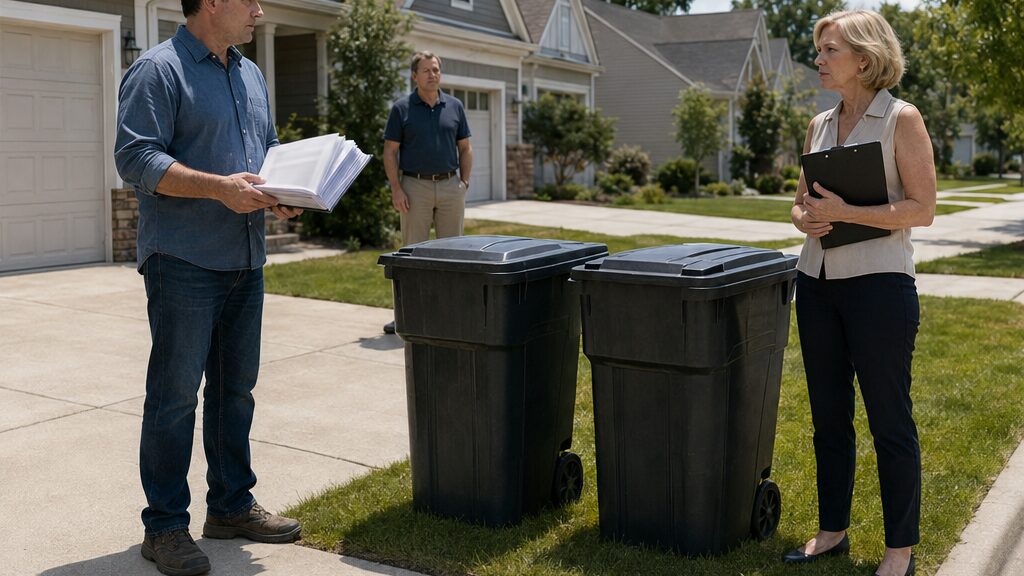
Barbara Hill was photographing Richard Thomas’s trash cans when he opened his garage.
She stood at the edge of his driveway with her phone raised in one hand and a clipboard tucked against her hip. The two dark plastic bins were beside the garage wall where Richard had kept them since moving into the neighborhood three years earlier.
“Morning,” Richard said.
Barbara lowered the phone.
“You received the notice?”
“What notice?”
She looked surprised by the question, as though the envelope should have reached him before she did. “Trash receptacles visible from the street.”
Richard glanced at the bins, then toward the street.
From the sidewalk, half of one lid was visible beyond a hedge.
“That’s where they’ve always been.”
Barbara gave the restrained smile she used at HOA meetings when someone had misunderstood a procedure.
“That doesn’t make it compliant.”
Richard had known Barbara for almost two years. They had never had an argument. She chaired the association’s compliance committee, organized the spring cleanup reminders, and seemed to notice things other people walked past without seeing: grass growing over sidewalks, basketball hoops left at the curb, holiday decorations that stayed up beyond the approved date.
Usually Richard admired people who paid attention.
He worked for the city reviewing maintenance contracts. Most problems he encountered at work existed because someone had stopped paying attention.
Barbara tore a sheet from the clipboard and handed it to him.
The number near the bottom caught his eye first.
Seventy-five dollars.
“For that?”
“For the violation.”
Richard read the description twice.
Trash receptacles visible from common roadway.
He looked at Barbara. “You said visible from the street.”
“That’s what it means.”
“Maybe.”
Her expression tightened slightly.
Richard could have challenged her then. He noticed the wording immediately because wording was what he did for a living. A contract could say “inspect” when someone meant “maintain.” It could say “upon request” when a department behaved as though it said “monthly.” One careless phrase could move thousands of dollars.
But this was his driveway.
His neighborhood.
He had no desire to turn Monday morning into an argument over garbage cans.
“What do you want me to do?”
“Keep them screened from view.”
“They’re behind the hedge.”
“Not completely.”
Richard folded the notice once.
Barbara lifted the clipboard against her chest. “I’m not trying to make this difficult.”
“I know.”
He wasn’t sure he did.
She walked toward the next house, and Richard rolled both bins six inches closer to the garage.
That evening, he paid the seventy-five dollars online.
He told himself he was purchasing peace.
Two days later, Kevin Martin stood at the low fence between their yards while Richard dragged the bins back after collection.
“Heard you got tagged,” Kevin said.
Richard stopped.
“How?”
Kevin gave him a look that answered the question without naming anyone.
“Barbara?”
“She mentioned compliance was getting stricter.”
Richard placed the first bin beside the second.
“This spot look different to you?”
Kevin squinted theatrically. “Compared with what?”
“Last month.”
“No.”
“Last year?”
Kevin shook his head. “You’ve always kept them there.”
Richard looked down the street. Three other houses had bins partly visible beside garages or fences. One blue recycling cart stood completely exposed near a mailbox.
Kevin followed his gaze.
“Don’t do that,” he said.
“Do what?”
“Start comparing.”
Richard laughed once.
Kevin didn’t.
“I’m serious. Pay it, move the cans, forget it. You don’t want to become a project.”
Richard rested his hands on the bin handles.
“A project?”
Kevin shrugged. “You know how these things go.”
Richard did know, which was exactly why he had paid.
At work, he could challenge a department head over six figures because the procedures were clear and the disagreement belonged inside a system. At home, consequences traveled differently. They appeared at mailboxes, board meetings, driveways. People remembered who said what.
He moved the bins another few inches inward.
Before going inside, he walked to the curb and looked back.
The hedge blocked most of them. Only the upper corners were visible.
He took a picture.
Not because he planned to fight.
Just because taking a picture was easier than wondering later.
Friday afternoon, an HOA envelope arrived.
Richard opened it over the kitchen counter.
The violation language was almost identical.
Trash receptacles visible from common roadway.
Another seventy-five dollars.
He pulled Monday’s notice from the recycling pile and placed the two sheets side by side.
The dates were different.
The amount was the same.
The violation was the same.
But something else bothered him.
Barbara had told him the rule required the bins to be screened from view.
The notice did not say that.
It said visible from common roadway.
Richard opened the association website and found the section on refuse containers. The language was broader than the notice and narrower than Barbara’s explanation.
Containers were required to be stored in a manner minimizing visibility from streets and neighboring lots except during collection periods.
Minimizing.
Not eliminating.
He read it again.
That single word turned irritation into something less comfortable.
Richard walked outside with both notices.
The bins were still tucked behind the hedge.
He stood at the curb exactly where Barbara had stood Monday morning. From there, one lid corner showed through the leaves.
He opened the photo he had taken Wednesday.
Same position.
Then he found an older photograph on his phone from the previous summer. He had taken it because a storm had knocked a branch across the driveway.
The trash bins were visible in the background.
Same wall.
Same hedge.
Same position.
For three years, no one had said anything.
Richard slipped the phone back into his pocket.
He was still standing there when Barbara’s car turned the corner.
She slowed slightly as she passed.
Richard raised one hand in greeting.
Barbara did the same.
Nothing about the gesture was openly hostile.
That somehow bothered him more.
He went inside and placed the second fine beside the first.
For the first time, he stopped wondering how to make the trash cans compliant.
He started wondering what rule Barbara was actually enforcing.
Chapter 2: Every Fine Changed the Rule
The third envelope did not contain another seventy-five-dollar charge.
It contained a repeat-offense penalty for one hundred twenty-five.
Richard stood at the kitchen counter with the envelope still open in his hand.
The bins had not moved.
That was the part he could not stop returning to.
He had paid the first fine, shifted them closer to the garage, photographed the location, and left them there. The second notice had described the same offense. Now the third notice called his behavior repeated noncompliance.
He called the HOA management office before he could talk himself out of it.
The property manager answered after several rings.
Richard gave his address and account number.
“I’m trying to understand exactly what I’m supposed to correct.”
There was a pause while keys clicked.
“Trash receptacle screening.”
“That’s not what the notice says.”
Another pause.
“What does your notice say?”
“Visible from common roadway.”
“That’s the compliance category.”
“Barbara told me the cans have to be completely screened.”
The manager hesitated.
“Our governing documents say receptacles should be stored to minimize visibility.”
Richard leaned against the counter.
“Minimize.”
“Yes.”
“Not eliminate.”
“I’d have to refer interpretation questions to the compliance committee.”
Richard stared at the envelope.
“Barbara chairs that committee.”
“Yes.”
“So the person who issued the violation is also the person who decides what the violation means?”
“I wouldn’t characterize it that way.”
Richard almost smiled.
At work, that phrase usually meant someone knew exactly how a situation looked.
He thanked the manager and ended the call.
For a minute, he considered paying the one hundred twenty-five dollars.
The payment portal was already open on his laptop.
He could afford it.
That was part of the trap.
One hundred twenty-five dollars was irritating, not devastating. It was just low enough to encourage surrender. Pay it, forget it, keep the peace.
Kevin’s advice had sounded reasonable because Richard had spent years giving himself the same advice in other forms.
At the city, he had once participated in an audit that uncovered sloppy billing on a maintenance contract. The numbers were real, but a supervisor in another department turned the findings into a public argument over competence and blame. By the time the matter ended, people cared less about fixing the contract than proving who had embarrassed whom.
Richard had learned something from that experience.
Evidence could solve a problem.
Visibility could create ten more.
He entered his card information.
Then he stopped before clicking Submit.
Instead, he opened a blank spreadsheet.
Date.
Notice amount.
Violation wording.
Bin location.
Contact.
Response.
He entered the first three fines.
By the time he finished, the page looked absurdly formal for a dispute involving two plastic containers.
Still, the irritation in his chest eased.
Documentation gave shape to things.
The following Saturday, Barbara approached while Richard was trimming the hedge.
“You received the latest notice?”
“I did.”
She watched him put down the clippers.
“The board doesn’t want this escalating.”
Richard wiped his hands on his jeans. “Neither do I.”
“Then move the receptacles behind the fence.”
“That isn’t what the rule says.”
Barbara’s posture changed.
Only slightly.
“The rule is meant to keep receptacles out of public view.”
“It says minimize visibility.”
“You’re arguing wording.”
“I’m asking what standard you’re enforcing.”
She exhaled through her nose.
“Richard, everybody understands what the rule means.”
He looked past her.
Across the street, a green waste cart was visible beside another garage.
Barbara followed his eyes, then looked back at him.
“If you have concerns about another property, submit them separately.”
“I don’t.”
“Then we’re talking about yours.”
He nodded.
That was the first moment Richard stopped believing this was merely a misunderstanding.
Barbara continued, quieter now.
“You’re making something simple complicated.”
Richard glanced at the hedge.
“No. I think it was already complicated.”
She left without answering.
On Monday, another envelope arrived.
Richard almost laughed when he opened it.
The amount near the bottom was two hundred seventy-five dollars.
The notice warned that continuing unpaid violations could result in additional collection measures under association policy.
He read the sentence twice.
Then a third time.
The argument had changed.
It was no longer seventy-five dollars for bins.
The association had begun creating a record that described him as deliberately noncompliant.
Richard opened his spreadsheet and added another row.
He attached photographs.
Then he created a folder on his computer called HOA.
Inside it went every notice, every date, and notes from his conversation with management.
He did not call Barbara.
He did not call the property manager.
He did not pay.
That evening Kevin came over carrying a package mistakenly delivered to his house.
“You still fighting the garbage war?”
“I’m not fighting.”
Kevin handed him the box. “That’s what people who are fighting always say.”
Richard showed him the newest notice.
Kevin’s expression changed at the amount.
“Two seventy-five?”
“Apparently.”
“For the same cans?”
“Apparently.”
Kevin handed the paper back.
“I’d just move them behind the fence.”
“There isn’t enough clearance on collection morning without dragging them through the side gate.”
“So drag them.”
Richard looked at him.
Kevin lifted both hands.
“I’m not saying they’re right. I’m saying you live here.”
That sentence stayed with Richard after Kevin left.
You live here.
As though home required a different standard of truth than work.
Richard sat at his desk after dinner and reopened the association website.
For the first time, he ignored the payment portal.
He downloaded the full governing documents.
The file ran more than eighty pages.
He printed the sections dealing with architectural standards, common areas, maintenance responsibilities, enforcement authority, and refuse containers.
The printer worked steadily beside him.
Paper slid into the tray one page at a time.
Richard picked up a pen.
He had spent two weeks trying to make the problem disappear.
Now he wanted to know exactly what the documents said.
Chapter 3: The Strip of Grass They Forgot
Richard found the sentence at 10:47 that night.
He had already read the refuse section three times when a cross-reference sent him backward into the maintenance provisions.
There, halfway down a page describing association responsibilities, was the narrow strip of land he had walked past every day without thinking about it.
The association maintained landscaping between the curb and designated residential boundaries where recorded plat conditions assigned that strip to common maintenance.
Richard read it again.
Then he pulled up the neighborhood plat available through the county property database.
His driveway ended at his property boundary.
The narrow landscaped strip between that boundary and the curb was maintained by the association.
Barbara had told him the bins could not remain visible beside the garage.
The written refuse rule required him to minimize visibility while stored.
Nothing in that section prohibited placement on collection days within the maintained strip.
He leaned back.
It was not a loophole in the dramatic sense.
It was simply two provisions Barbara had been treating as though only one existed.
Richard should have felt satisfied.
Instead, he felt the familiar caution that came whenever a document appeared to give him exactly the answer he wanted.
He checked the definitions section.
Then the enforcement section.
Then the landscaping map again.
At 11:32, he closed the laptop.
The next afternoon was collection day.
Richard rolled both bins past the hedge and stopped them on the narrow grass strip near the curb, carefully clear of the sidewalk and driveway entrance.
He measured the distance from the pavement.
Then he stepped back.
They looked almost aggressively ordinary.
Two dark plastic bins on green grass.
Nothing about them justified the amount of paper they had generated.
Kevin came outside while Richard was taking a photograph.
“What are you doing?”
“Following the documents.”
Kevin stared at the bins.
“That looks more visible.”
“It is.”
Kevin laughed in disbelief. “You’ve lost your mind.”
“The association maintains this strip.”
“So?”
“The rule she keeps citing applies to storage visibility. On collection day, these can be here.”
“You’re testing her.”
Richard shook his head. “I’m testing the rule.”
“That distinction is not going to matter to Barbara.”
Richard knew that.
He also knew he had reached the point where continuing to guess at Barbara’s preferred interpretation would teach him nothing.
At three twenty that afternoon, Barbara appeared.
Richard saw her through the front window.
She stopped on the sidewalk.
Looked at the bins.
Looked toward the house.
Then pulled the clipboard from under her arm.
Richard stepped outside carrying the printed governing documents.
Barbara’s mouth tightened when she saw them.
“You moved them.”
“Yes.”
“They’re completely visible now.”
“They’re out for collection.”
“That doesn’t mean you can store them on association property.”
“I’m not storing them.”
“You know what you’re doing.”
Richard stopped at the edge of the driveway.
“What am I doing?”
“Trying to prove a point.”
“I’m trying to follow the rule you’re enforcing.”
Barbara tapped the clipboard.
“The rule requires receptacles to be kept from public view.”
Richard opened the document.
“No. It says stored to minimize visibility except during collection periods.”
“You’re parsing language.”
“I’m reading it.”
She stared at him.
The neighborhood was quiet enough that Richard could hear a lawn sprinkler clicking two houses away.
He turned one page.
“This strip is maintained by the association.”
Barbara looked at the grass.
“That doesn’t make it yours.”
“I didn’t say it did.”
“So now you’re putting personal property in a common area.”
Richard felt something inside him go still.
“Which section prohibits that during collection?”
Barbara did not answer immediately.
That pause mattered more than Richard expected.
Until then, every conversation had followed the same pattern: Barbara stated the rule, Richard questioned it, Barbara spoke with greater certainty.
Now she looked down at her clipboard.
Then at the documents in his hand.
“You think because you found a phrase in the covenants, you understand how the community operates?”
“No.”
His answer seemed to surprise her.
Richard continued.
“That’s why I’m asking you for the section.”
Barbara’s face colored.
“I’ve lived here twelve years.”
“I know.”
“I’ve served on this board for eight.”
“I know.”
“We had people leaving boats in driveways, cans at the curb all week, dead shrubs for months. Everyone complains when standards slip, but nobody wants to be the person enforcing them.”
Richard lowered the papers slightly.
For the first time, Barbara did not sound like a compliance chair.
She sounded tired.
“I’m not asking you not to enforce rules.”
“Then stop challenging every decision.”
“I’m asking you to show me the decision in the rules.”
The tiredness disappeared behind her expression.
She wrote something on the clipboard.
Richard watched.
“What are you writing?”
“A compliance note.”
“For what?”
“Unauthorized use of common area.”
He almost thought he had misheard her.
“You just changed the violation.”
“No. The circumstances changed.”
“The bins didn’t.”
“The location did.”
“Because the original location was supposedly wrong.”
Barbara tore the page free.
“This is exactly the problem.”
Richard took the notice.
A two-hundred-dollar charge appeared beneath the new violation category.
He read it slowly.
The anger arrived, but it did not feel hot.
It felt precise.
He looked at Barbara.
“Was this category ever mentioned in any of the earlier notices?”
“You weren’t using the common area earlier.”
“So when I comply with your interpretation of one provision, another one appears.”
“You are not complying. You are looking for ways around compliance.”
Richard glanced down at the bins.
A garbage truck turned onto the far end of the street.
For several seconds neither of them spoke.
Then Richard folded the notice and placed it inside the governing documents.
Barbara looked toward the approaching truck.
“You could make this easier.”
“So could you.”
She walked away.
The truck stopped in front of Richard’s house minutes later. A mechanical arm lifted the first bin, emptied it, and set it back on the grass.
Richard stood at the driveway watching something utterly routine happen exactly where Barbara had just declared it improper.
Kevin crossed the street after the truck moved on.
“Well?”
Richard handed him the new notice.
Kevin read the category.
His eyebrows rose.
“They can do that?”
Richard looked toward Barbara’s house.
“I don’t know.”
That evening he placed the new fine beside the earlier notices.
Four categories and amounts stared back at him from the desk.
Seventy-five.
Seventy-five.
One twenty-five.
Two seventy-five.
Now two hundred for something different.
Richard opened his spreadsheet.
He entered the new violation.
Then he stopped.
At work, when one requirement changed every time a contractor met the previous requirement, Richard stopped treating the problem as performance.
He started reviewing the system that produced the requirement.
He opened the HOA folder.
For the first time, he clicked past enforcement rules and began looking for budgets, vendor contracts, maintenance obligations, and board-approved expenditures.
If Barbara was willing to change the rule rather than admit the first interpretation had failed, Richard wanted to know what else the association had stopped examining closely.
Chapter 4: Richard Started Reading the Numbers
One landscaping total stopped Richard in the middle of entering a formula.
He had expected to find procedural clutter.
Instead, the annual figure in the HOA budget was large enough that he checked whether he had misread the line.
Landscaping and grounds maintenance: forty-eight thousand dollars.
Richard leaned closer to the screen.
The number itself was not automatically suspicious. The neighborhood had common entrances, strips of grass along several streets, a clubhouse lawn, tree beds, seasonal trimming, irrigation checks, and enough shrubs to keep a crew busy.
But Richard had been walking those same streets for three years.
Forty-eight thousand felt high.
He opened the prior year’s budget.
The figure was almost identical.
Then the year before that.
Again, nearly the same.
He sat back.
The trash-bin folder remained open in another window. Five notices now sat inside it, scanned and named by date.
For the first time, the fines looked small.
Not unimportant.
Small.
Richard found the most recent annual financial statement and searched for vendor details. The association listed landscaping as a contracted service, but the summary did not show enough detail to identify the underlying scope.
He checked the board meeting archives.
Minutes were available for most months, though they were brief.
Landscape renewal approved.
Seasonal enhancement approved.
Irrigation adjustment approved.
The same phrases appeared repeatedly without prices attached.
Richard rubbed his forehead.
This was exactly the kind of record that could look suspicious while being perfectly ordinary.
A budget line was not proof.
Neither was vague meeting language.
He needed the contract.
The HOA website did not provide it.
The next morning, Richard stopped by the city records office before work. The neighborhood itself was privately managed, but certain common-area maintenance records overlapped with permits, drainage responsibilities, and public-right-of-way coordination. If the landscaping contractor had performed work affecting those areas, some documents might exist outside the HOA files.
The clerk listened while Richard explained what he was looking for.
“Not HOA financial records,” Richard clarified. “Anything tied to maintenance permits, right-of-way work, irrigation modifications, contractor registrations. I’m trying to understand scope.”
The clerk nodded slowly.
“You doing this for the city?”
“No.”
That answer seemed to interest her.
“For your house?”
“For my neighborhood.”
She gave him a look that suggested she had heard much stranger reasons.
“I can pull contractor filings by address range.”
“That would help.”
Richard went to work and tried not to think about it.
He failed.
During lunch he opened his personal spreadsheet and began building a second tab.
Budgeted amount.
Identifiable contract work.
Public filings.
Known maintenance areas.
He hated himself a little for enjoying the structure of it.
Numbers were cleaner than people.
People could say one thing and mean another. Numbers could be wrong, incomplete, even manipulated, but they still had relationships. If one figure moved, another figure usually had to explain why.
That afternoon, the clerk emailed several documents.
Richard printed them after dinner.
The first batch was disappointing.
Tree trimming.
Irrigation work.
A small drainage repair.
Seasonal planting approvals.
Then he found a contractor registration that matched the company named indirectly in an older board packet.
He searched the company through available county filings and public bid references.
Nothing directly gave him the HOA contract.
But enough pieces existed to sketch the work.
Routine mowing.
Edging.
Shrub maintenance.
Seasonal cleanup.
Irrigation inspection.
He began estimating—not what the work should cost, but what scope had actually been documented.
That distinction mattered.
Richard had seen auditors ruin their own credibility by comparing contract prices to what they personally thought something ought to cost.
He refused to do that.
He wanted documents.
At nine fifteen, he found a maintenance attachment buried in an HOA meeting packet from eighteen months earlier.
It referenced a base service amount significantly lower than the current annual landscaping budget.
Richard froze.
He read the attachment again.
Then checked the date.
Then checked whether it had been superseded.
A later renewal notice increased the amount.
Another amendment added seasonal services.
Another added irrigation work.
The numbers climbed.
But even after Richard stacked every identifiable addition, the total remained far below forty-eight thousand.
He wrote the figures by hand on a yellow pad.
Base service.
Seasonal additions.
Irrigation.
Tree allowance.
Estimated authorized total.
He added them.
Then did it again.
There was a gap.
Not necessarily missing money.
Not yet.
But a gap.
Richard walked to the kitchen and poured water.
Through the window, he could see the top of one trash bin beside the garage wall.
The thing had started all of this.
He almost laughed.
Instead, he returned to the desk.
The next morning, he called the HOA management office.
“I’d like the current landscaping contract and amendments.”
The property manager paused.
“Those documents usually require a formal records request.”
“Send me the procedure.”
“What is this regarding?”
“Association expenditures.”
Another pause.
“Is this still about the receptacle violations?”
Richard looked at the spreadsheet.
“No.”
The answer came out before he could soften it.
The manager gave him an email address and a form.
Richard submitted the request that afternoon.
Three days passed.
Then four.
On the fifth day, the management office sent a partial response.
He received budget summaries, several invoices, and two contract amendments.
Not the complete original agreement.
Richard compared the invoices.
Several were straightforward.
Monthly maintenance.
Seasonal color.
Irrigation repair.
Then he found descriptions that bothered him.
“Enhanced common-area service.”
“Landscape improvement allocation.”
“Supplemental grounds support.”
No locations.
No quantities.
No detailed scope.
One invoice had been approved for the same rounded amount three months in a row.
Richard checked the board minutes.
No corresponding discussion.
He opened his spreadsheet and began matching invoice dates against visible approvals.
A pattern formed slowly.
The HOA had budgeted close to forty-eight thousand dollars annually.
The documentation Richard could trace clearly accounted for substantially less.
He resisted calculating the difference until he had reviewed everything twice.
Then he did.
Approximately twenty-two thousand dollars.
Richard stared at the number.
His first reaction was anger.
His second was embarrassment at the anger.
He knew better.
A discrepancy was not theft.
It could be bundled services.
Insurance.
Emergency work.
Automatic renewals.
Administrative pass-through charges.
Bad recordkeeping.
Any of those explanations would be less dramatic and more likely than deliberate corruption.
He wrote one sentence above the calculation.
Unreconciled difference—not evidence of misuse.
Then he underlined it.
The distinction did not make the number less important.
It made Richard more careful.
That night Kevin stopped by while Richard was bringing the bins in.
“You still on this?”
Richard rolled the second bin beside the garage.
“It got bigger.”
Kevin frowned.
“What got bigger?”
Richard hesitated.
This was the line he normally avoided crossing.
Once information left his desk, it became social.
Once it became social, people chose sides.
“I’m looking at the landscaping budget.”
Kevin blinked.
“What does that have to do with your cans?”
“I don’t know yet.”
“That sounds like a bad answer.”
“It’s the accurate one.”
Kevin studied him.
“How much?”
Richard looked toward the houses across the street.
“Enough that I don’t want to guess.”
Kevin did not ask again.
After he left, Richard sat down at his desk and reopened the calculation.
Forty-eight thousand.
Documented scope below that.
A possible difference near twenty-two thousand.
He placed the original seventy-five-dollar violation beside the printed invoices.
The fine had annoyed him because Barbara would not explain her standard.
The invoices bothered him for the same reason.
Too much authority.
Not enough explanation.
Richard closed the calculator and looked at the figure one last time.
Twenty-two thousand dollars was large enough to demand an answer.
It was also large enough to punish anyone who asked the question carelessly.
Chapter 5: The Money Was Wrong, But Not How He Expected
“Your twenty-two thousand is wrong.”
Lisa Campbell said it before Richard had fully sat down.
They were at a corner table in the HOA management office, a stack of financial packets between them. Lisa wore reading glasses low on her nose and had already marked several pages with sticky tabs.
Richard placed his notebook on the table.
“How wrong?”
“Enough that you shouldn’t say it publicly.”
He nodded once.
That was not the reaction Lisa expected.
“You’re not going to argue?”
“If I’m wrong, I want to know where.”
Lisa removed her glasses.
“I thought you were coming in here convinced somebody stole money.”
“I’m not convinced of that.”
“You requested three years of records.”
“Because the numbers don’t reconcile.”
“That is not the same thing.”
“I know.”
Lisa looked at him for another second, then pushed the first packet across the table.
“Some landscaping costs are bundled through the management agreement. You counted the contractor’s base scope but not several pass-through services.”
Richard opened the packet.
Lisa pointed.
“Mulch delivery. Storm cleanup reserve. Irrigation monitoring.”
He read each line.
“Those aren’t in the landscaping contract.”
“No. They’re billed under management and allocated back.”
“Why?”
“That’s how it was set up.”
Richard wrote the amounts in his notebook.
The twenty-two-thousand-dollar gap began shrinking.
He should have felt relieved.
Part of him did.
Another part noticed the phrase Lisa had used.
That’s how it was set up.
Not why.
He kept reading.
By the time they finished the first packet, nearly nine thousand dollars of his unexplained total had legitimate supporting documents.
Lisa leaned back.
“See?”
“Yes.”
“So this isn’t what you thought.”
Richard made another calculation.
“No. It isn’t.”
Her shoulders loosened.
Then Richard turned to the next invoice.
“But this still leaves more than twelve thousand I can’t tie to defined work.”
Lisa’s shoulders stiffened again.
“That doesn’t mean it’s missing.”
“I didn’t say missing.”
“You keep using words that sound better than what you mean.”
“I said I can’t tie it to defined work.”
He slid the invoice toward her.
“Enhanced common-area service. What was enhanced?”
Lisa looked at the description.
“I’d have to check.”
“Where?”
“The vendor files.”
“Were those checked before payment?”
She did not answer.
Richard waited.
Lisa looked toward the glass wall of the management office. The property manager was at another desk, far enough away not to hear them.
Finally she said, “Invoices come through management. I review the totals against budget categories.”
“Do you review the work against contract scope?”
“Not every month.”
“How often?”
Lisa tapped one fingernail against the paper.
Richard recognized the gesture.
People often did something small when they were about to answer a question they wished had not been asked.
“I don’t know.”
He stopped writing.
“You’re the treasurer.”
“I know what my title is.”
Her irritation was immediate and real.
Richard regretted the sentence as soon as he said it.
“Sorry.”
Lisa folded her arms.
“No, you’re not wrong. That’s the problem.”
She pulled the glasses off again.
“When I joined the board, I thought treasurer meant watching the accounts. Bank balance, reserves, delinquent assessments, whether bills got paid. The contractor was already in place. Management told us the renewal was routine.”
“Automatic?”
“Mostly.”
Richard glanced at the amendments.
“Mostly?”
“The base agreement renews unless notice is given. Add-ons get approved separately.”
“By the board?”
“Sometimes by email. Sometimes by the property manager if they fit an existing budget category.”
Richard felt the shape of the problem changing.
This was not a clean story.
Clean stories were easier.
Someone took money.
Someone lied.
Someone got caught.
What Lisa was describing was messier.
People inheriting a system.
Approvals becoming habits.
Rounded totals becoming normal because they had appeared the year before.
He asked, “When did anyone last reconcile the full contract scope against the invoices?”
Lisa stared at him.
Richard let the silence answer.
“That’s not good,” he said.
“No.”
“Do you have the original contract?”
Lisa looked down.
“Yes.”
“I requested it.”
“I know.”
“You didn’t send it.”
“Management handled your request.”
“Can I see it?”
She hesitated.
Then stood.
“I’ll get it.”
When she returned, the contract was thicker than Richard expected.
He spent twenty minutes reading without speaking.
The automatic renewal clause was clear.
So were several service definitions.
Others were broad enough to allow interpretation.
There were allowances.
Price escalators.
Optional services.
Richard compared the contract to his notes.
His original twenty-two-thousand-dollar discrepancy fell further.
But several invoices still lacked obvious support.
Not twenty-two thousand.
Not even close.
Still enough to matter.
“I would’ve embarrassed myself at the meeting,” he said.
Lisa looked surprised.
“What?”
“If I’d said twenty-two thousand was unexplained.”
“You would’ve been wrong.”
“Yes.”
Richard crossed the number out on his notebook.
Not lightly.
Completely.
Lisa watched him do it.
“You don’t mind?”
“I mind being wrong.”
“I meant losing the bigger number.”
He understood what she was asking.
Some people became attached to findings because findings gave them purpose.
Richard had seen that too.
“I’m not trying to win.”
Lisa gave a tired laugh.
“Everyone says that before an HOA meeting.”
He almost smiled.
Then she pulled one invoice from the stack.
“This one bothers me.”
Richard leaned closer.
The charge was for supplemental grounds support.
“What is it?”
“I don’t know.”
“Then why was it paid?”
Lisa looked uncomfortable.
“Because it had been paid before.”
Richard sat back.
There it was.
Not theft.
Not conspiracy.
Habit.
He went through six months of invoices with her.
By the end, they identified three charges that required clarification and two services that appeared repeatedly under vague descriptions. None proved misuse. All demonstrated that no one had recently forced the vendor’s billing back against the actual agreement.
Richard began organizing his notes.
“Someone should have done this earlier.”
Lisa did not respond.
He looked up.
She was studying one of the old board packets.
“What?”
Lisa pressed her lips together.
“Barbara asked about these.”
Richard stopped.
“When?”
“Last fall.”
“Before my fines?”
“Yes.”
“What did she ask?”
“She wanted to know why landscape expenses kept rising when the visible work didn’t seem different.”
Richard stared at her.
“What happened?”
“We talked about rebidding.”
“And?”
“Management said changing vendors could cause service disruptions. We were heading into budget season. There were complaints about weeds at the entrance, irrigation failures near the clubhouse.”
“So you renewed.”
Lisa nodded.
“Barbara pushed for a review again in January.”
Richard thought about the dates.
His first trash-bin violation had come months later.
“She knew there were questions.”
“She knew there were questions about the contract.”
“Why didn’t she keep pushing?”
Lisa’s expression hardened.
“You should ask her.”
“I’m asking what happened in the room.”
Lisa closed the folder.
“What happened was everyone was tired.”
Richard waited.
“We had homeowners angry about dues. Other people angry about enforcement. One board member wanted to resign. Barbara said if we opened the contract issue without having answers, people would assume something was wrong before we knew whether anything was wrong.”
Richard looked at the stack between them.
“So she chose not to ask.”
“She chose to wait.”
“Until when?”
Lisa gave him a small, humorless smile.
“That was the problem.”
Richard took the documents home.
That night, the original violation notices remained at one corner of his desk while a new document took shape in front of him.
Four pages.
Page one: enforcement timeline.
Page two: governing-document conflicts.
Page three: landscaping contract structure.
Page four: questions requiring board review.
He removed the twenty-two-thousand-dollar claim entirely.
In its place, he wrote that his initial calculation had failed to include bundled and pass-through services.
Then he listed the remaining unresolved charges.
It made the summary less dramatic.
It also made it stronger.
Richard read the four pages twice.
His anger at Barbara had changed.
That bothered him more than anger itself.
She had not invented the financial problem.
She had noticed part of it.
Then she had chosen not to force the issue.
Months later, when Richard challenged her interpretation of a trash-can rule, she had become even more rigid.
He looked at the bins through the dark window.
Maybe Barbara’s obsession with compliance had never been only about the bins.
Maybe order was the one part of the association she still believed she could control.
Richard printed the four-page summary.
At the bottom of the final page, he left one question for himself.
If Barbara already knew the system had weak spots, why had she become harsher with everyone who pointed at them?
Chapter 6: Barbara Had Her Own Version of Order
“I’ll cancel every fine.”
Barbara said it in the clubhouse hallway the evening before the open meeting.
Richard stopped walking.
She stood beside the bulletin board with a folder pressed against her ribs. The main meeting room was empty behind her, chairs already arranged in rows for the following night.
“What?”
“Your fines.”
Barbara kept her voice low.
“The seventy-five-dollar notices. The repeat penalties. The common-area violation. All of it.”
Richard looked at her.
“What changed?”
“Nothing changed.”
“Then why cancel them?”
She glanced toward the office door.
“Because this has gone too far.”
Richard almost laughed.
Instead, he shifted the four-page summary under his arm.
Barbara noticed it.
Her eyes stayed on the pages.
“You’re planning to present that tomorrow.”
“Yes.”
“Don’t.”
The word came without hesitation.
Richard felt his pulse change.
“What are you asking me to do?”
“I’m asking you to handle your complaint through the board instead of turning an open meeting into a spectacle.”
“It is through the board.”
“You know what I mean.”
“I don’t.”
Barbara looked at him sharply.
“Yes, you do.”
Richard had spent enough years avoiding confrontations to recognize the moment when leaving would be easier.
He could say they would discuss it tomorrow.
He could go home.
He could accept the cancellation.
Every practical incentive pointed in that direction.
No fines.
No collections.
No microphone.
No neighbors staring at him like he had appointed himself the association’s prosecutor.
“What happens to the landscaping review?” he asked.
Barbara’s jaw tightened.
“That is separate.”
“Is it?”
“Yes.”
“The same board that can’t explain which rule I violated is supposed to explain invoices nobody reconciled?”
“You’re combining issues.”
“Because they have the same problem.”
“And what problem is that?”
Richard looked at her.
“Nobody wants to admit the process failed.”
For a moment Barbara said nothing.
Then she opened the clubhouse door and gestured toward the hallway outside.
“Walk with me.”
They went through the side exit into the parking lot.
A few cars passed on the residential street beyond the trees. Somewhere behind the clubhouse, irrigation clicked on with a sudden hiss.
Barbara stopped beside her car.
“You think I enjoy this?”
“I don’t know what you enjoy.”
“That’s unfair.”
“Probably.”
The answer seemed to disarm her more than denial would have.
Richard leaned against the hood of his own car.
Barbara stared toward the clubhouse.
“When I joined the board, half the neighborhood complained there was no enforcement.”
Richard remained quiet.
“People left trailers in driveways. Lawns died. One homeowner ran extension cords across a sidewalk for months. Everybody wanted standards until they got a notice themselves.”
“I understand that.”
“No, you understand contracts.”
Her voice was not mocking.
It was weary.
“I understand what it’s like to be the person everyone expects to say no,” she continued. “Then when you say no, they make you the problem.”
Richard thought of his supervisor years earlier, the audit meeting where a billing issue had become an argument about reputations.
Barbara folded her arms.
“People think the board is some machine. It isn’t. It’s five tired people answering emails after dinner.”
“That doesn’t make the rules say something they don’t.”
“I know.”
Richard looked at her.
It was the first time she had said it.
Not maybe.
Not interpretation.
I know.
Barbara looked down at the pavement.
“The trash rule should have been clearer.”
“And the common-area fine?”
She closed her eyes briefly.
“That was my call.”
“Why?”
“Because you moved the bins out there after I told you to screen them.”
“Which the documents did not require.”
“I thought you were daring me.”
Richard almost answered immediately.
Then he didn’t.
Because, if he was honest, part of him had been testing her.
Not daring.
But testing.
“That wasn’t entirely wrong,” he said.
Barbara looked surprised.
“I wanted to know whether the rule mattered more than your interpretation.”
“And?”
“You changed the violation.”
She looked away.
The irrigation hiss continued behind them.
Finally Barbara said, “I should not have done that.”
Richard felt no triumph.
Only a strange reduction in pressure.
Barbara opened her folder.
Inside were copies of financial summaries Richard recognized.
“You talked to Lisa.”
“Yes.”
“She told you about the contract.”
“Yes.”
Barbara’s fingers tightened around the folder.
“I saw those invoice descriptions last fall.”
Richard waited.
“I asked management for clarification. They gave me enough explanation to make it plausible.”
“Not enough to verify it.”
“No.”
“Why stop?”
Barbara’s voice dropped.
“Because everything else was already coming apart.”
She told him about the budget meeting where homeowners accused the board of wasting dues. The resignation threat from another board member. The complaints over landscaping, parking, late fees, fences, and dogs.
“I thought if we opened another issue before we understood it, people would decide the entire board was incompetent.”
“Were they wrong?”
Barbara gave him a hard look.
Then something in her expression broke into tired amusement.
“Sometimes I really don’t like you.”
Richard nodded. “Fair.”
She looked back toward the clubhouse.
“I told myself we’d review the contract after budget season.”
“But you didn’t.”
“No.”
“And then?”
“There was always something else.”
Richard knew that excuse.
It was almost identical to his own.
He had paid the first fine because there was always an easier way to avoid conflict.
Barbara had postponed the contract review for the same reason.
Different sides of the same weakness.
“You could say that tomorrow,” Richard said.
She shook her head immediately.
“No.”
“Why?”
“Because the minute I say I knew there were questions, nobody will hear the rest.”
“That may be true.”
“They’ll say I covered something up.”
“Did you?”
Barbara stared at him.
“I didn’t steal anything.”
“I didn’t ask that.”
Her face hardened.
Richard regretted the phrasing but not the question.
Barbara looked down at the folder.
“I knew there was weak oversight.”
There it was.
Not theft.
Not secret profit.
A smaller truth with larger consequences.
“And you chose not to push it.”
“Yes.”
Richard let the silence sit.
Barbara looked at the four pages under his arm.
“Leave the financial section off tomorrow’s agenda. Let us review it privately first.”
“And my fines disappear.”
“Yes.”
The offer was practical.
Almost generous.
Richard could feel the attraction of it.
He imagined waking the next morning with nothing to prove. No balance owed. No threat of collections. No need to stand in front of neighbors who might misunderstand everything he said.
A month earlier, he would have accepted before Barbara finished the sentence.
He looked toward the clubhouse doors.
“What about everyone else’s fines?”
“This isn’t about everyone else.”
“What about next year’s contract?”
“We’ll review it.”
“When?”
Barbara’s answer did not come quickly enough.
Richard nodded.
“That’s the problem.”
Her face tightened.
“You want to embarrass me.”
“No.”
“Then what do you want?”
Richard thought about the answer before giving it.
“I want the rule to mean the same thing when I read it as when you enforce it. And I want forty-eight thousand dollars to be explainable without somebody having to start a fight first.”
Barbara’s eyes dropped.
Richard continued.
“I’ll say my twenty-two-thousand-dollar calculation was wrong.”
She looked up.
“You will?”
“Yes.”
“Even after all this?”
“Especially after all this.”
Barbara studied him as if the admission changed something.
Maybe it did.
Richard opened the car door.
“Cancel the fines if they’re wrong.”
“They are.”
“Then cancel them because they’re wrong. Not because I stay quiet.”
Barbara did not answer.
The next evening, Richard returned to the clubhouse.
Cars filled most of the lot.
Through the front windows he could see homeowners taking seats.
Kevin stood near the entrance, hands in his pockets.
“You actually doing this?”
Richard looked down at the four-page summary.
For years, paper had been the place he put conflict so he would not have to carry it himself.
Tonight the pages felt different.
“Yes.”
Kevin held the door open.
Inside, Barbara was already seated at the board table.
She looked up as Richard entered.
Neither of them smiled.
Richard walked past the rows of neighbors, carrying four pages that could no longer solve anything while they remained in his hand.
Chapter 7: Four Pages in an Open Meeting
Barbara interrupted before Richard reached the second page.
“The board has already agreed to review the landscaping agreement,” she said from behind the folding table at the front of the clubhouse. “So I’m not sure why we need to speculate publicly about vendor charges tonight.”
Richard stopped.
Thirty or so homeowners faced him from rows of metal chairs. Kevin sat near the aisle, arms folded. Lisa Campbell was at the board table with a binder open in front of her, looking down rather than at either of them.
Richard glanced at the first page in his hand.
He had expected nerves.
What he felt instead was the same concentrated stillness that came before a difficult audit meeting.
“I’m not asking anyone to speculate,” he said.
Barbara opened her mouth.
Richard continued before she could speak.
“I’m asking us to separate what we know from what we don’t.”
A chair creaked somewhere behind him.
He placed the first page on the lectern.
“This started with a trash-bin violation at my house.”
A few people shifted as if disappointed by the smallness of the subject.
Richard held up the original seventy-five-dollar notice.
“The written rule says containers should be stored in a way that minimizes visibility except during collection periods. I was told that meant they had to be completely screened.”
Barbara leaned toward her microphone.
“That was the committee’s interpretation.”
“Yes.”
Richard looked at her.
“And when I asked for the written standard supporting that interpretation, I didn’t receive one.”
He put down the first notice and lifted the second.
“Then I received another violation for the same placement.”
The third.
“A repeat-offense penalty.”
The fourth.
“Then a larger penalty.”
Finally the two-hundred-dollar common-area notice.
“And when I moved the bins according to another section of the governing documents, I was fined under a different category.”
Barbara interrupted again.
“You deliberately moved them onto common property after being told what the compliance expectation was.”
Richard looked at the room.
Then back at Barbara.
“That is true.”
The admission changed the air.
Barbara seemed startled.
Richard went on.
“I was testing whether the written rule or the committee’s interpretation controlled the outcome. That wasn’t entirely neutral on my part.”
A man in the second row leaned forward.
Richard had not planned to say that sentence.
But once it was out, he knew it belonged there.
He had spent weeks proving where Barbara’s judgment had failed.
If he refused to admit his own part in escalating the test, the four pages would become another weapon instead of an accounting.
He laid the notices side by side.
“But testing a rule should not cause the rule to change.”
That produced the first murmur from the room.
Not applause.
Just recognition.
Richard turned to page two.
He walked through the governing language slowly, avoiding legalistic phrasing wherever he could. The association required minimized visibility. The maintenance provisions placed responsibility for certain curb strips with the HOA. The common-area restriction cited later did not appear in any of the earlier notices.
He did not claim the bins could be left anywhere.
He did not claim Barbara had no enforcement authority.
He claimed the standard had not been consistent.
When he finished that section, one of the board members asked, “Are you saying all trash violations are invalid?”
“No.”
Richard shook his head.
“I’m saying homeowners should be able to read the rule and know what conduct is expected before they’re fined.”
The board member looked down at the papers.
That was enough.
Richard turned to page three.
Barbara’s posture changed.
This was the page she had wanted removed.
“The landscaping budget is about forty-eight thousand dollars a year.”
Several homeowners looked toward the board table.
Richard could feel the room wanting a scandal.
He could also feel how easily he could give them one.
He looked at the number he had crossed out in his notes.
“My first review suggested that roughly twenty-two thousand dollars of that total could not be explained by the base landscaping contract.”
The room stirred more sharply.
Barbara leaned toward the microphone.
Richard raised one hand.
“That calculation was wrong.”
The sound stopped.
Lisa finally looked up.
Richard continued.
“I failed to include bundled services billed through management, pass-through costs, storm cleanup reserves, irrigation monitoring, and several contract amendments.”
A woman near the back whispered something to her neighbor.
Richard did not hurry.
“If I had come here and told you twenty-two thousand dollars was missing, I would have been giving you a number the records did not support.”
Barbara stared at him.
He could not tell whether she felt relieved or betrayed.
Maybe both.
Richard lifted page three.
“But correcting that number does not make the review unnecessary.”
He described the remaining problem.
Several invoices used broad descriptions that could not be tied clearly to defined contract scope. The base agreement renewed automatically. Add-on work had accumulated over time. Some charges were approved within budget categories without a documented reconciliation against actual contracted services.
He avoided the word corruption.
He avoided the word missing.
He used the word unreconciled.
A homeowner asked, “So where did the money go?”
Richard answered immediately.
“I don’t know.”
The homeowner frowned.
Richard added, “And if we don’t know, we should not invent an answer.”
That quieted the room again.
Lisa adjusted her microphone.
“I reviewed the records with Richard.”
Barbara turned toward her.
Lisa’s voice was careful.
“His original estimate was too high. But he is correct that we have not performed a complete recent reconciliation of the vendor scope against invoices.”
One of the other board members looked at her.
“How long is recent?”
Lisa hesitated.
“I can’t identify the last full reconciliation.”
The room changed.
Not explosively.
More dangerously than that.
People stopped whispering.
Richard turned to page four.
“This is the part that matters to me.”
He looked down at the original fine beside his summary.
“The same thing happened with my bins that happened with these invoices.”
Barbara’s expression hardened.
Richard continued.
“A practice became normal. Then because it was normal, nobody had to explain it clearly.”
“You’re comparing two completely different issues,” Barbara said.
“In scale, yes.”
He looked at her.
“In process, I’m not sure they are different.”
Barbara’s hands flattened against the table.
Richard could see the impulse to fight.
Then he saw something else.
Exhaustion.
The same thing he had seen in the parking lot.
One board member cleared his throat.
“I’d like to make a motion.”
Barbara turned.
The board member looked at Lisa, then Richard, then the room.
“That we engage an independent review of the landscaping agreement, including current scope, amendments, invoice support, and renewal terms.”
No one spoke for a second.
Another board member said, “Second.”
Barbara looked down.
The board secretary began writing.
Richard stepped away from the lectern.
He had expected some satisfaction at this point.
Instead, he felt exposed.
The facts were now public.
So was his correction.
So was Barbara’s failure.
So was his own willingness to turn a household fine into a room full of neighbors asking questions.
The board discussed the motion.
Not every homeowner liked it.
One person complained about the cost of an outside review.
Another asked whether dues would rise.
Someone else wanted to know whether every existing violation would now be challenged.
Barbara answered those questions more calmly than Richard expected.
“No,” she said. “A contract review does not suspend enforcement.”
Then she paused.
“But enforcement procedures may need separate clarification.”
Richard looked at her.
She did not return the look.
The vote was called.
Lisa voted yes.
One board member voted yes.
Another hesitated, then yes.
The fourth voted no, citing cost.
Barbara was last.
She stared at the motion in front of her.
The room seemed to lean toward the table.
Richard remembered her offer in the parking lot.
Cancel every fine.
Leave the financial section off the agenda.
He had imagined that refusing would turn her into a permanent opponent.
Barbara lifted her hand.
“Yes.”
No one cheered.
The secretary recorded the vote.
The meeting moved on, but something fundamental had changed.
Richard gathered his notices and the four-page summary.
When he turned, Kevin was standing behind him.
“You corrected yourself in front of everybody.”
“I was wrong.”
Kevin looked toward Barbara.
“Doesn’t seem like people do that much in here.”
Richard folded the pages once.
Across the room, Barbara remained seated while homeowners approached the board table with questions.
For years she had built authority by being the person with the answer.
Tonight she had voted to have someone else examine the answers.
Richard left before he could decide whether that counted as courage.
Chapter 8: The Bins Stayed Where They Were
The final HOA envelope arrived three weeks later.
Richard found it in the mailbox on a Tuesday afternoon and stood at the curb holding it longer than he wanted to admit.
Same white envelope.
Same return address.
Same association logo in the corner.
For months, that shape had meant money owed, deadlines, and one more interpretation he had not known existed.
Kevin was dragging his recycling cart toward the street next door.
“You opening that?”
Richard looked over.
“Eventually.”
Kevin smiled. “You audit contracts for a living, but envelopes scare you now?”
“Only residential ones.”
He tore it open.
The first sentence made him read it twice.
The association had reversed the trash-receptacle penalties and the later common-area violation after reviewing the enforcement record and governing-document language.
Richard lowered the paper.
Kevin stopped pulling the cart.
“Well?”
“They reversed them.”
“All of them?”
Richard kept reading.
“Yes.”
Kevin let out a low whistle.
Richard did not feel the rush of victory he had imagined in the early weeks.
What he felt was lighter.
The difference mattered.
He finished the letter.
The board had approved temporary enforcement guidance while a formal clarification was drafted. Trash receptacles had to be reasonably screened during storage periods, with collection-day placement permitted in designated curb areas without creating sidewalk or roadway obstruction.
The language was ordinary.
That was what Richard liked about it.
Ordinary language for ordinary bins.
No invented certainty.
No moving standard.
Two days later, the association posted a financial notice to homeowners.
The landscaping agreement was under independent review.
The contract itself remained active while scope, amendments, and billing practices were compared against actual services. Future annual budget summaries would include clearer vendor categories rather than broad combined totals.
No accusations.
No dramatic findings.
Just a process that had finally been forced to examine itself.
Richard printed the notice and placed it on his desk.
For several minutes he considered putting it in the HOA folder.
Instead, he closed the folder.
That Saturday, Kevin knocked on his garage door.
“You got the financial summary?”
Richard was sorting tools.
“Online.”
“I know. I can’t find the vendor section.”
Richard wiped his hands and walked over to Kevin’s phone.
Three months earlier, Kevin had told him not to compare houses.
Pay the fine.
Move the cans.
Don’t become a project.
Now he was scrolling through HOA expenditures.
Richard showed him where the summaries were posted.
Kevin nodded.
“Think the review finds anything?”
“Probably some things they should fix.”
“That sounds disappointingly boring.”
“Boring is good.”
Kevin grinned.
“You didn’t think that when you had twenty-two grand written down.”
Richard looked at him.
“No.”
That number still embarrassed him.
Not because he had calculated it.
Because for several hours he had wanted it to be true.
A large discrepancy would have made the story simpler. Barbara would have been wrong. Richard would have been right. The board would have been exposed.
Reality had demanded more discipline than that.
He was grateful for it now.
The following month, the board circulated another notice.
The landscaping review had not found evidence of money being taken for personal use. It did find inconsistent invoice descriptions, outdated approval habits, poorly documented add-on services, and contract-renewal procedures that gave management too much discretion without regular board reconciliation.
The board adopted annual contract reviews.
Add-on work above a defined amount would require explicit approval.
Expense summaries would be available to homeowners before budget meetings.
It was practical.
Unexciting.
Useful.
Richard read every line.
At the bottom was a second announcement.
Barbara Hill would remain on the board but was stepping down as compliance chair.
Richard saw her two days later near the clubhouse.
For a moment, both of them slowed.
Barbara spoke first.
“I assume you saw the notice.”
“I did.”
She adjusted the bag on her shoulder.
“You happy?”
Richard considered the question.
“I think the procedures are better.”
“That wasn’t what I asked.”
“No.”
Barbara gave a small smile.
Not warm.
Not hostile.
“That’s probably the right answer.”
They stood beside the parking lot where she had offered to erase the fines weeks earlier.
Richard said, “You voted for the review.”
“I did.”
“You could have voted no.”
“It would have passed anyway.”
“That isn’t the same thing.”
Barbara looked toward the clubhouse windows.
“I spent years thinking consistency meant never backing up.”
Richard said nothing.
She glanced at him.
“The problem is, if you refuse to back up after taking a wrong turn, you’re still being consistent.”
Richard almost smiled.
Barbara continued.
“I still think you enjoyed that grass-strip stunt more than you admitted.”
“I probably did.”
“I knew it.”
“But the common-area fine was wrong.”
Her smile disappeared.
“Yes.”
The word came easier this time.
Richard nodded.
That was as close as either of them came to an apology.
It was enough.
Not because the earlier months no longer mattered.
Because neither of them had to pretend they had been something else.
On the next collection morning, Richard rolled the trash bins down the driveway before leaving for work.
He placed them on the approved curb strip, clear of the sidewalk.
For a second his hands remained on the handles.
He remembered Barbara photographing them.
The first seventy-five-dollar notice.
The spreadsheet.
The two-hundred-dollar common-area fine.
Forty-eight thousand dollars.
Twenty-two thousand crossed out.
Four pages on a lectern.
All of it attached, somehow, to two objects whose only purpose was to hold garbage until Tuesday morning.
A car passed.
Nobody slowed.
Nobody photographed anything.
Richard went to work.
That evening, the collection truck had already come when he returned.
Kevin’s cart stood near the curb next door.
Richard wheeled his own bins back beside the garage and tucked them behind the hedge according to the clarified rule.
The upper corners were still visible from one particular angle in the street.
He noticed.
Then he went inside.
The bins stayed where they were.
The story has ended.