The Red Valve Was Their Proof Until His Old Lake Log Proved Otherwise
Chapter 1: The Bill Arrives Beside the Valve
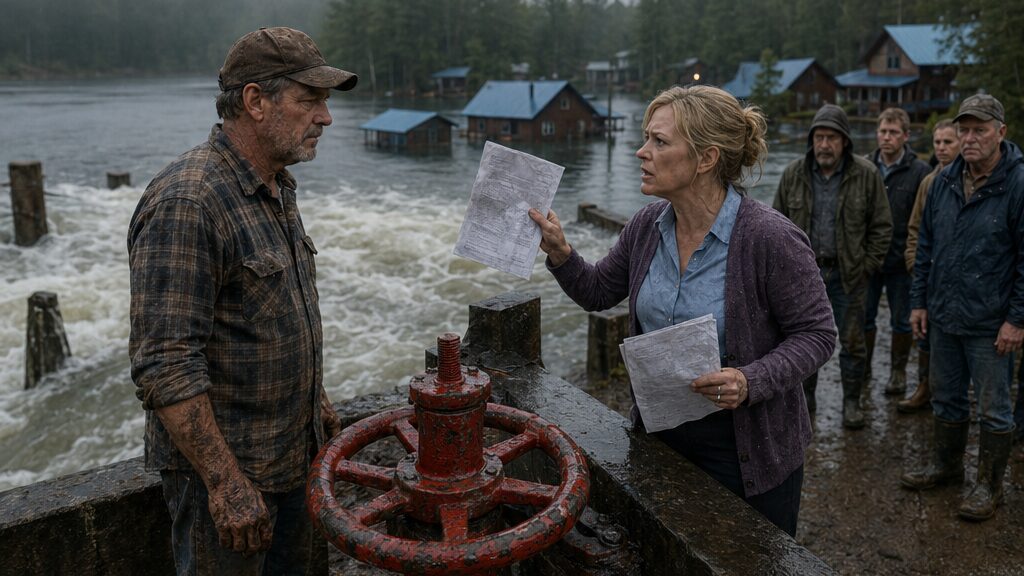
Sharon Williams slapped the wet repair estimate against the red valve housing so hard the clip snapped sideways and one corner of the paper stuck to the metal.
“What did you do?”
Robert Davis looked first at her hand, not her face. Her fingers were pale from gripping the pages. Mud had dried in a thin line along the cuff of her purple cardigan. Behind her, past the low concrete wall, the lake was still spilling hard through the channel, brown water rolling white where it struck the rocks below.
Across the cove, the blue-roofed cabins sat with their porches drowned to the second step.
Three owners stood on the path behind Sharon, arms folded, boots muddy, eyes moving between Robert and the valve. A repair crew member leaned against a truck with a pump hose coiled at his feet. Nobody said good morning. Nobody asked if Robert had slept.
Sharon tapped the estimate again. “I asked you a question.”
Robert wiped one hand down the front of his plaid shirt, leaving a darker streak where valve grease had not fully washed out. “I heard you.”
“That’s all you have to say?”
He glanced toward the cabins. A patio chair had wedged itself against a dock post. Someone’s blue cooler floated upside down near the shoreline, bumping against the railing every few seconds. The sound carried strangely in the damp morning air, hollow and small against the spillway’s roar.
Sharon pulled the top page free and turned it toward him. “Emergency water extraction, damaged flooring, wall removal, electrical inspection, lost rental bookings. That’s just the first estimate. Charles said it may go higher once they open the lower walls.”
Robert read the contractor heading, then the amount.
$46,800.
The number sat in bold type near the bottom like it had weight. Under it, a line read: Preliminary damage start time estimated between 8:10 p.m. and 8:40 p.m.
Robert’s eyes stayed there.
Sharon noticed. “Yes, I know it’s a lot. That’s why we’re not dragging this out.”
One of the owners behind her muttered, “My sister was supposed to bring her kids this weekend.”
Robert did not answer the man. He kept looking at the printed time.
Sharon reached into the folder tucked under her arm and brought out another document, cleaner than the estimate because she had kept it under plastic. “This is a statement for the insurance adjuster. It says you were seen operating the water-control valve immediately before the flooding worsened. If you sign it now, we can at least show cooperation.”
Robert looked at the blank signature line.
His name had already been typed above it.
Robert Davis.
It was strange, seeing his name waiting there as if his hand had been expected all along.
“I’m not signing that,” he said.
The air changed before anyone spoke. It was not silence exactly. The spillway filled every space with rushing water, but among the people on the path, something tightened.
Sharon’s mouth opened slightly, then closed. “Robert, you were at this valve last night.”
“Yes.”
“You turned it.”
“Yes.”
The man near the pump hose straightened.
Sharon took half a step closer. “Then why are you acting like this is some mystery?”
Robert looked at the valve wheel. Its red paint was chipped down to old primer where hands had gripped it over the years. Rainwater clung in the shallow grooves. Last night, in the dark, he had felt the wheel resist under his palms. Not frozen. Not free either. Stubborn, catching on something inside the housing while the lake climbed behind him.
He had not slept because he could still feel that resistance in his shoulders.
Sharon followed his eyes. “Don’t stare at it like it’s going to explain for you.”
Robert’s jaw moved once. “The lake was already over the mark.”
“What mark?”
“The danger mark.”
A short, humorless sound came from one of the cabin owners. “Now there’s a mark.”
Robert looked at him then, just long enough for the man to look away.
Sharon shook her head. “No. No, you don’t get to do that. You don’t get to stand here and talk in riddles while people’s cabins are full of water. You were seen turning the valve. After that, the lower row flooded. That is what we know.”
“That’s not all we know.”
“Then say it.”
Robert could have. He could have told them about the dock post, about the water line he had checked in the lightning with a flashlight clenched between his teeth, about the way the spillway had been backing up long before his boots touched this path. He could have said that if he had not opened the valve when he did, Sharon’s cabins might not have lost flooring; they might have come loose from their foundations.
But Sharon was holding his name above a signature line, and the owners were watching him with faces that had already chosen the shape of the story. Man at valve. Water in cabins. Bill on paper.
He looked again at the estimated damage time.
8:10 to 8:40.
He had reached the valve after nine.
“Robert,” Sharon said, softer now, but not kinder. “I know you’ve lived here a long time. I know people let you check things and keep your little notes. But this is beyond that. This is an insurance matter. If you make this difficult, the board will have to document your refusal.”
“My refusal to sign something false?”
Her cheeks flushed. “Your refusal to cooperate.”
A seasonal renter, standing beside the boardwalk in sandals damp with mud, lifted a phone as if to take a picture, then lowered it when Robert looked in that direction. Robert wished the man had taken it. Pictures had dates. Pictures kept their mouths shut.
Sharon placed the statement against the valve housing beside the estimate. The two pages fluttered in the mist from the spillway.
“Charles is preparing a full report,” she said. “The adjuster is coming this afternoon. I am trying to keep this from becoming worse for everyone.”
“For everyone,” Robert repeated.
“Yes.”
“You included lost rental income.”
“My cabins are part of the affected property.”
“They were booked?”
Sharon’s face hardened. “That is not the issue.”
“It’s on the estimate.”
“It is a legitimate loss.”
Robert looked across at the blue roofs. Sharon owned two of the lower cabins and managed three others for out-of-town owners. Everybody knew it. Everybody also knew the association reserve had been thin since the dock rebuild. Every spring meeting had ended with someone saying they could wait one more season on one more repair.
The valve wheel creaked in the wind. Or maybe it was the metal sign behind it.
Sharon held out a pen.
Robert did not take it.
For the first time, anger showed through the control in her face. Not loud anger. The sharper kind, the kind that had already done math.
“You’re making a mistake,” she said.
“I made one last night.”
The people behind her stirred.
Robert regretted the sentence as soon as it left his mouth. Not because it was untrue. Because it was incomplete, and incomplete truth could be used like a hook.
Sharon seized it. “What mistake?”
He looked at the water. “Waiting as long as I did.”
Sharon stared at him. “So you admit you acted too late.”
“No.”
“You just said—”
“I said I waited too long.”
“That is exactly the point.”
Robert felt the old familiar door close inside him. The one that shut when people pushed too fast. He had spent most of his life fixing things that did not care how he felt about them: stuck hinges, frozen pipes, tilted dock posts, engines that coughed but would not catch. You did not argue with a thing like that. You found the point of pressure and worked until it moved.
People were harder. People took the half sentence they wanted.
He stepped around Sharon and reached for the estimate. She snatched it back.
“You don’t get to take this.”
“I was going to point to the time.”
“The time came from Charles.”
“Charles wasn’t here at nine.”
“He inspected the damage this morning.”
“That doesn’t tell him when the lake crossed the porches.”
Sharon’s eyes flicked to the others, then back to Robert. “This is why you need to let the professionals handle it.”
Robert almost smiled, but there was no humor in him. “Then get one.”
The insult landed quietly. Sharon understood it before the others did.
Her voice dropped. “Careful.”
Robert looked down at the pen still in her hand. “I am.”
For a few seconds, all of them stood with the water roaring behind them and the cabins sitting wet across the cove. Robert could feel the eyes on his shirt, his boots, the grease at his fingernails. He had not shaved. He had not changed since before dawn. Sharon had arrived with a folder, plastic sleeves, printed forms, numbers in bold.
Paper always looked more official than memory.
Sharon slid the unsigned statement back into the folder. “Fine. I’ll note your refusal.”
“You do that.”
“And I’ll note that you confirmed you operated the valve.”
Robert’s eyes moved to the wheel again. He could still see the black line on the gauge in his mind, the one nobody else cared about until water reached their steps.
“I did operate it,” he said.
A woman behind Sharon covered her mouth.
Sharon turned toward the watching owners, lifting her voice just enough for it to carry over the spillway.
“You all heard him,” she said. “He just admitted he turned it.”
Chapter 2: The Water Mark No One Counted
Amanda Davis found the unsigned liability form on Robert’s kitchen table before she found him.
It lay beside his cold coffee, the signature line still blank, the paper curling at one corner from the damp that had followed him indoors. Someone had highlighted his name in yellow. Someone had circled the line that said likely responsible party pending investigation.
Amanda stood over it in her work blouse and muddy sneakers, breathing through her nose the way she did when she was trying not to start yelling.
“Dad.”
Robert was at the back sink, rinsing grit from a metal ruler. He did not turn around.
Amanda picked up the form. “Please tell me this is not what I think it is.”
“It is.”
“They’re naming you?”
“They’re trying to.”
She looked toward the window above the table. From there, the lake seemed almost calm if you did not look at the lower shoreline. Sunlight had come out weakly after noon, touching the water with silver in places, but the cabin row still looked bruised. Pump hoses ran from doorways. Wet rugs hung over railings. A rowboat sat half on the grass where the flood had dropped it.
Amanda set the form down carefully, as if rough handling might make it more real. “How much?”
Robert dried the ruler with a dish towel. “Forty-six eight.”
She closed her eyes. “Thousand?”
He said nothing.
“Dad.”
“I’m not paying it.”
“I didn’t ask if you were paying it. I asked what they’re saying you owe.”
“That’s the number on Sharon’s first estimate.”
“First estimate,” Amanda repeated. “So there could be more.”
Robert opened the drawer by the sink and took out a red pencil worn down to half its length. He put it in his shirt pocket.
Amanda watched him with the helpless irritation of someone who had grown up around his silences and still found herself trapped by them. “You can’t just walk around measuring things while they build a claim against you.”
“That’s exactly what I can do.”
“No. That’s what you do when a shelf leans or a dock board warps. This is insurance. This is people saying you caused damage.”
Robert took a battered black logbook from the shelf beside the back door. The cover had softened at the corners. A rubber band held it closed. He slipped it into his coat pocket and reached for his hat.
Amanda stepped in front of the door. “Talk to me like I’m not one of them.”
The sentence made him stop.
He looked at her then. She was forty now, no longer the girl who used to sit on the dock and count turtles, but in moments like this he still saw the child’s face underneath the adult one, asking him to explain storms in a way that made them less frightening.
“They have the time wrong,” he said.
Amanda waited.
“The estimate says damage started between eight-ten and eight-forty.”
“And?”
“I opened the valve after nine.”
Her eyebrows drew together. “Can you prove that?”
He tapped the pocket with the logbook.
Amanda looked at it, then at him. “You wrote it down?”
“I write the lake down.”
“That’s not what I asked.”
“It’s the same answer.”
She moved aside only because she knew he would not keep talking in the kitchen. Robert led the way out the back, down the slope toward the dock posts. The ground sucked at their shoes. A line of leaves and pine needles marked where the water had reached before falling back. On one post near the old canoe rack, several pencil marks cut across the weathered wood at different heights, each with tiny dates beside them.
Amanda folded her arms against the damp air. “I used to think those were just you being you.”
“They are.”
“Dad.”
He knelt with some effort and placed the metal ruler against the post. “Last night at seven-thirty, the water was here.”
He pointed to a lower mark.
“At eight-fifteen, here.”
Higher.
“At eight-fifty, it was above the black gauge by the spillway.”
Amanda looked from the post to the lake. “The black gauge?”
“The danger mark. The one the association stopped repainting because they didn’t like how it looked in rental photos.”
She stared at him. “You’re serious.”
Robert opened the logbook. The pages were lined with dates, numbers, short notes, wind direction, water level, gate condition. His handwriting was small and squared off, built for fitting facts into tight places.
He found the page from the night before and held it open.
Amanda leaned closer.
7:32 p.m. — rain hard, west runoff strong.
8:14 p.m. — lower dock lip covered.
8:47 p.m. — lake at old black mark.
9:03 p.m. — valve opened one turn, sticking.
9:11 p.m. — opened another half, flow increased.
Amanda touched the page lightly, not on the ink but near it. “Why didn’t you show Sharon this?”
“She didn’t ask what happened. She asked what I did.”
“That’s not an answer.”
“It is the answer she wanted.”
Amanda stood, rubbing both hands over her face. “You know how this looks, right? You were seen turning the valve. You admitted it in front of people. You wouldn’t sign. You wouldn’t explain. That makes them think you’re hiding something.”
“I’m not hiding it.”
“You’re keeping it in a little book in your pocket.”
Robert closed the logbook.
A pump coughed across the cove, then caught again with a rough mechanical groan. Someone shouted from inside one of the cabins. The sound carried over the water, tired and angry.
Amanda softened, but only slightly. “I know you didn’t flood those cabins on purpose.”
“I didn’t flood them at all.”
“I believe you. But believing you isn’t the same as stopping them.”
Robert looked toward the spillway path. From this angle, the valve housing was visible through the trees, a red spot against gray concrete. He had painted that wheel himself twelve years ago, after the old coating flaked away under his hands. He remembered telling the board that bright red was practical. Easy to see in rain. Easy to find in an emergency.
Now it looked like a warning nobody understood.
Amanda reached for the form again when they went back inside. “If they push this through insurance and it lands on you, what happens?”
“I contest it.”
“With what? A notebook?”
“With the truth.”
She let out a short breath. “Truth costs money when people put paperwork around a lie.”
Robert set the logbook on the table beside the liability form. One old black cover beside three clean printed pages. The difference made him angry in a way Sharon’s accusation had not. Not hot angry. Heavy.
Amanda sat down. “Maybe you talk to them before this gets worse. Maybe you show the adjuster everything. Maybe you don’t wait until everyone has decided what kind of man you are.”
He looked at her, and she looked back without blinking.
For a moment, he nearly told her about the other storm. The one years ago. The one when he had stood on this same shoreline and told himself the water would crest before it reached the cabins. The one that taught him the cost of waiting for certainty.
Instead he said, “I’ll show what I need to show.”
Amanda’s mouth tightened. “That is not the same as fighting.”
A chime sounded from the table.
Robert’s phone sat faceup beside the cold coffee. The screen lit with an email notification. The sender line showed the insurance company. The subject read: Preliminary Liability Inquiry — Robert Davis.
Amanda reached it before he did, then stopped herself and let him pick it up.
Robert opened the message.
The first paragraph was polite. The second was not. It referenced Sharon’s statement, Charles’s preliminary estimate, and Robert’s confirmed operation of the water-control valve. It requested his response within forty-eight hours and identified him as the likely responsible party pending review.
Amanda read over his shoulder.
For once, she did not tell him to talk.
Robert folded the liability form once, exactly down the middle, and laid it beside the logbook.
Chapter 3: The Contractor’s Estimate Changes Shape
Charles Harris would not look at the valve while Sharon was watching him.
That was the first thing Robert noticed the next morning.
The second was that Charles had parked his truck facing out, nose toward the road, as if he expected to leave quickly.
“Robert,” Charles said, adjusting the clipboard under his arm. “I can’t get into all this right now.”
Robert had not asked anything yet. He stood beside the lower cabin row, where fans hummed in open doorways and strips of wet drywall leaned against porch rails. The smell of lake mud, insulation, and cut lumber sat heavily in the air.
Sharon stood on the porch of her first rental cabin with a phone pressed to her ear. She was not speaking into it. She was listening and watching.
Robert nodded toward Charles’s clipboard. “You revised anything since yesterday?”
Charles glanced toward Sharon. “Still assessing.”
“That’s not what I asked.”
A muscle moved in Charles’s cheek. He was younger than Robert by fifteen years, broad in the shoulders, always clean-shaven even on muddy jobs. He had fixed half the failing steps and porch rails around the lake, sometimes well, sometimes fast, depending on who was paying and how loudly they complained.
“I’m here for emergency mitigation,” Charles said. “Not a hearing.”
“You wrote the time window.”
“I wrote an estimate based on visible damage.”
“You wrote eight-ten to eight-forty.”
Charles’s grip tightened on the clipboard. “Water leaves marks.”
“So do people.”
Sharon ended her call without saying goodbye. “Robert, Charles has work to do.”
Robert did not turn toward her. “Then I’ll ask while he works.”
“No,” she said, coming down the porch steps. “You’ll submit your response to the adjuster like everyone else.”
“I am.”
“Good.”
“I’m starting with the estimate.”
Charles looked down.
Sharon’s voice sharpened. “This is exactly why the board needs to meet. You keep trying to intimidate people one at a time.”
Robert looked at Charles then, letting the contractor decide whether that word would stand between them.
Charles cleared his throat. “Nobody’s intimidated.”
“Then tell me about April,” Robert said.
Charles stopped moving.
Sharon’s face changed only a little, but enough.
Robert had not known April mattered when he woke up. He had known only that the valve felt wrong last night, and that sometime before summer he had seen Charles’s truck by the spillway shed. The memory had come back while Robert made coffee: Charles kneeling near the housing, tool bag open, Sharon standing with arms crossed, both of them looking at the wheel instead of the water.
Now the memory had found a nerve.
“What about April?” Sharon asked.
Robert kept his eyes on Charles. “You serviced the valve.”
Charles shifted his weight. “Routine check.”
“Was it routine?”
Sharon gave a small laugh. “Robert, everything feels dramatic after a flood. The association does inspections all the time.”
“No, it doesn’t,” Robert said.
One of the repair fans rattled in the cabin behind them. Charles looked toward the sound as if grateful for it.
Robert stepped away from the porch and started toward the spillway shed. After a moment, Charles followed. Sharon followed too.
The path was slick where silt had dried into a thin gray skin. Pine needles stuck to Robert’s boots. The red valve came into view at the bend, bright against the damp concrete. A county warning sign leaned crooked beside it, streaked with mud.
Robert went past the wheel to the small metal shed that held old gauges, oil cans, and parts nobody had inventoried in years. The door hung open. Someone had been inside since the storm. A muddy footprint crossed the threshold.
“Robert,” Sharon said behind him. “You are not authorized to disturb association equipment.”
He crouched near the valve housing instead of entering the shed.
Half-buried under mud at the base of the pipe was a faded maintenance tag, tied with wire to a bolt. The paper had been laminated once, but water had clouded the edges. Robert brushed mud away with two fingers.
Charles inhaled.
Robert lifted the tag enough to read the top line.
HARRIS MAINTENANCE — APRIL CHECK.
Below that, in faded marker: Gate resistance noted. Recommend adjustment before heavy season.
Sharon stepped closer. “That doesn’t mean anything.”
Robert stood slowly. “It means it wasn’t routine.”
Charles rubbed the back of his neck. “It was sticking a little. Not locked. Just stiff.”
“Stiff enough to write down.”
“I write down a lot.”
“Not on tags you leave tied to a housing.”
Charles’s eyes flicked to Sharon, then away.
Robert saw it then: not guilt exactly, but fear of losing work. Around the lake, contracts moved through conversations before they moved through invoices. If Sharon decided a contractor was difficult, three cabins became five cabins became none.
Sharon folded her arms. “The valve being stiff in April does not change the fact that you opened it during the storm.”
“No,” Robert said. “It changes why opening it mattered.”
Charles lowered his voice. “Robert, don’t make me the middle of this.”
“You were already in the middle. Your name is on the estimate.”
“That’s for drying cabins.”
“And for a time window that puts the flood before I touched the valve.”
Charles’s jaw tightened. “I said visible saturation suggested water intrusion started earlier in the evening. Sharon asked for a preliminary range for insurance. Preliminary. It’s not a court document.”
“But it is a weapon,” Robert said.
The words landed harder than he intended. Charles looked ashamed for half a second. Sharon looked offended.
“That is an ugly accusation,” she said.
Robert finally turned to her. “Yes.”
Sharon’s eyes narrowed. There was fatigue under her anger, and for the first time Robert saw it clearly. She had not slept either. Her rentals were damaged. Her phone had probably been ringing with guests, owners, insurance questions, board complaints. Fear did not excuse what she was doing, but it made her less simple than the voice she used.
“I have three families asking whether their deposits are refundable,” she said. “Two owners who think I should have prevented this. An adjuster asking who operated the valve. And you, Robert, standing here with half sentences and a notebook like the rest of us are supposed to guess your meaning.”
“Then don’t guess.”
“Then stop making us.”
Charles looked between them. “The April note should’ve gone into the board packet.”
Sharon snapped toward him. “It was mentioned.”
“In the packet?”
“In discussion.”
Charles looked down at the tag.
Robert saw the opening, but he also saw the trap. If he pushed too hard, Charles would retreat into vagueness and Sharon would call it harassment. Robert had made that mistake before, thinking pressure could force a clean answer from someone whose living depended on staying useful.
So he did the harder thing.
He stopped.
He took out his phone and photographed the tag. Not the whole valve, not Sharon, not Charles’s face. Just the tag, the bolt, the wire, the faded April note.
Sharon watched him. “You think a picture of an old tag clears you?”
“No.”
“Then what are you doing?”
“Keeping it from disappearing.”
Charles’s eyes lifted sharply.
For the first time all morning, Sharon did not have an immediate answer.
A truck door slammed down by the cabins. Another owner called for Charles, asking whether the baseboards had to come out too. Charles looked relieved, then trapped by his own relief.
Before he left, Robert stepped beside him, far enough from Sharon that the spillway noise covered their voices.
“You warned them,” Robert said.
Charles stared toward the cabins. “I told Sharon it should be adjusted before peak rental season. I told Susan too, I think. It was sticking under load.”
“In writing?”
“Not like I should have.”
“Why not?”
Charles gave a tired, bitter smile without humor. “Because every time I put something in writing around here, somebody asks whether it can wait until after Labor Day.”
Robert looked toward the red wheel. “Could it wait?”
Charles did not answer for a long moment.
“No,” he said at last. “Not if we got a storm like that.”
Sharon called Charles’s name from the path. Her voice had regained its public firmness.
Charles stepped back. “Don’t quote me unless I’m there.”
“Will you be?”
His silence was answer enough.
By late afternoon, every owner had received Sharon’s email. Robert read it standing in his kitchen, the logbook open beside him and the photo of the maintenance tag still glowing on his phone.
Emergency Association Meeting — Flood Damage Liability and Recovery Vote.
The final line said the board would consider whether to formally pursue Robert Davis for damages related to unauthorized valve operation.
Robert stood still until the screen dimmed.
Then he touched the logbook cover once, as if checking that it was still there.
Chapter 4: The Meeting Turns the Lake Against Him
The first thing on the clubhouse wall was a photograph of Robert’s hand on the red valve.
Someone had taken it from the path during the storm, close enough that his knuckles filled half the frame. The wheel looked brighter than it had in real life, wet red against gray metal, and the white blur of rushing water behind it made the image seem more violent than the moment had felt. His face was not visible. Only the hand, the wheel, and the implication.
A murmur passed through the room.
Robert stood near the back beside Amanda, hat in his hands, watching his own hand become evidence.
Sharon clicked the remote. The image stayed on the wall.
“This,” she said, “is the action that occurred immediately before the lower cabin row experienced accelerated water intrusion.”
Amanda shifted beside him. “Accelerated,” she whispered.
Robert did not answer. He had noticed the word too.
The clubhouse smelled of wet coats, coffee, and plywood. Folding chairs filled the room in uneven rows. Cabin owners sat with printed packets in their laps, some still wearing work boots crusted with mud from hauling ruined rugs and warped floorboards. A few looked angry. More looked scared. Fear, Robert knew, was easier to aim at one person than at a lake.
Susan Nelson sat at the secretary’s table near the front, pen ready, shoulders tight. She did not look at Robert when he entered. She had always been polite to him at meetings, the kind of polite that came from wanting everyone to leave with the same opinion they brought in. Tonight, she looked like a woman who had found a snake in a drawer and was trying not to slam it shut.
Sharon stood beside the projector screen with the confidence of someone who had arranged the room before anyone else arrived. Her purple cardigan was gone; she wore a navy jacket now, dry and pressed, her hair clipped back. The muddy cuff from the morning had been replaced by clean sleeves. Robert wondered if she had changed because of the adjuster call or because she needed the owners to see order when everything outside smelled like floodwater.
“As treasurer,” Sharon continued, “I have a duty to present the financial exposure facing this association. Initial mitigation and repair estimates total forty-six thousand eight hundred dollars, not including full structural assessment, electrical certification, or additional rental losses.”
One of the owners made a low sound.
Sharon clicked again. A spreadsheet appeared. Numbers, columns, cabin numbers, projected repair ranges. Robert saw his name in a notes column halfway down.
Amanda leaned closer. “They already put you in the packet.”
He looked at the printed packet in his hand. He had not opened it. Now he did.
There it was: Incident factor — unauthorized valve operation by Robert Davis.
He closed the packet before he could grip it hard enough to tear.
A board member asked whether the association’s insurance would cover the damage. Sharon turned slightly, prepared.
“Coverage may depend on cause,” she said. “If an individual action contributed to or worsened the flood, the insurer may seek recovery from that individual or that individual’s carrier.”
Robert heard Amanda inhale.
He kept his eyes on Sharon. She did not say he caused it. She said contributed. She said worsened. She said may. Each word gave her room to step back later, but in the room they all landed the same way.
The owner whose sister had been coming for the weekend raised his hand without waiting to be called. “So if Robert hadn’t opened that valve, would my cabin have stayed dry?”
Sharon looked down at her papers for half a second. “That is the question before the adjuster.”
“No,” Robert said.
Every head turned.
Sharon’s lips pressed together. “Robert, there will be a comment period.”
“No,” he said again, quieter. “That is not the question before the adjuster. The question is when the lake reached the cabins and why the valve was not working freely before I touched it.”
The room shifted. Not in his favor. Not yet. But the clean line Sharon had drawn had a nick in it now.
Sharon’s voice remained level. “If you have documentation, you can submit it through the proper channel.”
“I asked for the April maintenance minutes.”
Susan’s pen stopped.
Robert looked at her. “They weren’t in the packet.”
Sharon glanced toward the secretary’s table. “The packet includes relevant documents.”
“The April note on the valve says adjustment recommended before heavy season.”
Several people turned toward Sharon.
Susan looked down at her papers, then up at Sharon, then back down. The pen moved once, but she did not write.
Sharon clicked the remote again. The spreadsheet disappeared, replaced by a photo of the flooded cabins. “The April inspection was routine. The issue tonight is the emergency action taken during the storm.”
Robert felt Amanda’s hand touch his sleeve. Not to stop him. To steady herself.
He said, “Was the adjustment voted on?”
Sharon’s eyes narrowed. “Robert, this meeting is not about relitigating maintenance choices.”
“It is if maintenance choices are why the valve stuck.”
A man in the front row turned around. “Stuck?”
Robert held Sharon’s gaze. He had not meant to say that much. He could feel himself stepping past the line he usually kept, the line where facts stayed in his pocket until they could not be misunderstood. But silence had already been misunderstood. It had been printed.
Susan cleared her throat.
It was a small sound, nearly lost under the heater’s fan, but Sharon heard it.
“What?” Sharon asked.
Susan looked at the board table. “The April inspection did include a recommendation.”
Sharon’s expression did not change, but something behind it tightened.
“A routine recommendation,” Sharon said.
Susan’s pen rolled under her fingers. “It was discussed as an item to be scheduled.”
“After peak rental cash flow stabilized,” Robert said.
Now Sharon looked at him. Fully.
“How would you know that?”
“I was there.”
“You were in the audience.”
“Yes.”
“That does not mean you understood the reserve discussion.”
Amanda stiffened, but Robert raised one hand slightly. Not toward Sharon. Toward Amanda. A quiet request not to speak for him.
He looked at Susan. “Were minutes taken?”
Susan’s mouth opened, then closed.
Sharon answered for her. “Minutes are always taken.”
“Then I want the April minutes attached to the claim.”
A board member shifted in his chair. “Can he request that?”
Susan said, “Any owner can request approved minutes.”
Sharon’s head turned slowly toward her.
The room felt different now. The accusation had not gone away, but the shape of it was less smooth. People were looking at Sharon, at Susan, at the packet in their laps. Robert saw confusion in their faces, and confusion was not trust, but it was better than certainty.
Sharon recovered quickly. “No one is hiding minutes. But I will not let this meeting turn into an attempt to distract from Mr. Davis’s own admission. He operated the valve without board authorization.”
Robert almost laughed then, not because it was funny, but because of the absurdity of board authorization in a storm. He saw again the water at the black mark. The flashlight beam jumping in rain. The red wheel under his palms, refusing the first pull.
Amanda spoke before he did. “Should he have called a meeting while the lake was rising?”
A few people murmured.
Sharon looked at Amanda, then back to Robert. “I understand you want to protect your father.”
“He won’t let me,” Amanda said.
Robert turned toward her.
There was anger in her face, but not at Sharon alone. At him too. At the blank spaces he kept leaving for other people to fill.
“He won’t explain himself,” Amanda said, voice tight. “He won’t ask for help. He won’t even say the full sentence when half a sentence can ruin him.”
The room went quieter than it had been all evening.
Robert felt the words land where Sharon’s accusation had not. Amanda had not meant to wound him. That made it worse.
Sharon took advantage of the moment. “This is exactly why we need a formal process. Emotion cannot guide liability.”
She lifted a single sheet from her folder.
“I received an updated contractor statement from Charles Harris late this afternoon,” she said. “It clarifies that Robert’s operation of the valve likely accelerated downstream pressure at the lower cabin row.”
Robert looked toward the side wall. Charles stood there near the coffee urn, arms crossed, face drawn. He had not taken a seat.
Sharon began reading.
“Based on visible saturation patterns and timing provided by witnesses, sudden release through the spillway may have increased water movement along the lower shoreline, contributing to the speed and severity of intrusion.”
May have. Provided by witnesses. Contributing.
Words with soft edges and sharp uses.
Robert looked at Charles. “Did you write that?”
Charles stared at the floor.
Sharon lowered the paper. “It is signed.”
The room moved again, this time away from Robert. He could feel it. The April minutes had created a crack, but the revised statement poured cement over it. A signed contractor statement looked clean. A man’s old logbook looked like a hobby.
Amanda leaned close. “Dad.”
This time there was no anger. Only fear.
Robert looked at the photo still frozen on the projector screen. His hand on the red valve. The room saw guilt there because guilt had been arranged around it.
He opened his packet and took out a blank comment form. With Sharon watching, with Charles silent by the coffee urn, with Amanda’s fear beside him, Robert wrote one sentence in the small box at the bottom.
I request the April maintenance minutes and the original, unedited contractor inspection note be attached before any vote.
He walked it to Susan.
She took it, and for one second her fingers held the paper too tightly.
Sharon watched the exchange. Then she lifted the signed contractor statement again.
“In light of this new clarification,” she said, “the board will consider formal recovery action.”
Chapter 5: The Logbook Shows a Different Storm
Robert found the red-pencil page before sunrise, folded inside the back cover of a logbook he had not opened in nine years.
The page was stiff from old water damage. Its edges had gone soft and brown. A diagonal stain crossed the lower corner, swallowing part of a number he needed. But the red pencil marks were still there, pressed deep enough into the paper that he could feel them with his fingertip.
Amanda stood across the table from him, sleeves rolled, hair tied back, the current flood log open beside three old notebooks and the printed contractor statement.
“What is that?” she asked.
Robert did not answer right away.
The cabin was quiet except for the old refrigerator and the dull thump of pump equipment starting across the cove. On the table, Amanda had lined up the documents as if the surface itself could become a courtroom: Sharon’s liability form, the insurance email, the photo of the April tag printed from Robert’s phone, the revised statement, the current logbook, two older logs, and now the stained page.
Robert had brought the storage box in from under his bed after midnight. He had not let Amanda help carry it. The box was metal, green once, now scratched at the corners. Inside were things he had not meant to sort while anyone else was in the room.
Amanda watched him touch the red marks.
“Dad.”
“It was the south storm,” he said.
She waited because she had learned by then that if she interrupted, he might close the box and the subject with it.
“Nine years ago. Before Sharon bought the rental cabins. Before the lower row got raised.”
Amanda pulled out the chair slowly and sat.
Robert kept looking at the page. The handwriting was his, but younger. Sharper. He had written hard that night. Too hard.
7:05 — heavy runoff.
8:22 — dock lip covered.
9:40 — water at porch rails.
10:15 — valve opened.
Below that, the red pencil had drawn three lines under one sentence: waited too long.
Amanda’s voice came quietly. “That’s why you keep the lake readings.”
He closed his hand around the edge of the table. “That night, I thought the rain would break east. It usually does. I thought if I opened too early, I’d send water hard through the lower channel and tear out the bank.”
“Did it flood?”
“Two cabins took water. Not like this. But enough.”
“Was it your fault?”
Robert looked up then. “It was my waiting.”
“That’s not what I asked.”
“It’s the answer I’ve had.”
Amanda’s eyes softened, but she did not reach for him. She knew he would stand if she did.
He slid the old page beside the current log. The two storm timelines sat nearly parallel, separated by nine years and one old mistake. Current readings, old readings. Red pencil, black ink. Waiting too long, opening at 9:03.
“This time,” Robert said, “I opened when the lake crossed the mark.”
Amanda leaned over the current log. “The contractor statement says sudden release likely accelerated shoreline movement between eight-ten and eight-forty.”
“I wasn’t at the valve then.”
“You have that written.”
“I have more than written.”
He took her outside to the dock post while the sky was still gray. The flood line had dried into a rough ring around the wood, mud and shredded leaves stuck to it. Robert pointed to the mark he had made at 8:47, then to the higher scrape from where floating debris had hit near the porch-step level.
Amanda photographed each one with her phone.
“Put the ruler beside it,” she said.
He did.
She took another picture. “Again, closer.”
He looked at her.
“What?” she said. “If we’re going to use your quiet little records, we’re going to make them loud enough for other people.”
The corner of his mouth moved despite himself.
They worked for an hour. The current logbook on the table. Photos of the dock post. The April tag. The old stained page. A rough map Amanda drew of the lower cabins, the spillway, and the channel. Robert corrected the direction of flow twice until she told him to hold the pencil himself if he wanted it exact.
By midmorning, she had built a timeline on the table.
7:32 — runoff strong.
8:14 — lower dock lip covered.
8:47 — lake at old black mark.
8:50-8:55 — water already reaching lower cabin steps.
9:03 — Robert opens valve one turn.
9:11 — second half turn.
Amanda placed Sharon’s estimate below it.
Estimated damage start: 8:10-8:40.
Then Charles’s revised statement.
Sudden release likely accelerated damage between 8:10 and 8:40.
Amanda tapped the paper. “This doesn’t just blame you. It puts your action before it happened.”
“It says likely.”
“It says enough.”
Robert went to the stove and poured coffee he did not want. His hands were steadier with the cup than they had been with the old page. He disliked that Amanda had seen it. He disliked more that part of him felt lighter because she had.
She turned the old stained log toward him. “This corner. What was the number?”
Robert looked. The stain had swallowed the final digit beside an old reading. It might have been 9:10. It might have been 9:18. It did not matter to the current claim, not directly, but it mattered to the story his own mind told about him. He had kept the page as punishment and warning. Now it looked like an unreliable document, the kind Sharon could dismiss with a glance.
“That one’s not for them,” he said.
“Then why take it out?”
He looked toward the window. Across the cove, someone had propped a ruined cabinet door against a tree. Pale wood exposed, hinges bent. Damage did not become less real because blame was wrong.
“Because I don’t want to pretend I’ve always been right.”
Amanda was quiet for a moment.
Then she said, “Good. Don’t. Just don’t let them turn that into you being wrong now.”
His phone rang before he could answer.
Susan Nelson’s name appeared on the screen.
Robert picked it up and put it on speaker because Amanda pointed at the phone with the same expression she had used as a child when he was about to forget a grocery list.
“Susan,” he said.
There was a pause on the line. “Robert, I don’t have long.”
Amanda sat straighter.
Susan lowered her voice. “I checked the packet from last night.”
“The April minutes weren’t in it.”
“I know.”
“Were they approved?”
Another pause. Paper rustled faintly in the background.
“They were approved in May,” Susan said. “I remember because Charles’s note caused a discussion about whether the reserve could handle a valve adjustment before rental season.”
Robert closed his eyes once.
Amanda wrote May approved on a blank sheet.
Susan continued, “But the copy Sharon sent for the emergency packet skips from March to June.”
Amanda stopped writing.
Robert looked at the phone. “Skips?”
“The April minutes are not in the packet Sharon circulated. They’re not in the shared folder link either.”
“Do you have a copy?”
“I should. I keep backups. But Robert—”
Her voice caught, not emotionally, but with fear.
“If I send them to you directly, Sharon will say I broke board process. She already told me all document requests need to go through her until the claim is organized.”
Amanda mouthed, That’s not right.
Robert said, “I made the request at the meeting.”
“I know. I logged it.”
“Then follow the request.”
“I’m trying.”
The line went quiet except for Susan’s breathing.
Robert waited.
Susan said, “There’s something else. The minutes mention postponing adjustment until after peak rentals began generating income. That wording is not flattering.”
“To who?”
“To the board.”
“To Sharon?”
Susan did not answer.
Robert understood then why her voice sounded the way it did. She was not protecting a lie because she believed it. She was afraid of being the person who opened the drawer and let everyone see what had been put away.
“Susan,” he said, “I’m not asking you to take my side.”
“I know.”
“I’m asking you not to hide the lake’s side.”
Amanda looked at him. It was the kind of sentence he usually would have kept in his head.
On the phone, Susan exhaled shakily. “I’ll look again.”
“No,” Robert said. “Don’t look again. Send the approved minutes through the request process and copy the board.”
“Robert—”
“If they belong in the file, put them in the file.”
Susan said nothing.
Across the cove, a pump shut off. The sudden quiet made the cabin feel exposed.
At last Susan spoke, so softly Amanda leaned toward the phone.
“The minutes Robert asked for,” Susan said, “are not in the packet Sharon sent.”
Then the line went dead.
Chapter 6: The Second Inspection Finds the Old Mistake
The county water inspector put one hand on the red valve wheel and asked, “Did you open this during the storm?”
Robert felt every person on the spillway path wait for him to save himself by trimming the truth.
Sharon stood to the inspector’s left with a binder pressed to her chest. Charles was near the shed, arms crossed, eyes tired. Susan had arrived late and stayed at the edge of the group, a folder held flat against her side. Amanda stood beside Robert with the current logbook in both hands.
The lower cabin row was quieter now. The pumps had stopped. Fans still ran inside, but the first emergency had passed, leaving the second one: documents, blame, and who would be made to pay.
Robert looked at the inspector, then at the wheel.
“Yes,” he said. “I opened it.”
Sharon’s face did not change, but Robert saw her fingers tighten on the binder.
The inspector was a narrow man with mud on the knees of his work pants and a measuring rod tucked under one arm. He had spent twenty minutes walking the shoreline without saying much. He had checked the dock posts, the spillway gauge, the valve housing, and the lower cabin steps. He seemed less interested in people than in marks.
“At what time?” he asked.
“First turn at 9:03 p.m. Second half turn at 9:11.”
“You’re certain?”
Robert took the logbook from Amanda. “I wrote it down when I did it.”
Sharon made a small sound. “A personal notebook is not an official operating record.”
The inspector did not look at her. “I’ll decide what helps me establish sequence.”
Robert opened to the storm page and held it out.
The inspector read without touching at first. Then he took the book and compared it with the photos Amanda had printed: dock post marks, ruler measurements, the old black gauge, the April maintenance tag. He said nothing for long enough that the path became uncomfortable.
Sharon broke first. “The issue is not whether Mr. Davis kept notes. The issue is that unauthorized valve operation may have worsened the damage.”
“May have,” the inspector said.
“It is in the contractor statement.”
The inspector turned to Charles. “You wrote that?”
Charles rubbed his jaw. “I signed it.”
“That’s not what I asked.”
A faint flush rose at Charles’s neck. “The wording came after a phone conversation.”
“With who?”
Charles looked at Sharon.
Sharon lifted her chin. “I asked him to clarify his preliminary findings for the insurer.”
The inspector’s eyes stayed on Charles. “Did the valve release occur between 8:10 and 8:40?”
“No.”
The word was quiet, but it did more work than anything Charles had said all week.
Sharon turned on him. “Charles.”
He looked at her, then at the valve. “No. If Robert opened it after nine, then that part of the statement is wrong. The saturation could’ve started earlier. The release he made didn’t start damage before it happened.”
The inspector made a note.
Robert felt Amanda shift beside him, but she did not speak. He was grateful. This had to stay clean.
The inspector crouched near the valve housing. “You serviced this in April?”
Charles nodded. “Checked it.”
“Found resistance?”
“Yes.”
“Show me.”
Charles hesitated.
The inspector looked up.
Charles took two steps forward, then crouched beside the housing and pointed to a joint near the lower assembly. “Here. The gate stem was binding under load. Not all the time. But enough that I recommended adjustment.”
“Before heavy season?”
“Yes.”
Robert watched Sharon’s eyes move toward Susan’s folder.
The inspector stood. “Was that recommendation submitted to the association?”
Charles wiped his hands on his pants. “Verbally at the meeting. I left the tag. I sent a short service note.”
Sharon spoke quickly. “The board discussed prioritization. There were multiple repairs competing for limited funds. Nobody ignored anything.”
Susan’s voice came from the edge of the path. “It was postponed.”
Everyone turned.
Susan looked pale, but she held the folder out with both hands. “The approved April minutes.”
Sharon’s face went still. “Susan, this is not the appropriate—”
“It was requested by an owner at a meeting,” Susan said. Her voice shook at the start and steadied by the end. “And it belongs in the claim file.”
She gave the folder to the inspector, not Robert.
Robert respected her for that.
The inspector opened it on the hood of a nearby truck. The pages were clipped and marked with yellow tabs. He read the relevant section. Nobody moved except the water below them.
“Maintenance recommendation for valve adjustment before heavy rental season,” the inspector read. “Discussion tabled due to reserve balance and pending rental revenue.”
Sharon’s mouth tightened.
The inspector flipped a page. “Motion to revisit in June?”
Susan nodded. “Yes.”
“Was it revisited?”
Susan looked at Sharon.
Sharon answered, “The June meeting was shortened because of the dock access issue. It was not intentionally skipped.”
“Was the valve adjusted?”
“No,” Charles said.
The inspector looked at Robert. “When you opened it, did it move freely?”
“No.”
“Describe.”
Robert placed both hands around empty air, remembering the weight of the wheel. “First pull caught. I had to back it a quarter turn, then lean into it. When it released, flow increased, but not clean. It shuddered.”
Charles nodded once despite himself. “That tracks with binding under load.”
Sharon looked sharply at him, but Charles kept his eyes on the inspector.
The inspector stepped to the wheel and tried it gently. It moved partway, then resisted with a dull metal catch. He did not force it. He just held it there, palm against red paint, and looked down at the muddy base where the April tag still hung.
“So,” he said, “we have a rising lake before nine, documented shoreline marks, a valve with prior resistance, a postponed maintenance recommendation, and an estimate assigning damage timing before the documented valve operation.”
Sharon’s voice was tight. “The cabins still flooded after he opened it.”
“The cabins were already taking water,” the inspector said.
“That is not proven.”
Robert opened the logbook to the current page and pointed to the 8:47 entry. “The lake was at the old black mark here.”
Sharon gave him a hard look. “A mark you maintained yourself.”
“Because the association stopped.”
The sentence was plain. It did not accuse. That made it harder to dismiss.
The inspector walked to the gauge and rubbed at the post with his thumb. Beneath mud and algae, a black line showed faintly where paint had once been. He measured from that mark to the flood stain on the nearby post, then compared Amanda’s photos.
“This mark predates the current event,” he said.
Sharon looked toward the lower cabins as if the buildings might argue for her.
Amanda handed Robert the old stained page from nine years ago, sealed now in a clear sleeve. He had not planned to bring it out. It was not needed, not really. But the inspector had asked why he maintained unofficial readings, and Robert had felt the old door inside him begin to close.
This time, he kept it open.
“I keep them because I once waited too long,” Robert said.
Amanda looked at him.
Sharon’s expression flickered, uncertain for the first time.
Robert handed the old page to the inspector. “Different storm. Different cabins. Less damage. But I waited for someone else to decide, and by the time I moved, water had already reached porches. After that, I kept levels. Not because anyone asked me. Because I didn’t want to guess again.”
The inspector looked at the page, then at Robert. “This does not establish liability for the current event.”
“No,” Robert said. “It establishes why I was watching.”
No one spoke.
For once, Robert did not feel his silence being filled by someone else. He had said enough, and the facts were standing around him now: the mark on the post, the tag on the valve, Susan’s minutes, Charles’s reluctant admission, the logbook in his hand.
The inspector closed the folder. “Based on what I’ve seen, the claim cannot stand as written. I’ll note that the current documentation does not support assigning primary causation to Mr. Davis’s valve operation.”
Amanda let out a breath she had been holding.
Charles looked down at his boots.
Susan pressed her folder against her chest as if it were the only thing keeping her upright.
Sharon’s face colored slowly. “You are not the insurance company.”
“No,” the inspector said. “But they asked for a water-control assessment. That is what they’ll get.”
“The association still has damages.”
“Yes.”
“Someone is responsible.”
“Possibly more than one someone,” he said. “Possibly maintenance process. Possibly storm conditions. Possibly deferred adjustment. But not the statement as written.”
Robert watched Sharon absorb the words. Her eyes moved from the inspector to Charles, from Charles to Susan, from Susan to Robert.
He expected anger. He expected retreat. What he saw first was fear.
Then the fear hardened into the shape she could use.
“I am not withdrawing the claim today,” Sharon said.
Amanda turned toward her. “After all that?”
Sharon kept her eyes on Robert. “The board will review the inspector’s report when it is submitted. Until then, the association’s position remains unchanged.”
The inspector slipped his notebook into his pocket. “That is your choice.”
Robert looked at the red valve. Mist from the spillway had collected on the wheel again, bright drops clinging to chipped paint.
Sharon closed her binder.
“And I will make sure the record shows,” she said, “that Robert Davis admitted, in front of everyone, that he opened it.”
Chapter 7: The Claim Drops But the Shore Stays Quiet
Robert received the corrected notice folded inside a plain white envelope, wedged halfway under his cabin door where the morning wind had tried to pull it loose.
He knew what it was before he opened it. Not because the envelope looked different, but because Amanda had stopped on the porch behind him and gone completely still.
The return address was the insurance company.
Robert picked it up, carried it to the kitchen table, and slit the envelope with the same pocketknife he used for twine and dock rope. Amanda stood across from him, both hands wrapped around a coffee mug she had not touched. The lake outside the window was lower now, calmer, the shoreline showing brown scars where the water had reached and gone back.
Robert unfolded the letter.
The first paragraph was formal. The second was careful. The third held the sentence.
No liability assigned to Robert Davis for the flood damage event based on current documentation and water-control assessment.
Amanda set the mug down too hard. Coffee jumped over the rim.
Robert read the sentence again. He did not smile. His body did not seem to know yet what permission felt like.
Amanda came around the table and took the letter from him, her eyes moving quickly, then slowing when she reached the line. “They dropped it.”
“They corrected it.”
“That means dropped.”
“It means corrected.”
She looked up at him, almost laughing and almost crying. “You are impossible.”
Robert took the letter back, but gently. His thumb rested on his name. For days, that name had appeared on forms beside words like likely, responsible, unauthorized, recovery. Now it sat beside no liability assigned, and the words looked almost too plain for what they had cost.
A truck rolled slowly along the road outside. Both of them looked toward the window. It passed without stopping.
Amanda let out a breath. “I thought that was Sharon.”
“She’ll come.”
“You know that?”
Robert folded the letter along its original crease. “She’ll want to say it before the board meets.”
Amanda’s face tightened. “Say what?”
“That she didn’t have a choice.”
By noon, the association office door was propped open to let out the smell of damp carpet. The office was a small room attached to the clubhouse, with a copier, a file cabinet, two folding tables, and a bulletin board full of outdated notices about boat slips and quiet hours. A new notice had been pinned in the center: Special Board Review — Flood Claim Documentation.
Robert arrived with the corrected letter, his logbook, and the April minutes in a brown folder. He did not bring the old stained page. That one had gone back into the green metal box under his bed.
Sharon was already there.
She stood beside the copier, dressed neatly again, though no jacket could hide how tired she looked. Her face had sharpened over the week. Not softened. Sharpened, as if she had been filed down by phone calls, owners, guests, and the knowledge that a story she had tried to aim had turned around in her hands.
Susan sat at the table with a stack of papers, carefully aligning edges that were already aligned.
Charles stood near the door, cap in his hand. He looked like a man who had come to fix something and found out the broken part was not made of metal.
Sharon saw the letter in Robert’s hand. “You got yours.”
“Yes.”
“The board got the same determination.”
Robert waited.
Amanda had offered to come with him. He had told her no, then changed it to not this time. She had studied him for a long moment, then nodded. He knew she understood the difference.
Sharon crossed her arms, then uncrossed them. “The association will not pursue recovery from you based on the current claim.”
Robert looked at Susan, who wrote something down.
“Based on the current claim,” he said.
Sharon’s mouth tightened. “That is the language.”
“Whose?”
“The insurer’s. The board’s. Everyone’s, Robert. It’s how these things are written.”
He put the letter on the table. “Then write this too. The prior packet named me as a likely responsible party before the April minutes and valve assessment were included. I want the meeting record corrected.”
Susan’s pen stopped, but this time she did not look frightened. She looked ready.
Sharon glanced at her. “The record can reflect the updated determination.”
“No,” Robert said. “The record should reflect the correction. Not just the update.”
Charles shifted near the door.
Sharon looked at Robert for a long moment, and the office seemed to shrink around the four of them. Outside, someone dragged lumber across a porch, the scrape carrying through the open window.
“You want me to stand up tonight and say I was wrong,” Sharon said.
Robert considered the sentence. It was almost true, but almost truth had caused enough trouble.
“I want the minutes to show I didn’t owe that money.”
“They will.”
“And that the April maintenance recommendation was left out of the emergency packet.”
Susan lowered her eyes to the page, but her pen moved.
Sharon’s face flushed. “I was trying to organize a disaster response.”
“I know.”
That stopped her more than accusation would have.
Robert picked up the corrected notice and placed it beside the photocopy of the April minutes. “That’s why I’m not asking for more.”
“For more?”
He looked at the bulletin board, at the neat notice for the board review, at the pushpins holding paper over old paper. “You told people I admitted turning the valve. Tonight you can tell them the rest.”
Sharon folded her hands together. For the first time since the flood, she looked less like a treasurer defending a position and more like a woman who had run out of positions sturdy enough to stand on.
“I had owners calling me before the water even went down,” she said. “People wanted answers. They wanted someone to tell them the damage had a direction. Insurance wanted cause. Guests wanted refunds. The reserve account is not enough for another season like this.”
Robert did not interrupt.
She looked at him then, and there was anger still, but it had lost its audience. “And you stood there saying nothing.”
“Yes.”
“You made it easy to think you were hiding something.”
“Yes.”
Susan looked up.
Charles watched Robert, surprised.
Sharon’s eyes narrowed slightly, as if she had expected denial and did not know what to do with agreement.
Robert said, “I was hiding the old storm.”
Sharon’s expression changed. She had read the inspector’s attachment. She knew what he meant.
“That didn’t make you responsible for this one,” she said quietly.
“No.”
“But it made you act like you were already on trial.”
Robert slipped the logbook back into his folder. “Maybe.”
For a moment, there was nothing between them but the copier hum and the distant sound of repair work. Sharon looked down at the corrected notice. When she spoke again, her voice was lower.
“I should not have put your name in that packet the way I did.”
It was not quite an apology. It protected itself at the edges. But it was not nothing.
Robert nodded once. “No. You shouldn’t have.”
Susan wrote that down too.
At the evening meeting, fewer owners came than before. The crisis had lost its sharpest teeth. People still cared about money, repairs, insurance, summer bookings, and who would pay for the valve adjustment now that nobody could pretend it was optional. But the hunger in the room had changed. Nobody projected the photo of Robert’s hand on the red wheel.
Sharon stood at the front with the corrected notice in her hand.
“The insurer has revised its position,” she said. “Based on the county water-control assessment, the April maintenance record, and submitted timing documentation, no liability is assigned to Robert Davis for the flood damage event.”
No one applauded.
Robert had not wanted them to.
A few people turned around to look at him. Some looked embarrassed. Some looked unconvinced in the stubborn way people did when a conclusion had cost them less than admitting they had reached it too fast. The man whose sister had been coming for the weekend gave a small nod, then looked down at his packet.
Sharon continued. “The prior emergency packet was incomplete. The April minutes should have been included. The record will be corrected.”
Susan wrote each sentence.
Robert sat still, hands folded over the brown folder in his lap. Amanda sat beside him after all, because she had arrived five minutes before the meeting and taken the chair without asking. He had not told her to leave.
When Sharon finished, the board moved to valve repair bids, reserve transfers, and whether cabin owners could use temporary dehumidifiers from association funds. Life returned quickly to practical matters. That was both mercy and insult.
Afterward, Charles caught Robert near the door.
“I should’ve been clearer sooner,” Charles said.
“Yes.”
Charles winced, then nodded. “I’ll put the service recommendations in writing from now on.”
“Bold writing?”
A tired smile crossed Charles’s face. “Bold writing.”
Outside, the path to the spillway had been cleared of mud. Temporary caution tape fluttered along the concrete. The red valve wheel had been cleaned and repainted, brighter than before. It looked almost new, which made Robert distrust it a little. New paint could hide old resistance if people let it.
Amanda walked with him to the dock instead of to the truck.
Across the cove, the blue-roofed cabins sat open to the dry air. Some porch boards had been pulled. One cabin had a missing lower wall panel covered with plastic. The lake looked peaceful again, but not innocent.
“You got what you asked for,” Amanda said.
“Yes.”
“Does it feel good?”
Robert watched a ripple move across the water and break against the dock post. The old pencil marks were still there, though the newest one had been darkened by rain and handling. He took the red pencil from his pocket.
“It feels correct,” he said.
Amanda leaned her shoulder against the railing. “That is the most you answer you’ve ever given.”
He looked at her. She was smiling, but not teasing. Not only teasing.
“I’m glad you said the whole thing,” she said.
“So am I.”
She looked surprised enough that he almost smiled.
After she left, Robert stayed on the dock until the evening light flattened across the lake. He took out the logbook and opened to a clean line.
The first mark he made was the date. The second was the water level. The third was a short note: valve repaired, claim corrected.
He paused, pencil hovering.
Then he added one more line beneath it.
Saying nothing is not the same as keeping peace.
Robert closed the book and rested his hand on the cover. Across the cove, someone shut a cabin door. The sound traveled clearly over the water, ordinary and final.
The shore was quieter now, but not the way it had been before. Some quiet came from peace. Some came from knowing exactly what people had been willing to believe.
Robert stood, slid the logbook into his coat pocket, and walked back up the path past the repainted red valve. He touched the wheel once, not to test it, not from fear, but to remind himself that a thing could be used against you and still be worth keeping in working order.
Th