She Locked Her Neighbor’s Truck During His Family Party, Then the HOA Revealed Who Had Been Lying
Chapter 1: The Truck Was Blocking Her Before Sunrise
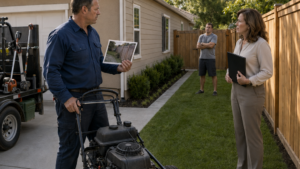
At 6:12 on Monday morning, Jessica Lewis’s phone chimed with a reminder that read, Eli—first visit, severe dental anxiety, just as she stepped into her garage and saw that she could not leave it.
A black lifted pickup stood diagonally across the mouth of her driveway. One oversized rear tire rested beyond the faded white line she had painted along the concrete two summers earlier. The truck’s front end pointed toward the Adams house, but its long bed cut across Jessica’s exit like a gate.
She stared at it for three seconds, still holding her travel mug.
Then the office phone began ringing through the Bluetooth speaker in her car.
Jessica set the mug on the hood and called Anna.
“Tell me you’re already driving,” Anna said.
“I’m in the garage.”
There was a pause.
“The truck again?”
Jessica looked toward the neighboring house. No porch light. No movement behind the blinds.
“I’m handling it.”
“You said that Friday.”
“I handled Friday.”
“You moved your first two patients.”
Jessica pressed her lips together. “Open the side entrance. Put Eli in the quiet room. Don’t let them leave.”
She ended the call before Anna could answer.
The truck had blocked her twice before. The first time, Robert Adams had moved it after ten minutes and apologized with a shrug that made the apology feel borrowed. The second time, he had said Betty’s sister was visiting and there was nowhere else for the truck to go.
Both times Jessica had believed that naming the problem clearly would prevent a third.
She crossed the narrow strip of grass between the houses and knocked on Robert’s door. The porch camera tilted toward her with a faint mechanical click.
She knocked again.
At 6:17, Robert opened the door wearing gray sweatpants and an undershirt. His phone was in one hand. He looked first at Jessica, then past her toward his truck.
“You need to move it,” she said.
Robert rubbed his jaw. “Right now?”
“My first appointment is at six forty-five.”
“I thought you opened at eight.”
“You thought wrong.”
He glanced at his phone as though a better answer might appear there. “Betty’s car is in the garage, and my brother dropped this off late. I didn’t want it sitting in the street.”
“It’s sitting across my driveway.”
“It’s on the apron.”
“It is blocking the only way out of my garage.”
Robert stepped onto the porch and squinted toward the concrete. “The HOA map shows that lower section as guest parking.”
Jessica felt the sentence land before she understood it.
“What map?”
“The one in the welcome packet. Patrick showed it to me when we closed. That flare between the driveways is common-use pavement.”
“That is not between the driveways. It is my driveway.”
Robert gave a small, tired laugh. “Jessica, I’m not trying to steal your land.”
“I didn’t say you were.”
“You’re acting like I parked in your kitchen.”
Her office phone rang again through the car speaker. Then Anna sent a message.
They’re here. He won’t get out of the car.
Jessica held the screen where Robert could see it.
“I have a child waiting for me.”
Robert’s expression changed, but only slightly. He looked embarrassed rather than sorry.
“I’ll get the keys.”
He disappeared into the house.
Jessica returned to her garage and waited beside her car. Two minutes passed. Then four. At 6:24, Robert came outside wearing shoes, circled the truck, and searched his pockets.
“You said you were getting the keys,” Jessica said.
“I did.”
“Where are they?”
He checked the cup holder through the window. “Betty may have moved them.”
Jessica called Anna again.
“Reschedule the first appointment.”
“No,” Anna said. “You told me not to let them leave.”
“I’m telling you now.”
“He’s seven. His mother took off work. They’ve been sitting in the parking lot since six thirty.”
Jessica looked at the truck tire crossing the painted line. For one sharp second, she imagined a bright yellow steel arm clamped around it, absolute and impossible to dismiss.
Then Robert called from his doorway that he had found the keys.
By the time the truck rolled away, Jessica’s hands were trembling. She backed out too quickly, braked at the curb, and forced herself to breathe before driving.
The pediatric office occupied a converted brick house ten minutes away. Its front rooms were painted in soft greens and blues, with paper stars suspended from the ceiling and a wooden train table near reception. When Jessica arrived at 6:52, Anna stood behind the desk with her arms folded.
The quiet room was empty.
“Where are they?”
“They left.”
Jessica set down her bag. “Did you explain?”
“I explained that you had an emergency.”
“It was an access problem.”
“Jessica.”
“What?”
Anna lowered her voice. “The mother asked whether this happens often.”
Jessica looked toward the hallway. A stuffed alligator sat upright in one of the child-sized chairs, smiling with a row of white felt teeth.
“What did you tell her?”
“I told her no.”
It was a lie, but not one Jessica could blame Anna for telling.
At 7:18, the mother sent an email requesting Eli’s records be transferred to another practice. She wrote that her son had spent all weekend preparing for the appointment and could not go through that process twice.
Jessica read the message once, then moved it into a folder marked Follow Up.
Anna watched from the doorway. “You should document this.”
“I am documenting it.”
“I mean the reason.”
“The reason is a parking disagreement.”
“The reason is that you couldn’t leave your own house.”
Jessica opened the morning schedule. “We have patients.”
Anna did not move. “You cannot keep making it sound smaller because you don’t want anyone to think you’re difficult.”
Jessica’s hand stopped above the keyboard.
Years earlier, at another practice, she had reported that a senior partner was reusing single-dose sedation supplies. The complaint had been substantiated. The partner had left quietly. Jessica had been asked to leave less quietly, after being described as rigid, confrontational, and unable to preserve team trust.
She had built this office afterward with borrowed money and a promise to herself that no one would ever again call her unstable for insisting on what was true.
“I said I’m handling it,” she told Anna.
At noon, an email arrived from Patrick Wilson, the HOA community manager.
Subject: Shared Apron Parking Concern
Attached was a neighborhood map marked with pale gray blocks. The area at the end of Jessica’s driveway was labeled Guest Parking / Common Access.
Patrick’s message was polite.
He asked both homeowners to avoid escalation while management reviewed the matter. He noted that Robert’s understanding appeared consistent with the association’s welcome materials.
Jessica enlarged the map until the pixels blurred.
The gray block covered the same concrete where her deed description placed the eastern edge of her lot.
For the first time that morning, Robert’s confidence made sense.
It did not make him right.
But it meant the faded line on the driveway might not be the boundary that mattered.
Chapter 2: The Welcome Map Did Not Match the Ground
On Tuesday evening, Jessica knelt on the concrete with a paint roller and watched Robert park directly over the wet white line.
The rear tire flattened the edge before the paint had dried. When he stepped out of the truck, a crescent of white marked the rubber.
Robert looked down at it.
“You repainted that?”
“It was fading.”
“Patrick asked us not to add markings.”
“He asked us not to escalate.”
“This feels like escalation.”
Jessica capped the paint tray. “Then stop parking on it.”
Robert shut the truck door more firmly than necessary. “I parked where the HOA told me I could park.”
“The HOA sent a sales map. My deed says something else.”
“Then get a survey.”
“I’m working on it.”
“So am I supposed to park in the street until you decide your paperwork is better than mine?”
Jessica stood. “You own a two-car driveway.”
“Betty needs clear access to the garage when she brings her mother over.”
“Then your inconvenience belongs on your property.”
Robert’s face tightened. “You don’t know anything about our situation.”
“No. I know about mine.”
She carried the paint tray inside before the conversation became something she would later have to explain.
The next morning, Patrick met them at the HOA office, a narrow suite above a title company. He wore a navy blazer without a tie and spoke in the patient tone of someone accustomed to turning anger into numbered action items.
On the table between them lay the welcome map, Jessica’s deed, three photographs of the truck, and a printed copy of the community parking rules.
“The problem,” Patrick said, “is that these documents were created for different purposes.”
“My deed was created to establish ownership,” Jessica said.
“And the association map was created to show common-use areas.”
“So which one controls?”
Patrick folded his hands. “That is a legal conclusion I cannot make.”
Robert leaned back. “Then why did the association give me the map?”
“It reflects our operational understanding.”
“Operational understanding,” Jessica repeated.
Patrick looked at her. “Until a licensed surveyor identifies the boundary, I’m asking both of you to maintain the status quo.”
“The status quo is his truck blocking me.”
“The status quo is shared use,” Robert said.
Jessica turned to him. “Shared with whom? I cannot use it when your truck is there.”
Patrick raised one hand. “This is exactly the kind of language we need to avoid.”
“What kind?”
“Personal accusations.”
Jessica stared at him. “A truck across a driveway is not an accusation. It is a location.”
Patrick’s expression cooled by a degree. “No signs, barriers, cones, chains, fresh paint, or other self-help measures until the review is complete.”
Robert nodded as though a ruling had been issued in his favor.
Jessica gathered her deed. “How long will the review take?”
“I manage eleven communities. I’ll contact counsel and our survey vendor.”
“That is not a date.”
“Likely two to three weeks.”
“My office opens at six forty-five every weekday.”
Robert exhaled loudly. “I already said I’d try not to block you in the mornings.”
“Try?”
Patrick slid the map toward the center of the table. “For now, Robert will make reasonable efforts to preserve access.”
The meeting ended with no enforcement, no boundary decision, and no definition of reasonable.
By Thursday, the dispute had begun to spread into Jessica’s workday.
A dental-supply driver called at 11:20 and said he could not reach the garage behind her house, where Jessica stored sealed cartons of gloves, fluoride varnish, and disposable suction tips before bringing them to the office.
“Truck’s across the lower drive,” he said. “I can leave the boxes at the curb, but I need a signature.”
Jessica was with a child receiving a stainless-steel crown. She could hear the high whine of the handpiece through the treatment-room door.
“Can you wait fifteen minutes?”
“My route says eight.”
“Then leave them at the office.”
“Address change requires dispatch approval.”
Anna stood beside Jessica, already reading the problem in her face.
“Give me the phone,” Anna said.
Jessica turned away. “I can handle it.”
She called Robert. No answer.
She called Betty. No answer.
She called Patrick.
“I cannot provide immediate parking enforcement while the boundary is disputed,” he said.
“This is a commercial delivery.”
“That may itself raise a home-business use question.”
Jessica went silent.
Patrick continued, softer now. “I am not threatening you. I’m telling you why we need to be careful about expanding the complaint.”
The driver left the cartons at the curb. By the time Jessica reached home, one had been soaked by a sprinkler. Another had split when someone moved it onto the grass. Two cases of sterile supplies had to be discarded.
That evening, she drove to the county records office before closing.
The clerk behind the counter listened as Jessica described the property, then searched by subdivision name and lot number. She produced an index card from an older scanning system and wrote down a plat book and page reference.
“This is the recorded subdivision plat,” the clerk said. “Not a marketing plan.”
“Can I get a certified copy?”
“Tomorrow, if the archive scan is clean.”
Jessica placed Patrick’s map beside the index card. The shapes were similar, but the common-access block on the HOA version extended several feet farther onto her lot.
“Could the association map have been updated later?”
“Could have been redrawn. Could have been simplified. This office only records what was filed.”
The clerk entered another search.
Her fingers stopped.
“What?” Jessica asked.
“The association management company requested this same plat.”
“When?”
The clerk turned the monitor slightly. “Two years ago.”
Jessica leaned closer. The requester field listed Patrick’s company. The service address matched the HOA office where he had told her he needed weeks to determine which map applied.
“Can I have that request record?”
“It’s public, but it won’t tell you who in the company opened it.”
“It tells me they knew the plat existed.”
The clerk gave her a careful look. “It tells you they ordered it.”
Jessica left with the reference number written on a yellow receipt.
At home, Robert’s truck was gone. The white line remained scarred where his tire had crossed it, broken into three uneven segments.
A new email from Patrick waited on her phone.
He instructed both households to remove all signs and markings associated with the disputed area by Saturday. Failure to comply could result in enforcement charges.
Jessica read the message beneath the porch light.
Then she looked at the date on the county request again.
Two years earlier, the HOA had asked for the exact record Patrick now claimed he needed time to locate.
Chapter 3: She Stopped Asking During the Birthday Dinner
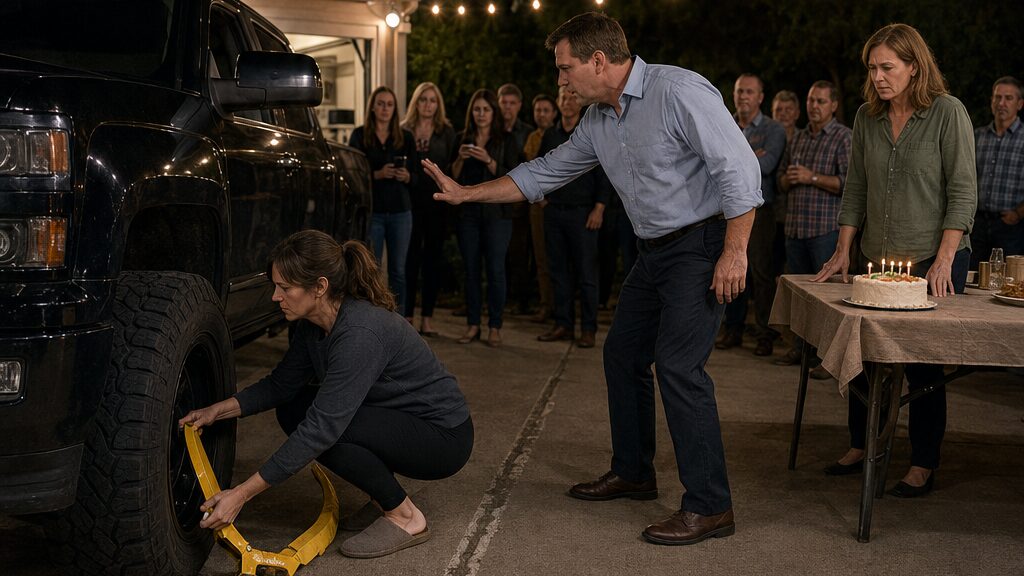
The party went quiet one guest at a time as Jessica crossed the lawn carrying the yellow wheel boot.
She wore black leggings, an old college sweatshirt, and house slippers with rubber soles. The boot’s steel arms knocked softly against her leg. Twenty feet away, beneath strands of patio lights, Betty stood beside a birthday cake while Robert’s relatives watched Jessica approach his truck.
Robert came around the side of the house with a paper plate in one hand.
“What are you doing?”
Jessica stopped beside the front tire.
“Restoring access to my driveway.”
His gaze dropped to the boot. “You put that on my truck, and you’re paying for every scratch.”
Jessica set the device on the concrete.
Behind him, someone laughed uncertainly, waiting for the moment to become a joke.
It did not.
The county office had emailed the certified plat on Friday afternoon. A thick black line placed the entire lower apron inside Jessica’s lot. The surveyor she contacted could not stake the boundary for another ten days, but he had confirmed that the legal description matched the recorded drawing.
Patrick had replied with three sentences.
He acknowledged receipt. He repeated that no party should use self-help measures. He said management would review the documents.
Robert had parked across the driveway at 5:40 Sunday evening, after Jessica watched him open Patrick’s email on his phone while standing beside the truck.
She had walked over once.
“My driveway needs to remain open.”
He had looked toward the tables filling his backyard.
“I have twenty-two people here.”
“That does not change the boundary.”
“It changes where everybody can fit.”
“Move the truck.”
“After dinner.”
“My emergency access cannot depend on your dessert schedule.”
Robert had smiled without humor. “You’re really going to make Betty’s birthday about this?”
Jessica had returned home.
For twenty minutes she sat at her kitchen table with the boot’s instruction sheet, the recorded plat, the HOA rules, and a printed notice she had prepared herself. She called the tow-company dispatcher and asked whether a homeowner could immobilize a trespassing vehicle on private residential property.
“We don’t advise owners on booting,” the dispatcher said. “We tow under posted-property authorization.”
“Can you tow tonight?”
“Not without confirming signage and ownership. Earliest inspection is tomorrow.”
Jessica called the sheriff’s nonemergency line. The operator said a deputy could respond if the dispute became threatening, but property boundaries were civil matters.
No one told her she had authority to use the boot.
No one clearly told her she did not.
The yellow device sat on the kitchen floor like an answer that had arrived before permission.
Now Robert stood over her as she opened its steel arms.
“You were told not to put barriers out here,” he said.
“This isn’t a barrier.”
“What do you call it?”
“A consequence.”
Several guests murmured. Betty remained near the cake, one hand gripping the edge of the table.
Robert lowered his voice. “You need to think very carefully.”
“I have.”
“No, you’ve been stewing over this for weeks, and now you’re walking into my wife’s party dressed like you’re taking out the trash.”
Jessica looked at him then.
“I lost a patient because I couldn’t leave my garage.”
Robert’s expression shifted, but the guests were watching. Whatever response might have surfaced disappeared.
“That doesn’t give you the right to damage my property.”
“It gives me the right to protect mine.”
“According to which map?”
“The recorded one.”
“The HOA hasn’t ruled.”
“The county already did when it recorded the plat.”
Robert stepped closer. “Patrick said the area stays shared until review.”
“Patrick does not own my driveway.”
Betty came forward at last. “Robert, maybe move it.”
He turned sharply. “The keys are inside, and she has already decided to perform for everybody.”
Jessica crouched beside the tire.
The boot was heavier than it had seemed in the product video. She aligned the padded clamp around the rubber, checked that no metal touched the rim, and tightened the locking arm one notch at a time.
A guest raised a phone.
Robert saw it. “Put that away.”
The guest lowered it.
Jessica compared the serial number stamped on the boot with the number printed on her release notice. Her hands were steady. That steadiness frightened her more than anger would have.
She closed the lock.
The click was small, almost delicate.
The yellow arms looked absurd against the enormous black tire, yet the truck was suddenly no longer the largest fact in the driveway.
Jessica slid the notice beneath the windshield wiper. It stated that the vehicle was immobilized because it obstructed access to private property. It provided her phone number and warned against attempting to drive.
Robert pulled the paper free and read it.
“Release fee?”
“It covers the device and the documented losses from tonight if I need emergency transport.”
“You made up a fee.”
“I calculated a fee.”
“That is not the same thing.”
“No,” Jessica said. “It isn’t.”
For several seconds, no one spoke.
Then Robert took out his phone and called the sheriff.
The deputy arrived twelve minutes later. By then, party guests had divided into quiet clusters. Betty had carried the cake indoors. The music was off.
The deputy examined the truck, the boot, Jessica’s plat, Robert’s HOA map, and Patrick’s email.
“The boundary may be yours,” he told Jessica, “but that does not automatically mean you can immobilize a vehicle.”
“It is blocking access.”
“I understand.”
“Can you order him to move it?”
“I can ask him to move it. He cannot move it while the boot is attached.”
Robert folded his arms. “She wants money.”
Jessica felt every face turn toward her.
“I want access.”
“Then remove the boot,” the deputy said. “You can pursue trespass or towing through the proper process.”
“What happens if I remove it and he leaves it there?”
The deputy looked at Robert. “He should move it immediately.”
“Should?”
The deputy’s expression warned her that the next sentence would not help.
“This is why self-help creates complications.”
The phrase struck harder than she expected. Self-help. The same instinct that had built her office after the partnership collapsed. The same instinct that had kept Anna from knowing the practice was losing money. The same instinct that had carried a sixty-pound boot into a birthday party because she could not tolerate needing anyone’s permission to leave her own home.
Jessica unlocked the device.
Robert moved the truck while the deputy watched. He parked along the curb, fully clear of her driveway, then returned without looking at her.
No one apologized.
At 9:14, after the guests had begun leaving, Patrick sent an email to both households and the HOA board.
He described the incident as an unauthorized vehicle immobilization involving a disputed common area. He cited the association rule against owner-installed enforcement devices. He scheduled an emergency hearing for Wednesday evening.
The final paragraph stated that the board would consider monetary fines, removal of Jessica’s private-parking signs, and temporary suspension of her right to park on association-controlled common access areas.
Jessica read the sentence twice.
Patrick’s map labeled the only path from her garage to the street as association-controlled access.
By locking Robert’s truck for less than twenty minutes, she had given the HOA a way to threaten the very access she had been trying to protect.
Chapter 4: The Hearing Made Her Look Like the Trespasser
The first thing Jessica saw when she entered the HOA clubhouse was a six-foot photograph of the yellow boot projected onto the wall.
The image had been taken from across Robert’s driveway. Jessica was crouched beside the truck, her face turned away, one hand on the locking arm. Behind her, three party guests stood beneath the string lights. From that angle, the painted boundary line was hidden beneath the tire.
Patrick Wilson stood beside the projector with a remote in his hand.
“Please take a seat,” he said.
The board president occupied the center of a folding table at the front of the room. Two board members sat beside her with printed packets. Robert and Betty were already in the first row. Robert wore a collared shirt and kept one hand resting on a folder in his lap. Betty looked at Jessica once, then lowered her eyes.
On a smaller table near the wall sat the yellow wheel boot.
Patrick had placed it there like a confiscated weapon.
Jessica chose a chair across the aisle from Robert. She carried the certified plat, the deed, the county request record, and printed copies of every message she had sent. She had not brought the file Anna had begun assembling about missed appointments. She had told herself that patient information did not belong in a neighborhood hearing.
The board president called the meeting to order.
Patrick began with policy.
“The association’s concern tonight is not to determine criminal trespass or issue a final legal interpretation of private title. Our concern is conduct within the community and compliance with association rules.”
Jessica understood the move immediately. The meeting would not begin with Robert’s truck. It would begin with her response to it.
Patrick advanced to the next photograph. The boot filled the screen.
“Section nine prohibits residents from installing barriers, immobilization devices, chains, or other private enforcement equipment on areas designated or treated as common access.”
Jessica raised her hand.
The board president nodded. “You’ll have time to respond.”
Patrick continued. He described the birthday dinner as a private family event interrupted by an escalating parking dispute. He mentioned the sheriff’s response. He noted that Jessica had demanded a release payment not authorized by the association.
“I did not collect any money,” Jessica said.
The president looked over her glasses. “Dr. Lewis.”
Jessica stopped.
Robert’s photographs followed: the repainted line, her private-driveway sign, the printed release notice beneath his windshield wiper. Each image isolated an action from the reason for it.
When Patrick finished, the board president turned to Robert.
He stood and opened his folder.
“When Betty and I bought the house, we were given this map.” He held up the welcome packet. “It shows the apron as guest parking. I relied on that. I never tried to trap Jessica in her home. I told her I would move whenever she needed out.”
Jessica felt a pulse begin behind her right eye.
Robert continued. “But the signs got bigger. Then she painted a line. Then she started photographing my truck. On Sunday she came into a family gathering with an industrial boot and demanded money.”
“I asked you to move before the party started.”
Robert turned toward her. “You told me what to do on property I had been told was shared.”
“The recorded plat—”
The board president tapped her pen once. “You will both address the board, not each other.”
Robert faced forward again.
“I don’t want a war with my neighbor,” he said. “I want clear rules. But I also don’t think someone should be allowed to immobilize a vehicle because they decide they’re right.”
That was the strongest thing he could have said because part of it was true.
Patrick projected the HOA map beside the county plat. On the welcome map, the gray guest-parking block widened across the lower driveway. On the recorded plat, the boundary line cut along Robert’s side of the pavement.
One board member leaned closer to the screen. “The deeded line appears to favor Dr. Lewis.”
Patrick nodded. “It may. Counsel has not issued an opinion.”
“Why would counsel need to interpret a recorded boundary?” Jessica asked.
“Because the association has maintained the apron as common access.”
“You have never maintained it.”
Patrick’s expression stayed neutral. “The association’s treatment of the area is part of the review.”
“The cracks were sealed at my expense. I paid to repaint the edge. I shovel it when it snows.”
“That may support your claim,” the board president said. “But ownership does not automatically authorize the boot.”
Jessica looked at the yellow device against the wall. Three nights earlier it had seemed like the only solid answer in a dispute made of soft language. Now it looked crude and theatrical.
The board president turned to her. “Please explain why you believed that action was necessary.”
Jessica opened her folder.
She could have described Eli. She could have explained the mother sitting in the parking lot with a frightened child while Jessica waited for Robert to find his keys. She could have shown the discarded dental supplies and the continuing-education cancellation charge. Anna had emailed her the figures that afternoon.
Instead, Jessica said, “I had repeatedly requested access. I obtained the recorded plat. I posted notice. I contacted law enforcement and a towing company before acting.”
“That was not my question,” the president said. “Why was it necessary?”
Jessica felt Robert watching her.
Because I could not leave my own house.
Because a child trusted me to be there.
Because the last time I explained too much, people used my anger to erase the danger I reported.
She chose the narrowest answer.
“The vehicle was obstructing my driveway.”
A board member glanced at Patrick’s summary. “Were there financial losses?”
“Nothing relevant to title.”
“Were you prevented from responding to an emergency?”
“No emergency occurred.”
Robert shifted in his chair. The small movement sounded louder than it should have.
The president asked, “Then why not wait for the survey?”
Jessica closed her folder. “Because I had already waited through repeated obstruction.”
The answer was factual and inadequate. She heard it as the room heard it: a disciplined professional had grown impatient and staged a consequence at a birthday party.
Patrick offered an interim recommendation. Jessica would remove all private signs and markings from the disputed apron. Robert would avoid blocking the garage “when reasonably possible.” Jessica would receive a $750 enforcement charge for the immobilization device. The board would also reserve the right to suspend parking access across any area later determined to be association-controlled.
“Suspending access would prevent me from reaching my garage,” Jessica said.
“If the apron is common,” Patrick replied, “access is a privilege governed by association rules.”
“And if it is mine?”
“Then that provision would not apply.”
“So I am being threatened with losing access until you determine whether you have the power to take it.”
Patrick’s jaw tightened. “No one is threatening you.”
The board president called a ten-minute recess.
Jessica stepped into the hallway. Through the clubhouse windows she could see rows of matching mailboxes and trimmed lawns under white streetlights. Everything looked orderly from a distance.
Robert emerged a minute later. He stopped near the water fountain.
“This could have ended if you’d just asked me to move,” he said.
Jessica stared at him.
“I did.”
“You made demands.”
“I knocked on your door before sunrise while a patient waited for me.”
“You never said someone left your practice.”
The fact that he did not know was partly her fault. She had wanted him to respect the boundary without needing a tragedy attached to it.
“It should not require a lost patient,” she said.
“No. But you keep acting like I knew the full effect.”
“You knew you were blocking me.”
“That’s not the same thing.”
Patrick called them back inside before she could answer.
The board postponed a final boundary decision but approved the enforcement charge by two votes to one. Jessica was ordered to remove the painted line and sign within forty-eight hours.
When the meeting ended, she carried the yellow boot to her car. Its weight pulled against her shoulder.
Anna was waiting beside the driver’s door.
Jessica stopped. “What are you doing here?”
“You weren’t answering.”
“This was a closed hearing.”
“I stayed outside.”
Anna held a thick accordion file against her chest.
“What is that?”
“The problem you told everyone was only parking.”
Jessica reached for the file, but Anna did not release it immediately.
Inside were cancellation notices, delivery photographs, rescheduling logs, the continuing-education fee, and Eli’s transfer request. Anna had placed a total on the front page, not only in dollars but in appointments, staff hours, and children affected.
“You had no right to pull patient records,” Jessica said.
“No names are included.”
“I didn’t ask you to do this.”
“I know.”
Anna let go of the folder.
Jessica looked through the clubhouse window. Robert and Patrick stood near the projected photograph, talking quietly beneath the image of her crouched beside the boot.
Anna’s voice softened. “You keep protecting your reputation by hiding the evidence that explains your choices.”
Jessica held the file against her ribs.
The next hearing would not allow her to remain both private and believable.
Chapter 5: The Email Sent Before the Party Changed Everything
Jessica found the timestamp because Patrick had forwarded the wrong message.
It arrived Monday at 9:06 a.m., while she was reviewing the previous week’s cancellation log in the small office behind reception. Patrick’s subject line read, Proposed Resolution—Lewis/Adams Access Matter.
Below his new message sat an older email chain.
Jessica was about to print the settlement when she noticed the first line of the attached correspondence:
From: County Records Division
Sent: Friday, 2:14 p.m.
To: Patrick Wilson
Friday was two days before Betty’s birthday party.
The attachment listed the certified subdivision plat and the same book and page number Jessica had provided. Patrick had not merely received her copy after the incident. The county had sent it directly to him before Robert parked across her driveway on Sunday.
Jessica enlarged the header.
Patrick’s forwarding notes began at 4:38 Friday afternoon.
Please review before responding to homeowner. Existing association map may not conform. Potential exposure if prior access directives relied on same exhibit.
The message was addressed to association counsel and the board president.
Jessica read it three times.
Then she called Anna into the office and pointed at the screen.
Anna leaned over the desk. “He knew.”
“He knew the map might be wrong.”
“He knew enough not to tell Robert the area was shared.”
Jessica searched the chain for Robert’s address. It was not there.
“Maybe he didn’t send it to them.”
Anna straightened. “Does that make it better?”
“No.”
But it changed the shape of the lie. Patrick had not fabricated a boundary. He had delayed acknowledging one because the correction threatened more than a single parking dispute.
At noon, Patrick called.
“I assume you’ve reviewed the proposal,” he said.
Jessica looked at the printed settlement on her desk. It removed the $750 charge and recognized her right to unobstructed garage access. In exchange, she would grant Robert limited use of the lower apron for up to six hours during family visits, withdraw any demand for losses, and agree that the resolution created no precedent for other properties.
A confidentiality clause prohibited either household from discussing the settlement with other owners.
“You had the certified plat before the party,” Jessica said.
Silence held for half a second.
“We received a record that required legal review.”
“You told me the association still needed time to locate the controlling document.”
“We needed time to assess it.”
“You also told Robert the status quo remained shared use.”
“I instructed both parties not to escalate.”
“You left the truck where the harm was occurring and prohibited me from marking the boundary.”
Patrick’s tone became careful. “Jessica, the proposed agreement gives you what you asked for. Your garage remains accessible. The enforcement charge disappears. Robert gets narrow, scheduled use that does not interfere with your work.”
“And the old map stays in circulation.”
“The map is an internal operational exhibit.”
“It was handed to Robert as proof of his rights.”
“We can update his packet.”
“What about everyone else?”
Patrick exhaled. “This is not the only property in the subdivision with discrepancies between sales materials and recorded descriptions.”
There it was.
Jessica glanced at Anna, who had remained by the door.
“How many?” Jessica asked.
“I cannot discuss other owners’ files.”
“Enough that correcting them would be expensive?”
“Enough that a broad announcement could create confusion and unnecessary disputes.”
“Unnecessary for whom?”
“Please don’t turn this into an accusation of bad faith. Associations inherit imperfect records. Managers resolve practical conflicts every day without reopening decades of decisions.”
Jessica looked at the settlement again. It was clean, quiet, and almost generous. She could sign it and be done. Robert would have rules. The fine would vanish. The office would stop losing time.
The offer touched the exact weakness she had protected for years: the desire to solve a problem without becoming publicly difficult.
“What happens if I refuse?” she asked.
“The enforcement charge remains pending. The board could proceed with access restrictions, although counsel may advise otherwise once title is confirmed.”
“You are offering not to use a power you may not have.”
“I am offering certainty.”
“No. You are offering privacy.”
Patrick lowered his voice. “Privacy can be useful when everyone has made mistakes.”
Jessica looked toward the reception area. A child was turning the wooden train in slow circles while Anna’s assistant spoke with his father. The ordinary sound of the office made Patrick’s proposal seem even more dangerous. It would repair Jessica’s driveway and preserve the same machinery that had dismissed the harm.
“I’ll respond in writing,” she said.
After the call, Anna pointed toward the settlement.
“You’re thinking about signing.”
“I am thinking about my staff.”
“You’re thinking about never having to explain the boot again.”
Jessica pushed back from the desk. “I did something I may not have had the authority to do.”
“Yes.”
The immediate agreement in Anna’s voice irritated her more than resistance would have.
“And if the board fines me, that money comes out of this practice.”
“Yes.”
“If Robert sues over the boot—”
“Then hiding the rest of the facts will not make that disappear.”
Jessica stood. “You make honesty sound free.”
Anna’s expression changed. “No. I’m the one who has been moving appointments around while you pretend nothing is wrong. I know exactly what it costs.”
The words hung between them.
Jessica left the office before she said something that would reduce Anna’s loyalty to insubordination.
At the county records room that afternoon, the clerk provided a certified copy of the management company’s earlier request. The same plat had been ordered two years before during an unrelated drainage-access complaint. The clerk could not say what Patrick had done with it, only that his company had received it.
A surveyor met Jessica outside the records building and reviewed the documents against the legal description.
“This lower apron is yours,” he said, tracing the line with a capped pen. “The association may have easement rights for drainage or utility access, but that does not create guest parking.”
“Could the welcome map override it?”
“No.”
“Could long use make it shared?”
“That’s a lawyer question. But a marketing exhibit doesn’t convey title.”
The answer should have felt like victory.
Instead, Jessica imagined every homeowner who had obeyed a warning based on the same gray map. Every painted line removed. Every access dispute settled because Patrick preferred stability to correction.
That evening, she spread the documents across her kitchen table. The yellow boot’s release notice lay beside Patrick’s email chain. Both contained dates, serial numbers, and language designed to make control look official.
She had created one without authority.
Patrick had relied on the other after learning it might be false.
The difference mattered, but it did not make her blameless.
Jessica opened the settlement and typed a response.
She acknowledged that the boot violated association policy and stated that she would not contest a reasonable penalty for that action. She rejected shared parking, confidentiality, and any resolution that left the obsolete map in use. She requested a reconvened hearing, disclosure of all records related to the plat, and an association-wide correction process.
Before sending it, she attached Anna’s file.
Not the patient identities. Not private treatment details.
Only the losses she had hidden.
She pressed send at 10:42 p.m.
At 10:57, her phone lit up with a message from Betty Adams.
I need to speak to you before the hearing. Alone, please. Robert cannot know yet.
Chapter 6: Betty Would Not Sign Robert’s Version
Betty arrived carrying the white ceramic plate Jessica had brought over on moving day.
A strip of faded yellow ribbon still clung to its edge. Jessica recognized it immediately. Six weeks earlier, the plate had held a lemon loaf wrapped in wax paper, still warm from the oven. Now it was empty and clean enough to reflect the porch light.
“I should have returned this sooner,” Betty said.
Jessica opened the storm door but did not invite her inside.
Betty held out the plate. “May I sit?”
They took the two chairs on Jessica’s porch. Between them, beyond the railing, the painted boundary line crossed the driveway in broken white pieces. Jessica had removed the sign as ordered, but she had not yet scrubbed away the paint. Robert’s tire had smeared one section into a pale arc.
Betty placed the plate on her knees.
“Patrick wants us to sign statements before the hearing,” she said.
“What kind of statements?”
“That we had no notice the driveway belonged to you before the party.”
Jessica kept her hands folded. “Did you?”
Betty looked toward her house.
“Robert opened the survey email Friday night.”
The neighborhood was quiet except for an air-conditioning unit cycling on two houses away.
Jessica asked, “Patrick sent it to him?”
“No. You did.”
She remembered. After receiving the certified copy, Jessica had forwarded it to Robert and Betty with one sentence: This confirms the lower apron is within my recorded lot. Please keep it clear.
The message showed as opened, but she had not known by whom.
Betty rubbed her thumb along the plate’s rim. “Robert read it at the kitchen counter. I was standing there.”
“What did he say?”
“That a drawing was not a survey. That Patrick had told him not to accept your interpretation. He said nothing was final until the board decided.”
“Then why sign a statement saying he never received it?”
“He says receiving something is not the same as being formally notified.”
Jessica almost laughed, but Betty’s face stopped her.
“He knew enough,” Jessica said.
“Yes.”
“Yet he parked there Sunday.”
Betty’s shoulders lowered. “My family was coming. My mother uses a walker. We had borrowed a van for her, and Robert’s truck had to move out of our driveway so the van could pull close to the garage.”
“He could have parked on the street.”
“He doesn’t like leaving it there.”
“That does not make my driveway available.”
“I know.”
The admission was quiet, almost without force, but it was the first time anyone from the Adams house had said it plainly.
Betty looked at the fractured line. “Robert was moved out of his regional supervisor job in January. They kept him, but he lost the vehicle allowance and part of his bonus. We bought this house before that happened.”
Jessica said nothing.
“He bought the truck when the promotion came through. Now the payment is more than our first mortgage was. Widening the driveway would mean moving a retaining wall and drainage inlet. We got an estimate. We can’t do it.”
“That explains why the space mattered to him.”
“It doesn’t excuse what he did.”
“No.”
Betty looked relieved that Jessica had not softened the distinction for her.
“He kept saying the map meant we had time,” she continued. “Then when your plat came, he said if he admitted you were right, everyone at the party would know we couldn’t afford to fix our own driveway.”
“Your guests did not need an explanation.”
“He thought they would ask why the truck was on the street. His brother already makes comments about the job.”
Jessica looked through the porch railing toward Robert’s house. The lifted truck was parked fully inside his driveway tonight, squeezed close to the garage door. Betty’s car sat at the curb.
Robert’s behavior had not come from ignorance alone. It had come from shame sharpened into entitlement.
“Why are you telling me this?” Jessica asked.
Betty’s fingers tightened around the plate.
“Because Patrick’s statement says you acted without warning and that Robert reasonably believed the space was common. The second part was true at first. The first part isn’t.”
“Will you tell the board?”
“I’ll tell them we received the email.”
“Will you tell them Robert opened it?”
Betty did not answer immediately.
“I won’t sign a lie,” she said. “But I’m not going into that room to humiliate my husband.”
“He used your birthday to make me look unstable.”
“I know.”
“He stood in front of your family and pretended he had no reason to move.”
“I know.”
Betty’s voice cracked on the second word. She looked down at the empty plate.
Jessica felt the old instinct to press harder. To secure the exact statement, the exact commitment, the exact result before Betty could retreat. It was the same instinct that had tightened the yellow boot one notch at a time.
Instead, she waited.
Betty finally said, “If I’m asked directly whether we saw the survey before the party, I will answer truthfully. I won’t give Patrick the statement he drafted.”
It was less than Jessica wanted and more than Robert expected.
“Thank you,” Jessica said.
Betty stood.
At the steps, she paused. “You really lost patients?”
“One transferred. Others rescheduled. Deliveries were damaged.”
“Robert said you had flexible hours because you owned the practice.”
Jessica looked at her. “Owning the practice means everyone else’s missed hour belongs to me.”
Betty nodded once and walked home carrying nothing.
Jessica left the empty plate on the porch table.
The next morning, she woke to a scraping sound outside.
It was 5:48.
She went to the front window and saw Robert kneeling at the boundary line with a wire brush attached to a cordless drill. White dust spread across the concrete around him. He worked in short, angry passes, erasing the paint before the final hearing.
Jessica stepped onto the porch.
Robert did not look up.
“What are you doing?”
“Following the board’s order.”
“The deadline passed yesterday.”
“Then I’m late.”
“That line marks the survey reference.”
“It marks where you decided the survey goes.”
Jessica descended one step. “A licensed surveyor is coming next week.”
Robert stopped the drill.
For a moment, neither moved.
Then he stood and faced her. His eyes were tired, his work shirt wrinkled as though he had slept in it.
“You talked to Betty.”
“She talked to me.”
“You dragged her into this.”
“No. You asked her to sign something false.”
His face hardened. “You have no idea what Patrick asked us to sign.”
“She told me enough.”
Robert looked toward his house, then back at Jessica. “You think this is all simple because you have a document and a business and people who call you doctor.”
Jessica felt the accusation search for a place to land.
“This became simple when you received the plat and parked there anyway.”
“My family needed access.”
“So did mine.”
“You live alone.”
The words stayed between them.
Jessica did live alone. That did not make her time, work, or property less inhabited.
Robert seemed to recognize too late what he had said. His grip loosened on the drill.
Jessica stepped off the porch and stopped several feet from the line.
“I am not going to stop you from removing paint the board ordered removed,” she said. “But the concrete dust, the photographs, and the time you began will be included in the hearing record.”
Robert gave a bitter laugh. “Of course they will.”
“You can still tell the truth before Betty has to.”
His eyes shifted toward the Adams house.
For one second, Jessica thought he might answer.
Instead, he lowered the drill and pulled the trigger.
The wire brush screamed against the concrete, and the last visible section of the white boundary disappeared beneath a cloud of dust.
Chapter 7: Jessica Refused the Settlement That Protected Everyone Else
Patrick placed the settlement in front of Jessica before the hearing had formally begun.
The document was clipped inside a blue folder. A yellow tab marked the signature page. At the top, beneath the association’s letterhead, a bold line read: Confidential Resolution of Access Dispute.
“If both households sign tonight,” Patrick said quietly, “the board can close the matter without further findings.”
Jessica did not touch the folder.
Across the clubhouse, Robert sat beside Betty. He kept his eyes on the table. Betty had no papers in front of her.
The yellow wheel boot rested on a folding table beneath the projector screen. Jessica had brought it herself, along with its key, the recorded plat, Patrick’s email chain, Anna’s loss summary, and the association welcome map. She had arranged the documents in separate folders, but the boot required both arms to carry. Several homeowners invited as observers had watched her bring it through the door.
Patrick lowered his voice further. “Your fine disappears. The Adams household agrees not to block your garage. Limited guest use would be scheduled in advance. This is a workable outcome.”
“And the map?”
“We will correct the Adams file.”
“The association-wide map.”
“That is not part of this settlement.”
“Then this settlement protects my driveway and leaves the error in place.”
Patrick’s expression tightened. “It prevents unnecessary disruption.”
Jessica opened the folder.
The confidentiality clause covered not only the settlement but the disputed records, the county request, and the circumstances surrounding the birthday incident. Another paragraph required both parties to acknowledge that the association had acted reasonably based on information available at the time.
Jessica looked up. “You had the correct plat before the party.”
“We had a document requiring review.”
“You wrote that the map might not conform.”
“That was an internal concern, not a final conclusion.”
“And you let Robert continue treating the area as shared.”
Patrick glanced toward the board table. “This is your opportunity to resolve the problem you actually have.”
Jessica closed the folder.
“That is not the only problem I have.”
The board president called the hearing to order.
Patrick presented the settlement as evidence that management had attempted compromise. He described the remaining dispute as a question of scope: whether correction should apply only to Jessica and Robert or whether the association should examine older neighborhood records.
One board member asked how many properties might be affected.
Patrick adjusted his papers. “We have identified at least seven files with maps derived from the same sales exhibit.”
A murmur moved through the observers.
The board president frowned. “Seven?”
“Potentially. That does not mean seven title errors exist.”
“But the same obsolete map was used?”
“Yes.”
The projector displayed the welcome map. Gray areas marked guest parking, drainage access, and shared aprons. Jessica noticed several places where the gray shapes ignored lot lines entirely.
Patrick continued. “A broad audit could create unnecessary alarm, legal expense, and demands to revisit prior enforcement.”
Jessica heard the argument clearly now. The association did not fear being unable to find the truth. It feared the cost of admitting that truth had been available while easier answers were enforced.
The board president turned to Jessica.
“You requested this hearing. You may respond.”
Jessica stood.
She placed the recorded plat on the table beneath the screen. Then she set the welcome map beside it. Finally, she carried the yellow boot from the evidence table and placed it between them.
The metal struck the table with a dull weight.
“I want to begin with what I did wrong,” she said.
Patrick looked up sharply.
Jessica removed the key from her pocket and laid it beside the boot.
“I immobilized Robert’s truck without written authority. I had confirmed that the driveway was within my recorded lot, but I had not confirmed that I was legally permitted to use this device. I prepared my own release notice and included a fee the association had not approved.”
Robert shifted in his seat.
Jessica kept her eyes on the board.
“I believed that because I was right about the boundary, every action I took to defend it became right as well. That was not true.”
No one interrupted.
“The boot should not have been used. I will accept a reasonable penalty tied to that decision.”
One of the board members leaned toward the president. The other wrote something on her packet.
Patrick said, “That admission supports the original enforcement charge.”
“It supports a charge for the boot,” Jessica replied. “It does not support pretending the truck was parked in a common area.”
She opened Anna’s file.
“My first patient on the Monday Robert blocked me was a seven-year-old child with severe dental anxiety. His mother transferred him to another practice after I failed to arrive. A supply delivery was damaged because the driver could not reach my garage. Staff hours were spent rescheduling appointments. I paid a cancellation fee after missing continuing education.”
She handed the summary to the board president.
“I did not disclose this at the first hearing because I did not want my professional problems discussed by my neighbors. I also believed that the boundary should matter without a dramatic story attached to it.”
She looked at Robert.
“It should have.”
Robert’s face remained still, but Betty lowered her eyes.
Jessica continued. “My silence made the boot look like the beginning of the conflict instead of a bad decision made after repeated obstruction. That silence was mine. The obsolete map was not.”
She displayed Patrick’s email chain.
The forwarding timestamp appeared on the screen.
Patrick stood. “Those communications were produced out of context.”
“The context is in the chain,” Jessica said. “You received the certified plat two days before the party. You warned counsel that previous directives might rely on the same incorrect exhibit. You did not correct the shared-use instruction.”
“I could not make a title determination without legal review.”
“You could have told both households not to park in the disputed area.”
Robert spoke from his chair. “There was nowhere else for the truck that night.”
The board president turned to him. “Mr. Adams, did you receive Dr. Lewis’s copy of the plat before the party?”
Robert looked toward Patrick.
Patrick did not answer for him.
Robert said, “I received an email containing a drawing.”
“Did you open it?”
He hesitated. “I reviewed it.”
Betty’s hands tightened together.
The president asked, “Did you understand that Dr. Lewis claimed the drawing established her ownership?”
“Yes.”
“And you parked there anyway?”
Robert glanced toward the observers. The same social pressure that had shaped the birthday dinner entered the room again.
“The association had not changed its position.”
“That was not my question.”
Betty spoke before he could answer.
“We both saw it Friday night.”
Robert turned to her.
She did not look at him.
“Patrick’s proposed statement says we had no notice,” Betty continued. “I will not sign that.”
The room became completely still.
Robert’s face reddened. “Betty.”
She looked at him then. “You said the board would protect us if we held the line.”
Jessica felt no triumph. Only the hard settling of something that had resisted its own weight.
Robert stood. “I believed the HOA map controlled until they told me otherwise.”
“At first,” Jessica said. “Not by Sunday.”
He faced her. “You think I wanted any of this? I lost part of my income. We cannot widen the driveway. Her mother needs the garage. That truck payment does not disappear because your plat has a black line.”
“No,” Jessica said. “It does not.”
The room seemed surprised by her agreement.
“But neither does my work. Neither does my right to leave my house. Your financial pressure explains why the space mattered. It does not transfer that pressure to me.”
Robert sat down slowly.
The board president called a recess. The three board members moved into the adjoining room with association counsel. Patrick remained beside the projector, gathering papers into a stack that no longer looked orderly.
He approached Jessica.
“You understand that an association-wide audit may reopen years of disputes.”
“Yes.”
“Owners may demand reimbursement.”
“Yes.”
“Management costs will rise. Dues may increase.”
Jessica looked at the boot between the maps.
“Then the cost belongs to the error, not to the person who found it.”
Patrick’s mouth tightened. “You could leave tonight with everything you asked for.”
“I asked for the truth to control the boundary.”
“You asked for access.”
“I thought access was the whole problem.”
The board returned after twenty-three minutes.
The president read the decision without preamble.
The $750 enforcement charge was voided and replaced with a $150 safety violation for unauthorized vehicle immobilization. No parking-access suspension would be imposed. The recorded plat would govern the Lewis-Adams boundary unless later modified by a court.
Robert was ordered not to obstruct Jessica’s driveway.
Patrick’s management company would no longer make unilateral boundary determinations. The association would retain an independent survey firm to audit all common-access maps derived from the obsolete sales exhibit.
Corrected records would be sent to every affected homeowner.
Patrick stared at the table while the president spoke.
Jessica listened until the final sentence.
“The board further directs that no confidential settlement may prevent disclosure of corrected property information.”
The observers did not applaud. They shifted, whispered, and began calculating what the decision might mean for their own homes.
It was better that way.
Jessica picked up the boot key but left the boot on the table until Patrick signed the receipt acknowledging its return.
When she stepped outside, Robert was standing alone near the curb.
Betty had already walked home.
Robert looked toward Jessica’s driveway, where the painted line had been erased.
“What do you want from me now?” he asked.
Jessica held the folders against her chest.
“Keep your truck on your property.”
His jaw moved as if he had expected something larger—money, apology, humiliation.
“That’s it?”
“No,” Jessica said. “But it is where you start.”
Chapter 8: The New Boundary Did Not Restore the Old Welcome
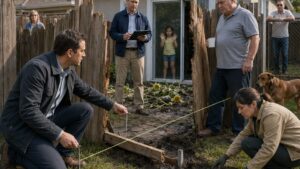
The saw cut into the driveway at the exact place where Robert had erased the painted line.
A worker guided the blade through the concrete while another held a vacuum hose near the dust. The sound carried across the subdivision entrance and into both houses. Jessica stood near her garage with Anna, watching a narrow channel appear between the properties.
Inside the cut, the surveyor would set a brass marker flush with the surface.
It could not be smeared by a tire or removed with a wire brush.
Six weeks had passed since the final hearing. The association audit had identified five boundary discrepancies and two mislabeled drainage easements. None produced a second conflict as bitter as Jessica’s, but three homeowners had been paying maintenance fees for areas they did not own. Another had removed a fence years earlier after Patrick’s company cited the wrong map.
Patrick remained employed by the management company, but he no longer attended board meetings alone or issued boundary instructions without counsel’s review. The HOA had mailed a four-page correction notice to every owner.
The notice did not mention the yellow boot.
Jessica had returned it to the supplier two days after the hearing. The company deducted a restocking fee because the lock showed use. She paid it without contest.
Anna handed her a paper cup of coffee. “You know you’re allowed to go inside.”
“I want to see them finish.”
“You’ve been standing here forty minutes.”
“I waited longer for the board.”
Anna smiled faintly. “That sounded almost like a joke.”
“It wasn’t.”
The worker lifted the saw. The surveyor crouched over the channel, checked his measurements, and tapped the brass disk into place with a rubber mallet. Its surface caught the morning light.
A permanent line without paint.
Robert’s truck was parked along his side of the driveway, close to the retaining wall. For the past six weeks he had not crossed the surveyed boundary once. Betty’s car occupied the garage. When her mother visited, the borrowed van parked at the curb, and Robert carried the walker from the street.
The arrangement was inconvenient.
It was also possible.
The HOA required Robert to pay for half the marker installation and the section of concrete damaged when he removed Jessica’s paint. The association covered the survey and record correction. A full driveway redesign remained beyond the Adams household’s finances, so the board approved a staged plan: Robert could widen his upper parking pad after replacing the drainage inlet the following spring.
Jessica had accepted repayment for the damaged supplies and the survey expense. She did not demand reimbursement for every lost appointment. Some losses could be counted accurately. Others had already spread too far into trust.
The workers packed their tools and left the brass marker visible between the two driveways.
Anna looked at her watch. “We need to leave in seven minutes.”
“You go ahead.”
“You have the first patient.”
“I know.”
Anna studied her face. “Are you waiting for him?”
Jessica looked toward the Adams house.
“No.”
The front door opened.
Robert walked outside holding an envelope.
Anna raised one eyebrow.
Jessica sighed. “Go start the car.”
“I’m not your driver.”
“You’ve been acting like one for two months.”
“That is because you tried to solve a property dispute with industrial equipment.”
Anna walked toward Jessica’s car, but not before giving Robert a look sharp enough to remind him that the driveway conflict had never belonged only to the two homeowners.
Robert stopped on his side of the brass marker.
“I have the check,” he said.
Jessica accepted the envelope. The amount matched the repayment schedule approved by the board.
“Thank you.”
He looked down at the marker.
“They could have made it less obvious.”
“It is the size required by the surveyor.”
“I mean the whole thing.”
Jessica waited.
Robert put his hands in his pockets. Without the truck behind him, he looked smaller than he had during the dispute, though not defeated.
“I should not have parked there after the email,” he said.
“No.”
“I honestly believed the map was right when we moved in.”
“I know.”
“And Patrick kept saying nothing was final.”
“I know that too.”
Robert glanced toward Anna in the car.
“I wasn’t trying to damage your business.”
“You knew I needed to leave.”
“I didn’t know about the kid.”
Jessica held the envelope by one corner.
“You keep coming back to what you didn’t know.”
His eyes lifted to hers.
“You knew enough to move the truck.”
Robert pressed his lips together. “Yes.”
The word emerged without defense.
Then he added, “But that party was already a mess. Betty’s mother was having trouble. My brother had been asking about work. Everybody was watching. When you came out with that boot, it felt like you had picked the one night that would make me look worst.”
“I picked the night you blocked me again.”
“I know. I’m saying what it felt like.”
Jessica looked at the permanent marker between them.
The apology was imperfect. It still carried the shape of his embarrassment, asking her to understand the pressure that had not prevented him from creating hers.
“I did not bring the boot out to help you understand,” she said. “I brought it because I wanted control.”
Robert nodded slowly.
“That was wrong.”
“The parking was wrong too.”
“Yes.”
He seemed to need both statements present at once.
Jessica gave them to him.
“I should not have immobilized your truck. You should not have used my driveway after you knew it was mine.”
Robert looked toward his house. Betty stood behind the front window but stepped away when he noticed her.
“She hasn’t forgiven me for asking her to sign that statement,” he said.
“That is between you and Betty.”
“I know.”
He sounded as if he were beginning to understand how many things could not be transferred onto a neighbor.
Jessica placed the envelope in her bag.
“I accept the repayment.”
Robert waited.
She did not offer the easy sentence—the one about starting over, being neighbors again, putting everything behind them.
He finally said, “I suppose lemon loaf is out of the question.”
Jessica remembered the plate on her porch, the yellow ribbon faded along its edge.
“I welcomed you once,” she said. “That was sincere.”
“And now?”
“Now I expect us to respect the marker.”
Robert looked down at the brass disk.
“All right.”
He stepped back toward his house.
Betty came outside after he went in. She carried the same white plate, this time without the ribbon.
“I thought this was yours,” she said.
“It was a gift.”
“I know. I just didn’t want it to feel like I kept something I hadn’t earned.”
Jessica took the plate.
Neighborliness had become another disputed boundary: neither ownership nor forgiveness could be established by a single gesture.
Betty looked toward the marker.
“Do you think people can live beside each other after something like this?”
“They already do.”
“That isn’t what I meant.”
Jessica ran her thumb over the plate’s smooth edge.
“I don’t know whether we will be friendly.”
Betty nodded.
“But I can be civil,” Jessica continued. “I can be fair. I can tell you directly when something is wrong.”
“That sounds like more than what we had before.”
“It may be.”
Betty looked relieved, though Jessica had offered no promise of closeness.
Anna tapped the car horn once.
Jessica checked the time.
6:31.
She carried the plate into her garage and placed it on a shelf. Not hidden, not displayed. Simply returned to her side.
When she came back out, Robert was moving his truck. He backed slowly, corrected the angle, and parked fully behind the brass marker. The tires left more space than necessary.
Jessica opened her car door.
Anna glanced at the dashboard clock. “Fourteen minutes.”
“We’ll make it.”
“You said that the first time.”
Jessica paused.
The old version of herself would have rejected the reminder as criticism. She would have insisted this morning was different and carried the responsibility alone.
Instead, she handed Anna her phone.
“Call the office. Tell them we are on the way.”
Anna accepted it without comment.
They pulled out of the garage at 6:33. The driveway was clear from the rear bumper to the street. No truck, no gray map, no temporary sign stood between Jessica and the morning.
At the subdivision entrance, she stopped fully at the sign and checked both directions.
Behind her, Robert’s truck remained inside its boundary.
Ahead, the road to the pediatric office was open.
Jessica arrived at 6:43.
A child waited in reception clutching a stuffed rabbit while his father completed a form. When Jessica entered, the child looked toward her with the careful suspicion of someone who had been promised that the dentist would be there.
Jessica crouched to his height.
“Good morning,” she said. “I’m Dr. Lewis.”
The child tightened his arms around the rabbit.
“Are you ready?”
He shook his head.
“That’s okay. We can start before you’re ready.”
Anna opened the quiet-room door.
Jessica followed the child inside at exactly 6:45.
The story has ended.