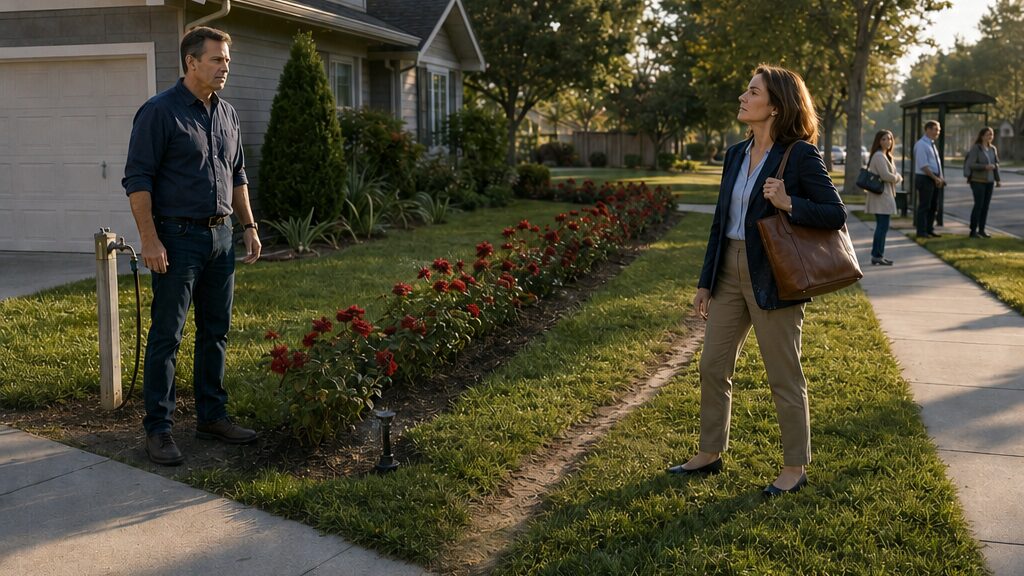
They Cut Across My Roses Until an HOA Complaint Forced Everyone to Read the Property Line
Chapter 1: The Path That Was Never Ours
The shoeprint was still wet when I found it.
It sat deep in the dark soil under Catherine’s roses, heel pressed almost against the base of the plant. Above it, one red bloom hung sideways from a snapped stem.
I crouched beside it with the garden hose still running behind me.
“Catherine.”
She came around the side of the house carrying her coffee. She didn’t ask what was wrong. She followed my eyes to the broken stem.
“That’s the third one,” she said.
“The third rose?”
“The third this week.”
I turned off the hose.
Our house sat on a corner lot where two residential streets met at a shallow angle. The sidewalk followed both streets, but between them our lawn formed a broad green triangle. The previous fall, Catherine had planted a line of red roses along the inside edge of that triangle, not as a fence, just enough to soften the corner.
People had apparently decided the shortest distance between the two sidewalks ran through our yard.
At first I had told myself it was occasional.
Someone walking a dog.
A teenager rushing toward the bus stop.
A neighbor carrying groceries.
But once Catherine pointed it out, I began seeing the pattern.
The grass told the story better than anyone could.
A faint diagonal stripe ran from the sidewalk near our mailbox toward the opposite corner. The blades were flattened. In two places the soil showed through. Near the roses, feet had narrowed the route into a worn dirt line.
“You’ve noticed this for a while?” I asked.
Catherine lifted one shoulder.
“I didn’t want to make a thing out of it.”
That sentence bothered me more than the shoeprint.
We had moved because we were tired of making things into things.
At our old house, parking disputes became three-hour arguments. A barking dog became a neighborhood email chain. Catherine and I had promised each other this place would be quieter.
So I did what I thought a reasonable person would do.
I bought a small yard sign.
USE THE SIDEWALK.
Nothing threatening. Nothing about trespassing. Nothing with cameras or legal language.
I placed it beside the dirt track where anyone approaching the shortcut would see it.
For two days, I thought it worked.
Then on Thursday morning I stood at the kitchen window and watched a woman in a navy blazer cross the lawn as if the sign were invisible.
I recognized her from three houses down.
Melissa Thompson.
She carried a large brown work bag over one shoulder and walked quickly, angled toward the bus stop. She stepped off the sidewalk, crossed ten feet of grass, passed within inches of Catherine’s roses, and disappeared around the corner.
No hesitation.
No glance toward the sign.
That evening, I saw two more people follow the same path.
The next morning, Melissa did it again.
I was taking the trash bin back from the curb when she appeared.
“Morning,” I called.
She looked up.
“Morning.”
She was already on the grass.
I pointed toward the sidewalk.
“I’m trying to keep people off this section. It’s getting worn down.”
She looked at the dirt under her shoes, then toward the roses.
“I’ll be careful.”
“That’s not really the issue.”
She gave me a polite smile that somehow ended the conversation without agreeing to anything.
“I’m late for the bus.”
Then she kept walking.
I stood there holding the trash bin handle.
That bothered me.
Not because she had shouted.
She hadn’t.
Not because she had insulted me.
She hadn’t.
It was the calm assumption underneath it. The idea that my request was something she could acknowledge and then disregard because her schedule mattered more.
By the weekend, the dirt track looked wider.
Catherine knelt beside the roses Saturday afternoon, tying one bent stem to a small support.
“Don’t turn this into a war,” she said.
“I put up a sign.”
“I know.”
“I asked her directly.”
“I know.”
“So what am I supposed to do?”
She sat back on her heels.
“Figure out why they think they can do it.”
I almost answered that it didn’t matter.
Our deed said the land was ours.
Our mortgage said the land was ours.
I mowed it. I watered it. Catherine planted it.
Why should I investigate somebody else’s reason for walking across it?
But I didn’t say that.
Sunday morning, I went outside and found the sign face-down in the dirt.
One metal stake was bent.
There was mud across the white plastic.
For several seconds I just stared at it.
Then I picked it up and looked toward Melissa’s house.
I didn’t see anyone.
The logical part of me knew I hadn’t watched her knock it down.
The less logical part had already decided she had.
I straightened the stake against the edge of the driveway, pushed the sign back into the ground, and moved it closer to the roses.
Catherine watched from the porch.
“You don’t know who did that.”
“No.”
But my voice said I thought I did.
Monday evening, I measured the diagonal route.
Thirty-one feet from one sidewalk to the other.
Thirty-one feet of convenience.
The public route around the corner was maybe another sixty.
That was what we were fighting over.
A minute of somebody’s morning.
Tuesday, I was trimming the damaged stems when Melissa came down the sidewalk again.
This time she stopped when she saw me.
Her eyes moved from me to the sign.
“You really don’t like people using this, do you?”
“I don’t like people walking through Catherine’s roses.”
“I’ve never stepped on her roses.”
“Your bag hit them Friday.”
Her expression tightened.
“I’ve been walking this way for years.”
“Not through my yard.”
She looked genuinely confused.
Then she gave a short laugh.
“David, this was the walkway before you moved here.”
“There is no walkway.”
“You know what I mean.”
“No, I don’t.”
She adjusted the strap on her bag.
“This corner has always been used this way. Everyone knows that.”
“Used by people doesn’t make it public.”
Her jaw shifted.
For the first time, the politeness disappeared.
“You know this has always been the walkway.”
Then she stepped onto the dirt track again.
Chapter 2: The Morning the Sprinkler Answered
The motion sensor clicked when Melissa was already halfway across the lawn.
I heard it from the garage.
A small plastic sound.
Then the sprinkler head snapped upright.
Water burst across the grass in a hard silver fan.
Melissa shouted.
She jerked backward, but the rotating spray followed its normal arc and caught her across the side of her blazer. Her brown work bag slipped from her shoulder and landed near the edge of the driveway.
For one terrible second, I almost laughed.
Then I saw the people at the bus stop turning around.
Melissa stood frozen beside the roses, water dripping from her sleeve.
I ran to the faucet.
“Hold on.”
I shut the valve.
The spray weakened, sputtered, then stopped.
Melissa stared at me.
“You did that on purpose.”
“I installed a motion sprinkler.”
“On the route people walk?”
“On my lawn.”
A man near the bus stop looked away quickly when I glanced toward him. Another commuter pretended to check a phone.
Melissa’s cheeks had gone red.
I walked to the driveway, picked up her bag, and held it out.
She took it from me without thanking me.
Her voice dropped.
“You wanted this to happen.”
“No.”
“You put a motion sensor where you knew people walk.”
“I put it where people keep cutting through my yard.”
“That’s the same thing.”
It wasn’t.
At least that was what I told myself.
But standing there with half the morning commute watching us, the distinction felt thinner than it had inside my garage.
The device itself was ordinary. I had bought it at a home improvement store after reading about people using them to keep deer away from gardens. When motion crossed the sensor, the sprinkler fired for a few seconds.
No chemicals.
No trap.
No hidden wire.
Just water.
I had aimed it at the worn grass, not the sidewalk.
I had also known exactly who walked there every morning.
Catherine stepped onto the porch.
She took in Melissa’s soaked blazer, the bag in her hand, and me beside the faucet.
Her expression told me we would be discussing this later.
Melissa saw her too.
“This is ridiculous.”
Catherine didn’t answer immediately.
“I’m sorry you got soaked.”
Melissa gave a sharp laugh.
“Are you?”
Catherine looked at me before answering.
“I’m sorry it got this far.”
That landed harder than I expected.
Melissa wiped water from her sleeve.
“You don’t get to block a pedestrian route because you planted flowers beside it.”
I turned toward her.
“It isn’t a pedestrian route.”
“I already spoke to the HOA.”
The words stopped me.
“About what?”
“This corner.”
“What about it?”
“That it’s shared access.”
I stared at her.
“Shared according to who?”
“According to how the neighborhood works.”
“That is not the same thing as ownership.”
“No, David, but you moved into a neighborhood. You didn’t buy an island.”
The sentence irritated me because part of it was fair.
I had moved into a neighborhood.
That did not mean my yard belonged to whoever was late for a bus.
“What exactly did the HOA tell you?”
Melissa adjusted her wet bag against her hip.
“That this has been used as pedestrian access for years.”
“Did they tell you it’s on my property?”
“They said corner areas can be treated differently.”
“Can be?”
She hesitated.
It was brief.
But I caught it.
She did not have a clear answer.
I stepped closer to the dirt track and pointed down.
“This is not concrete. There’s no path. There’s no curb cut. There’s no sign. There is grass because it’s a lawn.”
“It’s a worn path because people use it.”
“That doesn’t make it theirs.”
Her eyes narrowed.
“You want to make this about ownership because you know exactly how this looked.”
She gestured at her wet blazer.
A bus pulled up at the corner.
The commuters began boarding.
Melissa glanced toward it, then back at me.
“I’m filing a complaint.”
“For what?”
“The roses are blocking established access, and now you’ve installed something that sprays people for using it.”
“Melissa—”
But she had already turned.
This time she took the sidewalk.
Catherine waited until the bus pulled away.
Then she came down the steps.
“You knew she would trigger it.”
“I knew somebody would.”
“That isn’t what I asked.”
I looked at the sprinkler.
A few drops clung to the plastic head.
“She could have used the sidewalk.”
“Yes.”
“She knew I wanted people off the lawn.”
“Yes.”
“So?”
Catherine folded her arms.
“So being right about the lawn doesn’t automatically make everything you do right.”
I hated that sentence because I had no clean answer.
By lunchtime, I had moved the sensor deeper into the yard so it could not reach anyone near the sidewalk.
By afternoon, I was searching our closing documents.
Deed.
Survey.
HOA covenants.
Plat map.
I found references to drainage easements and utility access, but nothing I could understand as pedestrian access.
Still, Melissa had said something I couldn’t dismiss.
She had already spoken to the HOA.
At four-thirty, I called their office.
George White answered.
I had met him once at a neighborhood meeting. He was in his early sixties, careful with words, the kind of person who could make “we’ll look into it” sound like a complete resolution.
“George, it’s David Miller.”
“Yes, David.”
“I need to ask about a pedestrian route across my corner lot.”
There was a pause.
“I’m aware there’s been some disagreement.”
“Is there a right-of-way across my property?”
“I wouldn’t characterize it that way without reviewing the records.”
“Melissa just characterized it that way.”
Another pause.
“There has historically been pedestrian use across that corner.”
“That’s not my question.”
“I understand.”
“Is there an easement?”
“I’ll have to check.”
That answer changed the temperature of the conversation.
If he had known there was one, he would have said so.
“What exactly did you tell Melissa?”
“That long-standing neighborhood use can become complicated.”
“Complicated legally?”
“I didn’t say legally.”
“But she thinks the HOA can enforce it.”
George exhaled.
“David, why don’t we avoid turning this into something larger than it needs to be?”
I looked through the kitchen window toward the roses.
That was precisely what Catherine wanted too.
But there was now a difference.
Someone had invoked authority over my property.
I needed to know whether that authority existed.
At six-ten the next evening, a white envelope appeared in our mailbox.
The return address was the homeowners association.
Catherine stood beside me while I opened it.
The first paragraph referred to a formal nuisance complaint.
The second mentioned landscaping obstruction.
The third stopped me cold.
“Alleged interference with established pedestrian right-of-way.”
I read it twice.
Catherine leaned closer.
“Does it say where that right-of-way is recorded?”
“No.”
“Does it say there actually is one?”
“No.”
I lowered the letter.
The roses were visible through the front window behind her, bright red against the green lawn.
What had started as footprints through flower beds was now written on HOA letterhead as if the route already belonged to someone else.
Chapter 3: The Line Missing From the Map
Sandra Lee read the HOA notice once, then placed it flat on her desk.
“What if they used it before you bought the house?”
That was the first question she asked me.
Not whether Melissa was rude.
Not whether the roses were damaged.
Not whether the sprinkler had soaked her.
“What does that have to do with the deed?” I asked.
“Possibly nothing. Possibly something socially. Sometimes something legally, depending on facts we don’t have yet.”
I sat back.
Her office overlooked a commercial strip twenty minutes from our neighborhood. Through the window I could see a pharmacy sign, traffic, and the roof of a fast-food restaurant. It was not the dramatic setting I had imagined for a property dispute.
Sandra opened the folder I had brought.
“Let’s separate what you know from what you assume.”
“I know it’s my property.”
“Good. Prove that.”
I handed her the deed.
She read the legal description.
Then the survey from our closing package.
Then the subdivision plat I had printed online.
She used a pencil to trace the corner.
“Here’s your lot boundary.”
“I know.”
“Here’s the utility easement.”
“Yes.”
“Drainage.”
“Yes.”
She tapped the diagonal area between the sidewalks.
“And here?”
“Nothing.”
“On this document, nothing.”
I felt my shoulders loosen.
“So that’s it.”
“No.”
I stared at her.
“There is no pedestrian easement.”
“I said there isn’t one shown here.”
“That’s the same thing.”
“It is not the same sentence.”
I understood then why people paid attorneys to sound less excited than they felt.
Sandra turned the HOA letter toward herself.
“The association is alleging an established pedestrian right-of-way. We need to make them identify the basis. Recorded easement? Plat dedication? Covenant language? Something else? They don’t get to substitute a phrase for evidence.”
That was what I had wanted someone to say.
But she was not finished.
“And you need to stop assuming the absence of a line means the entire history is simple.”
“Melissa is crossing my yard.”
“I agree.”
“She filed a complaint claiming rights she can’t show.”
“Maybe.”
“She told me it was shared.”
Sandra folded her hands.
“Did she say she had seen a deed?”
“No.”
“A plat?”
“No.”
“An easement agreement?”
“No.”
“Then she may be wrong. That isn’t automatically the same as dishonest.”
I thought about the flattened sign.
“She knows what she’s doing.”
Sandra watched me for a moment.
“Maybe. But we’ll work with facts.”
That afternoon we went to the county records office.
The clerk pulled the subdivision plat and the recorded instruments attached to our parcel.
Utility.
Drainage.
Restrictions.
No pedestrian easement.
We searched by lot number and subdivision name.
Nothing.
Sandra asked for older recorded documents.
Still nothing.
When we stepped outside, she handed me a copy of the plat.
“You have a strong answer to the HOA’s claim.”
“Strong?”
“There is no recorded pedestrian easement across the area they identified.”
I looked at the clean lines on the page.
For the first time since the complaint arrived, I felt something close to victory.
“So they can dismiss it.”
“They should withdraw any enforcement based on a right-of-way they cannot establish.”
“And Melissa?”
Sandra gave me the look again.
“What about her?”
“She filed a false complaint.”
“We don’t know that.”
“We know there’s no easement.”
“We know she appears mistaken about the property right. We don’t know what she was told, what she believed, or why the HOA allowed the complaint to get this far.”
I folded the plat.
“I’m not interested in her reasons.”
“That may change.”
It didn’t feel likely.
Back home, I laid the plat across the dining table.
Catherine came in from outside wearing gardening gloves.
“What did she say?”
“No easement.”
Her expression softened.
“Good.”
I waited for more.
“That’s all?”
“What else do you want?”
“I don’t know. Relief?”
“I am relieved.”
She pulled off one glove.
“But?”
“But Melissa got sprayed in front of half the bus stop, and now you look happier about proving her wrong than you do about fixing the yard.”
“That’s unfair.”
“Is it?”
I pointed at the map.
“They tried to claim part of our property.”
“Then stop them.”
“I am.”
“I know.”
She sat down.
“What happens after you stop them?”
I didn’t answer.
That evening, Sandra emailed a formal response to George.
It requested the recorded basis for the alleged right-of-way and attached the plat.
George called the next morning.
His voice sounded tighter than before.
“I reviewed what your attorney sent.”
“And?”
“I don’t currently see a recorded pedestrian easement.”
“Then withdraw the complaint.”
“The board has to follow procedure.”
“Procedure created a right-of-way that doesn’t exist?”
“No. Procedure allows us to review the complaint.”
I walked toward the front window.
Melissa was passing on the far sidewalk.
She did not look toward the house.
“What basis did you have for accepting it?”
“Historical use.”
“That’s not ownership.”
“I understand that.”
“Did you understand it when you sent the notice?”
George was quiet.
“David, there are neighborhood practices that predate you.”
There it was again.
Predate you.
As if moving into a house meant inheriting every habit strangers had formed around it.
After we hung up, I went outside with the plat.
I stood near the roses and traced the property line with my eyes.
Catherine’s planting bed sat comfortably inside it.
The dirt trail cut straight across.
Legally, the picture looked clean.
Emotionally, it suddenly didn’t.
That afternoon Catherine was sorting old documents from the file box we had received at closing.
“David.”
Her voice came from the dining room.
I found her holding a glossy real-estate brochure.
It was from the listing for our house.
The photograph showed the front yard in summer, years before we bought it.
The roses did not exist yet.
But the dirt trail did.
More than that, two people were visible in the background.
One was crossing the lawn.
The other stood near the corner, apparently talking to the previous homeowner.
Catherine placed the photo beside the county plat.
On the plat, the diagonal route was nothing.
In the photograph, it was unmistakable.
I looked from one to the other.
The line that mattered most to the neighborhood was the one the map did not show.
Chapter 4: What the Old Owner Allowed
The old HOA email used a phrase that changed the entire argument.
Neighborly courtesy.
Sandra had forwarded the message just after seven in the morning with one sentence above it.
This matters.
I opened the attachment at the kitchen table while Catherine made coffee.
The email was six years old, part of a routine exchange between the previous homeowner and the association. A resident had complained that landscaping near the corner made the diagonal route harder to use. The previous homeowner’s response was brief.
He had allowed people to cross because it was convenient for neighbors walking to the bus stop.
He did not object to reasonable pedestrian use.
But he also wrote, plainly, that the route was a courtesy and not a dedicated walkway.
I read the paragraph again.
Catherine placed my coffee beside the laptop.
“So Melissa didn’t invent the history.”
“No.”
“But she turned the history into something it wasn’t.”
“Yes.”
The distinction should have made me feel better.
Instead it complicated everything.
The dirt trail outside suddenly looked different.
For weeks, I had seen it as evidence that strangers had decided my property belonged to them.
Now I could see how it had happened.
Someone before me had said yes.
Then yes again.
Then stopped being asked.
A favor had become a routine, and the routine had survived the person who created it.
I called Sandra.
“So what does this change?”
“The recorded-property question? Probably very little.”
“And the HOA complaint?”
“It makes their confusion more understandable.”
“Understandable isn’t enforceable.”
“No.”
I heard papers moving on her end.
“But if you go into the hearing claiming everyone knowingly ignored a clear boundary from the beginning, that won’t be accurate either.”
I looked through the window at the worn line across the grass.
“I never said from the beginning.”
“You were thinking it.”
I didn’t answer.
Sandra let the silence sit.
“There’s another thing,” she said. “The HOA files include older maintenance records. You should come look at them.”
The association kept paper archives in a narrow back room behind its small office. George was not there when I arrived. A board member let Sandra and me use a folding table beneath fluorescent lights.
The records were exactly as exciting as they sounded.
Landscaping invoices.
Irrigation repairs.
Fence approvals.
Tree-removal requests.
Then Sandra slid one work order toward me.
The date was the same week my sidewalk sign had been knocked flat.
Contractor note: damaged temporary homeowner sign during mowing; reset unsuccessful due to bent stake.
For several seconds I didn’t understand what I was reading.
Then I did.
“The landscaping crew?”
Sandra nodded.
“It appears so.”
I stared at the photocopy.
The sign in my memory had been different.
I had seen mud on the plastic.
A bent stake.
Melissa walking the same route despite my request.
Without ever saying it aloud, I had connected the three.
I had pictured her kicking it over.
Maybe deliberately.
Maybe with that same calm expression she wore whenever she crossed the yard.
There had been no evidence.
None.
“I accused her of that in my head for two weeks.”
Sandra looked at me.
“Did you accuse her out loud?”
“No.”
“That matters.”
“Not as much as I’d like.”
She said nothing.
I hated that too.
On the drive home I passed Melissa walking along the opposite sidewalk. For once, she was not cutting across my lawn.
Maybe because of the sprinkler.
Maybe because of the complaint.
Maybe because she was avoiding me.
I slowed at the stop sign.
She glanced toward the car.
Neither of us waved.
That afternoon I found Catherine cutting back one of the damaged rose stems.
“I was wrong about the sign.”
She looked up.
“What?”
“The landscaping contractor knocked it down.”
She sat back on her heels.
“Not Melissa?”
“No.”
Her face did not show satisfaction.
That made it worse.
“I was sure.”
“You wanted to be sure.”
I leaned against the fence post beside the flower bed.
“She still ignored it when it was standing.”
“I know.”
“She still crossed.”
“I know.”
“She still filed the complaint.”
“I know.”
Catherine clipped another broken piece from the plant.
“You don’t have to turn her into a better person just because you were wrong about one thing.”
“I’m not.”
“But you do have to turn yourself back into a person who checks.”
That sentence stayed with me.
Later that evening, Melissa came down the sidewalk.
She slowed near the corner.
I stepped outside before I could talk myself out of it.
“Melissa.”
She stopped.
“I found something in the HOA records.”
Her expression tightened immediately.
“If this is about the complaint, I’ll discuss it at the hearing.”
“It’s about the sign.”
“What sign?”
“The one that was knocked down.”
She looked at me for a second.
“I didn’t knock it down.”
“I know.”
The answer came quickly.
Too quickly for pride.
Her eyebrows lifted slightly.
“The landscaping crew did.”
She adjusted the strap on her bag.
“I told George that.”
“You did?”
“I told him I saw their mower hit something near your corner. I didn’t know if it was your sign.”
I felt heat move into my face.
“You could have told me.”
“You never asked.”
There was no aggression in the sentence.
That was why it landed.
I nodded once.
“You’re right.”
She looked almost suspicious of the admission.
Then her gaze moved toward the roses.
“The old owner didn’t mind people walking there.”
“I found that too.”
“So now you understand.”
“I understand why you thought the route was accepted.”
“It was accepted.”
“By him.”
“That matters.”
“It does.”
She waited.
I continued.
“But he also wrote that it was a courtesy. Not an easement.”
Her expression hardened.
“There was never a problem until you moved in.”
“That doesn’t create a property right.”
“No. It creates a neighborhood.”
We stood there with the worn dirt track between us.
For once, I could see the whole argument without needing either side to be stupid.
Melissa had mistaken history for entitlement.
I had mistaken my title for a complete explanation.
Neither mistake made the other person harmless.
Before she walked away, Melissa said, “I’m still not agreeing to walk all the way around because you decided everything changed.”
“It’s sixty extra feet.”
“That isn’t the point.”
“What is?”
She looked directly at me.
“That you think buying the house means everything before you stops counting.”
Then she left.
The next morning, Sandra called.
“I found another problem.”
I stood in the garage, staring at the motion sprinkler I had removed from the lawn.
“With Melissa?”
“With the HOA.”
“What kind of problem?”
“Enforcement history.”
She paused.
“Two open violations on Melissa’s property were deferred. Similar violations on other properties were not.”
I straightened.
“How long?”
“Years.”
“And George knew?”
“I don’t know yet.”
For the first time, the question was no longer why Melissa believed rules bent around neighborhood custom.
It was why the HOA seemed to have been bending them too.
Chapter 5: The Rules George Never Enforced
George closed the office door before he made the offer.
“If you withdraw your request for a formal boundary determination, I can recommend that Melissa’s complaint be dismissed.”
I stared at him across the small conference table.
“You’re asking me to drop the issue.”
“I’m asking both sides to stop escalating.”
Sandra sat beside me with her legal pad closed.
She had warned me before we came in not to fill silences just because they made me uncomfortable.
So I didn’t.
George finally continued.
“Melissa withdraws the nuisance complaint. You agree not to pursue enforcement related to prior access. We treat the matter as resolved.”
“What about the right-of-way language?”
“We remove it from the file.”
“Because it doesn’t exist?”
His mouth tightened.
“Because the records don’t support it.”
“That sounds like the same thing.”
“It’s not always useful to phrase things in the most adversarial way possible.”
I looked at Sandra.
She gave me nothing.
That was deliberate.
George wanted quiet.
I wanted clarity.
The difference had become obvious.
“What about Melissa’s other violations?” I asked.
He leaned back slightly.
“That is unrelated.”
“Apparently not.”
His eyes moved to Sandra.
She opened her folder.
“Two unresolved matters,” she said. “One concerning an unapproved exterior modification. One involving a recurring storage restriction. Both were opened and then deferred.”
George’s expression changed.
Not shock.
Recognition.
That told me enough.
“You knew,” I said.
“I knew the files existed.”
“Why weren’t they enforced?”
George rubbed a thumb along the edge of the table.
“Because enforcement is not as mechanical as people think.”
I almost laughed.
“That’s convenient.”
“No, David. It’s exhausting.”
His tone sharpened for the first time.
“We have neighbors who live beside each other for fifteen years. People get sick. People lose jobs. Families take care of parents. Someone needs three months to fix something, then six. Another person’s fence is technically wrong but bothering no one. A shed is six inches over a guideline. A complaint comes in because two people already hate each other.”
He looked at me.
“If we treat every provision like a trigger that fires automatically, this neighborhood becomes unbearable.”
The sprinkler image came into my head before I could stop it.
A trigger that fires automatically.
George did not know how accurately he had described my own mistake.
“So you decide which rules count.”
“We use judgment.”
“Privately.”
“Sometimes.”
“And sometimes that means one person gets an exception someone else doesn’t.”
His face tightened again.
“Yes.”
There it was.
Not corruption.
Not a conspiracy.
Something almost more ordinary.
Avoidance dressed as discretion.
George leaned forward.
“Melissa’s issues were deferred because they weren’t creating immediate harm. Other cases were different.”
“Documented how?”
He didn’t answer.
Sandra did.
“They weren’t.”
George glanced at her.
“That’s the problem,” she said.
I had expected to enjoy this moment.
For days, I had pictured someone proving the HOA had protected Melissa while sending me notices.
Instead, I felt tired.
If George had been taking money or hiding some secret arrangement, anger would have been simple.
But his failure was recognizable.
He had kept making small exceptions because small exceptions were easier than hard conversations.
Eventually the exceptions became a system no one could explain.
George looked at me.
“I can make your complaint disappear.”
“That isn’t what I want.”
“Then what do you want?”
I almost said, I want Melissa fined.
The words were ready.
Sandra had already shown me provisions that could support sanctions if the board concluded Melissa knowingly made unsupported claims.
I could push.
I could ask them to reopen everything.
I could make the process hurt.
A week earlier, I would have.
Instead, I said, “I want the HOA to determine whether there is a pedestrian right-of-way across my lot.”
George exhaled.
“There isn’t one in the records.”
“Then put that in writing.”
“And after that?”
“Then apply whatever complaint procedures you’re supposed to apply.”
“To Melissa?”
“To everyone.”
That made him look at me differently.
He had expected revenge.
So had I.
When I got home, Catherine was in the garden with pruning shears.
One of the damaged roses had declined despite everything she had done.
The leaves had curled inward.
Two stems were dark near the base.
She cut through the thicker cane.
I winced at the sound.
“You’re removing it?”
“It’s not recovering.”
“You could give it another week.”
“I already gave it two.”
She lifted the plant carefully from the soil.
There was something almost severe about seeing the empty place in the row.
I told her about George’s offer.
“You said no?”
“Yes.”
She looked at me.
“Because you want the hearing?”
“Yes.”
“Or because you want them to punish Melissa?”
I started to answer.
Stopped.
“That’s what I’m trying to figure out.”
Catherine brushed soil from her gloves.
“Good.”
“Good?”
“It’s better than pretending you already know.”
She carried the damaged rose toward the yard-waste bin.
I followed.
“The HOA deferred her violations.”
“So?”
“So she’s been demanding rules against us while getting exceptions herself.”
“That’s ugly.”
“Exactly.”
“But if George has been making exceptions for everybody, then the problem is bigger than her.”
“He hasn’t made them for everybody.”
“That’s worse.”
“I know.”
Catherine dropped the plant into the bin.
“Then fix that.”
The next day Melissa rejected George’s proposed settlement.
I learned because George copied us on the email.
Her response was short.
She would withdraw nothing unless David Miller removed the landscaping encroaching upon the historically used pedestrian route and agreed not to obstruct future access.
I read it twice.
Then a third time.
She now knew there was no recorded easement.
Sandra had made that clear in writing.
George had acknowledged it.
And still Melissa was pushing the same language.
That changed something.
Her original belief had been understandable.
This was a choice.
I forwarded the email to Sandra.
She called five minutes later.
“Now the hearing matters more.”
“For her?”
“For the process.”
I paced the kitchen.
“She’s trying to force me to remove Catherine’s roses because people used to walk past them.”
“Yes.”
“And she knows the deed doesn’t support her.”
“Yes.”
“So we go after the false complaint provision.”
“We can.”
I stopped walking.
There it was.
The opening.
The thing I had wanted.
A clean route from her pressure to consequences.
“How hard?”
Sandra was quiet.
“That depends on what you mean by hard.”
“Whatever the rules allow.”
“Be careful with that sentence.”
“Why?”
“Because George could say the same thing about you.”
I looked toward the corner lawn.
The dirt path remained.
The sprinkler was gone.
One rose was gone too.
“I want the board to address the complaint.”
“Good.”
“And the deferred violations.”
“Good.”
“And the way George handles exceptions.”
“Also good.”
Sandra paused.
“But if you ask them to apply maximum punishment to Melissa because you’re angry, you’ll turn a policy problem back into a personal feud.”
I knew she was right.
I also knew some part of me still wanted that feud.
That evening I printed everything.
The deed.
The plat.
The old courtesy email.
The contractor record about the sign.
Melissa’s complaint.
George’s settlement proposal.
The deferred-enforcement history.
Catherine watched me arrange the pages into labeled folders.
“You look happy.”
“I’m prepared.”
“That wasn’t what I said.”
I stopped.
She came to the table and rested one hand on the folder containing Melissa’s violations.
“What do you actually want to happen to her?”
The question was harder than anything Sandra had asked.
I could have said I wanted her to stop crossing.
That was true.
I could have said I wanted the roses protected.
Also true.
But neither explained why the violations folder gave me satisfaction.
“I want her to understand she can’t use rules only when they benefit her.”
Catherine nodded.
“And if the board makes her understand that without humiliating her?”
I looked at the folder.
“Then that should be enough.”
“Should be?”
I closed it.
The next morning I called Sandra.
“At the hearing, I don’t want this framed as Melissa versus me.”
“What do you want it framed as?”
“Whether the HOA can call something a right-of-way without proof, and whether it can enforce rules differently depending on who asks.”
Sandra was silent for a moment.
Then she said, “That is a much stronger case.”
Not stronger against Melissa.
Stronger than Melissa.
Chapter 6: The Hearing Where Winning Changed
George began the hearing by asking me a question I had not expected.
“What remedy are you requesting?”
The clubhouse meeting room went quiet.
Melissa sat three chairs away with her brown work bag upright beside her feet. Sandra sat at my right. Three board members faced us behind folding tables pushed together beneath a framed neighborhood map.
On the table in front of me lay two images.
One was the county plat.
The other was a photograph Catherine had taken of the damaged roses.
For weeks, I had believed the map was the more important document.
That night, I wasn’t sure.
George repeated the question.
“David?”
I looked at Melissa.
Then at the board.
“I want the association to state whether a pedestrian right-of-way crosses my lot.”
A board member glanced down at the documents.
“And if it does not?”
“Then I want the complaint based on that right-of-way dismissed.”
George nodded.
“And sanctions?”
There it was.
The question beneath the question.
Sandra did not look at me.
She had made it clear before the meeting that the answer had to be mine.
Melissa folded her arms.
I said, “I want the board to apply its rules consistently.”
George’s expression tightened.
“That includes the possibility of sanctions.”
“I understand.”
“For Melissa.”
“And for anyone else whose case qualifies.”
The room shifted slightly.
Not physically.
Socially.
The hearing stopped being a trial between two neighbors.
George opened the HOA file.
The first part moved quickly.
Sandra presented the deed and county plat.
The board compared the lot description with subdivision records.
No pedestrian easement appeared.
No dedicated walkway crossed the corner.
No covenant provision transformed long-term casual use into HOA-controlled access.
George finally said the sentence I had wanted for nearly a month.
“The association does not find a documented pedestrian right-of-way across the Miller property.”
I expected relief to feel larger.
It didn’t.
Maybe because I had already known.
Maybe because Melissa was still sitting three chairs away, waiting for her turn.
A board member asked her why she had used the term right-of-way in her complaint.
Melissa opened her folder.
“Because the route was used before they bought the house.”
“That does not answer the question.”
“It was treated as neighborhood access.”
“By whom?”
“The previous homeowner. Residents. The association.”
George shifted.
Melissa continued.
“I asked whether there was documentation. I was told no one had located any.”
The room became still.
That was the late truth.
Not that she had invented the route.
Not that she had secretly possessed proof.
She had known there was no proof and filed anyway.
The board member leaned forward.
“You knew before filing the complaint that no recorded easement had been identified?”
Melissa’s jaw tightened.
“I knew nobody had shown me one.”
“Then why allege obstruction of a right-of-way?”
“Because if I had written ‘people have always walked there,’ nothing would have happened.”
Her answer surprised me with its honesty.
She looked toward me.
“He bought the property and immediately treated everyone who used that route like they were trespassing on purpose. That path had been there for years. Families used it. People going to work used it. The old owner never made it a problem.”
“You knew I objected,” I said.
“Yes.”
“And kept crossing.”
“Yes.”
“Why?”
“Because I thought if enough of us kept using it, you’d stop trying to close it.”
There it was.
Not confusion anymore.
Pressure.
She had believed custom should overpower my objection if the custom was strong enough.
I felt my anger return.
Then I saw the photograph of the roses.
Not the map.
The photograph.
A broken stem.
Trampled soil.
Damage that had been real even when my assumptions had not.
George moved to the sanctions provision.
Melissa’s complaint, he explained, could qualify for further review because it asserted a property right without documented support after questions about that support had already been raised.
The board also reviewed the deferred violations on Melissa’s property.
Then Sandra placed one more summary sheet on the table.
It showed similar enforcement cases across the neighborhood.
Some had received notices immediately.
Others had been deferred.
No consistent written standard explained why.
George looked tired.
“I made those judgment calls.”
A board member asked, “Without votes?”
“Some of them.”
“Without written criteria?”
“Yes.”
“Why?”
George leaned back.
“Because every time we formally escalate a neighbor dispute, the dispute gets worse.”
Nobody spoke.
He continued.
“I thought I was preserving flexibility.”
Sandra said, “You were preserving uncertainty.”
George nodded once.
“I can see that now.”
That admission changed the room more than any document had.
I had spent weeks imagining the HOA as something above us—a machine that could be forced to obey its own rules if I found the correct paragraph.
Instead it was people.
People making shortcuts.
Not through lawns.
Through decisions.
The board returned to sanctions.
One member asked whether I wanted to submit a formal request for the maximum penalty available under the bad-faith complaint provision.
Melissa looked at me.
For the first time since this began, she looked uncertain.
I thought about the sprinkler.
About the bus stop.
About the sign I had blamed on her.
About the satisfaction I had felt when Sandra discovered her old violations.
I could make this hurt.
The rules gave me a path.
That did not mean I had to take the longest version of it.
“No,” I said.
Melissa blinked.
George looked up.
“I want the complaint dismissed. I want reasonable reimbursement for the damaged landscaping. And I want the board to adopt a written process requiring property claims to be verified before enforcement notices go out.”
A board member asked, “And the deferred violations?”
“Review all of them.”
“All?”
“Yes.”
“Including Melissa’s?”
“Yes.”
“And if there are any open issues on your property?”
I felt Sandra glance at me.
“Yes.”
The answer came easier than I expected.
“Mine too.”
George stared at me for a moment.
Then he closed the sanctions section.
After a short recess, the board returned with its decision.
The pedestrian right-of-way complaint was dismissed.
The association would reimburse documented landscaping damage attributable to the unresolved access dispute, subject to receipts.
Melissa’s separate violations would be reopened under the same review schedule applied to other residents.
The board would draft written standards for complaint verification and discretionary enforcement.
No maximum retaliatory fine was imposed.
No one applauded.
No one smiled.
It was better that way.
Outside the clubhouse, people dispersed quickly.
Sandra shook my hand.
“You got what you asked for.”
“I think so.”
“That uncertainty is probably healthy.”
She left.
I was walking toward my car when Melissa called my name.
I turned.
She stood beneath the parking-lot light with her bag over one shoulder.
For a moment neither of us spoke.
Then she said, “Are you going to put up a fence?”
“What?”
“Around the whole corner.”
“I haven’t decided.”
“You can now.”
“I could before.”
She looked away.
“Not without everyone calling you unreasonable.”
“And now?”
“Now they’ll call you legally correct.”
There was no warmth in it.
But there was something else.
Recognition, maybe.
Not agreement.
She looked back at me.
“If you fence it, the corner is going to look ridiculous.”
I almost laughed.
Almost.
“I’ll take that under consideration.”
Her mouth moved slightly, not quite a smile.
Then she walked toward her car.
I stood there thinking about the question.
For weeks I had wanted a line nobody could cross.
Now that everyone had finally agreed the line belonged to me, I had to decide what kind of boundary I actually wanted to build.
Chapter 7: The Roses Stayed Inside the Line
The survey stakes appeared on a Tuesday morning.
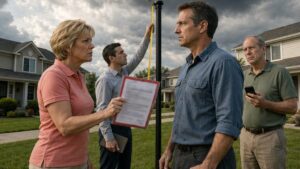
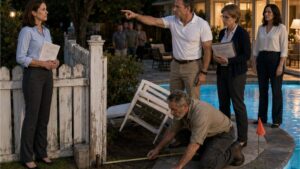
Three narrow wooden markers stood in the grass where the old dirt shortcut used to cut across the corner, each topped with a strip of bright flagging that moved in the breeze.
I saw them before I finished pouring coffee.
For weeks, the diagonal route had been an argument.
Now it had coordinates.
Catherine came up beside me at the kitchen window.
“So that’s it?”
“That’s it.”
The surveyor had finished the previous afternoon. The line matched the county plat almost exactly where Sandra said it would. Catherine’s rose bed sat safely inside our property. The worn shortcut crossed the boundary at one sidewalk, ran thirty-one feet through our lawn, then crossed back out near the other street.
Nothing dramatic.
No hidden strip of common land.
No surprise easement.
Just a line.
I expected seeing it marked would give me the same satisfaction I had felt when the board dismissed Melissa’s complaint.
Instead, I stared at the stakes and thought about fences.
I had already priced them.
Black aluminum would look clean.
A low decorative fence would stop foot traffic without making the yard feel closed.
A taller privacy fence would stop the argument permanently, although Catherine had called that option “a punishment with posts.”
I hadn’t ordered anything.
That morning I went outside with a tape measure and stood where the dirt trail met the sidewalk.
The public route around the corner was visible from there.
Melissa had been right about one thing.
It was longer.
Not much longer, but longer.
The shortcut had made sense.
That still didn’t make it hers.
I walked along the survey line toward the roses.
One space remained empty where Catherine had removed the plant that never recovered.
The gap bothered me more than the dirt path now.
A vehicle slowed beside the curb.
For half a second I expected Melissa.
It was the landscaping contractor.
Two workers got out with rolls of sod.
The association had approved reimbursement for the damaged section of lawn, and Catherine and I had chosen restoration instead of redesigning the entire corner.
One worker looked at the worn diagonal stripe.
“This all getting covered?”
“Yes.”
“You want stones or edging along the property line?”
I looked at the survey stakes.
“No.”
He waited.
“No fence?”
“Not today.”
They cut away the compacted soil and loosened the ground beneath it.
The path disappeared faster than I expected.
Years of footsteps had created it.
An hour with a shovel erased most of it.
By noon, rectangles of fresh sod covered the diagonal route from sidewalk to sidewalk.
The seam was obvious if you knew where to look.
But it was grass again.
Catherine came outside carrying two glasses of water.
“You didn’t ask for edging.”
“No.”
“Or spikes.”
“No spikes.”
“That’s growth.”
“I considered a moat.”
She smiled.
It was the first time either of us had joked about the dispute.
Later that week, the HOA emailed residents a new complaint procedure.
Property-based complaints would require supporting records before enforcement notices could describe disputed access as established fact. Discretionary delays in violations would have to be documented. Old deferred cases were being reviewed under one schedule.
That included Melissa’s.
It also included ours.
A board member contacted me about a minor issue with the location of a small storage box beside our garage. Under the previous informal system, it probably would have been ignored.
I moved it twelve inches.
Catherine watched me do it.
“You could appeal.”
“I could.”
“You’re not going to?”
“No.”
She nodded toward the corner lot.
“Consistent.”
“Annoyingly.”
“That’s usually how consistency works.”
The real test came the following Monday.
I was watering the new sod by hand because I had not reinstalled the motion sprinkler.
The sensor unit remained on a garage shelf.
I wasn’t sure whether I would ever use it again.
The bus was due in six minutes when Melissa appeared.
Same brown work bag.
Same quick pace.
She approached the corner from the direction of her house.
For months, I had learned the rhythm of her shortcut so well that I knew exactly where she would normally step off the pavement.
She reached that spot.
Slowed.
Looked toward the new sod.
Then toward me.
Neither of us spoke.
The survey stakes were gone, but one small marker remained flush with the ground near the property corner.
Melissa looked at it.
Then she stayed on the sidewalk.
She walked around.
No exaggerated sigh.
No remark.
No glance back.
Just sixty extra feet.
I stood with the hose in my hand and watched her reach the bus stop.
I had imagined that moment more times than I wanted to admit.
In most versions, it had felt like triumph.
This one felt quieter.
Better, maybe.
Not because Melissa had surrendered.
She hadn’t.
She still believed I had been unnecessarily rigid.
I still believed she had tried to force a privilege into a right.
The hearing had not made either of us suddenly admire the other.
It had only given us something more useful.
A boundary neither of us could honestly pretend was unclear.
Two days later, I found Melissa near the mailbox while I was bringing in a package.
She stopped.
“The lawn looks better.”
“Thanks.”
A pause.
“George sent another notice about my storage issue.”
“I heard they reopened the old files.”
“He seems very enthusiastic about consistency now.”
There was enough dryness in her voice that I almost smiled.
“You asked for rules.”
“So did you.”
“Fair.”
Another pause.
Then she looked toward the roses.
“You’re really not putting up a fence?”
“No.”
“Why not?”
I considered giving her a sharp answer.
Something about not needing one now that people knew where the line was.
Instead I said, “Because I wanted people off the lawn. I didn’t want the corner to look like nobody was welcome near it.”
She studied me.
“That sounds more reasonable than the sprinkler.”
“It probably is.”
Her eyebrows lifted.
It was the closest either of us had come to admitting fault directly.
She adjusted her bag.
“For what it’s worth, I shouldn’t have called it a right-of-way after George told me they couldn’t find one.”
I waited.
She added, “I thought making it official would force you to compromise.”
“It almost did the opposite.”
“I noticed.”
Neither of us apologized.
Maybe someday we would.
Maybe not.
She gave a small nod and continued down the sidewalk.
Catherine found me in the garage that Saturday holding the old sprinkler sensor.
“You keeping that?”
“I haven’t decided.”
She took it from my hand, set it in a storage bin, and closed the lid.
“Decide later.”
Then she handed me a small nursery pot.
A new red rose.
Its stems were thin and green, with one tight bud near the top.
“Replacement?” I asked.
“For the one we lost.”
We carried it to the corner together.
The empty space in the rose border was still visible.
Catherine placed the pot near the old position and looked toward the small ground marker showing the surveyed line.
“Where do you want it?”
Months earlier, I would have measured the distance twice.
I still measured it once.
Then I moved the pot several inches farther inside our property than necessary.
Catherine noticed.
“You’re giving up territory?”
“No.”
I pressed the shovel into the soil.
“I’m leaving room.”
She smiled and knelt beside me.
We planted the rose where no foot following the sidewalk could brush it and no reasonable person could mistake it for part of a public path.
The new sod had already begun blending into the older lawn.
If you looked carefully, you could still see where the shortcut had been.
A faint diagonal difference in the grass.
A memory of a route people once assumed would always be there.
I didn’t need to erase that history.
I only needed it to stop deciding what came next.
Catherine packed soil around the rose and handed me the watering can.
I poured slowly until the dark earth settled around the roots.
The flower stood entirely inside the line.
And for the first time, that felt like enough.
The story has ended.