They Ordered Her Fence Moved, Then Learned Their Pool Was Built Across Her Property
Chapter 1: The Certified Letter Beside the Old White Fence
The certified envelope was caught halfway through the white fence gate, its cardboard edge bent where the latch had closed against it.
Virginia Miller saw it from the kitchen window just after seven in the evening, while a client’s unfinished tax return glowed on one monitor and a spreadsheet of quarterly payments filled the other. She had been working since before sunrise. A mug of coffee sat cold beside her keyboard, and the ache behind her eyes had settled into a steady pulse.
The envelope did not belong there.
Her mail was delivered to the box at the curb. Anything pushed through the gate had been brought by hand.
Virginia stepped outside without putting on shoes. The cedar boards of the porch were cool beneath her socks. Beyond the fence, the Riveras’ pool lights had already come on, turning the water an unnatural blue. Someone on their patio laughed, and glass touched glass.
The return address belonged to a law office she did not recognize.
Inside was a two-page demand advising her that the fence separating her property from Thomas and Ashley Rivera’s property stood approximately six feet beyond the lawful boundary. She was instructed to relocate it within thirty days and restore the affected area at her own expense.
Virginia read the sentence twice.
Then a third time.
The fence had been there for twelve years.
Her father had helped her build it the summer she bought the house, before his hands became too stiff to hold a drill. He had measured every post twice, stretched the line until it sang when plucked, and made her redo the southwest corner because, as he had said, close enough was how people lost inches they never got back.
Six feet was not an inch.
Virginia looked across the yard. From where she stood, the fence ran straight beneath the live oak, past the hose reel, and toward the rear corner where white paint had weathered away from the top of the oldest post.
The pool on the other side lay close to it. Closer than she had liked when it was built two summers earlier.
She had noticed that then.
She had also told herself that the Riveras had permits.
That had been enough to let her remain silent.
A gate clicked behind her.
Thomas Rivera stepped through without knocking.
He wore a white polo with the logo of his real-estate firm stitched over the chest. His sunglasses rested on top of his head despite the fading light. Ashley remained on their side of the fence, one hand folded over the other, watching through the open gate.
“You got the letter,” Thomas said.
Virginia folded the pages once. “You had it delivered to my yard.”
“I wanted to make sure it didn’t get lost in tax season.”
He smiled when he said it, as though mentioning her work made them familiar.
Virginia had prepared returns for three people on the street. She had never prepared his.
“What survey are you relying on?” she asked.
Thomas gestured toward the fence. “The site plan from our purchase, the pool plans, the HOA records. They all show the line farther over.”
“Then send me the survey.”
“The documentation is in the notice.”
“It isn’t. There’s no sealed survey attached.”
His smile thinned.
Behind him, Ashley shifted her weight but said nothing.
Thomas came one step closer. “Virginia, I do this for a living. Boundaries, disclosures, valuation. Your fence is cutting into our usable lot, and now that we’ve improved the property, it affects resale.”
The word improved carried across the yard toward the glowing pool.
Virginia looked at the six-foot demand again. “The fence predates your purchase.”
“That doesn’t make it correct.”
“No. A survey would.”
For a moment, the pool pump was the only sound between them.
Then Thomas lowered his voice.
“You really want to fight a real-estate professional over this?”
The question was quiet enough to sound reasonable. That made it worse.
Virginia felt heat move up her throat. She imagined telling him to leave. She imagined listing every return deadline waiting inside, every hour of sleep she had lost, every reason he had chosen the wrong week to make her responsible for his property concerns.
Instead, she opened the gate wider.
“I want you off my lawn.”
Ashley’s eyebrows rose.
Thomas looked at Virginia for several seconds, then stepped back through the opening. “The HOA already has the complaint. I was trying to give you a chance to handle it privately.”
“You sent a legal demand.”
“I sent notice.”
“You sent it before showing me proof.”
His expression changed, not dramatically, but enough for Virginia to see that he was no longer enjoying the conversation.
“You have thirty days,” he said.
She closed the gate between them.
The latch struck harder than she intended.
Inside, her client’s tax software had timed out. Virginia logged in again, but the numbers would not hold still. She entered the same mortgage interest figure twice and caught the error only when the totals failed to reconcile.
At nine twelve, an email arrived from Lisa Roberts, the community manager for the homeowners association.
The subject line read: Architectural Compliance Review—Boundary Fence.
The message was professionally worded and almost friendly. The association had received documentation suggesting that Virginia’s fence did not conform to the approved lot line. She had ten business days to provide contrary evidence or submit a correction plan. Failure to respond could result in a hearing and daily fines under the covenants.
Attached were the Riveras’ complaint, photographs of the fence, and a site sketch.
Virginia enlarged the sketch.
Her lot was outlined in black. The Riveras’ was outlined in gray. A red line ran through the middle of Virginia’s side yard, six feet inside the fence.
She recognized the shape of her house. She recognized the driveway and rear easement.
She did not recognize that boundary.
At the bottom of the page, beneath a contractor’s stamp, was a date from the year the pool had been installed.
Virginia opened the fireproof box beneath her desk and pulled out the property folder she had not touched since refinancing. Deed. Closing statement. Title policy. A folded copy of the recorded plat.
The old paper resisted when she opened it.
She placed it beside the HOA attachment.
On the recorded plat, the rear corner of her property aligned with the post her father had made her reset.
On the HOA sketch, the line bent away from it.
Virginia stared at the two versions until the difference stopped looking like a mistake and began looking like a choice.
Chapter 2: The Map in the HOA File Did Not Match
The county records clerk placed the two maps side by side and said, “These cannot both describe the same boundary.”
Virginia had arrived ten minutes after the office opened with the recorded plat in one sleeve, the HOA sketch in another, and less than four hours of sleep behind her. Fluorescent light flattened the colors on the counter, but the conflict between the documents needed no interpretation.
The recorded plat showed straight lot lines tied to survey monuments and distances.
The pool sketch showed a shifted rear boundary with no monument references at all.
“Which one controls?” Virginia asked.
The clerk tapped the recorded plat. “This one is filed in the county records. I can’t give legal advice, but this is the subdivision plat of record.”
“And the other?”
“Looks like a site drawing. Maybe prepared for construction.”
“It has a contractor stamp.”
“That doesn’t make it a boundary survey.”
The clerk searched by parcel number and printed the Riveras’ deed, Virginia’s deed, the subdivision plat, and two easement documents. None reflected a boundary adjustment. No sale of land. No recorded agreement. No amended plat.
Virginia felt relief first.
Then she thought of Lisa’s deadline and the municipal complaint Thomas had threatened.
Relief was not the same as safety.
At the HOA office that afternoon, Lisa Roberts sat behind a desk crowded with violation files. She appeared tired in the particular way of people whose work required them to absorb other people’s anger without showing their own.
Virginia slid copies of the county records across the desk.
“The recorded plat supports the fence,” she said.
Lisa reviewed the first page, then the second. “The Riveras submitted a newer site plan when they applied for architectural approval.”
“Newer does not mean recorded.”
“No, but it was part of an approved project.”
“Approved by whom?”
“The architectural committee.”
“Thomas serves on that committee.”
“He recused himself from the vote.”
“That does not answer where the line came from.”
Lisa leaned back. “Virginia, I understand why you’re concerned. But the HOA is not a surveying authority. We rely on the materials homeowners submit.”
“You relied on theirs enough to give me ten days.”
“We received a formal complaint supported by an approved plan.”
Virginia placed the two maps next to each other. “They conflict.”
Lisa studied them longer this time.
The difference was not subtle. On the county plat, Virginia’s fence tracked the western lot line. On the pool sketch, the line had moved inward toward her house, creating extra width on the Riveras’ side.
Lisa touched the red line with the tip of a pen. “This plan was also included in the municipal permit package.”
“Was it certified?”
“I don’t know.”
“Was a survey required?”
“I would have to check the file.”
Virginia waited.
Lisa opened a digital folder and scrolled through documents. Application. Contractor drawings. Equipment specifications. Drainage notes. A sheet labeled existing conditions.
“There,” Lisa said.
The drawing included dimensions from the Rivera house to the pool and from the pool to the supposed boundary. Virginia compared them with the recorded plat.
“These measurements aren’t on either deed,” she said.
“They may have been taken in the field.”
“By whom?”
Lisa’s mouth tightened.
The permit package named the pool contractor but not a surveyor.
Virginia left the office with a copy of everything Lisa would release. Before she reached her car, her phone rang.
The caller identified himself as a municipal code officer.
“A complaint has been opened regarding a fence at your address,” he said. “I need to schedule an inspection.”
“What rule is it alleged to violate?”
“Possible encroachment and unapproved placement.”
“The fence was there before the current HOA management company.”
“That may be relevant. I still have to inspect.”
Virginia looked through the windshield at the folder on the passenger seat. Being right had begun to require appointments, copies, fees, and time she did not have.
“Friday morning,” she said.
Back home, she spread the documents across the kitchen table. Client reminders arrived every few minutes. One needed an extension. Another had forgotten a brokerage account. A third had uploaded forty-six unlabeled receipts.
Virginia silenced the notifications.
She called three survey companies. The first could come in six weeks. The second said boundary disputes required a larger deposit. The third transferred her to Dennis Wilson.
He listened without interrupting.
“How old is the fence?” he asked.
“Twelve years.”
“Any prior survey?”
“I have the subdivision plat and the mortgage location sketch from closing.”
“Those are not the same thing as a current boundary survey.”
“I understand.”
“Do the neighbors have a survey?”
“They have a construction sketch.”
“That was not my question.”
“No.”
Dennis gave her a price that made her close her eyes.
Then he said he could begin preliminary research the next morning and conduct fieldwork within a week if the adjoining yard was accessible.
Virginia hired him.
The municipal officer arrived Friday at eight. Thomas stood in his driveway before the officer had finished introducing himself.
“I can show you the affected area,” Thomas said.
The officer looked at Virginia. “Is it all right if we view the fence from both sides?”
“Yes.”
Thomas led them along the white fence, describing lost yard width, diminished value, and the inconvenience of landscaping around a structure he claimed had been incorrectly placed.
Virginia carried the recorded plat.
When Thomas finished, the officer asked, “Do you have a sealed boundary survey?”
Thomas pointed toward his house. “The city approved the pool.”
“That’s not what I asked.”
“The approved plans show the line.”
Virginia watched Thomas’s jaw tighten.
The officer photographed the fence and noted the age of the posts. He did not order removal, but the complaint remained open pending documentation.
Afterward, Thomas followed Virginia to the gate.
“This could have been simple,” he said.
“It still can be. Show me a survey.”
“You’re spending money to prove what is already in the file.”
“No,” Virginia said. “I’m spending money because you put something in the file that doesn’t match the county record.”
For once, Thomas had no prepared answer.
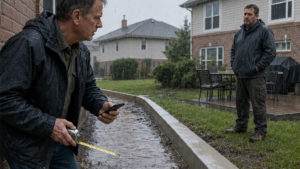
Dennis arrived the following Tuesday with a tripod, receiver, metal detector, and two cases of equipment. He began at the front monuments, worked along the street, then moved toward the rear yards.
Near the Riveras’ landscaping, the detector gave a sharp tone beneath a bed of decorative stone.
Thomas came outside when Dennis began moving rocks.
“What are you doing?”
“Looking for a called monument,” Dennis said.
“You’re digging on my property.”
“I have permission from the record owner whose boundary I’m surveying, and I’m within the search area. I’ll restore the stone.”
Thomas looked toward Virginia. “You authorized this?”
“I authorized a survey.”
Dennis knelt and scraped away soil with a narrow hand tool. Several inches down, metal struck metal.
He exposed the top of an old iron pin.
For the first time that morning, he stopped moving.
He checked the receiver, then the plat, then the pin again.
“What does that mean?” Virginia asked.
Dennis stood and looked through the white fence toward the Riveras’ pool.
“It means,” he said, “the corner is where the county record says it should be.”
He pointed past the fence, beyond the shrubs Thomas had planted, toward the stone deck surrounding the water.
“And if the other monuments hold, we have a much bigger problem than your fence.”
Chapter 3: Fourteen Feet Beyond the Line They Claimed
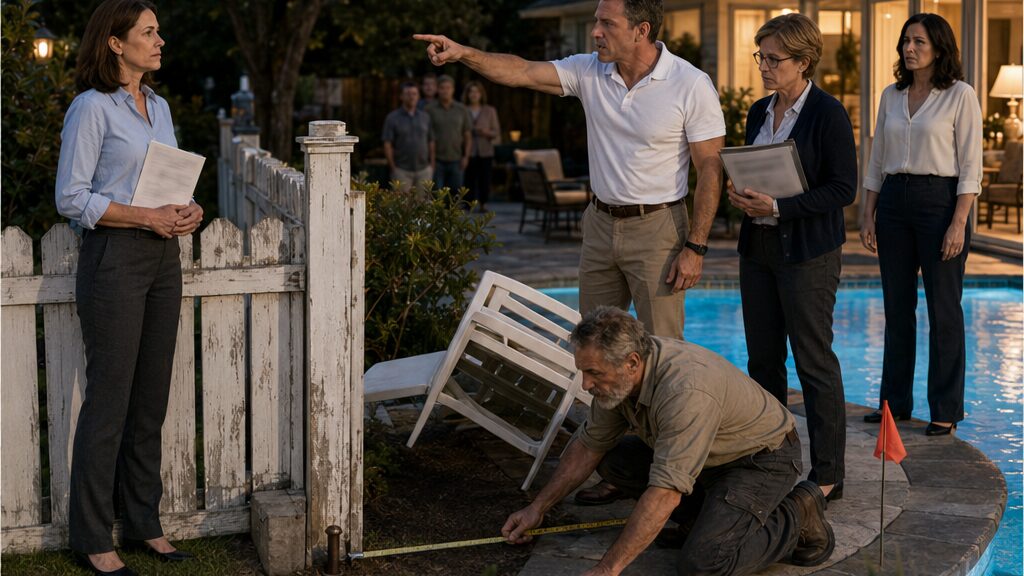
Dennis’s steel measuring tape ran beneath a white pool chair and disappeared under the edge of a striped towel.
Thomas stared at it as if the tape itself had trespassed.
“You cannot drag equipment through my yard without telling me what you’re doing,” he said.
“I told you yesterday,” Dennis replied. “I’m locating the record boundary.”
“You said you found a pin. That doesn’t establish the entire line.”
“No. That’s why I’m measuring the rest.”
Virginia stood beside the old white fence with her hands clasped behind her back. Lisa Roberts had arrived with the HOA board president, and the municipal code officer stood near the gate, taking notes. Thomas had insisted that everyone attend the field review. He had said it would prevent further confusion.
Now no one seemed confused except him.
Dennis had recovered the rear iron pin, confirmed the front monument, checked the subdivision control points, and run the line three times. Bright survey flags marked his work. They did not stand in Virginia’s yard.
They curved through the Riveras’ landscaping.
One flag rose beside a row of ornamental grasses. Another stood between two lounge chairs. A third had been placed near the pool equipment enclosure.
Ashley watched from the patio doors. She had not spoken since the officials arrived.
Thomas stepped over the tape. “Your rear pin could have been moved.”
Dennis straightened. “It could have been. That’s why I checked its position against the plat, adjoining monuments, and the front line.”
“And?”
“And it fits.”
Thomas turned to the municipal officer. “The city approved our permit. We passed inspections.”
The officer glanced at the pool, then at the tape. “Construction inspection verifies work against submitted plans. It does not certify ownership of the land shown on those plans.”
“The HOA approved it too.”
Lisa’s expression hardened slightly. “Based on the application materials provided.”
Thomas looked from one official to the next, searching for someone willing to restore the order he had expected.
Virginia understood the feeling more than she wanted to.
For two weeks, she had wanted a document that would make everyone stop questioning her. Now the measurements were doing exactly that, and the result felt less like triumph than watching a floor give way beneath another person.
Dennis walked to the recovered iron pin and hooked the end of his tape to a temporary stake. He extended the line toward the front monument, passing the tape along the ground beside the fence.
“Your fence,” he told Virginia, “sits within a few inches of the record line. Given its age and construction, that is consistent with it having been placed from the subdivision monuments.”
“A few inches on which side?” Thomas asked quickly.
“Virginia’s.”
Thomas seized the words. “Then it is not on the line.”
“It is inside her property,” Dennis said. “Not yours.”
The board president cleared his throat.
Lisa opened the folder she carried. “Then Virginia’s compliance deadline is withdrawn effective today.”
It was the sentence Virginia had needed to hear since the certified letter appeared in her gate.
She expected relief to rush through her.
Instead, she looked at the fence post nearest Dennis. The paint had cracked around a knot in the wood. Her father had once stood there with a level pressed against the post and told her not to trust her eyes when a tool could tell her the truth.
She had remembered the line correctly.
The small payoff settled quietly in her chest.
Thomas did not acknowledge Lisa. “What about the pool?”
Dennis retrieved a can of marking paint and walked farther into the Rivera yard. He measured from the record line to the nearest edge of the stone coping.
The tape crossed beneath the pool chair.
“Move that,” he said.
Ashley came forward and lifted the chair without being asked. The towel fell onto the deck.
Dennis stretched the tape flat.
“Fourteen feet, two inches at this point,” he said.
No one spoke.
He placed a bright flag in the landscaped strip beside the coping.
The flag stood well inside the Riveras’ enclosed pool area, not near the fence, not in some ambiguous patch of grass, but beside the expensive stone border where guests set drinks and children left wet footprints.
Thomas gave a short laugh.
It had no humor in it.
“That is impossible.”
Dennis pointed to the rear pin, the front monument, and the line between them. “The recorded boundary passes through this side of the pool enclosure. Based on the preliminary field location, portions of the landscaping, deck, and possibly the pool structure itself extend onto Virginia’s parcel.”
“Possibly?”
“I’ll calculate the final relationship and prepare the survey. I do not make structural conclusions until I finish the work.”
Thomas stepped toward the flag. “Take that out.”
Dennis did not move. “No.”
“It’s creating a false impression.”
“It marks a measured point.”
“You’re standing here telling my neighbors and the HOA that my pool is on her land.”
“I’m telling everyone where the record line is.”
Thomas looked at Virginia.
The expression on his face was not the swagger she had seen at her gate. It was anger stripped of confidence, looking for somewhere to land.
“You knew the pool was close,” he said.
Virginia felt every face turn toward her.
“Yes.”
The admission surprised Thomas.
She continued before fear could make her soften it.
“I saw the excavation near the fence. I assumed you had a survey because you had permits.”
“So you said nothing.”
“I did not know you were over the line.”
“You watched us spend money and said nothing.”
“You filed a complaint demanding six feet of my yard without obtaining a survey.”
“That has nothing to do with this.”
“It has everything to do with why we are standing here.”
Thomas opened his mouth, but Ashley spoke first.
“Thomas.”
Her voice was low.
He ignored her.
“The city approved those plans,” he said again. “The HOA approved them. The contractor built from them. You cannot put this entirely on me.”
“No one has,” Lisa said. “But we now have to determine whether the plan in our file reflects the recorded parcel.”
Virginia removed the HOA sketch from her folder.
“Which parcel number appears on the approved drawing?” she asked.
Lisa took the page.
The number in the title block matched the Riveras’ property.
Virginia handed her the county plat. “And where does that parcel end?”
Lisa traced the recorded line with one finger, then looked toward the flag beside the pool.
The board president exhaled slowly.
The municipal officer closed his notebook. “I’m suspending the fence complaint. I’ll need the certified survey before determining whether there is a separate compliance issue involving the pool.”
Thomas turned on Lisa. “You approved this.”
“The association approved what you submitted.”
“You had the plans.”
“We are not land surveyors.”
“You cannot approve a project and then abandon the homeowner when there’s a question.”
Lisa’s face reddened, but she kept her voice level. “I am not abandoning anyone. I am saying the approval did not alter a deeded boundary.”
Virginia watched the blame travel around the yard: from her to Dennis, from Dennis to the city, from the city to the HOA, from the HOA toward the contractor who was not there.
No one yet knew where the wrong line had begun.
Dennis gathered his equipment, leaving the flags in place. “I’ll have the signed survey within several days.”
Thomas blocked his path for half a second, then stepped aside.
The officials left through the gate one by one. Lisa paused beside Virginia.
“I’m sorry we issued the deadline before verifying the records,” she said.
Virginia could have accepted the apology and ended the exchange. That was what she usually did with discomfort: made it smaller so everyone could leave.
Instead she asked, “Will the correction be in writing?”
Lisa nodded. “By the end of today.”
“And the complaint removed from my account?”
“Yes.”
“Thank you.”
It was not forgiveness. It was a record.
After the gate closed, Virginia began collecting her copies from the patio table. Across the yard, Thomas pulled one of the survey flags from the ground and threw it beside the pool.
Ashley walked toward him.
“Why did you tell me there was no question about the measurements?” she asked.
“There wasn’t.”
“You said something different during construction.”
Thomas looked toward Virginia, as though Ashley had violated a rule by speaking where she could be heard.
Ashley did not lower her voice.
“You told me the rear numbers were not closing,” she said. “You called it a measurement problem.”
The striped towel lay between them on the deck. Water dripped from one corner into a dark spot on the stone.
Thomas’s face changed.
Not because the accusation was wrong.
Because he remembered saying it.
Chapter 4: The Approval That Everyone Had Chosen to Trust
The photograph showed Thomas standing beside the unfinished pool with one foot on a coil of orange extension cord.
Behind him, the white fence ran straight across the image. In front of him, two workers held a tape measure at an angle that did not match it.
The date in the lower corner was eighteen months old.
Virginia enlarged the image on the HOA conference-room screen until the pixels softened around Thomas’s face.
“Where did this come from?” he asked.
Lisa Roberts kept her eyes on the file in front of her. “It was included in the contractor’s progress upload.”
“That photograph proves nothing.”
“No,” Virginia said. “But it shows the fence was visible when the pool was laid out.”
Thomas turned toward her. “You think I directed the crew to build over your property?”
“I think the approved sketch did not match the recorded plat. I’m trying to learn who knew that.”
The table held four versions of the same project: the county plat, the HOA approval set, the municipal permit drawings, and Dennis Wilson’s certified survey. Colored tabs marked each contradiction.
Lisa had invited the pool contractor after the association attorney advised that every approval source needed to be identified. The contractor sat near the end of the table, shoulders rounded, a paper cup untouched beside him.
The HOA board president asked him to explain how his crew established the rear line.
“We used the site sketch provided with the contract,” he said.
“Provided by whom?” Virginia asked.
The contractor glanced at Thomas. “The homeowner package already had it.”
Thomas leaned forward. “Your company prepared the construction drawings.”
“Construction drawings, yes. Not a boundary survey.”
“You represented that setbacks were compliant.”
“Based on the dimensions you gave us and the HOA-approved plan.”
The blame moved around the room with practiced efficiency.
Virginia watched it pass from person to person until no one appeared to own it.
The contractor opened a folder and removed a copy of the private sketch. In the upper corner was a handwritten note: rear line per owner-provided site plan.
Thomas reached for it. “I never wrote that.”
“No one said you did,” the contractor replied.
“Then who supplied it?”
“It came with your initial documents.”
Ashley sat beside Thomas, but her chair had been angled slightly away from his since the survey. She looked at the note without touching it.
Lisa pulled up the original architectural application. “The upload account was yours, Thomas.”
“That does not mean I drew the plan.”
“No,” Virginia said. “It means you submitted it.”
He looked at her with the same restrained anger he had shown at the fence, but the room no longer belonged to him. Every sentence now had to survive the documents on the table.
The contractor cleared his throat. “We also had a field issue.”
Thomas’s head turned sharply.
“What issue?” the board president asked.
“We couldn’t locate the rear corner marker.”
Virginia felt the room tighten.
The contractor continued. “The landscaping had been redone before we arrived. We found what looked like a stake near the back bed and used the plan dimensions from there.”
Dennis, who had attended by phone for the technical portion, spoke through the conference speaker.
“A wooden landscaping stake?”
The contractor hesitated. “It was metal-topped.”
“A survey monument is not identified by looking convenient,” Dennis said.
“We were not contracted to perform a boundary survey.”
“Then you should not have treated an unverified marker as one.”
The contractor’s voice hardened. “We told the homeowner the rear measurements were not closing.”
Ashley turned toward Thomas.
Virginia did not.
She kept her eyes on the contractor. “What does that mean?”
“The distances between the house, the presumed rear line, and the side line did not reconcile exactly. We were several feet off depending on where we started.”
“How many feet?”
“Not fourteen. At least, not in the working area we checked. Four or five at first.”
Thomas pushed back from the table. “You said the discrepancy came from the old fence.”
“I said it could have.”
“You told me fences were often misplaced.”
“They are.”
“You said the approved plan was enough to proceed.”
“I said proceeding without a survey would leave the homeowner responsible for boundary risk.”
Ashley’s face went still.
Virginia remembered the day excavation began. She had stood at her kitchen sink while a machine tore into the Riveras’ yard. The hole looked enormous. The work seemed too close to the white fence, but Thomas had waved from across it and told her everything had been approved.
She had nodded.
It was easier to trust a permit than begin a conflict.
The board president asked Lisa, “Did the architectural committee require a certified survey?”
Lisa closed the digital file.
“No.”
“Why not?”
“The guidelines require a site plan showing setbacks. They do not specify that it must be prepared by a licensed surveyor.”
Thomas seized on the answer. “Then I complied.”
“You submitted the required form,” Lisa said. “That is not the same as establishing that the information was correct.”
“The committee approved it.”
“Yes.”
“So the association shares responsibility.”
Lisa folded her hands. “The association relied on an unverified drawing. I have already told counsel that.”
The admission changed the room. It did not clear Thomas, but it removed the possibility that the HOA would pretend its only mistake had been believing him too efficiently.
Virginia looked again at the photograph on the screen.
The white fence stood in the background, weathered and ordinary. No one in the image treated it as evidence. The workers measured past it. Thomas watched. The project moved forward because stopping would have required someone to say they did not know.
The association attorney joined the meeting for the final twenty minutes. She explained that approval by the HOA did not transfer ownership, and a city permit did not cure private encroachment. The association’s insurer would be notified. The contractor’s carrier might become involved. The Riveras’ title company would review the claim.
Each new institution created another file, another deadline, another reason for Thomas to look smaller in his chair.
Then the attorney mentioned the lender.
“If the improvement is materially noncompliant or partly located outside the borrower’s parcel, the mortgage documents may require notice,” she said.
Thomas’s composure finally cracked.
“You’re going to contact my bank?”
“We are not your attorney,” she said. “You need independent advice. But concealing a known title or compliance issue could worsen your position.”
“The pool is the major improvement on that house.”
No one answered.
“The appraisal assumed it belonged to the property,” he continued. “The loan assumed it. We refinanced after construction.”
Ashley looked at him. “You told me the appraisal was clean.”
“It was.”
“Because no one knew.”
Thomas pressed his palms against the table. “I did not know the pool crossed fourteen feet.”
The sentence was true enough to sound like a defense.
Virginia believed him.
She also believed he had known something was wrong.
For the first time, she saw the pressure beneath his behavior clearly: the home-equity debt, his professional reputation, the possibility that every confident statement he had made about land and value could become evidence of his own carelessness.
Understanding it did not excuse the complaint against her.
It only made his choice more legible.
The meeting ended without resolution. The contractor agreed to produce field notes. Lisa agreed to provide the full approval record. Thomas left before Ashley, taking the wrong folder and returning for it without looking at anyone.
That evening, Virginia tried to resume work. She completed one return, then caught herself staring at a depreciation schedule without reading it.
At eight forty, the doorbell rang.
Ashley stood alone on the porch holding a tablet and a folded printout.
“I found something,” she said.
Virginia did not invite her in immediately.
Ashley looked toward the white fence. One survey flag remained visible beyond it, bright against the Riveras’ dark landscaping.
“This was in our shared email archive,” she said. “Thomas deleted it from the project folder, but he didn’t delete the forwarded copy I sent myself.”
Virginia opened the door wider.
At the kitchen table, Ashley placed the printout beneath the light.
The message was from the pool contractor, sent three days before excavation. It warned that the rear dimensions did not reconcile with visible site conditions and recommended pausing work until a licensed surveyor located the boundary.
Below it was Thomas’s reply.
Proceed using approved site plan. Delay not acceptable.
Virginia read the two lines twice.
Ashley sat across from her, hands locked together.
“He told me the contractor had confirmed the fence was wrong,” she said. “He said that was why the pool looked close.”
Virginia looked at the date, then at Thomas’s reply.
The wrong line had not begun as a certainty.
It had begun as a doubt Thomas could not afford to examine.
Chapter 5: The Offer at Virginia’s Door Was Not an Apology
“Eighty thousand dollars,” Thomas said before Virginia had fully opened the door.
He stood on the porch with a leather folder tucked beneath one arm. His collar was open, and the practiced brightness had vanished from his face.
Virginia kept one hand on the door.
“For what?”
“For an easement covering the affected area.”
The number hung between them, large enough to be distracting and precise enough to suggest someone else had calculated it.
Thomas glanced toward the street. “Can we discuss this inside?”
“No.”
His eyes moved to the neighboring houses. “I would prefer privacy.”
“So would I. That stopped being possible when you filed the complaint.”
He absorbed the sentence without arguing.
From the porch, Virginia could see the corner of the white fence and the oldest post, the one her father had reset. Thomas rested his folder against it while he removed several papers.
“I had counsel prepare a proposal,” he said. “You would receive payment at closing. We would cover recording costs.”
“Survey costs?”
“We can discuss reasonable expenses.”
“Legal review?”
“That depends.”
“HOA fines if they appear later?”
“There should not be fines once the easement is executed.”
Virginia held out her hand.
Thomas gave her the papers.
The first page described a permanent easement over a strip of Virginia’s parcel. The legal description was incomplete pending final survey. The payment figure appeared in bold.
At first glance, it looked generous.
By the second page, it looked familiar.
The agreement stated that the parties acknowledged uncertainty regarding the historical boundary and wished to resolve a good-faith dispute. It treated the HOA sketch as the practical line for future use. It released Thomas and Ashley, the contractor, the association, and related parties from all existing claims.
It also prohibited Virginia from challenging the pool permit or disclosing the terms except where legally required.
“You want me to validate the false line,” she said.
“It creates a clean record.”
“It says the old boundary was uncertain.”
“It was disputed.”
“By you.”
“Virginia, the survey creates a problem for both properties. This fixes it.”
“It fixes your title.”
“It compensates you.”
“And erases how it happened.”
Thomas exhaled through his nose. “Do you want compensation or a confession?”
The question was sharper than his other words, but beneath it she heard exhaustion.
“I want an agreement that does not pretend your complaint was reasonable.”
“I believed the fence was wrong.”
“You had an email telling you the measurements did not close.”
His face changed.
Ashley had not told him she had brought it over.
Virginia did not enjoy the advantage. She simply waited.
Thomas looked toward his house. “The contractor sends protective language on every job.”
“He recommended a survey.”
“He also said fences are unreliable.”
“So you decided mine was wrong.”
“The approved plan showed it.”
“The plan you submitted.”
“I did not draw it.”
“You chose to proceed with it.”
Thomas’s hand tightened around the edge of the folder.
“If we had stopped then, the cancellation charges would have been significant. Materials were ordered. Financing was in place. We had already removed the old patio.”
“That explains why you proceeded.”
“Yes.”
“It does not explain why you demanded six feet from me.”
His gaze dropped briefly.
When he spoke again, his voice was lower.
“Because if your fence moved, the current layout would have aligned more closely with the plan.”
There it was.
Not a conspiracy. Not a secret scheme formed at the beginning.
A later choice, made after the pool existed, to turn uncertainty into her obligation.
Virginia felt anger arrive without heat. It was clean and heavy.
“You tried to make me repair your decision.”
“I believed the fence may have been misplaced.”
“You believed moving it would solve your problem.”
“Both can be true.”
“No,” Virginia said. “Not after you filed the complaint without a survey.”
Thomas picked up the agreement and tapped the payment line. “Eighty thousand dollars is not pressure.”
“It is when the release takes more than it gives.”
“What do you want?”
“I do not know yet.”
“You have a survey. You know exactly what leverage you have.”
“That is not the same as knowing what outcome I want.”
He stared at her, unable to understand why possession of leverage had not immediately become a demand.
Virginia understood his confusion. Numbers usually simplified choices. This one did not.
She could insist on removal. The law might support it. The Riveras’ pool could be cut back, reconstructed, or abandoned. Their refinance could unravel. Their house might have to be sold.
A month earlier, that possibility would have sounded like justice.
Standing across from Thomas, she saw the human cost without forgetting who had created it.
“What happens if I refuse any easement?” she asked.
He looked away.
“The lender may require a cure. The city could revoke the certificate for the affected improvement. The association’s attorney mentioned removal.”
“And financially?”
“We would likely have to sell.”
“Would selling fix the encroachment?”
“No.”
“So the buyer would inherit it.”
“There might not be a buyer.”
Virginia folded the agreement.
Thomas added, “Ashley thinks I should accept whatever you ask.”
“That is not the same as accepting responsibility.”
“She is angry.”
“She should be.”
His expression hardened, then fell again. “You think I do not know that?”
For one moment he looked less like the man who had crossed her lawn and more like someone standing inside the consequences of every shortcut he had defended.
Virginia handed back the papers.
“I am not signing this.”
“Make a counteroffer.”
“Not tonight.”
“We need certainty.”
“So did I when you gave me thirty days.”
His mouth opened, but nothing came out.
Virginia closed the door without slamming it.
She stood in the entryway until she heard him lift the folder from the fence post and walk away.
The refusal should have felt victorious. Instead, she saw the bold payment figure each time she closed her eyes.
Eighty thousand dollars could replace the fence, repair the roof, and reduce the number of tax seasons she had to work until midnight. Refusing it had not been easy.
But the money came attached to a version of events in which no one had chosen to pressure her. She could not accept that version simply because it paid well.
The next evening, Ashley returned.
This time Virginia let her into the kitchen without hesitation.
Ashley remained standing. “Thomas told me you had known for years that the fence was on our property.”
Virginia set down the client file she had been reviewing.
“When?”
“When we first discussed asking you to move it. He said you had admitted the placement was approximate.”
“I never said that.”
“I know.”
“How?”
“Because he told me about the contractor’s warning only after I showed him the email.”
Ashley’s voice did not break, but her face had the strained stillness of someone holding herself together by refusing unnecessary movement.
“He said he was trying to protect us,” she continued. “He said if we approached you as though the line was uncertain, you might refuse to cooperate. So he made it sound settled.”
Virginia looked toward the dark window above the sink. The fence was not visible from there, but she knew exactly where it stood.
“You supported the complaint,” she said.
“Yes.”
“You stood across the gate while he threatened me with the HOA.”
“Yes.”
“Why?”
Ashley swallowed. “Because I believed him. And because I liked believing that the problem belonged to you.”
The answer was not flattering. It was also the first fully honest thing Ashley had said to her.
“If the pool has to come out,” Ashley said, “I will not blame you.”
Virginia looked at her.
“But if there is another solution,” Ashley continued, “I want it to be truthful. Not whatever he put in that agreement.”
After Ashley left, Virginia reopened the proposed easement and placed it beside Dennis’s survey.
One document erased responsibility.
The other located a line.
Neither told her what kind of neighbor she intended to become now that she had the power to choose.
Chapter 6: The Meeting Where Virginia Refused Both Easy Choices
“Do you want the pool demolished?”
The HOA board president asked the question before Virginia had removed her coat.
Every chair in the conference room was occupied. Thomas and Ashley sat at opposite ends of the same side of the table. Lisa Roberts had arranged binders in front of each board member. The association attorney waited beside a projector displaying two images: the recorded plat and the pool sketch.
Between them, a photograph of Virginia’s white fence stretched across the screen.
Virginia placed her marked proposal on the table.
“No,” she said.
Thomas looked up.
The board president seemed almost disappointed by the simplicity of the answer. “Then are you prepared to grant the easement?”
“Not the one Thomas offered.”
The attorney gestured toward the empty chair beside her. “Please sit. We need to determine a legally supportable cure. At present, the affected portion of the improvement either has to be removed or authorized through a recorded agreement.”
The choices had been presented as opposites since Dennis’s survey: destroy the pool or surrender the land.
Virginia had spent the week refusing both.
The association attorney summarized the record. The HOA had approved an architectural application using an unverified site plan. The city had inspected construction against that plan. Dennis’s survey established that Virginia’s fence stood within her parcel and that the Riveras’ pool improvements crossed the boundary.
Thomas interrupted twice to distinguish between the pool shell, the deck, and the landscaping.
The attorney finally said, “Those distinctions affect the remedy, not the ownership line.”
Lisa distributed a proposed association resolution. It withdrew Virginia’s violation, amended the architectural file, and required the Riveras to cure the encroachment within sixty days.
Virginia read the first page.
“What happens to the original complaint?” she asked.
“It will be marked closed,” Lisa said.
“On what basis?”
“Insufficient evidence.”
“It was not insufficient. It was contradicted by the recorded plat.”
Lisa glanced toward the attorney.
“We can revise the language,” the attorney said.
Thomas leaned back. “We are spending an extraordinary amount of time debating wording.”
Virginia turned toward him. “Wording was enough to put a deadline and potential fines on my house.”
Silence settled over the table.
A month earlier, she would have softened the sentence. She would have added that she understood everyone was busy, that mistakes happened, that she did not intend to make the meeting difficult.
She said none of it.
The board president asked, “What are you proposing?”
Virginia opened her folder.
“A limited recorded easement based on Dennis’s final legal description. Not a boundary change. Ownership remains mine.”
Thomas’s eyes narrowed.
“The easement would cover only the portions necessary to keep the existing pool structure,” she continued. “It would not include unrestricted future use of the entire fourteen-foot strip.”
“What about the deck?” he asked.
“Any deck area outside the defined easement must be removed or relocated.”
“That could require tearing out half the coping.”
“The contractor can determine the least destructive compliant design.”
“And landscaping?”
“Restored at your expense.”
He gave a quiet, disbelieving laugh. “So you do want removal.”
“I want the encroachment reduced to what is necessary to avoid destroying the pool.”
The distinction landed heavily. Virginia could feel the board recalculating her position.
She continued.
“The Riveras pay the survey, legal, recording, title, and landscaping costs. The agreement acknowledges that their original complaint was filed without a verified survey. The HOA corrects its records and adopts a certified-survey requirement for future projects near property lines.”
Lisa wrote something in the margin of her copy.
Virginia looked at Ashley before adding the final conditions.
“Pool equipment must be relocated away from the fence. New privacy screening goes on their side. No amplified outdoor music after the association’s quiet hour. No expansion or replacement of the pool without my written consent if it affects the easement.”
Thomas shook his head. “You are using a title issue to regulate how we use our backyard.”
“I am addressing the conditions created by an improvement partly on my property.”
“The music has nothing to do with the line.”
“It has to do with whether I grant ongoing use.”
The board president looked toward the attorney.
“She may condition a voluntary easement,” the attorney said. “Subject to negotiation and enforceability.”
Thomas pushed his copy away. “This is punishment.”
Virginia looked at the projected photograph of the white fence.
“No,” she said. “Punishment would be insisting that everything beyond the line be removed simply because I can.”
The room went still again.
“I am offering a path that preserves the pool,” she continued. “But preserving it cannot require me to accept a false history or permanent disruption without limits.”
Thomas looked toward Ashley, perhaps expecting support.
She did not give it.
The attorney asked Virginia whether she understood that litigation might still be necessary if the parties could not agree.
“Yes.”
“And that a court could reach a different result?”
“Yes.”
“Then why offer an easement at all?”
Virginia had prepared an answer involving cost, time, and proportionality. Those things were true, but incomplete.
She looked at the fence photograph and remembered the excavation two summers earlier.
“Because I saw the work getting close,” she said.
Thomas’s head lifted.
“I noticed it,” Virginia continued. “I told myself the permits meant someone else had checked. I did not ask a question because I did not want trouble with new neighbors.”
Ashley watched her carefully.
“My silence did not create the wrong boundary,” Virginia said. “But it allowed the work to continue when I had enough concern to speak.”
Thomas leaned forward. “Then you admit you share responsibility.”
“No.”
The word came easily.
“I admit I avoided conflict. That is not the same as authorizing you to build on my land. It is the reason I will not avoid this one.”
The distinction seemed to unsettle him more than denial would have. Virginia had named her own failure without surrendering his.
The attorney asked whether Thomas and Ashley had reviewed the contractor’s email concerning the measurement discrepancy.
Thomas said nothing.
Ashley did.
“I reviewed it last week,” she said. “Thomas received it before construction.”
He turned toward her. “We discussed this.”
“You told me it was standard contractor language.”
“It was.”
“You also told me Virginia had admitted the fence was approximate.”
Thomas’s face tightened.
Ashley placed a printed copy of the email on the table.
“She did not,” Ashley said. “And you knew the measurements had been questioned before you filed the complaint.”
No one moved.
The surprise was not the email. Everyone in the room already knew it existed.
The surprise was Ashley choosing to say what it meant while sitting within arm’s reach of her husband.
Thomas looked down at the table. When he spoke, his voice had lost its edge.
“I thought the approved plan would control.”
“You hoped it would,” Ashley said.
The board president called for a short recess.
During the break, Thomas stood alone near the water dispenser. Virginia remained at the table, reviewing her proposed terms.
He approached without the folder, the performance of negotiation temporarily gone.
“If I sign something that says the complaint lacked verified evidence, it could affect my license,” he said.
“Did the complaint have verified evidence?”
“No.”
“Then the sentence is accurate.”
“I did not knowingly file a false complaint.”
“I did not say you did.”
“That is how it will be read.”
Virginia closed her folder. “You were willing to have the HOA record that my fence violated the boundary.”
“That was different.”
“It felt different because the record would have harmed me.”
His face hardened, but he did not deny it.
When the meeting resumed, the attorney explained that any easement would need a precise legal description, lender consent, municipal review, and an amended HOA approval. The agreement could not be a private payment hidden from the institutions whose records were wrong.
Thomas’s first offer had promised speed and silence.
There would be neither.
The board adopted the resolution withdrawing Virginia’s violation and correcting the association file. It also approved a rule requiring certified boundary information for future structural projects within a defined distance of lot lines.
The practical victory arrived without applause. Lisa handed Virginia a signed copy of the correction, and Virginia placed it carefully in her folder.
Then the attorney asked whether the Riveras accepted Virginia’s proposed framework.
Thomas requested another week.
Virginia shook her head.
“The municipal notice allows thirty days to establish a cure plan. More than half of that time is gone.”
“We need lender review.”
“You have had the survey for eleven days.”
“This affects our house.”
“It affected mine the day you filed the complaint.”
Ashley looked at Thomas. “Forty-eight hours is enough to say whether we accept the framework. The details can be drafted after.”
He stared at her, then at Virginia.
Virginia slid the marked proposal across the table.
“Forty-eight hours,” she said. “Accept these terms as the basis for settlement, or I will instruct counsel to begin formal removal proceedings.”
The sentence left no room for anyone else to define her position.
Thomas looked at the paper but did not touch it.
For the first time since he had walked through her gate, his next choice could not be concealed inside someone else’s approval.
Chapter 7: A Boundary Agreement Written Without Surrender
Thomas returned the agreement with every financial term accepted and one sentence crossed out.
Virginia saw the red line before she sat down.
They were in the association attorney’s conference room forty-six hours after the board meeting. Dennis’s final legal description lay beside the draft easement, identifying the narrow area required to preserve the pool shell while excluding most of the surrounding deck and landscaping. The Riveras’ lender had agreed to review the arrangement. The city had indicated that a corrected permit could be issued if the encroachment was legally cured and the nonessential improvements were moved.
The disputed sentence appeared in the section titled Prior Proceedings.
The original fence complaint was submitted without a certified survey or other verified boundary evidence and was later withdrawn as inconsistent with the recorded subdivision plat.
Thomas had struck through the entire line.
“We accept the payment amount,” he said. “We accept the survey expenses, legal expenses, title work, recording fees, deck modifications, landscaping, screening, equipment relocation, and restrictions on future expansion.”
“But not what happened,” Virginia said.
“The sentence is unnecessary.”
The association attorney looked from Thomas to Virginia. “It is not required to create the easement.”
“Then remove it,” Thomas said.
Virginia closed the draft.
“No.”
Thomas’s shoulders dropped by an inch. “We are not disputing your survey.”
“This is not about the survey.”
“It reads like an admission of misconduct.”
“It says you filed a complaint without verified boundary evidence.”
“I relied on an approved plan.”
“And the agreement says the complaint was inconsistent with the recorded plat. That is true.”
Thomas turned toward the attorney. “Can this be written neutrally?”
“It is neutral,” Ashley said.
She sat beside him, though there was visible space between their chairs. A separate cashier’s-check receipt lay in front of her, showing that part of the settlement funds would come from an account held in her name.
Thomas looked at her. “We discussed this.”
“We discussed paying what we owe.”
“This could follow me professionally.”
Ashley’s expression did not change. “The complaint followed Virginia’s house.”
The words seemed to exhaust him more than anger him.
For several seconds, the only sound was the low ventilation above the table.
Virginia had expected resistance over the money. The settlement required the Riveras to pay for Dennis’s work, her attorney, the revised title documents, removal of the excess deck, relocation of the pool equipment, new privacy landscaping, and the permanent easement itself. The total exceeded Thomas’s original offer.
He had accepted every dollar.
Responsibility was the expense he could not bear.
Virginia opened the agreement again.
“I am not asking you to say you intended to file a false complaint,” she said. “I am not asking for a public apology or a notice sent to the neighborhood. I am asking the permanent record not to suggest that we simply disagreed over an uncertain line.”
Thomas rubbed his thumb along the edge of the table.
“What if we say the complaint was based on an unverified site plan?” he asked.
“That is accurate.”
“And remove ‘inconsistent with the recorded subdivision plat’?”
“No. That is why the complaint was withdrawn.”
He looked at the crossed-out sentence for a long time.
Then he uncapped the pen and wrote in the margin: based on an unverified site plan.
He left the rest intact.
The attorney incorporated the change. Thomas signed first, pressing hard enough that the pen left an impression on the page beneath it. Ashley signed next. Virginia signed last.
There was no sense of victory in the room. Only the release of pressure held too long.
Over the next six weeks, the agreement passed through the lender, title company, municipal review, and county recording office. Dennis returned to mark the limited easement. This time the flags did not claim the entire fourteen-foot strip. They enclosed only the portion necessary to preserve the pool shell and a narrow maintenance path.
Everything else had to move.
Workers removed sections of stone deck, relocated the equipment pad, and pulled out the ornamental grasses planted on Virginia’s parcel. New shrubs went in on the Rivera side, chosen for privacy rather than display. The speakers disappeared from beneath the patio roof.
The white fence never moved.
Virginia watched the construction from her kitchen between client extensions and quarterly filings. There was less noise than before. The Riveras no longer held weekend parties. Cars stopped filling the curb on Saturday evenings.
Ashley occasionally spoke with Virginia through the fence. Their exchanges were civil and brief.
Thomas mostly nodded from a distance.
The settlement paid every documented expense. It also compensated Virginia for the permanent use of the limited easement. The money arrived without drama, deposited through the title company and accompanied by a closing statement that accounted for every dollar.
Virginia used part of it to repair the roof.
She did not replace the fence.
One afternoon in early June, Thomas approached while she was watering the narrow bed beside it. The moved pool equipment left a clean stretch of ground where the mechanical hum had once pressed through the boards.
He stopped on his side.
“The agreement requires us to pay for fence restoration if the work damaged it,” he said.
Virginia turned off the hose.
“It did.”
“Several boards are cracked near the rear section. The contractor can replace the whole run if you want. Same style, new materials.”
She looked along the weathered boards. Some leaned slightly. Paint had peeled from the tops. The newest landscaping beyond them looked too small to provide privacy yet.
A new fence would be straighter.
It would also remove every board her father had held in place while she drove the screws.
“Repair the damaged section,” she said.
Thomas glanced toward the oldest corner post. “That post is worn out.”
“It stays.”
He nodded once.
Before leaving, he rested a hand against the top rail, then seemed to realize whose side of the line it occupied and withdrew it.
“Virginia,” he said.
She waited.
“I should have stopped the project.”
It was not a complete apology. It did not include the complaint, the threat, or the months he had spent turning uncertainty into her burden.
But it was the first sentence he had offered that did not hide behind an approval.
“Yes,” she said. “You should have.”
He walked back toward his house.
The following morning, the fence contractor arrived and asked whether Virginia was certain she wanted repairs instead of replacement.
She placed her hand on the weathered corner post.
“I’m certain.”
Chapter 8: The Gate Virginia Finally Learned to Open
The contractor lifted the weathered cap from the corner post and found two initials carved into the wood beneath it.
V.M.
Virginia touched them with one finger.
Her father had cut them there before setting the cap, hidden from weather and sight for twelve years. She remembered him carrying the post across the yard, refusing help because he said balance mattered more than strength. She did not remember him carving her initials.
“Still want to keep it?” the contractor asked.
“Yes.”
He reinforced the post from below, replaced the damaged boards, and repainted the fence without covering the marks beneath the cap. Near the middle of the yard, Virginia asked him to add a narrow gate.
It had a simple latch and opened inward onto her property.
The settlement did not require it. Neither did the repairs.
She chose it.
Several months passed before anyone used it.
By late summer, the Riveras’ new shrubs had filled enough to soften the view of the pool. The water remained visible through small gaps, but the yard was quieter. Thomas and Virginia exchanged brief greetings near the mailboxes. Neither pretended they were friends.
One Saturday morning, Ashley appeared at the new gate holding a faded survey flag.
“I found this behind the equipment pad,” she said.
The plastic had lost some of its brightness, but the metal stem was still bent where it had been pushed into the ground beside the pool.
Ashley kept both hands on her side of the fence.
“May I come through?”
The question was ordinary.
That was why it mattered.
Virginia lifted the latch.
Ashley stepped into the yard and handed her the flag. For a moment, they stood beside the post bearing Virginia’s hidden initials.
“I did not know those were there,” Ashley said.
“Neither did I.”
Ashley looked toward her house. “Thomas is showing fewer listings.”
Virginia waited.
“He says it is temporary.”
“That may be.”
“He still thinks the sentence in the agreement was harsher than necessary.”
“It was accurate.”
“I know.”
Ashley rubbed her thumb across the faded flag. “I should have asked you before supporting the complaint.”
“Yes.”
The word did not end the conversation.
Ashley looked relieved by that.
Virginia carried the flag to the porch and leaned it against the wall. “Coffee?”
Ashley hesitated, then nodded.
They sat outside beneath the live oak, not discussing the lawsuit that never happened or the pool that remained partly on Virginia’s land. They spoke about work, the heat, and a landscaping company that had planted one shrub upside down before anyone noticed.
When Ashley left, Virginia walked her back to the gate.
Thomas stood near the pool, adjusting a cover strap. He looked over but did not approach.
Ashley stepped through and waited while Virginia closed the gate.
The latch settled into place with a quiet click.
Virginia locked it from her side.
Then she slipped the key into her pocket, where she could choose when to open it again.
The story has ended.