The HOA Sent A Crew To Tear Down The Ramp Built On My Property Line
Chapter 1: The Machine Was Already At The Gate
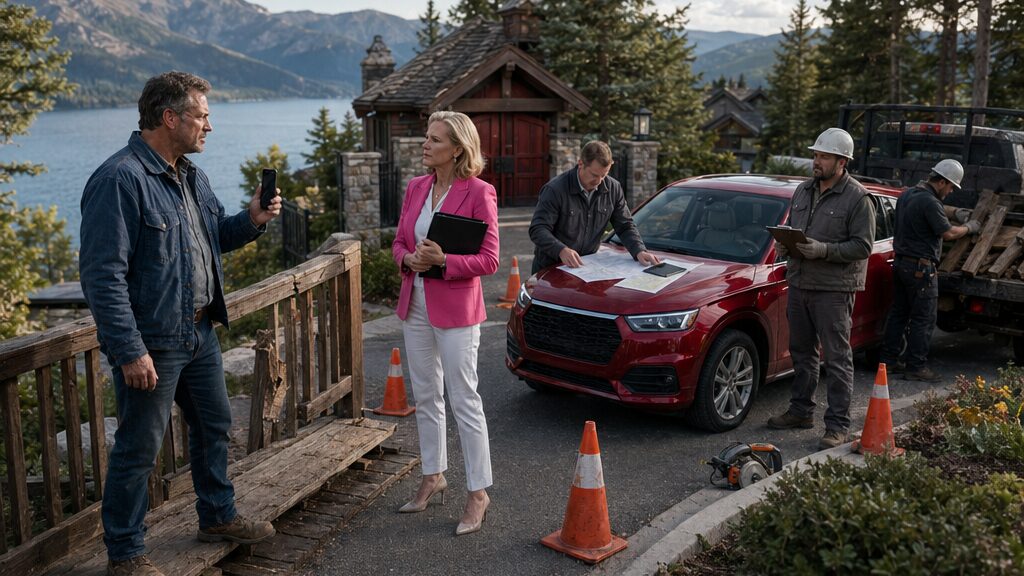
The saw was already biting through the handrail when Frank Carter reached the driveway.
For half a second he could not make his body move. The sound came sharp and wrong across the lake air, a metallic scream chewing through the rail Jonathan Wright had bolted in only three days earlier. One worker held the rail steady while another leaned into the saw. A third man dragged two loosened boards toward a white crew truck parked beside the stone entrance wall.
Behind them, the red HOA vehicle idled with its hazard lights blinking.
It was parked exactly where Frank had told them not to park.
Frank stepped off the porch so fast that the screen door slammed behind him.
“Stop cutting.”
The worker with the saw glanced up, but the blade kept spinning.
Frank raised his voice, not enough to shout, just enough to cut through the motor. “I said stop cutting.”
The saw lifted away from the wood. The worker looked past Frank instead of at him, toward the woman standing near the red double doors of the gatehouse. Deborah King wore a bright pink blazer, white slacks, and sunglasses too large for the gray morning. She held a folder against her ribs as if it were a shield.
“Continue,” she said.
Frank walked straight to the remaining section of ramp and stood between the worker and the rail.
The crew supervisor stepped forward. “Sir, you need to move out of the work zone.”
“This is my driveway.”
“This structure is under removal.”
“This structure is attached to my house.”
Deborah came toward him with clipped, careful steps. She did not hurry. People like Deborah never hurried when someone else was supposed to feel rushed.
“Mr. Carter,” she said, “you were notified.”
Frank looked at the half-cut rail, the removed boards stacked against the truck, the orange cones set in a line that ended at the red HOA vehicle’s front tire.
“When?”
Deborah opened the folder and pulled out one page. “This morning.”
Frank stared at her. “This morning when the crew was already here?”
“The notice was posted properly.”
He took the paper without looking away from her face. Across the top, in bold letters, it read: EMERGENCY ENFORCEMENT ACTION. Beneath it, the date was that morning. The time stamp was 7:42 a.m.
It was 8:16.
Frank folded the paper once and slid it into the back pocket of his jeans. His hands wanted to shake. He did not let them.
“The ramp stays,” he said.
Deborah’s mouth tightened. “The unauthorized structure is being removed. You were advised not to proceed with exterior work without architectural approval.”
“It’s not decorative.”
“It changes the exterior appearance of the common access corridor.”
Frank turned his head slowly toward the side path. The narrow strip ran between his lake house and the stone wall that curved toward the HOA gate. Rain had washed a cut through the gravel there, leaving the main steps slick and uneven. Jonathan’s temporary ramp bridged the worst part, with a rail high enough for steady hands and a drainage channel underneath to carry water away from the foundation.
Frank had built more complicated things than this in his life. He knew what a cosmetic project looked like.
This was not that.
A board clattered into the truck bed. Frank looked over and saw one of the workers carrying a post with the concrete anchor still attached.
“Put that down,” Frank said.
The worker froze.
Deborah removed her sunglasses. Her eyes were not cruel. That almost made it worse. They were certain.
“Mr. Carter, this is not optional. The board has an obligation to enforce community standards consistently. If every homeowner installed ramps, platforms, channels, and temporary structures wherever they felt like it, we would have liability chaos.”
“Then show me the order.”
“I just handed it to you.”
“No. You handed me a notice. I want the authorization for removal, the board vote, the property map you’re relying on, the name of the person who approved crew access to my land, and the crew supervisor’s license information.”
The crew supervisor shifted his weight.
Deborah blinked once. “You are escalating this unnecessarily.”
Frank took out his phone and started recording. He held it at chest height, angled toward the ramp, the cut rail, the crew truck, and the red HOA vehicle.
“No,” he said. “You escalated it when you sent a crew before you gave notice.”
A neighbor had come out onto a balcony across the lane. Another stood near a mailbox, pretending to check envelopes. The lake sat behind all of it, flat and silver, boats rocking against private docks as if nothing here mattered.
Deborah lowered her voice. “You are blocking authorized work.”
“I am standing on my property.”
“You are standing in a common access zone.”
“That’s what you keep saying.”
“That is what the recorded community map shows.”
Frank turned the phone slightly toward the red vehicle. Its front tires rested beyond the painted curb line, over the old seam where the asphalt apron met the gravel shoulder. Years ago, his father had pointed to that seam with the end of a fishing rod and said, Don’t let them move that line by habit. A man could lose land by letting people act like it was theirs.
Frank had thought about that sentence often after Mary moved in.
Not because he cared about the few feet of gravel.
Because that strip was the only way to give her a safer entrance without tearing apart the whole front of the house.
“Your vehicle is on my side of the line,” Frank said.
Deborah gave a short, humorless laugh. “This again.”
The crew supervisor looked at her. “Ma’am, do you want us to keep going?”
“No,” Frank said.
Deborah said, “Yes.”
The supervisor did not move.
Frank kept the phone steady. “Nobody touches another board until I see written authority.”
Deborah’s face reddened under the clean makeup. “This is precisely why the board acted. You ignore procedure, install an unapproved structure along a shared approach, then claim ownership of a community strip when enforcement begins.”
“I submitted the request.”
“You submitted incomplete materials.”
“You never answered.”
“The association cannot be held hostage by one homeowner’s interpretation of urgency.”
Frank almost said Mary’s name then. It rose in his throat, hot and simple. My mother cannot use those stairs safely. But he saw, through the window over the porch, the edge of the living room curtain move.
Mary was watching.
She had asked him not to make her the subject of another board conversation. She had said it softly, looking at her hands. I moved here to live with you, Frank, not to become an exhibit.
So he swallowed the words and held up the phone instead.
“I’m asking you again,” he said. “Show me the work order and the property authority.”
Deborah turned away and took out her own phone. “Fine. We’ll let the county confirm what the association already knows.”
“Good.”
She paused, as if she had expected him to object. “A code officer is nearby. I’ll ask him to come immediately.”
“Ask him.”
The next twenty minutes stretched thin. The saw stayed silent. One worker sat on the lowered tailgate. Another looked at the half-cut rail and then at Frank as if apologizing would cost him his job. Deborah stood by the red vehicle making calls, one hand pressed against her ear. Frank stayed near the ramp, phone lowered now but still recording.
When the county code officer arrived, he came in a white pickup with the county seal on the door and a tablet under his arm. He was younger than Frank expected, but he carried himself like someone used to being disliked by both sides.
Deborah reached him first. “Thank you for coming. We have an unauthorized exterior structure installed in a common access corridor. Removal is already underway, but Mr. Carter is obstructing.”
Frank waited until the officer looked at him.
“I’m asking for verification before they remove anything else,” Frank said. “The structure is temporary access and drainage stabilization. I submitted an emergency request. They started cutting before notice. And they’re standing on a property line they haven’t verified.”
The officer looked from Frank to Deborah, then to the ramp. “Do you have documents?”
Deborah opened her folder instantly. Frank went to the porch, picked up his own worn brown file from the bench, and brought it back. His file did not look like hers. It was bent at the corners, marked with old pencil notes and a coffee ring from the kitchen table.
He handed over the survey first.
The officer placed Deborah’s HOA map on the hood of the red vehicle. Then he placed Frank’s survey beside it.
The wind lifted one corner. Frank put his palm down on the paper before Deborah could.
For the first time that morning, her certainty flickered.
The officer enlarged something on his tablet, then looked back down at the two pages. His finger moved from the stone gate to the asphalt apron, from the apron to the ramp posts, from the posts to the red vehicle’s front tires.
He said nothing for a while.
Deborah crossed her arms. “The association map has governed this corridor for years.”
The officer looked at Frank’s survey again.
Then he looked at the ramp.
Then at the red vehicle.
“I’m not authorizing further removal right now,” he said.
Deborah’s head snapped toward him. “Excuse me?”
The officer tapped Frank’s survey with one finger. “This HOA map does not match the county record.”
Chapter 2: The Notice Was Dated This Morning
The HOA’s only written answer to Frank’s repair request was not an answer at all.
It was an automated email buried between a pharmacy receipt for Mary and a message from Jonathan Wright about gravel delivery. Frank found it at the kitchen table after the crew left and the code officer told everyone to hold position until he reviewed the property records. The subject line read: Architectural Submission Received.
No approval. No denial. No request for more information.
Just received.
Frank printed it anyway.
The printer coughed out the page slowly, like it objected to being dragged into the fight. Frank took the warm sheet, placed it beside the violation notice, and wrote the dates on a yellow sticky note. Request submitted: Monday, 6:18 a.m. HOA enforcement notice: Thursday, 7:42 a.m. Removal started: before 8:16 a.m.
From the living room, Mary said, “You’re pressing too hard with that pen.”
Frank looked down. The numbers had dug through the sticky note into the table.
He pulled his hand back. “Sorry.”
Mary sat in her armchair near the lake-facing window, a blanket folded across her lap though the room was warm. She had not asked about the saw. She had not asked how much of the ramp they had taken. That was how Frank knew she already understood enough.
“They stopped,” he said.
“For now.”
“For now,” he admitted.
She nodded once, eyes on the lake. “You always say the second part when it’s bad.”
Frank almost smiled. “I didn’t know I had tells.”
“You had them at ten.”
The phone rang before he could answer. Jonathan Wright’s name lit the screen.
Frank put it on speaker and set the phone on the table. “Tell me you kept copies.”
Jonathan exhaled. “I kept everything.”
“Good.”
“But Frank…”
There was a pause sharp enough to raise Frank’s eyes from the paperwork.
“What?”
Jonathan’s voice dropped. “Deborah called me Tuesday afternoon. Told me not to continue any exterior work near the gate until further board review.”
Frank straightened. “You told me you hadn’t heard from them.”
“I hadn’t heard officially.”
“You stopped for half a day because she called?”
“I had two jobs already delayed by HOA disputes this spring. I can’t afford to get blacklisted in a lake community. She said if I kept working, the board could report me for unauthorized work on common property.”
Frank closed his eyes. That explained the gap in the schedule. The missing drainage boards. The way Jonathan had said he was waiting on materials when the materials were already stacked under a tarp.
“Why didn’t you tell me?”
“Because I thought she’d send the review by Wednesday. I figured I’d lose half a day, not watch a crew tear out my work.”
Mary shifted in the living room. Frank kept his gaze on the printed email.
“Jonathan, I need you to send me exactly what she said. Time, date, as close as you remember.”
“I’ll write it up.”
“And I need the notes about the side path.”
“I already have photos. That washout is going to get worse with one hard rain. The temporary drainage wasn’t pretty, but it was doing what it needed to do.”
Frank heard the shame under the man’s practicality.
“You should have told me,” Frank said.
“I know.”
Frank wanted to push harder. Instead he looked at the half-open door, through which he could see the missing handrail outside. Getting angry at Jonathan would not put it back.
“Send the notes,” he said. “Today.”
After the call, he clipped the automatic HOA email to Jonathan’s original ramp sketch. The drawing showed the side path, the temporary rail, the drainage channel, and the small landing that gave Mary enough room to turn without stepping into the washout. In the bottom corner Jonathan had written: emergency stabilization before next heavy rain strongly recommended.
Frank had asked him not to write Mary’s name.
At the time, it had seemed respectful.
Now it looked like a hole Deborah could drive a truck through.
Mary watched him from the living room. “You’re thinking about the doctor’s letter.”
Frank did not answer quickly enough.
“Frank.”
“It would help.”
“I know what it would do.”
“It would show this isn’t about appearances.”
“It would show every person in that room what I can and can’t do.”
He turned in his chair. “They already think I built it because I didn’t feel like asking permission.”
“Let them think you’re stubborn. You are.”
“That doesn’t bother me.”
“It bothers you plenty.”
He rubbed both hands over his face. He was tired in the deep way that made small noises feel personal. The printer settling. The refrigerator clicking on. A crew truck door outside. The house had become too loud because the ramp was quiet.
Mary set the blanket aside and reached for her cane. Frank started to rise.
“Don’t,” she said.
He stopped halfway out of the chair.
She stood carefully, one hand on the chair arm, the other on the cane. Her movement was controlled and practiced, but the distance from chair to kitchen looked longer than it had a month ago.
“You promised me,” she said, “when I moved in, that I would not have to ask a committee for permission to live here.”
Frank swallowed. “I remember.”
“I did not ask you to fight them with my medical file.”
“I’m not trying to make a case out of you.”
“That’s exactly what it becomes once paper starts moving.”
He had no clean answer. He had always respected her pride because it resembled his own. They were both good at keeping pain private until privacy became another kind of trouble.
He picked up the folded medical letter from the end of the table. It was still sealed in the clinic envelope, the one Mary had brought home and placed under the fruit bowl like it could disappear if neither of them touched it.
“I won’t use it unless you say so,” he said.
Mary looked at the envelope for a long time.
“Then don’t use it yet.”
That was not permission. It was not refusal either. It sat between them with the weight of something postponed.
By late afternoon, Frank had assembled a file: the automatic confirmation, Jonathan’s repair notes, photos of the washed-out path, pictures of the crew cutting the rail, the violation notice dated that morning, and his old survey. He did not include the medical letter.
He drove to the HOA office behind the red doors and asked the clerk to stamp a copy as received. Deborah was not there. Or she did not come out. The clerk took the papers without expression and pressed the stamp down crookedly.
“Will this go to the board?” Frank asked.
“It will be placed in the architectural file.”
“That’s not what I asked.”
The clerk glanced toward the closed office door behind her. “That is the process.”
When Frank returned home, a white envelope was taped to his front door.
For one hopeful second, he thought it might be a pause order.
Then he saw the red HOA seal.
The letter inside was short. It directed him to complete “full restoration of common-area appearance” by Friday at 9:00 a.m. If he failed to do so, the association would proceed with removal and bill his account.
Frank read the sentence twice.
Common-area appearance.
He turned toward the side path, where the missing rail cast no shadow now.
Behind him, Mary’s curtain shifted.
Chapter 3: The Board Calls Safety A Style Issue
Frank walked into the HOA meeting room just as a photo of his half-removed ramp filled the wall.
The image had been taken from an angle that made the boards look bulky and careless, the temporary drainage channel like a trench dug out of spite. Someone had circled the rail in red and typed two words beneath it: Unauthorized Structure.
No one had written access.
No one had written safety.
Deborah stood beside the projection screen with a remote in one hand. She had changed from the pink blazer into a cream jacket and dark skirt, but the posture was the same as it had been at the gate: shoulders back, chin level, certain the room belonged to her. Edward Scott sat near the center of the board table, glasses low on his nose, a binder open in front of him.
Three neighbors occupied the folding chairs along the back wall. Frank recognized one from the balcony that morning. She looked away when he glanced at her.
“Mr. Carter,” Deborah said, “you’re late.”
Frank looked at the clock. “I’m two minutes early.”
“The agenda has begun.”
“Then I’m glad I made it in time for the part about my house.”
A chair scraped somewhere behind him. Deborah’s mouth tightened, but she did not take the bait. Frank respected that against his will. She was not sloppy. That was part of the problem.
He sat in the front row and placed his folder on his knees.
Deborah clicked to the next slide. It showed the ramp from the side, the red HOA vehicle visible in the background. “The association is here to address an unapproved exterior installation in the common access corridor adjacent to the gatehouse parcel. This installation was performed without final architectural approval, using materials inconsistent with Lakeside Ridge standards, and without verified easement clearance.”
Frank lifted his hand. “That is not a full description.”
“You will have time to speak.”
“You’re describing it as if it appeared for no reason.”
Edward looked up from his binder. “Let her finish, Frank.”
Frank turned toward him. Edward did not look hostile. He looked tired, and that irritated Frank almost more. Tired men let other people make hard choices and then called it procedure.
Deborah continued. “The board has received complaints regarding visual impact, drainage uncertainty, and liability. We cannot allow individual homeowners to modify shared approaches on an emergency basis simply because they believe their circumstances are exceptional.”
Frank heard Mary’s voice in his head: Let them think you’re stubborn.
He opened the folder but kept the medical envelope inside it.
Deborah clicked again. The next slide showed a section from the HOA standards manual. Exterior additions must preserve original community design language and shall not alter shared sightlines, gatehouse appearance, or common access areas without prior written approval.
“This is not a style argument,” Frank said.
Deborah turned toward him. “Then why did you use raw pressure-treated lumber visible from the gate?”
“Because Jonathan had forty-eight hours before the next storm window and the ground was giving way.”
Edward folded his hands. “Why did you install first and seek approval later?”
Frank took out the printed request confirmation and held it up. “I submitted before work continued. Monday morning. Six-eighteen.”
Deborah said, “Submission is not approval.”
“I didn’t say it was. I’m saying you had the request before you sent a crew.”
“Your submission lacked necessary supporting material.”
“Then why didn’t anyone request it?”
The room went still enough for the projector fan to become loud.
Frank stood and stepped toward the board table. He placed copies in front of Deborah, then Edward, then the two unnamed board members. “Stamped received. Photos. Contractor notes. Date of submission. Date of removal. Your notice was dated after the crew arrived.”
Deborah did not touch the packet immediately.
Edward did. He flipped through the pages, stopped at Jonathan’s note, and frowned. “Emergency stabilization before next heavy rain strongly recommended.”
“Correct,” Frank said.
“For what specific condition?”
Frank felt the envelope inside his folder like a hot coal. He could have opened it. He could have placed the letter on the table and watched the room change shape around Mary’s private life. Instead, he closed one hand over the folder edge.
“The side path is unsafe,” he said. “The main stairs are steep when wet. The ramp and rail make access safer.”
“For whom?” Deborah asked.
Frank looked at her.
She had asked it softly. Not kindly, but carefully. It was the question that mattered, and she knew it.
“For my household,” he said.
Deborah nodded as if he had confirmed something. “The association cannot evaluate vague hardship claims. If there is a formal accommodation request, it must be submitted as such.”
“I submitted an emergency repair request.”
“Which was incomplete.”
“Because you ignored it.”
“Because it was not adequate.”
Edward lifted a hand. “Let’s separate two issues. One, whether Frank submitted in time. Two, whether the area is common access.”
Deborah clicked to another slide before Frank could respond. A faded development map appeared. The red gatehouse parcel was outlined in thick blue. A narrow strip beside Frank’s house was shaded as shared approach.
“This is the recorded community map used by the association since the gate expansion,” Deborah said. “The area in question is not solely Mr. Carter’s private driveway.”
Frank stared at the projected map.
He had seen versions of it before, mostly in meeting packets no one read closely. But on the wall, enlarged and simplified, it looked convincing. Clean line, shaded strip, official stamp in the corner. To anyone in the room, it would look like Deborah had the answer.
“That map is wrong,” Frank said.
Deborah gave him a level look. “That is your opinion.”
“It does not match my deed.”
“Your deed does not control common association easements.”
“My survey controls my property line.”
“And the association has easement rights.”
“Then show the easement.”
Deborah paused.
It was brief. Too brief for most people to notice. Edward noticed. Frank saw his eyes shift from the map to Deborah’s face.
Deborah recovered. “The board is not here tonight to litigate boundary history. We are here to enforce exterior compliance and prevent unsafe, unauthorized work near a shared approach.”
Frank gave a short laugh before he could stop himself. “You’re calling the repair unsafe while tearing out the rail that made it safe.”
A neighbor in the back murmured something. Deborah looked past Frank toward the chairs, and the room quieted.
“This is precisely why standards exist,” she said. “No one person gets to decide that their preferred solution overrides everyone else’s rights.”
Frank looked at the ramp photo again. The red circle around the rail. The label underneath. Unauthorized Structure.
He could feel his own mistake now. He had believed the survey would be enough. He had believed the truth would sit there plainly if he placed it on paper. But Deborah had not left empty space for truth. She had filled it with categories: appearance, liability, shared access, process.
And because he had refused to say Mary’s name, the room had no reason to see the ramp as anything but boards.
Edward turned another page. “Deborah, if his submission was Monday, why did enforcement begin Thursday morning without a denial letter?”
“The board authorized enforcement based on ongoing noncompliance.”
“Was there a vote?”
“The executive committee reviewed the matter.”
“That’s not the same thing.”
Deborah’s eyes sharpened. “Edward, we discussed the risk.”
“We discussed potential risk. I don’t remember authorizing a crew to start before notice.”
For the first time that night, Frank saw uncertainty move around the board table. Not sympathy. Not yet. Just a small procedural crack.
Deborah closed her folder. “Then we will cure any procedural ambiguity now.”
She turned to the two other board members. “Motion to direct full removal of the unapproved structure and restoration of the common access corridor by Friday at nine a.m., with costs assessed to the homeowner pending further review.”
Frank stepped forward. “You haven’t verified the property line.”
Deborah did not look at him. “Motion?”
One board member shifted. Edward stared at the map, jaw tight.
The other board member said, “Second.”
“Deborah,” Edward said, “we should wait for county clarification.”
“We have an obligation to enforce,” she replied.
The vote passed with Edward opposed.
Frank stood in front of the projected image of his own ramp while Deborah wrote the decision into the minutes. The red circle glowed across his shirt.
She looked up at him when she finished. “Friday morning, Mr. Carter. If the structure remains, removal proceeds.”
Frank gathered his folder slowly. He kept the medical envelope inside.
Outside, beyond the red doors, the HOA vehicle sat under the gate lights in its usual place beside the curb.
Right where his father had told him the line was never supposed to move.
Chapter 4: The Survey Line Runs Under Red Paint
The surveyor drove a metal stake into the ground exactly where the red HOA vehicle usually parked.
Frank stood beside the stone gate and watched the man stretch a line from the corner pin near the lake wall to the mark beside the curb. The string cut across the asphalt apron, skimmed over the faded seam in the pavement, and ran beneath a stripe of red paint Deborah’s maintenance crew refreshed every spring.
The surveyor looked at his instrument, then at Frank’s old survey, then back at the ground.
“Well,” he said, “that’s inconvenient.”
Frank almost laughed, but the sound did not come out right. “For who?”
“For whoever poured this apron thinking the old map was close enough.”
The red HOA vehicle was not there that morning. Deborah had moved it after the code officer’s pause order, but the tire marks remained in the grit. Frank could see where the front wheels usually sat, two dark arcs pressed into the shoulder just beyond the red curb.
The surveyor set another flag. Its orange tape snapped in the breeze.
“That’s my side?” Frank asked.
“According to the county record and the deed description you gave me, yes. But I’m not giving you legal advice. I’m marking what the recorded survey shows.”
Frank nodded. He had heard enough disclaimers in the last two days to build a fence with them.
The county code officer stood a few yards away with his tablet, looking from the flags to Deborah’s old map. He had asked to meet at the site after Frank brought him the deed, the stamped plat, and the photo of the crew cutting the rail. Deborah had sent the HOA’s maintenance manager instead of coming herself. The manager stood near the gatehouse door and kept texting.
Frank crouched beside the flag nearest the half-removed ramp. The remaining rail leaned slightly because one support post had been taken. The board with the saw mark still hung there, cut nearly through, the exposed wood pale against the weathered surface.
“It runs under the ramp landing,” Frank said.
“Part of it,” the surveyor replied. “And under that pull-off.”
Frank followed his gesture to the widening of asphalt beside the gate. The place where residents waited for the gate to open. The place where the red vehicle idled. The place Deborah had called common access as if the phrase could redraw land.
The code officer came closer. “This doesn’t settle every question.”
Frank stood. “It settles whether they should be cutting things down before checking.”
“It raises a serious issue,” the officer said carefully. “But the association is claiming easement rights over the gate approach. Easements can exist even if ownership is private.”
“Then they need to show it.”
“Yes.”
“Have they?”
The officer looked toward the maintenance manager, who quickly looked down at his phone. “Not yet.”
Frank put both hands on his hips and let the morning air fill his lungs. The lake was visible behind the gatehouse, all blue-gray shine and quiet docks. He had grown up measuring that view by where he stood: from the porch, from the lower path, from the end of the dock, from the strip beside the gate where his father had once tapped a fishing rod against the ground and warned him about lines that moved by habit.
Frank had thought the man was being stubborn then.
Now he wished he had asked more questions.
The code officer opened the HOA packet on his tablet. “The association map shows a gatehouse expansion easement from the late nineties.”
“Recorded?”
“I don’t see recording information on the copy they sent.”
“That means no.”
“That means I don’t see it.”
Frank smiled without warmth. “You all talk like that when a straight answer might cost somebody money.”
The officer did not take offense. “Straight answers have to survive paperwork.”
The surveyor gathered his tripod and said, “He’s not wrong.”
Frank looked at the flags again. They made the property line visible in a way paper never had. It looked ridiculous now, the red curb crossing it, the asphalt widening past it, the ramp being called an intrusion when the gate itself might have been the thing that wandered.
The maintenance manager finally walked over. “Mrs. King says the association reserves all rights and does not consent to any obstruction of gate operations.”
Frank looked at him. “I’m not obstructing the gate.”
“She says any attempt to block access will result in legal action.”
“I said I’m not blocking the gate.”
The manager held the phone away from his ear as if Deborah could hear Frank through the air. “She says the flags are not authorization to interfere with association property.”
Frank turned toward the officer. “You hearing this?”
“I hear it.”
“Do you also hear me saying I’m not interfering with gate access? I’m trying to keep them from removing a safety ramp they never had authority to touch.”
The officer typed something on his tablet. “I’m noting both positions.”
Frank wanted to snatch the tablet out of his hands and write the obvious sentence himself: They cut first and checked later. But that was anger. Anger had already taken enough space.
The surveyor handed Frank a paper copy of the preliminary mark sheet. “This isn’t the final report. But the line’s the line unless someone produces a superior recorded document.”
Frank folded the paper carefully and slid it into his file.
The small payoff should have felt larger. He had been right. The line his father warned him about had not moved, not legally. But proof did not restore the missing post. It did not make the path safer. It did not make Deborah stop.
The maintenance manager listened to his phone again, then said, “Mrs. King says the Friday restoration deadline remains.”
The code officer looked up. “I’ve advised a pause pending document review.”
“She says the HOA is proceeding under its authority.”
The officer’s expression changed by one narrow degree. “Then Mrs. King should put that in writing to my office.”
The manager repeated the sentence into the phone and winced at whatever came back.
Frank gathered his file, but before he reached the driveway, he saw Edward Scott standing near the row of mailboxes, half hidden by the stone pillar. Edward was not dressed for a board meeting. He wore a faded jacket and held a folded newspaper he clearly had not been reading.
Frank walked toward him. “You here to inspect my unauthorized string?”
Edward looked at the orange flags. “No.”
“Then why are you here?”
Edward hesitated. Behind him, the gate opened for a delivery van. The van passed slowly over the asphalt apron, right across the marked line.
“I wanted to see where it fell,” Edward said.
“You saw.”
“Yes.”
Frank waited.
Edward glanced toward the gatehouse door, then lowered his voice. “You need to be careful.”
“That sounds like advice from somebody who voted against me too late.”
Edward accepted that without flinching. “Maybe.”
“What do you know?”
Edward looked at the red curb, then at the ramp rail hanging with its saw cut.
“That map has been a problem longer than you know.”
Chapter 5: The Person Behind The Permit
Rain found the gap in the ramp before Mary reached the door.
It started as a hard tapping on the lake-facing windows, then became the kind of steady mountain rain that turned gravel loose and made the old main steps shine black. Frank had placed a temporary board across the missing section where the crew had pulled the support post, but the board shifted under his boot when he tested it.
Mary stood inside the lower entrance with one hand on the wall and her cane angled in front of her.
“I can wait,” she said.
“You have an appointment in forty minutes.”
“I have missed appointments before.”
“That’s not the point.”
“It becomes the point when you look like that.”
Frank looked down at his hands. He was gripping the doorframe hard enough to whiten his knuckles. He let go and stepped onto the wet board again. It held his weight, barely. It would not hold Mary’s hesitation. The danger was not only whether the board broke. It was the half-second of uncertainty when her foot met something unstable and her body had to decide what to trust.
He knew that half-second. He had watched it too many times.
“We’ll use the front,” he said.
Mary looked past him toward the steep main steps. Water ran down them in thin, shining sheets.
“No.”
“Mom.”
“No.”
Her voice was not loud. That was how Frank knew she was serious.
He stepped back inside and closed the lower door. The rain blurred the lake behind him. For a while, neither of them moved.
“You should have let Jonathan finish,” she said.
“I tried.”
“You should have told them why.”
Frank turned. “You told me not to.”
“I told you not to put my medical history on a meeting room wall.”
“There’s a difference?”
“There should be.”
He wanted to argue. Instead he pulled a chair from the mudroom wall and set it beside her. Mary lowered herself into it slowly, angry at the chair for being useful.
Frank crouched in front of her. The cane rested between them, rubber tip damp from the doorway.
“When Dad built the lower path, he said it was so you could carry laundry without slipping,” Frank said.
Mary’s mouth moved, almost a smile. “Your father built that path because he hated the stairs after fishing.”
“He told me it was for you.”
“He told everyone his better reasons.”
The rain beat harder. Water found the drainage cut Jonathan had started and followed it partway before spilling into the gravel, exactly where the unfinished channel ended. Frank could see the problem from where he crouched: half a repair was sometimes more dangerous than no repair at all, because it made people trust a path that had stopped being whole.
Mary followed his gaze. “Don’t make me your argument, Frank.”
“I’m not trying to.”
“You are. In your head, maybe not on paper yet.”
He looked at her hands. The knuckles were swollen this morning. She had hidden them under the blanket earlier, but the rain changed things. Rain made the house tell the truth.
“I promised you this house,” he said. “I promised you could stay where you could see the lake.”
“You promised me I would still be myself.”
He looked up.
Her eyes were wet, but not from fear. “I don’t want a room full of people deciding whether I am helpless enough to deserve a railing.”
Frank sat back on his heels. That was the thing he had been avoiding because it hurt too much to name. He had thought keeping her medical letter sealed preserved her dignity. But silence had allowed Deborah to reduce the ramp to lumber, the request to paperwork, Mary to no one at all.
“I don’t know how to protect both,” he said.
Mary looked toward the rain. “Maybe you ask me what protecting means before deciding for me.”
He nodded once. The apology stayed in his throat because saying it would be too easy.
The phone rang from the kitchen. He stood, expecting Deborah, the officer, maybe Jonathan. Instead it was the home health nurse, waiting at the clinic entrance.
Frank answered. “We’re delayed.”
“How delayed?”
He looked at Mary. She had turned her face away from him.
“Too delayed,” he said.
The nurse’s voice softened. “Do you need to reschedule?”
Frank closed his eyes. “Yes.”
After the call, he went to the kitchen table and opened his file. The clinic envelope still sat under the fruit bowl where Mary had left it, untouched except for the soft bend at one corner.
Mary came in behind him slowly. He did not rush to help. That restraint cost him something, and she noticed.
She sat across from him.
“Open it,” she said.
Frank did not move. “You don’t have to.”
“I know.”
“I can keep fighting with the survey.”
“And they can keep pretending the ramp is about the survey.”
He looked at the envelope.
Mary placed her cane across her lap like a boundary. “I am not giving them permission to discuss every part of me. I am giving you permission to show what matters: stairs, balance, safe access, temporary modification. Nothing more.”
Frank nodded. “Only what matters.”
“If Deborah King says the word hardship like it tastes bad, you may tell her I still have better manners than she does.”
This time Frank did smile.
He opened the envelope carefully, using a butter knife so the paper would not tear. The letter was short and plain. It did not dramatize. It stated that Mary required stable rail-assisted access to the lower entrance during wet conditions and that temporary exterior access modification was medically advisable while permanent options were reviewed.
That was all.
That was enough.
Frank clipped it behind Jonathan’s sketch, not on top. Mary noticed that too.
“Why there?” she asked.
“Because you’re not the first page,” he said. “The repair is.”
She looked at him for a long moment. Then she nodded.
By evening, Frank had drafted a formal accommodation request. He included the medical letter, contractor notes, the rain photos, the dated HOA submission, and the survey flags. He wrote one sentence three times before leaving it alone: The requested repair is necessary to preserve safe access to the home for a resident with documented mobility limitations.
Mary read it.
“Too stiff,” she said.
“It’s a formal request.”
“It can be formal and human.”
So he added another sentence beneath it: The ramp is not an expansion of use; it is a way to keep the existing entrance usable.
Mary tapped that line with one finger. “That one.”
Frank sent the packet by email, certified mail, and hand delivery to the HOA office.
Then, with Mary watching from the kitchen doorway, he placed the original medical letter into the brown file.
Outside, rainwater ran through the unfinished channel and spilled into the place where the missing post had been.
Frank looked at the Friday deadline on Deborah’s notice and set his alarm for dawn.
Chapter 6: The Old Map Was Never Innocent
The crew truck returned before the HOA had answered the accommodation request.
Frank saw it from the kitchen window just after seven on Friday morning, backing toward the red gate with its bed already stacked with his removed boards. The saw-cut rail lay on top, the pale wound in the wood turned upward as if someone had arranged it for him to see.
Mary was still at the table with her tea. She followed his gaze but did not stand.
“Go slowly,” she said.
Frank picked up the brown file, his phone, and the printed delivery confirmation showing the request had been received the evening before.
“I’m going clearly,” he said.
“That is not the same as slowly.”
He looked back. She was right, and he hated that he needed to hear it.
Outside, Deborah stood beside the red HOA vehicle in the same bright pink blazer she had worn the first morning. The choice felt deliberate. Beside her, the crew supervisor reviewed a clipboard while two workers unloaded tools.
Frank started recording before he reached them.
“Has the board responded to my accommodation request?” he asked.
Deborah did not look at the phone. “Good morning, Mr. Carter.”
“Has the board responded?”
“The board will review any properly submitted request in accordance with procedure.”
“You received it yesterday.”
“At 5:34 p.m.”
“And you’re here at seven to remove the ramp.”
“We are here to complete restoration ordered before that submission.”
Frank held up the delivery confirmation. “The request includes medical documentation and contractor safety notes. Removal now interferes with a pending accommodation review.”
Deborah’s face remained composed, but something behind it hardened. “The association is not required to allow an unsafe unauthorized structure to remain indefinitely because you file paperwork at the last moment.”
“I filed Monday.”
“You filed an architectural request Monday. You filed an accommodation request yesterday evening, after enforcement began.”
Frank stepped closer to the remaining ramp section. “Because you kept calling it a style issue.”
The crew supervisor shifted. “Are we cleared to work?”
“No,” Frank said.
Deborah said, “The board’s order remains in effect.”
Frank turned to the supervisor. “If you touch that rail, I want your written authority and proof of insurance in my hand first. I also want you to acknowledge on camera that you’ve been told there is a pending accommodation request and a disputed property line.”
The supervisor looked at Deborah. “Ma’am, I’m not getting in the middle of a legal issue.”
“You were retained for removal,” Deborah said.
“I was retained for a standard enforcement job. This is not standard anymore.”
For a moment, Frank thought the crew might pack up. Then Deborah opened her folder and removed a document he had not seen before.
“We can resolve this today,” she said.
He did not reach for it.
She held it out anyway. “The association is prepared to allow you to reconstruct a temporary access feature using approved materials, subject to board review, if you sign this acknowledgment confirming that the gate approach, vehicle pull-off, and access corridor remain under association control and that you waive any objection to existing gate operations.”
Frank stared at her.
The lake wind pressed the paper against her fingers.
“You want me to sign away the line,” he said.
“I want you to stop turning a ramp issue into a boundary dispute.”
“They are the same issue because your crew is standing on that boundary.”
“They are not the same issue unless you insist on making them one.”
He took the paper then, but only to read it. The language was smooth. Temporary permission. Neighborly accommodation. No admission. No waiver of HOA enforcement power. No challenge to existing common access use.
A trap in polite clothes.
“You knew,” he said.
Deborah’s eyes narrowed. “Knew what?”
“That the boundary file was incomplete.”
“I know the association has used this access corridor for decades.”
“That isn’t what I said.”
A voice behind him said, “It’s what the insurance letter said too.”
Frank turned.
Edward Scott stood near the mailbox row, rain jacket zipped to his throat though the rain had stopped. He held a thin folder in one hand. His face had the pale, set look of a man who had slept badly and decided not to pretend otherwise.
Deborah turned on him. “Edward.”
He did not come closer at first. “I asked for the gate expansion file after the meeting. The old easement packet has a missing recording page.”
Deborah’s voice dropped. “This is not the place.”
“The insurance carrier flagged it in February.”
Frank looked from Edward to Deborah. “February?”
Edward nodded once. “They asked whether the association could document access rights for the expanded pull-off and gate maintenance area. Deborah told us it was an administrative cleanup.”
“It is,” Deborah said.
Edward looked at her. “Then why are we asking him to waive his objection before letting him rebuild a ramp?”
The workers had stopped pretending not to listen.
Deborah’s face flushed, but her voice stayed controlled. “Because if Mr. Carter blocks gate access, every household past this point is affected. Emergency vehicles, deliveries, residents—”
“I said I wasn’t blocking the gate,” Frank said.
“You keep saying the gate is on your land.”
“I keep saying you don’t get to cut up my access ramp and hide behind a map that doesn’t match the county record.”
Edward opened his folder and pulled out a copy of an email. “There was no full board authorization for removal before notice. I should have pushed that harder. I didn’t because I was worried about liability exposure if we let unapproved structures stay near the gate. Deborah used that concern to move faster than our own process allowed.”
Deborah looked at him as if he had slapped her. “You agreed there was risk.”
“I agreed there was risk. I did not agree to ignore the accommodation request, the notice timing, and the boundary problem.”
The county code officer’s white pickup came through the gate before Deborah could answer. He parked deliberately away from the red curb, stepped out with his tablet, and took in the crew truck, the tools, the remaining ramp, and the cluster of people.
“I was told removal might resume,” he said.
Frank handed him the accommodation receipt, the survey mark sheet, and Deborah’s proposed acknowledgment.
The officer read in silence. Deborah folded her arms. Edward looked at the ground.
Finally, the officer said, “No further removal today.”
Deborah inhaled. “On what authority?”
“On the authority that I am not going to stand here while a disputed access modification tied to a medical accommodation and unresolved property records is removed before review. If the association believes it has emergency authority, bring it to the emergency review this afternoon.”
“This afternoon?”
“Yes. County office. Three o’clock. Bring the board authority, the easement file, the insurance correspondence, and the accommodation response. Mr. Carter, bring your contractor notes, medical support, survey documents, and proof of submission.”
Frank nodded.
Deborah closed her folder with a clean snap. “This is highly irregular.”
The officer looked at the half-cut rail in the truck bed. “So is starting demolition before the paperwork agrees with itself.”
For the first time since the saw cut into the rail, no one had an immediate answer.
Frank looked at the agreement still in his hand. He could sign it and probably have the ramp back faster. Mary could use the entrance sooner. The gate dispute would disappear into a sentence written by someone else. It was the kind of practical compromise tired people accepted because they were tired.
He folded the paper once and handed it back to Deborah.
“No,” he said.
Her expression sharpened. “Then you may be delaying your own repair.”
Frank looked at the missing rail, the crew truck, the red curb, and Edward’s folder.
“No,” he said again. “I’m refusing to trade my mother’s access for silence about where your line really is.”
The code officer typed something into his tablet, then looked up at both sides.
“Three o’clock,” he said. “And nobody touches that ramp before then.”
Chapter 7: The Ramp Is Not An Argument
“Unauthorized work,” Deborah said, tapping the photograph on the screen, “is not less unauthorized because someone feels strongly about it afterward.”
Frank sat three seats from the end of the emergency review table with the saw-cut ramp board across his knees.
He had brought it because the code officer told both sides to bring documents, and Frank had decided the board needed to see what their documents had done. The board was rough against his palms, one end still marked where the saw had entered and stopped. Jonathan had helped him load it into the truck without asking why. Mary had watched from the porch and said only, “Don’t swing it at anyone.”
Now it lay on the table beside Frank’s brown file, more honest than every map in the room.
Deborah stood near the projection screen in the county meeting room, not the HOA office this time. That mattered. The red doors were not behind her. The county code officer sat at the head of the table with his tablet, and the survey flags from the morning had been photographed and printed in color.
Edward Scott sat across from Frank. He had not looked at Deborah since the meeting began.
Deborah continued. “The association’s position is simple. The structure was installed without final approval. It was visible from the gate. It altered a shared approach area. It created drainage and liability concerns. The board cannot permit homeowners to create their own exceptions.”
Frank waited. His hands rested on the cut board.
The code officer looked at him. “Mr. Carter.”
Frank stood slowly. He did not pick up the board. He did not want the room to mistake his anger for his evidence.
He placed four pages on the table in a straight line.
“The request went in Monday at 6:18 a.m. The contractor note says emergency stabilization was recommended before the next storm. The medical letter says stable rail-assisted access is necessary for a resident of the home during wet conditions. The survey mark sheet shows the ramp and part of the gate pull-off sit inside my recorded property line.”
Deborah folded her arms. “Again, the association has easement rights.”
Frank placed the fifth page down. “Then this is where those rights should be recorded.”
The code officer leaned forward. Edward did too.
It was a copy of the easement page Deborah had submitted that morning, with the recording information cut off at the bottom and the legal description ending halfway through a sentence.
Deborah’s jaw tightened. “That copy came from an older packet.”
“Exactly,” Frank said. “Not from the county record.”
The code officer looked at Deborah. “Do you have a complete recorded copy?”
“Our attorney is locating archival materials.”
“That is not an answer for today.”
Deborah turned to him. “With respect, the association’s uninterrupted use of that corridor—”
“May matter later,” the officer said. “It does not give me comfort about authorizing removal today.”
Frank felt the room shift, but he did not relax. A partial win could still become another delay with better language.
Edward opened his folder. “I need to put something on record.”
Deborah’s face changed. “Edward.”
He did not stop. “In February, the insurance carrier asked the board to verify gate approach access because of the expanded pull-off and maintenance vehicle parking. We discussed it in executive session. I understood Deborah to be handling a title review.”
“I was,” Deborah said.
Edward looked at the code officer. “The review was not complete when removal was ordered.”
The words landed quietly. No one gasped. No one shouted. That made them worse.
Deborah’s voice stayed controlled, but Frank heard the strain beneath it. “The boundary issue was unrelated to the unauthorized ramp.”
“No,” Edward said. “We treated it as unrelated because that was easier.”
Frank looked at him. Edward’s face showed no triumph. Only embarrassment, and something like relief.
Deborah turned toward the board members seated behind her. “If we allow every disputed boundary claim to stop enforcement, the association becomes ungovernable.”
Frank touched the cut board.
“This is not every claim,” he said.
Deborah looked at him sharply.
“This is my mother’s entrance,” Frank said.
The room went still.
He opened the medical letter, but he did not pass it around. He slid a copy to the code officer and kept the original in the file.
“My mother lives with me. She uses the lower entrance because the front stairs are unsafe for her in rain. The ramp is temporary. The rail is temporary. The drainage work is temporary. But the need is not imaginary, and it was not created after enforcement started.”
Deborah glanced at the letter as the officer read it. “The board was not given that information Monday.”
“No,” Frank said. “Because I thought the repair facts and the survey were enough. And because my mother did not want to become a discussion item.”
His voice nearly broke on the last words. He stopped, took one breath, and made himself continue.
“That was my mistake. I protected her privacy so tightly that I let you pretend there was no person behind the permit.”
Deborah’s expression flickered. Not regret, not yet. But discomfort, real enough to be human.
Edward took off his glasses. “Deborah, did the architectural committee send any request for additional information between Monday’s submission and Thursday’s removal?”
“No formal request,” she said.
“Did we issue a written denial?”
“No.”
“Did we wait for accommodation review once the issue was raised?”
“It was not raised formally until last night.”
Edward looked at the cut board. “Because we were already cutting it down.”
One of the unnamed board members shifted in her chair. “Can we approve a temporary repair without deciding the entire boundary issue?”
The code officer answered before Deborah could. “You can withdraw the violation, allow temporary safety restoration subject to code conditions, and reserve the boundary issue for proper review. You can also stop parking association vehicles on the disputed strip until the record is clarified.”
Deborah’s face hardened again at the last sentence. “That disrupts gate operations.”
Frank looked at her. “No. It disrupts your habit.”
The words came sharper than he intended. He saw Edward glance at him, warning. Frank pressed his palm flat on the board and pulled himself back.
“I’m not asking to close the gate,” he said. “I’m asking you not to use the need for access as cover to erase the line.”
Deborah looked from Frank to Edward to the code officer. For once, she seemed to be calculating in public.
“If the association withdraws the violation,” she said, “Mr. Carter must agree to approved materials and inspection.”
“Reasonable,” Frank said.
“And he must not obstruct gate operation while the easement is reviewed.”
“I won’t obstruct the gate.”
“And the association does not concede ownership.”
Frank looked at the survey, then at the board members. “You don’t have to concede ownership today. You have to stop destroying my repair while you figure out what you can prove.”
Edward nodded. “I move that the violation be withdrawn pending accommodation and boundary review; that temporary access restoration be allowed immediately under county safety conditions; that removal costs not be assessed to Mr. Carter; and that association vehicles be kept off the disputed pull-off until the easement file is complete.”
Deborah stared at him. “You are making a mistake.”
“No,” Edward said. “I made it yesterday.”
The vote was not unanimous. Deborah voted no. One board member hesitated long enough to make Frank’s pulse climb, then voted yes. The other followed.
The code officer wrote the result into his tablet.
Frank should have felt victory. Instead he felt the weight of the next choice settle in front of him. The gate still needed to function. Delivery trucks, emergency vehicles, neighbors with groceries and children in back seats; all of them used the approach because that was how the community had been built. If Frank pressed the property claim hard enough right now, he could make the HOA feel every inch they had ignored.
He could also become the man who turned access into a weapon.
Deborah gathered her papers. “Temporary restoration depends on signed access terms.”
Frank looked at the saw-cut board and then at the medical letter clipped behind Jonathan’s sketch.
“No waiver,” he said. “No silence. But I’ll discuss a temporary access agreement that protects the gate while the line is corrected.”
The code officer nodded. “Then we put that in writing.”
Deborah’s eyes met Frank’s across the table. For the first time, she looked less certain that certainty would save her.
Chapter 8: The Line They Finally Had To See
Jonathan reinstalled the final rail exactly where the saw had stopped.
Frank held the post steady while Jonathan drove the bolt through the bracket and into fresh blocking beneath the landing. The new rail was not the same raw lumber as before. The county had required a smoother grip surface, a slightly different height, and reflective edging along the drainage side. Frank had argued about the edging for thirty seconds, mostly out of habit, then accepted it because the code officer was right.
A safe ramp did not become less safe because someone else had a good point.
The orange survey flags still marked the edge of the pull-off near the red curb. Beyond them, the red HOA vehicle sat in a new place, ten feet back from where it used to idle, parked awkwardly beside the gatehouse wall like a guest who had been told not to sit in the family chair.
Jonathan tightened the last bolt and stepped back. “Try it.”
Frank put both hands on the rail. It did not move.
Jonathan looked relieved in a way he tried to hide by packing his tools too quickly. “Drain channel’s clear too. I’ll come back after the next rain and check flow.”
“You don’t have to.”
“I do,” Jonathan said. “I should’ve told you when Deborah called.”
Frank looked at him. The apology had been circling between them for a week, practical men avoiding a soft landing.
“Next time,” Frank said, “tell me before someone brings a saw.”
Jonathan nodded. “Next time, I will.”
At ten, Deborah arrived with Edward and the county code officer. She wore navy instead of pink. Frank noticed and wished he had not. Her clothes were not the story, but everyone in Lakeside Ridge understood uniforms whether they admitted it or not.
She carried two signed documents in a folder: withdrawal of violation and temporary access agreement. The agreement gave the HOA limited use of the gate approach while the boundary and easement records were reviewed by a title professional. It did not require Frank to waive claims. It did require him not to physically obstruct the gate. It required the HOA to keep vehicles and maintenance equipment off the marked disputed strip unless access was necessary and documented.
It was not poetic.
That was why Frank trusted it more than an apology.
Deborah handed him the withdrawal first. “The association is withdrawing the violation without prejudice pending accommodation review and boundary clarification.”
Frank read every line. Edward waited without interrupting. The code officer stood near the ramp with his tablet, watching the rail as if it were the only honest participant.
Frank signed where he needed to sign and handed the papers back.
Deborah did not apologize in front of Jonathan. She did not perform regret. She looked at the ramp, at the survey flags, at the red vehicle parked out of its old place.
Then she said, “The board should have paused before removal.”
Frank looked at her.
It was not enough for what had happened. It was also more than he had expected from her.
“Yes,” he said. “It should have.”
Her mouth tightened, but she nodded once.
Edward gave Frank a copy of the updated parking directive. “Temporary, until the easement review is complete.”
Frank looked toward the gate. “Temporary things have a way of lasting around here.”
Edward accepted that too. “That’s why this one has a date.”
The code officer inspected the ramp after they left. He checked the rail height, the landing, the drainage slope, the edge marking. He did not make small talk. Frank appreciated that.
“Approved for temporary use,” the officer said at last. “Permanent solution still needs review.”
“I know.”
“Review is not removal.”
Frank looked at the repaired rail. “That should be printed on your truck.”
The officer almost smiled. “Wouldn’t fit.”
By afternoon, the house had quieted into the kind of silence that comes after tools stop. Mary stood at the lower door with her cane in one hand and her other hand hovering above the new rail.
Frank stayed three steps back.
She looked over her shoulder. “You’re not going to help?”
“Do you want me to?”
“No.”
“Then no.”
She stepped onto the landing.
The rail held.
She moved slowly, not because she was weak, but because she was measuring trust. One step, then another. Her hand slid along the rail. At the turn, she paused and looked down at the drainage channel where water would run away from the entrance instead of under her feet.
Jonathan had left no rough edges. The saw-cut board was gone, stored now in Frank’s garage because he could not quite throw it out.
Mary reached the bottom and stood on the gravel path. The lake opened beyond her, bright under a clear sky. For a moment, she looked younger not in body, but in ownership. Like the house had stopped asking her to prove she belonged inside it.
Frank did not cheer. He did not say anything.
Mary looked back at him. “That’s better.”
His throat tightened. “Yes.”
She tapped the rail once. “Not beautiful.”
“No.”
“Good.”
He laughed quietly.
The following week, the red HOA vehicle did not park on the disputed strip. Residents noticed. One neighbor asked Frank if he had “won.” Frank said the ramp was back and the line was under review. That was all. Winning was too simple a word for a rail reinstalled after someone had already cut it down.
At the next board packet, Edward added a policy item requiring emergency access requests to receive written response before enforcement action, except in immediate danger. Deborah did not speak against it. She revised two words and voted yes.
Frank watched from the back row, Mary’s medical letter no longer in his folder. He had returned the original to her. She had placed it in her own drawer.
After the meeting, Deborah passed him near the red doors.
“Mr. Carter,” she said.
He stopped.
“The title review may take several months.”
“Then we’ll wait for the facts.”
She glanced through the glass toward the gatehouse. “Facts are not always as simple as painted lines.”
“No,” Frank said. “But painted lines are not facts just because people park on them long enough.”
For a second, something almost like respect moved across her face. Then she nodded and walked away.
Outside, the red vehicle sat in its new marked space, away from the flags, away from the strip his father had warned him not to surrender by habit. The ramp rail caught the late sun beside Frank’s house, plain and sturdy, not an argument anymore.
Mary would use it in the morning.
That was the part that mattered.
The story has ended.