The HOA Ordered Gregory to Remove the Library, but the Empty Shelves Told a Different Story
Chapter 1: The Notice Appeared Before the Doors Were Finished
Melissa Clark took the first photograph before Gregory had hung the glass doors.
He heard the artificial shutter sound from the sidewalk and looked up from the brass hinge in his palm. Melissa stood beside the curb in a pale yellow polo, her phone held vertically, framing the unfinished cabinet, the cedar post, and Gregory kneeling in the grass with a screwdriver between his teeth.
“Please stop working,” she said.
Gregory removed the screwdriver. “Morning, Melissa.”
“I’m serious.”
“So am I. That’s why I measured twice.”
The cabinet stood a little over four feet high, with a pitched roof, two empty shelves, and a narrow cedar trim Gregory had sanded smooth before sunrise. The blue paint was still curing along the side panels. Without the doors, the shelves looked exposed and expectant, like a small stage before anyone entered.
Melissa took another photograph.
“You submitted a sketch,” she said. “You did not receive written approval.”
“I submitted dimensions, color, materials, and placement.”
“You received no decision.”
“I received no response.”
“That is not the same thing.”
Gregory set the hinge against the frame and marked the screw holes with a sharpened pencil. He had spent twenty years hanging cabinet doors in kitchens where homeowners watched every fraction of an inch. Melissa’s stare was less demanding than most.
“The review period was thirty days,” he said. “Today makes forty-two.”
“The committee asked for additional information.”
“On day thirty-eight.”
“Because your application was incomplete.”
“You wanted a manufacturer’s specification sheet for something I built.”
Melissa lowered the phone. “This neighborhood has standards.”
Gregory drove the first screw into the cedar. The drill made her step back, though she was six feet away.
Across the street, a garage door paused halfway open. Someone inside was watching.
Melissa folded her arms. “A freestanding structure at the curb affects appearance, maintenance, liability, pedestrian access, and property values.”
“It holds books.”
“That doesn’t exempt it from rules.”
He fitted the second hinge. “Does being a book make it more dangerous or less?”
Her expression tightened. “Don’t make this childish.”
Gregory looked through the empty cabinet toward her. “It’s partly for children.”
“That is not the point.”
It was always the point with Melissa: whatever stood in front of her was never the point. The point was precedent, process, consistency, exposure. She had chaired the architectural committee for eleven months and had learned to speak as if each flowerpot carried the weight of a court ruling.
Gregory aligned the first glass door. The gap at the top was barely wider than the gap at the bottom.
Melissa reached into the leather folder beneath her arm.
The paper she removed had already been printed.
That bothered him more than the photographs.
It was bright orange, bordered in red, and headed NOTICE OF UNAPPROVED EXTERIOR MODIFICATION. His address appeared beneath the heading. So did the words immediate correction requested.
“You brought that before you saw what I was doing,” he said.
“I saw the post yesterday.”
“It was a post yesterday.”
“It was the beginning of an unapproved structure.”
She peeled a strip of clear tape from a dispenser attached to the folder.
Gregory stood.
For a moment neither of them moved. A delivery truck slowed at the corner. Somewhere behind the houses, a lawn mower coughed to life.
“You’re not taping that to wet paint,” he said.
“I’m required to post notice.”
“You can hand it to me.”
“The violation must be visible.”
“To whom?”
“To the owner and the inspecting committee.”
“I’m standing here.”
Melissa’s mouth pressed into a thin line. She crossed the grass and fixed the notice to the unpainted center rail between the empty shelves.
The orange paper fluttered against the cedar.
Gregory felt the first clean edge of anger.
It would have been easy to pull the notice down. Easier still to tell her why the cabinet mattered, whose measurements he had copied from an old notebook, why he had painted it the exact blue his sister once chose for her kitchen shelves. He could have said the books were waiting in his garage, sealed in three cartons for nearly four years.
Instead he picked up the second door.
“How long?” he asked.
“Forty-eight hours to remove the structure and restore the area.”
“And if I don’t?”
“The management company may schedule removal at your expense. Fines begin after the compliance period.”
“You already decided.”
“The committee followed procedure.”
“The committee didn’t meet.”
Melissa looked away for half a second. “An emergency determination can be made where safety or liability is involved.”
“What emergency?”
“The placement is close to the sidewalk and driveway approach.”
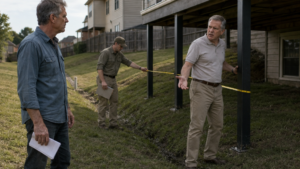
“It’s twenty-one inches behind the sidewalk.”
“Children may gather around it.”
“That’s the hope.”
“Which could create an obstruction.”
Gregory set the second door into place. His hands remained steady, but he drove one screw too deep. The brass head bit into the hinge leaf.
Melissa noticed.
She said nothing, which felt worse than if she had smiled.
He backed the screw out, filled the crushed grain with a sliver of cedar, and reset it. Then he tested both doors. They opened evenly and closed with a soft magnetic click.
For a few seconds, the finished cabinet stood between them with the orange notice visible through the glass and nothing at all on the shelves.
“There,” Gregory said.
Melissa raised her phone again. “You’re continuing after formal notice.”
“I’m finishing what I started.”
“That will be included in the report.”
He wiped sawdust from his palms. “Make sure you include that the doors are level.”
She stared at him, then turned toward her house.
The garage across the street closed. The delivery truck continued down the block. Gregory remained beside the cabinet until Melissa disappeared behind her front door.
Only then did he unlock the glass doors and remove the notice. He folded it carefully along its printed margins instead of tearing it. The paper fit into his back pocket, where the corners pressed against him whenever he moved.
He carried his tools into the garage.
Three cartons sat against the far wall beneath an old moving blanket. Gregory had walked around them for years. He had stacked lumber in front of them, then moved the lumber. He had placed a shop vacuum beside them, then relocated that too. Nothing had ever truly hidden the handwriting on the top box.
BOOKS FOR THE LITTLE LIBRARY.
The letters slanted upward in black marker. His sister had always written as if each line were climbing somewhere.
Gregory crouched and cut through the yellowed packing tape.
The cardboard released a dry, papery breath. Inside, the books were arranged by size, their spines turned inward to protect them. On top lay a sheet of notebook paper folded in half.
He did not touch it.
Instead he lifted the first book, then the next, until a yellow children’s book appeared near the center of the box. The cover was worn pale at the corners.
Something moved inside when he opened it.
On the title page, beneath his sister’s name, she had written one sentence in blue ink:
Let this one find someone first.
Chapter 2: The Yellow Book Left the Shelf First
At nine the next morning, Melissa arrived with two board members and instructions for removing the cabinet.
Gregory saw them through the glass doors as he placed the last row of books on the lower shelf. Melissa carried the same leather folder. One board member held a clipboard. The other kept checking his watch, as if the dispute had been scheduled between breakfast and something more important.
The shelves were full now.
Hardcovers stood shoulder to shoulder along the bottom. Paperbacks filled the upper shelf in two rows. Gregory had arranged them by height, then rearranged them by subject, then returned them to height because that was how his sister had packed them.
The yellow children’s book sat alone near the front.
Melissa stopped at the edge of the grass. “You stocked it.”
Gregory closed the carton at his feet. “That’s generally how libraries work.”
The board member with the clipboard cleared her throat. “Mr. Harris, we are here only to document current conditions.”
“Then document them.”
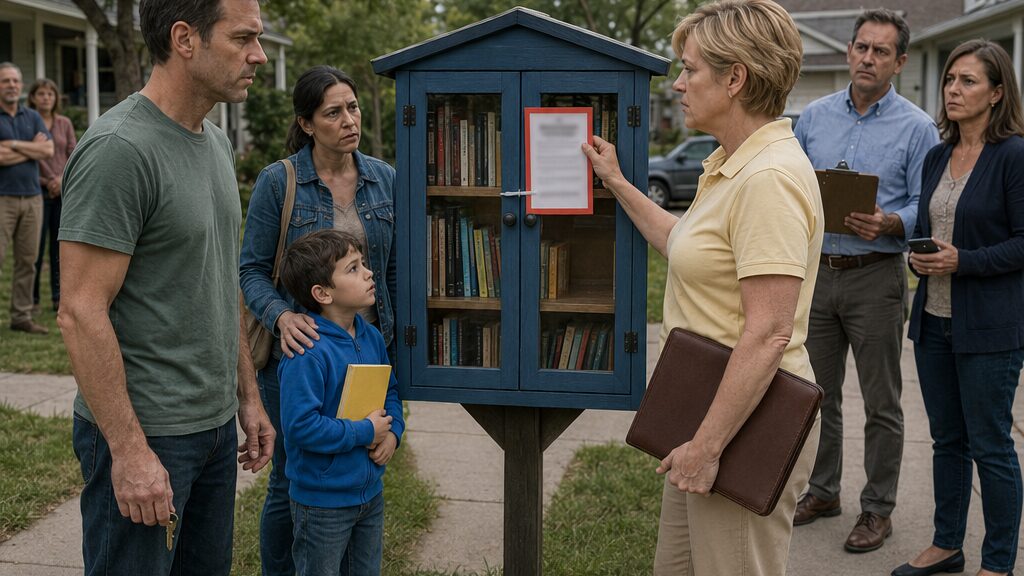
Melissa crossed to the cabinet and unfolded a new notice. This one was laminated.
“You removed the original posting,” she said.
“I accepted delivery.”
“It was required to remain visible.”
“It wasn’t required to damage fresh paint.”
“This notice will remain until compliance.”
She looped a plastic tie around the cabinet handle and pulled it tight. The red-bordered card hung against the glass, covering part of the upper shelf.
UNAPPROVED STRUCTURE—REMOVAL PENDING.
Gregory felt heat rise beneath his collar. On the sidewalk, a delivery driver had stopped with a package under one arm. Two houses down, a curtain shifted.
Melissa spoke loudly enough for both.
“If the structure is not voluntarily removed, the association may authorize a contractor to remove and store it. Costs will be assessed to the property.”
“Store it where?”
“That will depend on the contractor.”
“And the books?”
“You should remove personal contents before enforcement.”
Gregory opened the cabinet.
Melissa took one quick step forward. “Do not interfere with the notice.”
He reached behind it and adjusted a paperback that had tipped sideways.
“I’m not interfering.”
“This is exactly the kind of response that makes reasonable enforcement difficult.”
He turned to face her. “Reasonable would have been answering the application.”
The board member with the watch sighed. “There was a request for more information.”
“After the deadline.”
“The committee is volunteer-run.”
“So was the cabinet.”
The words came out sharper than he intended. The watching delivery driver looked away.
Melissa’s face changed—not softer, but more formal. “This is not about whether your project is well intentioned.”
“You haven’t asked what the intention is.”
“Intent does not eliminate risk.”
Before Gregory could answer, a child’s voice came from the sidewalk.
“Mom, look.”
Kimberly Roberts was walking with her son toward the corner. Gregory knew her well enough to wave but not well enough to know where they were going on a Sunday morning. She wore work shoes with jeans and carried a canvas grocery bag. Her son had already stepped off the sidewalk.
Kimberly caught his shoulder. “Hold on. Mr. Harris might not be open yet.”
The boy pointed through the glass. “There are books.”
Gregory looked at the three HOA representatives standing in front of the cabinet. Melissa looked at him.
That small pause became a decision.
Gregory took the key from his pocket, unlocked the doors, and stepped aside.
“It’s open,” he said.
The boy approached cautiously, glancing at the adults as though he had entered a room where an argument had stopped for him. The laminated violation notice swung from the handle. He pushed it aside with one finger and scanned the shelves.
“What do I do?” he asked.
“Take one,” Gregory said. “Bring it back when you’re done. Or bring a different one.”
“For free?”
“For reading.”
The boy smiled and reached directly for the yellow book.
Gregory’s hand rose before he knew what he meant to do.
His fingers stopped inches from the child’s wrist.
Everyone saw it.
The boy froze. “Am I not supposed to take this one?”
Gregory looked at the worn cover, then at the blue-ink sentence hidden inside. Let this one find someone first.
His arm dropped.
“No,” he said. “That one’s supposed to go first.”
The boy opened it immediately. A loose card slipped from between the pages and landed faceup on the grass.
Kimberly bent to retrieve it.
Gregory knew the handwriting before she read a word.
“For Gregory,” she said quietly, then stopped.
He took the card from her, but not before the boy leaned closer.
“What does it say?”
Gregory could feel Melissa watching. The board members no longer looked impatient.
He turned the card over in his hand.
“My sister wrote her name in the book,” he said.
The boy looked at the title page. “Angela?”
“No. Christine.”
The name sat in blue ink above the message. Beneath it, in smaller writing, was a line Gregory had not seen the night before.
For the child who needs somewhere else to go for a while.
The boy traced the words without touching them. “Did she own all these?”
“Yes.”
“Where is she?”
Kimberly closed her eyes briefly.
Gregory looked toward the cabinet. Behind the glass, the rows appeared too orderly, too preserved. He had imagined strangers taking the books. He had not imagined being asked who had touched them first.
“She died,” he said.
The boy held the yellow book against his chest. “I’m sorry.”
Gregory nodded once.
No one spoke for several seconds.
Then Melissa reached for the laminated notice, as though to straighten it. The gesture looked suddenly clumsy.
Kimberly took out her phone.
“Please don’t,” Gregory said.
“I was just going to get a picture of him with the book.”
“No faces.”
She studied him, then nodded. She photographed only her son’s hand holding the yellow cover beside the red-bordered violation notice.
By noon, the image had moved through the neighborhood message group.
Gregory did not see the post until Angela Lee appeared carrying a grocery tote filled with paperbacks.
“There are fourteen comments asking when they can bring books,” she said.
“I didn’t ask for a campaign.”
“You built a public library.”
“I built a cabinet.”
“With books in it.”
“That doesn’t mean I want people turning it into a fight.”
Angela glanced at the notice. “It was a fight before anyone borrowed anything.”
Neighbors came anyway.
A teenager left three fantasy novels. An older man exchanged a mystery for a history book. A woman Gregory had never met placed two picture books on the lower shelf and apologized for their bent covers. By late afternoon, the careful arrangement had collapsed. Empty spaces opened between titles. Someone put a gardening guide beside a crime novel. A board book lay flat on top of everything.
Gregory kept correcting the rows until he realized people were waiting for him to move.
He stepped back.
For the first time, the shelves looked used instead of finished.
At six twelve, an email arrived from the property-management company.
FORMAL ENFORCEMENT HEARING AND REMOVAL AUTHORIZATION VOTE.
The hearing was scheduled for the following Thursday. Attached were Melissa’s photographs, including one taken after the child had left.
In it, six neighbors stood around the cabinet, two on the sidewalk and four on the grass.
Beneath the image, the report stated:
Unapproved installation is already encouraging pedestrian congregation near a driveway approach, confirming the committee’s stated safety concern.
Chapter 3: Every Neighbor Had a Different Version
At five forty the next morning, Gregory opened his front door and found two strangers stocking the library in the dark.
One held a flashlight between her teeth while sliding romance novels onto the upper shelf. The other had placed a cardboard box on the grass and was sorting children’s books by size.
They froze when the porch light came on.
“Sorry,” the woman with the flashlight said around the metal cylinder.
“You live here?” Gregory asked.
“Other side of the development.”
“How did you know where this was?”
She removed the flashlight. “The neighborhood group.”
The second woman lifted a thin picture book. “Are donations not allowed?”
Gregory looked at the shelves. Half the books his sister had packed were already gone. In their place stood titles he had never seen, unevenly arranged and carrying other people’s names inside their covers.
“They’re allowed,” he said.
“Great.” The woman smiled. “We didn’t want to cause trouble.”
Behind them, the laminated violation notice clicked softly against the glass.
By eight, three different versions of the story were circulating.
In one, Gregory had applied properly and Melissa had blocked him because she disliked the color blue. In another, he had never applied at all and built the cabinet overnight to provoke the board. A third claimed the HOA planned to seize donated books and charge residents to recover them.
None was true. Each contained enough truth to be difficult to kill.
Kimberly apologized by text for the post. Gregory answered that it was fine, then deleted the message before sending it and wrote: Please don’t add anything else.
At ten, Angela found him rearranging the shelves.
“You know people are going to keep moving those,” she said.
“They put hardcover books on top of paperbacks.”
“They’re readers, not cabinet installers.”
“They’re bending the covers.”
Angela reached past him and pulled out a faded green novel. Her hand stopped.
“Oh,” she said.
Gregory recognized the cover. Christine had carried that book through two hospital admissions, though she never finished it.
Angela opened to the first page. A small penciled star sat in the margin.
“She told me about this one,” Angela said. “She said the ending was honest.”
“She didn’t reach it.”
“I know.”
Gregory held out his hand for the book.
Angela did not give it to him. “May I borrow it?”
He almost said no.
The word formed cleanly in his mind. No, because Christine had folded the corner on page one hundred eighty-seven. No, because a coffee stain shaped like a crescent marked the back cover. No, because if Angela took it away, the cabinet would contain one less object Christine had touched.
Then he saw the open space where the yellow book had been.
“That’s what it’s there for,” he said.
Angela slipped the novel into her tote. “Yes.”
The answer irritated him more than it should have.
That afternoon, Frank Williams came through the side gate carrying a file box with one broken handle. He had served as HOA treasurer for seven years before resigning, and he entered Gregory’s garage with the cautious expression of someone bringing information he wished belonged to somebody else.
“I heard about the hearing,” Frank said.
“So has everyone within ten miles.”
Frank set the box on the workbench. “The association changed management companies twice. Records got scattered.”
“What kind of records?”
“Architectural decisions. Expense approvals. Things people thought were too minor to formalize.”
He lifted a folder and opened it.
Inside were photographs of a decorative wishing well, a curbside bench under a tree, and a wooden cabinet used for garden tools near the community pond. Handwritten notes appeared on the backs.
Approved if maintained.
No objection.
Owner assumes upkeep.
None had committee signatures.
“Those are structures,” Gregory said.
“They are.”
“In common view.”
“Yes.”
“Near sidewalks.”
Frank rubbed a thumb along the folder edge. “Some.”
“So Melissa knew.”
“I don’t know what Melissa knew.”
“You were treasurer.”
“I knew the board allowed things without completing the forms.”
“And said nothing?”
“We were trying to be practical.”
Gregory laughed once. “Practical for whom?”
Frank’s face tightened. “That’s fair.”
“No, it isn’t.”
“I said it was fair.”
“You brought me evidence after the notice, after the photographs, after they scheduled a vote.”
“I brought what I found.”
“You found it because people started watching.”
Frank looked toward the open garage door. Beyond it, a neighbor was choosing a book from the cabinet.
“I should have pushed for written standards years ago,” he said. “I didn’t. I thought avoiding conflict was the same as keeping peace.”
Gregory said nothing.
The sentence landed too close.
Frank slid the folder across the workbench. “Copies only. Don’t say they prove approval. They prove inconsistency.”
At the HOA office that evening, the property-management representative accepted the copies without changing expression.
“Prior tolerance does not create automatic authorization,” she said.
“It creates selective enforcement.”
“It may indicate inconsistent recordkeeping.”
“Is that what we call it?”
She folded her hands. “Mr. Harris, your strongest position is to demonstrate compliance or propose a modification.”
“My strongest position is that you ignored other structures.”
“That may be relevant. It does not answer the placement question.”
Melissa entered carrying a rolled neighborhood map.
She did not greet Gregory. She spread the map across the conference table and weighted its corners with a stapler, a tape dispenser, Frank’s folder, and her phone.
A red triangle had been drawn from the edge of Melissa’s driveway across part of Gregory’s front verge.
“What is that?” he asked.
“Required driveway visibility,” she said. “A neighbor submitted a formal concern after Sunday’s gathering.”
“Which neighbor?”
“The complaint is confidential.”
“Your driveway is the only one there.”
Melissa’s eyes held his. “The concern is not limited to one driver.”
She placed a photograph beside the map. It showed Kimberly’s son beside the cabinet while a car waited to turn out of Melissa’s driveway.
The angle made the library appear directly between the driver and the child.
Gregory studied it longer than he intended.
“The car was stopped,” he said.
“This time.”
“The cabinet is behind the sidewalk.”
“The children aren’t.”
He wanted to dismiss the photograph as another manipulated piece of procedure. Instead he remembered the six people crowded around the cabinet, the boy stepping off the sidewalk, the strangers sorting books before dawn.
Melissa saw the hesitation.
“I am not saying books are dangerous,” she said. “I am saying you placed an attraction where people may not be visible to a reversing driver.”
“You could have said that before posting a removal notice.”
“I did say safety.”
“You said standards, liability, appearance, property values, and then safety.”
“Because all of them matter.”
“Not equally.”
“No,” she said. “But I don’t get to wait until a child is struck before deciding which concern sounded most polite.”
The room went still.
Gregory rolled up his copies and left before the meeting ended.
The next morning, he carried the neighborhood map to the county development counter. A clerk entered the parcel number, pulled up a recorded plat, and overlaid the driveway sight triangle on a computer screen.
The red shape covered the front corner of Gregory’s cabinet.
“Is that exact?” he asked.
“It’s based on standard measurement from the driveway edge,” the clerk said. “Field conditions would need verification.”
“So it might be outside.”
“It might.”
“And if it’s inside?”
“You would likely need to relocate it or demonstrate that it does not obstruct the required line of sight.”
“It’s mostly glass.”
“The lower half isn’t.”
Gregory looked at the screen. The digital triangle cut through the cedar post, the lower shelf, and the place where children naturally stood to open the doors.
The clerk printed the map and marked two dimensions in pen.
“You could move it several feet toward the center of your property,” she said. “That appears to clear the triangle.”
Gregory folded the page without answering.
When he returned home, the library doors were open. The shelves were half empty again. Someone had left a handwritten note inside thanking him for the cookbooks.
For the first time, the empty spaces did not feel like proof that he had been right.
They looked like places where people would stand.
And the cabinet stood exactly where Melissa had said it did.
Chapter 4: The Rule Was Real but the Record Was Not
The county map covered Gregory’s workbench, its red sight triangle cutting through the printed outline of his library.
He laid a steel tape measure across the page, as though the right measurement might change what the clerk had shown him. Twenty-one inches behind the sidewalk. Forty-six inches from the driveway edge. The lower shelf began thirty-two inches above the ground.
None of those numbers erased the shaded corner.
Outside, the cabinet doors opened and closed at irregular intervals. Each soft click announced another visitor. Gregory had removed half the books before bringing out his measuring tools, leaving gaps large enough to see through the glass. From the garage, he watched a woman bend toward the lower shelf while her toddler stood near the driveway.
The child wandered two steps sideways.
Gregory was moving before the mother noticed.
“Stay on this side of the post,” he said, more sharply than he intended.
The woman pulled the child close. “Sorry. We were just looking.”
“You’re fine.”
She left without taking a book.
Gregory returned to the workbench and stared at the map.
At noon, Frank arrived with a ring of old keys and led him to the association’s archive room behind the community meeting hall. The room smelled of dust, printer toner, and cardboard that had absorbed years of damp air.
“This was better organized when I left,” Frank said.
“You left three years ago.”
“That’s enough time for people to create six folders called miscellaneous.”
They searched file boxes by street name. Most contained paint approvals, fence diagrams, and roof-shingle samples stapled to yellowing forms. Near the bottom of a cabinet, Frank found a thin folder marked LANDSCAPE FEATURES.
Inside were photographs Gregory recognized: the wishing well near the south entrance, a bench beside a maple tree, and the garden cabinet by the pond.
Each photograph had a brief note attached.
No objection if maintained.
Owner responsible for repair.
Approved verbally pending paperwork.
There were no signatures and no recorded votes.
Gregory spread the pages across a folding table. “Melissa had access to these.”
“So did every committee chair.”
“She said there were no comparable structures.”
Frank shifted his weight. “She said there were no approved comparable structures.”
“That distinction is doing a lot of work.”
“It’s still a distinction.”
Gregory photographed every page.
Frank closed the file drawer but kept one hand on it. “These records show inconsistency. They don’t make your placement safe.”
“I know what the county said.”
“Do you?”
Gregory looked at him.
Frank nodded toward the map under Gregory’s arm. “You keep carrying that like you intend to prove the triangle wrong.”
“It’s based on standard measurements, not a field survey.”
“Then get a field measurement.”
“And if it lands inside?”
Frank did not answer.
The silence irritated Gregory because it left him with the question.
That afternoon, he removed the remaining books and measured from the driveway edge himself. He crouched low enough that his cheek nearly touched the asphalt, sighting along the line a driver might use while backing out. Through the glass upper half, he could see the sidewalk. Through the solid lower shelf, he could not.
Moving the structure six feet toward the center of his yard would clear the triangle. Moving it eight would place it beside the walkway to his porch, where visitors could reach it without standing near a driveway.
He marked both positions with blue painter’s tape.
The solution was so simple that he resented it immediately.
Melissa was watering a row of shrubs when he crossed onto her porch that evening. She turned off the hose but did not invite him closer.
“I found the old records,” he said.
“I assumed Frank would.”
“You knew about them.”
“I knew informal decisions had been made before my term.”
“You told the management company no comparable structures had been permitted.”
“They were not properly permitted.”
“They were allowed.”
“Improperly.”
“And you left them in place.”
Melissa set the hose nozzle on the porch rail. “None of them occupies a driveway sight triangle.”
“The wishing well is three feet from the sidewalk.”
“It is not beside a driveway.”
“The bench gathers people.”
“It faces an interior green.”
“The garden cabinet—”
“Is behind a fence line.”
Gregory unfolded the county map. “You could have explained the actual problem instead of making this about appearance and property values.”
“I did explain it.”
“After you posted the notice.”
“Because before I posted it, you had already poured the footing.”
“You waited thirty-eight days to ask for information you knew a handmade cabinet couldn’t provide.”
Melissa’s face tightened. “Your application had no traffic assessment, no setback drawing, and no indication of expected use.”
“It’s a box of books, not a shopping center.”
“Sunday proved you expected people.”
“I hoped people would use it.”
“That is expected use.”
Gregory almost laughed, but the marked relocation points in his yard stayed in his mind.
“I can move it,” he said.
Melissa’s eyes dropped to the map.
“Six feet clears the standard line,” he continued. “Eight gives people room off the sidewalk.”
“That would address most of my concern.”
Most.
The word gave him something to resist.
“It stays where it is until the hearing.”
“Why?”
“Because that location faces Christine’s house.”
Melissa looked across the street toward the brick ranch that had changed owners twice since Gregory’s sister died.
He had never told her that.
The porch seemed to narrow around them.
“She lived there?” Melissa asked.
“For nine years.”
“And that is why you placed it by my driveway?”
“I placed it where she would have seen it from her kitchen.”
Melissa’s expression shifted, but not toward surrender. “Gregory, the current owners are not your sister.”
“I know that.”
“Children standing there cannot see what you see.”
He folded the map too hard, creasing the county seal.
“You think I don’t care whether a child gets hurt?”
“I think you care about something else more right now.”
The words struck with the accuracy of a tool slipping in his hand.
Melissa reached for the hose, then stopped. “When I was twelve, a boy in my neighborhood rode his bicycle out from behind a decorative fence panel. A driver backing from a garage never saw him.”
Gregory said nothing.
“He survived,” she continued. “After surgeries. The board had received two complaints about that panel. They decided it was attractive and the owner was well liked, so they did nothing.”
Her voice remained controlled, but her fingers had tightened around the nozzle.
“My father was on that board,” she said. “He signed the letter saying no action was necessary.”
The shrubs dripped into the mulch.
Gregory looked at the cabinet across the yard. From Melissa’s porch, the lower cedar shelf blocked a clean wedge of sidewalk.
“You could have told me,” he said.
“You could have waited.”
Neither statement repaired the other.
Melissa picked up the hose. “The old records should be disclosed at the hearing. I won’t dispute that.”
“And the notice?”
“The placement still needs correction.”
Gregory stepped off the porch with the map under his arm.
Behind him, Melissa turned the water back on. Its spray struck the leaves with a steady hiss.
When Gregory reached his yard, he stopped beside the blue tape marking the safer location. The cabinet could be moved in less than an hour. He had the tools, the hardware, and the measurements.
But from that spot, the glass doors would no longer face Christine’s old kitchen window.
For the first time, he understood that the practical solution demanded something from him the rules had never named.
Chapter 5: What Gregory Had Preserved Was Not the Promise
The note was hidden beneath the bottom flap of the last sealed carton.
Gregory found it while lifting the box onto his workbench two days before the removal vote. The tape had dried and loosened, exposing a corner of lined paper pressed between cardboard layers.
He pulled it free carefully.
The page was folded into quarters, but there was no envelope and no name on the outside. Christine’s handwriting began halfway down the first line.
Gregory—
If I don’t get to finish this, please don’t make it too precious to touch.
He stopped reading.
The garage door stood open behind him. Across the yard, someone opened the library and returned a book. The glass door clicked shut.
Gregory folded the note along its old creases and put it in his shirt pocket.
He carried the carton to Angela’s house.
She opened the door before he knocked, as though she had watched him cross the street.
“You found it,” she said.
Gregory held up the folded page. “You knew.”
Angela stepped aside.
Her kitchen table was crowded with returned books, adhesive labels, and a handwritten list of damaged covers. Christine’s green novel lay near a cup of tea.
Gregory remained standing.
“How much did you know?”
Angela sat slowly. “She asked me about starting a neighborhood book exchange.”
“When?”
“During her last winter.”
“She told me the idea was mine.”
“She wanted you to build it.”
“That isn’t what I asked.”
Angela looked at the note in his hand. “She knew you would preserve every book exactly as she left it.”
“I kept them dry.”
“You kept them closed.”
“She was sick.”
“Yes.”
“She changed her mind every week.”
“She changed her mind about treatments. Not about books.”
Gregory placed both palms on the table. “You let me think the location mattered to her.”
“I didn’t know where you planned to put it until the post was in the ground.”
“You knew it faced her house.”
“I understood why.”
“That isn’t the same as telling me I was wrong.”
Angela’s eyes sharpened. “You weren’t ready to hear that the library was not supposed to face backward.”
The sentence left no polite way around it.
Gregory took the note from his pocket and unfolded it.
Angela waited while he read.
If I don’t get to finish this, please don’t make it too precious to touch. Paint it whatever color is left in your garage. Put it wherever people will actually stop. Let children bend the covers. Let somebody lose one. Let another person write in the margins. Books are only useful when they keep finding people.
At the bottom, Christine had added:
And don’t turn it into a monument to me. I know how you are.
Gregory read that line twice.
Angela gave a small, unwilling smile. “She did know.”
“She never gave me this.”
“She didn’t finish it.”
“Why was it in the carton?”
“I put it there.”
He looked up.
Angela’s smile disappeared.
“After the funeral,” she said. “Your mother asked me to gather the books Christine had set aside. I found the note under her lamp. I thought you would open the box when you were ready.”
“You could have handed it to me.”
“I could have.”
“Four years, Angela.”
“I was wrong.”
The admission came without defense, which made it harder to strike.
A knock sounded at the back door.
Kimberly’s son stood outside holding the yellow book in both hands. Kimberly waited on the path behind him.
“I finished it,” the boy said when Angela let him in.
He placed the book on the table. A small square of notebook paper protruded from the cover.
Gregory pulled it free.
Thank you for letting this book find me. I liked the part where the boy was scared but went anyway.
Below the sentence was a drawing of the blue cabinet with books floating from it like birds.
Gregory ran his thumb along the folded edge.
“I didn’t bend it,” the boy said.
Gregory looked at the worn cover. One corner had curled farther than before.
“That would have been all right.”
The boy considered this, then smiled. “Can I take another one?”
“Pick any one you want.”
While he searched the table, Kimberly drew Gregory aside.
“I need to show you something.”
Her phone displayed a chain of neighborhood comments beneath the photograph she had posted. The early messages praised the library. The newer ones named Melissa, shared a picture of her house, and called for residents to surround her driveway during the hearing.
One comment suggested filling her lawn with unwanted books.
Kimberly’s face had gone pale. “I deleted the original post, but people took screenshots.”
“Who started this?”
“I don’t know. Some aren’t even from the neighborhood.”
Gregory scrolled through insults written by strangers who knew only a yellow shirt, an orange notice, and a cabinet full of books.
“Did you tell them about the sightline?”
“I tried. They said I was defending her.”
“You are defending her.”
“I’m trying to stop this.”
The boy returned carrying a mystery novel. Gregory barely saw him.
By the time Gregory crossed home, two handmade signs had appeared beside the library.
BOOKS ARE NOT A CRIME.
STOP HOA BULLIES.
He pulled both signs from the grass.
A car slowed. The passenger raised a phone toward Melissa’s house.
Gregory stepped into the street.
“Keep moving.”
The car accelerated away.
Melissa stood behind her front curtain. When she saw him looking, she let it fall closed.
Gregory carried the signs into his garage and set them beside the county map, the old approval records, and Christine’s note.
For weeks, he had believed silence kept the private parts of the dispute clean. Instead, silence had left open space for everyone else to fill.
He opened the neighborhood message group and typed until the words stopped sounding like a defense.
The library matters to me, but that does not justify harassing Melissa Clark. She raised a real safety issue that I should have addressed before building. The board’s process was inconsistent, and the public notice overstated the danger. Both things can be true. Do not visit her property, photograph her home, block her driveway, or use my sister’s books as an excuse to threaten a neighbor.
He attached no photograph.
No mention of Christine.
No request for support.
He read the message once and pressed send.
Then he walked outside, unlocked the cabinet, and removed the remaining books so he could prepare to move it.
Across the lawn, Melissa opened her front door.
She did not approach. She only looked at the empty shelves, then at Gregory.
For the first time since the dispute began, neither of them mistook silence for agreement.
Chapter 6: He Refused the Exemption That Would Save Him
The board chair announced that Gregory had enough votes before he was allowed to speak.
“There appears to be support for a one-time variance,” she said, looking down the long table toward him. “Conditional upon reflective marking, a maintenance agreement, and written acknowledgment of liability.”
The meeting room was full. Neighbors stood along the back wall, though Gregory had asked them not to turn the hearing into a demonstration. Kimberly sat beside Angela. Frank occupied the end chair nearest the aisle, a file folder balanced on his knee.
Melissa sat with the architectural committee, her leather folder closed.
On the table in front of Gregory lay three drawings, a county map, photographs of the old informal approvals, and a small model of a redesigned mounting bracket. He had expected to argue for those plans.
Instead, the board was offering to let him keep everything as it was.
The property-management representative slid a document toward him.
“If signed tonight,” she said, “the association will suspend removal action and treat the current structure as an individual exception.”
Gregory read the first page.
The variance applied only to his address. It did not acknowledge delayed review, incomplete records, or standards for future community structures. It required him to accept sole responsibility for incidents “arising from attraction, congregation, use, or misuse.”
He looked toward the back of the room. Several neighbors smiled as if the fight were finished.
Angela did not.
Melissa’s gaze remained on the closed folder.
“Who proposed this?” Gregory asked.
The board chair glanced at her notes. “The architectural committee submitted it as a possible resolution.”
“The whole committee?”
Melissa opened her folder. “I recommended it.”
A murmur moved through the room.
Gregory studied her. “Why?”
“To end the escalation.”
“That isn’t an answer.”
“It is the relevant answer.”
The board chair tapped her pen. “Mr. Harris, the variance gives you the result you requested.”
“No,” Gregory said. “It gives me permission to keep my cabinet.”
“That is the disputed structure.”
“The dispute is larger than the structure.”
Someone at the back whispered, “Take the win.”
Gregory heard it clearly.
Weeks earlier, he would have.
He placed the variance beside the county map. “If Kimberly builds one next year, does she get the same terms?”
The board chair hesitated. “Any future application would be considered on its own merits.”
“So no.”
“It would receive review.”
“Within thirty days?”
The property-management representative shifted in her chair. “The review timeline is addressed in the governing documents.”
“Without any consequence when the committee misses it.”
“We are discussing your variance.”
Gregory touched the model bracket. “That’s the problem.”
Melissa leaned forward slightly. “Gregory.”
He looked at her.
“If you reject this,” she said, “the removal authorization remains active.”
“I understand.”
“Do you?”
The question was not hostile. That made it heavier.
Gregory stood and unfolded the redesigned plan.
The new cabinet retained the blue sides and glass doors, but the solid lower shelf had been raised. The post mounted to an adjustable steel base that could be placed outside driveway sight triangles. A paved standing area kept users off the sidewalk, and reflective markers sat low on each side.
“I can move my library eight feet,” he said. “That clears the sightline. Or it can go on the shared green near the entrance, where there are no driveways. I’m willing to rebuild the base and maintain it.”
He placed a second page beside the first.
“But I’m asking for a written standard that applies to anyone: maximum dimensions, setback requirements, maintenance responsibility, sightline review, and a decision deadline. Not an exception tied to whether the board likes the owner.”
Frank rose from his chair.
The board chair frowned. “Public comment has not opened.”
“I’m not commenting on his design,” Frank said. “I’m confirming the records.”
He held up the folder containing the old informal approvals.
“During my time as treasurer, the board allowed exterior structures without completing the required documentation. We called it flexibility. It was also favoritism, even when we didn’t mean it that way.”
The room quieted.
Frank sat before anyone could thank him.
The board chair turned to Melissa. “Did the committee review these records before issuing the violation?”
Melissa opened her folder and removed the original orange notice.
“I reviewed them after the notice was posted,” she said.
“Were comparable structures left in place?”
“Yes.”
“Did the initial notice state that the library presented an immediate safety hazard?”
“Yes.”
“Was an immediate hazard determination supported by a field measurement at that time?”
Melissa’s thumb pressed against the paper’s edge.
“No.”
The answer traveled through the room without applause.
Melissa continued before anyone could speak. “The sightline concern was legitimate. The language of the notice overstated what had been established. I should have described the risk as requiring evaluation, not as an immediate confirmed hazard.”
Gregory watched her fold the notice once.
It was not an apology. It was also more than he had expected.
The property-management representative whispered to the board chair. After a brief recess, the chair returned with a revised proposal.
“The board will postpone final enforcement for thirty days while drafting a neutral policy,” she said. “However, because the existing placement remains within the standard sight triangle, the cabinet must be removed from its current post tonight.”
The neighbors behind Gregory stirred.
Kimberly whispered, “They can’t make you do it tonight.”
“They can,” he said.
The board chair looked directly at him. “Do you accept those terms?”
Gregory thought of Christine’s note.
Put it wherever people will actually stop.
Not wherever she once could have seen it.
He pushed the unsigned variance back across the table.
“I accept removal tonight,” he said. “I do not accept the individual exemption.”
Outside, the neighborhood followed him home in scattered groups.
No one carried signs. No one shouted at Melissa, who walked several yards behind the committee members.
Gregory removed the books first. Neighbors held open cartons while he passed each stack down. Angela took Christine’s green novel. Kimberly’s son carried the yellow book with both hands and placed it carefully on top.
When the shelves were empty, Gregory unlocked the steel brackets at the base of the cabinet.
The structure was heavier than it looked. Frank offered to help, but Gregory shook his head.
“I built the lift points into the frame.”
He crouched, set his hands beneath the lower corners, and raised it from the cedar post.
For one strained second, the cabinet blocked his view of everyone. He could see only the empty shelves, the glass reflecting his own face, and the orange glow from Melissa’s porch.
Then he turned and carried it toward the garage.
The neighbors made space without being asked.
At the edge of her driveway, Melissa bent and pulled the blue painter’s tape from the safer location Gregory had marked days earlier. She wound it around two fingers and placed it in her pocket.
Gregory set the cabinet on padded blocks inside the garage.
When he turned back, the post stood alone in the grass.
The empty square above it looked larger than the library ever had.
Chapter 7: By Sunset Almost Every Shelf Was Empty
Someone had changed the shelf labels before Gregory arrived.
The new library stood on the shared green near the neighborhood entrance, eight feet from the walking path and well beyond every driveway sightline. Gregory had installed it the previous evening, leveling the steel base by flashlight while Frank held the plans and Angela argued that the cabinet leaned left.
Now the handwritten labels beneath the shelves no longer matched his arrangement.
CHILDREN had been moved to the lowest shelf.
MYSTERY and HISTORY had been combined.
A strip of masking tape reading SURPRISE ME covered the small section Gregory had marked GENERAL FICTION.
He stood with the key in his hand, staring through the glass.
Kimberly approached carrying two cartons against her hip. “You’re early.”
“Who changed these?”
She followed his gaze. “Angela, probably.”
“Probably?”
“She had volunteers here at seven.”
“The opening isn’t until ten.”
“We have more books than table space.”
Gregory unlocked the doors. Someone had already stocked half the lower shelf with picture books facing outward instead of spine-first. Their covers formed a bright, uneven row.
He reached for the masking tape.
Christine’s note rested in his wallet, folded behind his driver’s license.
Please don’t make it too precious to touch.
Gregory lowered his hand.
Kimberly watched him without pretending not to. “Do you want me to ask everyone to wait until you approve the layout?”
“No.”
“You sound like you do.”
“I designed the shelves for weight distribution.”
“They moved paperbacks.”
“They put hardcovers on top.”
Kimberly smiled. “There he is.”
Gregory looked at her.
“The man who almost reorganized my son’s backpack while he was borrowing a book.”
“I was keeping the bindings from bending.”
“He bends everything.”
Gregory took one of the cartons from her. “Then he should use the lowest shelf.”
“That’s why Angela moved the label.”
He had no answer to that.
By ten, the green had filled without becoming crowded. The new policy limited the cabinet’s dimensions, required clear standing space, and assigned maintenance to registered volunteers. It also required the board to answer applications within thirty days or provide a written reason for delay.
Frank had insisted on that line.
Angela sat at a folding table recording donations in a notebook no one had asked her to keep. Kimberly arranged extra books in plastic bins beneath a canopy. Children moved between the library and the grass, where several residents had spread blankets.
No one stood near a driveway.
Melissa arrived shortly after eleven.
She wore a navy cardigan and carried nothing. She stopped beside the paved standing area and looked along the path toward the street, checking the view in both directions.
Gregory recognized the movement because he had done it himself six weeks earlier.
“The placement works,” she said.
“That was the idea.”
“The board approved a low marker beside the path.”
“I saw the amendment.”
“It should be reflective.”
“The policy says it may be reflective.”
Melissa glanced at him. “At night, the cabinet blends into the trees.”
“The path lighting reaches the base.”
“Not from the south approach.”
Gregory felt the old resistance rise with familiar speed. He had measured the lighting. He had submitted photographs. The board had approved the location.
Then he saw Melissa’s hand tightening around the strap of her purse.
Not authority. Memory.
“What kind of marker?” he asked.
She pointed to the grass beside the paved area. “Low enough not to look like a sign. Amber reflector. Two inches wide.”
“No red border?”
Her mouth almost changed. “No red border.”
“I can mount one this week.”
Melissa nodded. “Thank you.”
They stood together while a girl opened the cabinet and removed a book from the section labeled SURPRISE ME. She carried it to her father, who turned it over and laughed at something on the back cover.
Melissa watched them.
“I did not oppose the books,” she said.
“I know.”
“You didn’t before.”
“No.”
She looked toward the library. “I didn’t help you understand.”
Gregory considered telling her that understanding had not been her responsibility alone. Instead he said, “The first notice was still wrong.”
“Yes.”
“And the original placement was still bad.”
“Yes.”
Neither answer erased the other.
At noon, Kimberly’s son came running across the green with the yellow children’s book held above his head.
“I brought it back.”
He had covered the book in a clear protective sleeve. The curled corner remained visible beneath it.
Gregory opened the cabinet for him.
The boy looked at the crowded shelves. “Where does it go?”
Gregory scanned the labels. Children. Surprise Me. Books to Read Together. A narrow empty space remained on the lowest shelf.
“Where do you think?”
The boy crouched and slid the yellow book into the gap, leaving part of its cover visible.
“Someone should see it first,” he said.
Gregory felt Christine’s sentence before remembering the exact words.
Let this one find someone first.
A smaller child approached almost immediately. She knelt, studied the covers, and pulled out the yellow book.
Kimberly’s son turned to Gregory with a look of alarm and pride.
“She took it already.”
“That’s what it’s for.”
The child carried the book to the grass.
By midafternoon, almost every shelf had gaps. The mystery section had been stripped to three titles. The cookbooks were gone. Children’s books disappeared and returned in different hands. A resident left a gardening guide where the yellow book had been. Another placed a notebook inside for recommendations.
Gregory stopped correcting anything.
He repaired one loose hinge, tightened the base bolts, and then put his tools beneath the table. When Angela changed SURPRISE ME to SOMETHING YOU WOULD NOT CHOOSE, he let the new label remain even though it extended beyond the shelf edge.
Near sunset, the crowd thinned.
Kimberly folded the canopy. Frank carried empty cartons to his car. Angela sat on the bench reading Christine’s green novel, one finger holding her place near the end.
Gregory stood before the library.
The glass reflected the low light, but he could still see through it. The shelves were nearly empty. A few paperbacks leaned against one another across spaces that had been full that morning.
Four years earlier, empty shelves would have looked like loss.
Now each space marked a book moving through a house he might never enter, beside a bed he would never see, into the hands of someone who would crease a page or forget where it came from.
Angela closed the green novel and walked over.
“She was right about the ending,” she said.
“Honest?”
“Very.”
She placed the book on the upper shelf.
Gregory did not ask whether the coffee stain remained or whether she had folded another corner. He closed the glass door and turned the key only far enough to test the latch.
“The volunteers need copies,” Angela said.
“Of the key?”
“Yes.”
“How many?”
“Four.”
He had planned to keep one and give another to Angela.
Instead he removed the key ring from his pocket. Five newly cut keys hung beside his own.
Angela looked at them. “You came prepared.”
“I know how you are.”
She laughed, and the sound crossed the nearly empty green without drawing attention.
After she left, Gregory installed the amber reflector Melissa had requested. It took two screws and less than five minutes.
He was packing the drill when Melissa returned along the path.
She carried a single hardcover against her side.
“I thought you went home,” Gregory said.
“I did.”
She stopped beside the library and looked at the reflector. “That works.”
“It doesn’t ruin the appearance?”
“It is two inches wide.”
“Standards matter.”
“They do.”
Melissa opened the cabinet without asking for the key. Gregory had left it unlocked while he worked.
She crouched and placed the hardcover on the lowest shelf. Its jacket showed a child standing beneath a night sky. There was no donation label, no note, and nothing written inside the cover that Gregory could see.
“My father read that to me,” she said.
Gregory waited.
Melissa straightened. “I don’t need it back.”
She closed the glass door carefully, checking that the latch caught, then walked toward her house.
Gregory looked through the cabinet.
Her book stood alone on the lowest shelf, surrounded by open space and the last gold light of the day.
He did not move it.
The story has ended.