The Blue Container Everyone Wanted Removed Became the One Place That Held the Neighborhood Together
Chapter 1: The Blue Box Beside the Garden Path
The shipping container cleared Thomas Miller’s fence by less than a foot.
Suspended above the backyard, it looked even larger than it had on the delivery truck: forty feet of faded blue steel, corrugated sides, rust around the locking bars, and old shipping markings dulled by years of salt and rain. The crane cable creaked as the operator guided it over the cedar fence toward the gravel pad Thomas had spent two weekends leveling beside the curved garden path.
Across the adjoining yard, Barbara White stood perfectly still with a watering wand in one hand.
Thomas saw her before she spoke. He also saw her phone come out.
“You cannot be serious.”
The delivery driver looked at Thomas.
“Keep going,” Thomas said.
The container descended another foot. Its shadow crossed the hydrangeas and swallowed half the lawn.
Barbara came through the side gate without waiting to be invited. She wore gardening gloves, clean white sneakers, and the expression she usually reserved for homeowners who left garbage bins visible from the street.
“What is that doing here?”
Thomas pointed toward the gravel pad. “Going there.”
“I can see where it’s going.” She looked up at the container. “Why is it going there?”
The driver coughed into his fist and turned away.
Thomas watched the rear corner line up with the concrete blocks. The placement mattered. Too close to the fence and he would lose access to the electrical conduit. Too far toward the path and the doors would strike the maple when they opened.
“Six inches left,” he called.
Barbara stepped closer. “Thomas.”
The crane lowered. Steel met rubber pads with a deep, final thud that seemed to travel through the flower beds.
The driver released the rigging. Thomas checked the level with a short carpenter’s spirit level, then walked the length of the container and checked again.
Barbara followed him.
“This makes the whole property look industrial.”
“It’s temporary.”
“The container?”
“The way it looks.”
She stared at him, waiting for an explanation he did not intend to give.
For three months, he had measured the yard after dark, drawn layouts at the kitchen table, compared insulation systems, and argued with a municipal permit clerk about ventilation clearances. He had ordered the container only after the stamped conversion permit arrived.
He had not submitted anything to the homeowners association.
Barbara lifted her phone and photographed the serial plate near the rear corner.
Thomas looked at her. “You don’t need that.”
“If it has identifying information, the property manager may need it.”
“For what?”
“To determine whether it is approved.”
“It has a city permit.”
“That was not my question.”
Thomas took a folded sheet from the back pocket of his jeans. He opened it once and held it out.
Barbara removed one glove before taking it. Her eyes moved over the municipal seal, the description of the accessory structure, the setbacks, the electrical work to be completed by a licensed contractor.
Her expression changed only slightly.
“This is a building permit.”
“Yes.”
“It is not architectural approval.”
“It says the structure is allowed.”
“It says the city will allow it if it meets code.” She returned the paper. “The association has separate restrictions.”
“The association doesn’t override the city.”
“No. And the city does not approve exterior appearance for the association.”
Thomas refolded the permit more sharply than necessary.
The driver lowered the crane arm and began securing the cables. Barbara stepped back onto the path and took a wider photograph: blue steel against trimmed lawn, hydrangeas, and the pale siding of Thomas’s house.
“You should have brought this to the committee before delivery.”
“I knew what the committee would say before seeing it.”
“That does not give you permission to skip the process.”
Thomas ran a hand over one of the doors. The metal was warm from the morning sun. Behind it was nothing yet but an empty floor and the smell of old cargo.
“Give me one week.”
Barbara’s eyebrows lifted. “For what?”
“One week. Then inspect it.”
“You expect the board to ignore a violation for seven days while you make it harder to remove?”
“I expect you to look at the finished work before deciding what it is.”
“I know what it is.”
“No,” Thomas said. “You know what it looks like.”
For a moment neither of them moved.
The delivery truck started, filling the side yard with diesel noise. Barbara stepped away from the path so it could pass.
“I’ll call the property manager today,” she said.
“I assumed you would.”
Her mouth tightened. “You always do that.”
“Do what?”
“Act as though other people are predictable because their concerns are beneath you.”
Thomas turned back to the container.
Barbara left through the gate, but he heard her speaking before it closed.
“Yes,” she said into her phone. “It was delivered this morning. No, there was no architectural request. I’m looking at it right now.”
By noon, the electrical contractor had marked the trench line from the house. By two, Thomas had bolted the first pressure-treated sleepers to the steel floor. At four, an email arrived from the property manager requesting photographs, dimensions, intended use, contractor information, and copies of all permits.
Thomas answered with the municipal permit and nothing else.
At six, another email arrived.
An exterior inspection had been scheduled for the following Sunday. Barbara and two architectural committee members would attend. Failure to provide access could result in an immediate recommendation for enforcement.
Thomas read the message twice, then set the phone facedown on the workbench in his garage.
He opened a cardboard box marked SOUND PANELS and carried the first bundle through the narrow gap between the container doors. He opened them only wide enough to pass sideways, then shut them again behind him.
Inside, the late sunlight entered through the roof vent cutouts in thin white shafts. The empty steel walls amplified every footstep.
Thomas stood where the second workbench would go.
He could already see its height, lower than his own by three inches. He could see the shallow drawer for pencils, the pegboard arranged for smaller hands, and the narrow shelf where a worn wooden hand plane would rest.
He worked until the light faded.
When he finally stepped outside, Barbara was waiting at the edge of her yard. She did not come through the gate this time.
A white sheet of paper was in her hand.
“You have until Sunday,” she said.
She crossed the lawn, entered Thomas’s yard, and pressed the paper against the meeting line of the locked doors. The tape ran from one door to the other, sealing the notice across the steel locking bars.
SEVEN-DAY COMPLIANCE NOTICE was printed across the top.
Barbara smoothed the corners flat.
Thomas read the first line, then looked at the doors behind it.
“You could have handed it to me.”
“I wanted there to be no question that it was posted.”
She left without another word.
Thomas waited until the gate latched. Then he touched the paper where it covered the lock.
To open the doors, he would have to tear it.
Chapter 2: Seven Nights Behind the Locked Doors
Thomas slid a utility knife beneath the compliance notice and cut it cleanly down the center.
The paper separated with a soft ripping sound as he pulled the locking bars apart. Half remained taped to each blue door, the printed warning divided between them.
He opened the gap just wide enough to carry in two rolls of mineral wool insulation.
By Monday night, the empty steel shell had become a grid of framing lumber. Thomas worked beneath temporary lights, fitting studs around the corrugations and sealing every gap with acoustic caulk. The container made even small mistakes obvious. A dropped screw sounded like a coin thrown down a stairwell.
He did not make many mistakes.
At ten thirty, the property manager emailed again.
Three residents had reported power tools after approved quiet hours.
Thomas looked at the cordless drill in his hand. He had stopped using the circular saw at eight. Since then, he had been tightening fasteners by hand.
He typed a reply explaining that no exterior noise reading had been taken and that the work would end by eleven.
Then he deleted it.
He shut down at ten forty-five.
On Tuesday, the electrical contractor installed a subpanel, LED fixtures, emergency shutoff, and outlets mounted above future bench height. Thomas spent the afternoon fitting rigid insulation beneath the floor. At dusk, Barbara appeared on her deck and watched him carry plywood through the narrow opening.
He did not wave.
On Wednesday, he installed the ventilation duct and dust collection line. The exhaust outlet faced his own roofline, away from neighboring yards. He tested the fan, walked outside, and stood beside the fence.
Only a low hum reached the garden path.
Robert Davis found him there.
Robert lived two houses down and had spent thirty-one years inspecting commercial renovations for the county. Retirement had not softened the way he looked at structures. He examined them as if they were already trying to conceal a failure.
“That the fan running?” Robert asked.
Thomas nodded.
“Quieter than my heat pump.”
“That was the point.”
Robert glanced toward the container. “Barbara says you’re building a commercial shop.”
“Barbara says many things.”
“She says you won’t answer basic questions.”
Thomas looked at him.
Robert raised both hands. “I didn’t say she was right. I said that’s what she says.”
“It’s not commercial.”
“Then what is it?”
“A workshop.”
“For paid work?”
“No.”
“Classes?”
Thomas hesitated. “Not now.”
Robert noticed the hesitation but did not press it. He walked around the container, checking the setback with his eyes.
“City inspection?”
“Electrical on Friday. Final conversion inspection after that.”
“Association approval?”
Thomas picked up a scrap of insulation from the path. “You know the answer.”
Robert sighed. “Good work and proper process are separate things.”
“That sounds like Barbara.”
“It sounds like thirty-one years of people telling me a safe staircase didn’t need a permit because it was safe.”
Thomas carried the scrap inside and closed the doors.
By Thursday, the walls were paneled in pale birch plywood. He installed French cleats for tool storage and built the first workbench beneath the long LED strip. His own bench was heavy, square, and plain.
The second took longer.
He cut the legs three inches shorter. He added a narrow front vise and rounded the corners of the top, though there was no practical reason to do so. In the shallow drawer, he placed three carpenter’s pencils and a brass marking gauge.
On the pegboard above it, he mounted an empty wooden rack.
At the center of the rack was a space shaped for one tool.
Thomas went into the house and opened the bottom drawer of the sideboard. Beneath old tax folders and appliance manuals lay a worn wooden hand plane. The handle had darkened from years of use. One side bore a faint line where someone had once written E.M. in pencil and rubbed most of it away.
He carried it to the container.
He did not place it in the rack. He set it inside the drawer and closed it.
Friday’s electrical inspection passed.
The municipal inspector checked the subpanel, tested the outlets, examined the ventilation, and signed the temporary approval card.
“You did most of the interior yourself?” the inspector asked.
“Yes.”
“Clean work.”
Thomas accepted the card without smiling. Praise felt less satisfying when nobody important was there to hear it.
Late Saturday morning, Nicole Garcia appeared at the side gate carrying a plate covered with foil.
“I brought too many muffins,” she said.
Thomas looked at the plate. “You baked exactly six?”
“My son baked twelve. Six survived.”
She glanced past him at the container doors, which stood open by less than two feet.
“Is that all we’re allowed to see?”
“Inspection is tomorrow.”
“I’m not the committee.”
“That has never stopped information from reaching it.”
Nicole gave him a tired look. “I came with muffins, Thomas, not a hidden camera.”
He took the plate. “Thank you.”
A delivery of clamps arrived while she was still there. Thomas had to open one door fully to carry the long box inside. Nicole followed two steps before he noticed.
She stopped beneath the lights.
The walls were finished now. Tools hung in measured rows. Shelves held wood blanks, finishing oils, safety glasses, and labeled hardware bins. At the far end, the two benches stood side by side.
Nicole’s attention went immediately to the smaller one.
“Whose is that?”
Thomas set down the box.
“No one’s.”
“It’s built for someone.”
“It’s a second station.”
“With an empty tool rack.”
He moved between her and the bench. “The room isn’t finished.”
Nicole looked at him, then at the closed drawer beneath the smaller bench.
“My son would lose his mind in here,” she said. “He’s been asking for a shop class since the school dropped theirs.”
“This is not a community center.”
“I didn’t say it was.”
“You were about to.”
She folded her arms. “Actually, I was about to say this doesn’t look like what Barbara described.”
Thomas glanced toward the open door.
Nicole lowered her voice. “People think you’re hiding inventory. Or running machines for clients. One neighbor said there were employees coming at night.”
“The electrical contractor?”
“I know that. They don’t.”
“They could ask.”
“They are asking. You aren’t answering.”
He looked toward the second bench again.
Nicole’s expression softened. “Who is it for?”
Thomas closed the door between them halfway.
“No one,” he said.
That evening, he sat at his kitchen table with his phone beside the hand plane.
Emma’s number was still saved.
He opened the message thread. The last exchange was eleven months old.
Happy birthday, she had written.
Thank you, he had answered.
His thumb rested over the blank message field.
I built something.
He typed the words, read them, and erased them.
At nine seventeen, an email from the property manager arrived with an attachment. Barbara had circulated an emergency notice to residents near Thomas’s property.
POSSIBLE UNAUTHORIZED COMMERCIAL WORKSHOP, the subject line read.
The notice warned of potential noise, traffic, hazardous materials, and unapproved business activity. It invited written concerns before Sunday’s inspection.
Thomas opened the list of recipients.
Nicole was on it. Robert was on it. Nearly every house bordering the common green was on it.
He looked through the kitchen window at the blue container. From inside, the warm lights glowed faintly through the roof vents.
By morning, the inspection would no longer be about whether he had built something well.
It would be about whether anyone still believed him.
Chapter 3: When the Steel Doors Finally Opened
Barbara arrived with the removal recommendation already clipped to the front of her folder.
Thomas could read the heading from ten feet away.
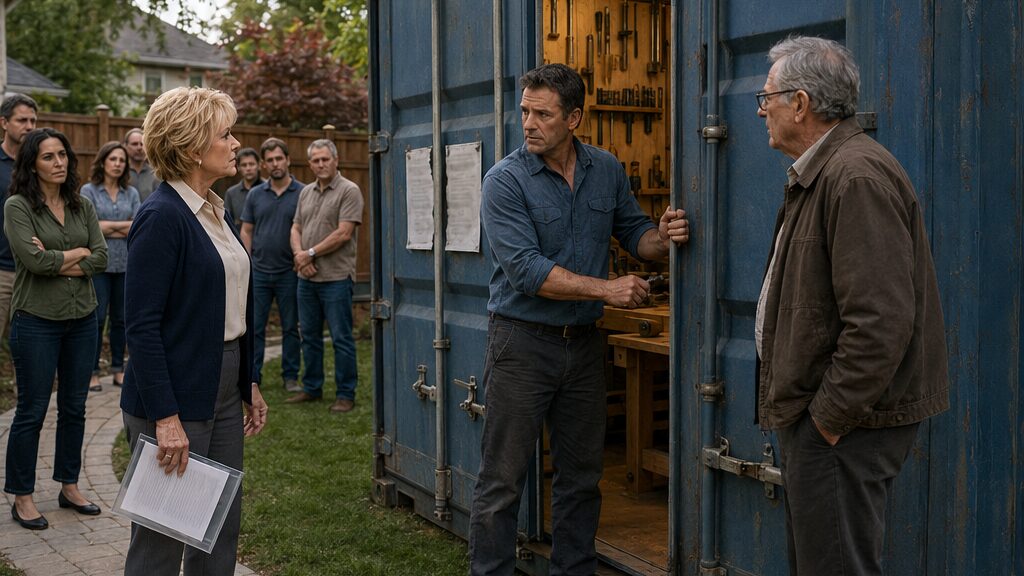
The inspection was scheduled for two o’clock. At one fifty-three, two architectural committee members entered through the side gate behind Barbara. The property manager followed with a tablet. Robert came from the sidewalk. Nicole stood near the fence with several neighbors who had found reasons to be outside at the same time.
Thomas had expected four people.
There were nineteen.
Barbara surveyed the yard, noting the container, the gravel pad, the trench line, and the closed steel doors. Her gaze paused on the compliance notice, still split neatly between them.
“You were instructed not to alter the posted notice.”
“I had to open the doors.”
“You could have requested authorization.”
“To cut paper?”
“To access a structure under review.”
Thomas placed one hand on the locking bar. “Are you here to inspect it?”
“We are here to document the current condition and determine enforcement.”
“That sounds decided.”
Barbara tapped the folder. “The recommendation is based on what was known when the meeting packet was prepared.”
“You prepared it before seeing the inside.”
“We asked for intended use. You answered with a permit.”
“The permit states the intended use.”
“It states accessory workshop.”
“Then you knew.”
“We did not know whether it was personal, commercial, educational, or storage attached to a business.”
Thomas looked at the neighbors gathered beyond her shoulder.
“You told them it might contain hazardous materials.”
“I listed potential concerns.”
“You listed every concern except the possibility that I knew what I was doing.”
Barbara’s face tightened, but she did not raise her voice.
“Open it, Thomas.”
The yard went quiet.
Thomas released the upper latch, then the lower. The steel bar rotated with a heavy metallic knock. He repeated the motion on the second door.
For seven days, he had opened them only as far as necessary.
Now he pulled both wide.
The cold blue panels swung outward, exposing darkness.
Someone near the fence shifted for a better view.
Thomas reached inside and pressed the wall switch.
Warm light flooded the container.
The pale birch walls seemed to push the steel shell outward. Hand tools hung in precise rows above the benches. Clamps lined one wall by size. Shelves held books, wood blanks, safety equipment, and labeled bins. A compact lathe stood beneath the ventilation duct. The dust collection system ran cleanly along the ceiling. At the far end, the two work stations waited beneath a long strip of light.
A neighbor whispered, “Oh.”
Nicole smiled before she caught herself.
One of the committee members stepped closer. “You built all this in a week?”
“The interior, yes. Most components were prepared beforehand.”
Barbara did not enter.
Robert did.
He stopped just inside, looked up at the conduit, then crouched near the subpanel. He examined the emergency shutoff, checked the outlet spacing, and ran a hand along the edge of the first bench.
“Licensed electrical work?” he asked.
Thomas handed him the signed inspection card.
Robert read it.
“Ventilation?”
Thomas turned on the fan. The low hum settled beneath the silence.
“Dust collection has a separate switch and blast gates at each machine. Finishing products stay in the rated cabinet.”
Robert opened the yellow metal cabinet, checked the label, and closed it.
“This is better organized than half the commercial shops I inspected.”
The comment moved through the group like a change in pressure.
One committee member entered, followed by the other. The property manager raised the tablet and began taking photographs. Nicole stepped in after asking Thomas with her eyes. He nodded.
The neighbors stayed near the doors, but their posture had changed. Arms uncrossed. Heads tilted. Someone asked whether the wall panels were soundproofing.
“Mineral wool behind birch,” Thomas said. “Resilient channels between the framing and finish panels. The floor is isolated from the steel shell.”
Nicole pointed toward the smaller bench. “And that one?”
Thomas followed her gesture.
The empty rack above it seemed more visible with so many people in the room.
“A second station,” he said.
“For whom?” Barbara asked from outside.
Thomas did not answer.
Barbara finally entered. Her shoes crossed the threshold carefully, as though quality itself might be a trap.
She examined the shelves, the machines, and the ventilation. For the first time since the container arrived, uncertainty appeared in her face.
Then she looked at the walls.
“There are no windows.”
“Not required for this use. Mechanical ventilation meets code.”
“Fire access?”
“Both doors open from inside. Extinguisher by the panel. No fuel storage.”
“Operating hours?”
“Personal use.”
“That is not an hour.”
Thomas stared at her. “You came prepared to order removal. Now you’re asking for a schedule.”
“I’m doing the inspection you demanded.”
A few neighbors shifted uncomfortably.
Nicole touched the edge of the second bench. “This is beautiful, Thomas.”
He looked at the clean surface, the rounded corners, and the shallow drawer hiding the hand plane.
“Thank you.”
For one brief moment, he allowed himself to feel what he had expected all week. Not triumph exactly, but release. The room existed outside his imagination now. People could see it. They could see the care in the sealed joints, the aligned tools, the lighting, the quiet fan.
Barbara opened her folder.
The release vanished.
“The structure is impressive,” she said.
Thomas waited.
“But workmanship is not the only issue before the association.”
She removed a stapled document and turned it toward him. Several sections were highlighted.
“Covenant seven, section four. Exterior accessory structures require prior written approval from the architectural committee. Section nine prohibits freight containers and temporary storage units unless screened and approved. The committee must determine whether conversion changes its classification.”
“It’s not temporary storage.”
“That may help your application.”
“I already have a permit.”
Robert spoke before Barbara could answer. “City approval and association approval are separate.”
Thomas looked at him.
Robert held the inspection card in one hand. “This tells me the electrical work passed. It doesn’t tell me the covenant disappeared.”
“You said the work was good.”
“It is.”
“Then what are we arguing about?”
“Whether good work gives you the right to skip the agreement attached to the property.”
The neighbors had gone quiet again.
Barbara placed the highlighted covenant beside the municipal inspection card on the bench.
“You submitted no plans,” she said. “No exterior elevations. No screening proposal. No use statement beyond the city permit. No request for a variance.”
“Because you would have rejected it when you saw the word container.”
“You do not know that.”
“I know you.”
Her eyes sharpened. “You know the version of me that is convenient when you want to avoid asking.”
The sentence landed harder than Thomas expected.
He looked toward the open doors. Beyond them, the yard was bright, green, and crowded. From inside, the neighbors were framed by the same blue steel they had condemned all week.
The property manager cleared his throat.
“For the record, Mr. Miller, did you know architectural approval was required before installation?”
Thomas could have said he had misunderstood.
He could have pointed to the municipal permit, the conflicting language, or the fact that other sheds had been approved after construction. He could have argued classification until the meeting dissolved into definitions.
Instead, he saw the empty tool rack above the second bench.
He thought of the message he had erased.
“Yes,” he said.
Barbara’s hand stopped on the folder.
The property manager looked up from the tablet. “You knew?”
Thomas kept his eyes on the open doors.
“I knew there was a review process.”
“And you chose not to submit?”
“Yes.”
The admiration in the room did not disappear, but it changed. It became cautious, incomplete.
Barbara closed the folder.
“Then this is no longer only a question of what you built.”
Thomas looked at the workshop he had finished in seven nights, at the warm wood enclosed by cold steel, and understood that opening the doors had revealed more than he intended.
Everyone could finally see the work.
They could also see the rule he had chosen to ignore.
Chapter 4: The Rule Thomas Chose to Ignore
The removal recommendation was already projected on the clubhouse wall when Thomas entered.
His name appeared beneath the heading in black capital letters, followed by the property address and a photograph of the blue container with both doors open. The warm interior looked almost inviting in the image. Beside it, someone had placed a second photograph showing the torn compliance notice.
Recommended action: removal within thirty days.
Thomas took a seat in the second row. Barbara sat at the committee table with the HOA president, the property manager, and two architectural committee members. Robert had chosen a chair near the aisle rather than the table, making it clear he was present as a resident, not an ally.
Barbara did not look at Thomas when the meeting began.
The property manager summarized the case in a flat voice: delivery without architectural approval, posted notice, inspection, municipal permits, admitted knowledge of the review process.
Then the HOA president asked Thomas whether the summary was accurate.
“The structure is permitted by the city,” Thomas said.
“That was included.”
“The electrical work passed.”
“That was also included.”
Thomas glanced at the projected photograph. “The recommendation makes it sound unsafe.”
Barbara folded her hands. “The recommendation says unauthorized.”
“You circulated concerns about hazardous materials and commercial traffic.”
“I circulated possible impacts because you refused to provide a use statement.”
“I said it was a workshop.”
“You did not say who would use it, when it would operate, whether clients would visit, or whether materials would be stored for paid work.”
“Because none of that was happening.”
Barbara finally looked at him. “None of it was explained.”
The president turned to Robert. “You asked to make a technical comment?”
Robert stood.
“I inspected only what was visible during Sunday’s visit. The electrical card appears valid. The ventilation is professionally designed. The floor, wall treatment, emergency cutoff, and material storage were better than I expected.”
Thomas felt several residents behind him shift.
Robert continued.
“But safety compliance and architectural approval are different questions. The structure can be well built and still violate the declaration.”
Barbara gave a small nod.
Robert saw it. “That also means an architectural violation should not be described as a safety failure unless there is evidence of one.”
Barbara’s expression changed.
The room went still.
The HOA president asked, “Are you saying the committee overstated the danger?”
“I’m saying the notice listed possibilities as if they were active conditions. I found no evidence of commercial stock, fuel storage, or unsafe wiring.”
A quiet murmur passed through the chairs.
Thomas looked at Barbara. For the first time, she seemed less like the person directing the room and more like someone being measured by it.
She opened a folder.
“Three years ago,” she said, “this committee approved a play structure after installation because the homeowner claimed it was safe and temporary. The plans were incomplete. The anchoring was never inspected. During a storm, part of it came down across a neighboring fence.”
A committee member lowered her eyes.
“The association paid legal fees,” Barbara continued. “The neighboring family threatened suit. Residents accused the committee of favoritism because the owner knew two board members. I signed that approval.”
No one interrupted.
Thomas remembered the damaged fence. He had not known who had approved the structure or who had absorbed the blame.
Barbara turned toward him.
“When a resident decides the process does not apply because the work is good, I do not hear confidence. I hear the beginning of the same mistake.”
Thomas wanted to tell her that his container was nothing like the play structure. The words rose quickly, ready-made.
He looked at Robert instead.
Robert’s face gave him nothing.
The HOA president leaned forward. “Mr. Miller, why did you not submit plans?”
“Because the covenant lists freight containers with temporary storage units.”
“That does not answer the question.”
Thomas rubbed his thumb against a callus on his index finger.
“I thought the committee would reject the word before it considered the design.”
Barbara said, “So you denied us the chance to prove you wrong.”
Thomas looked at her. “Would you have approved it?”
“I don’t know.”
He almost laughed, but her face stopped him.
She did not know. That was not the same as no.
The president conferred quietly with the property manager. A form was passed down the table.
“We have three options,” the president said. “Order removal, impose fines while the structure remains, or allow Mr. Miller to submit a variance application before a final decision.”
One committee member favored removal. The other asked whether exterior screening could reduce the visual impact.
Barbara said nothing.
Thomas’s attention returned to the projected photographs. In one, the doors were open and neighbors stood inside the shop. In the other, the notice was split down the middle.
The room had reduced his week of work to two images: what he had built and what he had cut through to build it.
The HOA president turned to Barbara. “Your recommendation?”
Barbara closed her folder.
“Ten days,” she said. “Full variance application. Exterior elevations, screening proposal, operating hours, intended use, regular users, storage plan, and confirmation of noncommercial activity. No additional construction until review.”
Thomas stared at her.
“If the application is incomplete,” she added, “the removal recommendation returns without another extension.”
The president called for a vote. The ten-day allowance passed by one vote.
It was not approval. It was not forgiveness.
But the projected word removal disappeared when the property manager closed the file.
At home, Thomas spread the variance packet across his kitchen table.
Most of it was simple. Dimensions. Setbacks. Paint colors. Planting plan. Noise controls. He drew a cedar screen along the visible side and added evergreen shrubs near the fence.
Then he reached the section marked Intended Users.
Owner.
Occasional guests.
Regular participants.
He set down the pen.
The second bench stood behind the locked container doors. The worn hand plane remained hidden in its drawer.
Thomas wrote Emma Miller on the line.
The letters looked official in a way his private intention never had.
He read the certification beneath the section: I affirm that the information provided is complete and accurate.
His pen hovered over the next line.
Emma had not agreed to use the workshop. She had not seen it. She did not know he had built the smaller bench, or that he had measured its height from the old one she had used before leaving.
He crossed out her name.
The ink left a dark bruise across the form.
For the first time since the container arrived, Thomas understood that the missing approval was not the only permission he had assumed.
Chapter 5: The Daughter Missing From the Second Bench
Emma was standing outside the open container when Thomas came through the side gate.
She held a folded copy of the variance application in one hand.
The page with her crossed-out name faced him.
“Why am I on an HOA form?”
Thomas stopped beside the garden path.
Emma wore a dark jacket over work clothes, though not the kind she had once worn in his shop. Her hair was shorter now. A pencil was tucked behind one ear, the same place she had always kept one, but the detail offered no comfort.
“You weren’t supposed to get that version.”
“That is not an answer.”
He looked toward Barbara’s yard. The fence line was empty.
“The property manager sent the draft to the listed users for verification,” Emma said. “Apparently crossing out a name does not remove it from a scanned copy.”
“I corrected it.”
“After writing it.”
Thomas stepped closer to the workshop. “I was filling in the use section.”
“And decided I was a use.”
“That’s not what I meant.”
“What did you mean?”
The doors stood fully open behind her. Morning light reached only halfway inside before the LEDs took over, turning the birch walls gold. Emma looked past him at the benches.
Her eyes stopped on the smaller one.
Thomas knew the exact moment she recognized its height.
“You built that for me.”
He did not deny it.
Emma entered without asking. Her hand passed above the rounded corner but did not touch it. She opened the shallow drawer.
The worn hand plane lay inside.
She stared at the faded pencil marks on its side.
“You kept this.”
“It was yours.”
“No. It was yours. You let me use it.”
Thomas moved inside, though the container suddenly felt too narrow for both of them.
“I thought you might want it back.”
“You thought a lot of things without calling.”
“I nearly did.”
Emma closed the drawer. “That sounds exhausting.”
He absorbed the remark without answering.
She studied the tool wall, the dust collection line, the cabinets, and the second station. She understood the work too well to dismiss it. That made her silence worse.
“The joinery is clean,” she said finally.
“Thank you.”
“The ventilation is better than the old shop.”
“Yes.”
“And the second vise is mounted left-handed.”
Thomas looked at the bench. “You always switched positions at mine.”
“I remember.”
The words held neither gratitude nor anger. Only evidence.
He took the variance application from her hand and folded it again.
“The association may order removal.”
“So you called me because you need someone to save it?”
“I didn’t call you.”
“You put my name on a legal form. That is a call with paperwork.”
Thomas’s jaw tightened. “I crossed it out.”
“After deciding what I was supposed to want.”
“That bench is not an obligation.”
“It has my measurements.”
“It has a height that made sense.”
Emma gave a short, disbelieving breath. “You still do that.”
“Do what?”
“Turn a choice into a measurement so you don’t have to say it was a choice.”
He looked toward the open doors.
Outside, a lawn mower started two yards away. The sound reached the shop softened, distant, proving the walls worked exactly as intended.
“I wanted a place where we could work again,” he said.
Emma’s expression did not soften.
“You wanted the old arrangement back.”
“No.”
“You built your bench first.”
He looked at the larger work station.
“You chose the tools,” she continued. “You chose the layout. You chose where I would stand. Did you leave any space for the drafting table I asked for?”
“There’s room at the far wall.”
“For the thing you told me was not real woodworking?”
Thomas said nothing.
The memory returned with ugly precision: Emma at twenty-six, holding plans for weekend classes that combined furniture design with beginner hand-tool work. Thomas had looked at her drawings and asked when she intended to stop teaching people who were not serious.
She had left the shop before he realized the argument was over.
“You said you wanted to make things,” he said.
“I did.”
“You stopped coming.”
“I stopped coming to your shop.”
He looked at her.
Emma turned toward the doors. “I have an hour.”
They drove separately to a roadside café beyond the subdivision, a place with laminated menus and booths deep enough to make conversation private. Emma chose a table near the back.
Thomas ordered coffee. She ordered tea and did not drink it.
“You told people the workshop was for me?” she asked.
“I did not tell the committee that.”
“But that is what you were going to say.”
He traced the rim of his cup.
“I thought it might matter that it had a purpose.”
“It already has a purpose. You want a workshop.”
“That is not all.”
“No. You want to repair something without having to discuss how it broke.”
A server passed. Thomas waited until she was gone.
“I was wrong about the classes.”
Emma looked at him steadily.
He forced himself not to qualify it.
“I was wrong,” he repeated. “You were trying to build something I did not understand, and I treated that as if it had less value.”
Her fingers tightened around the tea bag string.
“You treated it as if I was wasting what you taught me.”
“I thought you were walking away from the craft.”
“I was walking toward a different part of it.”
Thomas nodded once.
The admission did not create warmth. It created room, which was smaller and more useful.
“The association wants regular-user information,” he said. “I will submit the application without your name.”
“Good.”
“I am not asking you to endorse it.”
“Good.”
He looked down at the folded form. “I wanted you to see it before it was gone.”
Emma’s gaze moved toward the window.
“That part I believe.”
For several seconds they listened to dishes striking the bus tray behind the counter.
Then she said, “The shop program at the high school never came back.”
Thomas looked up.
“You know that?”
“I know Nicole Garcia. Her son asked about my weekend design course last year, but it was too far for them.”
Thomas waited.
Emma finally lifted the tea.
“A private workshop built as an apology is not a strong variance argument,” she said. “It sounds temporary, emotional, and dependent on a relationship the committee cannot regulate.”
“That is a very committee answer.”
“It is a true answer.”
“What would you tell them?”
“I would tell them the neighborhood lost practical instruction when the school cut its shop program. I would tell them the structure is safer and quieter than a garage full of portable tools. I would offer limited supervised sessions with written rules.”
Thomas stared at her.
“You would teach there?”
“I did not say that.”
“You said—”
“I said what might justify keeping it.”
He leaned back.
Emma placed the untouched tea on the table.
“You built a second bench for one person who never agreed to return,” she said. “Maybe the problem is not the bench. Maybe it is that you decided only one person could stand there.”
Thomas looked at the crossed-out name on the application.
Emma pushed the paper back toward him.
“The workshop might deserve to stay,” she said. “But not because you built it for me.”
Chapter 6: A Variance With the Doors Still Closed
“Staff recommends denial unless the owner accepts substantial operating conditions.”
Barbara read the sentence without looking at Thomas.
The second hearing had been moved from the clubhouse to his backyard because two committee members wanted to view the screening proposal against the actual property line. Folding chairs stood in two rows beside the garden path. The blue container doors remained shut behind Thomas, their locking bars dark against the faded paint.
Emma sat near the end of the first row.
She had made no promise beyond attending.
On the table before the committee lay Thomas’s revised application, a planting plan, noise specifications, municipal inspection records, and a proposed program titled Neighborhood Woodworking Mentorship Sessions.
The HOA president adjusted his glasses.
“The staff concerns are traffic, liability, nonresident access, commercial conversion, noise, and precedent.”
“Six participants maximum,” Thomas said. “Residents only unless approved in writing. Saturday mornings. No fees.”
Barbara turned a page.
“You also propose exterior screening.”
“Cedar slats along the visible side. Evergreen planting at the rear.”
“Who maintains it?”
“I do.”
“Who supervises participants?”
“I do. Any second instructor would be named on the schedule.”
Her eyes moved briefly toward Emma.
Emma did not react.
Barbara continued. “Finishing chemicals?”
“No student use. Locked storage.”
“Power tools?”
“Demonstration only for beginners. Hand-tool work at the second station.”
One committee member asked, “Why was none of this in the first application?”
Thomas could have said the idea had developed later.
Instead, he looked at the closed doors.
“Because the first purpose I gave it was not honest enough.”
A neighbor in the second row shifted.
The president said, “Explain.”
Thomas faced the committee.
“I built the workshop for myself. I also built part of it around the idea that my daughter would come back and use it with me.”
Emma lowered her eyes.
“I did not ask her,” Thomas continued. “I did not submit to architectural review because I believed the committee would reject the container before considering the work. I treated that belief as permission to bypass the process.”
Barbara watched him without expression.
“I was wrong.”
The words did not come easily, but they came cleanly.
“I still believe the structure can belong here. The city permits are valid. The work is safe. The sound controls are effective. But I created this dispute by deciding that everyone else’s answer in advance.”
The yard was quiet enough for Thomas to hear the ventilation flap move in a light breeze.
Barbara rested one hand on the staff report. “You expect the committee to reward that admission with a variance?”
“No.”
“What do you expect?”
“A decision based on what I am willing to be accountable for now.”
He picked up the proposed conditions.
“Saturday operation from nine until noon. Six participants. No commercial clients, no sales, no customer deliveries, no exterior storage, no finishing work during sessions. Annual electrical inspection. Probationary review after six weeks and again after six months. I will install the screening before the first session.”
The second committee member looked toward Robert, who stood near the fence.
Robert said, “Those conditions are enforceable if the board wants them to be.”
Barbara asked, “And if the mentoring program ends?”
Thomas looked at the container.
“It returns to private hobby use under the same operating hours.”
“No future commercial conversion?”
“No.”
“No paid instruction?”
Thomas hesitated.
The workshop could have supported small classes. The benches, tools, and ventilation had value. Giving up every commercial possibility would narrow the future he had imagined.
Barbara noticed.
“This is the problem with exceptions,” she said. “They expand after approval.”
Emma spoke from her chair.
“Then write the restriction into the variance.”
All eyes turned toward her.
Barbara asked, “Are you proposing to serve as an instructor?”
“Occasionally,” Emma said. “Not as a condition of approval.”
Thomas kept his face still.
Emma continued. “The program should not depend on a family relationship. It should depend on supervision standards and resident demand.”
Barbara studied her. “And you believe six teenagers using tools in a shipping container will reduce neighborhood concerns?”
“I believe six teenagers using hand tools with supervision creates fewer concerns than six teenagers improvising in garages.”
A few parents murmured agreement.
Barbara waited for the sound to settle.
“This is not a popularity vote.”
“No,” Emma said. “That is why the rules should be specific.”
Thomas looked at her. She did not look back.
The HOA president asked Barbara to read the proposed conditions into the record. She did so slowly: screening, hours, inspections, resident-only participation, no commercial activity, no paid instruction, six-week probation, noise compliance, immediate suspension after a substantiated safety violation.
Then she added one more.
“Any change in use requires full architectural review before implementation.”
Thomas nodded.
The president looked at him. “Do you accept?”
He thought of the months spent designing the space, the paid classes he might once have imagined, and the stubborn satisfaction of owning something nobody else could define.
Then he thought of the second bench.
“I accept.”
Barbara closed the document.
“Before we vote,” she said, “the committee needs to inspect the final interior configuration under the proposed use.”
Thomas placed his hand on the locking bar.
He had opened the doors the first time to prove everyone wrong. This time, opening them would mean accepting that the workshop’s future no longer belonged only to him.
He turned the first bar, then the second.
Both doors swung outward.
Warm light framed the benches. On the smaller station, the empty tool rack had been replaced by six pairs of safety glasses, six marking knives, and a row of simple pine boards.
Emma saw them and gave Thomas a brief look.
Not approval.
Recognition.
The committee entered. Barbara checked the chemical cabinet seal. Robert demonstrated the emergency shutoff. One member measured the walking clearance between the benches. The other examined the participant rules posted inside the door.
When they returned to their seats, the HOA president called for the vote.
The first committee member voted to approve the conditional variance.
The second voted to deny it.
The president voted to approve.
The property manager recorded each answer.
Barbara had not yet voted.
Under the committee rules, a tie required the chair to decide.
She looked at the open workshop, then at the conditions Thomas had signed. Her gaze moved to the neighbors, the parents, Emma, and finally Thomas.
He could not read her face.
Barbara lifted her pen above the ballot line.
The entire future of the workshop narrowed to the space before its tip touched paper.
Chapter 7: The First Saturday the Doors Stayed Open
Barbara arrived eleven minutes before the first student.
She carried a clipboard, a decibel meter, and the final variance agreement in a clear plastic sleeve. Thomas had expected the property manager to conduct the probation inspection. Instead, Barbara stepped through the side gate alone and stopped beside the curved garden path.
The cedar screen now covered most of the container’s visible side. Young evergreens stood along the rear fence, still too small to hide much but planted at the spacing required by the approval.
Both steel doors were open.
Warm light reached across the gravel pad.
Barbara checked her watch. “The agreement says the workshop may operate beginning at nine.”
“It is eight forty-nine.”
“You are running the ventilation.”
“The conditions permit setup before operating hours.”
She looked toward the ceiling duct. “And the dust collector?”
“Off.”
Barbara entered and inspected the emergency cutoff, chemical cabinet seal, posted participant rules, and attendance sheet. Six pairs of safety glasses had been arranged beside six pine boards. The second bench stood beneath the once-empty rack, now holding marking knives, squares, and small wooden mallets.
The worn hand plane was absent.
Barbara made a note.
“Where is the second instructor?”
“Emma said she would be here.”
“That is not the same as being here.”
Thomas checked the open doors. “She has eleven minutes.”
Barbara positioned the decibel meter near the property line.
“If a substantiated complaint occurs during probation, the committee can suspend sessions pending review.”
“I read the agreement.”
“I know.”
The first student arrived with Nicole, carrying a water bottle and wearing safety glasses already pushed onto his forehead. Two more teenagers followed with their parents. By nine, five students stood beside the garden path.
Emma was not among them.
Thomas began with the safety rules.
“No loose sleeves near rotating tools. Nothing gets plugged in unless I say so. If you do not understand an instruction, stop. Asking twice is cheaper than replacing a finger.”
A nervous laugh moved through the group.
Barbara did not smile.
Thomas handed out pencils and boards. “Today we are making small keepsake boxes. Hand tools only.”
He demonstrated how to measure the lid and base, then moved to the second bench. The students crowded closer.
“The first cut determines whether every later correction becomes harder,” he said. “So mark carefully.”
“You are holding the square backward.”
Emma’s voice came from the doorway.
Thomas turned.
She stood between the open steel doors with a canvas bag over one shoulder. She wore an old work apron over her clothes, though it was not the apron she had used in his former shop.
The students looked from her to Thomas.
He glanced at the square in his hand.
“For the method you are about to teach,” Emma said, “the fence belongs on the finished side.”
Thomas knew that. He had taught it that way for years.
He had placed it backward because five teenagers, Barbara’s clipboard, and Emma’s empty chair had pulled his attention in separate directions.
His first instinct was to turn the square over without comment and continue.
Instead, he handed it to Emma.
“Show them.”
She hesitated only a second.
Emma placed the square against the board and drew a clean line with the marking knife.
“If the fence rides the finished edge,” she said, “the blade tells you exactly where the waste begins. Label the waste side before cutting. Otherwise a perfect cut can still be on the wrong half.”
The students marked their boards.
Thomas stepped aside.
Barbara noticed.
For the next hour, Emma led the layout while Thomas supervised the sawing stations. He corrected grip and stance but resisted taking tools from students whose work progressed slowly. When Nicole’s son cut just outside his line, Thomas began to reach for the saw.
Emma looked at him.
Thomas lowered his hand.
“Plane it to the mark,” he said. “The mistake is still small enough to teach you something.”
At ten twenty, the property manager called Barbara.
She stepped outside to answer. Through the open doors, Thomas saw her turn toward the house behind the rear fence.
When she returned, her expression had tightened.
“A resident has submitted a noise complaint.”
The students stopped working.
Thomas looked at the machines. None were running. The loudest sound in the shop was a hand saw moving through pine.
“What time?” he asked.
“Ten fourteen.”
Barbara checked the decibel meter at the property line.
The reading rose when a lawn service started a gas blower across the street, then dropped when it moved away.
Thomas folded his arms. “The complaint is not from this workshop.”
“That has to be documented.”
“Then document it.”
Barbara walked the perimeter while the students waited. At the rear corner, she held the meter near the fence. Emma instructed one student to resume sawing. The blade made a dry, rhythmic whisper.
Barbara recorded the reading.
“Below the threshold,” she said.
Thomas looked toward the neighboring roofline. “Who complained?”
“The process does not require me to identify the resident during an initial review.”
“So anyone can interrupt every session with a phone call?”
“Anyone can report a possible violation. Evidence decides what follows.”
Thomas felt the old answer rise—the one that treated procedure as obstruction and Barbara as its human form.
He looked at the five students standing motionless beside unfinished boxes.
“What do you need from me?” he asked.
Barbara seemed surprised.
“Continue normal activity for five minutes. I will take readings at three points.”
Thomas nodded.
“Resume,” he told the students.
The shop filled again with hand saws, mallet taps, and Emma’s calm corrections. Barbara measured at the garden path, the rear fence, and the adjoining property line.
Every reading remained within the variance limit.
She signed the inspection sheet.
“The complaint is unsubstantiated.”
The tension left the students in small movements: shoulders dropping, hands returning to boards.
Barbara slid the form into its sleeve.
Before leaving, she paused beside Thomas.
“I did not approve the variance because the neighbors liked the interior.”
“I know.”
“I approved it because the restrictions were specific enough to enforce, and because you agreed that they applied to you.”
“I know that too.”
She looked toward Emma, who was helping a student fit a lid that had warped slightly.
“Do not make me regret it.”
Thomas considered the words.
“I will not ask you to ignore anything.”
Barbara gave one short nod and left through the gate.
By noon, five uneven pine boxes stood on the benches. None would have satisfied a furniture showroom. Every lid opened. Every joint held.
The students signed their names on the bottoms.
After the parents left, Thomas swept the floor while Emma reorganized the second station. She moved two tools to lower hooks and replaced the smallest mallet with one better balanced for beginners.
“You changed the rack,” he said.
“It was arranged for you.”
“I thought it was arranged by size.”
“That is usually how you arrange things for yourself.”
Thomas leaned the broom against the wall.
On the second bench, the surface was covered with knife marks, pencil lines, and pale curls from the hand planes. It no longer looked like a station waiting for one absent person.
It looked used.
Emma opened her canvas bag and removed the worn wooden hand plane.
Thomas stared at the faded E.M. on its side.
“I sharpened the iron,” she said.
She set it on the second bench, not in the shaped rack above it.
“You do not have to leave it.”
“I know.”
Outside, the steel doors remained open, framing the curved path, the young evergreens, and the quiet line of neighboring houses.
Emma removed her apron.
“I have a class across town next Saturday afternoon,” she said. “I could come here in the morning.”
Thomas kept his hands at his sides.
“That would be helpful.”
“Helpful,” she repeated.
He almost corrected himself. Almost filled the silence with something larger than either of them could promise.
Instead, he nodded toward the hand plane.
“I will leave the second bench as you arranged it.”
Emma looked at him, measuring whether he understood what he had just said.
Then she picked up her bag.
“I will be here at nine.”
She walked down the garden path and through the side gate.
Thomas stood inside the container after she left. The workshop was no longer silent. The day remained in it: shallow saw marks, scattered shavings, five outlines traced in pencil, and a row of empty spaces where safety glasses had hung.
He considered closing the doors.
Instead, he swept the last curls of pine toward the threshold and left both blue steel panels open to the afternoon light.
The story has ended.