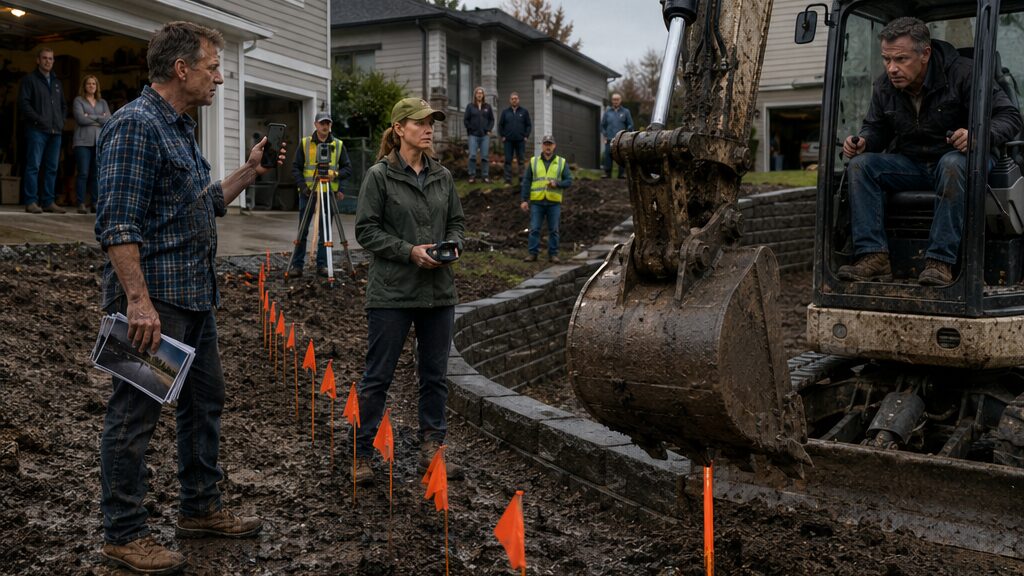
He Crushed the Boundary Stake, but the Wall Had Already Changed Both Their Lives
Chapter 1: The Stake Broke Before Either Man Stepped Back
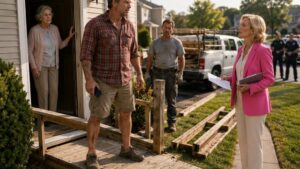
Benjamin’s boot came down before David finished saying, “Don’t touch that.”
The orange survey stake snapped near the ground. Its painted top struck the retaining wall, bounced once, and disappeared into the wet grass. The lower half stayed buried in the soil, split along the grain.
Benjamin kept his work boot planted over it.
“There,” he said. “Now show me where your line is.”
David stood with one hand still raised. Rainwater collected at the edge of his sleeve and ran over his wrist. For a moment, he watched Benjamin’s boot press deeper into the soft earth.
Ten years earlier, David might have answered quickly. Twenty years earlier, he would have matched the other man’s volume and regretted every word by lunch.
Instead, he took his phone from his pocket.
Benjamin laughed. “You taking pictures of dirt now?”
David photographed the broken top of the stake, Benjamin’s boot, the curved retaining wall, and the strip of lawn between them. The wall was new enough that pale mortar still showed between the charcoal blocks. Eighteen feet of it followed the slope behind Benjamin’s patio before turning toward David’s yard.
“Move your foot,” David said.
“You said this was your property.” Benjamin folded his arms. “Prove it.”
David crouched only after Benjamin stepped back. He pulled the buried half free, wiped mud from its pointed end, and laid both pieces on the retaining wall.
“You know those cost money,” he said.
“It’s a piece of wood.”
“It was a survey marker.”
“It was something you hammered into my side of the yard.”
David looked at him. “Your side?”
Benjamin gestured toward the wall. “The association approved the plan. The contractor built where the drawing showed. You watched the whole thing go in.”
The last sentence landed harder than the first two.
David straightened slowly. Beyond Benjamin’s shoulder, the patio rose on a compacted bed of gravel. A narrow seam of fresh concrete joined the older slab. The retaining wall supported both.
He had watched the first trench open in April. He had watched the block pallets arrive. He had taken photographs from his kitchen window because the work looked close to the line.
He had told himself he would check the plat before speaking.
Then he had told himself he needed the corner dimensions.
Then the footing had been poured.
“You were supposed to build inside your parcel,” David said.
“I did.”
“You crossed approximately two feet.”
Benjamin gave a short breath through his nose. “Approximately.”
“Over eighteen feet.”
“Nobody cares about two feet of grass.”
“I care.”
The words came out flatter than David intended. Benjamin’s expression changed—not softer, but more alert, as though David had finally said something worth opposing.
“You retire and suddenly you need a project?” Benjamin asked. “Is that what this is?”
David walked toward his pickup without answering. The truck was parked in his driveway with a plastic document sleeve on the passenger seat. He had placed it there before dawn, expecting an argument but not the destruction of the stake.
Benjamin followed as far as the curb.
David removed a folded plat from the sleeve and spread it across the wet hood. The paper had been copied from a county record, but the original recording marks remained visible along the margin.
“Subdivision plat,” David said. “Recorded in 1994. Lot twenty-eight and lot twenty-nine. Your property is twenty-nine.”
Benjamin barely glanced down. “That thing is older than either house.”
“The line doesn’t expire when somebody builds a house.”
“The pin was never where you say it was.”
“The original corner description is tied to the street monument and the rear iron rod.”
Benjamin looked toward the retaining wall. “There hasn’t been an iron rod back there since we moved in.”
“That doesn’t move the parcel.”
“Neither does an old piece of paper.”
David held the plat in place as a gust lifted one corner. A dark drop of rain struck the printed boundary and spread through the copy.
Benjamin tapped the hood near the lot line. “The HOA approved my wall.”
“The HOA cannot transfer my land.”
“They approved the dimensions.”
“Did they verify them?”
Benjamin’s jaw tightened. “I gave them the site plan.”
“Who prepared it?”
“I did.”
David said nothing.
For the first time that morning, Benjamin looked away.
The silence lasted only a second, but David recognized what it contained. Not guilt exactly. Calculation.
Benjamin recovered quickly. “You were standing right there when the contractor marked it. You never said the line was wrong.”
“I hadn’t verified it.”
“That’s not my problem.”
“It became your problem when you poured concrete over the boundary.”
Benjamin stepped closer to the hood. “Listen to yourself. You’re talking like this is a highway project.”
David folded the wet plat along its existing crease.
“For twenty-six years,” he said, “I reviewed right-of-way maps, easements, and recorded corrections for the city. I know the difference between an approval sketch and a property survey.”
That stopped Benjamin.
Not for long, but long enough.
“You never mentioned that,” he said.
“You never asked.”
Benjamin looked from David to the wall and then back to the broken stake resting on top of it.
“So this is what?” he asked. “You’re going to make me tear out eighteen feet of wall because you found a line on a map?”
“I’m going to have the line surveyed.”
“And when it comes back where I built?”
“Then I’ll pay for the survey and apologize.”
Benjamin smiled without warmth. “Good. Get whoever you want. But that wall is staying.”
He turned toward his driveway.
“Benjamin.”
He stopped.
David held up the broken pieces of the stake. “Don’t touch the next one.”
Benjamin glanced back. “Put it on your property.”
He crossed the lawn, climbed into his truck, and started the engine. The exhaust hung low above the wet pavement before he backed into the street.
David remained beside the retaining wall. One of the neighboring porch doors opened and then closed again. Nobody came outside.
He carried the broken stake into his garage and set it on the workbench. Then he opened the HOA website on his laptop and requested the architectural file for Benjamin’s retaining wall.
The association manager sent it just before noon.
David printed every page.
The approval letter was brief. The committee had authorized a curved segmental wall, drainage fabric, and a gravel backfill. The attached sketch showed the wall set eighteen inches inside Benjamin’s side of the property line.
David measured the printed scale twice.
Then he compared it with the wall outside his window.
The approved wall and the built wall were not in the same place.
Chapter 2: The Wall Was Approved Somewhere Else
The HOA file contained no survey, no engineer’s boundary certification, and no measurement tied to a recorded corner.
David checked it three times before calling the association office.
The president answered on the fourth ring.
“I have the Harris wall packet,” David said. “The approved sketch places the wall inside lot twenty-nine. The constructed wall crosses into lot twenty-eight.”
A pause followed, filled by keyboard sounds.
“We approved the design,” the president said. “We don’t adjudicate property lines.”
“You approved dimensions submitted as verified.”
“That is between the owners.”
“The approval letter is being used as proof that the wall is properly located.”
“We always tell residents that architectural approval does not replace permits or surveys.”
“That language isn’t in this letter.”
Another pause.
“It’s in the community guidelines.”
David looked at the printed packet spread across his kitchen table. One page had Benjamin’s signature beneath a certification stating that the submitted dimensions were accurate and that construction would remain within his property.
“Was the committee shown a revised drawing?” David asked.
“This is the full file.”
“Who reviewed it?”
“I don’t discuss individual committee votes.”
“Benjamin sits on that committee.”
“He recused himself.”
“Is that documented?”
The president’s voice cooled. “Mr. Mitchell, if you believe there is an encroachment, obtain a survey and consult counsel. The association cannot take sides in a private boundary dispute.”
David ended the call before his frustration became audible.
On the kitchen counter, the broken orange stake lay beside a roll of clear tape. He aligned the splintered edges and wrapped them carefully, not because he intended to put the stake back in the ground, but because leaving it in pieces felt too much like accepting Benjamin’s version of the morning.
The tape made the break more visible.
At the county records office, the clerk accepted the plat number without comment and returned ten minutes later with a certified copy and two later instruments.
“Any boundary adjustment between these lots?” David asked.
“Nothing recorded.”
“No quitclaim strip? No maintenance easement?”
The clerk turned the monitor toward him. “Not between twenty-eight and twenty-nine.”
David studied the index. The original subdivision plat had been followed by utility easements and a drainage maintenance agreement at the rear, but nothing altered the side boundary.
“The street monument still controlling?” he asked.
“Unless a licensed surveyor establishes a conflict.”
David nodded.
The clerk looked at the old copy he had brought. “You’ve worked with these.”
“Used to.”
“Then you know the recorded plat wins over a homeowner sketch.”
“It establishes the record,” David said. “A survey establishes where that record falls on the ground.”
The clerk gave him a brief, approving look. It was the first clean confirmation he had received since the argument.
It should have eased him.
Instead, it sharpened the question Benjamin had raised: You watched the whole thing go in.
David paid for the certified copies and drove to the HOA management office.
The records room occupied the back of a converted model home. Metal cabinets stood where a dining table had once been. The office manager brought him the physical folder and remained nearby while he reviewed it.
The paper file matched the digital packet until he reached a yellow routing sheet clipped behind the approval letter.
Three boxes had been initialed: landscaping, drainage, architectural appearance. The fourth—property-line verification—was marked “owner certified.”
Benjamin’s signature appeared beneath it.
David turned the page.
The original sketch showed the wall inside the boundary. A faint staple impression suggested another page had once been attached.
“Was anything removed from this file?” he asked.
The manager leaned over the folder. “Not that I know of.”
“There’s a missing attachment.”
“We scan everything we receive.”
“The staple holes don’t align with these pages.”
She looked uncomfortable. “The committee sometimes circulates working copies.”
“Can I see the meeting notes?”
She retrieved a binder. The minutes contained one sentence: Harris retaining-wall application approved subject to standard conditions.
No discussion. No measurements. No survey.
David photographed the pages and closed the binder.
As he stood to leave, the manager said, “Benjamin told the committee the slope was moving.”
David turned.
“He said the patio edge had dropped after heavy rain,” she continued. “There was concern about drainage toward the foundation. That may be why the review was expedited.”
“Expedited doesn’t mean relocated.”
“No. But it might explain why everyone moved quickly.”
Outside, David sat in his truck without starting it. Through the windshield, the community entrance sign stood behind trimmed shrubs and a row of identical mailbox posts. The neighborhood had always sold order as reassurance: approved paint colors, matching fence heights, shrubs no taller than windowsills.
Yet the file that supposedly protected that order contained a homeowner’s drawing, a signature, and an empty space where verification should have been.
He called Emma Thompson.
They had met years earlier when she surveyed a utility corridor for the city. She answered from a job site, wind clipping her words.
“I need a residential boundary survey,” David said.
“How friendly are the neighbors?”
“One destroyed a temporary marker this morning.”
“That answers that.”
He gave her the subdivision name and lot numbers.
“I can pull the control data tonight,” she said. “Earliest field time is Wednesday.”
“I’ll take it.”
“Both owners need notice that we’ll be near the line.”
“I’ll send certified notice.”
Emma was quiet for a beat. “David, are you hiring me to find a boundary or confirm one?”
“To find it.”
“That sounded rehearsed.”
“It’s still the answer.”
“Good. Because if your old plat conflicts with field evidence, I’m not protecting your theory.”
“I wouldn’t ask you to.”
He prepared the notice that afternoon. He kept it short: survey date, access area, request not to disturb markers. He printed two copies, signed one, and sent the other by certified mail.
Before sealing the envelope, he almost added that the HOA sketch placed the wall elsewhere.
He stopped.
Facts first, he told himself. Full record before confrontation.
The habit had once made him reliable. At the city, supervisors had trusted David to find errors others missed. But years earlier, when a colleague had transposed two parcel numbers, David had documented the mistake in a formal memo before speaking to him. The correction had protected the project and ended the friendship.
After that, David had promised himself he would never accuse anyone without complete proof.
He had never decided what to do when waiting for complete proof allowed damage to continue.
On Tuesday evening, Emma arrived alone to inspect access points before bringing her crew. She walked the retaining wall, compared the street monument to her digital notes, and examined the slope behind the houses.
“Where did the contractor first mark the wall?” she asked.
David pointed to the grass. “Close to where it is now.”
“How close?”
“I wasn’t certain.”
“That isn’t what I asked.”
He looked toward Benjamin’s darkened windows.
Emma crouched near the wall and found a faded stripe of marking paint beneath the gravel.
“This was laid out before excavation,” she said. “Did you see it?”
“Yes.”
“And when did you first tell Benjamin you believed it crossed the line?”
David hesitated.
Emma stood.
“Before the footing?” she asked.
“No.”
“Before the blocks?”
“No.”
“Before the concrete?”
David looked down at the taped orange stake in his hand.
Emma’s expression remained professional, but her voice changed.
“Then tomorrow,” she said, “we’re measuring more than a wall.”
Chapter 3: The Excavator Stopped Above the Orange Line
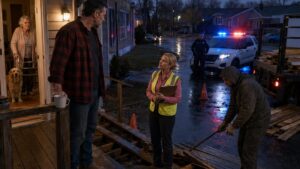
The compact excavator arrived before Emma finished recording the final measurement.
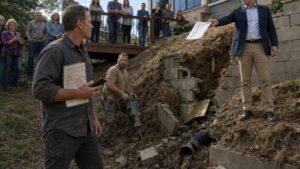
Its rubber tracks climbed Benjamin’s driveway with a low mechanical growl. Mud shook from the bucket as the operator swung it toward the narrow strip between the retaining wall and David’s lawn.
Benjamin was operating it himself.
Emma looked up from the data collector. “Did he tell you he was bringing equipment?”
“No.”
One survey assistant stood over the rear control point. The other held the rod beside an orange stake newly driven into the wet ground. A line of smaller flags ran parallel to the retaining wall, exposing the problem with a clarity no argument had managed.
At the widest point, the wall crossed twenty-five inches into David’s parcel.
At the narrowest, nineteen.
Emma had measured eighteen feet, four inches of encroachment.
Benjamin stopped the excavator ten yards away and opened the cab door.
“Move the flags,” he called.
Emma did not move. “We’re completing a licensed boundary survey.”
“You’re blocking my access.”
“Your access to what?”
“The drainage trench.”
Emma looked at David. “Did you authorize work on your parcel?”
“No.”
Benjamin climbed down. He wore work gloves and a dark jacket spotted with rain. “This is temporary maintenance. The wall needs backfill before the next storm.”
“The backfill area crosses the line,” David said.
Benjamin pointed at the flags. “Those weren’t there yesterday.”
“The boundary was.”
A garage door opened across the street. A neighbor stepped out carrying a trash bag but did not walk toward the curb.
Benjamin noticed. His voice dropped.
“You’re turning this into a show.”
“You brought the excavator.”
“I brought it to protect my house.”
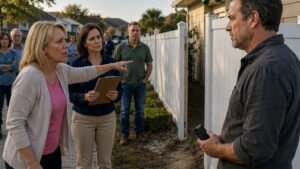
Emma raised the data collector. “Mr. Harris, the field measurements place part of the wall on lot twenty-eight. We are documenting the position now.”
Benjamin looked at her. “Based on what? That ancient map he waved around?”
“Based on recorded control, recovered monuments, occupation evidence, and current measurements.”
“The old pin was gone.”
“That does not erase the boundary.”
David heard his own words from Monday in hers, but without anger or ownership. Emma was not defending him. She was defending the measurement.
Benjamin returned to the cab.
“Last chance,” he said. “Move the flags.”
Emma stepped back toward the tripod. “We won’t interfere with work on your property.”
The excavator’s engine rose.
David felt the sound in his ribs before the machine moved. The bucket lifted, swung over the retaining wall, and stopped above the flagged strip. Clumps of mud loosened from its teeth and struck the ground around the orange stake.
One of the assistants retreated.
David did too—not backward toward his house, but sideways, behind the marked line. He pulled out his phone and began recording.
Benjamin lowered the bucket.
The orange stake trembled from the vibration.
“Parcel twenty-eight,” David said clearly. “Recorded plat book forty-one, page sixteen. Licensed survey in progress. You have written notice not to disturb the markers or enter the parcel.”
Benjamin leaned out of the cab. “You think reciting numbers makes you untouchable?”
“No. It makes the location identifiable.”
“You stand there taking pictures while I’m trying to stop water from reaching my foundation.”
“I have forty-one dated photographs of this wall from layout through completion.”
That changed Benjamin’s face.
The bucket remained suspended inches above the stake.
David continued. “If you cross the surveyed line, I’ll document the contact and notify your insurer of additional property damage after formal notice.”
“You’d call my insurance company?”
“If your equipment enters my property, yes.”
“You’ve been planning this.”
“I’ve been recording it.”
Benjamin stared at him from the cab. The engine idled. Hydraulic lines shivered along the boom.
For several seconds, nobody spoke.
Then Benjamin curled the bucket inward and lowered it onto his own side of the flags. The metal struck gravel with a dull, controlled impact.
The neighbor across the street carried the same trash bag back into the garage.
Emma returned to her instrument. “We need ten more minutes.”
Benjamin killed the engine and climbed down. He walked directly toward David, stopping at the flagged line.
“You want to ruin me over two feet,” he said.
“I want the encroachment addressed.”
“The wall is holding up a slope that was moving toward my house.”
“You should have surveyed first.”
“You watched it.”
David said nothing.
Benjamin reached inside his jacket and pulled out the certified envelope David had mailed. It had been opened along one end.
“You send me this after the concrete is already in,” he said. “Then you bring a crew and act like I hid the wall in the night.”
“I needed the boundary established.”
“You needed leverage.”
Benjamin threw the envelope. It landed short of David, one corner sinking into mud.
“If you sue me,” Benjamin said, “I’ll bury you in legal bills before you see one block moved.”
Emma looked up. “Mr. Harris.”
“This isn’t your conversation.”
“It became my work site when you lowered machinery over my marker.”
Benjamin’s hands closed at his sides. For an instant, David thought he might kick the new stake as he had kicked the first.
Instead, he turned and walked back toward the excavator.
“You have your measurements,” he said. “Now get off my property.”
Emma checked the instrument. “We are standing on Mr. Mitchell’s parcel.”
Benjamin stopped but did not look back.
The distinction hung there, more humiliating than any insult David could have offered.
Emma finished the survey while Benjamin watched from his patio. The assistants photographed each marker, measured offsets to permanent features, and placed capped stakes along the line. David recovered the certified letter from the mud and set it on the hood of his truck beside the old plat.
Rain spotted both documents.
The facts remained readable.
When the crew packed its equipment, Emma handed David a preliminary field sketch.
“The final signed survey will take a few days,” she said. “But the encroachment is clear.”
David looked at the measurements. Seeing the numbers should have brought relief. Instead, he saw the dates printed automatically beneath the photographs listed in his phone.
April 7: trench marks.
April 11: footing forms.
April 14: first concrete delivery.
April 19: block course above grade.
His certified notice had been mailed May 2.
Emma followed his gaze.
“Your photographs prove what he did after notice,” she said.
“And before?”
“They prove you were watching.”
“I was checking the record.”
“For three weeks?”
“I didn’t want to accuse him without being certain.”
Emma folded the field sketch once and placed it in his hand.
“I’m not giving legal advice,” she said. “But certainty isn’t the only issue now.”
David glanced toward Benjamin’s house. Donna stood behind the sliding patio door, one hand on the curtain. When she realized he had seen her, she stepped away.
Emma lowered her voice.
“Several of those photographs show the foundation already poured before your first written objection. His wall is over the line. That part is straightforward.”
“And the rest?”
“The rest is what people do with the time before they speak.”
She left him beside the orange stakes, the damaged letter, and forty-one photographs that no longer pointed in only one direction.
Chapter 4: Silence Became the Evidence Against Him
Laura Wilson began the call by naming the date David had taken his first photograph.
“April seventh,” she said. “The trench paint is visible, the contractor’s stakes are in place, and the wall alignment is already marked.”
David stood at his kitchen counter with the phone on speaker. The taped survey stake lay beside three envelopes he had drafted but never mailed.
“I was documenting the work,” he said.
“I understand.”
“You say that as if it hurts me.”
“It may.”
Her voice was calm enough to make every answer feel permanent.
David looked through the sliding door toward the retaining wall. Benjamin’s excavator was gone, but the fresh track marks remained in the gravel. The orange flags Emma had placed formed a clean line through the mud.
Laura continued. “April eleventh, you photographed the footing forms. April fourteenth, the concrete truck is visible. April nineteenth, the first block courses are above grade.”
“I had not confirmed the boundary.”
“But you suspected a problem.”
“Yes.”
“And you did not tell my client.”
“I asked him about the old corner pin.”
“That is not the same as objecting.”
“He told me it had never existed.”
“Did you tell him you believed the wall was crossing your property?”
David did not answer immediately.
Laura did not fill the silence.
“No,” he said.
The word seemed to alter the room. Until then, David had held the facts like tools arranged in order: plat, photographs, measurements, certification, damaged marker. Now one of them had turned in his hand.
Laura said, “Title is not the same as consent. I’m not suggesting he owns your land. He does not. But if this reaches litigation, your delay becomes part of the story.”
“His contractor should have required a survey.”
“Possibly.”
“He signed a certification that the dimensions were verified.”
“Yes.”
“He destroyed a licensed survey marker after receiving notice.”
“That is also relevant.”
“And he lowered an excavator over my property.”
“Also relevant.”
David gripped the edge of the counter. “Then why are we discussing my silence as if it cancels everything he did?”
“Because it doesn’t cancel it. It complicates it.”
The distinction irritated him more than denial would have.
Laura shifted papers on her end of the call. “I have Emma Thompson’s preliminary measurements. Approximately eighteen feet of wall encroaches, averaging twenty-two inches. That is a significant problem for my client.”
“It is a significant problem for me.”
“I agree.”
“No, you agree it’s expensive.”
“I agree it belongs on your side of the legal analysis.”
David looked at the broken orange stake. Clear tape held the pieces together, but the split remained visible beneath it.
“What does Benjamin want?” he asked.
“To leave the wall in place.”
“No.”
“Listen before deciding.”
“I’ve listened since April.”
“And that is part of why we’re here.”
David’s hand tightened around the phone.
Laura continued before he could respond. “The wall supports a slope leading to the Harris patio. The drainage system behind it connects to a trench along the foundation. Removing the wall immediately may undermine the patio edge and alter runoff toward the house.”
“Then it should be rebuilt correctly.”
“Yes. But demolition and reconstruction could exceed eighteen thousand dollars before any patio repair.”
“That is his cost.”
“It may be. It may also become a shared argument over mitigation if your preferred remedy causes avoidable damage.”
“My preferred remedy is to have my land back.”
“That is a legitimate goal. Immediate demolition is not the only way to reach it.”
David walked to the table and opened Emma’s field sketch. The encroaching wall was drawn as a heavy curved line. The property boundary passed through it without concern for concrete, drainage, or debt.
Records were merciful that way. They showed what existed without asking what it would cost to correct.
Laura said, “My client is prepared to discuss compensation for temporary use.”
“For how long?”
“That depends on terms.”
“Months?”
“Possibly longer.”
“Years?”
“That is what we need to discuss.”
David stared at the wall through the glass.
Benjamin appeared briefly on his patio, saw him, and went back inside.
“You think I should rent him the strip,” David said.
“I think a recorded easement or license could preserve your ownership while avoiding immediate structural damage.”
“And reward him for building first.”
“No. Compensation, fees, and corrective obligations would address that.”
“Would they address the marker?”
Laura paused. “The damaged stake?”
“The decision behind it.”
“I represent him in a property dispute, Mr. Mitchell. I cannot negotiate his character.”
“That wall exists because he decided finishing the work mattered more than knowing where the line was.”
“And you watched because knowing perfectly mattered more than speaking early.”
The words were not raised. They did not need to be.
David saw, without wanting to, a municipal conference room from eleven years earlier. His colleague had sat across from him while a supervisor read David’s memo aloud. Every number in it had been correct. Every conclusion had been defensible.
Afterward, the colleague had said, You could have walked ten steps to my desk.
David had answered that the correction needed a formal record.
They had never eaten lunch together again.
Laura said, “I will send a proposed framework. You are free to reject it.”
“Send it.”
The email arrived Thursday morning.
Benjamin offered to pay the survey cost, replace the damaged stake, and provide a one-time payment for use of the land. The wall would remain under a renewable agreement. The amount proposed was low enough that David read it twice, wondering whether a zero had been omitted.
He printed the document and placed it beside his unanswered drafts.
Then he began calculating.
He estimated the occupied square footage, applied a premium for exclusive use, added the period since construction, survey expenses, recording fees, and the cost of restoring access. The numbers gave shape to his anger.
By Friday afternoon, he had reached nineteen thousand two hundred dollars in back compensation.
For continued use, he wrote three hundred twenty dollars per month.
No expiration.
The payment would continue as long as any portion of the wall remained on his land.
He drafted late charges, inspection rights, insurance requirements, attorney fees, and an annual increase. Each clause tightened the agreement until the narrow strip behind the wall felt less like grass than a controlled corridor.
When he finished, the document was twenty-three pages.
David printed it and set the stack on the table.
The taped orange stake rested beside it.
For the first time since Benjamin’s boot came down, David felt that the balance had shifted completely.
Then he noticed that the monthly payment, multiplied across ten years, would exceed the likely cost of rebuilding the wall.
He did not revise it.
Chapter 5: The Contractor Had Warned Him First
Donna Harris held David’s proposed agreement by one corner as though it had come from somewhere dirty.
“Why was this never shown to me?” she asked.
They stood in the HOA records room on Saturday morning. The president had agreed to open the office after Laura requested access to the complete architectural file. Benjamin remained near the door with his arms folded. David stood opposite him beside the metal cabinet.
Donna was not looking at the agreement.
She was looking at a photocopied contractor note clipped behind it.
The note contained one sentence underlined in blue ink: Confirm side-yard boundary by licensed survey before excavation.
Benjamin said, “That was a general recommendation.”
“It says before excavation.”
“The contractor writes that on everything.”
Donna turned to the contractor, who had been asked to attend because his company’s file did not match the HOA packet.
“Do you?” she asked.
The contractor shifted his weight. “Not on everything.”
Benjamin’s face hardened. “The old pin was missing.”
“That’s why I recommended a survey.”
“You told me the wall could follow the drainage line.”
“I told you the drainage line was not a property line.”
The room went quiet.
David felt his anger change texture. Until that moment, he had pictured Benjamin moving forward on assumption, pride, and haste. The warning made the choice narrower.
Donna read the note again. “Did you show me this?”
Benjamin looked at the floor.
“Did you show the committee?” she asked.
“The committee approved the project.”
“That is not what I asked.”
The HOA president opened the physical file. “This note is not in our packet.”
The contractor reached into his folder and removed a second page. “It was attached to the estimate.”
David recognized the misaligned staple holes immediately.
The president did too.
She turned through the file until she found the original sketch showing the wall eighteen inches inside Benjamin’s parcel.
“This is what we approved,” she said.
Benjamin pushed away from the wall. “The field conditions changed.”
“What changed?” David asked.
“The slope.”
“The property line did not.”
Benjamin faced him. “You want to do this here?”
“You changed the location.”
“I adjusted it.”
“After approval?”
“I moved it enough to catch the drainage.”
The president studied the contractor’s second page. “There’s a revised sketch initialed by you.”
Donna stepped closer.
The drawing was rough, but the wall had been shifted toward David’s lot. A handwritten note identified the new position as verified in field.
“Verified by whom?” she asked.
Benjamin did not answer.
David saw the moment Donna understood. Her shoulders lowered, not in relief but under added weight.
“You signed my name on the financing forms,” she said quietly. “You told me the boundary had been checked.”
“I told you the committee approved it.”
“You told me it was checked.”
“The insurance adjuster gave us thirty days.”
The argument stopped there.
Even David had not known about the deadline.
Benjamin looked around the room as if the walls had moved closer. “The adjuster said the slope movement had to be stabilized before renewal. If the policy lapsed, the lender could place coverage. We couldn’t afford that. We couldn’t afford the foundation work either.”
Donna’s expression did not soften. “So you guessed with our house.”
“I used the plan.”
“You moved the plan.”
“The contractor said the drainage had to go farther out.”
The contractor shook his head. “I said we needed room. I did not say you owned the room.”
Benjamin’s hand struck the filing cabinet, not hard enough to dent it but hard enough to make the folders jump.
“The patio had already dropped half an inch,” he said. “Water was reaching the foundation. Everyone kept telling me to get another report, another inspection, another survey. Every delay cost money.”
David looked through the small records-room window toward the community parking lot. Benjamin’s truck sat outside with dried mud along its lower panels.
For the first time, the wall appeared to him not only as an intrusion but as the shape of a frightened decision repeated until it became permanent.
It did not excuse the stake.
It did not excuse the excavator.
But it explained why Benjamin had treated every new fact as an attack on the house itself.
Donna turned to David. “And this?”
She raised the twenty-three-page agreement.
David said, “Compensation for use of my property.”
“Three hundred twenty dollars every month. Forever.”
“For as long as the wall remains.”
“We would pay more than rebuilding it.”
“Then rebuild it.”
“The contractor just explained what removal could do.”
“That risk came from building it there.”
Donna held his gaze. “Did you know they were pouring the footing?”
“Yes.”
Benjamin let out a sharp breath. “There it is.”
David looked at him.
“You stood by your window taking pictures,” Benjamin said. “You watched the trench. You watched the concrete truck. You waited until I couldn’t pull it back without losing everything.”
“I was verifying the boundary.”
“You were building a case.”
“I had not confirmed the line.”
“You knew enough to photograph it.”
The accusation was unfair in its conclusion and accurate in its center.
David could have walked across the yard.
He could have said, Stop until I check.
Instead, he had drafted letters, revised them, and waited for certainty to arrive without discomfort.
Donna set the agreement on the table.
“I’m not signing this,” she said.
Benjamin looked at her. “We need a settlement.”
“We need one based on the truth.”
“This is the truth. The wall is over.”
“Not all of it.”
She picked up the contractor’s warning.
“You hid this from me. You left it out of the HOA file. Then you told everyone David was inventing a line because he was bored.”
Benjamin’s face reddened. “I was trying to keep our house insured.”
“You were trying not to tell me you made a decision you couldn’t afford.”
The words removed whatever defense remained in the room.
Benjamin looked toward David, but his anger no longer had the same direction.
“I saw the warning,” he said. “Fine. I saw it. I thought the old pin was wrong, and I thought the committee sketch was close enough.”
“You changed the sketch,” the president said.
“I changed the wall because of the drainage.”
“And certified the dimensions,” David said.
Benjamin’s eyes fixed on him.
“Yes,” he said. “And you watched me build it.”
Neither man moved.
The broken stake photograph lay on top of David’s agreement. In the image, Benjamin’s boot covered the buried half while David’s hand entered the frame from one side.
Two actions captured at once: one man destroying a boundary, the other recording it.
Benjamin pointed at the photograph.
“You want me to admit what I did,” he said. “When are you going to admit what you did not do?”
Chapter 6: Three Choices at the Folding Table
Benjamin arrived expecting to sign the indefinite lease.
Laura placed her briefcase beside the folding table in the HOA community room. Donna sat two chairs away from her husband. The HOA president remained near the wall with a legal pad, present only because the association’s approval record would require correction.
David had arranged four items in front of his seat: the recorded plat, Emma’s signed survey, three sealed document folders, and the repaired orange stake.
The clear tape around the stake had begun to cloud.
Laura opened her briefcase. “Before we start, I want to confirm that the payment terms circulated Friday were David’s proposal, not an agreed settlement.”
Benjamin pulled out a chair. “We know whose proposal it was.”
David looked at Donna. She gave him no indication of what she expected.
Laura reached for the twenty-three-page lease.
David put his hand on it first.
“I’m withdrawing this.”
Benjamin stopped halfway into his chair.
“What?”
“The indefinite lease.”
Laura studied David. “Are you replacing it?”
“Yes.”
Benjamin remained standing. “This another trick?”
“No.”
“You calculate how much more you can get?”
David slid the document away from Laura and placed it beneath his folder.
“I calculated what anger could justify if I called it protection.”
No one responded.
The air conditioner clicked on above them. Its vibration traveled through the folding table, making the broken stake roll slightly before David steadied it.
He looked at Benjamin.
“The wall is on my property. Your certification was false. You destroyed a survey marker after formal notice and brought equipment over the line.”
Benjamin’s mouth tightened.
David continued. “I also saw the layout before the footing was poured. I suspected it was wrong, and I did not tell you directly to stop.”
The HOA president lowered her pen.
Donna looked at David for the first time since he entered.
“I told myself I needed complete proof,” David said. “That was true. It was also easier than walking across the yard and risking an argument before I knew I could win it.”
Benjamin sat down slowly.
“My silence did not give you the land,” David said. “But it helped the problem become concrete.”
The words felt less clean than anything he had prepared in writing. That was how he knew they were necessary.
Laura folded her hands. “What are the replacement terms?”
David pushed the first sealed folder to the center of the table.
“Option one: immediate removal and reconstruction fully inside lot twenty-nine. Benjamin pays the survey, recording costs, restoration of my yard, and any damage caused by removal.”
Benjamin did not touch the folder.
David placed the second beside it.
“Option two: I sell the occupied strip at an appraised rate, plus costs.”
Donna’s expression sharpened.
“But,” David said, “the sale would permanently alter both parcels. It could affect setbacks, future improvements, and resale disclosures. I do not recommend it.”
Benjamin looked at the third folder.
David placed it down last.
“Option three: a five-year recorded easement. The wall remains temporarily. You pay back-use compensation, all survey and legal costs, and the drainage correction. During those five years, you fund and complete reconstruction within your own parcel. The easement expires on a fixed date.”
Laura opened the third folder.
“How much back compensation?” she asked.
“Eight thousand four hundred.”
Benjamin looked up. “You wanted nineteen.”
“I wanted you to feel trapped by a number the way I felt trapped by the wall.”
“And now?”
“Now I want the boundary restored.”
Laura read silently, turning pages.
“The monthly amount?” she asked.
“No monthly rent. Required deposits into a reconstruction account every quarter.”
Donna leaned forward. “Controlled by whom?”
“An escrow agent selected jointly. Funds can only be used for engineering, removal, drainage, and rebuilding.”
Benjamin gave a humorless laugh. “So I still pay for five years.”
“You pay for the correction you postponed.”
“What happens if costs rise?”
“You remain responsible.”
“What happens if the patio cracks?”
“Your engineer designs the sequence before removal.”
Benjamin looked at Laura. “Can he require all this?”
Laura did not answer immediately. “He can require terms in exchange for allowing the wall to remain. Otherwise, he can pursue removal.”
David watched Benjamin read the first page.
The anger came, but without the old certainty. It moved across his face and met too many facts to settle.
“You had this ready,” Benjamin said.
“Yes.”
“Before you admitted you waited.”
“Yes.”
“You think saying that makes this fair?”
“No. The terms have to make it fair.”
Benjamin pushed the folder away. “Five years is too short.”
“The wall should never have been there.”
“The insurance deadline was real.”
“So was the contractor’s warning.”
“You think I had eighteen thousand dollars sitting around?”
“No.”
“Then what would you have done?”
David looked at the taped stake.
“I would like to say I would have stopped everything and paid for the survey,” he said. “But I have spent most of my life delaying difficult conversations until I had enough paper to control them. So I do not know.”
Benjamin seemed unprepared for that answer.
David met his eyes. “I know what you did after you were warned. You changed the drawing. You certified it. You crushed the stake. You used the excavator. Pressure explains the first bad decision. It does not explain all the decisions after it.”
Donna placed her hand on the third folder.
“What would the HOA correction say?” she asked.
The president answered. “That approval applied to the original submitted location, that no boundary verification was performed by the association, and that the constructed wall deviated from the approved sketch.”
“And Benjamin’s certification?”
David said, “Corrected in writing.”
Benjamin stared at him. “You want me to announce I lied.”
“I want the record to stop carrying the lie.”
“There are people in this neighborhood who will never let that go.”
David glanced toward the closed community-room door. No neighbors had been invited. There would be no porch audience, no public table in the street, no scene built around humiliation.
“That is not why we are here,” he said.
Benjamin looked at the orange stake. “Why bring that?”
“Because this started when you decided breaking the marker changed what was underneath it.”
“And it didn’t.”
“No.”
Benjamin picked up the repaired stake. The taped joint bent slightly under its own weight.
“It’s still broken,” he said.
“Yes.”
Laura finished reading the easement. “The structure is workable. Some terms need revision, but the path is clear.”
Benjamin set the stake down.
“What if I choose removal now?”
“Then we schedule access, engineering, and restoration,” David said.
“What if I choose the strip?”
“We obtain independent appraisals, and I reserve the right not to sell.”
Benjamin frowned. “Then it isn’t an option.”
“It is an option to negotiate. Not a right to purchase.”
“And the five years?”
“A right to use only the defined area while you correct the problem.”
Donna turned toward her husband. “That is the only option that keeps the house protected and restores the line.”
Benjamin did not look at her. “You decided already?”
“No. I decided I will not sign anything that pretends this happened by accident.”
His face changed.
The room became smaller around them—not because anyone raised a voice, but because the last private defense had become part of the official discussion.
Donna slid the contractor’s warning from her folder.
“If we choose the easement,” she said, “you correct the HOA record first.”
Benjamin rubbed both hands over his face.
Laura waited.
The president’s pen remained motionless above the page.
David felt no triumph. The agreement was still unsigned. The wall still occupied his land. Benjamin could reject every option and force the dispute into court.
But the choice was no longer between surrender and punishment.
Benjamin lowered his hands.
“What exactly do you want me to say?” he asked.
Donna answered before David could.
“The truth,” she said. “Including what you changed.”
Chapter 7: The New Marker Needed No One to Defend It
Benjamin read the corrected HOA statement without looking up.
“The retaining wall constructed along the boundary between lots twenty-eight and twenty-nine does not match the location shown in the approved architectural sketch. I revised the field placement after approval and certified dimensions that had not been confirmed by a licensed survey.”
His voice remained level until the final sentence.
“The association did not authorize construction across the recorded property line, and David Mitchell did not consent to the encroachment.”
The HOA president sat at the end of the conference table with the correction form in front of her. Laura occupied the chair beside Benjamin, one finger resting on the signature line. Donna sat on his other side.
David had chosen a chair across from them rather than at the head of the table.
Benjamin set the paper down.
“Is that enough?” he asked.
The president glanced at David.
David said, “It corrects the record.”
“That wasn’t my question.”
“No,” David said. “It probably doesn’t feel like enough.”
Benjamin’s expression tightened, but Donna touched the edge of the statement before he could pull it back.
“It’s true,” she said.
Benjamin signed.
The sound of the pen crossing the paper was smaller than David expected. No one outside the room knew it was happening. There were no neighbors at the windows, no raised voices in the hallway, no moment in which the entire community turned to see which man had won.
Laura placed the five-year easement beside the correction.
During the previous two months, they had revised its terms line by line. The back-use payment remained eight thousand four hundred dollars. Benjamin and Donna would cover Emma’s survey, county recording charges, legal drafting, and repairs to the narrow section of David’s lawn disturbed by the machinery.
Every quarter, money would move into an escrow account for reconstruction. An engineer would inspect the drainage system within sixty days and produce a phased removal plan. The wall could remain only until the expiration date written in bold on the first page.
If the reconstruction was not complete by then, the temporary easement would end and David could pursue removal without renegotiating the delay.
Benjamin signed that document more slowly.
Donna signed after him.
David added his name last.
At the county recording office, the clerk stamped the easement and correction with the same indifferent pressure she used for every deed, lien, and release. The machine struck the paper once, fixing five years of future obligation into the public record.
Outside, Benjamin stood near the steps while Donna and Laura walked ahead.
“You could still have made us pay monthly,” he said.
“Yes.”
“Why didn’t you?”
David looked toward the parking lot. “Because I would have spent five years checking whether you were late.”
Benjamin gave a faint, skeptical breath.
“That’s not the whole reason.”
“No.”
David waited, then added, “The lease would have kept the wall profitable to me. I wanted it gone.”
Benjamin nodded once. He did not thank him.
That afternoon, Emma returned to the property with one assistant and a small metal case. The temporary flags had faded from weeks of sun and rain. Several leaned at angles where lawn crews had worked around them.
The repaired orange stake still rested on David’s garage workbench.
Emma set her instrument over the control point, confirmed the measurements, and walked to the place where Benjamin had crushed the first marker.
Benjamin watched from his patio. Donna stood behind him with her arms folded against the cold.
Emma drove a narrow rod into the ground, checked its position, and fitted a brass cap over the top. The cap sat nearly flush with the soil. It carried her license number and the survey reference, but from more than a few feet away it looked like nothing more than a small circle catching the light.
“No flag?” David asked.
“Not unless you want one.”
He considered the bright orange stakes, the torn certified letter, the excavator bucket suspended above wet earth.
“No,” he said.
Emma pressed the soil around the cap with the heel of her boot.
“There,” she said. “Permanent enough for the record. Quiet enough for the lawn.”
The HOA president arrived before Emma finished packing her equipment. She carried no folder.
“We have an opening on the architectural committee,” she told David. “Given your experience, the board thought you might be useful.”
Benjamin looked away toward the wall.
David almost laughed. Months earlier, the invitation might have felt like recognition. He imagined reviewing sketches, requiring surveys, correcting language, preventing another owner from treating approval as ownership.
He also imagined becoming the person residents avoided until they had every measurement perfect.
“No,” he said.
The president seemed surprised. “You wouldn’t need to attend every meeting.”
“That isn’t the issue.”
“We could use someone who understands records.”
“You need a rule requiring verified boundaries when construction approaches a property line.”
“We are drafting one.”
“Then put it in writing and make it apply to everyone.”
She waited, perhaps expecting more.
David looked at the brass cap in the grass.
“I don’t need a seat on the committee to speak to my neighbor,” he said.
Benjamin heard him. Neither man acknowledged it.
For the next five years, the wall remained.
The agreement did not create friendship. David and Benjamin no longer borrowed tools or talked across the driveways about football. When packages were delivered to the wrong porch, they carried them over without conversation. When storms clogged the shared curb inlet, they cleared opposite sides.
The distance between them became ordinary.
Quarterly escrow statements arrived. Engineering plans followed. The first contractor withdrew after discovering the patio would need temporary support. A second proposed a staged system of short wall sections built inside Benjamin’s parcel before the old blocks were removed.
The work cost more than expected.
Benjamin never asked David to extend the deadline.
On the first Monday after the five-year easement expired, a crew arrived at seven in the morning. The old retaining blocks came out one section at a time. Behind them, the disputed strip appeared as a narrow band of compacted gravel and pale soil.
David stood near his garage as the excavation exposed the full length.
For years, the conflict had occupied legal folders, photographs, meetings, bank statements, and silences between two houses. On the ground, it was less than the width of a person’s stride.
Benjamin came down from the patio carrying the contractor’s new layout sheet.
“The drainage outlet stays on my side,” he said.
David took the page and checked the dimension nearest the brass cap.
“It does.”
“The crew may need temporary access for the compactor.”
“How far?”
Benjamin pointed rather than guessing. “Eighteen inches. Two hours, according to the foreman.”
David looked at him.
Five years earlier, Benjamin would have called it nothing. David might have photographed the request before answering.
Now Benjamin waited.
“Put it in an email,” David said. “Include the time and restoration.”
“I already drafted it.”
David nodded. “Then send it.”
By late afternoon, the new footing lay fully within lot twenty-nine. The concrete was still wet when Benjamin walked toward the edge to speak with the foreman.
His boot approached the brass boundary cap.
Without looking at David, without anyone warning him, Benjamin stopped and stepped back onto his own side.
The story has ended.