The HOA Took His Parking Space, Then Learned Its Only Access Road Crossed His Land
Chapter 1: The Permit Revocation Everyone Was Meant to Witness
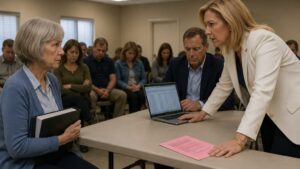
Rebecca Torres slapped the notice across Stephen Miller’s hands hard enough to leave a pale streak through the grease on his knuckles.
The microphone in front of her caught the crack of paper against skin. Forty people sat around the clubhouse meeting room, and for one suspended second nobody shifted, coughed, or looked away.
Stephen read the bold line at the top.
PARKING AUTHORIZATION REVOKED.
“Effective immediately,” Rebecca said. She remained standing while he sat at the end of the long conference table. Her white jacket was buttoned neatly, and the stack of meeting papers beside her had been squared to the edge with the precision of a display home. “Your truck may not be parked on Association-maintained streets after Sunday night.”
Stephen looked from the notice to her. “On what violation?”
“The board received a complaint.”
“From whom?”
“Complaints may be confidential.”
“What did it say I did?”
Rebecca’s mouth tightened, as though his questions were further proof of the problem. “Your vehicle is regularly left near the main gate. It creates congestion and detracts from the appearance of the entrance.”
His truck was a twelve-year-old dark-blue pickup with a ladder rack, lockboxes, and a dent near the rear wheel. It carried copper fittings, shutoff valves, electrical testers, and enough hand tools to repair most of the failures that sent his phone ringing before sunrise. He kept it clean. He never blocked a driveway. He parked it against the curb because the turning radius into his narrow side drive was too tight when his utility trailer was attached.
“It’s legally registered,” he said. “And the permit was renewed three months ago.”
A board member near the center of the table studied his binder. Another stared at a water bottle. Jeffrey King, the treasurer, lowered his eyes before Stephen could catch them.
Rebecca addressed the room rather than him.
“We have standards for a reason. When work vehicles and street parking begin accumulating, prospective buyers don’t distinguish between owner-occupied homes and rental turnover.”
The words landed more softly than the paper had, but they cut deeper.
Stephen heard a chair scrape behind him. Someone whispered and stopped. Rebecca had not called him a renter. She had arranged the sentence so everyone could complete it themselves.
“I own my house,” he said.
“No one disputes that.”
“You just implied otherwise.”
“I said appearances affect all of us.” Rebecca placed two fingers on the revocation notice and pushed it closer to him. “Ownership does not exempt anyone from becoming a neighborhood problem.”
Heat moved up Stephen’s neck. He could have listed the houses whose frozen pipes he had repaired without charging emergency rates. He could have named the elderly widower whose furnace he had kept alive through a January night with a borrowed motor and two hours of improvised wiring. He could have reminded the room that his father had bought the corner lot before the clubhouse, gatehouse, stone monument, and ornamental pear trees existed.
Instead, he folded the notice once.
Rebecca mistook the silence for retreat.
“If the truck remains on the curb Monday morning, towing enforcement will begin,” she said. “People who repeatedly challenge community rules cannot expect preferred access near the gate.”
“Preferred access,” Stephen repeated.
“It’s the most visible entrance in the development.”
His house stood beside that entrance, where the main boulevard divided. One branch curved past the clubhouse. The narrower paved connector crossed the southeast edge of his lot and led toward twelve homes built behind a drainage rise. Residents used it without thinking. Delivery vans used it. Landscapers, guests, repair crews, and school carpools used it.
Stephen looked down the table.
“Did the board review the original subdivision plat before voting?”
Rebecca blinked once. “This is a parking matter.”
“That wasn’t my question.”
The association secretary leaned toward her, but Rebecca raised a hand.
“We are not reopening a settled vote because you want to bury the board in irrelevant paperwork.”
Stephen turned toward Jeffrey. “You saw the plat?”
Jeffrey’s gaze remained fixed on the table. A muscle moved in his cheek.
That was answer enough.
Stephen stood. The chair legs dragged across the hardwood, louder than he intended. Rebecca stepped back half a pace, then recovered and gathered the remaining copies of the notice.
“You have until Sunday,” she said.
He slid the folded paper into the inside pocket of his brown work jacket.
“No,” he said quietly. “I have until Monday.”
Outside, the clubhouse windows reflected the landscaped entrance: trimmed hedges, uplights, fresh mulch, and the white vinyl sign announcing the community’s name in bronze letters. Stephen’s truck sat beyond it under a streetlamp, ladder rack visible over the shrubs.
Two neighbors passed him without speaking. One gave him a thin, apologetic smile and kept walking.
Stephen climbed into the pickup and rested both hands on the wheel. Through the windshield, he could see Rebecca inside the meeting room, already moving to the next agenda item. Her posture had relaxed. She believed the difficult part was over.
He drove home by the longer curve, though the connector ran beside his property. At his driveway he backed in twice before getting the angle right, the trailer hitch missing the fence post by inches.
Inside, he left the lights off except for the lamp above his desk.
The bottom drawer stuck halfway. He pulled harder, and the runners released with a dry wooden knock. Beneath tax receipts, appliance manuals, and his father’s old contractor licenses lay a brown deed folder softened at the corners.
Stephen placed it on the desk.
The first pages showed closing documents and survey descriptions. The folded map was in the rear sleeve, exactly where his father had kept it. Its paper had yellowed along the creases. Stephen unfolded one panel, then another, flattening it beneath his palms.
Blue parcel lines crossed the subdivision. Black lines marked the later roads.
The connector appeared as a narrow strip of pavement running from the main boulevard toward the rear homes.
The blue boundary of Lot One did not stop beside it.
It ran underneath it.
Stephen reached into his jacket and laid the parking revocation beside the map.
For several minutes, he studied the line Rebecca’s board had apparently never bothered to see.
Chapter 2: The Road Beneath Everyone’s Daily Routine
The county clerk returned from the archive room carrying a recording book that did not appear anywhere in the association’s digital property file.
She set it on the counter with both hands. Dust clung to the dark binding, and the spine had been repaired with gray cloth tape.
“This is the volume referenced in your deed,” she said. “The scanned index skips from instrument forty-eight to fifty-two. Yours is fifty-one.”
Stephen glanced at Nicholas Davis, the county land-records specialist assigned to help with older subdivision records.
Nicholas adjusted his glasses and opened the book. “Missing from the scan doesn’t mean missing from the record.”
The easement occupied four pages. It had been signed decades earlier by Stephen’s father, the original developer, and the county. The association had not yet existed under its current name.
Nicholas traced the legal description with a capped pen.
“The pavement is inside your parcel,” he said. “That part is clear. The back lots receive passage over this strip.”
“So they don’t own it.”
“No.”
“Can they revoke my parking permit while using my property every day?”
Nicholas looked at him rather than the book. “That is not the same question as who owns the land.”
He turned to the next page. The easement granted residential access, emergency passage, and ordinary service use. A later amendment required the managing association to share resurfacing, drainage, and snow-removal costs. Another clause prohibited the association from imposing access restrictions on the burdened-property owner that were arbitrary or discriminatory.
Stephen read that line twice.
“What happens if they breach it?”
“That depends on the breach, the notice, and what remedy a court considers reasonable.”
“It says access is conditional.”
“It does.”
“So I can close it.”
Nicholas capped the pen firmly. “Ownership is not a magic word, Mr. Miller. You may have grounds to suspend uses outside the protected purpose. You may have grounds to demand compliance. A total blockade affecting residents or emergency vehicles could create a different problem for you.”
Stephen felt the evening meeting return to him: Rebecca’s hand on the paper, the room watching, the word renters left hanging where an accusation did not have to be proved.
“They gave me three days.”
“That doesn’t change the record.”
“No. It changes my patience.”
Nicholas studied him for a moment, then copied the relevant instruments and stamped each page. He did not argue further.
Back home, Stephen spread the original map across his workbench. Sunlight from the garage door fell over pencil marks he had overlooked the night before.
His father’s handwriting ran beside the connector boundary in small block letters:
KEEP THE BACK HOMES CONNECTED.
Below it, another note listed gravel costs, culvert work, and the first paving contribution. The figures stopped twelve years earlier.
Stephen pulled the HOA’s annual statements from a file cabinet. Maintenance assessments had increased three times. The budget listed entrance landscaping, monument lighting, security cameras, and decorative gate repairs. It did not contain a separate line for the connector.
He walked outside with a tape measure and notebook.
Cars crossed the pavement every few minutes. A grocery delivery van turned toward the rear cul-de-sac. A landscaper’s trailer followed. A woman in a white sedan slowed and waved to him. Stephen recognized Susan Green from one of the houses behind the rise. A child sat in the back seat, head bent over a tablet.
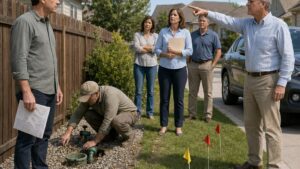
The asphalt near the drainage edge had begun to crumble. Water had cut a narrow groove along his grass where the association’s contractor should have maintained the shoulder. Stephen photographed it.
By Saturday afternoon he had a timeline.
The HOA had used the road continuously. It had collected assessments from the rear homes. It had not paid the maintenance share described in the amendment for at least nine years. More troubling, it had now restricted Stephen’s own practical access near the gate without identifying a complainant or a concrete safety violation.
He drafted a letter, deleted it, then drafted another.
The first version accused Rebecca of retaliation. The second demanded immediate reinstatement. The third was shorter.
It identified the recorded easement, cited the maintenance and nondiscrimination conditions, and gave notice that nonessential commercial and guest access would be suspended pending board review. Residential and emergency rights were mentioned in the legal paragraph, though Stephen did not yet decide how he would physically separate them.
On Sunday evening, he carried two concrete planters from behind his garage using a hand truck. Each was wide enough to prevent a vehicle from slipping around the edge without crossing his lawn. He placed them beside the connector but not yet in the roadway.
The folded map remained on the passenger seat of his truck.
He read his father’s penciled note again.
Keep the back homes connected.
His father had been generous with land and careless with paperwork. He had trusted handshakes, postponed arguments, and paid bills rather than risk becoming unpopular. By the time Stephen inherited the house, the association spoke of the connector as if the family had never owned it.
Stephen folded the map along its original creases.
“I’m not giving them another inch,” he said to the empty cab.
The sentence sounded like a promise he had made at his father’s hospital bed. It also sounded, now, like an answer to a question his father had never asked.
At the post office Monday morning, Stephen sent the notice by certified mail. He kept the stamped receipt in his shirt pocket.
Then he returned home, rolled the planters into the pavement, and fastened a laminated sign between them.
EASEMENT ACCESS SUSPENDED
NONESSENTIAL TRAFFIC PENDING BOARD REVIEW
The first delivery van appeared at the turn before he had finished securing the second chain.
Chapter 3: The Morning the Back Street Stopped Moving
The delivery van stopped three feet from the concrete planters, its brakes squealing against the quiet Monday morning.
The driver leaned out of the window. “I need the rear addresses.”
Stephen tightened the final chain beneath the laminated sign. “You’ll have to use the service turnaround until the association reviews the easement.”
“There is no other entrance.”
“I know.”
Within ten minutes, two cars, a landscaping truck, and a grocery delivery vehicle had formed a line behind the van. Horns began in short uncertain taps, then hardened into longer blasts.
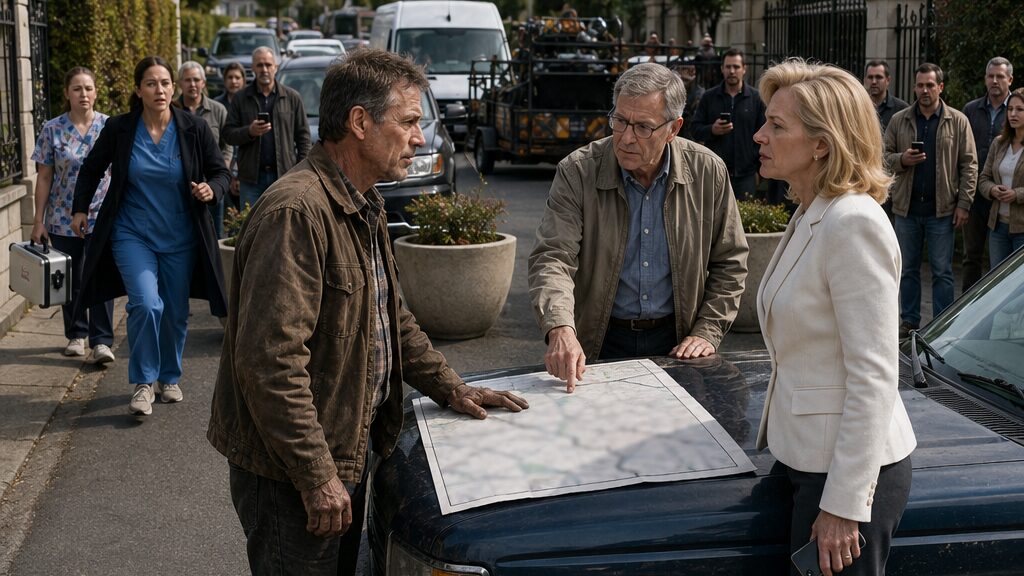
Stephen set a folding chair beside his old pickup. The county map lay on the hood beneath a clear plastic sheet. He had brought copies of the deed, the easement, the amendment, the certified-mail receipt, and photographs of the failed drainage edge.
A man from the rear cul-de-sac marched toward him in slippers and a sweatshirt.
“You can’t close a neighborhood road.”
“It isn’t a neighborhood road.”
“It has pavement and streetlights.”
“The pavement is on my lot.”
The man stared at the sign as though its wording were an insult. “People have jobs.”
“So do I.”
By eight, the line reached the main gate. Residents began backing into driveways to turn around, only to discover there was nowhere else to go. A school carpool unloaded children beside the clubhouse. A contractor abandoned his truck near the monument and carried tool cases by hand.
Stephen felt a hard satisfaction watching the system jam.
No one in the meeting room had cared that his truck was part of his livelihood. Now one row of concrete planters had made everyone notice what crossed his land.
Rebecca arrived in a white SUV and parked crookedly beside the curb. She stepped out wearing a navy suit and low heels, phone already raised.
“Move them,” she said.
Stephen remained seated.
“You received the notice.”
“I received an email attachment fifteen minutes ago. That does not authorize you to barricade an Association road.”
Stephen stood and turned the map toward her.
“Show me where the Association owns it.”
Rebecca did not look down. “This road has served the community for decades.”
“That wasn’t my question.”
Several residents gathered around them. Phones appeared. The delivery driver sat on the van’s bumper, watching.
Rebecca pointed toward the planters. “You are creating a safety hazard and interfering with residents’ property rights.”
“Your board interfered with mine first.”
“This is retaliation over a parking decision.”
“This is review of a breached easement.”
The certainty in her face wavered, but only briefly. “An easement means we have the right to use it.”
“Under conditions.”
“Your interpretation.”
“County record.”
A gray county sedan turned through the gate. Nicholas Davis stepped out carrying a tube case and a clipboard. Stephen had asked him to verify the public record on site, though Nicholas had warned that he would not adjudicate the dispute.
Rebecca looked relieved when she saw the county seal.
“Good,” she said. “Please explain to Mr. Miller that this is a recorded community roadway.”
Nicholas opened the tube and removed a large certified parcel map. He laid it over Stephen’s smaller copy on the hood of the pickup. The wind lifted one corner; Stephen placed a wrench on it.
Nicholas pointed to the main boulevard.
“This section is Association-owned common property.”
His finger moved toward the connector.
“This pavement begins on common property, then crosses Parcel One before reaching the rear tract.”
Rebecca leaned closer. “Crosses in what sense?”
“In the ordinary sense.” Nicholas traced the blue boundary. “The underlying land here is titled to Stephen Miller.”
A murmur moved through the residents.
Rebecca stared at the line. “But the Association holds an easement.”
“Yes.”
“So he cannot block it.”
Nicholas kept his tone even. “The easement grants defined uses. It also contains maintenance and owner-access conditions. I can verify the record. I cannot tell either party what remedy a judge would approve.”
Stephen tapped the amendment. “They stopped paying maintenance.”
Rebecca looked toward the eroded shoulder, then back at the map.
“That is an accounting issue.”
“You revoked access near my own property without naming a violation.”
“We revoked a parking permit.”
“Under a clause that says you cannot impose arbitrary access restrictions on the burdened owner.”
For the first time since the meeting, Rebecca had no immediate response.
The residents noticed.
Someone behind Stephen said, “She knew about this?”
Another voice answered, “How could the board not know?”
Stephen felt the balance shift. It was visible in Rebecca’s posture, in the phones turning from him toward her, in the way Jeffrey King had appeared near the clubhouse but stopped at the edge of the crowd.
Rebecca recovered by tightening her grip on her phone.
“This does not excuse a blockade,” she said. “We will seek emergency relief today.”
“But it does mean this isn’t your road.”
Her eyes fixed on him. “Do you think humiliating every family behind you makes what happened Thursday acceptable?”
The question should have angered him. Instead, it lingered.
A white hatchback pulled around the line and stopped near the planters. Susan Green jumped out before the engine was fully quiet. She wore hospital scrubs beneath an open coat, and her face was flushed from either haste or fury.
“Which one of you is moving this?” she demanded.
Stephen stepped forward. “Nonessential traffic is suspended. Residents can park near the clubhouse until—”
“My father’s nurse is behind those vans.”
The satisfaction left him so quickly it felt like a physical drop.
Susan pointed toward a small sedan trapped behind the landscaping truck. A woman in blue medical clothing stood beside it holding a case.
“He had surgery six days ago,” Susan said. “She has medication and dressing supplies. He cannot walk from the clubhouse.”
Stephen looked at the planters. He had left space along the grass for pedestrians but not enough for a car. The eroded drainage edge made the shoulder unsafe.
“I’ll carry the supplies,” he said.
“That is not the point.”
“I can take the nurse in my truck through my side drive.”
“And tomorrow? And the day after that?” Susan’s voice broke, then sharpened to cover it. “Did you ask who lived back there before you decided we were all part of your argument?”
Stephen heard Nicholas’s warning from Friday.
Ownership is not a magic word.
Rebecca stepped beside Susan, her authority returning through someone else’s pain.
“This is exactly why emergency action is necessary.”
Stephen glanced at her. “Don’t use her.”
“I didn’t put concrete across the road.”
“No,” Susan said, looking at both of them. “You just started whatever this is.”
The crowd became quieter.
Stephen reached for the planter chain. It was secured with a hardened padlock. The key was in his pocket, but moving the concrete boxes required the hand truck and time. He pictured Susan’s father waiting in a rear bedroom while strangers argued over maps.
Before he could act, a diesel engine sounded from the gate.
A tow truck entered slowly, amber lights rotating across the clubhouse windows. The driver stopped beside Rebecca’s SUV and lowered his window.
Rebecca raised one hand toward Stephen’s pickup.
“That vehicle is parked under a revoked permit,” she said. “Remove it from the roadway.”
Stephen’s truck stood partly along the curb and partly beside the mouth of the connector, exactly where it had been parked for years.
The tow operator looked from Rebecca to Stephen, then at the county map spread across the hood.
A sheriff’s deputy pulled in behind the truck.
Rebecca lifted her phone so the gathered residents could see the email on its screen.
“The Association attorney is preparing an emergency injunction,” she announced. “Until then, we will enforce every existing rule.”
Stephen put one hand on the folded edge of the map and the other over the planter key in his pocket.
The road was his. The nurse was waiting. The tow cable was already unspooling.
Chapter 4: The Complaint That No Neighbor Actually Filed
Susan Green placed the missed-care notice on Stephen’s kitchen table as if it were evidence in a trial.
The paper had been folded into quarters and opened again. One corner was damp from her hand.
“My father’s dressing was supposed to be changed at nine,” she said. “The nurse got there after eleven because she had to park at the clubhouse and wait for you to move equipment.”
Stephen stood across from her with both palms resting on the chair back. The county map lay folded beside the sugar bowl. He had brought it inside after the deputy told Rebecca that a civil property dispute did not authorize an immediate tow. The truck remained where it was. The planters remained too.
“I drove the nurse through my side yard,” he said.
“After forty minutes of arguing.”
“I opened a route.”
“You improvised one after you trapped her.”
The words struck more cleanly than Rebecca’s insults had. Stephen looked at the notice without touching it. The medical agency had documented delayed access, increased pain, and a rescheduled follow-up.
Susan wore the same scrubs she had worn at the connector. There were shadows beneath her eyes. Her phone vibrated twice in her pocket. She ignored it.
“I didn’t know about your father,” Stephen said.
“You didn’t ask.”
“No.”
She seemed prepared for a defense. His answer interrupted it.
Stephen pulled out a chair, but Susan did not sit.
“The board told us you were blocking everyone because your parking permit got taken away.”
“That’s part of it.”
“Then what part am I missing?”
He opened the deed folder, but before he could unfold the map, Susan raised her hand.
“I saw the map. I heard the county man. I understand the road is on your property.” She tapped the missed-care notice. “I’m asking what gave you the right to decide my father could wait.”
Nothing on the map answered that.
Stephen folded his arms, then forced them apart. “It was supposed to be nonessential traffic.”
“You blocked the whole lane.”
“I had no practical way to separate it Monday morning.”
“You had the weekend.”
He looked toward the garage door, where the hand truck leaned beside a stack of lumber. He had spent the weekend measuring the pavement, drafting notice, photographing the shoulder, and imagining Rebecca’s face when the county line was traced aloud.
He had not walked the rear cul-de-sac.
He had not asked who depended on the connector.
Susan watched the recognition reach him.
“I’m not saying the board was right,” she said. “Rebecca came to my house last night. She wanted me to make a statement about you.”
“What kind of statement?”
“That you endangered my father. That you were unstable. Her word, not mine.”
Stephen’s jaw tightened.
“Did you sign it?”
“No.”
“Why not?”
“Because she already had it written when she arrived.”
The room seemed to narrow around the paper on the table.
Susan took out her phone and showed him a photograph. The document carried the HOA letterhead. Her name had been typed beneath a paragraph describing Stephen’s “reckless and retaliatory obstruction.” A signature line waited at the bottom.
“She said the lawyer needed it before noon,” Susan said. “I told her I’d write my own statement.”
Stephen enlarged the image. “Send this to me.”
“I’ll send it when you tell me what you’re doing about access.”
He looked toward the folded map again. Instead of opening it, he picked it up and closed the deed folder around it.
“I’ll make a lane wide enough for medical and emergency vehicles.”
“And residents?”
“Not yet.”
Susan’s expression hardened.
“I need to preserve the dispute,” he said. “If I reopen everything, the board will say the problem is resolved and ignore the conditions again.”
“That sounds like something a lawyer told you.”
“It’s something the record tells me.”
“No. The record tells you what land you own. You’re deciding what kind of man owns it.”
She left the missed-care notice on the table.
An hour later, Stephen rolled one planter back from the connector. The concrete base caught in a crack, forcing him to rock it inch by inch while residents watched from porches and parked cars.
He measured eleven feet between the remaining barrier and the grass. Enough for an ambulance or nurse’s sedan. Not enough for delivery trucks or landscaping trailers.
He replaced the sign with a new one.
EMERGENCY AND MEDICAL ACCESS OPEN
OTHER ACCESS PENDING REVIEW
Susan stood near her mailbox with her arms crossed. When he finished, she gave one brief nod. It was not forgiveness, but it was the first thing that felt like progress.
By Tuesday morning, photographs of the narrow lane had appeared in the community email group.
Rebecca’s message called it an “unauthorized and hazardous traffic configuration.” One photograph had been taken from an angle that made the open lane look barely wider than a sidewalk. Another showed children standing near the planter, though Stephen had seen Rebecca’s landscaper position them there before the picture.
At ten, Jeffrey King knocked on Stephen’s back door.
He entered without removing his rain jacket and remained standing near the counter.
“There was no complaint,” he said.
Stephen waited.
Jeffrey took a folded sheet from his pocket. “Not from a resident. Not through the reporting portal. Not in the board inbox.”
“What was read at the meeting?”
“A memo Rebecca drafted.”
“You voted on a memo she wrote?”
“She said several people had spoken to her informally.”
“Did they?”
Jeffrey rubbed his thumb along the paper’s edge. “I never heard from any of them.”
Stephen read the document. The language matched Rebecca’s remarks almost word for word: visual congestion, rental appearance, declining entrance standards. At the bottom, a file history showed it had been created on Rebecca’s office computer two days before the meeting.
“You knew Thursday.”
“I suspected.”
“You sat there.”
“I thought she was pressuring you to move the truck, not preparing a legal fight.”
“You voted yes.”
Jeffrey flinched. “I abstained.”
“You kept your hand down while she counted it as consent.”
“That is not the same thing.”
“It was to me.”
Jeffrey looked toward the closed deed folder on the table. “The association is in worse shape than people know. Rebecca has been trying to keep the board united until refinancing closes.”
“That doesn’t explain the road.”
“No. But this might.”
He took a second document from inside his jacket. It was a letter from the HOA attorney dated three months earlier. The subject line referenced the connector easement and potential exposure for unpaid maintenance.
Stephen read the first paragraph, then the second.
The attorney had warned the board that any restriction placed on Stephen’s practical access could be viewed as discriminatory under the easement amendment. The letter specifically advised against parking enforcement near his parcel until the governing documents were reviewed.
Rebecca’s initials appeared at the bottom beside the words RECEIVED AND DISCUSSED.
Stephen looked up.
“She knew,” he said.
Jeffrey nodded.
“And she did it anyway.”
“She said the permit was separate.”
“Did you believe her?”
Jeffrey’s silence lasted too long.
Stephen folded the warning letter along its existing crease. Outside, a vehicle passed slowly through the medical lane.
The question was no longer whether Rebecca had made a mistake.
It was why she had decided the risk was worth taking.
Chapter 5: The Reserve Fund Behind the Perfect Street
Jeffrey turned the computer monitor toward Stephen and pointed to a number that was smaller than the cost of replacing a single section of the connector.
“That’s the reserve balance,” he said.
They were alone in the HOA records room after business hours. The narrow space smelled of toner and old carpet. Filing boxes rose along one wall beneath framed photographs of seasonal landscaping awards.
Stephen leaned closer. “That can’t be current.”
“It is.”
“Last year’s statement showed nearly three hundred thousand.”
“That included restricted insurance proceeds and a line of credit that was never approved.”
Jeffrey opened another spreadsheet. Payments ran down the screen: monument lighting, gate-camera upgrades, clubhouse flooring, ornamental trees, consultant fees. The drainage and pavement account showed repeated transfers out and none back in.
“What happened to the connector maintenance money?” Stephen asked.
“It was rolled into general operations.”
“Without changing the easement?”
“Yes.”
“For how long?”
Jeffrey looked at the floor. “Nine years.”
The number matched Stephen’s own records.
He moved through the files slowly, not because the figures were difficult, but because each one changed the shape of the conflict. Rebecca had not simply ignored an old obligation. She had spent money intended for less visible infrastructure on the entrance everyone saw.
The stone monument had been pressure-washed twice that year. The connector shoulder had been allowed to crumble into his yard.
“Why refinance?” Stephen asked.
“Roof reserves are short. Storm-drain repairs are coming. Two owners are more than a year behind on assessments. If the lender sees unstable property values or unresolved access rights, the terms get worse—or the loan disappears.”
“So Rebecca decided my truck was the threat.”
“She believes the entrance sets the value of every house.”
Stephen gave a humorless laugh. “The entrance that crosses my land.”
Jeffrey closed the office door, though no one else was in the building.
“She is wrong about what she did to you,” he said. “But she isn’t inventing the financial danger.”
“Then why not tell the residents?”
“Because the last board meeting with a proposed assessment nearly became a recall.”
“And hiding the numbers improved them?”
Jeffrey did not answer.
The next afternoon, Rebecca asked Stephen to meet in the diner outside the subdivision. She arrived early and chose a booth near the back, away from the windows.
A folder sat beside her coffee.
Stephen slid into the opposite seat but kept his jacket on.
“I assume Jeffrey has shown you confidential records,” she said.
“I assume you know the maintenance account is empty.”
Her expression remained controlled. “The Association has managed competing obligations during an unusual period.”
“You spent easement money on the gate.”
“We preserved market confidence.”
“You preserved a sign.”
“The sign, landscaping, lighting, and entrance standards affect appraisals. Appraisals affect refinancing. Refinancing pays for roofs, drains, and roads—including yours.”
“It isn’t mine when you collect fees for it. It’s mine when you want to control me.”
Rebecca looked down at her coffee. For the first time since the clubhouse meeting, she seemed tired rather than angry.
“You think I enjoyed that meeting?” she asked.
“You arranged it.”
“I arranged a clean enforcement action before a lender’s property review. Your truck sits where every appraiser and prospective buyer enters.”
“It also carries the tools that keep half your houses from flooding when a shutoff breaks.”
“That is not visible in a valuation photograph.”
There it was: not hatred, exactly, but a faith in surfaces strong enough to harm whatever they concealed.
Rebecca opened the folder and pushed a two-page agreement across the table.
“Your permit will be restored today,” she said. “All towing action will be withdrawn. The Association will reimburse reasonable legal consultation related to this dispute.”
Stephen read the first page. The second contained a release and amendment. It granted the HOA permanent, unrestricted use of the connector and waived future claims arising from maintenance failures or owner-access restrictions.
“You want me to sign away the easement conditions.”
“We need certainty.”
“You need my land.”
“The rear homes need access. Emergency services need access. You have already demonstrated why individual control is risky.”
He looked at her. “And you demonstrated why board control is.”
Rebecca’s fingers tightened around the coffee cup.
“Stephen, if the refinancing fails, residents will face a special assessment large enough to force some of them to sell. Susan Green cannot absorb that. Several retirees cannot absorb it. You can restore your permit, protect your legal costs, and end the disruption.”
“You could have done that before the meeting.”
“We had a deadline.”
“You had a warning letter.”
Something changed in her face.
Jeffrey had not told her what he had shared.
Stephen continued. “Your attorney told you not to restrict my access until the documents were reviewed.”
“The attorney gave cautious advice.”
“You marked it received.”
“I believed the parking permit was governed separately.”
“You believed no one would check.”
Rebecca sat back. The diner’s refrigerator compressor clicked on behind the counter.
“I believed,” she said carefully, “that one resident’s preference could not outweigh the stability of the entire community.”
“My work truck is not a preference.”
“Neither is solvency.”
For a moment, Stephen understood the structure she had built around herself. Every concealed transfer had become necessary because the previous one had to remain hidden. Every visual standard had become protection against questions the board could no longer afford. He could understand it without accepting any part of it.
He folded the agreement and pushed it back.
“No private release.”
Her composure cracked at the edges. “Then what do you want?”
“An open meeting. Full financial disclosure. Independent audit. A vote on a new access agreement.”
“You will destroy lender confidence.”
“You already spent it.”
“If you publish incomplete records, you will frighten people who do not understand them.”
“Then explain them.”
Rebecca leaned forward. “You think the county map makes you untouchable. It does not. A judge can order the road reopened. The Association can assess legal costs. Residents can sue you individually.”
“Maybe.”
“And you are willing to risk all of that?”
Stephen thought of Susan’s missed-care notice. He thought of his father’s pencil note and the pleasure he had felt when traffic first stopped.
“No,” he said. “I’m willing to risk standing in the room and telling the truth. You should try it.”
He left the unsigned agreement on the table.
By evening, a notice had been posted for an emergency membership meeting Friday night. Rebecca’s version of the agenda listed “Threats to Community Access and Financial Stability.”
Stephen added his own request beneath it through the member portal:
Review of Easement Conditions, Maintenance Funds, and Board Disclosure.
The portal accepted the submission before the board could remove it.
For the first time, the dispute would not be settled by a memo, a private offer, or a roadblock.
It would be placed in front of everyone who might have to pay for the truth.
Chapter 6: The Meeting Where Silence Stopped Protecting Anyone
The first image on the clubhouse projector showed Stephen sitting beside the blocked connector while vehicles backed up behind him.
Rebecca had chosen the angle carefully. The medical lane was outside the frame.
“This,” she said into the microphone, “is what unilateral action looks like.”
Stephen stood near the rear wall with the folded county map under one arm. Every chair was occupied. Residents lined the windows and doorway. Susan sat in the second row beside her father’s empty wheelchair, which she had brought to make a point no photograph could soften.
Rebecca advanced the slide.
The next image showed children near a planter. The next showed a delivery van stopped at the gate. The next showed Stephen’s truck beneath the laminated suspension sign.
“Before we discuss confidential financial matters,” Rebecca said, “we must recognize the immediate safety and liability crisis created by one homeowner.”
“Let him speak,” someone called.
“He will have his allotted time.”
Stephen looked toward Jeffrey at the board table. Jeffrey had placed a thick file in front of himself. His hands rested on either side of it.
The HOA attorney spoke next. He explained that ownership of the underlying parcel did not permit interference with protected easement users and that a court could order access restored. He did not say Stephen’s claim was false. Rebecca’s eyes narrowed when the distinction became clear.
When Stephen’s name was finally called, he walked to the front and set the folded map on the table.
Rebecca gestured toward the projector. “Before you begin, do you deny that your blockade delayed medical care?”
“No.”
The room shifted.
She had expected resistance.
Stephen faced the residents instead of her.
“I knew the road crossed my property. I knew the board had stopped meeting the written conditions. I knew my permit had been revoked without a real complaint.” He paused. “I did not know Susan’s father depended on scheduled nursing access because I did not ask.”
Susan watched him without expression.
“I was right about the land,” he continued. “I was wrong to treat everyone behind it as part of the board.”
Rebecca reached for the microphone. “An apology does not remove liability.”
“No. It doesn’t.”
He unfolded the county map.
The creases divided the development into pale rectangles. Stephen flattened them with both hands, not using a wrench this time.
“This line is my parcel. This strip is the connector. The easement protects resident and emergency passage. It also requires maintenance contributions and prohibits arbitrary restrictions against the owner of the burdened property.”
He placed the attorney’s warning letter beside the map.
“This was sent three months ago.”
A murmur spread across the room.
Rebecca’s voice sharpened. “That communication is privileged.”
The HOA attorney leaned toward her. “The board circulated it beyond counsel.”
Jeffrey opened his file.
“I received it as treasurer,” he said. His voice was low, but the microphone carried it. “The warning was discussed in executive session.”
Rebecca turned toward him. “Jeffrey.”
He did not look away this time.
“We were advised not to take enforcement action affecting Stephen’s access until the easement was reviewed,” he said. “The parking complaint did not come from a resident.”
The room broke into overlapping questions.
Rebecca struck the gavel once. “There were multiple informal concerns.”
Susan stood.
“No,” she said.
Her voice cut through the noise more effectively than the gavel.
Rebecca looked at her. “Susan, I understand you are upset. Your father was directly endangered.”
“He was delayed because Stephen blocked the road,” Susan said. “That part is true.”
Rebecca’s shoulders eased slightly.
Then Susan held up her phone.
“But you came to my house with a statement already written. You wanted me to say he was unstable. You did not ask what happened. You asked for my signature.”
The relief vanished from Rebecca’s face.
Susan turned toward Stephen. “He opened a medical lane after I confronted him. He should have done it before. He knows that.”
Stephen nodded once.
“And the board should never have created this fight with a complaint nobody filed.”
The room went quiet enough for the projector fan to be heard.
Jeffrey began passing copies of the reserve summary along the table. “The maintenance contribution required by the connector amendment has not been separately funded for nine years. Money designated for infrastructure was moved into general operations and entrance projects.”
A resident near the aisle stood halfway. “Are we broke?”
“No,” Jeffrey said. “But the reserve is substantially below what members were shown.”
Rebecca took the microphone from its stand.
“We made decisions to protect the community’s borrowing position,” she said. “The roof, drainage system, and aging roads require financing. Declining entrance standards would have weakened appraisals before lender review.”
“You used my truck as an appraisal problem,” Stephen said.
“I used an existing rule to address a visible risk.”
“You invented the complaint.”
“I relied on concerns expressed to me.”
“Name one person.”
Rebecca looked across the room. No one offered her a name.
Her grip on the microphone softened.
“You all want transparency now,” she said. “But when this board discussed a special assessment last year, half this room threatened recall. You demanded better landscaping, new cameras, and no increase in dues. Those demands do not pay for themselves.”
The accusation landed because it contained enough truth to make people uncomfortable.
Several residents lowered their eyes. One of the rear homeowners began to speak, then stopped.
Stephen saw what Rebecca had counted on: everyone preferred a single villain to a shared bill. For a week, he had preferred one too.
The HOA attorney cleared his throat.
“Permanent obstruction remains legally dangerous,” he said. “Whatever failures occurred, protected access cannot simply disappear. Continued closure could result in an injunction and cost allocation against one or both parties.”
Rebecca turned toward Stephen. “Open it completely tonight.”
Stephen looked down at the map.
The simplest move would be refusal. The crowd had heard the warning letter, the fabricated complaint, and the reserve figures. Rebecca’s authority had been wounded in public. He could keep pressing until it broke.
Instead, he took a marker from the table.
He drew a line through the connector, then a narrower boundary along one side.
“This stays open at all times,” he said. “Emergency vehicles, residents, medical care, school transport.”
He marked a wider turning point near the main boulevard.
“Commercial deliveries and contractors use scheduled access until a new agreement is recorded. The Association pays the maintenance share it owes going forward. Past costs get reviewed by an independent auditor, not calculated by me.”
He circled the curb near his house.
“My parking permit is restored under the same written standards applied to every owner. No private waiver. No special exemption.”
Then he placed the marker beside the map.
“I want a resident vote on the access terms. I want an independent financial audit. I want the board’s warning letters and maintenance transfers released to the membership.”
Rebecca stared at the lines he had drawn.
“You are dictating terms from private property.”
“No,” Stephen said. “I’m proposing terms in public. People can vote them down.”
“And if they do?”
He looked toward Susan, then at the empty wheelchair beside her.
“The protected lane stays open while the court decides the rest.”
The answer cost him leverage. Everyone in the room understood it.
It also removed Rebecca’s strongest weapon.
Jeffrey closed his file. “I move for an independent audit and a special membership vote on a revised easement agreement.”
Another board member seconded it before Rebecca could speak.
The room did not erupt in applause. People began asking about costs, timelines, assessments, and legal fees. The questions were anxious and practical. They were the questions the board had avoided and Stephen’s blockade had forced into view.
Rebecca stood behind the table as control moved away from her one motion at a time.
At the end of the meeting, Stephen left the county map unfolded beneath the fluorescent lights. His father’s pencil note was visible along the parcel line.
Keep the back homes connected.
Beside it, in fresh black ink, ran the emergency corridor Stephen had drawn himself.
The membership vote was scheduled for the following week.
The audit motion had passed.
Now the community had to decide whether it wanted the truth badly enough to pay for what the truth required.
Chapter 7: The Easement His Father Meant to Leave
“Do you want control,” the mediator asked, “or do you want a solution?”
The question was directed at Stephen, though everyone at the table heard the accusation inside it.
The mediation room was smaller than the clubhouse and deliberately plain. No raised platform. No microphone. No audience beyond the people required to make a decision.
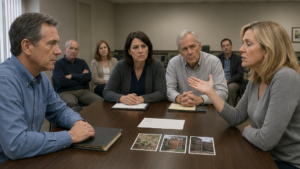
Stephen sat with the original map folded beside his legal pad. Rebecca sat across from him with the HOA attorney. Jeffrey occupied the end chair as treasurer, though the recall petition already had enough signatures to force a vote. Susan had been invited to represent the rear-lot residents.
Nicholas Davis was not present. The county had verified the record. What happened next belonged to the people who lived with it.
Stephen looked at the mediator. “I want the conditions enforced.”
“That describes a tool,” she said. “Not an outcome.”
Rebecca exhaled through her nose. “The outcome he wants is authority over every vehicle entering the rear section.”
Stephen turned toward her. “You offered me my permit back if I gave you permanent unrestricted access.”
“I offered certainty.”
“You offered silence.”
The mediator lifted one hand before the exchange could harden.
“Let’s begin with what is not disputed. The connector crosses Mr. Miller’s parcel. Residential and emergency passage is protected. The Association has maintenance obligations it did not separately fund. The parking action was taken despite prior legal concern.”
Rebecca’s attorney nodded reluctantly.
“The disagreement,” the mediator continued, “is how to preserve access without erasing ownership or exposing residents to another unilateral closure.”
Susan opened a folder. “The rear homes need twenty-four-hour access. Not just emergencies. People work nights. Children get picked up. My father’s care schedule changes.”
Stephen nodded. “Resident access stays open.”
“And deliveries?”
“Ordinary household deliveries stay open.”
Rebecca leaned forward. “Then what exactly are you restricting?”
“Commercial contractors using the road for Association projects. Heavy vehicles. Event traffic. Anything that adds wear beyond normal residential use unless maintenance is funded.”
“That is an administrative burden,” Rebecca said.
“So was revoking my permit.”
The mediator let the silence sit.
Jeffrey slid a maintenance estimate toward the center. The figures covered drainage repair, shoulder stabilization, resurfacing, and striping for the emergency corridor. The total was not ruinous, but it was far beyond the remaining reserve.
“This requires a temporary assessment,” he said. “There is no other honest way to pay for it.”
Susan scanned the page. “How much per house?”
Jeffrey told her.
She closed her eyes for a moment. “That will hurt people.”
“Yes.”
Rebecca tapped the estimate. “This is exactly what I was trying to avoid.”
“No,” Jeffrey said. His voice was quieter than hers, but it did not bend. “You were trying to avoid telling them.”
Rebecca turned to him. “And you signed every budget.”
“I did.”
The admission shifted something at the table. Jeffrey did not separate himself from the failure or ask to be treated as the brave one because he had finally spoken.
“I should not remain treasurer after the audit,” he said. “But the numbers do not change because I resign.”
Rebecca looked down at her copy of the proposal.
The mediator asked whether she would step aside before the recall vote.
“No.”
Susan stared at her. “After all this?”
“I was elected,” Rebecca said. “If the members want me removed, they can remove me through the process they agreed to.”
Stephen had expected denial or bargaining. Her refusal was stubborn, but it was not cowardly.
“And the audit?” the mediator asked.
Rebecca’s jaw tightened. “I will not obstruct it.”
“The records release?”
“Subject to privacy requirements.”
“The revised easement?”
She looked at Stephen. “I will sign if the Association attorney approves the final language and the membership votes for the assessment.”
It was not an apology. It was more useful than one.
The mediator turned to Stephen. “And you?”
He unfolded the map.
His father’s pencil note lay along the boundary, faint but legible.
KEEP THE BACK HOMES CONNECTED.
For years Stephen had read the words as evidence of how much his father had given away. He remembered him returning from board meetings with unsigned promises and vague assurances that the association would handle the shoulder next season. Stephen had watched weeds grow through the cracks and invoices gather in drawers. At the hospital, with his father’s voice reduced to breath, Stephen had promised that nobody would take another inch.
He had treated the promise as a boundary marker.
Now he saw the road his father had intended to protect.
“My father granted this because the rear lots would have been isolated without it,” Stephen said. “He did not grant the Association the right to use my land against me. But he did not mean for me to trap families either.”
He turned the map so Susan could see it.
“The opening clause should preserve continuous resident and emergency access. Not as a favor. As a recorded right.”
Susan studied his father’s note, then nodded.
“Commercial traffic contributes by schedule or fee,” Stephen continued. “The Association pays the ongoing maintenance share. Any future restriction affecting my parcel requires written cause, notice, and equal application. No anonymous enforcement memo.”
Rebecca said, “That last phrase does not belong in an easement.”
“Then put it in the enforcement resolution passed at the same meeting.”
The attorney made a note.
They worked through the afternoon. Every solution carried a cost. Wider turning clearance required removing part of Stephen’s hedge. The emergency corridor would occupy more of his frontage than he preferred. Snow removal needed a fixed contribution formula. Heavy delivery access required advance notice but could not be withheld unreasonably.
By four, the mediator read the final summary aloud.
Residents retained uninterrupted passage. Emergency and medical access remained absolute. Household deliveries were included. Commercial and Association traffic would be subject to maintenance contributions and reasonable scheduling. Stephen’s ordinary curb-parking permit would be restored under neutral rules. An independent audit would review past transfers. The board would face a recall vote. The temporary assessment would fund repairs rather than hide them inside another loan.
Rebecca signed the mediation summary first.
Her pen paused above the page, then moved without flourish.
Stephen signed beneath her.
Outside, they stood beside the connector while the mediator’s assistant photographed the temporary lane. Stephen measured the hedge section that would have to come out.
Susan joined him near the planter.
“My father asked why the road was blocked,” she said.
“What did you tell him?”
“That two people were arguing about who had the right to protect the neighborhood.”
Stephen looked toward Rebecca, who was speaking with the attorney beside her SUV.
“And what did he say?”
“He said anyone who has to tell you they’re protecting you is probably leaving something out.”
Stephen smiled despite himself.
Susan touched the edge of the folded map. “Your father wrote that?”
“Yes.”
“He sounds less interested in property lines than you are.”
“He was too trusting.”
“Maybe.”
Stephen folded the paper carefully. “Maybe I was too interested in proving he was wrong.”
The revised agreement went to the county for recording that evening. The access terms were settled between the parties, but they could not take effect fully without the membership approving the assessment and related board resolutions.
For the first time, the future of the road did not depend on what Stephen could stop or what Rebecca could conceal.
It depended on whether the residents would vote to pay for the responsibilities they had inherited.
Chapter 8: The Same Map on a Different Table
The first maintenance crew arrived at seven on a Monday morning and stopped at the open connector to check the new access diagram.
Stephen stood beside his truck while the foreman compared the pavement markings with the recorded map mounted beneath clear acrylic near the gate.
The concrete planters were gone.
In their place, a painted emergency lane ran along the stabilized shoulder. Fresh stakes marked the drainage work. One section of Stephen’s hedge had been removed to widen the turn, leaving a raw strip of earth beside his lawn.
The membership had approved the assessment by eleven votes.
Not everyone had forgiven the cost.
A rear-lot resident drove past without returning Stephen’s wave. Another slowed long enough to say the new charge should have come from the board alone. Stephen did not argue. The audit had shown poor judgment, concealed transfers, and years of deferred maintenance, but no stolen fortune waiting to make everyone whole.
The money had been spent on things many residents had once demanded.
The recall vote removed Rebecca as president. Two other board members resigned. Jeffrey stepped down as treasurer after presenting the final records and answering every question put to him.
Rebecca remained in the neighborhood.
Stephen saw her that morning walking past the gate with an envelope from the management office tucked under her arm. She owed the same temporary assessment as everyone else.
She stopped near the new sign.
RECORDED RESIDENT AND EMERGENCY ACCESS
COMMERCIAL USE SUBJECT TO MAINTENANCE AGREEMENT
Her eyes moved to Stephen’s truck, parked legally along the curb with a standard permit decal on the windshield.
“They restored it,” she said.
“They applied the rule.”
Rebecca looked toward the workers cutting the damaged asphalt.
“The lender approved revised terms after the audit,” she said. “Higher rate.”
“I heard.”
“The assessment could have been smaller if we had refinanced earlier.”
“It could have been larger if the road failed first.”
She gave him a tired look. “You always need the last word?”
“No.”
That surprised both of them.
A maintenance truck approached. Rebecca stepped aside, and Stephen guided it through the widened turn. The driver followed the painted line without crossing the grass.
When Stephen returned, Rebecca was still standing near the map.
“I believed the entrance was the first thing people judged,” she said.
“It probably is.”
“And you still think I was wrong.”
“I think you started treating people like parts of the entrance.”
She accepted that without defending herself.
“I am not going to apologize for trying to keep the Association solvent,” she said.
“I didn’t ask you to.”
“For the meeting, though.” Her gaze shifted toward the work truck. “I should not have done that.”
Stephen waited. The apology was incomplete and awkward, but it had not been demanded by a crowd.
“I should not have closed the whole road,” he said.
Rebecca nodded once and continued toward her house.
By noon, the crew had removed the crumbling shoulder and exposed the failed drainage channel beneath it. The defect was worse than the surface suggested. Water had been moving under the pavement for years.
Stephen watched the workers rebuild the base.
Susan drove through with her father in the passenger seat. He lifted two fingers from the window in greeting. The home-health nurse followed several minutes later without stopping at the clubhouse.
There was no ceremony.
No one thanked Stephen for forcing the issue. No one thanked Rebecca for finally signing. Residents complained about noise, dust, assessment installments, and the temporary detour around the paving equipment.
The road functioned anyway.
That evening, Stephen carried the original map into his kitchen. He flattened it on the table beside the restored parking notice and the recorded agreement.
His father’s pencil note had faded further along one crease.
Keep the back homes connected.
Stephen ran one finger beneath the words, then folded the map along its old lines. He returned it to the brown deed folder and placed the folder in the bottom drawer.
Before closing it, he looked through the front window.
At the gate, the recorded copy remained visible beneath the clear cover. Parcel line, emergency corridor, resident rights, maintenance obligations—nothing hidden in a private drawer or dependent on one person’s memory.
Stephen shut the drawer.
Outside, his work truck stood beside the open road, neither one mistaken for something the neighborhood could use without respect.
The story has ended.